edwina@edwin-pump.com

View All Products
en
Reliable access to water is essential for agriculture, livestock production, rural communities, construction sites, household water systems, and many off-grid applications. In locations where grid electricity is unavailable, unstable, or expensive to operate, solar pumping provides an efficient way to move groundwater from a borehole to a storage tank, irrigation network, or distribution system. The 4EW solar submersible borehole pump is designed for this purpose, combining a compact borehole-compatible structure with brushless permanent-magnet motor technology, AC/DC compatibility, intelligent electronic control, stainless steel construction, and multiple protection functions.
Unlike a conventional pump that depends entirely on a fixed utility supply, this model is designed to work with variable renewable power. Its broad voltage range allows it to be integrated into solar photovoltaic systems while also supporting AC operation in suitable applications. This flexibility makes the pump useful for agricultural irrigation, remote water supply, rainwater and groundwater systems, livestock watering, small-scale municipal projects, and other applications where dependable pumping must be achieved with limited infrastructure.
The pump is identified as model 4EW0.55-4/54. It has a rated power of 0.55 kW, equivalent to 0.75 HP, a maximum flow rate of 4 m3/h, a maximum head of 54 m, a 1.25-inch outlet, and a 4-inch pump diameter. These specifications provide a practical balance between energy consumption, lifting capability, and borehole compatibility. The 4-inch diameter is especially important because it allows the pump to fit many standard small and medium borehole casings.
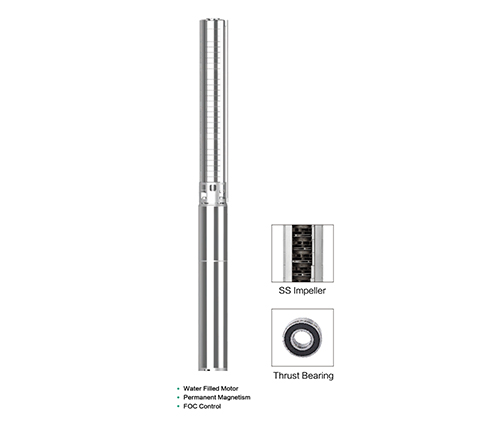
4EW Solar submersible borehole pump
The 4EW solar submersible borehole pump is a deep-well pumping solution intended to operate below the water surface. A submersible configuration places the pump close to the water source, allowing it to push water upward through a delivery pipe instead of relying on atmospheric pressure to draw water from a distance. This arrangement is well suited to boreholes because it reduces suction limitations and supports the lifting of water from considerable underground depths.
The pump combines a submersible hydraulic section with a water-filled, double-shielded permanent-magnet brushless motor. This motor design is intended to provide dependable operation while reducing the maintenance requirements normally associated with brushed motors. Because the motor does not use conventional mechanical brushes for electrical commutation, there are fewer wear components inside the motor’s electrical operating system.
The unit also includes an internal intelligent controller with field-oriented control, commonly abbreviated as FOC. This control method manages motor operation electronically and is intended to provide smoother and more controlled performance. It can help the motor respond to changes in available power and operating conditions, which is particularly valuable when the pump is supplied by solar panels whose output varies with sunlight intensity, weather, and time of day.
The pump body and motor body are manufactured from SS304 stainless steel. Stainless steel construction supports corrosion resistance and provides a robust exterior for installation in wet environments. The product information also specifies laser welding for component assembly. Laser welding is an advanced manufacturing process that can produce precise, concentrated welds and help create consistent joints when correctly controlled during production.
| Item | Specification |
|---|---|
| Model | 4EW0.55-4/54 |
| Rated power | 0.55 kW |
| Rated motor output | 0.75 HP |
| Maximum flow rate | 4 m3/h |
| Maximum head | 54 m |
| Outlet size | 1.25 inches |
| Pump diameter | 4 inches |
| Listed voltage range | DC 90–360 V; AC 90–240 V, 50/60 Hz |
| Motor type | Permanent-magnet brushless motor |
| Pump and motor body | SS304 stainless steel |
| Control system | Internal intelligent controller with FOC function |
The supplied product data also describes the operating voltage in the feature section as 60–360 VDC or 90–240 VAC at 50/60 Hz, while the specification table lists DC 90–360 V. For project design and final selection, the purchaser should confirm the applicable voltage range, controller configuration, solar array requirements, and installation conditions with the manufacturer or authorized technical representative before ordering.
One of the most important advantages of the 4EW pump is its ability to support both DC and AC power input. Solar pumping systems commonly produce variable direct current, while many sites also have access to alternating current from a utility network, generator, or other power source. A pump designed for a single input type may require additional conversion equipment or a separate replacement pump when the power source changes.
The 4EW design addresses this challenge through AC/DC convertibility. The listed electrical range is DC 90–360 V and AC 90–240 V at either 50 or 60 Hz. This gives system designers more freedom when selecting photovoltaic modules, controllers, backup supplies, and installation configurations. It can also simplify the transition between solar operation and conventional electrical operation where both sources are available.
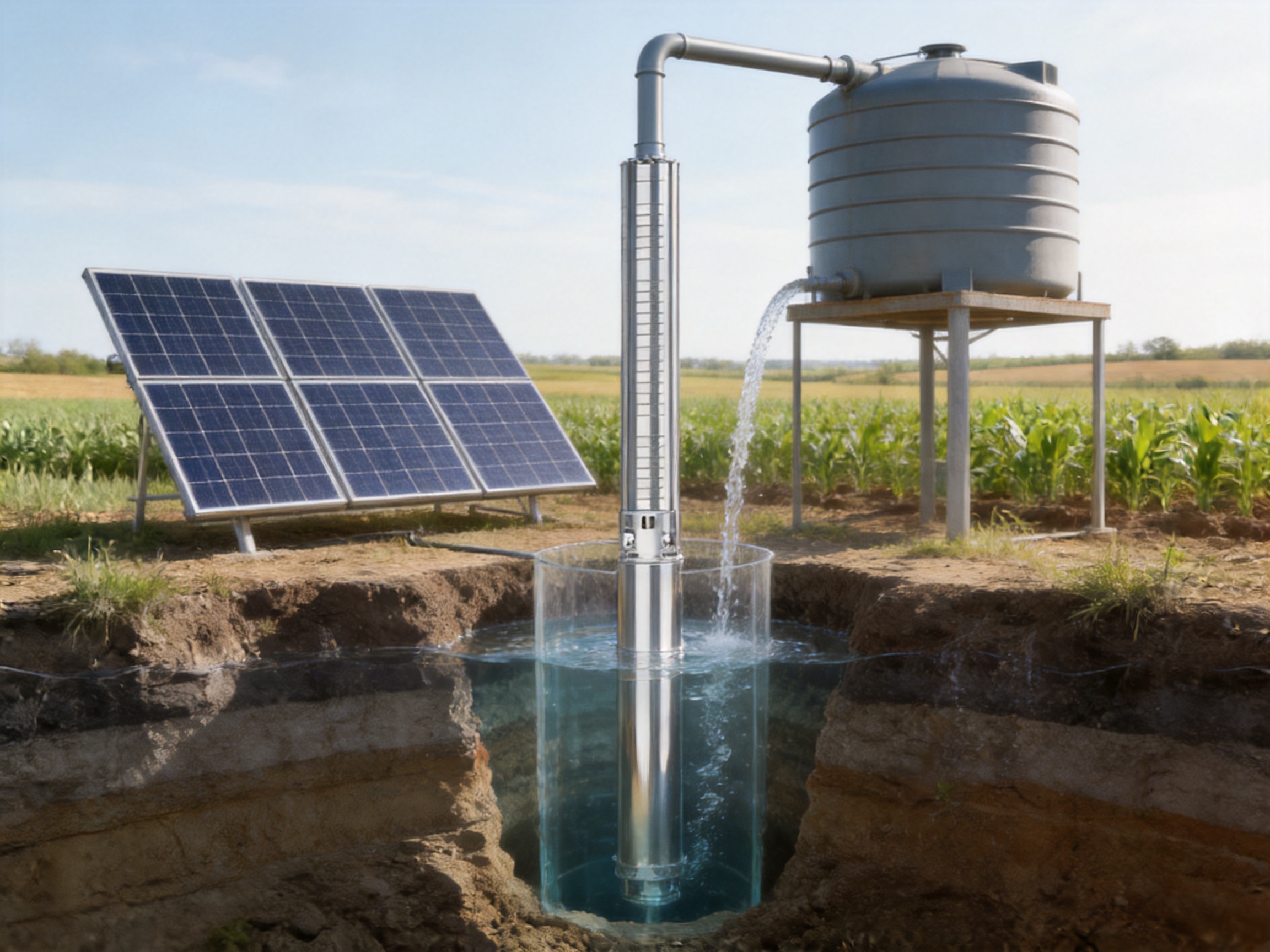
In a solar-only installation, the pump can be connected to an appropriately designed photovoltaic power system. The exact solar array voltage, current, power reserve, wiring, protection equipment, and control arrangements must be selected according to local solar conditions and the pump’s actual electrical requirements. The pump’s broad voltage capability provides design flexibility, but it does not remove the need for correct system sizing.
In a hybrid installation, the pump can operate from solar power during daylight hours and use an AC source when solar energy is insufficient. Such a configuration may be useful for farms, commercial properties, and remote facilities that require water availability beyond the solar production period. The ability to use multiple power sources can reduce dependence on a single energy supply and improve operational continuity.
A wide operating range can be beneficial when solar radiation changes throughout the day. Early in the morning, during periods of cloud cover, or late in the afternoon, the photovoltaic system may deliver less energy than it produces at midday. An intelligent motor controller can regulate the motor more effectively than a basic fixed-speed arrangement, allowing the system to respond to changes in available electrical power.
This does not mean that the pump will always operate at its maximum flow rate under weak sunlight. Pump output depends on available power, water level, pipework, total dynamic head, and system resistance. However, a flexible electrical design and intelligent control system can make better use of available energy than a system that is limited to one fixed input condition.
Compared with a conventional AC-only borehole pump, the 4EW model can be more suitable for sites where solar power is the primary energy source. Compared with a basic DC pump designed for a narrow voltage range, its AC/DC capability may simplify procurement and provide more choices for system integration.
The pump uses a permanent-magnet brushless motor. In a brushed motor, electrical brushes and a commutator are used to transfer current and change the direction of the magnetic field. These components are subject to mechanical contact and gradual wear. A brushless motor uses electronic switching and permanent magnets to produce rotation without conventional motor brushes.
The brushless configuration is valuable in a submersible pump because the motor is installed in a demanding environment. It is surrounded by water, exposed to continuous operating loads, and often expected to function for extended periods without frequent service access. Removing brush wear from the motor design can reduce one potential maintenance concern and support longer service intervals when the pump is correctly installed and operated.
Permanent-magnet motor technology can also offer a high power density in a compact package. This is important for a 4-inch borehole pump, where the available installation space is restricted by the casing diameter. A compact motor can provide the required pumping power without making the complete pump assembly too large for standard borehole applications.
The product description identifies the motor as water-filled and double-shielded. A water-filled motor design can support internal cooling and lubrication arrangements suitable for submersible operation. The double-shielded structure is intended to protect the motor’s internal components while allowing the motor to function below the water level.
Electronic commutation allows the motor controller to manage the sequence and timing of electrical power supplied to the motor windings. When combined with field-oriented control, this can support smoother torque production and more controlled motor behavior. Smooth operation is useful in solar pumping because available energy can change rapidly and the motor must respond without unnecessary mechanical shock.
The product information also emphasizes soft-start operation. Instead of applying full starting stress immediately, the controller gradually accelerates the motor. This can reduce starting impact on the motor, pump stages, electrical cables, and power source. It may also help prevent sudden voltage drops in a solar system, where the available power reserve can be limited.
Soft starting is particularly helpful in remote installations. A pump located deep inside a borehole may be difficult and expensive to remove for service. Reducing unnecessary starting stress can contribute to stable operation and may help extend the service life of connected components.
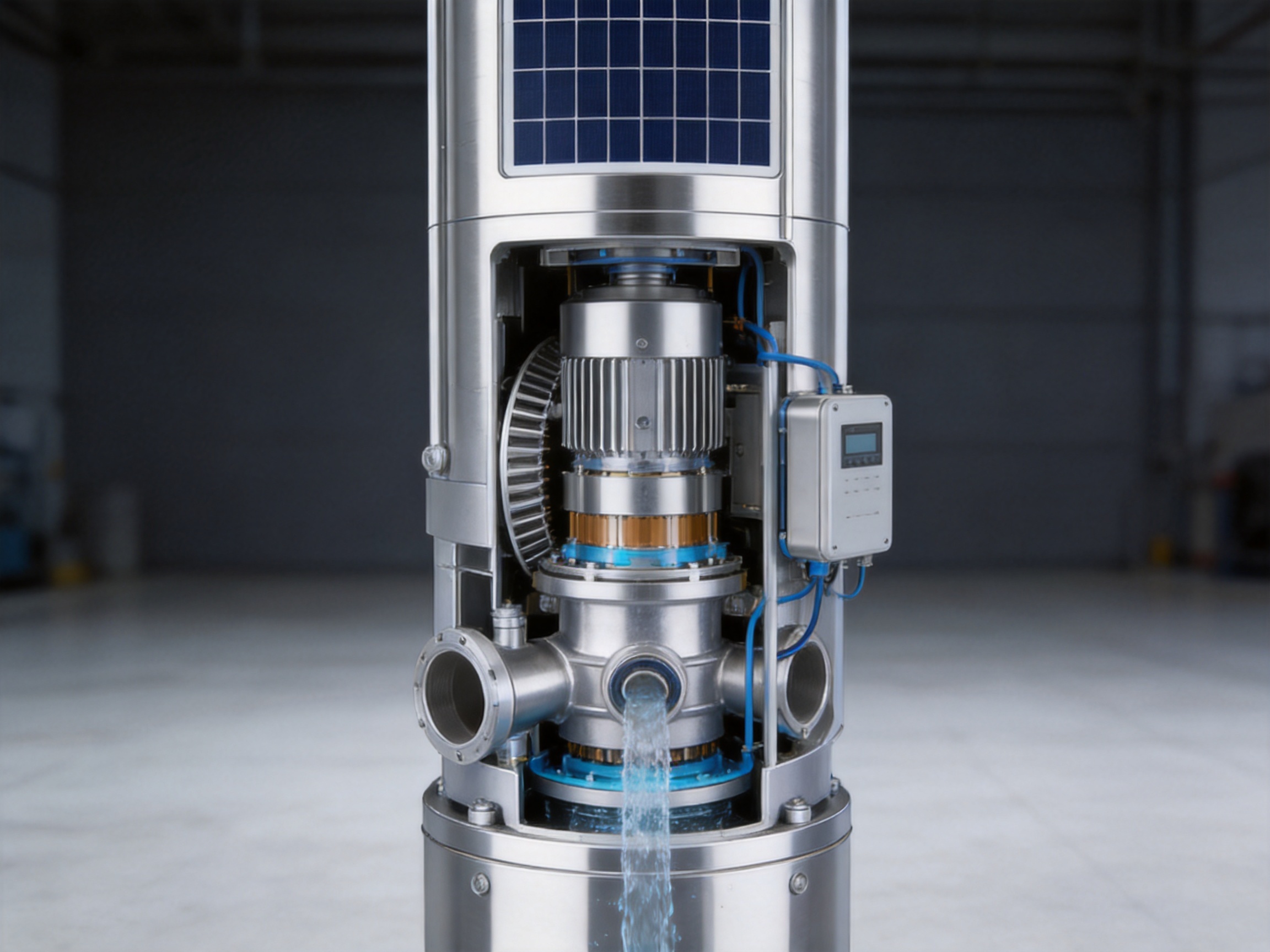
The internal intelligent controller is one of the product’s most significant differences from a basic submersible pump. It is specified with FOC functionality, which is a control technique used to regulate the magnetic field and torque of an electric motor. In practical terms, FOC can help the controller manage motor speed and torque more accurately than a simple on-and-off control method.
For a solar pump, intelligent control is important because the power source is not constant. A conventional pump may stop repeatedly when solar voltage falls below its operating threshold. A more responsive controller can use available power more effectively, although the pump will still be limited by the amount of energy supplied by the solar array and the hydraulic requirements of the system.
The controller is also described as providing multiple protection functions. These include dry-running protection, overload and under-load protection, over-current and under-current protection, over-voltage and under-voltage protection, and phase-loss protection. Such functions help protect the motor and pump from abnormal operating conditions.
Dry running occurs when the pump operates without adequate water surrounding the hydraulic intake. This may happen when the borehole water level drops, when the source is temporarily depleted, or when the pump is installed incorrectly. Without sufficient water, cooling and lubrication conditions can be affected, and the hydraulic components may be exposed to unnecessary stress.
Dry-running protection is especially valuable in solar borehole systems because water levels can vary seasonally and pumping demand may change. The protection function can help stop or limit operation when the controller detects conditions associated with insufficient load or water availability. It remains important to carry out proper borehole testing and to install the pump at a suitable depth.
Overload may occur when the pump is required to work against excessive head, a blocked pipe, a closed valve, or an abnormal hydraulic condition. Over-current can also result from electrical faults or mechanical resistance. Protection against these conditions can reduce the likelihood of motor damage and help prevent prolonged operation outside the intended range.
Protection systems are not a substitute for correct pipe sizing, suitable valves, appropriate cable selection, and professional installation. They are an additional layer of safety that helps the pump respond when unexpected conditions arise.
Under-load and under-current conditions may indicate dry running, insufficient water, a broken coupling, an open or damaged delivery line, or another abnormal operating state. Monitoring these conditions allows the controller to identify operation that may not be hydraulically normal. This is especially useful in unattended solar installations where a site operator may not be present every day.
Solar arrays, batteries, generators, and utility networks can all produce voltage variations. Excessive voltage may damage electronic components, while insufficient voltage may cause unstable operation or repeated starting attempts. Over-voltage and under-voltage protection helps the controller respond to power conditions outside the intended operating range.
Phase-loss protection is relevant when the pump operates from an AC supply. A missing phase or abnormal AC input condition can create an unbalanced motor state and increase electrical stress. The inclusion of phase-loss protection provides an additional safeguard for installations that use AC operation or hybrid power arrangements.
The pump body and motor body use SS304 stainless steel. This material is widely used in water-handling equipment because it offers a combination of corrosion resistance, strength, clean appearance, and suitability for wet operating environments. In a borehole pump, the external body is continuously exposed to water and must withstand installation, operation, retrieval, and contact with the surrounding environment.
SS304 construction can be particularly useful in applications where the water quality is not highly aggressive and where a durable metal body is preferred over a lower-cost material. It can also support applications requiring a clean and professional pump surface, including domestic water supply, agricultural systems, and commercial installations.
Material selection must always be matched to the actual water chemistry. Water containing high concentrations of chlorides, acids, abrasive particles, or other aggressive substances may require a different material assessment. The stainless steel specification is an important strength of the product, but project engineers should evaluate water quality before final selection.
The product information states that an advanced laser welding machine is used to weld components. Laser welding concentrates energy into a small area, which can help achieve accurate joints with limited heat-affected zones when the process is properly controlled. This may support consistent assembly, clean weld profiles, and reduced distortion compared with less precise joining methods.
In a submersible pump, manufacturing precision affects alignment, sealing, hydraulic performance, vibration, and service life. The motor and hydraulic components must operate concentrically within a compact housing. Small deviations can increase friction, noise, or mechanical stress. Consistent welding and assembly procedures help maintain the dimensional stability of the pump body.
Advanced welding equipment is only one part of manufacturing quality. Reliable production also depends on material inspection, component control, assembly procedures, electrical testing, sealing checks, performance verification, and final inspection. The manufacturer’s integrated approach to research, production, and export supports the coordination of these activities within one supply chain.
The pump is equipped with imported bearings, including water-lubricated bearings and thrust bearings. Bearings are critical components in a submersible motor because they support rotating parts, maintain alignment, and manage radial or axial forces created during operation.
Water-lubricated bearings are designed to operate with water serving as the lubricating medium. This is suitable for a water-filled submersible motor, where the internal environment differs from that of a conventional air-cooled motor. The use of water-compatible bearing arrangements can help maintain smooth rotation while avoiding reliance on oil-based lubrication inside the water-filled motor chamber.
Thrust bearings are important because a vertical borehole pump can experience axial forces as the impellers move water upward. These forces must be managed so that the rotating assembly remains correctly positioned. A suitable thrust-bearing arrangement helps protect the motor and hydraulic components from excessive axial movement.
The stated use of imported bearings reflects an emphasis on component quality and operating reliability. Bearing performance still depends on correct assembly, clean internal conditions, suitable water quality, proper alignment, and operation within the specified hydraulic range.
The rotor is described as being covered with stainless steel shielding. This shielding is intended to protect the magnetic material from corrosion and oxidation. Permanent magnets are important to the motor’s operation, so protecting them from the surrounding water-filled environment is essential.
The shielding iron core is also described as supporting heat dissipation. Motor heat must be transferred away from the electrical and magnetic components during operation. In a submersible pump, heat transfer is closely related to the surrounding water, motor filling medium, casing design, and pumping conditions. A properly designed heat dissipation path can help maintain stable motor temperature.
Temperature management is particularly important in solar pumping systems because the pump may operate for long periods during peak daylight hours. The system may be started and stopped repeatedly as solar conditions change, so both continuous operation and cycling conditions should be considered during system design.
The stainless steel shield provides a physical barrier around the rotor while contributing to the structural integrity of the motor assembly. This combination of corrosion protection and heat-transfer support is an important design advantage over less protected motor arrangements.
The 4-inch pump diameter allows the product to be used in boreholes with a compatible internal diameter. Compact sizing is one of the most practical advantages of a borehole pump because installation space is determined by the casing. A pump that is too large cannot be installed, while an unnecessarily small pump may not provide the required hydraulic capacity.
The 1.25-inch outlet provides a defined connection point for the rising main or delivery pipe. Pipe selection should consider the required flow rate, total lifting height, horizontal distance, friction losses, water quality, installation depth, and expected operating pressure. A properly sized pipe helps the pump work efficiently and reduces unnecessary system resistance.
Installation is described as easy, but professional installation remains important. The installer should confirm the borehole diameter, static and dynamic water levels, pump setting depth, cable length, pipe strength, suspension method, check-valve arrangement, electrical protection, and grounding requirements. The pump should not rest directly on the bottom of the borehole, where sediment could enter the intake or restrict cooling water movement.
The pump should be lowered and removed using suitable support equipment. The electrical cable and delivery pipe must be secured so that the weight of the assembly does not place excessive stress on the motor cable connection. Cable joints should be waterproof and appropriate for submersible service.
Before installation, the borehole should be evaluated for yield, water quality, depth, casing condition, and sediment content. The pump’s maximum flow rate is 4 m3/h, but the actual operating flow will depend on the system curve. Selecting a pump solely by maximum flow or maximum head can result in an unsuitable installation if the required duty point is not properly calculated.
The total dynamic head includes the vertical lift from the water level to the discharge point, pressure requirements at the outlet, friction losses in pipes and fittings, and any additional elevation differences. If the system requires water storage, the pump may be controlled by a tank float switch, level sensor, or suitable external automation system.
Solar array sizing should account for local sunlight availability, seasonal conditions, expected pumping hours, cable losses, controller requirements, and the desired daily water volume. A system designed only for ideal midday conditions may not provide adequate water during cloudy weather or winter months.
Agricultural irrigation is one of the most suitable applications for a solar submersible borehole pump. Farms may be located far from utility infrastructure, and extending a grid connection can be expensive. Solar power can provide daytime energy for pumping without the fuel consumption associated with a diesel generator.
The 4EW model can be used to transfer groundwater into storage tanks, irrigation reservoirs, drip irrigation systems, or small sprinkler networks, subject to the required flow and head. Its maximum flow rate of 4 m3/h is suitable for small and medium water-demand applications when the irrigation system is correctly designed.
Solar pumping can also align naturally with irrigation schedules. Many crops require water during daylight hours, when solar energy is available. Water can be pumped directly to the fields or stored for use later. A storage tank can act as an energy buffer, allowing the pump to operate when sunlight is available while irrigation continues according to the farm’s watering schedule.
The pump’s dry-running and electrical protection functions are useful for agricultural sites that may not have a dedicated technician nearby. Remote farms benefit from equipment that can respond to abnormal conditions and reduce the risk of damage caused by empty boreholes, unstable voltage, or excessive load.
Remote homes, villages, field stations, and livestock facilities often need a dependable water source without access to a stable electricity grid. A solar borehole pump can provide an autonomous water supply using local groundwater and photovoltaic energy.
The AC/DC capability provides additional flexibility. A remote system may begin as a solar-only installation and later add a generator or AC backup supply. Conversely, an existing AC installation may be expanded with solar generation to reduce operating costs or improve resilience.
The brushless motor and soft-start function are also valuable in locations where maintenance access is limited. Reduced brush wear and controlled starting can support a lower-maintenance operating model. The intelligent protection functions can help prevent damage when the system is unattended for extended periods.
For domestic water supply, the pump may feed an elevated tank, pressure vessel, or small distribution network. A separate booster system may be required if the borehole pump does not provide the final pressure needed by household fixtures. The pump should be selected according to both water volume and pressure requirements.
Commercial sites may use the 4EW model for groundwater transfer, landscape irrigation, construction water, equipment washing, or auxiliary water systems. The stainless steel body, compact format, and flexible power input make it suitable for projects where equipment must fit within a defined borehole and operate reliably under changing power conditions.
Construction sites can use solar pumping where temporary power infrastructure is limited. Water may be required for dust suppression, material preparation, cleaning, or worker facilities. The pump’s compact design can support temporary or semi-permanent installations, although the borehole, pipework, and electrical system must still be engineered for the site conditions.
In commercial landscaping, the pump can supply storage tanks or irrigation zones. The intelligent controller can be integrated into a broader water-management strategy that includes timers, level sensors, valves, and monitoring equipment.
For engineering companies and distributors, AC/DC compatibility can simplify product positioning across several markets. The same pump family can be considered for solar projects, conventional electrical projects, and hybrid systems, subject to local technical requirements and application conditions.
Taizhou Edwin Electric Co., Ltd., operating under the Edwin Pump name, was founded in 2008. The company is described as an integrated manufacturing enterprise with capabilities in independent research and development, mass production, and global export. This integrated structure is important for buyers who require more than a single pump unit and need consistent product supply, technical coordination, and export support.
The company’s core product lines include deep well pumps, submersible pumps, domestic booster pumps, and circulation pumps. It has also expanded into solar water pumps and intelligent booster pumps since 2018, reflecting a focus on new energy and intelligent pumping technology.
Independent research and development can help a manufacturer adapt product designs to changing market requirements. Solar pumping requires attention to electrical control, motor design, photovoltaic compatibility, protection functions, and system integration. Experience across several pump categories can also support the development of related products and application solutions.
Mass production capability is valuable for wholesalers, project contractors, agricultural equipment suppliers, and international distributors. Stable production capacity can help support repeat orders, standardized specifications, and coordinated delivery schedules. Buyers should still request the applicable quality documentation, inspection procedures, production lead time, and warranty terms for each project.
The company has established related import and export organizations to support procurement planning, order tracking, cross-border delivery, and foreign trade services. This one-stop service structure may be useful for international purchasers who need assistance coordinating product selection, manufacturing, documentation, shipping, and after-sales communication.
The manufacturing strengths described for this product include the use of SS304 pump and motor bodies, laser welding, imported bearings, water-lubricated bearing arrangements, shielded magnetic rotors, and intelligent controller integration. Together, these elements demonstrate attention to material selection, mechanical construction, motor protection, and electronic control.
A quality-oriented production process should begin with controlled raw materials and verified component specifications. Stainless steel sheets, motor parts, bearings, magnets, seals, cables, controllers, and hydraulic components must be checked before assembly. Consistent incoming inspection reduces the risk that variations in materials will affect the finished pump.
During production, welding quality, motor assembly, bearing installation, rotor shielding, electrical connections, and sealing must be carefully managed. Each stage influences the final performance of a submersible unit. Because the pump operates underwater, sealing and insulation quality are particularly important.
Final testing may include electrical insulation checks, running tests, current verification, vibration assessment, leakage inspection, control-function checks, and hydraulic performance evaluation. The specific tests applied should be confirmed with the supplier for the relevant order. For larger projects, buyers may request inspection reports, sample testing, or third-party verification.
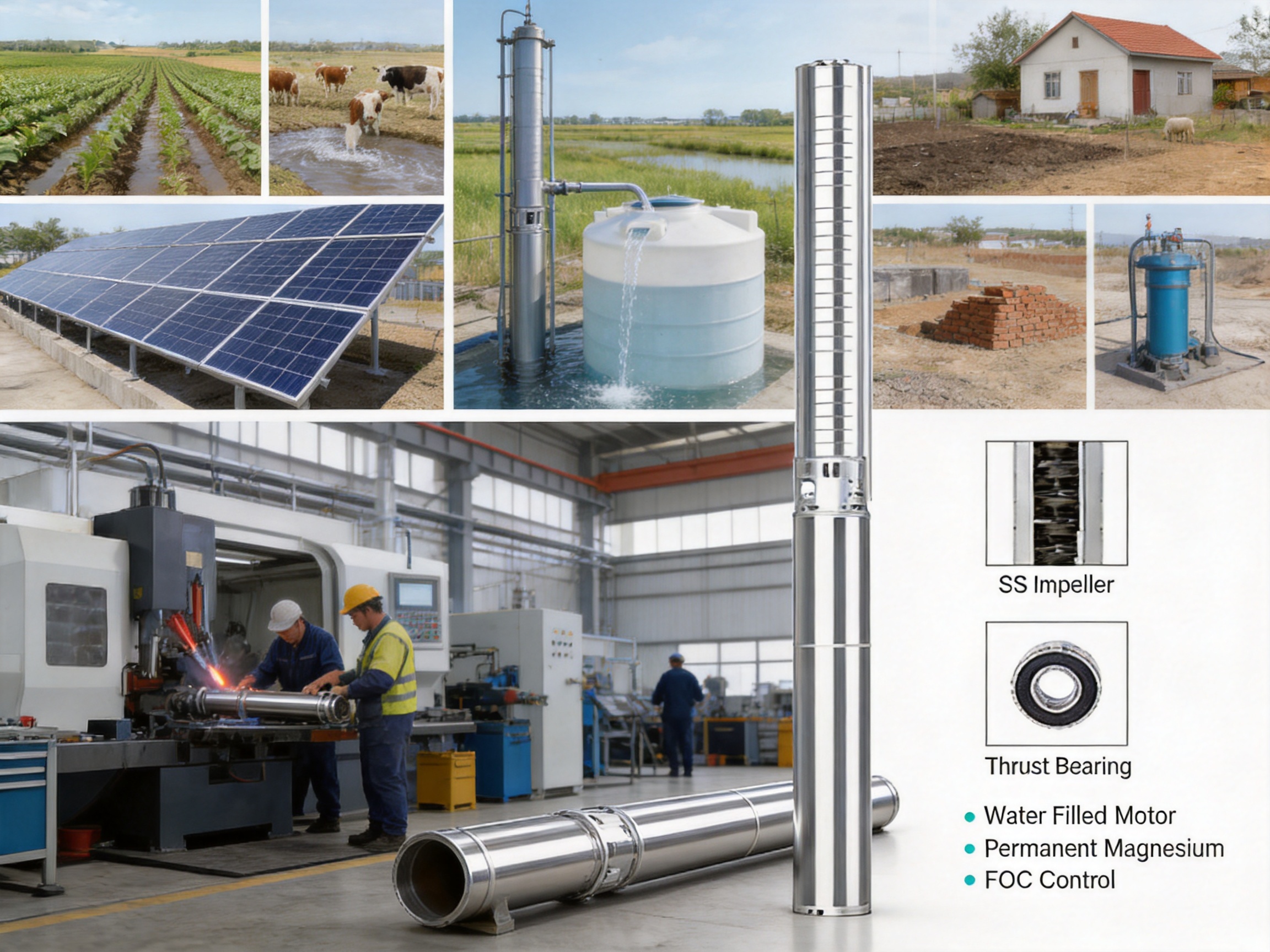
The 4EW solar submersible borehole pump offers several design characteristics that distinguish it from a basic conventional pump. The most important difference is its combination of solar suitability, AC/DC flexibility, brushless permanent-magnet motor technology, intelligent FOC control, and built-in protection functions.
| Design Aspect | 4EW Solar Submersible Borehole Pump | Basic Conventional Alternative |
|---|---|---|
| Power compatibility | Supports listed DC and AC voltage ranges | May be designed for one fixed power type |
| Motor technology | Permanent-magnet brushless motor | May use brushed or conventional motor construction |
| Control method | Internal intelligent controller with FOC function | May rely on simpler fixed-speed or on/off control |
| Starting behavior | Soft-start operation | May apply higher starting stress |
| Protection functions | Dry-run, overload, under-load, current, voltage, and phase-loss protection | Protection may require external equipment |
| Body material | SS304 stainless steel pump and motor body | Material depends on model and supplier |
| Rotor protection | Stainless steel shielding for the magnetic rotor | Protection depends on the motor design |
| Installation diameter | 4 inches | Varies by product |
This comparison does not mean that every conventional pump has the same limitations. Pump performance depends on the specific model, manufacturer, and system design. However, the 4EW product combines multiple features that are particularly relevant to renewable-energy pumping and remote operation.
A key competitive advantage is the integration of functions that might otherwise require additional equipment. A conventional AC pump used in a solar system may need an external inverter, separate motor protection, and additional control hardware. The 4EW’s AC/DC design and internal controller can reduce system complexity in suitable applications, although the complete installation may still require disconnects, fuses, surge protection, grounding, sensors, and other components.
To achieve dependable performance, the pump should be operated within its specified hydraulic and electrical conditions. The maximum flow rate and maximum head are reference limits, not necessarily the operating point that provides the best performance in every installation. The actual duty point should be determined from the pump curve and the system curve.
The water source should provide sufficient yield. If the borehole cannot replenish water as quickly as the pump removes it, the water level may fall and activate dry-running protection. In such cases, reducing the operating period, adding storage, lowering the pump setting, or selecting a different pumping capacity may be necessary.
Pipework should be sized to limit excessive friction losses. Small or excessively long pipes can increase resistance and reduce delivered flow. Unnecessary bends, restrictive valves, and undersized filters can also increase the total dynamic head. A well-designed delivery system allows the pump to convert more of its available energy into useful water delivery.
Solar array design should consider the difference between rated panel power and actual field output. Temperature, shading, dust, orientation, inclination, cable length, and seasonal sunlight all influence performance. The array should provide an appropriate voltage and power range for the pump controller without exceeding permitted limits.
Routine maintenance may include checking the electrical connections, inspecting the delivery line, reviewing controller status, monitoring water level, cleaning filters, and checking for abnormal noise or vibration. Because the pump is submersible, preventing problems through correct installation and monitoring is generally easier than removing the pump after a failure.
Before purchasing the 4EW model, buyers should confirm the required water volume per day, desired instantaneous flow, total dynamic head, borehole diameter, borehole yield, water quality, available power source, cable length, discharge pipe size, and operating schedule.
The borehole should be at least compatible with the 4-inch pump diameter, while allowing adequate clearance for installation and water movement. The static water level and lowest expected dynamic water level should be measured. The pump should be positioned so that it remains submerged during normal operation but does not sit in accumulated sediment.
Electrical designers should verify the appropriate DC or AC voltage, maximum current, cable cross-section, voltage drop, disconnect devices, circuit protection, grounding, surge protection, and control interface. For photovoltaic systems, the panel arrangement should be checked against the controller’s permitted voltage range under both normal operating and open-circuit conditions.
Purchasers should also confirm whether the supplied unit includes all required controller components, cables, sensors, mounting accessories, check valves, and documentation. Product configuration can vary according to market and project requirements, so a detailed commercial and technical confirmation is recommended before order placement.
The 4EW is a solar-compatible submersible borehole pump designed for installation below the water surface in a compatible borehole. It uses a permanent-magnet brushless motor and an internal intelligent controller.
The listed rated power is 0.55 kW, equivalent to 0.75 HP.
The maximum listed flow rate is 4 m3/h. Actual flow depends on total head, pipe friction, water level, power availability, and the operating point shown on the applicable pump curve.
The listed maximum head is 54 m. The actual usable head will depend on the required discharge pressure, vertical lift, pipework, fittings, and system resistance.
Yes. The product information identifies AC/DC convertibility, with the specification table listing DC 90–360 V and AC 90–240 V at 50/60 Hz. The feature description also references a 60–360 VDC range. The exact applicable limits should be confirmed for the ordered configuration before installation.
FOC, or field-oriented control, is an electronic motor-control method. It manages motor torque and magnetic-field behavior to support smoother and more controlled operation, particularly when the available solar power changes.
Yes. Dry-running protection is listed among the integrated protection functions. Proper borehole testing and water-level monitoring are still required because protection cannot replace correct installation.
The pump body and motor body are specified as SS304 stainless steel. The rotor is also described as being covered with stainless steel shielding to help protect the magnetic material from corrosion and oxidation.
The product information specifies imported bearings, including water-lubricated bearings and thrust bearings. These components support the rotating assembly and help manage the forces associated with submersible operation.
Yes. It can be considered for agricultural irrigation, water storage, livestock watering, and other farm applications when the required flow, head, borehole yield, and solar power capacity match the pump’s capabilities.
It may supply a household water system through a storage tank, pressure vessel, or suitable distribution arrangement. If higher final pressure is required at household fixtures, a separate booster system may be necessary.
Soft start gradually accelerates the motor instead of applying full starting stress immediately. This can reduce mechanical and electrical impact, which is particularly helpful in solar systems with limited starting power.
Users should check borehole diameter, water level, borehole yield, water quality, total dynamic head, pipe size, cable length, electrical voltage, solar array configuration, grounding, and protection equipment. Installation should be performed by qualified personnel.
The 4EW provides AC/DC compatibility, intelligent FOC control, brushless permanent-magnet motor technology, soft start, and multiple built-in protection functions. These features can make it more suitable for solar and hybrid installations than a pump designed only for fixed AC operation.
International buyers should request the applicable pump curve, electrical data, installation manual, wiring information, controller details, warranty terms, inspection documentation, packaging information, lead time, and confirmation of the exact voltage range for the ordered model.
The 4EW solar submersible borehole pump is designed to provide a flexible and intelligent solution for groundwater pumping in locations where solar energy, conventional AC power, or both may be available. Its 0.55 kW motor, 4 m3/h maximum flow rate, 54 m maximum head, 4-inch diameter, and 1.25-inch outlet make it a practical option for many small and medium borehole applications.
Its main advantages include AC/DC convertibility, a permanent-magnet brushless motor, water-filled double-shielded construction, internal FOC control, soft-start operation, stainless steel pump and motor bodies, laser-welded components, imported bearings, shielded rotor technology, and a broad range of protective functions. These characteristics address many of the challenges associated with remote solar pumping, including variable power, limited maintenance access, dry-running risk, voltage fluctuation, and installation constraints.
The manufacturer’s experience in research and development, mass production, stainless steel pump construction, solar water pumps, intelligent pumping technology, and international export provides a foundation for supplying both individual products and larger project orders. Its related procurement and foreign-trade service organizations further support global customers requiring order coordination and cross-border delivery.
For the best results, the pump should be selected as part of a complete water system rather than as an isolated component. Proper assessment of borehole yield, total dynamic head, pipework, solar resource, voltage range, water chemistry, and control requirements is essential. When correctly matched and installed, the 4EW can provide a durable, low-maintenance, and adaptable pumping solution for agriculture, rural water supply, commercial sites, and renewable-energy water projects.
1. Product specification and feature information for the 4EW solar submersible borehole pump, supplied by the manufacturer.
2. General principles of submersible pump selection, borehole hydraulics, and total dynamic head calculation.
3. General engineering references on permanent-magnet brushless motors and field-oriented motor control.
4. General technical references on photovoltaic water-pumping system design and solar array sizing.
5. General materials references concerning SS304 stainless steel in water-handling equipment.
6. General maintenance and installation practices for submersible borehole pumps and renewable-energy pumping systems.
edwina@edwin-pump.com
+86-13586290903 (WhatsApp)
Xuri Gongliang Cutting Tool Entrepreneurship Park, Wenqiao Town, Wenling City, Taizhou City, Zhejiang Province, China

High Performance Smart Pump Factory


 English