
edwina@edwin-pump.com

View All Products
en
Solar water pumping has become one of the most practical technologies for agriculture, rural water supply, livestock watering, construction sites, and remote infrastructure. As solar modules become more affordable and motor-control electronics become more intelligent, users no longer need to choose between sustainability and performance. A modern solar submersible borehole pump can deliver reliable water from deep wells while reducing dependence on diesel generators, unstable grid power, and high operating costs.
The 4EW solar submersible borehole pump is designed for this new generation of water supply systems. It combines a permanent magnet brushless motor, an intelligent internal controller, AC/DC convertible operation, stainless-steel construction, laser-welded components, water-lubricated bearings, and comprehensive protection functions. These features make it suitable for demanding environments where efficiency, durability, and installation flexibility are critical.
Unlike older deep well pumps that often depend on fixed AC power and external control cabinets, the 4EW solar submersible borehole pump is engineered for flexible power conditions. It can operate with DC solar input or AC utility power, supporting DC 90–360 V and AC 90–240 V at 50/60 Hz. This hybrid capability helps users maintain water supply even when sunlight changes or when backup grid power is available. For farms, rural homes, irrigation projects, and off-grid water systems, this flexibility offers a major practical advantage.
4EW Solar submersible borehole pump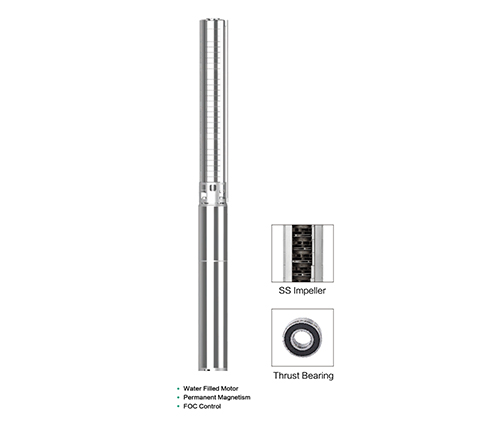
The 4EW solar submersible borehole pump is a 4-inch deep well solar pump designed for borehole water extraction. Its compact diameter allows it to fit standard narrow wells, while its stainless-steel structure provides corrosion resistance and mechanical strength. The model 4EW0.55-4/54 offers 0.55 kW power, equivalent to 0.75 HP, with a maximum flow rate of 4 m³/h and a maximum head of 54 m. It is equipped with a 1.25-inch outlet and is designed for practical installation in agricultural, domestic, and remote water supply systems.
The pump is not merely a conventional submersible pump connected to a solar panel. Its core design is built around solar compatibility, variable power conditions, and intelligent electronic control. The permanent magnet brushless motor improves energy conversion efficiency, while the internal controller with FOC function supports smooth operation and optimized motor control. These features allow the pump to perform effectively when solar irradiance changes throughout the day.
In real-world operation, solar pumping systems experience constant power variation. Morning sunlight is weak, midday sunlight is strong, and clouds can suddenly reduce solar output. A pump without intelligent control may stop frequently, run inefficiently, or suffer premature component stress. The 4EW pump addresses this challenge with soft start operation, smart protection, and stable motor-control logic. This helps improve service life and makes the system easier to use in remote locations.
Model |
Voltage |
Power |
Power |
Maximum Flow Rate |
Maximum Head |
Outlet Size |
Diameter |
4EW0.55-4/54 |
DC 90–360 V; AC 90–240 V, 50/60 Hz |
0.55 kW |
0.75 HP |
4 m³/h |
54 m |
1.25 inches |
4 inches |
One of the most important advantages of the 4EW pump is its ability to work with both DC and AC power. The working range of DC 90–360 V makes it suitable for photovoltaic power supply, while AC 90–240 V compatibility allows the pump to operate from grid power or other AC sources. This dual-power capability is especially valuable in areas where solar energy is abundant but grid electricity may still be available as a backup.
Many traditional submersible pumps require a fixed AC power supply and cannot be directly connected to solar arrays without an additional inverter or drive system. That adds cost, complexity, and more potential points of failure. In contrast, the 4EW solar submersible borehole pump is designed to reduce system complexity by supporting both power types. For installers, this means simpler system planning. For users, it means fewer interruptions in water supply.
Compared with entry-level solar pumps that operate only on low-voltage DC power, the wide voltage range of the 4EW model gives it broader application potential. It can be used in small solar systems, off-grid farms, rural households, and hybrid water supply systems. This flexibility makes the pump more adaptable than many single-mode competitors.
The pump uses a permanent magnet brushless motor, an important technology in modern solar pumping. Brushless motors reduce friction and electrical loss because they do not rely on carbon brushes for commutation. This improves motor efficiency, reduces maintenance needs, and extends service life. In solar applications, every watt of energy matters, and a more efficient motor can translate into higher water output from the same photovoltaic array.
Traditional induction motors are robust but often less efficient under variable power conditions. Solar energy is naturally variable, so a motor designed for efficient low-load and variable-speed operation has a clear advantage. Permanent magnet brushless technology allows the 4EW pump to convert available electrical energy into hydraulic output more effectively.
For customers comparing pump systems, this advantage can reduce the number of solar panels needed for a given water requirement. It can also improve daily water yield during lower sunlight periods. In agricultural irrigation, livestock water supply, and remote household water systems, higher efficiency helps reduce total project cost over the equipment’s lifetime.
The built-in intelligent controller is another major product strength. It includes FOC, or field-oriented control, which enables precise control of motor torque and speed. FOC technology is widely used in high-performance motor systems because it improves efficiency, smoothness, and responsiveness. In a solar pump, this helps maintain stable operation as input power changes.
Some competing solar pump systems rely on external controllers that must be installed separately, wired correctly, protected from weather, and matched to the pump. External controller systems can work well, but they increase installation complexity and may introduce compatibility issues. The 4EW design integrates intelligent control into the pump system, improving compactness and ease of use.
The controller also supports multiple protection functions. These include dry running protection, overload and under-load protection, over-current and under-current protection, over-voltage and under-voltage protection, and phase-lack protection. These safeguards are essential for deep well pumping, where the pump is hidden underground and difficult to inspect visually. Intelligent protection reduces the risk of damage and lowers the maintenance burden.
The 4EW solar submersible borehole pump uses SS304 stainless steel for the pump body and motor body. Stainless steel provides excellent resistance to corrosion, rust, and wear in water environments. Borehole pumps may operate for long periods under water, and material quality directly affects service life. SS304 is a widely trusted material for water pump applications because it offers a strong balance of corrosion resistance, strength, and cost effectiveness.
Compared with pumps that use low-grade metals or plastic-heavy structures, stainless-steel construction offers better durability in demanding installations. For customers who rely on continuous water supply, material strength is not only a technical detail; it is a financial and operational concern. A more durable pump reduces replacement frequency and helps avoid downtime during irrigation seasons or community water demand peaks.
Stainless-steel construction also supports cleaner water handling. For domestic and agricultural water systems, corrosion resistance helps protect water quality and reduces contamination risks from rusted components. This is especially important in rural household systems, livestock watering, and drinking water supply projects.
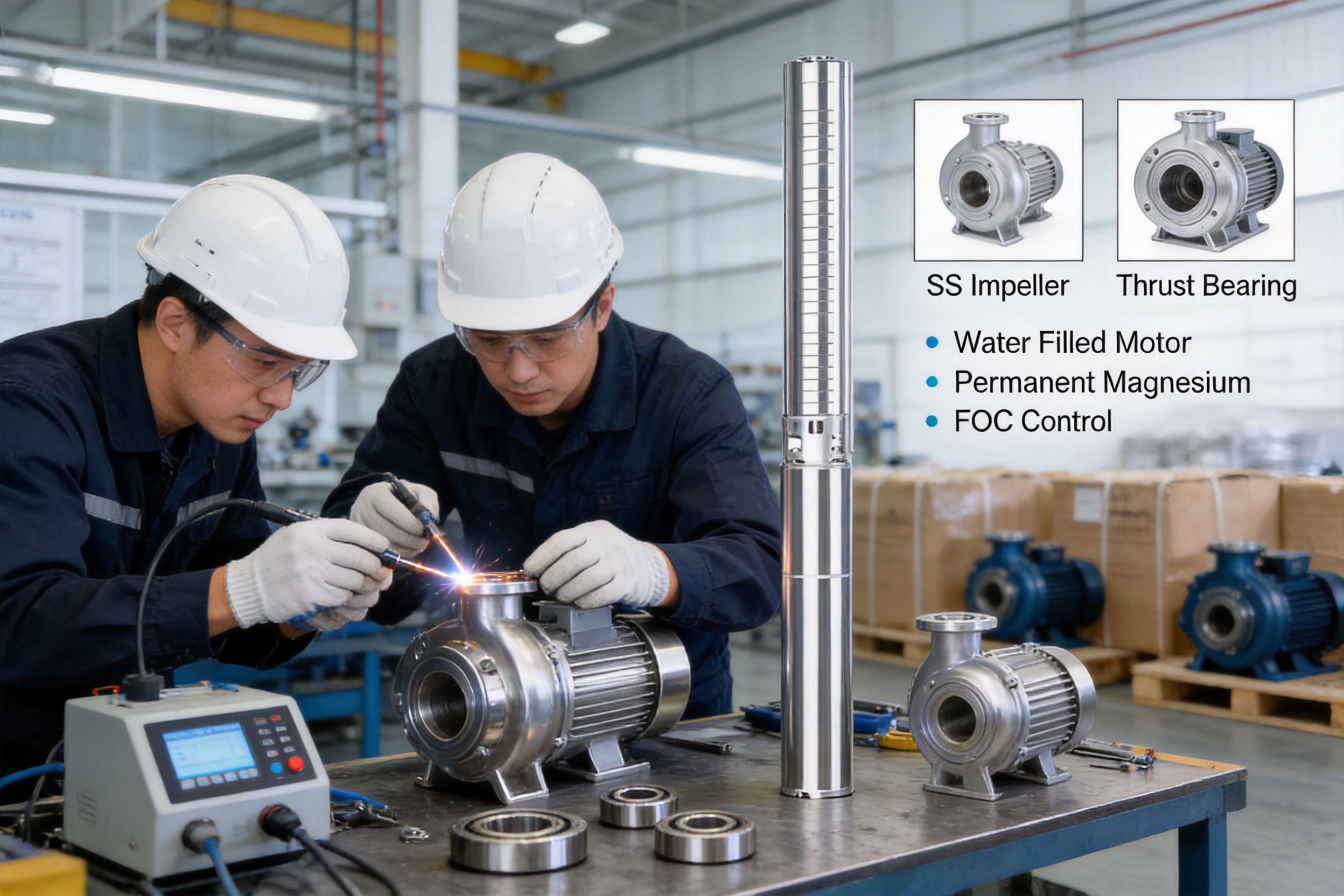
Manufacturing quality is one of the key factors that separate dependable pump products from low-cost alternatives. The 4EW pump benefits from advanced laser welding technology used in production. Laser welding allows components to be joined with precision, consistency, and high structural integrity. It can create clean, narrow, and strong welds with reduced thermal distortion compared with many conventional welding methods.
For a submersible pump, welding quality affects sealing reliability, body strength, and long-term durability. Poor welds can lead to leakage, corrosion points, or mechanical weakness. By using advanced laser welding machinery, the manufacturer improves the consistency of pump assembly and helps ensure that stainless-steel components are securely joined.
This manufacturing advantage matters especially for international customers who need predictable quality across bulk orders. A pump may look similar from the outside, but internal manufacturing processes determine whether it will perform reliably after months or years underwater. Laser welding supports repeatability, quality control, and long-term confidence.
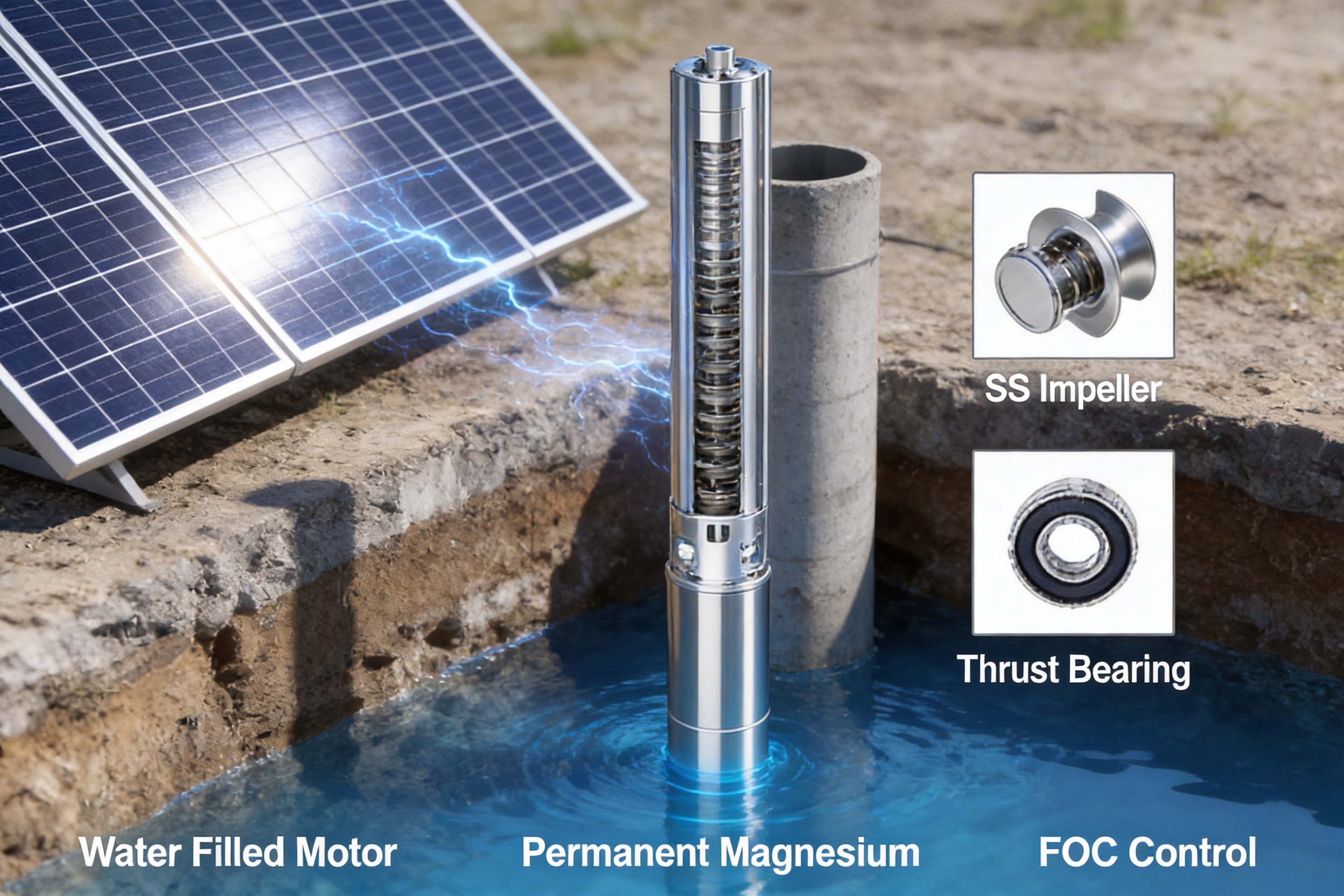
The pump is equipped with imported bearings, water-lubricated bearings, and thrust bearings. Bearings are critical components in any rotating machine. In a submersible pump, they must support continuous operation under water while resisting wear, vibration, and axial load. High-quality bearing selection contributes directly to pump reliability and noise reduction.
Water-lubricated bearings are suitable for submersible applications because the surrounding water assists lubrication and cooling. This design reduces the need for oil-based lubrication systems and supports clean operation. Thrust bearings help manage axial forces generated by the impellers during pumping, improving stability and extending service life.
Compared with low-cost pumps that may use inferior bearing materials, the 4EW pump’s bearing system provides a stronger foundation for continuous duty. This is especially important in irrigation and rural water supply, where pumps may run for long hours during sunny periods.
The 4EW pump uses a shielding rotor covered with stainless material. This design helps prevent magnetic steel from corrosion and oxidation. In permanent magnet motors, the condition of magnetic components is essential for maintaining motor efficiency and torque. If magnets corrode, motor performance may decline and failure risk increases. The shielding structure protects these critical components from water-related damage.
The shielding iron core also benefits the heat dissipation system. Heat management is vital in electric motors, particularly in submersible solar pumps that may operate under changing load and voltage conditions. Effective heat dissipation helps maintain stable performance and protects motor insulation and electronic components.
This design demonstrates that the pump is engineered as a complete system, not only as a set of separate parts. Motor protection, thermal management, bearing performance, and hydraulic efficiency all work together to determine real-world reliability.
Soft start operation reduces mechanical and electrical stress during startup. When a conventional pump starts suddenly, it may experience high inrush current, strong torque impact, pressure shock, and mechanical strain. Over time, repeated hard starts can shorten the life of the motor, bearings, impellers, and connected pipes.
The 4EW pump’s soft start operation allows smoother acceleration. This is especially useful in solar systems, where starting may occur under variable sunlight. Soft start also reduces stress on solar power electronics and helps avoid sudden voltage drops. In piping systems, smoother startup can reduce water hammer and protect valves, joints, and fittings.
For users, soft start technology is an invisible but valuable feature. It may not attract as much attention as flow rate or head, but it contributes significantly to long-term reliability. It also helps the pump operate quietly and steadily, making it suitable for farms, homes, and community water systems.
The pump is designed to work quietly, which improves user comfort and reduces disturbance in household or community environments. Submersible pumps are naturally quieter than surface pumps because they operate underwater, but motor design and bearing quality still affect vibration and noise. The permanent magnet brushless motor, water-lubricated bearings, and stable controller all contribute to quieter operation.
Easy installation is another important advantage. Solar water systems are often installed in remote locations where technical support may be limited. A pump that supports broad voltage input, integrated intelligent control, and standard borehole dimensions simplifies the installation process. The 4-inch diameter allows use in many borehole applications, while the 1.25-inch outlet provides practical water discharge compatibility.
Reduced installation complexity can lower labor cost and minimize the risk of wiring or configuration errors. For dealers, contractors, and project managers, this makes the pump easier to specify and deploy across multiple sites.
The solar pump market includes international premium manufacturers, regional agricultural pump suppliers, and many cost-driven producers. Leading companies in the sector have advanced solar pump performance through high-efficiency motors, MPPT control, remote monitoring, hybrid power capability, stainless-steel hydraulics, and intelligent protection. However, users often need to balance performance, cost, serviceability, and long-term reliability.
The 4EW solar submersible borehole pump competes strongly because it combines several essential technologies in one practical product. It does not rely only on one advantage, such as low price or stainless-steel appearance. Instead, it integrates efficient motor technology, intelligent control, hybrid power input, stainless-steel body construction, laser welding, protective functions, and deep well suitability.
Traditional AC deep well pumps are common, but they usually require stable grid power or a generator. In remote agricultural and rural areas, grid electricity may be unavailable, unstable, or expensive. Diesel generators add fuel cost, maintenance, noise, and emissions. A conventional AC pump can be connected to solar power only with additional inverter equipment, which increases system complexity.
The 4EW pump has an advantage because it is designed for both DC solar input and AC input. Users can operate it directly in solar-powered systems and still retain AC backup capability. This makes it more suitable for modern off-grid and hybrid water systems than a standard AC-only pump.
Basic DC solar pumps may be affordable and simple, but many lack advanced protection functions, wide voltage compatibility, durable stainless-steel construction, or high-quality motor control. Some are suitable only for shallow water or light-duty applications. When used in deeper wells or demanding conditions, they may suffer from unstable operation or shorter service life.
The 4EW pump improves on basic DC designs by offering a robust 4-inch submersible structure, 54 m maximum head, intelligent internal control, FOC technology, soft start, and multiple protection mechanisms. These features make it more suitable for users who need dependable water supply rather than a low-cost temporary solution.
Premium international solar pump systems from leading manufacturers may offer advanced digital monitoring, high hydraulic efficiency, and strong global service networks. However, they can also be expensive, especially for small and medium-sized agricultural users. In many markets, the challenge is not simply finding the most advanced system, but finding a reliable system that delivers high value.
The 4EW solar submersible borehole pump is positioned as a practical high-performance solution with strong manufacturing quality and essential intelligent features. Its AC/DC convertible design, stainless-steel body, FOC controller, and comprehensive protection functions give it many of the capabilities users expect from modern solar pumps, while its manufacturing base supports competitive supply and flexible procurement.
The market also includes low-cost suppliers whose products may look similar but vary greatly in material quality, controller reliability, bearing selection, welding precision, and after-sales support. The biggest risk with unverified low-cost pumps is hidden quality inconsistency. A product that works during initial testing may fail after months of operation due to poor sealing, weak bearings, low-quality electronics, or insufficient protection logic.
The 4EW pump is supported by an integrated manufacturing enterprise with experience in R&D, mass production, and export. The use of SS304 stainless steel, advanced laser welding, imported bearings, and intelligent controllers reflects a more systematic quality approach. For buyers who need stable supply, consistent batches, and long-term cooperation, manufacturing strength can be as important as technical specifications.
A solar submersible borehole pump must be designed for difficult operating conditions. Once installed deep in a well, maintenance is inconvenient. Pulling a pump from a borehole requires labor, time, and sometimes specialized equipment. Therefore, manufacturing quality has a direct impact on total ownership cost.
The manufacturer behind the 4EW pump was founded in 2008 and has developed as an integrated production enterprise specializing in independent research and development, mass production, and global export. Its main product lines include deep well pumps, submersible pumps, domestic booster pumps, and circulation pumps. This broad product base gives the company practical hydraulic design experience and production knowledge across multiple water pump categories.
Since 2018, the company has invested in new energy and intelligent pump technology, including solar water pumps and intelligent booster pumps. This development direction matches the global trend toward renewable energy, smart controls, and more efficient water systems. Rather than treating solar pumps as a small side product, the company has expanded its portfolio to address growing demand for clean-energy pumping solutions.
Research and development capability is essential for modern pump manufacturing. Solar pumping requires the integration of hydraulics, motor engineering, electronic control, materials science, and field application knowledge. A manufacturer with independent R&D can improve product design according to customer feedback, new market requirements, and changing technology standards.
The 4EW pump reflects this integrated design approach. Its permanent magnet brushless motor, internal intelligent controller, FOC function, protective logic, stainless-steel body, and shielding rotor structure all require coordinated engineering. A pump is not reliable simply because one component is advanced; all components must work together under real water, voltage, temperature, and load conditions.
Mass production capability allows the manufacturer to serve distributors, contractors, and project buyers who require consistent products in quantity. For export markets, consistency is critical. Buyers need confidence that the pump delivered in one batch will perform like the pump delivered in the next batch. This depends on standardized production procedures, component selection, inspection systems, and process control.
Advanced manufacturing processes such as laser welding improve repeatability. Stainless-steel welding requires precision, and laser welding helps reduce human error while improving the quality of joints. Combined with selected bearings, controlled assembly, and motor testing, these production capabilities support stable performance in the field.
The company serves global customers and has built professional trade service teams for procurement planning, order tracking, cross-border delivery, and foreign trade support. This matters because pump purchasing is not only a technical decision. International buyers also need reliable communication, documentation, logistics coordination, spare parts planning, and after-sales responsiveness.
To meet diverse purchasing needs, related import and export service entities were established in 2012. This structure supports one-stop procurement for customers who may need different pump categories, accessories, pipes, valves, and water treatment peripheral products. For contractors and distributors, a supplier that can coordinate multiple products reduces purchasing complexity and improves project efficiency.
The manufacturer’s pumps are used in new energy projects, agricultural irrigation, municipal engineering, mining, construction, HVAC systems, and household water supply. This wide application experience supports product development because each industry places different demands on pumps. Agriculture emphasizes water volume, durability, and cost control. Municipal projects require reliability and consistency. Mining and construction demand ruggedness. Household water supply values quiet operation and stable pressure.
The 4EW solar submersible borehole pump benefits from this broader manufacturing background. It is not designed in isolation; it belongs to a product ecosystem that includes deep well pumps, submersible pumps, booster pumps, circulation pumps, surface pumps, garden pumps, commercial multistage pumps, end suction pumps, pump accessories, pipes, and valves. This complete water-system perspective helps improve practical usability.
Water and energy are closely connected. Many regions with strong agricultural potential also face limited grid infrastructure. Diesel pumping is expensive and exposes users to fuel price fluctuations. Solar pumping offers a more stable long-term solution by using local renewable energy. Once installed, a solar pump system can operate with low daily energy cost and reduced maintenance compared with fuel-powered systems.
Submersible borehole pumps are particularly important because groundwater is often the most reliable water source in dry regions. Surface water may be seasonal, polluted, or distant from farms and communities. Boreholes provide access to underground water, but extracting that water requires a pump capable of overcoming vertical head and operating reliably underwater.
The 4EW pump’s 54 m maximum head makes it suitable for many borehole applications where moderate lifting height is required. Its 4 m³/h maximum flow rate can support household water supply, livestock watering, small-scale irrigation, and rural water storage systems. When paired with a suitable solar array and storage tank, the pump can supply water during the day and store it for use at night or during cloudy periods.
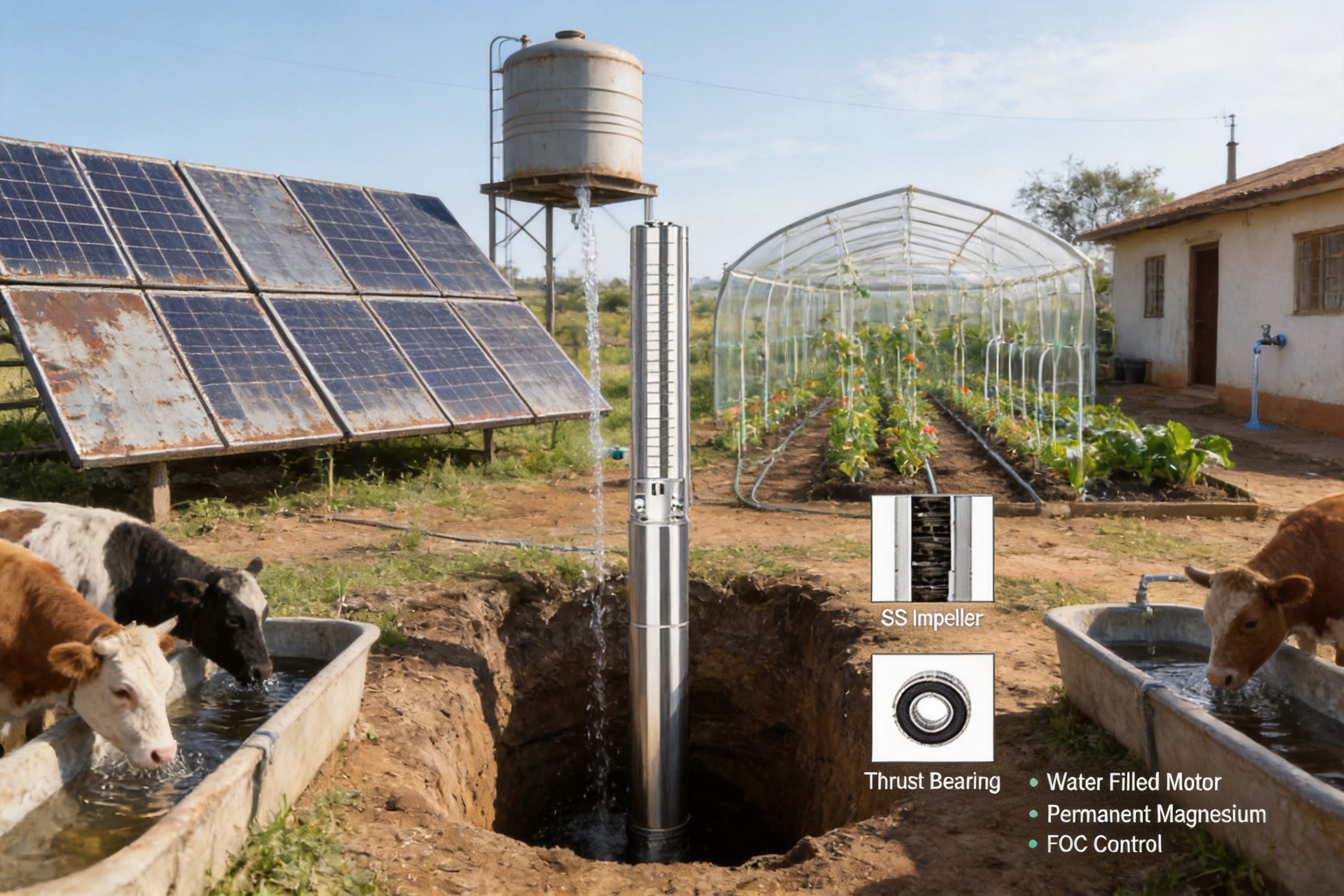
Farmers need water at predictable times, especially during dry seasons. A solar submersible borehole pump can reduce irrigation energy costs and improve independence from unstable power grids. The 4EW pump is suitable for small and medium-sized irrigation systems that require water from boreholes. Its maximum flow of 4 m³/h can support drip irrigation, greenhouse watering, orchard irrigation, and crop water storage tanks depending on site conditions.
The pump’s intelligent protections are especially valuable for agriculture. Water levels may fall during dry periods, increasing dry-run risk. Voltage may vary with sunlight. Pipes and filters may create changing hydraulic loads. The controller’s protection functions help reduce damage risk and improve operational reliability.
Livestock operations often require water in remote fields where grid power is not available. Solar pumping provides a practical method to fill tanks and troughs from boreholes. Quiet operation is also useful around animals, reducing disturbance. The 4EW pump can support reliable water delivery when installed with proper solar panels, piping, float controls, and storage capacity.
Rural homes may rely on boreholes for daily water use. In areas where grid power is unstable, a hybrid AC/DC solar submersible pump provides resilience. During sunny hours, the pump can use solar energy. When necessary, it can also operate from AC power. This improves water security and reduces dependence on one energy source.
Remote schools, clinics, villages, and community water points need reliable pumping systems with low operating cost. The 4EW pump’s stainless-steel construction, intelligent protection, and solar compatibility make it suitable for decentralized water systems. When combined with elevated storage tanks, the pump can provide water during daylight and maintain gravity-fed supply when the pump is not running.
Construction sites may require water for mixing, dust suppression, cleaning, and worker facilities. Where borehole water is available, a solar-capable submersible pump can reduce fuel consumption and simplify site logistics. The AC/DC convertible function allows flexible power arrangements as site conditions change.
Although the pump itself is advanced, system performance depends on correct design. Buyers should consider borehole depth, dynamic water level, required daily water volume, pipe diameter, friction loss, solar irradiation, panel capacity, cable length, and storage tank size. A pump with a 54 m maximum head should be applied within suitable operating conditions, allowing margin for pipe losses and water-level variation.
Solar panel sizing is especially important. If the array is too small, water output will be limited, particularly during cloudy periods or early and late hours. If the array is properly sized, the pump can operate more consistently and deliver better daily yield. The wide DC voltage range gives system designers flexibility in panel configuration, but correct voltage and power matching remain essential.
For critical water supply, a storage tank is usually recommended. Instead of relying on the pump to supply water instantly at all times, the system can pump water during sunny hours into a tank. Stored water can then be used at night or during cloudy periods. This approach often eliminates the need for batteries, reducing system cost and maintenance.
Pipe and valve selection also affects performance. Undersized pipes increase friction loss and reduce delivered flow. Poor-quality valves may leak or create unnecessary resistance. Since the company’s broader product categories include pipes and valves as well as pump accessories, buyers can coordinate a more complete water delivery solution.
Deep well pump failures often occur because of preventable operating conditions. Dry running can damage bearings and hydraulic parts. Overload can overheat the motor. Voltage abnormalities can stress electronic components. Under-load conditions can indicate lack of water or system problems. Phase-lack protection is important for motor safety in relevant operating scenarios.
The 4EW pump includes a broad set of protection functions designed to reduce these risks. Dry running protection helps prevent operation when water is insufficient. Overload and under-load protection detect abnormal mechanical or hydraulic conditions. Over-current and under-current protection help safeguard the electrical system. Over-voltage and under-voltage protection support stable operation under fluctuating power supply. These features are particularly valuable in solar systems, where power conditions are not constant.
Protection features do not eliminate the need for good installation and maintenance, but they provide an important safety layer. In remote applications, automatic protection can prevent minor issues from becoming expensive failures. This helps users avoid downtime and reduces after-sales service pressure for distributors and contractors.
The global solar pump market is shaped by several innovation leaders. Some international companies are known for premium digital water systems, remote monitoring, advanced controllers, and high-efficiency pump engineering. Specialized solar pump manufacturers have advanced MPPT controller technology and remote management. Other companies focus on rugged integrated systems, agricultural affordability, or broad product ranges.
At the same time, Chinese manufacturers have become important contributors to solar pump accessibility. They are advancing rapidly in power electronics, brushless motor production, controller integration, and cost-efficient manufacturing. However, supplier quality varies widely. The most competitive manufacturers are those that combine cost advantages with real engineering, strong materials, production control, and export service capability.
The 4EW solar submersible borehole pump represents this more advanced category. It is built around practical innovation rather than superficial features. Its technology addresses real user problems: variable sunlight, unstable power supply, corrosion, difficult borehole maintenance, motor stress, and installation complexity. Its manufacturing background supports consistent production and global supply.
The pump is designed to extract water from boreholes or deep wells using solar DC power or AC power. It is suitable for agricultural irrigation, rural household water supply, livestock watering, community water projects, and other applications where reliable water pumping is needed.
Yes. The pump can operate with DC solar input in the range of 90–360 V. This allows it to work in off-grid locations when connected to a properly designed photovoltaic system.
Yes. The pump supports AC 90–240 V at 50/60 Hz. This AC/DC convertible design allows users to operate the pump from solar power or AC power, improving flexibility and backup options.
A permanent magnet brushless motor improves efficiency, reduces maintenance needs, and performs better under variable solar power conditions. It has no carbon brushes, which reduces wear and helps extend service life.
The intelligent internal controller helps manage pump operation under changing voltage and sunlight conditions. With FOC function and multiple protection features, it improves smoothness, efficiency, safety, and reliability.
The pump includes dry running protection, overload and under-load protection, over-current and under-current protection, over-voltage and under-voltage protection, and phase-lack protection. These functions help reduce damage risk and extend service life.
SS304 stainless steel offers strong corrosion resistance and durability in underwater environments. It helps protect the pump body and motor body from rust and supports long-term operation in boreholes.
Laser welding improves precision, weld strength, and consistency. For a submersible pump, reliable welding supports sealing quality, structural strength, and long-term durability.
Yes. With a maximum flow rate of 4 m³/h and maximum head of 54 m, it can support many small and medium irrigation systems, especially when paired with proper solar panels, piping, and water storage.
It combines AC/DC operation, a permanent magnet brushless motor, intelligent FOC control, stainless-steel construction, advanced welding, quality bearings, soft start, quiet operation, and multiple protection functions. These features make it more reliable and suitable for long-term use than many basic low-cost alternatives.
The 4EW solar submersible borehole pump is a strong example of how modern water pumping technology is evolving. It combines renewable-energy compatibility with intelligent control, efficient motor design, durable stainless-steel construction, and manufacturing precision. Its AC/DC convertible operation gives users practical flexibility, while its permanent magnet brushless motor and FOC controller improve efficiency and stability under variable solar conditions.
For farmers, rural households, livestock operators, contractors, and community water projects, the pump offers a balanced solution: efficient enough for solar use, strong enough for borehole installation, intelligent enough to protect itself, and practical enough for real-world deployment. Its advantages over conventional AC pumps, basic DC solar pumps, and low-quality alternatives are clear in areas such as power flexibility, protection, material durability, and manufacturing reliability.
Behind the product is a manufacturing enterprise with experience in R&D, mass production, global export, and multiple pump categories. Its investment in new energy and intelligent technology supports the development of solar pumps that are not only affordable but also dependable. In a market where quality varies greatly, the combination of engineering design, advanced manufacturing processes, and export service capability gives the 4EW solar submersible borehole pump a meaningful competitive position.
As solar water pumping continues to expand worldwide, users will increasingly demand systems that are smarter, more efficient, more durable, and easier to install. The 4EW pump meets these expectations by focusing on the fundamentals that matter most: reliable water delivery, energy flexibility, component protection, and long-term value.
1. International Renewable Energy Agency. Solar Pumping for Irrigation: Improving Livelihoods and Sustainability.
2. Food and Agriculture Organization of the United Nations. Solar-Powered Irrigation Systems: Technology, Economy and Impacts.
3. World Bank. Water Supply and Renewable Energy Solutions for Rural Communities.
4. Hydraulic Institute. Pump Application Guidelines for Submersible and Deep Well Pumps.
5. Electric Motor Engineering Handbook. Permanent Magnet Brushless Motor Control and Efficiency Principles.
6. Photovoltaic Water Pumping Design Manual. Solar Array Sizing, Pump Selection, and System Optimization.
aseriesnoisereductiondesignacid-baseverticalsurfacepump-1.jpg "EV(F)A Series Noise Reduction Design Acid-base Vertical Surface Pump")
edwina@edwin-pump.com
+86-13586290903 (WhatsApp)
Xuri Gongliang Cutting Tool Entrepreneurship Park, Wenqiao Town, Wenling City, Taizhou City, Zhejiang Province, China

High Performance Smart Pump Factory


 English