edwina@edwin-pump.com

View All Products
en
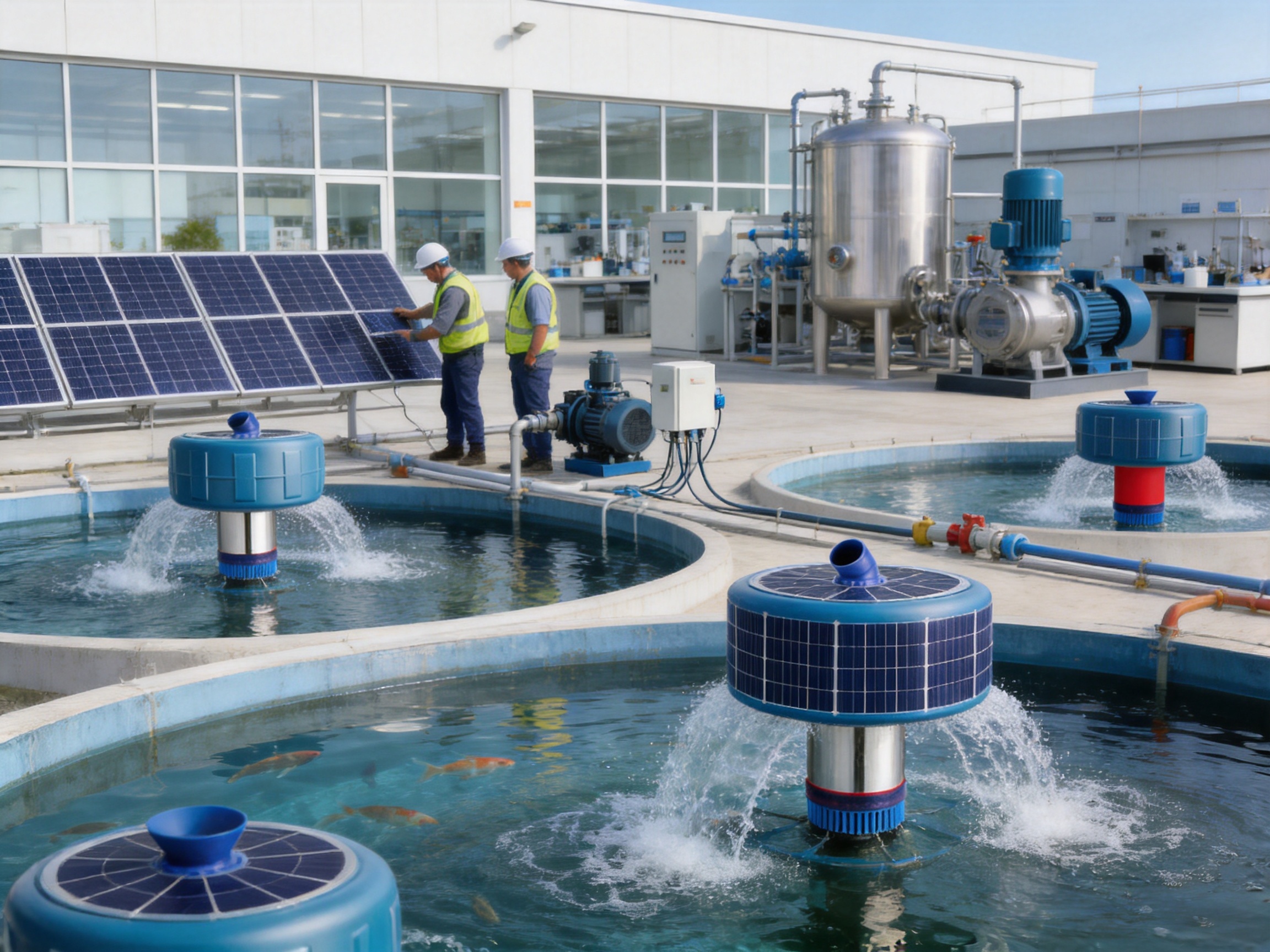
Modern aquaculture depends on stable water quality, reliable circulation, and continuous oxygen availability. Whether the application is a small household pond, a commercial fish farm, or an ecological aquaculture project, dissolved oxygen is one of the most important conditions affecting aquatic life. When oxygen levels fall, fish and other cultured organisms experience stress, feeding efficiency declines, disease risks may increase, and overall production performance can suffer. Aeration is therefore not merely an optional accessory; it is a central part of responsible and productive aquaculture management.
The ADSA Series AC/DC Brushless Motor Solar Aerator is designed to address these challenges through a combination of surface water circulation, solar energy utilization, brushless motor technology, and hybrid AC/DC operation. Instead of relying exclusively on grid electricity or a conventional single-source power system, the aerator can work with solar power and mains electricity. Its power mode automatically responds to available lighting conditions or electrical supply, helping the equipment maintain operation across changing environmental conditions.
This approach gives aquaculture operators a practical way to reduce energy consumption while preserving operational continuity. During periods of adequate sunlight, the solar system can provide the required energy. When sunlight is weak or unavailable, the AC/DC hybrid configuration supports continued operation through an alternative power source. The result is a more flexible aeration solution for applications where water quality must be maintained throughout the day and night.
Water contains dissolved oxygen, but the amount available to fish and other aquatic organisms changes continuously. Temperature, stocking density, feeding activity, organic decomposition, algae growth, weather conditions, and water movement all affect oxygen concentration. Warm water generally holds less oxygen than cool water, while heavily stocked ponds consume oxygen more rapidly. At night, photosynthetic organisms stop producing oxygen, and oxygen levels may decrease further before sunrise.
A reliable aerator helps offset these natural fluctuations. By moving and disturbing the water surface, it promotes gas exchange between the atmosphere and the pond. Oxygen from the air can enter the water more effectively, while gases that accumulate in the water can be released. Surface circulation also helps distribute oxygen more evenly, reducing the risk of stagnant areas where water quality can deteriorate.
The ADSA Series is designed around surface-circulating oxygen technology. Rather than treating aeration as simple mechanical agitation, the equipment creates water movement that supports oxygen transfer and circulation. This is particularly useful in ponds where different areas may otherwise develop varying oxygen concentrations. Better circulation can also help spread temperature and water-quality conditions more evenly throughout the pond.
For fish farms, oxygen management is closely related to production reliability. Fish that experience oxygen stress may become less active, consume less feed, and show slower growth. Severe oxygen depletion can result in rapid losses. A dependable aeration system provides an important layer of protection, especially during high-temperature periods, heavy rainfall, cloudy weather, or unexpected changes in biological demand.
The ADSA Series AC/DC Brushless Motor Solar Aerator combines a brushless motor with a solar energy system and AC/DC hybrid power design. The available performance model, ADSA55-5-300-2200, is rated for AC220/DC300V operation. Its best input voltage range on the DC side is 300V to 400V, and its rated power is 2,200 watts.
Under the stated performance conditions, the unit provides a maximum flow of 55 cubic meters per hour and a maximum head of 5 meters. The outlet size is 4 inches. The recommended solar panel open-circuit voltage is below 450 volts, while the solar panel power should be at least 1.3 times the pump power. These values provide a practical starting point for system planning, although final installation decisions should account for local sunlight, wiring distance, controller configuration, operating conditions, and professional engineering requirements.
| Item | Specification |
| Product series | ADSA Series AC/DC Brushless Motor Solar Aerator |
| Performance model | ADSA55-5-300-2200 |
| Power supply | AC220/DC300V |
| Best DC input voltage | 300V–400V |
| Rated power | 2,200W |
| Maximum flow | 55m³/h |
| Maximum head | 5m |
| Outlet | 4 inches |
| Recommended solar panel open-circuit voltage | Below 450V |
| Recommended solar panel power | At least 1.3 times pump power |
| Motor type | Brushless AC/DC hybrid motor |
The combination of high flow and a 4-inch outlet makes this model suitable for demanding pond environments that require meaningful water movement. The maximum head of 5 meters indicates the equipment can support applications where water must be lifted or circulated through a moderate vertical distance. Actual flow will depend on installation layout, pipe resistance, water conditions, voltage, solar availability, and the operating point of the system.
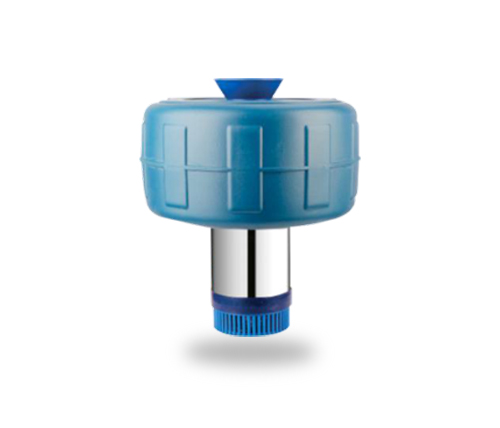
ADSA Series AC/DC Brushless Motor Solar Aerator
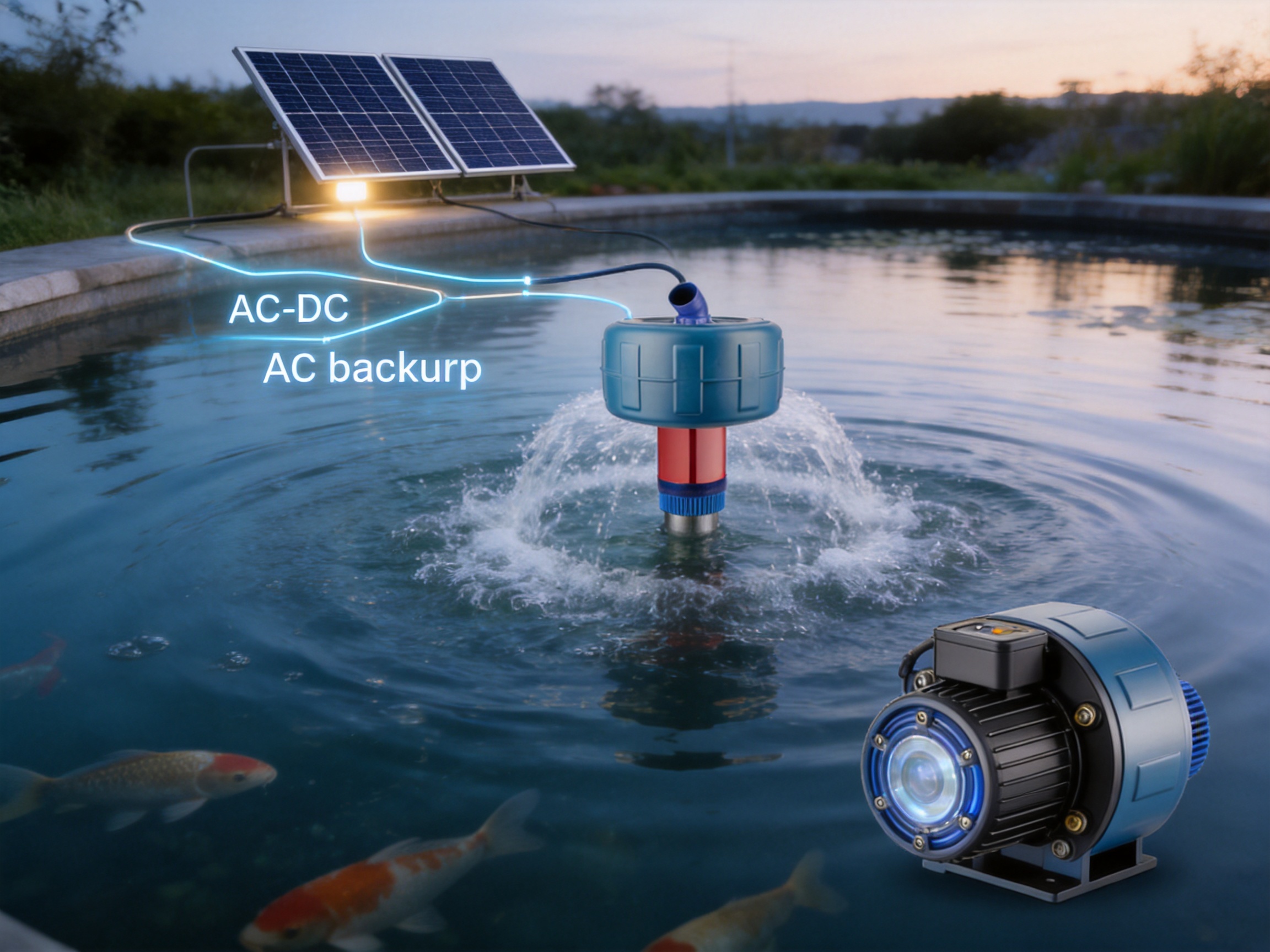
One of the defining features of the ADSA Series is its hybrid power design. Traditional electric aerators generally depend on a stable grid connection, while basic solar aerators may be limited by sunlight availability. A single-source system can become less effective when the environmental or electrical conditions change. The AC/DC configuration is intended to reduce that limitation by allowing the aerator to use solar-generated DC power and AC mains power according to the available supply conditions.
When sunlight is sufficient, the solar panels can provide energy to the system. This allows the aerator to use renewable power during daylight hours and may reduce dependence on conventional electricity. In low-light conditions, during cloudy weather, or when solar energy is not enough to support normal operation, the hybrid system can switch power based on the available conditions or mains supply. This design supports more consistent aeration than a solar-only system that stops whenever solar generation falls below the required level.
Continuous operation is especially important in aquaculture because oxygen demand does not follow a simple business schedule. Fish require oxygen at night, during overcast periods, and during seasonal changes. A system that works only in strong sunshine may leave the pond vulnerable during precisely the periods when oxygen management can be most challenging. The AC/DC hybrid arrangement provides a practical response to this issue.
The design also gives farm owners more flexibility when planning new installations. A pond may be located far from a reliable electrical connection, making solar power attractive. At the same time, operators may want a backup power option to protect stock during extended periods of cloud cover or high oxygen demand. The ADSA Series can support this type of diversified energy strategy.
Compared with a conventional AC-only aerator, the ADSA Series can make use of solar energy and may reduce reliance on grid electricity during suitable daylight conditions. This can be valuable in regions with high solar exposure or where electricity costs are a significant part of operating expenses. It can also support aquaculture projects that prioritize renewable energy and lower direct energy consumption.
Compared with a solar-only aerator, the AC/DC hybrid design offers greater operational continuity. The equipment is not limited to daylight operation when an appropriate mains supply is available. This distinction is important for commercial farms, where a pause in aeration may expose fish stocks to unnecessary risk.
Compared with basic systems that require manual intervention when the energy source changes, the automatic switching approach is more convenient for operators. The equipment is designed to respond to lighting conditions or mains power, reducing the need for constant supervision. Automatic power management can be especially useful for remote ponds, agricultural sites, and installations where staff cannot monitor equipment throughout the day.
The aerator uses a brushless motor rather than a conventional brushed motor. In a brushed motor, mechanical brushes and a commutator transfer electrical current to the rotating part of the motor. These components gradually wear during operation and may generate friction, heat, and maintenance requirements. A brushless motor uses electronic commutation instead, reducing the need for physical brush contact.
Brushless motor technology can offer several practical benefits in a water-management application. Reduced mechanical contact generally supports longer service life, lower wear, and quieter operation. The motor can also work efficiently with electronic control systems that manage changing power input from solar panels or AC supplies. This compatibility is particularly important for a hybrid aerator, because the available electrical conditions can vary throughout the day.
The brushless design is also aligned with the product’s energy-saving objective. When combined with a solar power system, efficient motor operation can help make better use of the energy generated by the panels. Every improvement in electrical efficiency can contribute to a more practical solar installation, especially where panel area, sunlight duration, or project budget is limited.
Longer component life has value beyond reducing replacement frequency. In aquaculture, maintenance work may require access to ponds, platforms, electrical equipment, or remote sites. Fewer wear-related interventions can reduce labor requirements and help limit downtime. A more durable motor is therefore beneficial not only from a mechanical perspective but also from an operational and management perspective.
The absence of conventional motor brushes removes one category of wear components. Operators still need to maintain the aerator, inspect electrical connections, protect the solar system, and keep the water-side components free from obstruction. However, the brushless structure can reduce the frequency of motor-specific maintenance compared with older brushed designs.
Routine inspection should include checking the equipment for unusual noise, vibration, overheating, reduced flow, or visible damage. The pond should also be evaluated for leaves, algae, mud, floating debris, and other materials that could interfere with water movement. Preventive attention is generally more effective than waiting until oxygen conditions decline or the equipment stops unexpectedly.
Because installation conditions vary, maintenance intervals should be established according to operating hours, water quality, seasonal conditions, and the recommendations supplied with the final system. Aquaculture sites with heavy biological activity or high levels of suspended material may require more frequent inspection than clean, lightly stocked ponds.
The ADSA Series is designed to use surface circulation to improve dissolved oxygen conditions. When water is moved across or disturbed at the surface, the contact area between water and air increases. This creates favorable conditions for oxygen transfer. Circulation can also help move oxygen-rich surface water into other parts of the pond.
Surface aeration is useful because oxygen concentration is not always uniform. In a static pond, oxygen may be higher near the surface and lower in deeper or poorly circulated zones. Organic matter can consume oxygen as it decomposes, while bottom layers may become oxygen-depleted. Water movement helps reduce this stratification and supports a more balanced pond environment.
The maximum flow of 55 cubic meters per hour provides substantial circulation capacity for the stated model. However, flow rate alone should not be interpreted as a complete measure of aeration performance. The actual improvement in dissolved oxygen depends on water temperature, pond geometry, depth, stocking density, atmospheric conditions, organic loading, and the position of the aerator. A qualified installer should select the number and location of aerators based on the specific pond and production objectives.
Good placement is important. The aerator should be positioned to encourage broad circulation rather than creating a narrow flow path that leaves large areas stagnant. Operators should consider prevailing wind, pond shape, water depth, access for servicing, and the location of fish enclosures or feeding zones. In larger ponds, multiple units may be required to provide adequate coverage.
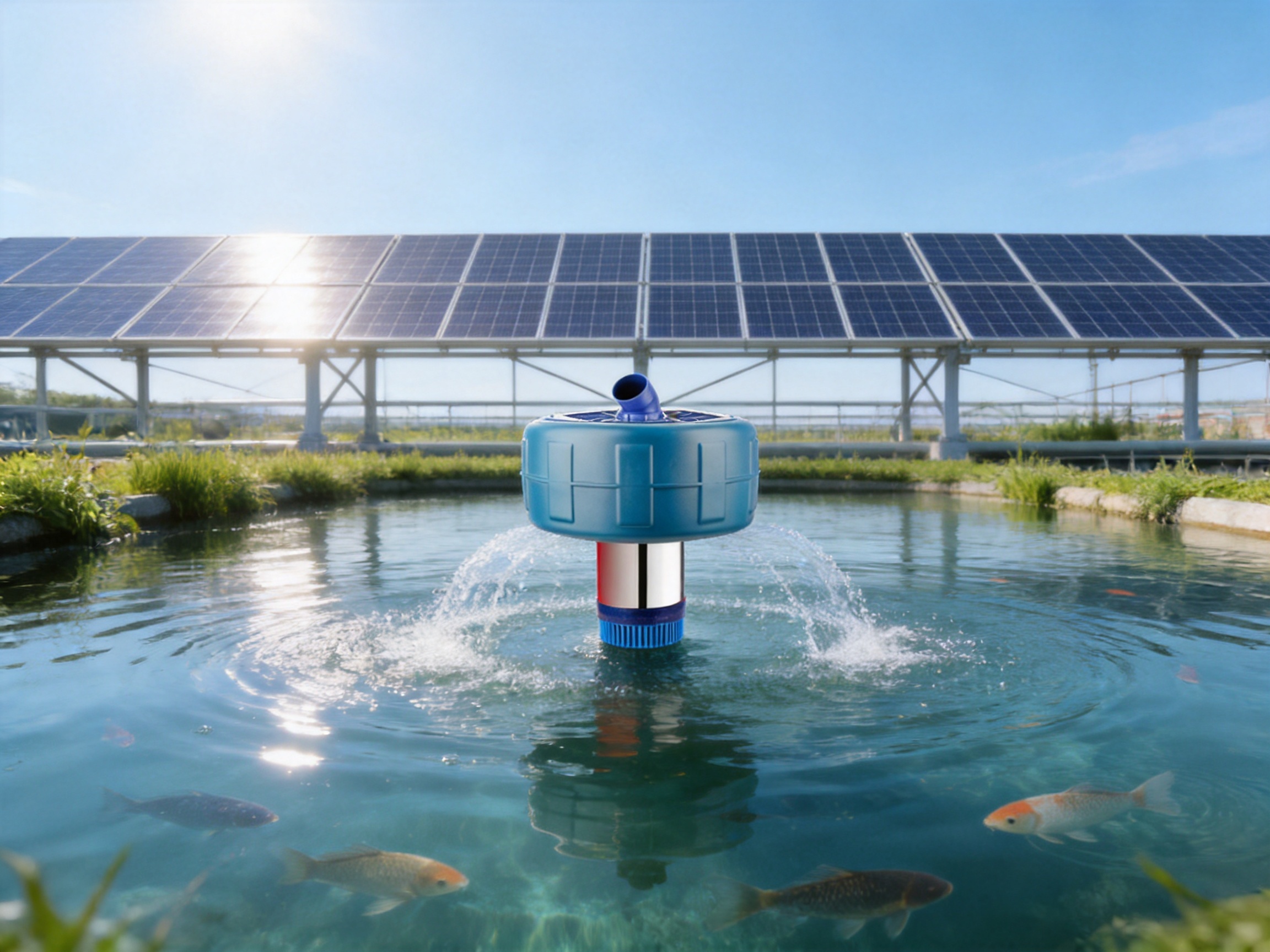
Small household ponds may be used for ornamental fish, personal food production, educational activities, or hobby aquaculture. Even when stocking levels are modest, water quality can change quickly in a confined environment. A solar aerator can provide circulation without requiring the owner to operate a large electrical system. The AC/DC hybrid function adds convenience when the pond needs overnight or low-light aeration.
For residential installations, noise, visual impact, maintenance access, and electrical safety are important considerations. The brushless motor design can support quieter and smoother operation, while the solar system may reduce the need for long power cables across a garden or rural property. Professional installation is still recommended, particularly where high-voltage DC solar arrays or AC connections are involved.
Large fish ponds commonly face greater oxygen demand because of increased stocking density, feeding levels, and biological activity. A high-flow aerator can assist with circulation across a larger water area, while hybrid power helps maintain operation under changing weather conditions. The ADSA55-5-300-2200 model’s 2,200-watt rating and maximum flow of 55 cubic meters per hour make it suitable for projects requiring stronger water movement than a small domestic aerator can provide.
Before installation, the farm operator should assess the total pond volume, expected biomass, seasonal water temperature, feeding schedule, and emergency oxygen requirements. The aerator should be viewed as part of a complete water-management plan that may also include water exchange, filtration, monitoring, backup equipment, and emergency procedures.
Ecological aquaculture projects often seek to balance production with energy efficiency and environmental responsibility. Solar-assisted aeration supports this objective by using renewable energy during periods of sunlight. The brushless motor further contributes to an efficient operating concept, while hybrid operation protects continuity when sunlight is insufficient.
Such projects may be located in rural areas with limited grid infrastructure. Solar energy can make it easier to place aeration equipment near ponds without depending entirely on a distant electrical connection. The use of a hybrid system also gives operators a practical backup option, which is important when protecting valuable aquatic organisms.
Remote fish ponds and seasonal aquaculture sites may have limited access to maintenance personnel. A system with automatic power management and a durable motor can help reduce the need for daily manual adjustments. When combined with suitable monitoring, the aerator can become part of a more autonomous pond-management strategy.
However, remote operation should not eliminate inspection. Solar panels must remain clear of dust, leaves, and snow where relevant. Cables and connectors should be protected from damage. The aerator should be checked after storms, flooding, abnormal water levels, or other events that may affect equipment safety or performance.
The performance of a solar aerator depends not only on the motor and pump assembly but also on the design of the solar array. The stated ADSA model requires a recommended solar panel open-circuit voltage below 450 volts. Its solar panel power should be at least 1.3 times the pump power. For a 2,200-watt pump, this means the recommended panel capacity should be no less than approximately 2,860 watts under the stated sizing rule.
This recommendation helps account for the difference between laboratory-rated panel output and real-world solar generation. Panels rarely produce their nameplate power continuously. Temperature, cloud cover, dust, panel orientation, shading, cable losses, and seasonal sun angles all affect actual output. Oversizing the solar array relative to the pump power can provide a more practical energy margin during less-than-ideal conditions.
Voltage selection must be handled carefully. The open-circuit voltage of the complete solar array should remain below the specified limit, including consideration of low-temperature voltage increases. The operating voltage should also remain within the controller’s acceptable range. Incorrect panel configuration can damage equipment, reduce performance, or create serious electrical hazards.
Solar panels should be installed where they receive strong, unobstructed sunlight for the most important operating hours. Even partial shading can affect the performance of a series-connected array. The mounting structure should withstand local wind and weather conditions, and wiring should be selected and protected for outdoor use. Proper grounding, disconnect devices, overcurrent protection, and installation procedures are essential.
Because the ADSA Series supports AC/DC hybrid operation, the complete project should define how the power sources are integrated. The system designer should confirm the switching method, controller requirements, protection devices, mains characteristics, and emergency isolation procedure. High-voltage DC systems can present arc and shock risks, so installation should be completed by qualified electrical personnel.
Product comparisons are most useful when they focus on operating requirements rather than on simple marketing claims. The ADSA Series has several design characteristics that can provide advantages over common single-purpose aerators.
Many conventional aerators are designed around AC mains power alone. They can operate reliably where grid electricity is stable, but they may increase operating costs and become difficult to install in remote locations. The ADSA Series can integrate solar-generated DC power, creating an opportunity to reduce grid consumption and extend installation flexibility.
Some solar aerators operate only when sunlight is strong. These units may be economical during the day but can stop at night or during long cloudy periods. The AC/DC hybrid structure of the ADSA Series is designed to address this weakness by supporting continued operation through mains power when solar input is inadequate.
Manual switching between power sources can be inconvenient and may introduce the risk of delayed response. Automatic switching based on lighting conditions or mains availability simplifies operation and helps maintain aeration without requiring constant human supervision. This feature is particularly valuable for farms with several ponds or for locations where staff are not present around the clock.
Conventional brushed motors contain wear components that may require periodic replacement. The brushless motor in the ADSA Series is designed to reduce this type of mechanical wear. This can support service life, reduce motor-related maintenance, and improve compatibility with electronic power management.
With a stated maximum flow of 55 cubic meters per hour and a 4-inch outlet, the available ADSA model is intended for applications requiring more than light surface agitation. The combination of flow and a 5-meter maximum head gives system designers additional flexibility when planning circulation routes and equipment placement.
Solar integration helps aquaculture operators align aeration with broader energy-efficiency goals. When solar energy is available, the system can use a renewable source instead of relying exclusively on conventional electricity. This may reduce operating costs depending on the site’s electricity price, sunlight conditions, and system design.
The product is intended for around-the-clock aeration support, including operation during low-light conditions. Continuous availability is a major distinction between a hybrid system and a solar-only system. For fish farmers, the value of continued operation is not limited to convenience; it can help protect stock during the hours when oxygen levels may naturally fall.
A three-year warranty demonstrates the manufacturer’s stated confidence in the durability and reliability of the product. Warranty terms should always be reviewed carefully before purchase, including coverage conditions, exclusions, installation requirements, shipping responsibilities, and procedures for technical support. Nevertheless, a defined warranty period can provide buyers with greater confidence when evaluating equipment for commercial use.
Taizhou Edwin Electric Co., Ltd., operating under the Edwin Pump name, was founded in 2008. The company is described as an integrated manufacturing enterprise with capabilities covering independent research and development, mass production, and global export. This combination is important for specialized equipment such as solar aerators because product performance depends on the coordination of mechanical design, motor engineering, electrical control, assembly, inspection, and after-sales support.
A manufacturer with independent research and development capability can adapt products to changing market needs rather than relying solely on standard third-party designs. The company’s expansion into solar water pumps and intelligent booster pumps since 2018 indicates an ongoing focus on new energy and intelligent technology. The ADSA Series reflects this direction by combining renewable energy with automated power management and brushless motor technology.
Mass production capability is also significant for buyers who need stable supply. Commercial aquaculture projects may require multiple units, replacement equipment, or repeat orders for additional ponds. A structured production operation can support consistent procurement planning, standardized components, production scheduling, and delivery coordination.
Solar aeration requires more than attaching solar panels to a conventional motor. The power source varies constantly, so the motor, controller, electrical protection, and hydraulic system must work together. A manufacturer with experience in pumps and intelligent equipment is better positioned to develop products that account for these interactions.
Product development should consider input voltage variation, motor efficiency, heat management, switching logic, water movement, sealing, cable protection, and serviceability. The AC/DC hybrid concept requires particular attention because the equipment must respond appropriately to different power conditions. The brushless motor also depends on suitable electronic control to achieve stable operation.
Reliable manufacturing begins with control of incoming materials and components. Motors, impellers, housings, seals, cables, controllers, fasteners, and electrical connectors all contribute to the final performance of an aerator. Proper incoming inspection helps prevent inconsistent components from entering assembly.
During production, the assembly sequence should be controlled so that mechanical alignment, fastening torque, insulation, sealing, and wiring are completed correctly. Electrical and mechanical inspections can identify problems before shipment. Performance checks may include operating current, voltage response, rotation, vibration, noise, flow behavior, and protection functions, according to the manufacturer’s internal procedures.
For solar-compatible equipment, testing under different input conditions is particularly valuable. The system should be evaluated for stable operation within the intended voltage range and for appropriate response when power conditions change. Hybrid switching should be verified to reduce the risk of interruption or abnormal operation during transitions.
Although specific factory certifications and test standards are not included in the supplied product information, buyers can request the relevant technical documents during the procurement process. These may include inspection records, wiring diagrams, installation manuals, component specifications, warranty conditions, and available quality documentation.
The company serves customers in international markets and has developed additional organizations to support procurement planning, order tracking, cross-border delivery, and foreign trade services. This structure can be useful for overseas buyers who need more than a product quotation. International projects often involve documentation, packaging, logistics coordination, customs requirements, spare parts, and communication across multiple time zones.
Global export experience may also help a supplier understand the different operating conditions found in aquaculture projects. Solar intensity, voltage standards, environmental conditions, transport routes, and installation practices vary from country to country. Effective communication before production can reduce the risk of selecting an unsuitable configuration.
For distributors and project contractors, one-stop procurement support can simplify purchasing. The company’s broader product portfolio includes deep well pumps, submersible pumps, domestic booster pumps, circulation pumps, solar water pumps, intelligent booster pumps, and related water-treatment peripheral products. This range may allow customers to coordinate several water-management requirements with one supplier.
A commercial installation should begin with a site survey. The survey should identify pond dimensions, water depth, stocking density, species, expected biomass, feeding practices, water temperature, prevailing weather, and existing electrical infrastructure. The solar resource should also be evaluated, including daily sunlight, seasonal variation, shading, and panel mounting options.
The aerator’s location should promote useful circulation while allowing safe access for service. It should not be placed where floating debris accumulates continuously or where water levels can fall below the safe operating requirement. The water-side installation should be protected from collision with boats, nets, harvesting equipment, and other farm machinery.
Electrical infrastructure should be designed around both the DC solar input and the AC mains supply. The system should include suitable disconnects and protective devices so that technicians can isolate each source before inspection. Cables should be routed to prevent abrasion, immersion beyond their rated protection, animal damage, and accidental contact with workers or farm equipment.
The solar array should be mounted on a stable structure with adequate ventilation around the panels. Excessive heat can reduce panel output and affect the performance of nearby electrical equipment. The array should be positioned to minimize shading and should remain accessible for cleaning and inspection.
Before commissioning, installers should verify polarity, voltage, grounding, insulation, protective devices, connection tightness, and controller settings. The aerator should be operated under controlled conditions while checking current, sound, vibration, water movement, and the transition between available power sources. Any abnormal condition should be corrected before the system is placed into routine operation.
Good maintenance protects both the equipment and the aquatic environment. Operators should establish a regular inspection schedule based on the intensity of use and the condition of the pond. Daily visual checks can help identify changes in surface movement, unusual sound, reduced flow, or signs of electrical damage.
Solar panels should be kept clean enough to receive effective sunlight. Dust, bird droppings, leaves, and other deposits can reduce energy generation. Cleaning methods should follow the panel manufacturer’s safety guidance, and workers should avoid contact with live electrical components.
The aerator should be checked for blocked passages and excessive biological growth. Accumulated algae, weeds, mud, and floating waste can restrict water movement. Any cleaning or mechanical inspection should be performed after isolating the electrical supply, including both AC and DC sources.
Operators should monitor water quality rather than relying solely on visible surface movement. Dissolved oxygen, temperature, pH, ammonia, and other relevant parameters can help identify changes before they become serious. Monitoring data can also help determine whether additional aeration is needed during hot weather, after feeding, or during periods of high stocking density.
Seasonal planning is important. Warm weather generally increases oxygen demand while reducing the amount of oxygen water can hold. Heavy storms can disrupt pond conditions and introduce organic material. Extended cloudy periods can reduce solar output. The hybrid function can help during these conditions, but operators should still maintain emergency procedures and verify that backup power is ready.
Any reduction in performance should be investigated promptly. Possible causes include low solar input, damaged cables, incorrect voltage, blocked water passages, excessive wear, controller faults, or changes in pond conditions. Recording inspection results and operating history can help technicians diagnose recurring problems more efficiently.
The financial value of a solar aerator depends on the full project context. Important factors include local electricity prices, solar availability, operating hours, pond size, stocking density, equipment quantity, maintenance costs, and the consequences of oxygen-related stock losses. A solar-assisted system may reduce electricity consumption during daylight hours and provide a practical energy option for sites with limited grid access.
Lower energy demand can also reduce the operating burden of remote farms. If the equipment is located far from a central facility, extending grid cables may require significant construction work. A solar array can provide power close to the pond, although the installation still requires proper electrical engineering and protection.
Environmental benefits may include increased use of renewable energy and reduced dependence on conventional electricity. Efficient aeration can also support more responsible water management by improving pond conditions without requiring constant water replacement. Better circulation may help a farm maintain stable conditions and use resources more effectively.
These benefits should be assessed realistically. Solar panels, mounting systems, controllers, wiring, and electrical protection create an initial investment. The solar array must be sized correctly, and the equipment may still require mains power during low-light conditions. A professional life-cycle assessment can compare installation cost, energy savings, maintenance, expected service life, and production benefits.
Buyers should begin by confirming the operating point required for the pond rather than choosing a product based only on maximum flow. The maximum flow and maximum head are reference values, and actual performance changes as resistance increases. Pipe length, bends, valves, elevation, and outlet design all affect the final flow.
The power configuration should be discussed in detail. Buyers should confirm whether the project will use solar power, AC power, or both; how automatic switching is managed; what controller is included; and what protection devices are required. The solar panel open-circuit voltage must remain within the specified limit, and the recommended panel capacity should be followed when designing the array.
For international orders, buyers should request the complete technical package. This may include product drawings, performance curves, wiring diagrams, installation instructions, packing details, spare-parts lists, warranty terms, and recommended maintenance procedures. Clear documentation is especially important when equipment will be installed by a local contractor who has not previously worked with the product.
Distributors should also clarify the availability of replacement components and technical support. A dependable supply chain is important for commercial users because an aeration failure can have immediate consequences. Stocking commonly required parts, such as electrical connectors, seals, controllers, or other service components, may reduce downtime.
Factory communication is another important factor. A supplier that can coordinate procurement planning, order tracking, production scheduling, and delivery services may simplify the process for overseas customers. The manufacturer’s experience with global export and its broader pump portfolio can support customers who are developing complete water-supply or aquaculture systems.
Although the ADSA Series is designed specifically for aquaculture aeration, it forms part of a wider water-equipment product strategy. The supplier’s product lines include deep well pumps, submersible pumps, surface pumps, booster pumps, circulation pumps, garden pumps, pool and spa pumps, commercial multistage pumps, end suction pumps, intelligent booster pumps, pipes, valves, and pump accessories.
This broad product knowledge can be useful when an aquaculture project requires more than aeration. A farm may need a deep well pump for water supply, a submersible pump for drainage, a circulation pump for treatment equipment, or valves and pipes for distribution. Working with a supplier familiar with several pump categories may improve compatibility and reduce the complexity of multi-vendor procurement.
The company’s focus on high-performance pumps, solar water pumps, and intelligent technology suggests an effort to serve both traditional water-supply applications and newer energy-conscious projects. For customers seeking a long-term supplier, this ability to support different stages of expansion can be valuable. A small pond installation may later develop into a larger commercial operation requiring additional pumping and water-treatment equipment.
The ADSA Series combines water, electricity, and high-voltage solar input. Safety must therefore be treated as a primary design requirement. Installation should be completed by qualified personnel who understand both AC and DC electrical systems. The solar array may continue producing voltage whenever it is exposed to light, even if the mains supply is disconnected.
All power sources should be isolated before maintenance. Workers should use suitable protective equipment and follow local electrical regulations. Cables, connectors, enclosures, and grounding arrangements should be appropriate for outdoor and wet environments. The installation should include clear labeling so that workers understand the presence of both AC and DC sources.
The aerator should not be operated in conditions outside the manufacturer’s stated limits. Water level, temperature, debris, installation position, and electrical input should be checked. Unauthorized modifications can affect performance, safety, and warranty coverage.
Farm staff should also be trained to recognize oxygen emergencies. Fish gathering at the surface, unusual movement, reduced feeding, or sudden mortality may indicate a serious water-quality issue. The aerator should be started or switched to the appropriate backup mode according to the site’s emergency plan, while water-quality measurements and professional assistance are obtained.
Its main purpose is to improve aquaculture water quality by circulating surface water and increasing dissolved oxygen. It is designed for household ponds, large fish ponds, and ecological aquaculture farms.
Yes. The AC/DC hybrid design is intended to support continuous operation when solar power is unavailable or insufficient, provided that a suitable mains power supply or properly designed backup system is available.
Solar output may decrease during cloudy weather. The hybrid power system is designed to respond to available lighting conditions or mains power, allowing the aerator to continue operating when the electrical configuration is properly installed and connected.
A brushless motor avoids conventional mechanical brushes, reducing a source of wear and supporting efficient electronic control. This can contribute to longer service life, lower motor-related maintenance, and better compatibility with variable solar input.
The ADSA55-5-300-2200 model has a stated maximum flow of 55 cubic meters per hour. Actual flow depends on head, piping, valves, installation resistance, water conditions, and available power.
The stated maximum head is 5 meters. This value should be considered together with the complete hydraulic layout when selecting the equipment.
The listed solar panel open-circuit voltage should be below 450 volts. The final array must be designed carefully so that the voltage remains within the equipment’s permitted range under all expected temperature conditions.
The stated recommendation is at least 1.3 times the pump power. For the 2,200-watt model, this corresponds to approximately 2,860 watts or more of solar panel capacity, subject to professional system design.
No single aerator is suitable for every pond. Selection depends on pond volume, depth, stocking density, species, temperature, feeding levels, organic loading, and the desired circulation pattern. Larger or heavily stocked farms may require multiple units.
No. Aeration supports oxygen management but does not replace monitoring. Operators should measure dissolved oxygen and other relevant water-quality indicators and should maintain emergency procedures.
Operators should inspect solar panels, cables, connectors, the aerator body, water passages, flow, sound, vibration, and signs of overheating or damage. Debris and biological growth should be removed only after all electrical sources have been isolated.
Potential users include household pond owners, fish-farm operators, ecological aquaculture projects, agricultural businesses, distributors, contractors, and organizations developing renewable-energy water systems.
Yes. The company’s product portfolio includes several pump categories, such as deep well pumps, submersible pumps, booster pumps, circulation pumps, solar water pumps, intelligent booster pumps, commercial multistage pumps, pipes, valves, and pump accessories.
The product information states a three-year warranty. Buyers should confirm the detailed warranty conditions, coverage, exclusions, and service procedures before placing an order.
The ADSA Series AC/DC Brushless Motor Solar Aerator provides a practical approach to aquaculture oxygen management by combining surface circulation, renewable energy, hybrid power operation, and brushless motor technology. Its purpose is to help improve dissolved oxygen levels and water quality in home ponds, large fish ponds, and ecological aquaculture farms.
Its strongest distinction from many conventional aerators is the ability to combine solar DC power with AC mains operation. Solar energy can reduce reliance on grid electricity during suitable conditions, while the hybrid configuration helps maintain aeration when sunlight is weak or unavailable. Automatic power switching further reduces the need for manual intervention.
The brushless motor supports the product’s focus on efficiency and durability. Reduced mechanical wear, compatibility with electronic control, and the potential for lower maintenance make the design appropriate for long operating periods. The stated flow of 55 cubic meters per hour, 5-meter maximum head, and 4-inch outlet provide substantial circulation capacity for the listed performance model.
The manufacturer strengthens the product proposition through experience in research and development, mass production, global export, and a broad water-pump portfolio. Its investment in solar and intelligent technology supports the development of equipment suited to changing energy and water-management requirements.
For best results, the aerator should be selected and installed according to the specific pond conditions. Solar array voltage, panel capacity, electrical protection, hydraulic resistance, aerator placement, maintenance access, and emergency procedures all require careful planning. When integrated into a complete aquaculture management program, the ADSA Series can support more stable oxygen conditions, greater energy flexibility, and more reliable long-term pond operation.
1. Product performance data for the ADSA Series AC/DC Brushless Motor Solar Aerator, including voltage, power, flow, head, outlet, and solar panel requirements.
2. Manufacturer-provided product description concerning brushless AC/DC hybrid motor operation, surface circulation, dissolved oxygen improvement, solar energy use, application areas, and warranty information.
3. Manufacturer company information concerning research and development, mass production, global export, water-pump product lines, and investment in solar and intelligent technology.
4. General principles of aquaculture water-quality management, dissolved oxygen control, pond circulation, and aeration planning.
5. General engineering practices for photovoltaic system sizing, electrical protection, outdoor equipment installation, and AC/DC power-source safety.
edwina@edwin-pump.com
+86-13586290903 (WhatsApp)
Xuri Gongliang Cutting Tool Entrepreneurship Park, Wenqiao Town, Wenling City, Taizhou City, Zhejiang Province, China

High Performance Smart Pump Factory


 English