edwina@edwin-pump.com

View All Products
en
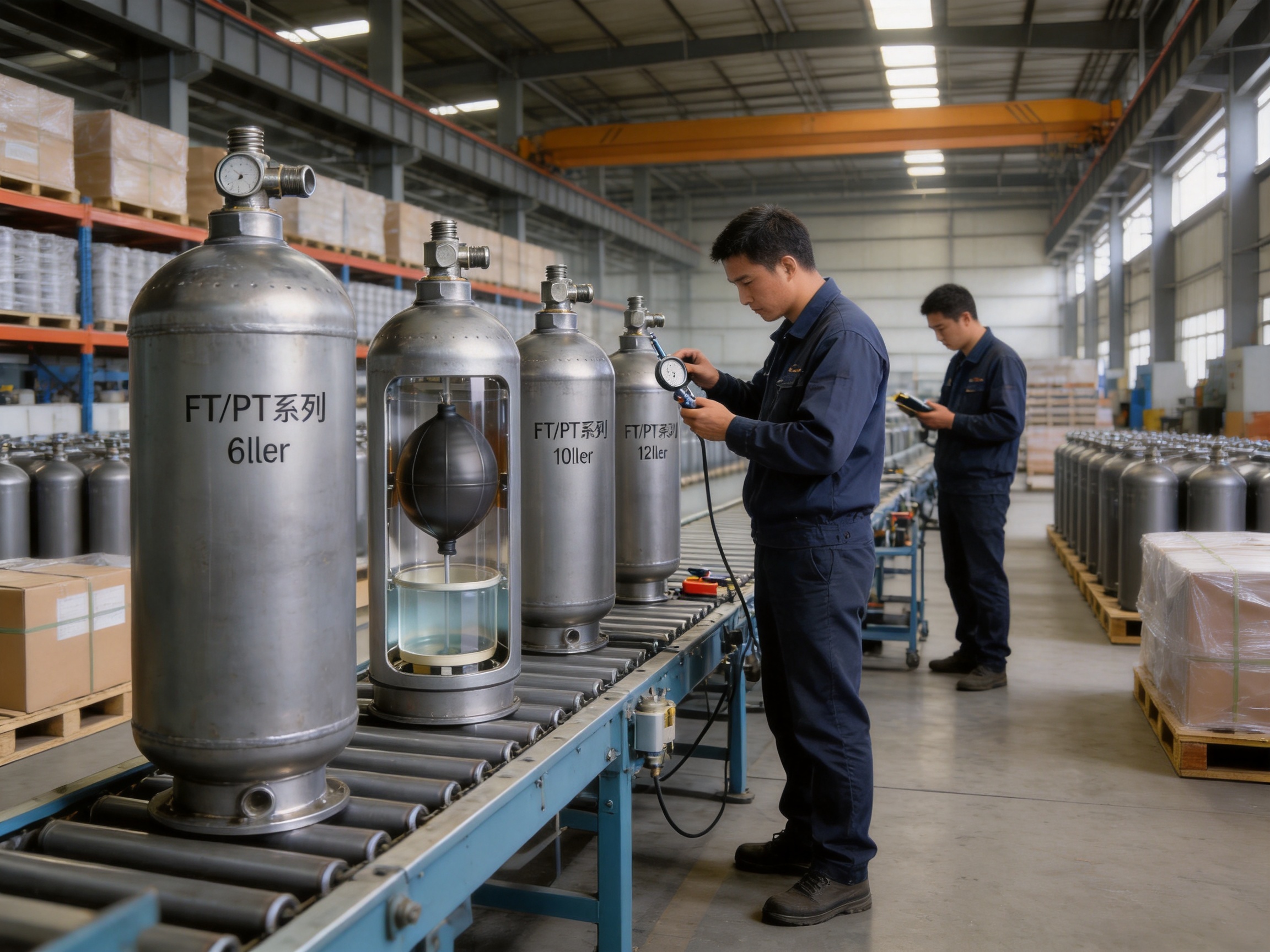
Pressure tanks play an important role in closed-loop water, heating, and fluid-management systems. Although they are often smaller and less complex than pumps, a properly selected pressure tank can improve system stability, reduce unnecessary pump cycling, protect components from pressure fluctuations, and support more reliable operation. The FT/PT Series pressure tank is designed as a practical carbon steel solution for thermal systems, boiler systems, and solar systems that require dependable pressure compensation in a compact format.
Manufactured by Taizhou Edwin Electric Co., Ltd., the FT/PT Series combines a carbon steel tank body with a fixed SBR rubber balloon, a factory pre-charge pressure of 1.5 bar, and a maximum working pressure of 4 bar. The product range includes compact models from 6 liters to 12 liters, together with an 8-liter PT model. These sizes are suitable for installations where space, pressure control, and straightforward maintenance are important considerations.
The product has been developed for professional distributors, system integrators, heating-equipment manufacturers, solar-system installers, pump wholesalers, and original equipment manufacturers. Its design focuses on practical performance rather than unnecessary complexity. A standardized 3/4-inch connector, compact dimensions, OEM support, and a focused model range make it easier to select, package, and integrate into different equipment configurations.
Many water and heating systems experience changes in pressure as fluid temperature, demand, and pump operation vary. In a closed system, liquid expands when heated and contracts when cooled. Without an expansion volume, this change can cause pressure to rise excessively or fall below the desired operating range. A pressure tank provides a controlled space for fluid expansion and helps moderate these changes.
In pump systems, the tank can also reduce the frequency of pump starts. When a small amount of water is required, the stored pressure within the tank may supply part or all of the demand without immediately starting the pump. Fewer starts can reduce mechanical stress on the pump motor, switching equipment, valves, and electrical components.
In thermal and boiler installations, the tank helps absorb pressure variations created by heating and cooling cycles. In solar thermal systems, pressure can change rapidly because of fluctuating solar radiation and high fluid temperatures. A correctly sized and correctly pre-charged pressure tank can provide additional stability for these operating conditions.
The FT/PT Series is designed to serve this pressure-management function in a compact and economical form. Its internal rubber balloon separates the system fluid from the air or gas chamber. This separation helps reduce direct contact between the stored gas and the system water or heating fluid, supporting more consistent pressure behavior than a simple unseparated air vessel.
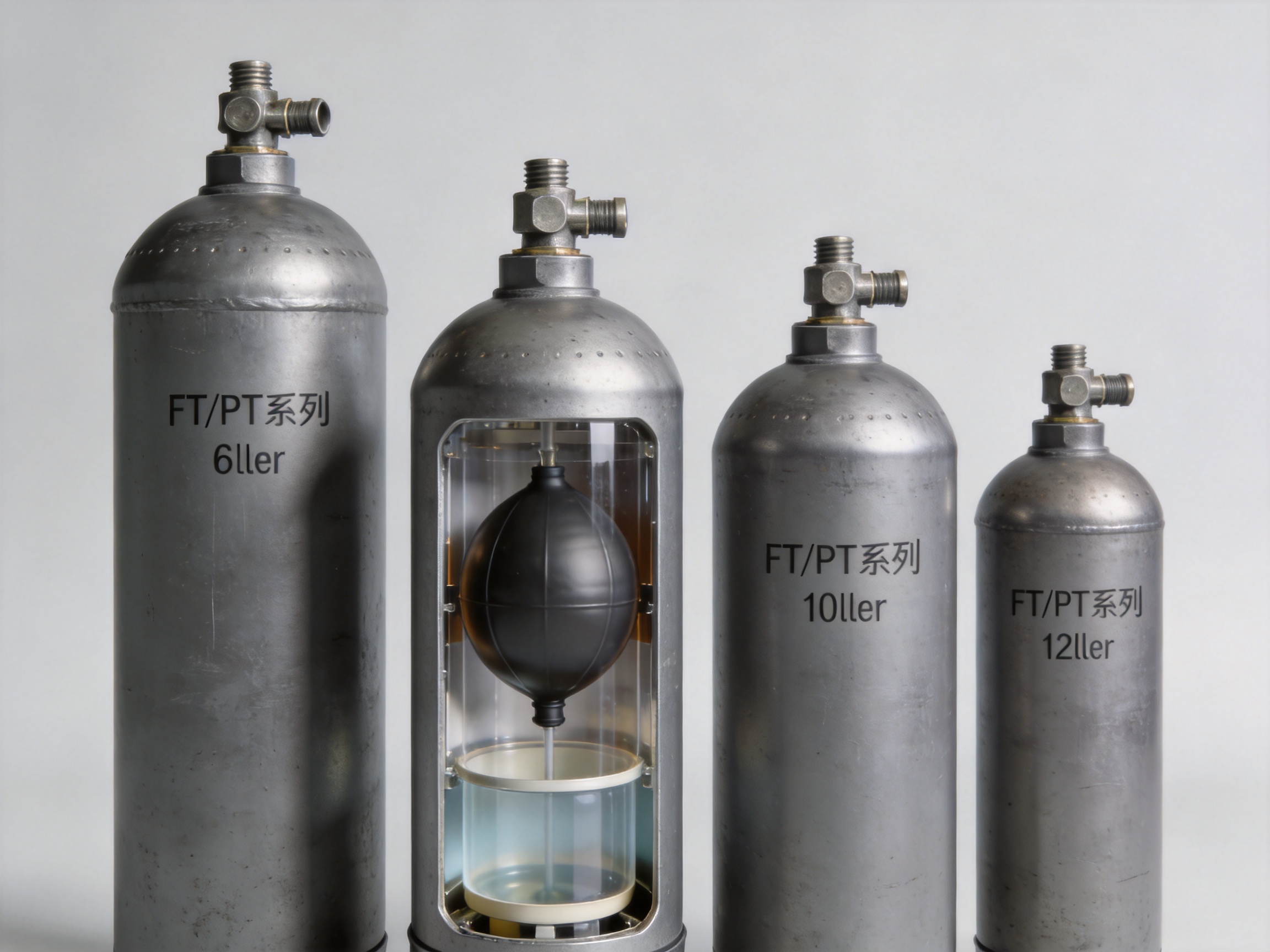
The FT/PT Series pressure tank uses a carbon steel shell and a fixed SBR rubber balloon. The metal shell provides the structural enclosure required to withstand internal pressure, while the rubber balloon creates the flexible volume needed for expansion and pressure storage.
Each tank is supplied with a stated pre-charge pressure of 1.5 bar. Pre-charge is the pressure placed in the gas chamber before the tank is connected to the system. This value is an important installation reference because the tank must be matched to the system pressure, pump settings, and application requirements.
The maximum working pressure is specified as 4 bar. The stated working temperature range is from -10°C to 99°C when using EPDM-related configuration information provided for the product. Because the product description also identifies a fixed SBR rubber balloon, installers and OEM customers should confirm the exact membrane compound and temperature suitability for the intended application before final selection, particularly where the fluid is hot, chemically treated, or not ordinary water.
The tanks feature a 3/4-inch connector. This common connection size can simplify installation and help distributors maintain compatibility with a broad range of pumps, valves, manifolds, boilers, and solar-system components.
| Item | Specification |
|---|---|
| Product series | FT/PT Series pressure tank |
| Tank category | Carbon steel pressure tank |
| Internal component | Fixed SBR rubber balloon |
| Pre-charge pressure | 1.5 bar |
| Maximum working pressure | 4 bar |
| Working temperature | -10°C to 99°C, subject to material and configuration confirmation |
| Connector | 3/4 inch |
| OEM service | Available |
| Typical applications | Thermal systems, boiler systems, solar systems, and compatible water-pressure applications |
The FT/PT Series includes several compact capacities. The FT models cover 6 liters, 8 liters, 10 liters, and 12 liters. A PT-8L model is also listed, giving buyers an additional configuration for projects that require a similar nominal volume but a different tank format or dimensional arrangement.
Compact tank sizes are useful in wall-mounted boilers, small solar-water systems, domestic heating units, pump assemblies, and equipment packages where installation space is limited. A smaller tank can be positioned close to a pump or heat source without requiring a large equipment room or extensive pipework.
Capacity selection should be based on the system volume, operating temperature, pressure range, pump characteristics, and expected fluid expansion. The largest available model is not automatically the best choice. Oversizing may increase cost and occupied space, while undersizing may allow excessive cycling or pressure variation. The FT/PT range allows system designers to choose a more appropriate size for compact installations.
| Model | Listed Diameter | Listed Height | Connector | Packaging Information |
|---|---|---|---|---|
| FT-6L | 325 mm | 103 mm | 3/4 inch | 0.06799 CBM per 5 pieces |
| FT-8L | 325 mm | 128 mm | 3/4 inch | 0.08820 CBM per 5 pieces |
| FT-10L | 325 mm | 136 mm | 3/4 inch | 0.09984 CBM per 5 pieces |
| FT-12L | 325 mm | 160 mm | 3/4 inch | 0.10658 CBM per 5 pieces |
| PT-8L | 398 mm | 100 mm | 3/4 inch | 0.01584 CBM as listed |
The dimensional and packaging information above should be confirmed against the latest technical drawing and packing list before production planning or container loading. This is especially important for OEM projects, because packaging arrangements may change according to customer labeling, export-market requirements, and carton configuration.
Carbon steel is widely used for pressure vessels because it offers a practical balance of strength, manufacturability, and cost. For compact tanks, a properly formed and welded steel shell provides the rigid structure needed to contain pressure while keeping the product economical for volume production.
The carbon steel construction gives the FT/PT Series a solid industrial character. Compared with lightweight plastic vessels, a steel pressure tank can provide greater resistance to impact and more consistent structural behavior in equipment rooms, plant rooms, boiler cabinets, and pump assemblies. It is also familiar to installers and service technicians who regularly work with metal heating and water-system components.
Durability depends on more than the base material. Shell forming, welding consistency, connection quality, surface treatment, pressure testing, packaging, and storage conditions all influence service life. A professional manufacturing process must therefore control the complete production chain rather than focus on the steel grade alone.
For installations in damp environments or areas exposed to aggressive chemicals, the tank should be installed according to the supplier’s surface-protection guidance. Appropriate pipe support, protection from impact, avoidance of freezing, and correct system-fluid selection are also important. The tank should never be exposed to pressure or temperature conditions above its specified limits.
The fixed rubber balloon is a central component of the FT/PT Series. It separates the system fluid from the pre-charged gas volume. As system pressure rises, fluid enters the available tank volume and compresses the gas chamber. As system pressure falls, the compressed gas pushes fluid back into the circuit.
This operating principle helps make the tank a responsive buffer. The rubber component must remain flexible enough to accommodate repeated expansion and contraction while maintaining a reliable separation between the fluid and gas sides. The use of an SBR rubber balloon reflects a common and economical design approach for compatible water and heating applications.
The supplied information also refers to EPDM in the working-temperature specification. SBR and EPDM have different chemical and thermal characteristics, so professional buyers should request the exact material specification for each order. If the tank is intended for glycol mixtures, treated water, unusual heating fluids, or temperatures approaching the upper limit, compatibility should be verified in writing.
Regular inspection is recommended in systems where pressure stability is critical. The pre-charge should be checked using an appropriate gauge after isolating and depressurizing the fluid side according to safe service procedures. A low or incorrect pre-charge can reduce usable tank volume and increase pump cycling. A pre-charge that is too high can limit fluid entry into the tank and reduce pressure-buffering performance.
The stated factory pre-charge of 1.5 bar provides a clear starting point for system design and installation. A defined pre-charge simplifies communication between the tank manufacturer, distributor, installer, and OEM customer. It also supports more consistent setup across multiple projects using the same model.
Pre-charge should not be treated as a universal setting for every system. The correct value depends on the system’s static pressure, pump control range, installation height, safety-valve setting, and manufacturer instructions. Installers may need to adjust the pre-charge before commissioning so that the tank operates correctly within the intended pressure range.
A clear pre-charge specification is one of the practical advantages of the FT/PT Series over unmarked or inconsistently prepared alternatives. When the starting pressure is documented, service teams can diagnose problems more efficiently and OEMs can establish repeatable assembly instructions.
The tank should be installed with suitable isolation and drainage arrangements where possible. These arrangements allow technicians to inspect or replace the tank without unnecessarily draining the entire system. A pressure gauge, safety valve, and correctly rated shut-off components should be selected as part of the overall system rather than relying on the tank alone to manage unsafe pressure conditions.
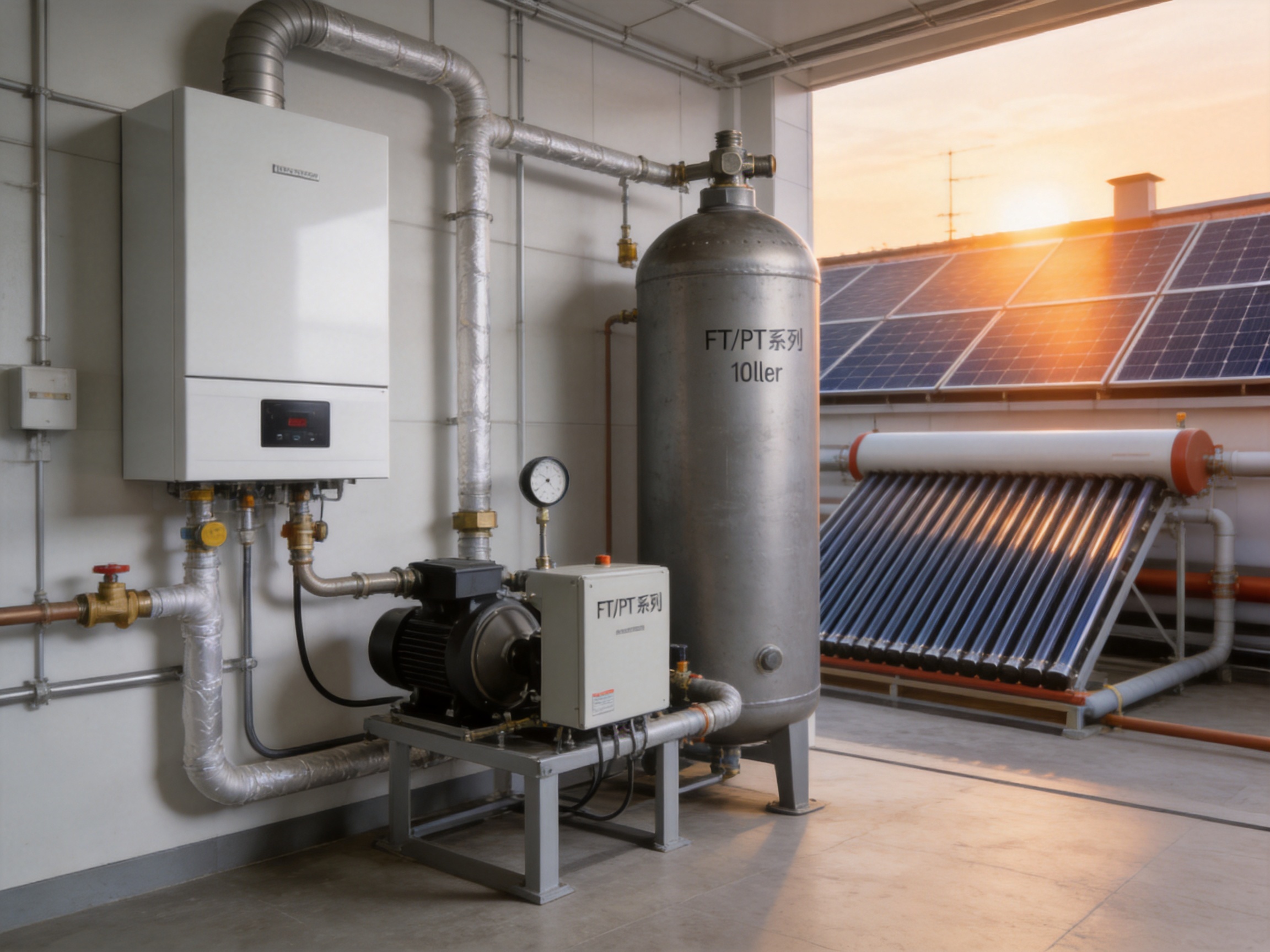
Thermal systems are one of the primary application areas for the FT/PT Series. Heating circuits experience fluid expansion when the temperature rises and contraction when the temperature falls. If the system is sealed, the resulting volume change must be accommodated somewhere.
A pressure tank installed in the correct location can help maintain a more stable pressure profile during heating cycles. This can support the reliable operation of circulation pumps, control valves, heat exchangers, radiators, underfloor heating circuits, and other system components.
The compact FT models are useful for smaller thermal installations, including domestic heating equipment and localized heating circuits. The 6-liter and 8-liter versions may be suitable where the system fluid volume is relatively low, while the 10-liter and 12-liter versions offer additional expansion capacity for somewhat larger compact systems. Final sizing must always be calculated from actual system data.
For thermal applications, installers should consider maximum fluid temperature, fluid composition, system height, cold-fill pressure, and the pressure-relief setting. The tank’s 4-bar maximum working pressure must not be exceeded, and the system should include a separate safety device suitable for the complete installation.
Boiler systems require dependable pressure management because repeated heating cycles can create substantial changes in fluid volume. A pressure tank can reduce the pressure stress associated with those cycles and help the boiler circuit operate within a more predictable range.
The FT/PT Series can be integrated into compact boiler packages, heating skids, and equipment assemblies where a 3/4-inch connection and compact body are convenient. Its standardized design can support repeat production for boiler manufacturers and distributors who need a consistent accessory across several equipment models.
For boiler OEMs, the availability of OEM support is particularly valuable. The tank may be supplied as part of a packaged solution with customer-specific labels, documentation, carton markings, or procurement requirements, subject to agreement with the manufacturer. This can simplify the sourcing process and reduce the need to coordinate several unrelated component suppliers.
Boiler designers should confirm the tank’s compatibility with the selected heating medium. Ordinary water, water-glycol mixtures, corrosion inhibitors, and other fluids may affect rubber life and metal protection differently. Material verification should be completed before the tank is approved for a new boiler platform.
Solar thermal systems can face rapidly changing operating conditions. Solar radiation may increase fluid temperature quickly during periods of strong sunlight, while evening cooling can create a significant pressure reduction. The tank must respond to these changes without exceeding its pressure or temperature limits.
The FT/PT Series offers a compact option for solar-system manufacturers and installers who need a dedicated pressure-compensation component. Its small capacities can be useful in compact solar hot-water packages, auxiliary heating circuits, and small collector systems, provided that the calculated expansion volume remains within the selected model’s capability.
Solar applications require careful attention to stagnation temperature, fluid concentration, and installation location. The stated temperature range should be treated as a design boundary, not a target operating condition. When collectors can reach high temperatures during low-flow or no-flow conditions, the tank’s suitability must be evaluated against the actual system design.
The rubber balloon, connection, and shell should all be checked for compatibility with the selected solar fluid. Correct pre-charge, correct tank orientation, protection from excessive heat transfer, and suitable safety equipment are essential. The tank can support system stability, but it cannot replace correct solar-loop design.
The FT/PT Series offers several practical advantages when compared with generic pressure tanks that provide limited technical information or inconsistent configuration.
The product information identifies a 1.5-bar pre-charge and a 4-bar maximum working pressure. These values give designers and installers a clear starting point for system calculations. Some low-cost alternatives provide incomplete labeling or uncertain factory settings, which can create additional work during commissioning.
The range from 6 liters to 12 liters allows buyers to choose a tank according to the requirements of a compact installation. A focused range can be more efficient than carrying a large number of overlapping models, especially for distributors managing inventory across several markets.
The 3/4-inch connector is widely used in water, heating, and pump applications. A common interface can reduce the need for special adapters and simplify replacement planning. It can also help OEMs standardize pipework across several equipment versions.
The carbon steel shell provides a robust enclosure for the rubber balloon and internal pressure. It is a familiar construction for heating and water-system professionals and is suitable for industrial-style equipment assemblies when correctly protected and installed.
OEM support gives equipment manufacturers an opportunity to discuss packaging, product identification, order quantities, and other commercial requirements. This is particularly useful for companies that want a pressure tank integrated into a branded boiler, solar package, pump set, or thermal-system product.
A pressure tank is often purchased together with pumps, valves, control components, or other water-treatment accessories. A manufacturer with experience in global export can help customers coordinate product sourcing, order tracking, packing, and cross-border delivery. This can be more efficient than purchasing a tank from a supplier with no established export process.
Taizhou Edwin Electric Co., Ltd. was founded in 2008 and operates as an integrated manufacturing enterprise with independent research and development, mass-production capability, and global export experience. Although the company is widely associated with water pumps, its product portfolio also includes water-treatment peripheral products such as pressure tanks and related accessories.
The company’s experience in deep well pumps, submersible pumps, domestic booster pumps, circulation pumps, solar water pumps, and intelligent booster pumps provides a useful understanding of complete water-system requirements. A pressure tank is most effective when it is selected and installed as part of a coordinated system. A manufacturer familiar with pump performance, control logic, and water circulation can better understand how pressure storage supports the wider installation.
Mass production requires repeatable processes. For the FT/PT Series, important manufacturing stages may include steel-material preparation, shell forming, welding, connector installation, surface finishing, rubber-balloon assembly, pre-charge preparation, pressure inspection, labeling, and packaging. Each stage must be controlled so that tanks supplied in different production batches maintain consistent dimensions and operating characteristics.
Independent product development also helps the manufacturer respond to market requirements. Different countries may require different packaging formats, labeling languages, connection conventions, documentation, or OEM identification. A company with internal technical and production coordination can adapt more efficiently than a trading organization that depends entirely on unrelated subcontractors.
The company’s global customer base and export experience are additional strengths for overseas buyers. Procurement teams commonly need predictable communication, production updates, packing information, and delivery coordination. The company’s related import and export organizations were established to support procurement planning, order tracking, cross-border delivery, and foreign-trade services.
Pressure tanks require quality control at both the metal and elastomer levels. The shell must be capable of containing the specified pressure, while the rubber balloon must retain flexibility and sealing performance during repeated operating cycles.
Typical quality-control activities for this type of product include incoming material checks, dimensional inspection, welding-process supervision, connector alignment inspection, leakage testing, pressure testing, appearance inspection, and packaging verification. The exact inspection plan depends on the production model, customer requirements, and applicable market regulations.
Pre-charge verification is also important. If the factory setting varies significantly from the stated 1.5 bar value, the tank may not perform consistently in a repeated OEM assembly. Proper labeling can help identify the model, nominal capacity, pressure rating, and production information for later service and traceability.
OEM buyers should discuss required inspection documents before placing an order. Depending on the destination market, buyers may request inspection reports, material declarations, batch records, pressure-test records, packaging photographs, or other quality documentation. These requirements should be agreed before mass production rather than introduced after goods are completed.
The tank should be installed by qualified personnel who understand pressure-system safety. Before installation, confirm the model, capacity, connector, pressure rating, temperature range, and membrane compatibility. Inspect the shell and connection for shipping damage, and do not install a tank that shows dents, cracks, leakage, or deformation.
Use pipework and fittings rated for the actual system pressure and temperature. The tank should be supported correctly so that the connector is not subjected to excessive mechanical loading. Heavy pipework should not hang from the tank connection.
Check the pre-charge before commissioning. The system-fluid side should be isolated and depressurized according to safe procedures before measuring or adjusting the gas-side pressure. The specified factory pre-charge is 1.5 bar, but the final setting may need to be adapted to the installation design.
After connection, fill the system gradually and remove trapped air where appropriate. Check all joints for leakage and confirm that the working pressure remains within the system limits during heating or pumping. The pressure-relief device must be installed and maintained separately from the tank.
Do not weld, drill, cut, or modify the tank after delivery. Such modifications may damage the rubber balloon, weaken the shell, or invalidate the pressure rating. If the connection size or tank capacity is unsuitable, select another approved model rather than altering the product.
Routine maintenance helps preserve pressure stability and extend the useful life of the tank. The inspection interval depends on the application, operating temperature, fluid type, and duty cycle. Heating and solar installations may require checks before and after the main operating season.
During inspection, technicians should look for external corrosion, coating damage, leakage, abnormal noise, deformed components, and pressure changes. The pre-charge should be checked using safe procedures and a calibrated pressure gauge. If the tank repeatedly loses pre-charge, the valve, balloon, connection, or shell may require further investigation.
A tank that becomes waterlogged may show symptoms such as frequent pump starts, unstable pressure, rapid pressure changes, or reduced water delivery between pump cycles. These symptoms should not be ignored because they may increase wear on the pump and control components.
When replacing a tank, select a model with compatible volume, pressure, temperature, connection, and membrane material. A visually similar tank may not have the same internal configuration or pressure rating. Product labels and technical documents should be checked before replacement.
The FT/PT Series is suitable for standard distribution as well as OEM procurement. Standard buyers can select from the listed FT-6L, FT-8L, FT-10L, FT-12L, and PT-8L models. OEM customers can discuss their expected annual volume, target market, packaging, identification, and system integration requirements with the manufacturer.
OEM support can be valuable when a pressure tank is part of a larger branded product. The customer may need coordinated labels, carton marks, user instructions, spare-part planning, or synchronized delivery with pumps and other equipment. Early technical communication helps avoid errors in dimensions, connector selection, pressure settings, and packaging quantities.
For export orders, buyers should confirm the latest product drawings, packing dimensions, net and gross weights, carton quantity, loading arrangement, and shipping marks. The listed packaging data should be used as a planning reference and verified before final shipment booking.
Taizhou Edwin Electric Co., Ltd. can support customers through its manufacturing and export organization. Its broader product portfolio also creates opportunities for one-stop procurement, especially for importers seeking pumps, pressure accessories, circulation equipment, and other water-system products from a coordinated source.
Model selection should begin with the application rather than the product name. Identify whether the tank will be used in a thermal system, boiler system, solar system, domestic pressure-boosting arrangement, or another compatible application.
Next, calculate or obtain the system volume, expected temperature range, cold-fill pressure, operating-pressure range, pump start and stop settings, and safety-valve setting. These factors determine how much expansion or pressure storage is required.
Choose a nominal capacity that provides sufficient usable volume without creating unnecessary cost or installation difficulty. The nominal tank volume is not always equal to the actual volume of fluid that can be delivered during operation. Usable volume depends on pre-charge and pressure settings.
Confirm the 3/4-inch connector is suitable for the planned pipework. Verify the material of the rubber balloon against the system fluid. Finally, confirm that the application remains within the 4-bar maximum working pressure and the applicable working-temperature range.
| Selection Question | Why It Matters | Recommended Action |
|---|---|---|
| What is the system type? | Thermal, boiler, solar, and pump systems have different operating conditions. | Identify the complete application before choosing a model. |
| What is the system fluid? | Fluid chemistry can affect the rubber balloon and metal components. | Confirm material compatibility with the supplier. |
| What is the system volume? | System volume influences required expansion capacity. | Calculate the required tank size rather than selecting by appearance. |
| What are the operating pressures? | Pre-charge and maximum working pressure determine safe operation. | Keep system pressure within the 4-bar product limit. |
| What is the temperature range? | High temperature affects fluid expansion and elastomer life. | Compare actual conditions with the stated temperature range. |
| What connection is needed? | An incorrect connector can increase installation cost. | Confirm that the 3/4-inch connection matches the system design. |
| Are OEM requirements involved? | Packaging, labeling, and documentation may affect production. | Discuss customization before ordering. |
Professional procurement teams generally evaluate more than purchase price. They consider technical consistency, supplier reliability, product availability, packaging, support, and the cost of failures in the field. The FT/PT Series addresses these concerns with a defined product range and practical specifications.
The carbon steel shell offers a familiar and economical pressure-vessel construction. The fixed rubber balloon provides a dedicated separation between gas and system fluid. The 1.5-bar pre-charge gives installers a documented starting reference. The 4-bar working-pressure limit provides a clear boundary for system design. The 3/4-inch connector supports straightforward integration.
The compact range also helps distributors serve different customers without creating excessive inventory complexity. A buyer can stock several capacities for common applications while maintaining a consistent product family and supplier relationship.
Most importantly, the product is backed by a manufacturer with experience in pumps, intelligent water systems, solar pumping, circulation, and global export. This broader technical background is useful when customers need advice on how a pressure tank should work with a pump or complete water system.
A pressure tank is a pressure-containing component and must be treated accordingly. Never exceed the maximum working pressure. Never operate the tank outside its approved temperature or fluid-compatibility range. Install an independent safety valve and other protective devices required by the complete system design.
Installation, inspection, pre-charge adjustment, and replacement should be performed by trained personnel. Local laws, building codes, pressure-equipment requirements, and heating regulations may apply. The product information in this article should be used together with the latest technical documentation and application guidance supplied for the specific order.
Where the product description contains different rubber-material references, the buyer should request confirmation of the exact configuration. This is especially important for high-temperature solar installations, glycol systems, and applications involving chemical additives.
The FT/PT Series is designed for pressure compensation and pressure storage in thermal systems, boiler systems, solar systems, and other compatible water-pressure applications. It can help absorb fluid expansion, stabilize pressure, and reduce unnecessary pump cycling.
The tank body is made from carbon steel. The internal flexible component is described as a fixed SBR rubber balloon. The supplied temperature information also refers to EPDM, so the exact rubber configuration should be confirmed for the specific order and application.
The stated factory pre-charge pressure is 1.5 bar. The correct installation setting may depend on the system design, so qualified installers should verify and adjust it when necessary.
The maximum working pressure is specified as 4 bar. The complete system, including the tank, pipework, valves, pump, and safety devices, must be designed and operated within safe pressure limits.
The stated working temperature range is -10°C to 99°C, with the supplied specification referring to EPDM. Customers should verify the exact membrane material and temperature suitability for their application before installation.
The listed connector size is 3/4 inch across the FT/PT models shown in the specification.
The listed models include FT-6L, FT-8L, FT-10L, FT-12L, and PT-8L. The correct capacity depends on system volume, pressure settings, temperature, and required expansion performance.
Yes, the product is specified for solar systems. However, solar installations can experience high temperatures and special fluid conditions. The tank must be checked against the actual maximum temperature, fluid composition, stagnation condition, and pressure requirements.
OEM support is available. Customers should discuss labeling, packaging, documentation, model identification, order quantities, and other requirements before production begins.
The fluid side should be isolated and depressurized using safe service procedures before checking the gas-side pre-charge with a suitable pressure gauge. Only trained personnel should perform this work.
No. A pressure tank helps manage pressure changes, but it does not replace an independent safety valve or other protective equipment required by the system design.
Correct sizing ensures that the tank has enough usable expansion or storage volume for the system. An undersized tank may cause frequent pump cycling or excessive pressure fluctuation, while an oversized tank may add unnecessary cost and installation space.
The FT/PT Series pressure tank is a compact and practical carbon steel solution for thermal systems, boiler systems, solar systems, and compatible pump-related applications. Its fixed rubber balloon, 1.5-bar pre-charge, 4-bar maximum working pressure, 3/4-inch connector, and range of compact capacities provide a clear foundation for system integration.
Compared with generic alternatives, the series offers documented operating parameters, standardized connections, several size options, OEM support, and the backing of an established manufacturer with experience in water pumps, intelligent pumping technology, solar systems, circulation equipment, and international supply.
For installers, the product provides a straightforward pressure-management component. For distributors, it offers a manageable product family. For OEM manufacturers, it provides a practical platform for integration into boiler, thermal, solar, and pump packages. Proper sizing, material verification, pre-charge adjustment, installation, and maintenance remain essential to achieving reliable performance.
With careful application engineering and support from an experienced manufacturing partner, the FT/PT Series can contribute to more stable pressure, reduced equipment cycling, and dependable operation across a wide range of compact water and heating systems.
1. Product specification sheet for the FT/PT Series pressure tank.
2. Manufacturer-provided technical information concerning carbon steel construction, rubber balloon configuration, pre-charge pressure, working pressure, temperature range, and OEM support.
3. General engineering principles for diaphragm and bladder expansion tanks in closed-loop heating and water systems.
4. General installation and maintenance practices for pressure vessels, heating circuits, boiler systems, and solar thermal systems.
5. Manufacturer background information concerning research and development, mass production, pump manufacturing, intelligent water technology, and global export services.
edwina@edwin-pump.com
+86-13586290903 (WhatsApp)
Xuri Gongliang Cutting Tool Entrepreneurship Park, Wenqiao Town, Wenling City, Taizhou City, Zhejiang Province, China

High Performance Smart Pump Factory


 English