edwina@edwin-pump.com

View All Products
en
Reliable water pressure is essential for comfortable modern living. Showers, faucets, water heaters, washing equipment, and household appliances all depend on a stable supply of water. In many homes, however, the available pressure is affected by elevated pipe runs, low municipal pressure, water storage tanks, long distribution lines, well systems, or simultaneous demand from several outlets. A compact domestic booster pump can solve these problems by adding controlled pressure exactly where it is needed.
The SBP Series Smart Permanent Magnet Canned Booster Pump for Bathroom is designed for residential water-pressure improvement, clean-water transfer, garden irrigation, and other light-duty applications. It combines a 24-volt direct-current electrical design with a permanent magnet motor, water-cooled construction, dual pressure-and-flow control, corrosion-resistant fluid-contact materials, and multiple protective functions. The result is a compact pump intended to operate quietly, efficiently, and safely in demanding household environments.
Unlike many conventional booster pumps that rely on a larger alternating-current motor, mechanical switches, or fan cooling, this series focuses on low-voltage safety, intelligent adaptation, quiet operation, and simplified maintenance. Its shielded canned construction helps separate the motor’s electrical components from the pumped liquid, while the use of food-grade plastics in fluid-contact areas helps prevent rust-related water contamination.
This article explains the pump’s operating concept, technical characteristics, competitive advantages, manufacturing strengths, application possibilities, installation considerations, and maintenance requirements. It also presents a model comparison table and answers common questions from distributors, installers, contractors, and end users.
A booster pump increases water pressure or maintains a more consistent pressure level in a piping system. In a home, it may be installed between a storage tank and household outlets, downstream of a low-pressure supply line, or within a dedicated bathroom water circuit. The pump detects demand and provides additional flow and pressure when a tap, shower, or appliance is opened.
Low pressure can originate from several causes. A building may be located at the end of a municipal distribution network. Water may need to travel vertically to an upper floor. A roof tank or underground storage tank may not provide enough natural head. Internal pipes may be long or undersized. A water heater may require a minimum inlet pressure to operate correctly. In each situation, a properly selected booster pump can improve the user experience.
However, increasing pressure is not the only design objective. A household pump must also be quiet, safe, compact, resistant to corrosion, economical to operate, and capable of responding smoothly to changing demand. A pump that starts too aggressively can create water hammer. A pump that runs continuously can waste energy and shorten component life. A pump that contains ordinary metal parts in the wet section may introduce rust or discoloration into the water.
The SBP Series addresses these concerns through a combination of automatic control, permanent magnet motor technology, low-voltage operation, water cooling, engineered plastics, and protective electronics. These features make it particularly suitable for bathrooms and other areas where occupants are close to the equipment.
The SBP Series is a super-silent, auto-adaptive, dual-control, low-voltage permanent magnet household booster pump. It is available in several configurations with maximum heads of 15, 18, or 21 meters and maximum flows of 23 or 30 liters per minute.
The product range includes SBP15-A, SBP18-A, SBP21-A, SBP15-B, SBP18-B, and SBP21-B. All listed models use a DC 24-volt motor system and support 50/60 Hz input through the associated power arrangement. The principal differences are maximum head, flow capacity, connection size, and minor package-weight variations.
The pump is built around a compact body measuring approximately 178 by 160 by 95 millimeters. This small footprint allows installation in bathroom cabinets, utility spaces, near water heaters, beside storage tanks, or within other restricted areas where a conventional booster pump may be difficult to place.
Its headline performance characteristics include:
DC 24-volt operating output for a human-safe low-voltage pump circuit.
Ingress protection rated IP65 for resistance to dust and water exposure.
Super-quiet operation with a stated noise range of approximately 20 to 30 decibels.
Dual pressure and flow control for automatic demand response.
Food-grade materials in fluid-contact areas to reduce rust-related water contamination.
Permanent magnet motor technology for efficient operation and long service life.
Water cooling that eliminates the need for a conventional cooling fan.
Water-shortage, overcurrent, and undervoltage protection.
A stated service life of up to 30,000 operating hours under suitable conditions.
Maximum suction capability of approximately 8 meters under appropriate installation conditions.
Suitability for clean water and non-corrosive liquids without solid particles or fibers.

SBP Series Smart Permanent Magnet Canned Booster Pump for Bathroom
The permanent magnet motor is one of the most important features of this booster pump series. In a conventional induction motor, the rotor depends on induced electromagnetic currents to produce torque. A permanent magnet motor uses magnetic material in the rotor, allowing the motor to generate torque with a highly efficient electromagnetic arrangement.
This design can reduce energy losses in comparison with less efficient motor architectures, especially when the pump operates at variable loads. Household water demand is rarely constant. A tap may be opened slightly, a shower may require moderate flow, and a filling application may demand more pressure. A motor that adapts effectively to these conditions can avoid unnecessary energy consumption.
The SBP Series is specified at an electric pump speed of approximately 12,000 revolutions per minute. The high-speed compact motor helps the pump deliver useful pressure from a small housing. The motor and hydraulic components are integrated into a space-saving design instead of requiring a large external motor assembly.
Permanent magnet technology also supports quiet operation. The motor does not require a cooling fan, and the water-cooling structure helps remove heat during operation. Eliminating the fan reduces one source of mechanical noise and removes a component that could accumulate dust or eventually require replacement.
For household users, the benefits are practical. Lower acoustic output makes the pump more comfortable in bathrooms, apartments, kitchens, and utility rooms. Reduced energy waste can help lower operating costs over the life of the equipment. A compact high-speed assembly can simplify installation where space is limited.
Noise is a major difference between household booster pumps and many general-purpose industrial pumps. A pump installed near a bedroom, bathroom, kitchen, or living space must not become a constant disturbance. The SBP Series specifies a noise level of approximately 20 to 30 decibels, placing its intended acoustic performance within the super-quiet category.
The low noise level results from several design choices working together. The permanent magnet motor reduces the need for a noisy cooling fan. The water-cooling structure removes heat through the pumped liquid. The compact canned configuration helps protect the motor assembly and may reduce vibration transmission when correctly installed. Automatic control also prevents the motor from running unnecessarily when no water demand exists.
Actual sound levels can vary according to installation quality, pipe design, mounting surfaces, water conditions, and operating point. Rigid pipes, poor alignment, trapped air, cavitation, or direct contact with a resonant cabinet can increase perceived noise. For this reason, installers should use suitable pipe supports, avoid unnecessary sharp bends, confirm that the pump is fully primed, and prevent the housing from pressing against thin panels.
Even with these practical considerations, the design objective remains valuable. A pump that is quiet at the source gives installers more flexibility and improves the comfort of the end user. It is particularly advantageous in residential renovations where the equipment must be placed close to occupied rooms.
The pump uses a DC 24-volt output system, which is widely regarded as a human-safe voltage range for many household control and equipment applications. This is especially relevant in bathrooms, where water, metal fixtures, wet floors, and human contact create a more sensitive installation environment than a dry utility room.
Low voltage does not remove the need for correct electrical practice. The power supply, wiring, grounding arrangements, connectors, and upstream protection must be selected and installed according to local electrical requirements. The pump should only be operated with a compatible power system, and electrical connections should be kept protected from direct water exposure.
The pump is specified with IP65 protection. This rating indicates a high level of protection against dust ingress and resistance to water jets from limited directions. IP65 does not mean that the pump can be submerged, installed underwater, or exposed to unlimited high-pressure washing. Correct mounting and appropriate drainage remain necessary.
The waterproof design supports direct use in bathroom environments when the unit is installed correctly. It also provides useful protection in utility spaces, near water heaters, or in areas where occasional splashing and moisture may occur. The combination of low-voltage output and waterproof construction gives the product an important safety advantage over conventional higher-voltage pumps that are not specifically designed for close-proximity domestic use.
Installers should still follow the product documentation and local codes. The pump must be protected from freezing, the electrical supply must be stable, and all connections must be secured against moisture. Safety performance depends on the complete installation rather than the pump alone.
The SBP Series uses a dual control system based on pressure and flow detection. This allows the pump to respond to actual water demand rather than simply running continuously. When a user opens an outlet, the system detects the change in flow or pressure and starts the pump. When the outlet is closed and the demand falls, the pump reduces or stops operation according to its control logic.
This approach offers several advantages. First, it improves convenience because the user does not need to operate a separate manual switch each time water is required. Second, it helps reduce energy consumption by limiting operation to periods of actual demand. Third, it can support more stable pressure across changing usage conditions.
The stated design supports stepless pressure regulation for pumps with a 0 to 100 meter head range. This statement refers to the control concept and pressure-adjustment capability rather than the maximum head of every SBP model. The individual models in this series have maximum heads of 15, 18, or 21 meters, so selection must be based on the actual model curve and system requirements.
Dual control can also reduce unwanted cycling caused by minor pressure fluctuations. In a properly designed installation, the pressure signal and flow signal work together to identify genuine demand. This is useful in household systems where small leaks, check-valve behavior, or thermal expansion may otherwise cause repeated starts.
Automatic operation is especially convenient for showers, hand basins, kitchen faucets, water heaters, and small irrigation circuits. It allows the pump to become part of the water system rather than an appliance that the user must manually manage.
Water quality and material compatibility are central considerations in domestic pump design. Conventional metal components can corrode under certain water conditions, particularly when the water contains dissolved minerals, oxygen, aggressive chemicals, or fluctuating pH. Rust particles may discolor water, damage seals, and shorten component life.
The SBP Series uses food-grade plastic for fluid-contact components. The listed construction includes an engineering-plastic pump body, ABS plastic base and upper cover, a PPS shield cover, a PPO impeller, ferrite permanent magnets, and a ceramic motor shaft identified as 99 ceramic. These materials are selected to support corrosion resistance, compact construction, and compatibility with clean-water applications.
The use of engineered polymers has several additional benefits. Plastic components can be molded into complex hydraulic shapes, allowing the manufacturer to integrate passages, mounting features, and sealing surfaces efficiently. They are also lighter than many metal alternatives. Reduced weight simplifies handling during installation and lowers shipping costs for distributors and project suppliers.
The wet-end material selection must be understood within the specified application range. The pump is designed for clean water or non-corrosive liquids without solid particles and fibers. It is not intended for abrasive slurry, sewage, heavily contaminated water, solvent-based chemicals, or liquids containing large suspended solids. Maintaining the correct liquid conditions is essential for the expected service life.
For drinking-water-related applications, project buyers should also confirm the regulatory requirements of the target market and verify whether the specific configuration carries the approvals required for potable-water use. Food-grade material selection is an important design feature, but local approval requirements may differ.
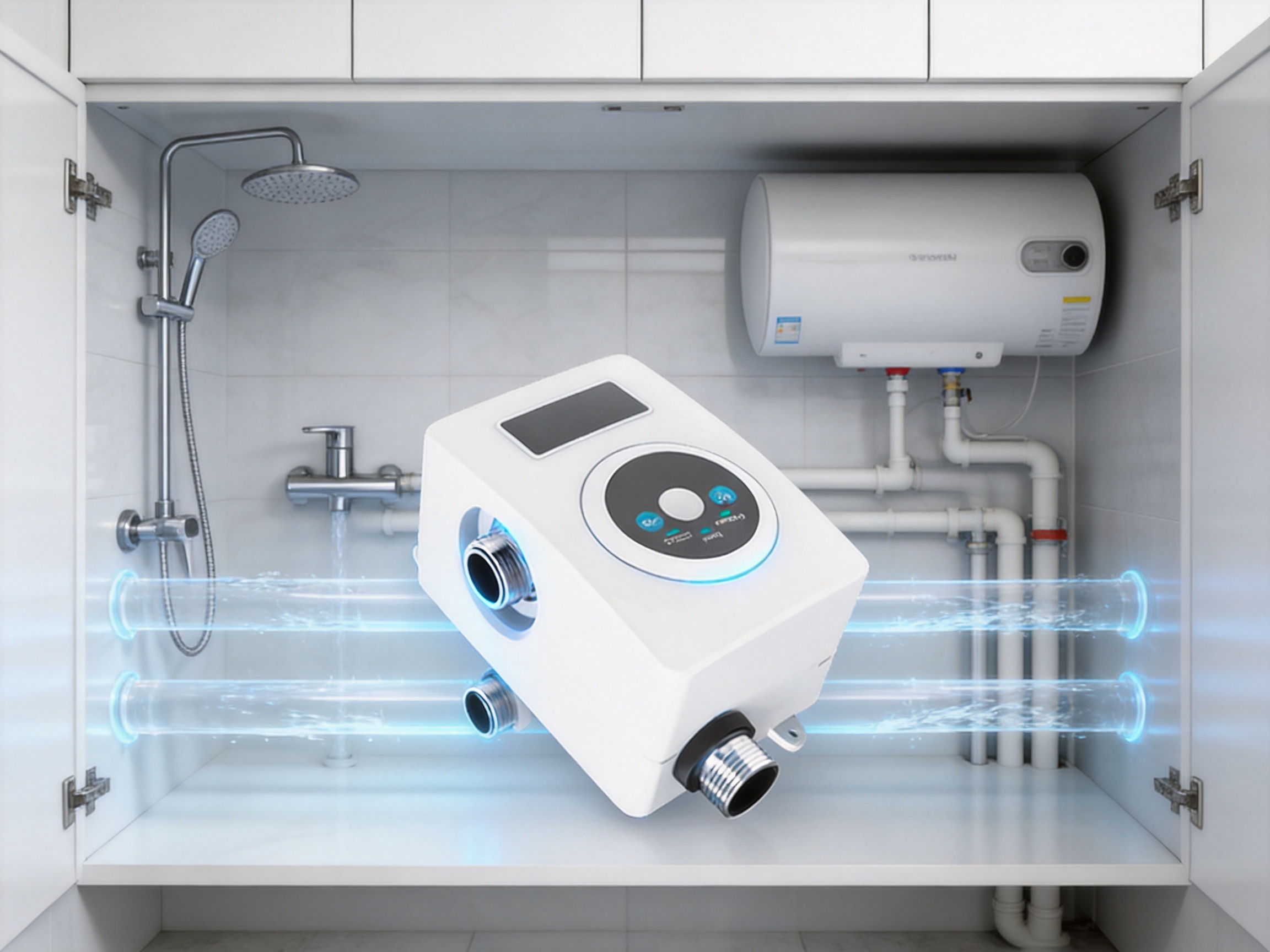
Household pumps are exposed to changing operating conditions. A storage tank may become empty, an inlet valve may be closed, a power supply may fluctuate, or a blocked outlet may increase system resistance. The SBP Series includes several protection functions to help safeguard the pump under abnormal conditions.
Water-shortage protection is designed to help prevent damage when the pump does not receive sufficient liquid. Running without adequate water can cause overheating, seal damage, unstable hydraulic performance, and accelerated wear. A protection function that detects a dry or low-water condition can reduce these risks, although the inlet system should still be designed to maintain a reliable water supply.
Overcurrent protection helps respond to excessive electrical load. Overcurrent may occur because of a mechanical obstruction, abnormal operating conditions, wiring problems, or a motor fault. Undervoltage protection helps address unstable or insufficient input voltage, which can cause poor motor performance or excessive current in some electrical systems.
The pump is specified for a duty cycle of S1, indicating continuous-duty operation when used within the applicable operating conditions. Continuous-duty capability is useful for water transfer, pressure boosting, and systems with extended demand. It does not mean the pump can operate indefinitely without correct flow, adequate cooling, or suitable liquid conditions.
The stated service life is up to 30,000 hours. Long service life depends on many factors, including water cleanliness, correct voltage, proper priming, suitable pressure, appropriate ambient temperature, correct installation, and routine inspection. Nevertheless, the combination of a permanent magnet motor, water cooling, robust polymers, ceramic shaft construction, and electronic protection provides a strong foundation for durable operation.
The SBP product family offers several performance options so that buyers can select a pump according to the required head, flow, and connection size. Maximum head describes the approximate pressure capability under specified test conditions. Maximum flow describes the highest stated flow rate, generally at low system resistance. Actual operating performance depends on the intersection between the pump curve and the system curve.
| Model | Power | Maximum Flow | Maximum Head | Inlet and Outlet | Dimensions | Net Weight |
| SBP15-A | 70 W, 0.1 HP | 23 L/min | 15 m | 1/2 inch × 1/2 inch | 178 × 160 × 95 mm | 0.67 kg |
| SBP18-A | 78 W, 0.1 HP | 23 L/min | 18 m | 1/2 inch × 1/2 inch | 178 × 160 × 95 mm | 0.67 kg |
| SBP21-A | 84 W, 0.1 HP | 30 L/min | 21 m | 3/4 inch × 3/4 inch | 178 × 160 × 95 mm | 0.67 kg |
| SBP15-B | 70 W, 0.1 HP | 23 L/min | 15 m | 1/2 inch × 1/2 inch | 178 × 160 × 95 mm | 0.68 kg |
| SBP18-B | 78 W, 0.1 HP | 23 L/min | 18 m | 1/2 inch × 1/2 inch | 178 × 160 × 95 mm | 0.68 kg |
| SBP21-B | 84 W, 0.1 HP | 30 L/min | 21 m | 3/4 inch × 3/4 inch | 178 × 160 × 95 mm | 0.68 kg |
All models use DC 24 volts and are listed for 50/60 Hz systems through the relevant input arrangement. The broader system input information identifies single-phase input ranges of 100 to 140 volts and 160 to 240 volts at 50/60 Hz. Because power-supply configurations can vary by market and package, purchasers should confirm the exact electrical arrangement before ordering.
The A and B versions have nearly identical hydraulic and electrical data, with small differences in listed net and gross weight. The model code also identifies the maximum head: for example, “15” indicates a maximum head of approximately 15 meters. The product documentation should be consulted for the specific distinction between series variants and packaging configurations.
Many conventional household booster pumps use a direct higher-voltage motor. The DC 24-volt arrangement of the SBP Series offers an alternative for applications where low-voltage safety is a priority. This is a meaningful advantage in wet rooms and compact domestic spaces, provided that the complete power-supply installation is correctly designed.
Traditional pumps may use fan-cooled motors, large induction motors, or mechanical pressure switches that create audible vibration and cycling noise. The permanent magnet motor and water-cooling structure of the SBP Series are designed to achieve approximately 20 to 30 decibels. This supports more comfortable use in homes, apartments, guest rooms, and bathroom areas.
The approximately 178 by 160 by 95 millimeter housing and less-than-one-kilogram listed net weight make the pump easier to handle and install than many larger pressure-boosting units. Compact dimensions are valuable during renovation projects, especially where cabinets, wall cavities, or utility spaces provide limited clearance.
Food-grade plastics and engineered polymer components help avoid the rust concerns associated with ordinary ferrous wet-end components. This supports cleaner water delivery and can extend component life in suitable clean-water applications.
The pressure-and-flow dual control system provides more convenient and efficient operation than a basic manual pump. The pump starts when demand is detected and stops when demand ends, reducing unnecessary runtime and improving everyday usability.
Water-shortage, overcurrent, and undervoltage protection provide a stronger safety layer than a simple motor with only an external switch. These functions help protect the equipment when the water supply or electrical conditions are not ideal.
The available head and flow options support a variety of domestic requirements, including bathroom pressure boosting, water heater support, well-water lifting, storage-tank filling, pipeline boosting, and small garden irrigation. A distributor can therefore offer several performance choices within one compact product family.
Taizhou Edwin Electric Co., Ltd. was founded in 2008 and operates as an integrated manufacturing enterprise focused on research and development, mass production, and international export. Its product portfolio includes deep-well pumps, submersible pumps, household booster pumps, circulation pumps, solar water pumps, and intelligent booster pumps.
For a product such as the SBP Series, integrated manufacturing capability is important because performance depends on the coordination of motor design, hydraulic geometry, control electronics, molded components, sealing, assembly, and final testing. A company that manages these areas through a coordinated production system can improve consistency and respond more quickly to customer requirements.
The use of engineered plastics requires accurate mold design and stable injection-molding processes. The pump body, ABS covers, PPS shield components, and PPO impeller must maintain dimensional accuracy so that clearances, sealing surfaces, and hydraulic passages remain within the intended range. Consistent molding also supports reliable assembly and helps reduce variation between production batches.
Permanent magnet motor manufacturing requires careful control of rotor balance, magnet placement, shaft alignment, winding quality, and electrical performance. The ceramic motor shaft must be produced and installed with appropriate precision because shaft runout or misalignment can increase vibration, wear, and noise. A high-speed motor operating at approximately 12,000 revolutions per minute benefits greatly from controlled balancing and accurate assembly.
The canned construction also requires careful separation between motor and fluid areas. Sealing interfaces, shield components, bearings, and wet-end clearances must be checked during production. A reliable manufacturing process reduces the risk of leakage, electrical contamination, and premature component failure.
Edwin Pump’s stated capabilities include independent research and development, mass production, order tracking, procurement planning, cross-border delivery, and foreign-trade services. These capabilities are valuable to global distributors and project buyers because successful pump supply involves more than manufacturing alone. Product selection, packaging, documentation, quality coordination, shipment scheduling, and after-sales communication all influence the total purchasing experience.
The company’s expansion into intelligent technology and new-energy products since 2018 also aligns with the SBP Series design philosophy. Low-voltage systems, smart controls, energy efficiency, and compact permanent magnet motors are increasingly important in modern water-supply equipment. Continued investment in these areas can support product improvement and broader system integration.
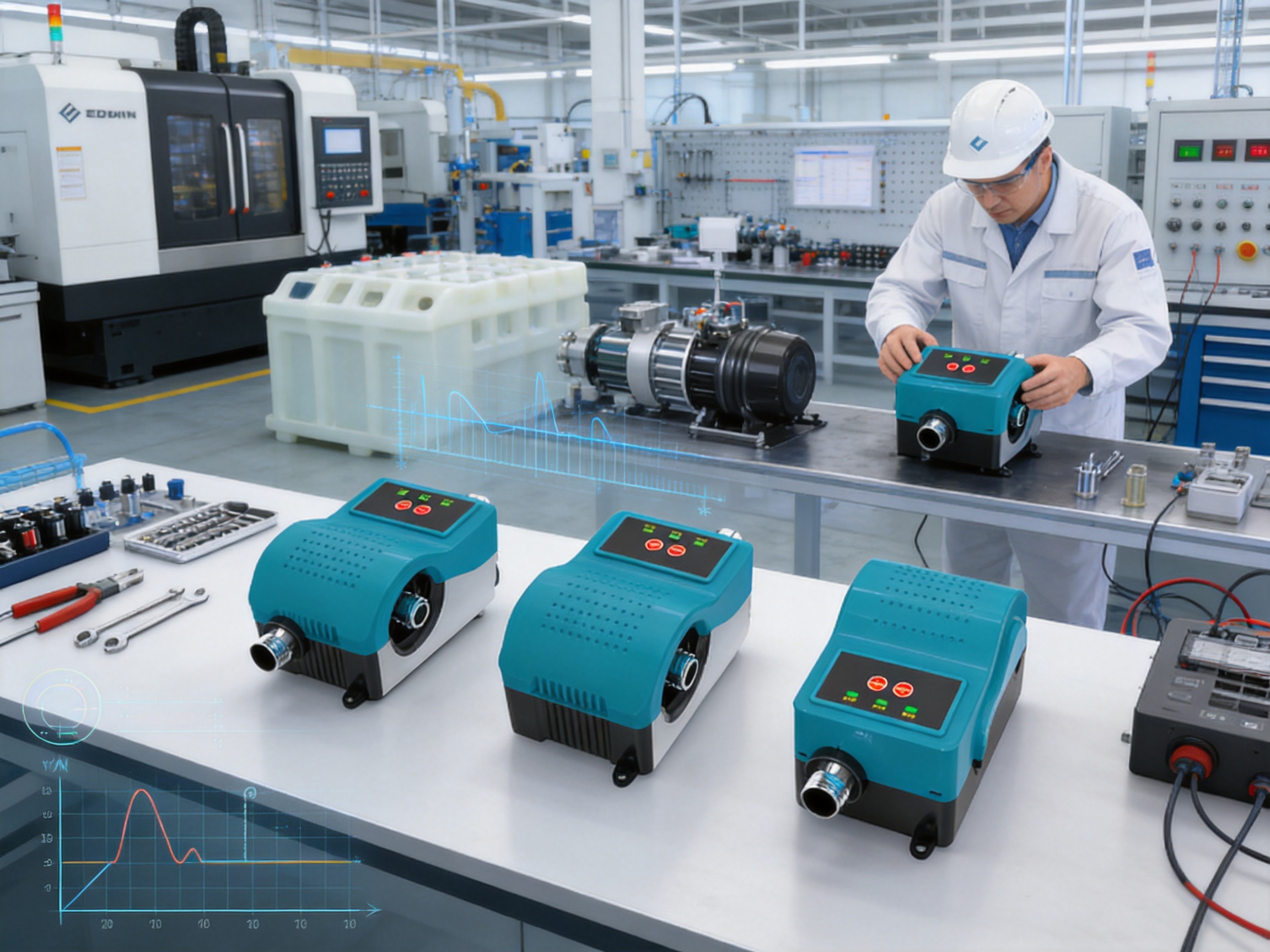
A high-quality booster pump requires testing at multiple stages rather than relying only on a final visual inspection. Incoming materials should be checked for dimensional accuracy, resin quality, electrical properties, magnet consistency, shaft condition, and compatibility with the intended production process.
During assembly, manufacturers should verify winding connections, rotor balance, impeller installation, shaft alignment, sealing condition, control-board connections, and terminal integrity. Automated or semi-automated assembly equipment can improve repeatability for high-volume components, while trained technicians remain important for process supervision and problem analysis.
Electrical testing may include insulation performance, input-current measurement, startup behavior, overload response, undervoltage behavior, and protective-function verification. Hydraulic testing may include flow, pressure, head, leakage, priming response, shutoff behavior, and automatic start-and-stop performance.
Noise and vibration checks are especially important for a pump marketed as super quiet. A production test can identify abnormal bearing noise, rotor imbalance, impeller interference, trapped air, or assembly variation before products leave the factory. Long-duration endurance testing can provide additional information about thermal performance and control stability.
For international customers, quality control should also include packaging inspection, labeling accuracy, model identification, accessory verification, and documentation review. Correct packaging protects the pump during transport, while accurate labels help installers match the product to the intended voltage, connection size, and operating conditions.
Manufacturing quality is not limited to one inspection point. It is the result of controlled materials, repeatable processes, trained personnel, documented procedures, traceability, testing, and continuous improvement. These elements are particularly important when supplying multiple markets with different installation standards and customer expectations.
Correct installation is essential for achieving the stated performance of any booster pump. Before installation, the user or installer should confirm the required flow, total dynamic head, pipe size, liquid temperature, suction conditions, voltage arrangement, and available mounting space.
The pump should be installed on a stable surface or suitable support. Pipework should be aligned with the inlet and outlet to avoid placing excessive mechanical stress on the pump body. Heavy or poorly supported pipes can transfer vibration and strain to the connections. Isolation valves may be installed to simplify future maintenance, provided they do not create an unsafe operating condition.
The inlet line should be as short and direct as practical. Excessive restrictions, undersized pipes, clogged filters, multiple sharp bends, or partially closed valves can reduce the available inlet pressure and increase the risk of cavitation or dry running. A clean inlet strainer may be useful in systems where the water supply could contain small particles, but the strainer must be maintained and should not restrict flow.
The pump must be properly primed before operation. Air inside the hydraulic chamber can prevent normal pumping, increase noise, and cause unstable pressure. The exact priming method depends on the system arrangement and the product instructions. The pump should not be allowed to operate without adequate liquid.
Electrical connections should be completed by a qualified person when required by local regulations. The correct power supply must be used, and the DC 24-volt output must match the pump specifications. The supply should include suitable protection, and cables should be routed away from sharp edges, excessive heat, and standing water.
Bathroom installations should provide drainage and should avoid locations where the pump could be submerged. IP65 protection supports resistance to dust and water jets, but it is not a substitute for proper placement. The pump should be accessible for inspection and should not be permanently enclosed without ventilation or service clearance where such clearance is required.
The SBP Series is specified for liquid temperatures from 0 to 100 degrees Celsius and ambient temperatures from approximately 4 to 55 degrees Celsius. These ranges should be respected during normal operation. The pump is intended for clean water or non-corrosive liquids without solid particles and fibers.
The maximum stated suction capability is approximately 8 meters. Actual suction performance depends on atmospheric pressure, water temperature, pipe losses, elevation, inlet design, and the condition of the water source. Suction lifts should be minimized where possible because positive inlet pressure generally provides more stable operation than a long suction line.
The insulation class is listed as Class H, and the protection rating is IP65. The duty cycle is S1 for continuous operation within the design limits. These specifications indicate a robust operating range, but they do not eliminate the need for correct system sizing.
Water containing sand, mud, fibers, abrasive particles, or corrosive chemicals can damage the impeller, shaft, seals, control components, and internal passages. Where the source water is not clean, filtration or pretreatment should be considered. The pump should not be selected for wastewater or slurry service unless the manufacturer has specifically approved that application.
The principal application is improving pressure at bathroom outlets. The pump can support showers, washbasins, toilet supply lines, and other domestic fixtures where incoming pressure is insufficient. Its compact dimensions, waterproof construction, quiet operation, and low-voltage design are well suited to this environment.
Some water heaters require adequate inlet pressure and flow to operate correctly. The SBP Series can support the supply line to a water heater when the selected model matches the required flow and pressure. The installer should verify the heater manufacturer’s minimum and maximum pressure requirements before commissioning.
The pump can be used for clean-water transfer from a source to a storage tank or water tower. Automatic control can simplify filling operations, while water-shortage protection provides an additional safeguard when the source tank level is low. A suitable float switch or independent level-control system may also be required depending on the installation.
The pump is suitable for certain clean-water well applications within its suction and performance limits. Well-water quality should be assessed before installation. Sand, iron deposits, or other suspended materials may require filtration or a different pump type.
Small garden irrigation systems can benefit from pressure boosting where the available supply is weak. The automatic demand response allows the pump to start when a hose, sprinkler, or irrigation zone is opened. The system should be designed so that the required flow does not exceed the pump’s practical operating range.
The pump can support water supply systems associated with solar energy equipment, provided that the electrical arrangement is compatible and the hydraulic requirements are within the model’s capacity. Its low-voltage DC output can be useful in systems that already include low-voltage control or energy-storage components, although a suitable power-management design is essential.
Routine maintenance begins with observation. Users should check for unusual noise, vibration, reduced pressure, frequent cycling, visible leakage, abnormal heating, or delayed startup. Early detection can prevent a minor issue from becoming a major failure.
The inlet should be kept free from blockage. If a filter or strainer is installed, it should be cleaned at appropriate intervals. Pipe connections should be checked for leakage, and valves should be confirmed to be fully open during normal operation. Any visible water around electrical components should be treated as a safety concern.
If the pump does not start, possible causes include no power, incorrect voltage, a closed valve, insufficient water, air in the system, a control-sensor issue, or a protection function that has activated. The installer should first confirm the power supply and water availability before opening the pump.
If the pump starts but provides weak pressure, the inlet may be restricted, the system may require a higher-head model, the water source may be too low, or air may remain in the pipework. The actual flow and pressure should be compared with the pump performance chart rather than evaluated only by sound or touch.
If the pump cycles repeatedly, the system may contain a leak, a faulty check valve, trapped air, an incorrectly adjusted control condition, or an outlet with very low intermittent demand. Locating and correcting the system cause is usually more effective than repeatedly resetting the pump.
When internal service is necessary, the product information indicates that maintenance can be performed relatively easily with a cross screwdriver because of the high pass rate of standard parts and the efficient assembly structure. Nevertheless, electrical power must be disconnected before service, and internal repairs should be carried out by qualified personnel.
Distributors should begin with application segmentation. The SBP15 models are appropriate where the required head is close to 15 meters or below and flow demand is moderate. The SBP18 models provide additional head capacity, while the SBP21 models offer the highest listed head and maximum flow in this family.
Connection size is another selection factor. The SBP15-A, SBP18-A, SBP15-B, and SBP18-B models use 1/2-inch inlet and outlet connections. The SBP21-A and SBP21-B models use 3/4-inch connections, supporting the higher stated maximum flow of 30 liters per minute.
Buyers should distinguish maximum values from normal operating values. A pump’s maximum flow is not necessarily available at maximum head. The selected model should be matched to the system curve, including vertical lift, pipe friction, fittings, filters, valves, and required outlet pressure.
Project purchasers should also confirm the exact voltage package, regional plug or wiring requirements, packaging configuration, documentation, spare-part availability, and quality-inspection procedures. For large orders, pre-shipment inspection and sample approval can help ensure that model labeling, accessories, and performance match the project specification.
The product family is particularly attractive for markets seeking compact, quiet, low-voltage, corrosion-resistant domestic pumps. It can help distributors differentiate their offering from basic booster pumps that provide pressure but lack smart controls, low-noise performance, or bathroom-oriented safety features.
Global customers often require more than a standard product. They may need customized packaging, multilingual labels, different power arrangements, private labeling, project-specific documentation, mixed-container loading, or coordinated delivery schedules. An integrated manufacturer is better positioned to manage these requirements because engineering, production, quality, and export functions can communicate directly.
Edwin Pump’s manufacturing and export structure supports one-stop procurement for customers purchasing several pump categories. A buyer interested in household booster pumps may also require deep-well pumps, submersible pumps, circulation pumps, solar pumps, or related water-system products. Coordinated sourcing can simplify supplier management and reduce the administrative burden of multiple separate orders.
The company’s associated procurement and import-export service capabilities are designed to support order tracking, cross-border delivery, and foreign-trade coordination. This is valuable for distributors that need predictable communication from quotation through production, inspection, shipment, and after-sales support.
Advanced manufacturing is ultimately measured by repeatable performance. For the SBP Series, that means producing a pump that starts reliably, controls demand smoothly, maintains quiet operation, withstands normal moisture exposure, and delivers consistent pressure within the selected model’s operating range. Research and development, mass production, and global service must work together to achieve that result.
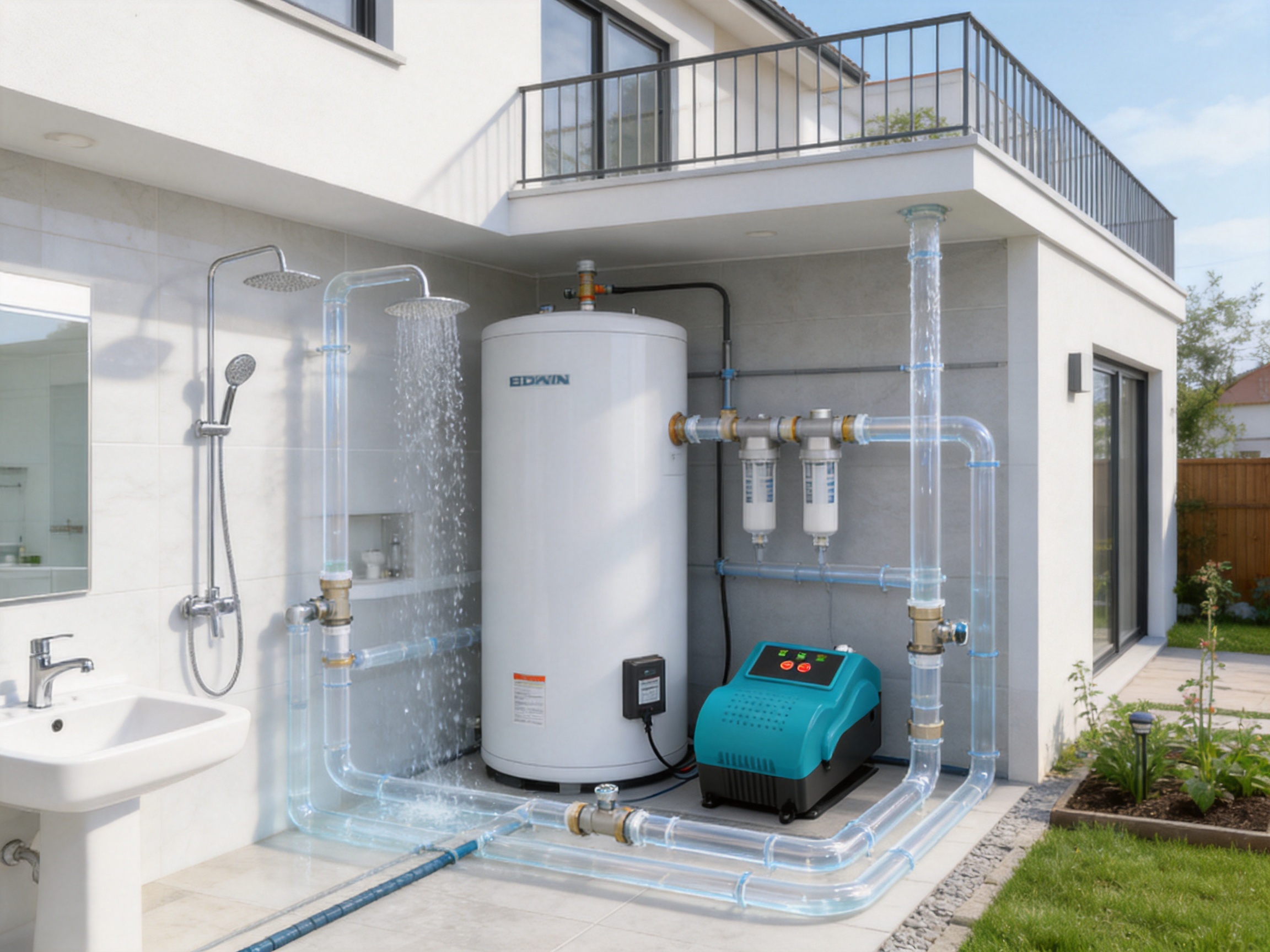
The main purpose is to increase and stabilize water pressure in household applications, especially bathrooms. It can also support water heaters, storage-tank filling, well-water lifting, garden irrigation, pipeline boosting, and clean-water transfer.
Yes, the pump is designed for bathroom-related use and has an IP65 protection rating. It should still be installed in a properly drained location, protected from immersion, and connected according to local electrical and plumbing requirements.
DC 24 volts provides a lower-voltage motor output that is useful in wet domestic environments. It can reduce electrical risk compared with higher-voltage motor arrangements, although the power supply and wiring must still be installed correctly.
The stated noise level is approximately 20 to 30 decibels. Actual sound depends on mounting, pipe alignment, air in the system, water conditions, and installation quality.
No. The dual pressure-and-flow control system is designed to detect water demand and operate automatically. It can start when an outlet is opened and stop when demand ends, reducing unnecessary runtime.
The pump is intended for clean water and non-corrosive liquids without solid particles or fibers. It should not be used for abrasive slurry, sewage, heavily contaminated water, or aggressive chemicals unless specifically approved by the manufacturer.
The listed models provide maximum heads of approximately 15, 18, or 21 meters. The SBP21 models have the highest stated head in the series. Actual pressure depends on flow, pipe losses, elevation, and the system operating point.
The SBP15 and SBP18 models are listed at up to 23 liters per minute, while the SBP21 models are listed at up to 30 liters per minute.
The listed materials include engineering plastic for the pump body, ABS plastic for the base and upper cover, PPS for the shield cover, PPO for the impeller, ferrite for the permanent magnet, and 99 ceramic for the motor shaft.
It can be used for certain clean-water well applications within the stated suction and performance limits. The maximum suction is approximately 8 meters, and the water should not contain damaging levels of sand, fibers, or suspended solids.
The pump includes water-shortage protection, overcurrent protection, and undervoltage protection. These functions help protect the motor and control system under abnormal operating conditions.
The stated service life is up to 30,000 hours when the pump is installed and operated within the specified conditions. Water quality, voltage stability, priming, temperature, and maintenance all affect actual service life.
The correct model depends on the required pressure, flow, pipe size, vertical lift, and number of simultaneous outlets. A lower-head SBP15 model may be suitable for modest demand, while an SBP18 or SBP21 model may be required for greater lift or pressure.
Yes, it can support a water-heater supply system when the selected model matches the heater’s required inlet pressure and flow. The heater manufacturer’s operating limits should always be checked before installation.
Its key differences include DC 24-volt operation, permanent magnet motor technology, water cooling without a fan, approximately 20 to 30 decibels of noise, dual pressure-and-flow control, engineered plastic fluid-contact parts, IP65 protection, and multiple electronic safeguards.
The SBP Series Smart Permanent Magnet Canned Booster Pump offers a modern solution for household water-pressure challenges. Its design combines compact dimensions, quiet operation, automatic dual control, low-voltage safety, waterproof construction, corrosion-resistant materials, and protective electronics in one integrated product family.
For bathrooms and other residential environments, the advantages are practical and easy to understand. Users receive improved water pressure without the intrusive noise associated with many conventional pumps. Installers gain a lightweight unit that can fit into restricted spaces. Distributors can offer several head and flow options with consistent dimensions and a clear application range.
The pump’s value also depends on the manufacturing capability behind it. Research and development, precision molding, permanent magnet motor assembly, hydraulic testing, electrical testing, quality control, and international supply coordination all contribute to reliable product performance. Taizhou Edwin Electric Co., Ltd. combines these capabilities with a broader product portfolio and export-service structure, supporting customers that need both individual pump models and coordinated water-system sourcing.
When correctly selected and installed, the SBP Series can provide dependable pressure boosting for bathrooms, water heaters, storage tanks, well-water systems, gardens, solar water systems, and clean-water pipelines. Its emphasis on safety, efficiency, quietness, and long service life makes it a strong option for modern residential water-supply projects and for distributors seeking a differentiated intelligent booster-pump product.
1. SBP Series Smart Permanent Magnet Canned Booster Pump Product Specification.
2. Domestic Water Pressure-Boosting System Design and Installation Principles.
3. General Principles of Pump Performance Curves, Total Dynamic Head, and Flow Selection.
4. Electrical Protection and Low-Voltage Equipment Installation Practices.
5. Materials Engineering Guidance for Engineered Plastics in Clean-Water Pump Applications.
6. General Industrial Practices for Permanent Magnet Motor Design and Testing.
7. Household Water Supply, Storage-Tank, and Booster-Pump Application Guidelines.
edwina@edwin-pump.com
+86-13586290903 (WhatsApp)
Xuri Gongliang Cutting Tool Entrepreneurship Park, Wenqiao Town, Wenling City, Taizhou City, Zhejiang Province, China

High Performance Smart Pump Factory


 English