
edwina@edwin-pump.com

View All Products
en
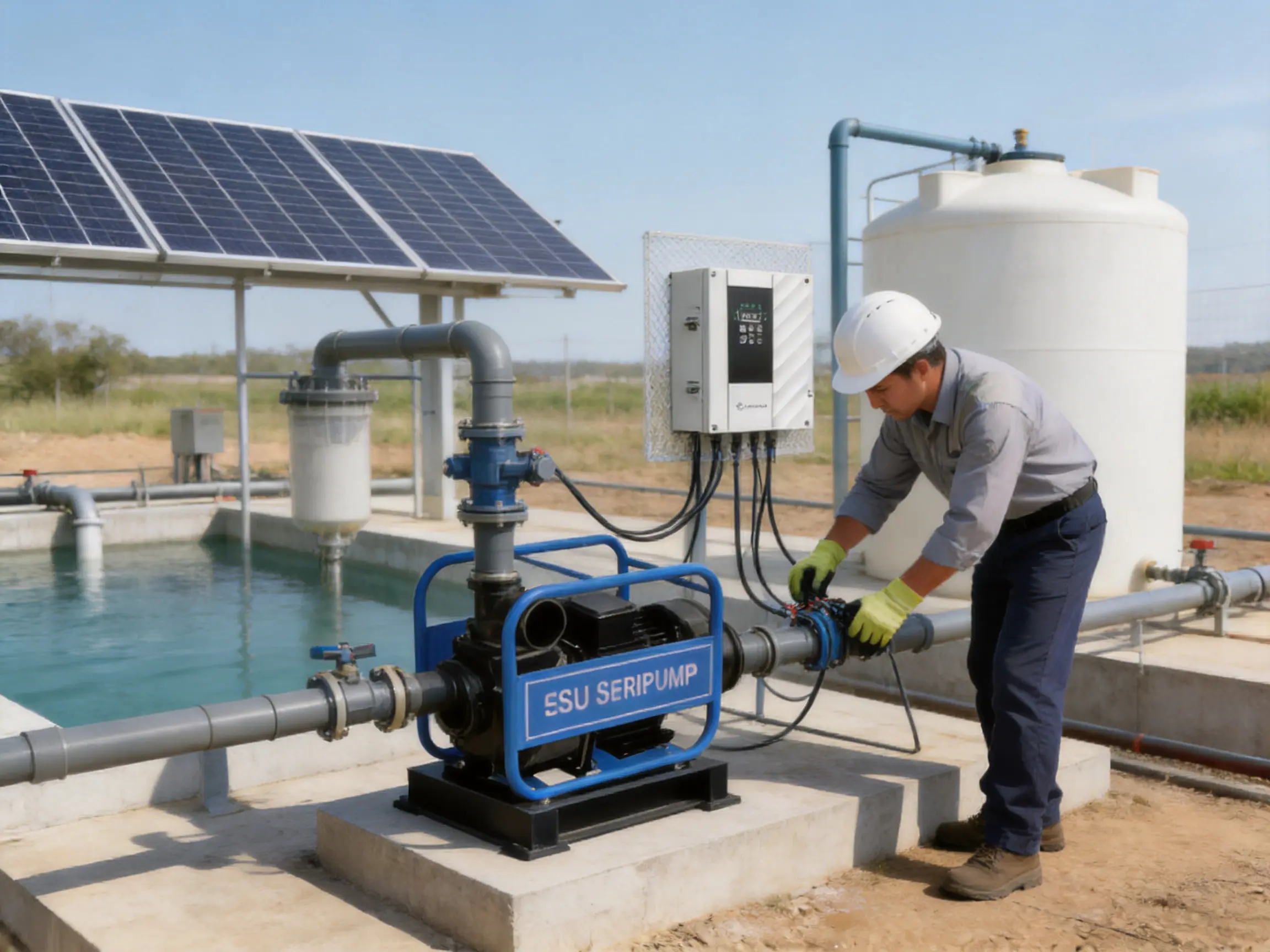
Reliable access to water is essential for homes, farms, gardens, orchards, and remote communities. In locations where grid electricity is unavailable, expensive, or unreliable, solar-powered pumping provides a practical alternative. The ESU Series Brushless DC Motor Solar Centrifugal Pump is designed for this purpose, combining a high-efficiency brushless DC motor, a centrifugal hydraulic design, compact installation, and flexible solar operation in one water supply solution.
With available models from 750 W to 1,500 W, maximum flow rates from 20 to 43 cubic meters per hour, and maximum heads from 15 to 25 meters, the ESU Series is suitable for a broad range of low- and medium-duty water transfer applications. It can support household water supply, garden irrigation, orchard watering, small farms, and off-grid projects where dependable daytime pumping is required.
Unlike conventional pumps that depend on stable alternating-current electricity or regular motor maintenance, the ESU Series is built around a brushless DC motor. This design reduces maintenance requirements, improves operating efficiency, and allows the pump to work directly with a properly configured solar power system. The result is a pumping solution that can reduce dependence on the electrical grid while supporting sustainable and economical water management.
Water pumping is one of the most common uses of electricity in residential, agricultural, and industrial environments. Traditional electric pumps can perform effectively, but their operating cost depends heavily on electricity prices, grid availability, and the distance between the electrical supply and the installation site. In rural and remote areas, extending a power line to a pump can be more expensive than the pumping equipment itself.
Solar pumping changes this economic and technical equation. Photovoltaic panels convert sunlight into electrical energy, which is then supplied to a solar-compatible pump. During daylight hours, the system can transfer water from a source to a storage tank, irrigation line, household supply system, or distribution point. The stored water can later be used when sunlight is weak or unavailable.
The ESU Series is particularly appropriate for applications that require smooth water delivery rather than extremely high pressure. Its centrifugal pump design is intended to provide continuous flow, making it useful for irrigation, tank filling, water transfer, and general solar-powered supply tasks.
A solar centrifugal pump can also reduce the environmental impact of pumping. Once the solar panels have been installed, the system uses renewable energy during operation and does not require fuel combustion. This can be valuable for farms, remote facilities, environmental projects, and communities seeking to improve water access without increasing fuel consumption.
The ESU Series Brushless DC Motor Solar Centrifugal Pump is a surface-mounted solar pump developed for water supply applications involving accessible water sources. It is categorized as a DC surface solar pump, which distinguishes it from submersible solar pumps designed to operate inside a well or reservoir.
The pump uses a brushless DC motor to drive a centrifugal hydraulic assembly. The motor receives direct-current input within the specified operating range, while the impeller converts rotational energy into water movement. The centrifugal configuration supports consistent flow and is well suited to transferring relatively large volumes of water at moderate head levels.
The available models are designed around a 110 V nominal system, with an optimum input voltage range of 110 V to 150 V DC. The solar panel open-circuit voltage must remain below 220 V. The recommended solar array power is at least 1.3 times the pump power, helping provide sufficient energy under normal sunlight conditions.
Depending on the selected model, the pump can provide a maximum flow rate between 20 and 43 cubic meters per hour. This range gives system designers flexibility when matching the pump to household, garden, agricultural, and small community requirements.
The product also includes a 0.6-meter cable and outlet sizes of either 2 inches or 3 inches, depending on the model. These connection options make it easier to select appropriate piping for different flow requirements.
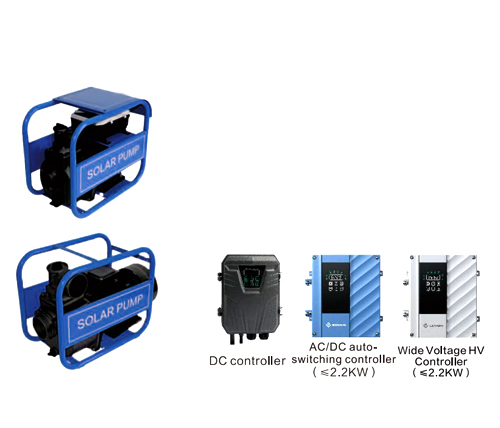
ESU Series Brushless DC Motor Solar Centrifugal Pump
One of the most important advantages of the ESU Series is its brushless DC motor. In a conventional brushed motor, carbon brushes and a mechanical commutator transfer electrical current to the rotating part of the motor. These components gradually wear during operation and may require inspection or replacement.
A brushless DC motor eliminates this mechanical brush system. Electronic control replaces the physical commutation process, allowing the motor to operate with fewer wear components. This contributes to low maintenance requirements and supports longer service life when the pump is correctly installed and operated.
The brushless design also supports efficient use of available solar energy. Solar power generation varies throughout the day because of changes in sunlight intensity, cloud cover, panel temperature, and seasonal conditions. A high-efficiency motor can make better use of the available electrical input, allowing more of the generated energy to be converted into useful hydraulic output.
For users in remote locations, the reduction in maintenance can be especially important. A conventional motor may require periodic brush replacement or service visits. The ESU Series is designed to minimize these routine interventions, reducing transportation costs and downtime for installations located far from workshops or service centers.
Another benefit is stable operation. The brushless motor is engineered for solar-powered pumping and is intended to provide dependable performance within the specified DC input range. Correct system sizing remains essential, but the motor architecture gives the pump a strong foundation for renewable-energy operation.
First, the design reduces mechanical wear associated with brushes and commutators. Second, it supports efficient electrical conversion, which is valuable when the energy source is limited to daylight. Third, it can reduce maintenance needs over the operating life of the pump. Fourth, it is well suited to automated solar systems where the pump starts and stops according to available power rather than manual switching.
These characteristics give the ESU Series an advantage over basic brushed-motor alternatives, particularly in applications where maintenance access is difficult or where the long-term cost of service must be controlled.
The centrifugal design is another key feature of the ESU Series. In a centrifugal pump, a rotating impeller transfers energy to the water. The water enters the pump, is accelerated by the impeller, and is directed toward the discharge outlet. This arrangement is widely used for water transfer because it provides smooth flow and a relatively simple mechanical structure.
For solar water supply applications, smooth flow is important. Garden irrigation, tank filling, and small-scale agricultural watering generally benefit from a continuous supply rather than irregular pulsing. The ESU Series is designed to deliver a steady flow profile suitable for these uses.
The pump range includes models with maximum heads of 15 m, 17 m, and 25 m. Maximum head refers to the highest vertical lifting capability under specified conditions. In actual installations, the available flow will depend on the required head, pipe length, pipe diameter, bends, valves, elevation changes, and other hydraulic losses.
Maximum flow should therefore not be interpreted as the flow available at every operating point. A professional system design should consider the complete duty point, including the required flow rate and total dynamic head. The performance curve supplied for the product should be consulted when selecting a model for a particular installation.
When appropriately matched to the system, centrifugal pumping can provide an effective balance between water volume, installation simplicity, and energy consumption. The ESU Series is therefore suitable for users who need practical water movement rather than high-pressure industrial service.
The ESU Series includes five listed configurations. These models use the same nominal voltage and optimum input voltage range but differ in motor power, maximum flow, maximum head, and outlet size.
| Model | Voltage | Optimum DC Input | Power | Maximum Flow | Maximum Head | Outlet | Cable | Solar Panel VOC | Recommended Solar Power |
|---|---|---|---|---|---|---|---|---|---|
| ESU20-15-110-750 | 110 V | 110–150 V | 750 W | 20 m³/h | 15 m | 2 inches | 0.6 m | Below 220 V | At least 1.3 × pump power |
| ESU23-17-110-1100 | 110 V | 110–150 V | 1,100 W | 23 m³/h | 17 m | 2 inches | 0.6 m | Below 220 V | At least 1.3 × pump power |
| ESU23-25-110-1500 | 110 V | 110–150 V | 1,500 W | 23 m³/h | 25 m | 2 inches | 0.6 m | Below 220 V | At least 1.3 × pump power |
| ESU35-15-110-1100 | 110 V | 110–150 V | 1,100 W | 35 m³/h | 15 m | 3 inches | 0.6 m | Below 220 V | At least 1.3 × pump power |
| ESU43-17-110-1500 | 110 V | 110–150 V | 1,500 W | 43 m³/h | 17 m | 3 inches | 0.6 m | Below 220 V | At least 1.3 × pump power |
The model selection illustrates the flexibility of the series. The 750 W model is appropriate for lower-volume installations, while the 1,100 W and 1,500 W models can support higher flow or greater lifting requirements. For applications requiring a 25-meter maximum head, the ESU23-25-110-1500 provides the highest listed head in the range.
Where a larger pipe connection and higher flow are priorities, the 3-inch models offer a suitable configuration. The ESU35-15-110-1100 can provide up to 35 cubic meters per hour, while the ESU43-17-110-1500 is listed with a maximum flow of 43 cubic meters per hour.
The most obvious advantage of the ESU Series is its ability to operate from a solar power system. This can reduce or eliminate the need for grid electricity during pumping hours. For remote farms, gardens, and rural homes, avoiding grid extension can significantly simplify the project.
Solar operation also protects users from certain electricity cost increases. Although the initial solar installation requires investment, the energy source itself is renewable and does not require continuous fuel purchases. The system can be particularly attractive where sunlight is abundant and water demand occurs during the day.
The brushless motor has fewer routine wear components than a brushed motor. This makes the ESU Series a practical alternative for users who want to reduce maintenance visits and spare-part requirements. It is especially valuable in remote locations where service personnel and replacement parts may not be readily available.
The centrifugal pump design provides continuous water movement. Compared with some pulsating or mechanically complex pumping arrangements, a centrifugal pump can offer a straightforward solution for tank filling and irrigation distribution.
The five listed configurations enable users to select a pump based on power, flow, head, and pipe size. This is more practical than using a single fixed model for every application. A correctly selected pump can reduce unnecessary energy consumption and help prevent the system from being oversized.
The product is described as compact and easy to install. This is useful for rooftop systems, gardens, small farms, and other locations where available equipment space is limited. A compact surface pump can also simplify access for inspection and service.
The three-year warranty demonstrates the manufacturer’s confidence in the product’s reliability and construction. A warranty does not replace correct installation or routine care, but it provides buyers with additional assurance when comparing the pump with lower-cost alternatives that may offer limited after-sales support.
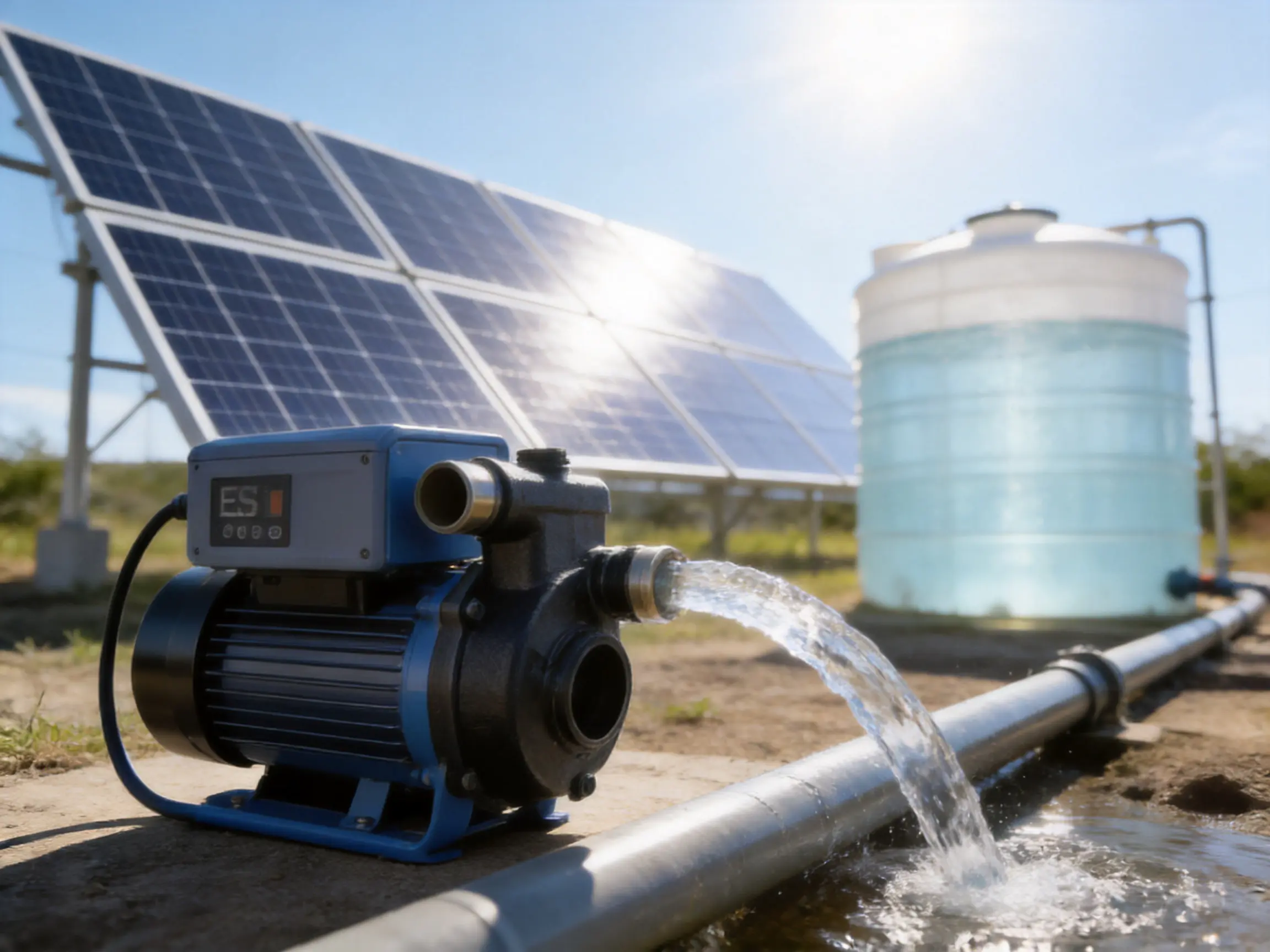
The ESU Series can be used to transfer water for households located in areas with limited grid access. A typical arrangement may draw water from a storage reservoir, surface source, or collection tank and deliver it to an elevated tank or domestic distribution point.
For household use, the installer must ensure that the water source is appropriate, the pump is protected from dry running, and the pressure and flow requirements are correctly calculated. If water must be filtered or treated for drinking, those processes should be designed separately and placed in the appropriate position in the system.
Gardens, lawns, nurseries, and landscaped areas often need regular water delivery during daylight hours. The solar operating profile of the ESU Series can align well with daytime irrigation, particularly when water is pumped directly to irrigation lines or stored in a tank for later use.
The selected model should match the number of irrigation zones, sprinkler requirements, pipe layout, and elevation. Larger outlets can help reduce flow restrictions in systems requiring higher water volume.
Small farms and orchards may require water to be moved from a pond, reservoir, collection tank, or other surface source. The ESU Series can support small-scale irrigation where a moderate head and substantial water volume are needed.
Farm operators can use a storage tank to separate pumping from irrigation. Water can be pumped when solar energy is available and distributed through drip lines, sprinklers, or field channels according to the crop schedule. This approach can improve operational flexibility and reduce the need for the pump to run during periods of weak sunlight.
Remote construction sites, environmental facilities, rural service points, and small community water systems may benefit from a solar surface pump. In these situations, the absence of a nearby electrical grid can make a conventional pump impractical.
The ESU Series can be incorporated into a larger water supply design that includes solar panels, structural supports, storage tanks, pipes, valves, filters, and control equipment. The simplicity of the brushless DC motor can support easier management in locations where technical resources are limited.
Correct solar system design is essential for reliable performance. The listed models have an optimum DC input voltage of 110 V to 150 V, and the solar panel open-circuit voltage must remain below 220 V. These values should be treated as design limits rather than general suggestions.
The solar array should provide at least 1.3 times the pump power according to the product data. For example, a 750 W pump requires a recommended solar power of at least 975 W, while a 1,500 W pump requires at least 1,950 W of solar power. Additional design margin may be considered where sunlight is variable or where seasonal conditions reduce panel output.
The open-circuit voltage of the panel string must be checked under the lowest expected temperature because photovoltaic voltage can increase in cold conditions. The installer should also consider the operating voltage under load, cable losses, panel orientation, shading, and the daily water requirement.
The pump should be installed on a stable base in a location protected from flooding, excessive dust, and accidental impact. Because this is a surface pump, the suction arrangement must be carefully designed. The suction pipe should be appropriately sized, kept as short as practical, and sealed against air leaks.
A foot valve or suitable suction arrangement may be required to maintain priming, depending on the installation design. The pump should not be operated without water unless the system is specifically designed to prevent damage from dry running. Water quality should also be considered, since abrasive particles, sand, or debris may affect hydraulic components.
Discharge piping should be selected to limit friction losses. A pipe that is too small may reduce actual flow and increase the energy required to achieve the desired result. Valves should be positioned so that the system can be isolated for maintenance. Where water is delivered to a storage tank, an appropriate level-control arrangement can help prevent overflow.
The correct pump is selected by comparing the required duty point with the performance curve. The duty point combines the desired flow rate and total dynamic head. Total dynamic head includes vertical elevation, pressure requirements, pipe friction, fittings, valves, and other losses.
For example, a pump advertised with a 20 cubic meter per hour maximum flow may not provide that flow when lifting water through a long pipe to a high tank. Similarly, a pump rated for a 25-meter maximum head may provide little or no useful flow at that extreme condition. The performance curve should therefore guide the final selection.
Professional installers should verify the electrical input, hydraulic requirements, cable sizing, protection devices, and local safety standards before commissioning the system.
The ESU Series is produced by Taizhou Edwin Electric Co., Ltd., an integrated manufacturing enterprise founded in 2008. The company’s capabilities include independent research and development, mass production, and global export. This combination is important because a reliable pump supplier must do more than assemble individual products; it must also maintain consistent product development, manufacturing, quality control, and customer support processes.
Independent research and development allows the manufacturer to build knowledge around motor technology, pump hydraulics, solar applications, and intelligent control. The company has expanded its product portfolio to include deep well pumps, submersible pumps, domestic booster pumps, circulation pumps, solar water pumps, and intelligent booster pumps.
This broad product base provides useful technical experience. Different pump categories involve different hydraulic conditions, motor arrangements, installation environments, and user requirements. Experience across these categories can support better product matching and more comprehensive procurement advice.
Mass production capability is another important strength. Solar pump projects may involve individual units, replacement orders, distributor purchases, or larger agricultural and infrastructure programs. A manufacturer with established production capacity can provide a more consistent supply than a small workshop focused only on occasional custom orders.
Integrated manufacturing also improves communication between product development, production, inspection, packaging, and export teams. When these functions operate within a coordinated business structure, customer requirements can be handled more efficiently from initial inquiry through delivery.
Although detailed factory process specifications are not provided in the product information, the manufacturing priorities for a pump of this type are clear. They include accurate motor assembly, reliable electrical connections, consistent impeller and casing production, proper sealing, dimensional control, and functional testing before shipment.
A brushless DC motor requires accurate interaction between the motor, electronic control system, rotor, stator, and pump load. Production consistency is important because variations in alignment or electrical connection quality may affect efficiency, noise, starting performance, or service life.
The hydraulic assembly also requires careful control. The impeller, casing, shaft, seals, and outlet must work together to deliver the intended flow and head. Consistent component dimensions help ensure that the pump performs in accordance with its design specifications.
Quality management should extend beyond the pump itself. Solar pump reliability depends on the compatibility of the electrical input, cable, connectors, installation instructions, packaging, and technical documentation. A complete manufacturing and support process therefore contributes to better field results.
Taizhou Edwin Electric Co., Ltd. serves customers in international markets and has developed related companies to support procurement planning, order tracking, cross-border delivery, and foreign trade services. This is a practical advantage for distributors, contractors, and industrial buyers who need more than a product quotation.
International purchasing often involves product selection, document preparation, packaging requirements, shipping coordination, customs information, and after-sales communication. A supplier with established export experience can help reduce misunderstandings and improve order visibility.
The company’s product applications extend across new energy projects, agricultural irrigation, municipal engineering, mining, construction, HVAC systems, and household water supply. This application diversity suggests a broad understanding of pump requirements across residential, commercial, and industrial environments.
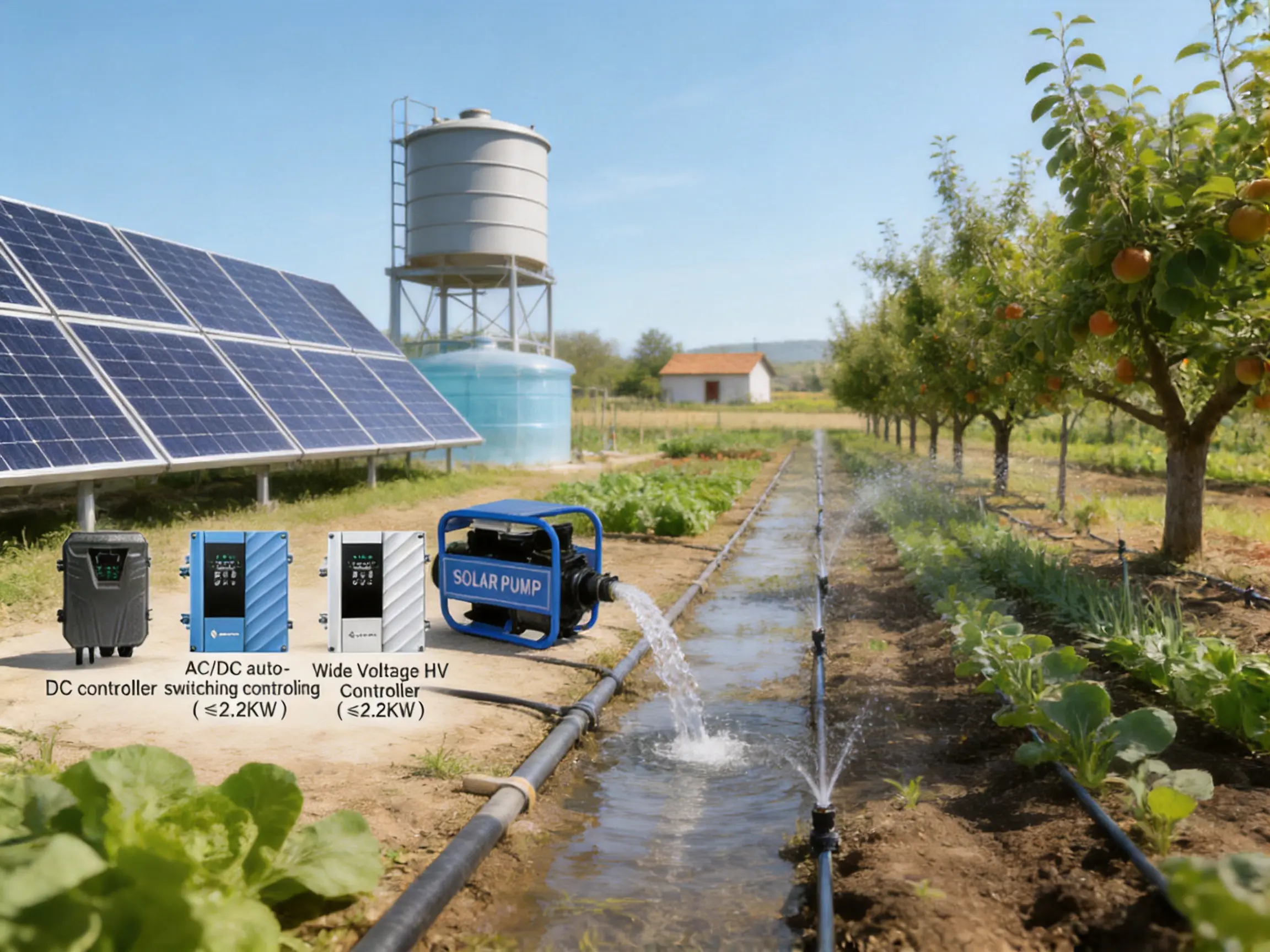
Professional buyers usually evaluate more than the initial purchase price. They consider energy consumption, expected maintenance, delivery reliability, product compatibility, warranty support, spare parts, technical documentation, and the supplier’s ability to fulfill repeat orders.
The ESU Series addresses several of these considerations. Its brushless DC motor supports reduced maintenance. Its solar compatibility helps control operating energy costs. Its five model options simplify product selection. Its three-year warranty provides a defined level of manufacturer support. Its compact format can reduce installation complexity in smaller projects.
For distributors, the product range provides several market segments within one series. A distributor can offer a lower-power model for household and garden applications, medium-power models for small farms, and higher-flow models for larger irrigation or water-transfer requirements.
For contractors, the consistent nominal voltage range may simplify solar system planning across multiple projects. The different outlet sizes and performance levels provide flexibility without requiring an entirely different product platform for every application.
For end users, the principal benefit is practical operation. The pump can convert solar energy into useful water movement without relying on fuel or a permanent grid connection. When combined with appropriate storage and controls, it can form part of a dependable water management system.
Although the brushless motor reduces routine maintenance, every pump system requires proper care. Before operation, the installer should inspect the water source, suction line, discharge line, electrical connections, and mounting base. The pump should be adequately primed where required, and the system should be checked for leaks.
During use, operators should monitor unusual vibration, abnormal noise, reduced flow, overheating, or changes in water quality. A sudden reduction in output may be caused by blocked piping, a dirty intake, insufficient solar power, air entering the suction line, excessive head, or a change in the water level.
The solar panels should be kept reasonably clean and free from shading. Dust, leaves, snow, and other obstructions can reduce energy production and lead to lower pumping performance. Electrical connectors should be protected from moisture and installed according to applicable safety requirements.
Water containing excessive sand or abrasive material should be evaluated before use. Solid particles can accelerate wear in many types of pumps, even when the motor itself requires little maintenance. Where necessary, a suitable filtration or sediment-control arrangement should be installed.
At the end of a seasonal operating period, the pump and piping should be inspected and protected against freezing or other environmental risks. Proper storage and preventive maintenance can help preserve performance and extend the useful life of the system.
The ESU Series supports the transition from fuel-based or grid-dependent pumping toward renewable-energy water supply. In locations with strong solar resources, a photovoltaic pump can deliver water with low operating emissions and limited ongoing energy expenditure.
The environmental value is especially relevant for agricultural and rural applications. Water can be moved without the direct combustion emissions associated with diesel generators. Reduced fuel transportation also lowers logistical demands in remote areas.
From an economic perspective, the main evaluation should include the complete life-cycle cost. This includes the pump, solar panels, support structure, wiring, protection devices, pipes, valves, storage, installation, maintenance, and possible replacement parts. Although solar equipment involves an initial investment, the ongoing energy source can be inexpensive after installation.
The use of a storage tank can further improve system economics. Rather than attempting to pump continuously at a fixed rate, the system can use available sunlight to fill the tank. Water can then be used according to household or irrigation demand, improving flexibility and reducing the need for energy storage batteries in many applications.
Users should begin by defining the daily water requirement. This may be expressed in liters per day or cubic meters per day. Agricultural users should account for crop type, irrigation method, seasonal conditions, and the number of irrigation zones.
Next, the water source and destination should be identified. The installer should measure the vertical elevation difference and estimate the pressure required at the delivery point. Pipe length, diameter, bends, filters, valves, and other restrictions should be included in the hydraulic calculation.
The required flow and total dynamic head can then be compared with the ESU Series performance curves. The selected pump should operate near a practical point on the curve rather than at an extreme limit. Oversizing may increase cost and energy requirements, while undersizing may result in inadequate water delivery.
The solar array should be designed around the pump’s electrical requirements. The optimum input range is 110 V to 150 V DC, the open-circuit voltage must remain below 220 V, and the solar panel power should be at least 1.3 times the pump power according to the product data.
Finally, the buyer should verify installation requirements, delivery scope, warranty terms, cable arrangements, spare parts, and after-sales support. Working with an experienced manufacturer can simplify these steps and reduce the risk of selecting incompatible equipment.
The ESU Series is a DC surface solar pump with a brushless DC motor and centrifugal hydraulic design. It is intended for surface installation rather than direct placement inside a deep well.
The listed models have a nominal voltage of 110 V and an optimum DC input range of 110 V to 150 V. The solar array must be designed so that its open-circuit voltage remains below 220 V.
The product data recommends solar panel power of at least 1.3 times the pump power. A 750 W model therefore requires at least 975 W of solar power, while a 1,500 W model requires at least 1,950 W.
Yes. The ESU Series is suitable for solar-powered household water supply when the pump, pipes, storage tank, filtration equipment, and electrical system are correctly matched to the household requirements.
Yes. Garden irrigation, landscape watering, small farm irrigation, and orchard watering are listed applications. The correct model should be selected according to the required flow, elevation, pipe losses, and irrigation method.
The listed maximum flow rates range from 20 to 43 cubic meters per hour, depending on the model. Actual flow depends on the operating head and the complete hydraulic system.
The listed models provide maximum heads from 15 to 25 meters. The highest listed head is 25 meters for the ESU23-25-110-1500 model. Actual performance should be confirmed using the product performance curve.
A brushless motor eliminates mechanical brushes that wear during operation. This supports lower maintenance, efficient operation, and stable performance in solar-powered applications.
The product information specifies solar panel operation but does not require a battery in the listed configuration. A storage tank can be used to store water pumped during daylight hours. Any battery-based system should be designed separately according to the project requirements.
The ESU Series is supplied with a three-year warranty. Buyers should confirm the detailed warranty conditions, exclusions, installation requirements, and service process before purchase.
The pump should not be operated without adequate water unless a suitable dry-run protection system is installed and approved for the application. Correct priming and water-level monitoring are important for surface pump installations.
Model selection should be based on the required flow, total dynamic head, outlet size, solar voltage, solar power, and installation conditions. The performance curve should be used rather than selecting solely by maximum flow or maximum head.
The ESU Series is manufactured by Taizhou Edwin Electric Co., Ltd., an integrated enterprise specializing in research and development, mass production, and global export of water pump products.
The ESU Series Brushless DC Motor Solar Centrifugal Pump provides a practical combination of renewable-energy compatibility, efficient motor technology, smooth centrifugal pumping, compact installation, and model flexibility. Its available power range from 750 W to 1,500 W allows it to serve household, garden, agricultural, orchard, and small community water applications.
The brushless motor reduces maintenance requirements compared with conventional brushed alternatives, while the centrifugal design supports steady water delivery. The 110 V nominal system, 110–150 V optimum input range, and solar array recommendation of at least 1.3 times pump power provide clear starting points for electrical system design.
Its three-year warranty, broad application range, and manufacturer’s experience in independent research and development, mass production, and international export add value for both end users and professional buyers. The company’s wider product portfolio and experience in solar, domestic, agricultural, municipal, construction, mining, HVAC, and household applications further support its role as a comprehensive pump supplier.
For the best results, the ESU Series should be selected according to the complete duty point rather than a single headline specification. Proper solar sizing, hydraulic calculation, installation, protection, and maintenance are essential. When these factors are addressed, the pump can provide dependable solar-powered water movement while helping users reduce dependence on grid electricity and fossil fuels.
1. ESU Series Brushless DC Motor Solar Centrifugal Pump Product Performance Data, manufacturer-supplied technical information.
2. Manufacturer product information for DC surface solar pumps, solar water pumping applications, and performance selection.
3. General principles of centrifugal pump operation, hydraulic head calculation, and water system design.
4. General photovoltaic system design principles for DC motor loads, voltage matching, and solar array sizing.
5. General guidance on agricultural irrigation, household water supply, and off-grid water infrastructure planning.
6. Manufacturer company information concerning research and development, mass production, global export, and pump application sectors.
edwina@edwin-pump.com
+86-13586290903 (WhatsApp)
Xuri Gongliang Cutting Tool Entrepreneurship Park, Wenqiao Town, Wenling City, Taizhou City, Zhejiang Province, China

High Performance Smart Pump Factory


 English
