edwina@edwin-pump.com

View All Products
en
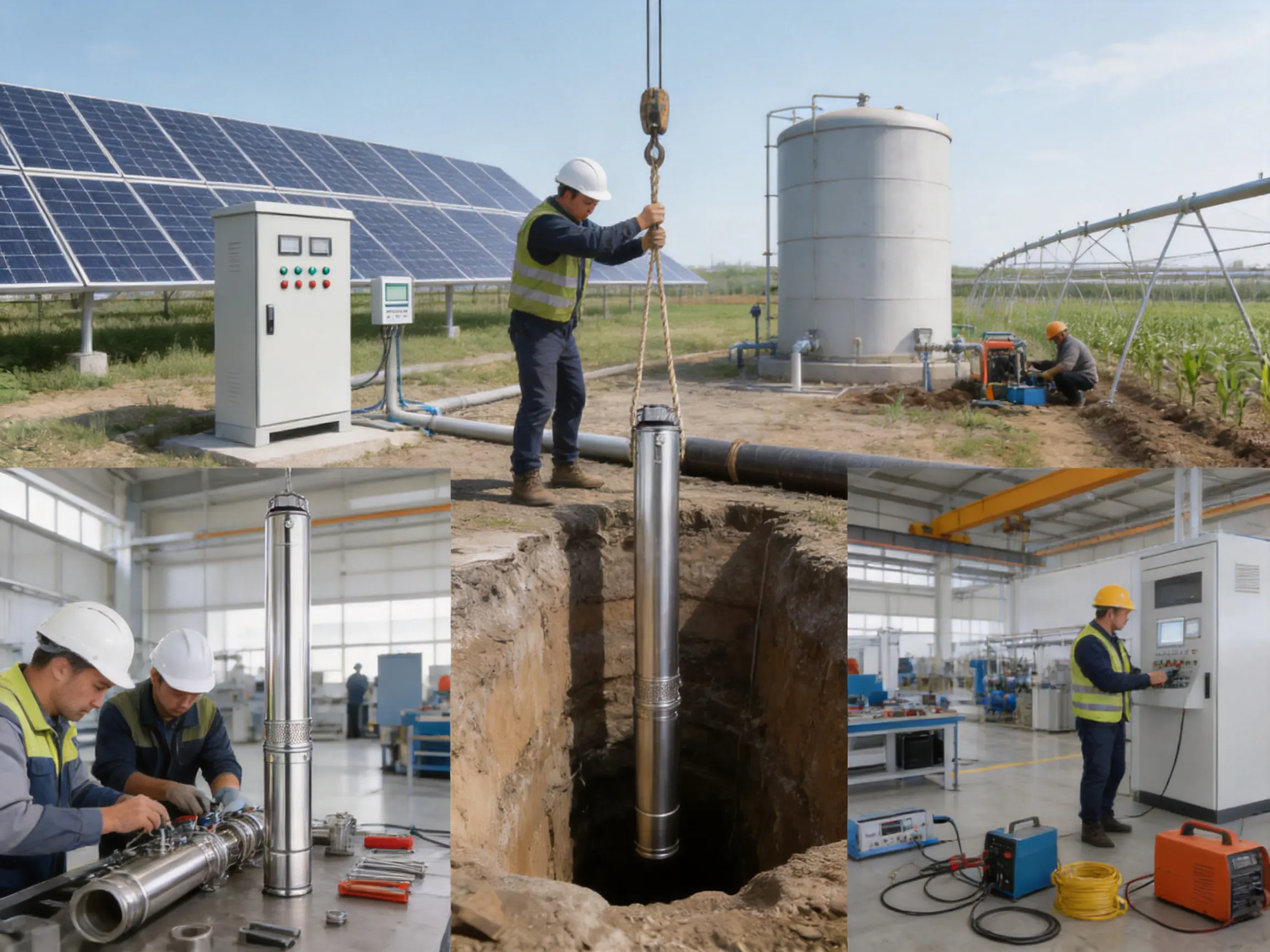
Reliable access to water is essential for agricultural irrigation, livestock production, rural communities, construction sites, mining operations, and many off-grid installations. In locations where grid electricity is unavailable, unstable, or expensive to extend, solar pumping provides a practical alternative. The 4ESC solar submersible borehole pump is designed for these demanding conditions, combining deep-well pumping capability, high lifting performance, multiple flow options, and compatibility with solar-powered water systems.
Unlike surface pumps that must remain close to the water source, a submersible borehole pump operates inside the well. This arrangement allows the pump to push water upward from significant depths while reducing priming problems, suction limitations, and exposure to weather. The 4ESC series is offered in 1,500 watt, 2,200 watt, and 3,000 watt configurations, with maximum heads ranging from 49 meters to 250 meters and maximum flow rates from 3 cubic meters per hour to 17 cubic meters per hour.
The product is manufactured by Taizhou Edwin Electric Co., Ltd., an established Chinese pump manufacturer founded in 2008. The company focuses on independent research and development, mass production, export services, and the manufacture of deep well pumps, submersible pumps, booster pumps, circulation pumps, and solar water pumps. Its broader experience in water movement and water treatment equipment supports the development of pumping solutions for agriculture, municipal projects, new energy systems, construction, mining, HVAC applications, and household water supply.
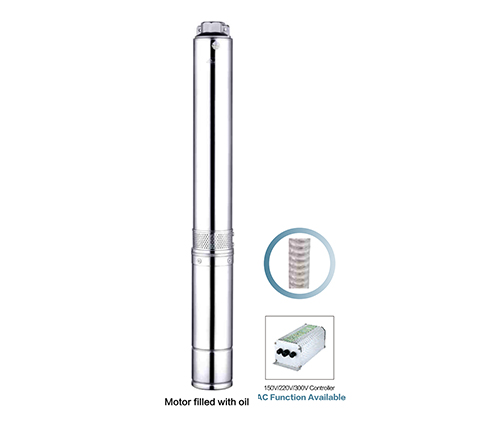
4ESSC Solar submersible borehole pump
The 4ESC is a solar submersible borehole pump intended for installation in wells and boreholes with a minimum internal diameter of approximately four inches. Its compact cylindrical design allows it to fit into standard four-inch well casings, making it suitable for new borehole projects as well as many existing water wells.
The principal performance variables are voltage, motor power, flow rate, pumping head, outlet size, and pump diameter. Three power groups are available:
Power Group |
Voltage |
Rated Power |
Maximum Flow Range |
Maximum Head Range |
1500 watt group |
150 V |
1500 W |
3 to 15 m³/h |
49 to 155 m |
2200 watt group |
220 V |
2200 W |
3.5 to 16 m³/h |
68 to 215 m |
3000 watt group |
300 V |
3000 W |
4 to 17 m³/h |
85 to 250 m |
Within each power group, different hydraulic models are available. Lower-flow models are designed to reach greater heights, while higher-flow models provide more water at moderate lifting distances. This selection makes it possible to match the pump to the well depth, required delivery rate, irrigation method, storage-tank elevation, and solar system capacity.
The pump has a four-inch diameter in all listed configurations. Outlet sizes are either 1.25 inches or 2 inches, depending on the hydraulic model. The smaller outlet options are generally associated with high-head, lower-flow designs, while the two-inch outlet options support larger water volumes.
The 4ESC series can be used in solar-powered water supply systems for:
Agricultural irrigation in remote fields and farms.
Water delivery to elevated storage tanks.
Drinking-water supply projects in areas without reliable grid power.
Livestock watering systems.
Greenhouses and horticultural installations.
Small-scale municipal and community water projects.
Construction-site water supply.
Mining and industrial water transfer applications where the operating conditions are suitable.
Emergency or temporary water systems powered by photovoltaic equipment.
Solar water pumping is especially valuable where water must be lifted from a deep borehole but the available electrical infrastructure is limited. By using photovoltaic energy during daylight hours and storing water in a tank, the system can continue supplying users even when the pump is not operating at night.
Choosing a solar borehole pump requires more than selecting the highest available head or flow figure. The correct model must operate near the actual duty point, which is the combination of flow and total dynamic head required by the installation. Total dynamic head includes the vertical distance from the pumping water level to the discharge point, pipe friction, fittings, valves, and any pressure needed at the point of use.
The performance information for the 4ESC series shows that head decreases as flow increases. This is normal for centrifugal and multistage pump hydraulics. The maximum head is measured at or near zero flow, while the maximum flow is achieved at a much lower head. A system designer should therefore avoid treating the maximum head and maximum flow as simultaneously available values.
The 1500 watt group is designed for systems requiring moderate power consumption and a broad range of lifting performance. The available models include high-head versions such as the 4ESC3-155-150/1500, which has a maximum flow rate of 3 cubic meters per hour and a maximum head of 155 meters.
The 4ESC5-130-150/1500 provides up to 5 cubic meters per hour and a maximum head of 130 meters. This model may suit applications that need a balance between vertical lift and useful daily water volume.
For higher flow requirements, the 4ESC8-95-150/1500, 4ESC13-75-150/1500, and 4ESC15-49-150/1500 models provide maximum flow rates of 8, 13, and 15 cubic meters per hour respectively. Their maximum heads are 95, 75, and 49 meters.
Model |
Voltage |
Power |
Maximum Flow |
Maximum Head |
Outlet |
4ESC3-155-150/1500 |
150 V |
1500 W |
3 m³/h |
155 m |
1.25 inch |
4ESC5-130-150/1500 |
150 V |
1500 W |
5 m³/h |
130 m |
1.25 inch |
4ESC8-95-150/1500 |
150 V |
1500 W |
8 m³/h |
95 m |
2 inch |
4ESC13-75-150/1500 |
150 V |
1500 W |
13 m³/h |
75 m |
2 inch |
4ESC15-49-150/1500 |
150 V |
1500 W |
15 m³/h |
49 m |
2 inch |
The 2200 watt group is intended for higher lifting duties or greater water delivery. The 4ESC3.5-215-220/2200 reaches a maximum head of 215 meters at a maximum flow rate of 3.5 cubic meters per hour. This configuration is appropriate for deep boreholes or elevated discharge points where the required volume is relatively moderate.
The 4ESC5.5-160-220/2200 offers a maximum flow of 5.5 cubic meters per hour and a maximum head of 160 meters. The 4ESC8-117-220/2200 offers up to 8 cubic meters per hour and 117 meters of head.
For systems requiring larger water volumes, the 4ESC14-83-220/2200 and 4ESC16-68-220/2200 models provide maximum flow rates of 14 and 16 cubic meters per hour, with maximum heads of 83 and 68 meters respectively.
The 3000 watt group is the highest-power range listed for the series. It is designed for demanding water supply projects that require either a high vertical lift or substantial flow. The 4ESC4-250-300/3000 reaches a maximum head of 250 meters at a maximum flow of 4 cubic meters per hour, making it the highest-head model in the published range.
The 4ESC5-225-300/3000 provides up to 5 cubic meters per hour and 225 meters of head. These high-head models are useful when water must be lifted from deep wells or delivered to elevated reservoirs.
The 4ESC8-140-300/3000, 4ESC14-112-300/3000, and 4ESC17-85-300/3000 models focus progressively more on flow capacity. Their maximum flow rates are 8, 14, and 17 cubic meters per hour, while the maximum heads are 140, 112, and 85 meters.
The 4ESC series offers several practical advantages compared with common surface-pump arrangements and less specialized solar pumping equipment. These advantages relate to installation location, borehole performance, model flexibility, energy integration, and system scalability.
A surface pump must draw water through a suction line. Atmospheric pressure limits the practical suction lift of a surface pump, and performance can deteriorate because of air leakage, insufficient priming, or excessive suction-line friction. A submersible pump avoids these limitations by being placed below the water level and pushing water through the discharge pipe.
This configuration is especially important for deep wells. The pump can operate at the water source and use its available pressure to raise water to the surface. It also reduces the need for a large surface pump shelter and protects the main pumping unit from direct exposure to rain, dust, and accidental impact.
Reaching up to 250 meters of maximum head in a four-inch pump format gives the 4ESC series a strong position for deep-water applications. Many basic solar pumps are optimized for low-head irrigation or shallow water transfer. They may not provide the pressure required for deep boreholes, long discharge pipelines, or elevated tanks.
The high-head configurations of the 4ESC range allow project planners to address challenging vertical-lift requirements without moving to a much larger borehole diameter. This can lower drilling constraints and simplify the use of existing four-inch wells, provided that the well casing and water conditions are suitable.
A major advantage of the series is the number of hydraulic options available within three power classes. The product range does not force every customer to use one general-purpose pump. Instead, users can select a high-head, medium-flow, or high-flow model according to actual site conditions.
For example, a remote home with a deep well and a small daily demand may need a 3 cubic meter per hour high-head model. A farm irrigating several zones may benefit from a 13, 15, 16, or 17 cubic meter per hour model if the borehole yield and solar array can support the demand. Matching the pump more closely to the system can improve operating efficiency and help reduce unnecessary energy consumption.
Solar pumping systems can be designed to operate when sunlight is available and store water rather than electricity. This approach is often more economical than installing a large battery bank. The 4ESC pump can form the pumping core of such a system, transferring water from a borehole to a storage tank during daylight hours.
Stored water can then be used for irrigation, livestock, household service, or other applications according to demand. This method reduces dependence on batteries, limits battery replacement costs, and allows the system to make direct use of renewable energy.
Compared with diesel-powered borehole pumps, a solar submersible pump can reduce fuel transportation, engine servicing, exhaust emissions, and noise. Compared with a grid-powered pump, it can be deployed in areas where power lines are unavailable or where electricity prices make water pumping expensive.
The actual financial benefit depends on sunlight, system design, water demand, pump duty point, installation quality, and local energy costs. Nevertheless, the elimination or reduction of recurring fuel and electricity expenses is one of the principal reasons for selecting solar pumping technology.
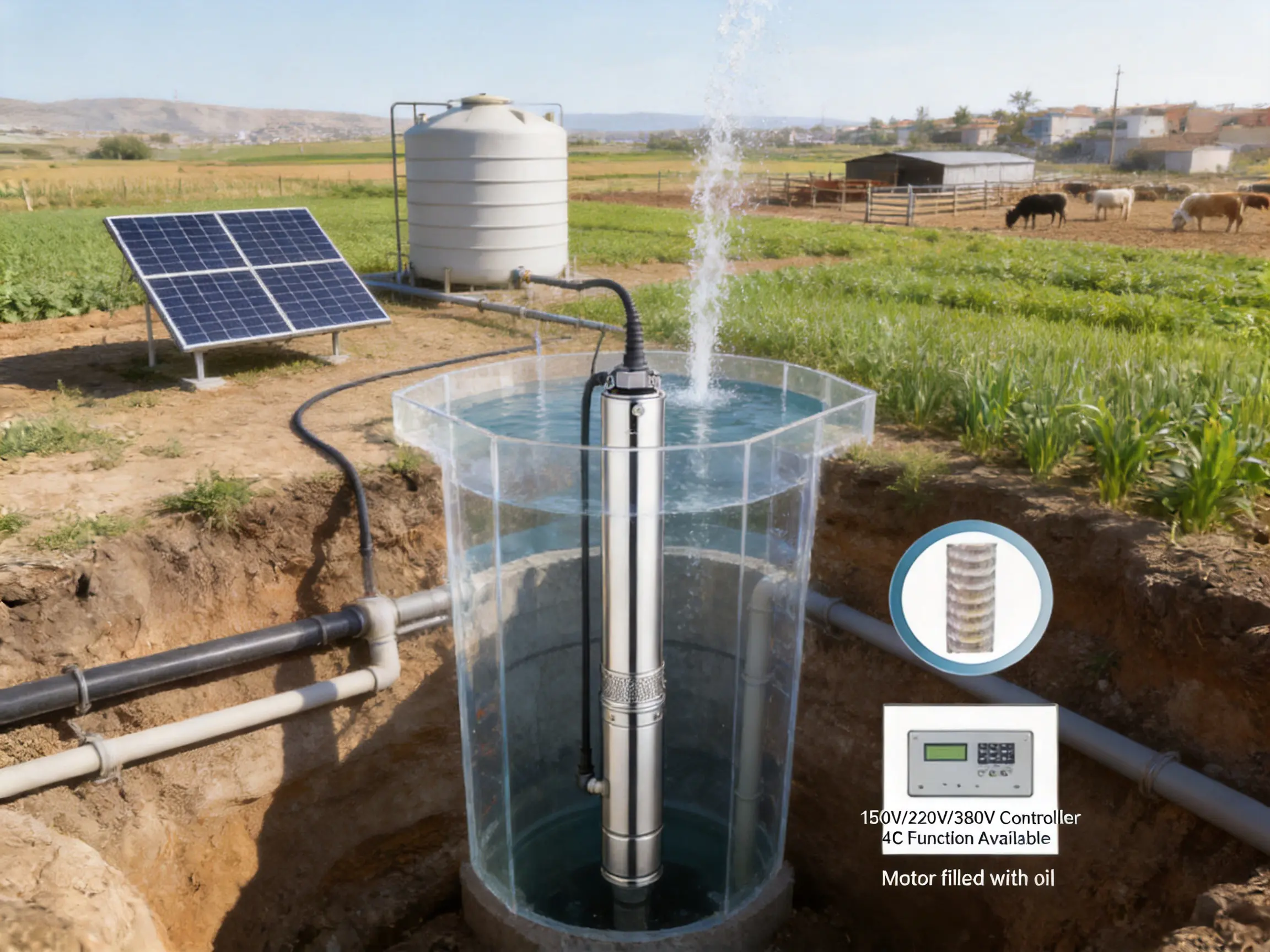
The performance data supplied for the 4ESC range demonstrates the relationship between flow and head. At zero flow, the pump produces its highest pressure head. As water flow increases, the available head declines. This operating curve should be considered when selecting pipe size and determining the expected delivery point.
For instance, the 4ESC8-95-150/1500 model is listed with a head of 95 meters at zero flow, approximately 80 meters at 2 cubic meters per hour, approximately 60 meters at 4 cubic meters per hour, approximately 37 meters at 6 cubic meters per hour, and approximately 2 meters at 8 cubic meters per hour. This information indicates that the pump is not intended to deliver its maximum flow against its maximum head.
Similarly, the 4ESC17-85-300/3000 model is listed with approximately 79 meters of head at 2 cubic meters per hour, 72 meters at 4 cubic meters per hour, 65 meters at 6 cubic meters per hour, 57 meters at 8 cubic meters per hour, 47 meters at 10 cubic meters per hour, 35 meters at 12 cubic meters per hour, 22 meters at 14 cubic meters per hour, and approximately 2 meters at 16 cubic meters per hour. This type of data helps designers estimate the pump's behavior under different flow conditions.
Total dynamic head is calculated from several components. The first is static lift, which is the vertical distance between the pumping water level and the discharge point. The second is pressure head, which may be required for sprinklers, drip-irrigation equipment, household fixtures, or industrial processes. The third is friction loss in the rising pipe, horizontal pipeline, elbows, check valves, filters, and other fittings.
Water levels can change during pumping. The static water level before operation may be significantly higher than the dynamic water level while the pump is running. A professional design should consider the lowest expected pumping level rather than relying only on a short-term water-level measurement.
Pipe selection is also important. An undersized pipe increases friction and can reduce the delivered flow. A correctly sized discharge line allows the pump to operate closer to its intended duty point and reduces the energy wasted overcoming avoidable resistance.
Agricultural users should calculate the required daily water volume and the available solar operating period. A pump that delivers 8 cubic meters per hour for six effective pumping hours can theoretically transfer 48 cubic meters per day before accounting for solar variation, water-level changes, controller behavior, and system losses.
Higher flow is not always better. If the borehole produces water slowly, excessive pumping may lower the water level, introduce sediment, or cause the well to run dry. The borehole yield should therefore be tested and compared with the selected pump's flow range.
For drip irrigation, water may be pumped into a storage tank and distributed through a separate pressure system. For open-channel or low-pressure irrigation, a larger flow model may be more appropriate. The final selection should reflect crop requirements, irrigation scheduling, available sunlight, storage capacity, and well recovery rate.
A solar submersible pump is only one part of a complete water pumping system. Reliable operation depends on correct coordination between the pump, solar panels, controller, cables, protection devices, water-level sensors, pipework, and storage arrangement.
The photovoltaic array must provide suitable voltage and power under real operating conditions. Solar panels rarely deliver their rated output throughout the day. Temperature, cloud cover, dust, shading, panel orientation, cable losses, and seasonal changes all affect available energy.
The array should be sized with the pump's electrical requirements and the expected daily water target in mind. A system designed only around the nameplate power may perform poorly during early morning, late afternoon, winter conditions, or periods of cloud cover.
A controller is normally required to manage the electrical relationship between the photovoltaic array and the pump motor. Depending on the system design, the controller may regulate voltage, convert power, provide soft starting, protect against overload, and respond to dry-run or low-water conditions.
The voltage information for the 4ESC models should be carefully matched to the selected controller and solar array. The 1500 watt group is listed at 150 volts, the 2200 watt group at 220 volts, and the 3000 watt group at 300 volts. System integrators should confirm the exact electrical requirements, operating range, current characteristics, wiring configuration, and controller compatibility before installation.
One of the most effective ways to use a solar borehole pump is to pump water into an elevated tank. The tank acts as a form of energy storage. Water can be used after sunset or during periods of low solar production without requiring the pump to operate continuously.
This arrangement can be particularly useful for livestock systems, village water points, greenhouse irrigation, and household supply. A float switch or level sensor can stop the pump when the tank is full, while a low-water sensor can prevent the pump from operating when the borehole water level falls below a safe limit.
A complete system should include suitable electrical protection, including isolation equipment, grounding, overcurrent protection, surge protection where appropriate, and protection against abnormal operating conditions. The installation should comply with applicable local electrical and water-safety requirements.
Mechanical protection is also important. A check valve can help prevent reverse flow and reduce water hammer. The discharge pipe should be supported independently where necessary so that its weight is not carried by the pump cable or motor connection. The pump should be suspended using appropriate equipment rather than lowered by the electrical cable.
The manufacturer of the 4ESC series, Taizhou Edwin Electric Co., Ltd., was founded in 2008 and operates as an integrated manufacturing enterprise. Its stated capabilities include independent research and development, mass production, and global export. This combination is important for international buyers that need more than a single product shipment.
Independent research and development can help a manufacturer adapt hydraulic structures, motor systems, solar-pump configurations, and control requirements to changing market needs. It also allows the company to develop related products rather than relying exclusively on third-party designs.
Mass-production capability supports repeatability and supply continuity. For distributors, engineering contractors, and project buyers, consistent production is valuable because replacement units and additional systems must be compatible with earlier installations. A broad model family also helps reduce the need to source every pump type from a different supplier.
The manufacturer's product portfolio includes deep well pumps, submersible pumps, domestic booster pumps, circulation pumps, solar water pumps, intelligent booster pumps, and other water-pumping equipment. Experience across these categories provides a broader understanding of pressure management, water transfer, domestic supply, agricultural applications, and system integration.
The listed product categories also include surface pumps, garden pumps, pool and spa pumps, commercial multistage pumps, end-suction pumps, pipes and valves, and pump accessories. This range supports one-stop procurement for customers that need pumps and related components for a complete water system.
Since 2018, the company has invested in new energy and intelligent technology, including solar water pumps and intelligent booster pumps. This direction reflects the changing requirements of the global water industry. Customers increasingly seek equipment that can operate with renewable energy, reduce operating expenses, monitor system conditions, and respond efficiently to variable demand.
Solar pumping requires knowledge of both hydraulic and electrical behavior. The available sunlight is variable, while the pump's hydraulic demand changes with flow and head. A manufacturer with experience in conventional pumps and solar pumping can better understand the relationship between motor selection, hydraulic stages, controller matching, and field performance.
To support international purchasing, the company established Taizhou Haipai Import and Export Co., Ltd. and Golden Falcon Industrial Co., Ltd. in 2012. These organizations provide procurement planning, order tracking, cross-border delivery, and foreign-trade services according to the supplied company information.
For overseas customers, export capability can simplify communication, documentation, production scheduling, packaging, and delivery coordination. It is particularly useful for distributors and contractors that manage several product categories or serve multiple installation markets.
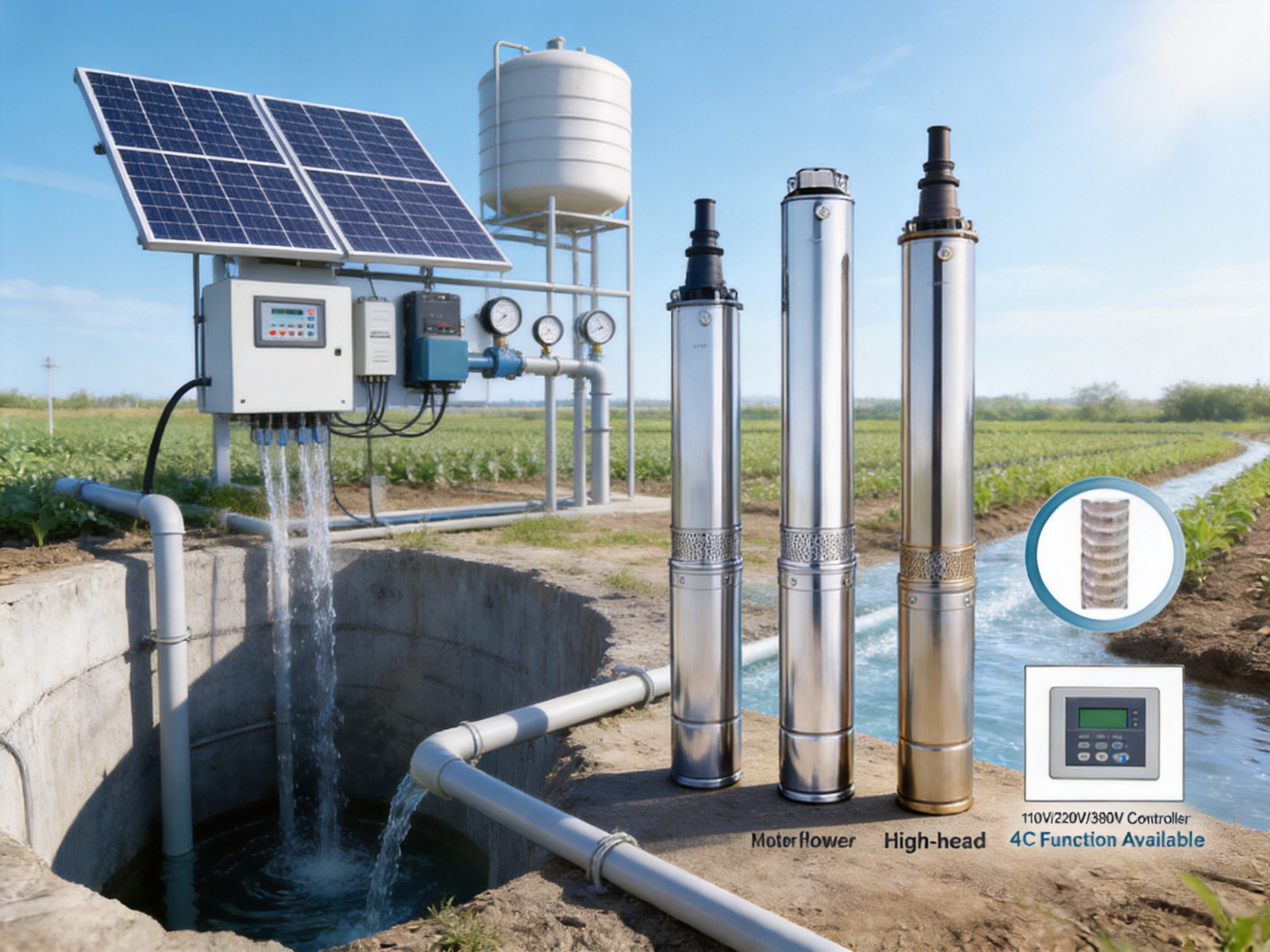
A high-performance borehole pump depends on the coordinated quality of its motor, hydraulic components, seals, cable connection, fasteners, and protective structure. Manufacturing quality is not limited to the final assembly. It begins with design and material selection and continues through machining, component inspection, assembly, electrical testing, hydraulic verification, packaging, and after-sales support.
The first stage is the development of a hydraulic and motor configuration for the intended operating range. The 4ESC series is divided into multiple model families so that pump performance can be adjusted to different combinations of flow and head. This approach is more useful than applying one pump design to every installation.
Engineering teams must consider the external diameter, outlet size, motor power, operating voltage, internal hydraulic stages, and expected pressure. The four-inch diameter provides a compact form for borehole installation, while the different outlet sizes accommodate both lower-flow high-head operation and higher-flow water delivery.
Mass production requires controlled assembly procedures so that each pump is built according to the specified configuration. Correct alignment of rotating parts, secure fastening, suitable sealing, and proper cable connection are essential for dependable submersible operation.
Because the pump operates underwater, the integrity of the motor and cable entry is especially important. Assembly personnel must ensure that sealing surfaces are clean and correctly fitted. The final product should be handled carefully to avoid impact damage to the casing, outlet, cable, or electrical connection.
Electrical testing can identify problems involving insulation, current draw, wiring, motor continuity, and abnormal resistance. Performance testing helps confirm that the pump can achieve its intended relationship between flow and head within the specified operating range.
Testing procedures should be applied consistently across production batches. For international buyers, it is appropriate to request product test records, inspection standards, wiring information, operating instructions, and confirmation of the required model before shipment.
Traceability helps connect a finished pump to its production batch, model specification, inspection status, and shipment information. This is valuable for distributors managing inventories and for contractors supporting equipment after installation.
When purchasing in volume, buyers can request consistent nameplate information, packaging marks, spare-parts availability, and documentation. These details support easier installation and reduce confusion when several similar pump models are used in the same project.
Correct installation is essential for achieving the expected service life and performance of a solar submersible borehole pump. The following guidelines provide general planning principles. Site-specific work should be carried out by qualified personnel in accordance with local regulations and the manufacturer's technical instructions.
The internal diameter and straightness of the borehole should be checked before lowering the pump. The listed pump diameter is four inches, so the borehole must provide adequate clearance for safe installation and removal. A well that is damaged, constricted, or filled with sediment may prevent correct placement.
The well should also be tested for yield, water quality, static water level, dynamic water level, and recovery rate. Sand, abrasive particles, corrosive water, or excessive mineral content can affect pump components and should be considered during equipment selection.
The pump should be installed below the lowest expected dynamic water level while remaining clear of the bottom of the borehole. Installing too close to the bottom may increase the risk of drawing in sediment. Installing too high may allow the pump to run dry when the water level falls.
The final depth should account for seasonal changes and the expected pumping rate. A water-level sensor or dry-run protection device can provide additional protection when the borehole yield is variable.
The rising pipe should be selected according to flow, head, water quality, temperature, and installation depth. All joints must be sealed and mechanically secure. The pump cable should be fastened to the rising pipe at suitable intervals using appropriate cable supports, while avoiding sharp edges or excessive compression.
The pump must not be lowered, suspended, or retrieved by pulling on the electrical cable. A suitable lifting rope, pipe support, or wellhead arrangement should carry the mechanical load.
The controller and protection devices should be mounted in a dry, ventilated, and accessible location. Cable lengths and voltage drop must be considered, particularly in systems where the solar array and well are separated by a significant distance.
All electrical connections should be protected against moisture. Grounding and surge protection should be provided where required. Before starting the pump, installers should verify polarity, voltage, insulation, cable continuity, protective settings, and controller configuration.
During commissioning, the system should be started at a controlled flow and observed for abnormal noise, vibration, current, discharge pressure, water clarity, and water-level behavior. Initial water may contain sediment after drilling or maintenance, so the system should be flushed according to the well contractor's recommendations.
The actual operating point should be compared with the design duty point. If the pump produces an unexpected flow, pressure, or current, the installer should stop the system and investigate the cause rather than allowing prolonged operation under unsuitable conditions.
Solar pumping systems generally have fewer moving parts than fuel-driven systems, but they still require inspection. Regular maintenance helps protect the pump, photovoltaic array, controller, pipework, tank, and water source.
Solar panels should be checked for dust, shading, cracks, loose connections, and damage. In dusty agricultural or desert environments, cleaning may be necessary to maintain energy production. The controller should be inspected for overheating, moisture, warning indicators, and loose terminals.
The well should be monitored for changes in water level, sand content, output, and recovery time. A gradual reduction in flow may indicate a changing water table, blocked intake, pipe obstruction, worn hydraulic components, or a solar-array problem.
Storage tanks, float switches, level sensors, valves, and filters should also be checked. A fault in the distribution system can cause the pump to run against a closed valve or continue operating after the tank is full. Proper control logic and routine inspection reduce these risks.
Where water quality is aggressive or abrasive, the maintenance schedule should be adjusted. The installer should record operating conditions and service observations so that changes can be identified early.
The 4ESC series is not simply a single pump model; it is a structured product family that gives distributors and system integrators several selling and engineering advantages.
First, the range covers both high-head and high-flow applications. A distributor can serve different customer requirements while maintaining a consistent product family and four-inch installation format.
Second, the three power groups allow projects to be scaled according to water demand and available solar generation. Customers can select a 1500 watt, 2200 watt, or 3000 watt solution rather than purchasing a pump that is significantly oversized or undersized.
Third, the series is suitable for applications where grid extension or fuel supply is difficult. This expands its market potential in rural, agricultural, island, mountainous, and developing areas.
Fourth, the manufacturer's wider portfolio can help contractors source related equipment from one supply chain. A complete project may require pumps, valves, pipes, accessories, booster equipment, or circulation pumps. A supplier with multiple product categories can simplify procurement and coordination.
Fifth, the manufacturer's experience in independent development, mass production, and international export can support repeat orders. This is important for dealers that need stable supply, consistent specifications, and technical communication over time.
A practical pump-selection procedure should begin with the water source. Measure the well diameter, static water level, dynamic water level, well yield, water quality, and required installation depth.
Next, calculate the required flow. Consider daily water volume, the number of pumping hours, irrigation scheduling, tank size, and seasonal demand. Avoid selecting a flow rate that exceeds the sustainable yield of the borehole.
Then calculate total dynamic head. Add the vertical lift, required terminal pressure, pipe friction, fittings, valves, filters, and estimated water-level drawdown. Select a model whose performance curve provides the required flow at this total head.
After that, confirm the solar system. The photovoltaic array and controller must match the selected voltage and power group. Allowance should be made for real-world solar variation and cable losses.
Finally, confirm mechanical compatibility. Check the four-inch borehole diameter, outlet size, rising pipe, cable length, wellhead structure, control equipment, and water-storage arrangement.
Selection Question |
Information Required |
Why It Matters |
How much water is needed? |
Daily volume and peak flow |
Determines the appropriate hydraulic model |
How deep is the water source? |
Static and dynamic water levels |
Determines required lifting head |
What is the borehole yield? |
Pumping test and recovery rate |
Prevents excessive drawdown and dry running |
What energy is available? |
Solar array size, sunlight, and controller |
Ensures stable electrical operation |
What pipe is required? |
Diameter, length, fittings, and pressure |
Controls friction losses and system efficiency |
Where will water be delivered? |
Tank, irrigation network, or user outlet |
Defines pressure and storage requirements |
The 4ESC is a solar submersible borehole pump. It is installed inside a well or borehole and pushes water through a rising pipe to the surface or to an elevated destination.
The listed pump diameter is four inches. The borehole must be sufficiently large and clear to allow safe installation, operation, and removal. Actual borehole clearance should be verified by the installer because casing dimensions and internal obstructions vary.
The highest listed maximum head is 250 meters, provided by the 4ESC4-250-300/3000 model. Maximum head is a zero-flow or near-zero-flow reference and should not be interpreted as the head available at the maximum flow rate.
The largest listed maximum flow rate is 17 cubic meters per hour, provided by the 4ESC17-85-300/3000 model. The available flow at a particular installation head will be lower than the maximum flow rating.
High-head models are generally more appropriate for deep wells. The correct choice depends on the actual dynamic water level, required delivery pressure, pipe losses, and required flow. The high-head options include models with maximum heads of 155, 215, and 250 meters in the respective power groups.
A solar pumping system can often operate without a battery when water is pumped during daylight hours into a storage tank. A suitable controller and control arrangement are required. If water must be delivered continuously at night without storage, a battery or another energy source may be necessary.
The supplied specifications list 150 volts for the 1500 watt models, 220 volts for the 2200 watt models, and 300 volts for the 3000 watt models. The exact operating range and controller requirements should be confirmed before purchase and installation.
The models are supplied with either a 1.25-inch outlet or a 2-inch outlet. High-head, lower-flow models commonly use the 1.25-inch outlet, while higher-flow configurations commonly use the 2-inch outlet.
Yes. The series can be applied to agricultural irrigation when the selected model matches the required flow, pressure, well yield, and available solar energy. A storage tank can be used to balance variable solar production with irrigation demand.
It may be used in a household or community water-supply system when the water source is suitable and the installation includes appropriate filtration, storage, pressure control, electrical protection, and local health-safety measures. Water intended for drinking should be tested and treated as required.
Maximum head is normally reached at very low or zero flow. A pump may be capable of lifting water to a high point but provide little useful water at that height. Selection must be based on the required flow at the total dynamic head of the actual system.
Customers should provide the borehole diameter, well depth, static and dynamic water levels, expected flow, daily water volume, pipe length and diameter, elevation of the delivery point, water quality, solar-array information, controller requirements, and intended application.
The manufacturer has operated since 2008 and states that it combines independent research and development, mass production, and global export. It also operates related import and export organizations that support procurement planning, order tracking, cross-border delivery, and foreign-trade services.
The 4ESC solar submersible borehole pump is designed to address the practical challenges of deep-water pumping in areas where renewable energy is preferred or grid electricity is unavailable. Its four-inch diameter, three power groups, broad flow range, and high-head configurations provide flexibility for agricultural, rural, municipal, construction, and industrial water projects.
Its greatest advantage is the combination of deep-well submersible operation and solar-system compatibility. By placing the pump inside the water source and using photovoltaic energy to transfer water into storage, the system can reduce priming difficulties, fuel consumption, grid dependence, and operating noise. The available model range also makes it easier to match hydraulic performance to the actual site requirement.
The value of the product is supported by the manufacturer's wider capabilities. Taizhou Edwin Electric Co., Ltd. has experience in pump research and development, mass production, international export, and multiple water-pump categories. Its investment in solar and intelligent pumping technology reflects a long-term focus on high-performance water systems and changing global energy requirements.
For the best results, the pump should be selected through a complete engineering assessment rather than by maximum rating alone. Well yield, dynamic water level, total dynamic head, pipe friction, solar availability, controller compatibility, and storage capacity must all be considered. When these factors are properly matched, the 4ESC series can provide an efficient and scalable foundation for dependable solar water supply.
1. Product specification data for the 4ESC solar submersible borehole pump, including model, voltage, power, flow, head, outlet-size, and diameter information.
2. Manufacturer profile and company information for Taizhou Edwin Electric Co., Ltd., including production history, research and development, export activities, and product categories.
3. General principles of centrifugal and submersible pump performance, including the relationship between flow rate, pressure head, and total dynamic head.
4. General engineering practices for photovoltaic water-pumping systems, solar controllers, water storage, dry-run protection, and borehole installation.
5. General irrigation-system design principles covering water demand, pipe friction, borehole yield, storage tanks, and pumping schedules.
edwina@edwin-pump.com
+86-13586290903 (WhatsApp)
Xuri Gongliang Cutting Tool Entrepreneurship Park, Wenqiao Town, Wenling City, Taizhou City, Zhejiang Province, China

High Performance Smart Pump Factory


 English