edwina@edwin-pump.com

View All Products
en
The EMS Series Easy Installation Aluminum Support Stainless Steel Water Surface Centifugal Pump is designed for dependable water transfer in domestic, civil, agricultural, and light commercial applications. Its construction combines a stainless steel pump body, stainless steel wetted components, an aluminum support structure, a durable electric motor, and practical hydraulic performance for clean-water systems.
Surface centrifugal pumps are widely used wherever water must be transferred from a tank, well, reservoir, or supply line without placing the complete pumping unit underwater. Compared with many basic surface pumps, the EMS Series is designed with a broader set of practical features, including a maximum suction height of 8 meters, a maximum liquid temperature of 60°C, several inlet and outlet configurations, and a range of motor powers from 0.75 kW to 2.2 kW.
The series is suitable for applications such as household water distribution, garden irrigation, water tower supply, automatic irrigation, well-water lifting, tank transfer, and small pressure-boosting systems. Its stainless steel hydraulic construction helps improve corrosion resistance, while the aluminum support and motor housing contribute to a practical balance between strength, weight, and ease of installation.
For users, contractors, distributors, and engineering buyers, the value of the EMS Series lies not only in its pump performance. It also lies in its material selection, standardized component structure, broad model range, ease of maintenance, and suitability for global procurement. These characteristics make it a useful choice when a project requires a compact surface pump that can operate reliably in ordinary water-supply environments.
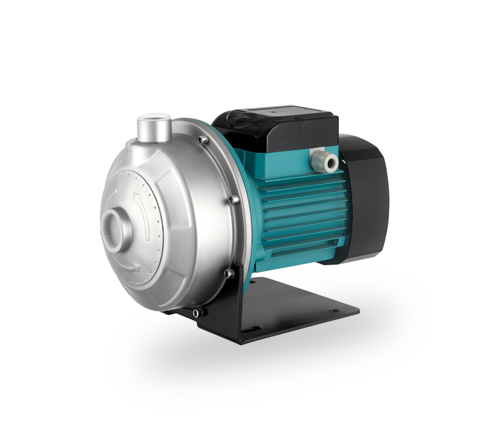
EMS Series Easy Installation Aluminum Support Stainless Steel Water Surface Centrifugal Pump
The EMS Series belongs to the surface centrifugal pump category. A surface pump is installed outside the water source, usually on a firm horizontal foundation, while a suction pipe connects the pump inlet to a tank, well, reservoir, or other water source. The pump motor rotates an impeller, creating centrifugal force that moves water from the suction side to the discharge side.
During operation, water enters through the inlet connection and reaches the rotating impeller. The impeller transfers energy to the water, increasing its velocity. The diffuser and pump body then help convert part of that velocity into pressure, allowing the water to travel through a delivery pipe toward a storage tank, irrigation network, household system, or other point of use.
The EMS Series is intended mainly for clean water or liquids with physical and chemical characteristics similar to water. It is not presented as a slurry pump, sewage pump, chemical process pump, or abrasive-media pump. Proper application selection is therefore important. Water containing sand, stones, fibers, corrosive chemicals, or large suspended solids may cause accelerated wear or damage unless the system is specially designed for those conditions.
As a surface unit, the pump provides convenient access for inspection and servicing. Unlike a permanently submerged pump, it can be checked without removing equipment from a deep borehole or water tank. This arrangement is particularly useful in household pump rooms, agricultural service areas, equipment sheds, and small utility installations where regular access is valuable.
The maximum suction height is specified as 8 meters. This figure describes the vertical distance between the water level and the pump’s suction position under suitable installation conditions. Actual performance can be influenced by pipe length, pipe diameter, elbows, valves, air leakage, water temperature, altitude, and the condition of the foot valve or check valve. The 8-meter value should therefore be treated as a maximum design reference rather than a guarantee for every installation.
One of the principal advantages of the EMS Series is its stainless steel pump body. The pump body is the main hydraulic enclosure and is continuously exposed to the pumped liquid. Stainless steel provides a clean and durable wetted surface and offers better resistance to rust than ordinary untreated steel.
The material schedule also identifies the diffuser and impeller as stainless steel. These components are important because they directly influence hydraulic performance. A stainless steel impeller can provide improved resistance to corrosion in clean-water applications and can help maintain a stable internal flow path over an extended service period when the pump is operated within its intended conditions.
Stainless steel construction is especially useful in installations where appearance, hygiene, or corrosion resistance matters. Household water systems, small water towers, garden installations, and equipment rooms may all benefit from a pump that presents a clean metallic surface and is less vulnerable to surface rust than a conventional painted-steel design.
Material selection should not be confused with universal chemical compatibility. The product is intended for clean water and similar liquids. The exact grade of stainless steel, liquid chemistry, chloride concentration, pH, and operating temperature should be assessed before using the pump in specialized industrial fluids.
The aluminum support provides a stable connection between the hydraulic section and the motor assembly. Aluminum is valued for its relatively low weight, good machinability, and suitability for compact equipment structures. A lighter support can make handling, positioning, and installation easier for technicians.
The component list also identifies the motor case and motor cover as aluminum. This construction supports a practical design philosophy: use corrosion-resistant materials in key exposed or wetted areas while maintaining a compact and manageable motor package. For distributors and installers, the result is a pump that can be transported, positioned, and mounted without the handling difficulties associated with heavier all-cast-iron assemblies.
The product content also refers to an aluminum support and describes the pump as easy to install. This is particularly relevant for replacement projects or small systems where installation time affects total project cost. A straightforward structure can simplify pipe alignment, foundation preparation, electrical connection, and later access for service.
The EMS Series includes models with different power ratings, connection sizes, flow capacities, and head capabilities. The listed motor powers range from 0.75 kW to 2.2 kW, allowing the series to serve both modest domestic applications and higher-capacity water transfer duties.
The available inlet and outlet combinations include 1.25-inch by 1-inch, 1.5-inch by 1.25-inch, and 2-inch by 1.25-inch configurations. These options make it easier to match the pump to existing pipework or to select a suitable connection arrangement for a new installation.
The stated maximum flow values range from 160 L/min to 360 L/min, while maximum head values range from 22 meters to 33 meters. The combination of flow and head differs by model. A pump with a higher maximum flow is not automatically the correct choice for a high-pressure system, and a pump with the highest maximum head may not be the most efficient selection for a low-resistance transfer application.
Model selection should be based on the actual duty point: the required flow rate at the total dynamic head of the system. The user should consider static lift, friction loss, pressure requirements, pipe diameter, fittings, valves, water level variation, and any required reserve capacity.
The product description indicates that the pump can handle situations where air or water may be present in the water to be pumped. This feature may be useful in practical suction systems where small quantities of air can enter during startup, intermittent operation, changing water levels, or imperfect priming conditions.
However, a centrifugal pump still requires proper priming and a correctly sealed suction line. Air entering continuously through a loose fitting, damaged hose, poor thread seal, or defective foot valve can prevent stable pumping. The statement about handling air or water should therefore be understood as an application advantage under appropriate operating conditions, not as permission to run the pump dry or with a permanently air-filled suction pipe.
The motor specifications include durable copper wiring, high-efficiency C&U bearings, a built-in thermal protector for the single-phase motor, Class F insulation, and IP44 protection. These features address common requirements for small electric pump motors.
Copper windings support efficient electrical conduction and help provide reliable motor performance. Bearings designed for smooth operation reduce mechanical friction between rotating and stationary parts. The built-in thermal protector is intended to interrupt or protect the motor under overheating conditions, helping reduce the risk associated with excessive temperature caused by overload, blocked ventilation, abnormal voltage, or other operating problems.
Class F insulation provides a defined level of thermal resistance for the motor winding insulation system. IP44 protection indicates protection against solid objects of a specified size and against water splashing from various directions. IP44 does not mean that the motor is waterproof or suitable for direct immersion. The pump should be installed in a properly protected, ventilated, and dry location.
| Model | Power | Rated Power Reference | Inlet/Outlet | Maximum Flow | Maximum Head | Maximum Suction |
| EMS-750A | 0.75 kW | 1 HP | 1.25 in × 1 in | 160 L/min | 27 m | 8 m |
| EMS-1100A | 1.1 kW | 1.5 HP | 1.25 in × 1 in | 160 L/min | 33 m | 8 m |
| EMS-1100B | 1.1 kW | 1.5 HP | 1.5 in × 1.25 in | 280 L/min | 22 m | 8 m |
| EMS-1500B | 1.5 kW | 2 HP | 1.5 in × 1.25 in | 310 L/min | 27 m | 8 m |
| EMS-2200B | 2.2 kW | 3 HP | 1.5 in × 1.25 in | 360 L/min | 33 m | 8 m |
| EMS-1100C | 1.1 kW | Listed reference requires confirmation | 2 in × 1.25 in | 320 L/min | 22 m | 8 m |
| EMS-1500C | 1.5 kW | 2 HP | 2 in × 1.25 in | 340 L/min | 24 m | 8 m |
| EMS-2200C | 2.2 kW | 3 HP | 2 in × 1.25 in | 360 L/min | 28 m | 8 m |
The table summarizes the technical data supplied for the series. Maximum flow and maximum head are limiting reference values and should not be interpreted as simultaneous operating points. In real operation, the pump curve determines the flow available at a particular head. Buyers should request the relevant performance curve, voltage, frequency, phase, and duty-point information before final selection.
The EMS-1100C entry is shown with a 1.1 kW power rating, but the supplied horsepower field appears inconsistent with the other power conversions. It should be verified with the manufacturer or technical sales team before an order is placed. This type of confirmation is important for motor selection, electrical protection, and replacement planning.
In practical terms, the A models emphasize the smaller 1.25-inch by 1-inch connection arrangement and provide up to 160 L/min in the listed data. The B models provide larger connections and higher listed flow capacities, making them suitable for systems that require increased water movement at moderate to higher heads. The C models use a 2-inch inlet and are positioned for applications where a larger suction connection may help reduce inlet losses and support higher transfer rates.
Connection size alone does not determine final performance. The suction pipe should be sized and installed to reduce friction and avoid excessive velocity. Long suction lines, multiple elbows, narrow hoses, partially closed valves, or clogged strainers can significantly reduce the actual flow and may contribute to cavitation or unstable operation.
The materials table provides useful information about the internal and external construction of the pump. The pump base is identified as 08F, while the pump body, diffuser, impeller, mechanical seal disc holder, and several other hydraulic components are identified as stainless steel or designated engineering materials.
The pump base provides the mounting interface and helps maintain alignment between the pump and the supporting surface. A stable base is important because vibration can affect pipe joints, mechanical seals, bearings, and electrical connections. Installers should mount the pump on a rigid and level foundation and should avoid using pipework as the primary structural support.
The stainless steel pump body encloses the hydraulic passage and directs water through the impeller and diffuser. The diffuser helps manage the transition from high-velocity flow to useful pressure. Maintaining a clean and correctly formed hydraulic passage is essential for preserving efficiency and minimizing turbulence.
The impeller is listed as stainless steel in the components table. Its geometry determines much of the pump’s flow and head behavior. Impeller balance is also important because an unbalanced rotating component can increase vibration and bearing load. Proper manufacturing, inspection, and assembly of the impeller are therefore central to reliable operation.
The mechanical seal is identified as carbon and ceramic. Mechanical seals prevent water from passing along the rotating shaft into the motor-side area. Carbon and ceramic are commonly used together because their characteristics can provide suitable sealing performance in clean-water applications when the seal faces remain lubricated by the pumped liquid.
A mechanical seal should not be allowed to operate dry for an extended period. Dry running can produce heat and damage the seal faces. This is one reason why priming, adequate water supply, and protection against empty-tank operation are important during installation and commissioning.
The materials table lists the shaft and rotor, ball bearing, and stator as structural components, although no material specification is provided for some of these items. The shaft transfers motor torque to the impeller, while the rotor and stator form the electromagnetic drive system. The bearings support smooth rotation and help maintain the correct position of the rotating assembly.
Because the shaft is exposed to the mechanical seal and may be near the pumped liquid, the product description separately specifies an AISI 304 stainless steel shaft. This rust-free water-contact area is an important feature for clean-water service and helps support long-term sealing and corrosion resistance.
The fan is listed as PP, while the terminal board is identified as PC and the terminal cover as ABS. These polymer components support electrical insulation, cooling, and protection of the motor connection area. The fan cover helps protect the rotating cooling fan and contributes to safe airflow through the motor housing.
Electrical components should be installed by qualified personnel. The motor must be connected to a suitable power supply with appropriate overload protection, grounding, isolation, and cable sizing. The exact electrical configuration should be checked against the nameplate and the purchasing specification, especially when pumps are supplied to different regions with different voltage and frequency standards.
The pump should be installed in a clean, dry, well-ventilated location protected from flooding, direct weather exposure, and accidental mechanical impact. Although the motor has an IP44 protection rating, the rating does not permit immersion or uncontrolled exposure to heavy water spray.
Adequate clearance should be left around the motor and terminal box. The motor requires airflow for cooling, and service personnel need space to inspect connections, remove covers, and perform maintenance. The installation surface should be firm, level, and capable of supporting the pump without excessive vibration.
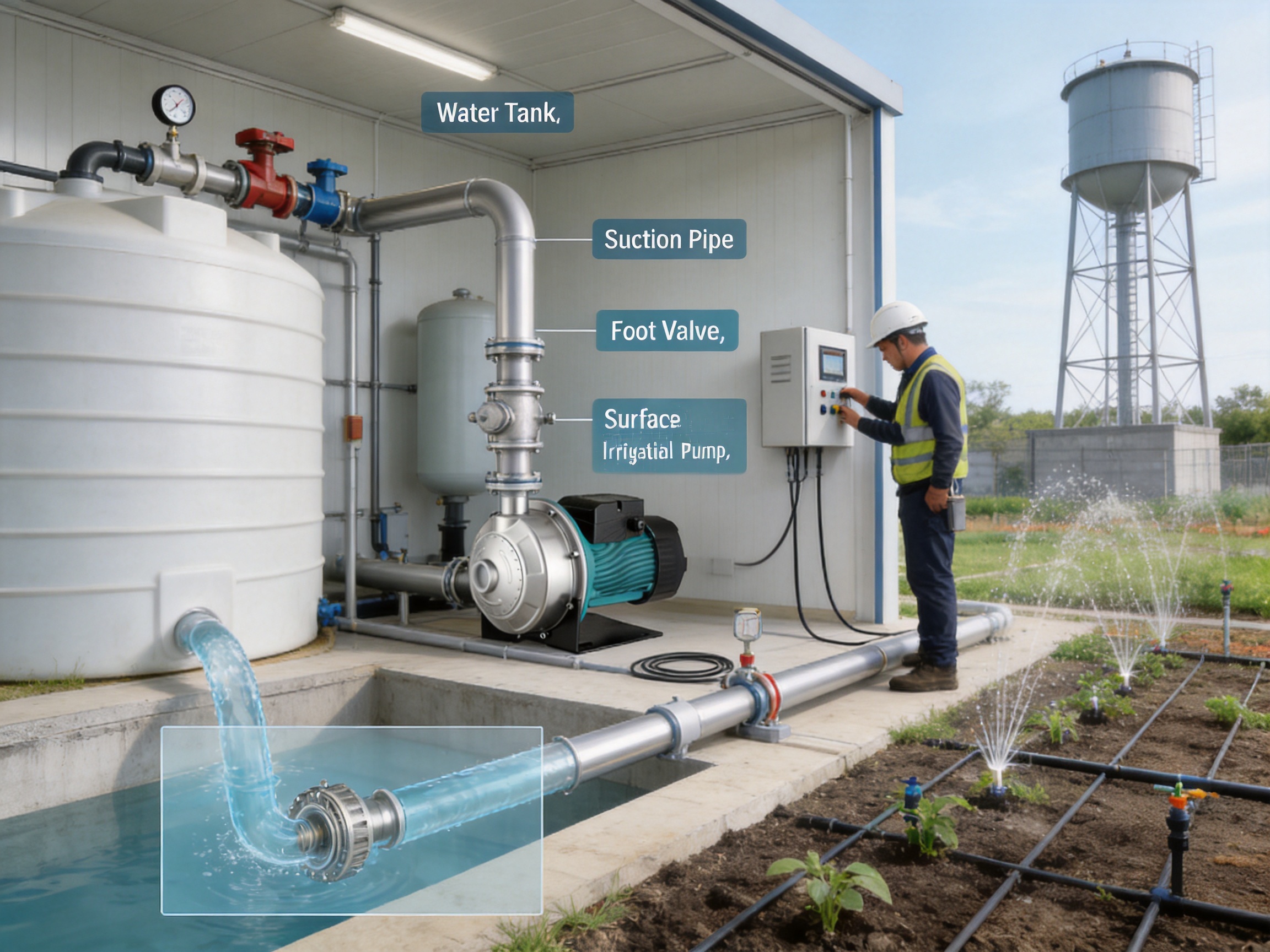
The suction pipe should be as short and direct as practical. It should rise continuously toward the pump where possible, avoiding high points that can trap air. All suction connections must be airtight. Even a small air leak may prevent the pump from creating a stable suction condition.
The suction pipe diameter should not be smaller than the pump inlet unless the system design specifically justifies a reduction. Reducing the suction diameter can increase friction losses and reduce available performance. For higher-flow models, the larger listed inlet sizes should be used with appropriately sized pipework.
A foot valve or suitable check valve may be installed at the suction end where the application requires the suction line to remain filled. A strainer can help prevent debris from entering the impeller, but it must be selected and maintained carefully. An undersized or clogged strainer can create excessive inlet resistance.
The discharge pipe should be supported independently so that its weight and thermal movement do not load the pump connections. Valves, non-return devices, pressure switches, and gauges should be installed according to the system design. The pipe network should be flushed before connection whenever construction debris, metal particles, sealant fragments, or dirt may be present.
For garden irrigation and tank transfer, the discharge arrangement may be relatively simple. For domestic water distribution or small pressure sets, the pump may be combined with a pressure vessel, pressure controller, check valve, or automatic control system. These accessories should be compatible with the pump’s flow, pressure, and electrical characteristics.
Before starting the pump, the pump body and suction line should be filled with clean water in accordance with the installation method. The pump should not be started dry. Dry operation can damage the mechanical seal and may cause rapid temperature rise.
After priming, the installer should check that suction and discharge valves are positioned correctly, the motor rotates in the intended direction where applicable, and there are no leaks from threaded or flanged connections. The pump should be observed during the first operating period for abnormal vibration, unusual noise, overheating, unstable flow, or repeated thermal protection trips.
If the pump loses prime, the cause should be investigated rather than repeatedly restarting it. Possible causes include a low water level, air leakage, an incorrectly installed foot valve, a blocked strainer, an excessively long suction line, or a suction height beyond the practical limit.
The EMS Series can be used to distribute clean water in household and small residential systems. It may draw water from a ground-level tank, transfer water to an elevated tank, or provide additional pressure for a small set of consumption points.
For domestic use, the pump should be selected according to the number of outlets, expected simultaneous demand, required pressure, and available water source. Oversizing can produce unnecessary cycling, higher energy consumption, and excessive pressure in the pipe network. Undersizing may result in insufficient flow at the farthest outlet.
Water towers and elevated storage tanks often require reliable transfer from a lower tank or supply source. The pump’s maximum head capability should be compared with the static elevation difference and all pipe friction losses. Automatic float switches, level controllers, or control panels may be used to start and stop the pump according to tank level.
Control equipment should prevent the pump from running when the source tank is empty. It should also avoid rapid start-stop cycling, which can increase motor and mechanical seal wear. A properly designed control system improves both convenience and service life.
The pump is suitable for garden irrigation and allotment watering where clean water is drawn from a tank, well, or reservoir. Irrigation systems often contain several zones, sprinklers, drip lines, filters, and valves. The required flow and pressure can vary significantly between these arrangements.
Sprinklers usually require a defined operating pressure, while drip irrigation systems may require filtration and pressure regulation. The pump should be selected for the most demanding zone or controlled with a system that prevents operation outside the desired range. Filters should be inspected regularly, especially when water is drawn from open tanks or shallow wells.
The EMS Series may be used for lifting water from wells within the stated suction-height limitation. The actual well-water level can change seasonally, so the lowest expected water level should be used for design calculations. The suction line must be properly sealed and protected against collapse.
For deeper wells or applications where the water level exceeds the practical suction capability of a surface pump, a deep-well or submersible pump may be more appropriate. Selecting a surface pump for a source beyond its suction range can cause poor performance, loss of prime, cavitation, and mechanical damage.
The pump can serve as a component in a small pressure-boosting set. Such a set may include a pressure switch, pressure gauge, non-return valve, accumulator or pressure vessel, isolation valves, and electrical protection. The pump’s head should be sufficient to meet both the pressure requirement and the elevation of the outlets.
A pressure vessel can reduce the number of starts during low-volume demand. However, the pre-charge pressure, switch settings, and vessel size must be correctly matched. Poor adjustment may cause unstable pressure, frequent cycling, or insufficient water delivery.
The series is also described as suitable for various corollary equipment. This can include water-treatment peripheral systems, small machinery cooling circuits using clean water, equipment washdown systems, and utility transfer applications. Before integration, the designer should confirm liquid compatibility, operating temperature, duty cycle, electrical supply, and required control method.
The EMS Series offers several advantages over basic surface centrifugal pumps that rely on a more limited material and model selection. The stainless steel hydraulic section provides a more corrosion-resistant solution than many ordinary painted-metal pumps. The stainless steel shaft and wetted components also support a cleaner and more durable water-contact arrangement.
The aluminum support, motor case, and motor cover help create a compact and manageable assembly. This can be advantageous for installers who need to work in confined pump rooms or transport equipment to gardens, agricultural plots, and elevated installation points.
The series also provides multiple connection formats rather than a single standardized configuration. This can reduce the need for adapters and simplify the replacement of existing pumps. The range from 0.75 kW to 2.2 kW allows distributors to cover several common application categories with one product family.
Another advantage is the combination of domestic usability and light commercial flexibility. The pump is not restricted to one narrow market. It can be used in household supply, irrigation, tank transfer, water tower supply, well lifting, and small pressure systems, provided the duty point remains within the selected model’s operating range.
Compared with a submersible pump, a surface centrifugal pump offers easier access to the motor, terminal box, mechanical seal, and external pipe connections. Compared with a deep-well pump, it may be simpler and more economical for shallow sources. Compared with a basic transfer pump, its available head and model range may better support pressure-oriented applications.
These advantages do not eliminate the need for correct selection. No pump design is ideal for every service. A submersible pump may be more suitable for deep water sources, a sewage pump for solids-bearing wastewater, and a multistage pump for higher-pressure duties. The strength of the EMS Series is its fit for clean-water surface applications requiring reliable, accessible, and practical pumping equipment.
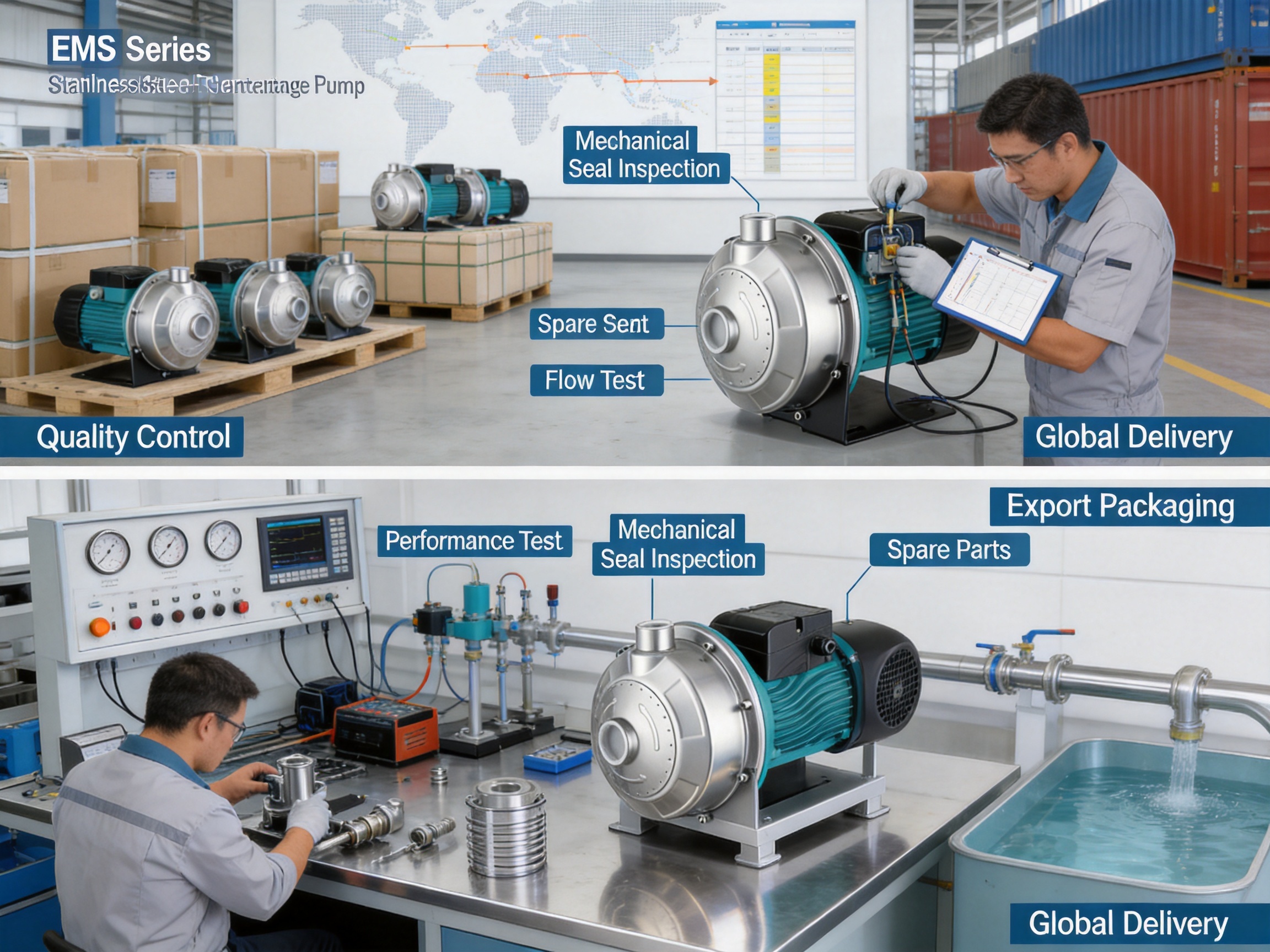
The manufacturer is described as an integrated enterprise specializing in independent research and development, mass production, and global export. This combination is important for pump buyers because product performance depends not only on design but also on repeatable manufacturing, component control, assembly consistency, testing, packaging, and after-sales coordination.
Independent research and development supports ongoing improvement in hydraulic design, motor construction, component selection, and product adaptation. For a pump series such as the EMS range, development work may involve matching impeller geometry to motor power, refining the pump body and diffuser, improving sealing arrangements, and designing several connection configurations for different markets.
Research and development also helps a manufacturer respond to application feedback. Household water systems, irrigation networks, and export markets may have different expectations concerning voltage, pipe standards, packaging, controls, and documentation. A manufacturer with internal development capability can coordinate these requirements more effectively than a trading company that only resells unrelated products.
Mass production can provide consistency across repeated orders. Standardized components, controlled assembly procedures, and organized production planning help reduce variation between units. This is especially valuable for distributors purchasing multiple models or for projects that require a series of pumps with consistent dimensions and performance characteristics.
Production capability also supports supply continuity. Contractors and wholesalers often need predictable delivery for project scheduling, replacement stock, and seasonal irrigation demand. A manufacturer that combines production with export services can coordinate manufacturing plans, order tracking, inspection, and shipment preparation within one supply chain.
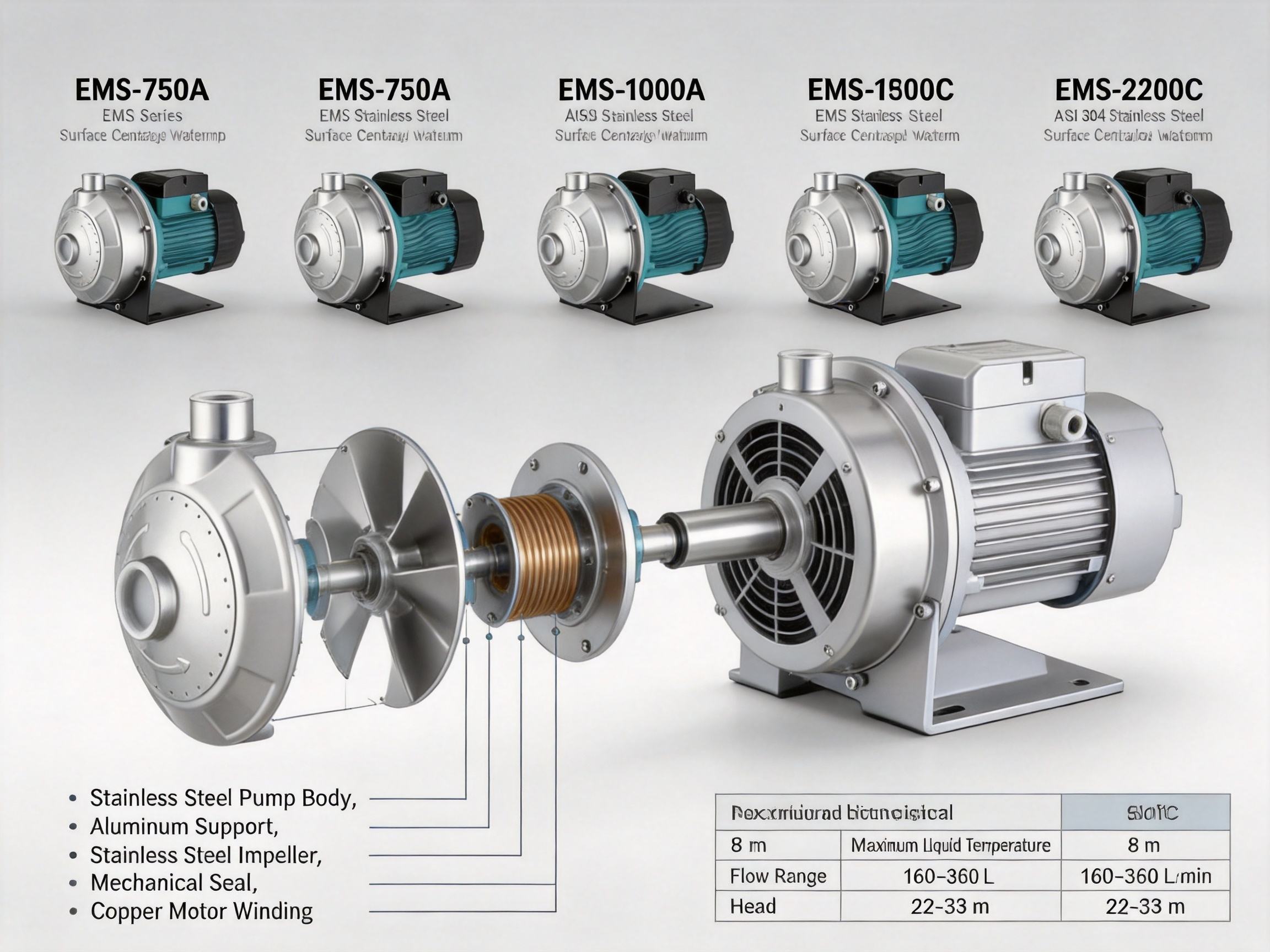
The EMS Series uses a defined list of components, including the pump base, pump body, diffuser, impeller, mechanical seal, seal disc holder, support, shaft and rotor, bearings, stator, motor case, motor cover, fan, fan cover, terminal board, capacitor, and terminal cover.
A clearly organized component structure supports manufacturing control and service planning. It makes it easier to identify wear parts, communicate technical requirements, prepare spare-part lists, and establish assembly procedures. It also helps buyers compare product configurations and understand the relationship between hydraulic parts, mechanical parts, and electrical parts.
The company group is described as supporting procurement planning, order tracking, cross-border delivery, and foreign-trade services. These capabilities are meaningful for international customers who may need more than a product quotation. Importers often require packing information, commercial documents, model coordination, production updates, shipment planning, and communication across different time zones.
A one-stop procurement approach can be useful when buyers source several pump categories or related water-treatment products. The broader product portfolio includes deep-well pumps, submersible pumps, domestic booster pumps, circulation pumps, solar water pumps, intelligent booster pumps, and other pump-related products. This creates opportunities for distributors to consolidate product sourcing and develop a more complete water-equipment offering.
The manufacturer’s products are described as being used in new-energy projects, agricultural irrigation, municipal engineering, mining, construction, HVAC systems, and household water supply. Exposure to different fields can strengthen product understanding because each sector places different demands on equipment selection, operating conditions, installation, and service.
The EMS Series itself is intended for clean-water applications rather than every industrial duty. Nevertheless, experience across multiple sectors can support better communication when the pump is used as part of a larger system. Buyers can request assistance in determining whether a surface centrifugal pump, submersible pump, booster pump, circulation pump, or multistage pump is the correct technology for a specific project.
Routine inspection should include checking for water leaks, unusual noise, vibration, overheating, pressure changes, and reduced flow. Any change in operating behavior may indicate a blocked strainer, a closed valve, a suction leak, impeller wear, bearing problems, seal damage, or an electrical fault.
The suction strainer and foot valve should be inspected where fitted. Dirt accumulation can restrict water entry and increase the load on the pump. A foot valve that fails to close may allow the suction line to drain, causing repeated loss of prime.
Pipe connections should be checked periodically, especially in installations exposed to vibration or temperature changes. Threaded joints, flexible hoses, and clamps may loosen over time. Any air leak on the suction side can be more serious than a small visible water leak because it may allow air into the pump without clearly showing external water loss.
The mechanical seal is a wear component. A small amount of initial adjustment should not be attempted unless specified by the service procedure. If water continuously leaks from the seal area, the pump should be stopped and inspected. Continued operation with a damaged seal may allow water to reach motor-side components.
Motor ventilation should be kept clear. Dust, plant debris, plastic coverings, or nearby walls can restrict airflow through the fan and fan cover. The thermal protector helps protect against overheating, but repeated activation is a warning that the underlying issue requires attention.
Before maintenance, isolate the electrical supply and relieve hydraulic pressure. Only trained personnel should open the terminal cover, replace electrical components, or work on the motor. Replacement parts should match the original specifications, particularly for mechanical seals, capacitors, bearings, impellers, and electrical protection devices.
Energy efficiency is influenced by the complete pumping system, not only by motor nameplate power. A correctly selected EMS model can reduce wasted energy by operating near the actual required duty point. An oversized pump may need throttling, bypass flow, or frequent cycling, all of which can increase operating cost.
Pipe design also has a major influence. Larger and shorter pipes generally reduce friction losses, allowing the pump to deliver water with less pressure loss. Unnecessary elbows, restrictions, undersized filters, and partially closed valves can force the pump to operate at an inefficient point.
Regular cleaning and maintenance help preserve efficiency. A clogged strainer, worn impeller, leaking check valve, or partially blocked discharge pipe can change the system curve and reduce useful water delivery. Monitoring flow, pressure, and electrical behavior can help identify problems before they become major failures.
For intermittent irrigation or domestic systems, automatic controls should be adjusted to match actual demand. Avoiding unnecessary starts and stops reduces mechanical and electrical stress. For applications with changing demand, a suitable intelligent booster arrangement may be considered, while the EMS Series remains a practical choice for straightforward fixed-speed surface pumping.
Before ordering, identify the water source, the normal and minimum water levels, the required flow, the required pressure, the total vertical lift, and the estimated pipe friction. Confirm whether the liquid is clean water or a comparable liquid and verify the maximum temperature requirement.
Next, compare the duty point with the performance curve for each candidate model. The maximum figures in a catalog are useful for initial screening, but they do not replace a complete hydraulic calculation. Ask for the operating flow at the required head rather than selecting solely by motor power.
Confirm the inlet and outlet sizes and determine whether they match the existing pipe network. The suction side deserves particular attention because inadequate suction piping can limit performance even when the pump itself is correctly sized.
Verify voltage, frequency, phase, insulation class, protection rating, starting current, and required electrical protection. The built-in thermal protector is helpful but should not replace properly selected circuit protection and grounding.
Confirm the intended duty cycle. A pump used occasionally for tank transfer may have different practical requirements from a pump operating for many hours each day in irrigation or commercial service. Ask about ambient temperature, ventilation, installation altitude, and the availability of replacement parts.
For international orders, confirm packaging, spare-parts availability, documentation, labeling, delivery schedule, and any destination-market electrical requirements. The manufacturer’s export and procurement support can assist with these details, but the purchaser should ensure that all specifications are recorded before production begins.
The EMS Series is one type of pump within a broader water-equipment portfolio. Understanding the difference between pump categories helps users avoid selecting equipment based only on appearance or motor power.
A deep-well pump is generally intended for lifting water from greater depths, where a surface pump may not be able to create sufficient suction. A submersible pump operates below the water level and can be appropriate for wells, drainage, or tanks depending on its design. A booster pump is used to increase pressure in an existing supply system. A circulation pump is designed to continuously move water through heating, cooling, or HVAC loops.
A commercial multistage pump is typically used when a higher pressure requirement must be achieved through multiple impellers. A solar pump is designed to operate with solar-electric systems and may require different control equipment. An intelligent booster pump usually includes electronic control functions for automatic pressure management and variable operating conditions.
The EMS surface centrifugal pump is most appropriate when the water source is accessible through a suction line, the required suction height is within the stated range, and the application requires clean-water transfer or moderate pressure. Its accessible installation and relatively simple operating principle make it attractive for domestic, agricultural, and light commercial users.
Safe pump operation begins with correct installation. The pump should be mounted securely, protected from flooding, and connected to an electrical supply that includes suitable grounding and overcurrent protection. The terminal cover should remain properly fitted during operation.
Never place hands, tools, or loose clothing near the cooling fan while the motor is energized. Do not remove protective covers while the pump is running. Before opening the pump or motor, disconnect the power and verify that the unit cannot restart automatically through a pressure switch, level controller, or remote control.
The pumped liquid should remain within the specified application range. The maximum liquid temperature is listed as +60°C, but hot-water service may require additional attention to pressure, seal material, pipe rating, and burn protection. The maximum ambient temperature is listed as +40°C. Installation in hotter environments may require ventilation improvements or a different product selection.
Protect the pump from freezing. Water trapped in the pump body or pipework can expand and damage internal components. Where the pump will be shut down in freezing conditions, the system should be drained or otherwise protected according to the installation requirements.
It is a surface centrifugal pump designed for transferring clean water or liquids with similar physical and chemical properties. The pump is installed outside the water source and uses a suction pipe to draw water into the hydraulic section.
The listed maximum suction height is 8 meters. Actual suction performance depends on atmospheric conditions, water temperature, pipe design, air tightness, fittings, water-level changes, and the condition of the foot valve or check valve.
The product is recommended for clean water and liquids similar to water in physical and chemical characteristics. Abrasive, highly corrosive, heavily contaminated, or solids-bearing liquids require a pump designed specifically for those conditions.
The specified maximum liquid temperature is +60°C. Users should also verify the effect of temperature on pressure, mechanical seal compatibility, piping, and safety procedures before pumping warm water.
The listed maximum ambient temperature is +40°C. The motor should be installed in a ventilated location with sufficient clearance around the fan and motor housing.
Yes. The pump and suction line should be filled with water before startup unless the specific installation includes an approved self-priming arrangement. The pump should not be operated dry because dry running may damage the mechanical seal.
The EMS-2200B and EMS-2200C are both listed with a maximum flow of 360 L/min. Their connection arrangements and maximum head values differ, so the correct choice depends on the complete system duty point.
The EMS-1100A, EMS-2200B, and the listed data for other models show maximum head values up to 33 meters. The user should compare the actual performance curve at the required flow rather than relying only on the maximum head figure.
No. The series includes different inlet and outlet sizes. The connection arrangement must be checked against the system pipework, required flow, suction conditions, and available fittings.
Yes. It is recommended for irrigating gardens and allotments and may be integrated with sprinklers, drip systems, filters, valves, and control equipment. The pump must be selected according to the irrigation zone’s flow and pressure requirements.
It can be used for well-water lifting when the water level and suction arrangement remain within the practical 8-meter suction limitation. Deeper sources may require a deep-well or submersible pump.
IP44 indicates protection against specified solid objects and water splashing from different directions. It does not mean the motor can be submerged or exposed to uncontrolled flooding. A dry and protected installation remains necessary.
The specifications include a built-in thermal protector for the single-phase motor. This feature supports motor safety, but it does not replace correct sizing, ventilation, grounding, overload protection, and proper operating procedures.
Inspect the water level, suction pipe, threaded connections, hose condition, foot valve, strainer, suction height, and pump-body priming. Continuous air entry or an empty source tank should be corrected before restarting the pump.
The series is intended mainly for domestic, civil, irrigation, tank-transfer, well-lifting, and similar clean-water applications. Higher-pressure industrial duties may require a commercial multistage pump or another specialized design. The required flow, head, liquid, duty cycle, and temperature should be reviewed before selection.
Buyers should provide the required flow, total head, suction height, liquid temperature, pipe sizes, voltage, frequency, phase, duty cycle, and installation conditions. The manufacturer or technical supplier can then recommend the most suitable model and verify the performance data.
The EMS Series Easy Installation Aluminum Support Stainless Steel Water Surface Centrifugal Pump is a practical clean-water pumping solution for domestic, civil, agricultural, and light commercial use. Its key strengths include stainless steel hydraulic components, an AISI 304 stainless steel shaft, an aluminum support structure, copper motor windings, C&U bearings, Class F insulation, IP44 protection, and a built-in thermal protector for single-phase operation.
The range provides several motor powers and connection configurations, with listed maximum flows from 160 L/min to 360 L/min, maximum heads from 22 meters to 33 meters, and a maximum suction height of 8 meters. These options allow the series to address a variety of tank-transfer, irrigation, water-tower, household, and shallow-well applications.
Its advantages over more basic competitor products are most visible in the combination of corrosion-resistant wetted materials, accessible surface installation, broad model coverage, manageable aluminum construction, and support for global procurement. The manufacturer’s stated capabilities in independent research and development, mass production, export coordination, and multi-sector water-equipment supply further strengthen the product’s value for distributors and project buyers.
Correct selection and installation remain essential. The pump must be matched to the actual flow and head, installed with an airtight suction line, protected from dry running and flooding, and connected to an appropriate electrical system. When these requirements are followed, the EMS Series can provide reliable and serviceable water movement for a wide range of everyday applications.
1. Product technical description and component information supplied for the EMS Series Easy Installation Aluminum Support Stainless Steel Water Surface Centrifugal Pump.
2. Product technical parameter table supplied for EMS-750A, EMS-1100A, EMS-1100B, EMS-1500B, EMS-2200B, EMS-1100C, EMS-1500C, and EMS-2200C models.
3. Manufacturer information concerning research and development, mass production, global export, procurement planning, and water-pump product categories.
4. General centrifugal pump installation and maintenance principles for clean-water surface pumping systems.
5. General electrical motor safety principles relating to thermal protection, insulation class, grounding, ventilation, and enclosure protection.
6. General hydraulic design principles concerning suction lift, pipe friction, priming, check valves, strainers, and pump duty-point selection.
edwina@edwin-pump.com
+86-13586290903 (WhatsApp)
Xuri Gongliang Cutting Tool Entrepreneurship Park, Wenqiao Town, Wenling City, Taizhou City, Zhejiang Province, China

High Performance Smart Pump Factory


 English