
edwina@edwin-pump.com

View All Products
en
Reliable water movement is essential in residential buildings, commercial facilities, industrial plants, agricultural systems, municipal projects, and many other applications. As water systems become more automated and energy-conscious, pump users are looking for equipment that can do more than simply transfer water. They need stable pressure, dependable operation, protection against common operating problems, compact installation, easy maintenance, and long service life.
The EVR(S) Series Water Shortage Protection Voltage Stabilization Stainless Steel Vertical Multistage Pump is designed to answer these requirements with an integrated approach. It combines a vertical multistage hydraulic structure, stainless steel construction, water shortage protection, and voltage stabilization functions in one pump solution. This combination makes the series suitable for pressure boosting, water supply, industrial circulation, irrigation, building services, and other applications in which consistent performance is important.
Manufactured by Taizhou Edwin Electric Co., Ltd., the EVR(S) Series reflects the company’s broader focus on research and development, mass production, global export, and smart pumping technology. The company has developed product lines covering deep well pumps, submersible pumps, domestic booster pumps, circulation pumps, solar water pumps, intelligent booster pumps, and related water equipment. This product experience supports a practical understanding of different water supply conditions and customer requirements.
This article examines the design concept, operating advantages, construction, application value, maintenance characteristics, manufacturing strengths, and selection considerations of the EVR(S) Series. It also explains why a stainless steel vertical multistage pump can be a strong alternative to conventional single-stage pumps, horizontal multistage pumps, or basic pressure-boosting equipment.
serieswatershortageprotectionvoltagestabilizationstainlesssteelverticalmultistagepump.jpg)
EVR(S) Series Water Shortage Protection Voltage Stabilization Stainless Steel Vertical Multistage Pump
The EVR(S) Series is a vertical multistage pump intended for applications requiring increased pressure and reliable water delivery. Unlike a basic transfer pump, which may be selected mainly for flow movement, a multistage pump develops pressure through several impeller and diffuser stages arranged in series. Each stage contributes part of the total pressure, allowing the pump to achieve higher head within a relatively compact body.
The vertical configuration places the hydraulic stages along a vertical axis. This arrangement reduces the floor area required for installation and can make the equipment easier to integrate into mechanical rooms, utility spaces, water treatment systems, and commercial plant rooms. For projects where floor space is limited, a vertical multistage design can provide a practical advantage over larger horizontal equipment.
The stainless steel construction provides a durable wetted structure for clean-water and general water-supply applications. Stainless steel is widely used in pumping equipment because it offers good resistance to corrosion, supports hygienic operation, and maintains a clean appearance over extended service. The exact grade, seal material, motor configuration, and allowable liquid conditions should always be confirmed according to the selected model and project requirements.
The defining functional features of the EVR(S) Series include:
Water shortage protection to help reduce the risk of damage caused by dry running or insufficient inlet water.
Voltage stabilization to support more consistent electrical operation in areas where supply voltage may fluctuate.
Stainless steel construction for durability and corrosion resistance in appropriate water-handling conditions.
Vertical multistage design for high-pressure water supply in a compact installation footprint.
Easy maintenance through an organized structure and accessible service requirements.
These features are particularly valuable when a pump must operate as part of an automated water system rather than as an isolated, manually supervised machine.
A pump’s ability to deliver water is normally described through two key performance factors: flow rate and head. Flow rate refers to the volume of water moved within a given time, while head represents the pressure or elevation that the pump can provide. Many building and industrial systems require substantial head because water must travel through long pipe networks, rise to upper floors, pass through filters or heat exchangers, or maintain pressure at several outlets simultaneously.
A single-stage pump may provide adequate flow for low-pressure transfer, but it may not be the most efficient or compact choice when higher pressure is required. Increasing pressure through one very large impeller can create design and operating challenges. A multistage pump divides the pressure-generation process between several stages. This makes it possible to achieve a higher total head without relying on one oversized hydraulic stage.
In a vertical multistage arrangement, the stages are aligned in a narrow, upright assembly. Water passes through the impeller and diffuser of one stage before entering the next. The pressure increases progressively as the water moves through the pump. This structure is useful for applications such as:
High-rise building water supply.
Commercial pressure boosting.
Industrial process water.
Boiler or equipment feed systems, where compatible conditions apply.
Water treatment and filtration systems.
Agricultural irrigation networks.
Cooling and heating circulation systems.
General clean-water transfer requiring elevated pressure.
The multistage principle does not mean that every project should use the largest possible number of stages. Correct selection still depends on the required flow, total dynamic head, suction conditions, pipe layout, liquid temperature, operating schedule, and electrical supply. The value of the EVR(S) Series lies in its ability to provide a flexible platform for pressure-oriented applications while maintaining a compact and serviceable form.
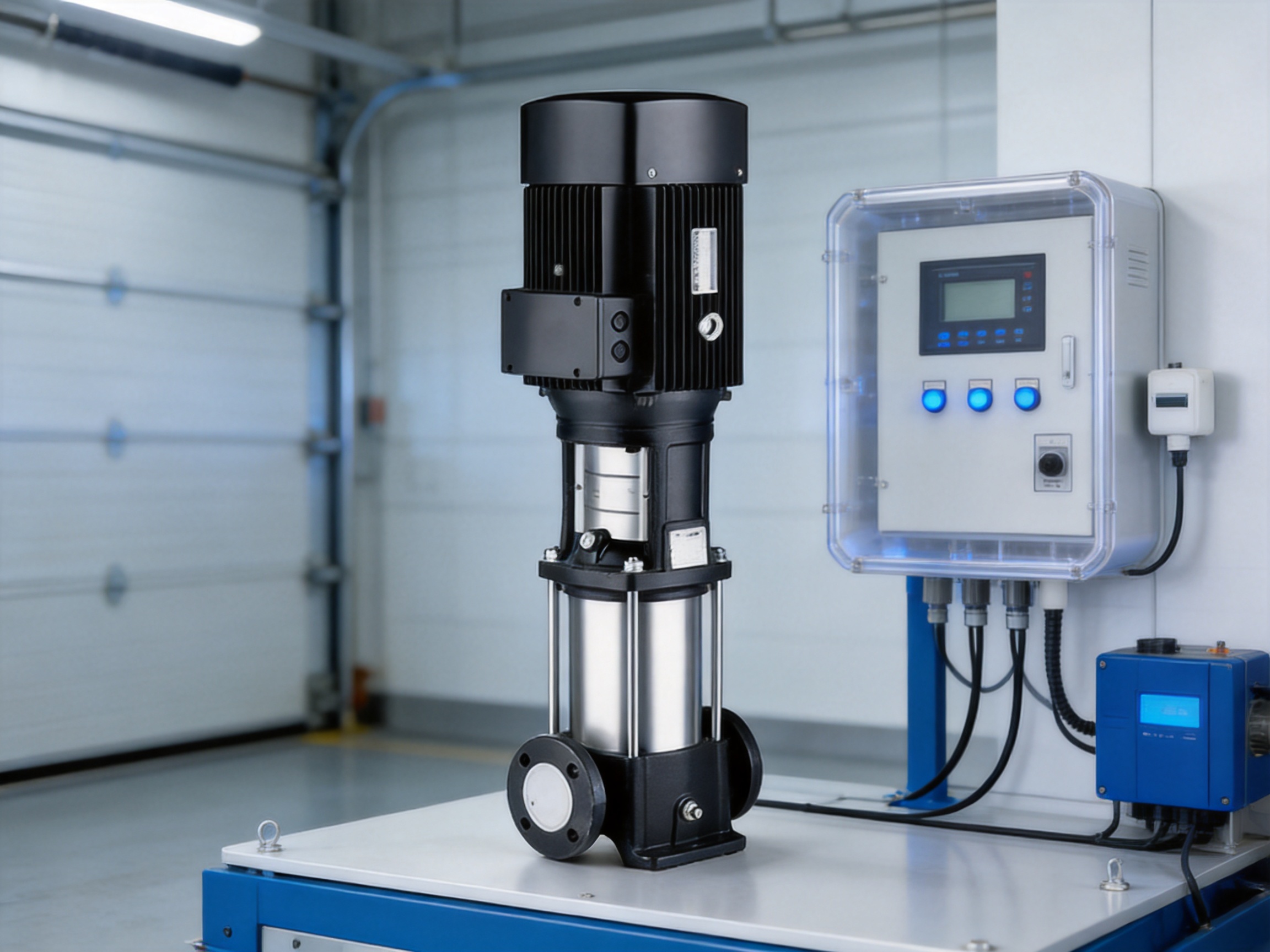
Material selection has a direct impact on pump reliability. Pump components are exposed to water, pressure, temperature changes, mechanical loads, and sometimes chemicals or dissolved minerals. A material that performs well in one environment may be unsuitable in another. Stainless steel offers a balance of durability, cleanability, and corrosion resistance that makes it a popular choice for water equipment.
Stainless steel is naturally more resistant to corrosion than ordinary carbon steel in many water-handling environments. This can help preserve the integrity and appearance of the pump body, stages, and other wetted components. The benefit is especially relevant in systems where equipment may be exposed to moisture, condensation, mildly corrosive water, or frequent cleaning.
However, stainless steel should not be treated as universally corrosion-proof. Water chemistry, chloride concentration, temperature, chemical additives, and galvanic contact with other materials can affect service life. Users should provide water-quality information during product selection and confirm the suitable stainless steel grade with the manufacturer or authorized technical representative.
For domestic, commercial, and selected light-industrial applications, stainless steel provides a clean and professional appearance. Its relatively smooth surface can also support easier cleaning compared with rough or heavily coated surfaces. This characteristic is useful in equipment rooms, public facilities, water supply installations, and systems where visual cleanliness matters.
A stainless steel pump structure can provide robust support for the internal hydraulic stages. When combined with appropriate manufacturing tolerances, balanced rotating components, and correct assembly, the result can be a stable pump body capable of handling continuous water service. Durability is not created by material alone; it also depends on the design of the shaft, bearings, seals, motor, fasteners, and connection points.
Choosing a corrosion-resistant pump can reduce the likelihood of premature replacement caused by external rust, material degradation, or deterioration of wetted parts. It may also support easier maintenance because service personnel can inspect the equipment without dealing with extensive surface corrosion. Over the full ownership period, these factors can contribute to lower disruption and more predictable maintenance planning.
Water shortage is one of the most common risks in pumping systems. A pump may experience insufficient water because of an empty storage tank, a blocked inlet, a closed valve, an undersized suction line, an incorrect installation, or a temporary interruption in the water source. If the pump continues operating without adequate water, internal components may overheat or suffer accelerated wear.
Water provides several important functions inside a pump. It carries heat away from certain components, lubricates or cools compatible sealing areas, supports hydraulic loading, and allows the impeller to operate as intended. When water is absent or insufficient, the pump may run dry, generate abnormal noise, lose performance, damage mechanical seals, or experience other failures.
The water shortage protection function of the EVR(S) Series is intended to help reduce these risks. Depending on the configured control system and model specification, the protection system may monitor operating conditions and stop or prevent pump operation when a shortage is detected. The exact detection method, reset behavior, response time, and sensor arrangement should be verified before purchase.
Water shortage protection provides several practical benefits:
It can reduce damage caused by dry running.
It can improve equipment safety in unattended installations.
It can help protect mechanical seals and internal hydraulic components.
It can reduce the need for emergency intervention after a storage tank or supply source is depleted.
It can support more reliable integration with automatic water supply systems.
Protection technology does not replace correct installation. The pump should still be installed with suitable inlet piping, proper valves, adequate water storage, correct electrical wiring, and appropriate commissioning procedures. Users should also check that the protection function is compatible with the system’s control logic and operating environment.
Electrical instability can affect pump performance and service life. In some regions, voltage may fluctuate because of long distribution lines, variable loads, generator operation, temporary power interruptions, or unstable local grids. Voltage that is too low may cause a motor to draw excessive current or fail to start properly. Voltage that is too high can increase electrical stress and temperature. Repeated fluctuations can contribute to premature motor or control-component failure.
The voltage stabilization feature associated with the EVR(S) Series is intended to support more consistent pump operation under variable electrical conditions. In practical terms, this can help the pump maintain a more reliable operating state when the incoming power supply is not perfectly stable. The actual allowable voltage range, stabilization method, protection logic, and electrical specification depend on the selected model and should be confirmed before system design.
Voltage stabilization can be particularly valuable in:
Rural and remote installations.
Small commercial buildings with variable electrical loads.
Agricultural facilities.
Construction sites and temporary water supply systems.
Industrial areas with heavy equipment connected to the same electrical network.
Locations using generators or other variable power sources.
Even with voltage stabilization, users should install suitable circuit protection, grounding, overload protection, and disconnect equipment. The pump should be connected by qualified electrical personnel according to local regulations and the manufacturer’s instructions.
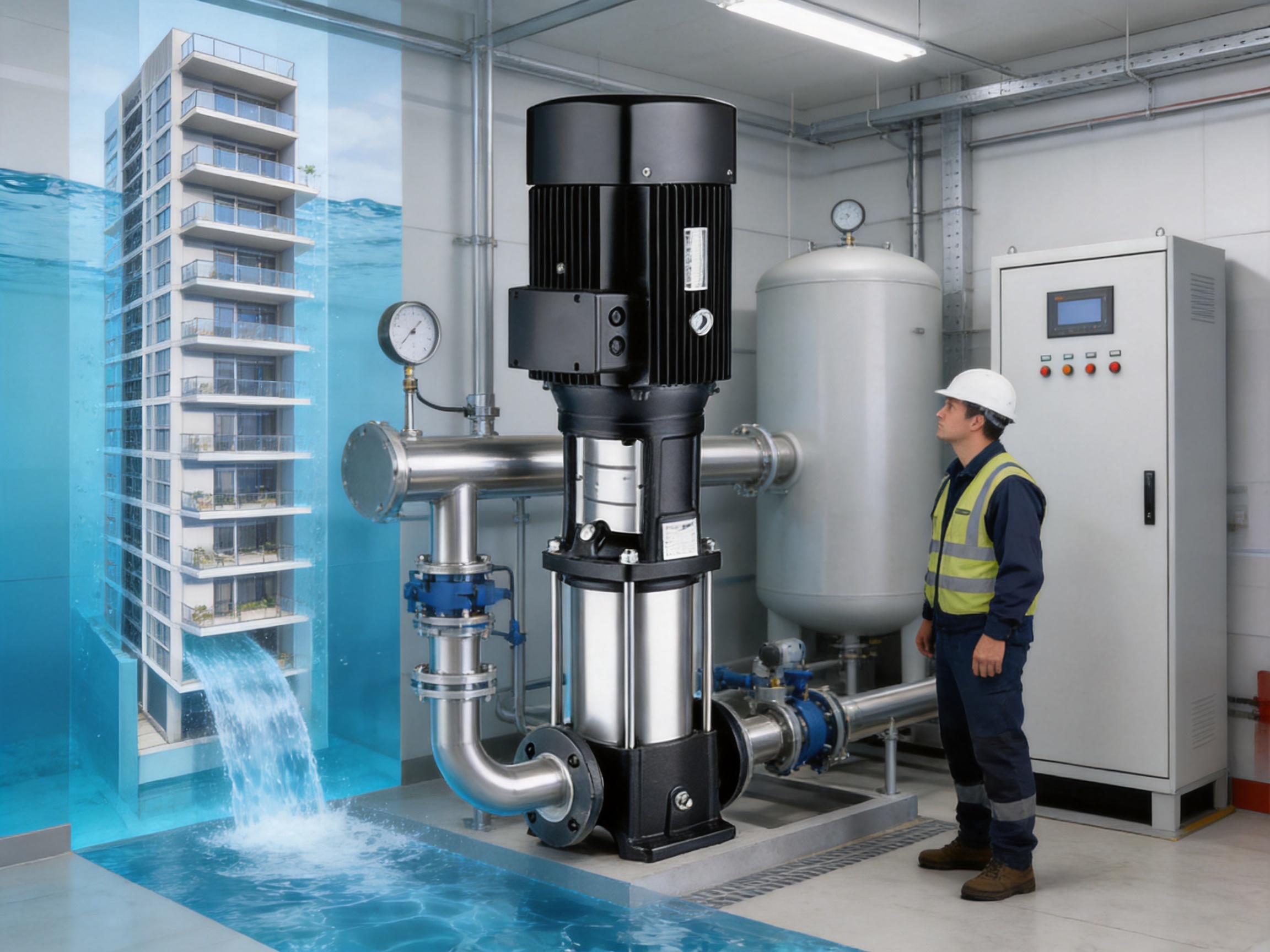
Space is increasingly important in modern buildings and industrial facilities. Equipment rooms may be located in basements, service corridors, rooftop plant areas, or compact utility enclosures. A pump that delivers the required performance while occupying less floor area can help simplify system planning.
The vertical multistage form of the EVR(S) Series concentrates the hydraulic stages into an upright assembly. Compared with many horizontally arranged high-pressure systems, this design may require less floor space and can provide a clean, organized installation. The vertical arrangement can also simplify the visual identification of inlet and outlet connections, motor location, and service access.
When planning an installation, the following points should be considered:
Provide a stable and level foundation.
Leave adequate clearance around the motor and pump for inspection and maintenance.
Use pipe supports so that piping loads are not transferred directly to the pump connections.
Install isolation valves where needed for service and replacement.
Use a suitable check valve if reverse flow could affect the system.
Confirm that the suction conditions meet the pump’s requirements.
Protect the pump from flooding, excessive humidity, freezing temperatures, and environmental contamination.
Ensure that the electrical control panel is accessible and protected from water exposure.
A compact pump should not be installed in a space so tight that technicians cannot remove covers, inspect seals, check wiring, or replace wear components. Space efficiency is most valuable when it is combined with practical service access.
The EVR(S) Series can offer several advantages when compared with basic single-stage pumps or conventional non-protected pressure pumps. These advantages should be evaluated according to the actual application rather than treated as universal claims.
Single-stage transfer pumps are often suitable for moving water over relatively short distances or through systems with modest pressure requirements. However, when a project requires higher pressure, a single-stage pump may need to operate near the upper end of its performance range or use a larger impeller and motor. The vertical multistage structure can provide higher pressure in a more specialized and compact package.
The EVR(S) Series also adds protection functions that may not be included in a basic transfer pump. Water shortage protection can reduce dry-running risk, while voltage stabilization can be beneficial in areas with variable power quality.
Horizontal pump assemblies can provide strong performance, but they may occupy more floor area and require a larger foundation or more extensive piping arrangement. A vertical multistage pump may be easier to fit into a narrow equipment room. Its upright configuration can also support a more organized installation when several pumps or auxiliary components share one space.
A standard pressure pump without integrated shortage or voltage-related protection may depend entirely on external controls and careful operator supervision. External protection can be effective, but it adds components, wiring, programming, and commissioning requirements. By integrating protective functions into the pump solution, the EVR(S) Series can simplify system planning for suitable applications.
Painted or ordinary metal pump bodies may be economical in some conditions, but they can be more vulnerable to surface corrosion or coating damage. Stainless steel construction can provide a stronger long-term proposition where appearance, water contact, or moisture exposure is important. The final choice should still consider water chemistry, budget, operating temperature, and required service life.
Oversizing a pump may appear to provide a safety margin, but it can produce unnecessary energy consumption, unstable pressure, frequent cycling, and inefficient operation. A properly selected multistage pump can match the pressure requirement more closely. Correct sizing is essential because even a high-quality pump can perform poorly if the operating point is far from its intended range.
| Evaluation factor | EVR(S) Series vertical multistage pump | Basic single-stage pump | Conventional unprotected pressure pump |
|---|---|---|---|
| Pressure generation | Multiple hydraulic stages support elevated head in a compact structure | Generally suited to lower or moderate pressure requirements | Depends on the individual hydraulic design |
| Installation footprint | Vertical arrangement can reduce floor-space requirements | Often compact, but performance range may be more limited | Varies by configuration and motor size |
| Water shortage protection | Integrated protection function is available in the series design | May require separate controls | May be absent or dependent on external equipment |
| Voltage-related support | Voltage stabilization feature supports more consistent operation | Usually depends on external electrical protection | Varies by model and control package |
| Material emphasis | Stainless steel construction for suitable water applications | May use different materials depending on model | Depends on manufacturer and product grade |
| Typical value proposition | High pressure, protection, compactness, and durability in one solution | Simple water transfer and lower initial complexity | Pressure boosting with potentially greater dependence on external controls |
The EVR(S) Series can serve a broad range of clean-water and pressure-boosting requirements. Final suitability depends on flow, head, liquid temperature, water quality, electrical conditions, and the exact model selected.
Apartment buildings, offices, hotels, schools, hospitals, and public facilities often require stable water pressure at multiple levels or outlets. Municipal pressure may be insufficient for upper floors, or demand may vary significantly throughout the day. A vertical multistage pump can be incorporated into a booster system to deliver water to elevated locations and maintain useful pressure across the distribution network.
In building applications, low noise, compact installation, control compatibility, and protection against empty tanks are important. The stainless steel structure can also be appropriate for clean-water systems where equipment appearance and corrosion resistance are valued.
Shopping centers, restaurants, office complexes, hotels, and service facilities may experience fluctuating water demand. Pressure boosting equipment must respond reliably to changing use while remaining easy to inspect. The EVR(S) Series can be considered for systems supplying washrooms, kitchens, cleaning points, process fixtures, and other commercial outlets.
Manufacturing plants often use water for equipment cooling, cleaning, processing, washing, and utility services. A multistage pump can support process lines that require stable pressure and continuous water availability. Stainless steel construction may be beneficial in suitable industrial environments, especially where moisture and cleaning operations are common.
Industrial users should carefully verify liquid compatibility. The pump is not automatically suitable for aggressive chemicals, abrasive slurries, oils, or high-temperature fluids simply because it is made of stainless steel. The manufacturer should review the application before final selection.
Irrigation networks frequently need pressure to push water through long pipelines, sprinklers, filters, and elevated fields. The EVR(S) Series may be used in clean-water irrigation systems where stable pressure and protection against an empty source are important. Water shortage protection can be particularly useful when the pump draws from a storage tank or seasonal water source.
For irrigation water containing sand, silt, algae, or other suspended solids, filtration and pre-treatment may be needed. Excessive solids can accelerate wear in hydraulic components and seals. System designers should assess water quality before using any multistage pump.
Heating, ventilation, and air-conditioning installations use pumps to circulate water through cooling, heating, and temperature-control loops. The correct pump depends on the system fluid, temperature, flow, pressure drop, and control strategy. Where the liquid and operating conditions are compatible, a vertical multistage pump can support circulation or pressure-related duties within HVAC infrastructure.
Water treatment systems often contain filters, membranes, softeners, storage tanks, and distribution lines that create pressure losses. A multistage pump can help move treated water through these components. Stainless steel construction may support a clean equipment environment, while water shortage protection can help prevent operation when a supply tank is empty.
Municipal facilities, public wash stations, utility buildings, and community water systems may require dependable pressure boosting and water transfer. Equipment used in these projects is often expected to operate for long periods with clear maintenance procedures. The EVR(S) Series can be evaluated as part of a complete municipal or public water solution, subject to project specifications and applicable standards.
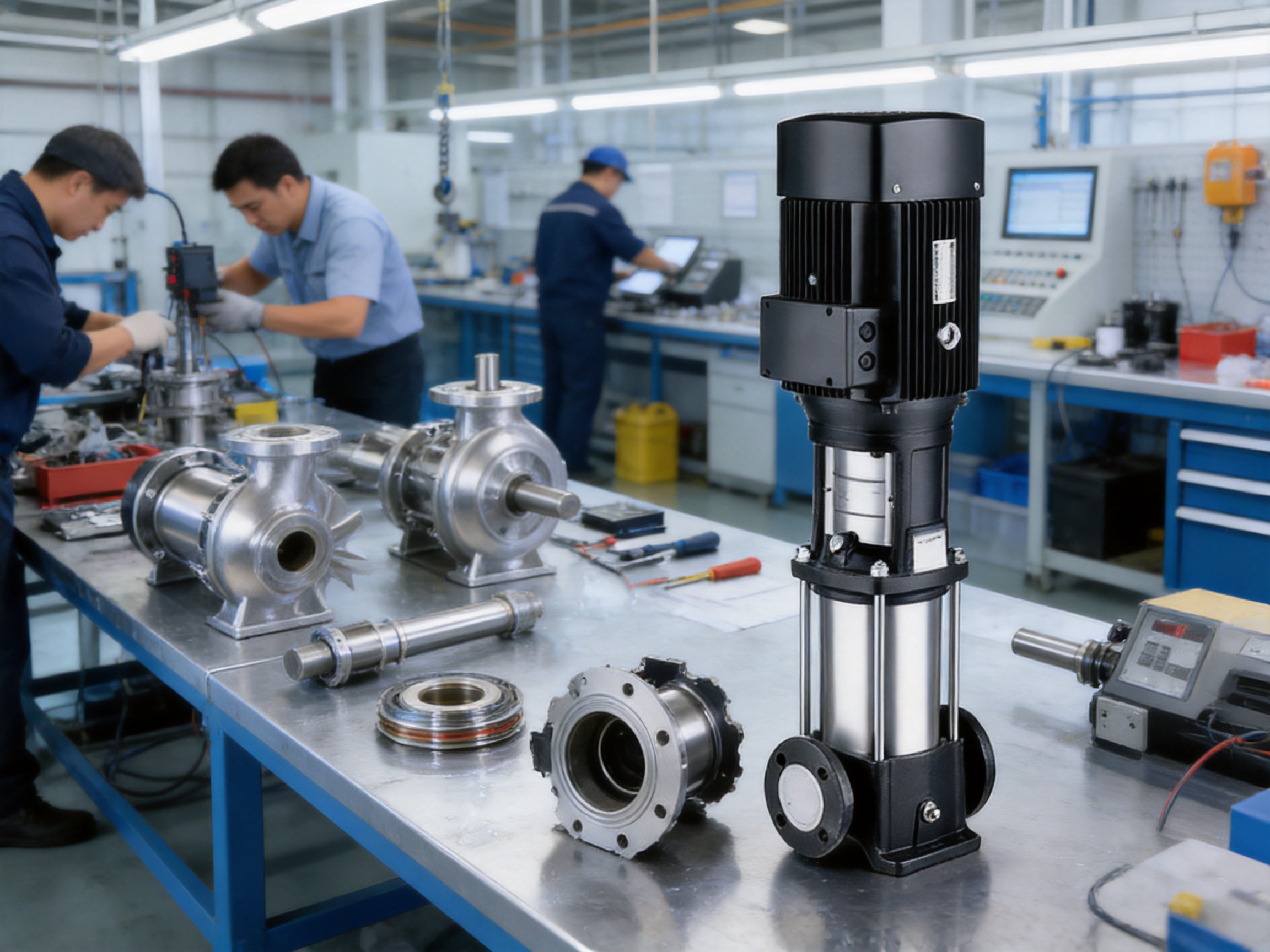
The performance of a pump depends not only on its design concept but also on how consistently it is manufactured. Small variations in machining, assembly, balancing, sealing, wiring, or testing can affect noise, vibration, efficiency, and service life. For this reason, the manufacturer’s production capability is an important part of product value.
Taizhou Edwin Electric Co., Ltd. was founded in 2008 and operates as an integrated manufacturing enterprise focused on independent research and development, mass production, and global export. This integrated structure allows the company to connect product design, manufacturing, quality management, order coordination, and international delivery.
Independent research and development gives a manufacturer greater control over product improvements. Instead of relying only on generic designs, an experienced pump company can study recurring customer requirements and translate them into practical features. For the EVR(S) Series, this product-oriented approach is reflected in the combination of multistage pressure generation, stainless steel construction, water shortage protection, voltage stabilization, and maintenance-oriented design.
Research and development also supports adaptation to different markets. Customers may require different voltage systems, connection standards, control methods, flow ranges, installation conditions, and packaging requirements. A manufacturer with its own technical capability can respond more effectively to these variations.
Mass production requires repeatable processes. Pump components must be manufactured within appropriate tolerances, and assembly procedures must be sufficiently controlled to create consistent products. This includes hydraulic components, shafts, seals, motors, electrical controls, fasteners, and external housings.
Production scale can also improve material planning, component availability, production scheduling, and delivery coordination. For distributors, contractors, and project buyers, this may provide greater confidence when ordering multiple units or planning repeat purchases.
Edwin Pump’s product portfolio includes deep well pumps, submersible pumps, domestic booster pumps, circulation pumps, solar water pumps, intelligent booster pumps, and related pump accessories. This breadth is valuable because water projects often require more than one type of pump. A buyer may need a source pump, a booster pump, circulation equipment, valves, pipes, controls, or replacement accessories.
A broad product range can support one-stop procurement and make it easier to coordinate equipment across a project. It also gives the manufacturer exposure to different operating conditions, including residential water supply, agricultural irrigation, new energy projects, municipal engineering, mining, construction, HVAC, and industrial applications.
Global export requires more than manufacturing. It involves product communication, technical documentation, packaging, order tracking, customs coordination, delivery planning, and after-sales support. The company established Taizhou Haipai Import & Export Co., Ltd. and Golden Falcon Industrial Co., Ltd. in 2012 to support procurement planning, order tracking, cross-border delivery, and foreign trade services.
This organizational experience can be valuable for overseas buyers that need clear communication from inquiry through shipment. It can also support distributors and project contractors that purchase equipment in batches or require coordinated delivery of several product categories.
Although the precise production procedures may vary by model, a quality-oriented pump manufacturing process generally includes several important stages. Each stage contributes to consistent performance and should be supported by suitable inspection records and process controls.
The process begins with a review of hydraulic requirements, motor loading, material selection, sealing, protection functions, and installation conditions. The design should balance head, flow, efficiency, size, durability, and cost. For a vertical multistage pump, attention is also required for stage alignment, shaft stability, axial forces, pressure distribution, and connection design.
Stainless steel sheets, castings, machined components, shafts, seals, bearings, motors, cables, and electrical control parts should be selected according to the intended application. Consistent component quality helps reduce variation between units. For export products, component specifications should be clearly documented so customers can understand the equipment configuration.
Hydraulic components must be produced with suitable dimensional accuracy. Impeller geometry, diffuser passages, shaft fits, seal seats, and connection surfaces all influence performance. Poor machining can increase vibration, reduce efficiency, create leakage, or accelerate wear. Precision machining and inspection help ensure that components assemble correctly and operate smoothly.
The rotating assembly must be aligned and balanced to reduce vibration. The shaft, impellers, couplings, and other rotating parts work together at operating speed. Correct assembly is essential for protecting bearings and seals and for maintaining acceptable noise levels.
Mechanical seals and static sealing elements must be installed carefully. The sealing system should match the liquid, temperature, pressure, and operating frequency. Pressure integrity checks can help identify leakage or assembly problems before the pump reaches the customer.
Motor wiring, terminal connections, sensors, protection devices, and control components should be assembled according to the product specification. Voltage stabilization and water shortage protection require dependable electrical integration. Wiring should be organized, insulated, and checked before shipment.
Testing may include visual inspection, electrical testing, insulation checks, rotation verification, leakage inspection, noise or vibration observation, and performance testing where applicable. Test procedures should be appropriate to the model and intended operating range. Thorough testing helps identify defects before delivery and supports more reliable commissioning at the customer’s site.
Proper packaging protects the pump from impact, moisture, contamination, and movement during transportation. Export shipments may travel through several handling stages, making secure packaging especially important. Product labels, manuals, spare parts, and documentation should be organized so that installation teams can identify the equipment quickly upon arrival.
Choosing the correct EVR(S) Series model requires more than comparing motor power or external dimensions. A pump should be selected according to the complete system duty.
Calculate the expected water demand under normal and peak conditions. For a building, this may involve the number of fixtures, occupancy, usage patterns, and storage arrangements. For irrigation, flow depends on the number of zones, sprinklers, emitters, and irrigation schedule. For industrial systems, the process engineer should define continuous and intermittent demand.
Total head includes static elevation, required delivery pressure, pipe friction, fittings, valves, filters, heat exchangers, and other system losses. A pump selected only according to vertical elevation may fail to provide sufficient pressure once friction and equipment losses are considered.
The selected pump should operate within an appropriate region of its performance curve. Operating too far left or right of the recommended range can lead to unstable flow, excessive recirculation, high energy consumption, vibration, or overload. Buyers should request the pump curve and technical data for the exact model rather than relying on general series descriptions.
Provide information about water temperature, pH, mineral content, chloride level, suspended solids, chemical additives, and cleanliness. Stainless steel construction is suitable for many water applications, but aggressive or abrasive liquids may require special materials or a different pump type.
Confirm the available voltage, frequency, phase, starting method, rated current, and protection requirements. If the installation is in an area with unstable power, discuss the voltage stabilization function and allowable operating range with the supplier. External circuit protection and proper grounding remain essential.
Determine whether the pump will operate manually, through a pressure switch, with a float or tank sensor, through a variable-speed controller, or as part of a larger building management system. The water shortage protection function should be compatible with the selected control approach.
Ensure that the installation provides access to the motor, seals, connections, control equipment, and inspection points. A pump that is easy to service can reduce downtime and support better preventive maintenance.
Correct installation is necessary to obtain the benefits of any advanced pump. Before installation, inspect the pump for transport damage and confirm that the model matches the order. Check the nameplate, connections, motor data, accessories, and documentation.
The foundation should be stable, level, and capable of supporting the equipment and connected piping. Pipework should be cleaned before connection because welding debris, rust, sand, and other particles can damage the impellers or seals. The suction line should be correctly sized and arranged to reduce air entry and excessive pressure loss.
Valves should be installed according to the system design. Isolation valves can simplify maintenance, while check valves may protect against reverse flow. Pipe supports should be independent of the pump body. If the system requires flexible connectors, they should be selected and installed correctly rather than used to compensate for poor alignment.
Before startup, verify that the pump is filled or primed according to the design. Confirm that the water source is available and that the water shortage protection system is correctly connected. Check electrical wiring, grounding, rotation direction, overload protection, and voltage conditions.
During initial operation, observe pressure, flow, sound, vibration, motor temperature, leakage, and control response. Do not allow the pump to operate dry. If unusual noise, severe vibration, abnormal current, or leakage occurs, stop the pump and investigate the cause before continuing.
Regular maintenance helps preserve pump performance and identify developing problems before they become failures. The maintenance schedule should reflect operating hours, water quality, temperature, system criticality, and manufacturer recommendations.
Routine inspections may include:
Checking for external leakage around seals and connections.
Inspecting unusual noise or vibration.
Confirming stable pressure and flow.
Reviewing motor current and operating temperature.
Checking electrical terminals and control components.
Inspecting valves, strainers, filters, and storage tanks.
Confirming that water shortage protection responds correctly.
Checking that the pump starts and stops according to the control settings.
Cleaning the surrounding area to prevent moisture, dust, or debris from affecting the motor and electrical components.
If performance declines, possible causes may include a blocked inlet, air entering the suction line, worn seals, impeller obstruction, insufficient water level, incorrect rotation, closed valves, excessive system resistance, or electrical problems. Troubleshooting should begin with simple external checks before internal disassembly.
When service is required, isolate the electrical supply and relieve hydraulic pressure. Use appropriate replacement parts and follow the manufacturer’s service instructions. Because the EVR(S) Series includes multiple stages, careful attention should be given to the order and orientation of internal components during disassembly and reassembly.
A pump’s environmental impact is influenced by its energy consumption, service life, maintenance requirements, replacement frequency, and suitability for the system. A correctly sized multistage pump can help avoid the waste associated with oversized equipment and unnecessary throttling. Stable operation can also reduce repeated restarts and abnormal operating conditions.
Longer service life is another important sustainability factor. Stainless steel construction, suitable protection functions, and preventive maintenance may reduce the need for early replacement. When a pump remains in service for many years, the environmental and financial costs associated with manufacturing, transporting, and installing replacement equipment are reduced.
Water shortage protection can contribute to resource responsibility by preventing uncontrolled operation when the water source is unavailable. In water supply systems, avoiding dry running protects the equipment while also supporting more responsible management of stored or pumped water.
For the best result, users should consider the complete lifecycle rather than only the initial purchase price. Energy use, downtime, spare parts, maintenance labor, water loss, and replacement risk can all influence the true cost of ownership.
Technical support is especially important when a pump is part of a larger system. Buyers may need help interpreting performance curves, choosing materials, matching electrical specifications, configuring protection functions, preparing export documents, or coordinating multiple products.
Edwin Pump’s business structure includes manufacturing, research and development, export coordination, order tracking, and foreign trade services. This integrated approach can help customers manage procurement from initial inquiry to delivery. The company’s broader product range also allows customers to discuss related pumping needs with one supplier.
For project buyers, useful pre-sales information may include:
Required flow and head.
Liquid type and water quality.
Operating temperature.
Available voltage and frequency.
Installation dimensions and connection requirements.
Duty cycle and expected operating hours.
Control and communication requirements.
Environmental conditions.
Required quantity and delivery schedule.
After-sales support should include installation guidance, operating instructions, troubleshooting information, replacement parts, and communication channels for technical questions. Buyers should request the documentation and support scope relevant to their project before placing an order.
The EVR(S) Series is designed for water supply and pressure-boosting applications that require a vertical multistage structure, stainless steel construction, water shortage protection, and voltage stabilization. It is suitable for many clean-water applications, subject to model selection and operating-condition verification.
A vertical multistage pump uses several impeller and diffuser stages arranged in series to increase water pressure progressively. The vertical arrangement provides high-pressure capability in a relatively compact footprint.
Stainless steel offers corrosion resistance, a clean appearance, and durable performance in many suitable water-handling conditions. It can be valuable in domestic, commercial, industrial, and water treatment environments. Water chemistry should still be reviewed before selection.
Water shortage protection is intended to detect insufficient water conditions and help prevent the pump from continuing to operate without adequate liquid. This can reduce the risk of dry-running damage. The exact protection method and reset behavior depend on the model configuration.
No. Voltage stabilization can support more consistent operation, but the installation still requires suitable grounding, overload protection, circuit protection, correct wiring, and compliance with local electrical requirements.
Not automatically. Stainless steel resistance depends on the material grade and the liquid conditions. Seawater, high-chloride water, aggressive chemicals, abrasive liquids, and high-temperature fluids require specific technical review before purchase.
It may be suitable for high-rise water supply and pressure boosting when the selected model provides the required flow and total head. The system designer should calculate elevation, friction losses, peak demand, and delivery pressure before selecting the pump.
It can be considered for clean-water irrigation systems requiring pressure. If the water contains sand, silt, or other solids, suitable filtration and water-quality evaluation are necessary.
Buyers should provide the required flow, total head, liquid type, temperature, water quality, voltage, frequency, phase, installation arrangement, operating schedule, quantity, and destination. A complete application description helps the supplier recommend the correct model.
The EVR(S) Series is designed with easy maintenance in mind, but all multistage pumps require correct inspection and service procedures. Adequate access, clean water, proper electrical isolation, and suitable replacement parts are important for efficient maintenance.
The series combines several features in one product concept: multistage pressure generation, vertical space-saving construction, stainless steel materials, water shortage protection, and voltage stabilization. These features can reduce the need for separate protective arrangements in suitable applications.
It can be evaluated for automatic systems using pressure controls, tank sensors, float switches, or other control arrangements. Compatibility should be confirmed with the supplier, especially when external controllers or building management systems are involved.
The EVR(S) Series Water Shortage Protection Voltage Stabilization Stainless Steel Vertical Multistage Pump is designed for users who need more than basic water transfer. Its multistage hydraulic structure supports higher-pressure applications, while the vertical arrangement helps reduce installation footprint. Stainless steel construction provides a durable and clean solution for many appropriate water environments. Water shortage protection helps reduce dry-running risk, and voltage stabilization supports more consistent operation in challenging electrical conditions.
Compared with conventional single-stage pumps, large horizontal assemblies, unprotected pressure pumps, and non-stainless steel alternatives, the EVR(S) Series offers a balanced combination of pressure performance, protection, compactness, and durability. Its value is strongest when the pump is correctly matched to the required flow, head, liquid conditions, electrical supply, and control strategy.
The product is supported by Taizhou Edwin Electric Co., Ltd., a manufacturer with experience in independent research and development, mass production, global export, and a broad portfolio of water pumping equipment. The company’s capabilities across deep well pumps, submersible pumps, booster pumps, circulation pumps, solar pumps, intelligent pumps, and accessories can support customers seeking coordinated procurement for complete water systems.
For building services, agricultural irrigation, industrial water supply, HVAC infrastructure, water treatment, municipal engineering, and commercial pressure boosting, the EVR(S) Series can be evaluated as a dependable and flexible pumping solution. The best results will come from detailed technical selection, correct installation, proper commissioning, and regular preventive maintenance.
Hydraulic Institute. Pump Application Guidelines and General Pump System Practices.
International Organization for Standardization. General Guidance for Rotodynamic Pump Selection and Performance Evaluation.
American Society of Mechanical Engineers. Rotodynamic Pump Design, Testing, and Application Principles.
Grundfos. Technical Principles of Multistage Pumping and Pressure Boosting.
World Health Organization. Guidelines for Drinking-Water Quality and Water System Management.
International Electrotechnical Commission. General Practices for Electrical Motor Protection and Low-Voltage Equipment.
Manufacturer technical materials for the EVR(S) Series Water Shortage Protection Voltage Stabilization Stainless Steel Vertical Multistage Pump.
edwina@edwin-pump.com
+86-13586290903 (WhatsApp)
Xuri Gongliang Cutting Tool Entrepreneurship Park, Wenqiao Town, Wenling City, Taizhou City, Zhejiang Province, China

High Performance Smart Pump Factory


 English
