edwina@edwin-pump.com

View All Products
en
Effective wastewater management depends on equipment that can operate reliably in demanding environments, handle contaminated liquids, and maintain stable drainage performance over long working periods. The Submersible Sewage Pump WQ is designed for these requirements. It provides a practical pumping solution for factories, construction sites, commercial facilities, municipal sewage systems, residential drainage stations, methane pools, and countryside irrigation applications.
Unlike ordinary clean-water pumps, a sewage pump must work with liquids containing suspended solids, organic matter, and other contaminants. It must also tolerate immersion, fluctuating operating conditions, and frequent starts and stops. The WQ series addresses these challenges through a submersible design, a built-in thermal protection system, a copper-wound motor, a stainless steel welded shaft, and an IPX8 protection class.
Manufactured by an experienced pump enterprise with capabilities in research and development, mass production, procurement support, and global export, this product is positioned as a dependable option for professional distributors, engineering contractors, agricultural users, property managers, and industrial customers. Its compact structure and direct submersible installation method can simplify drainage planning while reducing the need for extensive surface piping or a separate priming system.
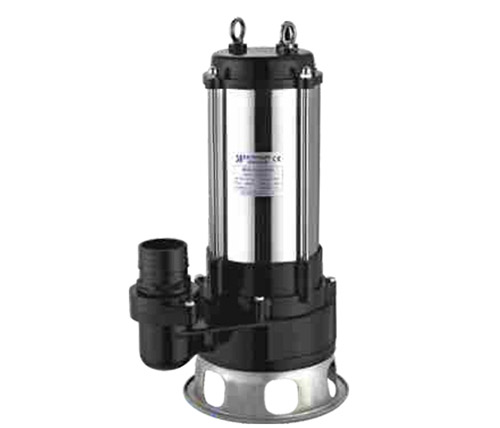
SUBMERSIBLE SEWAGE PUMP WQ
A submersible sewage pump is installed directly inside the liquid that needs to be removed. The pump motor and hydraulic components are designed to operate while immersed, allowing the unit to push wastewater through a discharge pipe toward a treatment facility, drainage channel, collection tank, or irrigation point.
This arrangement differs from a surface-mounted pump. A surface pump must remain above the liquid and typically requires a suction pipe, foot valve, priming arrangement, and careful control of suction lift. A submersible pump, by contrast, is positioned close to or inside the collection area. The liquid surrounds the pump, helping the unit begin operation without the same type of manual priming procedure required by many surface installations.
For wastewater applications, this operating principle offers several practical benefits:
• The pump can be installed inside a sump, pit, tank, or drainage station.
• Suction-lift limitations are reduced because the pump is located at the liquid source.
• Installation can be more compact where floor space is limited.
• The pump can remove water from low-level areas that are difficult to drain by gravity.
• Automatic control systems can be added through float switches, level sensors, or other control equipment when required.
The WQ design is intended for drainage and sewage-related work rather than for untreated drinking water supply. Its operating limits should always be considered when selecting the installation site and application. The maximum immersion depth is 5 meters, the maximum liquid temperature is 40°C or 104°F, the permitted liquid pH range is 5 to 9, and the maximum liquid density is listed as 1.2 × 10³ kg/m³.
The following table summarizes the principal information available for the Submersible Sewage Pump WQ.
| Item | Specification |
|---|---|
| Product type | Submersible sewage and wastewater drainage pump |
| Maximum immersion depth | 5 meters |
| Maximum liquid temperature | 40°C / 104°F |
| Permitted liquid pH | 5–9 |
| Liquid kinematic viscosity | Approximately 7 × 10⁻⁶ to 23 × 10⁻⁶ m²/s, subject to confirmation for the final model |
| Maximum liquid density | 1.2 × 10³ kg/m³ |
| Motor winding | Copper winding |
| Motor protection | Built-in thermal protector |
| Shaft construction | Stainless steel welded shaft |
| Insulation class | Class B |
| Protection class | IPX8 |
Because wastewater conditions vary significantly, users should confirm the exact pump model, power rating, discharge diameter, head, flow rate, cable length, and control arrangement before purchase. The available information identifies the product family and its operating environment, while the final selection should be matched to the required duty point.
The most important structural advantage of the WQ pump is its submersible configuration. The pump is placed directly into the wastewater or drainage pit, allowing the hydraulic section to work close to the liquid source. This can reduce the complexity of the suction side of the system and make the pump suitable for locations where a conventional surface installation would be difficult.
In factories, for example, wastewater may collect in low-level pits beneath production areas. In construction sites, rainwater and groundwater can accumulate in excavations. In residential drainage stations, the available installation space may be narrow and enclosed. A submersible pump can fit these applications without requiring a large pump room or an elevated mounting platform.
The compact arrangement also supports flexible project planning. Contractors can install the unit in a collection tank and route the discharge line to a safe drainage location. Depending on the project, the pump may be used with a fixed discharge arrangement or a removable installation system for easier maintenance.
Wastewater pumps may experience changing loads caused by fluctuating liquid levels, variable solid content, or irregular inflow. Motor temperature can rise when the pump operates under excessive resistance, insufficient cooling, voltage instability, or other abnormal conditions. The built-in thermal protector helps protect the motor against excessive temperature.
A thermal protector does not eliminate the need for correct system design. It should be viewed as an additional layer of motor safety rather than a substitute for appropriate electrical protection. A properly selected circuit breaker, overload protection, grounding arrangement, and control panel remain important parts of a complete installation.
When the thermal protector responds, the pump may stop until the motor temperature returns to a safer range. Operators should investigate the cause of repeated thermal trips instead of repeatedly restarting the unit. Common causes may include a blocked discharge line, unsuitable liquid, excessive head, inadequate voltage, mechanical obstruction, or operation outside the recommended conditions.
The WQ motor uses copper winding. Copper is widely used in professional electric motors because of its favorable electrical conductivity and ability to support efficient transfer of electrical energy through the winding system. A properly manufactured copper winding can contribute to stable motor operation and dependable performance when the pump is operated within its rated conditions.
For wastewater equipment, motor reliability is especially important because access for inspection may be inconvenient. The pump may be installed inside a pit, below ground level, or in an area exposed to moisture and contamination. A robust motor design helps reduce the risk of premature failure and supports predictable maintenance planning.
Compared with basic low-cost pumps that may prioritize initial price over long-term construction quality, a copper-wound motor provides a stronger foundation for professional use. Actual efficiency and service life still depend on the specific motor rating, operating point, power supply quality, maintenance practice, and wastewater characteristics.
The stainless steel welded shaft is another important design feature. The shaft transfers motor torque to the hydraulic assembly and must remain dimensionally stable during operation. In a wet and potentially corrosive environment, the shaft material and manufacturing quality can affect durability.
Stainless steel offers useful resistance to moisture and many common wastewater conditions. The welded construction is intended to produce a secure shaft assembly while supporting reliable power transmission. This is particularly relevant when the pump operates frequently or when the liquid contains substances that could accelerate corrosion of less suitable materials.
Material selection must always be considered in relation to the actual liquid. A general sewage pump is not automatically suitable for highly aggressive chemicals, concentrated acids, solvents, or liquids containing unusual corrosive agents. The stated pH range of 5 to 9 provides an important boundary for normal selection.
The product is specified with an IPX8 protection class. In practical terms, this indicates that the enclosure is designed for continuous immersion under conditions defined by the manufacturer. This is essential for a pump intended to operate inside a tank, sump, or wastewater collection pit.
IPX8 protection supports the basic purpose of a submersible pump, but it does not mean that every installation condition is automatically safe. Cable connections, junction boxes, control panels, grounding systems, and installation accessories must also be protected correctly. The cable should not be damaged, sharply bent, or used as a lifting rope. The pump should be handled with suitable lifting equipment or a dedicated support arrangement.
Correct installation preserves the protection level and helps prevent moisture intrusion. Before commissioning, installers should inspect the cable, seals, mounting points, discharge connection, and electrical protection equipment.
The motor insulation class is listed as Class B. Insulation class defines the thermal capability of the motor winding insulation system. Class B insulation is commonly associated with a permitted temperature rise appropriate for many standard motor applications.
For the user, the key point is that insulation performance depends on the complete operating environment. The pump should be supplied with the correct voltage and frequency, and the motor should not be overloaded continuously. The thermal protector, correct control equipment, and appropriate operating schedule work together to help maintain motor reliability.
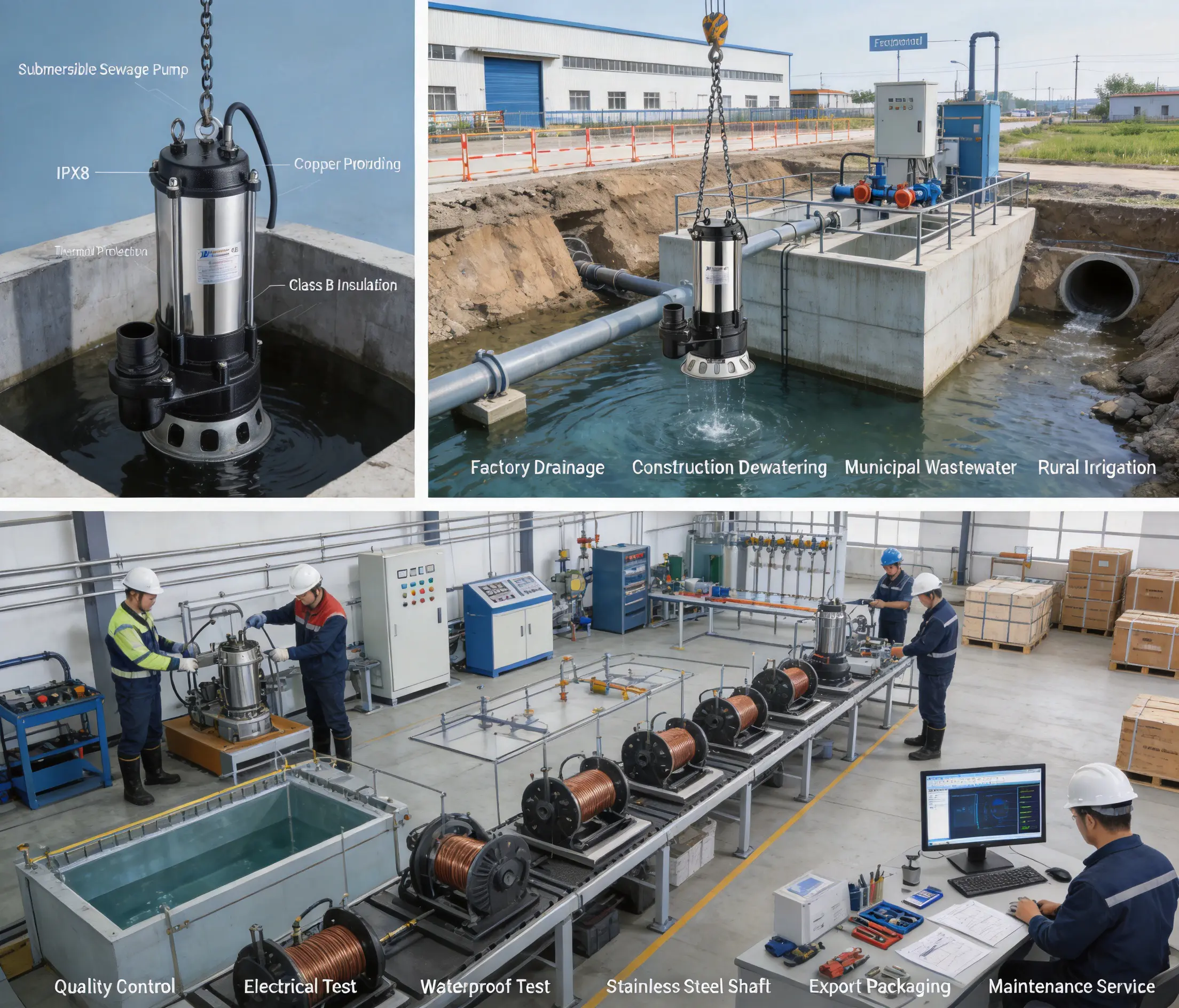
Factories often generate wastewater through cleaning, equipment washing, process drainage, rainwater infiltration, and floor-level collection systems. A submersible sewage pump can transfer accumulated liquid from pits or drainage tanks to a treatment plant, municipal connection, settling tank, or approved discharge point.
The WQ pump is suitable for general wastewater drainage where the liquid remains within the specified temperature, pH, viscosity, density, and immersion limits. It can support production facilities that need to prevent standing water, maintain clean working areas, and move wastewater away from low points.
Industrial users should identify the exact composition of the wastewater before installation. If the liquid contains abrasive solids, long fibrous materials, concentrated chemicals, oil, or unusually high temperatures, a specialized pump or additional pretreatment may be necessary.
Construction sites frequently face temporary water accumulation in foundation pits, underground areas, trenches, and excavation zones. Rainfall, groundwater, pipe leakage, and cleaning operations can create conditions that delay construction and damage materials.
A submersible pump offers a portable and practical method for removing collected water. Because it is installed directly in the flooded area, it can begin drainage without the long suction arrangements needed by some surface pumps. Contractors can move the unit as the site layout changes, provided that the electrical supply, discharge hose, lifting method, and operating conditions remain suitable.
Construction personnel should keep the pump clear of large debris and ensure that mud or sediment does not block the inlet. The pump should not be dragged by its power cable. Safe lifting and proper temporary electrical distribution are essential on active construction sites.
Commercial buildings may require wastewater drainage in basements, service areas, kitchens, parking structures, plant rooms, and underground collection tanks. Hotels, shopping centers, office buildings, workshops, and warehouses all benefit from reliable drainage equipment that can operate without occupying excessive floor space.
The WQ pump can be incorporated into a drainage station or collection pit. A level-control device can start the pump when the liquid rises and stop it when the level falls. This type of arrangement can reduce manual supervision and help prevent overflow, although the control system must be selected and installed separately according to project requirements.
Municipal drainage and sewage treatment systems include collection stations, transfer points, treatment facilities, and overflow-prevention systems. Submersible pumps are often used where wastewater must be lifted from a lower elevation to a higher pipeline or treatment stage.
The WQ pump is designed for drainage applications within its specified operating range. It may be used in smaller municipal facilities, auxiliary drainage points, local collection systems, or supporting applications. Large municipal projects should be evaluated by qualified engineers because flow requirements, duty cycles, solids handling, redundancy, control logic, and regulatory requirements can be more demanding than those of a small drainage installation.
Residential buildings in low-lying locations may require drainage stations to remove wastewater or rainwater when gravity drainage is unavailable. Basements, underground garages, garden drainage pits, and small community facilities are common examples.
The compact submersible format can be useful in residential systems because it minimizes equipment-room requirements. When combined with an appropriate level switch and non-return valve, the pump can provide automatic drainage for a collection tank. Noise may also be lower than with some surface-mounted arrangements because the motor is immersed and enclosed within the pump structure, although actual sound levels depend on the installation.
The stated application range includes methane pools and field irrigation in rural areas. In agricultural communities, anaerobic digestion systems may produce liquid by-products that need to be transferred or drained. The pump may also be used to move suitable water from collection points to fields.
These applications require careful liquid assessment. Methane-related environments may contain gases, organic matter, and potentially hazardous atmospheres. The pump and electrical system must be used only where the installation is safe and compatible with the site classification. A standard submersible pump should not be placed in an explosive atmosphere unless the complete equipment and installation have been specifically approved for that environment.
For agricultural irrigation, users should check whether the liquid contains abrasive sand, long fibers, heavy solids, or chemicals that could affect the pump. Filtration, screening, settling, or other pretreatment may improve reliability when the source water is heavily contaminated.
Selecting a sewage pump requires more than comparing price. The correct solution depends on installation depth, wastewater composition, required flow, total head, operating frequency, access for maintenance, and available power. The following comparison explains where the WQ submersible arrangement offers practical advantages.
| Pump type | Typical installation | Potential strengths | Important considerations |
|---|---|---|---|
| Submersible sewage pump | Inside a sump, pit, tank, or drainage station | Compact installation, reduced suction-lift concerns, suitable for immersed operation | Requires safe cable management, correct sealing, and suitable wastewater conditions |
| Surface centrifugal pump | Above the liquid level | Easy visual access and convenient servicing | May require priming, suction piping, and protection from flooding |
| Self-priming pump | Usually above or near the liquid source | Can restart more conveniently after some air enters the suction line | May be larger, noisier, and more dependent on suction piping design |
| Domestic booster pump | On a clean-water supply line | Useful for increasing pressure in buildings | Generally not intended for sewage or contaminated wastewater |
| Drainage ejector system | Collection basin with pump and controls | Can provide automatic drainage for buildings | Requires a complete basin, controls, valves, and maintenance plan |
The WQ pump’s principal advantage over many surface alternatives is that it is designed to work directly in the liquid. This makes it especially attractive when the source is below the pump room, when suction lift would be difficult, or when a simple compact drainage station is preferred.
Its advantage over clean-water booster pumps is application suitability. A booster pump is designed to raise pressure in a water supply system, while a sewage pump is designed to remove wastewater. Using the wrong pump type can result in blockages, seal damage, motor overload, poor hydraulic performance, or premature failure.
The product is manufactured by Taizhou Edwin Electric Co., Ltd., an integrated enterprise established in 2008. The company specializes in independent research and development, mass production, and global export. This combination is important for pump buyers because it connects product design, manufacturing control, order coordination, and international delivery within an organized supply structure.
Independent research and development allows a manufacturer to improve product configurations in response to application requirements. For a sewage pump, development work may involve hydraulic matching, motor protection, sealing performance, shaft construction, material selection, cable routing, and serviceability. A manufacturer with direct product-development capabilities can respond more efficiently than a trading company that has no control over the engineering process.
Mass production also provides practical advantages. Repeated production of the same pump family allows the manufacturer to establish standardized assembly procedures, organize component procurement, monitor production consistency, and support repeat orders. For distributors and engineering contractors, this can make product sourcing more predictable.
An integrated pump manufacturer typically understands how motor performance, hydraulic design, mechanical assembly, and electrical protection interact. This product knowledge is valuable because a pump is not simply a motor attached to an impeller. The complete assembly must operate as a balanced system.
The WQ pump reflects this integrated approach through the combination of copper motor winding, built-in thermal protection, stainless steel welded shaft, Class B insulation, and IPX8 protection. These features address different failure risks. The copper winding supports electrical performance, the thermal protector responds to overheating, the shaft construction supports mechanical transmission, the insulation system supports motor safety, and the enclosure design supports submerged operation.
Quality should be understood as a process rather than as a single material or component. It includes incoming material control, dimensional consistency, winding quality, sealing assembly, electrical testing, mechanical inspection, packaging, and final documentation. Buyers should request the specific inspection and testing records applicable to the order and model.
To support wider purchasing requirements, the company established Taizhou Haipai Import & Export Co., Ltd. and Golden Falcon Industrial Co., Ltd. in 2012. These affiliated organizations provide support in procurement planning, order tracking, cross-border delivery, and foreign trade services.
This broader supply capability can be valuable to overseas buyers who need more than a single product. Pump projects often require accessories, replacement parts, valves, pipes, control equipment, packaging coordination, and shipment documentation. A professional export team can help organize these requirements and reduce communication gaps between the buyer, factory, freight provider, and end user.
For distributors, dependable order support is a commercial advantage. It can help with repeat purchasing, product selection, private project coordination, delivery planning, and after-sales communication. The company’s experience in global export also supports customers who operate in different markets and need assistance with international shipment procedures.
The company’s product portfolio includes deep well pumps, submersible pumps, domestic booster pumps, circulation pumps, solar water pumps, intelligent booster pumps, and other water-treatment-related products. This range indicates experience across multiple water applications, from household supply and agricultural irrigation to wastewater drainage and intelligent pressure management.
A broad product portfolio can benefit customers because pump selection is often part of a larger water system. One project may require a drainage pump, a clean-water booster, a circulation pump, valves, pipes, or a solar pumping solution in another location. A manufacturer with knowledge across several pump categories can provide more coherent technical guidance and product coordination.
Since 2018, the company has invested in new energy and intelligent technology, including solar water pumps and intelligent booster pumps. Although the WQ sewage pump is a dedicated wastewater product rather than a solar or intelligent pressure pump, this wider development direction demonstrates an emphasis on adapting pump products to changing energy and automation requirements.
A reliable pump installation begins with accurate duty-point information. The required flow rate is the volume of liquid that must be moved within a specific period. The total head is the combined vertical lift and friction loss in the discharge system. Both values must be calculated before selecting the final model.
Users should gather the following information:
• Required flow rate in cubic meters per hour or liters per minute.
• Vertical distance from the liquid level to the discharge point.
• Length, diameter, and material of the discharge pipe.
• Number and type of elbows, valves, and other fittings.
• Minimum and maximum liquid levels.
• Expected operating hours and start frequency.
• Liquid temperature, pH, density, viscosity, and solids content.
• Available voltage, frequency, phase, and electrical capacity.
• Required control method, including manual or automatic operation.
• Environmental conditions surrounding the pump and control panel.
Oversizing is not always beneficial. A pump that is too large may cycle excessively, consume unnecessary energy, create high discharge velocity, or operate away from its most suitable hydraulic range. Undersizing may result in slow drainage, continuous operation, overheating, and poor system performance.
Where the liquid contains solids, the inlet and discharge arrangement should be checked carefully. Large debris should be removed before it reaches the pump. A strainer or screening system may be appropriate in some installations, but the screen must not become a restriction that causes the pump to starve or operate against abnormal resistance.
The pump should be installed by personnel familiar with electrical equipment and wastewater systems. Before installation, inspect the unit for transportation damage and verify that the model matches the project requirements.
Place the pump on a stable base or in a suitable guide arrangement. Avoid positioning it directly on loose sediment where mud can enter the inlet. If the installation is in a deep pit, use a secure lifting chain or support system. Never suspend or retrieve the pump by pulling on the electrical cable.
The discharge pipe should be adequately supported so that its weight is not transferred to the pump outlet. A non-return valve may be used where backflow could cause reverse rotation, repeated cycling, or unnecessary filling of the drainage pit. Isolation valves can simplify maintenance, but they should be used according to the system design.
The electrical supply must match the pump nameplate. Use a correctly rated circuit breaker and overload protection. Grounding must comply with local electrical requirements. Cable joints should remain dry and protected from immersion unless they are specifically designed and certified for submerged use.
Before the first full operation, check that the pump can move freely, that the discharge line is open, and that automatic controls respond at the intended liquid levels. Operate the pump briefly and observe vibration, noise, discharge behavior, current draw, and leakage indications. Stop the pump immediately if abnormal conditions appear.
Preventive maintenance helps extend service life and reduce unexpected downtime. The maintenance schedule should be adjusted to the liquid condition and operating frequency, but routine inspection may include the following tasks:
• Inspect the power cable for cuts, abrasion, crushing, or damaged insulation.
• Check the discharge pipe, valve, and non-return valve for blockage.
• Remove accumulated sediment from the pit or tank.
• Verify that the float switch or level sensor moves freely.
• Observe motor starting behavior and operating current.
• Check for unusual vibration, noise, or reduced discharge performance.
• Inspect seals and connections during scheduled service.
• Confirm that thermal protection is functioning as intended.
The pump must be disconnected from the electrical supply before inspection or handling. Wastewater may contain biological hazards, sharp objects, toxic materials, or combustible gases. Personnel should use suitable protective equipment and follow site safety procedures.
If the pump stops because of thermal protection, allow it to cool and investigate the reason. Repeated thermal trips often indicate an underlying issue rather than a normal operating condition. Possible causes include blocked flow, incorrect voltage, excessive head, mechanical obstruction, liquid conditions outside the specifications, or an unsuitable duty cycle.
The maximum immersion depth is 5 meters. Operating below this depth can increase pressure on seals and housing components and may exceed the design conditions. The maximum liquid temperature is 40°C. Hotter liquids can reduce motor cooling effectiveness, accelerate seal wear, and damage insulation or other components.
The permitted pH value is 5 to 9. Liquids outside this range may attack metallic components, elastomers, coatings, or cable materials. Users should provide a complete chemical analysis where the wastewater is industrial, mixed, or uncertain.
The listed liquid density limit is 1.2 × 10³ kg/m³. Higher-density liquids may require greater motor torque and can change the hydraulic performance. Similarly, excessive viscosity can reduce flow and increase motor load. The supplied viscosity figures should be confirmed against the final technical data sheet because the source information contains compressed notation.
The pump should not be used for applications that require certified explosion protection unless the complete product and installation are specifically approved for that purpose. Methane pools and other gas-producing environments require special risk assessment. The presence of methane does not automatically mean that a standard pump is suitable for the area.
For distributors, the WQ pump offers a product category with broad application potential. Wastewater drainage is required in industrial plants, construction projects, commercial buildings, residential facilities, agricultural sites, and municipal systems. A single product family can therefore serve several customer segments, provided that each order is matched to the appropriate model and operating conditions.
The product’s core features are also easy to communicate to end users: direct submersible operation, copper winding, built-in thermal protection, stainless steel shaft construction, Class B insulation, and IPX8 protection. These features provide a clear technical explanation of why the pump is suitable for wet and demanding service.
Project buyers may also benefit from the manufacturer’s broader procurement and export capabilities. A supplier that can coordinate pump products, accessories, documentation, order tracking, and international delivery may reduce the administrative burden of cross-border purchasing.
However, professional buyers should still request technical drawings, performance curves, model-specific nameplate information, spare-parts details, packaging specifications, warranty terms, and inspection documents before placing a large order. Clear technical confirmation protects both the buyer and the manufacturer by ensuring that the selected pump is appropriate for the intended system.
Reliable drainage equipment contributes to sustainability by reducing avoidable replacement, emergency transport, flooding damage, and inefficient operation. A pump that remains in service for a longer period can reduce the materials and energy associated with repeated replacement.
Energy performance depends on the complete hydraulic system. Correct pipe sizing, limited unnecessary bends, clean inlets, suitable control settings, and operation near the required duty point all help reduce energy waste. A pump should not be run against a closed discharge valve or used continuously under conditions that produce excessive load.
The company’s investment in solar water pumps and intelligent booster pumps also indicates attention to energy-conscious and technology-oriented water solutions. Different pump categories serve different purposes, but the wider product strategy reflects the growing need for efficient water movement, automation, and alternative energy integration.
The WQ pump competes through a combination of application suitability, protective construction, manufacturing experience, and supply support rather than through one isolated feature.
First, its submersible configuration is naturally suited to wastewater collection points and drainage pits. This can simplify installation compared with surface pumps that require carefully designed suction systems.
Second, the copper-wound motor, thermal protector, stainless steel welded shaft, Class B insulation, and IPX8 protection address important electrical, mechanical, and environmental requirements. These features are particularly valuable when the equipment must work in wet conditions and remain dependable between maintenance visits.
Third, the product is backed by an enterprise with experience in independent development, mass manufacturing, and overseas export. This gives buyers access to a more structured supply relationship than they may receive from an unverified reseller.
Fourth, the manufacturer’s wider pump portfolio and affiliated import-export organizations can support one-stop procurement and international order coordination. This is useful for distributors and engineering contractors who need consistent communication throughout the purchasing process.
Finally, the product is adaptable to several market segments, including factories, construction sites, commercial facilities, municipal drainage systems, residential stations, methane-related liquid handling, and rural irrigation. Its versatility increases its value when supported by correct model selection and responsible operation.
It is designed to drain wastewater and contaminated liquids from factories, construction sites, commercial facilities, municipal sewage systems, residential drainage stations, methane pools, and suitable agricultural applications.
The product is designed for submersible operation and should normally be installed inside the liquid source or collection pit. A different arrangement may affect priming, cooling, sealing, and performance. Consult the manufacturer before using it outside the intended configuration.
The stated maximum immersion depth is 5 meters. This limit should not be exceeded because greater depth can increase pressure on seals and other components.
The maximum liquid temperature is 40°C or 104°F. Hotter liquids may damage the motor insulation, seals, or other components and can reduce cooling performance.
The listed pH range is 5 to 9. Industrial liquids outside this range require special material and seal evaluation before a pump is selected.
Yes. The motor includes a built-in thermal protector. Correct electrical protection and proper system design are still required, and repeated thermal protection trips should be investigated.
Copper has strong electrical conductivity and is widely used in reliable motor construction. The copper winding supports stable motor performance when the pump is operated within its rated conditions.
IPX8 indicates that the enclosure is designed for continuous immersion under conditions specified by the manufacturer. Cable connections, control equipment, and installation practices must also be suitable for wet environments.
No pump can handle every wastewater condition. The liquid’s solids content, particle size, viscosity, density, pH, temperature, chemical composition, and gas environment must be evaluated. Large debris, aggressive chemicals, highly abrasive solids, and explosive atmospheres may require specialized equipment.
Its primary purpose is wastewater drainage. Clean-water pressure boosting generally requires a booster pump designed for that duty. Using a sewage pump for a pressure-boosting system may produce unsuitable performance.
Use a suitable lifting chain, rope, guide system, or other approved support method. Do not lift, lower, or retrieve the pump by its power cable.
Buyers should provide the required flow rate, total head, liquid temperature, pH, density, viscosity, solids content, immersion depth, available power supply, discharge-pipe size, operating frequency, and preferred control method. This information helps the supplier recommend the correct model.
Yes. The company operates an export-oriented supply structure and has affiliated organizations supporting procurement planning, order tracking, cross-border delivery, and foreign trade services. Buyers should confirm shipping, documentation, warranty, and service arrangements for their destination market.
The stated application range includes methane pools, but safety must be assessed carefully. A standard pump should not be used in an explosive atmosphere unless the complete product and installation have the required approval for that environment. Professional risk assessment is essential.
The Submersible Sewage Pump WQ is a practical drainage solution for users who need reliable liquid removal in wet, enclosed, or difficult-to-access locations. Its direct immersion design simplifies many installations, while the copper-wound motor, built-in thermal protector, stainless steel welded shaft, Class B insulation, and IPX8 protection provide a balanced combination of electrical, mechanical, and environmental features.
The product is supported by a manufacturer with experience in research and development, mass production, global export, and water-pump technology. Its broader organization also provides procurement planning, order tracking, cross-border delivery, and foreign trade support. These capabilities are valuable for distributors, contractors, and industrial customers seeking a consistent supply partner rather than a single unverified product source.
As with any wastewater equipment, the best results depend on correct selection and installation. Buyers should verify the final performance curve and model data, assess the liquid conditions, protect the electrical system, and maintain the pump according to the operating environment. When these requirements are addressed, the WQ series can provide dependable service across industrial drainage, construction dewatering, commercial wastewater handling, municipal systems, residential drainage stations, and selected agricultural applications.
1. Taizhou Edwin Electric Co., Ltd., Submersible Sewage Pump WQ product information and operating specifications.
2. Taizhou Edwin Electric Co., Ltd., Corporate manufacturing, product portfolio, and company development information.
3. International Electrotechnical Commission, Degrees of Protection Provided by Enclosures, IP Code classification principles.
4. International Electrotechnical Commission, Rotating Electrical Machines, motor rating and insulation terminology.
5. Hydraulic Institute, Pump Application and System Design Principles.
6. American Society of Mechanical Engineers, General guidance for pump selection, installation, and maintenance.
7. Standard engineering practice for wastewater pumping stations, submersible pump installation, electrical protection, and preventive maintenance.
aseriesnoisereductiondesignacid-baseverticalsurfacepump-1.jpg "EV(F)A Series Noise Reduction Design Acid-base Vertical Surface Pump")
edwina@edwin-pump.com
+86-13586290903 (WhatsApp)
Xuri Gongliang Cutting Tool Entrepreneurship Park, Wenqiao Town, Wenling City, Taizhou City, Zhejiang Province, China

High Performance Smart Pump Factory


 English