edwina@edwin-pump.com

View All Products
en
Reliable water-pressure control is essential in domestic water supply, agricultural irrigation, commercial buildings, industrial facilities, HVAC installations, and many other fluid-handling applications. A pump may have sufficient power and flow capacity, yet the overall system can still perform poorly if pressure fluctuates excessively, the pump starts too frequently, or water demand changes rapidly. A properly selected pressure tank helps solve these problems by storing pressurized water, absorbing pressure variations, reducing pump cycling, and improving the operating stability of the complete pumping installation.
The NVT Series Vertical Pressure Tank for Pump is a replaceable-membrane pressure tank designed for use with booster pumps, surface pumps, submersible pumps, domestic water systems, irrigation equipment, and other pressurized fluid applications. Its vertical structure, carbon steel flange, replaceable membrane construction, and multiple pressure ratings make it suitable for a wide range of system designs. Available in 60-liter, 80-liter, and 100-liter models, the series provides a practical balance between compact installation, useful water storage, and dependable pressure regulation.
Manufactured by Taizhou Edwin Electric Co., Ltd., the NVT Series reflects the company’s experience in pump manufacturing, export supply, product development, and complete water-system solutions. The company has developed a broad product portfolio covering deep well pumps, submersible pumps, domestic booster pumps, circulation pumps, solar water pumps, intelligent booster pumps, and related accessories. This product knowledge allows the pressure tank to be considered not as an isolated component, but as part of a complete and coordinated pumping system.
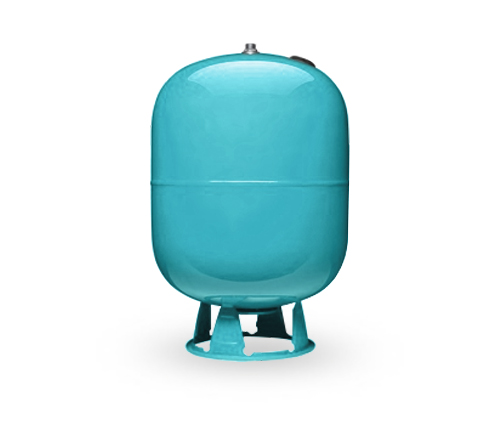
NVT Series Vertical Pressure Tank for Pump
A water pump is normally selected according to required flow, pressure, lift, and operating conditions. However, many water systems do not consume water continuously. Instead, they experience intermittent demand. A household may use a small amount of water several times per hour. An irrigation system may open and close different zones. A commercial building may experience rapid changes in demand between occupied and unoccupied periods. If the pump responds directly to every small demand event, it may start and stop repeatedly.
Frequent starts place additional stress on the pump motor, electrical components, seals, couplings, control devices, and pipework. They also consume more energy than a properly controlled operating cycle and can shorten the service life of the equipment. In some systems, repeated starts produce water hammer, pressure surges, vibration, or noticeable fluctuations at outlets.
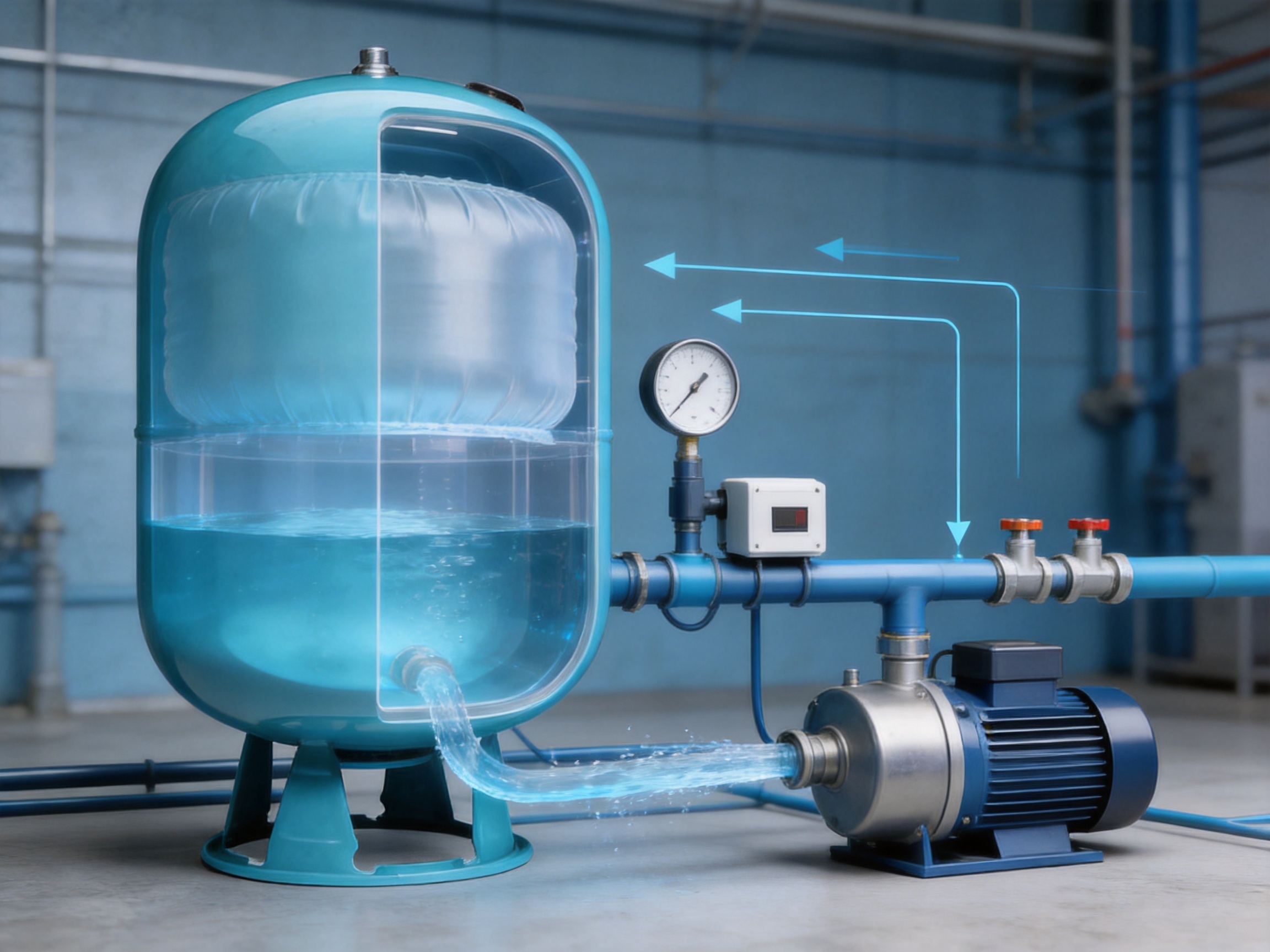
A pressure tank provides a buffer between the pump and the water outlets. When system pressure reaches the upper control point, the pump stops and the tank supplies a portion of the stored water. When pressure falls to the lower control point, the pump starts again and replenishes the tank. This operating principle reduces unnecessary starts and gives the pump longer, more efficient running periods.
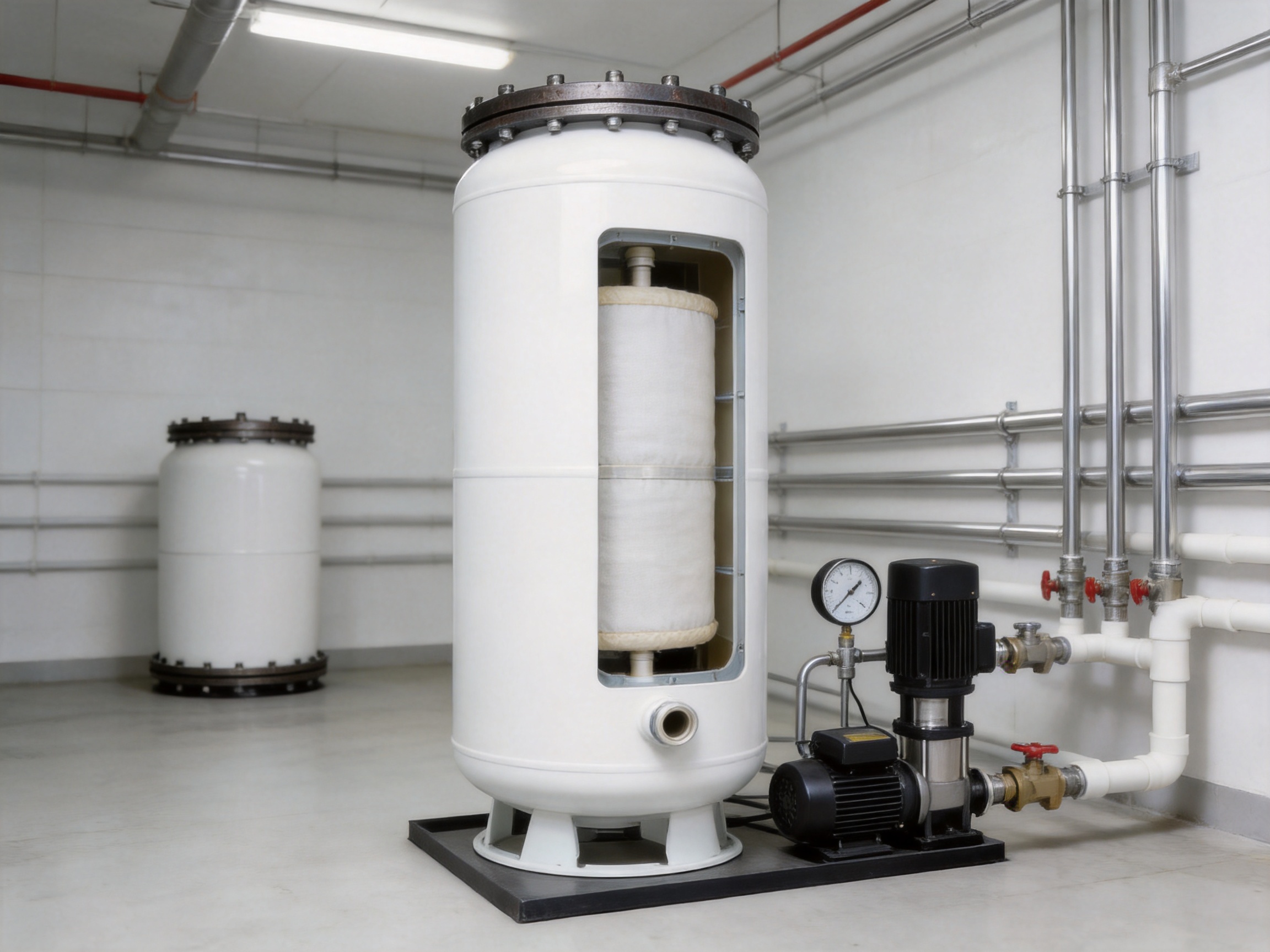
The tank does not simply store water like an open reservoir. It uses a flexible membrane to separate the water chamber from a precharged air or gas chamber. As water enters the tank, the membrane moves and compresses the air on the opposite side. The compressed air then provides the energy needed to push water back into the system when demand occurs. This arrangement maintains a reserve of pressurized water while keeping the water isolated from the tank shell.
For a pump system to perform correctly, the tank volume, maximum working pressure, precharge pressure, pump capacity, control pressure range, and connection size must be considered together. The NVT Series offers several choices within a compact vertical format, allowing installers and system designers to select a tank that suits the expected demand and pressure conditions.
The NVT Series is a vertical pressure tank with a replaceable membrane and carbon steel flange. It is available in three listed capacities: NVT60L, NVT80L, and NVT100L. The models share a 1-inch connector and are designed for straightforward connection to common pump and pressure-control assemblies.
The vertical configuration is particularly useful where floor area is limited but sufficient ceiling height is available. Compared with a horizontal tank of similar capacity, a vertical design can reduce the installation footprint and help organize the pump room more efficiently. It can also simplify the visual layout of a booster set, domestic water system, or irrigation installation.
The replaceable membrane is one of the key design features. In a conventional tank with an integrated or non-serviceable internal component, damage to the membrane may require replacement of the complete tank. A replaceable membrane design can make maintenance more economical and may reduce downtime when service is required. The actual replacement procedure should be carried out by trained personnel after the tank has been isolated, depressurized, and inspected according to applicable safety procedures.
The carbon steel flange provides a firm mechanical interface for the membrane assembly and water connection. Carbon steel is widely used in pressure-vessel applications because it offers a practical combination of strength, manufacturability, and cost efficiency. Surface treatment, coating quality, welding quality, and corrosion protection remain important factors in long-term service, particularly in humid pump rooms or installations exposed to aggressive environmental conditions.
The NVT Series is suitable for systems where stable pressure, fewer pump starts, and a reserve of pressurized water are required. It can support domestic water supply, small commercial booster systems, agricultural irrigation, circulation-related pressure applications, and other installations that operate within the listed pressure and temperature limits.
The following table summarizes the available NVT Series models based on the supplied technical data. Maximum pressure is offered in several options, allowing the tank to be matched with different pressure-control requirements. The selected pressure rating must always be compatible with the complete system, including the pump, pipes, valves, fittings, and control equipment.
| Model | Maximum Pressure Options | Diameter | Height | Precharge Pressure | Connector | Packing Volume |
|---|---|---|---|---|---|---|
| NVT60L | 6, 8, 10, or 16 bar | 380 mm | 728 mm | 1.8–2.0 bar | 1 inch | 0.1126 CBM |
| NVT80L | 6, 8, 10, or 16 bar | 450 mm | 680 mm | 1.8–2.0 bar | 1 inch | 0.1481 CBM |
| NVT100L | 6, 8, 10, or 16 bar | 450 mm | 765 mm | 1.8–2.0 bar | 1 inch | 0.1650 CBM |
The NVT60L model has the smallest diameter in the range and may be suitable for installations where floor width is restricted. The NVT80L provides greater nominal capacity while having a lower listed height than the NVT60L, which can be helpful in rooms with limited vertical clearance. The NVT100L offers the largest listed capacity and increased vertical dimensions, supporting applications where a larger water reserve is beneficial.
The packing volume information is useful for international shipment planning, warehouse organization, container loading, and distributor logistics. Because the company serves overseas customers, attention to packaging and transport efficiency is an important part of the product supply chain. Buyers can use the packing data when calculating freight requirements and planning stock levels.
The membrane is the working interface between the water and the compressed air chamber. During filling, water enters the tank and pushes the membrane away from the water connection area. This reduces the available air volume and increases air pressure. When the system requires water, the compressed air pushes the membrane back, forcing water out of the tank and into the pipe network.
This separation offers several benefits. First, the air and water do not need to mix. This helps preserve the pressure-storage function and reduces the risk of air dissolving into the water system. Second, the internal membrane reduces direct contact between the stored water and the tank shell. Third, the replaceable design can simplify service and extend the useful life of the pressure vessel when the tank body remains structurally sound.
Membrane material should be selected according to the fluid, temperature, and operating environment. The supplied information identifies Butyl, EPDM, and natural rubber options. The listed working temperature ranges are as follows: Butyl, approximately -20°C to 99°C; EPDM, approximately -20°C to 99°C; and natural rubber, approximately 0°C to 77°C. Product descriptions may also list a narrower range of -10°C to 99°C for certain configurations, so the exact membrane specification should be confirmed when placing an order.
Butyl rubber is commonly selected where low gas permeability and good water-service performance are important. EPDM is widely used for water-related applications and can provide good resistance in suitable temperature and chemical conditions. Natural rubber may be appropriate for selected applications within its lower temperature range. The correct choice depends on the water quality, fluid composition, temperature variation, local regulations, and compatibility requirements.
It is important not to treat the temperature range as the only selection criterion. A system designer should also consider pressure cycling, water chemistry, disinfectants, oils, cleaning agents, glycol content, and any other substances that may contact the membrane. The supplier or technical department should be consulted when the application involves non-potable fluids, treated water, hot-water systems, or unusual chemical conditions.
The flange is a critical structural and service component. It connects the internal membrane assembly and provides a secure interface for the tank connection. A properly formed and finished carbon steel flange contributes to mechanical stability, sealing performance, and resistance to the repeated loading associated with pump cycling.
Pressure tanks operate under repeated pressure changes. Each cycle applies mechanical stress to the shell, flange, membrane, welds, and connection area. For this reason, consistent forming, accurate welding, appropriate surface treatment, and effective quality control are essential. A pressure tank should not be evaluated only by its nominal volume. The strength and reliability of the complete pressure boundary are equally important.
Carbon steel remains a competitive material for pressure tanks because it can be processed efficiently and offers strong mechanical performance at a reasonable cost. Compared with some alternative materials, it can provide a robust structure without creating excessive production expense. However, carbon steel requires suitable corrosion protection. The tank should be installed in a location that minimizes condensation, standing water, chemical exposure, and direct weathering unless it has been specifically prepared for outdoor use.
During installation, the flange and connector should not be subjected to excessive external force. Pipework should be independently supported, and the tank should be placed on a stable surface. Improperly supported pipes can transfer vibration and bending loads into the tank connection, potentially affecting sealing and service life.
The NVT Series offers several practical advantages when compared with basic fixed-membrane tanks or poorly matched storage vessels. These advantages are especially relevant to pump manufacturers, distributors, engineering contractors, installers, and end users seeking dependable operation without unnecessary system complexity.
The principal advantage of a pressure tank is its ability to supply small and moderate water demands without immediately starting the pump. This can substantially reduce the number of start-stop cycles. Fewer starts may reduce motor heating, electrical stress, contactor wear, vibration, and mechanical shock.
A reduction in cycling can be particularly valuable for pumps that serve intermittent demand. Domestic booster systems, small irrigation networks, and commercial water-supply systems often experience many short usage events. The NVT Series provides a practical buffer for these applications, provided that the tank is correctly sized and the precharge pressure is properly adjusted.
Pressure fluctuations can be uncomfortable in domestic installations and disruptive in commercial or industrial systems. A pressure tank smooths the transition between pump operation and water demand. The tank does not eliminate every pressure change, but it can reduce abrupt variations and improve the perceived consistency of water delivery.
Stable pressure is useful for showers, faucets, washing equipment, irrigation sprinklers, process-water outlets, and appliances that require a more consistent supply. It can also help pressure-control devices operate with fewer rapid changes.
Every pump start produces sound and vibration. When a pump starts repeatedly, the noise becomes more noticeable, especially in residential buildings, hotels, offices, and other occupied spaces. By supplying water from the tank during small demand events, the system may operate more quietly.
The actual noise reduction depends on pump type, motor design, installation quality, pipework, check valves, and building structure. Nevertheless, reducing unnecessary starts is a practical way to support quieter operation.
A replaceable membrane gives the NVT Series an important service advantage. If the membrane becomes worn or damaged after extended use, the tank may be repairable without replacing the entire pressure vessel. This can reduce maintenance cost and support a longer product life.
Serviceability is particularly valuable for professional users who maintain multiple pump systems. A replaceable component can simplify spare-parts planning and reduce the amount of equipment that must be discarded during maintenance. The tank body, flange, fasteners, and connection area should still be inspected carefully before a membrane is replaced.
The availability of 6-bar, 8-bar, 10-bar, and 16-bar maximum-pressure options allows the tank to be matched with different system requirements. This is more flexible than offering only one pressure class for all applications.
The correct choice should be based on the maximum possible system pressure, pump shut-off pressure, control settings, temperature, safety margin, and applicable standards. A higher pressure rating does not automatically mean that the tank is better for every application. It means that the vessel is intended for a different pressure range and must be integrated appropriately.
The vertical design uses floor space efficiently. This can be an advantage in pump rooms, plant rooms, utility cabinets, water-treatment areas, and compact booster assemblies. A smaller footprint may allow easier access around the pump, control panel, valves, and pipework.
However, the available height must be checked before installation. The tank should have adequate clearance for connection, inspection, membrane replacement, and pressure-gauge access. A vertical tank should never be installed in a position where it cannot be safely supported or serviced.
In homes and small residential buildings, the NVT Series can be paired with a surface pump, jet pump, submersible pump, or domestic booster pump. The tank stores pressurized water for short usage events, reducing the need for the pump to run whenever a faucet is opened briefly.
This arrangement can improve comfort by reducing pressure fluctuation and pump noise. It may also support longer pump life by allowing longer operating cycles. The tank size should be selected according to the number of occupants, expected peak demand, pump capacity, pressure-switch settings, and available installation space.
Irrigation systems often operate in zones. Valves open and close according to programmed schedules, and demand may vary depending on the number of sprinklers or drip lines operating at one time. A pressure tank can help absorb short demand changes and reduce unnecessary cycling when small zones or control valves are used.
For larger irrigation networks, the tank may be used together with variable-frequency drives, pressure switches, electronic controllers, check valves, and flow sensors. The tank is not a replacement for correct hydraulic design, but it can complement the control system and improve pressure stability.
Booster systems are designed to raise pressure where the municipal supply, well system, or storage tank cannot provide sufficient pressure. A pressure tank can support the booster pump by supplying water during short periods of demand and reducing the frequency of pump starts.
In a multi-pump booster set, the pressure tank may also help manage low-flow conditions. The actual arrangement depends on whether the system uses fixed-speed pumps, variable-speed pumps, cascade controls, or intelligent pressure management. System designers should ensure that the tank precharge and control settings are coordinated with the selected pump-control method.
Hotels, offices, restaurants, retail buildings, and small industrial facilities often have changing water demand. The NVT Series can be used in appropriately sized commercial pressure systems to provide a reserve of pressurized water and reduce short-cycle operation.
Commercial installations require careful attention to hygiene, access, maintenance, local plumbing regulations, and equipment certification. If the tank is used for potable water, all wetted materials and membrane choices must comply with the requirements of the installation region.
Heating, ventilation, and air-conditioning systems may require pressure stabilization in closed or semi-closed water circuits. The tank type, membrane material, temperature range, and fluid compatibility must be carefully reviewed before use in such systems. Where glycol mixtures, elevated temperatures, or treatment chemicals are present, the selected membrane should be confirmed for compatibility.
The listed operating temperatures of the NVT Series provide useful flexibility, but the complete system must remain within the limits of every component. Pumps, seals, valves, pipework, sensors, and controllers may have different temperature and pressure limitations.
Solar pumping systems often experience changing power availability as sunlight conditions vary. A pressure tank can help buffer short-term demand and reduce the need for frequent pump starts during intermittent operation. It may be used with a solar water pump, controller, storage tank, or pressure-control arrangement.
Because solar systems can have variable voltage, variable speed, and changing flow, tank sizing should be coordinated with the controller and hydraulic design. The tank provides stored pressure, but it does not replace the need for electrical protection, dry-run protection, overpressure control, or appropriate system storage.
The manufacturer, Taizhou Edwin Electric Co., Ltd., was founded in 2008 and operates as an integrated manufacturing enterprise focused on independent research and development, mass production, and global export. This combination is significant because a pressure tank must satisfy both technical and commercial requirements. It must be consistently manufactured, available in repeatable quantities, properly packaged, and supported with information suitable for international customers.
The company’s core product lines include deep well pumps, submersible pumps, domestic booster pumps, circulation pumps, solar water pumps, intelligent booster pumps, and associated water-treatment peripheral products. This broad range provides practical experience in the operating conditions where pressure tanks are commonly used.
Independent research and development allows the manufacturer to consider the complete relationship between pump performance and pressure-tank operation. Product development can address dimensions, pressure classes, connection arrangements, membrane options, packaging, and compatibility with different pump families.
For distributors and project buyers, this can simplify product selection. A supplier that understands pumps, controls, pressure vessels, and accessories can provide more coordinated technical recommendations than a supplier focused on only one isolated component.
Mass production supports consistent availability and repeatable manufacturing. This is important for importers, wholesalers, engineering companies, and original-equipment manufacturers that need stable delivery over multiple orders.
Repeatable production also makes it possible to standardize inspection procedures, component dimensions, assembly methods, packaging specifications, and spare-parts planning. Consistency is especially valuable when pressure tanks are installed across multiple projects with similar requirements.
A reliable pressure tank manufacturing process generally includes material preparation, shell forming, flange production, welding or mechanical assembly, surface treatment, membrane installation, pressure testing, dimensional inspection, and final packaging. Each stage contributes to the final performance of the tank.
Material preparation should verify the specification and condition of the carbon steel components. Forming operations should maintain the required shape and dimensional accuracy. Welding processes should be controlled to reduce defects and ensure the integrity of the pressure boundary. Flange machining and sealing surfaces should be checked for correct alignment and finish.
After assembly, the membrane must be installed without damage, twisting, or improper positioning. The air-side valve and water-side connection should be inspected for secure assembly. Pressure testing and leak inspection are essential steps before the tank is released for shipment.
Surface treatment is also important. A properly prepared and coated carbon steel surface can improve resistance to handling damage, humidity, and general environmental exposure. Packaging should protect the tank from impact, abrasion, moisture, and deformation during storage and international transportation.
The company has developed professional capabilities in procurement planning, order tracking, cross-border delivery, and foreign-trade services through related import and export operations. This is a practical advantage for international buyers because successful procurement involves more than manufacturing alone.
Export customers may require coordinated product documentation, packaging data, production schedules, container planning, labeling, inspection arrangements, and shipping support. A supplier with experience in these areas can help reduce communication delays and improve order execution.
The manufacturer’s product portfolio supports one-stop purchasing for customers who need multiple pump categories or related accessories. A buyer may source pressure tanks together with deep well pumps, submersible pumps, booster pumps, circulation pumps, pipes, valves, and control components.
This can simplify supplier management and improve compatibility between products. It may also help distributors create complete product packages for different markets rather than purchasing each component from unrelated sources.
Selecting a pressure tank should begin with an understanding of the operating system. Important factors include the pump’s flow rate, motor power, minimum and maximum pressure, pressure-switch settings, expected water demand, number of outlets, pipe size, installation temperature, fluid type, and available space.
Nominal tank capacity is not the same as usable drawdown volume. The actual amount of water delivered between pump stop and pump start depends on precharge pressure, control pressure range, tank design, temperature, and system conditions. Therefore, a 60-liter tank does not necessarily provide 60 liters of usable water during each pressure cycle.
The precharge pressure must be adjusted according to the control settings and manufacturer recommendations. A precharge that is too high may reduce the amount of water entering the tank. A precharge that is too low may increase membrane movement, reduce system performance, or contribute to unstable operation. Adjustment should be carried out with the water side isolated and depressurized, using a calibrated pressure gauge.
Maximum tank pressure must never be exceeded. The selected tank rating should be higher than the maximum pressure that the system can produce under abnormal or shut-off conditions, while also complying with applicable safety requirements. A pressure-relief valve or other suitable protection may be required depending on the system design and local regulations.
The connector size of the NVT Series is 1 inch. The connecting pipe, valve, flexible hose, and fittings should be selected to avoid unnecessary flow restriction. A reducer may be used where necessary, but the effect on flow and pressure loss should be evaluated.
The tank should be installed on a stable, level, and adequately strong surface. The vertical body must be supported so that it cannot fall, tilt, or move during operation. In areas subject to vibration, additional structural support may be appropriate.
Pipework should be aligned with the tank connector and supported independently. The tank should not be used to carry the weight of a long pipe run, valve assembly, or pump manifold. Excessive mechanical loading can affect the connector, flange, gasket, or membrane assembly.
A shut-off valve may be installed where appropriate to allow the tank to be isolated for inspection and maintenance. However, the system must be designed so that an isolated tank cannot remain exposed to pressure without suitable protection. Any valve arrangement should be clear to operators and consistent with the safety requirements of the installation.
The tank should be installed where it can be inspected. Adequate access should be provided around the connector, air valve, flange, pressure gauge, and mounting area. Installation in a sealed or inaccessible cavity can make routine inspection difficult and increase maintenance risk.
Before commissioning, the system should be flushed if necessary, all connections should be checked for leakage, and the precharge pressure should be verified. The pump control range should be tested to confirm that the pump starts and stops at the intended pressures. Sudden pressure spikes, abnormal vibration, or repeated rapid cycling should be investigated immediately.
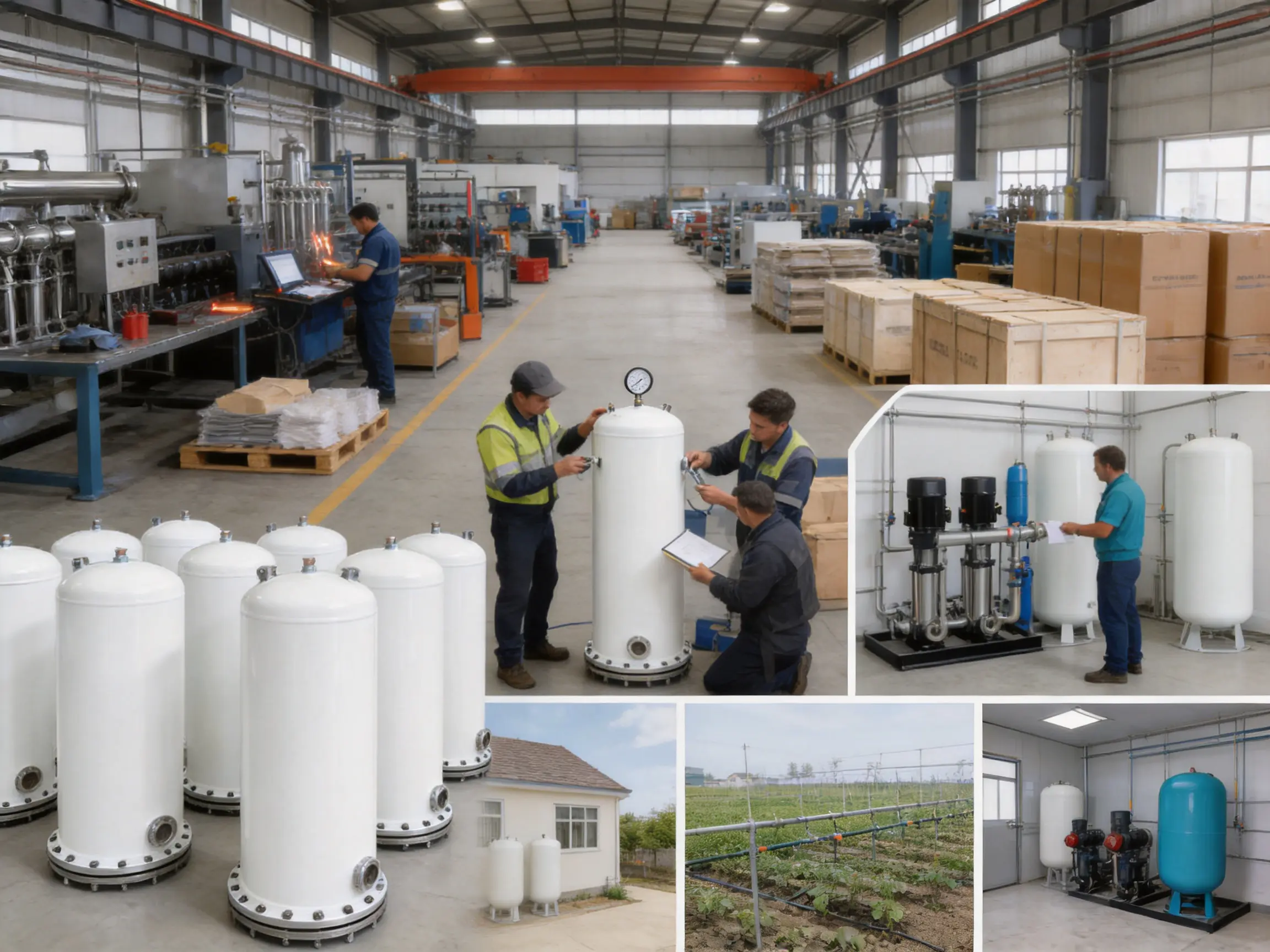
Routine maintenance helps preserve the performance of the NVT Series and the pump system connected to it. Inspection frequency depends on usage, water quality, temperature, pressure cycling, and installation environment.
The external shell should be checked for corrosion, coating damage, dents, leakage, and other visible defects. The connector and flange should be inspected for signs of seepage or gasket deterioration. The air valve should be protected from impact and checked during scheduled service.
Precharge pressure should be tested periodically using the correct procedure. The water side must be isolated and fully depressurized before measuring the air-side pressure. Measuring precharge while the tank remains pressurized can produce an inaccurate result because water pressure affects the reading.
If the pump starts and stops too frequently, the tank may be incorrectly sized, the precharge may be unsuitable, the membrane may be damaged, or the pressure-control device may require adjustment. Troubleshooting should examine the complete system rather than replacing the tank without identifying the cause.
Signs of membrane failure can include water emerging from the air valve, a sudden loss of usable drawdown, rapid pump cycling, unstable pressure, or unusual tank behavior. If membrane failure is suspected, the tank should be isolated and depressurized before inspection. Replacement should be performed using the correct membrane type and suitable sealing components.
Any repair involving the pressure boundary should be completed by qualified personnel. Welding, drilling, unauthorized modification, or the use of non-approved components can compromise safety and should not be carried out.
Pressure tanks are safety-related components because they store energy under pressure. Buyers and installers should verify the applicable standards and certification requirements for the destination market and intended application. Requirements may vary depending on whether the tank is used for potable water, heating water, industrial fluids, irrigation, or another service.
The tank should be operated only within its specified pressure and temperature range. The fluid should be compatible with the selected membrane and internal materials. External exposure to corrosive chemicals, extreme weather, fire, impact, or freezing conditions should be avoided unless the tank is specifically designed for those conditions.
Freezing can damage the membrane and tank components if water expands inside the system. Installations exposed to low temperatures should include suitable insulation, drainage, heating, or freeze protection. The listed low-temperature limits indicate material capability under defined conditions, but they do not remove the need to protect water-filled systems from freezing.
For potable-water applications, buyers should confirm the required approvals for the membrane, coatings, and wetted components. Product suitability for drinking water should not be assumed solely from the use of a particular rubber material.
The NVT Series combines several features that are valuable in real-world procurement. It offers three useful capacities, multiple maximum-pressure options, a standard 1-inch connector, a vertical installation format, a carbon steel flange, and a replaceable membrane. These features provide flexibility for different pump systems without requiring an unusually complex product range.
Compared with low-cost tanks that provide limited serviceability or unclear specifications, the NVT Series offers more information for selection, including dimensions, precharge pressure, pressure options, membrane temperature ranges, and packing volume. Clear technical information helps distributors and contractors reduce selection errors and plan installation more effectively.
The product also benefits from being supplied by a manufacturer with a wider pump portfolio. This can make it easier to coordinate the tank with a suitable pump, booster set, circulation system, solar pumping arrangement, or intelligent control package. For overseas buyers, manufacturing experience and export support add value beyond the physical tank itself.
For professional users, the replaceable membrane can support lifecycle cost control. Instead of treating the pressure vessel as a disposable component after membrane wear, maintenance teams may be able to replace the service part and continue using the tank body after inspection. This can reduce waste, simplify spare-parts management, and support more sustainable equipment maintenance.
The main purpose is to store pressurized water and reduce unnecessary pump starts. It also helps stabilize system pressure, reduce pump cycling, lower operating noise, and provide a reserve of water during short periods of demand.
The listed models are NVT60L, NVT80L, and NVT100L. Their nominal capacities are 60 liters, 80 liters, and 100 liters respectively.
All three listed models use a 1-inch connector.
The series is listed with maximum pressure options of 6 bar, 8 bar, 10 bar, and 16 bar. The correct option must be selected according to the maximum pressure of the complete pumping system.
The listed precharge pressure is 1.8–2.0 bar. The actual setting should be confirmed and adjusted according to the system’s pump-start and pump-stop pressures.
Yes. The NVT Series uses a replaceable membrane design. Replacement must be performed after the tank is isolated and fully depressurized, and the replacement membrane must be compatible with the tank model and application.
The supplied information identifies Butyl, EPDM, and natural rubber options. Butyl and EPDM are listed for approximately -20°C to 99°C, while natural rubber is listed for approximately 0°C to 77°C. Certain product descriptions may state a narrower -10°C to 99°C range for particular configurations, so the exact specification should be confirmed before ordering.
It may be suitable for potable-water systems when the selected membrane, coating, internal materials, and complete product configuration meet the applicable requirements. Buyers should confirm local approvals and material compliance before use in drinking-water applications.
Yes, it can be used in appropriately designed irrigation systems. It is especially useful where intermittent irrigation demand causes frequent pump starts or pressure fluctuations. The pressure rating, membrane material, and tank capacity must be matched to the irrigation system.
Not necessarily. A larger tank can provide more stored water and reduce cycling, but it also requires more installation space and may increase cost. The best size depends on demand, pump capacity, pressure settings, available space, and the desired operating cycle.
The water side should be isolated and fully depressurized before the air-side pressure is measured. A calibrated gauge should be used. Checking precharge while the tank is still under water pressure can result in an incorrect reading.
Outdoor installation depends on the coating, environmental conditions, local climate, and product instructions. The tank should be protected from excessive rain, direct sunlight, freezing, corrosive chemicals, flooding, and impact unless the selected configuration is specifically suitable for outdoor service.
The NVT Series is manufactured by Taizhou Edwin Electric Co., Ltd., a Chinese pump and water-system product manufacturer established in 2008. The company supports research and development, mass production, international export, and one-stop procurement for pump-related products.
The NVT Series Vertical Pressure Tank for Pump is designed to improve the stability, efficiency, and serviceability of pressurized water systems. Its vertical structure supports space-efficient installation, while the replaceable membrane allows more practical maintenance than many non-serviceable tank designs. The carbon steel flange provides a strong connection structure, and the available pressure classes support a range of pump-system requirements.
With NVT60L, NVT80L, and NVT100L models, users can select from several capacity options according to demand and installation conditions. Butyl, EPDM, and natural rubber membrane choices provide additional flexibility when temperature and fluid compatibility are considered carefully. The common 1-inch connector and clearly listed dimensions also simplify integration into many standard pump arrangements.
The product is supported by a manufacturer with experience in deep well pumps, submersible pumps, booster pumps, circulation pumps, solar water pumps, intelligent pumping systems, and international supply. This broader manufacturing background strengthens the company’s ability to provide coordinated equipment and technical support for complete water-pressure solutions.
For homeowners, contractors, distributors, agricultural users, commercial facilities, and industrial buyers, the NVT Series offers a practical way to reduce pump cycling, improve pressure consistency, control operating noise, and extend the useful life of pumping equipment. Correct sizing, suitable membrane selection, proper precharge adjustment, safe installation, and regular maintenance remain essential to achieving the best performance.
1. Manufacturer-supplied NVT Series Vertical Pressure Tank product specifications.
2. Manufacturer-supplied technical data for NVT60L, NVT80L, and NVT100L models.
3. Manufacturer-supplied information concerning replaceable membranes, carbon steel flanges, pressure ratings, dimensions, and temperature limits.
4. General engineering principles for hydropneumatic pressure tanks and pump-cycle control.
5. General maintenance practices for pressurized water systems, membrane tanks, valves, and pump accessories.
6. General guidance for pressure-vessel installation, precharge adjustment, inspection, and safe operation.
edwina@edwin-pump.com
+86-13586290903 (WhatsApp)
Xuri Gongliang Cutting Tool Entrepreneurship Park, Wenqiao Town, Wenling City, Taizhou City, Zhejiang Province, China

High Performance Smart Pump Factory


 English