edwina@edwin-pump.com

View All Products
en
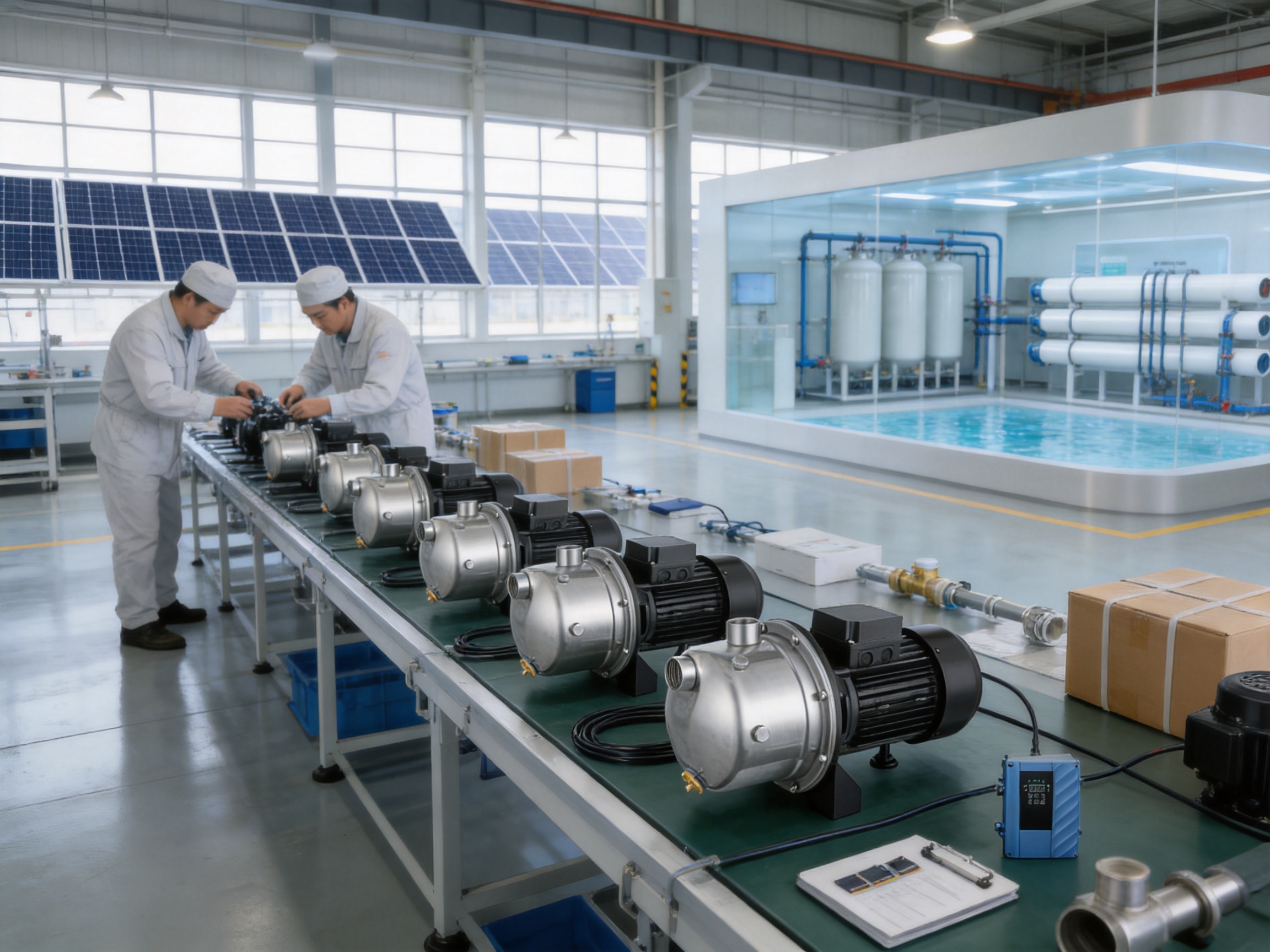
Reliable access to water is essential for households, farms, gardens, rural communities, and remote infrastructure. In locations where grid electricity is unavailable, unstable, or expensive to install, solar pumping provides a practical alternative. However, not every solar pump can deliver the pressure, durability, operating stability, and installation flexibility required by real-world water systems. The EJET Series DC Brushless Motor Solar Jet Pump is designed to address these challenges with a combination of efficient direct-current technology, jet pump performance, compact construction, and adaptable solar operation.
As a DC surface solar pump, the EJET Series is intended for applications in which water must be transferred from a surface source, tank, storage vessel, or shallow water supply point. Its jet pump design supports higher pressure and longer-distance water delivery than many basic low-head solar transfer pumps. This makes it suitable not only for filling tanks, but also for household water supply, garden irrigation, small agricultural systems, and off-grid projects where a stronger water stream is required.
The pump range includes three configurations with rated power from 370 W to 750 W, maximum flow from 2.5 m³/h to 3 m³/h, and maximum head from 35 m to 55 m. These options allow users, installers, distributors, and project planners to select a model according to voltage availability, pressure requirements, solar array design, and expected water demand.
Beyond the equipment itself, the product is supported by the manufacturing capabilities of Taizhou Edwin Electric Co., Ltd., also known as Edwin Pump. Founded in 2008, the company combines independent research and development, mass production, export experience, and one-stop procurement services. Its broader product portfolio includes deep well pumps, submersible pumps, domestic booster pumps, circulation pumps, solar water pumps, intelligent booster pumps, and related water system products. This product knowledge enables the company to approach solar pumping as part of a complete water solution rather than as an isolated motor and pump assembly.
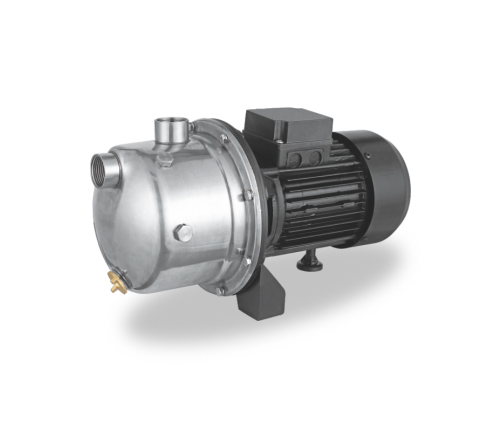
EJET Series DC Brushless Motor Solar Jet Pump
Solar pumping systems are often selected for their ability to operate without conventional grid power. Yet energy independence alone does not guarantee a satisfactory water supply. A pump must also provide useful pressure, maintain stable operation over changing sunlight conditions, and match the hydraulic characteristics of the installation. A low-cost pump with insufficient head may be unable to deliver water to an elevated tank, distant irrigation point, or pressurized household line.
The jet pump principle is valuable because it is designed to enhance suction and pressure performance. Instead of focusing only on moving a large volume over a short distance, a jet pump is intended to create the pressure needed for more demanding transfer conditions. In practical terms, this can help users overcome elevation differences, pipe friction, longer delivery distances, and the pressure requirements of domestic or agricultural outlets.
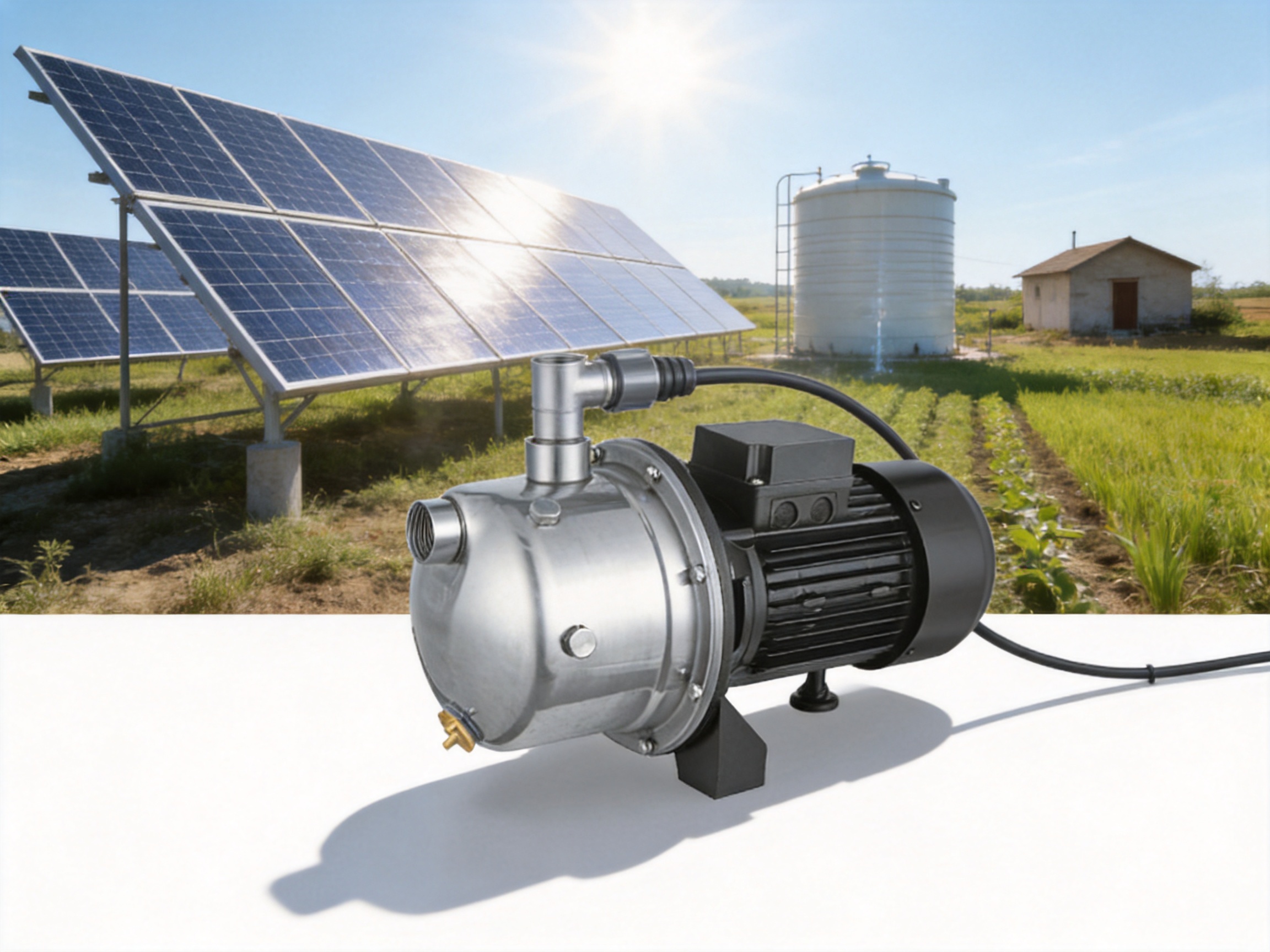
The EJET Series combines this jet pump structure with a DC brushless motor. The result is a solar-oriented pump that can operate directly with an appropriately designed DC solar power system. Its operating concept is straightforward: solar panels provide electrical power, the pump converts that power into mechanical energy, and the hydraulic section delivers water through the suction and outlet connections.
This direct-current architecture is particularly relevant for off-grid installations. It can reduce the need for additional conversion equipment compared with systems that require solar DC power to be converted into AC before powering a conventional motor. Fewer conversion stages may simplify system planning and help reduce installation complexity, although the solar array must still be properly matched to the pump voltage, power, wiring, and operating conditions.
The EJET Series uses a DC brushless motor developed for efficient and stable solar operation. Traditional brushed motors use physical brushes and a commutator to transfer electrical current to the rotating assembly. These components gradually wear during operation and may require maintenance or replacement. A brushless motor eliminates this mechanical brush contact, supporting longer service life and reducing routine maintenance requirements.
For solar applications, low maintenance is a major advantage. Many solar pumps are installed in agricultural fields, rural properties, rooftops, remote storage areas, or temporary water systems where regular service visits are inconvenient. A maintenance-free motor design can help reduce the need for brush replacement and limit the amount of mechanical attention required during normal use.
The brushless configuration also supports efficient energy use. Solar energy is limited by weather, daylight hours, panel orientation, and seasonal conditions. Efficient conversion of available electrical energy is therefore important. The EJET Series is designed to make practical use of the available DC supply while maintaining the pressure performance expected from a jet pump.
One of the clearest distinctions between the EJET Series and basic solar transfer pumps is its emphasis on pressure. The maximum head ratings reach 35 m, 45 m, and 55 m depending on the selected model. Maximum head is not the same as the flow available at every operating point, but it indicates the pump’s ability to work against significant hydraulic resistance under appropriate conditions.
This pressure capability makes the range suitable for applications that require more than simple water movement. Examples include lifting water to an elevated storage tank, transferring water through a long pipeline, supplying a garden with multiple outlets, or supporting a small household water system. In agricultural settings, the added head can help serve irrigation lines where distance and elevation would limit a low-pressure pump.
Competitors that focus only on high nominal flow may not provide the pressure needed by the complete installation. A pump must be evaluated according to the relationship between flow, head, pipe diameter, pipe length, elevation, fittings, and end-use pressure. The jet pump design gives the EJET Series a useful position for projects where pressure and transfer distance are more important than maximum free-flow volume.
The pump is designed as a compact surface unit with 1-inch by 1-inch inlet and outlet connections. Its relatively simple connection format makes it suitable for tanks, rooftop systems, garden installations, small farms, and portable or semi-permanent water projects. A compact pump can also be easier to position near a water source or integrate into a protected pump enclosure.
Compactness does not mean that installation requirements can be ignored. The pump should be installed according to the project’s suction conditions, pipe layout, electrical design, and protection requirements. The suction line should be appropriately sized and sealed, while the water source should provide a suitable supply without excessive debris. Correct installation is essential for stable priming, efficient performance, and long service life.
The EJET Series includes models designed for 48 V and 72 V systems. The 48 V options have recommended best DC voltage ranges of 60 V to 90 V, while the 72 V option has a recommended range of 90 V to 120 V. This gives system designers flexibility when selecting solar panel arrangements and configuring the array voltage.
The range includes a 370 W model, a 550 W model, and a 750 W model. The different power levels make it possible to select a pump according to the required head and flow rather than using a single configuration for every project. Smaller domestic and garden systems may be suited to the lower-power model, while higher-pressure agricultural or transfer applications may require the 550 W or 750 W versions.
| Model | Rated Voltage | Recommended Best DC Voltage | Power | Maximum Flow | Maximum Head | Outlet | Cable Length | Solar Panel Open-Circuit Voltage | Recommended Solar Panel Power |
| EJET2.5-35-48-370 | 48 V | 60–90 V | 370 W | 2.5 m³/h | 35 m | 1" × 1" | 2 m | Below 120 V | At least 1.3 × pump power |
| EJET2.7-45-48-550 | 48 V | 60–90 V | 550 W | 2.7 m³/h | 45 m | 1" × 1" | 2 m | Below 120 V | At least 1.3 × pump power |
| EJET3.0-55-72-750 | 72 V | 90–120 V | 750 W | 3 m³/h | 55 m | 1" × 1" | 2 m | Below 170 V | At least 1.3 × pump power |
The table provides the principal selection data for initial system planning. Actual operating flow will depend on the working head and the hydraulic curve. Installers should also consider solar radiation, panel temperature, cable losses, controller compatibility if used, water quality, suction lift, and protection against dry running or abnormal operating conditions.
A pump’s advertised maximum flow and maximum head represent different points of its operating capability. Maximum flow is normally associated with low or near-zero head, while maximum head is reached at a condition where flow approaches zero. Between these two limits, the pump operates along a performance curve. The actual duty point should be determined by comparing the system curve with the pump curve.
For a household water supply, the required duty point may involve moderate flow and considerable pressure. For garden irrigation, the system may require a balance between flow and head across several outlets. For tank transfer, the most important factor may be the elevation difference and the time available to fill the tank. A proper selection process ensures that the chosen EJET model operates within a useful portion of its performance range.
The 370 W EJET2.5-35-48-370 model offers a maximum flow of 2.5 m³/h and a maximum head of 35 m. It can be considered for compact household supply, gardens, small storage tanks, and applications where the required lifting height and pipe resistance are moderate.
The 550 W EJET2.7-45-48-550 model raises the maximum head to 45 m while providing a maximum flow of 2.7 m³/h. This configuration may be appropriate when the project requires additional pressure for longer lines, higher elevation, or more demanding domestic and small agricultural use.
The 750 W EJET3.0-55-72-750 model provides the highest maximum head in the range at 55 m and a maximum flow of 3 m³/h. Its 72 V operating class is intended for systems designed around a higher DC voltage. This model is well suited to applications where a stronger pressure reserve is needed, provided that the solar array and electrical protection are correctly configured.
Remote homes and rural properties may need water from a well, storage tank, rainwater collection system, spring, or surface source. A surface solar jet pump can support water transfer to a household tank or provide pressure for domestic distribution when the source and suction conditions are suitable.
The pressure-oriented design is useful where the water must travel through a relatively long pipe or reach a higher point in the building. The compact structure also allows the pump to be installed in a utility room, sheltered outdoor location, equipment cabinet, or solar pumping enclosure.
Domestic installations should include appropriate filtration where water contains sediment, as well as a suitable pressure vessel or control arrangement when pressurized delivery is required. The pump itself should not be treated as a substitute for a complete water treatment system. Drinking water applications must also consider local sanitation requirements and the compatibility of all wetted materials with the intended use.
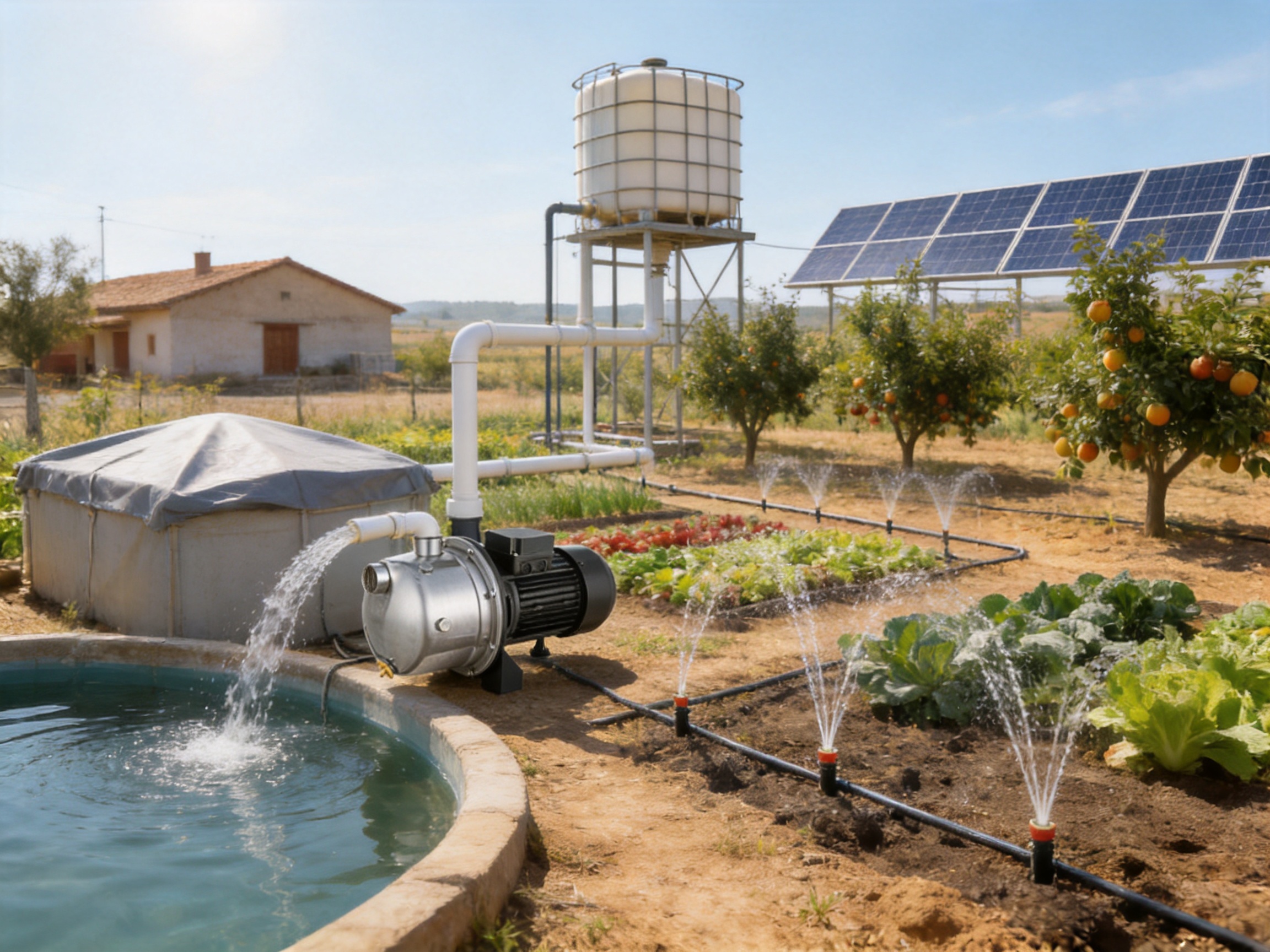
Gardens, orchards, nurseries, and small farms frequently need water transferred from tanks, ponds, reservoirs, or collection basins. Solar energy can provide a cost-effective source of power during daylight hours, especially where irrigation demand coincides with strong sunlight.
The EJET Series can support small-scale irrigation in systems that require a combination of useful flow and pressure. The pressure generated by the jet design may help distribute water through hose lines, small sprinkler systems, drip irrigation filters, or elevated irrigation zones. The correct model depends on the number of outlets, required flow per outlet, total pipe length, and elevation.
Solar irrigation systems may be designed for direct daytime watering or for pumping into a storage tank. Direct daytime irrigation reduces the need for batteries, while tank filling allows water to be stored and used later. The EJET Series can serve either approach when the hydraulic and electrical conditions are correctly matched.
Construction sites, rural facilities, remote workshops, small commercial properties, and temporary settlements may need water transferred between storage points. In such cases, grid connection may be unavailable or too expensive. A solar jet pump can provide a self-contained solution with a solar array and suitable protection components.
The pump’s DC brushless motor is particularly appropriate for these installations because it avoids the routine brush wear associated with brushed motors. The 2 m cable supplied with the listed models provides a starting point for connection planning, while the final cable arrangement must be selected according to distance, current, voltage drop, environmental exposure, and electrical safety requirements.
Elevated tanks are widely used in rural water systems, agricultural irrigation, and off-grid homes. They provide reserve capacity and may create gravity pressure for later use. The pump must overcome the difference in height between the water source and the tank, plus losses in the pipeline and fittings.
The 35 m, 45 m, and 55 m maximum head options give planners several choices for elevated storage projects. The highest-head model can provide additional capability for installations with greater elevation or more resistance, although the final selection should always be based on the actual system curve rather than maximum head alone.
Brushed DC pumps can be attractive because of their simple electrical design and low initial cost. However, brushes and commutators are wear components. Their service life may be reduced by frequent starting, high operating temperatures, dust, moisture, or demanding duty cycles. In remote solar installations, replacing worn brushes can be inconvenient.
The EJET Series avoids this particular maintenance requirement through its brushless motor. This gives it an advantage in applications where long unattended operating periods and reduced service work are important. The brushless design also aligns well with the long-life expectations of a solar array, which is intended to operate for many years.
Some solar pumps are optimized primarily for moving water at low pressure. They may be suitable for simple tank filling but less effective when the water must travel over a long distance or reach an elevated point. Selecting such a pump for a pressure-sensitive application can result in poor water delivery and the need to replace the equipment later.
The EJET Series is distinguished by its jet pump architecture and pressure-oriented specifications. Its maximum head range up to 55 m gives it a stronger position for installations involving elevation, pipe friction, or pressurized outlets. This does not mean it is suitable for every high-flow or industrial application, but it makes the series more versatile than a basic low-head solar transfer unit.
Conventional AC pumps can be powered from solar panels through an inverter. This arrangement can provide access to a wide selection of pump models, but it also adds an additional conversion stage, more equipment, and more installation considerations. The inverter must be selected for the motor’s starting current, operating power, voltage, and protection requirements.
A DC solar pump can simplify the electrical architecture by using the solar source more directly. The EJET Series is designed around 48 V or 72 V DC operating classes, helping project planners create a dedicated solar pumping system without necessarily requiring a separate AC inverter. The final system may still require a controller, disconnect, fuse, surge protection, or other components, but the overall concept can be more direct.
Using a larger pump than necessary may appear to provide extra security, but oversizing can increase cost, solar array requirements, pipe stress, and wasted energy. It may also cause the pump to operate away from its most appropriate duty point. The three-model EJET range helps users select a closer match for the actual water requirement.
The 370 W, 550 W, and 750 W options offer a graduated approach. A small garden or domestic tank may not need the 750 W model, while a higher-head agricultural line may benefit from the additional performance of the larger configuration. A properly matched pump can improve system economics and reduce unnecessary equipment capacity.
Solar pump performance depends on the relationship between the pump and the solar array. The listed specifications require solar panel open-circuit voltage below 120 V for the 48 V models and below 170 V for the 72 V model. These limits must be respected during array design, especially under low-temperature conditions when panel open-circuit voltage may increase.
The recommended solar panel power is at least 1.3 times the pump power. Based on the listed ratings, the minimum planning values are approximately 481 W for the 370 W pump, 715 W for the 550 W pump, and 975 W for the 750 W pump. In practice, designers may select additional panel capacity to compensate for temperature, dust, shading, aging, cable losses, and less-than-ideal solar conditions.
| Pump Model | Pump Power | Minimum Panel Power at 1.3 × Rating | DC System Class | Maximum Stated Panel Open-Circuit Voltage |
| EJET2.5-35-48-370 | 370 W | At least 481 W | 48 V pump class | Below 120 V |
| EJET2.7-45-48-550 | 550 W | At least 715 W | 48 V pump class | Below 120 V |
| EJET3.0-55-72-750 | 750 W | At least 975 W | 72 V pump class | Below 170 V |
The calculated values are minimum planning references, not a complete solar engineering design. Panel selection must account for the array’s maximum power voltage, open-circuit voltage, current, connection method, environmental conditions, and the electrical requirements of any controller. A qualified installer should verify the complete design before commissioning.
Protection is equally important. The system should include suitable disconnect equipment, overcurrent protection, grounding or earthing where required, and protection from moisture and mechanical damage. All electrical connections should be enclosed and installed according to applicable local standards. Solar DC systems can remain energized in daylight, so safe isolation procedures are essential.
A surface jet pump depends on appropriate suction conditions. The suction pipe should be airtight, correctly sized, and as short and direct as practical. Unsealed joints can allow air to enter, reducing suction performance and causing unstable operation. Excessive bends, undersized piping, or clogged strainers can also increase losses and reduce delivered flow.
The pump should be positioned close to the water source where possible. The inlet should be protected from large particles, floating debris, and conditions that could lead to blockage. If the source contains sand or abrasive solids, pre-filtration or a suitable settling arrangement may be necessary. Water quality has a direct effect on pump wear and system reliability.
Discharge piping should be selected according to the required flow and distance. Although the pump has 1-inch by 1-inch connections, the complete system design may require careful consideration of pipe diameter, valves, elbows, filters, non-return valves, meters, and irrigation components. An unnecessarily narrow pipe can create high friction loss and reduce the practical benefit of the pump’s pressure capacity.
Priming procedures should follow the installation instructions provided for the specific system. A surface pump may require the pump chamber and suction line to be filled with water before startup. Operating without adequate water can cause overheating, loss of prime, or damage. A dry-run protection strategy is strongly recommended for installations where the water source level may change.
The product is manufactured by Taizhou Edwin Electric Co., Ltd., an integrated enterprise with experience in independent research and development, mass production, and global export. This integrated structure is important because a solar pump must combine hydraulic design, motor technology, electrical compatibility, material selection, assembly accuracy, and application knowledge.
Independent research and development allows the company to create and improve products according to market requirements rather than relying only on standardized third-party designs. The development of solar water pumps and intelligent booster pumps since 2018 demonstrates the company’s continued investment in new energy and intelligent technology. This experience supports the design direction of the EJET Series, which is intended to combine solar compatibility with practical pressure performance.
Mass production provides advantages in consistency, purchasing efficiency, production planning, and supply capability. For distributors and project buyers, stable production is important because they may need repeated shipments of the same model for different markets or installation programs. A manufacturer able to support both development and volume production can reduce the gap between prototype performance and commercial availability.
The company’s broader product portfolio also contributes to its manufacturing strengths. Its product categories include deep well pumps, submersible pumps, domestic booster pumps, circulation pumps, garden pumps, pool and spa pumps, commercial multistage pumps, end suction pumps, pipes and valves, pump accessories, and intelligent booster pumps. Experience across these categories gives the company a broader understanding of water movement, pressure boosting, building services, agriculture, and industrial applications.
Manufacturing quality is not limited to the final assembly stage. A reliable pump depends on appropriate component selection, dimensional consistency, motor winding quality, sealing integrity, hydraulic balance, electrical connection quality, and inspection procedures. An integrated manufacturer can coordinate these stages more effectively than a trading operation that has limited control over production.
For international customers, export experience is another important strength. Taizhou Edwin Electric Co., Ltd. works with affiliated companies, including Taizhou Haipai Import & Export Co., Ltd. and Golden Falcon Industrial Co., Ltd., to support procurement planning, order tracking, cross-border delivery, and foreign trade services. This one-stop approach can be valuable for overseas distributors, engineering companies, and buyers managing multiple product categories.
The value of a solar pump should be assessed over its operating life rather than only by its purchase price. A lower initial price may not be economical if the pump consumes more energy, requires frequent maintenance, fails to provide sufficient pressure, or cannot be supported with replacement products. The EJET Series is designed to create lifecycle value through efficient operation, brushless motor construction, compact installation, and a range of selectable configurations.
Reduced maintenance is particularly valuable in remote locations. Service travel, labor, replacement parts, and downtime may cost more than the pump itself. The absence of brushes removes one common wear item. However, long-term reliability still depends on correct sizing, clean water conditions, electrical protection, adequate ventilation, and compliance with the recommended operating range.
Solar-powered operation may also reduce recurring energy expenses. Once the solar array is installed, the pump can use available sunlight without the fuel costs associated with a diesel generator or the monthly electricity costs associated with a grid-powered motor. The system’s financial performance depends on solar resource, installation cost, duty cycle, water value, and the cost of alternative energy sources.
Durability is also influenced by the environment. Outdoor installations should be protected from flooding, direct physical impact, extreme contamination, and unauthorized access. Electrical connections should be kept dry, and the pump should be installed on a stable base. In agricultural locations, the system should be protected from machinery, livestock, and accidental damage.
Model selection should begin with the required water quantity. Estimate the daily or hourly demand, including household use, irrigation, livestock, tank filling, and any seasonal variation. Next, determine the required flow rate and the time available for pumping. A system that operates only during daylight may need a higher flow rate than a system that fills a storage tank throughout the day.
The total dynamic head should then be calculated. This includes vertical lift, pressure required at the outlet, pipe friction, fittings, filters, valves, and other system resistance. The pump’s maximum head should not be treated as the normal operating head. The selected model should provide the required flow at the calculated total dynamic head.
For lower-head domestic, garden, and storage applications, the EJET2.5-35-48-370 may be a practical starting point. Where the system requires greater elevation or longer transfer distance, the EJET2.7-45-48-550 provides a higher head rating. For the most demanding pressure conditions within this series, the EJET3.0-55-72-750 offers the highest maximum head and power.
Voltage compatibility must also be confirmed. The solar panel arrangement must fall within the applicable open-circuit voltage limit and provide at least the recommended power. The selected cable, controller, and protection devices must be compatible with the pump’s DC voltage and current. If the project includes batteries, a charge controller, or automated controls, the complete system should be reviewed as one integrated design.
Before installation, inspect the pump, cable, connections, fittings, and water source. Confirm that the model matches the project voltage and hydraulic requirements. Check that the suction and discharge piping are clean and that no construction debris can enter the pump.
Install the pump on a stable, level base in a dry and ventilated location. Avoid placing the motor where it can be submerged or exposed to continuous spray. Provide enough space for inspection and service. If the pump is installed outdoors, use a suitable weatherproof enclosure that does not restrict cooling airflow.
Use an appropriate inlet strainer or filter where the water source contains debris. The filtration system should be maintained regularly because a blocked inlet can reduce flow and increase operating stress. Avoid drawing water from a source with excessive sand unless the system has been designed for that condition.
Fill and prime the pump as required before starting. Confirm that valves are in the correct position and that the discharge route is open enough to prevent abnormal pressure. Start the system during adequate sunlight and observe the sound, vibration, flow, and pressure. Any unusual noise, rapid cycling, loss of prime, or unstable flow should be investigated promptly.
Solar conditions change throughout the day. The pump may deliver different flow rates in the morning, at midday, and in the afternoon. Cloud cover, shading, dust, and high panel temperature can also affect output. A storage tank can help compensate for variations by allowing water to be collected when solar energy is available and used when it is not.
The brushless motor reduces routine motor maintenance, but the complete pumping system still requires periodic inspection. Check the inlet filter, pipe joints, valves, cable connections, mounting base, and protective enclosure. Look for leaks, corrosion, loose fittings, unusual vibration, or signs of overheating.
If flow is lower than expected, inspect the water level, suction pipe, inlet strainer, air leaks, discharge restrictions, and solar conditions. Confirm that the panel array is producing sufficient voltage and power. A pump may appear to be malfunctioning when the actual problem is shading, a loose connection, an undersized cable, or an incorrect array configuration.
If the pump loses prime, inspect all suction-side connections and verify that the water source is adequate. Air entering through a threaded joint or damaged seal can prevent stable suction. If the pump runs but does not deliver water, stop operation and correct the priming or suction problem rather than allowing extended dry operation.
If the motor does not start, verify the DC supply, disconnects, fuses, cable polarity where applicable, and solar array voltage. Do not exceed the stated voltage limits. Electrical troubleshooting should be carried out by qualified personnel using safe isolation procedures, particularly because solar panels may remain energized in daylight.
For international buyers, product quality must be accompanied by dependable communication and supply coordination. Edwin Pump has developed a professional service structure for procurement planning, order tracking, cross-border delivery, and foreign trade support. This is useful for distributors who need regular stock, contractors coordinating project equipment, and customers purchasing several types of pumps from one source.
The company’s history since 2008 provides a foundation in pump manufacturing and export operations. Its focus on the medium-to-high-end global market reflects an emphasis on reliable quality, product development, and long-term customer relationships. The addition of solar water pumps and intelligent booster pumps broadens its ability to serve customers whose water systems require energy efficiency and intelligent control.
One-stop sourcing can reduce the administrative burden of managing separate suppliers for deep well pumps, surface pumps, booster pumps, circulation pumps, valves, accessories, and solar equipment. Although every product must still be selected according to its own application, access to multiple water system categories can simplify project planning and improve compatibility across a broader installation.
The EJET Series is a DC surface solar jet pump powered by a suitable solar DC system. It is designed for surface water transfer, pressure boosting, household supply, irrigation, and off-grid water applications where suction and pressure performance are important.
The series uses a DC brushless motor. This design eliminates brush wear, supports efficient operation, and reduces routine maintenance compared with brushed motor constructions.
The range includes 370 W, 550 W, and 750 W models. The models are identified as EJET2.5-35-48-370, EJET2.7-45-48-550, and EJET3.0-55-72-750.
The highest listed maximum head is 55 m, provided by the EJET3.0-55-72-750 model. The other models provide maximum head ratings of 35 m and 45 m.
The maximum listed flow is 3 m³/h for the 750 W model. The 370 W and 550 W models have maximum flow ratings of 2.5 m³/h and 2.7 m³/h respectively. Actual flow depends on working head and system resistance.
Yes. The series is suitable for solar-powered household water supply when the source, suction conditions, required pressure, water quality, and solar array are appropriate. A complete domestic system may also require filtration, storage, pressure control, and sanitation measures.
Yes. The pump is suitable for small-scale irrigation in gardens, farms, orchards, nurseries, and similar applications. The selected model should be matched to the irrigation flow, elevation, pipe length, filters, and outlet pressure.
The 48 V models have a recommended best DC voltage range of 60 V to 90 V, with solar panel open-circuit voltage below 120 V. The 72 V model has a recommended best DC voltage range of 90 V to 120 V, with solar panel open-circuit voltage below 170 V.
The listed recommendation is at least 1.3 times the pump power. This corresponds to approximately 481 W for the 370 W model, 715 W for the 550 W model, and 975 W for the 750 W model. Actual design may require additional capacity to compensate for site conditions and system losses.
The EJET Series is designed for DC solar operation, so an AC inverter is not necessarily required for a properly designed direct-DC system. Other components, such as disconnects, fuses, controllers, or protection devices, may still be necessary depending on the installation.
The listed models use 1-inch by 1-inch inlet and outlet connections. The complete pipe system should be designed according to the required flow, distance, elevation, friction losses, and water quality.
The EJET Series is a surface solar pump rather than a deep well submersible pump. It should be selected for suitable surface-source or shallow-suction applications. Deep well projects generally require a pump specifically designed for submerged installation and the well’s depth and diameter.
Its principal competitive advantages include a DC brushless motor, jet pump pressure performance, compact installation, multiple voltage and power options, low routine maintenance, and suitability for residential, agricultural, and remote applications. The manufacturer’s R&D, mass production, export, and one-stop procurement capabilities add further value for professional buyers.
The buyer should calculate the required flow and total dynamic head, then verify solar voltage and power availability. The 370 W model is intended for lower-demand systems, the 550 W model provides greater pressure capability, and the 750 W model offers the highest head in the range. Final selection should be based on the pump curve and complete system design.
The EJET Series DC Brushless Motor Solar Jet Pump is designed for users who need more than basic solar water transfer. Its jet pump structure provides enhanced pressure and long-distance delivery capability, while the DC brushless motor supports efficient, stable, and low-maintenance operation. With three configurations covering 370 W to 750 W, maximum flow up to 3 m³/h, and maximum head up to 55 m, the series can be adapted to a broad range of household, irrigation, storage, and off-grid water projects.
The product’s value is strengthened by the manufacturing and service capabilities of Taizhou Edwin Electric Co., Ltd. The company’s experience in independent R&D, mass production, export, new energy technology, and complete pump categories enables it to provide more than a single equipment item. It offers a foundation for dependable product supply and coordinated water system procurement.
For the best result, the pump should be selected according to the actual hydraulic duty point, solar array design, suction conditions, pipe layout, and operating environment. When correctly matched and installed, the EJET Series can provide a practical and energy-efficient solution for reliable water access in locations where conventional power is limited or unavailable.
1. EJET Series product performance data supplied for product specification and model comparison.
2. Manufacturer-provided product information concerning the DC brushless motor, jet pump design, applications, and installation format.
3. Manufacturer company information concerning independent research and development, mass production, global export, and new energy technology investment.
4. General engineering principles for solar photovoltaic system sizing, pump selection, total dynamic head, suction piping, and hydraulic performance.
5. General practices for DC electrical protection, solar pump installation, water system filtration, and preventive maintenance.
edwina@edwin-pump.com
+86-13586290903 (WhatsApp)
Xuri Gongliang Cutting Tool Entrepreneurship Park, Wenqiao Town, Wenling City, Taizhou City, Zhejiang Province, China

High Performance Smart Pump Factory


 English