
edwina@edwin-pump.com

View All Products
en
Reliable access to water is essential for homes, farms, gardens, community facilities, and remote infrastructure. In many locations, however, conventional pumping systems face two continuing challenges: electricity may be expensive or unavailable, and solar energy can vary throughout the day. A pumping solution that depends on only one power source may therefore be limited by grid interruptions, low sunlight, or the high cost of installing electrical infrastructure.
The ADJET Series AC/DC Hybrid Motor Solar Jet Pump addresses these challenges by combining solar-powered operation with mains electricity in one flexible surface-pumping system. Designed for water supply, irrigation, pressure boosting, and long-distance transfer, the pump can use solar DC power when sunlight is available and AC mains power when additional reliability or backup operation is required. This hybrid capability makes the system suitable for both grid-connected and off-grid projects.
Unlike a basic solar surface pump that operates only when solar conditions are favorable, the ADJET Series is designed to provide greater continuity of service. Its jet pump construction improves pressure performance, while its compact format simplifies installation in residential, agricultural, and small commercial environments. The combination of AC/DC compatibility, high head capability, efficient solar operation, and durable construction gives users a practical alternative to conventional single-source pumps.
This article examines the product design, operating principle, performance characteristics, applications, manufacturing strengths, quality considerations, and purchasing advantages of the ADJET Series AC/DC Hybrid Motor Solar Jet Pump.
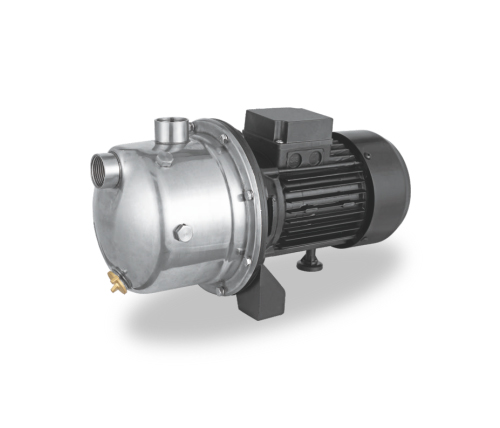
ADJET Series AC/DC Hybrid Motor Solar Jet Pump
Water pumping requirements differ significantly from one project to another. A household may need water delivered from a storage tank to bathrooms, kitchens, or elevated fixtures. A farm may require water to be transferred over a long distance to orchards or irrigation points. A remote facility may need a dependable water supply without access to a stable utility grid. These projects require different flow rates, pressure levels, installation conditions, and operating schedules.
Traditional AC pumps are familiar and widely available, but they depend on a stable electrical supply. In remote areas, extending a power line can be costly or technically difficult. Operating costs can also become substantial when a pump runs frequently for irrigation or household water supply. A solar pump can reduce dependence on the utility grid, but a conventional solar-only system may experience reduced output during cloudy weather, early morning, late afternoon, or seasonal changes in sunlight.
The ADJET Series responds to this practical limitation through a dual-input motor design. Its AC/DC hybrid motor supports both solar DC input and AC mains input. This allows a project to prioritize renewable solar energy while retaining the convenience of conventional electricity when necessary. The result is a more adaptable water supply system that can continue operating under a broader range of environmental and power conditions.
Hybrid operation is particularly valuable where water availability is more important than strict dependence on one energy source. For example, a household may use solar energy during daylight hours and switch to AC power during periods of low sunlight. A farm may run irrigation primarily from solar power while retaining mains backup for critical watering schedules. A remote project may initially use solar power and later connect to a generator or utility supply as the site develops.
The ADJET Series AC/DC Hybrid Motor Solar Jet Pump is a surface-mounted pump designed for applications requiring pressure improvement and water transfer. It is categorized as an AC/DC surface solar pump and uses a jet pump design to support higher pressure and long-distance delivery compared with many basic low-pressure solar pumping arrangements.
The pump is built around five central design characteristics:
1. AC/DC hybrid motor operation.
2. Jet pump hydraulic design.
3. High maximum head capability for a compact surface unit.
4. Solar-oriented energy efficiency and reduced operating cost.
5. Compact installation for homes, tanks, irrigation systems, and remote projects.
The available performance model, ADJET3-55-72-750, is rated at 750 watts. It offers an AC voltage range of 85V to 280V and a DC voltage range of 100V to 350V. The stated maximum flow is 3 cubic meters per hour, while the maximum head reaches 55 meters. The pump has a 1-inch by 1-inch outlet configuration, includes a 2-meter cable, and is designed for a solar panel open-circuit voltage below 450V. The recommended solar panel power is at least 1.3 times the pump power.
These specifications place the product in a useful range for domestic water supply, small agricultural irrigation, garden watering, and remote transfer systems that require more pressure than a basic surface solar pump can provide.
| Parameter | ADJET3-55-72-750 Specification |
| Product type | AC/DC hybrid surface solar jet pump |
| AC voltage | 85V–280V |
| DC voltage | 100V–350V |
| Rated power | 750W |
| Maximum flow | 3 m³/h |
| Maximum head | 55m |
| Outlet | 1 inch × 1 inch |
| Cable length | 2m |
| Solar panel open-circuit voltage | Below 450V |
| Recommended solar panel power | At least 1.3 × pump power |
The most important competitive advantage of the ADJET Series is its ability to operate with both solar DC power and AC mains power. This is more flexible than a pump designed exclusively for one electrical source. The hybrid motor enables users to design a system around available energy resources instead of being forced to select only solar or only grid operation.
When solar radiation is sufficient, the pump can use DC power from the solar array. This reduces dependence on purchased electricity and supports clean-energy operation. During low-light periods or when the solar array cannot deliver enough usable energy, AC mains power can provide an alternative source. This arrangement helps maintain water availability and reduces the risk that a temporary reduction in sunlight will interrupt essential pumping.
The hybrid configuration also improves project adaptability. A new installation may begin as an off-grid solar water system. If utility power becomes available later, the same pump can continue serving the project without requiring a complete replacement. Conversely, an existing AC water system can add solar generation to reduce energy consumption while preserving grid backup.
For agricultural users, this flexibility can be especially useful. Irrigation demand does not always match peak solar availability. Crops may require water according to soil moisture, weather, or cultivation schedules rather than the exact hours of strongest sunlight. A hybrid pump gives the operator more options for meeting those requirements.
For residential users, the advantage is convenience. Water pressure and household water availability should not depend entirely on whether the day is sunny. Solar operation can reduce routine energy costs, while AC operation provides an additional source when household demand continues after sunset or during poor weather.
Solar power is naturally variable. Output changes with cloud cover, panel temperature, shading, seasonal sunlight, and the angle of solar radiation. A pump that cannot accommodate changes in available energy may stop frequently or deliver inconsistent water performance.
The ADJET Series is designed to support stable and energy-efficient pumping under variable solar conditions and low sunlight. Its hybrid input capability provides an important layer of operational security. Rather than treating reduced solar output as a complete system failure, the project can use AC power when appropriate or schedule pumping according to available energy and storage capacity.
Correct system sizing remains essential. The solar array should be selected according to the pump power requirement, site conditions, daily water demand, and expected solar radiation. The stated recommendation of solar panel power equal to at least 1.3 times the pump power provides a practical starting point, although the final design should account for local conditions and installation requirements.
A jet pump is selected when a water system requires more pressure and transfer capability than a simple low-head circulation arrangement. The ADJET Series uses jet pump hydraulics to support water delivery over longer distances and to elevated points. This makes it suitable for pressure-sensitive applications such as household distribution, garden irrigation, and farm water transfer.
The maximum head of the ADJET3-55-72-750 model is specified as 55 meters. Maximum head is the theoretical vertical height the pump can achieve under defined conditions, and actual operating performance depends on flow, pipe diameter, pipe length, fittings, elevation, water source conditions, and system resistance. Even so, the 55-meter rating indicates that the pump is designed for demanding surface water transfer rather than only short, low-pressure movement.
The maximum flow is stated as 3 cubic meters per hour. This is equivalent to approximately 50 liters per minute under suitable conditions. Actual flow will decrease as the required head increases, which is why the pump curve should be reviewed during system design. A pump should be selected according to the intersection of the required flow and total dynamic head, not by relying only on the maximum values shown on a nameplate.
The jet configuration can be advantageous in residential pressure systems where water must move from a storage tank to multiple outlets. It can also support irrigation layouts in which the water source is separated from the planting area by a significant distance. By delivering useful pressure in a compact surface unit, the pump can reduce the need for more complex multi-stage arrangements in small and medium applications.
Household water systems often require more than simple tank filling. Users may need water to reach upper floors, showers, washing machines, garden taps, or multiple fixtures. A low-pressure pump may provide insufficient performance when several outlets operate at once or when the piping system includes long horizontal runs.
The ADJET Series is suited to household water supply where improved pressure is required. It can be installed with an appropriate storage tank, suction line, delivery line, valves, and control equipment. The jet design supports transfer from a tank or water source to the point of use, while the AC/DC motor gives the household more freedom in choosing its energy source.
Water transfer distance affects pump selection because pipe friction increases with length. Small pipe diameters, excessive elbows, filters, valves, and elevation changes can further increase resistance. A pump intended for long-distance delivery must therefore provide sufficient head while maintaining useful flow.
The ADJET Series is designed for long-distance transfer within its performance range. Its 55-meter maximum head offers a useful margin for projects involving elevation or extended piping. Professional sizing should still include a complete hydraulic calculation to ensure that the selected pump operates at an efficient point rather than at the extreme end of its curve.
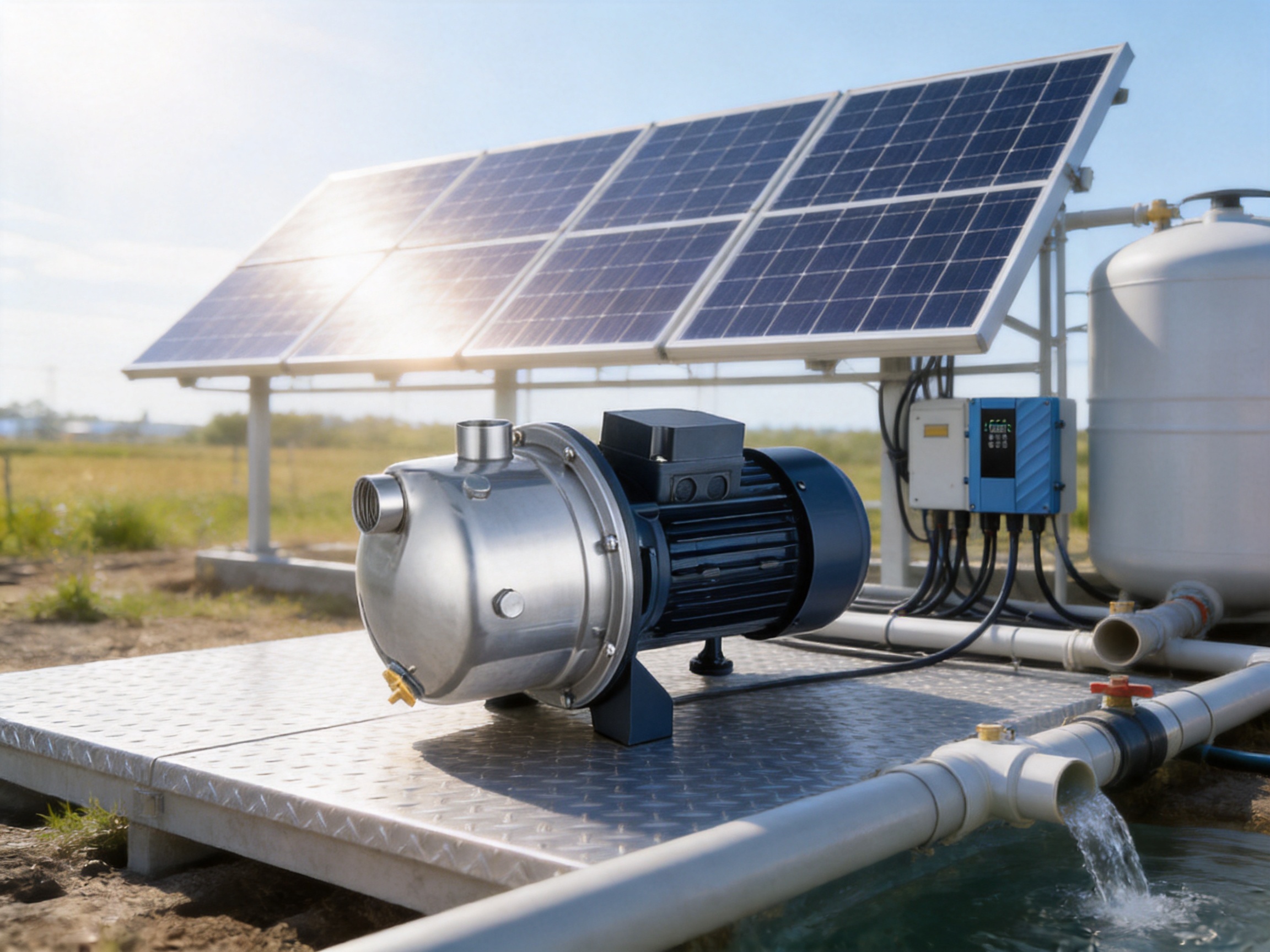
Solar pumping can reduce operating costs by replacing or supplementing electricity purchased from the grid. This is particularly valuable in locations where irrigation or water transfer occurs frequently. Once the solar array and associated equipment are installed, the energy used during sunny periods is generated on site.
The ADJET Series is optimized for solar-powered operation while also accepting AC supply. This combination provides a practical balance between energy efficiency and availability. Solar energy can be used whenever conditions permit, while AC power remains available for backup, high-demand periods, or low-light operation.
Energy efficiency should be evaluated across the complete system rather than by looking only at motor wattage. Efficient design includes the pump, motor, solar array, cable sizing, pipe layout, valves, storage tank, and operating schedule. A correctly sized pump that avoids unnecessary throttling and excessive friction will normally deliver better overall results.
The recommended solar panel power of at least 1.3 times the pump power helps compensate for real-world losses. Solar modules rarely deliver their rated output continuously because of temperature, dust, wiring losses, orientation, and changing sunlight. Providing appropriate array capacity helps the pump receive more consistent energy during normal operation.
For users comparing the ADJET Series with conventional AC pumps, the main economic advantage is the opportunity to reduce daytime grid consumption. Compared with a solar-only pump, the main advantage is operational flexibility. The best economic result depends on local electricity prices, solar conditions, water demand, installation cost, and the value of uninterrupted water availability.
A compact pump is easier to integrate into residential and small agricultural installations. The ADJET Series can be considered for rooftops, equipment areas, water tanks, irrigation systems, and remote solar setups where space may be limited. Compact installation can also reduce the amount of structural work required and simplify access for inspection.
Installation should be carried out on a stable, level base that protects the pump from flooding, excessive vibration, and physical impact. The suction line should be properly sealed to prevent air leakage, and the water source should be free from conditions that could damage the pump. Appropriate valves, strainers, non-return devices, and pressure controls may be required depending on the system arrangement.
The 1-inch by 1-inch outlet configuration provides a familiar connection size for many domestic and small irrigation systems. Piping should be selected to maintain suitable flow velocity and limit friction loss. Reducing the pipe size unnecessarily can lower performance, increase noise, and force the pump to work harder.
Routine maintenance is generally straightforward for a surface jet pump. Operators should inspect connections, check for leaks, clean filters or strainers, examine electrical cables, and verify that the pump is not running dry. Solar panels should be kept reasonably clean, and the system should be checked after severe weather or long periods of inactivity.
The product is described as energy-efficient and low maintenance. This does not eliminate the need for responsible installation and periodic inspection, but it can reduce the service burden compared with more complex pumping systems. A well-designed installation also improves service life by preventing excessive cycling, overheating, blockage, and operation outside the recommended range.
The ADJET Series can support household water supply from storage tanks, rainwater collection systems, or other suitable sources. Its pressure capability is useful where water must be delivered to elevated fixtures or distributed through a household piping network. AC backup offers additional assurance when solar energy is temporarily insufficient.
For residential use, system designers should consider daily water demand, the number of occupants, required pressure, tank elevation, pipe length, and the availability of AC electricity. The pump should not be selected only according to maximum head or maximum flow. A complete duty point ensures that the unit operates efficiently under normal household conditions.
Orchards, farms, nurseries, and gardens often require water in locations where grid electricity is limited. Solar pumping can reduce operating costs and support irrigation in remote cultivation areas. The hybrid motor provides additional flexibility for scheduled irrigation and periods of low sunlight.
The product is appropriate for small and medium irrigation duties within its capacity. It can transfer water from tanks, reservoirs, or other suitable sources to sprinklers, drip systems, garden lines, or elevated storage. Filtration and water-quality protection should be included when the source contains sediment or organic material.
Remote water projects may include rural homes, cabins, field facilities, temporary work areas, and community supply points. Installing a traditional electrical connection in such locations can involve high construction costs. A solar array provides local energy generation, while the AC input allows connection to a generator or later-installed grid supply.
The hybrid design is valuable for projects that cannot tolerate a complete loss of pumping during cloudy weather. Depending on the project, AC backup can come from a utility connection, generator, battery inverter, or other compatible source. Electrical integration should always be completed according to the applicable technical requirements.
Small community water systems may benefit from a pump that supports renewable energy while retaining backup capability. The ADJET Series can be considered for systems supplying shared tanks, community gardens, small public facilities, or localized distribution networks. Proper storage capacity can help balance variable solar production and daily demand.
Gardens and landscaping systems may require pressure for sprinklers, hose outlets, or transfer to elevated beds. The compact surface format and solar compatibility make the pump suitable for locations where a conventional pump would require a dedicated electrical outlet. The AC input can be useful for occasional high-demand watering or maintenance activities.
Product comparison should be based on application requirements rather than on a single specification. The ADJET Series offers several practical advantages when compared with common alternatives.
An AC-only pump depends completely on the availability and price of mains electricity. It may be suitable in an urban location with reliable power, but it is less flexible in remote areas and cannot directly use solar DC power without additional conversion equipment.
The ADJET Series can use solar energy during suitable conditions and AC power when required. This can reduce daytime energy consumption while maintaining a conventional backup source. It also gives users more options when planning a new installation or upgrading an existing water system.
A DC-only solar pump can be efficient in a dedicated off-grid installation, but its operation is closely tied to solar availability and system design. If the weather changes or the project needs pumping outside daylight hours, additional battery or backup equipment may be necessary.
The ADJET Series retains the benefits of solar DC operation but adds AC compatibility. This reduces dependence on batteries in some applications and allows the system to continue operating when solar input is inadequate. For users who value reliability and flexibility, this can be a major advantage.
Basic solar pumps may be designed primarily for moving water at relatively low pressure. They may not provide sufficient head for elevated delivery, long pipe runs, or household pressure systems. The ADJET Series uses a jet pump design and offers a maximum head of 55 meters, making it better suited to applications where pressure and transfer distance are important.
Some high-pressure projects use multiple pumps, separate backup systems, or complex control arrangements. Such solutions may be justified for larger installations, but they can increase equipment cost, installation time, and maintenance requirements. For appropriate domestic, garden, and small agricultural duties, a compact hybrid jet pump may provide a simpler alternative.
The competitive value of the ADJET Series therefore lies in its balance. It combines renewable energy compatibility, backup power flexibility, pressure performance, compact installation, and straightforward maintenance in one product platform.
| Comparison factor | AC-only surface pump | DC-only solar pump | ADJET hybrid solar jet pump |
| Solar DC operation | Usually unavailable without extra equipment | Available | Available |
| AC backup | Available | Usually unavailable without additional equipment | Available |
| Operation during low sunlight | Independent of sunlight if grid power is available | May be reduced or interrupted | Can use AC backup when available |
| Pressure-oriented jet design | Depends on model | Depends on model | Integrated into the product design |
| Suitability for remote use | Limited by grid availability | Strong, but weather-dependent | Strong, with dual-power flexibility |
| System flexibility | Moderate | Moderate | High |
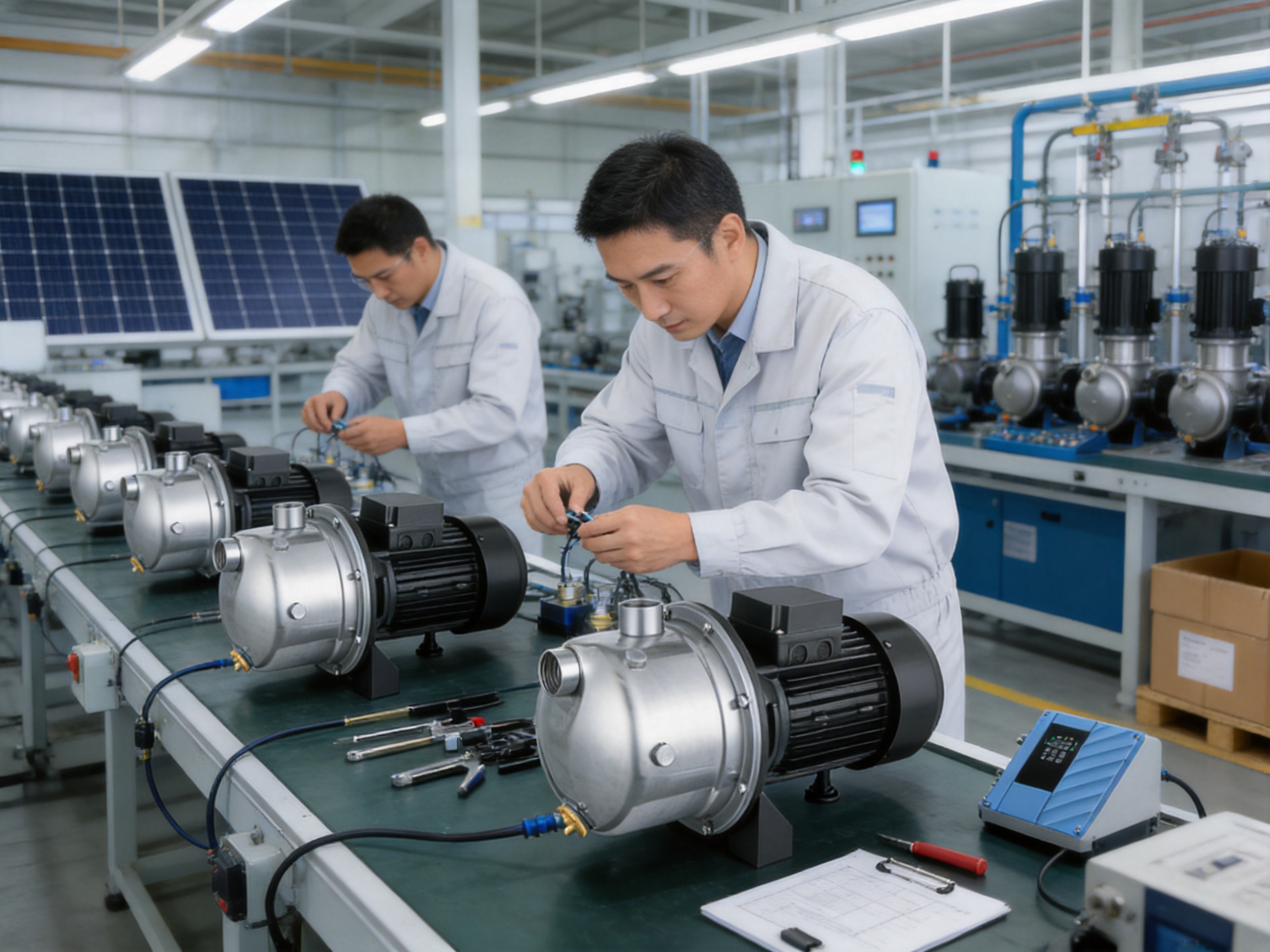
The performance of a pump depends not only on its advertised specifications but also on the quality of its engineering, production control, inspection, and after-sales support. Taizhou Edwin Electric Co., Ltd., operating under the Edwin Pump identity, was founded in 2008 and is described as an integrated manufacturing enterprise focused on independent research and development, mass production, and global export.
This integrated structure is important for a hybrid solar pump because the product combines hydraulic, mechanical, electrical, and renewable-energy requirements. A successful design must coordinate the motor, pump body, impeller system, electrical input range, cable arrangement, installation format, and operating behavior under changing power conditions.
Independent research and development allows the manufacturer to adapt product designs to changing market requirements. Solar water pumping has different needs from conventional domestic pumping. It requires attention to variable input, panel compatibility, energy efficiency, remote installation, and practical field use. Continued development in these areas supports a product portfolio that includes solar water pumps and intelligent booster pumps in addition to more established pump categories.
Mass production capability can provide important advantages for distributors, contractors, and project buyers. Consistent production processes help reduce variation between units, improve availability, and support repeat orders. This is particularly relevant for agricultural projects, residential developments, and international distribution where multiple units may be required over an extended period.
Manufacturing consistency depends on controlled assembly procedures, incoming material inspection, process supervision, electrical testing, hydraulic verification, and final product inspection. Although specific internal production procedures may vary by model and order, an established pump manufacturer should maintain documented quality controls throughout the manufacturing cycle.
For buyers, the practical benefit is greater confidence that replacement units will match the expected configuration and that product performance will remain consistent across batches. Standardized model information, including voltage range, power, flow, head, outlet, cable, and solar requirements, also supports accurate project planning.
In 2012, the company established Taizhou Haipai Import & Export Co., Ltd. and Golden Falcon Industrial Co., Ltd. to support procurement planning, order tracking, cross-border delivery, and foreign trade services. This structure reflects an emphasis on serving international customers through a more complete supply and export process.
For overseas buyers, product quality is only one part of the purchasing decision. They also need clear technical information, dependable order communication, export documentation, packaging coordination, shipment planning, and support for repeat procurement. A manufacturer with dedicated foreign trade resources can simplify these activities and reduce communication gaps between factory production and international delivery.
The company states that its pumps are used in new energy projects, agricultural irrigation, municipal engineering, mining, construction, HVAC systems, and household water supply. This broad application experience can help the manufacturer understand the different requirements of residential buyers, engineering contractors, distributors, and industrial clients.
Reliability in a solar pumping system is influenced by the pump, electrical supply, solar array, pipework, water quality, installation conditions, and maintenance schedule. The ADJET Series is built for long-term use in residential, agricultural, and off-grid applications, but the expected service life depends on correct selection and operation.
One important quality consideration is protection against unsuitable operating conditions. Surface pumps should not run without adequate water supply. Suction lines must be airtight, and the pump should be protected from excessive sediment, corrosive liquids, and temperatures outside the intended operating range. Electrical connections should be protected against moisture and installed by qualified personnel.
Durable construction is especially important in remote installations, where service visits may be difficult or expensive. A robust pump body, dependable motor assembly, secure electrical connections, and accessible maintenance points can reduce the likelihood of unexpected downtime.
Low maintenance does not mean maintenance-free. Regular checks can identify small problems before they become major failures. Operators should monitor unusual noise, vibration, leakage, overheating, reduced pressure, and changes in flow. Solar panels should be inspected for dirt, shading, physical damage, and loose wiring. Valves and filters should be serviced according to water quality and usage conditions.
When the pump is used seasonally, proper shutdown and storage procedures are important. The system should be protected against freezing, accidental dry running, and damage caused by prolonged exposure to severe weather. A documented maintenance routine is particularly valuable for farms, community systems, and commercial installations.
Before installation, the user should define the water source, required flow, total dynamic head, daily operating hours, solar conditions, backup power availability, and delivery destination. The total dynamic head should include static elevation, pipe friction, fittings, valves, filters, and the required terminal pressure.
The solar array must be compatible with the pump's DC voltage range. For the ADJET3-55-72-750 model, the specified DC operating range is 100V to 350V, and the solar panel open-circuit voltage should remain below 450V. These values should be checked carefully under the lowest and highest expected temperatures because panel voltage changes with temperature.
The recommended panel power is at least 1.3 times the 750W pump power, which means a solar array of at least approximately 975W as a starting reference. Final array sizing should consider local solar radiation, panel orientation, shading, seasonal operation, cable losses, and the desired pumping schedule.
AC supply planning is equally important. The model accepts an AC voltage range of 85V to 280V, but the actual supply must be checked against local electrical standards and installation conditions. Protective devices, grounding, isolation, and suitable switching equipment should be included as required by local regulations.
The suction pipe should be as short and direct as practical. Every bend, restriction, and poorly sealed joint can reduce suction performance. A suitable foot valve or check valve may be necessary, depending on the water source and system design. The pump should be positioned where it remains dry, accessible, and protected from direct physical damage.
The delivery side should use piping that matches the required flow and pressure. Although the pump has a 1-inch outlet, the complete pipe network may require careful sizing to avoid excessive friction. A pressure gauge can help with commissioning and troubleshooting, while isolation valves can simplify future service.
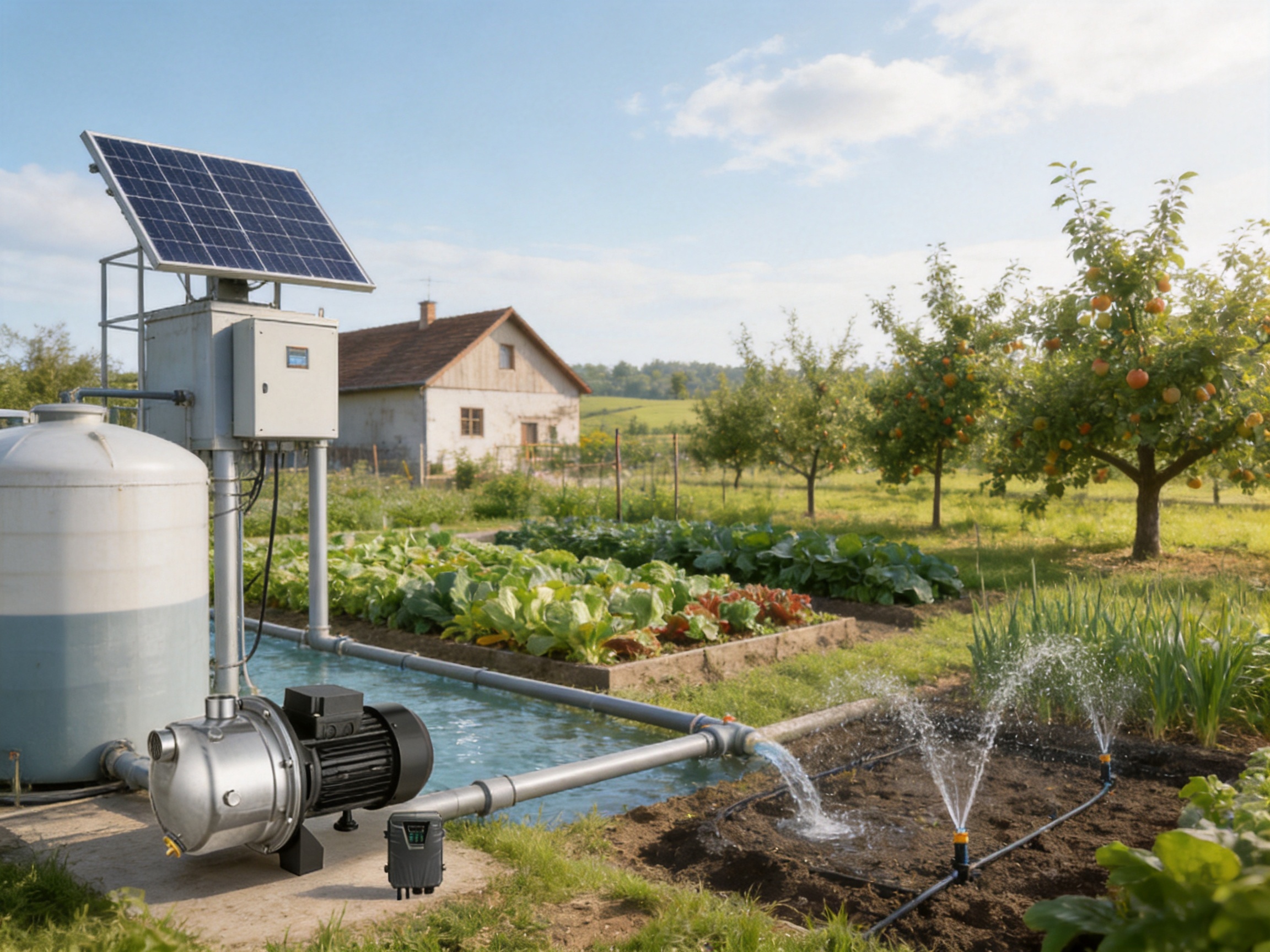
The hybrid motor allows users to choose an operating strategy based on project priorities. Some users may prioritize maximum use of renewable energy and operate the pump primarily when solar production is high. Others may prioritize continuous water availability and use AC power whenever solar conditions are insufficient.
A storage tank can make the solar system more effective by allowing water to be pumped when energy is available and used later. This approach may reduce the need for batteries, which can simplify maintenance and lower replacement costs. For irrigation, water storage can also help match pumping with crop requirements rather than with the exact timing of sunlight.
In household applications, a pressure tank or suitable control arrangement may reduce frequent starting and stopping. Excessive cycling can increase wear and reduce efficiency. The control method should be selected according to the water demand, tank volume, piping arrangement, and manufacturer recommendations.
For remote projects, users may combine solar operation with an AC generator or inverter. This provides a backup option during extended cloudy periods or emergency demand. The electrical system must be designed to prevent incompatible sources from being connected improperly. Professional installation is recommended where multiple power sources are involved.
Solar water pumping is a direct and practical use of renewable energy. It converts sunlight into a useful service without requiring fuel transport or continuous grid connection. The ADJET Series can support new energy projects that need water transfer, pressure boosting, or irrigation in locations with good solar availability.
The pump may be used as part of a broader system containing solar panels, mounting structures, protective electrical equipment, storage tanks, filters, valves, and distribution lines. Its AC/DC capability can make project planning more resilient because the system is not limited to solar generation alone.
For engineering contractors, a hybrid surface pump can simplify equipment selection for projects where conditions are not fully predictable. For distributors, it provides a product suitable for several market segments rather than only one narrow application. For end users, it offers a way to reduce energy costs while keeping a familiar backup source.
Solar pump performance depends heavily on system matching. A pump with a strong maximum head may still perform poorly if the solar array is undersized, the suction pipe leaks, the delivery pipe is too small, or the water source contains excessive sediment. Manufacturer support can help customers avoid these common mistakes.
Technical communication should cover the intended duty point, voltage compatibility, panel arrangement, installation height, pipe dimensions, control method, and environmental conditions. Clear product data allows engineers and installers to prepare accurate designs and reduces the risk of selecting equipment based only on maximum values.
International procurement also benefits from organized order tracking and export service. Buyers may require specific packaging, labeling, documentation, cable arrangements, or quantities. A manufacturer with experience in global export can coordinate these requirements more efficiently and provide a more predictable purchasing process.
Taizhou Edwin Electric Co., Ltd. presents itself as a professional manufacturer with a product portfolio covering deep well pumps, submersible pumps, domestic booster pumps, circulation pumps, solar water pumps, and intelligent booster pumps. This broader portfolio can be useful to customers who need several types of pumping equipment from one source.
Before purchasing an ADJET Series pump, buyers should confirm the following technical points:
1. The required flow rate at the actual operating head.
2. The vertical elevation between the water source and delivery point.
3. The total length and diameter of suction and discharge piping.
4. The availability and quality of solar radiation at the installation site.
5. Solar panel voltage compatibility with the pump DC range.
6. Solar array power, with consideration for real-world operating losses.
7. AC supply voltage and local electrical requirements.
8. The need for a storage tank, pressure tank, filter, check valve, or control device.
9. Water quality, sediment level, temperature, and possible corrosive content.
10. Protection against dry running, freezing, flooding, and physical damage.
11. Required cable length and installation location.
12. Availability of spare parts, technical support, and after-sales service.
This checklist helps ensure that the selected pump is evaluated as part of a complete water system. It also allows distributors and contractors to compare products fairly according to real project requirements.
The stated maximum flow of 3 m³/h and maximum head of 55m should be understood as reference limits rather than simultaneous operating values. In normal pumping, the flow and head relationship follows the pump performance curve. As the system requires greater pressure, the available flow generally decreases.
Users should therefore identify the required operating point before installation. For example, a short transfer line with low elevation may allow a higher flow, while a long pipe route with substantial elevation may produce a lower flow. Pipe friction and outlet pressure must be included in the calculation.
Solar performance also changes throughout the day. The pump may deliver different flow rates in early morning, midday, afternoon, and cloudy conditions. This is a normal characteristic of solar-powered equipment. The hybrid AC/DC design provides a way to maintain pumping when the project requires a more consistent output than solar conditions alone can provide.
Properly designed storage can make these variations less noticeable to the end user. Water can be pumped during periods of stronger solar generation and stored for later use. This is often more cost-effective than trying to produce identical pumping performance at every hour.
The product can reduce dependence on grid electricity while providing a backup operating mode. Its compact installation format is useful for homes with tanks, gardens, or elevated water points. The pressure-oriented design can improve practical water delivery where a basic transfer pump is not sufficient.
The pump can support irrigation in orchards, farms, nurseries, and gardens. Solar operation may lower recurring energy costs, while AC compatibility provides greater scheduling flexibility. Its performance range is suitable for many small agricultural water-transfer duties when the system is correctly sized.
Contractors can use the hybrid pump in projects that require renewable-energy compatibility without eliminating conventional backup. The combination of standardized connections, documented electrical ranges, and a compact surface format can simplify equipment planning.
Distributors can offer one pump platform to customers in residential, agricultural, garden, and remote-project markets. The product's dual-power capability creates a clear point of differentiation from single-input pumps and can support demand in regions with uneven grid access.
International buyers may benefit from the manufacturer's experience in mass production, product development, and global export. Coordinated procurement, order tracking, and cross-border delivery support can be important when several units or multiple pump categories are required.
The development of solar water pumps and intelligent booster pumps demonstrates the importance of continued innovation in the pumping industry. Customers increasingly expect equipment that uses less energy, operates with greater intelligence, and adapts to changing infrastructure conditions.
An AC/DC hybrid solar jet pump reflects this development by combining established jet pump hydraulics with a more flexible electrical architecture. It is not simply a conventional pump connected to a solar panel. The product must be engineered to accept different voltage conditions, operate efficiently under variable input, and remain practical for installation by different types of users.
Manufacturing experience in conventional pump categories can provide a foundation for developing advanced products. Knowledge of motors, impellers, pump bodies, seals, electrical protection, and production testing remains important even as the energy source changes. The ability to combine traditional pump engineering with new-energy technology is a significant strength for a modern pump manufacturer.
The company’s stated focus on independent research and development, mass production, quality, innovation, and one-stop procurement supports its role as a supplier for global industrial customers. Its application coverage across agriculture, construction, municipal projects, HVAC, mining, household supply, and new energy indicates an understanding of varied water-handling environments.
The ADJET Series is an AC/DC hybrid surface solar jet pump. It is designed for surface water transfer, pressure improvement, household supply, irrigation, and off-grid applications.
Yes. The hybrid motor supports AC mains power as well as solar DC power. This allows the pump to use AC electricity when sunlight is insufficient or when backup operation is required.
The rated power is 750 watts.
The specified AC voltage range is 85V to 280V, and the specified DC voltage range is 100V to 350V. Electrical installation should be checked against local standards and the final system design.
The stated maximum flow is 3 cubic meters per hour, and the stated maximum head is 55 meters. Actual flow depends on the operating head and the resistance of the complete piping system.
The stated recommendation is solar panel power of at least 1.3 times the pump power. For the 750W model, this equals approximately 975W as a starting reference. Site conditions and system design may require a larger array.
The solar panel open-circuit voltage should remain below 450V for the specified model. The array must also operate within the pump’s DC voltage range during normal conditions.
Yes. It is intended for irrigation in orchards, farms, gardens, and other small agricultural applications within its flow and head capacity. Filtration and proper water-source protection may be necessary.
Yes. The pump can support solar-powered household water supply where improved pressure or long-distance transfer is required. A storage tank, pressure control, and suitable piping may be included depending on the installation.
Yes. Solar DC operation supports off-grid use, while AC compatibility provides backup flexibility where a generator, inverter, or utility supply is available.
No. Maximum flow and maximum head are reference points. The actual flow at a particular head should be determined from the performance curve and the complete hydraulic calculation.
Routine maintenance may include checking for leaks, inspecting electrical cables, cleaning filters or strainers, protecting the pump from dry running, and monitoring unusual noise, vibration, heat, or reduced performance. Solar panels should also be kept reasonably clean and free from shading.
The key difference is the AC/DC hybrid motor. A solar-only pump is closely dependent on solar availability, while the ADJET Series can use AC mains power when solar energy is inadequate.
The jet pump design is intended to improve pressure and support longer-distance water transfer. The specified maximum head of 55 meters makes it suitable for applications requiring more pressure than a basic low-head transfer pump may provide.
The product is manufactured by Taizhou Edwin Electric Co., Ltd., also identified as Edwin Pump. The company was founded in 2008 and specializes in pump research and development, mass production, and global export.
The ADJET Series AC/DC Hybrid Motor Solar Jet Pump provides a flexible approach to water pumping by combining solar DC operation with AC mains compatibility. This dual-power design helps users reduce dependence on purchased electricity without giving up the reliability of a conventional backup source.
Its jet pump construction is intended to improve pressure and support long-distance water transfer. With a rated power of 750W, maximum flow of 3 m³/h, and maximum head of 55m, the ADJET3-55-72-750 model is suited to a broad range of household, garden, irrigation, community, and remote water applications when correctly selected and installed.
The product’s main advantages over single-source or low-pressure alternatives are operational flexibility, pressure-oriented performance, compact installation, solar energy compatibility, and reduced maintenance requirements. Its value is strongest in projects where water availability matters, solar energy is desirable, and grid or backup power may still be needed.
The manufacturing capabilities of Taizhou Edwin Electric Co., Ltd. further support the product proposition. The company combines independent research and development, mass production, global export experience, and a broad pump portfolio. Its expansion into solar water pumps and intelligent technologies reflects the changing needs of modern water systems.
For homeowners, farmers, contractors, distributors, and international project buyers, the ADJET Series offers a practical balance between renewable-energy operation and dependable water delivery. Proper system sizing, suitable solar panel selection, professional electrical installation, and regular maintenance will help users obtain the best performance and long-term value from the pump.
1. Product specification information for the ADJET3-55-72-750 AC/DC Hybrid Motor Solar Jet Pump.
2. Manufacturer-provided product features and application guidance for AC/DC surface solar pumping systems.
3. Manufacturer-provided performance data covering voltage range, rated power, maximum flow, maximum head, outlet size, cable length, and solar panel requirements.
4. General engineering principles for centrifugal and jet pump selection, including total dynamic head, flow rate, pipe friction, and system duty point.
5. General solar water pumping design principles concerning photovoltaic array sizing, variable solar conditions, energy losses, and water storage.
6. Manufacturer background information regarding research and development, mass production, global export, and pump product categories.
serieswatershortageprotectionvoltagestabilizationstainlesssteelverticalmultistagepump.jpg "EVR(S) Series Water Shortage Protection Voltage Stabilization Stainless Steel Vertical Multistage Pump")
edwina@edwin-pump.com
+86-13586290903 (WhatsApp)
Xuri Gongliang Cutting Tool Entrepreneurship Park, Wenqiao Town, Wenling City, Taizhou City, Zhejiang Province, China

High Performance Smart Pump Factory


 English