
edwina@edwin-pump.com

View All Products
en
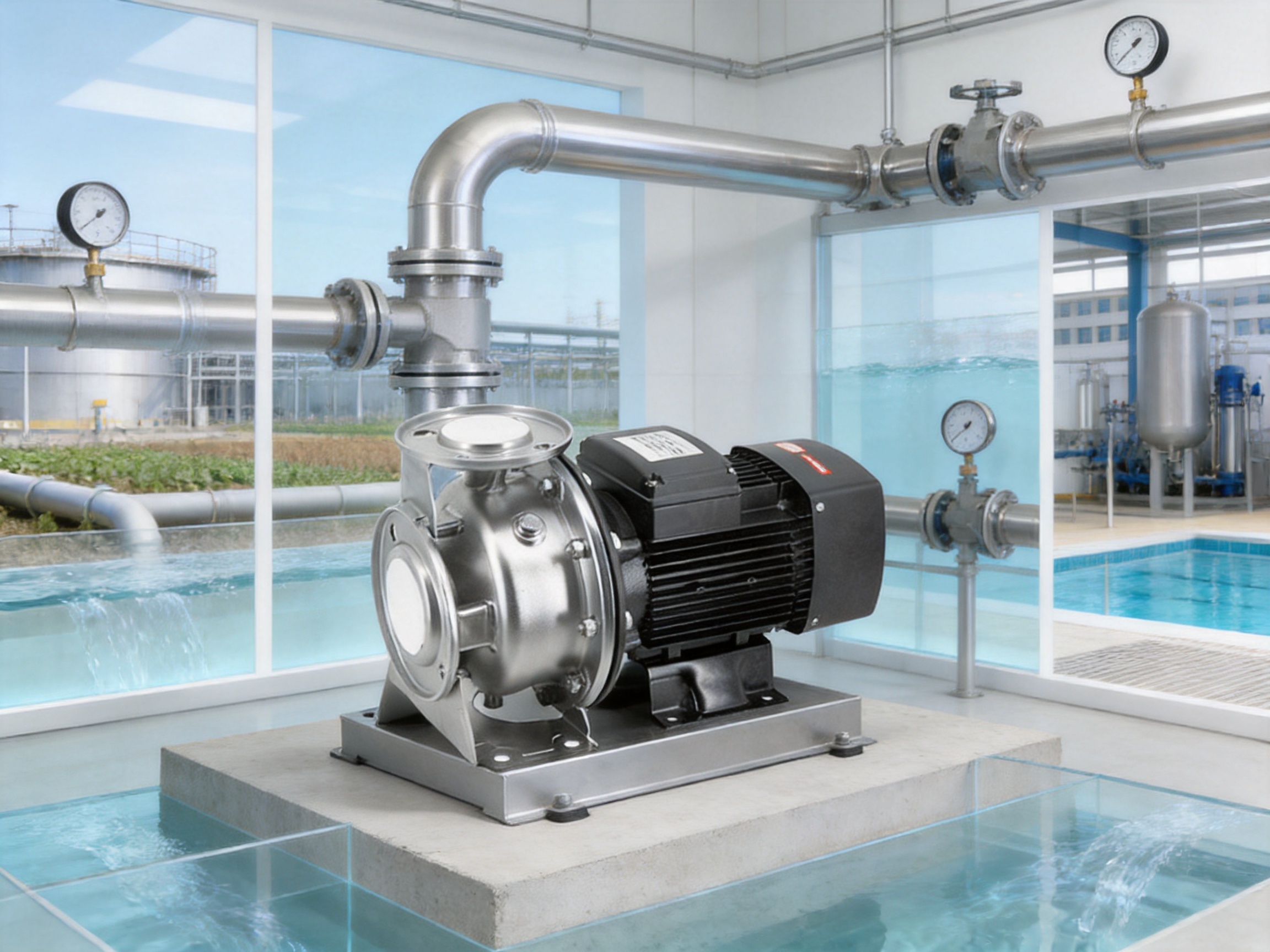
The EK(B) Series End-Suction Precision-Engineered Body Centrifugal Pump is a horizontal stainless steel, single-stage centrifugal pump developed for dependable water transfer, pressure boosting, circulation, and general industrial service. Its axial suction inlet, radial discharge outlet, stainless steel pump body, extended-shaft motor, and motor-and-impeller pull-out design provide a practical combination of hydraulic performance, serviceability, corrosion resistance, and installation flexibility.
Designed for clean, non-flammable, and non-explosive liquids without solid particles or fibers, the series covers a broad operating range. Available models provide rated flows from 12.5 m³/h to 320 m³/h and rated heads from approximately 11 m to 70 m, depending on the selected model and motor power. Power ratings extend from 1.1 kW to 90 kW, allowing the range to serve both compact commercial installations and larger municipal or industrial systems.
The pump is manufactured by Taizhou Edwin Electric Co., Ltd., an integrated manufacturing enterprise with experience in research and development, production, export, and pump-system support. The company’s manufacturing background includes stainless steel forming and fabrication processes such as cold pressing, hydroforming, welding, and related precision production techniques. These processes support the development of pump bodies that are structurally consistent, hygienic, durable, and suitable for demanding water-handling applications.
An end-suction centrifugal pump draws liquid through an inlet aligned with the impeller shaft and discharges the liquid radially through the outlet. This configuration is widely used because it offers straightforward pipe connections, compact installation, convenient maintenance access, and a familiar operating principle for pump engineers and technicians.
The EK(B) Series follows this established arrangement while incorporating a stainless steel pump body and a pull-out construction. The motor and impeller can be removed for inspection or servicing without dismantling the main pump casing from the connected pipeline. This feature can reduce maintenance time, limit disruption to surrounding equipment, and simplify routine replacement of wear components.
The series is intended primarily for clean-water duties and similar liquids with compatible chemical and thermal characteristics. It can be applied in waterworks transportation, municipal pressure boosting, process-water systems, cleaning systems, water treatment, swimming pool circulation, agricultural irrigation, medical facilities, petrochemical installations, aquaculture, and food-related industries.
The design combines a single-stage hydraulic structure with a broad motor selection. Lower-power models can support smaller commercial and utility systems, while higher-power versions are suitable for larger flow and pressure requirements. The range includes multiple pump sizes and performance points, making it possible to select a model according to required flow, head, motor power, electrical supply, and installation conditions.
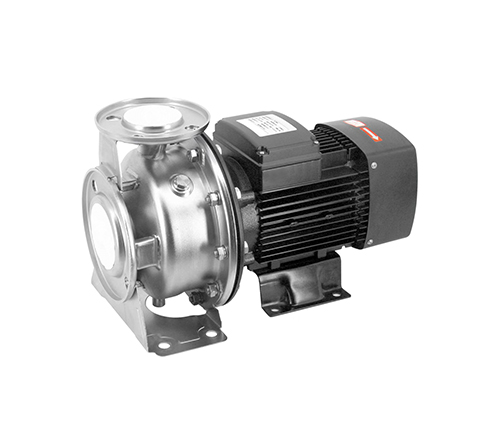
EK (B) Series End-Suction Precision-engineered Body Centrifugal Pump
The horizontal single-stage arrangement is a proven solution for water transfer and boosting. A single-stage pump uses one impeller to generate the required pressure, which generally results in a simpler hydraulic path than a multistage design. For applications within the series performance range, this can make the equipment easier to install, operate, inspect, and maintain.
The horizontal orientation is particularly suitable for plant rooms, pump stations, water-treatment facilities, utility buildings, irrigation systems, and process installations where a stable base and accessible pipework are available. The pump can be mounted on a suitable foundation with the motor and shaft aligned along the horizontal axis.
The axial inlet allows liquid to enter the pump in line with the rotating shaft. The radial outlet directs pressurized liquid away from the impeller and toward the discharge pipe. This configuration is widely recognized by installers and service teams, so it can be integrated into conventional pipework with relatively little design complexity.
The arrangement also helps separate the suction and discharge connection functions clearly. Correct pipe sizing, adequate suction conditions, proper alignment, and suitable valve installation remain essential for stable operation, but the basic connection layout is familiar across many industrial and commercial pumping systems.
The pump body is manufactured from stainless steel. This material provides several important advantages in clean-water and process-water environments. Stainless steel offers good resistance to corrosion, a smooth surface that can support easier cleaning, and a professional finish suitable for visible equipment installations.
Compared with ordinary painted carbon-steel casings, a stainless steel body can provide improved resistance to surface corrosion when exposed to moisture, condensation, or water splash. It can also be advantageous in applications where cleanliness, appearance, or reduced coating maintenance is important.
Material selection must always be matched to the liquid being pumped. The standard series is intended for compatible clean liquids, and the material should be reviewed carefully if the liquid contains aggressive chemicals, elevated concentrations of salts, abrasive particles, or other substances that may affect stainless steel, elastomers, or mechanical-seal materials.
One of the most practical features of the EK(B) Series is the pull-out design. The motor and impeller can be drawn out from the pump assembly without removing the pump casing and connected pipeline. This means that service personnel can access the rotating assembly while leaving the main casing in place.
In a conventional pump without this arrangement, maintenance may require the removal of several pipe connections, valves, or sections of pipe. Such work can increase labor requirements and extend downtime. The pull-out construction can help reduce these tasks, particularly in permanent installations where the casing is connected to fixed pipework.
The design is valuable for facilities that cannot easily interrupt water service. Municipal systems, process-water lines, commercial buildings, and industrial circulation systems may benefit from a shorter maintenance procedure. The actual time savings depend on the installation layout, isolation-valve arrangement, lifting access, technician experience, and the condition of the pump.
The series uses a fully enclosed, air-cooled, extended-shaft motor. The extended shaft connects the motor to the impeller and supports a compact integrated pump-and-motor structure. The motor design is available in two-pole or four-pole configurations, depending on the selected model and performance requirement.
A two-pole motor generally operates at a higher rotational speed than a four-pole motor when supplied at the same frequency. A four-pole motor generally operates at a lower speed and may be selected when the application requires different hydraulic characteristics, noise considerations, or mechanical operating conditions. Final selection should be based on the actual model documentation and system duty.
The motor protection class is IP55. This provides protection against harmful dust deposits and water jets from limited directions under the conditions defined by the relevant enclosure classification. IP55 is suitable for many indoor industrial, commercial, and utility environments, but the motor should still be protected from flooding, direct high-pressure washing beyond its rating, and prolonged exposure to severe outdoor conditions unless the installation is appropriately designed.
The motor insulation class is F. This insulation system supports reliable operation within the temperature limits established for the motor design. Correct overload protection, ventilation, voltage stability, phase balance, and operating conditions remain necessary to preserve motor life.
Single-phase versions are equipped with a built-in thermal protector. This feature can help protect the motor against certain overheating conditions. It should not be considered a substitute for correct electrical protection, appropriate circuit design, or professional installation.
Taizhou Edwin Electric Co., Ltd. operates as an integrated manufacturing enterprise covering independent research and development, mass production, and global export. This structure allows product development, manufacturing planning, quality control, packaging, and delivery coordination to be managed within a connected organization.
An integrated structure can provide advantages over a purely trading-based supply model. Engineering feedback can be transferred more directly to production teams. Manufacturing problems can be identified earlier, and product improvements can be evaluated against actual field requirements. It can also help maintain continuity between design specifications, component sourcing, assembly processes, inspection, and after-sales support.
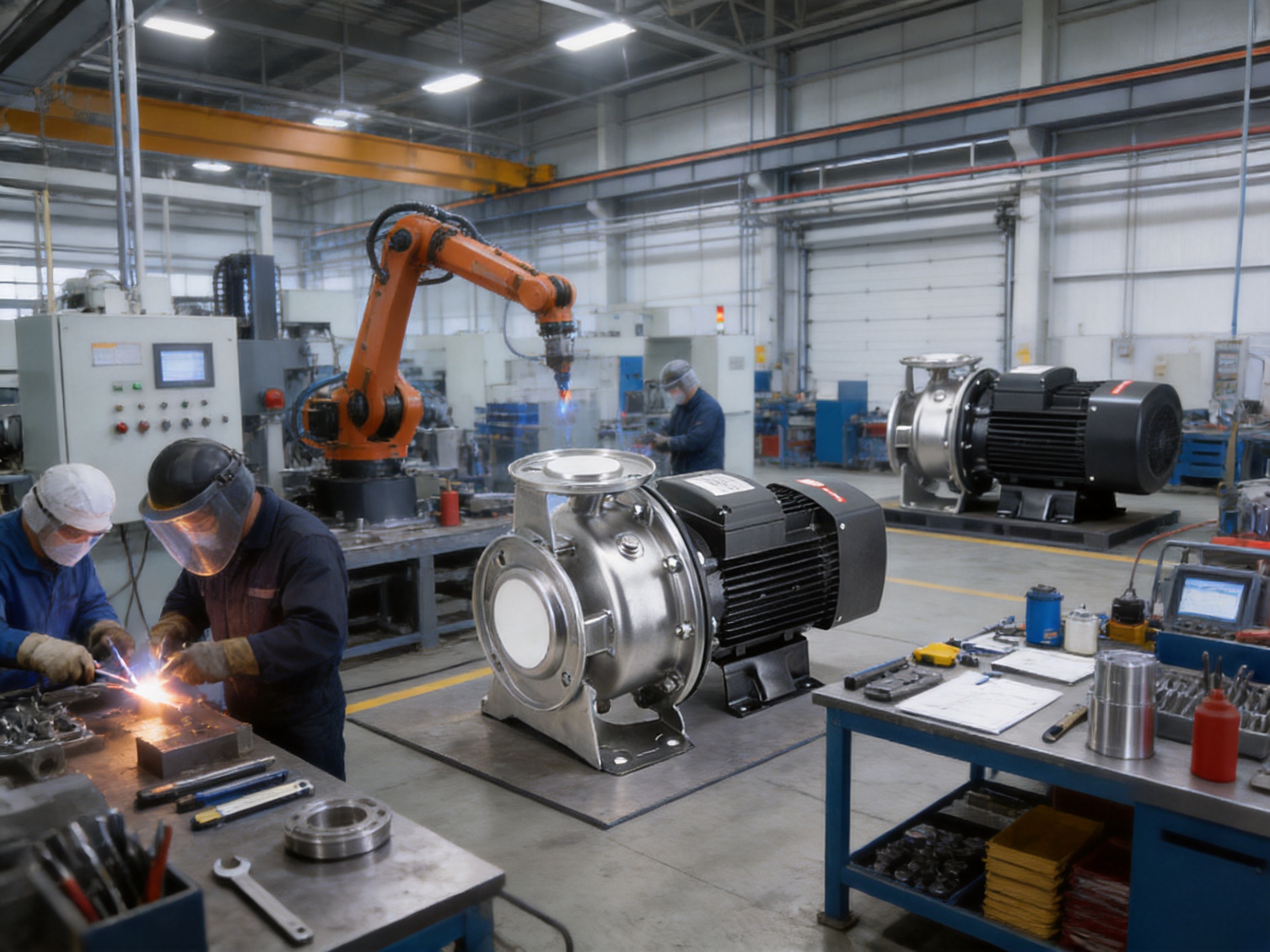
Cold pressing is used to form metal components through controlled shaping at or near room temperature. For stainless steel pump bodies, controlled forming can help produce repeatable geometry while supporting efficient material use. The process can contribute to consistent external surfaces, accurate connection areas, and a clean appearance.
The quality of a cold-pressed part depends on material condition, tooling precision, forming sequence, dimensional control, and inspection. Stainless steel requires appropriate forming techniques because its work-hardening behavior can affect tool loading and final geometry. Well-managed production helps reduce distortion and maintain consistency between batches.
For pump applications, body geometry is important because the casing must contain the liquid, support the hydraulic path, accommodate the inlet and outlet connections, and maintain alignment with internal components. Precision forming therefore contributes not only to appearance but also to the overall reliability of the assembled pump.
Hydroforming uses pressurized fluid to shape metal against a mold or forming tool. This technique can produce complex curved structures with controlled wall distribution and smooth transitions. In pump manufacturing, a carefully formed casing can support the hydraulic design while reducing unnecessary joints or irregularities.
A smooth and accurately shaped internal flow passage can be beneficial for liquid movement through the casing. It may help reduce abrupt changes in direction and support stable hydraulic behavior. The final performance, however, depends on the entire hydraulic design, including impeller geometry, clearances, inlet conditions, rotation speed, and operating point.
Hydroforming can also support consistent production of stainless steel components when the process is matched to the material grade and product geometry. The use of appropriate tooling, forming pressure, and inspection procedures is essential to prevent thinning, cracking, deformation, or dimensional variation.
Welding is used where formed, machined, or fabricated components must be joined. Stainless steel welding requires controlled preparation, suitable filler selection where applicable, appropriate heat management, and post-weld inspection. These factors help protect joint integrity and reduce the risk of distortion or contamination.
In a pump body, the quality of welded areas is especially important because the casing must withstand internal pressure over repeated operating cycles. A sound welding process supports leak resistance and mechanical stability. Production controls should include attention to joint fit-up, weld appearance, penetration, cleaning, and pressure or leak testing as required by the manufacturing procedure.
Welding also provides flexibility for producing different pump sizes and connection arrangements. It can be combined with forming and machining to create a casing that meets the required hydraulic and installation dimensions without relying on a single manufacturing method.
After forming and welding, selected components require machining to achieve the dimensions and tolerances needed for assembly. Shaft seats, bearing locations, seal interfaces, flange surfaces, and impeller connections must be produced with suitable accuracy.
Dimensional control is essential for reducing vibration, maintaining shaft alignment, and supporting the correct operation of the mechanical seal. Even a high-quality pump body cannot perform reliably if the rotating assembly is not properly aligned or if critical fits are inconsistent.
A manufacturing system that combines forming, welding, machining, assembly, and inspection allows the pump to be evaluated as a complete product rather than as a collection of unrelated parts. This is important for maintaining repeatability across the production range.
Final assembly brings together the pump body, support, impeller, mechanical seal, O-ring, motor, bearing, rotor, fan, fan cover, base, terminal cover, and other components. Correct assembly sequence and torque control help ensure that the pump operates as intended.
Testing should verify relevant operating and safety characteristics. Typical production checks for this type of equipment may include appearance, dimensions, electrical performance, rotation direction, insulation condition, leakage, pressure resistance, vibration, noise, and hydraulic operation. The precise inspection program depends on the model, factory procedures, and applicable customer requirements.
The company’s ability to conduct mass production while serving international markets suggests the importance of standardized procedures, repeatable assembly, coordinated procurement, and organized export operations. These capabilities are valuable to distributors, project contractors, and original equipment customers that require consistent supply rather than a one-time purchase.
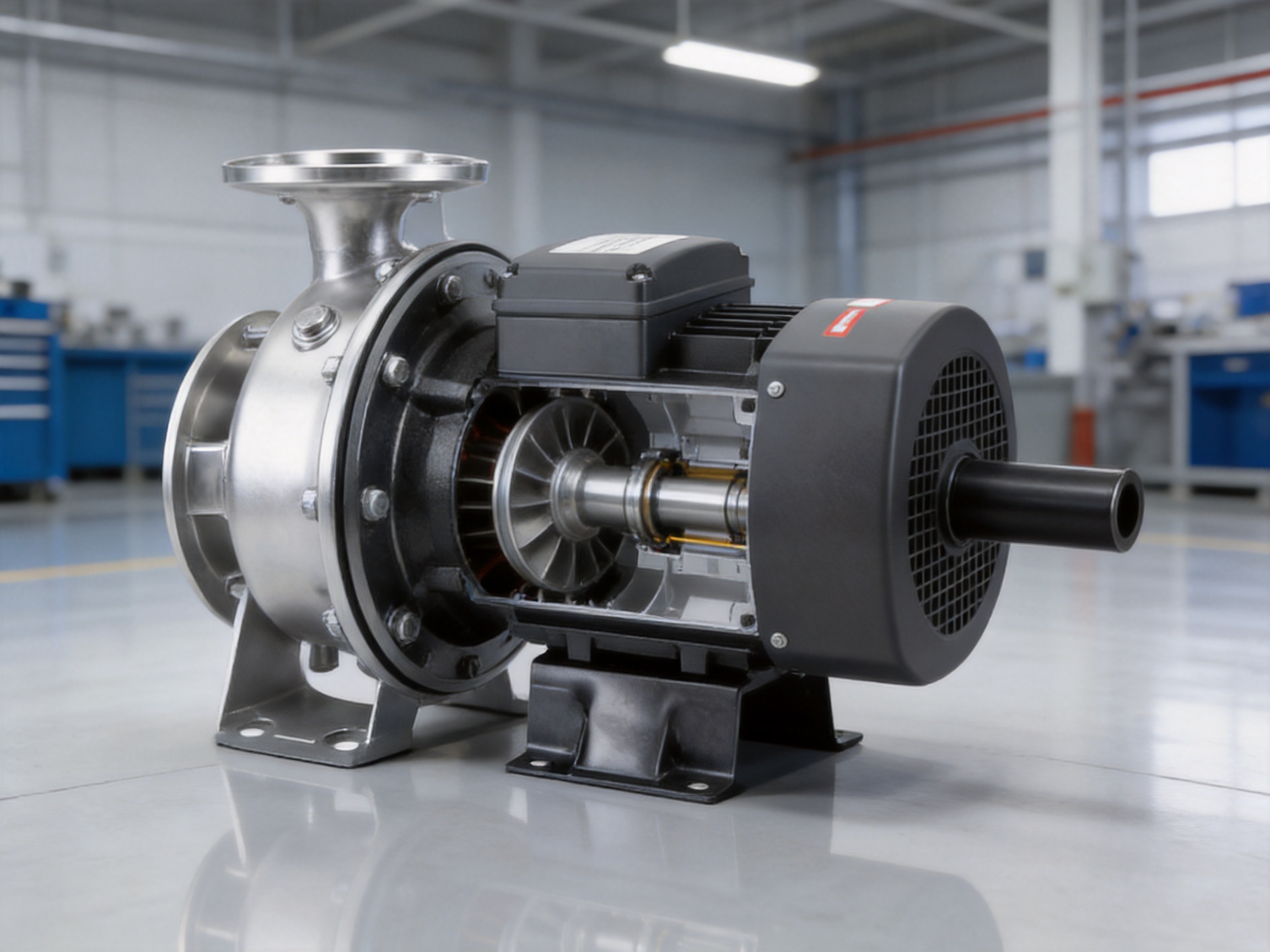
The materials list identifies stainless steel for the pump body. The impeller is listed as HT200 or 06Cr19Ni10, depending on the configuration. The support cover is listed as 06Cr19Ni10, while the support is HT200. The rear cover is ZL102, the fan is PP, and the fan cover and terminal cover are listed as 08F.
| Component | Listed Material | Functional Role |
|---|---|---|
| Pump body | Stainless steel | Contains the liquid and forms the main hydraulic casing |
| Impeller | HT200 or 06Cr19Ni10 | Transfers energy from the motor to the liquid |
| O-ring | NBR | Provides sealing between compatible stationary components |
| Support cover | 06Cr19Ni10 | Supports the assembly and interfaces with the pump casing |
| Support | HT200 | Provides structural support for the pump and motor assembly |
| Rear cover | ZL102 | Protects and supports the motor rear area |
| Fan | PP | Moves cooling air through the motor enclosure |
| Fan cover | 08F | Protects the cooling fan and directs airflow |
| Terminal cover | 08F | Protects the electrical connection area |
Material compatibility is a central part of pump selection. NBR is commonly used in many water and general-service applications, but elastomer performance varies with temperature and chemical exposure. If the liquid differs from clean water, the purchaser should confirm the suitability of the O-ring, mechanical seal, impeller, casing, and other wetted parts before ordering.
The use of stainless steel for major wetted casing components can be a significant advantage in applications where corrosion resistance and easy cleaning are priorities. However, the entire wetted material combination must be reviewed, not only the pump body. A pump should be selected based on the liquid’s temperature, pH, chemical composition, solids content, viscosity, and pressure conditions.
The EK(B) Series includes models for a wide range of flow and head requirements. The smallest listed models provide a rated flow of 12.5 m³/h with rated heads ranging from 18.5 m to 62.5 m. Larger models provide rated flows of 25 m³/h, 40 m³/h, 50 m³/h, 80 m³/h, 100 m³/h, 140 m³/h, 160 m³/h, 180 m³/h, 200 m³/h, and 320 m³/h.
Rated head varies according to the impeller and motor selection. For example, models in the 65-40 and 65-50 groups cover medium-flow duties with different head levels and motor powers. Models in the 80-65, 100-80, 125-100, and 150-125 groups extend the range to higher flows and larger system requirements.
| Representative Model | Power | Rated Head | Rated Flow | Listed 380 V Current | Approximate G.W. Range |
|---|---|---|---|---|---|
| EK(B)50-32-160/1.1(T) | 1.1 kW | 18.5 m | 12.5 m³/h | 2.6 A | 21.5–26.5 kg |
| EK(B)65-40-125/3.0T | 3.0 kW | 25.5 m | 25 m³/h | 6.3 A | 37–43.6 kg |
| EK(B)65-50-200/11T | 11 kW | 48 m | 50 m³/h | 21.2 A | 93–107 kg |
| EK(B)80-65-200/30T | 30 kW | 65 m | 100 m³/h | 55.4 A | 223–264 kg |
| EK(B)100-80-200/37T | 37 kW | 58.5 m | 160 m³/h | 67.9 A | 256–297 kg |
| EK(B)125-100-200/55T | 55 kW | 62 m | 200 m³/h | 98.5 A | 440–492 kg |
| EK(B)150-125-200/90T | 90 kW | 54 m | 320 m³/h | 159.9 A | 628–680 kg |
The listed technical data should be used as a preliminary selection reference. Actual performance depends on the complete pump curve, system resistance, liquid properties, speed, installation conditions, and motor configuration. The pump should be selected near its intended duty point rather than solely by matching a nominal flow or head value.
Some model entries use a suffix such as “T” or “(T),” while other entries do not. These designations should be confirmed with the supplier when preparing a quotation or technical submittal. Electrical current values also differ according to voltage and phase configuration, so the final motor nameplate and wiring requirements must be checked before installation.
The pull-out construction is one of the clearest advantages of the series. Many fixed-casing pump arrangements require extensive pipe disconnection before the motor or impeller can be removed. The EK(B) design can allow the rotating assembly to be serviced while the casing remains connected, provided that the pump is isolated, drained, and safely supported.
This can reduce the labor associated with seal replacement, impeller inspection, bearing service, and motor maintenance. For plants operating several pumps, easier access can improve maintenance planning and help technicians complete work during scheduled service windows.
The stainless steel pump body offers an advantage over basic painted or untreated casings in environments where moisture and corrosion are concerns. A stainless steel surface is also appropriate for facilities that value cleanliness and a smooth, easily maintained finish.
This feature can be important in water-treatment rooms, pool circulation systems, food-related process areas, medical facilities, and commercial buildings where equipment appearance and hygiene are considered alongside hydraulic performance.
The series includes numerous models across several connection and flow groups. This broad range allows system designers to choose more closely among available duty points instead of adapting the system to one standard pump size.
A better match between pump output and system demand can help avoid excessive throttling, unnecessary energy consumption, unstable operation, or insufficient pressure. Proper selection remains essential, but a wide product family provides more options for optimizing the installation.
Some pump products are designed for only one narrow market. The EK(B) Series is positioned for municipal, industrial, commercial, agricultural, water-treatment, and circulation applications. Its clean-liquid capability and broad performance range allow distributors and contractors to use the product in multiple project categories.
This versatility can simplify procurement. A supplier may be able to source pumps for waterworks boosting, factory process water, irrigation, and building services through one manufacturing organization. Standardized technical communication and coordinated order management can further support multi-project purchasing.
Taizhou Edwin Electric Co., Ltd. has developed an export-oriented operating structure supported by related import and export organizations. The company reports experience in procurement planning, order tracking, cross-border delivery, and foreign-trade services.
For international buyers, these capabilities are important because product quality is only one part of a successful project. Clear order communication, production coordination, packing, documentation, shipping arrangements, and follow-up support can influence the total purchasing experience.
The pump can be used for waterworks transportation and main pipeline pressure boosting. Municipal systems often require dependable equipment that can transfer water over extended operating periods and maintain pressure across distribution networks.
When used in a municipal installation, engineers should evaluate the required flow pattern, static head, friction losses, peak demand, standby capacity, suction conditions, electrical supply, and emergency operating requirements. Parallel pump arrangements may be considered where variable demand or redundancy is important.
Industrial facilities use process water for cooling, washing, production support, equipment cleaning, and utility services. The EK(B) Series can support clean-water circulation and transfer where the liquid properties fall within the specified compatibility range.
Industrial users should consider operating hours, seasonal load changes, water-treatment chemicals, inlet conditions, pressure fluctuations, and maintenance access. A stainless steel casing can be particularly useful where equipment is installed in damp areas or where a cleanable surface is preferred.
Cleaning systems require stable water flow and sufficient pressure. The pump can support water transfer and boosting for industrial cleaning, facility washing, and related utility systems, provided that the liquid does not contain unsuitable solids, fibers, or aggressive chemicals.
Where cleaning agents are introduced into the water, chemical compatibility must be verified. The standard NBR O-ring and other wetted materials may require review if detergents, solvents, acids, alkaline solutions, or elevated temperatures are present.
The product information identifies wine-brewing and food-processing systems as application areas. In such installations, pump material, surface condition, cleanability, seal selection, and process hygiene are critical.
The stainless steel body can be advantageous for clean-water and compatible process-water duties. However, the pump should be incorporated into a complete hygienic design that addresses pipework, drainage, cleaning procedures, seal materials, dead zones, operating temperature, and applicable food-processing requirements.
The pump can be used for water transfer in treatment systems and for other clean-liquid circulation duties. It may serve as a transfer pump between treatment stages, a circulation pump, or a pressure-boosting pump in a properly engineered system.
Water-treatment applications vary considerably. Filtration backwash water, treated water, chemical dosing solutions, and wastewater may have different solids levels and chemical properties. The EK(B) Series should be applied only where the liquid is compatible with the pump construction and does not exceed the permitted solids or temperature conditions.
Swimming pool systems require continuous or scheduled water circulation through filters, heaters, chemical-treatment equipment, and return lines. The pump’s stainless steel body and horizontal end-suction configuration can support suitable pool-water circulation applications.
Pool water chemistry must be controlled carefully. Chlorine concentration, salt levels, pH, temperature, and treatment additives can affect metals, elastomers, and mechanical seals. The selected model should therefore be checked against the actual water chemistry and required flow resistance.
The series can support farmland irrigation where the source water is sufficiently clean and free from damaging solids or fibers. Applications may include pipeline boosting, transfer from storage tanks, greenhouse water supply, and irrigation distribution systems.
Irrigation designers should account for water-source level changes, suction lift, filter requirements, pipe friction, elevation differences, pressure zones, and operating schedules. If the water contains sand, silt, algae, or suspended debris, suitable upstream filtration and a pump designed for the actual water quality may be required.
Medical and health facilities use pumps for clean-water distribution, utility systems, circulation, and building services. The stainless steel body can provide a clean and durable equipment surface, while the pull-out arrangement can support maintenance in technically sensitive facilities.
These installations require careful attention to noise, vibration, water hygiene, electrical reliability, backup systems, and access for maintenance. The pump should be selected as part of a complete facility utility design and installed in accordance with local regulations and project specifications.
The pump may be applied in petrochemical auxiliary water systems and aquaculture water-transfer duties when the liquid is compatible with the standard materials. In petrochemical facilities, the pump should not be assumed suitable for flammable or explosive liquids because the stated liquid compatibility is limited to non-flammable and non-explosive liquids.
In aquaculture, water quality and biological sensitivity are important. The selected operating point should provide the necessary circulation without creating excessive turbulence or damaging sensitive organisms. Chemical compatibility, temperature, filtration, and continuous-duty requirements should all be reviewed.
The standard temperature range is listed as -20°C to +70°C. A high-temperature version is listed for -20°C to +104°C. The high-temperature model should be selected only when confirmed by the supplier and when all seals, bearings, motor components, and operating conditions are suitable for the elevated temperature.
The maximum ambient temperature is listed as +50°C. At high ambient temperatures, motor cooling performance may be affected, and derating may be required depending on the motor design and local conditions. The pump room should provide adequate ventilation and should not expose the motor to excessive heat from boilers, steam lines, direct sunlight, or other equipment.
The maximum installation altitude is listed as 1,000 m. At higher altitudes, reduced air density can affect motor cooling and may require special consideration. If the installation site is above the stated altitude, the buyer should request confirmation of motor performance and any applicable derating.
The maximum working pressure is listed as 10 bar. This value must be considered together with the actual static pressure, shutoff pressure, temperature, pipe rating, valve rating, flange rating, and transient conditions. The system should be designed so that no component is exposed to pressure above its safe operating limit.
Correct selection begins with the required flow rate and total dynamic head. Flow rate should reflect the actual process or water-supply requirement, while total dynamic head should include static elevation, discharge pressure, pipe friction, fittings, valves, filters, heat exchangers, and other system resistance.
The pump should normally operate near the recommended region of its performance curve. Selecting a pump that is substantially oversized may result in throttling, excessive energy use, noise, vibration, or operation away from the preferred efficiency range. Selecting a pump that is too small may cause inadequate pressure, insufficient flow, or continuous overload.
Liquid compatibility must be confirmed before ordering. The standard specification is for clean, non-flammable, non-explosive liquids without solid particles or fibers. The purchaser should provide information about temperature, density, viscosity, pH, chemical additives, suspended solids, and any special cleaning or sanitation requirements.
Electrical requirements must also be confirmed. The product information lists voltage tolerance of ±10% and identifies 220 V/50 Hz and 380 V/50 Hz configurations for selected power ranges. The unusual notation in the source specification should be clarified with the supplier before production, especially for single-phase and three-phase models.
Motor current, cable size, overload settings, short-circuit protection, isolator selection, grounding, and control-panel design must be handled by qualified electrical personnel. The pump should not be operated with incorrect voltage, missing protection, poor phase balance, or inadequate ventilation.
The pump should be installed on a rigid, level foundation capable of supporting the operating weight and absorbing normal vibration. Larger models have substantial gross weights, and suitable lifting equipment may be required during installation and maintenance.
Suction piping should be correctly sized and arranged to minimize friction losses and air entry. The suction line should be supported independently so that pipe loads are not transferred to the pump casing. Sudden changes in pipe direction close to the suction inlet should be avoided where they may create uneven flow into the impeller.
Isolation valves should be installed so that the pump can be removed or serviced without draining the entire system. A check valve may be required on the discharge side depending on the system arrangement, particularly where reverse flow or water hammer could occur.
The pump should be aligned and checked before operation. Although the motor and pump are integrated through the extended shaft, installation forces, foundation irregularities, and pipe strain can still affect the assembly. All connections should be tightened appropriately, and the casing should be filled and vented before starting if the pump is not self-priming.
Dry running must be avoided. The mechanical seal relies on the pumped liquid for cooling and lubrication under normal conditions. Operation without adequate liquid can cause rapid seal damage and may result in leakage or permanent component failure.
Routine maintenance should include checking for leakage, unusual vibration, abnormal noise, motor temperature, electrical current, pressure, flow, and changes in operating behavior. A gradual reduction in flow or pressure may indicate a blocked strainer, worn impeller, air entry, valve problem, pipe restriction, or system change.
The mechanical seal and O-ring should be inspected when leakage occurs or during scheduled overhaul. Replacement components must match the application temperature and liquid chemistry. Reusing damaged or deformed sealing components can compromise the pump’s pressure integrity.
Bearings should be monitored for noise, temperature, and vibration. The correct maintenance method depends on the bearing design and factory instructions. Lubrication should not be added unless specified, because incorrect lubricant quantity or type can cause overheating or premature failure.
The pull-out design supports service access, but the pump must still be isolated electrically and hydraulically before work begins. The casing should be depressurized and drained, and the rotating assembly should be supported during removal. Technicians should follow lockout and tagout procedures and use suitable lifting equipment for heavier models.
Regular maintenance records can help identify trends before a failure occurs. Recording operating current, discharge pressure, flow, bearing temperature, vibration, and seal condition gives operators a useful reference for detecting changes over time.
Taizhou Edwin Electric Co., Ltd. was founded in 2008 and has developed product lines covering deep well pumps, submersible pumps, domestic booster pumps, circulation pumps, solar water pumps, intelligent booster pumps, and related water-treatment products. This broader portfolio gives the company experience across residential, agricultural, municipal, commercial, and industrial water applications.
The company states that it focuses on the medium-to-high-end global market and has built recognition among customers in international markets. Its production capability is supported by independent research and development, mass manufacturing, and export coordination.
In 2012, the company established Taizhou Haipai Import & Export Co., Ltd. and Golden Falcon Industrial Co., Ltd. to support procurement planning, order tracking, cross-border delivery, and foreign-trade services. These related capabilities can be useful for customers purchasing complete pump ranges, placing repeat orders, or coordinating equipment for overseas projects.
Since 2018, the company has invested in new-energy and intelligent technologies, including solar water pumps and intelligent booster pumps. This development broadens its understanding of modern water-management needs, energy-conscious pumping, automatic control, and integrated system solutions.
The company’s product experience extends into new-energy projects, agricultural irrigation, municipal engineering, mining, construction, HVAC systems, and household water supply. This application diversity provides useful feedback for product development because pumps must perform under very different installation conditions and duty cycles.
For buyers, the combination of manufacturing, product development, and export support can reduce the complexity of international procurement. A capable supplier can assist with model selection, technical communication, packaging, production scheduling, documentation, and shipping coordination. These services are especially valuable for distributors and contractors managing multiple pump categories.
The strongest competitive advantage of the EK(B) Series is not based on one isolated feature. It comes from the combination of a familiar end-suction layout, stainless steel construction, broad performance coverage, pull-out maintenance, enclosed motors, multiple electrical options, and an experienced manufacturing organization.
Against basic low-cost pumps, the stainless steel body and more serviceable construction can provide a stronger value proposition for professional installations. Against more complicated multistage systems, a single-stage design may offer simpler maintenance where the required head can be achieved with one impeller.
Against narrow product ranges, the large selection of flow, head, and motor-power combinations can make system matching easier. Against suppliers with limited export infrastructure, the company’s procurement and cross-border delivery experience can reduce logistical uncertainty.
These advantages do not eliminate the need for engineering selection. Pump efficiency, operating point, liquid compatibility, installation quality, electrical protection, and maintenance practices all influence long-term performance. However, the product architecture provides a solid foundation for reliable clean-water pumping in many commercial and industrial situations.
Before requesting a quotation, buyers should prepare the required flow, total head, liquid temperature, liquid composition, suction conditions, installation location, operating hours, electrical supply, connection sizes, ambient temperature, altitude, and required delivery schedule.
Buyers should also confirm whether the application requires a standard-temperature or high-temperature model, single-phase or three-phase power, two-pole or four-pole motor, special seal material, special flange dimensions, or additional control equipment.
The technical table should be treated as a selection guide rather than a substitute for a complete pump curve and datasheet. The purchaser should request confirmation of the selected model’s rated point, efficiency, power margin, NPSH requirements, dimensions, connection standards, motor details, noise data, and warranty conditions.
For export projects, packaging, spare parts, manuals, electrical documentation, marking, inspection reports, and shipping terms should be agreed before production. A clear technical purchase order helps prevent misunderstandings and supports consistent delivery.
It is a horizontal stainless steel, single-stage, end-suction centrifugal pump with an axial inlet and radial outlet. It is designed for clean-liquid transfer, circulation, and pressure-boosting applications.
The stated application is for clean, non-flammable, and non-explosive liquids without solid particles or fibers. Compatibility should be confirmed if the liquid contains chemicals, abrasive particles, fibers, high salt concentrations, or unusual additives.
The motor and impeller can be drawn out for service without dismantling the pump casing and connected pipeline. This can reduce maintenance labor and downtime when the installation includes suitable isolation valves and access space.
It can be suitable for compatible swimming pool circulation duties. Pool temperature, chlorine or salt concentration, pH, treatment chemicals, and seal materials should be checked before selection.
The standard model is listed for -20°C to +70°C. A high-temperature model is listed for -20°C to +104°C. The high-temperature version should be confirmed for the specific application and configuration.
The maximum ambient temperature is listed as +50°C. Adequate ventilation is still necessary, and motor derating may need to be considered in unusually hot environments.
The listed maximum working pressure is 10 bar. The complete system, including pipes, valves, flanges, seals, and fittings, must be designed within its applicable pressure and temperature limits.
The motor protection class is IP55, and the insulation class is F. Correct electrical protection and proper installation remain necessary for safe operation.
The information identifies single-phase models with built-in thermal protection and lists 220 V/50 Hz and 380 V/50 Hz configurations for applicable power ranges. The exact electrical configuration should be confirmed for the selected model.
The largest listed model is EK(B)150-125-200/90T, rated at 90 kW, with a rated flow of 320 m³/h and a rated head of 54 m.
The standard specification is for clean liquids without solid particles or fibers. Wastewater often contains solids, fibers, or abrasive matter, so a dedicated wastewater pump may be more appropriate unless the water has been adequately treated and compatibility is confirmed.
Provide the required flow, total head, liquid type, temperature, chemical characteristics, suction condition, electrical supply, altitude, ambient temperature, operating schedule, and installation arrangement. This information enables the supplier to recommend a suitable model.
Stainless steel can provide improved corrosion resistance, a smooth surface, and easier cleaning compared with many basic painted or untreated casing materials. Its suitability still depends on the liquid chemistry and the complete wetted-material combination.
The product is intended for professional water-transfer and boosting applications, but continuous-duty suitability should be confirmed from the specific model documentation, operating point, motor rating, ambient conditions, and installation design.
Yes. The company’s product portfolio includes deep well pumps, submersible pumps, domestic booster pumps, circulation pumps, solar water pumps, intelligent booster pumps, and other water-treatment-related products.
The EK(B) Series End-Suction Precision-Engineered Body Centrifugal Pump is a versatile clean-liquid pumping solution for municipal, industrial, commercial, agricultural, water-treatment, pool, food-related, medical, petrochemical auxiliary, and aquaculture applications.
Its stainless steel pump body, horizontal single-stage configuration, axial inlet, radial outlet, extended-shaft motor, IP55 protection, Class F insulation, and pull-out maintenance design provide a practical balance of durability, accessibility, and performance. The broad selection of models, from 1.1 kW compact units to 90 kW high-capacity versions, allows the series to serve diverse flow and head requirements.
The manufacturing foundation behind the product is equally important. Cold pressing, hydroforming, welding, machining, assembly, and inspection work together to produce consistent pump components and reliable finished equipment. Taizhou Edwin Electric Co., Ltd.’s integrated R&D, production, and export capabilities further support international customers seeking dependable supply and technical coordination.
For the best result, the pump should be selected according to the actual hydraulic duty, liquid compatibility, electrical supply, temperature, pressure, altitude, and installation conditions. When properly matched, installed, and maintained, the EK(B) Series can provide a durable and serviceable solution for modern water-transfer and pressure-boosting systems.
1. Product technical information for the EK(B) Series End-Suction Centrifugal Pump, including model data, materials, operating limits, and motor specifications.
2. Manufacturer-provided company information concerning research and development, production, export operations, and water-pump product lines.
3. General centrifugal-pump engineering principles concerning flow, head, suction conditions, pump selection, installation, and maintenance.
4. General motor-enclosure and insulation-class principles applicable to IP55 protection and Class F insulation.
5. General stainless steel forming, hydroforming, welding, machining, assembly, and dimensional-control practices used in pump manufacturing.
aseriesnoisereductiondesignacid-baseverticalsurfacepump-1.jpg "EV(F)A Series Noise Reduction Design Acid-base Vertical Surface Pump")
serieswatershortageprotectionvoltagestabilizationstainlesssteelverticalmultistagepump.jpg "EVR(S) Series Water Shortage Protection Voltage Stabilization Stainless Steel Vertical Multistage Pump")
edwina@edwin-pump.com
+86-13586290903 (WhatsApp)
Xuri Gongliang Cutting Tool Entrepreneurship Park, Wenqiao Town, Wenling City, Taizhou City, Zhejiang Province, China

High Performance Smart Pump Factory


 English