edwina@edwin-pump.com

View All Products
en
Reliable water access is essential for homes, farms, gardens, remote communities, and many small commercial projects. However, water pumping can become difficult when electrical infrastructure is unstable, when a project is located far from the grid, or when conventional solar pumps cannot maintain adequate pressure during changing weather conditions. The ADJET Series AC/DC Hybrid Motor Solar Jet Pump is designed to address these challenges by combining solar-powered operation, mains electrical compatibility, and jet pump performance in one compact surface-pumping solution.
Unlike a conventional pump that depends entirely on grid electricity, or a basic solar pump that may stop when solar conditions weaken, this hybrid system is designed to accept both solar DC power and AC mains power. This flexible operating concept helps users maintain water service across different seasons, weather conditions, and installation environments. When sufficient solar energy is available, the pump can operate from the solar power system. When sunlight is limited or a continuous supply is required, AC mains power provides an alternative source.
The jet pump design further improves the product’s suitability for applications that require increased pressure and longer-distance water transfer. It is appropriate for household water supply, agricultural irrigation, garden watering, rooftop tanks, remote solar installations, and small community water systems. With a maximum flow of 3 cubic meters per hour and a maximum head of 55 meters for the listed model, the pump provides a practical balance between water delivery, pressure, installation flexibility, and energy efficiency.
Manufactured by Taizhou Edwin Electric Co., Ltd., the ADJET Series reflects the company’s experience in pump research, production, export, and application development. Since its establishment in 2008, the company has developed a product portfolio covering deep well pumps, submersible pumps, domestic booster pumps, circulation pumps, solar water pumps, and intelligent booster pumps. Its manufacturing and service capabilities support customers seeking dependable equipment for residential, agricultural, municipal, construction, HVAC, mining, and new-energy projects.
Solar pumping has developed from a specialized off-grid technology into a practical solution for daily water supply and irrigation. Solar panels can generate electricity without fuel consumption during operation, making them attractive in locations with strong sunlight, high utility costs, or limited access to the electrical grid. Solar pumping also reduces the need to transport diesel fuel to remote sites, helping simplify operation and reduce exposure to fuel price fluctuations.
Nevertheless, solar energy is variable. Solar output changes according to sunlight intensity, cloud cover, season, panel orientation, dust, and local weather. A pump that operates only through a dedicated DC solar input may provide excellent performance at midday but reduced output during early morning, late afternoon, or overcast periods. For some applications, this variation is acceptable. For household water supply, pressure boosting, livestock watering, or time-sensitive irrigation, however, users may require a more consistent pumping option.
An AC/DC hybrid pump responds to this practical limitation. It can use DC energy generated by a solar array and can also operate from an AC mains supply. This creates a dual-source system that combines the low operating cost and renewable benefits of solar power with the continuity of conventional electricity. The user can choose the available energy source according to site conditions, project priorities, and daily water demand.
The hybrid design is particularly useful for installations where solar energy is the primary source but grid power is available as a backup. It is also suitable for sites where a project begins as an off-grid installation and may later be connected to the electrical network. Instead of replacing the entire pump when the energy system changes, the same pumping unit can remain useful under different operating arrangements.
The ADJET Series AC/DC Hybrid Motor Solar Jet Pump is a surface-mounted pump equipped with an AC/DC hybrid motor. It is designed to work with an AC voltage range of 85V to 280V and a DC voltage range of 100V to 350V. The listed ADJET3-55-72-750 model has a rated power of 750 watts, a maximum flow of 3 cubic meters per hour, and a maximum head of 55 meters.
The pump has 1-inch by 1-inch inlet and outlet connections, and the supplied cable length is 2 meters. The recommended solar panel open-circuit voltage is below 450V, while the stated solar panel power should be at least 1.3 times the pump power. These figures provide an initial basis for system design, although the final solar array configuration should be selected according to local sunlight conditions, installation requirements, controller specifications, cable length, and applicable electrical standards.
| Specification | ADJET3-55-72-750 |
|---|---|
| Product type | AC/DC surface solar jet pump |
| Motor type | AC/DC hybrid motor |
| AC voltage | 85V–280V |
| DC voltage | 100V–350V |
| Rated power | 750W |
| Maximum flow | 3 m³/h |
| Maximum head | 55m |
| Inlet and outlet | 1 inch × 1 inch |
| Cable length | 2m |
| Recommended solar panel open-circuit voltage | Below 450V |
| Recommended solar panel power | At least 1.3 times pump power |
Performance values such as maximum flow and maximum head represent the upper operating limits under specified conditions. Actual performance depends on pipe length, elevation, fittings, water temperature, suction conditions, voltage stability, solar availability, and the operating point shown on the pump curve. Professional system selection should therefore consider the complete hydraulic design rather than relying on a single maximum value.
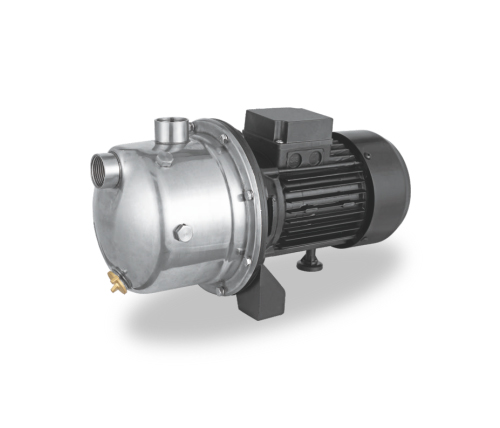
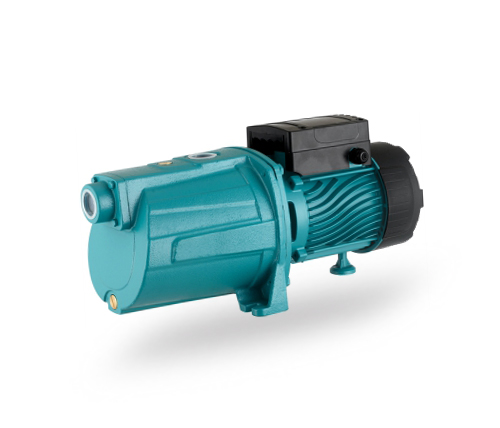
ADJET Series AC/DC Hybrid Motor Solar Jet Pump
The most distinctive advantage of the ADJET Series is its ability to operate with both solar DC power and AC mains power. This feature gives project designers more options than a single-input pump. In a solar-only installation, the pump can be connected to an appropriately configured solar array. In a grid-connected location, AC power can be used when necessary. In a hybrid water supply system, the two sources can support different operating priorities.
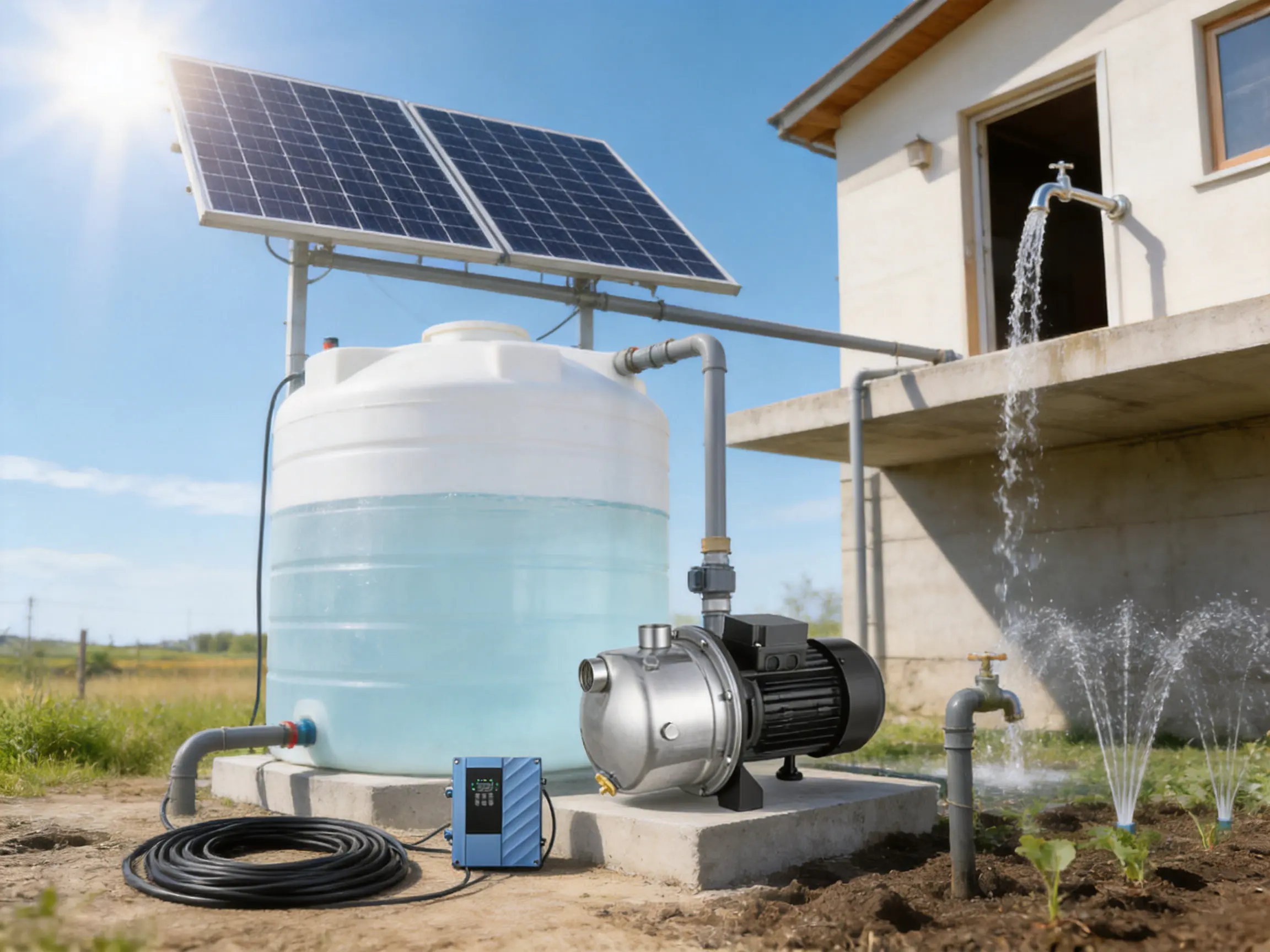
For example, a household may use solar energy during the daytime to fill an elevated water tank. The stored water can then serve domestic needs when solar production declines. If unusually high demand occurs or several cloudy days reduce solar output, AC power can be used to restore the tank more quickly. This approach combines renewable energy use with a practical backup plan.
In agricultural irrigation, solar energy can cover normal daytime pumping, while AC power can support critical irrigation cycles during poor weather or periods of increased demand. This is valuable for orchards, vegetable farms, nurseries, and gardens where delayed irrigation may affect plant health. The ability to use two electrical sources also helps users adapt the system to seasonal changes without installing a separate emergency pump.
For remote water transfer projects, the hybrid feature can simplify future expansion. A site may initially be powered only by solar panels because grid electricity is unavailable. If a grid connection becomes accessible later, the pump can continue serving the project using the new energy source. This provides a longer useful life and reduces the risk that the equipment will become unsuitable after infrastructure improvements.
Hybrid operation also improves purchasing flexibility. Some customers may require a completely off-grid system, while others may need a solar-assisted pump connected to a stable electrical network. A pump platform that supports both AC and DC operation can address these different requirements without forcing distributors to stock entirely separate product families for every application.
A jet pump is selected when a water system requires more pressure or improved transfer capability than a basic low-pressure surface pump can provide. The jet design assists the pumping process by using hydraulic circulation and pressure generation within the pump assembly. This makes the product suitable for transferring water through longer pipe runs, supplying elevated points, or supporting household systems that require stronger outlet pressure.
The 55-meter maximum head of the listed model indicates its ability to serve applications with significant pressure requirements, subject to the actual system curve. Head is a measure of the energy available to move water through vertical elevation and resistance. A system with a long pipe, multiple bends, filters, valves, or high discharge elevation consumes more head than a short, direct installation.
For residential applications, the jet pump can be used to improve pressure from a storage tank, supply upper floors, or move water from a collection point to a household distribution system. In garden and landscape applications, it can support sprinklers, hose outlets, and irrigation zones where stronger pressure is needed. In small agricultural systems, the pump can transfer water from a tank, pond, or collection reservoir toward an orchard, greenhouse, or cultivated area when the site conditions are appropriate.
Jet pump performance should not be judged only by maximum head. The actual flow available at a specific head is equally important. A system designer should review the performance curve and compare it with the required operating point. The best result is achieved when the pump operates within a stable and efficient region rather than at the extreme end of its performance range.
A conventional AC surface pump may be dependable where grid power is stable, but it cannot directly use solar DC power without additional equipment. A conventional DC solar pump can use solar electricity efficiently, but it may be less flexible when the weather changes or when grid electricity becomes available. The ADJET Series combines both options in one motor platform, reducing the limitations associated with a single-source design.
Solar-only systems can experience reduced output during cloudy conditions, early morning operation, and late afternoon operation. The AC input provides a practical alternative for users who cannot accept a complete interruption in water supply. Although system configuration and control strategy determine how the transition is managed, the dual-input design offers a foundation for more reliable daily operation.
Some basic solar pumps are optimized for moving large volumes of water at relatively low pressure. The jet design of the ADJET Series focuses on applications that need stronger pressure and longer-distance transfer. This makes it more suitable for household water pressure improvement, elevated storage, irrigation distribution, and compact water supply systems where both flow and head must be considered.
Using separate AC and DC pumps may require additional pipework, valves, controls, foundations, and maintenance planning. A hybrid pump can reduce equipment duplication by combining two power-input capabilities in a single pumping unit. A simpler installation can reduce the number of components that need to be inspected and can make system management easier for homeowners, installers, and small agricultural operators.
In remote areas, diesel pumps may be used because grid electricity is unavailable. However, diesel equipment requires fuel storage, regular refueling, exhaust management, and engine maintenance. A solar-powered pump can reduce routine dependence on fuel, while the AC input provides an alternative when solar conditions are insufficient and grid power is available. This combination can be more convenient for small water projects that do not require a large engine-driven system.
The ADJET Series is designed as a compact surface pump that can be installed in practical locations such as rooftops, equipment platforms, tank areas, garden service spaces, and remote solar sites. Its surface-mounted format makes inspection and maintenance more accessible than equipment installed deep underground or inside a narrow borehole.
Surface installation is especially convenient when water is drawn from a storage tank, rainwater collection system, shallow source, or reservoir. The pump can be positioned close to the water source and connected to the discharge pipe leading to the destination. Proper placement is important: the pump should be protected from flooding, excessive dust, direct mechanical impact, and unsuitable weather exposure. The suction line should be correctly sized and sealed to prevent air leakage.
The 1-inch inlet and outlet connections support common small-system piping arrangements. Installers should still verify the required pipe diameter, suction distance, total dynamic head, valve arrangement, and water quality before commissioning. Oversized suction distances or poorly sealed joints can reduce performance even when the pump itself is correctly selected.
For rooftop or elevated tank installations, the mounting base should be stable and capable of limiting vibration. For remote solar installations, the pump and electrical equipment should be arranged to minimize cable losses and protect connections from moisture. A well-designed installation improves efficiency, reduces noise and vibration, and helps extend the useful service life of the equipment.
The ADJET Series is optimized for solar-powered operation, helping users reduce energy costs when solar power is available. Solar energy can be used directly for pumping rather than being converted through multiple unnecessary stages. The actual energy savings depend on the solar resource, system design, operating schedule, water demand, and local electricity prices.
The hybrid concept also supports economical operation because users can prioritize solar energy during periods of strong production. Where an elevated tank or water reservoir is available, the pump can operate during the most productive solar hours and store water for later use. This reduces the need to run the pump during low-sunlight periods and can improve the overall value of the solar installation.
Maintenance requirements for a surface jet pump are generally manageable when the system is installed correctly. Routine care may include checking electrical connections, inspecting the suction line, cleaning filters or strainers, confirming that valves operate correctly, and looking for signs of leakage or abnormal vibration. Preventive inspection is particularly important in agricultural environments where dust, sediment, fertilizer residue, and changing water quality may affect equipment.
Low maintenance does not mean maintenance-free operation. The pump should not be operated dry, and the water source should provide suitable conditions for the pump design. Any unusual noise, loss of pressure, overheating, or repeated electrical protection should be investigated promptly. Timely attention can prevent minor issues from becoming major failures.
Product performance is influenced not only by design but also by manufacturing discipline. Taizhou Edwin Electric Co., Ltd. is an integrated manufacturing enterprise with activities covering independent research and development, mass production, and global export. This structure allows the company to connect product design with production planning, quality management, application feedback, and international customer service.
The company was founded in 2008 and has developed experience across several pump categories. Its core product lines include deep well pumps, submersible pumps, domestic booster pumps, and circulation pumps. It has also expanded into solar water pumps and intelligent booster pumps as demand has grown for energy-efficient and digitally enabled water systems.
A broad product portfolio can strengthen manufacturing knowledge because different pump categories require attention to different hydraulic, electrical, mechanical, and installation requirements. Experience with submersible pumps, for example, supports understanding of water handling and motor protection. Experience with booster pumps contributes to knowledge of pressure control and domestic water supply. Solar pump development adds requirements related to variable input power, energy management, and off-grid operation.
Independent research and development gives the manufacturer greater control over product adaptation. Different regions may require different voltage ranges, connection standards, performance targets, packaging arrangements, and documentation. An experienced internal development team can evaluate these requirements and support product improvements without relying entirely on external suppliers.
Mass production capability is also important for distributors and project buyers. It supports repeat orders, consistent product availability, and more predictable production scheduling. Customers involved in residential development, agricultural distribution, or renewable-energy projects often need equipment in batches rather than as isolated units. A manufacturer with organized production capabilities can better coordinate model selection, order quantities, inspection arrangements, and export preparation.
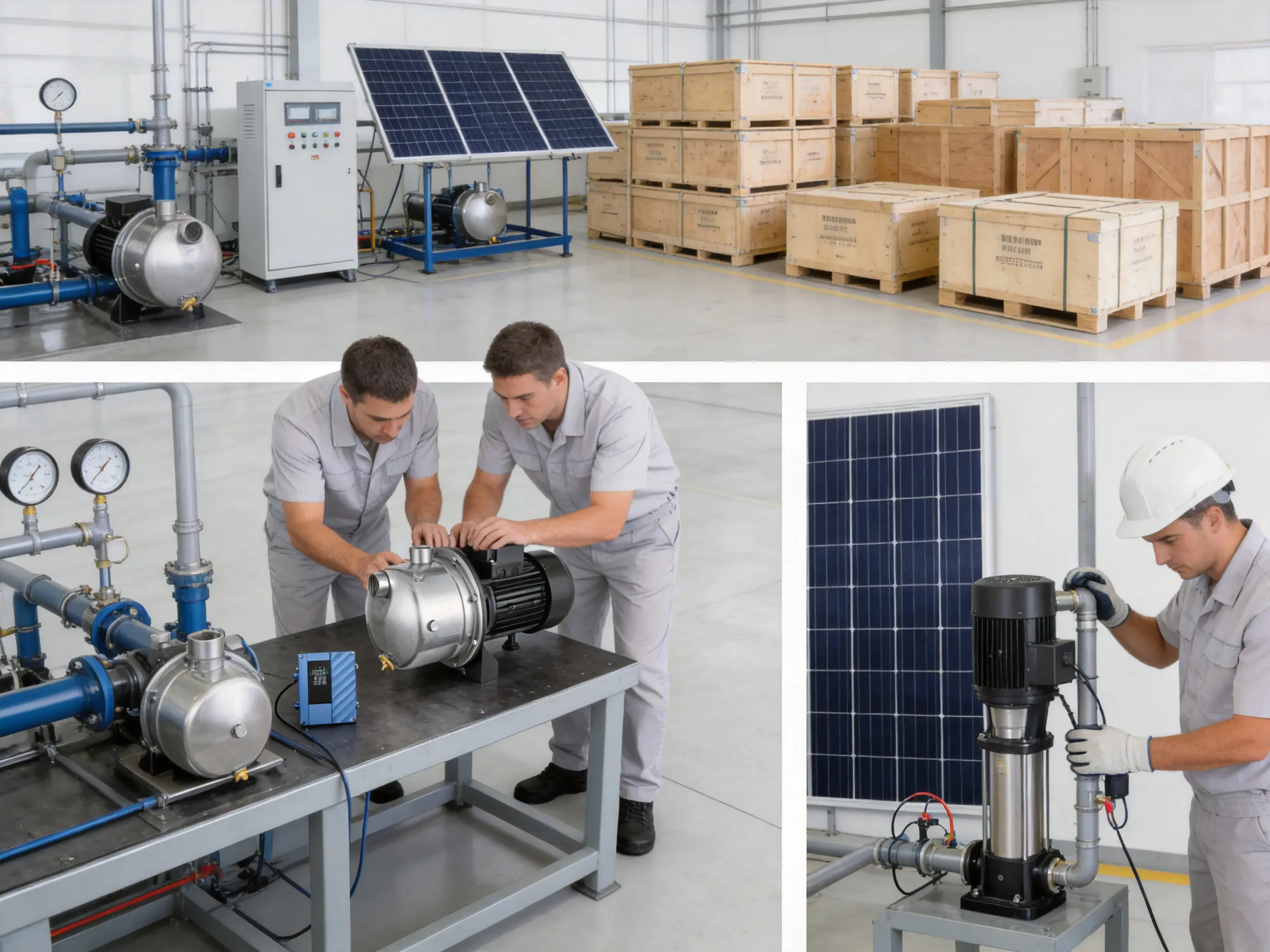
Reliable pump manufacturing requires control over multiple stages, including component sourcing, motor assembly, hydraulic assembly, electrical connection, sealing, performance inspection, and final packaging. Each stage affects the final product. A motor with suitable electrical characteristics is necessary, but it must be matched with a hydraulic assembly capable of delivering the intended flow and head. Likewise, a well-designed pump can underperform if assembly tolerances, seals, or electrical connections are inconsistent.
For an AC/DC hybrid pump, process control is especially important because the motor and associated electrical components must support different input conditions. The AC voltage range of 85V to 280V and DC voltage range of 100V to 350V represent a broad operating concept that requires appropriate electrical design and inspection. Components must be selected and assembled to support stable operation within the specified range.
Hydraulic quality control is equally important. Impeller balance, internal clearances, casing integrity, shaft alignment, and sealing performance influence vibration, noise, efficiency, and service life. A professional manufacturing process should include suitable inspection procedures to identify defects before products are shipped to customers.
Final testing and documentation help connect factory output with real installation requirements. Performance data such as maximum flow, maximum head, voltage range, power rating, outlet size, cable length, and solar input requirements provide distributors and installers with a basis for system design. Accurate technical information reduces selection errors and supports better customer service in international markets.
Edwin Pump’s integrated business model also includes affiliated import and export service capabilities. Taizhou Haipai Import & Export Co., Ltd. and Golden Falcon Industrial Co., Ltd. were established in 2012 to support procurement planning, order tracking, cross-border delivery, and foreign trade services. For overseas customers, this type of support is valuable because successful equipment supply involves more than manufacturing alone. It also requires communication, documentation, packaging coordination, shipment planning, and after-sales responsiveness.
Household water systems often require more than basic water movement. Users may need adequate pressure for showers, faucets, toilets, washing machines, garden taps, and storage tanks. Low pressure can become a problem when the water source is below the house, when a tank is located at ground level, or when several outlets operate at the same time.
The ADJET Series can support household water supply by transferring water from a tank or suitable source to the domestic distribution system. Its jet pump design is suited to pressure-oriented applications, while the hybrid motor allows the system to use solar power during the day and AC power when necessary.
For a household seeking greater energy independence, solar panels can provide the primary daytime energy source. Water can be pumped into an elevated tank or pressure vessel, depending on the system design. For a household that already has grid electricity, the pump can provide renewable-energy operation without giving up the convenience of an AC backup.
Domestic water installations should include appropriate filtration, non-return protection, isolation valves, and control equipment where required. The pump should be selected according to the total household demand and not simply the maximum flow value. A professional installer can calculate pressure losses and confirm whether the selected model meets the required service conditions.
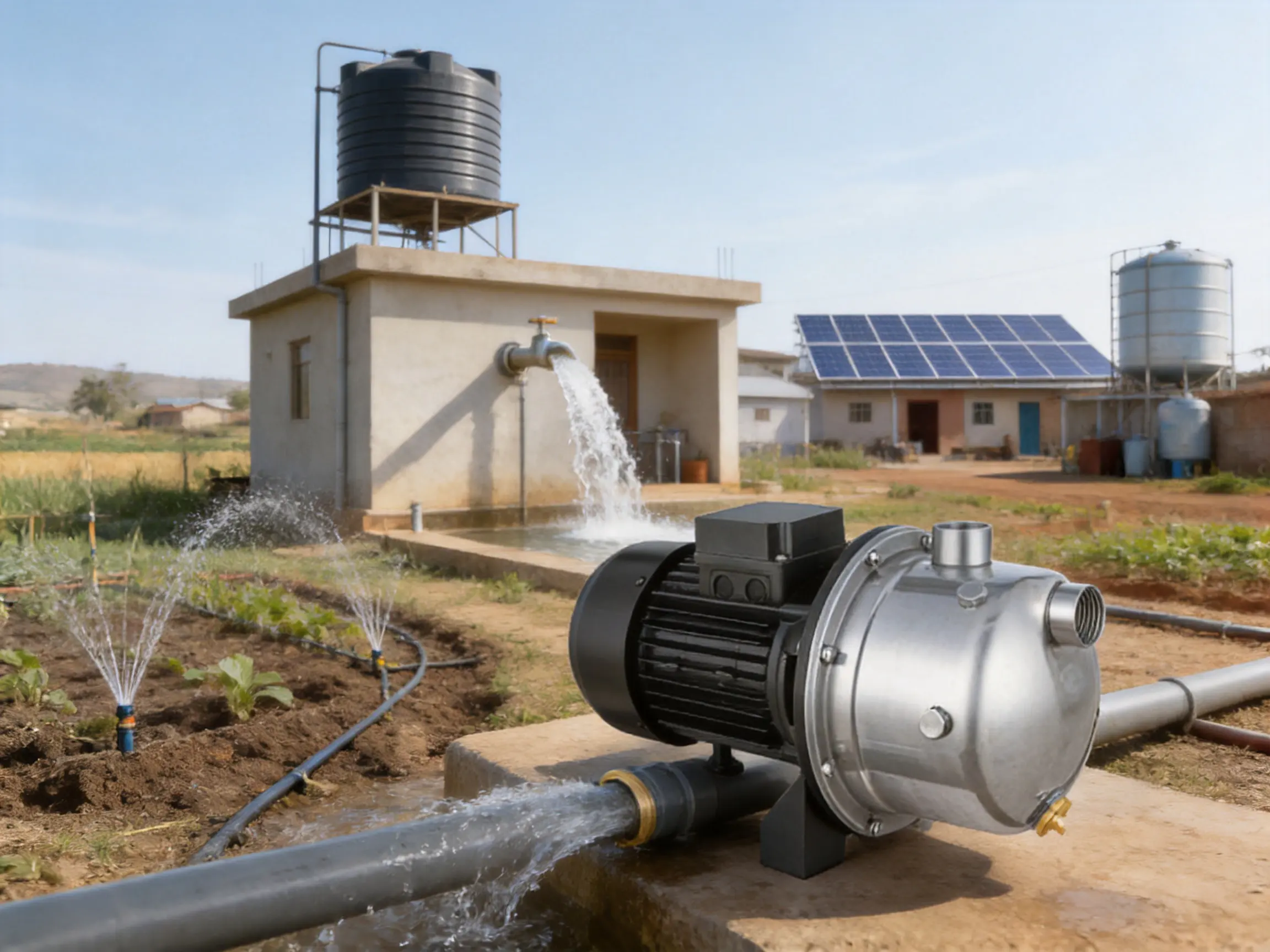
Agricultural and garden applications often take place in locations where power availability is limited or operating costs must be controlled. Solar pumping can provide a practical way to supply water to orchards, farms, greenhouses, nurseries, and landscape areas. The pump can draw from a storage tank, collection basin, or suitable shallow source and transfer water to irrigation zones.
The jet configuration is useful where the water must travel through a long pipe, rise to a higher field section, or supply a sprinkler system requiring pressure. With the maximum head specified for the ADJET3-55-72-750 model, installers can consider it for compact irrigation layouts after calculating the actual system resistance.
Solar operation can be scheduled around the irrigation plan. In many agricultural applications, water is pumped during sunny hours and stored for controlled distribution later. This approach can reduce the need for batteries because water storage performs the energy-storage function. Where the crop schedule requires irrigation during low-light periods, AC power can supplement the solar source if grid electricity is available.
Garden users can also benefit from this flexibility. The pump can support lawn irrigation, vegetable gardens, greenhouse watering, rainwater reuse, and tank transfer. Its compact installation concept is suitable for small properties where a large commercial pumping station would be unnecessary.
Remote water projects often face several challenges at once: limited grid access, difficult transport conditions, variable weather, and the need for straightforward maintenance. A solar pump can reduce dependence on fuel deliveries, while an AC/DC hybrid motor provides an additional operating option when an electrical supply is available.
For a small community water system, the pump may be used to transfer water into a storage tank that supplies several households or public outlets. The system should be designed with appropriate storage capacity, filtration, water treatment where necessary, and protection against dry running. The pump itself is one part of the complete water infrastructure, and its performance should be coordinated with the source, storage tank, distribution network, and daily demand.
In off-grid locations, solar panel sizing is particularly important. The provided guidance specifies solar panel power of at least 1.3 times the pump power. For the 750W model, this indicates a minimum nominal panel capacity of approximately 975W, subject to the final system design. Local solar conditions, seasonal performance, shading, panel temperature, wiring losses, and controller requirements should all be considered. A larger array may be appropriate when the project requires stronger performance during less favorable sunlight conditions.
A successful solar pumping system begins with a clear understanding of water demand. The designer should determine how much water is required per day, when the water is needed, the source level, the delivery point, the elevation difference, and the expected pipe losses. These factors determine the pump operating point and the solar energy requirement.
The solar array should be designed to meet the pump’s electrical requirements without exceeding the permitted input conditions. The listed product information states that the solar panel open-circuit voltage should be below 450V. This value should be treated as an important design limit. Open-circuit voltage can rise under certain temperature conditions, so installers should calculate the maximum possible voltage rather than relying only on the nominal panel rating.
The DC voltage range is specified as 100V to 350V. The array configuration should therefore provide an operating voltage within the required range under realistic conditions. Series and parallel connections must be selected carefully, and all wiring, connectors, isolators, fuses, grounding arrangements, and protective devices should comply with local electrical standards.
AC operation requires similar care. The stated AC input range is 85V to 280V. The supply should be stable, correctly grounded, and protected by suitable circuit breakers and residual-current protection where required. Electrical installation should be performed by qualified personnel, especially in wet areas or outdoor environments.
The solar panels should be placed where shading is minimized. Even partial shading can reduce array performance, particularly when panels are connected in series. Regular cleaning may be necessary in dusty or agricultural environments. The mounting structure should withstand local wind and weather conditions and should be oriented to achieve an appropriate solar yield.
Before installation, inspect the pump, cable, connections, inlet, outlet, and accessories for possible transport damage. Confirm that the selected model matches the required voltage, power, flow, head, and pipe connections. The pump should be installed on a firm, level base that can resist vibration and prevent movement during operation.
The suction pipe should be as short and direct as practical. All joints must be airtight because air entering the suction line can cause loss of prime, unstable operation, reduced flow, and excessive noise. A suitable foot valve or non-return valve may be needed depending on the water source and installation arrangement.
The pump should be primed according to the installation instructions before starting. Dry running can damage internal components and seals. The water source should also be checked for sand, debris, corrosive substances, or other conditions that may affect pump performance. If the source contains sediment, an appropriate filter or strainer should be installed and maintained.
On the discharge side, the piping should be sized according to the required flow and distance. Excessively narrow piping increases friction loss and can reduce the pressure available at the point of use. Isolation valves should be installed where they allow easier maintenance, but the system should not be operated with a closed discharge unless the equipment is specifically designed for that condition.
Electrical cables should be protected from sharp edges, standing water, ultraviolet exposure, animals, and mechanical damage. Solar and AC circuits should be clearly identified to prevent incorrect connections. All electrical work must follow local regulations and be completed by qualified professionals.
Regular inspection helps maintain stable performance. Users should check whether the pump starts normally, maintains expected pressure, and operates without unusual vibration or noise. A gradual loss of performance may indicate a blocked inlet, dirty filter, air leakage, worn components, insufficient voltage, or a change in the water level.
The solar array should be inspected for dirt, shading, loose wiring, and visible damage. If output declines, the cause may be related to the solar panels, electrical connections, environmental conditions, or the pump system itself. Because the pump accepts both AC and DC input, troubleshooting should begin by confirming which source is active and whether the input voltage is within the specified range.
Pipe connections should be checked for leaks. Even small leaks on the suction side can introduce air without producing an obvious water leak. Discharge leaks can waste water and reduce pressure. Filters and strainers should be cleaned according to the quality of the water source and the operating environment.
Before servicing the pump, disconnect all power sources. A hybrid system may have both AC and DC energy present, and solar panels can continue generating voltage in daylight even when the AC supply is switched off. Proper isolation and verification are essential for worker safety.
International pump buyers often evaluate more than product specifications. They also consider factory stability, production capacity, quality consistency, communication, packaging, lead times, documentation, and the manufacturer’s ability to support repeat orders. A supplier with experience in global export is better positioned to understand these requirements.
Taizhou Edwin Electric Co., Ltd. serves customers in international markets and focuses on high-performance water pumps and related water treatment peripheral products. Its experience includes new-energy projects, agricultural irrigation, municipal engineering, mining, construction, HVAC systems, and household water supply. This broad application background helps the company understand that pump selection must be connected to the customer’s complete project rather than treated as an isolated product transaction.
The company’s investment in new energy and intelligent technology since 2018 reflects the changing needs of the pump industry. Solar water pumps respond to the demand for renewable and off-grid operation, while intelligent booster pumps address the need for improved control and efficient domestic water management. These product directions complement the hybrid solar jet pump concept.
For distributors, a broad product range can support one-stop procurement. A buyer may need a surface solar pump for one project, a deep well pump for another, a circulation pump for HVAC equipment, and a booster pump for a domestic system. Working with a supplier that has multiple related categories can simplify vendor management, technical communication, and order coordination.
Before selecting the ADJET Series, buyers should define the application clearly. Important questions include the required daily water volume, maximum flow at the operating point, vertical lift, total pipe length, pipe diameter, water source, water quality, solar resource, and availability of AC power.
The pump is most appropriate when the project requires a surface-mounted solution and enhanced pressure. It may not be the correct choice for very deep boreholes, extremely high-volume municipal pumping, heavily contaminated water, or applications requiring specialized materials. In those cases, another pump category may be more suitable.
Distributors should also confirm local electrical requirements and customer expectations. The AC/DC input ranges, solar open-circuit voltage limit, recommended solar panel power, connection sizes, and cable length should be communicated accurately. Customers should receive guidance on system design rather than being given only a maximum flow or maximum head number.
For large projects, buyers may request technical drawings, performance curves, packaging information, inspection arrangements, spare parts recommendations, and samples before placing a production order. Clear communication at the quotation stage can reduce installation problems and improve long-term customer satisfaction.
It is a pump equipped with a motor that can operate from both solar DC power and AC mains power. This allows the user to use renewable solar energy when available and switch to or use mains electricity when solar production is insufficient or when continuous operation is required.
The jet design is intended to provide stronger pressure and support longer-distance water transfer than a basic low-pressure surface pump. It is suitable for household pressure improvement, tank transfer, garden irrigation, and small agricultural systems where water must be moved through elevation or pipe resistance.
Yes, it can be used in an off-grid solar pumping system when the solar array and associated equipment are correctly designed for the pump’s DC input requirements. The solar system must provide suitable voltage and power under actual site conditions.
Yes. The listed model supports an AC voltage range of 85V to 280V. Grid connection must be completed using suitable protection and wiring by qualified personnel, in accordance with local regulations.
The stated maximum flow is 3 cubic meters per hour. Actual flow depends on the operating head, pipe size, pipe length, fittings, water level, voltage, and other system conditions.
The listed maximum head is 55 meters. This is a maximum performance value, and the actual flow available at a 55-meter head will be lower than the maximum flow. The performance curve should be used to identify the correct operating point.
The product information specifies solar panel power of at least 1.3 times the pump power. For the 750W model, the initial reference value is approximately 975W or more. Final sizing should consider sunlight, temperature, seasonal conditions, wiring losses, and system requirements.
The stated solar panel open-circuit voltage should be below 450V. The array operating voltage should also remain within the pump’s DC input range of 100V to 350V. A qualified installer should calculate voltage under both normal and extreme temperature conditions.
It is designed for solar-powered household water supply applications where enhanced pressure is required. The final suitability depends on household demand, source conditions, storage arrangements, pipework, and the required pressure at each outlet.
Yes. The pump can be considered for orchards, farms, gardens, greenhouses, and other small agricultural applications. The irrigation system must be designed so that the pump’s actual flow and pressure match the requirements of the irrigation zones.
A battery is not necessarily required for every application. Water storage can be used to retain the pumped water and reduce dependence on battery storage. A battery may be considered when the project requires pumping at night or needs a more stable electrical supply during periods without sunlight.
Routine maintenance may include inspecting electrical connections, cleaning filters or strainers, checking for leaks, confirming proper priming, inspecting solar panels, and monitoring abnormal noise or vibration. The pump should always be protected from dry running and serviced with all power sources disconnected.
Hybrid solar pumping combines hydraulic design, motor engineering, electrical input management, solar system compatibility, and international installation requirements. A manufacturer with experience in pump research, mass production, multiple pump categories, and global export can provide more complete support from product selection through delivery and application.
The ADJET Series AC/DC Hybrid Motor Solar Jet Pump offers a practical response to the changing requirements of modern water supply. Its combination of solar DC operation and AC mains compatibility gives users greater energy flexibility than a single-source pump. Its jet pump design supports enhanced pressure and longer-distance transfer, making it appropriate for household water systems, agricultural irrigation, garden watering, remote installations, and small community projects.
The ADJET3-55-72-750 model provides a 750W motor, a maximum flow of 3 cubic meters per hour, and a maximum head of 55 meters. Its stated input ranges of 85V to 280V AC and 100V to 350V DC allow it to serve different power environments when correctly installed. The recommended solar panel power and open-circuit voltage limits provide a starting point for solar system design.
Its advantages become most apparent where users need renewable energy without sacrificing operational flexibility. Solar power can reduce running costs and dependence on fuel, while AC power can support reliable operation during low sunlight or higher demand. The compact surface-pump format also simplifies access for inspection and maintenance.
Behind the product is the manufacturing and export experience of Taizhou Edwin Electric Co., Ltd. Through independent research and development, mass production, a broad pump portfolio, and international service capabilities, the company supports customers seeking reliable water-pumping equipment for residential, agricultural, industrial, and new-energy applications.
As with any pump, correct system design remains essential. Buyers and installers should evaluate the complete hydraulic and electrical requirements, follow the specified voltage limits, select suitable solar panels, protect the equipment from dry running and environmental damage, and use qualified professionals for electrical installation. When these principles are followed, the ADJET Series can provide a versatile and efficient foundation for dependable solar-assisted water supply.
1. Product technical information for the ADJET Series AC/DC Hybrid Motor Solar Jet Pump, including model specifications, voltage ranges, flow, head, outlet size, cable length, and solar panel requirements.
2. Manufacturer information from Taizhou Edwin Electric Co., Ltd. concerning company history, product development, manufacturing capabilities, export services, and application fields.
3. General principles of centrifugal and jet pump selection, including flow, head, hydraulic resistance, suction conditions, and system operating points.
4. General solar photovoltaic system design principles concerning array voltage, open-circuit voltage, power sizing, shading, temperature effects, and electrical protection.
5. General guidance for surface pump installation, priming, suction-line sealing, filtration, maintenance, grounding, and safe isolation of AC and DC power sources.
edwina@edwin-pump.com
+86-13586290903 (WhatsApp)
Xuri Gongliang Cutting Tool Entrepreneurship Park, Wenqiao Town, Wenling City, Taizhou City, Zhejiang Province, China

High Performance Smart Pump Factory


 English