edwina@edwin-pump.com

View All Products
en
Reliable access to water is essential for agriculture, livestock production, domestic use, remote infrastructure, and many off-grid development projects. In locations where grid electricity is unavailable, unstable, or expensive to extend, solar pumping provides a practical alternative. However, a solar pumping system must do more than lift water from a borehole. It must convert variable solar energy into useful hydraulic performance, operate safely under changing conditions, resist corrosion, and remain easy to install and maintain.
The 4EW solar submersible borehole pump is designed for this type of application. It combines a permanent-magnet brushless motor, an intelligent internal controller, AC/DC convertible operation, stainless steel construction, water-lubricated bearings, soft starting, and multiple protection functions in one compact deep-well pumping solution. With a rated power of 0.55 kW, a maximum flow rate of 4 m3/h, and a maximum head of 54 m, the model is suited to a broad range of small and medium water-supply applications.
Unlike a conventional pump that is dependent on a fixed electrical supply, this solar borehole pump can work with a variable direct-current source and can also accept alternating-current input within its specified operating range. This flexibility makes it suitable for solar arrays, battery-supported systems, hybrid installations, and locations where grid power is available only intermittently.
This article examines the pump’s construction, operating principle, technical advantages, manufacturing strengths, installation considerations, maintenance requirements, and possible application fields. It also explains why a professionally manufactured AC/DC solar submersible pump can offer important advantages over traditional single-input pumps and less sophisticated solar pumping products.
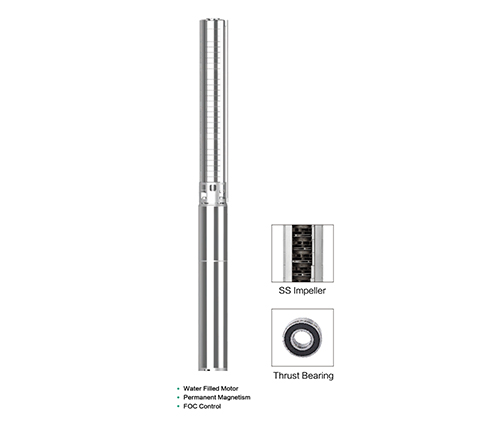
4EW Solar submersible borehole pump
The 4EW solar submersible borehole pump is a compact deep-well pumping unit intended for installation inside a borehole, well casing, storage well, or other submerged water source. Its motor and hydraulic section are designed to work below the water level, allowing the pump to push water upward through a discharge pipe rather than relying on surface suction.
The product data identifies the model as 4EW0.55-4/54. The model designation corresponds to a 0.55 kW power class, a maximum flow rate of 4 m3/h, and a maximum head of 54 m. The specified outlet size is 1.25 inches, while the pump diameter is 4 inches. A four-inch pump diameter is especially useful because it is compatible with many standard borehole arrangements and can be selected for narrow well applications where larger equipment cannot be installed.
Item |
Specification |
Model |
4EW0.55-4/54 |
Input voltage |
DC 90–360 V; AC 90–240 V, 50/60 Hz |
Rated power |
0.55 kW |
Rated power equivalent |
0.75 HP |
Maximum flow rate |
4 m3/h |
Maximum head |
54 m |
Outlet size |
1.25 inches |
Pump diameter |
4 inches |
The stated performance values represent maximum rated conditions. Actual flow at a specific installation will depend on total dynamic head, pipe length, pipe diameter, elevation changes, fittings, water level, solar input, and the operating point of the complete system. A correct system design should therefore consider the pump curve and the real hydraulic requirements rather than selecting a pump solely by its maximum flow or maximum head.
Traditional borehole pumps are often designed for stable AC power. When connected to a solar array, a conventional motor may require a separate inverter, a battery bank, and additional electrical protection. Each extra component increases installation complexity, energy losses, maintenance requirements, and total system cost.
Solar power also changes continuously. Output varies with sunrise, sunset, cloud cover, dust, seasonal conditions, panel temperature, and shading. A pump that operates well only at a fixed voltage or fixed frequency may stop frequently, draw excessive current, or suffer from unstable operation when solar conditions change.
The 4EW design addresses these challenges through an AC/DC convertible electrical architecture and an intelligent internal controller. The pump can use direct-current input from a suitable solar array while also supporting alternating-current input in the specified range. This allows the same pump platform to serve in different energy environments without requiring a completely separate product for every project.
For remote agricultural sites, this flexibility can reduce dependence on diesel generators. For domestic water systems, it can provide a dependable water source while preserving grid power as a backup. For commercial installations, it can simplify procurement by allowing one pump design to be deployed in solar, hybrid, or conventional power projects.
One of the most important features of the pump is its permanent-magnet brushless motor. Conventional brushed motors use mechanical brushes and commutators to transfer electrical energy to the rotating assembly. These parts wear over time, create friction, generate electrical noise, and may require periodic replacement.
A brushless motor eliminates the mechanical brush system. Electronic control is used to manage the motor’s magnetic field and rotation. Permanent magnets provide the rotor’s magnetic field, allowing efficient torque production with fewer wearing parts. This construction is particularly suitable for a submerged pump that may be difficult to access after installation.
The permanent-magnet design can provide several practical benefits:
• Higher electrical efficiency compared with many basic motor designs.
• Reduced mechanical wear because there are no carbon brushes to replace.
• Quieter operation, which is valuable near homes, livestock facilities, and water-storage areas.
• More compact construction for a given output range.
• Better suitability for variable solar input when paired with intelligent electronic control.
• Lower routine maintenance requirements over the working life of the pump.
For solar applications, efficiency is especially important. Every watt saved by the motor may reduce the required solar-panel capacity or allow more water to be delivered during weak sunlight. A highly efficient motor does not eliminate the need for correct system sizing, but it can improve the value obtained from the available solar energy.
The motor is described as a water-filled, double-shielded design. Water-filled motors are commonly used in submersible applications because the internal fluid can assist with cooling and lubrication. The double-shielded construction helps separate internal motor components from the surrounding water and supports protection of the electrical and magnetic elements during underwater operation.
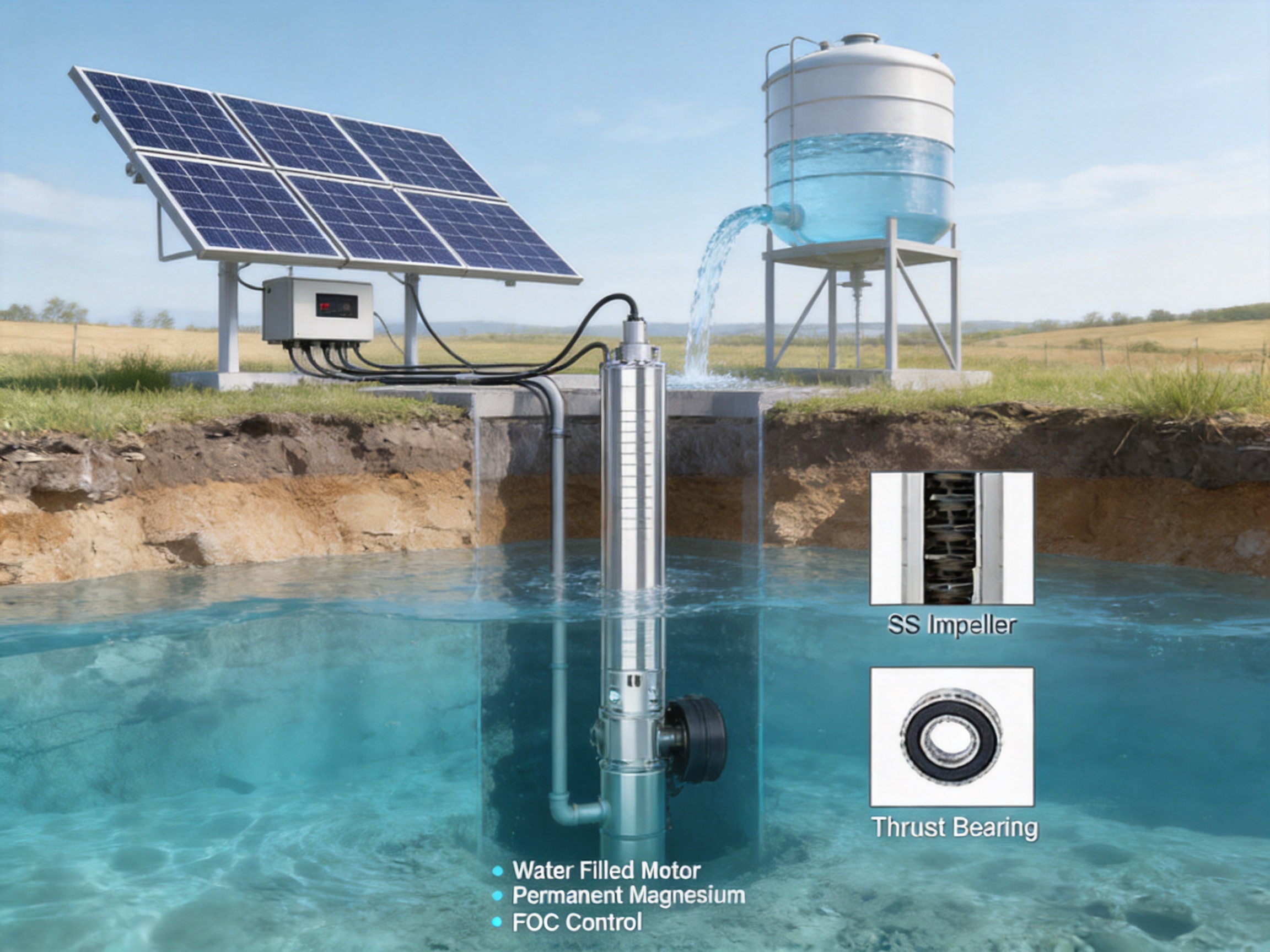
The ability to operate with both DC and AC input is a major difference between this product and many conventional single-input pumps. The listed input range is DC 90–360 V and AC 90–240 V at 50 or 60 Hz. This permits the pump to be integrated with a correctly configured solar power source while retaining compatibility with many conventional electrical supplies.
In a solar-only installation, the pump can be supplied by a photovoltaic array designed to provide an appropriate voltage under real operating conditions. In a hybrid installation, the system may use solar power during daylight hours and grid or generator power when solar energy is insufficient. In an emergency or seasonal situation, an AC supply can provide an alternative operating source.
This flexibility can simplify project planning. A user does not necessarily need to purchase one pump for solar operation and another pump for backup power. The same model can support a staged development strategy: a project may begin with a solar array and later add grid backup, or it may operate on AC initially and transition toward renewable energy as the solar infrastructure expands.
Input compatibility must always be verified by a qualified installer. Solar arrays should be designed according to the pump’s voltage requirements, expected open-circuit voltage, operating voltage, current capacity, temperature effects, and local electrical regulations. The pump should not be connected to an unsuitable supply merely because the nominal voltage appears close to the stated range.
The AC/DC function is most valuable when treated as part of a complete engineered system. Correct wiring, disconnects, grounding, surge protection, cable sizing, and array configuration are necessary for safe and stable performance. The pump’s built-in controller can manage the motor, but it does not remove the need for appropriate external installation practices.
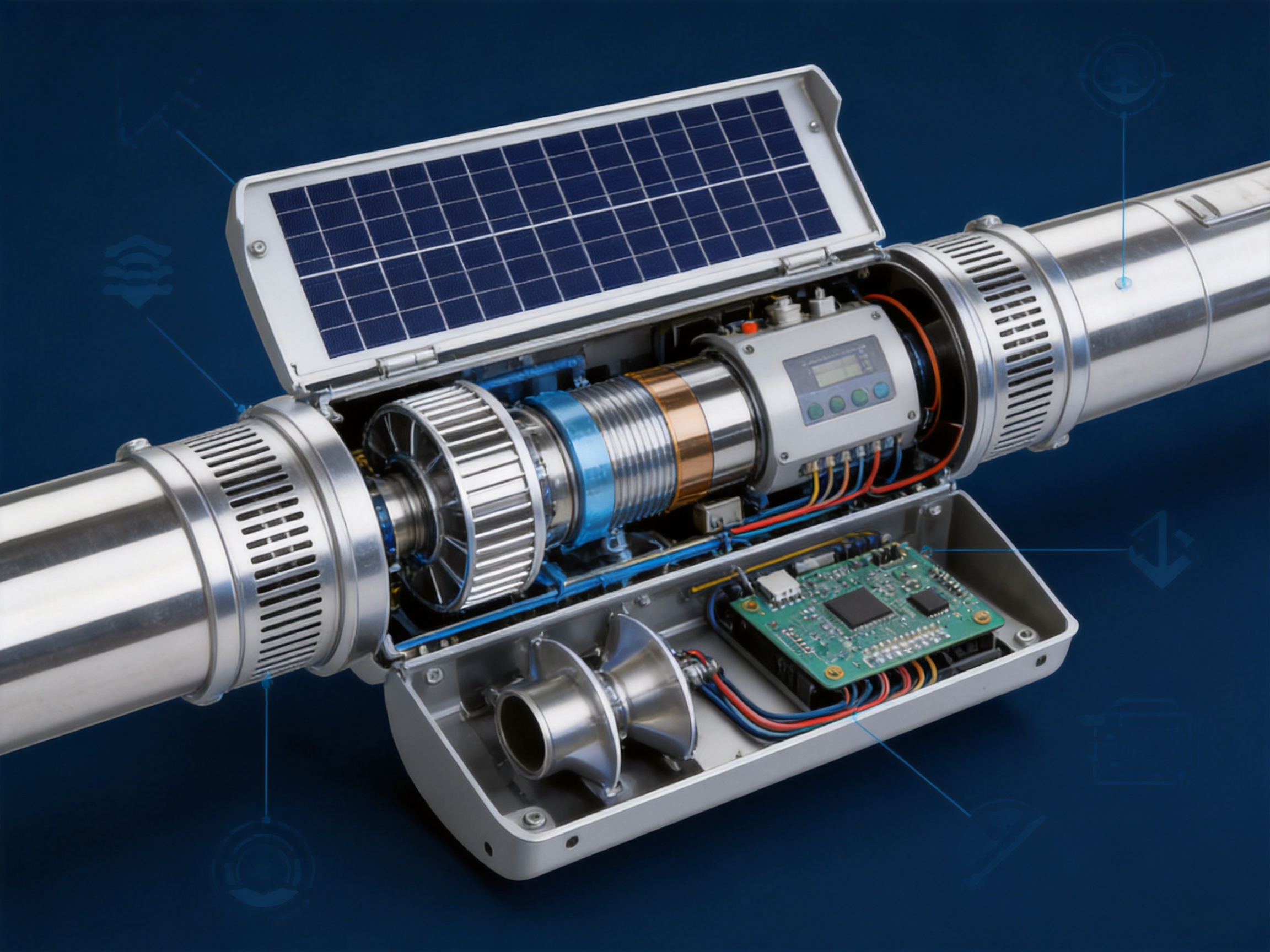
The product includes an intelligent internal controller with FOC function. FOC, or field-oriented control, is an advanced method of controlling brushless motors. Instead of simply switching current on and off, the controller regulates the relationship between electrical current and the motor’s magnetic field. This enables more precise torque control and can improve smoothness, efficiency, and response.
In a solar pumping system, intelligent control is valuable because the available energy is not constant. When sunlight changes, the controller can manage motor operation more effectively than a basic fixed-speed arrangement. This can help the pump use available power efficiently and reduce abrupt electrical or mechanical changes.
The internal controller also reduces the number of external control components needed for basic operation. A more integrated system can save cabinet space, reduce wiring complexity, and make installation more straightforward. It can also reduce the number of separate components that must be sourced, matched, and maintained by the user or project contractor.
FOC-based motor control can support smoother acceleration and stable running. Smooth electrical commutation reduces sudden torque changes, which may lower vibration and mechanical stress in the motor, pump stages, shaft, couplings, and pipework. It also contributes to the product’s quiet-running characteristic.
An intelligent controller should not be regarded as a substitute for a system controller in every application. Projects requiring remote monitoring, water-level automation, pressure management, communication, or detailed energy reporting may still require additional equipment. However, the integrated controller provides a strong internal foundation for efficient and protected pump operation.
The pump body and motor body are made from SS304 stainless steel. Stainless steel is widely used in water-handling equipment because it provides a useful combination of corrosion resistance, mechanical strength, clean surface characteristics, and long service potential.
Borehole water quality can vary significantly. Some wells contain dissolved minerals, suspended particles, or conditions that accelerate corrosion of ordinary carbon steel. SS304 does not make the pump immune to every chemical environment, and water analysis remains important, but it can offer a substantial advantage over lower-grade materials in many standard water applications.
The stainless steel body also supports a clean and professional appearance. This is useful in domestic water systems, agricultural projects, commercial facilities, and installations where equipment hygiene and visual quality matter. The smooth metallic surface can also be easier to clean than rough or damaged painted surfaces.
The manufacturing information highlights the use of advanced laser welding equipment. Laser welding can provide precise, concentrated heat input and consistent weld formation when properly controlled. Compared with less precise welding processes, it can support accurate assembly, reduce distortion, and create clean joints on stainless steel components.
Consistent welding is important in a submersible product. The pump must withstand hydraulic pressure, vibration, repeated starting and stopping, and long periods of underwater operation. High-quality welds contribute to structural integrity and help maintain the dimensional accuracy of the pump body.
Material selection and welding quality should be supported by inspection and process control. A professional manufacturing operation typically controls material specifications, component dimensions, weld parameters, surface condition, assembly tolerances, and final product testing. These controls help ensure that production units perform consistently rather than relying only on the quality of individual manual operations.
The pump uses imported bearings, including water-lubricated bearings and thrust bearings. Bearings are critical components in a submersible pump because they guide the rotating shaft, absorb loads, and help maintain alignment between the motor and hydraulic section.
Water-lubricated bearings are designed to operate with water as the lubricating medium. This is appropriate for submerged equipment because it avoids dependence on conventional oil or grease in areas where lubricant contamination could be undesirable. Water lubrication also aligns with the operating environment of the pump.
Thrust bearings are particularly important in vertical submersible pumps. Hydraulic stages can generate axial forces along the shaft. A properly selected thrust-bearing arrangement helps absorb these forces and reduces the load transferred to other motor components. This supports stable operation and can help extend service life when the pump is correctly installed and operated within its design limits.
The rotor is described as being covered with stainless steel shielding. This shielding helps protect the magnetic steel from corrosion and oxidation. Permanent magnets must retain their magnetic properties and physical integrity during long-term operation. Corrosion of magnetic materials can reduce performance and compromise mechanical reliability, especially in a wet environment.
The shielding iron core also benefits the heat-dissipation system. Motor heat must be transferred away from the windings and rotor so that the operating temperature remains within an acceptable range. Effective heat management is important for insulation life, electronic reliability, and overall motor durability.
These internal design details are not always visible to the end user, but they strongly influence long-term performance. A pump may appear similar externally to a competing model while having significant differences in bearing quality, rotor protection, sealing, heat transfer, and internal materials. Such differences can determine whether the equipment delivers dependable service after months or years of operation.
The pump is equipped with soft-start operation. A direct-on-line motor can draw a high inrush current when started and may generate a sudden torque impulse. Soft starting gradually increases motor activity, reducing the initial electrical and mechanical shock.
For a solar system, soft starting can be especially beneficial. Solar arrays have limited instantaneous power compared with a large utility supply. A sudden starting current may cause voltage to fall or cause the pump to fail to start under weak sunlight. A controlled start can make better use of the available energy and reduce stress on the electrical system.
Soft starting also benefits the mechanical system. Reduced starting shock can lower stress on the shaft, bearings, impellers, pipe connections, mounting components, and check valves. This is useful in installations where the pump starts and stops regularly according to sunlight or water demand.
Quiet operation is another practical advantage. Noise from a borehole pump can be transmitted through the discharge pipe, well casing, or surrounding structure. A quiet motor is desirable for residential water systems, schools, farms near living areas, guest facilities, and small commercial properties.
Noise reduction results from several factors working together, including brushless motor operation, electronic control, balanced rotating components, suitable bearings, and smooth hydraulic design. Actual sound levels will depend on installation depth, pipework, water conditions, support arrangements, and the structure surrounding the borehole.
Submersible pumps are often installed in locations where direct observation is difficult. A motor problem may not be immediately visible, and removing a pump from a borehole can require significant labor. Built-in protection functions are therefore an important part of a reliable product.
The 4EW pump includes dry-running protection. Dry running occurs when the pump operates without sufficient water around the hydraulic inlet or motor. This condition can reduce cooling, increase wear, and damage hydraulic components. Protection against dry running helps limit the consequences of falling water levels, inadequate well yield, blocked inlets, or incorrect installation.
Overload and under-load protection help the controller identify abnormal mechanical or hydraulic conditions. An overload may occur when the pump is obstructed, the motor is overloaded, or the operating point is outside the intended range. Under-load conditions may indicate loss of water, a broken pipe, a damaged impeller, or another fault that causes the motor load to fall below normal.
Over-current and under-current protection monitor electrical behavior. Excessive current may be associated with an electrical fault, obstruction, or unsuitable operating condition. Insufficient current may indicate a loss of load, supply problem, or interruption in the pumping process.
Over-voltage and under-voltage protection are important in both solar and AC applications. Solar voltage can vary according to array conditions, while AC supplies may experience fluctuations. Operating outside the approved voltage range can damage electronic components or reduce motor reliability. Protection helps the pump respond more safely to abnormal input conditions.
Phase-lack protection is included for applicable AC operating conditions. A missing phase can cause abnormal motor operation, increased current, overheating, or failure to start. Detecting this condition helps prevent damage caused by an incomplete electrical supply.
Protection functions improve reliability, but they should not be used as a reason to ignore system design. The pump should still be installed with correctly sized cables, appropriate fuses or circuit breakers, a suitable disconnect, proper grounding, and protection against lightning or electrical surges where required. Protection is most effective when combined with good engineering and regular inspection.
Many basic solar pumps are designed only for DC input, while many traditional borehole pumps are designed only for AC input. The 4EW model combines both operating possibilities in one product platform. This makes it more adaptable for hybrid projects and reduces the risk of choosing equipment that becomes unsuitable when the site’s energy strategy changes.
A conventional AC pump powered from solar panels generally requires an external inverter. The inverter adds cost, conversion losses, cabinet space, wiring, and another potential point of failure. A pump with an integrated controller and direct solar compatibility can simplify the power architecture. The exact system arrangement still depends on the project, but integration can be more efficient than assembling separate generic components.
Compared with many low-cost brushed or basic induction motor pumps, the permanent-magnet brushless motor can provide improved efficiency, lower wear, and quieter operation. These advantages are meaningful in solar applications, where available power is limited and equipment access may be difficult.
Low-cost pumps may depend heavily on external protective devices or may provide limited fault handling. The 4EW design incorporates multiple internal protections, including dry-running, overload, under-load, current, voltage, and phase-lack protection. This can improve operational security and reduce the burden on external control equipment.
The SS304 pump and motor bodies offer a stronger material profile than products using ordinary steel or lower-grade housings. Stainless steel construction can support longer service in many water environments and may reduce the risk of external corrosion affecting installation quality.
Soft starting can reduce electrical inrush and mechanical shock. This is a valuable advantage over direct-start products, particularly where the power supply is limited or the pump must start repeatedly during changing solar conditions.
The four-inch diameter allows the pump to fit into many standard borehole configurations while maintaining a useful flow and head range. Compact dimensions can reduce drilling requirements, simplify installation, and provide more flexibility when upgrading an existing well.
The quality of a solar submersible pump depends not only on its published features but also on the manufacturing system behind those features. A reliable product requires controlled design, stable component sourcing, accurate assembly, electrical testing, hydraulic verification, and consistent final inspection.
The manufacturer behind this product was founded in 2008 and operates as an integrated enterprise focused on independent research and development, mass production, and global export. This combination is important because product development and manufacturing experience can reinforce one another. Feedback from real applications can inform design improvements, while established production capabilities can support consistent output at commercial scale.
The company’s core product lines include deep-well pumps, submersible pumps, domestic booster pumps, and circulation pumps. This broader product knowledge can support a more complete understanding of hydraulic systems rather than limiting expertise to one isolated pump category.
Investment in new energy and intelligent technology since 2018 has supported the development of solar water pumps and intelligent booster pumps. This indicates a focus on adapting pump technology to changing energy requirements, digital control, and modern water-supply applications.
Advanced laser welding is one stated manufacturing capability. For stainless steel pump bodies, precision welding can help maintain accurate geometry and strong, clean joints. The value of such equipment is maximized when supported by trained operators, controlled parameters, inspection procedures, and repeatable production standards.
The use of imported bearings demonstrates attention to a critical internal component. Bearing performance influences shaft stability, noise, heat generation, and service life. Selecting suitable water-lubricated and thrust bearings is particularly important for a vertical submerged pump.
Global export experience also creates practical advantages for international buyers. Export-oriented manufacturing requires attention to packaging, documentation, order coordination, product communication, and delivery planning. For distributors and project contractors, these capabilities can be as important as the pump itself because delays or incomplete technical information can affect the entire installation schedule.
The wider business structure includes professional teams for procurement planning, order tracking, cross-border delivery, and foreign trade services. These functions support one-stop purchasing and can help customers coordinate multiple products or repeat orders more efficiently.
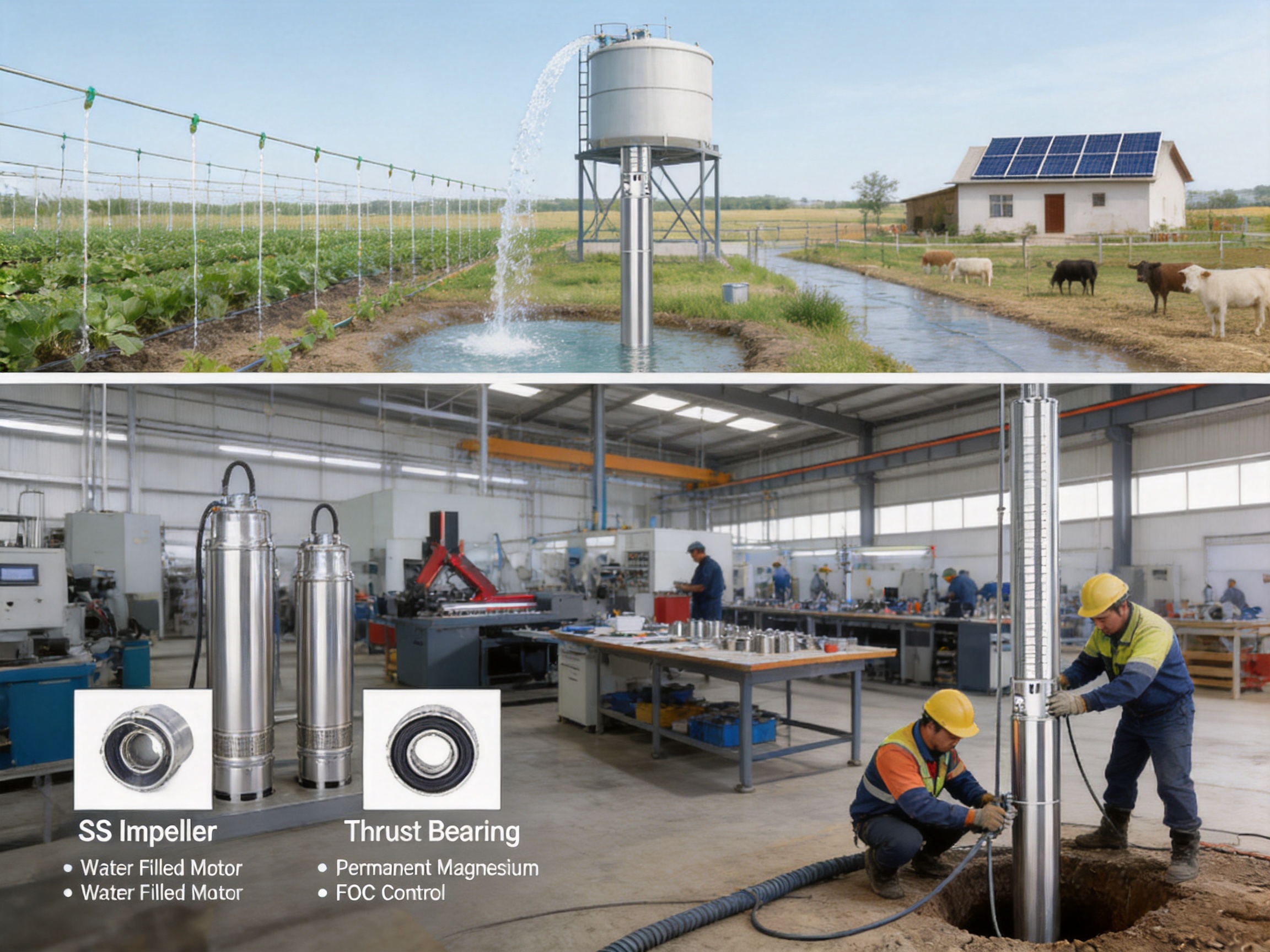
The pump can be used in agricultural irrigation systems where groundwater is lifted from a borehole to a storage tank, drip-irrigation network, sprinkler system, or field distribution line. Solar operation can reduce fuel costs and provide water during daylight hours when irrigation demand is often high.
The maximum flow rate of 4 m3/h can be suitable for small farms, vegetable plots, orchards, nurseries, and livestock-related water systems. The actual suitability depends on the irrigation method and required pressure. Drip irrigation may require a booster or pressure-regulation arrangement after the storage tank, while direct sprinkler operation requires careful calculation of pressure loss.
Remote farms and livestock facilities may require reliable water for animals, cleaning, and small-scale processing. A solar borehole pump can transfer water to elevated tanks, allowing gravity distribution even when the solar array is not producing energy.
Using a storage tank is often beneficial because it separates water production from immediate water consumption. The pump can operate when sunlight is available, while the stored water can be used in the evening or during short periods of low solar output.
In rural homes and remote residences, the pump can supply water from a borehole to a rooftop tank, ground-level storage tank, pressure vessel, or household treatment system. Quiet submersible operation is valuable because the pump is located away from living spaces.
Domestic users should confirm water quality before selecting materials and should install appropriate filtration and treatment equipment when required. The pump is a water-transfer device and does not itself make untreated groundwater safe for drinking.
Construction camps, telecommunications sites, environmental monitoring stations, roadside facilities, and remote public buildings may need water without dependable grid access. Solar pumping can reduce the need for fuel deliveries and generator maintenance.
The AC/DC capability is helpful for remote infrastructure because a project may begin with solar power and later receive grid service. Alternatively, a generator or AC source can serve as a backup during prolonged low-sun periods.
The pump may also be considered for commercial water transfer, small workshops, garden centers, service facilities, and other applications within its flow and head capability. The stainless steel body and integrated protections support professional use where reliability and easy system integration are priorities.
For industrial water, chemical, high-temperature, abrasive, or heavily contaminated applications, a detailed compatibility review is necessary. SS304 is suitable for many standard water conditions but not for every fluid or environment.
Correct system design is essential to achieving the expected performance of any borehole pump. The first step is to determine the required daily water volume, peak demand, available pumping hours, static water level, dynamic water level, and borehole yield.
Total dynamic head includes the vertical lift from the pumping water level to the delivery point, discharge pressure requirements, and friction losses in the pipe, valves, elbows, filters, and fittings. The maximum head of 54 m should not be interpreted as the head at which the pump will still deliver its maximum flow. At higher head, the actual flow will normally be lower.
Pipe sizing should be selected carefully. A pipe that is too small can create excessive friction loss and reduce delivered flow. A pipe that is too large may increase material cost without providing a proportional benefit. The 1.25-inch outlet should be connected using suitable fittings and a properly supported discharge line.
The borehole must provide enough water around the pump for cooling and continuous operation. The pump should not be positioned where sediment accumulation, mud, sand, or debris can block the inlet. The installer should also verify the minimum water level and ensure that the pump is not operated outside its recommended submergence conditions.
The solar array must be matched to the pump’s input requirements. Design should account for the difference between nominal panel voltage and actual operating voltage. Open-circuit voltage may rise in cold conditions, while operating voltage may fall under high temperature or weak sunlight. The array must remain within the controller’s allowable limits throughout expected site conditions.
Electrical cables should be sized according to current, distance, voltage drop, insulation rating, water exposure, and local regulations. Long cable runs can cause significant voltage loss, particularly in DC systems. Proper grounding and surge protection are strongly recommended for outdoor solar installations.
A check valve may be required in the discharge line to prevent reverse flow and reduce water hammer. Storage tanks, float switches, pressure controls, filters, and isolation valves should be selected according to the complete water system rather than the pump alone.
Installation should be performed by qualified personnel familiar with borehole pumps, solar electrical systems, and local safety requirements. Before installation, inspect the pump, cable, pipe, fittings, and control connections for damage. Confirm that the electrical supply matches the approved input range.
The pump should be suspended using appropriate pipework, cable support, or a dedicated lifting arrangement. The electrical cable must not carry the pump’s full mechanical weight unless the installation design specifically permits it. Cable joints below water level should use approved waterproof methods and should be protected against pulling, abrasion, and chemical exposure.
The pump should be lowered carefully to prevent impacts against the borehole wall. Excessive movement can damage the housing, cable, or discharge connection. The installation depth should be chosen according to the water level, borehole geometry, cooling requirements, and manufacturer guidance.
Before initial operation, verify that valves are in the correct position and that the discharge path is clear. The system should be started under controlled conditions and checked for flow, abnormal noise, vibration, electrical behavior, leaks, and water quality.
When operating from solar power, startup may occur at a lower output in the morning and may stop automatically as sunlight declines. This behavior can be normal. The system should be designed with adequate storage capacity if water is required after sunset or during cloudy weather.
Submersible pumps generally require less routine maintenance than many surface-mounted systems, but regular inspection remains important. Maintenance intervals should be based on water quality, operating hours, starting frequency, sediment content, and application conditions.
Inspect the solar array for dust, dirt, shading, loose connections, and physical damage. Dirty panels can reduce available energy and may cause the pump to operate for shorter periods. Check electrical enclosures, cable glands, grounding conductors, and protective devices for signs of moisture or overheating.
Monitor the water level and flow rate. A gradual reduction in flow may indicate changes in the borehole, pipe blockage, wear, sediment accumulation, or a change in the water table. A sudden change may indicate a broken pipe, electrical problem, controller fault, or dry-running condition.
Listen for unusual sounds and observe vibration in the discharge line. Although the pump is designed for quiet operation, changes in noise can provide early warning of bearing wear, debris, hydraulic blockage, or installation movement.
Do not repeatedly reset a pump that has entered a protection state without identifying the cause. Protection events are useful diagnostic information. The installer should determine whether the issue is low water, excessive load, abnormal voltage, missing phase, cable damage, or another system condition.
When removal is necessary, use suitable lifting equipment and follow safe procedures. The pump, cable, and pipe may be heavy, especially in deep installations. After servicing, the complete system should be tested before being returned to normal operation.
Solar pumping can reduce operating costs by replacing or supplementing diesel fuel and grid electricity. The economic benefit depends on solar resource, water demand, system size, local energy prices, installation cost, and maintenance requirements.
The permanent-magnet brushless motor can support lower energy consumption in comparison with less efficient motor designs. A longer-lasting motor and reduced brush maintenance can also lower lifecycle costs. Stainless steel construction, protected magnetic components, and appropriate bearings may reduce the frequency of replacement when the pump is used within suitable conditions.
Environmental benefits may include lower fuel consumption, reduced generator noise, and lower emissions at the point of use. These benefits are particularly relevant in remote agricultural or rural water projects where fuel transportation is expensive and difficult.
However, sustainability depends on proper system sizing. An oversized pump may require unnecessary solar capacity and may operate inefficiently. An undersized pump may run for excessive hours or fail to meet water demand. The best outcome comes from matching pump performance, solar generation, storage capacity, and water requirements as one integrated design.
International buyers often need more than a technically capable pump. They also need consistent communication, product documentation, order visibility, export coordination, packaging, and responsive after-sales support.
The manufacturer’s experience in global export and one-stop procurement can simplify the purchasing process. Its broader product range allows customers to source multiple pump categories, including deep-well pumps, submersible pumps, domestic booster pumps, and circulation pumps, from an experienced supplier.
This can be useful for distributors that want to consolidate orders or for engineering companies that require different pump types across several projects. A supplier with knowledge of procurement planning and cross-border delivery can help reduce coordination problems between product selection, manufacturing schedules, and shipment arrangements.
Repeat customers may also benefit from standardized model selection and established communication channels. Consistency in product identification, technical specifications, packaging, and order handling can help distributors maintain inventory and support their own customers more effectively.
Before placing an order, buyers should confirm the required voltage, performance point, cable length, accessories, packaging requirements, certification needs, spare parts, and destination regulations. Clear technical communication at the beginning of the project can prevent delays and reduce the risk of selecting an unsuitable configuration.
The 4EW solar submersible borehole pump combines several features that are valuable in real installations. Its 0.55 kW rating and 0.75 HP equivalent place it in a compact power class, while the stated maximum flow of 4 m3/h and maximum head of 54 m provide useful capacity for small and medium water systems.
Its four-inch diameter supports use in many boreholes without requiring the larger well casing associated with bigger pumps. The 1.25-inch outlet provides a practical discharge connection for water-transfer systems, provided the pipe network is correctly sized.
The combination of AC/DC compatibility, an intelligent controller, FOC motor control, soft starting, and multiple protections gives the model a broader operating profile than a basic fixed-input pump. Stainless steel construction, water-lubricated bearings, imported bearing components, and a shielded rotor further support its suitability for long-term submerged service.
Most importantly, the pump is supported by a manufacturer with experience in research, production, export, and intelligent water-pump development. This combination can provide value to agricultural users, engineering contractors, distributors, and international project buyers seeking a flexible and professionally manufactured solar pumping solution.
The 4EW is a solar submersible borehole pump designed to operate below the water level in a borehole or well. It lifts water through a discharge pipe to a tank, irrigation system, household supply, or other water-use point.
Yes. The listed input range is DC 90–360 V and AC 90–240 V at 50 or 60 Hz. The actual electrical installation must be designed and verified by a qualified professional to ensure that the supply remains within the approved operating limits.
The model has a rated power of 0.55 kW, equivalent to 0.75 HP, a maximum flow rate of 4 m3/h, and a maximum head of 54 m. Its outlet size is 1.25 inches, and its pump diameter is 4 inches.
No. Maximum flow and maximum head are different points of pump performance. Actual flow depends on the total dynamic head, pipe losses, elevation, valves, fittings, water level, and available power. System design should use the appropriate pump performance data for the required operating point.
A permanent-magnet brushless motor has no mechanical brushes, which reduces wear and maintenance. It can also provide efficient, quiet operation and is well suited to intelligent electronic control and variable solar input.
FOC means field-oriented control. It is an electronic motor-control method that manages the relationship between current and the motor’s magnetic field. This can support smoother rotation, improved control, efficient operation, and reduced mechanical stress.
The pump body and motor body are made from SS304 stainless steel. This material offers corrosion resistance and strength for many standard water applications. Water chemistry should still be reviewed before installation in unusual or aggressive environments.
The pump includes dry-running protection intended to help protect the equipment when sufficient water is unavailable. Nevertheless, the borehole should be tested for yield, and the pump should be installed at an appropriate depth with suitable water-level monitoring where necessary.
Because the pump supports DC input and includes an intelligent internal controller, a conventional external inverter may not be required for a properly designed direct-solar system. The final arrangement depends on the solar array, site requirements, backup source, controls, and applicable electrical regulations.
The pump can operate at night if the system provides an appropriate AC supply or a battery-supported source within the approved input range. In a solar-only system without energy storage, operation will normally depend on available sunlight.
The pump is intended for water pumping, but it does not treat or disinfect water. Groundwater should be tested, and filtration, disinfection, or other treatment should be installed when required by local health standards.
The listed protections include dry-running protection, overload and under-load protection, over-current and under-current protection, over-voltage and under-voltage protection, and phase-lack protection for applicable AC conditions.
Buyers should confirm the required flow, total head, borehole diameter, water quality, water level, power source, solar-array voltage, discharge-pipe size, cable length, installation depth, accessories, local regulations, and after-sales requirements.
Potential users include farmers, rural households, livestock operators, irrigation contractors, remote infrastructure operators, water-system distributors, construction companies, and commercial projects requiring a compact AC/DC-capable borehole pump.
A borehole pump contains precision electrical, magnetic, hydraulic, and mechanical components. Controlled welding, suitable bearings, accurate assembly, reliable materials, and final testing all influence service life and consistency. An experienced manufacturer can provide stronger support for product quality and international supply.
The 4EW solar submersible borehole pump is designed for water-supply applications that require flexibility, efficiency, compact installation, and dependable protection. Its permanent-magnet brushless motor, AC/DC convertible operation, intelligent internal controller, FOC function, stainless steel bodies, water-lubricated bearings, shielded rotor, soft starting, and comprehensive protection functions distinguish it from simpler conventional pump designs.
With a maximum flow rate of 4 m3/h, a maximum head of 54 m, a 1.25-inch outlet, and a four-inch diameter, the model can serve a wide range of agricultural, domestic, rural, and remote infrastructure projects. Its practical value is greatest when the pump is matched carefully with the borehole, pipework, solar array, storage tank, and water demand.
The manufacturer’s experience in independent research and development, mass production, stainless steel fabrication, intelligent pump technology, international export, and one-stop procurement further strengthens the product’s position. For buyers seeking a modern solar pumping solution that can also support AC or hybrid operation, this model offers a balanced combination of advanced motor technology, durable construction, and application flexibility.
1. Manufacturer-provided product specification for the 4EW solar submersible borehole pump.
2. Manufacturer-provided technical information on permanent-magnet brushless motors and intelligent FOC control.
3. Manufacturer-provided information on SS304 stainless steel construction, laser welding, bearings, and rotor shielding.
4. General engineering principles for borehole pump selection, total dynamic head calculation, and solar water-system sizing.
5. General guidance on photovoltaic-powered water pumping, electrical protection, grounding, and voltage-drop calculation.
6. General principles of submersible pump installation, dry-running prevention, water-level management, and preventive maintenance.
serieswatershortageprotectionvoltagestabilizationstainlesssteelverticalmultistagepump.jpg "EVR(S) Series Water Shortage Protection Voltage Stabilization Stainless Steel Vertical Multistage Pump")
edwina@edwin-pump.com
+86-13586290903 (WhatsApp)
Xuri Gongliang Cutting Tool Entrepreneurship Park, Wenqiao Town, Wenling City, Taizhou City, Zhejiang Province, China

High Performance Smart Pump Factory


 English