edwina@edwin-pump.com

View All Products
en
Reliable pressure control is essential to the safe and efficient operation of residential, commercial, agricultural, and industrial water systems. Pumps may provide the energy required to move water, but a pressure switch determines when that energy should be applied and when the pump should stop. If pressure control is inaccurate, a system may experience frequent cycling, unstable water delivery, unnecessary energy consumption, or damage to pumps and connected equipment.
The ERS-7 Series mechanical pressure controller is designed for water systems that require adjustable, dependable, and practical pressure management. With a pressure range extending from 15 to 100 PSI, adjustable starting pressure, a high-strength spring, and electrical compatibility with 110–240V and selected 400V applications, the controller provides a flexible solution for different installation environments. Its G1-inch connection, IP44 protection class, black cover, and rated current of 16(8)A make it suitable for a broad range of water pump installations.
This article examines the product’s operating principle, technical specifications, competitive advantages, installation value, application fields, quality considerations, and the manufacturing capabilities behind its production. It also explains how an experienced pump manufacturer can support customers through product development, production planning, inspection, customization, and export services.
A mechanical pressure controller monitors the pressure inside a water pipeline or pressure vessel. It is normally connected to the discharge side of a pump system. When system pressure falls below the selected cut-in level, the controller closes or activates the electrical circuit, allowing the pump to start. When pressure rises to the selected cut-out level, the controller opens or interrupts the circuit, stopping the pump.
This simple operating principle makes the device particularly useful in automatic water supply systems. A household may open a faucet, causing pipeline pressure to fall. Once pressure reaches the starting threshold, the switch activates the pump. When the faucet is closed and pressure returns to the desired upper level, the pump stops. The same principle can be applied to irrigation systems, water treatment equipment, booster sets, and other installations that require automatic pressure maintenance.
The controller is more than an on-and-off electrical component. It is part of a complete pressure management system. Its accuracy influences pump starting behavior, pressure stability, equipment service life, and user comfort. A well-designed pressure switch should therefore combine mechanical strength, consistent spring performance, electrical reliability, convenient adjustment, and resistance to the environmental conditions commonly found around water pumps.
The ERS-7 Series addresses these requirements through a mechanical spring-based design. The high-strength spring provides the force required to respond to changes in water pressure. Adjustment components allow the installer to set the starting and stopping behavior according to the system’s requirements. The electrical section is designed to work with common water pump power supplies, while the enclosure helps protect internal components against ordinary moisture and dust exposure.
The ERS-7 Series is a customized-setting mechanical pressure controller developed for water systems. It is available for rated voltage applications of 110–240V, with a listed 400V option for suitable configurations. Its rated current is 16(8)A, and its stated pressure range is 15–100 PSI. The starting pressure can be adjusted during installation within approximately 1.2–3.0 bar, depending on the selected configuration and customer requirement.
The pressure range can be supplied in commonly used settings such as 20–40 PSI, 30–50 PSI, and 40–60 PSI. Other settings may be available according to project requirements. This flexibility is important because water systems do not all operate under the same conditions. A compact domestic booster installation may need a different setting from an irrigation system, a commercial water supply unit, or a pump connected to a pressure tank.
The controller uses a G1-inch threaded connection. This size is widely used in water pump accessories and makes the product convenient to integrate with compatible piping, pump outlets, pressure tanks, and connection assemblies. A G1-inch plastic pipe joint can also be selected for quick connection to a water pump, providing an option for customers who prioritize simplified installation.
The standard cover color is black, although color customization can be arranged according to customer requirements. Cable length can also be selected according to the needs of the installation or purchasing project. These options are useful for original equipment manufacturers, distributors, engineering contractors, and importers who need the same basic product adapted to different markets or product families.
| Technical Item | Specification | Practical Significance |
|---|---|---|
| Product type | Mechanical pressure controller | Automatically starts and stops a pump according to water pressure |
| Rated voltage | 110–240V / selected 400V configuration | Suitable for multiple electrical system requirements |
| Rated current | 16(8)A | Supports common pump control applications within the specified electrical limits |
| Minimum cut-in | 15 PSI | Provides a low pressure activation reference |
| Maximum cut-out | 100 PSI | Allows a broad upper pressure control range |
| Common pressure settings | 20–40 PSI, 30–50 PSI, 40–60 PSI | Matches frequent domestic and commercial water system requirements |
| Adjustment range | Approximately 1.2–3.0 bar for starting pressure | Allows installers to adapt operation to the system design |
| Connection size | G1 inch | Compatible with many pump and pipe connection arrangements |
| Protection class | IP44 | Provides protection against solid objects and splashing water under suitable conditions |
| Maximum working temperature | 55°C | Defines the stated operating temperature limit |
| Cover color | Black as standard | Can support visual consistency and product identification |
| Warranty | One year | Provides a defined basic warranty period |
Electrical and pressure values should always be checked against the final product configuration, installation conditions, local regulations, and the pump motor’s requirements. In particular, customers ordering a 400V configuration should confirm the wiring arrangement, contact rating, motor load, and applicable technical documentation before installation.
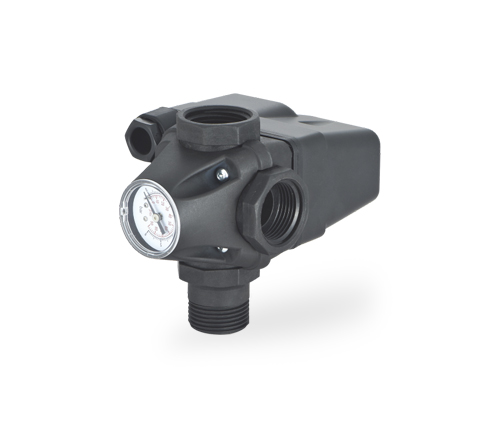
ERS-7 Series 110 to 240V Customized Setting High Strength Spring Pressure Switch for Water Systems
The spring is one of the most important mechanical elements in a pressure switch. It converts pressure movement into a controlled mechanical response. If a spring loses its shape, becomes fatigued, or responds inconsistently, the switch may start or stop the pump at an incorrect pressure. This can lead to rapid cycling, inadequate water pressure, or excessive pressure in the system.
The ERS-7 Series uses a high-strength spring intended to maintain reliable force during repeated operating cycles. The spring is designed to resist deformation under pressure and to support consistent switching performance. This is especially valuable in installations that start and stop frequently, such as household water supply systems, booster pumps, and pressure tank applications.
A high-strength spring also supports adjustment stability. When the installer changes the pressure setting, the spring must respond predictably to the new mechanical position. A stable spring helps the selected setting remain more consistent during operation. Although every pressure switch is influenced by system conditions, pump performance, pressure tank pre-charge, water temperature, and installation quality, a robust spring provides a strong mechanical foundation for dependable control.
Compared with a basic pressure switch using a less durable spring assembly, a high-strength design can offer better resistance to mechanical fatigue. It may also reduce the risk of adjustment drift caused by repeated loading. This is an important competitive consideration because the lowest purchase price does not necessarily represent the lowest ownership cost. A switch that maintains its operating characteristics for a longer period can reduce service calls, replacement frequency, and system interruptions.
Water pumps are often subject to repeated starts and stops. In a domestic booster system, for example, a pump may start every time a faucet, shower, or washing machine demands water. In a small irrigation system, repeated cycles may occur as valves open and close. In a commercial installation, the number of cycles can increase substantially depending on the demand pattern.
Each cycle places mechanical stress on the spring, diaphragm or sensing mechanism, contacts, terminals, and adjustment assembly. A pressure controller must therefore be designed not only for a single accurate switching event but also for long-term repeated operation. The ERS-7 Series is positioned as a durable control solution because its high-strength spring is intended to maintain performance under regular pressure changes.
Different water systems require different pressure thresholds. A small residential pump may be configured for a lower pressure range, while a multi-user building may require a higher setting. Agricultural irrigation systems may need settings that correspond to the pressure requirements of sprinklers, filters, valves, or long pipe runs.
The adjustable starting pressure of the ERS-7 Series gives installers the ability to adapt the switch to the actual system rather than forcing every installation to use one fixed setting. This helps improve compatibility and makes the product more useful to distributors serving multiple application sectors.
Adjustment should be performed by a qualified installer using a calibrated pressure gauge and following the appropriate product instructions. The final setting must remain within the rated range and should be coordinated with pump capacity, pressure tank pre-charge, pipe strength, safety devices, and the requirements of the connected equipment.
The ERS-7 Series is designed for common water pump electrical systems, with a listed rated voltage range of 110–240V and an available 400V configuration. This broad voltage flexibility enables the same product family to serve different regional markets and equipment designs.
Voltage variation is an important consideration for international pump manufacturers and distributors. Residential systems in different countries may use different supply standards, while commercial and industrial pump installations may use three-phase or higher-voltage arrangements. A controller family that can be configured for multiple electrical environments simplifies product selection and inventory planning.
The rated current is listed as 16(8)A. As with any pressure switch, the meaning of the current rating must be evaluated in relation to motor characteristics. Pump motors can draw a higher starting current than their normal running current, and inductive loads can place additional demands on electrical contacts. The controller should therefore be selected according to the motor’s voltage, phase, running current, starting behavior, and switching method.
For larger motors or demanding applications, an external contactor may be appropriate. In such an arrangement, the pressure switch controls the contactor coil while the contactor handles the motor’s main power circuit. This can help protect the pressure switch contacts and allow the same pressure control principle to be applied to higher-capacity pumps, provided the complete electrical design is correctly engineered.
The product’s voltage flexibility can reduce the need for multiple pressure switch models in a distributor’s inventory. Instead of stocking separate products for every voltage environment, a purchaser may select the appropriate configuration within the ERS-7 family. This can make procurement more efficient and simplify technical communication between the pump manufacturer, installer, and end user.
The switch is also suitable for integration into pump assemblies supplied as complete packages. A pump factory can install or specify the pressure controller together with a domestic booster pump, surface pump, pressure tank, or water supply set. When the control component is selected during the pump design stage, the manufacturer can better coordinate thread size, cable length, pressure range, and electrical requirements.
Nevertheless, compatibility should never be assumed solely from voltage. Installation professionals should confirm current, motor type, contact arrangement, enclosure conditions, cable specifications, earthing requirements, and local electrical regulations. The controller is a component of a complete system, and system-level safety remains essential.
The stated pressure range of 15–100 PSI provides a broad operating window. Within this range, customers can select common pressure combinations such as 20–40 PSI, 30–50 PSI, and 40–60 PSI. The lower value generally represents the pressure at which the pump starts, while the higher value represents the pressure at which the pump stops. The difference between these two values is commonly called the differential.
A correctly selected differential helps balance user comfort and pump operating frequency. If the differential is too narrow, the pump may start and stop too frequently. Frequent cycling can increase motor heating, mechanical wear, contact wear, and energy consumption. If the differential is too wide, users may experience a larger variation in water pressure before the pump starts again.
The correct range depends on the complete water system. Relevant factors include the pump’s head and flow characteristics, pressure tank size, pressure tank pre-charge, vertical elevation, pipe length, friction losses, fixture requirements, and the pressure limits of valves and appliances.
For example, a small residential water supply system may use a 30–50 PSI setting when its pump and pressure tank are designed for that range. A system with a high-elevation delivery point may require a different arrangement. An irrigation application may prioritize stable pressure at sprinklers, while a commercial booster system may use multiple pumps, sensors, or a more advanced control strategy.
The ERS-7 Series is advantageous because it is not restricted to a single factory-fixed setting. The adjustable design gives customers more opportunity to match the controller with the pump system. For OEM buyers, customized pressure settings can also help create product variants for specific markets without redesigning the entire pressure control platform.
The G1-inch connection is a practical feature for water pump applications. Threaded connections are widely used in pressure switches, pressure tanks, pump outlets, pipe fittings, and water treatment assemblies. A common connection size helps reduce the need for special adapters and makes replacement easier for maintenance personnel.
The optional G1-inch plastic pipe joint supports quick connection to a water pump. This option may be especially useful in compact domestic booster equipment, where installers value simplified assembly and limited installation time. It can also help distributors offer a more complete accessory package to customers.
Connection quality is essential. The threads should be clean and undamaged, suitable sealing material should be used, and the switch should not be over-tightened. Mechanical stress from poorly aligned piping can damage the connection or transfer excessive force to the pressure controller. The switch should be installed so that it can be inspected and replaced without dismantling unnecessary sections of the system.
Before commissioning, the installer should confirm that the pressure connection is free from blockage and that no sealing compound has entered the sensing passage. Air pockets, debris, or incorrect sealing can affect pressure response. The pressure gauge should be installed in a location that accurately represents the pressure seen by the controller.
The ERS-7 Series has an IP44 protection class. This indicates protection against solid objects above a specified size and protection against splashing water from appropriate directions. IP44 is commonly used for equipment installed in sheltered pump rooms, utility areas, domestic service spaces, and similar environments.
IP44 does not mean that the pressure switch can be submerged or exposed indefinitely to heavy rain, high-pressure cleaning, condensation, or direct water jets. Installation should protect the controller from unnecessary moisture, flooding, chemical exposure, and extreme temperature conditions. The stated maximum working temperature is 55°C, so the switch should not be positioned near a heat source that exceeds this limit.
Appropriate enclosure protection can contribute to longer service life by reducing the risk of corrosion, contamination, and electrical tracking. The black cover provides a recognizable external housing and can support consistent appearance across a pump product line. If a customer requires a different color for branding, market segmentation, or installation identification, color customization may be available.
Environmental protection is one area where product selection should reflect actual installation conditions. A pressure switch intended for an indoor domestic pump room may not be suitable for an exposed coastal installation without additional protection. Engineers should consider humidity, salt spray, dust, freezing conditions, vibration, and the possibility of condensation when selecting and installing the product.
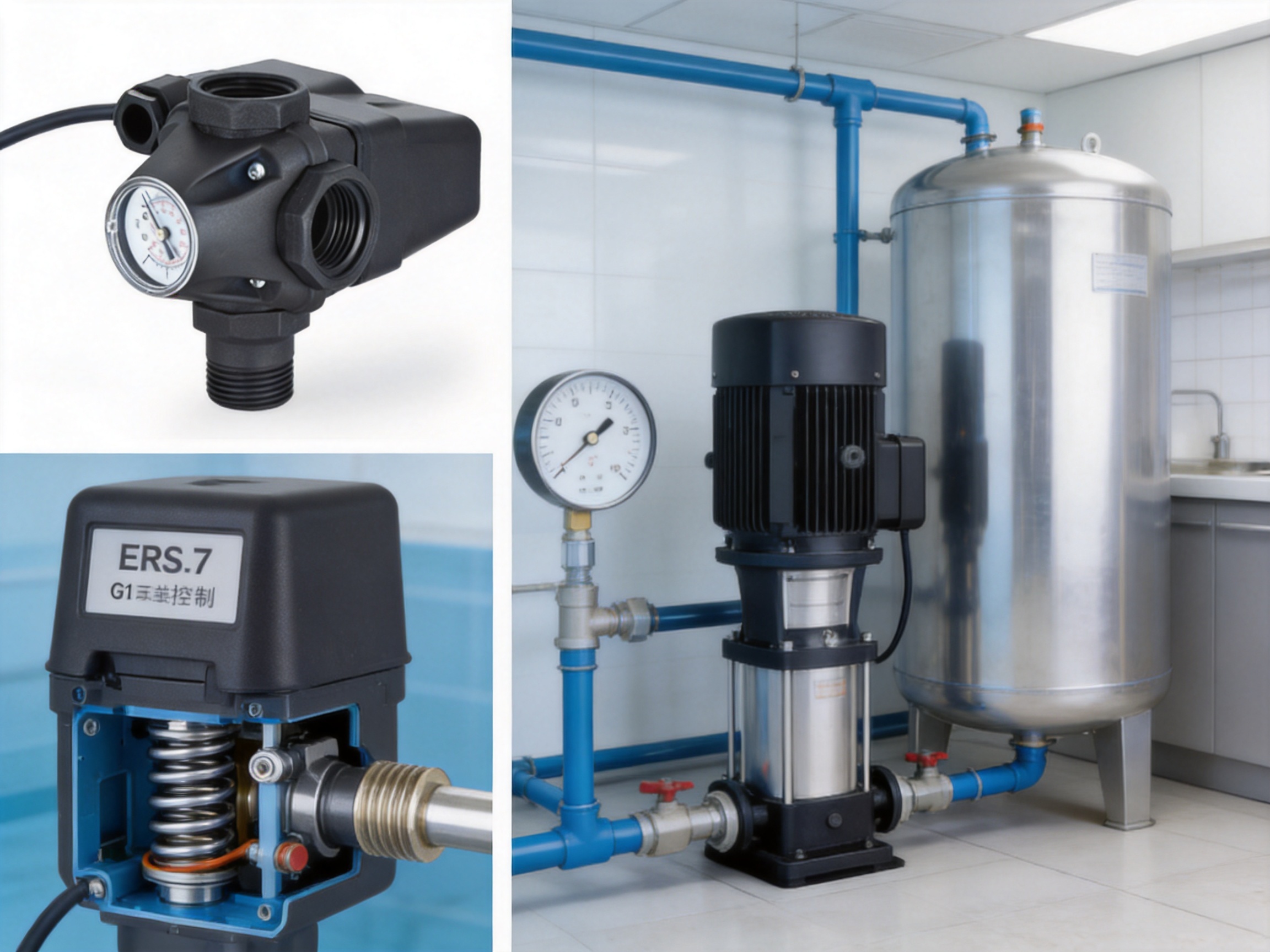
The market includes many pressure switches with similar external functions, but meaningful differences can exist in mechanical strength, adjustment consistency, electrical configuration, customization, manufacturing control, and after-sales support. The ERS-7 Series offers several advantages over a basic, fixed-setting, single-voltage pressure switch.
A controller that supports 110–240V configurations can serve a wider range of customers than a product designed for only one voltage. The listed 400V option further expands its potential application area when properly configured and confirmed for the intended pump system. This helps international buyers reduce model fragmentation and simplifies product planning.
Fixed pressure switches may be convenient for a narrow application, but they can create limitations when system conditions vary. The ERS-7 Series allows pressure adjustment during installation and can be supplied in several common pressure ranges. This flexibility is valuable for installers, distributors, OEM manufacturers, and engineering companies that work with different pump capacities and water delivery requirements.
The high-strength spring is a central advantage. It is intended to support accurate pressure control and resist deformation during repeated operation. A robust mechanical element can improve confidence in long-term performance and help reduce the risk of early adjustment drift compared with less durable designs.
Customers may request different cover colors, power cable lengths, pressure settings, and connection arrangements. Such customization is particularly useful for private-label products, pump packages, regional product versions, and engineering projects. A supplier capable of coordinating these options can provide more value than a seller offering only a standard off-the-shelf model.
The controller can be used with water pumps, water heaters, domestic booster systems, surface pumps, pressure tank assemblies, and other applications requiring pressure-based control. Its G1-inch connection and common electrical ratings make it practical for a wide range of equipment configurations.
A one-year warranty provides a clear basic support period. Warranty value depends on product quality, documentation, response speed, and the supplier’s ability to handle technical questions. When a pressure controller is purchased from a manufacturer with pump expertise, customers may also benefit from more informed system-level support than they would receive from a general electrical component trader.
The value of a pressure controller is influenced by the production system behind it. A reliable component requires more than a functional design. It requires controlled material selection, repeatable assembly, inspection discipline, accurate adjustment, traceability, and responsive technical communication.
The manufacturer behind the ERS-7 Series was established in 2008 and operates as an integrated manufacturing enterprise. Its activities include independent research and development, mass production, and global export. The company’s core product lines include deep well pumps, submersible pumps, domestic booster pumps, and circulation pumps, together with water system accessories and related control products.
This product breadth is important because pressure controllers are best understood in relation to the pumps they control. A manufacturer that develops and produces pump systems can evaluate pressure switches from the perspective of motor performance, pump head, flow, starting frequency, pressure tanks, installation layout, and water application. This broader engineering context can support more practical product customization and system matching.
Independent research and development gives a manufacturer greater control over product improvement. Instead of relying entirely on third-party specifications, an integrated company can collect feedback from pump applications, analyze common failure modes, refine mechanical structures, and develop options for different markets.
For the ERS-7 Series, development considerations include spring strength, pressure adjustment, electrical compatibility, connection size, housing protection, cable configuration, and integration with water pump systems. These features are not isolated; changes in one area may affect the others. A manufacturer with internal technical coordination can evaluate these relationships more efficiently.
Mass production requires repeatable processes. Components must be organized, assembly steps must be defined, and workers must be able to produce consistent results across large orders. For a pressure switch, production control may include spring installation, diaphragm or sensing assembly, terminal installation, cover fitting, thread inspection, electrical testing, and pressure switching verification.
Stable mass production benefits customers in several ways. It supports consistent product quality across batches, more predictable delivery, and better compatibility when replacement units are ordered later. It also makes it easier to provide customized versions while maintaining a controlled production procedure.
Pressure controllers should be evaluated through both mechanical and electrical checks. Mechanical checks may include thread dimensions, housing condition, pressure response, adjustment behavior, and leakage inspection. Electrical checks may include continuity, insulation performance, terminal security, switching behavior, and confirmation that the configuration matches the requested voltage and current rating.
Final inspection is especially important for customized products. A customer may request a specific cut-in range, cable length, cover color, or connection option. Clear order records and production identification help ensure that the delivered product matches the agreed specification.
The company established related import and export service organizations in 2012 to support procurement planning, order tracking, cross-border delivery, and foreign trade services. This structure can be valuable for overseas buyers because international purchasing involves more than manufacturing. It also requires quotation accuracy, packaging coordination, shipping documentation, communication across time zones, and delivery planning.
For distributors, professional order coordination can reduce uncertainty during repeat purchasing. Consistent communication helps buyers manage inventory, arrange product launches, plan container shipments, and coordinate technical documents with their own sales teams or installation partners.
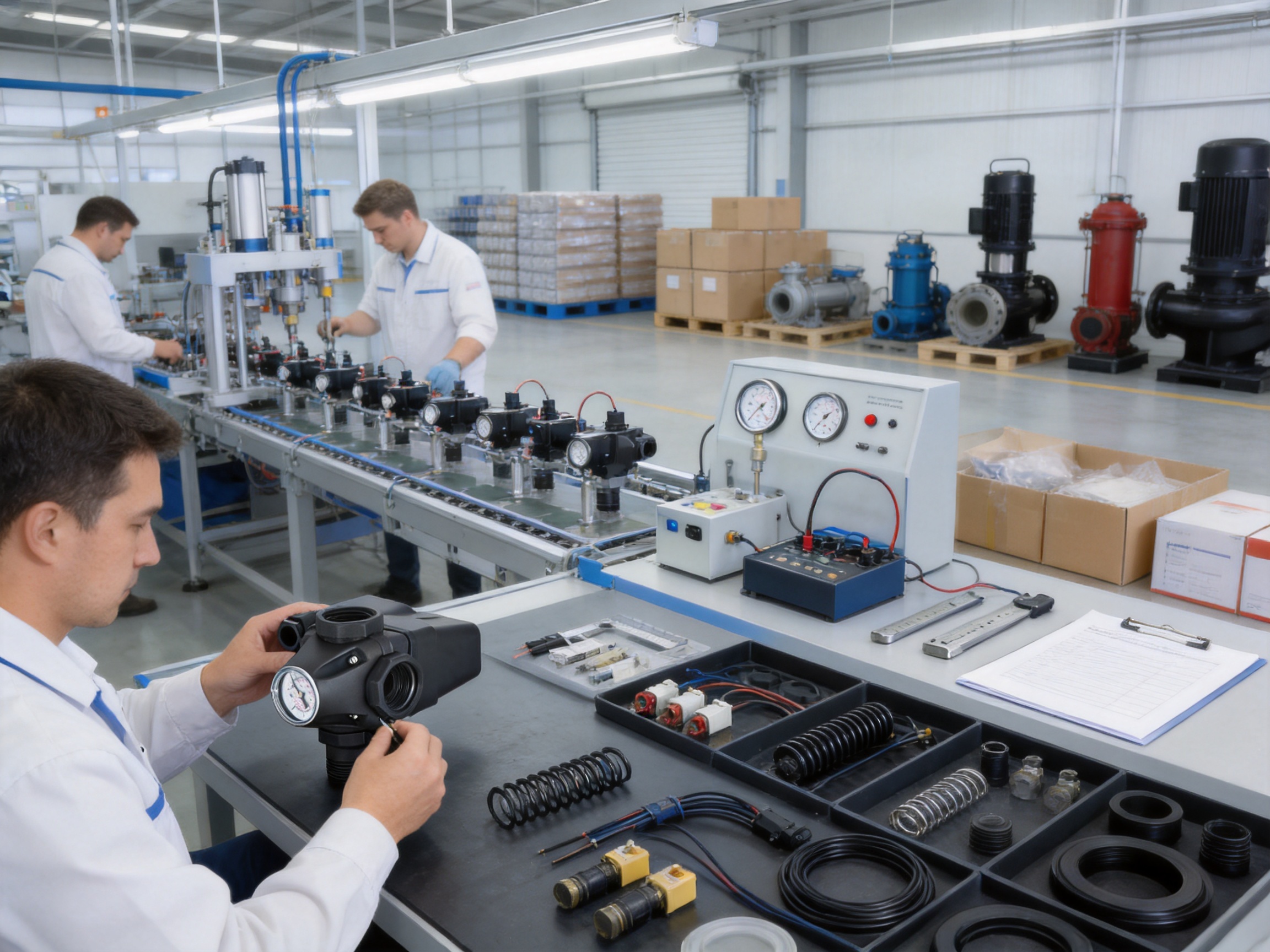
A modern manufacturing process for a mechanical pressure controller should begin with controlled incoming materials. Springs, terminals, molded housings, seals, threaded connectors, adjustment components, cables, and fasteners must meet defined dimensional and functional requirements. Incoming inspection helps prevent unsuitable components from entering the assembly line.
The next stage is component preparation. Metal parts may require cleaning, forming, surface treatment, or dimensional verification. Molded plastic components should be checked for deformation, cracks, flash, color consistency, and correct fit. Springs should be examined for dimensions, force characteristics, and surface condition. Electrical terminals and cables should be verified for conductor size, insulation quality, and secure connection compatibility.
During assembly, workers or automated equipment install the pressure sensing mechanism, spring, adjustment parts, electrical contacts, terminals, and protective cover in a defined sequence. Correct assembly order is important because the mechanical position of the spring and sensing components affects the final switching pressure.
Adjustment and calibration follow assembly. The pressure switch can be connected to a test system and exposed to controlled pressure changes. Technicians can verify the cut-in and cut-out behavior and make adjustments where necessary. This step is particularly important for products supplied under customized pressure requirements.
Electrical testing should confirm that the contacts open and close as intended and that the terminals are correctly connected. Depending on the production standard and customer requirement, testing may include continuity checks, insulation checks, voltage verification, and simulated operating cycles. The purpose is to identify assembly defects before shipment.
Pressure and leakage checks help confirm that the sensing section and connection area function correctly. The product should not show unacceptable leakage at the intended operating pressure. The adjustment mechanism should also respond in a predictable manner when the pressure setting is changed.
Final inspection includes visual examination, label or model confirmation, accessory verification, packaging inspection, and documentation review. Products with customized cable lengths, colors, pressure settings, or connection components should be matched with the customer’s order information before packing.
Packaging is another important manufacturing process. A pressure switch must be protected from impact, moisture, contamination, and deformation during handling and transportation. Proper internal separation and outer-carton strength can reduce the risk of damage during international shipment.
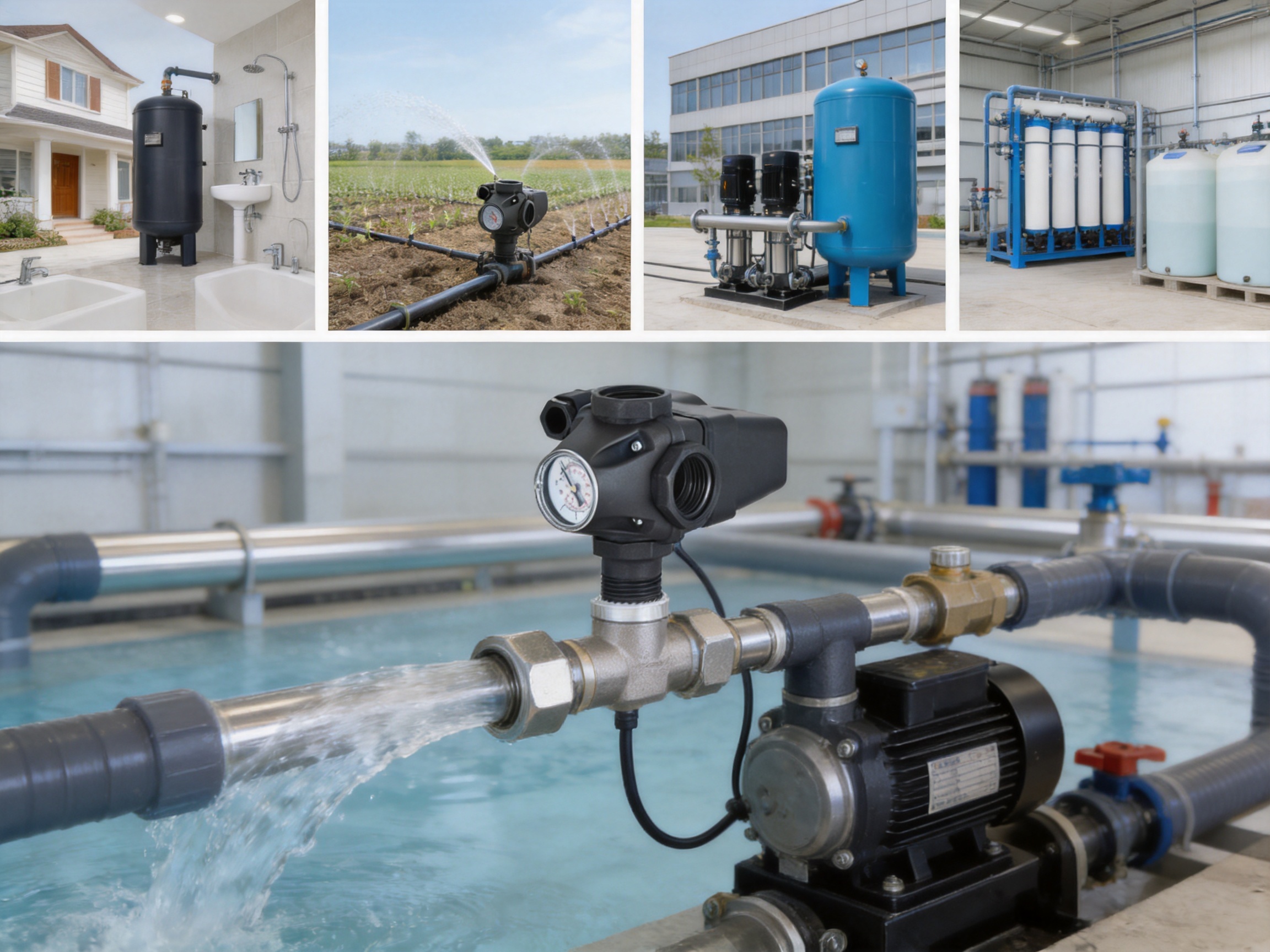
In domestic water systems, the controller can automatically operate a pump when household water demand causes pressure to fall. It may be used with surface pumps, booster pumps, pressure tanks, and compact water supply assemblies. Adjustable settings allow installers to select a pressure range that matches the home’s fixtures and pump capacity.
The switch can help maintain more convenient water delivery for showers, faucets, washing machines, and other water-using appliances. Correct selection is important because excessive pressure may damage fixtures, while insufficient pressure may reduce user comfort.
Booster pumps are used to increase water pressure in buildings, upper floors, remote sections of a property, and areas with unstable municipal supply. The ERS-7 Series can serve as a pressure-based starting and stopping component in suitable booster systems.
In a booster arrangement, the installer should evaluate inlet pressure, pump head, maximum discharge pressure, pressure tank size, and expected demand. The pressure switch setting should be coordinated with the pump’s operating curve so that the pump can reach the cut-out pressure without operating continuously or exceeding system limits.
Agricultural irrigation systems often include surface pumps, storage tanks, filters, valves, sprinkler lines, or drip irrigation equipment. The pressure controller can be used where automatic pump activation is required and where the system pressure falls within the product’s specified range.
Irrigation systems can experience dust, humidity, vibration, and seasonal temperature changes. The controller should be installed in a suitably protected enclosure or pump area, and the IP44 rating should be considered together with the actual environment. For systems using advanced irrigation automation, the pressure switch may operate as one part of a larger control system.
The pressure switch is also described as suitable for water heaters and other water-related applications requiring pressure control. In these installations, temperature and pressure conditions must be checked carefully. The maximum working temperature of the controller is stated as 55°C, so it should not be exposed to conditions beyond that limit.
Any water heater installation must comply with applicable safety requirements and should include appropriate temperature and pressure protection. The pressure switch should not be treated as a substitute for dedicated safety relief devices where those devices are required.
Commercial buildings, workshops, small factories, and service facilities may use pressure-controlled pumps for cleaning water, utility supply, equipment washing, or local distribution. The ERS-7 Series can be considered for applications where its pressure range, electrical rating, temperature limit, and IP44 protection are suitable.
For larger commercial or industrial installations, engineers may use the pressure switch to control a contactor, relay, or pump control panel rather than switching a large motor directly. This approach allows the pressure controller to provide the pressure signal while the main control equipment manages motor protection, sequencing, overload protection, and other functions.
Installation should be performed by qualified personnel familiar with water pumps and electrical systems. Before work begins, the power supply should be isolated, the water pressure should be released safely, and the system should be checked for stored energy in pressure tanks or pipelines.
The pressure controller should be installed at a point where it accurately senses system pressure. The connection should be clean and properly sealed. The unit should not be mounted in a position where the cable is pulled, the housing is exposed to flooding, or the pipe applies excessive mechanical force.
The electrical connection must match the selected product configuration. Voltage, current, phase, contact arrangement, cable identification, earthing, and motor protection should all be checked. The rated current of the pressure switch should not be exceeded, and an external contactor should be considered when motor starting current or load requirements make direct switching unsuitable.
After installation, the system should be filled and air should be removed where appropriate. The pump should be primed according to its instructions. The installer can then observe the pressure gauge while opening and closing a water outlet. The pump should start near the selected cut-in pressure and stop near the selected cut-out pressure.
If the pump cycles too frequently, the installer should examine the pressure differential, pressure tank pre-charge, water leakage, pipe sizing, pump capacity, and system demand. If the pump cannot reach the cut-out pressure, the issue may involve pump selection, blocked piping, insufficient water supply, incorrect adjustment, or a leak rather than a pressure switch defect.
Once the desired operation has been confirmed, all adjustment components should be secured according to the applicable instructions. The cover should be correctly fitted, cables should be protected from abrasion, and the installation area should remain accessible for future inspection.
Routine maintenance can help extend the service life of a pressure controller and the pump system connected to it. Maintenance personnel should inspect the housing for cracks, signs of water entry, corrosion, loose cables, damaged insulation, and abnormal heating. The pressure connection should be checked for leakage, and the surrounding area should be kept clean and dry.
If the pump does not start, possible causes include a disconnected power supply, incorrect wiring, pressure above the cut-in threshold, damaged contacts, a blocked pressure passage, insufficient water supply, or a motor fault. Testing should be carried out systematically rather than replacing the pressure switch immediately.
If the pump does not stop, possible causes include a pressure setting that is too high for the pump, a water leak, a blocked or inaccurate pressure gauge, a damaged contact mechanism, insufficient pump performance, or an incorrect electrical connection. The pump should not be allowed to run continuously without investigation.
If the pump starts and stops repeatedly, possible causes include an undersized pressure tank, incorrect tank pre-charge, a narrow pressure differential, a leaking check valve, a leaking pipeline, or unstable water demand. A pressure switch is only one part of the system, so troubleshooting should include all related hydraulic and electrical components.
Replacement should be considered when the switch shows severe contact wear, mechanical damage, persistent pressure inconsistency, water ingress, or insulation deterioration. A replacement unit should match the original voltage, current, connection size, pressure range, and environmental requirements.
For original equipment manufacturers, the ERS-7 Series can serve as a configurable component in pump packages. Cable length, pressure range, color, and connection options provide opportunities to adapt the product to different equipment designs. A pump manufacturer may integrate the pressure controller into a domestic booster unit, a compact surface pump assembly, or a packaged water supply system.
For distributors, a flexible pressure switch can reduce the number of separate products needed to serve different customers. Common pressure settings can be stocked while customized versions are arranged for project orders. The broad voltage range also supports multiple regional markets.
For engineering contractors, the ability to select the starting pressure during installation can help address site-specific requirements. This is especially useful where actual pipe losses, elevation, fixture demand, or pump behavior differ from the original design assumptions.
For importers, supplier capability is an important purchasing factor. Product consistency, packaging, documentation, lead-time communication, customization management, and after-sales response can influence the total cost of ownership. A manufacturer with pump expertise and international export experience may be better positioned to support repeat orders than a supplier that only trades individual components.
The manufacturer’s wider product portfolio includes deep well pumps, submersible pumps, domestic booster pumps, circulation pumps, solar water pumps, intelligent booster pumps, and related water treatment peripheral products. This portfolio creates opportunities for one-stop sourcing. Buyers can potentially coordinate pumps, pressure controls, valves, pipes, and other accessories through one professional supply channel.
Pressure control affects energy efficiency because it determines when a pump runs. A correctly configured switch can prevent unnecessary continuous operation and help the pump respond to actual water demand. By stopping the pump when the desired pressure is reached, the system avoids wasting energy after the immediate demand has been satisfied.
Durable components can also contribute to sustainability. A pressure switch that remains reliable for a longer period may reduce the frequency of replacement, packaging consumption, transportation, and discarded components. High-strength mechanical construction and stable production quality therefore have value beyond immediate performance.
Efficiency depends on the whole system. Pump selection, pipe diameter, pressure tank sizing, leakage control, motor efficiency, water demand management, and correct pressure settings all influence energy use. The ERS-7 Series should be viewed as a practical control component within a properly designed system rather than as a standalone energy-saving device.
The manufacturer’s investment in new energy and intelligent technology since 2018 reflects the broader movement toward more efficient and automated water systems. Solar water pumps and intelligent booster pumps require manufacturers to understand changing energy sources, automatic controls, digital functions, and system integration. Experience in these fields can support continued improvement in related pump accessories and control products.
A pressure controller may appear small compared with a complete pump, but its performance can influence the behavior of the entire installation. Manufacturer experience in pump development helps ensure that the product is considered in a realistic operating context.
A company with experience in deep well, submersible, booster, circulation, and solar pumping applications encounters different hydraulic conditions and customer requirements. Deep well systems may require attention to vertical lift and pressure delivery. Submersible systems may operate in demanding environments. Booster systems may require frequent cycling control. Circulation systems may prioritize continuous operation and temperature conditions. Solar pump systems may involve variable power availability and intelligent control.
This range of experience encourages practical engineering decisions. It can help the manufacturer identify which pressure ranges are commonly requested, which connection sizes are most useful, which cable options simplify installation, and which customization requests are important to overseas customers.
International manufacturing also requires an understanding of market differences. Electrical standards, packaging expectations, documentation requirements, installation practices, and purchasing habits vary by region. A supplier that serves global customers can use this experience to improve communication and provide more suitable configurations.
The controller automatically starts and stops a water pump according to system pressure. It activates the pump when pressure falls below the selected starting threshold and stops the pump when pressure reaches the selected upper threshold.
The stated overall pressure range is 15–100 PSI. Common configurations include 20–40 PSI, 30–50 PSI, and 40–60 PSI. The starting pressure can be adjusted during installation within approximately 1.2–3.0 bar, depending on the selected configuration and customer requirement.
Yes. The product is designed with customized settings in mind. Customers can request suitable pressure ranges, and installers can adjust the starting pressure during installation within the specified range. The final setting should match the pump, pressure tank, pipe system, and connected equipment.
The listed rated voltage is 110–240V, with a 400V configuration available for suitable applications. Customers should confirm the exact voltage, phase, contact arrangement, and current rating of the final model before installation.
It is the listed rated current of the pressure switch. Because pump motors are inductive loads and may draw higher starting current, the motor’s running and starting characteristics must be checked. An external contactor may be needed for larger or demanding motors.
The standard connection size is G1 inch. A G1-inch plastic pipe joint can also be selected for quick connection to a compatible water pump.
The product has an IP44 protection class. It is designed for protection against specified solid objects and splashing water, but it should not be submerged or exposed to direct high-pressure water jets. Installation in a sheltered and suitable location is recommended.
The stated maximum working temperature is 55°C. The controller should be installed away from heat sources or water conditions that exceed this limit.
It may be used with suitable water pumps, domestic booster pumps, surface pumps, pressure tank systems, water heaters, irrigation equipment, and other pressure-controlled water applications. Compatibility depends on pressure, voltage, current, temperature, and environmental conditions.
Yes. Power cable length can be selected according to customer requirements. The requested cable specification should be confirmed before production.
Black is the standard cover color, and other colors may be available according to customer requirements and order quantity.
The spring provides the mechanical force required for pressure response and adjustment. A high-strength spring is intended to resist deformation and maintain more stable operation during repeated pressure cycles.
Installers should check the product’s voltage, current, pressure range, connection size, cable configuration, pump motor characteristics, pressure tank settings, pipe condition, and environmental conditions. They should also confirm the correct wiring and comply with local electrical and water system regulations.
The product information states a one-year warranty. Warranty conditions should be confirmed in the commercial order and related product documentation.
A pump manufacturer understands the relationship between pressure control, pump performance, hydraulic conditions, and system design. This can support better product matching, customization, technical communication, and one-stop procurement of pumps and accessories.
The ERS-7 Series mechanical pressure controller is a practical solution for water systems requiring automatic pump control, adjustable pressure settings, and flexible electrical compatibility. Its high-strength spring, 15–100 PSI operating range, G1-inch connection, IP44 housing, customizable cable length, optional plastic pipe joint, and available color and pressure options make it suitable for a broad range of applications.
Its advantages over a basic fixed-setting pressure switch include wider configuration possibilities, improved adjustment flexibility, a durable mechanical design, and suitability for domestic, commercial, agricultural, and selected industrial water systems. The product can also support OEM equipment, distributor inventory, project-specific orders, and packaged pump assemblies.
The manufacturing capabilities behind the product add further value. Independent research and development, mass production experience, pump-system knowledge, international export coordination, and a broad product portfolio help create a stronger foundation for consistent supply and technical support. For buyers seeking a pressure control component from an experienced water pump manufacturer, the ERS-7 Series offers a balanced combination of adaptability, mechanical reliability, and application versatility.
1. Product technical specification for the ERS-7 Series mechanical pressure controller.
2. Product description and application information for customized pressure switches used in water systems.
3. General principles of pump pressure control, pressure tank operation, and automatic pump switching.
4. General guidance on electrical ratings, inductive motor loads, contact protection, and contactor applications.
5. General principles of IP protection classifications for electrical enclosures.
6. Manufacturer information concerning pump research and development, mass production, export services, and water system product lines.
7. General installation and maintenance practices for domestic, commercial, agricultural, and light industrial water pump systems.
edwina@edwin-pump.com
+86-13586290903 (WhatsApp)
Xuri Gongliang Cutting Tool Entrepreneurship Park, Wenqiao Town, Wenling City, Taizhou City, Zhejiang Province, China

High Performance Smart Pump Factory


 English