edwina@edwin-pump.com

View All Products
en
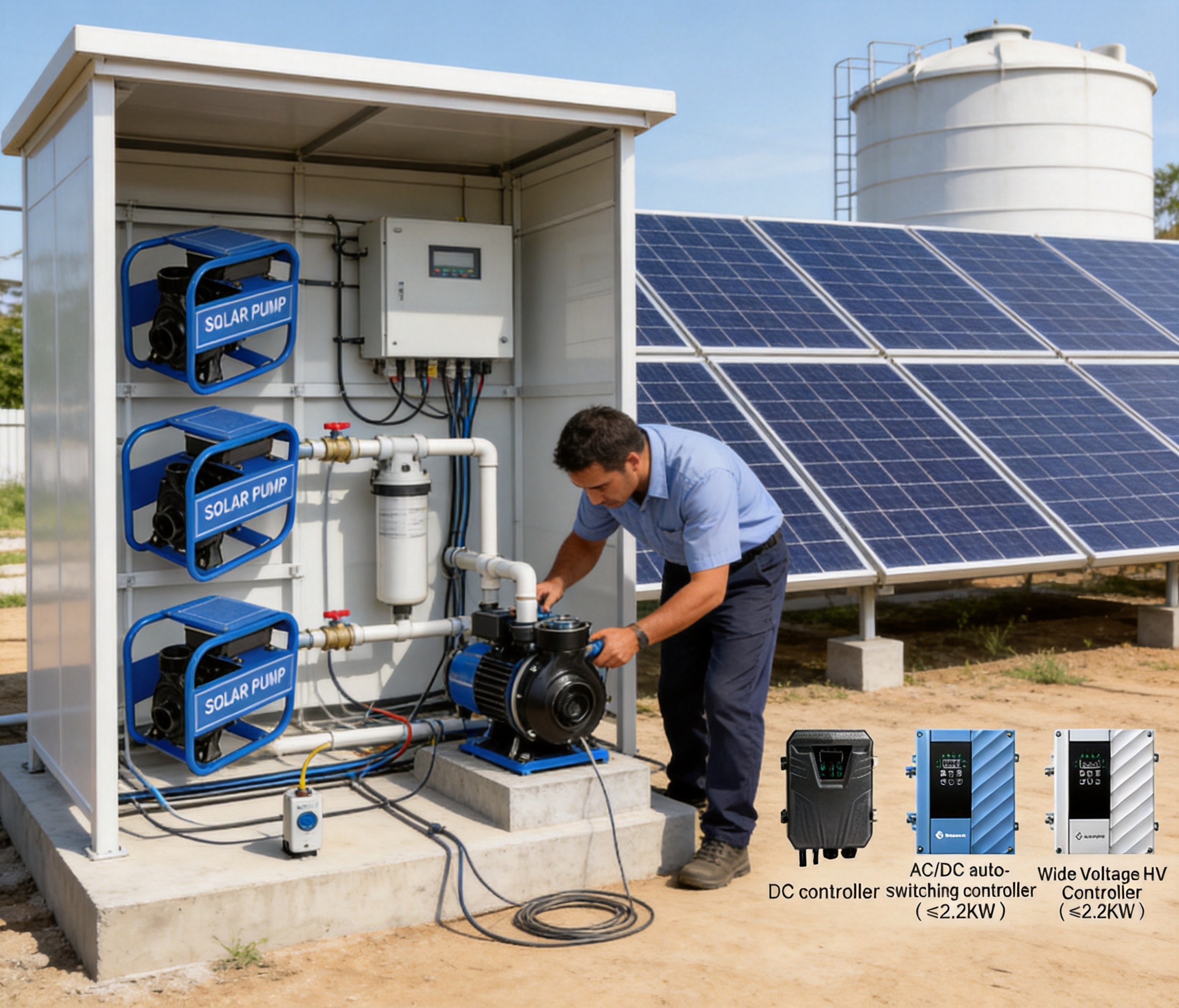
Reliable access to water is essential for households, farms, gardens, communities, and industrial sites. In locations where grid electricity is unavailable, unstable, or expensive, solar pumping provides an efficient alternative. The HVCPM Series Wide Voltage Brushless DC Motor Solar Centrifugal Pump is designed for this purpose. It combines a brushless direct-current motor, a centrifugal hydraulic structure, and a wide-voltage solar input range to deliver practical water transfer and irrigation performance in off-grid environments.
The series is designed for applications that require more than occasional low-volume pumping. Its available models cover rated powers from 750 W to 3,000 W, maximum flow rates from 21 m³/h to 85 m³/h, and maximum heads from 14 m to 28 m. This range allows users to select a pump according to the required flow, delivery distance, pipe size, and solar power system. The product is suitable for household water supply, garden and orchard irrigation, small farms, water storage projects, and community-scale solar water systems.
One of the main advantages of this product family is its wide-voltage operating concept. Solar power naturally changes during the day because of sunlight intensity, temperature, cloud cover, seasonal conditions, and panel orientation. A pump that can work across a broad DC voltage range can make better use of available solar energy than a narrowly specified pump. The HVCPM Series is available with optimum input voltage ranges such as 100–350 VDC, 110–350 VDC, 200–350 VDC, and 300–350 VDC, depending on the model.
The result is a solar pumping solution that can be configured for different system sizes while maintaining a comparatively simple architecture. Instead of depending on a conventional AC grid connection, the pump is designed around direct solar power. This can reduce dependence on batteries, simplify system planning, and lower operating costs in suitable installations.
The HVCPM Series is a surface-mounted solar centrifugal pump. Unlike a deep-well submersible pump, it is installed outside the water source and connected to the supply line through an inlet pipe. This arrangement makes the pump appropriate for reservoirs, tanks, open water sources, shallow collection points, and other applications where the pump can be positioned close to the water supply.
The product uses a brushless DC motor. Brushless motors do not rely on mechanical carbon brushes for electrical commutation. Instead, electronic control manages the switching of the motor windings. This design eliminates brush wear and can support long service life, consistent operation, and reduced routine maintenance compared with brushed motor structures.
The centrifugal hydraulic design is intended to provide continuous and smooth water movement. When the impeller rotates, water enters the pump, gains velocity, and is converted into pressure as it passes through the casing. Centrifugal pumps are widely used for water transfer and irrigation because they can deliver substantial flow rates and are suitable for systems requiring steady discharge rather than highly intermittent operation.
The series includes multiple models with different impeller and motor configurations. Model codes identify the approximate performance class, motor power, and voltage configuration. For example, the HVCPM21-14-72-750 model is rated at 750 W, with a maximum flow of 21 m³/h and a maximum head of 14 m. Larger models extend performance to 85 m³/h and 28 m of maximum head.
It is important to understand that maximum flow and maximum head are reference limits rather than simultaneous operating points. Actual performance depends on pipe length, pipe diameter, elevation difference, fittings, inlet conditions, water temperature, filtration, and the available solar power. Correct system design should therefore use the pump curve and the complete hydraulic system calculation rather than selecting a model only by its maximum flow value.
Solar pumping addresses several challenges faced by rural, agricultural, and remote users. Grid extension may be costly or technically difficult. Diesel generators require fuel transportation, regular servicing, oil changes, and noise control. Conventional electric pumps can be economical where the grid is reliable, but they may be less practical in isolated locations or areas with frequent power interruptions.
A solar pumping system converts sunlight into electrical energy through photovoltaic panels and uses that energy to operate the pump. During daylight hours, the system can transfer water directly to a storage tank, irrigation network, livestock trough, or elevated reservoir. Water storage can then provide a buffer during cloudy periods or after sunset, reducing the need for batteries.
The operating cost of a solar pump can be attractive because sunlight does not require fuel purchase. Once the panels, pump, structure, wiring, and protective equipment have been installed, routine expenses are generally associated with inspection, cleaning, replacement parts, and normal maintenance. The financial result depends on the local solar resource, pump utilization, system size, installation quality, and the cost of alternative energy.
Solar pumping can also support environmental objectives. Replacing diesel-powered pumping with photovoltaic energy can reduce fuel consumption and local emissions. The effect is especially meaningful in irrigation, where pumping may operate repeatedly over many seasons. A properly selected pump can use available solar energy efficiently while supplying water at the time it is most needed.
The HVCPM Series is particularly suited to this operating concept because its DC motor is designed for solar input and its voltage range can accommodate different photovoltaic array configurations. The pump can therefore form part of a system based on direct solar operation, water storage, or a hybrid arrangement designed for specific site conditions.
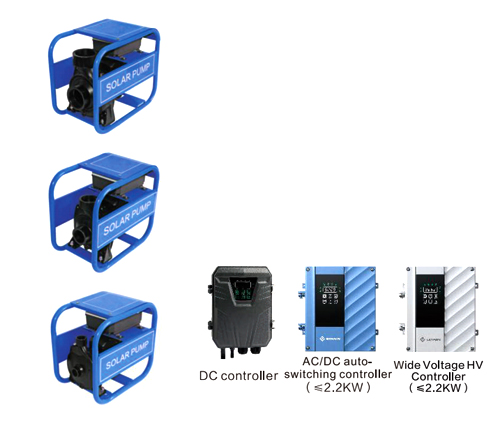
HVCPM Series Wide Voltage Brushless DC Motor Solar Centrifugal Pump
Photovoltaic output is not constant. A solar panel array may produce a high voltage under bright, cool conditions, while current and available power can fall when clouds pass over the site. Early morning and late afternoon operation also differs from midday operation. The pump must be compatible with the electrical behavior of the array if the system is expected to operate reliably throughout the available solar period.
The HVCPM Series offers model-specific optimum DC input ranges. Several models operate within a 100–350 VDC or 110–350 VDC range, while higher-capacity models require 200–350 VDC or 300–350 VDC. The solar array must be designed so that its operating voltage and open-circuit voltage remain within the permitted limits. The stated panel open-circuit voltage requirement is below 450 V, and the array power is specified as at least 1.3 times the pump power.
Oversizing the solar array relative to the nominal pump power can help the system obtain sufficient energy during less-than-ideal sunlight conditions. It can also improve the usable operating period in the morning, afternoon, and under moderate cloud cover. However, the array must still be checked against maximum voltage, current, environmental temperature, and controller requirements. A qualified installer should verify the electrical design before commissioning.
Wide-voltage compatibility offers an advantage over pumps that can operate only within a narrow fixed input range. A narrow range may require a more exact panel configuration and can make the system more sensitive to changes in sunlight. By contrast, a broad operating range gives the installer more flexibility when selecting the number and arrangement of panels, provided the specified limits are observed.
The wide-voltage design is also useful for international projects. Solar resources, panel availability, system standards, and installation practices differ from one region to another. A selection of pump models with different voltage classes allows distributors, contractors, and system integrators to configure installations for various applications without relying on one single electrical arrangement.
Wide-voltage operation does not mean that the pump can be connected to any solar array without planning. Voltage must be calculated at the lowest and highest expected temperatures, and the array must supply adequate power at the desired flow and head. Proper protection against overvoltage, reverse polarity, short circuits, dry running, and other operating risks should also be included according to the final system design.
The brushless DC motor is one of the central features of the product. In a conventional brushed motor, carbon brushes make physical contact with a rotating commutator. That contact creates friction and gradual wear. Brush replacement may eventually be required, and brush-generated dust or electrical arcing can be undesirable in some operating environments.
A brushless motor transfers the commutation function to an electronic control system. Because there are no mechanical brushes rubbing against the commutator, the motor can reduce one important source of wear. This structure can improve service life, reduce maintenance requirements, and support dependable daily operation when the pump is correctly installed and protected.
Brushless operation is also well suited to solar energy. Electronic control can respond to the available DC input and manage motor operation more precisely than a simple fixed-speed motor connected directly to an unstable power source. The motor can operate within the product’s intended voltage range while using the available solar input for water pumping.
For remote agricultural or household installations, maintenance reduction is especially valuable. A pump located far from a service center may be difficult and expensive to repair. Eliminating routine brush replacement can simplify ownership and reduce the number of consumable motor components. The pump still requires normal inspection of the hydraulic system, seals, connections, and water source, but the motor design can reduce mechanical electrical maintenance.
The brushless motor also supports a compact product configuration. A smaller and simpler motor assembly can be easier to position in a pump room, equipment shelter, garden service area, or rooftop installation. Compact dimensions are useful where space is limited, although the installer must still provide sufficient ventilation, access for inspection, and protection from rain, flooding, excessive dust, and direct environmental exposure.
The centrifugal pump structure is designed for smooth water delivery. This is an important characteristic for irrigation networks, transfer pipelines, storage tanks, and household supply systems. A steady flow can help reduce sudden pressure variation and support more predictable water distribution across the system.
The range includes models with maximum flow values of 21, 26, 27, 50, 60, and 85 m³/h. These options cover small and medium water transfer requirements as well as higher-volume agricultural and commercial applications. The models with 2-inch outlets are appropriate for smaller systems, while 3-inch, 4-inch, and 5-inch outlets support larger flow pathways where the pipeline can accommodate the required volume.
Outlet size is an important selection factor. A larger outlet does not automatically guarantee higher performance if the inlet pipe, discharge pipe, filters, valves, or water source are undersized. To obtain the intended flow, the entire hydraulic pathway must be designed with acceptable friction loss. Larger pipes can reduce friction loss, while excessive bends, poorly selected valves, and clogged filters can restrict performance.
The maximum head ratings range from 14 m to 28 m. Head represents the energy required to move water through vertical elevation and system resistance. The actual total dynamic head includes static elevation, pressure requirements, friction loss, fittings, valves, and any required filtration equipment. The pump should be selected using the operating point where the system curve intersects the pump performance curve.
Users should also consider the water source and suction conditions. Because the HVCPM Series is a surface pump, the distance between the pump and the water level can affect priming and operation. The suction line should be as short and direct as practical, with suitable pipe diameter and airtight connections. A foot valve or check valve may be used where appropriate to help retain water in the suction line.
Surface centrifugal pumps should not be allowed to run dry. Dry running can cause overheating, seal damage, and premature wear. A complete installation should include a reliable water-level strategy, such as a float switch, sensor, control function, or operating procedure that prevents the pump from running when the source is empty or the suction line is not primed.
| Model | Optimum DC Input Voltage | Power | Maximum Flow | Maximum Head | Outlet | Cable Length | Maximum Solar Open-Circuit Voltage | Recommended Solar Panel Power |
|---|---|---|---|---|---|---|---|---|
| HVCPM21-14-72-750 | 100–350 V | 750 W | 21 m³/h | 14 m | 2 inches | 0.6 m | Below 450 V | At least 1.3 times pump power |
| HVCPM26-15-72-1100 | 100–350 V | 1,100 W | 26 m³/h | 15 m | 2 inches | 0.6 m | Below 450 V | At least 1.3 times pump power |
| HVCPM27-21-110-1500 | 110–350 V | 1,500 W | 27 m³/h | 21 m | 2 inches | 0.6 m | Below 450 V | At least 1.3 times pump power |
| HVCPM50-17-110-1500 | 110–350 V | 1,500 W | 50 m³/h | 17 m | 3 inches | 0.6 m | Below 450 V | At least 1.3 times pump power |
| HVCPM60-20-200-2200 | 200–350 V | 2,200 W | 60 m³/h | 20 m | 4 inches | 0.6 m | Below 450 V | At least 1.3 times pump power |
| HVCPM85-28-300-3000 | 300–350 V | 3,000 W | 85 m³/h | 28 m | 5 inches | 0.6 m | Below 450 V | At least 1.3 times pump power |
The table provides a practical overview of the available selection. The smaller models are suitable for compact water systems, garden irrigation, and household storage filling. The medium models can support larger gardens, orchards, small farms, and transfer systems. The highest-capacity model is intended for applications that require substantial water volume and have sufficient solar generation and pipe capacity.
Performance data should be used as a starting point rather than a substitute for engineering review. Maximum flow is normally measured under favorable hydraulic conditions and may not represent the flow available at the required head. Similarly, maximum head is normally associated with a low-flow condition. The correct model is the one that provides the required flow at the actual total dynamic head of the installation.
A conventional AC pump can be effective where the electrical grid is reliable and readily available. However, grid connection may not exist in remote agricultural locations, and the cost of extending power lines can be substantial. Grid interruptions can also affect irrigation schedules, household supply, and water storage operations.
The HVCPM Series is designed to use solar DC power, making it suitable for locations without a conventional grid connection. This can reduce infrastructure dependence and enable pumping in rural or off-grid locations. It can also help users avoid some recurring electricity charges, although the initial photovoltaic installation must be evaluated as part of the total project cost.
The wide-voltage range gives the solar system designer flexibility in panel arrangement. A pump with a fixed and narrow input requirement may impose more restrictive design conditions. The HVCPM Series offers several voltage classes so that the array can be matched to the selected pump and the available site conditions.
Diesel pumps can provide high output, but they require fuel, engine oil, filters, mechanical servicing, and regular operator attention. Fuel delivery can be difficult in isolated areas, and noise and exhaust emissions may be undesirable near homes, livestock facilities, schools, or environmentally sensitive locations.
A solar centrifugal pump has no fuel tank, combustion engine, or exhaust pipe. During suitable daylight conditions, it can pump water quietly with fewer routine consumables. The absence of fuel logistics is a major practical benefit for remote installations. Solar pumping is not entirely maintenance-free, but it can reduce the operational complexity associated with combustion engines.
Brushed DC pumps can be simple and economical, but the brushes and commutator are wear components. Over time, electrical contact surfaces may degrade, particularly in applications with frequent starting, long operating hours, dust, heat, or poor protection.
The brushless motor in the HVCPM Series removes this specific mechanical contact arrangement. Electronic commutation can support longer maintenance intervals and stable operation. This is particularly useful where the pump is installed in a remote location and service access is limited.
Some solar pumps are designed around a limited voltage window. If the panel configuration does not match that window, the system may start late, stop early, or operate inefficiently during changing sunlight conditions. The HVCPM Series addresses this challenge through broader model-specific DC input ranges.
Its voltage options also support different power classes and system scales. Installers can choose a model based on the water requirement and then design the photovoltaic array within the pump’s specified voltage and power limits. This approach can be more flexible than using a one-size-fits-all solar pump.
The pump can be used to transfer water from a ground-level reservoir, rainwater tank, collection pool, or shallow source into an elevated storage tank. The stored water can then supply toilets, washing facilities, garden taps, or other non-potable household uses. Where potable water is involved, the complete installation must meet local drinking-water requirements, and the pump materials must be verified for the intended application.
For household projects, the smaller models may provide a practical balance between flow and solar system size. The final selection depends on the required daily water volume, pipe distance, elevation, and operating schedule. A storage tank can help separate pumping time from consumption time, allowing solar energy to be used during the day while water remains available later.
Garden and orchard irrigation often requires regular water transfer over a defined daily schedule. The HVCPM Series can supply drip irrigation systems, sprinkler networks, storage tanks, and distribution manifolds when the pump is matched to the irrigation demand and system pressure.
Drip irrigation generally requires careful filtration and pressure control. Sprinkler systems may require a higher operating pressure and can have different flow characteristics. The pump selection should therefore be based on the irrigation method rather than only the area of land. The use of a buffer tank can also prevent sudden changes in irrigation flow caused by passing clouds.
Small farms can benefit from a solar pump where electricity is unavailable or diesel costs are high. The 1,500 W to 3,000 W models may be considered for larger flow requirements, subject to the available solar resource and required head. Open-field irrigation, greenhouse water transfer, livestock water supply, and farm storage filling are possible applications.
A farm installation should include a clear water management plan. The operator should know the daily water requirement, the acceptable irrigation window, the minimum storage volume, and the consequences of cloudy weather. Solar pumping is most effective when the pump, photovoltaic array, storage tank, and irrigation network are designed as one integrated system.
The pump can transfer water between ponds, tanks, reservoirs, and elevated storage points. In remote construction areas, camps, workshops, or community projects, a solar water transfer system can reduce the need for temporary generator use. The pump’s external installation also allows it to be positioned in an accessible equipment area rather than inside the water source.
Small communities may use a solar centrifugal pump to fill a central tank or distribute water through a local network. Multiple operating periods can be scheduled according to solar availability and water demand. The choice of model should account for population, daily consumption, peak demand, storage capacity, pipeline losses, and future expansion.
For community applications, reliability and maintainability are particularly important. The system should include safe electrical isolation, suitable enclosure protection, water-level control, pipeline filtration, and a maintenance schedule. A local operator should be trained to recognize abnormal noise, vibration, reduced flow, leaks, or changes in solar performance.
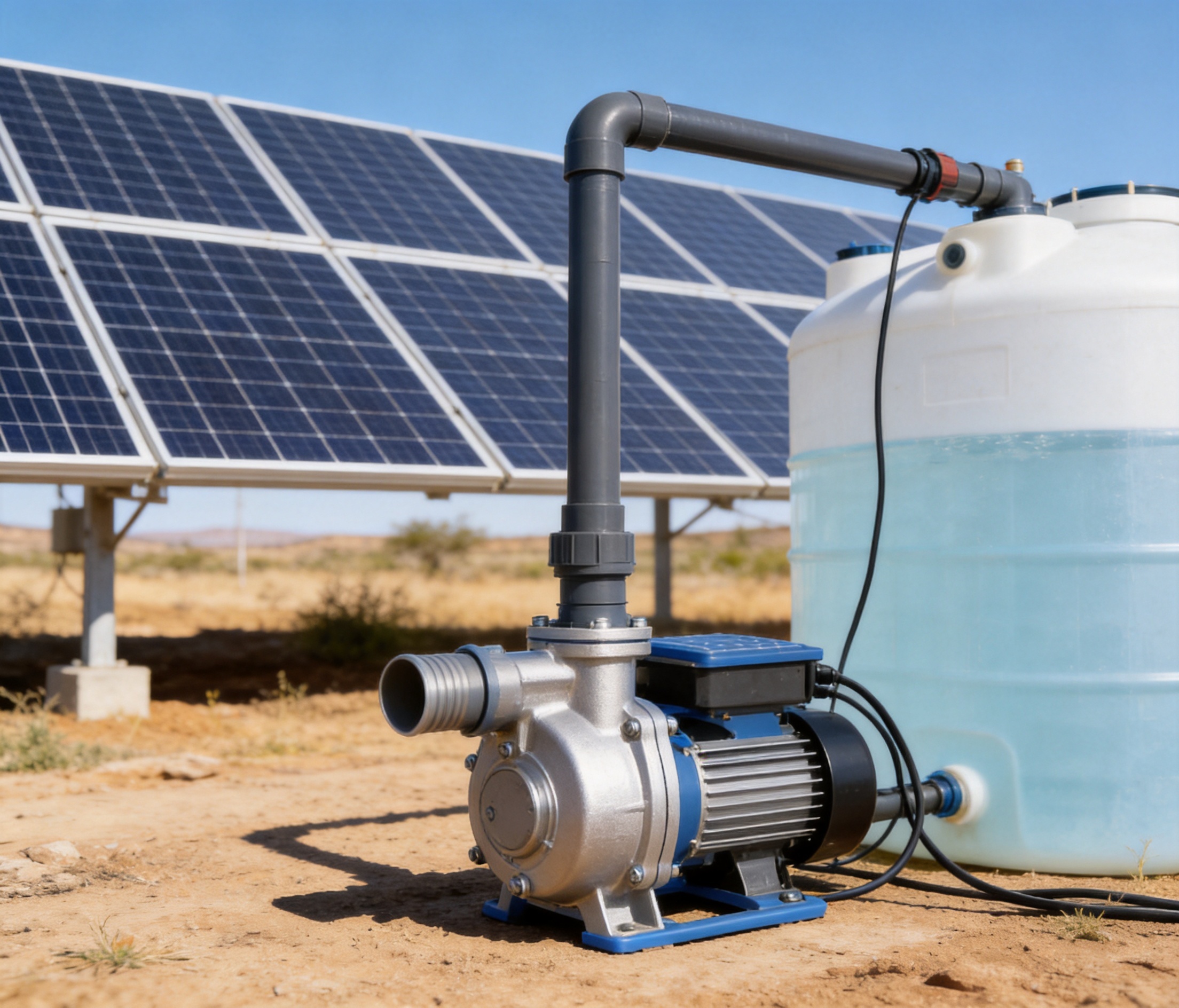
Total dynamic head is one of the most important factors in pump selection. It includes the vertical distance between the water surface and the delivery point, the pressure needed at the outlet, and the friction losses caused by pipes, elbows, valves, filters, meters, and other components.
For example, a system with a 10 m elevation difference may require more than 10 m of pump head if water must travel through a long pipeline or pass through a fine filter. If the delivery point needs pressure for a sprinkler, that pressure must also be converted into an equivalent head and included in the calculation.
Choosing a pump only by its maximum head can lead to insufficient flow. Choosing only by maximum flow can lead to insufficient pressure. The operating point must be checked against the pump curve. If the actual system resistance is higher than expected, the pump may deliver much less water than the catalog maximum.
Pipe diameter has a direct effect on friction loss. Small-diameter pipes can create high resistance, especially at elevated flow rates. This may reduce the delivered flow and increase the energy required for pumping. The larger models in the HVCPM Series are equipped with 3-inch, 4-inch, or 5-inch outlets, and the connecting pipeline should be selected to preserve the intended hydraulic performance.
The suction line deserves particular attention. It should be short, straight, properly supported, and sealed against air leakage. An inlet strainer may be needed to prevent debris from entering the pump, but the strainer must be sized correctly and cleaned regularly. Excessive suction resistance can cause unstable operation and reduce pump performance.
The solar array should provide at least the specified multiple of pump power, with the supplied data indicating a recommended solar panel power of at least 1.3 times the pump power. For a 750 W pump, this means a recommended array power of at least approximately 975 W. For a 3,000 W pump, the recommended array power is at least approximately 3,900 W.
This recommendation is not a complete design calculation. The installer must also consider solar irradiation, temperature, shading, panel aging, cable loss, controller efficiency, and seasonal conditions. The array’s maximum open-circuit voltage must remain below the specified limit, and the operating voltage must remain within the model’s optimum input range.
Panels should be installed where shading from buildings, trees, poles, and structures is minimized. Even partial shading can reduce the output of a series-connected array. Panel orientation and tilt should be selected according to the geographic location and the seasonal pumping requirement.
Clean water is generally preferred for centrifugal pump operation. Sand, silt, algae, leaves, and other suspended solids can damage hydraulic components, clog passages, and accelerate seal wear. A suitable inlet screen or filter can protect the pump, but it should not create excessive suction loss.
Water containing abrasive particles should be evaluated before installation. If the source contains significant sand or sediment, a settling tank, pre-filter, or alternative pump configuration may be necessary. The water temperature and chemical characteristics should also be checked against the pump’s material and seal compatibility.
The surface pump should be mounted on a stable foundation that limits vibration. It should be protected from flooding, standing water, heavy rain, excessive dust, direct mechanical impact, and unauthorized access. Adequate ventilation is important for motor cooling, while direct exposure to extreme weather should be minimized through a suitable shelter or enclosure.
The installation should provide enough space to inspect the pump, tighten connections, clean filters, and replace service components. Electrical wiring should be routed safely and protected from sunlight, moisture, abrasion, and animals. All electrical work should follow local regulations and be completed by qualified personnel.
The product is manufactured by Taizhou Edwin Electric Co., Ltd., an integrated enterprise established in 2008. The company’s activities include independent research and development, mass production, and global export. Its product portfolio covers deep well pumps, submersible pumps, domestic booster pumps, circulation pumps, solar water pumps, intelligent booster pumps, and related water-pumping products.
This broader product experience is valuable when developing a solar centrifugal pump. Pump design requires knowledge of motor systems, hydraulic components, sealing, electrical protection, materials, assembly, testing, and field application. Experience across several pump categories can help a manufacturer understand how different products behave in household, agricultural, municipal, industrial, and new-energy environments.
The company has supplied pumps for new-energy projects, agricultural irrigation, municipal engineering, mining, construction, HVAC systems, and household water supply. These application areas involve different performance requirements. Agricultural systems may prioritize flow and operating economy, while household systems may emphasize compact dimensions and low maintenance. Industrial and municipal projects may require more structured procurement, quality documentation, and delivery coordination.
Since 2018, the company has invested in new-energy and intelligent technology. The introduction of solar water pumps and intelligent booster pumps reflects a move toward more energy-conscious and digitally adaptable pumping solutions. The HVCPM Series fits within this development direction by combining direct solar operation with a brushless motor and a wide DC voltage range.
Advanced manufacturing is not limited to the production line itself. It also includes product development, component control, assembly consistency, performance verification, packaging, order coordination, and after-sales support. For international customers, the ability to manage the entire process from technical selection to delivery is an important supplier strength.
The company established related import and export service organizations to support procurement planning, order tracking, cross-border delivery, and foreign-trade services. This one-stop structure can be useful for distributors, contractors, original equipment customers, and project buyers who need coordinated communication across technical, commercial, and logistical stages.
Mass production can provide advantages in component procurement, process standardization, production scheduling, and repeatability. However, quality depends on how these capabilities are managed. A reliable manufacturing process should use defined assembly procedures, controlled component specifications, appropriate inspection points, and performance checks before products are shipped.
For a solar pump, manufacturing quality should cover both the hydraulic and electrical sides. Hydraulic inspection may include casing integrity, impeller assembly, shaft alignment, sealing, leakage control, and performance verification. Electrical inspection may include motor winding quality, cable condition, insulation, controller compatibility, operating voltage, and protection functions. Consistency across these areas supports dependable field operation.
The HVCPM Series is supplied with a three-year warranty. A warranty does not eliminate the need for correct installation, but it demonstrates the manufacturer’s confidence in the product’s expected operating life under appropriate conditions. It also provides buyers with a defined support framework when evaluating procurement options.
Long-term reliability depends on several factors. The pump must operate within its voltage and power limits, receive adequate water, avoid dry running, and remain free from severe blockage or excessive abrasive material. The photovoltaic array must be correctly designed, and electrical protection must be installed according to the system requirements.
Routine maintenance should include checking for leaks, inspecting cable connections, cleaning inlet filters, confirming stable pump sound, observing flow changes, and monitoring the water source. A sudden reduction in flow may indicate a blocked filter, low water level, suction air leakage, pipe damage, or a change in solar input. Early diagnosis can prevent more serious damage.
Seasonal inspection is recommended for agricultural and outdoor systems. Before the irrigation season, the operator should verify the panel condition, mounting structure, wiring, pump priming, valve operation, storage tank level controls, and pipeline integrity. At the end of a cold season or during extended shutdown, the system should be protected from freezing and stagnant water where necessary.
A three-year warranty is most valuable when supported by responsive technical communication and clear product documentation. Buyers should retain the model number, installation information, operating records, and maintenance history. These details can help the manufacturer or distributor identify the cause of a problem and recommend the correct solution.
Farmers can select among several flow and power classes according to irrigation volume and available land area. The use of solar energy can reduce exposure to diesel costs and grid interruptions. Water can be pumped into a tank during sunlight hours and distributed through drip lines or sprinklers according to the crop schedule.
System integrators benefit from the availability of multiple voltage and outlet configurations. The range makes it possible to build solutions for household, agricultural, and community projects using a related product family. Model-specific electrical data helps the integrator design the photovoltaic array, protection equipment, pipe system, and storage capacity.
Distributors can offer a solar centrifugal pump range rather than a single model. This improves the ability to respond to different customer requirements, from compact garden installations to higher-flow farm systems. The manufacturer’s wider pump portfolio can also support cross-selling opportunities in submersible, deep-well, booster, circulation, and accessory categories.
Contractors can use the product in off-grid water transfer and irrigation projects where low operating cost, broad solar compatibility, and simple maintenance are priorities. The three-year warranty and factory support structure can provide additional confidence during project planning and after installation.
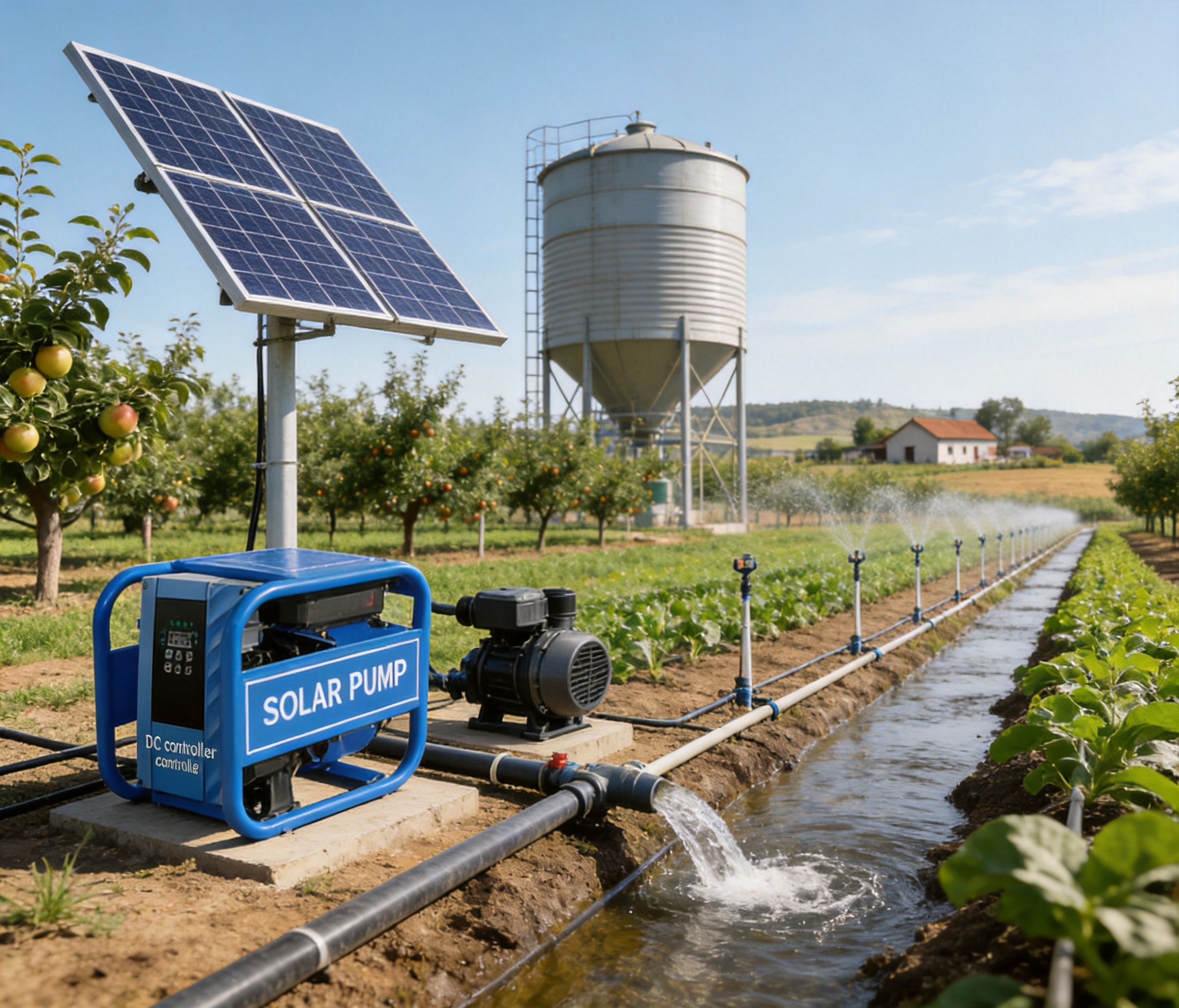
The first step is to define the required water volume. Determine how many cubic meters must be delivered per day and whether the water demand is concentrated at particular times. Irrigation, household use, livestock supply, and tank filling may have different schedules.
The second step is to measure the total dynamic head. Include elevation, pipeline length, pipe diameter, valves, filters, fittings, and outlet pressure. Avoid using only the vertical height as the design head unless friction and pressure requirements are negligible.
The third step is to identify the water source. Confirm the minimum water level, maximum suction distance, water quality, sediment content, and seasonal availability. A surface centrifugal pump should be installed with suitable suction conditions and protection against dry running.
The fourth step is to select a model whose pump curve meets the required flow at the calculated head. The maximum flow shown in the performance data should not be treated as the guaranteed operating flow for every installation.
The fifth step is to design the photovoltaic array. Check the required power, operating voltage range, open-circuit voltage, panel configuration, shading, orientation, temperature, cable size, and protection components. The recommended array power should be treated as a minimum starting point for engineering review.
The sixth step is to plan water storage. A tank can make the system more useful by allowing water to be pumped during high-sunlight periods and consumed later. Storage also reduces the need to operate the pump continuously at the exact moment of water demand.
The final step is to confirm installation, commissioning, and maintenance arrangements. The user should know how to prime the pump, clean the filter, isolate the electrical supply, monitor the water level, and respond to abnormal conditions.
Before starting the pump, confirm that the suction line is filled with water where priming is required. Check that valves are in the correct position and that the water source contains enough water. Verify that the solar array is connected correctly and that the voltage is within the permitted range.
During operation, observe the water flow, discharge pressure, sound, vibration, and motor temperature. A stable pump normally produces consistent hydraulic output under steady solar conditions. Sudden changes should be investigated rather than ignored.
Filters and inlet screens should be cleaned at intervals determined by water quality. A dirty filter can restrict suction flow and cause performance loss. In water sources with leaves, algae, or sediment, inspection may need to be more frequent than in clean storage tanks.
Pipe connections should be checked for air leaks on the suction side and water leaks on the discharge side. Air entering the suction line can interrupt pumping and create unstable operation. A leaking discharge line can reduce delivered water and allow water to collect around electrical equipment.
Solar panels should be kept reasonably clean and free from shading. Dust, bird deposits, leaves, and other contamination can reduce energy output. Cleaning should be performed safely and according to the panel manufacturer’s recommendations.
If the system will be unused for an extended period, the pump should be isolated according to the operating instructions. In climates with freezing temperatures, water should not be allowed to remain in vulnerable components. Any shutdown procedure should be followed carefully to protect the motor, casing, pipes, and seals.
It is a surface-mounted solar centrifugal pump equipped with a wide-voltage brushless DC motor. It is designed for solar-powered water transfer, irrigation, household supply, and other off-grid applications.
Yes. The product is designed for DC solar input and can be used in off-grid systems when the photovoltaic array is correctly designed. A battery is not necessarily required if the system is configured for direct daytime pumping, although storage tanks or other energy-management equipment may be used.
The listed models range from 750 W to 3,000 W. The correct power class depends on the required flow, total dynamic head, operating schedule, and solar resource.
Depending on the model, the listed maximum flow rates range from 21 m³/h to 85 m³/h. Actual flow will depend on the operating head and the resistance of the complete pipe system.
The listed maximum head values range from 14 m to 28 m. These values should be compared with the required total dynamic head, including elevation, friction, fittings, filters, and pressure requirements.
A brushless motor does not use mechanical carbon brushes for commutation. This reduces brush wear and can lower routine maintenance requirements. Electronic commutation also suits the variable DC power conditions associated with solar systems.
It means that each model can operate within a specified broad DC input range. Depending on the model, the optimum input range is 100–350 V, 110–350 V, 200–350 V, or 300–350 V. The solar array must remain within the applicable voltage limits.
The supplied performance data specifies solar panel power of at least 1.3 times the pump power. For a final design, the installer should also consider local sunlight, temperature, shading, cable losses, controller efficiency, and seasonal conditions.
The pump should not be operated dry. A reliable water-level control, float switch, sensor, or operating procedure should be used to prevent dry running and protect the hydraulic seal and motor.
The pump can be used with suitable reservoirs, tanks, shallow collection points, and other water sources compatible with a surface pump. Water containing heavy sediment, abrasive particles, or large debris should be filtered or treated before entering the pump.
Yes. The series is suitable for garden, orchard, small farm, and off-grid irrigation applications. The model must be selected according to irrigation flow, pressure, pipe design, and available solar power.
The HVCPM Series is described as having a three-year warranty. Warranty coverage should be confirmed with the supplier for the specific order, installation conditions, and applicable service terms.
Maintenance includes checking filters, inspecting suction and discharge connections, confirming adequate water levels, monitoring flow and sound, keeping solar panels clean, and protecting the pump from flooding, freezing, and electrical damage.
The manufacturer has experience in research and development, mass production, global export, pump manufacturing, and foreign-trade service. Its related service organizations support procurement planning, order tracking, cross-border delivery, and international customer coordination.
The HVCPM Series Wide Voltage Brushless DC Motor Solar Centrifugal Pump is designed for practical, energy-efficient water pumping in solar-powered systems. Its main strengths include a brushless DC motor, broad model-specific voltage ranges, centrifugal water delivery, compact surface installation, multiple flow classes, and a three-year warranty.
The product offers a useful alternative to grid-dependent, diesel-powered, brushed-motor, and narrow-range solar pumping solutions. Its value is strongest in locations where sunlight is available, water must be transferred during the day, and grid electricity or fuel supply is limited. The available models cover applications ranging from household storage filling and garden irrigation to higher-volume agricultural and community water transfer.
Successful operation depends on correct engineering. The pump must be matched to the total dynamic head, pipeline, water source, solar array, storage tank, and control system. When these factors are properly coordinated, the HVCPM Series can provide reliable water movement with reduced fuel dependence, simplified motor maintenance, and flexible solar system integration.
Backed by a manufacturer with experience in pump research, production, export, and new-energy technology, the series is positioned as a dependable option for distributors, contractors, farmers, system integrators, and off-grid users seeking a high-performance solar water pumping solution.
1. Manufacturer-provided HVCPM Series product specifications and performance data.
2. Manufacturer-provided information on brushless DC motor solar pump applications.
3. General centrifugal pump selection and hydraulic system design principles.
4. General photovoltaic system sizing principles for motor-driven water pumping.
5. General guidelines for solar-powered irrigation, water storage, and off-grid water supply systems.
6. Manufacturer-provided company profile and information on research, production, export, and pump application experience.
edwina@edwin-pump.com
+86-13586290903 (WhatsApp)
Xuri Gongliang Cutting Tool Entrepreneurship Park, Wenqiao Town, Wenling City, Taizhou City, Zhejiang Province, China

High Performance Smart Pump Factory


 English