edwina@edwin-pump.com

View All Products
en
Reliable access to water is essential for agriculture, livestock production, rural households, greenhouse cultivation, and remote infrastructure. In many locations, however, a dependable grid connection is unavailable, expensive to extend, or unreliable. Solar-powered pumping provides a practical alternative by converting renewable energy into a continuous water supply. The 3HVPC Wide Voltage Brushless DC Motor Submersible Solar Deep Well Pump is designed specifically for this type of demanding environment.
This deep well pump combines a submersible configuration, a wide-voltage brushless direct-current motor, corrosion-resistant hydraulic components, NSK bearings, and several performance options ranging from 750 W to 1,500 W. Its design allows users to pump clean water from deep wells while taking advantage of variable solar power input. Instead of depending on a fixed electrical supply, the pump can operate across a broad DC voltage range, helping maintain useful performance when solar conditions change throughout the day.
The product is manufactured by Taizhou Edwin Electric Co., Ltd., an established pump producer with experience in research and development, mass production, export, and integrated procurement services. The company’s product portfolio includes deep well pumps, submersible pumps, domestic booster pumps, circulation pumps, solar water pumps, and intelligent water systems. Its manufacturing and service capabilities support customers in agriculture, municipal projects, construction, mining, HVAC applications, new energy projects, and household water supply.
This article examines the construction, operating principle, performance range, application value, manufacturing strengths, installation considerations, and competitive advantages of the 3HVPC pump series.
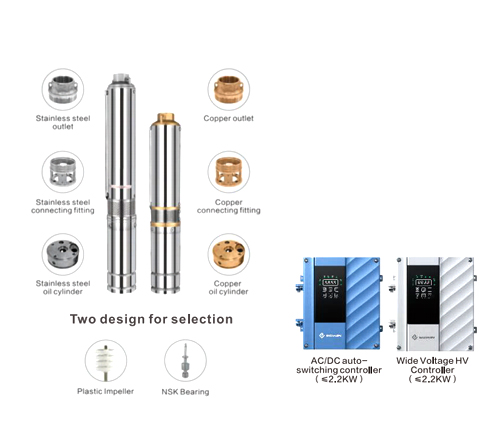
3HVPC Wide Voltage Brushless DC Motor Submersible Solar Deep Well Pump
A solar deep well pump is a pumping system that uses electricity generated by photovoltaic panels to lift water from an underground source. The water may be delivered to a storage tank, irrigation network, livestock trough, rural water system, or other point of use. The pump is installed below the water level, allowing it to push water upward through a delivery pipe rather than relying on surface suction.
This arrangement is especially important in deep wells. Conventional surface pumps are limited by atmospheric pressure and generally cannot draw water from very great depths. A submersible pump avoids this limitation because the hydraulic unit is placed directly in the well. Water enters the pump through the submerged inlet, and the impeller generates the pressure required to move the water to the surface.
Solar pumping offers several practical benefits. It can reduce dependence on utility electricity, eliminate or reduce fuel consumption, and lower operating costs in areas with abundant sunlight. It is also suitable for isolated farms, pastureland, villages, construction sites, and emergency water systems where electrical infrastructure is limited.
However, solar energy is variable. Cloud cover, changing sunlight intensity, panel temperature, seasonal conditions, and time of day all influence the voltage and available power supplied to a pump. A motor designed only for a narrow electrical range may frequently stop, operate inefficiently, or fail to use available solar energy effectively. This is why wide-voltage motor technology is a central feature of the 3HVPC series.
The 3HVPC is a three-inch-bore submersible solar deep well pump equipped with a brushless DC motor. It is intended for clean water pumping and is available in multiple hydraulic configurations. The product range includes models with maximum flow rates from 3.8 to 8 cubic meters per hour and maximum heads from 46 to 180 meters, depending on the selected model.
Each model is identified by a code that describes important performance characteristics. For example, the designation 3HVPC3.8-95-110-750 indicates a three-inch series pump with a nominal maximum flow class of 3.8 cubic meters per hour, a 95-meter maximum head, an optimum input voltage beginning at 110 V DC, and a rated power of 750 W.
The pump series uses a 1.25-inch or 1.5-inch water outlet depending on the model. A two-meter cable is supplied in the listed configurations. The recommended solar panel open-circuit voltage is below 450 V, while the solar array power should be at least 1.3 times the pump power. These electrical requirements should be evaluated together with the actual well depth, pipe length, static water level, dynamic water level, required flow, and total system losses.
Because the hydraulic requirements of different installations vary considerably, the series offers multiple combinations rather than a single universal pump. A low-flow, high-head configuration may be appropriate for a deep borehole and elevated storage tank, while a higher-flow, lower-head model may be better suited to irrigation or water transfer.
The principal characteristics of the 3HVPC series include:
• Wide-voltage brushless DC motor technology for operation under changing photovoltaic power conditions.
• Submersible installation for deep wells and direct water lifting.
• Copper water outlet and copper cylinder for improved structural durability and corrosion resistance.
• Corrosion-resistant plastic impeller designed for smooth water flow and reduced weight.
• NSK bearings selected for wear resistance and reduced friction.
• Compact three-inch bore compatibility for narrow wells and space-limited installations.
• Multiple power, flow, head, and outlet configurations for system matching.
• Compatibility with off-grid solar water supply projects for farms, livestock, rural communities, and remote facilities.
The motor is one of the most important components in a solar pump. The 3HVPC uses a brushless DC motor, which eliminates the physical brushes and commutator used in traditional brushed motors. In a brushed design, the brushes experience mechanical wear as they maintain electrical contact with the rotating armature. Dust, arcing, friction, and brush replacement can eventually affect service life and reliability.
A brushless motor uses electronic commutation instead. The controller switches the motor phases according to rotor position, allowing the rotor to turn without conventional carbon brushes. This construction reduces mechanical contact inside the motor and can improve operating durability, efficiency, and maintenance performance.
The brushless configuration is particularly useful in solar applications because the pump may operate for many hours under changing load and power conditions. The absence of brushes reduces one source of wear and eliminates the need for routine brush replacement. It also supports a compact motor design suitable for a three-inch deep well pump.
The wide-voltage operating range is equally significant. The listed models accept optimum DC input ranges beginning at 100 V, 110 V, or 150 V and extending to 350 V, depending on the configuration. This flexibility allows the pump to work with different solar array designs and to continue operating as available photovoltaic voltage changes.
Wide-voltage operation does not mean that the pump can be connected to any power source without planning. The installer must still respect the model’s specified voltage range and the maximum recommended open-circuit voltage of the solar array. Correct matching of panels, controller, cable, protection devices, and pump remains essential. Within the specified limits, however, the wide-voltage design gives the system greater tolerance to normal solar variation.
A narrow-range solar pump may require a tightly controlled panel voltage to start and operate correctly. When sunlight is weak, the voltage may fall below the required threshold. When panels are connected in a different configuration, the voltage may exceed the safe operating range. Such limitations can complicate installation and reduce the hours during which the pump is useful.
The 3HVPC’s wider input range provides several advantages:
First, it gives system designers more flexibility when selecting the number and arrangement of photovoltaic modules. Second, it helps the pump make use of changing solar conditions rather than stopping whenever the voltage fluctuates modestly. Third, it can simplify the adaptation of the pump to different regions, panel technologies, and project sizes. Finally, it supports a more stable water supply during periods when sunlight is present but not at peak intensity.
The actual water output will still vary with available solar power. A pump cannot produce its maximum rated flow when the solar array supplies insufficient energy. Nevertheless, a motor and controller designed for variable input can provide more useful operation across the daily solar window than a system with a very narrow operating range.
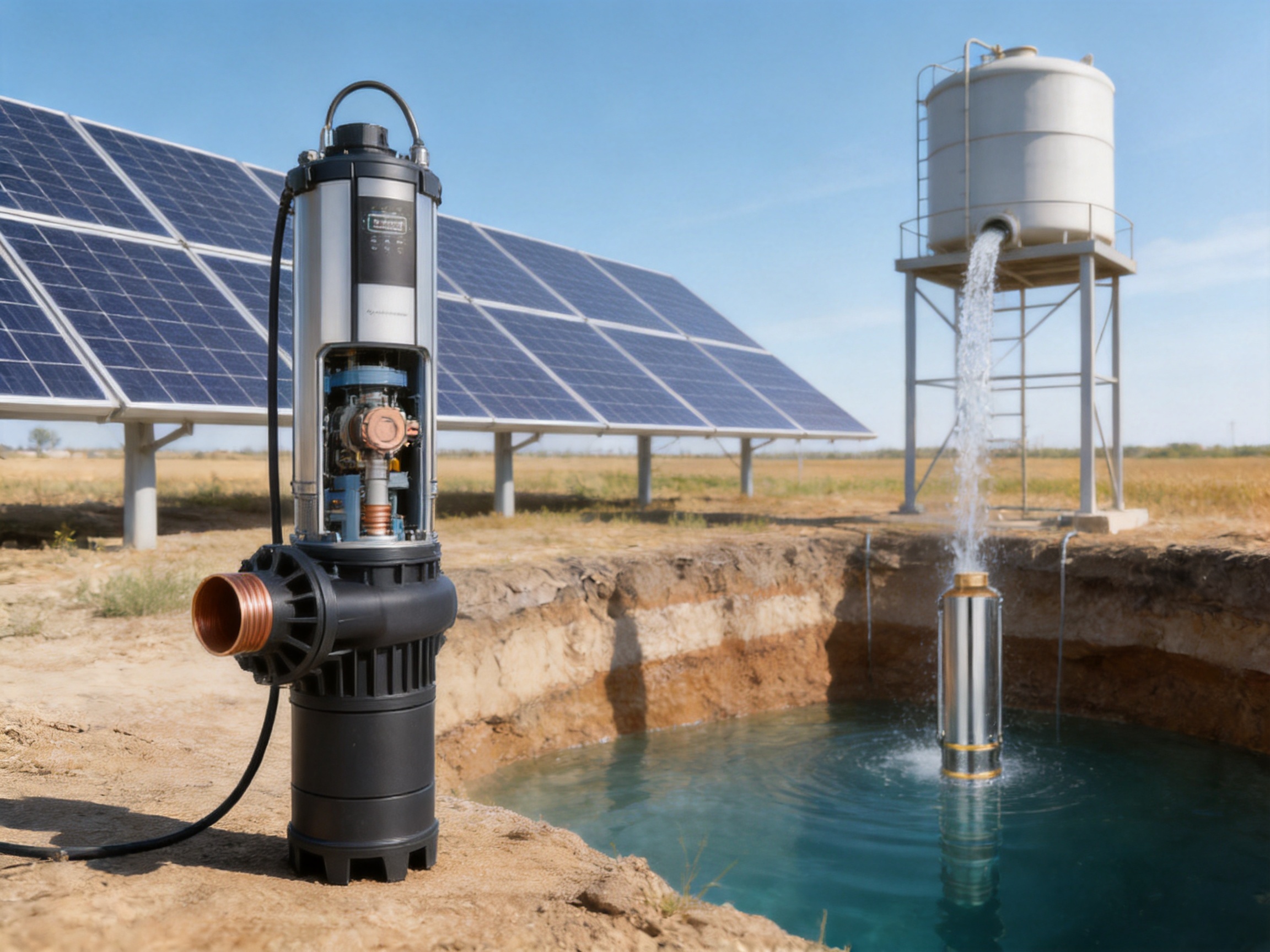
The hydraulic section converts motor rotation into water flow and pressure. The quality of its materials influences service life, efficiency, corrosion resistance, and maintenance requirements. The 3HVPC series incorporates a copper water outlet, a copper cylinder, and a plastic impeller to balance durability, hydraulic performance, and weight.
The water outlet is a critical connection point between the pump and the delivery pipe. It must withstand hydraulic pressure, mechanical loading, and repeated operation. Copper provides a strong and durable connection material with good resistance to corrosion in appropriate clean-water applications. The copper outlet also supports a stable interface for the discharge pipe and helps protect the connection from premature deterioration.
The copper cylinder contributes to the structural enclosure of the pump’s internal components. It helps protect the motor and hydraulic assembly while offering resistance to corrosion. In a submerged environment, material selection is important because the exterior is continuously exposed to water. The copper cylinder is designed to support long-term operation when the pump is installed in a suitable clean-water source and operated within its specified conditions.
The impeller is the rotating hydraulic component responsible for transferring energy to the water. The 3HVPC uses a corrosion-resistant plastic impeller. Compared with a heavy metal impeller, a plastic component can reduce rotating mass and support efficient motor operation. It is also resistant to many forms of corrosion that could affect unprotected metal components.
A properly designed plastic impeller can provide smooth water passage and stable hydraulic performance. Its lower weight may help reduce starting load and rotating inertia, which is useful in solar pumping systems where the available power changes during the day. The impeller is intended for clean water applications; abrasive sand, excessive sediment, or aggressive chemicals can cause wear and should be evaluated before installation.
Bearings support the rotating shaft and allow the motor and impeller to turn with controlled friction. The 3HVPC series uses NSK bearings, which are selected for wear resistance and long-term rotational performance. High-quality bearings can reduce frictional losses, limit shaft movement, and help maintain stable operation.
Bearing condition is influenced by water quality, alignment, load, temperature, installation depth, and operating schedule. Even a durable bearing requires correct system design. Preventing excessive sand intake, avoiding dry running, and ensuring that the pump is adequately submerged are important measures for protecting the bearing assembly.
The 3HVPC series is designed to cover different combinations of flow and head. Maximum flow refers to the highest stated water delivery under the relevant test conditions, while maximum head refers to the maximum vertical pressure capability at very low or zero flow. In actual service, flow and head operate together according to the pump curve and the resistance of the installation.
Users should not select a model only by looking at maximum flow or maximum head. The correct selection must consider the total dynamic head, which includes vertical lift, pressure requirements, pipe friction, fittings, valves, filters, and any elevation difference at the discharge point.
The available performance data are summarized below.
| Model | Optimum DC Input Voltage | Power | Maximum Flow | Maximum Head | Outlet | Cable | Solar Panel Open-Circuit Voltage | Minimum Solar Panel Power |
|---|---|---|---|---|---|---|---|---|
| 3HVPC3.8-95-110-750 | 110–350 V | 750 W | 3.8 m³/h | 95 m | 1.25 in | 2 m | <450 V | At least 1.3 × pump power |
| 3HVPC3.8-123-110-1100 | 110–350 V | 1,100 W | 3.8 m³/h | 123 m | 1.25 in | 2 m | <450 V | At least 1.3 × pump power |
| 3HVPC3.8-155-110-1300 | 110–350 V | 1,300 W | 3.8 m³/h | 155 m | 1.25 in | 2 m | <450 V | At least 1.3 × pump power |
| 3HVPC3.8-180-150-1500 | 150–350 V | 1,500 W | 3.8 m³/h | 180 m | 1.25 in | 2 m | <450 V | At least 1.3 × pump power |
| 3HVPC5.2-75-110-750 | 100–350 V | 750 W | 5.2 m³/h | 75 m | 1.5 in | 2 m | <450 V | At least 1.3 × pump power |
| 3HVPC5.5-65-110-750 | 100–350 V | 750 W | 5.5 m³/h | 65 m | 1.5 in | 2 m | <450 V | At least 1.3 × pump power |
| 3HVPC6-84-110-1100 | 110–350 V | 1,100 W | 6 m³/h | 84 m | 1.5 in | 2 m | <450 V | At least 1.3 × pump power |
| 3HVPC6-125-150-1500 | 150–350 V | 1,500 W | 6 m³/h | 125 m | 1.5 in | 2 m | <450 V | At least 1.3 × pump power |
| 3HVPC7-46-110-750 | 100–350 V | 750 W | 7 m³/h | 46 m | 1.5 in | 2 m | <450 V | At least 1.3 × pump power |
| 3HVPC8-62-110-1100 | 110–350 V | 1,100 W | 8 m³/h | 62 m | 1.5 in | 2 m | <450 V | At least 1.3 × pump power |
| 3HVPC8-90-150-1500 | 150–350 V | 1,500 W | 8 m³/h | 90 m | 1.5 in | 2 m | <450 V | At least 1.3 × pump power |
The table demonstrates that the series includes both high-head and high-flow choices. The 3.8 m³/h group is suited to applications requiring substantial lifting height, with listed maximum heads of 95, 123, 155, and 180 meters. The 8 m³/h model provides a higher nominal flow but a lower maximum head of 90 meters. Between these two ends are models designed for 5.2, 5.5, 6, and 7 m³/h.
Begin by measuring or estimating the static water level and the water level while pumping. The difference between the water surface and the delivery point provides the vertical lifting requirement. Next, calculate pipe friction based on pipe diameter, pipe length, flow rate, and the number of elbows, valves, filters, and other fittings.
If water must be delivered into a pressurized irrigation system or elevated tank, add the required discharge pressure or elevation. The total of these factors is the approximate total dynamic head. The desired flow rate should then be compared with the pump performance curve rather than with the maximum flow figure alone.
The bore diameter is also important. The product is identified as a three-inch-bore pump, so the well casing must provide enough internal clearance for safe installation and removal. The pump should never be forced into a casing that is too narrow, and the well should be checked for obstructions, excessive sand, and adequate water recharge.
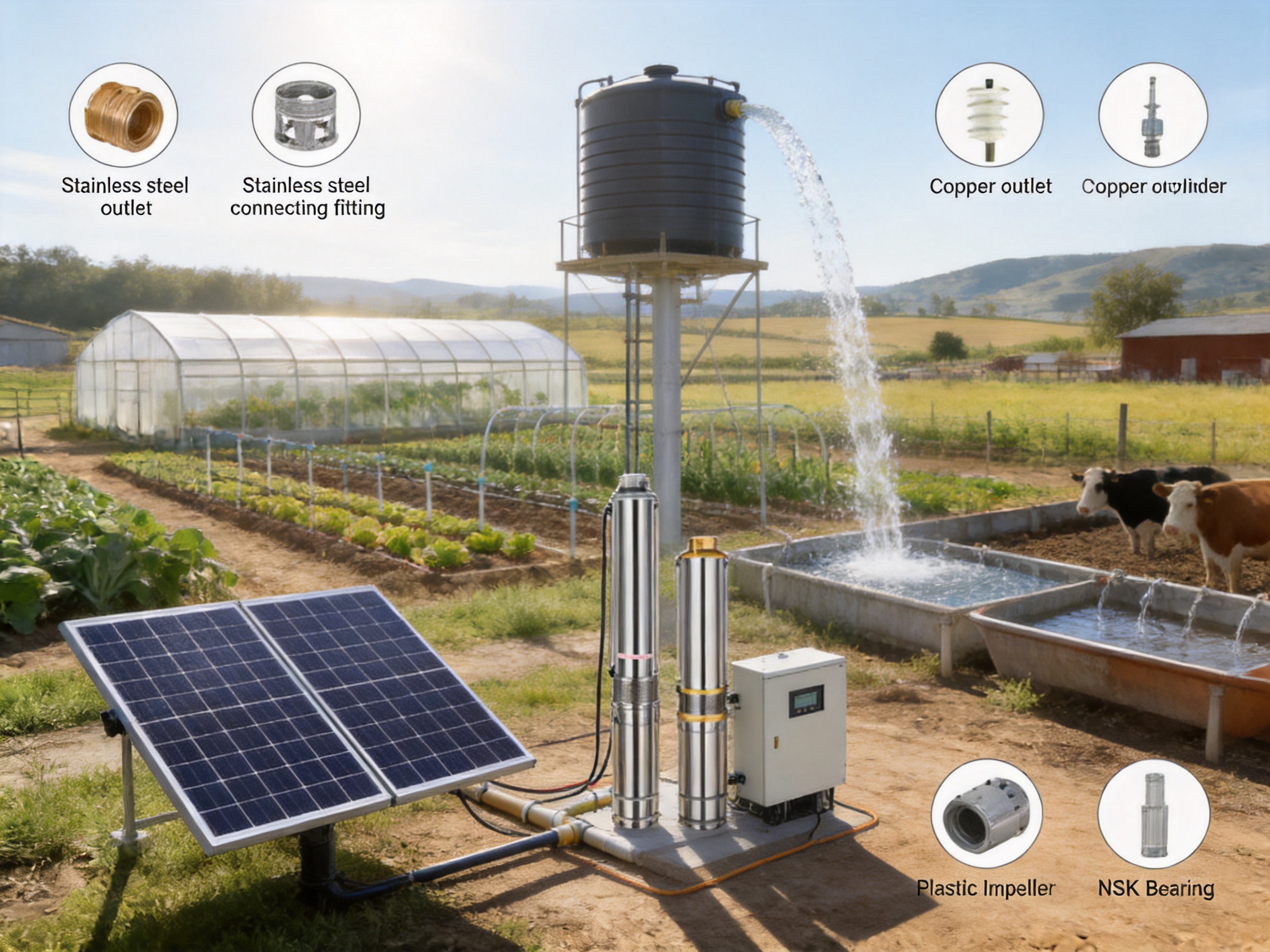
The 3HVPC series offers several competitive advantages when compared with conventional narrow-voltage, brushed, or surface-mounted pumping solutions. These advantages are most relevant in off-grid and variable-energy applications.
The wide-voltage DC motor is designed for a broad input range. This makes it more adaptable to solar arrays than a narrow-voltage pump. During early morning, late afternoon, or partly cloudy weather, available electrical conditions may change quickly. A wide-voltage design can continue to use available energy within the permitted range and can help extend the practical daily operating window.
The brushless motor does not use conventional mechanical brushes. This reduces brush wear, eliminates brush replacement as a regular maintenance task, and limits one common source of electrical arcing and friction. For remote installations where service visits are difficult, the reduction in routine motor maintenance can be especially valuable.
Because the pump is installed inside the well, it is not subject to the same suction limitations as a surface pump. The submersible design is appropriate for deep water sources and can deliver water through a vertical riser pipe to the surface. It also avoids the need for a large surface pump house in many installations.
The combination of copper structural components and a corrosion-resistant plastic impeller provides a practical balance. Copper supports durable water connections and motor protection, while the plastic impeller reduces weight and resists corrosion. This combination can be more suitable for solar-powered operation than a needlessly heavy hydraulic assembly.
Competitor products may offer only one flow and head combination, forcing users to oversize or undersize the pump. The 3HVPC series provides twelve listed configurations across several power levels. This gives project planners more opportunities to match pump performance with well depth, irrigation demand, storage capacity, and available solar energy.
Many rural wells and boreholes have limited casing diameter. The compact three-inch format allows installation in narrower wells than larger pump families. This can reduce drilling requirements for new projects and make replacement or upgrading easier in existing boreholes, provided that the casing dimensions are verified.
Compared with a diesel-powered surface or submersible pump, a solar pump does not require daily fuel delivery, engine oil changes, fuel storage, or combustion-engine maintenance. Solar energy can reduce operating expenses and simplify logistics, particularly in remote farms and pasture areas. The system can also reduce local noise and exhaust emissions during operation.
Agriculture is one of the most suitable applications for solar deep well pumping. The pump can supply water for orchards, open fields, greenhouses, nurseries, and small-scale irrigation networks. A storage tank can be placed at an elevated position so that water is pumped during sunny periods and distributed later through gravity or a secondary pressure system.
Model selection should reflect the irrigation method. Drip irrigation may require a moderate flow and controlled pressure, while flood irrigation or multiple sprinklers may require greater flow. The 3HVPC range allows the system designer to select a suitable balance between the two.
Livestock farms and remote pastures often need water in areas far from utility infrastructure. A solar-powered submersible pump can lift water from a borehole and deliver it to tanks or troughs. The tank can act as a buffer, ensuring that animals have access to water even when cloud cover temporarily reduces pump output.
The system should include appropriate filtration or well protection if the source contains sand. Float switches, level sensors, or a controller-based water management arrangement can help prevent tank overflow and dry running.
Small households and rural communities can use the pump to transfer clean groundwater to an elevated storage tank. Water can then be distributed to taps or a household booster system. The pump’s compact design is helpful where the borehole is narrow and the available space for surface equipment is limited.
For domestic use, water quality must be tested before consumption. The pump is designed for clean water pumping, but pumping equipment alone does not guarantee potable water. Treatment, filtration, disinfection, and storage hygiene should be designed according to local regulations and water analysis.
Greenhouse crops require regular water delivery and may be located far from conventional utility services. Solar pumping can operate during the same daylight hours when irrigation and ventilation loads are often active. A storage tank and irrigation controller can help separate the pumping schedule from the exact timing of crop watering.
Temporary construction sites, communications facilities, environmental monitoring stations, and remote infrastructure projects may need water before permanent grid services are available. A modular photovoltaic pumping system can provide a practical temporary or semi-permanent supply, especially when the project has adequate sunlight and a suitable well.
The product can also be used for transferring clean water between a well, reservoir, storage tank, or elevated container. The selected model must be matched to the transfer distance and elevation. Where the source is an open reservoir rather than a deep well, a suitable intake arrangement and pump installation method should be confirmed before use.
Product performance depends not only on the pump design but also on the manufacturer’s ability to control materials, assembly, testing, and supply. Taizhou Edwin Electric Co., Ltd. was founded in 2008 and operates as an integrated manufacturing enterprise focused on independent research and development, mass production, and global export.
The company’s experience covers several pump categories, including deep well pumps, submersible pumps, domestic booster pumps, and circulation pumps. It has also expanded into solar water pumps and intelligent booster pumps as part of its investment in new energy and intelligent technology since 2018. This product diversification gives the engineering team experience with different hydraulic systems, motor technologies, controls, and customer requirements.
Independent research and development allows a manufacturer to adapt pump structures and electrical systems to changing market requirements. For solar pumping, this includes developing motors and control approaches that can work with variable photovoltaic input. It also involves selecting materials that balance cost, durability, efficiency, and compatibility with different installation environments.
The 3HVPC series reflects this development approach through its wide-voltage brushless motor, compact bore format, multiple hydraulic configurations, and material combination. Rather than treating a solar pump as a conventional pump with a solar panel added, the product is designed around the characteristics of renewable electrical input.
Mass production can improve consistency by using standardized component specifications, repeatable assembly procedures, and established inspection processes. It also supports the supply of multiple models for distributors, engineering contractors, agricultural projects, and original equipment applications.
A manufacturer with a broad product range can organize common components, production tooling, testing procedures, and quality controls across multiple pump families. This creates a foundation for reliable repeatability while allowing different flow and head configurations to be produced for specific markets.
Submersible pump production requires close coordination between motor components, hydraulic parts, bearings, sealing systems, electrical cables, and external protective materials. A change in one component can influence the performance of the complete pump. For example, impeller geometry affects motor load, bearing load, flow, and efficiency, while cable design affects voltage drop and installation safety.
The use of copper water outlets, copper cylinders, plastic impellers, and NSK bearings shows attention to the interaction between hydraulic and mechanical components. Proper component coordination is essential for a pump that must operate under changing solar input and potentially long daily duty cycles.
In addition to manufacturing, the company has developed related import and export service organizations to support procurement planning, order tracking, cross-border delivery, and foreign trade services. This is useful for international customers that need more than a product catalog. Agricultural contractors, distributors, system integrators, and project buyers often require technical clarification, model selection, packaging coordination, documentation, and shipment management.
The company’s pumps are used in new energy projects, agricultural irrigation, municipal engineering, mining, construction, HVAC systems, and household water supply. Exposure to these application areas helps the supplier understand the different requirements associated with commercial, industrial, agricultural, and residential projects.
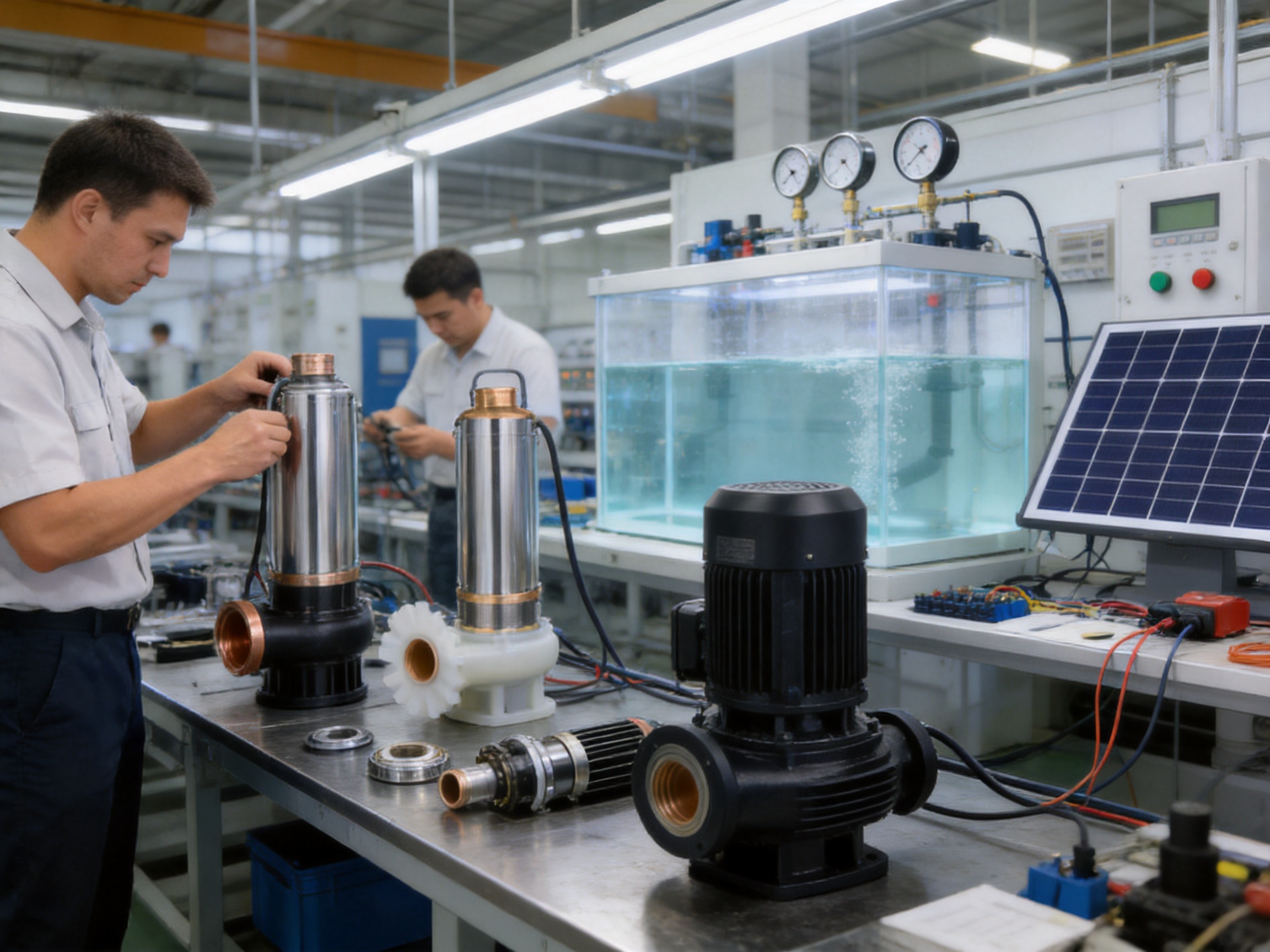
Correct installation is essential to achieving the expected performance of any deep well pump. Before installation, the well should be inspected and documented. Important information includes casing diameter, total well depth, static water level, dynamic water level, water temperature, water quality, sand content, recharge rate, and the location of the discharge point.
The solar array must be matched to the pump’s DC input requirements. The listed models require an open-circuit voltage below 450 V and a solar panel power rating of at least 1.3 times the pump power. The selected array must also produce sufficient operating voltage under real conditions, not merely under ideal laboratory sunlight.
Designers should consider voltage drop in the cable, panel temperature, cloud cover, seasonal solar variation, and controller requirements. The array should be configured so that its operating voltage remains within the pump’s specified range. Overvoltage can damage electrical components, while undervoltage may prevent reliable starting or reduce output.
Appropriate isolation, overcurrent protection, grounding, surge protection, and disconnecting equipment should be provided according to applicable electrical standards. Because the system may operate at high DC voltage, installation must be performed by qualified personnel familiar with photovoltaic and pump systems.
The pump should be suspended using a suitable support method and should not be carried solely by the electrical cable. The discharge pipe, safety rope or support cable, and electrical cable must be arranged to prevent abrasion and excessive tension. The pump should remain adequately submerged during operation, including during seasonal changes in the water level.
The pump should not rest directly on the bottom of the well. Maintaining clearance from sediment helps reduce the risk of abrasive particles entering the hydraulic section. A well screen, intake protection, or suitable filtration arrangement may be necessary where sand or suspended solids are present.
Dry running can cause overheating, bearing damage, and premature failure. The well must have sufficient yield, and the water level must not fall below the pump’s safe operating position. A level sensor, controller protection function, or tank management system can help prevent operation when the water source is depleted.
A storage tank is often recommended for solar pumping systems. It allows the pump to operate when solar energy is available and stores water for use later. This approach can reduce the need for batteries, which may simplify the system and reduce battery replacement costs. The tank should be sized according to daily water demand, available sunlight, well yield, and the required reserve period.
The brushless motor and corrosion-resistant components are intended to reduce maintenance requirements, but every deep well pump still benefits from regular system inspection. The solar panels should be kept free of excessive dust, leaves, bird droppings, and shading. Loose electrical connections, damaged insulation, unusual noise, and changes in water output should be investigated promptly.
Water output should be monitored over time. A gradual reduction in flow may indicate a falling water level, clogged intake, pipe blockage, impeller wear, excessive sediment, panel performance problems, or cable voltage drop. Comparing operating voltage, current, water level, and flow can help identify the cause.
The well should be checked for sand and sediment, especially during the first operating period after drilling or rehabilitation. If abrasive material enters the pump, it may wear the impeller and bearings even when the motor itself remains electrically sound.
Seasonal maintenance should include inspection of the mounting structure, cable routing, pipe supports, tank float systems, valves, and protection devices. In regions with storms or severe weather, photovoltaic panels and external electrical equipment should be checked for mechanical damage and water ingress.
Solar pumping can provide environmental and economic benefits when the system is correctly sized. The energy source is renewable, and the pump can operate without direct combustion emissions. In agricultural areas, the absence of routine fuel deliveries can simplify logistics and reduce exposure to fuel price fluctuations.
The brushless motor supports efficient electrical conversion by reducing brush friction and associated losses. The plastic impeller can reduce rotating weight, while the wide-voltage design helps the system use available solar energy across a broader range of conditions. These features work together to support efficient water delivery, although total system efficiency also depends on panel quality, controller performance, cable sizing, pipe friction, and well conditions.
Water conservation should accompany energy efficiency. Drip irrigation, scheduling, moisture sensors, leak detection, and properly sized storage tanks can reduce unnecessary pumping. A high-performance pump cannot compensate for an inefficient irrigation network or uncontrolled water loss.
The most sustainable design is one that matches the pump to the actual demand. Oversizing can increase initial cost and may cause inefficient operation, while undersizing can result in inadequate water supply and excessive operating time. Professional hydraulic and solar design is therefore recommended for commercial and agricultural installations.
The 3HVPC series combines several features that are particularly valuable in remote solar pumping. Its brushless DC motor reduces routine mechanical wear. Its wide voltage range improves compatibility with variable photovoltaic input. Its submersible structure enables deep well operation. Its copper and plastic hydraulic components provide a balance of durability, corrosion resistance, and reduced weight. Its NSK bearings support long-term rotational performance.
The availability of twelve listed performance configurations is another important advantage. Buyers can select a 750 W, 1,100 W, 1,300 W, or 1,500 W option according to required head and flow. The range includes high-head models for deep lifting and high-flow models for irrigation and water transfer. This reduces the need to force one general-purpose pump into every application.
From a supplier perspective, the product is supported by a manufacturer with experience in research and development, mass production, international export, and one-stop procurement services. This combination is useful for customers that require repeat orders, project coordination, technical selection, or multiple pump categories from one source.
The product is not intended to replace every type of pump. It is designed primarily for clean water, deep well, and solar DC applications. Installations involving abrasive slurry, seawater, aggressive chemicals, high-temperature liquids, or unusually demanding industrial fluids require separate material and engineering evaluation. Within its intended range, however, the 3HVPC provides a practical and technically flexible solution.
Before purchasing, project buyers should prepare a complete set of technical information. This reduces the risk of selecting a model with insufficient head, excessive flow, or incompatible electrical requirements.
The purchasing checklist should include the following:
• Borehole diameter and total well depth.
• Static and dynamic water levels.
• Required daily water volume.
• Required peak flow rate.
• Total vertical lift to the discharge point.
• Pipe diameter, length, fittings, valves, and filtration equipment.
• Water quality, temperature, sand content, and chemical characteristics.
• Solar panel type, quantity, operating voltage, and open-circuit voltage.
• Required pump power and available installation space.
• Storage tank capacity and water-level control method.
• Local electrical, construction, and water-safety requirements.
• Required documentation, packaging, spare parts, and delivery schedule.
Providing this information to the supplier allows the appropriate model to be evaluated using the actual system curve rather than a general assumption. It also helps determine whether additional controllers, sensors, protection devices, or accessories are needed.
The pump is designed for clean water applications, including deep well irrigation, livestock water supply, rural water systems, and clean water transfer. Water containing excessive sand, abrasive particles, chemicals, or corrosive substances should be analyzed before installation. Additional filtration or a different pump material may be required.
The wide-voltage brushless DC motor is designed to operate under variable solar input within its specified voltage range. Output may decrease when sunlight is weak, and the pump may stop if the available voltage or power falls below the operating requirement. A correctly sized solar array and storage tank can improve overall system availability.
The listed pump is designed for solar DC operation. A battery is not necessarily required when water is pumped into a storage tank during daylight hours. Batteries may be added in systems that require pumping at night or during extended low-sun periods, but the battery bank, controller, and protection equipment must be designed separately.
It means that the pump can operate across a broad specified DC input range rather than requiring one narrow voltage value. Depending on the model, the optimum input range begins at 100 V, 110 V, or 150 V and extends to 350 V. The solar array open-circuit voltage must remain below 450 V, and the exact model specifications must be followed.
The listed requirement is at least 1.3 times the pump power. For example, a 750 W pump should be paired with a solar array rated at no less than approximately 975 W under the stated sizing guideline. Actual design may require additional capacity because temperature, shading, dust, orientation, seasonal sunlight, and cable losses affect real output.
The 3HVPC is a compact three-inch-bore pump. The casing must still provide sufficient internal clearance for safe installation, cable routing, and removal. The actual borehole dimensions should be measured and compared with the pump’s physical dimensions before purchase.
The answer depends on the total dynamic head and required flow, not only the well depth. The 3HVPC3.8-155-110-1300 and 3HVPC3.8-180-150-1500 models are among the high-head options, but the final choice must account for water-level drawdown, pipe friction, discharge elevation, and required output. A performance curve should be used for final selection.
Normally, maximum flow and maximum head represent different points on a pump performance curve. Maximum flow is generally achieved at low head, while maximum head occurs at very low or zero flow. The actual operating point lies between these conditions and depends on the system resistance.
A brushless pump does not require conventional brush replacement, but the complete system still requires inspection. Solar panels, electrical connections, cable insulation, pipework, valves, tank controls, water levels, and flow should be checked periodically. The well should also be monitored for sand and sediment.
The pump can be used in a clean-water supply system, but the pump itself does not certify that the source water is safe to drink. Water quality testing, filtration, disinfection, storage hygiene, and compliance with local drinking-water requirements are necessary for potable applications.
Its solar DC input reduces dependence on grid power and fuel. The submersible design supports deep well pumping, the brushless motor reduces brush-related maintenance, and the wide-voltage range accommodates changing photovoltaic conditions. Storage tanks can provide water during periods when solar output is reduced.
The 3HVPC series is manufactured by Taizhou Edwin Electric Co., Ltd., a Chinese pump manufacturer established in 2008. The company focuses on pump research and development, mass production, global export, and related procurement services.
The 3HVPC Wide Voltage Brushless DC Motor Submersible Solar Deep Well Pump is designed to address the practical challenges of off-grid and variable-energy water pumping. Its wide-voltage motor helps accommodate changing photovoltaic input, while the brushless construction reduces brush-related maintenance. The submersible format makes it suitable for deep wells, and the compact three-inch design supports installations where borehole space is limited.
The pump’s copper water outlet and cylinder provide durable structural components, while the corrosion-resistant plastic impeller helps reduce weight and support smooth water flow. NSK bearings contribute to long-term wear resistance and stable rotation. With power options from 750 W to 1,500 W, maximum flow ratings from 3.8 to 8 m³/h, and maximum head ratings from 46 to 180 meters, the series offers flexibility for irrigation, livestock, rural household water, greenhouse production, and clean water transfer.
Its advantages are strengthened by the manufacturer’s integrated capabilities in product development, mass production, export, and technical supply coordination. For customers seeking a dependable solar deep well pump, the most important step is to match the pump model to the actual well and hydraulic system. When the solar array, pipework, storage, protection devices, and pump are correctly designed together, the 3HVPC series can provide an efficient and durable water supply for remote and agricultural applications.
1. Product technical information for the 3HVPC Wide Voltage Brushless DC Motor Submersible Solar Deep Well Pump.
2. Manufacturer-provided performance data for 3HVPC pump models, including voltage, power, flow, head, outlet, cable, and photovoltaic sizing requirements.
3. General principles of centrifugal pump performance curves and total dynamic head calculation.
4. General engineering guidance for photovoltaic array sizing and DC motor operation.
5. General practices for submersible pump installation, well protection, dry-run prevention, and water-quality assessment.
6. Manufacturer information concerning pump research and development, mass production, global export, and integrated procurement services.
aseriesnoisereductiondesignacid-baseverticalsurfacepump-1.jpg "EV(F)A Series Noise Reduction Design Acid-base Vertical Surface Pump")
serieswatershortageprotectionvoltagestabilizationstainlesssteelverticalmultistagepump.jpg "EVR(S) Series Water Shortage Protection Voltage Stabilization Stainless Steel Vertical Multistage Pump")
edwina@edwin-pump.com
+86-13586290903 (WhatsApp)
Xuri Gongliang Cutting Tool Entrepreneurship Park, Wenqiao Town, Wenling City, Taizhou City, Zhejiang Province, China

High Performance Smart Pump Factory


 English