
edwina@edwin-pump.com

View All Products
en
Reliable access to water is essential for agriculture, livestock production, rural communities, construction sites, and many remote facilities. In locations where grid electricity is unstable or unavailable, solar-powered pumping has become an increasingly practical solution. However, not every solar pump is designed to deliver stable performance under changing sunlight, demanding well conditions, and long operating periods. The 4ADFSW AC/DC Ceramic-Coated SS304 Rotor Shaft Water-Filled Solar Pump is engineered to address these challenges through a hybrid power design, water-filled motor construction, corrosion-resistant materials, and a wide range of hydraulic configurations.
This product belongs to the AC/DC hybrid submersible solar pump category and is designed for four-inch bore applications. It can operate from solar-generated direct current or compatible mains alternating current, depending on the selected model. By combining renewable-energy compatibility with backup grid operation, the pump offers greater flexibility than a solar-only system. Users can continue pumping when sunlight is reduced, while still taking advantage of solar energy during normal daytime operation.
The product range includes models from 750 W to 2,200 W, with maximum flows from 4.8 m³/h to 30 m³/h and maximum heads from 26 m to 255 m. This broad selection allows installers and system designers to match pump performance to well depth, pipeline resistance, irrigation demand, storage-tank elevation, and required daily water volume.
At the center of the design is a ceramic-coated SS304 rotor shaft. This component is intended to improve wear resistance and provide dependable operation in continuously circulating water. The water-filled motor structure supports heat dissipation and helps reduce the risk of overheating during extended pumping. Together, these design elements create a submersible pump platform suitable for deep wells, agricultural irrigation, rural water supply, livestock systems, and other applications in which service access may be limited.
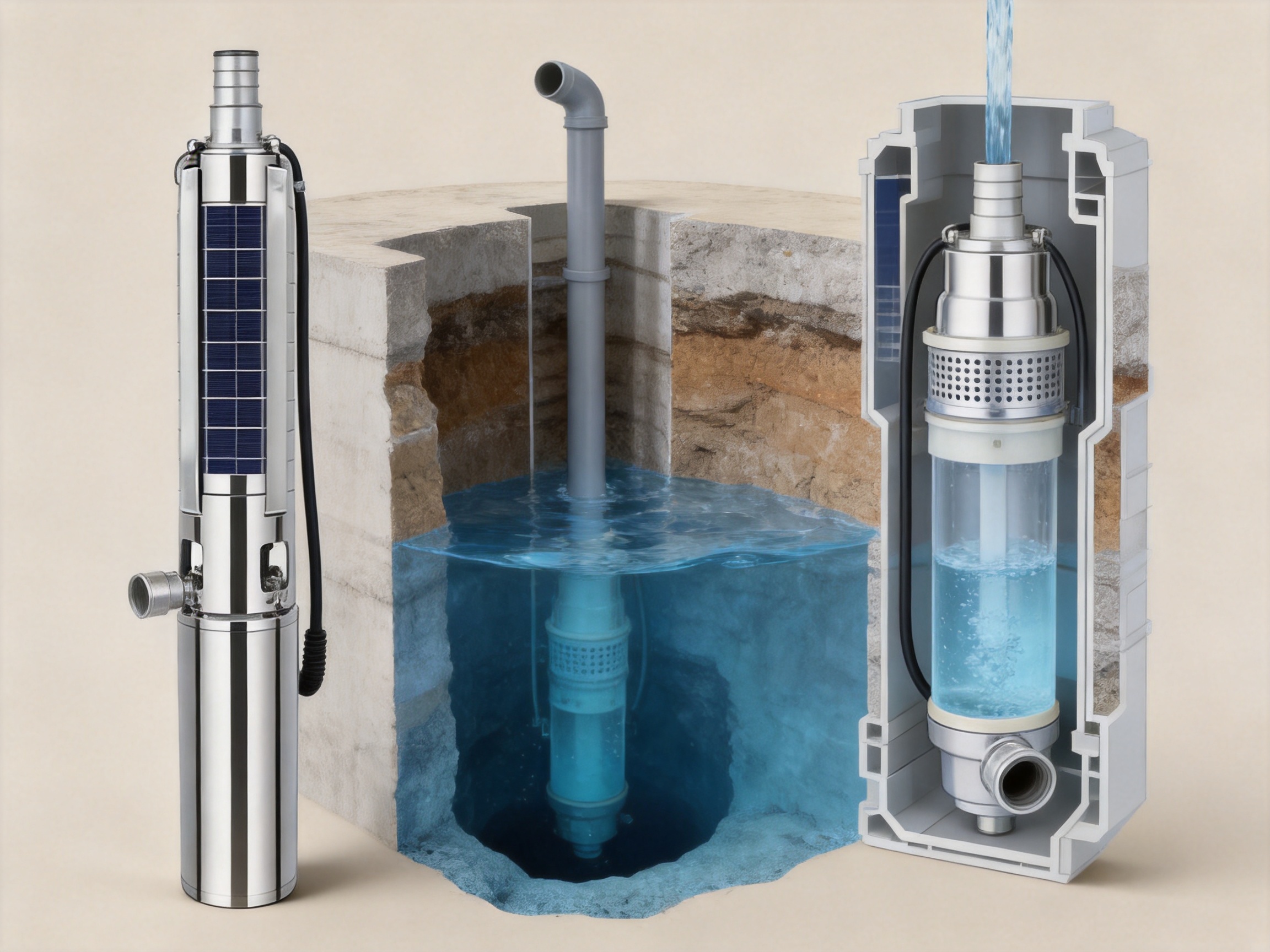
The 4ADFSW series is a submersible solar pump system intended to be installed inside a suitable four-inch borehole or water source. Because the pump is submerged, it pushes water upward through the discharge pipe rather than relying on surface suction. This arrangement is particularly useful for deep wells, where a conventional surface pump may be limited by suction height and atmospheric pressure.
The pump is driven by a hybrid motor that accepts either DC power from a properly configured photovoltaic system or AC power within the specified input range on AC/DC models. The hybrid arrangement enables the same pumping equipment to work with renewable energy and mains electricity. In practical installations, solar power can be prioritized during daylight hours, while AC power can provide operational continuity during cloudy weather, nighttime demand, commissioning, or emergency use.
The water-filled construction allows the surrounding pumped water to participate in motor cooling. This is important in a submersible environment because the motor may run for long periods under load. Effective heat transfer helps protect internal components, supports more stable performance, and may contribute to longer service life when the pump is correctly selected and installed.
The product is not limited to a single hydraulic duty point. Instead, the range includes high-head models for deep wells and elevated delivery systems, medium-head models for general irrigation and domestic supply, and high-flow models for applications that require significant water volume at comparatively lower pressure. The model code and performance table should always be checked before selection because maximum flow and maximum head are not achieved simultaneously under normal operating conditions.
The rotor shaft is a critical moving component in a submersible pump. It is exposed to rotational forces, bearing loads, vibration, water contact, and possible suspended particles. The 4ADFSW design uses an SS304 stainless steel rotor shaft with a ceramic coating intended to improve surface hardness and wear resistance.
Compared with a conventional uncoated shaft, a ceramic-coated shaft can offer an additional protective surface in applications where friction and repeated operation are significant concerns. Stainless steel provides a corrosion-resistant base material, while the ceramic coating is designed to help protect the working surface. This combination supports smooth rotation and helps reduce the impact of wear on the shaft and related components.
The use of SS304 is also relevant in agricultural and domestic water environments where the pump may be exposed to moisture, dissolved minerals, or mildly aggressive water. Material suitability still depends on the actual water chemistry. Highly corrosive liquids, abrasive sand concentrations, or chemically contaminated water should be evaluated before installation. Nevertheless, the stainless steel construction provides a strong foundation for general water pumping applications.
A major advantage of the AC/DC versions is their ability to operate from two different electrical sources. The listed AC voltage range is 85 V to 280 V, while the DC voltage range is 80 V to 430 V. This wide DC range is intended for photovoltaic system integration, subject to correct array design, controller compatibility, grounding, cable sizing, and electrical protection.
Solar-only pumps can be highly effective in remote locations, but they depend directly on available sunlight. When the sky is overcast, when water is needed after sunset, or when solar array output temporarily falls below the required operating level, pumping may be interrupted. A hybrid pump reduces this limitation by allowing an appropriate mains supply to support operation when solar power is insufficient.
This flexibility can lower the need for separate pumping equipment. Instead of installing a dedicated solar pump and an independent AC pump, one hybrid pumping platform may serve both energy sources. This can simplify equipment planning, reduce installation complexity, and make operation easier for farms, rural water projects, and small commercial sites.
The HV versions in the range are DC-only models. They are suitable for installations where the available energy system is specifically designed for high-voltage DC operation. The A/D versions are the appropriate choice when both AC and DC input capability is required. Purchasers should clearly specify the required version because the electrical input characteristics differ between A/D and HV models.
Submersible motors must control heat effectively because they operate within a confined underwater environment and may be required to run continuously. The water-filled construction supports heat transfer from the motor to the surrounding pumped water. This helps reduce thermal stress on internal components and supports stable operation during extended duty cycles.
Heat management can influence motor efficiency, insulation life, bearing performance, and overall reliability. A motor that regularly operates above its intended temperature may experience accelerated deterioration, nuisance shutdowns, or shortened service life. The water-filled design is therefore an important feature for applications involving long pumping periods, particularly during irrigation seasons or routine community water supply.
Correct installation remains essential. The pump should be fully submerged as required by the installation instructions, and the well must provide suitable water flow around the motor. The pump should not be operated dry. Proper sizing, adequate water level, correct cable selection, and suitable protection devices are necessary to obtain the intended benefits of water-filled cooling.
Water pumps are continuously exposed to moisture, and submersible units may also encounter minerals, soil particles, and changing water conditions. Stainless steel components offer useful resistance against common forms of corrosion and help maintain structural integrity over extended service periods.
The corrosion-resistant construction is especially valuable in rural water supply, irrigation, livestock watering, and domestic applications where reliable operation is required but frequent maintenance visits may be difficult. A durable exterior also supports easier handling during installation and servicing.
Material resistance should not be interpreted as universal chemical compatibility. Before installation, the water should be evaluated when there is a known risk of high salinity, unusual acidity, industrial contamination, or significant abrasive content. The pump is primarily designed for water pumping, and proper water-quality assessment remains part of responsible system engineering.
Submersible pumps can be difficult to access after installation, especially in deep wells. For this reason, low-maintenance design is an important advantage. The ceramic-coated rotor shaft, water-filled motor, corrosion-resistant construction, and precision-engineered rotating assembly are intended to support smooth operation and reduce unnecessary service interruptions.
Low maintenance does not mean maintenance-free operation. Installers should inspect electrical connections, monitor flow and pressure, check for unusual noise or vibration, and verify that the well is not producing excessive sand. Solar panels, controllers, cable joints, protection devices, and storage systems should also be inspected as part of the complete installation.
When the pump is correctly selected and operated within its design limits, a lower-maintenance configuration can reduce total ownership costs. Fewer retrieval operations, fewer emergency repairs, and more predictable service intervals can be especially valuable for agricultural operators and remote-site owners.
The 4ADFSW range contains multiple hydraulic configurations. Some models prioritize high head, while others provide higher flow at lower head. Selecting a model based only on motor power is not sufficient. The required flow, total dynamic head, well conditions, pipeline losses, discharge elevation, and energy availability must all be considered.
Maximum head represents the greatest stated pumping height under the relevant test conditions and should not be treated as the normal operating point. Maximum flow is likewise a rated value that depends on system resistance. As the delivery head increases, the actual flow generally decreases. A proper pump curve and system calculation should be used whenever available.
| Model Group | Power Range | Maximum Flow Range | Maximum Head Range | Typical Outlet Options |
| 4.8–5.2 m³/h models | 750–2,200 W | 4.8–5.2 m³/h | 67–255 m | 1.25 inches |
| 7.5 m³/h models | 1,300–2,200 W | 7.5 m³/h | 80–150 m | 1.25 inches |
| 11 m³/h models | 1,500–2,200 W | 11 m³/h | 60–120 m | 2 inches |
| 19 m³/h models | 1,500–2,200 W | 19 m³/h | 35–60 m | 2 inches |
| 25–30 m³/h models | 1,500–2,200 W | 25–30 m³/h | 26–36 m | 2 inches |
The high-head 5.2 m³/h and 4.8 m³/h models are suitable for applications where water must be lifted from a deep borehole or delivered to a high storage tank. For example, the 4DFSW5.2-255-300-2200 models provide a stated maximum head of 255 m at 2,200 W. This configuration is oriented toward demanding vertical-lift applications rather than high-volume surface irrigation.
The 7.5 m³/h models provide a balance between flow and lifting capability. The 4DFSW7.5-80-150-1300 versions offer a stated maximum head of 80 m at 1,300 W, while the 4DFSW7.5-150-300-2200 versions extend the stated head to 150 m at 2,200 W. These models may be considered for farms, elevated tanks, and medium-scale water distribution systems where both useful volume and moderate-to-high pressure are required.
The 11 m³/h, 19 m³/h, 25 m³/h, and 30 m³/h models are intended for greater water volumes at lower or moderate heads. The 4DFSW30-36-300-2200 models, for example, provide a stated maximum flow of 30 m³/h and a maximum head of 36 m. This type of configuration can be considered for large storage filling, low-elevation irrigation, drainage-related water transfer, and other applications where volume is more important than extreme lifting height.
Every solar pump installation must be designed as a complete energy system. The pump is only one part of the arrangement. The solar array, controller or inverter, cables, disconnects, protection devices, grounding system, and optional energy storage must be properly matched.
The product information specifies a solar panel open-circuit voltage below 430 V and recommends solar panel power of at least 1.3 times the pump power. This recommendation should be treated as a baseline design guideline rather than a substitute for a detailed solar assessment. Actual array sizing depends on local solar radiation, seasonal conditions, panel temperature, orientation, shading, cable losses, controller efficiency, and the desired daily water output.
| Item | Specified Value or Guideline |
| AC input for A/D models | 85–280 V |
| DC input | 80–430 V |
| Solar array open-circuit voltage | Below 430 V |
| Recommended solar panel power | At least 1.3 times pump power |
| Standard cable length | 2 m |
| Available pump power range | 750–2,200 W |
For a 750 W pump, the stated 1.3-times guideline indicates a solar array of at least approximately 975 W. For a 1,500 W pump, the corresponding baseline is approximately 1,950 W. For a 2,200 W pump, the baseline is approximately 2,860 W. These figures are simple sizing references; an installer must still confirm that the array voltage remains within the permitted range at both low and high temperature.
High-voltage DC systems require careful engineering. Open-circuit voltage can rise when photovoltaic modules operate in cold conditions, and this must remain below the permitted limit. Electrical protection should include appropriately rated disconnects, overcurrent protection, surge protection where required, and safe grounding. All wiring should be installed by qualified personnel in accordance with applicable local electrical standards.
AC/DC models can provide a practical operating strategy for locations with variable sunlight. During strong solar conditions, the pump can use the photovoltaic supply. During low solar output or periods of greater demand, the AC input can support continued water delivery. This arrangement can be especially useful where water storage is limited and uninterrupted pumping is important.
The first notable advantage is energy-source flexibility. A conventional solar-only pump may be efficient and effective during sunlight hours but may require a large storage tank, battery bank, or separate backup system to maintain supply during poor weather. The AC/DC hybrid design can reduce dependence on batteries or excessive water storage when mains power is available.
The second advantage is operational continuity. A farm, livestock facility, or rural residence may need water even when solar conditions are not ideal. The ability to change between DC and AC operation gives users more control over when and how the pump operates. This can improve resilience during seasonal changes, cloudy periods, and unexpected increases in water demand.
The third advantage is installation consolidation. A single hybrid pump can serve multiple operating strategies, avoiding the need to purchase and maintain separate solar and conventional pumps. Although the complete system still requires suitable controls and protection, equipment planning can be simpler when one pump platform supports both energy sources.
The fourth advantage is better suitability for deep-well applications than many surface-mounted alternatives. Because the pump is installed inside the well, it is not limited by the suction constraints that affect surface pumps. This makes it suitable for deep groundwater sources, provided the bore diameter, water level, pump setting depth, and hydraulic requirements are compatible.
The fifth advantage is the combination of material protection and thermal management. Some low-cost pumps may rely on basic shaft materials or less advanced cooling arrangements. The ceramic-coated SS304 rotor shaft and water-filled motor are designed to address wear and heat, two common concerns in long-running submersible equipment.
A basic submersible pump may be designed primarily for AC mains use and may not be compatible with the variable electrical characteristics of photovoltaic systems. Connecting such a pump directly to a solar array is not generally appropriate. The 4ADFSW series is specifically configured for solar integration through its DC operating range and solar system requirements.
In addition, basic pumps may offer a narrower model selection. The 4ADFSW product family covers low-flow high-head duties as well as high-flow lower-head duties. This makes it easier for distributors and system integrators to build solutions around different well depths and water delivery requirements.
The water-filled design is another differentiating factor. In a submersible application, managing motor temperature is essential. Water-filled construction supports heat transfer to the surrounding water and is aligned with the long-duration operating demands of solar pumping, where the pump may run for many daylight hours.
The hybrid versions also support a wider range of project types. A basic AC pump may be appropriate for a stable grid, while a basic DC pump may be suitable for a dedicated solar installation. The AC/DC versions can bridge these two use cases, making them attractive for locations where energy infrastructure is developing or where backup power is necessary.
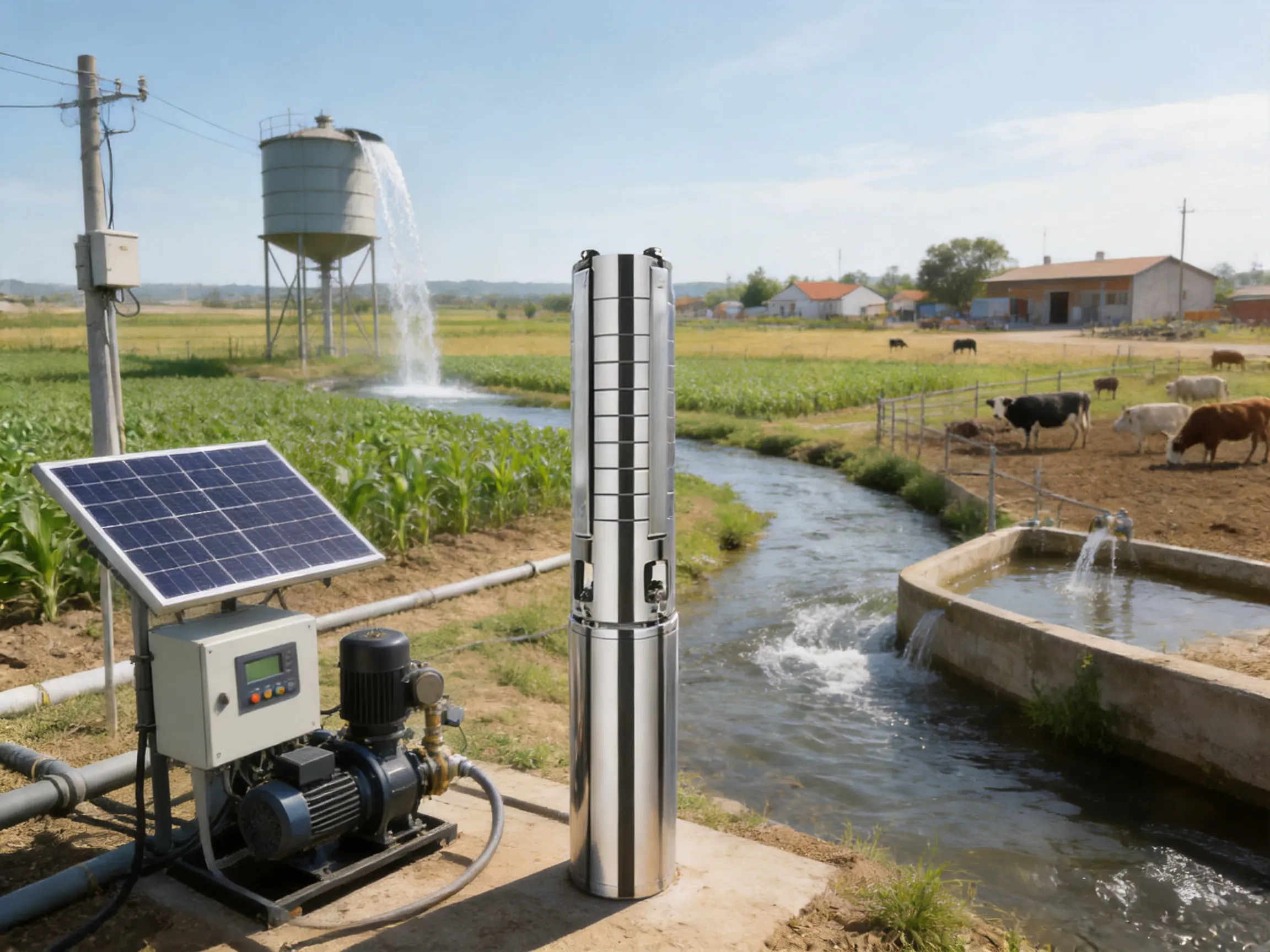
Agriculture is one of the most important application areas for solar water pumps. Fields, orchards, nurseries, and greenhouses often require water at locations far from electrical distribution networks. Solar power can reduce reliance on fuel-powered generators and may lower operating costs during the irrigation season.
The 4ADFSW range supports different irrigation layouts. High-head models can feed elevated tanks, drip systems, or long pipelines where pressure losses are significant. Higher-flow models can provide larger volumes for open irrigation channels, storage ponds, and low-pressure distribution systems. The correct model depends on crop requirements, irrigation method, well depth, pipeline length, and daily pumping schedule.
For a drip irrigation project, the installer must calculate the pressure required at the emitters, filter losses, elevation changes, and friction losses in the delivery pipe. For sprinkler systems, operating pressure may be higher, and the pump must be selected accordingly. A pump should not be chosen solely because its maximum flow appears suitable.
Remote homes and villages may require a dependable water source for drinking-water treatment, washing, sanitation, and general household use. A solar pump can transfer groundwater to an elevated storage tank, allowing water to be distributed by gravity when required.
The AC/DC hybrid design can be useful in rural areas where a grid connection is available but not always reliable. Solar energy can reduce daytime electricity consumption, while AC operation can support water production during low-sunlight periods. Where grid electricity is unavailable, the DC-only HV versions may be considered for a properly engineered photovoltaic installation.
For domestic water supply, water quality must be assessed independently of pump performance. The pump should be installed in a properly constructed and protected well, and the water should be tested and treated according to local health requirements before consumption.
Livestock operations often need water at dispersed locations. Running electrical cables to remote pasture areas can be expensive, while fuel generators require regular refueling and maintenance. A solar pump connected to a storage tank or trough can provide an efficient water delivery solution.
The system designer should account for peak livestock demand, tank size, seasonal water availability, and the distance between the well and watering point. A storage tank can help balance changes in solar output and reduce the need for the pump to operate during every period of demand.
Small communities, schools, clinics, and rural service facilities may benefit from a pump that can operate with renewable energy and backup electricity. A properly sized storage tank can provide a reserve during nighttime or temporary power interruptions.
The broad range of flows and heads allows the product family to support different community sizes and terrain conditions. Before procurement, the project should evaluate well yield, expected daily consumption, storage requirements, water treatment, electrical safety, and the availability of local technical support.
Construction sites, temporary camps, and remote worksites may require water transfer for dust suppression, concrete preparation, cleaning, or general site use. The hybrid power function can be helpful where temporary solar arrays and portable AC sources are both available.
Because construction environments may contain sediment and suspended solids, the water source should be inspected before installation. Excessive sand can accelerate wear in any pump, including pumps with protected shafts. Appropriate well development, filtration, and operating controls can improve reliability.
Taizhou Edwin Electric Co., Ltd. is an integrated manufacturing enterprise founded in 2008. Its stated activities include independent research and development, mass production, and global export. The company focuses on deep well pumps, submersible pumps, domestic booster pumps, circulation pumps, solar water pumps, and intelligent booster pumps.
An integrated manufacturing structure can provide advantages in product development and production coordination. When engineering, manufacturing, quality control, and export operations work within an organized supply chain, product revisions can be managed more efficiently and customer requirements can be communicated more directly to production teams.
The company’s product experience covers multiple pumping categories. This broader knowledge can support the development of solar pump systems because solar pumping involves more than hydraulic design. It requires consideration of motors, controllers, electrical input conditions, protection systems, installation practices, and different customer operating environments.
The 4ADFSW series reflects an emphasis on application-specific engineering. Rather than offering only one general-purpose pump, the range includes different combinations of flow, head, power, outlet size, and electrical version. This indicates a product strategy designed to serve multiple project requirements while retaining a consistent series platform.
Since 2018, the company has invested in new energy and intelligent technology, including solar water pumps and intelligent booster pumps. This development direction is relevant to the increasing demand for energy-efficient water movement and remote or automated operation.
Solar pumping requires careful coordination between the pump motor and the available energy source. A well-designed product must tolerate changing input conditions and provide useful performance across a range of operating points. Developing products for this environment requires knowledge of motor behavior, hydraulic loading, photovoltaic output, and system controls.
The ceramic-coated SS304 rotor shaft and water-filled motor design are examples of component-level engineering intended to improve reliability. These features address common operational concerns rather than merely adding external accessories. Wear resistance, heat dissipation, and corrosion resistance are all important considerations in a submersible product.
The company’s mass-production capability is relevant to distributors, project contractors, and original equipment buyers that need repeatable product availability. A consistent series structure can simplify spare-parts planning, technical training, product documentation, and inventory management.
Global export experience can also support international procurement requirements. Different markets may have different electrical standards, documentation expectations, packaging requirements, and shipping arrangements. A manufacturer accustomed to global supply is better positioned to coordinate these commercial and technical details.
For large projects, buyers should still request current technical drawings, performance curves, certificates, inspection documents, warranty conditions, packaging specifications, and confirmation of the exact model configuration. Project-specific verification is especially important when the installation involves high-voltage DC, deep boreholes, or critical water supply.
Before installing the pump, verify the internal diameter and condition of the borehole. The well must provide enough clearance for the pump and allow adequate water flow around the motor. The static water level, dynamic water level, well yield, and desired pump setting depth should be documented.
The pump should be suspended using a suitable support arrangement. The discharge pipe, safety rope or cable, electrical cable, and connection hardware must be selected for the pump weight, installation depth, water environment, and local safety requirements. The power cable should not be used as the sole mechanical support unless specifically designed and approved for that purpose.
The discharge system must be checked for pressure rating and compatibility with the selected outlet size. The listed models use either a 1.25-inch or 2-inch outlet. Pipe diameter, total length, bends, valves, filters, and elevation changes all influence system resistance and actual flow.
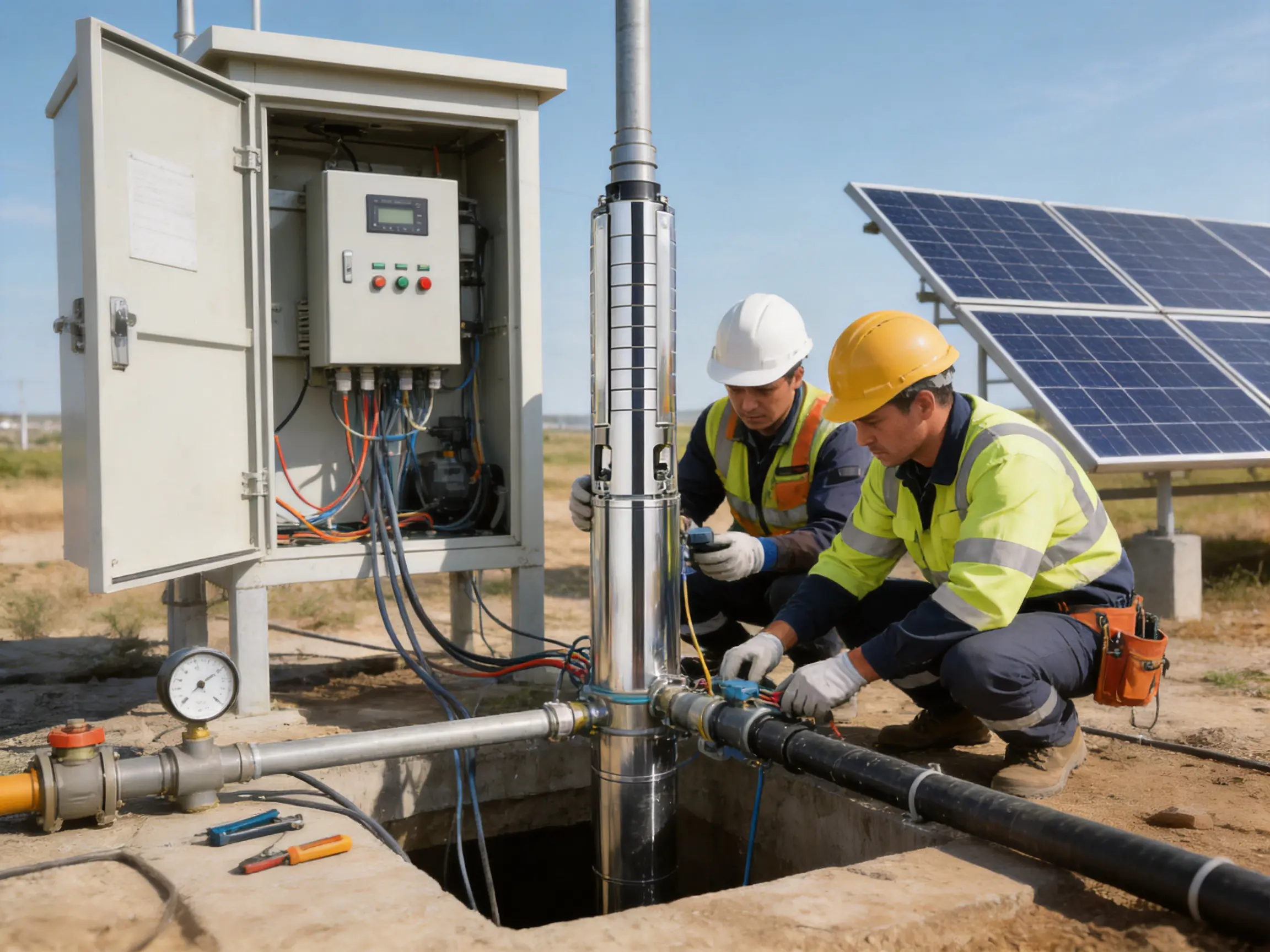
Electrical connections should be protected against water entry and mechanical damage. DC systems operating at up to 430 V can present serious shock and arc hazards. Installation, commissioning, testing, and maintenance should be performed by qualified professionals using appropriately rated equipment.
The pump should never be allowed to run dry. Low-water protection, overcurrent protection, overload protection, surge protection, and suitable monitoring equipment should be considered. The exact protection requirements depend on the controller, power source, local regulations, and installation conditions.
Routine inspection is an effective way to identify problems before they become major failures. Operators should monitor water flow, discharge pressure, operating sound, current draw, solar input, and the frequency of starting and stopping. A sudden reduction in flow may indicate a blocked pipe, falling water level, worn hydraulic components, or excessive sediment.
Solar panels should be kept reasonably clean and free from shading. Dirt, leaves, dust, and bird deposits can reduce array output and cause unstable pump operation. The array mounting structure should also be checked after severe weather.
Electrical connectors and cable joints should be inspected for moisture, corrosion, looseness, or heat damage. Any abnormal discoloration, odor, repeated tripping, or insulation damage should be investigated before the pump is returned to service.
The well should be monitored for sand production. Excessive sand can increase wear on impellers, diffusers, bearings, and shaft surfaces. If sand levels rise, the well condition and pump setting should be evaluated. In some situations, well redevelopment or filtration may be necessary.
When a pump is removed from a well, the shaft, cable, outlet, seals, and external surfaces should be inspected. Maintenance records should include operating hours, observed flow, electrical readings, repairs, and replacement components. These records can help identify trends and improve future system management.
The first step is to determine the required flow. This should be based on daily water demand, peak demand, irrigation scheduling, tank-filling time, and the recovery rate of the well. The required flow should not exceed the sustainable yield of the water source.
The second step is to calculate total dynamic head. This includes the vertical distance from the pumping water level to the delivery point, pressure required at the outlet, friction loss in the pipe, losses through fittings and valves, and any additional elevation. Using only the well depth may result in an incorrect selection.
The third step is to select the power and hydraulic configuration. High-head models such as the 4DFSW5.2-255-300-2200 versions are appropriate for demanding lifting requirements, while 25 m³/h and 30 m³/h models are better aligned with higher-volume, lower-head duties. The selected model should operate near an efficient portion of its performance range rather than at an extreme limit.
The fourth step is to select the electrical version. Choose an A/D model when both AC and DC operation are required. Choose an HV model when the installation is designed specifically for DC operation and does not require AC input.
The fifth step is to verify the solar array. Confirm that the array power meets the recommended minimum, that open-circuit voltage stays below the stated limit under the coldest expected conditions, and that operating voltage remains compatible with the controller and pump.
The final step is to confirm physical compatibility. Check the bore diameter, outlet size, cable length, pipe connection, installation depth, water chemistry, and access conditions. A technically suitable pump may still be unsuitable if the well or electrical system cannot support it.
It is an AC/DC hybrid submersible solar pump designed for four-inch bore applications. It is intended for deep wells, irrigation, rural water supply, livestock watering, and other water-transfer duties.
The A/D versions are designed to accept both compatible AC and DC input. This allows mains power to be used when solar energy is unavailable or insufficient. The HV versions are DC-only and should be used with a properly engineered high-voltage solar system.
The listed range extends from 750 W to 2,200 W. The correct power level depends on the required flow, total dynamic head, well conditions, and available electrical supply.
The highest stated maximum head in the provided range is 255 m, available on the 4DFSW5.2-255-300-2200-A/D and 4DFSW5.2-255-300-2200-HV configurations.
The highest stated maximum flow is 30 m³/h, available on the 4DFSW30-36-300-2200-A/D and 4DFSW30-36-300-2200-HV configurations.
No. Maximum flow and maximum head are reference ratings at different operating conditions. Actual performance depends on the system curve, pipe resistance, elevation, valves, and other installation factors.
The ceramic coating is intended to improve surface wear resistance on the SS304 rotor shaft. This supports durability in a rotating submersible assembly exposed to water and continuous operation.
The water-filled motor design supports heat transfer from the motor to the surrounding pumped water. Effective cooling can reduce thermal stress and support stable operation during extended pumping.
The provided information recommends solar panel power of at least 1.3 times the pump power. For example, a 1,500 W pump would require a baseline array capacity of approximately 1,950 W, subject to detailed local system design.
The solar panel open-circuit voltage should be below 430 V according to the supplied product information. Voltage must be checked under the lowest expected panel temperature because open-circuit voltage can rise in cold conditions.
The range includes models with 1.25-inch outlets and models with 2-inch outlets. The outlet size is listed in the model specifications and should be matched to the discharge piping system.
The pump is designed for water pumping, but suitability for potable-water systems depends on the complete material specification, local regulations, water quality, installation hygiene, and any required certifications. Water should be tested and treated according to applicable health standards.
The pump can be used only when the well and water conditions remain within acceptable limits. Excessive sand can accelerate wear on hydraulic and rotating components. Well development, water-quality assessment, and appropriate filtration should be considered where sand is present.
Maintenance includes checking flow, pressure, operating sound, electrical connections, cable condition, solar array cleanliness, protection devices, and well conditions. The pump should be inspected if performance changes or abnormal vibration and noise occur.
The product is manufactured by Taizhou Edwin Electric Co., Ltd., an integrated pump manufacturer based in Zhejiang Province, China. The company produces deep well pumps, submersible pumps, solar pumps, circulation pumps, domestic booster pumps, and related water-pumping products.
The 4ADFSW AC/DC Ceramic-Coated SS304 Rotor Shaft Water-Filled Solar Pump is designed for dependable water movement in applications where energy flexibility, deep-well capability, and long operating periods are important. Its hybrid AC/DC design allows the pump to work with solar power and compatible mains electricity, while its DC-only HV versions provide an option for dedicated high-voltage photovoltaic installations.
The ceramic-coated SS304 rotor shaft is intended to improve wear resistance, the water-filled motor supports heat dissipation, and the stainless steel construction provides useful corrosion resistance for general water applications. The broad model range, extending from 750 W to 2,200 W and from 4.8 m³/h to 30 m³/h, gives installers multiple options for high-head and high-flow requirements.
Compared with conventional single-energy pumps, this series offers greater operating flexibility. Compared with basic submersible designs, it provides a more application-focused combination of solar compatibility, thermal management, material protection, and hydraulic variety. These advantages can support lower dependence on fuel, improved energy planning, and more reliable water availability in agricultural, rural, commercial, and remote environments.
The best results depend on correct selection and installation. Flow, total dynamic head, well yield, bore diameter, water quality, solar-array voltage, electrical protection, and local safety requirements must all be evaluated before commissioning. When integrated into a properly engineered system, the 4ADFSW series provides a practical platform for modern solar water pumping and resilient off-grid water supply.
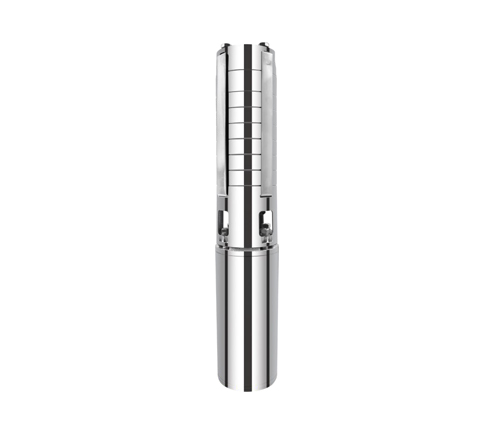
4ADFSW AC/DC Ceramic Coated SS304 Rotor Shaft Water Filled Solar Pump
Product category: AC/DC hybrid submersible solar pump.
Construction highlights: ceramic-coated SS304 rotor shaft, water-filled motor, corrosion-resistant components, and submersible four-inch bore design.
AC voltage for A/D models: 85 V to 280 V.
DC voltage: 80 V to 430 V.
Solar panel open-circuit voltage: below 430 V.
Recommended solar panel power: at least 1.3 times pump power.
Available power range: 750 W to 2,200 W.
Maximum listed flow: 30 m³/h.
Maximum listed head: 255 m.
Available outlet sizes: 1.25 inches and 2 inches.
Standard listed cable length: 2 m.
Confirm the static and dynamic water levels of the well.
Measure the required flow and estimate total daily water demand.
Calculate total dynamic head, including elevation, pressure, and pipe friction losses.
Verify borehole diameter and pump installation clearance.
Choose between an A/D model and an HV model according to the available energy sources.
Size the solar array according to pump power, local sunlight, temperature, and controller requirements.
Confirm that the solar array open-circuit voltage remains below the permitted limit.
Install suitable overcurrent, overload, low-water, surge, and disconnect protection.
Use qualified personnel for high-voltage DC and submersible electrical installation.
Establish a maintenance schedule for the pump, well, solar array, controller, cables, and delivery system.
1. Product technical information for the 4ADFSW AC/DC Ceramic-Coated SS304 Rotor Shaft Water-Filled Solar Pump, including model, electrical, hydraulic, and installation data.
2. Manufacturer product information for submersible solar pumps, deep well pumps, circulation pumps, booster pumps, and intelligent water-pumping systems.
3. General principles of photovoltaic water-pumping system design, including solar-array sizing, voltage verification, pump-controller matching, and energy-yield assessment.
4. General guidance on submersible pump installation, borehole assessment, total dynamic head calculation, electrical protection, and water-source management.
5. General engineering references concerning stainless steel component selection, rotating shaft wear, motor cooling, corrosion resistance, and preventive maintenance for water pumps.
6. General agricultural irrigation design references covering flow requirements, pressure losses, elevated storage tanks, livestock watering systems, and remote water distribution.
Taizhou Edwin Electric Co., Ltd. is an integrated manufacturing enterprise established in 2008 and located in Zhejiang Province, China. Its stated capabilities include independent research and development, mass production, and global export.
The company’s product portfolio includes deep well pumps, submersible pumps, domestic booster pumps, circulation pumps, solar water pumps, intelligent booster pumps, and related water-treatment peripheral products. Its application markets include new-energy projects, agricultural irrigation, municipal engineering, mining, construction, HVAC systems, household water supply, and other industrial and commercial water applications.
The company has also established related import, export, procurement, order-tracking, cross-border delivery, and foreign-trade service capabilities to support international customers and project buyers.
edwina@edwin-pump.com
+86-13586290903 (WhatsApp)
Xuri Gongliang Cutting Tool Entrepreneurship Park, Wenqiao Town, Wenling City, Taizhou City, Zhejiang Province, China

High Performance Smart Pump Factory


 English
