
edwina@edwin-pump.com

View All Products
en
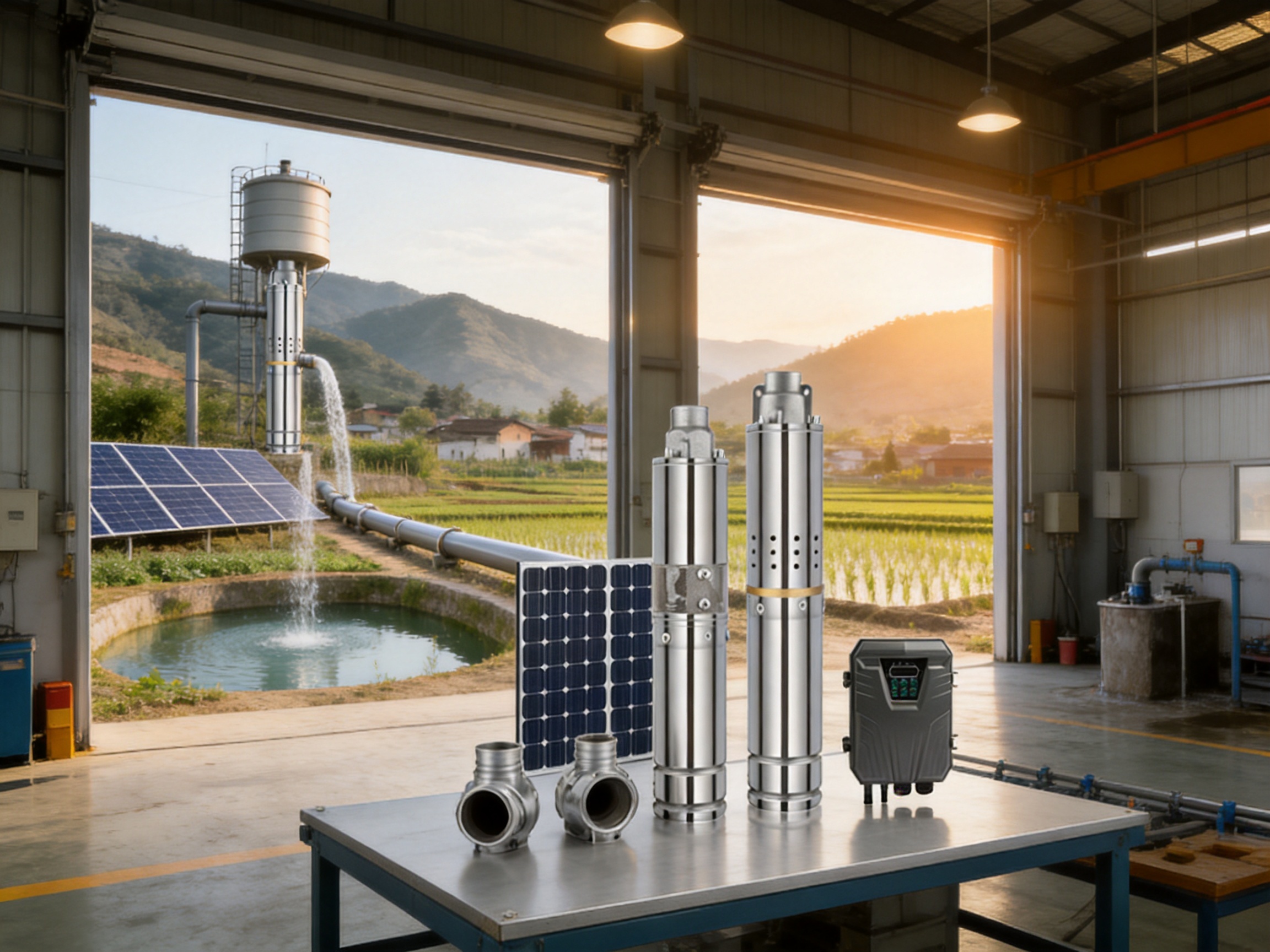
Reliable water access is one of the most important requirements in agriculture, aquaculture, rural development, and remote infrastructure. However, many water transfer projects are located far from electrical grids or in areas where conventional power supplies are expensive, unstable, or difficult to install. Solar pumping provides a practical alternative by converting renewable solar energy into useful hydraulic power without depending on continuous grid electricity or fuel delivery.
The 2/3/4ESS Brushless DC Motor Solar Screw Pump is designed for this purpose. It combines a brushless direct-current motor, solar-compatible electrical design, and screw pump hydraulics in a compact submersible package. The product range is suitable for water transfer, irrigation, aquaculture circulation, tank filling, pond management, and other off-grid applications that require dependable pumping with controlled energy consumption.
Available in multiple voltage, power, flow, head, and outlet configurations, the 2/3/4ESS series allows users to select a model according to the required pumping depth and delivery conditions. The series includes compact 80 W and 120 W versions for smaller water systems, as well as 750 W and 1,100 W models for demanding high-head applications. Maximum flow rates range from 0.5 m³/h to 3.7 m³/h, while maximum heads extend from 28 m to 180 m.
This article examines the operating principles, technical advantages, application value, selection considerations, and manufacturing strengths associated with the 2/3/4ESS solar screw pump range. It also explains why a brushless DC motor and screw pump structure can provide useful advantages compared with many conventional solar, centrifugal, or brushed-motor alternatives.
The 2/3/4ESS Brushless DC Motor Solar Screw Pump is a DC submersible solar pump developed for water transfer in locations where direct solar operation is preferred. The pump is designed to work with an appropriate photovoltaic power system, with each model requiring a specified operating voltage range and solar panel open-circuit voltage limit.
As a submersible pump, the unit is installed below the water surface. This arrangement helps the pump draw water without the same priming requirements associated with many surface-mounted pumps. When correctly installed, the pump can transfer water from wells, tanks, ponds, reservoirs, and other water sources to irrigation lines, storage tanks, livestock facilities, or community water points.
The product is based on a screw pump design. Instead of relying primarily on a high-speed impeller to generate water movement, the rotating screw element conveys liquid through the pumping chamber. This design creates a comparatively steady flow and can be suitable for water containing moderate sediment or for liquids whose viscosity is somewhat higher than that of clean water.
The motor uses brushless DC technology. Because the motor does not rely on mechanical carbon brushes for commutation, it can reduce brush wear, maintenance requirements, and the risk of performance decline caused by brush replacement. Electronic commutation allows the motor to operate efficiently with DC power from solar panels or a compatible solar controller.
The range is organized around three basic pump sizes. The 2ESS models use a 0.5-inch outlet, the 3ESS models use a 0.75-inch outlet, and the 4ESS models use a 1-inch outlet. These configurations make it possible to match the pump to different pipe sizes, flow requirements, and total head conditions.
A photovoltaic array produces DC electricity when exposed to sunlight. The electrical output varies according to solar intensity, panel temperature, shading, panel orientation, and system configuration. The pump is designed to operate within a defined DC input range, allowing the solar array to supply energy to the brushless motor either directly or through a suitable control and protection system.
The performance data specifies an appropriate input voltage range for each model. For example, some lower-voltage models operate with an optimum input range of 30 V to 48 V, while higher-power models use ranges such as 60 V to 90 V or 90 V to 120 V. The solar panel open-circuit voltage must remain below the specified limit. Proper system design is therefore essential for safe and stable operation.
The recommended solar panel power is at least 1.3 times the pump power. This allowance helps compensate for real-world conditions in which the solar array does not consistently deliver its rated output. Cloud cover, high panel temperature, dust, seasonal variation, and non-ideal installation angles can all reduce available power.
A brushless DC motor uses electronic switching rather than mechanical brushes and a commutator. Permanent magnets and electronically controlled stator windings generate rotation. This structure can offer high operating efficiency, reduced mechanical wear, and a long service life when the pump is correctly selected and maintained.
Brushless operation is particularly valuable in solar pumping systems because the available power can change during the day. An efficient motor can convert a larger proportion of available electrical energy into useful mechanical output. This can help improve water production during periods of moderate sunlight and reduce unnecessary electrical losses.
The absence of brushes also reduces the need for routine brush replacement. In remote agricultural or community installations, reducing service visits can be a major practical advantage. Maintenance teams may have to travel long distances to reach a pumping site, so a design with fewer wear components can contribute to lower operating complexity.
The screw pump mechanism uses a rotating screw and a matching pumping chamber to move liquid along the pump. The operating principle produces a relatively stable displacement effect. This is useful where the application requires consistent transfer rather than a highly fluctuating discharge.
Screw pumps can also be more tolerant of certain water conditions than delicate high-speed hydraulic arrangements. Water from ponds, open reservoirs, and agricultural sources may contain suspended particles or fine sediment. The pump should still be installed and operated within the manufacturer’s conditions, but the screw configuration is intended to support water transfer in environments where minor sediment is present.
The screw design is also helpful in high-head applications. Several models in the range provide maximum heads of more than 100 m, with the largest listed configuration reaching 180 m. Actual flow at a given operating point will depend on total dynamic head, pipe friction, water level, solar input, and system resistance, so maximum head should not be interpreted as the normal flow condition.
The pump is designed around direct-current solar operation. This avoids the need to convert solar DC power into alternating current before running the motor in applications where AC power is not otherwise required. Fewer conversion steps can help simplify the system and reduce potential conversion losses.
The combination of a brushless motor and optimized hydraulic structure supports efficient water transfer. For farms, orchards, greenhouses, and remote water projects, improved energy utilization can mean more water delivered from the same solar array or lower photovoltaic capacity for a defined water requirement.
Solar operation also reduces dependence on diesel fuel and grid electricity. Fuel-powered pumps require regular refueling, engine servicing, oil changes, exhaust management, and noise control. Grid-connected pumps may be economical where reliable electricity is available, but extending the grid to isolated sites can be costly. A correctly designed solar pump can provide daily water transfer using an energy source that is freely available after installation.
The brushless motor eliminates the mechanical brush components commonly associated with brushed DC motors. This can reduce wear-related maintenance and simplify long-term ownership. A submersible installation also protects the pump from some external environmental conditions, although the water source and installation quality remain important.
Lower maintenance is especially important for remote irrigation systems. A farm operator may prefer equipment that can operate for extended periods without frequent adjustment or replacement of motor components. Reduced service requirements can also improve system availability during critical growing seasons.
Low maintenance does not mean maintenance-free operation. Operators should inspect cables, pipe connections, mounting arrangements, water quality, and solar panels. Sediment accumulation, dry running, excessive cycling, incorrect voltage, or blocked outlets can affect service life. Good installation and periodic inspection remain essential.
The screw pump configuration is designed to produce smooth water movement. Stable delivery can benefit drip irrigation, greenhouse supply, tank filling, aquaculture circulation, and water transfer systems where sudden fluctuations are undesirable.
A steady flow can also make it easier to manage downstream storage. When a pump feeds a tank or reservoir, operators can plan filling times and use float switches, valves, or controllers to regulate the system. In irrigation projects, a predictable pumping pattern can support more consistent water distribution across different zones.
The 2/3/4ESS range includes models intended for relatively high lifting requirements. The 2ESS1.7-100-48-500 reaches a listed maximum head of 100 m, while the 3ESS series includes models with maximum heads of 109 m, 150 m, and 180 m. The 4ESS range offers maximum heads of 70 m, 103 m, and 112 m.
High-head capability is valuable in hilly agricultural areas, deep wells, elevated storage systems, and long-distance water delivery projects. A suitable pump can lift water from a lower source to a higher tank or field. The correct model must be selected using the complete system head, not only the vertical elevation.
The series includes multiple power and voltage options. Users can select a smaller pump for modest domestic or garden requirements or choose a higher-power model for deeper lifting and greater delivery demands. This is more practical than using one oversized pump for every project.
The available outlet sizes also support different pipe arrangements. A 0.5-inch outlet may suit compact installations, while 0.75-inch and 1-inch outlets can support larger delivery systems. Correct pipe sizing is important because undersized pipes increase friction losses and may reduce actual flow.
The product is designed for applications where conventional infrastructure may be unavailable. Remote farms, mountain communities, small aquaculture facilities, construction sites, field stations, and temporary water systems can all benefit from a solar-powered submersible pump.
Because the pump operates with DC input and does not require a conventional AC motor supply, the electrical system can be built around photovoltaic panels and a suitable control arrangement. Battery storage may be added when water is needed after sunset, but in many applications the pump can operate mainly during daylight and transfer water into a storage tank for later use.
This water-first approach can reduce battery requirements. Instead of storing electricity, the system stores water in a reservoir or elevated tank. In suitable locations, water storage may be more economical and easier to maintain than a large battery bank.
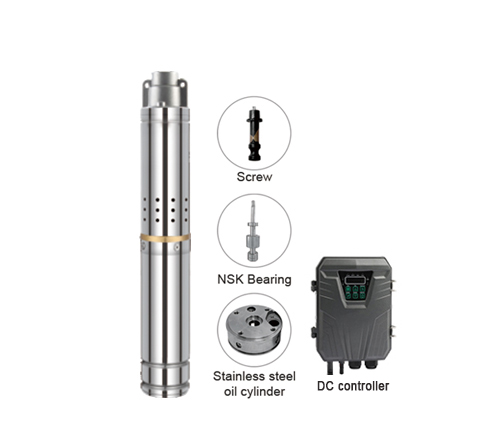
2/3/4ESS Brushless DC Motor Solar Screw Pump
The following table summarizes the listed performance data for the 2/3/4ESS Brushless DC Motor Solar Screw Pump range. Maximum flow and maximum head values represent stated limits under defined test conditions. Actual performance should be confirmed against the operating curve and the complete installation design.
| Model | Voltage | Optimum Input Voltage | Power | Maximum Flow | Maximum Head | Outlet | Cable | Solar Panel VOC Limit |
|---|---|---|---|---|---|---|---|---|
| 2ESS1.2-56-24-120 | 24 V | 30–48 V DC | 120 W | 1.2 m³/h | 56 m | 0.5 inch | 2 m | Below 60 V |
| 2ESS1.5-75-36-210 | 36 V | 30–48 V DC | 210 W | 1.5 m³/h | 75 m | 0.5 inch | 2 m | Below 60 V |
| 2ESS1.7-100-48-500 | 48 V | 60–90 V DC | 500 W | 1.7 m³/h | 100 m | 0.5 inch | 2 m | Below 110 V |
| 3ESS0.5-28-12-80 | 12 V | 30–48 V DC | 80 W | 0.5 m³/h | 28 m | 0.75 inch | 2 m | Below 60 V |
| 3ESS1.2-56-24-120 | 24 V | 30–48 V DC | 120 W | 1.2 m³/h | 56 m | 0.75 inch | 2 m | Below 60 V |
| 3ESS1.2-77-36-210 | 36 V | 30–48 V DC | 210 W | 1.2 m³/h | 77 m | 0.75 inch | 2 m | Below 60 V |
| 3ESS1.7-109-48-500 | 48 V | 60–90 V DC | 500 W | 1.7 m³/h | 109 m | 0.75 inch | 2 m | Below 110 V |
| 3ESS2-150-48-750 | 48 V | 60–90 V DC | 750 W | 2.0 m³/h | 150 m | 0.75 inch | 2 m | Below 110 V |
| 3ESS2-150-72-750 | 72 V | 90–120 V DC | 750 W | 2.0 m³/h | 150 m | 0.75 inch | 2 m | Below 170 V |
| 3ESS2.2-180-72-1100 | 72 V | 90–120 V DC | 1,100 W | 2.2 m³/h | 180 m | 0.75 inch | 2 m | Below 170 V |
| 4ESS2.6-70-48-500 | 48 V | 60–90 V DC | 500 W | 2.6 m³/h | 70 m | 1 inch | 2 m | Below 110 V |
| 4ESS2.6-103-48-600 | 48 V | 60–90 V DC | 600 W | 2.6 m³/h | 103 m | 1 inch | 2 m | Below 110 V |
| 4ESS3.7-112-72-750 | 72 V | 90–120 V DC | 750 W | 3.7 m³/h | 112 m | 1 inch | 2 m | Below 170 V |
All listed configurations require a solar panel power capacity of at least 1.3 times the pump power. The photovoltaic array should be designed so that its open-circuit voltage remains below the corresponding limit. The stated optimum input voltage is also important because a system that operates outside the recommended range may not deliver the intended performance.
The first selection step is to estimate how much water must be delivered within a particular period. Irrigation requirements may be expressed in cubic meters per day, liters per minute, or cubic meters per hour. A farm that requires 12 m³ of water per day does not necessarily need a pump capable of delivering 12 m³/h. If the pump operates for six effective sunlight hours, the required average flow may be approximately 2 m³/h, subject to solar availability and system losses.
Water demand should include irrigation, livestock, domestic use, tank filling, flushing, and any other connected loads. Seasonal requirements should also be considered. A pump selected only for average demand may be insufficient during dry periods or peak crop water requirements.
Total dynamic head includes the vertical lift from the water level to the discharge point and the friction losses in pipes, elbows, filters, valves, and other fittings. If water must be delivered to an elevated tank, the tank inlet elevation is part of the static head. If water is sent through a long pipeline, friction may become a significant part of the total requirement.
The maximum head shown in a product specification is not the head at which maximum flow occurs. As head increases, flow normally decreases. The correct design point should be located on the pump performance curve. The selected model should provide the required flow at the actual total dynamic head, rather than simply meeting a maximum-head figure.
The solar array must match the electrical requirements of the pump. The system designer should consider the pump’s rated voltage, optimum input voltage, maximum open-circuit voltage, panel output power, wiring losses, and environmental conditions.
For lower-voltage models, the available configurations include 12 V, 24 V, and 36 V nominal options. Higher-power models are available at 48 V and 72 V. Higher system voltage can help reduce current for a given power level, which may reduce cable losses when long wiring runs are unavoidable. However, higher-voltage systems require appropriate electrical protection and installation practices.
The pump is intended for water transfer and is described as suitable for water containing sediment or liquids with somewhat higher viscosity. Nevertheless, the source should be evaluated before installation. Large stones, fibrous material, abrasive particles, and severe contamination can damage pumping components or reduce service life.
A suitable intake arrangement, screen, or sediment management system may be needed. The pump should not be used for liquids outside the intended application without technical confirmation. Water chemistry, temperature, suspended solids, and biological matter can all influence material compatibility and operating life.
The outlet size provides an initial indication of the recommended connection size, but the complete pipeline should be designed according to flow and distance. A long pipe that is too small can create excessive friction and reduce the water delivered at the end of the system. Increasing pipe diameter may improve hydraulic efficiency, especially in long-distance or high-head installations.
Valves, filters, check valves, and fittings should be selected to minimize unnecessary pressure loss. The pipeline should also be supported to avoid mechanical stress on the pump outlet and cable assembly.
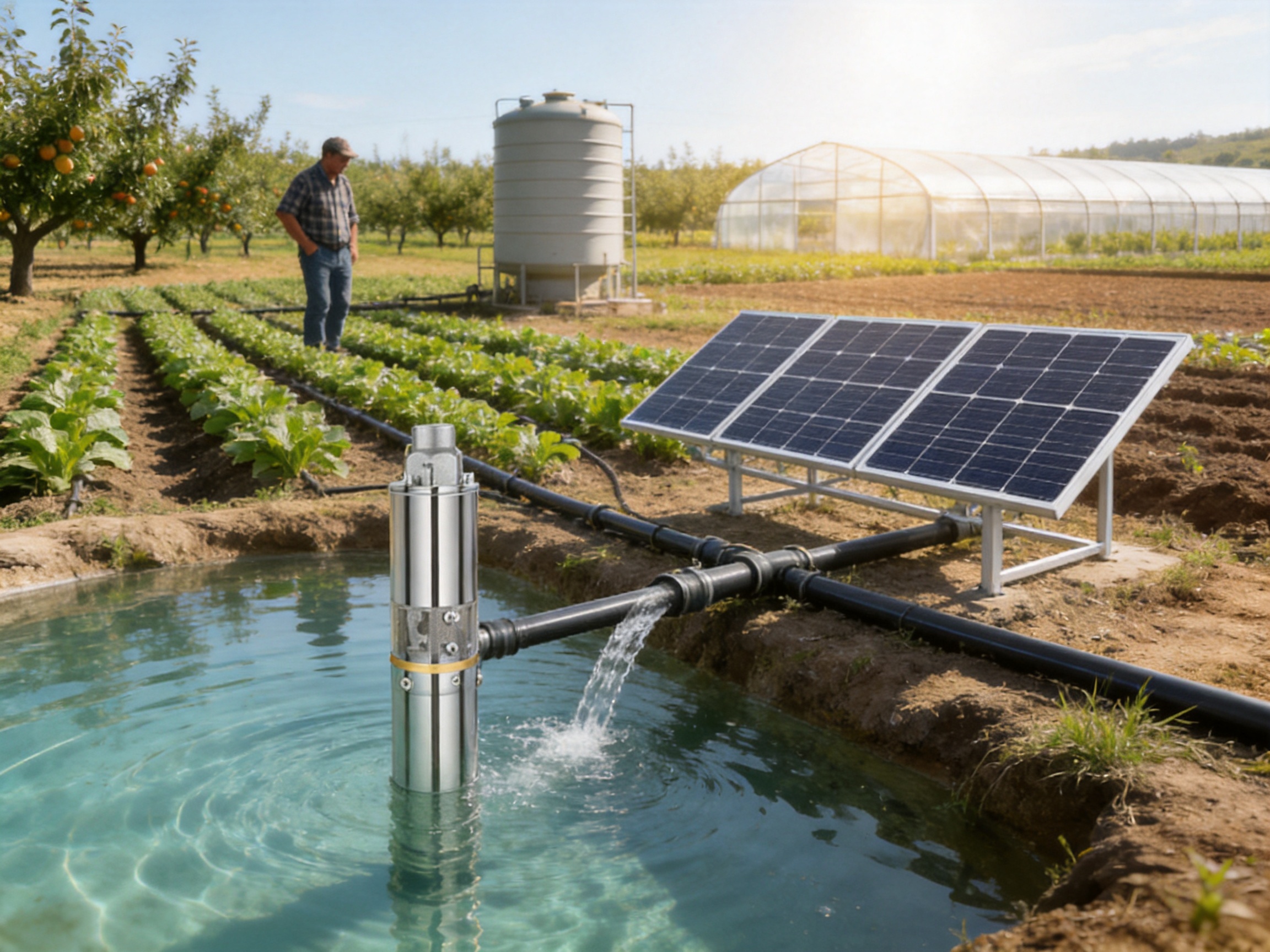
Solar irrigation is one of the most important applications for this pump range. Farms may use the pump to transfer water from a well, pond, canal, or reservoir to drip lines, sprinklers, storage tanks, or field distribution systems.
For drip irrigation, a storage tank can be positioned at an elevated location or connected to a controlled distribution network. The solar pump fills the tank during daylight, while irrigation takes place according to a timer or agricultural schedule. This approach separates water collection from water application and can make the system easier to manage.
The high-head models can be useful when the water source is deep or when fields are located above the source. Lower-power versions may be suitable for smaller plots, greenhouse sections, and localized irrigation zones.
Orchards often require water to be moved across uneven terrain. A solar screw pump can transfer water to elevated tanks or pressurized irrigation lines, depending on the system design. Greenhouses may use the pump for irrigation reservoirs, nutrient solution transfer, or water circulation, provided that the liquid characteristics are compatible with the pump.
Stable water delivery is valuable in controlled growing environments. It can support more consistent irrigation intervals and reduce the risk of sudden flow changes that affect sensitive plants.
Aquaculture facilities require regular water circulation, transfer, and replenishment. The pump can be used to move water between ponds, tanks, raceways, and reservoirs. Solar operation is particularly useful in outdoor aquaculture sites where sunlight is available and grid power is limited.
Water quality must be carefully considered in aquaculture. Intake screens and filtration may be required to protect fish, prevent blockage, and reduce the movement of unwanted solids. Operators should also verify whether the flow and head match the oxygenation, circulation, or exchange requirements of the facility.
In remote communities, solar pumping can provide water for storage tanks, household use, livestock, sanitation, and small-scale agriculture. A storage-based system can collect water during daylight and make it available throughout the day or night.
The pump’s submersible form can reduce the need for a dedicated surface pump room. However, the installation still requires proper cable routing, pipe support, water-level protection, and access for inspection or removal.
The range is suitable for transferring water between open or enclosed storage points. Applications may include filling an irrigation tank, moving water from a lower pond to an upper reservoir, maintaining water levels, or supplying a treatment process.
Where water is stored for later use, the pump can operate during periods of strong sunlight. This allows the project to use the reservoir as an energy storage medium, reducing the need for batteries and improving the practical value of the solar installation.
Brushed DC pumps use physical brushes that gradually wear as the motor operates. They may require periodic replacement, particularly in systems with long operating hours. The brushless design of the 2/3/4ESS range eliminates this specific wear mechanism.
Brushless motors can also provide improved electrical efficiency and more consistent operation over their service life. For remote installations, these advantages can reduce intervention and help maintain dependable performance. The actual service life still depends on operating conditions, water quality, voltage stability, cooling, and installation quality.
Fuel-powered pumps can deliver substantial output but require fuel logistics, combustion engine maintenance, lubrication, exhaust management, and noise control. They also generate direct operating emissions. A solar pump has higher initial system-design requirements but can provide very low routine energy costs after installation.
For daily irrigation and regular water transfer, the absence of fuel consumption can produce meaningful savings over the operating life of the system. Solar pumping can also be more convenient in areas where fuel deliveries are unreliable or expensive.
AC surface pumps are practical where grid power is available, but they may require a stable electrical supply, an inverter, or a generator in remote locations. A submersible solar pump can be installed closer to the water source and operated from a DC photovoltaic system.
The submersible arrangement may also reduce priming problems associated with surface suction pumps. However, surface pumps can be easier to access for inspection, so the best choice depends on water depth, installation conditions, security, and maintenance resources.
Centrifugal pumps are widely used and can provide high flow rates in suitable operating ranges. The screw configuration offers a different performance profile, emphasizing stable displacement and high-head water transfer in a compact format. It may be better suited to applications requiring moderate flow and substantial lifting height.
The correct comparison should consider the complete duty point, water quality, solar resource, pipe system, maintenance plan, and lifecycle cost. No single hydraulic design is ideal for every application. The value of the 2/3/4ESS range lies in its combination of screw pumping, brushless DC operation, and solar compatibility.
The product is manufactured by Taizhou Edwin Electric Co., Ltd., an integrated manufacturing enterprise established in 2008. The company focuses on independent research and development, mass production, and global export. Its product portfolio includes deep well pumps, submersible pumps, domestic booster pumps, circulation pumps, solar water pumps, and intelligent booster pumps.
An integrated manufacturing structure can provide important advantages for pump buyers. When product development, production, quality coordination, and export services are managed within an organized industrial business, it becomes easier to maintain product consistency and respond to different market requirements.
Independent research and development supports the adaptation of pump designs to changing application requirements. Solar pumping requires coordination between motor performance, hydraulic output, electrical voltage, photovoltaic capacity, and installation conditions. Developing these elements as a coordinated product system can help avoid the limitations of simply combining unrelated components.
The company’s investment in new energy and intelligent technology since 2018 reflects a focus on expanding beyond conventional pump products. The development of solar water pumps and intelligent booster pumps addresses growing demand for energy-efficient, automated, and remotely deployable water systems.
Mass production is important for distributors, engineering contractors, and original equipment buyers that require repeatable supply. A standardized series with multiple models can simplify procurement and spare-parts planning. It also allows buyers to select different pump capacities while maintaining a familiar product platform.
For international projects, production capability must be supported by consistent documentation, packaging, product identification, and order coordination. These factors influence not only the initial purchase but also the ability to deliver multiple batches over time.
Solar pumps are often installed in demanding outdoor environments. They may be exposed to temperature changes, moisture, dust, intermittent solar power, fluctuating water levels, and difficult service access. Durable construction and careful production control are therefore essential.
A quality-oriented manufacturing approach should include control of motor assembly, hydraulic components, sealing arrangements, electrical connections, cable integrity, and final operating checks. Although specific factory inspection procedures may vary by order and model, buyers should request the applicable inspection records, test standards, and quality documents for their project.
To meet wider purchasing needs, the company established Taizhou Haipai Import & Export Co., Ltd. and Golden Falcon Industrial Co., Ltd. in 2012. These related businesses support procurement planning, order tracking, cross-border delivery, and foreign trade services.
This structure can be useful for international customers that need more than a single pump. A project may require several pump sizes, accessories, packaging formats, shipping documents, and delivery schedules. Coordinated procurement support can reduce communication gaps between technical selection, production, and logistics.
The company serves customers in the global market and focuses on medium-to-high-end pump applications. Its products are used in new energy projects, agricultural irrigation, municipal engineering, mining, construction, HVAC systems, and household water supply.
Exposure to different international markets can help a manufacturer understand variations in voltage standards, installation practices, climate, pipe systems, water sources, and customer expectations. Export experience also requires attention to packaging, labeling, commercial documentation, and cross-border delivery coordination.
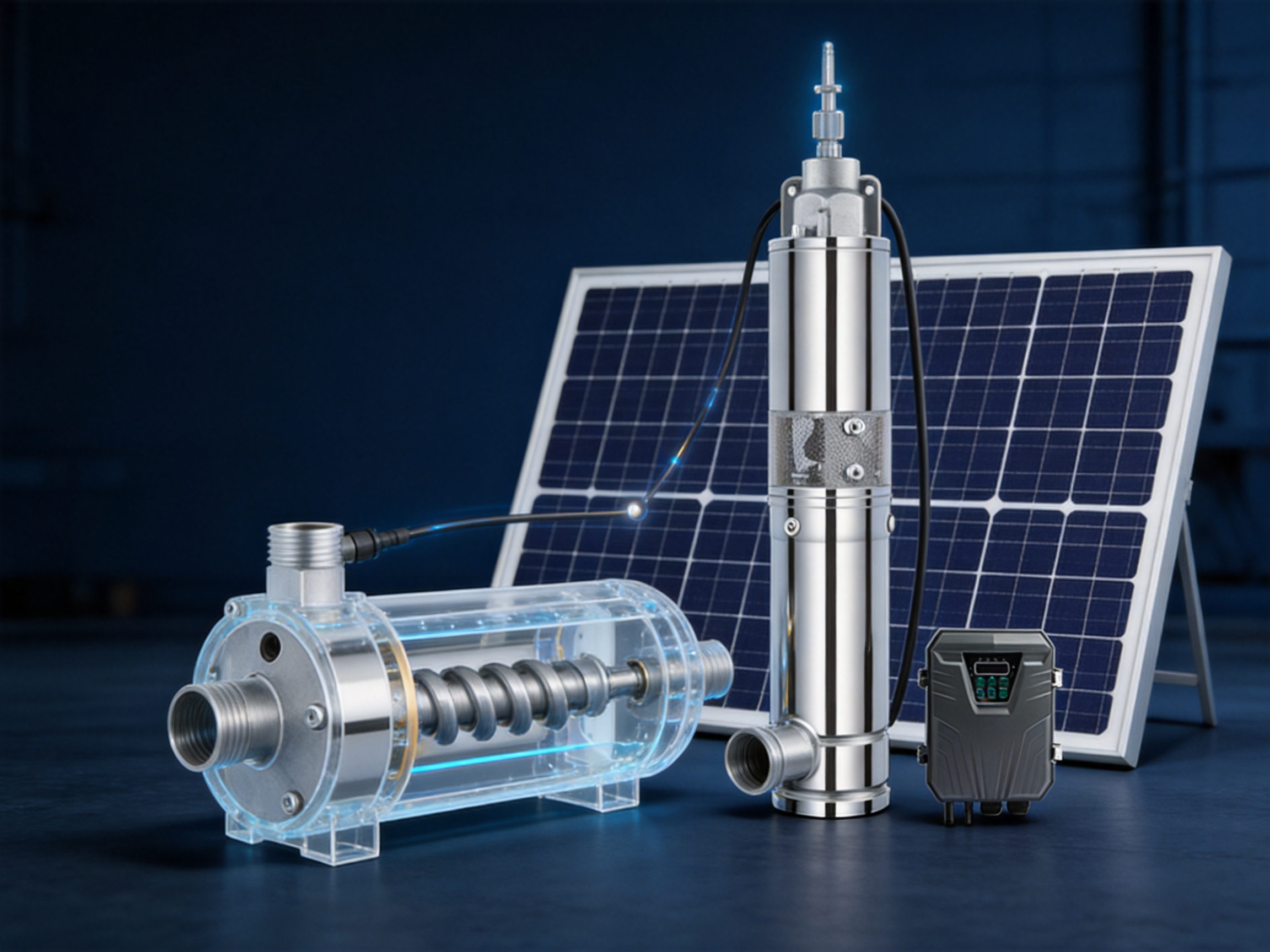
The recommended photovoltaic capacity is at least 1.3 times the pump power. For a 500 W pump, the minimum suggested panel power based on this guideline is approximately 650 W. For a 750 W pump, the corresponding value is approximately 975 W. For the 1,100 W model, the recommended minimum is approximately 1,430 W.
These values are starting points rather than complete system designs. Local solar radiation, seasonal weather, panel orientation, shading, cable length, controller efficiency, and desired daily operating time should also be considered. A project located in a cloudy region or requiring reliable seasonal output may need additional photovoltaic capacity.
The solar array’s open-circuit voltage must remain below the limit specified for the selected pump. The open-circuit voltage can rise under certain low-temperature conditions, so the designer should not evaluate the array only at its normal operating voltage.
Series and parallel panel arrangements should be calculated carefully. Protective devices and a compatible controller may be required to manage voltage, current, startup, dry-run conditions, and abnormal operating states. Electrical installation should be performed by qualified personnel in accordance with local regulations.
Submersible pumps should not be allowed to operate without adequate water coverage unless the product is specifically designed for dry running. A low-water sensor, float switch, probe, or suitable controller can help prevent operation when the source level falls below the safe limit.
Water-level protection is particularly important for seasonal wells, small tanks, and reservoirs that experience rapid drawdown. Preventing dry running can reduce heat buildup, mechanical stress, and premature component wear.
A storage tank can improve the usability of solar pumping by collecting water during strong sunlight and supplying demand later. A float switch can stop the pump when the tank is full, while a low-level sensor can restart it when the water level falls.
For irrigation, a controller can coordinate pump operation, tank filling, valve opening, and irrigation timing. For community water supply, storage capacity should be calculated from daily demand, expected sunlight, reserve requirements, and the reliability expected during cloudy periods.
The listed pump configurations include a 2 m cable. The cable should be protected from abrasion, sharp edges, excessive tension, and prolonged exposure to unsuitable conditions. Any extension or connection should use components rated for the system voltage and outdoor or submerged environment.
Connections must be sealed properly to prevent moisture ingress. Poor electrical connections can create voltage drop, overheating, intermittent operation, or motor damage. Cable routing should also allow the pump to be removed for inspection without placing stress on the electrical leads.
Before installation, inspect the pump, cable, outlet, fittings, and packaging for visible damage. Confirm the model number, voltage, power, outlet size, and intended operating conditions. Verify that the water source is deep enough and that the pump will remain adequately submerged during operation.
Check the solar array and control equipment before connecting the pump. Confirm that the voltage range and open-circuit voltage are appropriate. The system should also include any required switches, protection devices, fuses, sensors, or controllers.
The pump should be positioned securely in the water source. It should not rest directly on loose sediment where the intake may become blocked. A suitable support, suspension arrangement, or intake protection system can help maintain a stable position.
The discharge pipe should be supported independently where possible. The pump outlet should not carry the full weight of a long pipe or experience side loading caused by poor alignment.
At start-up, confirm that the discharge route is open and that water can move freely. Observe the initial flow, electrical behavior, pipe connections, and water quality. Check for abnormal vibration, unusual noise, leakage, or rapid changes in operating conditions.
The first operating period should be used to verify that the pump delivers water to the intended point and that the solar array provides sufficient power during the available sunlight. If the system stops during low sunlight, the design may require additional solar capacity or a different operating schedule.
Routine maintenance should include cleaning solar panels, checking cable and pipe connections, inspecting intake screens, confirming sensor operation, and monitoring water output. A decline in flow may indicate sediment accumulation, pipe blockage, falling water level, shading, solar panel contamination, or a change in system resistance.
The water source should be inspected periodically. Sediment can accumulate around the pump, especially in ponds and unlined reservoirs. If necessary, the pump should be removed and cleaned according to appropriate service procedures.
In areas subject to freezing temperatures, seasonal shutdown procedures may be required. Exposed pipes should be protected or drained, and the pump should be stored according to the environmental conditions. In regions with monsoon rainfall, flooding, or high sediment loads, operators should inspect the source after severe weather before restarting the system.
The economic value of a solar pump should be evaluated over its entire operating life rather than by purchase price alone. Initial costs include the pump, solar panels, supports, controller, cables, pipes, storage tanks, sensors, and installation. Operating savings may come from reduced fuel consumption, lower electricity bills, fewer service visits, and less dependence on remote infrastructure.
For agricultural users, dependable water access can also create indirect economic benefits. Regular irrigation may improve crop consistency, reduce losses during dry periods, and support higher-value cultivation in greenhouses or orchards. In aquaculture, stable water circulation can contribute to better management of ponds and tanks.
Environmentally, solar operation reduces direct fuel combustion at the pumping site. It can support renewable-energy projects and reduce noise compared with many engine-driven pumps. The overall environmental performance still depends on product durability, responsible installation, solar panel lifecycle, and correct end-of-life disposal.
Using a water storage tank instead of a large battery system can further reduce system complexity. Stored water can provide useful flexibility for irrigation and domestic supply while allowing the pump to operate mainly when solar energy is available.
International buyers should provide detailed application information when requesting a quotation. Important data includes water source type, minimum and maximum water level, required daily volume, desired flow rate, vertical lift, pipe length, pipe diameter, water quality, operating schedule, location, solar resource, and whether storage or battery backup will be used.
Model selection should be based on the actual duty point. A manufacturer or technical distributor can use the information to recommend a suitable configuration and identify whether additional controllers, sensors, pipes, valves, or accessories are needed.
For larger projects, buyers should also clarify packaging, production lead time, spare parts, inspection requirements, documentation, warranty terms, delivery terms, and after-sales support. A complete procurement plan helps prevent delays caused by mismatched voltage, incorrect pipe sizes, unsuitable solar arrays, or incomplete installation materials.
The manufacturer’s experience in R&D, mass production, export, procurement planning, order tracking, and cross-border delivery provides a foundation for serving both individual pump purchases and larger project orders. This one-stop approach can be particularly valuable for distributors, engineering contractors, agricultural developers, and infrastructure buyers.
The pump uses a brushless DC motor. Electronic commutation replaces mechanical brushes, helping reduce brush wear and maintenance requirements. The motor is designed for efficient operation in solar-powered DC systems.
The pump is designed for solar-powered operation, but the photovoltaic array must be correctly matched to the selected model. The input voltage, open-circuit voltage, power capacity, protection equipment, and control method must all comply with the applicable technical requirements.
The listed recommendation is solar panel power of at least 1.3 times the pump power. For example, a 500 W pump should generally be paired with at least approximately 650 W of solar panel capacity. Local weather, shading, seasonal conditions, and operating requirements may justify using more capacity.
The highest listed maximum head is 180 m, provided by model 3ESS2.2-180-72-1100. Actual flow at that head will depend on the pump curve and complete system conditions.
The highest listed maximum flow rate is 3.7 m³/h, provided by model 4ESS3.7-112-72-750. This maximum value should be evaluated together with the required head and pipe system.
The screw pump design is intended to handle water containing sediment or liquids with somewhat higher viscosity. However, extremely abrasive, heavily contaminated, or debris-filled water may require additional filtration or a different pump type. Water quality should be confirmed before purchase.
Yes. The pump is suitable for solar irrigation in farmland, orchards, and greenhouses. It can supply drip systems, sprinklers, storage tanks, and other irrigation arrangements when the flow and head requirements are correctly calculated.
A battery is not necessarily required if the pump operates during daylight and transfers water into a storage tank. Battery storage may be considered when water must be pumped after sunset or when the system requires more stable electrical availability.
A float switch, water-level sensor, probe, or compatible controller can be used to prevent dry running. The appropriate protection method depends on the water source and system configuration.
The voltage should be selected according to the required power, cable distance, solar array arrangement, and system design. The available range includes 12 V, 24 V, 36 V, 48 V, and 72 V configurations. The solar array must remain within the specified input and open-circuit voltage limits.
The brushless motor does not use mechanical carbon brushes, so it can reduce brush-related wear and maintenance. It can also provide efficient electrical operation, which is valuable when solar energy is limited or variable.
The product is manufactured by Taizhou Edwin Electric Co., Ltd., an integrated enterprise involved in pump research and development, mass production, and global export. The company’s product portfolio includes submersible, deep well, booster, circulation, solar, and intelligent pump products.
Users should provide the required flow, total head, water source, water quality, pipe length, pipe diameter, daily operating time, location, solar conditions, and storage requirements. This information allows the selected model and solar array to be matched more accurately to the project.
The 2/3/4ESS Brushless DC Motor Solar Screw Pump is a versatile solution for efficient water transfer in off-grid and renewable-energy applications. Its brushless DC motor supports low-maintenance operation, while the screw pump structure provides stable delivery and useful high-head capability. The range of voltage, power, outlet, flow, and head options allows the pump to serve applications from compact water systems to demanding agricultural and remote infrastructure projects.
Compared with many conventional alternatives, the product offers the combined advantages of solar compatibility, reduced dependence on fuel or grid electricity, efficient DC operation, compact submersible installation, and flexible model selection. Its practical value is strongest when the pump is matched carefully with the solar array, water source, pipe network, storage capacity, and actual hydraulic duty point.
The manufacturer’s experience in independent R&D, mass production, export, new-energy technology, and one-stop procurement support further strengthens the product’s suitability for international projects. With correct design, installation, protection, and maintenance, the 2/3/4ESS series can support sustainable irrigation, aquaculture, household supply, reservoir management, and other water-transfer requirements in locations where reliable conventional power is unavailable.
1. Manufacturer-provided product information for the 2/3/4ESS Brushless DC Motor Solar Screw Pump.
2. Manufacturer-provided performance data covering voltage, power, flow, maximum head, outlet size, cable length, and photovoltaic requirements.
3. General engineering principles for photovoltaic water pumping system design.
4. General reference materials on brushless DC motor operation and electronic commutation.
5. General reference materials on screw pump hydraulics, water transfer, and positive-displacement pumping.
6. General agricultural irrigation planning principles, including flow estimation, total dynamic head, storage, and pipe friction.
7. General guidelines for submersible pump installation, water-level protection, electrical safety, and routine maintenance.
aseriesnoisereductiondesignacid-baseverticalsurfacepump-1.jpg "EV(F)A Series Noise Reduction Design Acid-base Vertical Surface Pump")
edwina@edwin-pump.com
+86-13586290903 (WhatsApp)
Xuri Gongliang Cutting Tool Entrepreneurship Park, Wenqiao Town, Wenling City, Taizhou City, Zhejiang Province, China

High Performance Smart Pump Factory


 English