
edwina@edwin-pump.com

View All Products
en
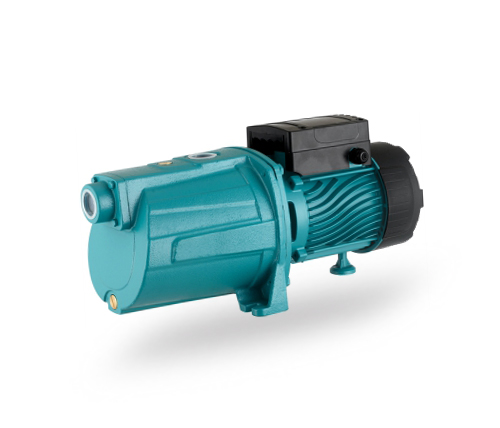
JSW Series C&U Bearing AISI304 Shaft Self-priming JET Pump for Clean Water
Reliable water transfer is essential in homes, gardens, farms, workshops, and small commercial facilities. In many of these applications, the water source is located below the pump, the suction pipe may contain air, or the installation may remain unused for extended periods. A standard surface pump can struggle under these conditions unless it is correctly primed and carefully maintained. A self-priming jet pump is designed to address these challenges by combining surface-mounted accessibility, suction capability, pressure generation, and convenient operation in one compact unit.
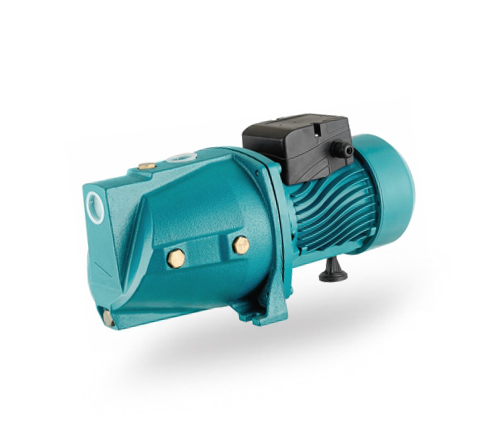
The JSW Series self-priming jet pump is developed for clean water and liquids with physical and chemical properties similar to water. It combines a cast iron pump body and support, a brass impeller, an AISI 304 stainless steel shaft, C&U bearings, a carbon/ceramic mechanical seal, and a copper-wound motor. These construction choices give the pump a balanced combination of durability, corrosion resistance, smooth operation, and practical cost control.
With a maximum suction height of 8 meters, maximum liquid temperature of 40°C, and model options covering approximately 45 to 60 liters per minute of maximum flow, the series is suitable for domestic water supply, garden irrigation, water lifting from tanks and wells, small pressure systems, and automatic irrigation installations. Its design also allows it to handle operating conditions in which air or water may be present in the suction line, making it more forgiving than many ordinary surface pumps.
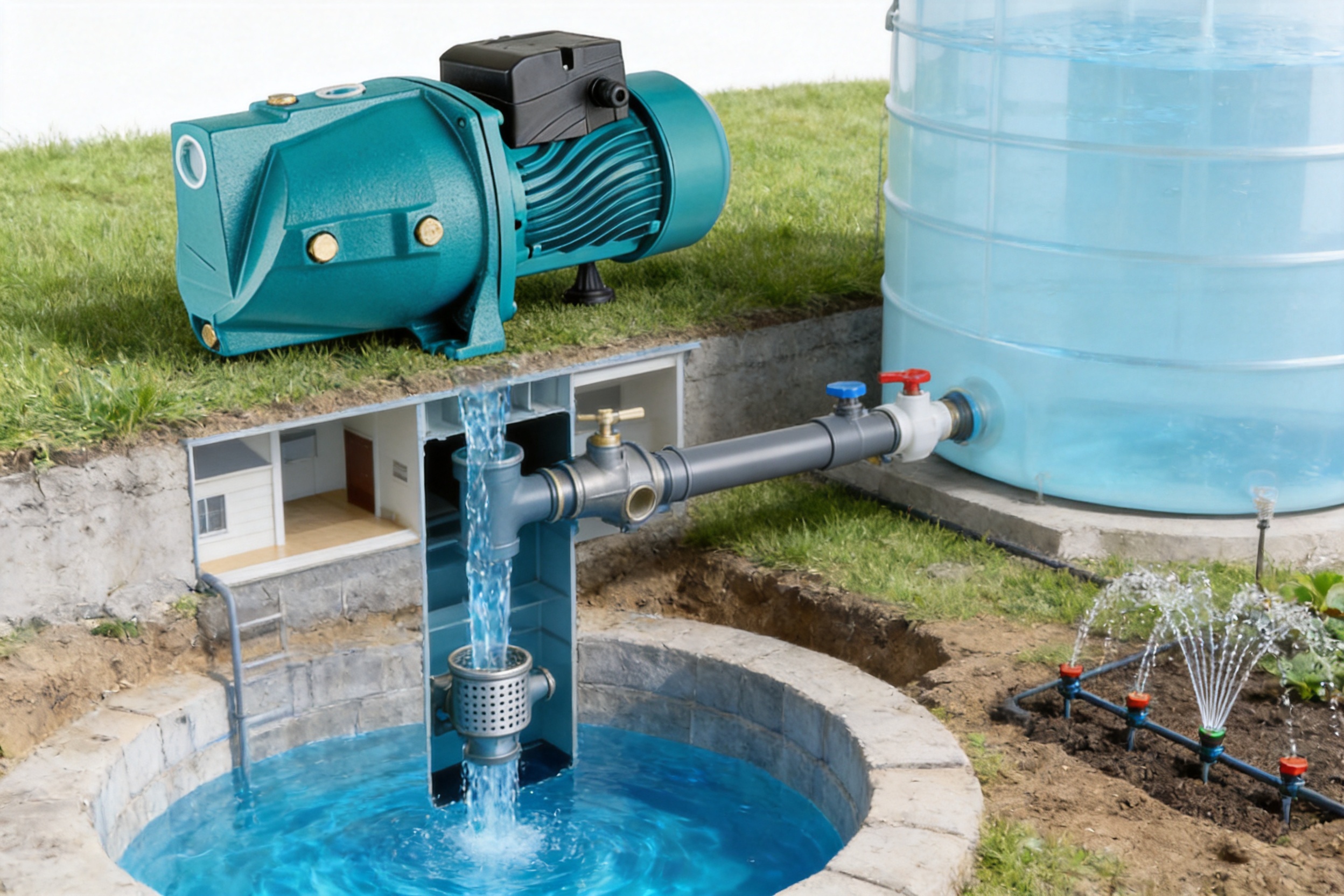
A self-priming jet pump is a surface-mounted centrifugal pump equipped with a jet or ejector passage that helps remove air from the suction line. During initial operation, the pump uses recirculated water to create a pressure difference within the hydraulic chamber. This action assists in drawing water upward from a lower source and helps establish a continuous flow through the suction pipe.
This operating principle is particularly useful where the pump cannot be installed directly inside the water source. Instead of lowering the motor and electrical components into a well, tank, or collection pit, the pump can remain in an accessible and protected location. The suction pipe connects the pump to the water source, while the discharge pipe supplies the building, irrigation system, storage tank, or pressure set.
The self-priming function does not eliminate the need for correct installation. The pump chamber generally needs to be filled with water before the first start, the suction pipe must be airtight, and the suction strainer or foot valve must be correctly installed where required. Once the hydraulic circuit is properly established, the jet design helps the pump recover from limited air entry more effectively than a conventional non-self-priming surface centrifugal pump.
For clean-water applications, the JSW Series provides a practical alternative to a deep-well submersible pump or a more complex multistage system. It is easier to inspect than a submerged pump, requires less installation depth, and can be selected according to the required pressure and flow. It is especially suitable for users who need dependable water transfer without the infrastructure associated with larger commercial pumping systems.
The shaft is one of the most important components in a pump because it transfers motor torque to the impeller and remains close to the pumped liquid. The JSW Series uses an AISI 304 stainless steel shaft in the water-contact area. This material offers significantly better resistance to rust and oxidation than ordinary carbon steel.
Using stainless steel helps protect the shaft during repeated contact with clean water and reduces the risk of corrosion-related surface damage. A smoother and more stable shaft surface also supports the service life of the mechanical seal. This is important because a damaged or corroded shaft can cause premature seal wear, leakage, vibration, and eventual pump failure.
The AISI 304 shaft is a meaningful advantage over entry-level pumps that use less corrosion-resistant shaft materials. Although the suitability of any stainless steel grade depends on the liquid chemistry, AISI 304 is well matched to ordinary clean-water service, domestic supply, and garden irrigation applications.
The impeller is responsible for transferring mechanical energy from the motor to the water. In the JSW Series, the impeller is made from brass. Brass provides a useful balance between strength, dimensional stability, corrosion resistance, and manufacturing practicality.
A brass impeller is less vulnerable to rust than a standard untreated ferrous impeller. It can also maintain its shape during normal clean-water operation, helping preserve the hydraulic characteristics of the pump. The use of brass, together with rust-free copper inserts, supports smoother restarting after the pump has been idle for a long period.
For domestic and small agricultural installations, this construction is valuable because pumps are not always operated continuously. A garden irrigation system, seasonal water installation, or backup supply pump may remain inactive for days or weeks. Materials that resist rust and sticking can make restarting more dependable when the pump is needed again.
The pump body and support are manufactured from HT200 cast iron and receive special anti-rust treatment. Cast iron is widely used in pump construction because it offers good mechanical strength, structural rigidity, vibration resistance, and cost efficiency.
A rigid housing helps maintain the alignment between the motor, shaft, impeller, and mechanical seal. It also provides a stable platform for connection to the suction and discharge piping. The anti-rust treatment improves the surface protection of the body and support, making the pump better suited to ordinary indoor and sheltered outdoor installations.
Compared with lightweight housings that may be more vulnerable to vibration or impact, a cast iron structure gives the JSW Series a solid operating foundation. At the same time, the aluminum motor case helps keep the overall motor assembly reasonably manageable for installation and servicing.
The motor uses high-efficiency C&U bearings. Bearings support the rotating shaft and rotor, reduce friction, and help maintain smooth rotation under operating load. Their condition has a direct effect on operating noise, vibration, energy transfer, and service life.
High-quality bearings are particularly important in a jet pump because the motor and hydraulic assembly operate at relatively high rotational speed. Stable bearing performance helps the impeller rotate concentrically and reduces unnecessary mechanical stress. It also contributes to a more consistent user experience during domestic water supply and irrigation.
Compared with pumps assembled with unidentified or inconsistent bearing components, the use of recognized C&U bearing technology provides a clearer basis for quality control and replacement planning. Bearing quality is only one part of total pump reliability, but it is an important part of the motor platform.
The motor is fitted with durable copper wiring. Copper has excellent electrical conductivity, allowing efficient current transfer through the stator winding. Proper copper winding design can help reduce resistive losses, control heat generation, and support dependable motor performance.
For a pump used in residential water supply or irrigation, motor reliability is often more important than peak output alone. The pump may start and stop frequently as taps open, tanks fill, or irrigation zones change. A properly designed copper-wound motor is suitable for these repeated operating cycles when the pump is installed and protected according to the instructions.
The single-phase motor also includes a built-in thermal protector. If the motor temperature rises excessively due to overload, blocked ventilation, abnormal voltage, or other operating problems, the thermal protection device can interrupt operation to reduce the risk of winding damage. The protector is not a substitute for correct electrical installation, but it adds an important layer of safety.
The motor uses Class F insulation. This insulation class is designed for a higher thermal endurance level than basic motor insulation systems, providing a useful margin during ordinary pump operation. Thermal endurance depends on the entire motor design, ambient conditions, loading, and ventilation, but the Class F specification indicates a robust insulation platform.
The motor protection rating is IP44. This means the enclosure is protected against solid objects of a specified size and against water splashing from different directions. IP44 is suitable for many sheltered pump-room and utility installations, but the pump should not be submerged or exposed to uncontrolled heavy rain, flooding, or direct water jets.
Installation in a dry, ventilated, and accessible location remains essential. The electrical supply should be correctly grounded, and a suitable circuit protection device should be provided. Users should always follow local electrical regulations and the product’s installation instructions.
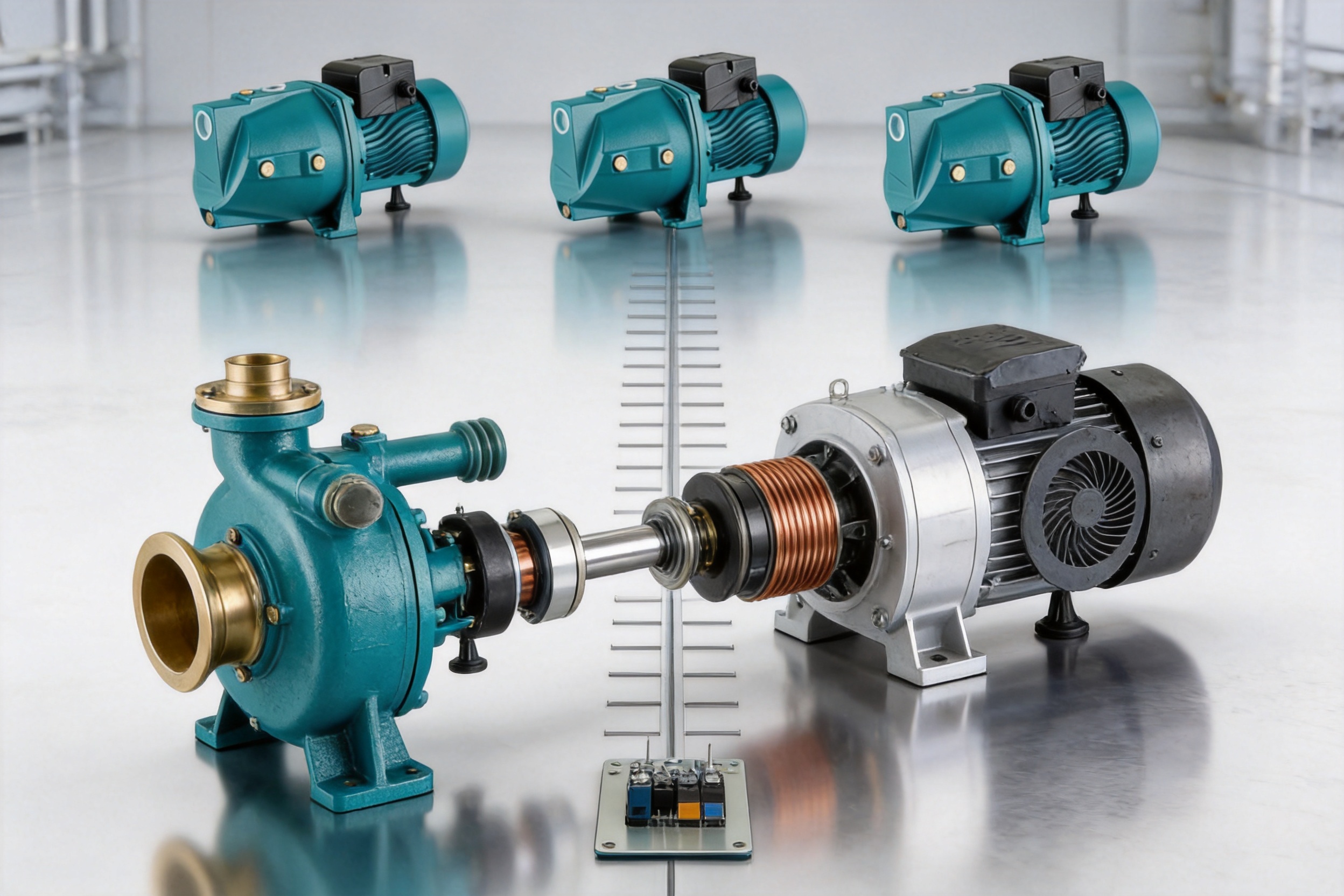
The product structure reflects a deliberate combination of metallic and engineered polymer materials. The pump body and support use HT200 cast iron, the venturi tube and diffuser use PPO, and the impeller uses brass. The mechanical seal uses carbon and ceramic materials, while the motor case is aluminum and the motor cover is cast iron.
The venturi tube and diffuser are important parts of the jet system. PPO is a suitable engineering polymer for these components because it can provide dimensional stability, low weight, and resistance to ordinary clean-water service. The material combination also allows the hydraulic passages to be manufactured with consistent geometry.
The carbon/ceramic mechanical seal separates the rotating shaft from the stationary pump housing. This seal must maintain a controlled contact interface while preventing water from entering the motor section. Carbon and ceramic are commonly used together because they offer a practical balance of sealing performance, wear resistance, and compatibility with clean-water pumping.
The aluminum motor case contributes to heat dissipation and weight management. The cast iron motor cover adds structural support at the rear of the motor. The fan and fan cover support motor cooling, while the terminal board made from PC provides electrical connection support inside the terminal area.
| Component | Specified Material | Functional Contribution |
|---|---|---|
| Pump body | HT200 cast iron | Rigid hydraulic housing and durable structural support |
| Venturi tube | PPO | Supports the jet and self-priming passage |
| Diffuser | PPO | Helps manage water velocity and pressure recovery |
| Impeller | Brass | Transfers motor energy to the water with corrosion resistance |
| Mechanical seal | Carbon/ceramic | Controls leakage around the rotating shaft |
| Shaft and rotor | AISI 304 shaft with motor rotor assembly | Transfers torque to the impeller |
| Motor case | Aluminum | Supports the motor and assists heat management |
| Motor cover | Cast iron | Provides rear structural protection |
| Fan | PP | Supports motor ventilation |
| Terminal board | PC | Provides a stable electrical connection platform |
The JSW Series includes three listed models: JSW-6M, JSW-8M, and JSW-10M. Their rated power ranges from 0.45 kW to 0.75 kW, corresponding to 0.6 HP to 1 HP. Each model uses 1-inch inlet and outlet connections and offers a maximum suction height of 8 meters.
The maximum flow and maximum head values indicate the approximate upper performance limits under specified test conditions. Actual operating flow will change according to pipe length, pipe diameter, elevation, fittings, valves, pressure requirements, water level, and system resistance. Maximum head and maximum flow should not be expected at the same operating point.
| Model | Power | Approximate Horsepower | Inlet/Outlet | Maximum Flow | Maximum Head | Maximum Suction |
|---|---|---|---|---|---|---|
| JSW-6M | 0.45 kW | 0.6 HP | 1 inch × 1 inch | 50 L/min | 45 m | 8 m |
| JSW-8M | 0.55 kW | 0.75 HP | 1 inch × 1 inch | 55 L/min | 50 m | 8 m |
| JSW-10M | 0.75 kW | 1 HP | 1 inch × 1 inch | 60 L/min | 60 m | 8 m |
The JSW-6M is a practical option for smaller installations with moderate flow and pressure requirements. It can be considered for garden watering, tank transfer, and basic domestic supply where the total dynamic head is relatively limited.
The JSW-8M provides an intermediate capacity. It is suitable when the installation requires more pressure or flow than the smallest model but does not need the full output of the 1 HP version. This model can be useful for larger gardens, small pressure systems, and multi-point domestic applications.
The JSW-10M offers the highest listed performance in the series, with a maximum head of 60 meters and maximum flow of 60 liters per minute. It is appropriate for applications with greater elevation, longer pipe runs, or higher pressure requirements, provided the actual duty point remains within the pump curve and installation limits.
A conventional surface centrifugal pump may require extensive manual priming and may lose its operating capability if air enters the suction line. The jet arrangement in the JSW Series is intended to improve air removal and simplify recovery after limited air presence in the suction system.
This makes the pump particularly attractive for installations where the water level changes, the suction pipe is long, or the pump is not operated continuously. While correct pipe sealing is still necessary, the self-priming design offers an additional level of operating convenience.
A submersible pump operates inside the water source. This can be beneficial for deep wells, but it also means that inspection, removal, cable checking, and servicing may require access to the well or tank. The JSW Series remains above ground, allowing users and technicians to examine the motor, terminal box, pump body, and pipe connections more easily.
For shallow wells, tanks, and domestic water sources within the 8-meter suction capability, an above-ground self-priming pump can simplify maintenance and reduce installation complexity. It also avoids placing the motor directly in the water, although the suction arrangement must be designed carefully.
Some low-cost pumps reduce manufacturing cost by using less corrosion-resistant shafts, lighter structural components, or unspecified bearing systems. The JSW Series takes a more balanced approach by combining HT200 cast iron, a brass impeller, AISI 304 stainless steel shafting, C&U bearings, copper wiring, and carbon/ceramic sealing surfaces.
This does not mean that every application should select the most heavily built pump. Instead, the material combination is designed to provide practical durability for clean-water duties while preserving a relatively compact and economical format. Buyers can obtain important reliability features without automatically moving to a much larger commercial pump.
The maximum head range of 45 to 60 meters gives the series useful flexibility. It can supply elevated tanks, garden systems, small pressure sets, and domestic fixtures where adequate pressure is required. The range also allows installers to select a model according to actual system resistance rather than using one pump size for every project.
Model selection should always be based on the operating point. A pump that can reach a high shutoff head may not deliver the required flow at that head. Conversely, a pump operating close to its maximum flow may provide less pressure than expected. A professional selection process should include vertical lift, desired delivery pressure, pipe friction, fittings, and any water treatment or filtration equipment.
The pump can be used to transfer clean water from a tank, cistern, or shallow water source to domestic consumption points. It may support sinks, utility rooms, outdoor taps, and small household pressure systems. The 1-inch connections are widely compatible with common pipework, although adapters may be required for specific installation standards.
For household drinking-water applications, the complete installation should use materials approved for the intended water service. The pump itself is described for clean water, but users must consider the entire piping system, storage tank, seals, fittings, and local regulatory requirements.
Garden irrigation often involves drawing water from a storage tank, rainwater collection system, shallow well, or surface reservoir. A self-priming jet pump can provide the pressure needed for hoses, sprinklers, drip irrigation zones, and small automatic irrigation systems.
The brass impeller and stainless steel shaft are useful in installations that may be idle outside the growing season. The pump should still be drained or protected from freezing temperatures because frozen water can damage the housing, seal, and pipework.
Where the vertical distance between the pump and the water surface does not exceed the specified maximum suction height, the JSW Series can be used to lift water from a tank or shallow well. The actual suction performance depends on altitude, pipe diameter, water temperature, air tightness, foot valve condition, and the presence of bends or restrictions.
A properly sized suction pipe is essential. Excessively narrow pipework increases friction losses and can limit the pump’s ability to draw water. The suction line should be as short and direct as practical, with airtight threaded connections and a suitable strainer or foot valve where needed.
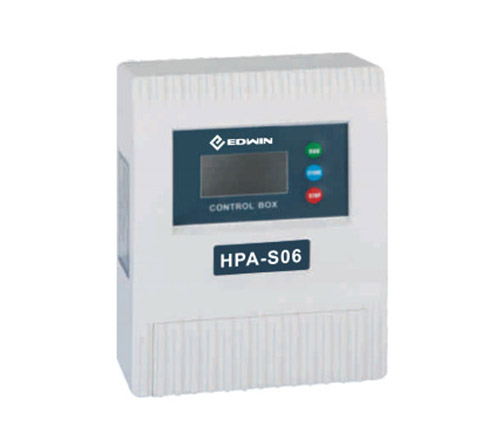
The pump can be integrated into a small pressure-boosting arrangement with a pressure tank, pressure switch, controller, or similar equipment. Such a system can reduce the need for manual starting and stopping while helping maintain a more stable pressure for domestic use or irrigation.
When a pressure switch is used, the cut-in and cut-out settings must remain appropriate for the selected pump and piping system. Frequent cycling may indicate an undersized pressure tank, a leak, an incorrect pressure setting, or insufficient water supply.
The JSW Series can support various related water systems, including small filtration installations, water transfer equipment, water tower supply arrangements, and automatic irrigation assemblies. Any filtration unit or valve installed on the suction side must be selected carefully because restrictions can reduce inlet pressure and affect self-priming performance.
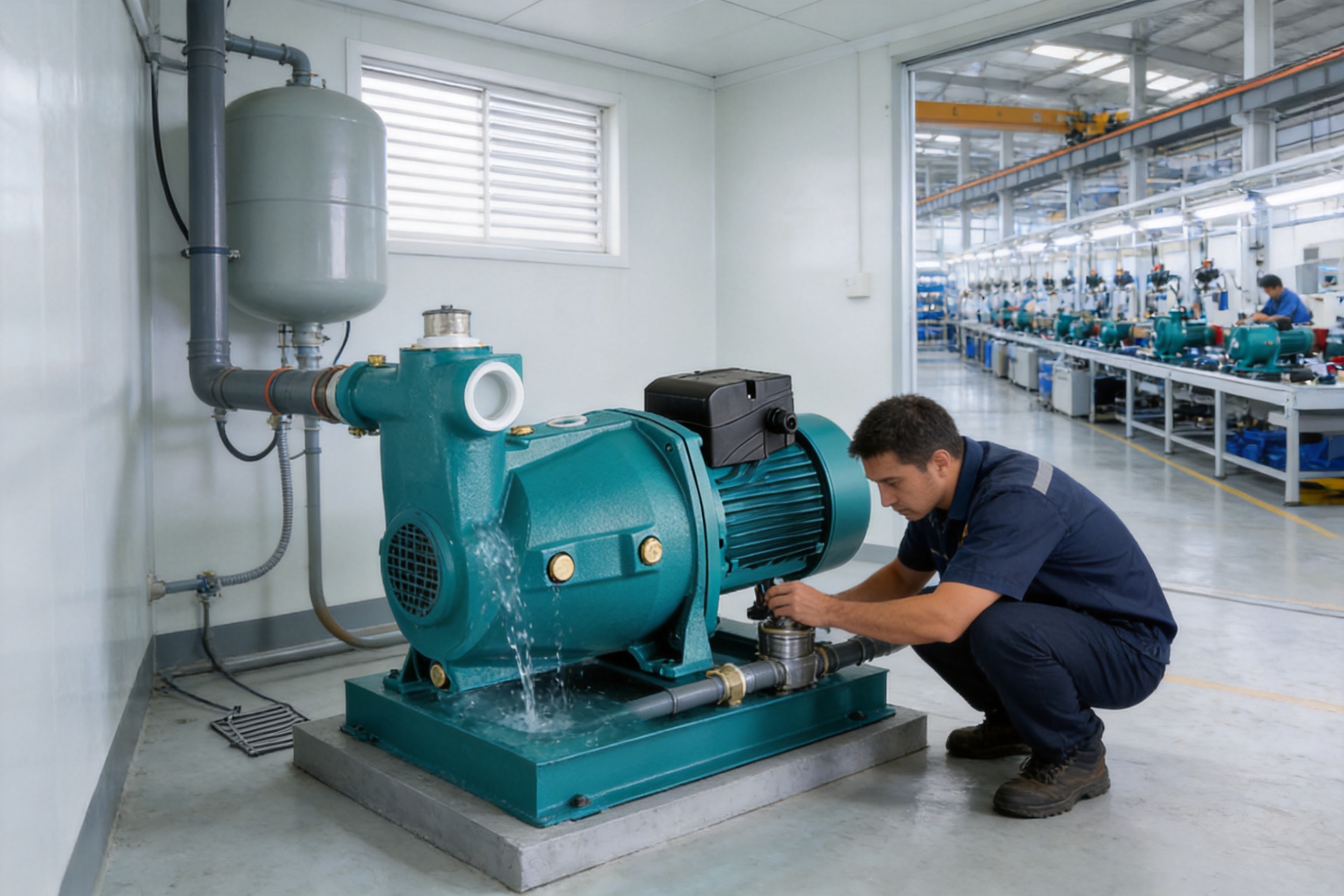
The pump is produced by an integrated manufacturing enterprise with capabilities in independent research and development, mass production, and global export. This type of organization can connect product design, component sourcing, assembly, quality management, packaging, and customer support within a coordinated operating structure.
Independent research and development is valuable because pump performance depends on the interaction of many parts. The impeller, diffuser, venturi tube, pump chamber, shaft, seal, motor, and bearings must work as a matched system. Hydraulic geometry cannot be considered separately from motor power, mechanical tolerances, thermal behavior, and installation conditions.
Mass production also provides opportunities for process standardization. Consistent machining, repeatable casting control, controlled component assembly, and systematic electrical testing can help reduce variation between units. For distributors and project buyers, repeatability is particularly important because the same model may be installed across multiple locations or included in private-label and original-equipment programs.
The specified use of different materials for different functions demonstrates a component-oriented engineering approach. HT200 cast iron is used where structural rigidity is important. PPO is used for the jet passages and diffuser. Brass is used for the impeller. AISI 304 stainless steel is used for the shaft in the water-contact area. Carbon and ceramic are used for sealing. Aluminum and cast iron are combined in the motor assembly according to mechanical and thermal requirements.
Such a material strategy can be more effective than manufacturing the complete pump from a single material. It places each material where its specific properties are most useful while controlling weight and production cost. The result is a product designed for practical performance rather than a simple one-material construction.
Electrical and mechanical quality control should cover winding integrity, insulation performance, bearing operation, shaft rotation, seal installation, hydraulic leakage, and final running behavior. The product specifications, including Class F insulation, IP44 protection, thermal protection, and copper wiring, provide a clear framework for these production checks.
The company’s broader product experience includes deep-well pumps, submersible pumps, domestic booster pumps, circulation pumps, solar water pumps, intelligent booster pumps, and other water-treatment peripheral products. This wider portfolio can strengthen engineering understanding across different pumping principles. It also allows customers to source multiple pump categories from a coordinated supplier when a project includes several water systems.
Install the pump in a dry, clean, ventilated, and accessible location. The base should be level and strong enough to support the pump while limiting vibration. Keep sufficient clearance around the motor for cooling and around the terminal cover for electrical inspection.
Although the motor has IP44 protection, it should be sheltered from flooding, direct water jets, and prolonged exposure to severe weather. Outdoor installations should include appropriate weather protection without restricting ventilation.
The suction line is central to self-priming performance. It should be airtight, properly supported, and arranged to avoid unnecessary high points where air can collect. Threaded connections should be sealed correctly, but excessive sealing material should not enter the pipe and obstruct the hydraulic passage.
A foot valve or non-return valve may be used to keep the suction pipe filled when the pump stops. A strainer can help prevent debris from entering the pump, but it must be correctly sized and cleaned regularly. A blocked strainer can create excessive suction resistance and reduce flow.
Before the first start, fill the pump chamber with clean water through the designated priming opening. Starting a dry pump can damage the mechanical seal and may prevent the pump from developing suction. Once the chamber is filled, close the priming plug securely and check the surrounding area for leakage.
If the pump fails to prime, switch it off and investigate the suction pipe, foot valve, water level, air leakage, and priming water. Do not allow the pump to run continuously without water. A self-priming design improves air-handling ability, but it does not make dry running safe.
The electrical supply must match the motor rating and local power requirements. Wiring should be completed by a qualified professional, with grounding and suitable overload protection. The built-in thermal protector provides additional motor protection, but it should be used together with correctly selected external electrical protection.
Before operating the pump, verify that all terminal connections are tight, the cable is protected from mechanical damage, and the installation is not exposed to water. Voltage instability, undersized cables, and poor connections can lead to overheating and reduced performance.
After installation, open the required valves and start the pump according to the operating procedure. Observe the discharge pressure, flow, sound, vibration, and seal area. Abnormal noise may indicate air entry, bearing problems, cavitation, loose mounting, or foreign material in the hydraulic section.
If the pump cycles frequently, check for leaks, incorrect pressure controls, a small pressure tank, or insufficient water supply. If flow is lower than expected, inspect the suction line, strainer, impeller, discharge restrictions, and total system head.
Regular maintenance helps protect the performance advantages of the JSW Series. Maintenance intervals depend on operating hours, water quality, installation conditions, and duty cycle. Clean-water service generally creates fewer problems than abrasive or contaminated water, but inspection remains necessary.
Inspect the pump for external leakage, unusual vibration, loose fasteners, damaged cables, and blocked ventilation openings. Keep the motor fan and fan cover free from dust and debris. A clean cooling path helps the motor operate within a reasonable temperature range.
Check the suction strainer and foot valve periodically. Remove accumulated dirt and confirm that the valve closes correctly. Air entering through a defective foot valve or suction connection can cause loss of prime, unstable flow, and excessive operating noise.
The mechanical seal is a wear component. A small amount of initial adjustment may occur during service, but continuing leakage should not be ignored. Leakage around the shaft can damage bearings and motor components if it reaches the motor housing.
If the pump will be stored or exposed to freezing conditions, drain the water from the pump body and connected pipework. Frozen water expands and can crack cast iron components or damage seals. Seasonal irrigation installations should be prepared for shutdown before temperatures fall below freezing.
When servicing the pump, disconnect the electrical supply completely and prevent accidental restarting. Allow the motor and water to cool before opening the hydraulic assembly. Replacement components should match the original design and material requirements to preserve safe and reliable operation.
Maximum flow is only one part of pump selection. Buyers should first determine the required flow rate at the actual discharge point. A household may need a modest continuous flow, while a sprinkler system may require a larger volume at a defined pressure.
Total dynamic head includes static elevation, required outlet pressure, pipe friction, valves, elbows, filters, and other restrictions. If a pump must lift water 20 meters and provide pressure equivalent to another 20 meters, the required head is already approximately 40 meters before friction losses are included.
Suction height should be measured vertically from the water surface to the pump inlet, not from the bottom of the well. The practical limit can be lower than the stated maximum under difficult conditions. High altitude, warm water, narrow pipes, long suction lines, and air leakage can all reduce effective suction capability.
Water quality must also be considered. The pump is intended for clean water or liquids with similar physical and chemical properties. Sand, mud, fibers, abrasive particles, corrosive chemicals, and high-viscosity fluids may damage the impeller, seal, diffuser, or internal passages. A different pump type may be required for wastewater, slurry, seawater, or chemical transfer.
Temperature is another selection factor. The stated maximum liquid temperature is 40°C, and the maximum ambient temperature is also 40°C. Applications involving hotter liquids or higher surrounding temperatures should be evaluated separately because seal materials, motor insulation, cooling, and hydraulic performance may be affected.
A compact family with consistent 1-inch connections and three power levels is convenient for distributors and installers. It permits a supplier to stock a focused range while covering several common domestic and light commercial duties. The shared platform also simplifies training, spare-parts planning, and service procedures.
For international buyers, a manufacturer with experience in global export can provide value beyond the pump itself. Procurement planning, order tracking, cross-border delivery coordination, and foreign-trade services can help reduce the administrative burden associated with repeat orders and project shipments.
The company’s related organizations support procurement and export services, while its product portfolio covers several categories of water pumps and peripheral equipment. This one-stop approach can be helpful for customers who need to combine self-priming pumps with submersible pumps, booster systems, solar pumps, circulation pumps, valves, pipes, or accessories.
For original-equipment buyers and private-label customers, manufacturing depth is especially important. Stable production processes, component coordination, technical communication, packaging management, and after-sales support all influence the total value of a pump purchase. A technically suitable pump can still become difficult to use if documentation, spare parts, and shipment coordination are weak.
The pump is designed for clean water and other liquids with physical and chemical properties similar to water. It is not intended for abrasive slurry, wastewater containing solids, corrosive chemicals, or liquids with unusually high viscosity unless the manufacturer confirms suitability.
No. The pump must not be operated without water. Fill the pump chamber before initial operation and investigate any loss of prime. Dry running can damage the mechanical seal and other internal components.
The listed maximum suction height is 8 meters. Actual performance depends on pipe length, pipe diameter, water temperature, altitude, valve condition, air tightness, and the difference between the water surface and pump inlet.
The answer depends on the required flow, elevation, pipe resistance, and pressure. The JSW-6M is suited to smaller requirements, the JSW-8M provides an intermediate option, and the JSW-10M offers the highest listed head and flow. Selection should be based on the actual duty point rather than motor power alone.
Yes, it can be used for water lifting from a shallow well if the water level and installation remain within the 8-meter maximum suction specification and the suction line is properly sealed. A foot valve and strainer may be required.
Yes. The series is suitable for garden hoses, small sprinkler systems, drip irrigation zones, allotments, and automatic irrigation arrangements using clean water. The required model depends on the number of outlets and the pressure needed by the irrigation equipment.
The AISI 304 stainless steel shaft provides improved resistance to rust in the water-contact area. It also helps maintain a stable sealing surface and supports reliable operation in ordinary clean-water applications.
A brass impeller offers corrosion resistance and dimensional stability in clean-water service. It is also suitable for pumps that may be stopped for extended periods and then restarted, provided the pump is correctly maintained.
No. IP44 indicates protection against specified solid objects and splashing water. The pump should not be submerged or exposed to flooding and direct high-pressure water. It should be installed in a dry, sheltered, and ventilated location.
The single-phase motor includes a built-in thermal protector. External electrical protection, correct grounding, and suitable installation are still required. A qualified electrician should confirm that the complete electrical system complies with local regulations.
The maximum listed liquid temperature is 40°C. The maximum ambient temperature is also 40°C. Hotter applications should not be assumed suitable without technical confirmation.
Maintenance includes checking for leakage, cleaning the suction strainer, inspecting the foot valve, keeping the motor ventilation area clear, checking electrical connections, monitoring vibration and noise, and draining the pump before freezing conditions. The mechanical seal and bearings should be inspected if leakage or unusual noise develops.
Yes. It can be incorporated into a small pressure set with an appropriate pressure tank and control system. The pressure settings must match the pump, piping, and application, and frequent cycling should be investigated.
Its principal advantages include self-priming jet functionality, an AISI 304 stainless steel shaft, brass impeller, cast iron body and support, C&U bearings, copper motor wiring, thermal protection, Class F insulation, and a practical range of models for clean-water applications.
The JSW Series self-priming jet pump is designed for users who need dependable clean-water transfer, useful suction capability, and straightforward above-ground maintenance. Its 8-meter maximum suction specification makes it suitable for many shallow wells, tanks, and water-storage applications, while the model range provides choices from 0.6 HP to 1 HP.
The product’s competitive strength comes from the combination of hydraulic design and material selection. A brass impeller supports corrosion-resistant operation, the AISI 304 shaft protects the water-contact rotating surface, HT200 cast iron provides structural rigidity, and C&U bearings support smooth motor rotation. Copper wiring, thermal protection, Class F insulation, and IP44 protection add further value to the motor platform.
Behind the product is an integrated manufacturing organization with experience in research and development, mass production, international export, and a broad portfolio of water-pumping technologies. This manufacturing and service structure can support distributors, installers, project contractors, and industrial buyers seeking consistent supply and coordinated procurement.
When correctly selected, installed, primed, and maintained, the pump can provide an efficient solution for domestic water supply, garden irrigation, tank transfer, shallow-well lifting, water tower supply, and small pressure systems. Its practical design makes it a strong option for clean-water applications where reliability, accessible maintenance, and self-priming convenience are important.
1. Product technical information for the JSW Series self-priming jet pump, including model data, materials, operating limits, and motor specifications.
2. Manufacturer-provided product description and application guidance for clean-water pumping systems.
3. General engineering principles for centrifugal and self-priming jet pump operation.
4. General guidance on pump suction piping, priming, foot valves, strainers, and total dynamic head.
5. General electrical motor principles relating to copper windings, thermal protection, insulation classes, and enclosure protection ratings.
serieswatershortageprotectionvoltagestabilizationstainlesssteelverticalmultistagepump.jpg "EVR(S) Series Water Shortage Protection Voltage Stabilization Stainless Steel Vertical Multistage Pump")
edwina@edwin-pump.com
+86-13586290903 (WhatsApp)
Xuri Gongliang Cutting Tool Entrepreneurship Park, Wenqiao Town, Wenling City, Taizhou City, Zhejiang Province, China

High Performance Smart Pump Factory


 English