
edwina@edwin-pump.com

View All Products
en
Water pressure tanks play a central role in the performance, stability, and service life of many water supply systems. Although they are often smaller and less mechanically complex than pumps, a pressure tank directly affects how frequently a pump starts, how consistently water is delivered, and how effectively a complete installation responds to changing demand. The WCF Series horizontal water pressure tank is designed to provide dependable pressure storage for domestic water supply, booster systems, irrigation, and other applications that require controlled hydraulic performance.
Available in several capacities and pressure configurations, the WCF Series combines a replaceable membrane, a carbon steel flange, standardized threaded connections, and a practical horizontal format. Its models cover maximum pressure ratings from 6 bar to 16 bar, with 1-inch and 1.5-inch connector options depending on tank size. This range allows installers, distributors, and system designers to select a tank that matches the application instead of relying on a single universal configuration.
The product is manufactured and supplied by Taizhou Edwin Electric Co., Ltd., an established Chinese manufacturing enterprise with experience in research and development, mass production, export operations, and water equipment integration. Through its pump and water-treatment product portfolio, the company supports customers requiring coordinated solutions for pumping, pressure control, irrigation, building water supply, and industrial water systems.
A pressure tank stores a volume of pressurized water so that the pump does not need to start every time a small quantity of water is used. Without adequate pressure storage, opening a tap for a few seconds or operating a small irrigation outlet may cause the pump to start immediately. Repeated starts can increase electrical consumption, mechanical stress, noise, and wear on the pump motor and control components.
The pressure tank works as a buffer between the pump and the demand points. When the pump operates, water enters the tank and compresses the air or gas chamber behind the membrane. When a user opens a tap, the stored pressure pushes water into the system before the pump must restart. This reduces short cycling and helps create a more stable operating pattern.
In a domestic booster system, the tank can help maintain a more comfortable water pressure during intermittent use. In agricultural irrigation, it can reduce unnecessary pump starts when valves are opened briefly or when demand fluctuates. In commercial applications, it can support a booster assembly by absorbing minor changes in flow and pressure. The correct tank size and precharge setting remain important, but the tank’s construction and membrane design are equally significant.
The WCF Series is intended for systems where stable pressure storage, serviceability, and compatibility with standard installation components are important. Its horizontal design may be suitable where vertical clearance is limited or where the tank is installed as part of a compact pump set. The format can also simplify integration with certain domestic booster assemblies and horizontal pressure-control packages.
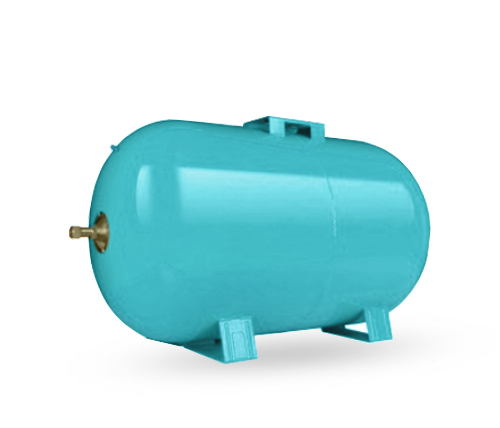
WCF Series 6 Bar to 16 Bar 1 Inch Connector Horizontal Water Pressure Tank
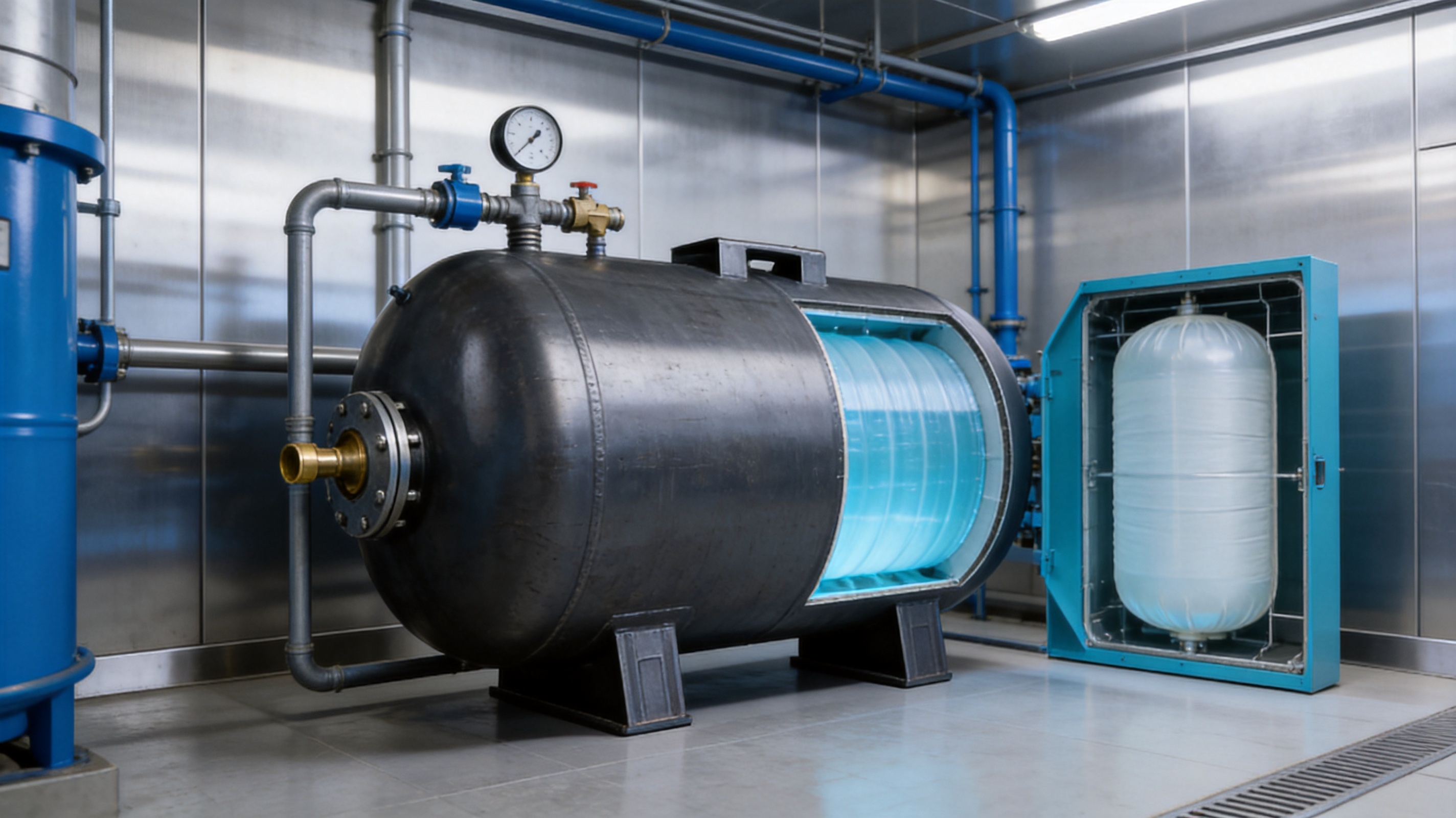
The replaceable membrane is one of the most important features of the WCF Series. In a membrane pressure tank, the water is separated from the compressed air or gas chamber by a flexible membrane. This separation helps prevent direct contact between the stored water and the internal air space, supporting more consistent pressure behavior and reducing the possibility of waterlogging caused by air dissolving into the water.
Over time, any flexible membrane can be affected by operating conditions, temperature, chemical exposure, pressure cycles, and general aging. A replaceable design provides a practical maintenance advantage because the membrane can be serviced without necessarily replacing the entire tank shell. This can reduce downtime and lower long-term ownership costs, particularly for professional installers and system operators managing multiple installations.
Compared with non-serviceable pressure tanks, the replaceable membrane configuration can provide greater flexibility during repair and refurbishment. A complete tank replacement may be inconvenient when the tank is installed in a confined plant room, a rooftop booster station, an irrigation cabinet, or a remote agricultural installation. A serviceable internal component allows qualified technicians to inspect the tank and replace the membrane when required.
Membrane maintenance should always be carried out by trained personnel after the tank has been isolated, fully depressurized, and disconnected according to applicable safety procedures. The replacement component should be compatible with the specific tank model and the intended water application. Proper maintenance practices are essential for preserving the performance benefits of the design.
The WCF Series uses a carbon steel flange. The flange forms a key structural and service connection between the tank body and the membrane assembly. Carbon steel is widely used in pressure equipment because it offers a practical combination of mechanical strength, manufacturing availability, and cost efficiency.
A properly manufactured flange must withstand repeated pressure cycles and maintain a reliable seal under normal operating conditions. It must also allow service access when the membrane requires inspection or replacement. The carbon steel flange used in this product reflects a balance between structural performance and maintainability.
For installations exposed to humidity, condensation, salt air, chemicals, or outdoor weather, the tank should be installed and protected in accordance with the operating environment. Surface protection, correct drainage, suitable ventilation, and regular inspection can help preserve the external condition of carbon steel components. The pressure tank should not be treated as a substitute for system-level corrosion protection.
The horizontal shape provides a useful alternative to conventional vertical pressure tanks. In many pump rooms, the available height is restricted by low ceilings, pipework, electrical cabinets, or equipment platforms. A horizontal tank can be installed beneath or beside a pump assembly where a taller vessel would be difficult to accommodate.
The horizontal arrangement may also be advantageous in compact booster packages. It can support a lower equipment profile and may simplify transportation or positioning during installation. The exact installation method depends on the tank model, support arrangement, pipe connection, and local engineering requirements. The tank must be securely supported and installed so that the connection is not subjected to excessive mechanical loading from unsupported pipework.
The smaller WCF models use a 1-inch connector, while the larger WCF200L and WCF300L models use a 1.5-inch connector. These connection sizes are widely recognized in water-supply installations and can simplify integration with pumps, pressure switches, check valves, manifolds, and other accessories.
A standardized connection does not eliminate the need to check thread type, fitting material, sealing method, and local pipe standards. However, it reduces the complexity of selecting compatible components. For distributors and installers, a familiar connector size can make product planning and replacement easier.
The WCF Series includes models with maximum pressure choices of 6 bar, 8 bar, 10 bar, and 16 bar. The available pressure rating depends on the model. WCF60L, WCF80L, and WCF100L are listed with 6, 8, 10, and 16 bar options. WCF150L, WCF200L, and WCF300L are listed with 10 and 16 bar options.
The maximum pressure rating should never be selected solely on the basis of the desired water pressure. It must be coordinated with the pump shut-off pressure, pressure switch settings, safety valve setting, pipe rating, and all other components in the hydraulic system. The tank rating must be equal to or greater than the highest pressure that can reasonably occur in the installation, including pressure surges where applicable.
The model name indicates the nominal tank volume. For example, WCF60L refers to a nominal 60-liter configuration, while WCF300L refers to a nominal 300-liter configuration. Nominal volume is not the same as the volume of water delivered between pump start and pump stop. The usable drawdown depends on the pressure settings, precharge pressure, membrane characteristics, and actual system conditions.
| Model | Maximum Pressure Options | Length | Height | Precharge Pressure | Connector | Packing Volume |
| WCF60L | 6, 8, 10, or 16 bar | 680 mm | 408 mm | 1.8–2.0 bar | 1 inch | 0.1054 CBM |
| WCF80L | 6, 8, 10, or 16 bar | 640 mm | 470 mm | 1.8–2.0 bar | 1 inch | 0.1398 CBM |
| WCF100L | 6, 8, 10, or 16 bar | 725 mm | 470 mm | 1.8–2.0 bar | 1 inch | 0.1616 CBM |
| WCF150L | 10 or 16 bar | 980 mm | 532 mm | 2.5 or 4.0 bar | 1 inch | 0.2803 CBM |
| WCF200L | 10 or 16 bar | 912 mm | 660 mm | 2.5 or 4.0 bar | 1.5 inches | 0.4134 CBM |
| WCF300L | 10 or 16 bar | 1192 mm | 660 mm | 2.5 or 4.0 bar | 1.5 inches | 0.5353 CBM |
The 60-liter, 80-liter, and 100-liter models are appropriate starting points for many domestic water-supply and compact booster applications. They share a 1-inch connector and a listed precharge range of 1.8 to 2.0 bar. Their different dimensions allow installers to choose according to available space as well as required storage capacity.
The WCF80L is listed with a length of 640 millimeters and a height of 470 millimeters. The WCF60L has a listed length of 680 millimeters and a height of 408 millimeters, giving it a lower overall height than the WCF80L. The WCF100L is listed with a length of 725 millimeters and a height of 470 millimeters. These dimensional differences can be useful when designing a pump skid or selecting a replacement for an existing installation.
The WCF150L increases the nominal storage capacity for applications with greater intermittent demand. It is listed with 10-bar and 16-bar options, a 1-inch connector, and a precharge pressure of 2.5 or 4.0 bar. With a listed length of 980 millimeters and height of 532 millimeters, it requires more installation space than the smaller models.
This model may be suitable for larger domestic systems, small commercial installations, irrigation systems, and booster sets where a compact tank would not provide sufficient pressure storage. The final selection should be based on pump flow, pressure-switch settings, expected demand, and the required reduction in pump cycling.
The WCF200L and WCF300L are the largest listed models in the series. Both use a 1.5-inch connector and are available in 10-bar and 16-bar configurations. Their larger volume and connection size make them suitable for higher-demand installations, larger booster systems, and applications where the water system benefits from greater stored capacity.
The WCF200L has a listed length of 912 millimeters and a height of 660 millimeters. The WCF300L has a listed length of 1192 millimeters and a height of 660 millimeters. Their packing volumes are listed as 0.4134 CBM and 0.5353 CBM respectively, which is relevant for export planning, warehouse organization, container loading, and project logistics.
The supplied product information identifies both Butyl and EPDM membrane options. The material choice should be matched to the water quality, temperature, chemical environment, and intended application. Butyl and EPDM are common elastomer choices in water-related equipment, but the best selection depends on the actual service conditions.
The product content lists a working temperature range of -10°C to 99°C for both Butyl and EPDM, while the detailed specification lists -20°C to 99°C for both materials. Because these two supplied values differ, buyers and system designers should confirm the applicable temperature range for the exact model and membrane material before placing an order or commissioning the equipment.
Temperature is important because elastomer flexibility, pressure behavior, and long-term durability can change as operating temperature changes. The tank should be protected against freezing, overheating, and sudden temperature fluctuations. A pressure tank must also be installed in a location where the ambient environment is consistent with the product specification.
For potable or domestic water applications, the membrane material should be confirmed as suitable for the applicable water-contact requirements in the target market. For irrigation, industrial, or process-water systems, the chemical composition of the water should be reviewed before the tank is selected. Oils, solvents, aggressive chemicals, high mineral content, and unusual pH conditions may affect membrane life.
One of the clearest advantages of the WCF Series over many basic non-replaceable pressure tanks is the replaceable membrane. A generic tank with a permanently sealed internal bladder may need to be discarded if its internal membrane fails. The serviceable design of the WCF Series provides a pathway for maintenance and component replacement, which can be especially valuable in commercial, agricultural, and remote installations.
Serviceability can also improve asset management. Operators can keep compatible replacement membranes available rather than storing complete tanks for every installation. Distributors may be able to offer membrane replacement as part of their after-sales support. This approach can reduce waste, shorten repair time, and improve the practical life of the external tank shell when it remains structurally sound.
Many low-cost tanks are offered in only one pressure configuration or with limited application flexibility. The WCF Series offers several pressure options across its model range, including 6, 8, 10, and 16 bar for selected models. This provides system designers with more flexibility when matching tank performance to different pump and water-supply requirements.
The availability of 16-bar models is particularly useful for higher-pressure booster systems, provided that every connected component is rated appropriately. At the same time, lower pressure options are available for less demanding installations where a 16-bar tank would be unnecessary. This model diversity can help reduce over-specification and support more economical project design.
The use of 1-inch and 1.5-inch connectors offers compatibility with common water system components. An appropriate connector size helps reduce restrictions at the tank inlet and can simplify the design of manifolds and connection assemblies. The larger 1.5-inch connection on the WCF200L and WCF300L is consistent with their higher storage capacity and larger installation scale.
The horizontal configuration offers an alternative to taller tanks that may not fit in compact plant rooms. This can be an advantage in equipment rooms below staircases, low-clearance utility areas, pump cabinets, agricultural service rooms, and retrofit projects. When floor space and height are carefully managed, the tank can be integrated into a complete pressure package without major structural modifications.
A coherent product family makes it easier for distributors and project contractors to organize purchasing. The WCF range covers six nominal sizes, two connector categories, and multiple pressure options. This creates a structured selection system rather than an unrelated collection of pressure vessels.
For international buyers, the range also supports different project requirements without requiring a completely different supplier for each capacity. The product can be considered alongside deep well pumps, submersible pumps, surface pumps, booster pumps, circulation pumps, garden pumps, and pump accessories supplied through the same broader manufacturing and export network.
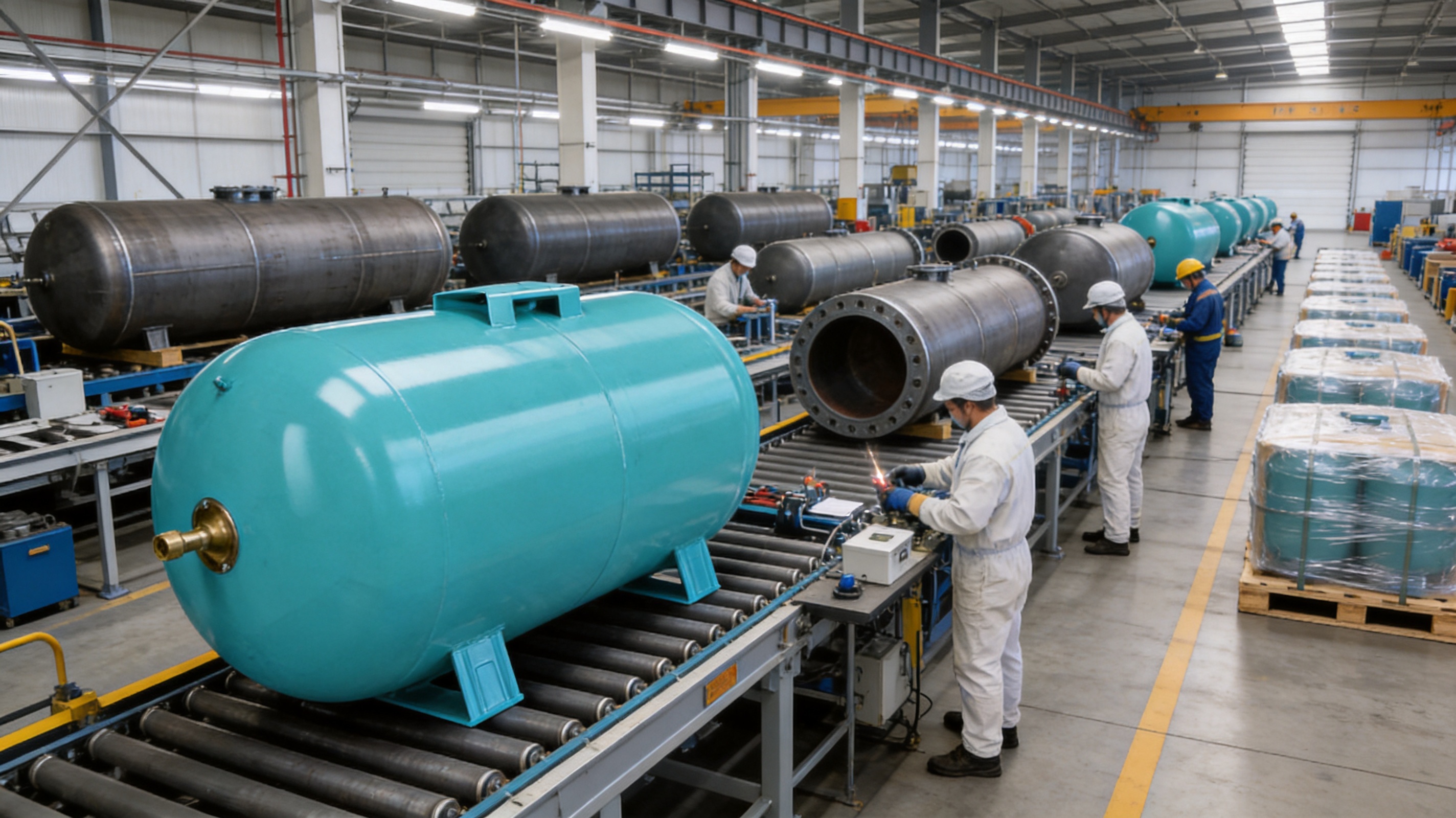
The performance of a pressure tank depends not only on its design but also on the consistency of manufacturing. A tank shell, flange, membrane assembly, and connection must work together under repeated pressure cycles. Dimensional variation, incorrect assembly, poor sealing, or inadequate inspection can reduce service life even when the product concept is sound.
Taizhou Edwin Electric Co., Ltd. was founded in 2008 and operates as an integrated manufacturing enterprise focused on independent research and development, mass production, and global export. This combination is important because it connects product development with manufacturing capability and international customer service. Instead of treating design, production, and export as unrelated activities, the company presents them as connected parts of a complete supply process.
Independent research and development supports the ability to adapt products to changing market requirements. For pressure tanks, development work may involve evaluating membrane structures, connection arrangements, dimensions, pressure ratings, materials, packaging, and compatibility with modern pump systems. A manufacturer with its own development capability can respond more directly to distributor feedback and project requirements.
The company’s broader investment in intelligent technology and solar water-pumping solutions demonstrates an interest in evolving water-system equipment rather than focusing only on traditional pump products. This broader technical environment can be valuable when the pressure tank is specified as part of an integrated pumping or pressure-control package.
Mass production can provide advantages in component availability, production planning, repeatability, and order capacity. A pressure tank range with several sizes requires coordinated management of steel components, membranes, flanges, connectors, packaging materials, and inspection procedures. Organized mass production helps support consistent output and more predictable lead-time planning.
For original equipment buyers and distributors, production scale is also important when placing repeat orders. A supplier must be able to maintain product continuity across different purchasing cycles. A structured product family reduces the risk of constantly changing dimensions or connection specifications, which can create problems for installers and replacement-stock managers.
The replaceable membrane and carbon steel flange require careful assembly. The flange must be correctly positioned, the sealing surfaces must be clean, and the membrane must not be twisted, pinched, or damaged during installation. Proper assembly is essential for pressure retention and long-term reliability.
While detailed factory inspection procedures are not provided in the supplied material, professional pressure-tank manufacturing should include dimensional checks, visual inspection, connection verification, sealing inspection, and pressure-related quality control. Buyers may request the manufacturer’s specific inspection records, test procedures, applicable standards, and quality documentation for the target market.
Edwin Pump has developed an international supply structure that includes procurement planning, order tracking, cross-border delivery, and foreign-trade services. Through associated companies established in 2012, the organization supports customers requiring one-stop procurement and export coordination.
This experience is relevant to pressure tanks because the product is often purchased as part of a larger order. A buyer may need pumps, pressure switches, valves, pipes, control equipment, and accessories at the same time. Coordinated sourcing can reduce communication gaps between different product categories and make project purchasing more efficient.
The listed packing volumes for each model also provide useful logistics information. Buyers can estimate warehouse requirements, pallet planning, container utilization, and freight costs at an early stage. Packaging volume is especially important for overseas distributors purchasing multiple models in mixed quantities.
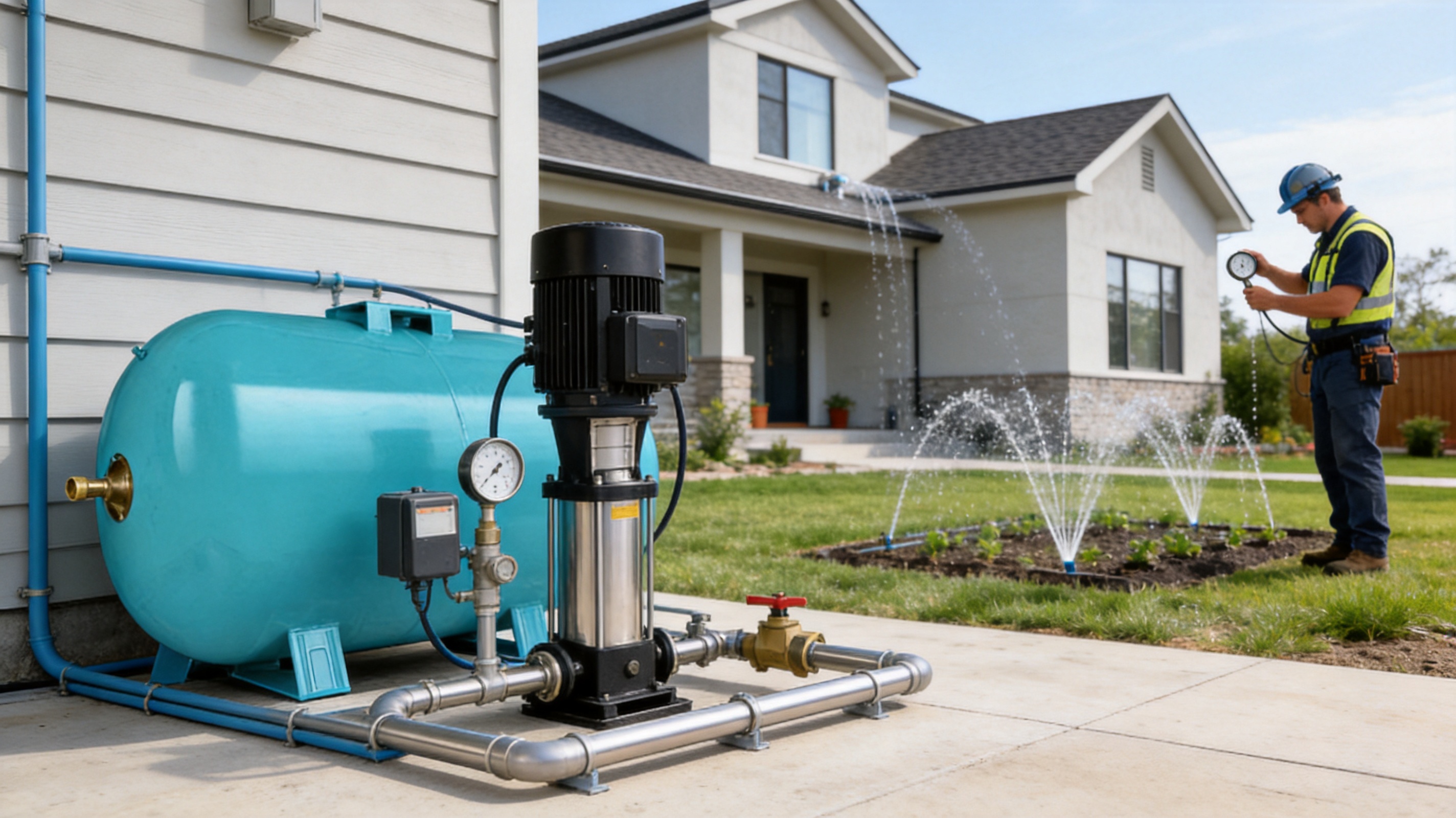
The WCF Series can be used in domestic water systems that require pressure stabilization and reduced pump cycling. Typical installations may include private houses, apartment units, villas, rural homes, and small residential developments. The tank can be paired with a surface pump, booster pump, or suitable submersible pumping arrangement.
In a home, demand often changes rapidly. A user may open a kitchen tap, flush a toilet, use a washing machine, or operate a shower at different times. A pressure tank helps absorb these short and irregular demand events. The correct pressure settings can provide smoother operation while reducing the frequency of pump starts.
Booster systems are designed to increase or maintain water pressure in buildings and facilities. A pressure tank can support a booster pump by supplying a limited quantity of water during low-flow events. This can prevent the pump from starting unnecessarily when demand is small.
The WCF Series may be used with domestic booster pumps, intelligent booster pumps, or conventional pressure-controlled pump sets, provided that the tank rating and connection arrangement match the system design. In an intelligent system, the controller may regulate pump speed or monitor pressure electronically, while the tank provides additional hydraulic buffering.
Irrigation demand is rarely constant. Valves may open and close in zones, sprinkler heads may operate intermittently, and small leaks or pressure changes may occur between irrigation cycles. A pressure tank can help manage these fluctuations and support more controlled pump operation.
For agricultural use, selection should consider water quality, sediment, fertilizer exposure, ambient temperature, and the possibility of outdoor installation. The tank should be positioned on a stable foundation and protected from unnecessary physical impact. A suitable filtration and maintenance program can help protect the membrane and pump system from contamination.
Small commercial buildings, workshops, guesthouses, offices, and retail facilities may require a more stable water supply than a basic domestic arrangement can provide. A pressure tank can be integrated into a booster package serving washrooms, cleaning points, kitchens, or light-duty process equipment.
The WCF150L, WCF200L, and WCF300L may be considered where the system requires greater stored capacity. However, tank selection must be based on actual flow demand and the required drawdown rather than nominal capacity alone. Larger buildings may need multiple tanks, variable-speed pumps, or a complete pressure-boosting system designed by a qualified engineer.
Some hydronic and circulation systems use expansion or pressure-control equipment to accommodate changes in fluid volume and system pressure. The WCF Series is described as a water pressure tank, so the suitability of a particular model for heating or treated-fluid applications must be confirmed before use. Fluid temperature, chemical additives, membrane compatibility, and pressure requirements are critical considerations.
Water pumps supplied for mining, construction, municipal engineering, and infrastructure projects often operate under changing hydraulic conditions. A pressure tank can be used in auxiliary water-supply systems, temporary construction facilities, equipment washing stations, or localized booster units.
These environments can be demanding because of dust, vibration, temperature changes, and irregular maintenance access. The tank should be installed according to a project-specific method statement, with adequate support, isolation valves, pressure relief protection, and inspection access.
Before installation, confirm the model, nominal volume, maximum pressure, precharge setting, connector size, membrane material, and operating temperature. Check that the tank dimensions are compatible with the planned location. The listed length and height should be treated as equipment dimensions for layout planning, while additional clearance may be required for connection, inspection, membrane replacement, and maintenance.
Install the tank on a stable support capable of carrying the filled weight and resisting movement during pump operation. The support should prevent excessive vibration and should not place concentrated loads on vulnerable parts of the tank. Horizontal tanks must be supported in a way that is consistent with the manufacturer’s installation instructions.
Use suitable pipework and fittings for the selected pressure rating. Pipework should be independently supported so that the tank connector is not used to carry the weight of long or poorly aligned pipes. Excessive strain at the connection can affect sealing and may damage the fitting or connected equipment.
Provide isolation valves where appropriate so that the tank can be removed or serviced without draining the entire water system. A drain point can make maintenance easier. A pressure gauge, pressure switch, check valve, and safety device may also be required depending on the pump arrangement and applicable regulations.
Before pressurizing the system, inspect the connection, confirm that the membrane and tank are correctly installed, and ensure that all temporary shipping protection has been removed. Open valves gradually to avoid sudden hydraulic shock. Check for leakage and observe the pressure behavior during pump start, pump stop, and water drawdown.
Precharge pressure is the pressure of the air or gas chamber when the water side is completely depressurized. It is a crucial setting because it affects the usable water volume and the operation of the pump control system. The supplied data lists a precharge range of 1.8 to 2.0 bar for WCF60L, WCF80L, and WCF100L, and 2.5 or 4.0 bar for WCF150L, WCF200L, and WCF300L.
The correct precharge setting depends on the pressure-switch or controller settings. In many conventional installations, the precharge is set below the pump cut-in pressure so that the membrane can deliver water effectively before the pump starts. The exact differential should follow the manufacturer’s technical instructions and the requirements of the complete system.
Precharge should be checked with the tank isolated from the water system and fully depressurized. Measuring precharge while the water side remains pressurized can produce an incorrect reading. Use a calibrated pressure gauge and an appropriate charging medium according to the manufacturer’s instructions.
If the precharge is too low, the membrane may move excessively and the tank may provide less effective pressure control. If it is too high, the tank may deliver insufficient drawdown and the pump may start too often. A correct setting supports more stable operation and helps the tank perform as intended.
Regular maintenance improves reliability and helps identify problems before they cause a system shutdown. Inspect the tank exterior for corrosion, dents, leakage, damaged paint, or signs of abnormal stress. Check the connector and nearby pipework for leaks or movement. Confirm that pressure readings remain consistent with the expected operating range.
Monitor pump cycling. A sudden increase in starts and stops may indicate incorrect precharge, a damaged membrane, a leaking check valve, a system leak, or an incorrectly adjusted pressure switch. The tank should be isolated and tested by qualified personnel before any internal service work is performed.
Because the membrane is replaceable, service technicians can inspect and renew the internal component when required. Replacement should be carried out using the correct membrane for the model and application. The flange, fasteners, gasket surfaces, and internal components should be inspected during the process.
Do not exceed the maximum pressure rating. Do not use the tank outside the confirmed temperature range. Do not modify the flange, connector, or shell without written technical approval. Any pressure vessel can present a safety risk if it is improperly installed, altered, or serviced while pressurized.
Buyers should identify the required nominal volume and pressure rating before requesting a quotation. The expected pump flow, cut-in pressure, cut-out pressure, number of pump starts per hour, and approximate water demand are useful inputs for sizing. The available installation space should be measured, including service clearance.
Specify whether the application requires a Butyl or EPDM membrane. Confirm the applicable operating temperature range because the supplied product information contains two different lower temperature values: -10°C in the product content and -20°C in the detailed specification. This point should be clarified for the exact order configuration.
Confirm the connector size and thread standard. WCF60L, WCF80L, WCF100L, and WCF150L are listed with a 1-inch connector, while WCF200L and WCF300L are listed with a 1.5-inch connector. The buyer should also confirm whether adapters, pressure gauges, valves, or mounting accessories are included or must be purchased separately.
For export projects, review packaging volume, loading quantity, shipping protection, labeling, documentation, and spare membrane availability. The listed CBM values can support preliminary freight calculations, but final logistics planning should use the supplier’s confirmed package dimensions and gross weights.
Working with an integrated manufacturer can offer advantages beyond the product itself. A pressure tank is often one part of a complete water solution. Customers may also require solar pumps, deep well pumps, submersible pumps, surface pumps, booster pumps, circulation pumps, garden pumps, pool and spa pumps, commercial multistage pumps, end-suction pumps, pipes, valves, and pump accessories.
Edwin Pump’s wider product range supports one-stop procurement for customers who want to coordinate pumping equipment and pressure-control components. This can simplify technical communication, commercial negotiation, packaging planning, and after-sales service. It can also help distributors build a more complete product portfolio for residential, agricultural, commercial, and industrial customers.
The company’s experience in global export and cross-border delivery is relevant to international projects with strict scheduling requirements. Order tracking and procurement coordination can be particularly valuable when several products must arrive together for a construction or installation deadline.
Since 2018, the company has invested in new energy and intelligent technology, including solar water pumps and intelligent booster pumps. These product directions align with the broader movement toward energy-efficient, automated, and digitally controlled water systems. The WCF Series can serve as a practical hydraulic storage component within suitable conventional or intelligent pumping arrangements.
The main purpose is to store pressurized water and reduce unnecessary pump starts. It helps stabilize pressure during intermittent demand and can reduce short cycling in compatible water-supply and booster systems.
The membrane separates the water chamber from the compressed air or gas chamber. It supports pressure storage while allowing the internal membrane to be replaced during service instead of automatically replacing the entire tank.
WCF60L, WCF80L, WCF100L, and WCF150L are listed with a 1-inch connector. The WCF200L and WCF300L are listed with a 1.5-inch connector.
All six listed models include a 16-bar option in the supplied technical data. WCF60L, WCF80L, and WCF100L are also listed with 6-bar and 8-bar options, while WCF150L, WCF200L, and WCF300L are listed with 10-bar and 16-bar options.
Selection should consider pump flow, system demand, pressure-switch settings, desired drawdown, installation space, and maximum system pressure. Nominal tank volume alone is not sufficient to determine usable water delivery.
The listed precharge pressure is 1.8–2.0 bar for WCF60L, WCF80L, and WCF100L. WCF150L, WCF200L, and WCF300L are listed with 2.5 or 4.0 bar. The final setting must match the pump control arrangement.
Outdoor use may be possible when the installation environment, temperature, moisture exposure, corrosion protection, and support arrangement are suitable. The tank should be protected from freezing, excessive heat, physical impact, and prolonged exposure to conditions outside the confirmed specification.
The supplied information identifies Butyl and EPDM membrane options. The preferred material depends on water quality, temperature, chemical compatibility, and the requirements of the target application.
The horizontal design can fit locations where vertical clearance is limited. It may be useful in compact pump rooms, booster packages, low-ceiling utility areas, and retrofit projects where a vertical tank would be difficult to install.
Not necessarily. A larger tank may provide more drawdown, but it also requires more space and may increase cost and handling requirements. The tank should be sized according to actual demand and control settings rather than selected solely by maximum available volume.
Confirm the model, nominal capacity, maximum pressure, connector size, precharge pressure, membrane material, temperature range, dimensions, packaging information, documentation, and spare-part availability. The two different lower temperature values supplied for the product should also be clarified before purchase.
Domestic pump installers, agricultural irrigation contractors, commercial water-system integrators, distributors, original equipment manufacturers, and international project buyers can all consider the WCF Series when a serviceable horizontal pressure tank is required.
The WCF Series horizontal water pressure tank provides a practical combination of pressure storage, serviceability, model flexibility, and installation convenience. Its replaceable membrane can simplify maintenance, while the carbon steel flange provides a robust structural and service connection. The horizontal format addresses space limitations, and the range of capacities, pressure ratings, and connector sizes supports diverse water-system designs.
Compared with basic generic tanks, the series offers meaningful advantages for professional users who value replaceable internal components, multiple pressure options, recognized connection sizes, and coordinated product sourcing. The WCF60L through WCF300L models cover a broad range of domestic, agricultural, commercial, and project applications.
The manufacturing strength behind the product is supported by Taizhou Edwin Electric Co., Ltd.’s experience in independent research and development, mass production, global export, pump manufacturing, intelligent water technology, and one-stop procurement services. These capabilities can help international customers obtain pressure tanks as part of a broader and more coordinated water-equipment solution.
As with all pressure equipment, correct sizing, installation, precharge adjustment, maintenance, and safety protection are essential. Buyers should confirm the final technical details for the selected model, especially the applicable temperature range and membrane specification. When properly matched to the pump system, the WCF Series can contribute to smoother pressure control, reduced pump cycling, easier maintenance, and more dependable water-system operation.
1. Product specification and technical data supplied for the WCF Series horizontal water pressure tank.
2. Manufacturer-provided information concerning replaceable membranes, carbon steel flanges, operating temperatures, model dimensions, connector sizes, and precharge pressures.
3. General engineering principles for diaphragm and membrane pressure tanks used in water-supply and booster systems.
4. General pump-system design practices concerning pressure control, pump cycling, precharge adjustment, and hydraulic storage.
5. Manufacturer profile and company information concerning research and development, mass production, global export, intelligent pumping technology, and one-stop procurement services.
edwina@edwin-pump.com
+86-13586290903 (WhatsApp)
Xuri Gongliang Cutting Tool Entrepreneurship Park, Wenqiao Town, Wenling City, Taizhou City, Zhejiang Province, China

High Performance Smart Pump Factory


 English