edwina@edwin-pump.com

View All Products
en
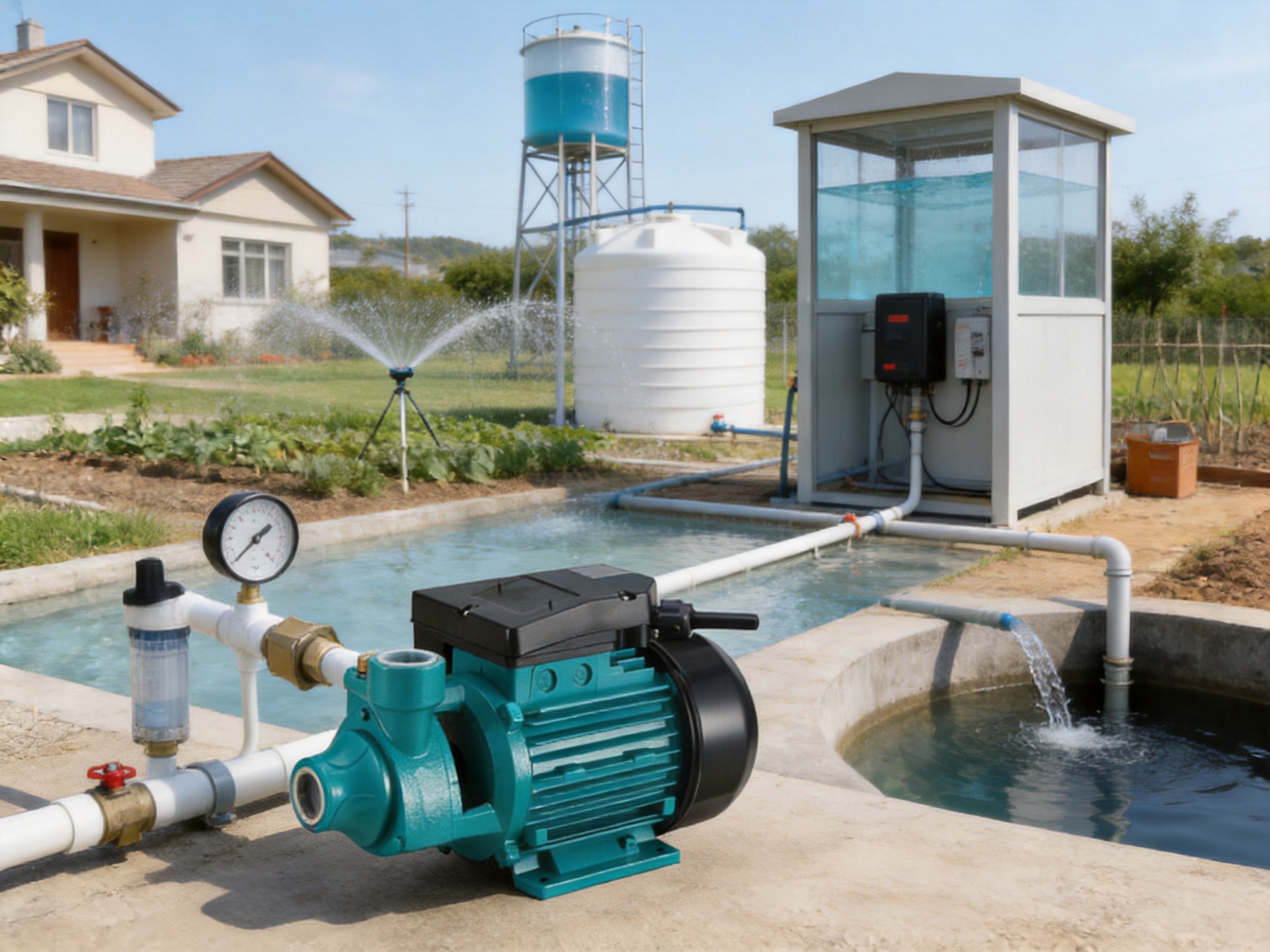
The PM Series vortex peripheral pump is designed for reliable clean-water transfer in domestic, agricultural, and light commercial applications. Combining an antirust-treated cast iron structure, brass impeller, copper winding, C&U bearing, stainless steel shaft, and built-in thermal protection, the series provides a practical balance of pressure, compactness, durability, and operating economy.
Available in PM-45 and PM-80 configurations, the pump covers common low-flow, high-head requirements. Depending on the model, it can deliver a maximum flow of 35 or 50 liters per minute and reach a maximum head of 40 or 70 meters. Both models feature 1-inch inlet and outlet connections and a maximum suction height of 8 meters.
Its vortex peripheral hydraulic design makes the PM Series especially suitable where a relatively small pump must produce useful pressure for water distribution, garden irrigation, tank transfer, automatic sprinkler systems, and small supporting equipment. The pump is also designed to tolerate operating conditions in which air or water may occasionally be present in the pumped liquid, provided that the application remains within the stated operating limits.
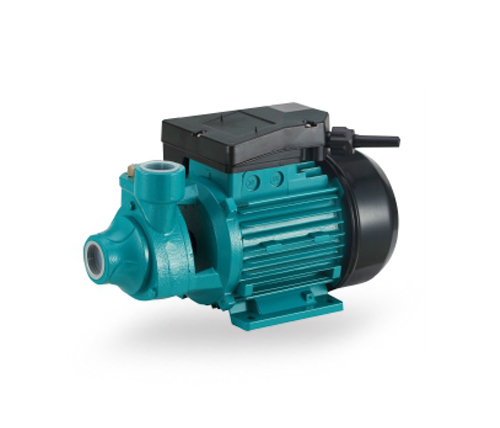
PM Series C&U Bearing Antirust Durable Vortex Peripheral Pump
A vortex peripheral pump is a compact centrifugal pump that uses a peripheral impeller and a specially shaped flow path to generate pressure. Unlike a conventional high-flow centrifugal pump, a peripheral pump is generally selected when pressure and lifting capability are more important than very large water volume.
The PM Series follows this design principle. Its two available models provide a convenient range for household water supply, small irrigation installations, water tower filling, well water lifting, and equipment support. The PM-45 is suited to lower-power duties, while the PM-80 is intended for applications requiring greater pressure and higher hydraulic output.
The pump is intended for clean water or liquids with physical and chemical properties similar to clean water. It is not designed for abrasive slurry, heavily contaminated wastewater, seawater, flammable liquids, or liquids containing aggressive chemicals unless the user has confirmed material compatibility and operating suitability in advance.
In practical installations, the PM Series can be used to move water from a storage tank to a building, supply a small pressure set, feed a sprinkler system, lift water from a well, or support a small air-conditioning or circulation-related system. Its compact motor-pump structure makes it suitable for locations where installation space is limited.
The core characteristics of the PM Series include antirust treatment on the cast iron pump body and support, a brass impeller, rust-free copper inserts, an AISI 304 stainless steel shaft, durable copper motor wiring, C&U bearings, and a built-in thermal protector for the single-phase motor.
The motor uses Class F insulation and an IP44 protection rating. The maximum liquid temperature is +60°C, the maximum ambient temperature is +40°C, and the maximum suction height is 8 meters. These specifications enable the pump to serve a broad range of normal domestic and light-duty water applications.
The combination of a pressure-oriented hydraulic design and carefully selected construction materials is one of the most important advantages of the series. A pump that produces pressure but uses unsuitable materials may suffer from corrosion, premature sealing problems, or difficult restarting after long periods of inactivity. The PM Series addresses these concerns through material selection and protective treatment.
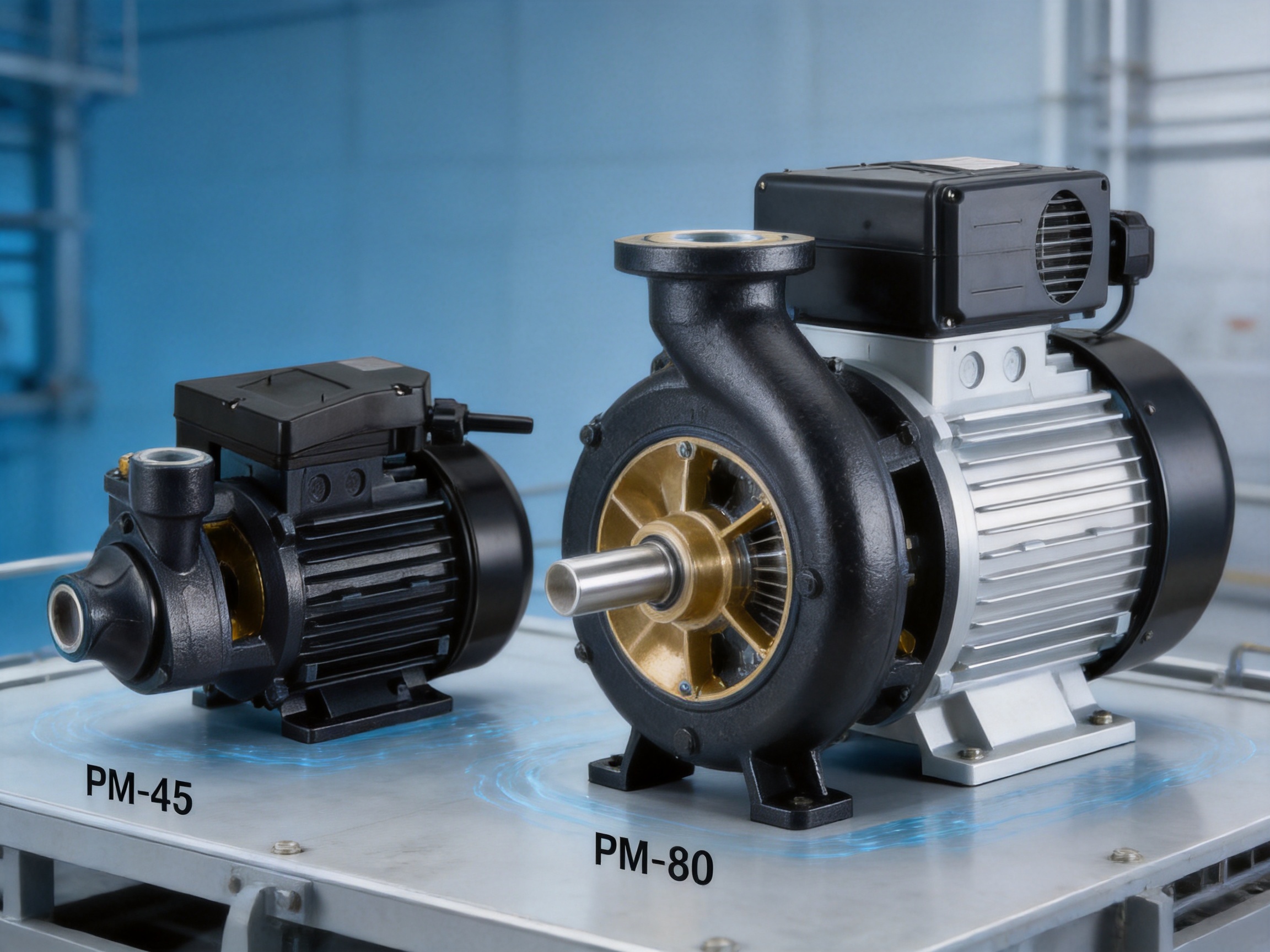
The PM Series consists of two models: PM-45 and PM-80. The model numbers identify different power and performance levels within the same product family. Both models use a 1-inch inlet and 1-inch outlet, allowing them to fit common small-pump pipework and accessories.
Model |
Power |
Power |
Inlet / Outlet |
Maximum Flow |
Maximum Head |
Maximum Suction |
Model |
kW |
HP |
Connection |
L/min |
m |
m |
PM-45 |
0.37 |
0.5 |
1" x 1" |
35 |
40 |
8 |
PM-80 |
0.75 |
1.0 |
1" x 1" |
50 |
70 |
8 |
The PM-45 has a rated power of 0.37 kW, equivalent to 0.5 horsepower. Its maximum flow is 35 liters per minute, and its maximum head is 40 meters. This configuration is appropriate for modest household water transfer, small gardens, short distribution networks, and applications where the required pressure is moderate.
Because of its lower power consumption, the PM-45 may be preferred when the duty point is within its capacity and the user wants a compact, economical pump. It can be used for transferring water from a tank, supporting a small pressure system, or supplying an automatic sprinkler arrangement with limited flow demand.
The PM-80 has a rated power of 0.75 kW, equivalent to 1.0 horsepower. It provides a maximum flow of 50 liters per minute and a maximum head of 70 meters. This additional capacity makes it appropriate for applications with greater vertical lifting requirements or longer pipe runs.
The PM-80 is a suitable choice where the PM-45 would operate too close to its limit. It can support larger domestic water distribution requirements, higher pressure demand, more demanding garden irrigation, or water transfer through a system with greater elevation difference and friction loss.
Maximum flow and maximum head are end-point values on a pump performance curve and should not normally be expected simultaneously. Actual performance depends on pipe diameter, pipe length, elbows, valves, elevation, suction conditions, water temperature, and the pressure required at the outlet.
For correct selection, the installer should identify the required flow rate and total dynamic head. Total dynamic head includes the vertical elevation between the water source and delivery point, the required outlet pressure, and friction losses through the pipework and fittings. The selected pump should operate near a practical point on its performance curve rather than continuously at an extreme limit.
The stated 8-meter maximum suction height should also be treated as a practical limit rather than a guaranteed value under every installation condition. Long suction pipes, air leaks, high water temperature, blocked strainers, excessive fittings, and poor priming can reduce the achievable suction performance.
The PM Series offers several advantages compared with basic low-cost water pumps that use simpler construction or are selected without considering pressure requirements. Its peripheral hydraulic design is particularly useful for compact installations where the system requires a relatively high head from a small motor.
A peripheral impeller creates a circulating flow inside the pump chamber. This design can generate substantial pressure relative to the pump’s physical size and motor power. As a result, the PM Series is well suited to small water distribution systems, compact booster arrangements, and applications involving vertical lifting.
For comparison, a larger-flow centrifugal pump may move more water but may not provide the same pressure in a compact package. Conversely, an oversized pump may consume more energy, require larger pipework, and cost more to install than necessary. A properly selected peripheral pump can provide a practical solution for low-to-moderate flow and higher-head duties.
Domestic water systems often require a combination of moderate flow and stable pressure. Examples include supplying taps, feeding a small upper-level tank, irrigating a residential garden, or supporting a small automatic sprinkler system. The PM Series is designed around this type of requirement rather than high-volume industrial transfer.
The 1-inch inlet and outlet connections are convenient for small installations. They allow the pump to be integrated with common valves, filters, pressure switches, flexible connectors, and domestic water piping, subject to the requirements of the individual system.
The integrated pump and motor arrangement reduces the complexity of installation. The pump can be mounted on a stable base near the water source, with suitable suction and discharge piping. Its compact format is useful in utility rooms, equipment cabinets, pump shelters, garden service areas, and small agricultural installations.
A straightforward installation also makes inspection and maintenance easier. Users can access the terminal cover, fan cover, suction connection, discharge connection, and pump body without the complexity associated with larger multi-stage systems.
Cast iron is widely used in pump bodies because it provides strength, dimensional stability, and cost efficiency. However, untreated cast iron can be vulnerable to surface rust, particularly when exposed to moisture, condensation, or extended idle periods. The PM Series uses special antirust treatment on the cast iron body and support to improve durability.
This treatment is valuable in domestic and agricultural environments where the pump may be installed in a humid location or may not operate continuously. It does not eliminate the need for correct installation and maintenance, but it provides an additional layer of protection compared with a basic untreated housing.
The AISI 304 stainless steel shaft helps protect the shaft area that is exposed to water and mechanical sealing conditions. A rust-resistant shaft can reduce the likelihood of corrosion-related surface damage that may affect mechanical seal performance or make future servicing difficult.
The use of a brass impeller also provides a durable alternative to lower-grade materials in many clean-water applications. Brass offers good mechanical strength and corrosion resistance for the intended service conditions. The rust-free copper inserts support smoother restarting after the pump has remained inactive for a prolonged period.
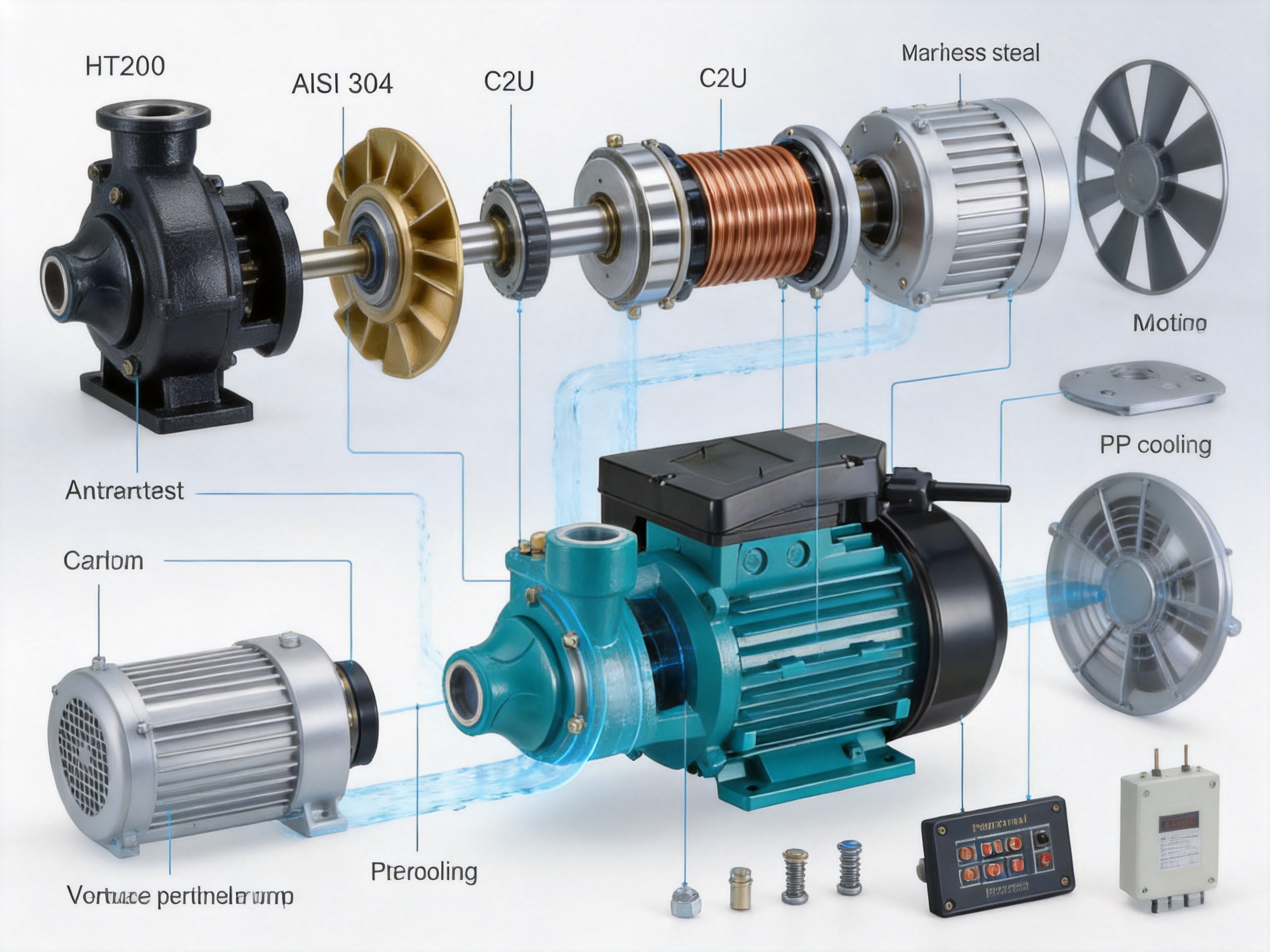
The PM Series is built from a combination of metal and engineered polymer components selected for their respective functions. The pump body and support use HT200 cast iron, the impeller is brass, the mechanical seal uses carbon and ceramic, the motor case is aluminum, the motor cover is cast iron, and the fan uses PP material.
Component |
Material or Feature |
Functional Purpose |
Pump body |
HT200 cast iron with antirust treatment |
Structural strength and durable hydraulic chamber |
Impeller |
Brass |
Hydraulic energy transfer and corrosion resistance |
Mechanical seal |
Carbon / ceramic |
Sealing between rotating shaft and pump body |
Support |
HT200 cast iron with antirust treatment |
Motor-pump alignment and mechanical support |
Shaft and rotor |
Designed for rotating drive assembly |
Transfers motor torque to the impeller |
Ball bearing |
C&U bearing |
Supports smooth and stable rotation |
Motor case |
Aluminum |
Lightweight motor enclosure and heat dissipation |
Motor cover |
Cast iron |
Protection and structural reinforcement |
Fan |
PP |
Motor cooling airflow |
Terminal board |
PC |
Electrical connection support |
The pump body contains the hydraulic chamber and must withstand water pressure, vibration, connection forces, and repeated operating cycles. The support helps maintain the relationship between the hydraulic section and the motor. Using HT200 cast iron for these structural components provides a robust foundation for the pump assembly.
The antirust treatment is particularly important for equipment exposed to humid air, occasional splashing, or seasonal operation. It helps preserve the external condition of the pump and supports longer service life when the unit is stored, transported, or installed in a demanding environment.
The impeller is the rotating hydraulic component responsible for transferring energy from the motor to the water. Brass is selected for its strength, machinability, and resistance to corrosion in clean-water service.
The copper inserts are designed to support reliable operation and smoother restarting after inactivity. This is beneficial for seasonal irrigation, backup water supply, and domestic systems that operate intermittently. The pump should still be inspected before restarting after long storage, particularly if the installation may have experienced freezing, sediment accumulation, or water contamination.
The mechanical seal prevents water from escaping along the rotating shaft into the motor area. Carbon and ceramic are widely used seal-face materials because they can provide suitable friction and wear characteristics in clean-water applications.
Seal life depends on operating conditions. Running the pump dry, pumping abrasive particles, operating with blocked suction, or exceeding the liquid temperature limit can cause premature seal wear. Correct priming, clean water, and adequate flow conditions are therefore essential to preserve the sealing system.
The C&U bearing supports the rotating shaft and rotor assembly. Smooth bearing operation helps limit vibration, mechanical noise, and friction losses. Reliable bearings are especially important in a compact high-speed motor because bearing problems can affect both the hydraulic and electrical portions of the pump.
The use of recognized C&U bearing components is a notable advantage over unbranded or inconsistent bearing selections often found in basic pump assemblies. Consistent bearing quality contributes to more predictable operation, easier quality control, and improved serviceability.
The motor is designed for durable operation in domestic and light commercial pumping duties. Copper winding provides good electrical conductivity and supports efficient conversion of electrical energy into mechanical power. Durable copper wiring can also contribute to longer service life when the motor is operated within its rated conditions.
The single-phase motor includes a built-in thermal protector. This component is designed to interrupt or protect the motor when excessive temperature develops due to overload, restricted cooling, abnormal operating conditions, or other causes of overheating.
Thermal protection is an important advantage for domestic pumps because users may not always have sophisticated electrical monitoring equipment. The protector provides an additional safeguard against damage caused by temporary overheating. It should not, however, be treated as a substitute for correct circuit protection, grounding, wiring, and installation.
The motor uses Class F insulation. This insulation class is designed for higher thermal endurance than lower-grade insulation systems and supports reliable operation when the motor experiences normal temperature increases during service.
Actual motor life depends on ambient temperature, voltage stability, load, ventilation, operating frequency, and cleanliness. The maximum ambient temperature for the PM Series is +40°C. The motor should be installed where air can circulate freely around the fan cover and motor housing.
The IP44 protection rating indicates protection against solid objects of a defined size and against water splashing from various directions. It is appropriate for many sheltered pump-room and domestic installations, but it does not mean that the motor can be submerged or exposed to direct high-pressure water jets.
Installation should protect the pump from flooding, heavy rain, uncontrolled spray, and condensation. Electrical connections must remain dry and should be made in accordance with local electrical regulations by a qualified person.
The aluminum motor case helps provide a lightweight enclosure and supports heat dissipation. The PP cooling fan directs air over the motor housing during operation. The fan cover protects the rotating fan and helps maintain the intended airflow path.
Dust, leaves, plastic film, and other debris should not be allowed to block the fan cover. A blocked airflow path can increase motor temperature and may cause the thermal protector to operate repeatedly.
The PM Series can support small domestic water supply systems where water must be transferred from a storage tank, ground-level reservoir, or shallow well to taps or elevated points. The PM-45 may be suitable for a modest single-building requirement, while the PM-80 provides additional head for more demanding layouts.
The actual system should include appropriate isolation valves, a suction strainer where necessary, a check valve or foot valve for suction service, and a pressure control arrangement if automatic starting and stopping are required. The pump should not be selected solely according to pipe size; the total system demand must also be considered.
Garden irrigation frequently involves moderate flow, pressure losses through hoses, and changes in elevation. The PM Series can be used for sprinklers, hose outlets, and small automatic irrigation systems when the flow and pressure requirements remain within the model’s capacity.
For irrigation systems, filters should be installed when water contains leaves, sand, or suspended particles. Sprinkler nozzles should be checked to ensure that the required pressure is available at the operating flow. If many sprinklers operate simultaneously, the PM-80 may be more appropriate than the PM-45, although the final choice should be based on the irrigation layout.
The pump can be used to lift water into an elevated storage tank or water tower. In these applications, the key selection factors are the vertical height, pipe friction, tank inlet requirements, and desired filling time.
A float switch, level controller, or pressure control device may be added to prevent overflow and allow automatic operation. Electrical control components should be selected and installed according to the pump motor rating and local safety requirements.
The maximum suction height is specified as 8 meters. This makes the pump suitable for certain shallow-well or low-level water lifting applications, provided that the actual suction lift remains within the limit and the suction pipe is correctly installed.
The suction line should be airtight, adequately supported, and as short and direct as practical. A foot valve can help retain water in the suction line when the pump stops. The pump should be properly primed before operation, and the water source should be free from excessive sand and abrasive solids.
The PM Series is suitable for selected small air-conditioning systems or supporting equipment where the liquid is clean and the temperature remains within the +60°C maximum. The system designer should verify flow, head, temperature, control method, and compatibility before installation.
For closed-loop systems, the pump may require additional consideration regarding expansion, air release, pressure, and system filling. The PM Series is not automatically a replacement for every specialized HVAC circulation pump, so the operating requirements of the equipment must be reviewed carefully.
Small farms, workshops, service buildings, and commercial facilities may use the pump for tank transfer, cleaning water, small irrigation zones, and general utility-water distribution. Its compact design and pressure capability can be valuable where a full industrial multistage pump would be unnecessary.
For continuous-duty commercial operation, the buyer should confirm the expected operating schedule, water quality, ambient conditions, motor voltage and frequency, and required maintenance plan. The pump is intended for clean-water service and should not be applied to heavy-duty process fluids without engineering confirmation.
The manufacturer behind the PM Series operates as an integrated pump enterprise with independent research and development, mass production, and global export capabilities. This combination is significant because it connects product design, component selection, manufacturing control, order fulfillment, and after-sales support within a coordinated organization.
Independent research and development allows the manufacturer to refine hydraulic structures, motor configurations, materials, and product families according to market requirements. For a peripheral pump, development work may involve impeller geometry, flow passage design, pressure balance, sealing performance, thermal behavior, and compatibility with domestic water systems.
Product development is not limited to achieving a maximum head or flow value. A commercially useful pump must also be manufacturable, serviceable, stable in repeated operation, and adaptable to different regional requirements. An integrated development team can evaluate these factors together rather than treating the pump as an isolated hydraulic component.
Mass production provides advantages in component standardization, process repeatability, purchasing efficiency, and delivery capacity. Consistent production is especially important for pumps because small variations in bearing fit, shaft alignment, mechanical seal installation, winding quality, or impeller balance can influence performance and reliability.
A mature production system can establish repeatable procedures for casting, machining, surface treatment, winding, assembly, inspection, and packaging. It can also maintain a stable supply of commonly used components such as bearings, capacitors, terminal boards, seals, fasteners, and electrical protection devices.
The PM Series demonstrates a coordinated approach to material selection. HT200 cast iron is used for structural pump components, brass is used for the impeller, AISI 304 stainless steel is specified for the shaft, carbon and ceramic are used for the mechanical seal, aluminum is used for the motor case, and PP and PC are used for selected motor and electrical components.
This combination balances mechanical strength, corrosion resistance, weight, electrical safety, thermal performance, and production practicality. The antirust treatment applied to the pump body and support adds an extra process step intended to improve durability in humid or intermittent-use conditions.
Reliable pump manufacturing requires inspection at multiple stages. Casting quality should be controlled to reduce defects and dimensional variation. Machined surfaces and connection threads should be checked for accuracy. Shaft runout and impeller balance should be controlled to reduce vibration. Mechanical seals should be installed correctly to prevent leakage.
Electrical production should include winding checks, insulation verification, terminal connection inspection, capacitor verification, and motor testing. Final assembly should confirm the correct relationship between the hydraulic section and the motor, while finished pumps should be checked for operating performance, noise, leakage, and general appearance.
These process priorities help distinguish a professionally manufactured pump from a low-cost assembly that may use inconsistent components or insufficient inspection. The result is not only a product specification on paper but also a more dependable production baseline across different orders and markets.
The company has developed export and foreign-trade service capabilities to support international customers. Its related procurement and import-export organizations provide services covering procurement planning, order tracking, cross-border delivery, and foreign-trade coordination.
For distributors and project buyers, this support can be as important as the pump itself. International purchasing often requires product communication, documentation, packaging coordination, shipment planning, and timely updates. A manufacturer with an established export structure can help reduce uncertainty throughout the purchasing cycle.
The PM Series should be compared with competing products according to application, materials, protection, and manufacturing consistency rather than price alone. A very low initial purchase price may not represent the lowest total cost if the pump requires frequent replacement, develops corrosion, has unstable electrical performance, or cannot deliver the required pressure.
Compared with many basic low-head transfer pumps, the vortex peripheral design offers stronger pressure performance for compact domestic systems. The PM-80, for example, provides a maximum head of 70 meters, making it more suitable for vertical lifting and pressure-oriented applications than a pump designed only for short-distance water transfer.
The antirust-treated cast iron body, brass impeller, copper inserts, and stainless steel shaft provide a more corrosion-conscious construction than an assembly made entirely from untreated or lower-grade materials. This advantage is relevant in humid installations, seasonal operation, and applications where the pump may remain idle between operating periods.
The built-in thermal protector, Class F insulation, and IP44 protection rating provide a stronger protection package than a basic motor with limited thermal safeguards. These features do not replace correct installation, but they can improve operational security and reduce the consequences of temporary overheating or demanding operating conditions.
C&U bearings support stable rotor operation and help improve consistency between units. Bearing quality affects vibration, noise, energy loss, and service life. The use of specified bearings is therefore a meaningful advantage compared with pumps assembled with unknown or inconsistent bearing sources.
The two-model structure makes selection easier for distributors, installers, and end users. The PM-45 addresses lower-power requirements, while the PM-80 provides greater pressure and flow capability. Both models retain the same general product concept and 1-inch connection format, simplifying product planning and accessory compatibility.
Correct installation is essential for obtaining the expected performance and service life. The pump should be installed on a solid, level base that can support its weight and limit vibration. The location should be dry, ventilated, accessible for inspection, and protected from flooding.
The suction pipe should be airtight and appropriately sized. The pipe should rise continuously toward the pump where practical, avoiding unnecessary high points that can trap air. Threaded connections should be sealed carefully without allowing sealing material to enter the hydraulic passage.
A foot valve or check valve may be required to maintain prime, depending on the installation. The suction inlet should be protected from large particles, floating debris, and excessive turbulence. The water source should provide sufficient depth to prevent the suction line from drawing air.
The discharge pipe should be supported independently so that its weight does not place stress on the pump connections. Excessive elbows, restrictive valves, and undersized piping increase friction losses and may reduce flow and pressure at the delivery point.
An isolation valve can be installed for maintenance. A pressure gauge may be useful for monitoring the system. Where automatic domestic water supply is required, a pressure switch, controller, pressure tank, or other suitable control device can be integrated according to the application.
The pump should be filled with water before starting when the installation requires priming. Running a mechanical-seal pump without adequate water can cause rapid seal damage and overheating. After filling, the installer should check all joints for leakage and confirm that the suction line remains full.
During initial operation, observe the pump for abnormal vibration, unusual noise, leakage, overheating, or unstable pressure. The motor should rotate in the correct direction where applicable, and the electrical supply should match the motor requirements shown on the product nameplate.
Electrical connections should be completed by a qualified professional. The circuit should include suitable overload and short-circuit protection, correct grounding, and an accessible disconnecting device. Cables must be selected according to current, distance, installation environment, and local regulations.
The terminal cover should remain correctly fitted during operation. The IP44 rating is not intended to protect against submersion or severe water exposure. Electrical components should be kept away from standing water, condensation, and unprotected outdoor weather.
Routine maintenance helps preserve pump efficiency and reduces the possibility of unexpected downtime. Before maintenance, disconnect the electrical supply and release pressure from the system. Allow hot water or hot components to cool before opening the pump or pipework.
Inspect the pump body, support, connections, mechanical seal area, cable, terminal cover, fan cover, and mounting base. Look for corrosion, water leakage, loose fasteners, damaged insulation, unusual vibration, or changes in operating sound.
The suction strainer and filters should be cleaned when required. A blocked filter can reduce inlet pressure, limit flow, increase noise, and contribute to cavitation or dry running. The water source should also be checked for sand, algae, leaves, or other contaminants.
If the pump is used only during the irrigation season, it should be inspected before storage and before restarting. In cold climates, water should be drained from the pump and exposed pipework to prevent freezing damage. The pump should be stored in a dry, protected environment.
After a long idle period, confirm that the shaft and impeller are free to rotate according to the manufacturer’s service procedure. Check the electrical connections and refill the pump before starting. The brass impeller and copper inserts help support restarting, but they do not eliminate the need for preparation after storage.
The maximum liquid temperature is +60°C. The maximum ambient temperature is +40°C. Exceeding these limits may affect the mechanical seal, motor insulation, bearings, lubricant, and other components.
When pumping warm water, the installer should consider the increased risk of scalding, vapor formation, reduced suction performance, and thermal stress. The pump should be isolated and allowed to cool before service.
Before selecting a PM Series pump, the buyer should define the water source, required flow, vertical elevation, desired outlet pressure, pipe length, water temperature, operating schedule, and environmental conditions. This information helps determine whether a peripheral pump is suitable and which model should be chosen.
Application Requirement |
Suggested Consideration |
Small household transfer |
Evaluate the PM-45 if flow and head requirements are modest |
Higher vertical lift |
Evaluate the PM-80 because of its higher maximum head |
Garden irrigation |
Calculate total sprinkler flow and friction loss before selection |
Shallow well lifting |
Keep actual suction height within the 8-meter maximum and ensure airtight piping |
Tank or water tower filling |
Consider elevation, filling time, level control, and overflow protection |
Warm-water application |
Keep liquid temperature at or below +60°C and verify seal compatibility |
Humid installation |
Use a sheltered, ventilated location and protect electrical components from water |
Distributors can benefit from stocking both models because they cover different pressure and power requirements while retaining a common product identity. Installers can also simplify customer recommendations by first identifying whether the priority is lower energy consumption and moderate performance or greater pressure and lifting capacity.
The PM Series is intended for clean water or liquids with physical and chemical properties similar to clean water. It should not be used for abrasive slurry, heavily contaminated wastewater, flammable liquids, or aggressive chemicals unless compatibility has been specifically confirmed.
The PM-45 uses a 0.37 kW, or 0.5 HP, motor and has a maximum flow of 35 liters per minute and maximum head of 40 meters. The PM-80 uses a 0.75 kW, or 1.0 HP, motor and has a maximum flow of 50 liters per minute and maximum head of 70 meters. Both models use 1-inch inlet and outlet connections and have an 8-meter maximum suction height.
It can be used for suitable shallow-well applications when the actual suction height does not exceed 8 meters. The suction pipe must be airtight, correctly sized, properly primed, and protected from air leaks and excessive debris.
No. The pump should not run without water. Dry running can damage the mechanical seal, increase temperature, and reduce service life. The pump should be filled and primed before operation.
The maximum stated liquid temperature is +60°C. Applications involving warm water should remain within this limit and should also consider seal compatibility, suction conditions, user safety, and local installation requirements.
IP44 provides protection against certain solid objects and water splashing. It does not mean that the motor can be submerged or exposed to high-pressure water jets. The pump should be installed in a dry or suitably sheltered location.
The built-in thermal protector helps protect the single-phase motor when excessive temperature develops. It can respond to certain overload or overheating conditions, but it does not replace a correctly designed electrical circuit, grounding, and external protection.
Routine maintenance includes checking for leakage, unusual vibration, abnormal noise, corrosion, loose connections, blocked filters, damaged cables, and restricted cooling airflow. Seasonal users should drain the pump where freezing is possible and inspect it before restarting.
Yes, it can support small automatic sprinkler and irrigation systems when the required flow and pressure are within the selected model’s capacity. A filter, check valve, controller, and suitable pressure control equipment may be required.
The PM Series combines an antirust-treated cast iron structure, brass impeller, copper inserts, AISI 304 stainless steel shaft, C&U bearings, copper winding, Class F insulation, IP44 protection, and built-in thermal protection. Its integrated manufacturing and export organization also supports more consistent production and professional procurement service.
The PM Series C&U bearing antirust durable vortex peripheral pump is a practical solution for clean-water applications that require compact construction and useful pressure. Its peripheral hydraulic design supports high-head performance in a relatively small format, while the PM-45 and PM-80 models provide options for different power and capacity requirements.
The product’s advantages are supported by a carefully selected component package. Antirust-treated HT200 cast iron provides structural durability, the brass impeller supports reliable hydraulic operation, copper inserts assist restarting after inactivity, and the AISI 304 stainless steel shaft improves resistance in water-contact areas. Carbon and ceramic mechanical sealing, C&U bearings, copper winding, Class F insulation, IP44 protection, and thermal overload protection further strengthen the overall design.
These features make the pump suitable for domestic water supply, garden irrigation, tank and water tower filling, shallow-well lifting, small sprinkler systems, and selected supporting equipment. Correct sizing remains essential: users must consider the actual flow, total head, suction height, pipe losses, temperature, water quality, and operating schedule.
Behind the product is an integrated manufacturer with independent research and development, mass-production capability, component and process coordination, and international procurement and export support. This combination helps provide a more stable product supply and a stronger foundation for distributors, installers, project buyers, and end users seeking dependable water-pumping equipment.
1. Product technical information for the PM Series C&U Bearing Antirust Durable Vortex Peripheral Pump.
2. Manufacturer-provided component and material specifications for the PM Series pump body, impeller, shaft, seal, motor, bearings, and electrical parts.
3. Manufacturer-provided PM Series technical data for PM-45 and PM-80 models.
4. General principles of centrifugal and peripheral pump selection, including flow, total dynamic head, suction lift, and friction loss.
5. General guidance for electric motor protection, insulation classes, enclosure ratings, grounding, and safe pump installation.
edwina@edwin-pump.com
+86-13586290903 (WhatsApp)
Xuri Gongliang Cutting Tool Entrepreneurship Park, Wenqiao Town, Wenling City, Taizhou City, Zhejiang Province, China

High Performance Smart Pump Factory


 English