
edwina@edwin-pump.com

View All Products
en
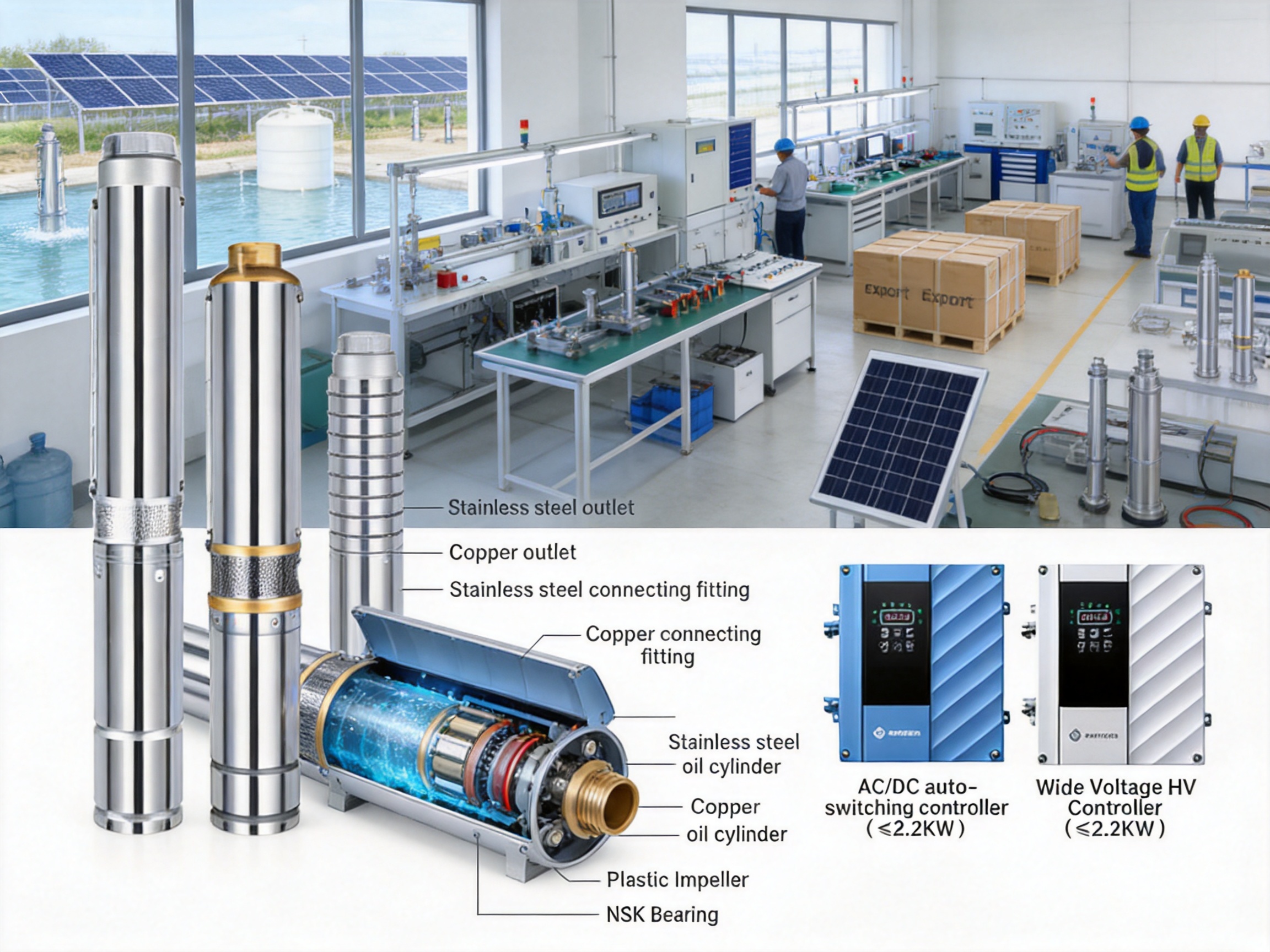
Reliable access to water is essential for rural communities, agricultural operations, livestock facilities, residential properties, and small commercial projects. In many locations, however, water must be lifted from deep wells where grid electricity is unavailable, unstable, or too expensive to extend. A solar-powered deep well pump can solve this challenge by converting renewable energy into a dependable water supply. The 4ADPCW AC/DC water-filled solar deep well pump is designed for this type of demanding application, combining solar compatibility, alternating-current and direct-current operation, intelligent control, corrosion-resistant construction, and a compact 4-inch submersible format.
Unlike a conventional single-input pump, this AC/DC hybrid model can operate with photovoltaic power or an AC power source within its specified voltage ranges. This flexibility enables the pump to use solar energy during suitable daylight conditions while retaining the option of grid or generator power when needed. The result is a more adaptable water-supply system for customers who require continuity, energy efficiency, and a practical transition between renewable and conventional power.
The pump is developed for deep well water lifting, household water supply, rural drinking water, agricultural irrigation, and small- to medium-sized irrigation projects. Its available configurations cover maximum flows from 6 m³/h to 17 m³/h and maximum heads from 36 m to 175 m. With motor powers ranging from 750 W to 2,200 W, the series can be selected for different well depths, pipe networks, tank-filling requirements, and irrigation layouts.
Beyond its performance data, the pump reflects a broader manufacturing philosophy based on integrated research and development, controlled production, material selection, and international supply capability. The manufacturer has specialized in deep well pumps, submersible pumps, booster pumps, circulation pumps, and related water equipment since 2008. Its experience in mass production and overseas delivery supports customers who need not only a pump, but also stable product availability, procurement coordination, technical communication, and long-term supply support.
Traditional submersible pumps are often designed for one electrical source. A standard AC pump normally depends on grid electricity or a generator, while a basic solar pump may require a dedicated DC or inverter arrangement. Each approach can be effective, but each also has limitations. Grid dependence creates exposure to power outages and rising electricity costs. A basic solar-only system may be affected by weather, seasonal sunlight changes, or insufficient photovoltaic output during early morning and evening hours.
An AC/DC hybrid solar pump addresses these limitations by accepting both AC and DC input. The 4ADPCW series is specified for an AC voltage range of 85 V to 280 V and a DC voltage range of 80 V to 430 V. These broad operating ranges allow the equipment to be integrated into a variety of solar and backup-power systems, subject to correct system design and professional installation.
During periods of sufficient sunlight, the pump can use solar energy directly through its intelligent controller. When solar conditions are weak or water demand must continue after sunset, an AC source can provide an alternative. This operating concept is especially valuable for rural water systems, farms, construction sites, remote homes, and locations where a complete battery-storage system would add cost and maintenance requirements.
The hybrid arrangement also provides an effective path toward energy transition. A customer may begin with AC operation and add photovoltaic power later, or install solar power as the primary source while keeping AC power for backup. This flexibility can reduce the need to replace the entire pumping system when the energy infrastructure changes.
The 4ADPCW utilizes an AC/DC brushless water-filled motor. A water-filled motor is designed to operate with water surrounding the internal motor components, providing cooling during operation. The water-cooled structure helps remove heat generated by the motor and supports stable operation in a submerged environment.
The brushless design eliminates the need for conventional mechanical commutation components associated with brushed motors. This can reduce brush wear and maintenance requirements while supporting efficient motor control. For a pump installed deep inside a well, reduced maintenance is particularly important because removing a submersible unit can require significant labor, equipment, and downtime.
The water-filled motor design also helps eliminate potential leakage problems associated with mechanical seals. Mechanical seals are common in many rotating machines, but they can become wear points under demanding conditions. By using a water-filled structure and avoiding the same type of mechanical-seal dependency, the pump is designed to provide a more reliable submerged operating arrangement.
The pump uses a compact 4-inch diameter housing. This format is suitable for many standard deep well applications where the internal well diameter limits equipment size. A smaller pump body can simplify installation in narrow wells and provide greater compatibility with existing borehole infrastructure.
Compact dimensions do not mean that the pump is intended only for light-duty operation. The product range includes models reaching 2,200 W, with maximum heads up to 175 m and maximum flows up to 17 m³/h depending on the selected hydraulic configuration. The pump body must still be matched to the actual well diameter, water conditions, installation depth, pipework, and required duty point.
The cylindrical stainless steel structure is intended to provide mechanical strength and corrosion resistance in deep well environments. Submersible pumps are exposed to water, pressure, suspended particles, temperature variation, and repeated starting cycles. The housing must therefore maintain its shape and protect internal components over extended operating periods.
The product information identifies environmentally friendly, oil-free 304 stainless steel for core components. This material selection is important for applications where cleanliness, corrosion resistance, and long service life are priorities. Stainless steel is commonly selected for water equipment because it provides a strong balance between durability, manufacturability, and resistance to many common water environments.
The product title identifies the pump as having a plastic impeller, while the technical description also refers to a corrosion-resistant stainless steel impeller. This indicates that configuration details should be confirmed against the exact model, order specification, and production documentation before purchase. Different hydraulic versions or product descriptions may use different impeller materials or component configurations. Buyers should request the final bill of materials and approved technical drawing when the material of the impeller is critical to an application.
Whether the selected configuration uses an engineered plastic impeller or a stainless steel impeller, the hydraulic design must be matched to water quality and operating conditions. Clean groundwater, irrigation water, and lightly suspended water can support reliable pump operation, while abrasive sand, corrosive chemicals, or heavy solids may require additional evaluation. Correct well development, filtration, installation clearance, and operating control are also important to protect the hydraulic stages.
The pump is equipped with Japanese NSK bearings, selected for wear resistance and long operating life. Bearings are critical in a submersible motor because they support rotating components, maintain alignment, and help manage radial and axial forces. A bearing failure can affect both motor efficiency and hydraulic stability, so bearing quality is a major consideration when comparing pumps from different suppliers.
The rotor shaft uses a ceramic coating to enhance wear resistance. The shaft is exposed to rotation, water contact, bearing interfaces, and thrust loads. A wear-resistant surface can help reduce deterioration at points where friction or contact occurs. The ceramic coating also complements the corrosion-resistant material strategy used in the pump’s main components.
A thrust bearing provides additional support for the axial force generated by the pump’s hydraulic stages. In a deep well pump, hydraulic thrust cannot be ignored. The thrust bearing helps maintain rotor stability and supports smooth operation under changing flow and head conditions. This is particularly relevant for models designed to produce high heads, where hydraulic loading can be more significant.
The built-in intelligent controller is one of the main advantages of the 4ADPCW series. It enables automatic start and stop, soft start, AC/DC switching, and maximum power point tracking in solar mode. These functions reduce the need for separate control equipment and help the pump respond to changing power and water conditions.
Automatic start and stop functionality supports unattended water supply. Depending on the complete system design, the pump can be connected to level sensors, pressure controls, storage tanks, or other control devices. Automatic operation can prevent unnecessary running when a water tank is full or when a dry-running condition is detected through the applicable control arrangement.
For remote farms, livestock facilities, and rural homes, automatic control reduces the need for personnel to travel to the pump site. It also makes it easier to integrate the pump with a storage tank. Water can be pumped when energy is available and stored for later use, allowing the system to separate the timing of water production from the timing of water consumption.
Soft start reduces the sudden electrical and mechanical stress that can occur when a motor starts at full intensity. A controlled acceleration process can help reduce starting current, hydraulic shock, torque stress, and disturbance to the photovoltaic power system. This is especially useful for solar pumping installations, where available power may fluctuate and the energy source may have limited short-term reserve.
Soft start may also help reduce stress on the rising main and associated valves. Sudden changes in flow can create water hammer in long pipe systems. Although correct pipe sizing and valve selection remain essential, gradual motor acceleration supports a smoother overall system response.
Automatic or intelligent AC/DC switching gives the pump greater operational flexibility. A project can use solar input as the primary energy source and AC input as backup, or the operating priority can be determined by the control strategy. This reduces dependence on one energy source and can improve water availability in regions with variable weather.
Because AC and DC systems have different electrical characteristics, the controller and installation must be configured according to the manufacturer’s requirements. The solar array voltage, open-circuit voltage, cable size, protection devices, grounding method, AC supply quality, and switching arrangement must be reviewed before commissioning.
In solar mode, the controller supports MPPT. Photovoltaic panels do not produce one fixed power output under all conditions. Their voltage and current vary with sunlight intensity, temperature, shading, and electrical load. MPPT technology adjusts the operating point to help the system draw power more effectively from the solar array.
The specified solar panel open-circuit voltage is less than 430 V, and the recommended solar panel power is at least 1.3 times the pump power. These values provide important guidance for system planning. The solar array should not simply be assembled by adding panels until a nominal voltage is reached. Designers must calculate the array’s maximum open-circuit voltage under the lowest expected temperature and confirm that it remains within the controller’s permitted limit.
The stated MPPT efficiency exceeds 99 percent under the product information. This high efficiency means that limited solar energy can be converted with minimal controller loss, although total system performance will still depend on panel efficiency, cable length, sunlight conditions, pump duty point, pipe losses, and water level.
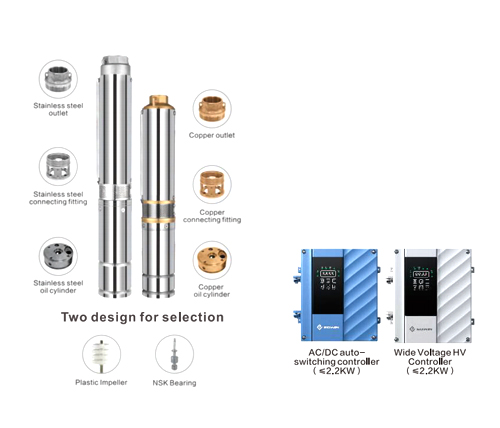
4ADPCW AC/DC Water Filled Solar Deep Well Pump with Plastic Impeller
The 4ADPCW product family includes multiple hydraulic capacities. The available models are not interchangeable in performance, even when they share the same motor technology and electrical ranges. The correct model must be selected according to the required flow, total dynamic head, well depth, pipe friction, elevation difference, storage tank height, and any pressure requirement at the point of use.
| Model | Power | Maximum Flow | Maximum Head | Outlet | AC Voltage | DC Voltage |
| 4ADPCW6-56-110-750 | 750 W | 6 m³/h | 56 m | 1.25 inches | 85–280 V | 80–430 V |
| 4ADPCW6-84-150-1100 | 1,100 W | 6 m³/h | 84 m | 1.25 inches | 85–280 V | 80–430 V |
| 4ADPCW6-112-150-1300 | 1,300 W | 6 m³/h | 112 m | 1.25 inches | 85–280 V | 80–430 V |
| 4ADPCW6-135-200-1500 | 1,500 W | 6 m³/h | 135 m | 1.25 inches | 85–280 V | 80–430 V |
| 4ADPCW9-45-110-750 | 750 W | 9 m³/h | 45 m | 2 inches | 85–280 V | 80–430 V |
| 4ADPCW9-58-150-1100 | 1,100 W | 9 m³/h | 58 m | 2 inches | 85–280 V | 80–430 V |
| 4ADPCW9-71-150-1300 | 1,300 W | 9 m³/h | 71 m | 2 inches | 85–280 V | 80–430 V |
| 4ADPCW9-85-200-1500 | 1,500 W | 9 m³/h | 85 m | 2 inches | 85–280 V | 80–430 V |
The first group is designed around nominal flows of 6 m³/h and 9 m³/h. The 6 m³/h models provide greater maximum head as motor power increases, making them suitable for relatively deep lifting or high-elevation delivery. The 9 m³/h models offer a higher flow range with lower maximum head values, which may be appropriate for applications requiring faster tank filling or moderate-pressure irrigation.
| Model | Power | Maximum Flow | Maximum Head | Outlet | AC Voltage | DC Voltage |
| 4ADPCW13-36-110-750 | 750 W | 13 m³/h | 36 m | 2 inches | 85–280 V | 80–430 V |
| 4ADPCW13-49-150-1100 | 1,100 W | 13 m³/h | 49 m | 2 inches | 85–280 V | 80–430 V |
| 4ADPCW13-54-150-1300 | 1,300 W | 13 m³/h | 54 m | 2 inches | 85–280 V | 80–430 V |
| 4ADPCW13-60-200-1500 | 1,500 W | 13 m³/h | 60 m | 2 inches | 85–280 V | 80–430 V |
| 4ADPCW17-48-200-1500 | 1,500 W | 17 m³/h | 48 m | 2 inches | 85–280 V | 80–430 V |
| 4ADPCW6-175-300-2200 | 2,200 W | 6 m³/h | 175 m | 1.25 inches | 85–280 V | 80–430 V |
| 4ADPCW9.5-125-300-2200 | 2,200 W | 9.5 m³/h | 125 m | 2 inches | 85–280 V | 80–430 V |
| 4ADPCW13-110-300-2200 | 2,200 W | 13 m³/h | 110 m | 2 inches | 85–280 V | 80–430 V |
The second group expands the selection to 13 m³/h and 17 m³/h models while also providing high-head 2,200 W versions. The 4ADPCW6-175-300-2200 model is intended for high-head applications with a nominal flow of 6 m³/h and a maximum head of 175 m. The 4ADPCW9.5-125-300-2200 model balances a flow of 9.5 m³/h with a maximum head of 125 m. The 4ADPCW13-110-300-2200 model is intended for a higher flow of 13 m³/h and a maximum head of 110 m.
Maximum flow and maximum head are not normally achieved simultaneously. A pump curve is required to identify the actual flow at the required operating head. The performance curves supplied with the product should be used during system design. A qualified pump engineer or installer can calculate the duty point and confirm the most appropriate model.
A conventional AC-only deep well pump may perform effectively where the grid is stable, but it provides limited flexibility in remote areas. The AC/DC hybrid design can use solar energy and AC power, allowing customers to select the most economical or available source. This is a significant advantage where grid expansion is difficult or where diesel generator operation is expensive.
Mechanical seals can be important maintenance points in many pump types. The water-filled motor structure reduces dependence on mechanical seals and is designed to eliminate potential leakage concerns associated with them. This design is particularly relevant to submersible equipment that may operate continuously for long periods and be difficult to access after installation.
The built-in controller combines functions that may otherwise require separate equipment. Automatic starting and stopping, soft starting, AC/DC switching, and solar MPPT can simplify system architecture. Fewer external control components may also reduce cabinet space, wiring complexity, and installation time, although appropriate protection and switching equipment is still required.
The product family offers a wide range of duty points from lower-flow, high-head applications to higher-flow, moderate-head applications. This gives distributors, engineering contractors, and project developers more choices within one product platform. It can simplify training, spare-parts planning, technical communication, and product standardization across several projects.
The 4-inch housing is suitable for many deep well installations and can be easier to place in narrow boreholes than larger submersible units. The compact format also supports applications where drilling costs, casing dimensions, or existing well infrastructure limit the available space.
NSK bearings, a ceramic-coated rotor shaft, a thrust bearing, stainless steel structural components, and a water-cooled motor indicate a design focused on durability. No pump can operate indefinitely under unsuitable conditions, but a carefully selected material and bearing package can reduce wear risks when the equipment is correctly installed and operated.
The manufacturer behind the pump was founded in 2008 and operates as an integrated enterprise covering independent research and development, mass production, and global export. This integrated structure is important for customers who need consistent technical specifications and stable product supply. A company that controls product development and manufacturing can respond more directly to application feedback, design improvements, production planning, and quality requirements.
The company’s product portfolio includes deep well pumps, submersible pumps, domestic booster pumps, circulation pumps, solar water pumps, intelligent booster pumps, and related water-treatment peripheral products. This breadth provides valuable system knowledge. A supplier that understands multiple pump categories is better positioned to discuss water distribution, pressure boosting, circulation, irrigation, and source-water lifting as connected parts of a project rather than as isolated products.
Its manufacturing and export activities serve customers in the medium-to-high-end international market. The company has established additional import and export service organizations to support procurement planning, order tracking, cross-border delivery, and foreign trade services. For overseas buyers, these functions can be as important as the pump itself. Clear order communication, documentation, packaging coordination, and delivery tracking reduce the risk of project delays.
The company has invested in new energy and intelligent technology since 2018. The development of solar water pumps and intelligent booster pumps reflects the changing requirements of the global water-equipment market. Customers increasingly seek products that combine energy efficiency, automation, remote-location suitability, and lower operating costs. The 4ADPCW series fits this trend by integrating renewable-energy compatibility with intelligent motor control.
Independent research and development allows the manufacturer to refine hydraulic structures, motor configurations, control logic, materials, and application solutions. Product development for a solar submersible pump requires more than adapting a conventional AC motor. The electrical system must work with variable photovoltaic output, while the hydraulic and motor system must maintain stable operation under changing speed and load conditions.
Development work also includes balancing motor power with pump head and flow. A pump that is efficient at one duty point may not be suitable for another. By offering multiple hydraulic variants, the manufacturer can address different combinations of flow and head instead of forcing one general-purpose model into every application.
Mass production capability supports repeatability and supply stability. For distributors and project contractors, this can reduce procurement uncertainty when multiple pumps are needed for a series of installations. Consistent production also supports standardized inspection procedures, component sourcing, assembly routines, and packaging methods.
Mass production must be paired with controlled component quality. Bearings, shafts, motor parts, hydraulic stages, cables, seals, controllers, and stainless steel components each influence final performance. A reliable production system should include incoming material checks, process controls, electrical testing, mechanical inspection, and final performance verification appropriate to the product and order requirements.
Global export requires more than manufacturing a pump. Products must be prepared for different electrical standards, installation practices, climatic conditions, shipping environments, and documentation requirements. Export experience helps a supplier understand packaging, labeling, commercial documents, inspection coordination, and communication with overseas distributors and engineering companies.
The manufacturer’s one-stop procurement approach can support customers who are sourcing pumps for agricultural irrigation, municipal works, construction, mining, HVAC systems, new energy projects, or household water supply. A customer can discuss product selection, production scheduling, order follow-up, and delivery arrangements through an established supply chain rather than coordinating with several unrelated vendors.
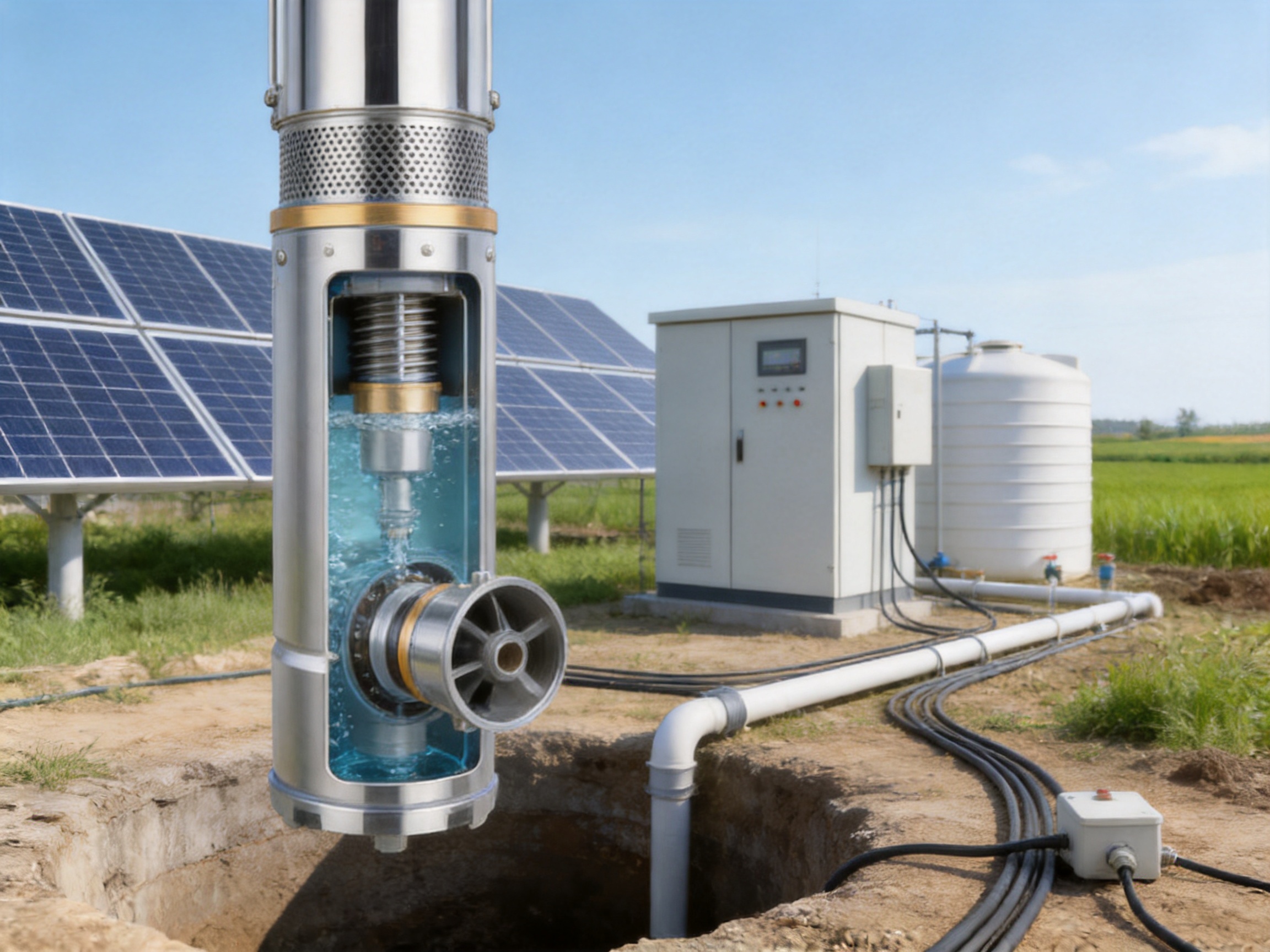
In rural locations, a deep well pump can lift groundwater into an elevated tank or pressure system. Solar operation is useful where grid electricity is unavailable or unreliable. The pump’s automatic control functions can support tank filling without constant supervision, while the AC input provides backup when water is urgently required or sunlight is insufficient.
For drinking-water applications, the complete system must be designed with suitable materials, hygienic storage, clean pipework, and appropriate water-quality testing. The pump alone does not determine whether water is safe for consumption. Well construction, source protection, treatment, storage, and distribution must all be considered.
The pump can be used to supply homes from deep wells, particularly when water is stored in a tank before entering the household distribution system. A tank-based arrangement can reduce pump cycling and provide a reserve during short periods of low solar output. Where direct pressure supply is required, the system should be designed with the correct pressure controls and protection devices.
Household systems benefit from quiet and low-maintenance operation. Because the motor is submerged, the pump can operate with less surface noise than many surface-mounted alternatives. The intelligent controller can also support smoother starting and stopping, reducing disturbance to the household electrical system.
Solar pumping is highly suitable for agricultural irrigation because water demand often occurs during daylight hours when photovoltaic energy is available. The pump can supply drip irrigation, sprinkler systems, storage tanks, or open-channel transfer systems, depending on the required pressure and flow.
For irrigation design, the pump must be selected according to the total dynamic head, including well lift, elevation changes, filter losses, pipe friction, valves, and the pressure required by the irrigation equipment. The maximum flow listed in the product data is not a guaranteed flow under all conditions. The actual output must be taken from the applicable performance curve.
Livestock facilities often require reliable water throughout the day, but they may be located far from utility networks. A solar pump can fill a storage tank or supply troughs while minimizing fuel and electricity costs. Automatic control can help prevent overflow and reduce unnecessary operation.
A suitable filtration arrangement should be considered where the well contains sand or suspended particles. The pump should not be operated outside its intended water-quality range, and the installation should prevent animals or vehicles from damaging exposed cables, pipes, or solar equipment.
Construction camps, temporary worksites, and remote infrastructure projects may need water before a permanent electrical connection is available. An AC/DC hybrid pump can operate from a temporary generator or AC source and later transition to solar power. This can extend the usefulness of the equipment through different project stages.
The range of available flows and heads makes the series suitable for small- and medium-sized irrigation networks. Several models can be compared according to whether the project prioritizes higher pressure, larger flow, or a balance between the two. The 2,200 W versions provide additional capacity for applications requiring higher head or greater delivery volume.
Correct installation is essential for achieving reliable performance. Before ordering, the installer should confirm the internal well diameter, static water level, dynamic water level, well yield, pump setting depth, required flow, delivery elevation, pipe diameter, cable length, and water quality.
The pump should be installed below the expected dynamic water level while remaining within the manufacturer’s permitted submergence and temperature limits. It should not be placed directly on the bottom of the well, where sediment can enter the hydraulic system or restrict cooling flow. The well should be properly developed so that excessive sand does not reach the pump.
The rising pipe must be adequately supported. The pump cable should be secured along the pipe using suitable fasteners that do not damage the insulation. Cable joints must be waterproof and installed according to professional electrical standards. Long cable runs can cause voltage drop, so cable size should be calculated based on current, length, conductor material, installation temperature, and allowable voltage loss.
The solar array must be designed so that its open-circuit voltage remains below 430 V under the most demanding temperature condition. The recommended solar-panel power is at least 1.3 times the pump power. For example, a 1,100 W pump should generally be paired with a solar array of at least approximately 1,430 W according to the stated sizing guidance, subject to the final controller and project design.
Solar panels should be arranged with correct series and parallel connections. The number of panels in series affects voltage, while the number of strings affects current and total power. Shading should be minimized because partial shading can significantly reduce output. Proper DC isolation, overcurrent protection, surge protection, grounding, and enclosure selection should be included in the system.
For AC operation, the supply must remain within the specified 85 V to 280 V range. An unstable or incorrectly wired AC supply can damage the controller or motor. A qualified electrician should verify the supply voltage, grounding, protective devices, cable capacity, and disconnect arrangement.
A check valve may be required in the delivery pipe to prevent reverse flow and reduce pressure shock when the pump stops. The valve should be selected and installed carefully because excessive restriction can reduce performance. Storage tanks should include level controls, overflow protection, and suitable inlet and outlet arrangements.
Submersible pumps generally require less routine surface maintenance than surface-mounted pumps, but they are not maintenance-free. Operators should inspect the solar array, controller, cables, tank, valves, and pipework at regular intervals. Dust, leaves, bird deposits, shading, loose connections, and damaged cables can reduce system performance.
The controller should be kept clean, dry, ventilated, and protected from direct weather exposure unless it is installed in an enclosure rated for outdoor use. Warning indicators, abnormal noises, repeated starts, fluctuating flow, and unexpected changes in current should be investigated promptly.
The well water level should be monitored, particularly during dry seasons. A falling water level can cause the pump to operate with insufficient cooling or lead to dry-running conditions. The control system should include appropriate low-water protection where applicable.
Sand production should be monitored. Abrasive particles can accelerate wear in impellers, bearings, shafts, and hydraulic stages. If sand levels increase, the well may require redevelopment, filtration, or a review of pump setting depth. Operating a pump continuously in unsuitable water can shorten service life regardless of the pump’s material quality.
Starting and stopping frequency should be minimized through proper tank sizing and control settings. Excessive cycling can place unnecessary stress on the motor, controller, valves, and pipework. Soft start reduces starting stress, but it does not remove the need for appropriate system control.
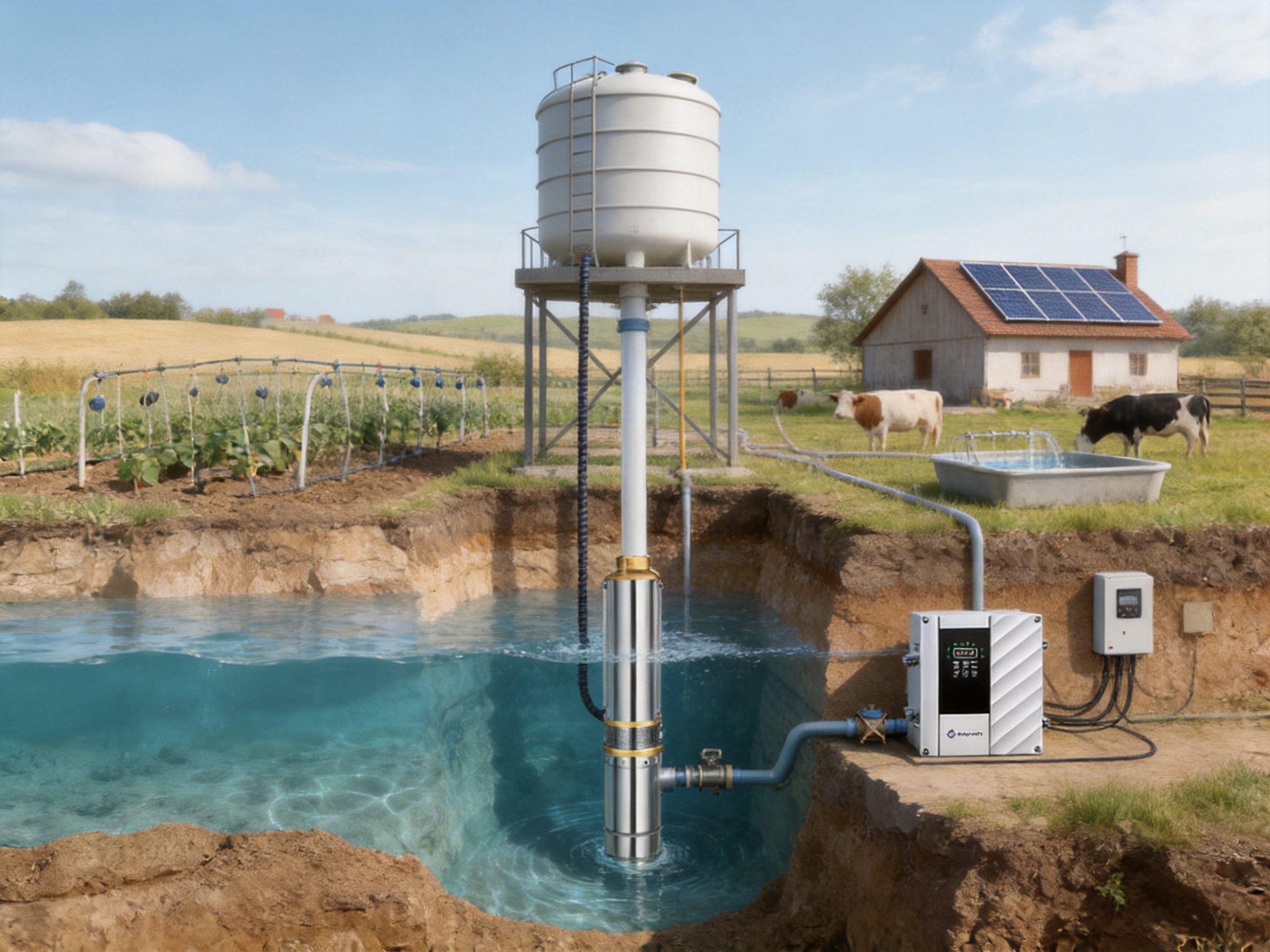
Model selection should begin with water demand. Estimate the daily and hourly water requirement, then determine whether the pump will deliver directly to the point of use or fill a storage tank. Agricultural applications may require a higher daytime flow, while household applications may prioritize consistent tank filling and pressure.
Next, calculate total dynamic head. This includes the vertical distance from the pumping water level to the delivery point, pressure requirements, friction losses in pipes and fittings, filter losses, valve losses, and any elevation difference between the well and the tank. Selecting a pump only according to well depth can lead to poor performance because the pump must overcome the entire system head.
Then compare the calculated duty point with the performance curve. A 6 m³/h model may be suitable for a high-head application, while a 13 m³/h or 17 m³/h model may be better for high-volume transfer at moderate head. The 2,200 W models can be considered when the required head or flow exceeds the practical range of lower-power units.
Finally, confirm electrical compatibility. The photovoltaic array must meet the controller’s voltage and power requirements, and the AC source must remain within the permitted input range. The cable length and installation conditions should be reviewed before finalizing the model.
The value of a deep well pump is determined by more than its purchase price. A low-cost pump may become expensive if it requires frequent removal, suffers from electrical failure, consumes excessive energy, or cannot obtain replacement components. The 4ADPCW series is positioned around long-term operating value through an integrated motor, controller, material, and product-range strategy.
Its brushless water-filled motor reduces dependence on mechanical seals and brush replacement. The ceramic-coated shaft, thrust bearing, and NSK bearings address wear and rotor-support requirements. The stainless steel housing and oil-free component approach support clean and corrosion-resistant operation. The intelligent controller reduces the need for separate solar control hardware and supports more efficient use of available photovoltaic power.
For distributors, the breadth of the product family creates opportunities to serve several market segments with a consistent platform. For project contractors, the AC/DC capability can simplify energy planning. For end users, solar operation can lower dependence on purchased electricity or fuel. These benefits should be evaluated together with installation cost, solar-array cost, pipework, storage, maintenance, and expected water demand.
It is an AC/DC hybrid submersible solar deep well pump with a 4-inch housing. It uses a brushless water-filled motor and an integrated intelligent controller for solar and AC operation.
Yes. The pump is designed to accept AC input from 85 V to 280 V. It can therefore operate from a suitable AC power source, although the complete electrical installation must comply with the required voltage, protection, grounding, and wiring specifications.
The specified DC voltage range is 80 V to 430 V. The solar array must be designed so that its open-circuit voltage remains below 430 V, including the effect of low ambient temperatures.
The product data specifies solar-panel power of at least 1.3 times the pump power. The final array should also be checked for voltage, current, temperature, shading, cable loss, and local solar conditions.
MPPT, or maximum power point tracking, helps the controller operate the solar array near the point where it can deliver the greatest available power. This is useful because panel output changes with sunlight, temperature, and electrical load.
Yes. The integrated intelligent controller supports automatic start and stop. The exact control arrangement may involve water-level sensors, tank controls, pressure switches, or other devices selected for the project.
Soft start gradually accelerates the motor instead of applying full starting stress immediately. This can reduce electrical current surges, mechanical stress, hydraulic shock, and disturbance to the solar power system.
Depending on the model, the maximum flow ranges from 6 m³/h to 17 m³/h, while the maximum head ranges from 36 m to 175 m. Maximum flow and maximum head are different limits and are not normally achieved at the same operating point.
The correct model depends on the required flow and total dynamic head, not only the physical depth of the well. The 6 m³/h models include high-head versions, including a 2,200 W model with a stated maximum head of 175 m. The performance curve should be used for final selection.
It can be used in rural drinking-water and household water-supply projects when the complete system is designed with suitable materials and water-quality controls. The pump itself does not guarantee water safety; the well, storage tank, piping, treatment, and source protection must also be appropriate.
The product information identifies oil-free 304 stainless steel for core components, NSK bearings, a ceramic-coated rotor shaft, and a thrust bearing. The product title refers to a plastic impeller, while the description also mentions a stainless steel impeller. The exact impeller material should be confirmed for the selected model and order.
Deep well pumps should not be selected or operated with excessive abrasive sand unless the specific model is designed and approved for that condition. Well development, filtration, correct installation depth, and water-quality testing are important for reducing sand-related wear.
The performance data lists a 2 m cable. If a longer cable is required, the extension and waterproof joint should be designed and installed by a qualified professional with attention to voltage drop and insulation protection.
A qualified pump and electrical installer should complete the installation. The work involves deep well equipment, high-voltage DC solar circuits, AC power, grounding, cable sealing, lifting equipment, and hydraulic pressure, all of which require appropriate technical competence.
The manufacturer provides integrated product development, mass production, export, procurement planning, order tracking, and cross-border delivery support. Buyers should confirm technical documentation, model selection, packaging, inspection requirements, spare parts, and warranty conditions before placing an order.
The 4ADPCW AC/DC water-filled solar deep well pump is designed for users who need more than a conventional submersible pump. Its hybrid electrical input supports both solar and AC power, while the intelligent controller provides automatic operation, soft start, AC/DC switching, and MPPT in solar mode. The water-filled brushless motor, compact 4-inch housing, stainless steel construction, NSK bearings, ceramic-coated rotor shaft, and thrust bearing form a durable platform for deep well applications.
The series covers a broad range of flows and heads, from 750 W models for moderate water duties to 2,200 W models for higher-head or higher-volume requirements. Its applications include rural drinking water, household supply, agricultural irrigation, livestock watering, remote construction sites, and small- to medium-sized irrigation systems.
Its strongest competitive advantage is the combination of energy flexibility, integrated intelligence, compact installation, and durability-focused construction. These technical features are supported by a manufacturer with experience in research and development, mass production, export, new-energy pumping, and one-stop procurement services. When correctly selected, installed, and maintained, the pump can provide an efficient and adaptable solution for reliable water lifting in locations where conventional infrastructure is limited.
1. Product technical information for the 4ADPCW AC/DC water-filled solar deep well pump, including performance data, electrical ranges, model capacities, and controller functions.
2. Manufacturer-provided product description covering the brushless water-filled motor, stainless steel construction, bearings, ceramic-coated shaft, thrust bearing, and application areas.
3. Manufacturer-provided company profile concerning research and development, mass production, international export, solar pumping, intelligent technology, and procurement services.
4. General principles of photovoltaic water-pumping system design, including solar-array sizing, MPPT operation, voltage verification, cable selection, and energy management.
5. General principles of submersible pump selection, including total dynamic head, duty-point analysis, well conditions, hydraulic losses, water quality, installation, and maintenance.
edwina@edwin-pump.com
+86-13586290903 (WhatsApp)
Xuri Gongliang Cutting Tool Entrepreneurship Park, Wenqiao Town, Wenling City, Taizhou City, Zhejiang Province, China

High Performance Smart Pump Factory


 English
