edwina@edwin-pump.com

View All Products
en
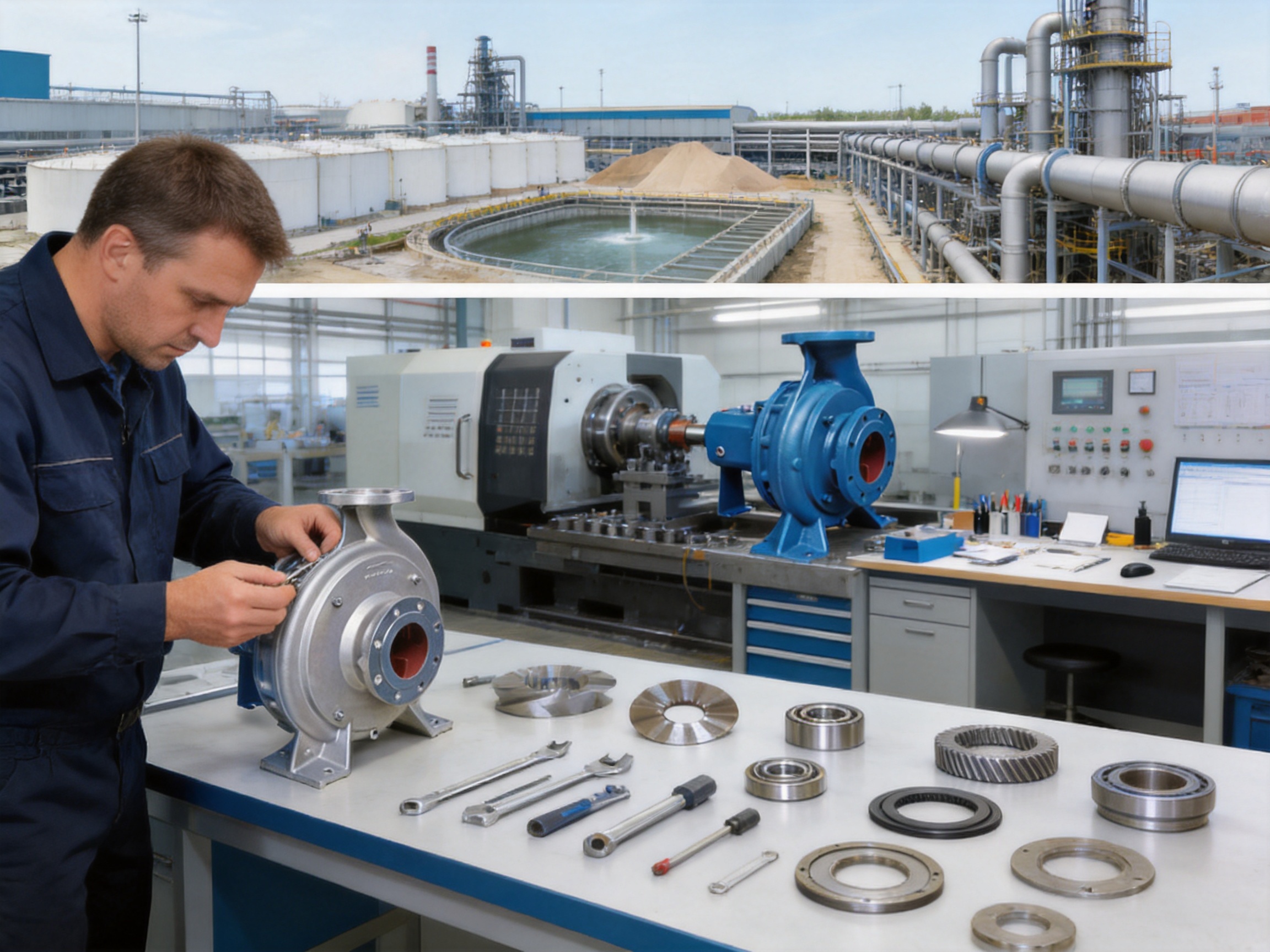
Industrial fluid-handling systems often operate under conditions that are far more demanding than those found in ordinary water-supply applications. Pulp, paper stock, mud, process slurry, wastewater, and other fluids may contain suspended solids, abrasive particles, entrained gas, fibers, or chemically aggressive components. These characteristics place considerable stress on pump casings, impellers, shafts, bearings, seals, and wear surfaces. A pump that performs well with clean water may suffer rapid wear, blockage, unstable operation, or excessive maintenance when applied to these duties.
The EPS Series Pulp Mud End Suction Centrifugal Pump has been developed for these challenging applications. Its semi-open impeller, replaceable front and rear wear plates, heavy-duty bearing arrangement, robust shaft, adaptable sealing system, and broad performance range make it suitable for pulp and paper processes as well as several related industrial applications. The design combines the familiar layout of an end suction centrifugal pump with construction features intended for solids-containing and abrasive liquids.
This article examines the pump’s design, operating advantages, materials, performance capabilities, maintenance characteristics, application suitability, and manufacturing strengths. It also explains why the pump can provide practical advantages over conventional clean-water centrifugal pumps and less specialized slurry-handling equipment.

EPS Series Pulp Mud End Suction Centrifugal Pump with Semi-open Impeller and Wear Plate
Pulp and mud are not uniform fluids. Their physical properties can change according to concentration, temperature, fiber length, particle size, chemical composition, and the amount of air incorporated into the liquid. In a paper mill, for example, a process stream may include cellulose fibers and water, while another stream may contain fillers, coatings, pigments, chemicals, and recycled material. In wastewater or mineral-related applications, the fluid may include abrasive solids that accelerate wear on wetted components.
These fluids create several problems for conventional centrifugal pumps. Suspended solids can erode the impeller and casing. Fibers can gather around narrow passages or interfere with rotating components. Air entrainment can cause unstable hydraulic performance and, in severe cases, contribute to loss of prime or cavitation-like behavior. High temperature and chemical exposure can further reduce the service life of ordinary materials.
The pump selected for such service must therefore do more than generate flow and pressure. It must maintain a suitable passage for the process medium, tolerate a certain quantity of gas, provide protection for high-wear areas, and permit practical inspection and replacement of components. It must also operate reliably for long periods because unexpected downtime in a continuous manufacturing process can be considerably more expensive than the original pump purchase.
The EPS Series addresses these requirements through a combination of hydraulic design and mechanical construction. The semi-open impeller is particularly important because it provides a compromise between the efficiency of a closed impeller and the solids-handling capability of a more open design. The front and rear wear plates create replaceable sacrificial surfaces, helping protect the pump casing and maintain appropriate internal clearances during the operating life of the equipment.
The EPS Series is an end suction centrifugal pump designed for pulp, mud, and other process liquids containing suspended materials. In a typical installation, the liquid enters axially through the suction nozzle and reaches the impeller eye. The rotating semi-open impeller transfers mechanical energy from the motor to the liquid, increasing its velocity. The pump casing then converts part of this velocity into pressure before the fluid leaves through the discharge connection.
Because the pump uses a single main suction and discharge flow path, it can be integrated into many existing industrial piping systems. The end suction arrangement is widely recognized by maintenance teams, which can simplify installation, inspection, and replacement planning. The pump can be supplied with different sealing configurations and material combinations according to the process liquid and operating conditions.
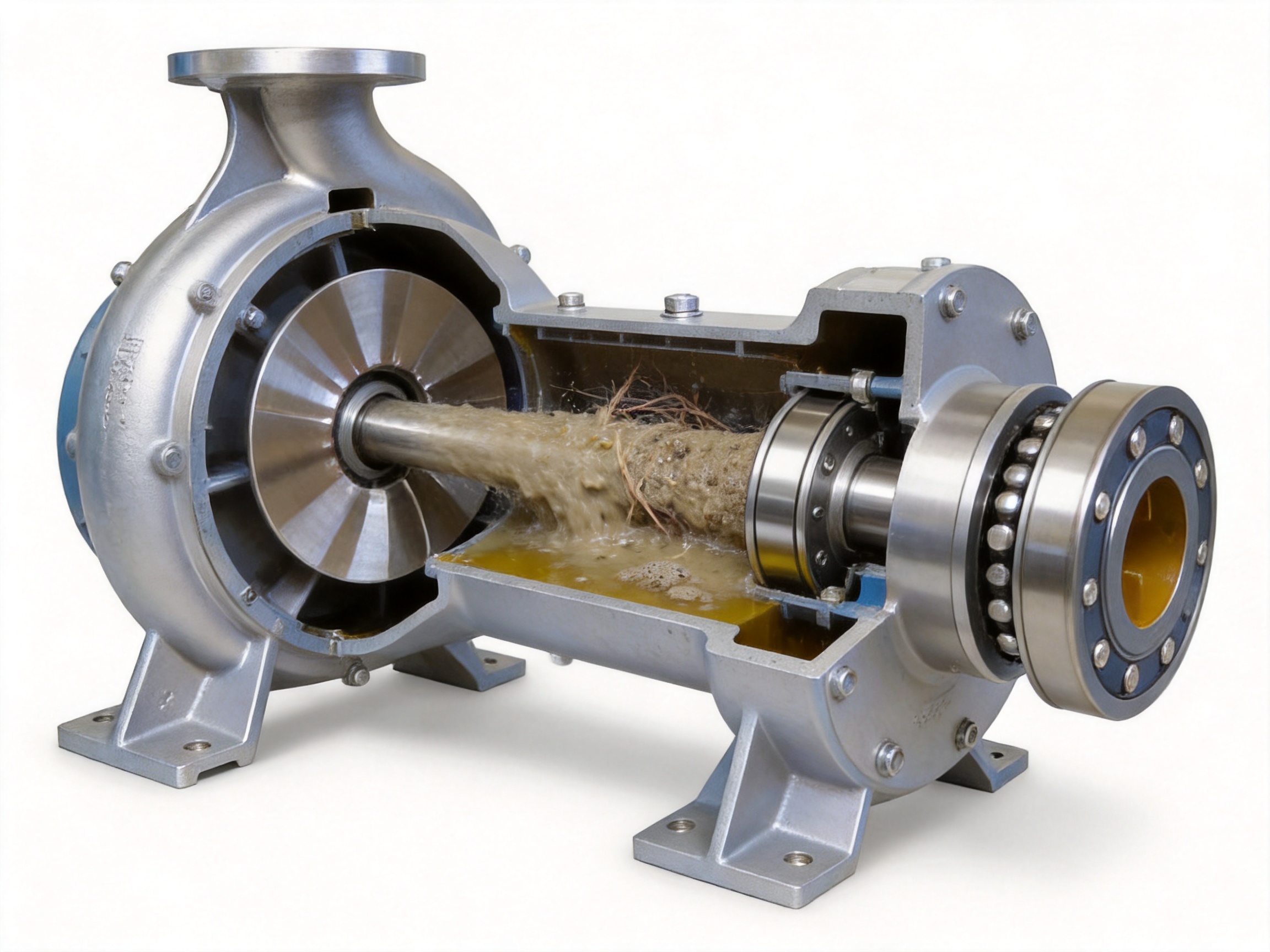
The semi-open impeller contains vanes supported on one side rather than being enclosed between two shrouds. This configuration allows the pump to handle a certain amount of gas medium together with the pulp slurry. It also offers greater tolerance for some fibrous and solids-containing liquids than a narrow-passage closed impeller. The exact suitability of the pump depends on the concentration, particle size, temperature, viscosity, and other properties of the pumped medium, so application data should be reviewed before final selection.
The pump is designed in accordance with ISO 2858 and ISO 5199 principles. These standards are associated with dimensional, performance, and mechanical requirements for centrifugal process pumps. Conformance-oriented design gives users a familiar industrial format and supports compatibility with international engineering, procurement, and maintenance practices.
A major advantage of the EPS Series is its semi-open impeller. Closed impellers can provide high hydraulic efficiency with clean liquids, but the close spacing between the impeller shrouds may be less suitable for fibrous stock, sludge, mud, or liquids containing suspended particles. The semi-open form provides a more accessible flow passage and is less dependent on extremely narrow internal clearances.
This design is useful in pulp and paper production, where fiber consistency and stock composition may vary. It can also support selected wastewater, chemical, food-processing, and industrial slurry duties. By reducing the likelihood that larger fibers or soft solids will become trapped in an enclosed passage, the impeller can help improve operating continuity.
Pulp and process slurries may carry air or other gas into the pump. Gas can interfere with the normal transfer of energy from the impeller to the liquid and may reduce the stability of a conventional pump. The semi-open impeller is designed to allow a certain amount of gas medium to pass with the pulp slurry, making it more appropriate for process streams where complete deaeration is difficult.
This feature does not mean that the pump can operate indefinitely with large quantities of gas or without adequate suction conditions. Correct pipework, suitable suction submergence, appropriate venting, and proper pump selection remain essential. However, within its intended operating range, the impeller configuration provides a useful advantage over many standard clean-water pumps.
The EPS Series uses an optimized hydraulic design with semi-open impeller diameters up to approximately 547 millimeters. This allows the product family to cover a broad range of flow and head requirements. Different impeller trims and operating speeds can be selected to match the required duty point, helping avoid excessive throttling and unnecessary energy consumption.
A correctly selected impeller can allow the pump to operate closer to its best efficiency region. This is important in industrial facilities because even a modest efficiency improvement can reduce electrical consumption over thousands of operating hours. The impeller must nevertheless be selected in relation to slurry characteristics, wear expectations, motor power, and the required system curve.
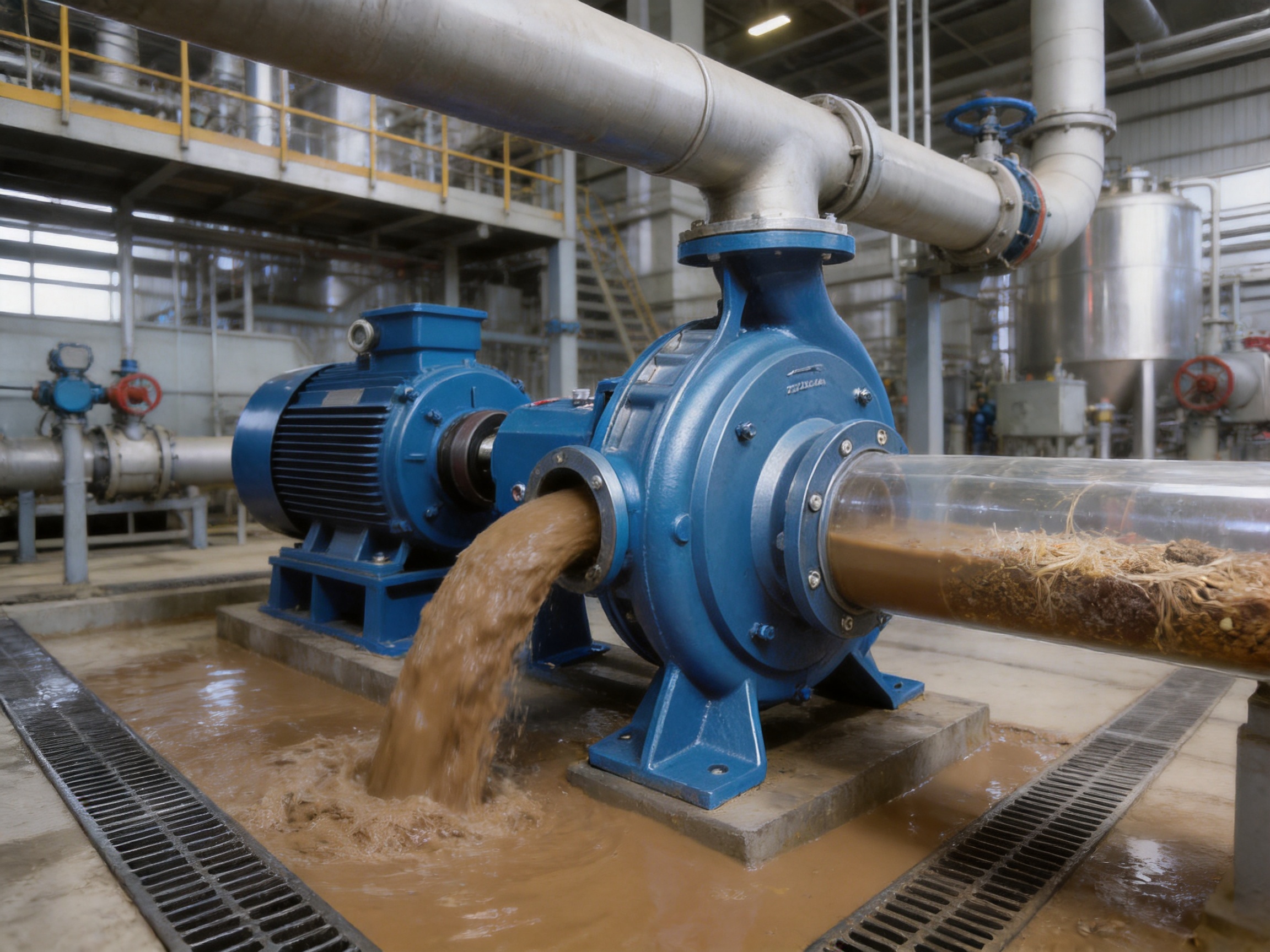
Abrasive process liquids gradually remove material from the surfaces they contact. In a centrifugal pump, high liquid velocity and turbulence near the impeller can make the casing and adjacent surfaces especially vulnerable. If wear changes the internal geometry, pump efficiency may decline, recirculation may increase, and the risk of vibration or seal problems may rise.
The EPS Series incorporates front and rear wear plates. These components act as replaceable protective surfaces between the rotating impeller and the pump casing. When wear occurs, maintenance personnel can inspect and replace the plates rather than replacing the complete casing. This arrangement can reduce repair cost and shorten the time required to restore the pump to service.
The front and rear wear plates also support the intended internal hydraulic clearances. Maintaining appropriate clearances is important because excessive gaps can allow internal recirculation from the high-pressure side toward the low-pressure side. Such recirculation reduces efficiency and may increase localized erosion. Replaceable wear components provide a practical method of restoring the original design relationship during scheduled maintenance.
Compared with a pump that relies solely on a permanently machined casing surface, a wear-plate design can offer a significant lifecycle advantage in abrasive service. The casing remains a durable structural component while the sacrificial surfaces can be renewed as necessary. This approach is particularly attractive when the pump is installed in a process where planned maintenance is preferable to unplanned failure.
Using wear plates at both the front and rear of the impeller provides protection on more than one internal surface. This is important because wear patterns can vary according to the direction of hydraulic forces, the distribution of solids, the impeller geometry, and the operating point. The two-plate arrangement supports balanced maintenance planning and helps preserve the pump’s internal configuration.
The wear plates are designed to be accessible and replaceable. When a maintenance team can change a high-wear component without replacing the complete pump casing, the work may require fewer resources and less inventory. The actual repair time depends on the installation, lifting arrangements, spare parts availability, and technician experience, but the design is intended to make intervention more straightforward.
The pump casing provides the pressure boundary and guides the liquid from the impeller toward the discharge nozzle. It must withstand hydraulic pressure, vibration, temperature changes, and the mechanical effects of suspended solids. The EPS Series is available with pump bodies made from cast iron or stainless steel, enabling users to match the material to the fluid and application environment.
Cast iron can provide a cost-effective and mechanically strong solution for many general industrial duties. Stainless steel may be preferred where corrosion resistance, process cleanliness, or chemical compatibility is more important. Final material selection should consider the liquid’s pH, chloride content, temperature, solids concentration, and any cleaning chemicals used in the plant.
The shaft transfers torque from the driver to the impeller and must resist bending, fatigue, corrosion, and wear near the sealing area. The EPS Series uses a stainless steel shaft. A sufficiently robust shaft helps minimize deflection, which is important because excessive deflection can increase mechanical seal movement, cause uneven wear, and contribute to vibration.
Maintaining shaft rigidity is especially valuable in pumps with large impellers or long operating hours. It also supports more stable alignment between the rotating assembly and stationary components. Correct coupling alignment, suitable bearing condition, and proper installation remain necessary to realize the full benefit of the shaft design.
The bearing arrangement is designed for industrial service. A cylindrical roller bearing is used at the impeller end, while two angular contact ball bearings are arranged back to back at the drive end. This configuration is intended to manage both radial and axial forces generated during operation.
The back-to-back angular contact arrangement is particularly relevant for axial load control. Although the front and rear wear plates and balancing holes in the impeller design largely balance the hydraulic axial force, a residual force remains. The drive-end bearings help absorb this remaining load while supporting the shaft during rotation.
The stated design bearing life is up to 25,000 hours under appropriate operating conditions. Bearing life depends on load, speed, lubrication, alignment, temperature, contamination control, and maintenance practice. The use of heavy-duty NTN bearings and oil lubrication provides an industrial foundation, but operators should still follow a planned inspection and lubrication program.
Shaft sealing is one of the most important considerations in a process pump. The seal must prevent the pumped liquid from escaping along the shaft while also preventing air from entering the suction side. Pulp, mud, chemicals, high temperature, suspended solids, and abrasive particles can all make sealing more difficult.
The EPS Series can be configured with several sealing options, including a standard single mechanical seal, double mechanical seals, cartridge mechanical seals, and gland packing. This range allows the pump to be adapted to different process requirements and maintenance preferences.
A single mechanical seal is suitable for many standard process applications when the pumped liquid, temperature, pressure, and solids content are within the seal’s operating limits. It can provide a compact and efficient sealing arrangement with relatively low leakage during normal operation.
For stock conveyance, a single mechanical seal may be used with sealing and rinsing water. The rinse arrangement helps protect the seal faces from solids and can support reliable operation when correctly designed. The quality, pressure, flow, and cleanliness of the rinse water must be controlled because excessive or insufficient flushing can both create problems.
Double mechanical seals can be considered for more demanding duties where additional protection, barrier fluid, or improved containment is required. Cartridge seals can simplify installation and reduce the risk of incorrect setting during maintenance because the seal is supplied as a preassembled unit. The final choice should be made after reviewing the process liquid and the plant’s safety requirements.
Gland packing remains a practical option in some industrial environments. It can be adjusted and serviced using commonly available maintenance methods. However, packing normally permits a controlled amount of leakage and may require regular adjustment. It should therefore be selected when its operating characteristics are acceptable for the process and environmental conditions.
The EPS Series covers pump sizes from approximately 32 millimeters to 350 millimeters. The maximum stated flow is up to 2,000 cubic meters per hour, while the maximum head is up to 160 meters. The maximum temperature is listed as 175 degrees Celsius, the maximum speed as 3,600 revolutions per minute, and the maximum pressure as 24 bar.
These figures describe the upper capability of the product range rather than a single operating point. Actual performance depends on pump size, impeller diameter, rotational speed, liquid properties, system resistance, material selection, sealing arrangement, and motor configuration. A pump should never be selected solely from a maximum flow or maximum head value.
Technical Parameter | Stated Capability | Selection Consideration |
Pump size | Approximately 32 to 350 mm | Based on required flow, pipework, and application duty |
Maximum flow | Up to 2,000 m³/h | Depends on pump model, impeller, speed, and fluid properties |
Maximum head | Up to 160 m | Must be matched to static and friction losses |
Maximum temperature | Up to 175°C | Requires suitable materials, seal, lubrication, and safety controls |
Maximum speed | Up to 3,600 rpm | Must be evaluated against wear, vibration, and motor requirements |
Maximum pressure | Up to 24 bar | Includes consideration of casing, flange, temperature, and operating limits |
For accurate selection, the buyer should provide the required capacity, discharge pressure or head, suction conditions, temperature, density, viscosity, solids concentration, particle size, fiber characteristics, pH, chemical composition, and operating schedule. Information about the available motor, voltage, frequency, installation arrangement, and control method is also useful.
The principal application is pulp and paper manufacturing. The pump can be considered for stock preparation, pulp transfer, process water containing fibers, white water, wastewater, coating-related streams, and other duties where a semi-open impeller and replaceable wear surfaces are beneficial.
Each paper mill contains multiple process loops with different fluid characteristics. A low-consistency stock stream may behave differently from a high-consistency stream. Recycled fiber may carry contaminants, while coating or chemical streams may impose special corrosion requirements. The pump’s adaptable materials and seal options allow the basic design to be configured for a variety of these duties, subject to engineering review.
Chemical and petrochemical facilities often require pumps that can manage process liquids at elevated temperature or with corrosive characteristics. The stainless steel shaft, optional stainless steel wetted components, and selection of mechanical seals can support suitable installations. Compatibility must be confirmed for each chemical because corrosion resistance varies significantly between alloys and operating conditions.
Refinery services may involve hot liquids, contaminated water, slurries, or chemical process streams. The pump’s temperature and pressure capabilities can be relevant to selected duties, while its end suction format may fit established plant layouts. Refinery applications require strict attention to hazardous-area classification, seal design, materials, fire safety, and applicable site standards.
Wastewater may contain suspended solids, fibers, sludge, and gas. The semi-open impeller and accessible wear components can be advantageous in selected transfer and process applications. Engineers should verify that the impeller passage, suction arrangement, and solids-handling capability are suitable for the actual wastewater composition.
Pharmaceutical and food applications may demand cleanable materials, controlled surface conditions, suitable seals, and compliance with hygienic design requirements. The pump can be considered for appropriate non-hygienic or utility services, while specialized hygienic versions and regulatory requirements should be confirmed before use in direct product-contact duties.
In food-related processing, including sugar production, fluids may contain suspended crystals, fibers, or process solids. The semi-open impeller can provide useful handling characteristics, but material selection, cleanability, temperature, and sanitation procedures must be evaluated for the specific installation.
Every pump must be compared according to duty, not only according to catalog specifications. A low-cost clean-water pump may appear attractive initially, but it may not be suitable for abrasive pulp or mud. The EPS Series offers several design advantages when compared with conventional end suction pumps intended mainly for clear liquids.
The semi-open impeller is more appropriate for certain fluids containing fibers, suspended solids, or entrained gas than a tightly enclosed clean-water impeller. This can reduce the risk of blockage and improve the pump’s tolerance to changing process conditions.
Front and rear wear plates provide a maintainable wear interface. In pumps without replaceable wear plates, casing erosion may require more extensive repair or complete casing replacement. The EPS arrangement can reduce lifecycle cost by allowing the most exposed surfaces to be renewed independently.
The combination of a cylindrical roller bearing and back-to-back angular contact ball bearings is intended for heavy-duty industrial service. It provides dedicated support for radial and axial loads and is more substantial than the bearing arrangement often found in light-duty pumps.
The availability of single mechanical seals, double seals, cartridge seals, and gland packing allows the pump to be tailored to the application. This is useful for plant operators who maintain different sealing philosophies across process areas or who need a specific containment solution.
Designing in accordance with ISO 2858 and ISO 5199 principles supports easier communication with international engineering teams and provides a recognizable basis for pump dimensions and performance expectations. This can be valuable for replacement projects, export installations, and standardized procurement systems.
The pump’s replaceable wear parts, serviceable construction, and adaptable sealing options can help reduce the total cost of ownership. Lifecycle cost includes energy, spare parts, labor, production losses, seal consumption, and disposal. A pump that costs slightly more initially may provide better value if it remains efficient and repairable over a longer period.
The manufacturer behind the EPS Series has operated as an integrated manufacturing enterprise since 2008. Its business model includes independent research and development, mass production, and international export. This combination is important because industrial pump quality depends not only on product design but also on repeatable manufacturing, quality control, parts availability, and technical support.
The EPS Series incorporates the advantages of advanced overseas products together with long-term research and development experience in the paper industry. The design was developed through cooperation with technical research institutes, creating an upgraded product line aimed at the practical needs of pulp and paper users.
Industry-specific development provides an advantage over generic pump products. Pulp and paper installations expose pumps to variable fiber content, abrasive contaminants, entrained air, chemical additives, frequent starts and stops, and demanding production schedules. Understanding these conditions helps engineers focus on the impeller passage, wear areas, shaft rigidity, bearings, sealing, and maintenance access.
Independent research and development allows the manufacturer to coordinate hydraulic design, materials, mechanical construction, sealing arrangements, and production requirements. Rather than treating each component as an isolated part, an integrated approach considers how the complete pump behaves under real operating conditions.
Hydraulic development can be supported by performance testing and design comparison. Mechanical development includes evaluation of shaft strength, bearing loads, casing pressure, sealing arrangements, and wear component replacement. Production engineering then converts the design into repeatable manufacturing processes.
Mass production can provide advantages in component consistency, process control, procurement efficiency, and spare-parts planning. For international industrial customers, repeatability is especially important because replacement pumps and components may be required years after the original installation.
A structured production system can also support the use of standardized components, controlled machining procedures, inspection records, and assembly instructions. These practices help reduce variation between pumps and make maintenance documentation easier to manage.
The pump is available with cast iron or stainless steel pump bodies and impellers, stainless steel shafts, mechanical seals, oil-lubricated bearings, and heavy-duty NTN bearing components. Material selection is not simply a matter of choosing the most expensive alloy. It requires matching the material to corrosion, erosion, temperature, stress, process cleanliness, and cost.
Providing more than one material option allows the pump to serve a wider range of customers. Cast iron may be suitable for less corrosive services, while stainless steel can provide additional protection in chemically aggressive environments. The impeller and casing materials should be considered together because dissimilar material combinations can affect wear and corrosion behavior.
The company has developed additional import and export service resources to support procurement planning, order tracking, cross-border delivery, and foreign trade services. For overseas buyers, this type of support can be as important as the equipment itself. Industrial projects often involve technical clarification, documentation, production schedules, inspection requirements, packing, shipping, and after-sales communication.
A supplier that can coordinate these stages may reduce administrative complexity for distributors, contractors, system integrators, and end users. The manufacturer’s broader product portfolio also supports one-stop procurement for customers who require several types of water pumps or related equipment in the same project.
Reliable industrial pump production depends on controlled processes from casting and machining through assembly and testing. Although individual factory procedures may vary, a high-quality manufacturing system should address material traceability, dimensional accuracy, balance, surface condition, shaft runout, bearing installation, seal setting, and final performance verification.
Pump casings and impellers made from cast materials must be produced with attention to composition, internal soundness, dimensional stability, and surface quality. Material certificates and inspection procedures help confirm that the selected material corresponds to the intended application. Defects or excessive variation in a casting can affect strength, hydraulic performance, and balance.
Machining establishes the dimensions that control the relationship between the shaft, bearings, impeller, wear plates, casing, and seal chamber. Accurate machining is essential for maintaining designed clearances and preventing unwanted contact. Precision at the bearing fits and seal locations is particularly important because small dimensional errors can cause vibration, leakage, or premature wear.
The impeller rotates at high speed and must be balanced to an appropriate industrial standard. Poor balance creates centrifugal forces that increase bearing loads, shaft vibration, seal movement, and noise. Proper balancing supports stable operation and helps protect the complete rotating assembly.
Shaft straightness, diameter, surface finish, keyway condition, and runout should be inspected during production. A sturdy shaft design is most effective when manufacturing tolerances preserve its intended alignment. The rotor assembly should also be checked after the impeller and coupling components are installed.
Bearings must be installed using correct methods to avoid damage to rolling elements and raceways. Oil lubrication requires suitable oil quality, correct level, contamination control, and appropriate operating temperature. Mechanical seals must be installed with clean faces, correct compression, and compatible elastomers.
Pressure testing helps verify casing integrity, while performance testing confirms that the pump can deliver the expected relationship between flow, head, power, and efficiency. Testing may be performed at selected points according to the project requirement and applicable standards. Proper test documentation helps the buyer understand the delivered equipment and provides a reference for future troubleshooting.
Correct installation is essential for achieving the expected service life of any process pump. The foundation should be sufficiently rigid, level, and capable of supporting the pump, driver, baseplate, and connected piping. Pipework should be independently supported so that excessive forces are not transferred to the pump flanges.
The suction line should be designed to minimize air pockets, turbulence, and unnecessary restrictions. The suction pipe should generally be short and direct where practical, with an appropriate diameter and properly arranged fittings. A suitable strainer or solids-management arrangement may be required, but restrictions that cause excessive pressure loss should be avoided.
Before startup, the pump should be filled or primed according to the installation arrangement. The operator should confirm that the pump is suitable for the actual liquid, that the shaft rotates in the correct direction, and that the seal flushing or barrier system is ready. The oil level and bearing housing condition should be checked, and the coupling guard should be installed before operation.
Initial commissioning should include observation of discharge pressure, flow, vibration, bearing temperature, seal leakage, motor current, and unusual noise. The pump should not be operated for extended periods far outside its recommended operating range. Operation near the best efficiency region generally supports lower hydraulic stress and better energy performance.
A preventive maintenance program should be based on the process severity and operating schedule. Routine checks may include bearing temperature, oil condition, seal leakage, vibration, discharge pressure, motor current, and wear-plate clearance. Trends are often more valuable than isolated readings because gradual changes can reveal developing problems.
Wear plates should be inspected according to the abrasive nature of the pumped medium and the number of operating hours. When clearances become excessive or the performance declines, replacing the wear plates can restore the hydraulic relationship between the impeller and casing. The impeller should also be inspected for erosion, corrosion, fiber accumulation, cracks, and imbalance.
Mechanical seals should be monitored for leakage and temperature. Seal failure may result from dry running, contaminated flush water, shaft movement, misalignment, incorrect installation, or incompatible materials. Replacing the seal without correcting the underlying cause may lead to repeated failure.
Oil-lubricated bearings require clean lubricant at the correct level. Contaminated or degraded oil can reduce bearing life. Bearing housings should be protected from water and process contamination, particularly in washdown areas or installations with high humidity.
Recommended spare parts may include wear plates, mechanical seals, packing sets, gaskets, bearings, shaft sleeves where applicable, impeller fasteners, and coupling components. The ideal inventory depends on the criticality of the pump and the availability of local service support. For essential production lines, keeping a complete rotating assembly or standby pump may further reduce downtime.
Energy is often one of the largest operating costs associated with a centrifugal pump. The pump’s efficiency depends on hydraulic design, impeller selection, speed, system resistance, liquid properties, and operating point. A pump that is too large may require throttling, while a pump that is too small may operate continuously at overload or fail to meet the process requirement.
The EPS Series is designed for efficient performance across a broad range of process duties. Its optimized hydraulic design and available impeller diameters allow the equipment to be selected for the required flow and head instead of relying on excessive throttling. Lower hydraulic losses can reduce motor power consumption and heat generation.
Total cost of ownership also includes wear parts and maintenance. In abrasive service, a pump with replaceable wear plates may be more economical than one with an inexpensive initial price but difficult casing repair. The ability to choose between seal arrangements can also help users balance leakage control, maintenance time, and operating cost.
Energy calculations should include the actual fluid density and viscosity. Pulp and mud may require more power than clean water at the same flow and head. Engineers should also account for changes in concentration and seasonal or batch-related process variation. Proper motor sizing and overload protection are essential.
Industrial pumps must be used within their specified mechanical and hydraulic limits. The maximum stated temperature, pressure, speed, and material capabilities should not be treated as interchangeable values. For example, operation at high temperature may reduce allowable pressure or change the suitability of a particular seal and bearing lubricant.
Operators should protect personnel from rotating parts, hot surfaces, pressurized liquid, chemical exposure, and unexpected startup. Lockout and isolation procedures should be followed before inspection or maintenance. The pump should be drained and depressurized before removing covers, seals, wear plates, or casing components.
When the pump is used in a hazardous environment, the motor, instrumentation, electrical equipment, and installation must satisfy the applicable site classification and local regulations. The pump supplier and project engineer should review the complete system rather than considering the pump in isolation.
Industrial users rarely have identical requirements. The same basic pump may be required to handle different temperatures, solids concentrations, corrosion conditions, pressures, or seal-flushing arrangements. The EPS Series can be adapted through material choices, impeller selection, sealing configuration, flange options, and driver arrangements.
Standard flange dimensions comply with ISO 7005-1:1992 PN16 requirements, while other flange configurations, including ANSI dimensions, can be made available by request. This flexibility can simplify integration into international plant standards and replacement projects.
Customization should begin with accurate process data. A supplier should receive the liquid name, temperature, specific gravity, viscosity, solids content, particle size, fiber information, pH, flow rate, pressure, suction conditions, operating hours, and control method. If the liquid changes during production, the complete operating envelope should be provided rather than only the average duty.
For engineered projects, the pump can be evaluated together with the motor, baseplate, coupling, valves, piping, controls, and standby philosophy. A complete package approach helps ensure that the pump is not selected without considering system interaction.
Product performance is influenced by the capabilities of the supplier behind it. A manufacturer with experience in deep-well pumps, submersible pumps, booster pumps, circulation pumps, solar water pumps, and intelligent pumping systems may bring broader hydraulic and application knowledge to industrial projects. A wider portfolio can also support customers seeking several pump categories from one source.
The company’s history includes production and export experience since 2008, development of additional trade and industrial service companies, and investment in intelligent technology and new-energy products since 2018. These activities indicate an effort to serve both traditional industrial pumping markets and newer applications involving solar energy and smart control.
For international customers, supplier strength includes more than factory capacity. It includes technical response, documentation, spare-parts coordination, production scheduling, inspection support, packaging, export procedures, and communication after delivery. These services can influence the actual project cost and risk.
A reliable purchasing process should include review of drawings, technical data sheets, material requirements, test procedures, warranty terms, spare-parts lists, and commissioning responsibilities. Clear communication at the order stage reduces the possibility of selecting a pump that is mechanically suitable but hydraulically inappropriate.
The pump is designed for pulp, mud, paper stock, and selected process liquids containing suspended solids, fibers, or a certain amount of entrained gas. It may also be considered for chemical, petrochemical, refining, wastewater, pharmaceutical, and food-related duties after confirming material and sealing compatibility.
A semi-open impeller provides a more accessible flow passage than a fully enclosed impeller and can handle certain fibrous or solids-containing liquids more effectively. It also allows a certain amount of gas medium to pass with the pulp slurry. The correct impeller must still be selected for the actual solids content and operating conditions.
The front and rear wear plates protect the pump casing and provide replaceable wear surfaces near the impeller. Replacing these parts can restore internal clearances and reduce the need for extensive casing repair when abrasive service causes wear.
The stated maximum temperature for the product range is up to 175 degrees Celsius. Actual allowable temperature depends on the selected materials, mechanical seal, bearing lubrication, pressure, liquid properties, and installation. High-temperature applications require specific technical confirmation.
Available options include a single mechanical seal, double mechanical seals, cartridge mechanical seals, and gland packing. A single seal may be used for many standard duties, while double or cartridge seals can be selected for more demanding containment or maintenance requirements.
The pump body and impeller can be supplied in cast iron or stainless steel. The shaft is made from stainless steel, and the bearing arrangement uses heavy-duty NTN components with oil lubrication. The final material combination should be selected according to corrosion, erosion, temperature, and cleanliness requirements.
The maximum stated flow for the EPS product range is up to 2,000 cubic meters per hour. The actual flow depends on the selected model, impeller diameter, speed, head, liquid characteristics, and system resistance.
It may be suitable for selected wastewater and sludge duties, especially where suspended solids and entrained gas are present. The engineer should verify solids size, fiber content, concentration, suction conditions, required passage, corrosion environment, and seal arrangement before approval.
Service life can be improved through correct selection, proper alignment, suitable suction piping, clean seal-flushing water, correct oil lubrication, regular vibration monitoring, timely wear-plate replacement, and operation near the recommended duty point. Avoiding dry running and excessive starts and stops is also important.
The standard flange dimensions comply with ISO 7005-1:1992 PN16 requirements. Other flange configurations, including ANSI flanges, are available by request and should be confirmed during technical evaluation.
The buyer should provide flow rate, head or discharge pressure, liquid temperature, density, viscosity, solids concentration, particle size, fiber content, pH, chemical composition, suction conditions, operating hours, motor requirements, flange standard, seal preference, and material requirements. Complete data improves selection accuracy.
The EPS Series is more specifically configured for process liquids containing pulp, mud, fibers, abrasive particles, or entrained gas. Its semi-open impeller, replaceable wear plates, heavy-duty bearings, and multiple sealing options provide advantages in these conditions compared with many pumps designed primarily for clean water.
Before selecting the pump, confirm the normal, minimum, and maximum flow rates. A pump that operates only at a short-term peak may be oversized for most of its service life. The system curve should include static head, friction loss, control valve losses, heat exchangers, filters, and any elevation changes.
Review the fluid carefully. “Pulp,” “mud,” or “sludge” is not sufficient information by itself. Concentration, density, viscosity, fiber length, particle hardness, particle size, chemical composition, and temperature can strongly affect the pump selection.
Check suction conditions and available net positive suction head. Air ingress, inadequate submergence, undersized piping, or excessive suction-side losses can cause unstable operation even when the pump has been correctly selected on paper.
Choose the casing and impeller materials together. Consider not only general corrosion but also localized attack, erosion-corrosion, abrasive wear, and the effect of cleaning chemicals. Seal materials and flush systems must be compatible with the process liquid.
Finally, define the maintenance philosophy. If downtime is costly, specify critical spares, standby arrangements, seal-flushing equipment, lifting provisions, and inspection access at the beginning of the project rather than after commissioning.
The EPS Series Pulp Mud End Suction Centrifugal Pump is designed for industrial users who require more than ordinary clean-water pumping performance. Its semi-open impeller is suited to selected pulp, mud, fiber-containing, solids-laden, and gas-entrained liquids. Front and rear wear plates provide replaceable protection in abrasive service, while the robust shaft and heavy-duty bearing arrangement support reliable mechanical operation.
The pump’s broad performance range, adaptable sealing configurations, cast iron or stainless steel construction, international design basis, and optional flange arrangements make it suitable for a wide variety of process installations. Its advantages are particularly relevant to pulp and paper production, wastewater treatment, chemical processing, refining, and selected food or pharmaceutical duties.
Beyond the product itself, the manufacturer’s integrated approach to research and development, mass production, export, technical cooperation, and one-stop procurement support provides value for international industrial customers. The company’s experience in multiple pump categories and its investment in intelligent and new-energy technologies further strengthen its ability to serve changing market requirements.
Successful application depends on proper engineering. Accurate process data, correct material selection, suitable sealing, adequate suction conditions, planned maintenance, and appropriate commissioning are essential. When these factors are addressed, the EPS Series can provide a durable and maintainable solution for difficult process-fluid transfer duties while helping users control energy consumption, wear-related costs, and production downtime.
International Organization for Standardization. ISO 2858, End-Suction Centrifugal Pumps: Designation, Nominal Duty Point, and Dimensions.
International Organization for Standardization. ISO 5199, Technical Specifications for Centrifugal Pumps: Class II.
International Organization for Standardization. ISO 7005-1:1992, Metallic Flanges and Flanged Components.
Hydraulic Institute. Centrifugal Pump Application and System Design Principles.
American Petroleum Institute. Centrifugal Pump Selection, Installation, and Maintenance Practices.
Metso. Pulp and Paper Process Pumping Principles.
Engineering manuals covering centrifugal pump hydraulics, mechanical seals, rolling-element bearings, wear mechanisms, and industrial maintenance planning.
edwina@edwin-pump.com
+86-13586290903 (WhatsApp)
Xuri Gongliang Cutting Tool Entrepreneurship Park, Wenqiao Town, Wenling City, Taizhou City, Zhejiang Province, China

High Performance Smart Pump Factory


 English