edwina@edwin-pump.com

View All Products
en
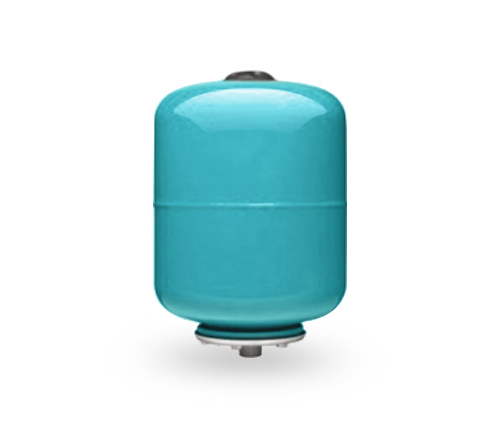
Modern solar water-heating installations require more than collectors, pipes, pumps, and controls. They also need a dependable way to manage thermal expansion, stabilize pressure, and protect the rest of the hydraulic circuit from unnecessary stress. The VT2 Series Vertical Tank is designed for this purpose. It is a compact carbon steel pressure tank with a fixed diaphragm membrane, a factory pre-charge pressure of 1.5 bar, a maximum working pressure of 3.5 bar, and an EPDM membrane suitable for working temperatures from -10°C to 99°C.
Although the tank is small in size, its role in a solar, boiler, or thermal system is important. Water expands when heated. Without a suitable expansion volume, that increase in volume can raise system pressure, cause frequent operation of safety valves, accelerate leakage at connections, and shorten the service life of pumps and other components. A properly selected expansion tank absorbs part of this volume change and helps the system operate more smoothly.
The VT2 Series is intended for applications where space efficiency, simple installation, corrosion-resistant internal membrane performance, and predictable pressure characteristics are important. The available VT2-2 and VT2-3 models offer different dimensional configurations while maintaining the same stated pre-charge pressure. Their compact form makes them suitable for smaller solar systems, domestic thermal circuits, boiler installations, and other applications that need a practical pressure-management component without occupying excessive installation space.
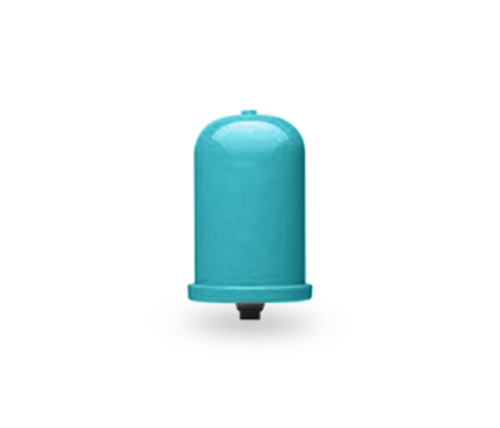
VT2 Series Vertical Tank for Solar System
A closed water circuit has a fixed physical boundary. When the temperature of the water rises, the water volume increases. If the system has no room to accommodate that increase, pressure rises rapidly. In a solar thermal system, this effect may be especially significant because the water or heat-transfer medium can experience repeated heating and cooling cycles during normal operation.
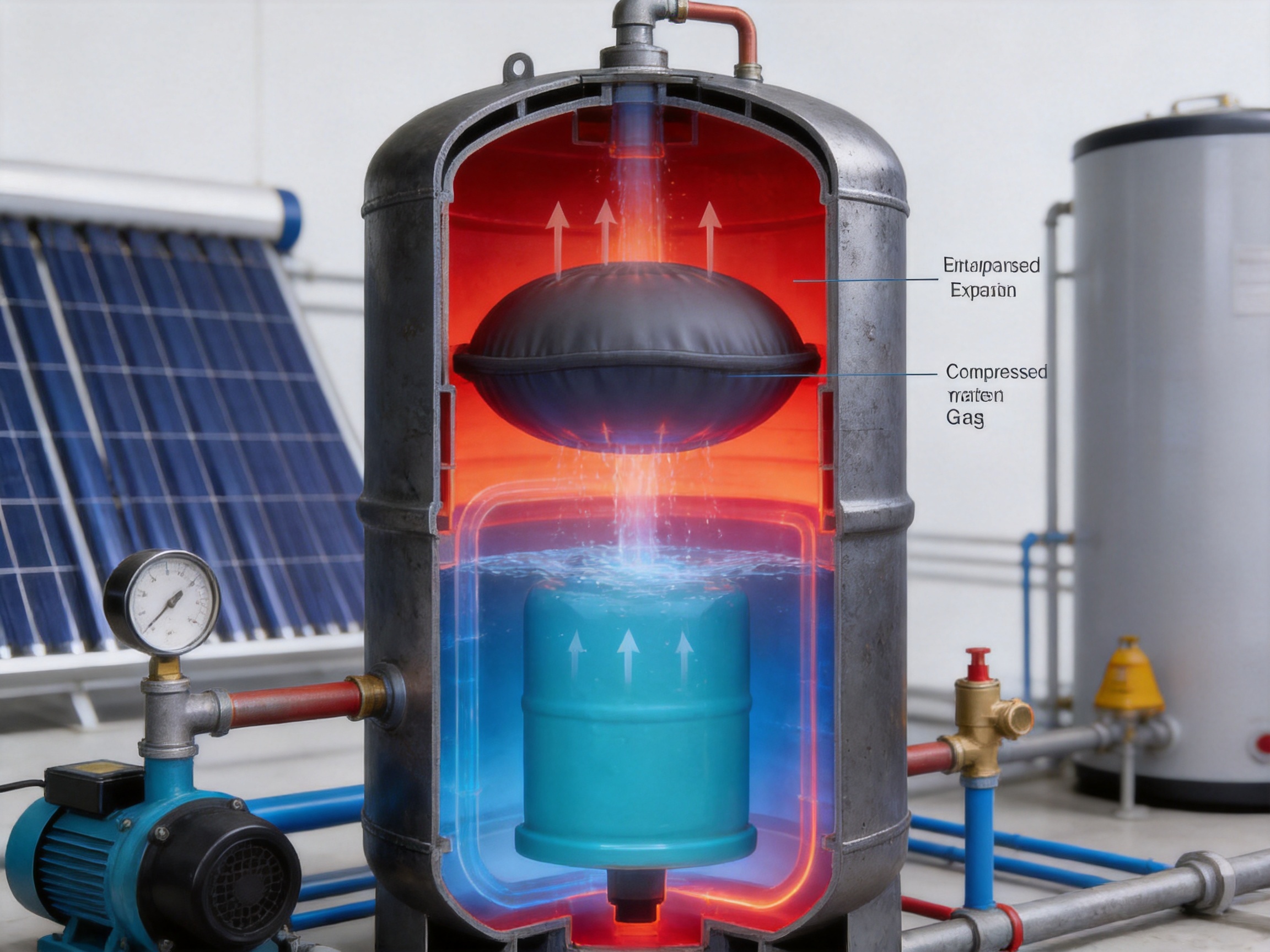
An expansion tank provides a controlled elastic volume inside the system. The tank is divided into a water side and a gas side by a flexible diaphragm. As system fluid expands, it enters the tank and pushes against the diaphragm. The gas on the opposite side is compressed, creating a buffer that helps limit pressure fluctuations. When the fluid cools and its volume decreases, the compressed gas pushes the diaphragm back toward its original position.
This process is passive, automatic, and continuous. It does not require an independent motor, electrical supply, or complicated control program. The tank works together with a pump, pressure-control equipment, safety valve, and other hydraulic components to maintain a more stable operating environment.
In solar systems, the tank can help address several common operating conditions:
• Thermal expansion caused by rising collector or storage-tank temperature.
• Pressure changes during repeated day-and-night heating cycles.
• Reduced water hammer and pressure shock in compact piping networks.
• Less frequent discharge from safety valves when the system is correctly sized.
• More stable conditions for pump seals, pipe connections, valves, and heat exchangers.
• Better use of limited installation space in domestic or small commercial projects.
The VT2 Series does not replace a safety valve, pressure gauge, air separator, or correctly designed circulation system. Instead, it forms part of a complete pressure-management arrangement. Correct sizing and installation remain essential for safe and effective operation.
The defining internal component of the VT2 Series is its fixed diaphragm membrane. The membrane separates the system fluid from the pre-charged gas. This separation is important because it prevents direct contact between the water and the gas chamber. It also creates a clear boundary between the fluid side and the pressure-storage side of the tank.
A fixed diaphragm construction is a practical choice for compact expansion tanks. It offers a simple internal design with fewer moving parts than more complex mechanical assemblies. The diaphragm flexes as pressure changes, while the tank shell contains the internal pressure. For small solar and thermal applications, this straightforward construction can provide a useful balance between cost, installation convenience, and functional reliability.
The membrane material specified for the VT2 Series is EPDM. EPDM is commonly used in water-related applications because of its resistance to water, weathering, ozone, and many temperature variations. The specified working temperature range of -10°C to 99°C indicates that the product is intended for a broad range of normal thermal-system conditions. The actual suitability of the membrane should always be evaluated against the specific fluid chemistry, additives, operating temperature, and local installation requirements.
The tank body is made from carbon steel. Carbon steel provides a rigid pressure vessel structure and supports the compact vertical format of the product. A rigid shell is necessary because the tank must contain pressure while allowing the diaphragm to respond to fluid expansion and contraction.
Compared with lightweight plastic containers that are not designed for pressure service, a carbon steel pressure tank provides a more appropriate structural solution for closed hydraulic systems. It can withstand the stated maximum working pressure of 3.5 bar when used within the specified conditions. The carbon steel construction also allows the tank to maintain a compact wall profile while providing the strength expected from a pressure-management component.
Surface protection, storage conditions, installation environment, and maintenance all influence the service life of a carbon steel tank. The installer should protect the tank from continuous external moisture, aggressive chemicals, impact, and conditions outside the product specification. The tank should also be installed in a position that allows inspection of the shell, connector, and nearby safety components.
Each listed VT2 model has a pre-charge pressure of 1.5 bar. Pre-charge is the pressure of the gas chamber before the tank is connected to the system. It is a key operating parameter because it determines how the diaphragm responds as system pressure changes.
A factory-set pre-charge simplifies initial installation and gives the installer a defined starting point. However, the correct pre-charge for a particular system depends on the static pressure, system height, minimum operating pressure, maximum operating pressure, fluid temperature, and tank position. The installer should verify the pressure requirements of the complete system before commissioning.
The pre-charge should be checked using an appropriate pressure gauge and according to the manufacturer’s service procedure. Pressure adjustments should only be made when the water side is depressurized and when the system has cooled sufficiently for safe handling. Uncontrolled adjustment may lead to incorrect tank performance or unsafe operating conditions.
The stated maximum working pressure is 3.5 bar. This value should not be treated as a target operating pressure. It is the maximum pressure at which the tank is specified to work under the stated conditions. The system designer must ensure that normal pressure remains within a suitable range and that a correctly rated safety valve is installed.
All connected components must be compatible with the pressure rating of the system. A pump, valve, pipe, heat exchanger, or fitting with a lower pressure rating can limit the safe operating pressure of the complete installation. In practical system design, the lowest-rated component often determines the permissible working range.
Thermal expansion, pump operation, static head, trapped air, and incorrect pressure settings can all affect system pressure. The VT2 tank helps absorb volume changes, but it cannot compensate for poor system design, a blocked safety valve, an incorrectly sized pipe, or a malfunctioning control system.
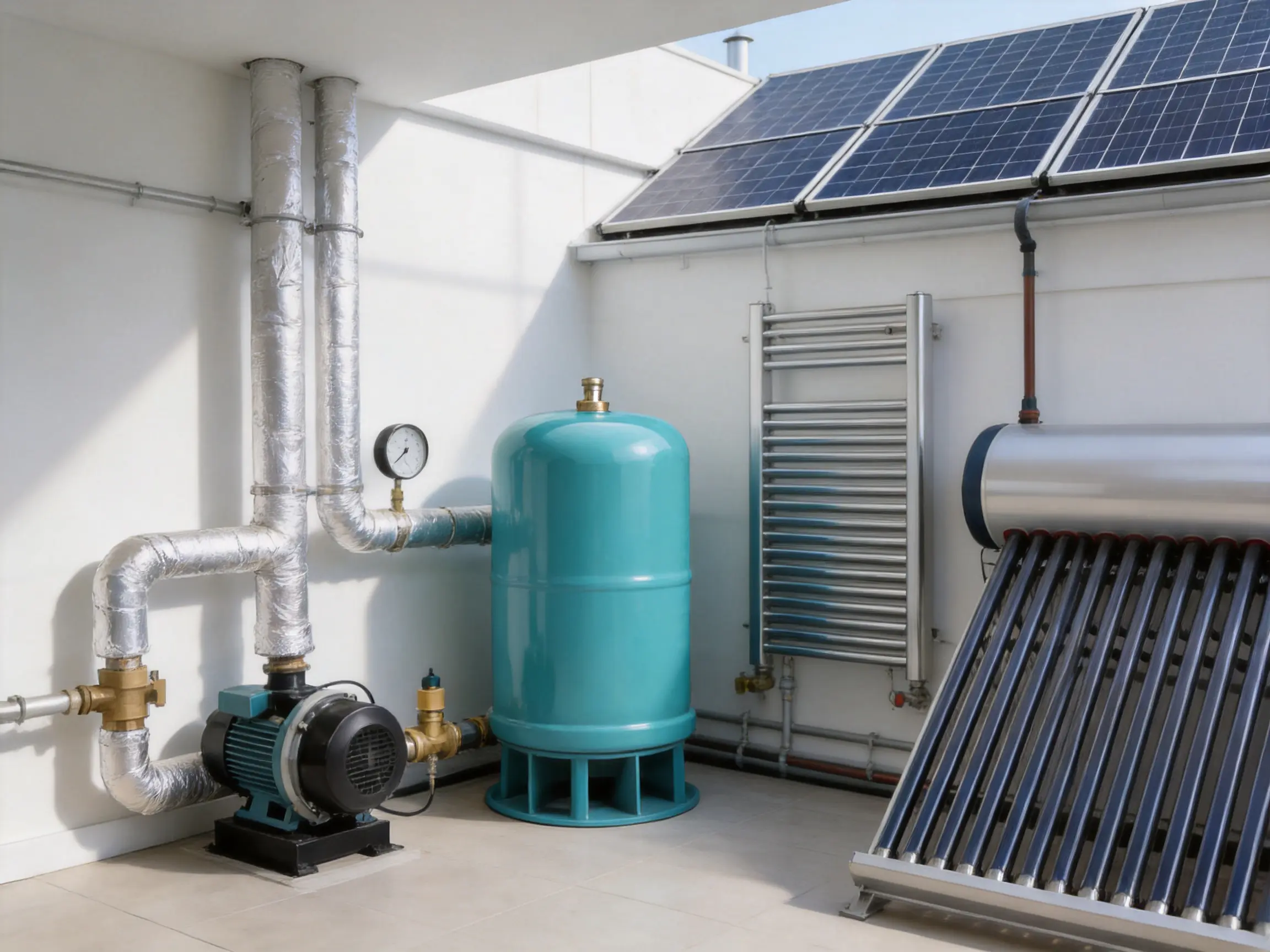
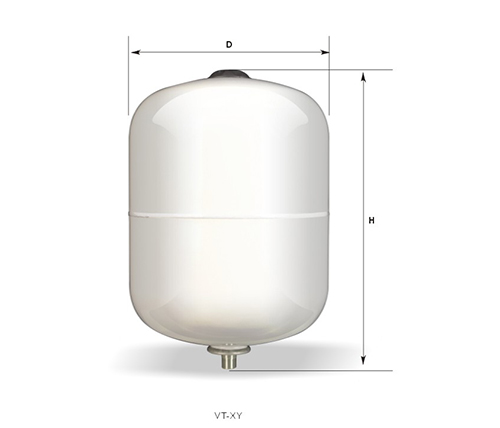
The following table summarizes the available technical data provided for the VT2 Series. The dimensions are stated in millimeters, and the packing values are expressed in cubic meters per stated package quantity.
| Model | Diameter | Height | Pre-charge Pressure | Connector | Packing |
| VT2-2 | 110 mm | 222 mm | 1.5 bar | 1/2 inch | 0.0625 CBM / 20 pieces |
| VT2-3 | 106/116 mm | 192 mm | 1.5 bar | 1/2 inch | 0.0520 CBM / 20 pieces |
The compact dimensions are one of the main practical advantages of this product family. The vertical arrangement uses limited floor area and can be convenient for installations near a solar storage tank, boiler, pump group, or compact mechanical cabinet. Before ordering, the installer should compare the listed dimensions with the available clearance, connection position, insulation thickness, pipe routing, and service-access requirements.
The VT2-2 model has a listed height of 222 millimeters and a diameter of 110 millimeters. The VT2-3 model has a listed height of 192 millimeters and a diameter shown as 106/116 millimeters. Because the VT2-3 diameter is provided as a dual value, buyers should confirm the exact dimensional drawing and production configuration for the intended order before preparing a mounting bracket or enclosure.
Both models use a 1/2-inch connector. This common connection size can support straightforward integration into many small hydraulic circuits, although an adapter may be needed depending on the pipe standard, valve arrangement, or regional connection practice. Thread compatibility should be checked before assembly. Thread sealant should be selected for the application and applied without contaminating the membrane or blocking the connection.
One clear advantage of the VT2 Series is its compact vertical design. Larger horizontal tanks can be difficult to install in small utility rooms, rooftop solar systems, apartment mechanical spaces, and domestic boiler cabinets. A vertical tank can be positioned close to the hydraulic connection while leaving more usable wall and floor space.
Compact size is also valuable during retrofit projects. Existing installations often have limited room because the pump, expansion vessel, heat exchanger, control box, and pipework are already in place. A small tank can be easier to add or replace without extensive reconstruction. This reduces installation disruption and may lower labor costs, although the final suitability depends on the required expansion volume.
The fixed diaphragm principle is uncomplicated. The fluid and gas sides are separated, and the flexible membrane responds to pressure variation. In contrast, an open expansion arrangement may expose the fluid to air, which can increase the risk of oxygen-related corrosion, contamination, and evaporation. A closed diaphragm tank offers a more controlled pressure-management method for a closed system.
The design also avoids the need for electrical controls at the tank itself. There is no separate motor, sensor, or software interface required for the expansion function. This helps reduce the number of active components that need troubleshooting. A correctly installed tank can continue performing its basic role even when the circulation pump is not running.
The EPDM diaphragm and stated working temperature range make the tank appropriate for many water-based thermal applications. The specification of -10°C to 99°C covers cold ambient conditions as well as high operating temperatures commonly encountered in domestic hot-water, boiler, and solar circuits.
Material selection is a key area where expansion tanks differ. A membrane designed for general low-temperature service may not be suitable for repeated exposure to elevated temperatures. The specified EPDM construction gives buyers a clearer basis for evaluating the tank for solar and thermal duties. Nevertheless, the fluid, temperature profile, pressure cycle, and chemical additives must be reviewed before final selection.
The stated 1.5-bar pre-charge and 3.5-bar maximum working pressure provide clear reference points for system designers and installers. Clear parameters make it easier to compare the tank with pumps, valves, safety devices, and system pressure requirements.
Products with incomplete pressure information can create uncertainty during commissioning. By providing the pre-charge and maximum working pressure, the VT2 Series gives the installer information needed for initial system evaluation. Additional technical documents may be required for detailed engineering, including tank volume, test pressure, connection drawings, material documentation, and applicable compliance information.
OEM support is listed as part of the product information. This is useful for distributors, solar-system integrators, pump wholesalers, and equipment brands that require coordinated product sourcing. OEM cooperation may support private labeling, packaging requirements, product configuration discussions, and procurement planning, subject to commercial and technical confirmation.
OEM capability can be particularly valuable when a customer needs multiple related products from one supply chain. A supplier experienced in pumps and water-system accessories can better understand the relationship between an expansion tank, circulation pump, booster equipment, valves, and system controls. This broader product knowledge may simplify communication and reduce the risk of selecting components that are technically incompatible.
The product is primarily positioned for solar systems. In a solar thermal installation, water or heat-transfer fluid may be heated by solar collectors during periods of strong sunlight. The resulting increase in temperature can create a volume increase and pressure rise. The expansion tank provides additional space for this fluid expansion.
The VT2 Series may be suitable for compact domestic solar-water systems, small commercial solar-heating circuits, and auxiliary thermal loops, provided that the tank capacity and material compatibility match the application. The installer must consider whether the system uses water, glycol mixture, or another heat-transfer medium. Not every membrane material is compatible with every fluid, and the stated temperature range should not be exceeded.
Boiler circuits also experience changes in temperature and volume. A small expansion tank can support pressure stability in a closed heating circuit, particularly where the system requires a compact vessel near a boiler or pump assembly.
For boiler applications, the designer should evaluate the total water volume, maximum boiler temperature, pressure relief settings, static height, and expected expansion. The tank is not automatically suitable for every boiler capacity. A larger system may require a larger expansion vessel or several vessels connected in accordance with the system design.
The VT2 Series can be considered for water-based thermal systems that operate within the stated temperature and pressure range. It may support compact heating loops, heat-exchange circuits, and other closed water circuits where pressure variation must be controlled.
The product’s small footprint is beneficial in equipment rooms where the circulation pump and control components are mounted closely together. A vertical tank can be integrated into a preassembled pump group or mounted near a manifold, provided that adequate support and access are available.
Domestic installations often have strict space limitations. Homeowners may need pressure-control equipment installed in a cabinet, utility room, rooftop enclosure, or service area. The VT2 Series offers a compact option for applications where a large tank would be impractical.
Even in a domestic installation, the tank should be selected based on the actual system volume rather than physical convenience alone. A tank that is too small may not provide enough expansion capacity, while a correctly sized compact tank can deliver better pressure control without consuming unnecessary space.
The supplier is an integrated manufacturing enterprise founded in 2008, with activities covering independent research and development, mass production, and global export. This combination is relevant to the VT2 Series because pressure tanks must be produced consistently across repeated orders. A product may perform well in a single sample, but commercial value depends on stable dimensions, repeatable materials, consistent pre-charge, reliable packaging, and responsive technical support.
Independent research and development can help a manufacturer adapt products to different market requirements. For a compact expansion tank, development work may involve membrane selection, shell geometry, connector arrangement, pressure behavior, packaging efficiency, and compatibility with solar or boiler equipment. Product improvement is not limited to changing the external appearance; it also includes making the tank easier to install, transport, inspect, and integrate with other components.
Mass-production capability supports customers that need regular supply rather than occasional spot purchasing. Solar distributors, pump wholesalers, engineering contractors, and OEM brands may require repeat orders according to seasonal demand. A manufacturer with organized production capacity can support planned procurement, batch manufacturing, and coordinated export schedules.
The company’s broader product portfolio includes deep-well pumps, submersible pumps, domestic booster pumps, circulation pumps, solar water pumps, intelligent booster pumps, and related water-system products. This portfolio gives the manufacturer experience across several fluid-handling applications. Although the VT2 Series is a pressure tank rather than a pump, it belongs to the same wider water-system ecosystem.
This product knowledge can help during project discussions. Buyers may require a pressure tank together with a circulation pump, solar pump, booster pump, valve set, or other accessory. A supplier familiar with these products can help organize a more complete procurement package, while the customer remains responsible for confirming final engineering compatibility.
The company also established related import and export organizations to support procurement planning, order tracking, cross-border delivery, and foreign-trade services. For international customers, these functions are important because the success of a product order involves more than manufacturing. Documentation, packing, lead-time coordination, shipment preparation, and communication all affect the total purchasing experience.
The company serves applications including new-energy projects, agricultural irrigation, municipal engineering, mining, construction, HVAC systems, and household water supply. Since 2018, it has invested in new-energy and intelligent-technology product development. This background is relevant to the VT2 Series because solar thermal equipment is part of the broader transition toward more efficient and renewable energy systems.
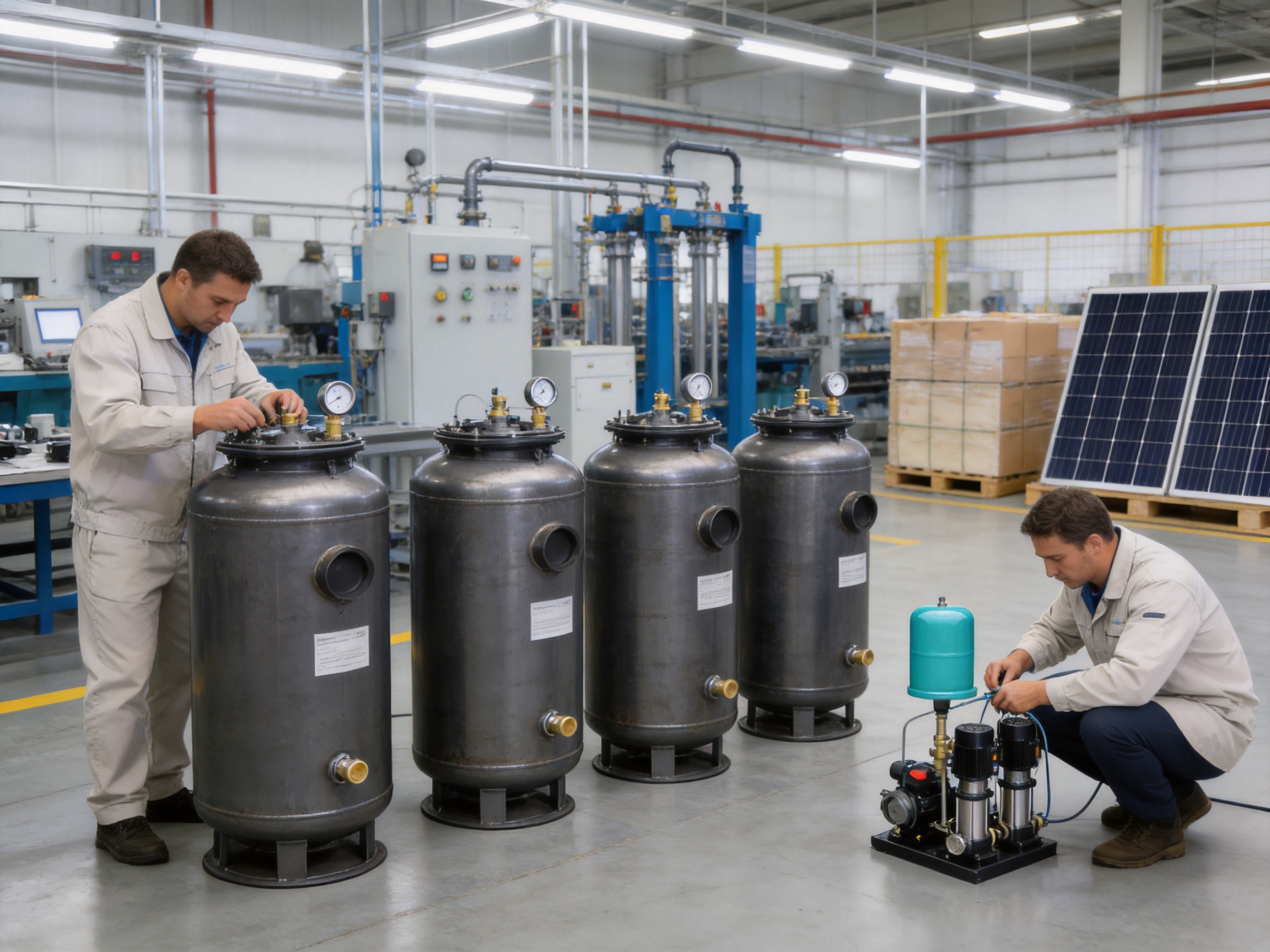
Quality in a pressure tank involves the interaction of several parts rather than one isolated feature. The shell must maintain structural integrity. The diaphragm must remain flexible and compatible with the operating fluid. The connector must provide a dependable connection. The pre-charge must be set consistently. Packaging must prevent damage during storage and transport.
Manufacturing control should address raw-material verification, shell forming, welding or joining operations where applicable, surface treatment, membrane assembly, connector installation, pressure testing, dimensional inspection, and final packaging. The exact process used for a particular production batch should be confirmed through the manufacturer’s technical and quality documentation.
Pressure testing is especially important for pressure vessels. A suitable test program helps identify leakage, structural weakness, connection defects, or assembly problems before shipment. Buyers handling regulated markets should request applicable test reports, conformity documents, inspection records, and certification information required by the destination country.
Pre-charge inspection is also important. A tank with an incorrect pre-charge may not respond as intended after installation. The manufacturer’s process should provide a consistent initial setting, while the installer should verify the pressure during commissioning according to the operating instructions.
Packaging volume is included in the product data. The stated packing quantities of 20 pieces per package indicate that the product is prepared for organized batch shipment. Efficient packing can reduce handling complexity and help distributors plan warehouse space. The tank should be protected against impact, moisture, thread damage, and deformation during transport.
The tank should be installed by a qualified technician familiar with closed hydraulic systems. Before installation, inspect the shell, connector, membrane-related components, and packaging for visible damage. Do not install a tank that appears dented, cracked, corroded, or otherwise compromised.
Confirm that the tank is suitable for the fluid used in the system. Water, water-glycol mixtures, and other heat-transfer fluids can have different material requirements. Verify the operating temperature, pressure, and chemical compatibility before connecting the tank.
Choose a location that is protected from direct mechanical impact, severe vibration, excessive external heat, flooding, and aggressive chemicals. The location should allow access for pressure checking, inspection, replacement, and connection maintenance. If the tank is installed inside a cabinet, adequate clearance should be provided around the connector and pressure-checking point.
Use a connection arrangement that allows the tank to be isolated when service is required, provided that the isolation method does not create an unsafe operating condition. A service valve, drain arrangement, pressure gauge, and safety valve may be used as part of a complete system design. The exact configuration depends on local codes and the type of thermal circuit.
Do not use the tank as a structural support for unsupported pipework. Excessive pipe loads can stress the connector and reduce installation reliability. Pipework should be independently supported and aligned before the tank connection is tightened.
Before commissioning, check the following items:
• The tank model and dimensions match the system design.
• The connector size and thread standard are compatible.
• The pre-charge pressure is appropriate for the installation.
• The system pressure is within the specified operating range.
• The safety valve is correctly rated and unobstructed.
• The membrane and shell are compatible with the system fluid.
• The tank is protected from freezing conditions unless the system design allows them.
• The pipework is supported and free from excessive mechanical stress.
• The system has been vented and filled according to the installation procedure.
• All connections have been checked for leakage after pressurization.
An expansion tank is a passive component, but it should not be ignored after installation. Periodic inspection helps identify pressure loss, external corrosion, leakage, damaged connections, or unusual system behavior.
One common service task is checking the gas-side pre-charge. This should be performed when the water side has been isolated and depressurized, and when the equipment is safe to handle. Measuring pre-charge while the water side remains pressurized can produce misleading results. The service technician should use a calibrated gauge and follow the product’s maintenance instructions.
Signs of a possible tank problem include frequent safety-valve discharge, large pressure fluctuations, repeated need for system refilling, visible corrosion, water emerging from the gas valve, or a tank that feels completely waterlogged. These symptoms may also be caused by other system faults, so diagnosis should include the pump, safety valve, air separator, pressure gauge, pipework, and control settings.
If water is found on the gas side or at the air valve, the diaphragm may have failed. In that situation, the tank should be removed from service and replaced or repaired according to the manufacturer’s approved procedure. The vessel must never be opened, welded, drilled, or modified by an unauthorized party.
The service life of the tank depends on temperature cycles, pressure cycles, fluid chemistry, installation environment, and maintenance quality. A tank operating continuously near its maximum temperature or pressure may experience more demanding conditions than one operating in a moderate range. Regular inspection is therefore valuable even when no visible failure has occurred.
Choosing between the VT2-2 and VT2-3 should begin with the system’s technical requirements rather than the model name alone. Consider the required expansion volume, physical clearance, connection position, installation orientation, operating pressure, working temperature, and fluid type.
The listed dimensions can help determine which model fits a particular equipment arrangement. The VT2-2 is taller at 222 millimeters, while the VT2-3 is listed at 192 millimeters. The VT2-3 diameter is supplied as 106/116 millimeters, so the exact production dimension should be confirmed before finalizing a mounting location.
The tank’s volume is not included in the supplied technical data. For an engineering selection, buyers should request the nominal volume, effective expansion volume, permissible installation orientation, test pressure, membrane specifications, and detailed dimensional drawing. These data are necessary when the tank is being selected for a defined solar collector area, boiler capacity, or thermal storage volume.
Buyers should also identify the destination-market requirements. Some countries or projects may require pressure-vessel approval, specific labeling, material declarations, test records, or conformity documentation. These requirements can vary by application and jurisdiction. OEM customers should communicate these needs before production so the manufacturer can review feasibility.
The VT2 Series competes through a combination of compact construction, clear pressure specifications, thermal-system suitability, and manufacturing support. Some competing products may offer a larger volume, a different membrane design, a stainless-steel shell, or additional certification. The best product depends on the application. However, the VT2 Series has several practical strengths for customers who need a compact and economical pressure-management component.
First, the product is focused on a defined use case: solar, boiler, and thermal systems. This makes its stated material and temperature information more relevant than the generic description of an undifferentiated pressure container.
Second, the fixed EPDM diaphragm provides a clear separation between the gas and fluid chambers. This supports stable operation in closed water circuits and reduces direct gas contact with the system fluid.
Third, the vertical form and compact dimensions help solve installation-space problems. This can be a major advantage in retrofit work and packaged equipment, where the available installation envelope is often more important than adding unnecessary capacity.
Fourth, the 1.5-bar pre-charge and 3.5-bar maximum working pressure are clearly stated. Buyers can use these values during preliminary system evaluation and can request further technical information where project-specific calculations are required.
Fifth, OEM support and the manufacturer’s experience in pumps and water-system equipment can simplify long-term procurement. Customers may obtain a pressure tank from a company that also understands solar pumps, circulation pumps, booster pumps, and other related products.
Finally, the company combines product development, mass production, and international export support. This can be valuable for distributors and project customers that need repeatable supply, coordinated packaging, and assistance with cross-border orders.
A reliable purchasing and installation process can be organized into several stages. First, define the system type, fluid, temperature range, total water volume, pressure range, and required expansion capacity. Second, compare these requirements with the VT2 Series specifications. Third, request technical drawings and any required compliance documentation. Fourth, confirm the model, connector, packaging, labeling, and OEM requirements. Fifth, inspect the shipment upon arrival and install the tank according to the approved system design.
For larger projects, the buyer should establish a technical approval process before placing a mass order. This may include a sample evaluation, dimensional confirmation, pressure testing, membrane-compatibility review, packaging inspection, and trial installation. Such a process reduces the risk of discovering compatibility issues after the product has been distributed or installed.
For distributors, product training is also useful. Sales and service teams should understand the difference between a thermal expansion tank and a domestic water booster accumulator. They should know the tank’s stated pressure limits, temperature range, connector size, and maintenance requirements. Correct product positioning helps prevent unsuitable applications and improves customer satisfaction.
The primary function is to absorb fluid expansion and help stabilize pressure in closed solar, boiler, and thermal water systems. The tank uses a fixed diaphragm to separate the system fluid from a pre-charged gas chamber.
The tank body is made from carbon steel. The diaphragm is specified as EPDM, a material commonly used for water-related thermal applications.
The listed pre-charge pressure for both VT2-2 and VT2-3 is 1.5 bar. The installer should verify the appropriate setting for the complete system before commissioning.
The maximum working pressure is 3.5 bar. The system should be designed so that normal operation remains within appropriate limits, and a correctly rated safety valve must be included.
The stated working temperature range is -10°C to 99°C with an EPDM membrane. The actual application must also be reviewed for fluid compatibility and temperature cycling.
The product information identifies thermal systems, boiler systems, and solar systems. It may be appropriate for other closed water circuits only after the pressure, temperature, fluid, and expansion requirements have been checked.
The listed models are VT2-2 and VT2-3. They have different listed dimensions but the same 1.5-bar pre-charge and 1/2-inch connector.
Both listed models have a 1/2-inch connector. The installer should confirm the actual thread standard and use a compatible fitting or adapter where necessary.
No. Suitability depends on the solar-system volume, fluid type, operating temperature, pressure range, required expansion capacity, and local regulations. A qualified designer should confirm the selection.
No. The expansion tank and safety valve have different functions. The expansion tank manages normal volume changes, while the safety valve protects the system against excessive pressure.
Pre-charge may be adjustable in service, but adjustment must follow the manufacturer’s procedure. The water side must be depressurized before an accurate gas-side measurement or adjustment is made.
Confirm the required tank capacity, model dimensions, connector compatibility, fluid type, temperature range, pressure range, documentation, packaging, and any OEM or destination-market requirements.
The compact vertical design can fit into small utility rooms, solar equipment spaces, boiler cabinets, and retrofit installations where a larger horizontal vessel would be difficult to accommodate.
The supplier has experience in independent research and development, mass production, global export, pumps, solar-water products, intelligent water equipment, and related water-system accessories. These capabilities support product development and organized international supply.
The VT2 Series Vertical Tank is a compact pressure-management solution for solar, boiler, and thermal water systems. Its fixed diaphragm membrane, carbon steel shell, EPDM construction, 1.5-bar pre-charge, 3.5-bar maximum working pressure, and 1/2-inch connector provide a clear technical foundation for small closed hydraulic circuits.
Its main competitive advantages are its space-efficient vertical configuration, straightforward diaphragm operation, defined pressure parameters, thermal-system positioning, and OEM availability. These features make it relevant to solar installers, boiler manufacturers, pump distributors, HVAC suppliers, equipment integrators, and international brands seeking a compact pressure tank.
The product should always be selected as part of a complete system design. Tank capacity, working fluid, pressure, temperature, safety equipment, installation clearance, and local regulations must be reviewed before use. When these factors are correctly addressed, a compact expansion tank can help reduce pressure fluctuation, support smoother thermal-system operation, and protect the service life of connected equipment.
Supported by an integrated manufacturer with experience in research and development, mass production, related water-system equipment, and global export services, the VT2 Series offers a practical option for customers who value compact design, clear specifications, and coordinated procurement.
1. Product specification data for the VT2 Series Vertical Tank, including model dimensions, connector size, pre-charge pressure, working pressure, temperature range, and packing information.
2. Manufacturer-provided company information concerning research and development, mass production, global export, OEM support, and water-system product lines.
3. General engineering principles for diaphragm expansion tanks in closed solar thermal, boiler, and hydronic heating systems.
4. General technical guidance for pressure-vessel installation, pre-charge verification, safety-valve selection, and hydraulic-system maintenance.
5. General material-reference information concerning EPDM membranes in water and thermal-service applications.
edwina@edwin-pump.com
+86-13586290903 (WhatsApp)
Xuri Gongliang Cutting Tool Entrepreneurship Park, Wenqiao Town, Wenling City, Taizhou City, Zhejiang Province, China

High Performance Smart Pump Factory


 English