edwina@edwin-pump.com

View All Products
en
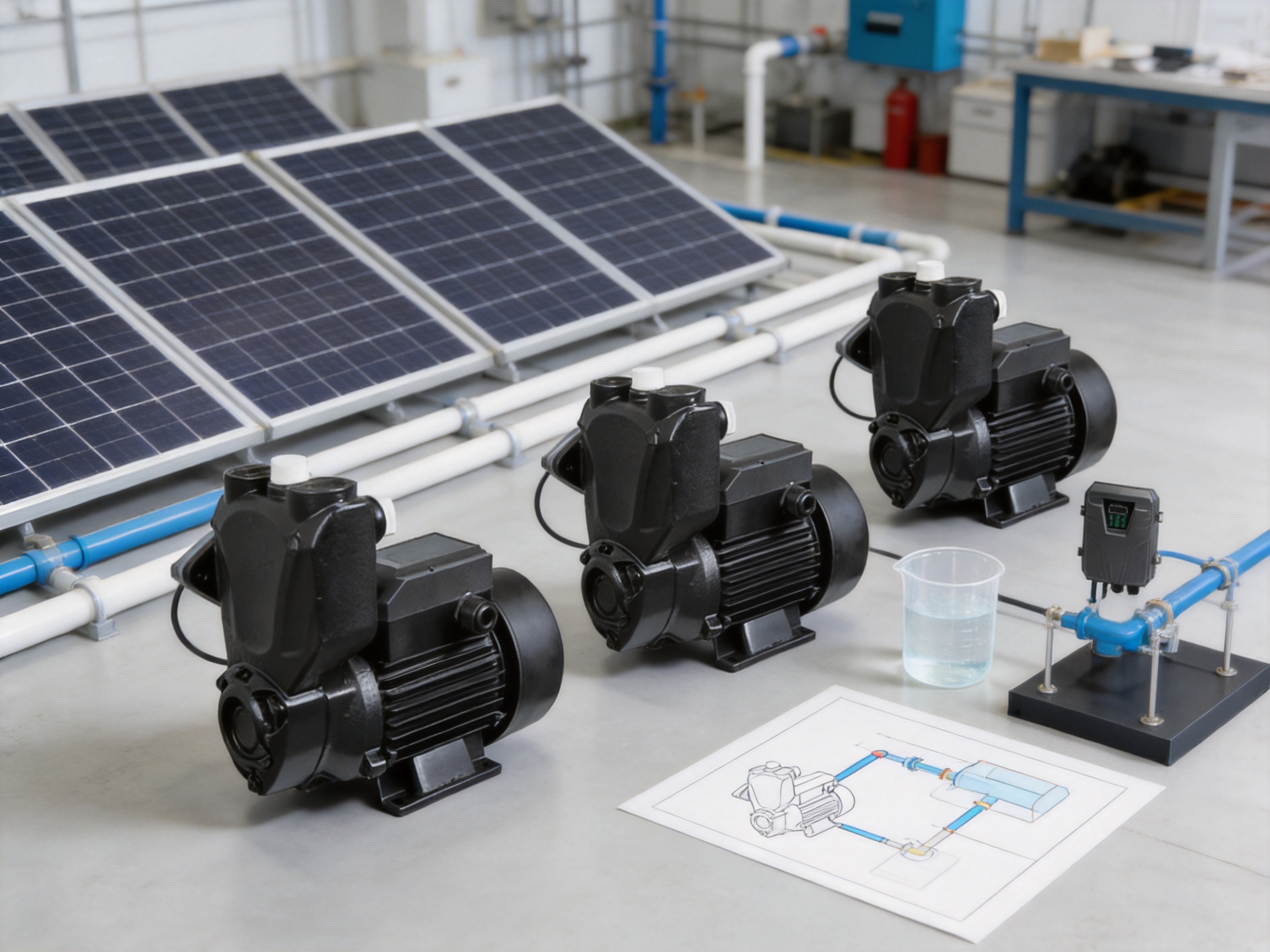
Reliable access to water is essential for homes, farms, gardens, remote facilities, and small commercial projects. However, many water supply locations are far from electrical grids or face unstable electricity, high energy costs, and difficult installation conditions. Solar-powered pumping provides a practical alternative by converting sunlight into useful water movement without depending on conventional grid power. Within this growing market, the EZB Series DC Brushless Motor Solar Self-Priming Pump is designed to provide efficient, convenient, and dependable water pumping for a wide range of small and medium-scale applications.
The EZB Series combines a DC brushless motor, solar-compatible electrical design, self-priming capability, compact construction, and low-maintenance operation. These features address several common problems associated with traditional pumps, including complicated startup procedures, dependence on grid electricity, frequent maintenance, and installation limitations. The result is a surface-mounted solar pump that can support household water transfer, garden irrigation, agricultural applications, and remote water supply projects.
Unlike a conventional AC pump that normally requires a stable mains power supply, the EZB Series is designed to operate from a suitable DC solar power system. Its optimum input voltage ranges are matched to practical solar panel configurations, while the brushless motor helps use available electrical energy efficiently. The pump is therefore suitable for users seeking a decentralized water supply system with reduced operating costs and fewer electrical infrastructure requirements.
The EZB Series is a DC surface solar pump intended for applications where water must be drawn from a source and transferred to another location. It is not a deep-well submersible pump. Instead, it is installed above the water source and uses its self-priming structure to create suction through the inlet line. This arrangement makes the pump convenient for tanks, shallow water sources, rainwater systems, storage containers, small irrigation networks, and portable solar water installations.
The pump is available in several combinations of voltage, power, maximum flow, and maximum head. Models include 24-volt versions rated at 210 watts and 280 watts, a 48-volt version rated at 550 watts, and a 72-volt version rated at 750 watts. Maximum flow rates range from 2 cubic meters per hour to 3 cubic meters per hour, while maximum heads range from 25 meters to 65 meters. This range allows users to select a model according to the elevation, pipe length, water demand, and available solar power.
Each listed model uses a 1 × 1 inch outlet connection and includes a two-meter cable. The solar panel open-circuit voltage must remain below the specified limit for the selected model. The recommended solar panel power is at least 1.3 times the pump power. Correct system sizing is important because actual performance depends on sunlight intensity, panel orientation, pipe resistance, water temperature, elevation, and the operating point of the pump.
The heart of the EZB Series is its DC brushless motor. Unlike a brushed motor, a brushless design does not rely on physical brushes and a commutator to transfer electrical current to the rotating assembly. This eliminates a common wear point and supports longer service life with less routine maintenance.
Brushless motors are particularly suitable for solar pumping because they can operate efficiently from a DC power source. Solar panels produce direct current, so the system can avoid some of the conversion stages that may be required when powering an AC motor. Fewer conversion stages can simplify the system and help reduce energy losses, although actual efficiency depends on the complete solar installation and operating conditions.
The brushless motor also contributes to stable operation and reduced maintenance requirements. For installations in remote agricultural fields, gardens, cabins, or off-grid facilities, minimizing maintenance visits is a major advantage. Users can focus on checking the water source, inlet line, filters, and solar panels rather than replacing motor brushes at regular intervals.
Self-priming is one of the most important practical features of the EZB Series. A conventional surface pump often needs to be filled manually before startup. If air enters the suction pipe or the pump casing becomes empty, the operator may need to repeat the priming procedure. This can be inconvenient in remote locations and may cause delays during seasonal operation.
The self-priming design automatically creates suction, allowing the pump to begin drawing water without repeated manual priming under suitable installation conditions. This makes startup easier and improves convenience for household, agricultural, and portable solar water systems. It is especially useful when the pump is started intermittently according to sunlight availability or water demand.
Self-priming does not remove the need for correct installation. The suction line should be properly sealed, the inlet should remain below the water level when required, and the pump should be installed within the permissible suction conditions. A foot valve, strainer, or other suitable inlet protection may be necessary depending on the water source. The user should also follow the installation instructions and avoid running the pump without adequate water protection.
The EZB Series provides several voltage choices for different solar system designs. The EZB2-25-24-210 and EZB2-30-24-280 models use a nominal 24-volt rating and accept an optimum input voltage of 30 to 48 volts DC. The EZB3-50-48-550 model uses a nominal 48-volt rating and accepts 60 to 90 volts DC. The EZB3-65-72-750 model uses a nominal 72-volt rating and accepts 90 to 120 volts DC.
These voltage ranges give installers flexibility when arranging solar panels in series and parallel configurations. A higher-voltage model can be useful when a longer cable run is required because higher voltage can help reduce current for a comparable power level. However, panel configuration must always remain within the pump’s electrical limits. In particular, the solar panel open-circuit voltage must remain below 60 volts for the 24-volt models, below 120 volts for the 48-volt model, and below 170 volts for the 72-volt model.
Operating a pump outside its recommended electrical range may result in unstable operation, insufficient performance, overheating, or damage. System designers should calculate the panel voltage under both normal and low-temperature conditions because open-circuit voltage can increase when solar modules operate in colder weather.
The EZB Series is designed as a compact surface pump that can fit into a variety of small installations. Its form factor is suitable for rooftop water systems, garden irrigation, storage tanks, portable units, and small farm projects. Compared with larger commercial pumping equipment, a compact pump can simplify mounting, transportation, inspection, and replacement.
Compact equipment is also valuable in solar applications because the entire system may need to be installed in locations with limited space. A small pump house, an equipment platform near a storage tank, or a mobile irrigation cart may not accommodate a large conventional pump. The EZB Series helps create a more practical arrangement while retaining useful flow and head capability.
Although the pump is compact, installation quality remains important. The pump should be mounted on a stable surface, protected from flooding, and positioned so that the inlet and outlet pipes are not subjected to excessive strain. Adequate ventilation and protection from severe weather can also support longer operating life.
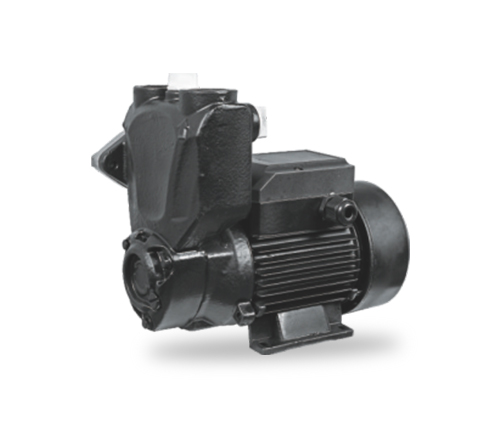
EZB Series DC Brushless Motor Solar Self-Priming Pump
Selecting the correct model requires more than comparing maximum flow figures. A pump operates along a performance curve, and the actual flow decreases as the required head and total system resistance increase. Total dynamic head includes vertical lift, pressure requirements, friction losses in the pipes, valves and fittings, and any additional elevation between the water source and delivery point.
For example, a model with a maximum head of 25 meters may be appropriate for a modest transfer application, but it may not deliver its maximum rated flow at that head. Similarly, a model with a 65-meter maximum head may be selected for a higher-elevation application, but the final flow rate must be evaluated at the actual operating point. The included performance curve should be used during system design.
| Model | Nominal Voltage | Optimum DC Input Voltage | Power | Maximum Flow | Maximum Head | Outlet | Cable | Maximum Solar Panel VOC | Recommended Solar Panel Power |
|---|---|---|---|---|---|---|---|---|---|
| EZB2-25-24-210 | 24 V | 30–48 V | 210 W | 2 m³/h | 25 m | 1 × 1 inch | 2 m | <60 V | At least 1.3 × pump power |
| EZB2-30-24-280 | 24 V | 30–48 V | 280 W | 2 m³/h | 30 m | 1 × 1 inch | 2 m | <60 V | At least 1.3 × pump power |
| EZB3-50-48-550 | 48 V | 60–90 V | 550 W | 3 m³/h | 50 m | 1 × 1 inch | 2 m | <120 V | At least 1.3 × pump power |
| EZB3-65-72-750 | 72 V | 90–120 V | 750 W | 3 m³/h | 65 m | 1 × 1 inch | 2 m | <170 V | At least 1.3 × pump power |
The 210-watt model is suitable for lower-head water transfer where the required flow is modest. The 280-watt model provides a higher maximum head while maintaining a similar maximum flow. These two versions are practical for small household supply systems, garden irrigation, and basic tank filling.
The 550-watt model provides a stronger combination of flow and head for larger irrigation layouts, elevated storage tanks, and applications involving longer pipe runs. The 750-watt model is intended for the highest head within the series and can support demanding elevation requirements when the solar array is correctly configured.
Users should treat maximum flow and maximum head as reference limits rather than simultaneous operating values. A complete design should include a calculated duty point, expected sunlight conditions, daily water demand, storage capacity, and the potential need for battery backup or a hybrid power source.
Traditional surface pumps powered by grid electricity can be effective where mains power is stable and affordable. However, extending electrical infrastructure to a remote field, garden, construction site, or rural property can be expensive. In some regions, grid interruptions may also make water supply unreliable.
A DC solar pump can operate using energy generated directly from solar panels. This reduces dependence on utility power and makes water pumping possible in locations where grid access is limited. Once the solar system has been installed, the primary energy source is free and renewable, which can reduce operating costs over the service life of the equipment.
The EZB Series is therefore well suited to decentralized water infrastructure. It can work as part of a direct solar pumping system during daylight hours or as one component of a broader system that includes a battery, water storage tank, controller, or backup generator.
Brushed DC motors can be economical, but their brushes gradually wear as the motor operates. Dust, moisture, repeated starts, and long operating hours can accelerate deterioration. Brush replacement adds maintenance tasks and may require the pump to be removed from service.
The brushless design of the EZB Series removes this particular maintenance item. While all pumping equipment still requires inspection and basic care, the absence of motor brushes can simplify long-term ownership. This is particularly valuable for remote users who may not have convenient access to repair technicians or replacement parts.
Non-self-priming surface pumps can require manual filling of the pump casing and suction pipe before every startup after the system has been drained. This is inconvenient for seasonal irrigation, intermittent water transfer, and installations managed by users without technical experience.
The EZB Series is designed to create suction automatically under appropriate conditions. This reduces startup complexity and helps the pump return to service more quickly after periods of inactivity. The feature can improve user confidence and reduce the risk of operating mistakes.
A conventional fixed-power pump may be selected around a single electrical supply and a specific installation layout. If the project changes, replacing or rewiring the system can be difficult. By offering multiple DC voltage and power options, the EZB Series gives project designers more flexibility.
The different models allow users to match pump output to panel size, water demand, elevation, and installation distance. A low-power model can support a small garden or household tank, while a higher-power model can handle greater head requirements. This range can simplify product selection for distributors, installers, and original equipment manufacturers serving different markets.
The EZB Series can support solar-powered household water supply in homes, cabins, rural properties, and remote residences. It may be used to transfer water from a ground-level tank to an elevated tank, provide water for non-potable household uses, or distribute collected rainwater for cleaning and garden irrigation.
In an elevated tank system, the solar pump can operate during periods of sunlight and fill the tank for later use. This approach separates water collection from water consumption and reduces the need for the pump to run whenever a tap is opened. The tank also provides a useful reserve during cloudy weather or nighttime operation.
For household applications, water quality must be considered carefully. The pump should be used only with fluids compatible with its materials and intended design. If the water is for drinking, the complete water system must meet applicable local requirements, including filtration, sanitation, storage, and material compatibility. Product selection should be confirmed with the supplier before use in potable water systems.
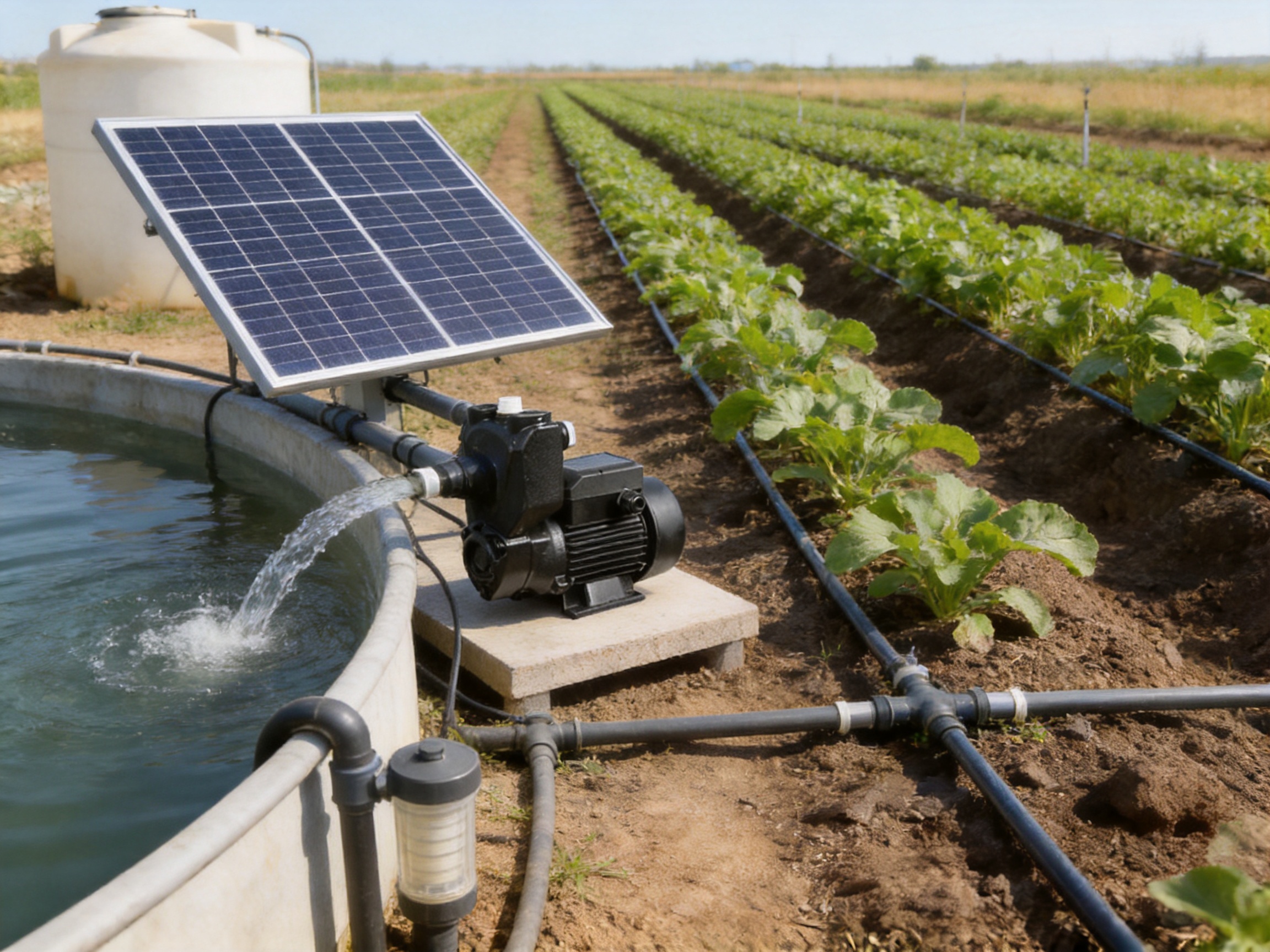
Small-scale agricultural irrigation is one of the most practical uses for a solar surface pump. Gardens, orchards, nurseries, and small farms often require water in locations where grid power is unavailable or where operating costs must be controlled. The EZB Series can transfer water from tanks, ponds, collection reservoirs, or other suitable sources to irrigation lines.
Solar pumping is especially useful for drip irrigation and low-volume sprinkler systems. These irrigation methods can distribute water gradually and efficiently, allowing a relatively modest pump to support productive growing areas. The pump can also fill an intermediate tank that supplies irrigation by gravity, reducing the need for continuous operation.
Farmers and installers should account for the water source condition. Mud, sand, algae, leaves, and other debris can affect pump performance. An appropriate strainer or filtration arrangement can help protect the inlet and downstream irrigation equipment. Regular cleaning of the intake area and solar panels is also recommended to preserve system performance.
For orchards and sloping farmland, head requirements may vary substantially across the site. The model should be selected after calculating the highest delivery point and the losses caused by long pipe runs, bends, filters, emitters, and valves. A pump that appears adequate based only on vertical height may not deliver the required water volume after all system losses are included.
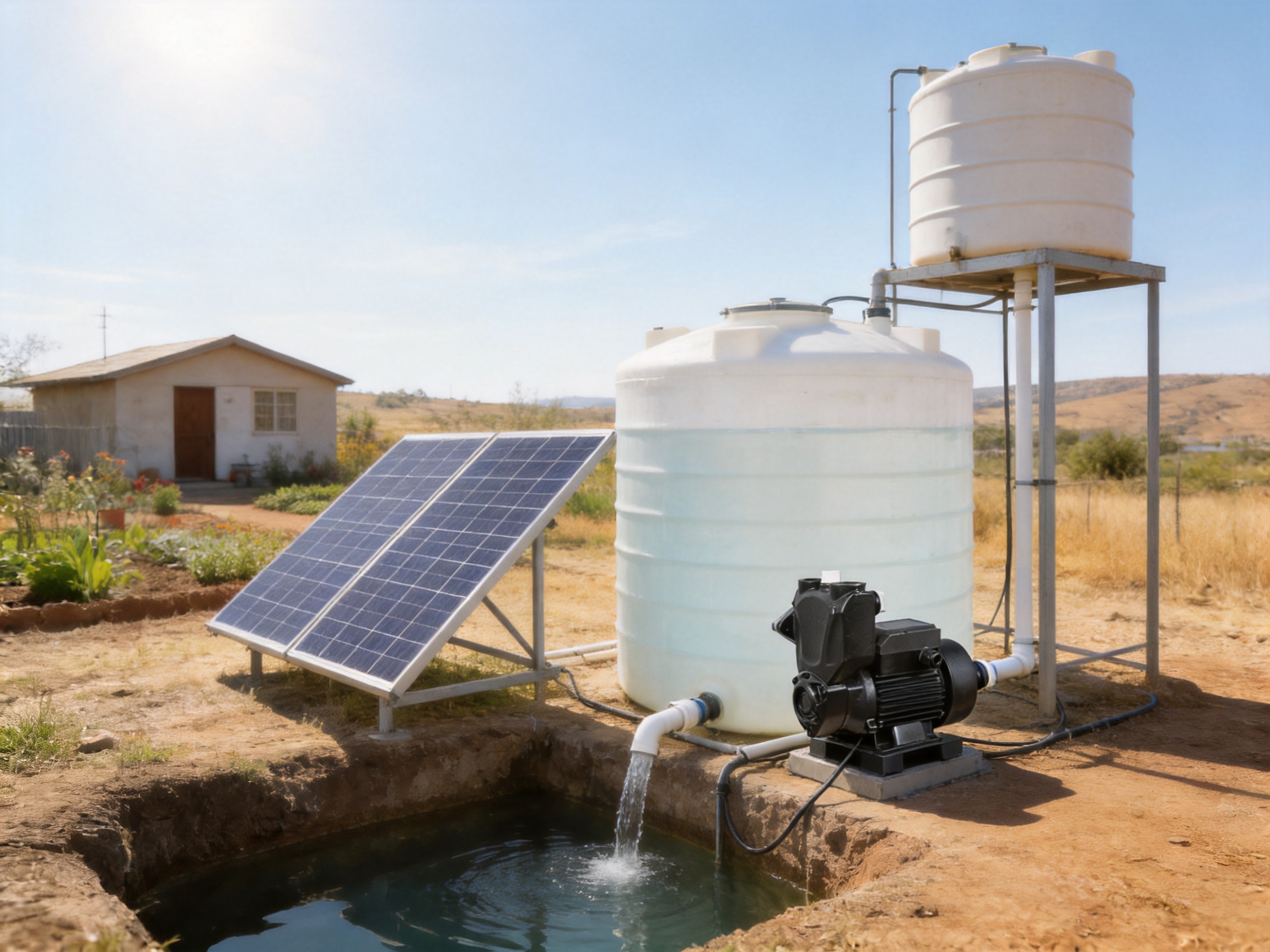
Remote locations often require equipment that is simple, robust, energy-efficient, and easy to maintain. The EZB Series addresses these requirements through its DC power input, brushless motor, self-priming design, and compact structure. It can be incorporated into water systems for remote workshops, field stations, temporary camps, small livestock operations, and isolated properties.
In these environments, serviceability is a major consideration. A pump that requires frequent brush replacement or complicated startup procedures can create unnecessary downtime. The EZB Series helps reduce these difficulties, although normal inspection and proper installation remain essential.
Portable solar water systems can also benefit from the pump’s compact design. A system may include foldable or movable solar panels, a water container, hoses, and a small mounting frame. Such an arrangement can be used for temporary irrigation, emergency water transfer, remote cleaning, or seasonal projects. The actual suitability of a portable configuration depends on the required suction distance, water source, pipe arrangement, and protection from movement or impact.
The product is manufactured by Taizhou Edwin Electric Co., Ltd., an integrated enterprise founded in 2008. Its operations include independent research and development, mass production, and global export. This combination is important for pump buyers because product development, manufacturing coordination, quality management, and international order fulfillment can be handled within an established industrial organization.
Independent research and development supports the continuous improvement of pump structures, motor systems, electrical compatibility, and application performance. For solar pumping products, engineering must consider more than the hydraulic section. The motor, electrical input range, solar panel arrangement, starting behavior, heat management, cable configuration, and operating environment all influence the final system. An integrated manufacturer is better positioned to coordinate these elements than a supplier that only resells unrelated components.
Mass production provides additional advantages. Repeated production of standardized models allows manufacturing teams to refine assembly procedures, improve consistency, manage component supply, and support stable delivery. It also helps distributors and project contractors obtain repeat products for multiple installations without redesigning the system each time.
The company’s broader product experience includes deep well pumps, submersible pumps, domestic booster pumps, circulation pumps, solar water pumps, and intelligent booster pumps. This product knowledge provides a wider understanding of water movement, pressure management, residential supply, agricultural irrigation, and renewable-energy applications. Customers with multiple pumping requirements can therefore work with a supplier that offers more than one category of equipment.
A reliable pump depends on the quality and compatibility of its individual components. Motor parts, hydraulic components, seals, electrical connections, cables, fasteners, and housing elements must work together under changing loads and environmental conditions. A professional manufacturing process should include incoming component checks, controlled assembly, electrical inspection, hydraulic testing, appearance inspection, and finished-product verification.
For the EZB Series, important process-control points include confirming the correct motor configuration, verifying the rated voltage and power, checking the sealing of the pump body, inspecting the cable connection, and testing the pump’s ability to operate within its intended performance range. Production consistency is particularly important for solar products because an incorrect electrical component or unsuitable connection can affect the entire photovoltaic system.
Mass production does not mean that every project is identical. Different markets may require different packaging, documentation, voltage arrangements, connectors, shipping configurations, or installation guidance. An experienced export manufacturer can coordinate these requirements while maintaining standardized core products.
Since 2018, the company has invested in new energy and intelligent technology, expanding its product portfolio with solar water pumps and intelligent booster pumps. This focus reflects the changing needs of the water-pumping market. Customers increasingly seek equipment that reduces energy consumption, works with renewable power, and can be integrated into smarter water systems.
Solar pumping requires careful matching between hydraulic demand and available renewable energy. Unlike a pump connected to a constant grid supply, a solar pump may experience changing voltage and power as sunlight changes. Product development must therefore address startup behavior, efficient motor operation, system sizing, and practical use under variable solar conditions.
The EZB Series represents this application-focused approach. Its available voltage levels and recommended solar panel sizing provide a foundation for designing a complete system rather than treating the pump as an isolated mechanical product.
Before installing the pump, identify the water source, its lowest and highest water levels, the distance to the pump, and the expected seasonal changes. Surface water, tanks, wells, rainwater reservoirs, and collection basins may each require different inlet arrangements.
The suction pipe should be as short and direct as practical. Excessive length, sharp bends, undersized piping, or air leaks can reduce pumping performance and interfere with self-priming. The inlet should be protected from large debris, and the pipe should remain securely supported so its weight does not load the pump connection.
Calculate the vertical distance from the water level to the discharge point, then add pressure requirements and pipe friction losses. If the water must be delivered through filters, valves, sprinklers, or drip lines, their resistance must be included. The resulting total dynamic head should be compared with the pump performance curve.
It is also important to estimate daily water volume. A pump may have a maximum flow of 2 or 3 cubic meters per hour, but solar energy availability changes throughout the day. A storage tank can help balance daytime pumping with nighttime consumption. In many installations, designing for a consistent daily volume is more useful than focusing only on instantaneous maximum flow.
The recommended solar panel power is at least 1.3 times the pump power. This provides a basic sizing reference, but local solar conditions may justify additional capacity. Factors include latitude, seasonal weather, panel orientation, shading, temperature, dust, and the desired operating duration.
The panel open-circuit voltage must remain below the applicable limit. The array should also provide the required operating voltage under real load, not merely under ideal laboratory conditions. A qualified installer should check the series and parallel arrangement, cable size, electrical protection, grounding requirements, and disconnecting method.
Solar panels should be positioned to receive direct sunlight for the expected pumping period. Partial shading can significantly reduce available power, especially when panels are connected in series. Regular cleaning may be necessary in dusty or agricultural environments.
The brushless motor reduces routine maintenance, but the complete pumping system still requires periodic attention. Operators should inspect the inlet strainer, suction pipe, discharge pipe, cable, pump housing, mounting base, and solar panels. Any unusual noise, vibration, leakage, reduced flow, or repeated startup failure should be investigated promptly.
The water source should remain sufficiently available during operation. Running a surface pump without water can cause overheating or damage to internal components, depending on the design. If the water level changes seasonally, the system should include an appropriate protection method or operating procedure to prevent dry running.
Self-priming performance depends on a sealed suction line. Air entering through a loose fitting, damaged hose, cracked seal, or improperly installed valve may prevent the pump from establishing suction. When a pump fails to prime, the first checks should include the water level, inlet pipe connections, foot valve or check valve, strainer condition, and any visible air leaks.
Solar panels should be kept clean and free from shading. Dirt and dust reduce the amount of energy reaching the photovoltaic cells and may cause the pump to operate below its expected performance. Electrical connections should be inspected for corrosion, looseness, moisture, or mechanical damage.
Proper maintenance helps protect service life and preserves energy efficiency. Because solar pumping equipment is often installed in locations where technical service is less accessible, preventive inspection is generally more economical than waiting for a complete failure.
Electrical installation should be performed by personnel familiar with DC photovoltaic systems. Even relatively small solar arrays can produce hazardous voltage, particularly when panels are connected in series. The system should include suitable isolation, protection, cable routing, and labeling.
Never exceed the maximum open-circuit voltage specified for the selected pump. The array should be checked under the lowest expected ambient temperature because photovoltaic open-circuit voltage can rise in cold conditions. Incorrect polarity or unsuitable wiring may damage the pump or create a safety hazard.
The pump should be protected from flooding, severe impact, excessive heat, and unauthorized access. If installed outdoors, the surrounding arrangement should prevent standing water from accumulating around electrical connections. Pipework should be supported independently where necessary, and the pump should not be used as a structural support for heavy piping.
Water compatibility must also be verified. Clean or relatively clean water is generally preferred for compact solar surface pumps. Abrasive solids, corrosive chemicals, high concentrations of suspended matter, or fluids with unusual temperatures may require a different pump design. Buyers should provide complete fluid information before selecting equipment for special applications.
The competitive value of the EZB Series comes from the combination of features rather than from one specification alone. A pump may offer solar compatibility but lack self-priming capability. Another may have self-priming capability but use a brushed motor with higher maintenance needs. A third may provide high power but be too large or complex for small installations.
The EZB Series brings together DC brushless motor technology, self-priming operation, compact construction, several voltage options, and a practical range of flow and head performance. This combination makes it especially attractive for decentralized water systems where simplicity and low maintenance are important.
Compared with conventional AC surface pumps, it can reduce dependence on grid power and simplify renewable-energy integration. Compared with brushed DC pumps, it can reduce motor maintenance. Compared with non-self-priming pumps, it offers easier startup. Compared with oversized commercial equipment, it can provide a more compact and economical solution for smaller water requirements.
The product is also supported by a manufacturer with experience in multiple pump categories and international supply. This matters to distributors and project buyers who need repeatable product quality, technical coordination, packaging, documentation, and export support.
Distributors should evaluate the complete product range rather than selecting a model based only on its name or rated power. Important questions include the required flow at the actual head, the solar panel arrangement, the daily operating schedule, the water quality, the suction distance, and the preferred installation method.
Project buyers should also confirm the availability of performance curves, product manuals, spare parts, packaging specifications, and technical support. For repeated installations, standardizing on a small number of models may simplify inventory and training. At the same time, each site should be checked individually because the same pump may perform differently under different elevations, pipe layouts, and solar conditions.
When purchasing for export, buyers may require coordinated labeling, cartons, product identification, electrical documentation, and shipping arrangements. An integrated manufacturer with established export experience can help manage these requirements more effectively than an unstructured supply channel.
No. The EZB Series is a DC surface solar pump. It is installed above the water source and uses a suction pipe. It should not be submerged unless a specifically approved configuration is provided by the manufacturer.
Self-priming means that the pump is designed to create suction automatically under suitable installation conditions. It can start without repeated manual filling of the pump and suction line, provided the inlet arrangement is correctly sealed and the pump is installed within its permitted suction conditions.
The pump is designed for solar-compatible DC operation. A suitable solar array must be selected according to the model’s optimum input voltage, maximum open-circuit voltage, and recommended power. Additional control equipment may be required depending on the complete system design.
The EZB2-25-24-210 model has a listed maximum head of 25 meters, but the actual operating point must be checked. If the system has pipe friction, fittings, filters, or a required outlet pressure, a model with additional head capacity may be more appropriate. Selection should be based on total dynamic head rather than vertical height alone.
Yes. The EZB Series is suitable for small-scale irrigation applications such as gardens, orchards, nurseries, and small farms. The selected model should match the irrigation flow, pipe length, elevation, and pressure requirement.
The brushless motor does not use conventional motor brushes, so brush replacement is not required. However, the pump and solar system still need routine inspection. Users should check the inlet, piping, electrical connections, solar panels, mounting, and operating performance.
The listed recommendation is at least 1.3 times the pump power. For example, a 210-watt pump should use solar panel power of at least approximately 273 watts as a basic reference. Actual system sizing may require additional capacity based on local sunlight, seasonal conditions, shading, and desired pumping duration.
The suitability depends on the amount and type of suspended material. Sand, mud, debris, abrasive particles, or corrosive substances may reduce performance or damage the pump. A suitable strainer or filtration system may be required, and fluid compatibility should be confirmed before use.
A direct solar system normally produces power during daylight. Nighttime operation requires stored energy, such as a battery system, or water storage that was filled during the day. The pump itself should be integrated with the selected power and control system.
Common causes include an empty or unsuitable water source, an air leak in the suction line, a blocked inlet strainer, an incorrect valve arrangement, insufficient solar power, incorrect polarity, or a pump installed beyond its suction capability. These conditions should be checked systematically before further operation.
It can be suitable for small commercial, agricultural, residential, and off-grid projects within its performance range. Larger commercial applications may require multiple pumps, storage tanks, control systems, or a different pump category. The application should be evaluated according to flow, head, duty cycle, and water quality.
The EZB Series DC Brushless Motor Solar Self-Priming Pump offers a practical solution for water pumping where efficiency, simple startup, low maintenance, and renewable energy compatibility are important. Its brushless DC motor is well suited to solar power, while its self-priming design helps simplify operation. Compact construction supports installation in homes, gardens, agricultural sites, tanks, and remote locations.
With models ranging from 210 watts to 750 watts, maximum flows from 2 to 3 cubic meters per hour, and maximum heads from 25 to 65 meters, the series provides useful flexibility for different system requirements. Correct sizing remains essential: users must consider total dynamic head, pipe friction, water demand, solar panel power, voltage limits, and seasonal operating conditions.
The product is supported by an established manufacturer with independent research and development, mass production, global export experience, and a broader portfolio of pump technologies. These capabilities can benefit distributors, installers, and project buyers seeking consistent supply and coordinated technical support.
For decentralized water infrastructure, the combination of solar compatibility, self-priming convenience, brushless motor efficiency, compact installation, and reduced maintenance makes the EZB Series a strong alternative to many conventional pumping arrangements. When correctly selected and installed, it can provide dependable water transfer for residential, agricultural, portable, and off-grid applications.
1. Product performance data and technical information for the EZB Series DC Brushless Motor Solar Self-Priming Pump.
2. Manufacturer information concerning product development, manufacturing, export operations, and solar water pump technology.
3. General principles of photovoltaic system design, including solar array voltage, open-circuit voltage, power sizing, and shading considerations.
4. General pump engineering principles concerning total dynamic head, flow rate, suction systems, pipe friction, and performance curves.
5. General maintenance and safety practices for DC motors, surface pumps, solar installations, and small-scale irrigation systems.
edwina@edwin-pump.com
+86-13586290903 (WhatsApp)
Xuri Gongliang Cutting Tool Entrepreneurship Park, Wenqiao Town, Wenling City, Taizhou City, Zhejiang Province, China

High Performance Smart Pump Factory


 English