edwina@edwin-pump.com

View All Products
en
The SK Series Single-Stage Liquid Ring Vacuum Pump is designed for industrial users who need dependable vacuum generation in demanding operating environments. Unlike many dry vacuum technologies that require highly controlled, clean, and low-moisture gas conditions, a liquid ring vacuum pump is naturally suited to applications involving humid gases, condensable vapors, dust, process moisture, and certain liquid carryover. This makes the SK Series a practical solution for chemical processing, food production, paper manufacturing, mining, petroleum operations, plastics, textiles, power utilities, and many other industries.
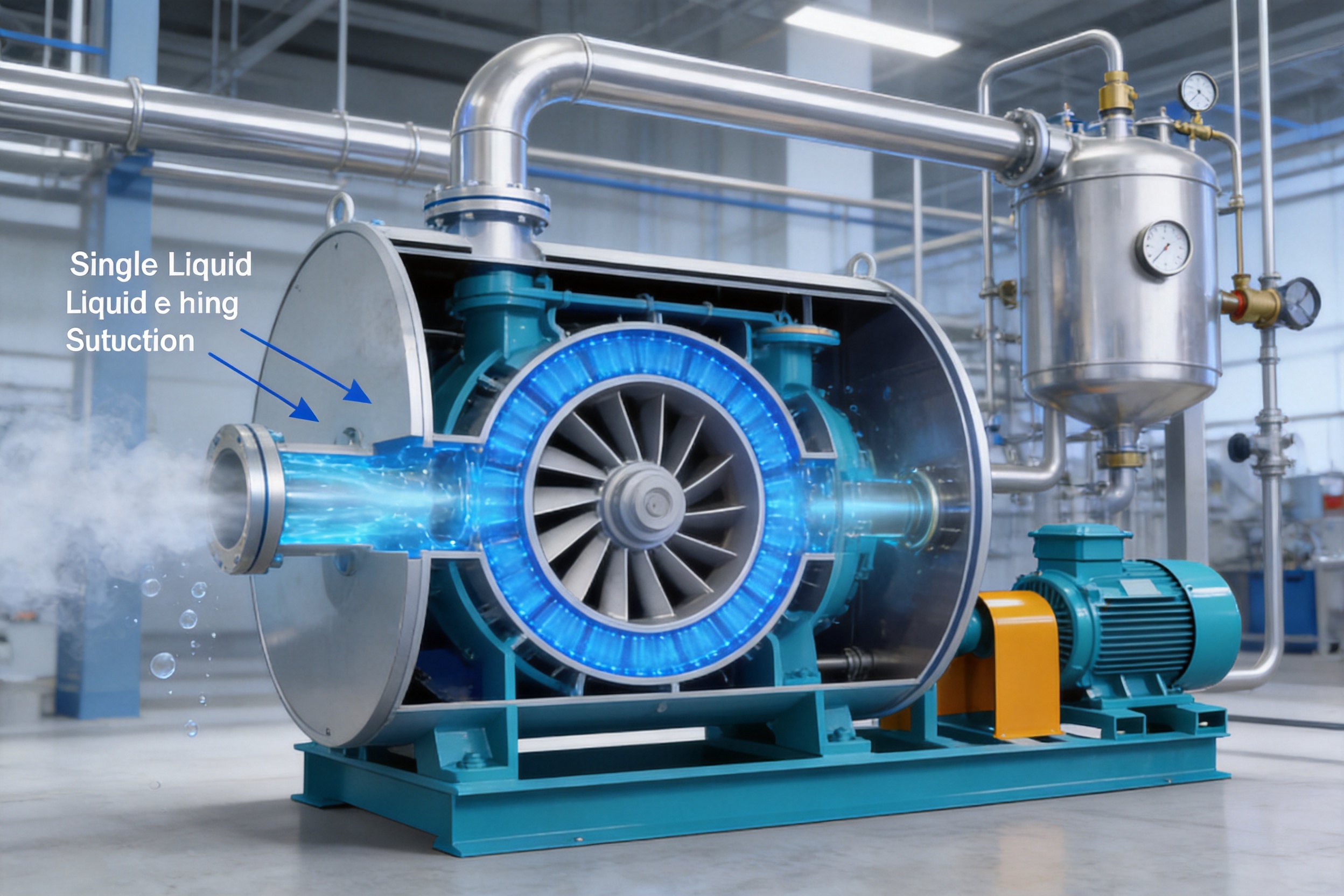
The pump compresses gas through the interaction of a rotating vaned impeller and a liquid ring formed inside a cylindrical casing. In normal operation, working liquid is introduced into the pump. Centrifugal force causes the liquid to move outward against the casing, creating a continuous ring around the impeller. Because the impeller is positioned eccentrically within the casing, the spaces between the impeller vanes and the liquid ring change in volume during rotation. These changing chambers alternately draw in, compress, and discharge gas.
This operating principle is simple, durable, and particularly valuable for process vacuum duties. It avoids the need for sliding vanes, complex dry-running sealing arrangements, or highly sensitive internal mechanisms. The compressed gas may contain a certain amount of working liquid, but a vapor-liquid separator can be used to separate the liquid from the discharged gas and support liquid recovery or controlled disposal.
Manufactured by Taizhou Edwin Electric Co., Ltd., the SK Series reflects the company’s experience in pump research and development, mass production, export coordination, and industrial customer support. Edwin Pump was established in 2008 and has developed product capabilities across deep well pumps, submersible pumps, domestic booster pumps, circulation pumps, solar water pumps, intelligent booster pumps, and related water-treatment products. This broader pump background supports a practical approach to mechanical design, production management, quality control, and global order fulfillment.
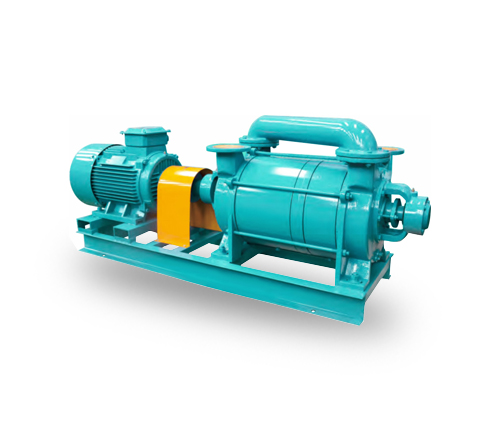
SK Series Single Stages Widely Applications Liquid Ring Vacuum Chenmical Industrial Pump
A liquid ring vacuum pump is a positive-displacement vacuum machine that uses a rotating liquid seal instead of a dry mechanical seal or sliding vane arrangement to compress gas. The working liquid is normally water, although another compatible liquid may be selected when process conditions require it. During operation, the impeller rotates inside a cylindrical casing. The liquid is forced outward by centrifugal action and forms a ring along the casing wall.
The liquid ring does not rotate as a solid component attached to the impeller. Instead, it moves dynamically within the casing while maintaining contact with the casing surface and the impeller vanes. The impeller axis is offset from the geometric center of the casing. As the impeller turns, the liquid ring and the vanes create enclosed spaces that vary in volume. When the chamber volume increases, gas is drawn through the suction port. When the chamber volume decreases, the gas is compressed and discharged.
This process takes place continuously and smoothly. Each revolution produces a sequence of suction and compression events across multiple chambers. The result is a stable vacuum flow with relatively low pulsation compared with some reciprocating technologies. The working liquid also provides cooling and helps absorb heat generated during compression.
The principle is well suited to applications where the gas stream is not perfectly clean or dry. Moisture, vapors, and small quantities of entrained liquid can often be tolerated more effectively than by many dry vacuum pumps. The liquid ring also provides a degree of protection for internal parts because the gas is compressed in contact with the working liquid rather than directly against dry sliding surfaces.
At startup, working liquid enters the casing. As the impeller rotates, centrifugal force moves the liquid toward the internal wall of the casing. The liquid forms a ring that follows the casing circumference. The ring is thicker in some areas and thinner in others because of the eccentric position of the impeller.
The liquid ring functions as a dynamic seal. It closes the spaces between adjacent impeller vanes and separates the suction side from the compression side. Since the sealing medium is liquid, the pump can maintain compression chambers without relying solely on tight dry clearances. This is one reason liquid ring pumps are valued for rugged industrial service.
Gas enters through an inlet port located at the end of the casing. As an impeller chamber passes the inlet region, the chamber volume increases and creates a suction effect. Gas is drawn into the available space between the vanes and the liquid ring. Continued impeller rotation moves the chamber away from the inlet area.
Because of the eccentric relationship between the impeller and casing, the chamber volume begins to decrease. The gas is compressed as the liquid ring moves inward relative to the impeller vane space. When the chamber reaches the discharge area, the compressed gas leaves through the discharge port. This sequence is repeated continuously during operation.
The working liquid has several functions. It creates the seal required for gas compression, removes heat, reduces internal friction at selected interfaces, and helps carry away contaminants that enter with the gas. Depending on the installation arrangement, the liquid may be supplied continuously, partially recirculated, or separated from the exhaust stream and returned to the pump.
A vapor-liquid separator may be installed downstream of the discharge port. The separator removes droplets from the compressed gas and can support the recovery of working liquid. The final arrangement depends on the gas composition, vacuum level, operating temperature, discharge requirements, environmental considerations, and the selected liquid.
Many industrial processes generate water vapor, solvent vapor, condensation, or wet gas. A liquid ring pump is naturally compatible with these conditions because the compression process already uses a liquid seal. Instead of treating moisture as an immediate threat to dry internal surfaces, the pump incorporates liquid into its operating method.
This characteristic is especially useful in food processing, paper production, chemical plants, mining, petroleum operations, and general manufacturing. In these environments, a vacuum system may be exposed to changing humidity, intermittent condensation, or process vapors. The SK Series can therefore offer a more forgiving operating profile than technologies that depend on a consistently dry gas stream.
Industrial gas streams may contain small amounts of dust, vapor, process residue, or liquid droplets. Although proper filtration and separation remain important, a liquid ring pump is often better suited to this type of duty than a highly sensitive dry vacuum device. The working liquid can capture or carry away some contaminants, while the absence of delicate sliding vanes reduces the risk associated with certain forms of contamination.
Users should still evaluate the chemical compatibility and concentration of contaminants before selecting a pump. Abrasive solids, corrosive substances, polymerizing materials, or substances that react with the working liquid may require special design measures. Nevertheless, for many humid and moderately contaminated applications, the liquid ring principle provides a practical balance of performance and durability.
The SK Series is intended for industrial vacuum duties where steady operation and predictable maintenance are important. Its single-stage construction uses a relatively straightforward arrangement of casing, impeller, ports, and working-liquid system. A simpler mechanical layout can help maintenance teams understand the equipment, plan inspections, and replace service parts efficiently.
Continuous operation also benefits from the cooling effect of the working liquid. Gas compression produces heat, and the liquid absorbs part of this heat during the operating cycle. Correct liquid flow, temperature control, and discharge management remain essential, but the liquid ring principle provides an integrated method of supporting thermal stability.
The rotating impeller creates multiple compression events during each revolution. This allows the pump to produce a comparatively smooth vacuum flow. In applications involving suction filtration, vapor removal, drying, degassing, or vacuum transfer, smooth operation can help reduce pressure fluctuations in the connected system.
The complete system may still require a receiver, separator, check valve, filter, condenser, or other accessory depending on the process. However, the basic rotary operating principle is well suited to installations where consistent vacuum is preferred over highly pulsating suction.
Dry vacuum pumps may rely on close-fitting components, sliding vanes, specialized coatings, or carefully controlled clearances. These arrangements can provide excellent performance under the right conditions, but they may be affected by contamination, inadequate lubrication, or inappropriate gas composition.
In a liquid ring pump, the working liquid plays a central role in sealing and compression. This does not eliminate the need for correct maintenance, but it changes the nature of the operating requirements. The user must manage liquid quality, liquid temperature, flow, and compatibility rather than depending entirely on dry internal surfaces. For wet process environments, this can be a significant operational advantage.
The SK Series can be considered for a wide range of general manufacturing and process vacuum duties. Its application profile includes industries where the gas is humid, dirty, condensable, or generated in large volumes. The same fundamental technology can support different processes when correctly sized and integrated with suitable separators, filters, valves, and liquid-management equipment.
This flexibility can simplify procurement for industrial groups that operate multiple types of plants. Instead of selecting unrelated vacuum technologies for every wet or vapor-laden duty, a liquid ring platform may cover a broad part of the application range. Final selection must always be based on required vacuum level, gas flow, gas composition, temperature, working liquid, installation altitude, and duty cycle.
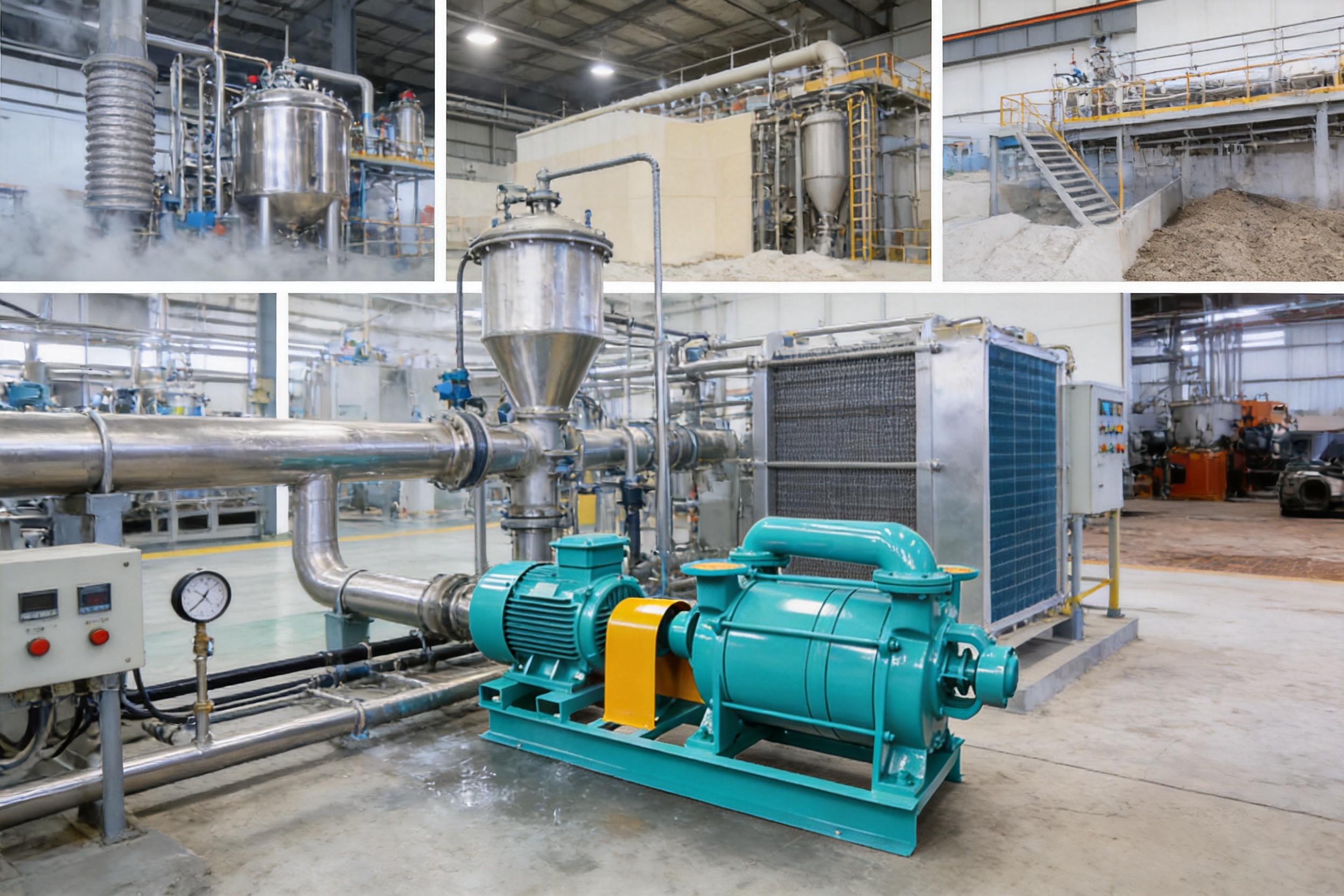
General manufacturing facilities use vacuum systems for material handling, fixture clamping, degassing, drying, packaging, filtration, and equipment evacuation. Conditions can vary significantly from one production line to another. A liquid ring pump is useful when the vacuum stream may contain moisture, oil mist, or intermittent process vapor.
The SK Series can be integrated into centralized or dedicated vacuum systems. A dedicated installation serves one machine or process, while a centralized system may connect several production points through a controlled piping network. In either case, correct pipe sizing and separation equipment are necessary to avoid excessive pressure loss and liquid carryover.
Food-processing applications often involve water, steam, cleaning cycles, condensation, and strict requirements for reliable operation. Vacuum may be used for evaporation, packaging, dehydration, filtration, lifting, or product handling. A liquid ring pump can be attractive because it tolerates wet gas more naturally than many dry systems.
For food-related duties, the selected working liquid, materials, seals, and downstream arrangement must be evaluated according to the relevant plant hygiene and process requirements. The pump should be installed so that cleaning, drainage, inspection, and separation can be carried out effectively.
Paint and coating processes may release solvent vapor, moisture, and fine particulate matter. Vacuum can be used during mixing, filtration, drying, deaeration, and vessel evacuation. A liquid ring system can provide stable vacuum where vapor handling is more important than achieving an extremely deep dry vacuum.
Chemical compatibility is critical in this sector. The working liquid must be selected carefully, and the user should verify whether vapors can dissolve in the liquid, react with it, or change its viscosity. Explosion-risk assessments, ventilation, electrical protection, and process safety procedures must be completed by qualified personnel.
Chemical processes frequently produce condensable vapors and mixtures whose composition changes during production. Liquid ring vacuum pumps are widely considered for distillation support, evaporation, filtration, crystallization, drying, vessel evacuation, and vapor recovery duties.
The SK Series can be considered where the process requires robust vacuum generation and the gas stream is not consistently dry. Material selection should account for corrosion, solvent compatibility, temperature, concentration, and the possibility of crystallization or polymerization. If the process liquid cannot be used as the working liquid, a separate compatible liquid circuit may be required.
Paper production uses vacuum in forming, dewatering, pressing, suction rolls, felt conditioning, and other stages. These duties often involve large volumes of humid air and water vapor. The liquid ring operating principle is well matched to this environment because moisture is expected rather than abnormal.
In a paper plant, energy efficiency and reliable availability are major considerations. The vacuum system should be sized according to actual air leakage, process demand, line speed, operating temperature, and required vacuum. Proper control may include throttling, variable operating strategies, multiple pumps, or staged capacity management.
Brick extrusion and ceramic production can use vacuum to remove trapped air from clay or other forming materials. Removing air improves material consistency and can help reduce defects in the finished product. Dust and moisture are common in these environments, making robust vacuum equipment particularly valuable.
Dust control remains essential. The pump should be protected from excessive abrasive solids through suitable filtration, settling, or separation equipment. Routine inspection of the working liquid and internal passages can help identify abnormal contamination before it affects performance.
Automotive plants and metalworking facilities use vacuum for clamping, lifting, impregnation, machining support, degreasing, drying, and component testing. Coolants, oils, water, and metalworking residues may enter the vacuum stream. A liquid ring pump may offer a durable option when the process requires resistance to wet gas and intermittent liquid carryover.
For machining applications, separators and filters should be selected according to the type of coolant or oil present. The installation should also prevent heavy solids from entering the pump. A well-designed inlet protection system can improve service life and reduce unnecessary maintenance.
Petroleum and oil-and-gas operations may require vacuum for vapor handling, priming, deaeration, recovery, filtration, and process support. Gas composition can vary widely, and the presence of hydrocarbons requires careful attention to material compatibility and safety.
The liquid ring pump should not be selected solely on the basis of nominal capacity. The user must assess vapor pressure, flammability, temperature, hazardous-area classification, seal compatibility, and the required separation or recovery arrangement. Engineering review by qualified process and safety specialists is essential for hydrocarbon service.
Mining operations commonly involve wet processes, slurry handling, filtration, and dewatering. Vacuum can support rotary filters, belt filters, concentrate dewatering, and other separation equipment. The surrounding environment may include dust, moisture, and abrasive particles.
The SK Series may be suitable for the vacuum side of such systems when the gas stream is properly managed. Abrasive solids should be removed before entering the pump whenever possible. The working liquid should be monitored because suspended solids can increase wear, affect sealing behavior, or reduce operating efficiency.
Plastics production may use vacuum for resin drying, extrusion, degassing, vessel evacuation, and material processing. Textile plants may use vacuum for drying, suction, filtration, and equipment handling. Both industries can produce vapor, moisture, or fine particles that influence vacuum equipment selection.
The liquid ring system provides a useful option when a process needs stable vacuum and the gas is not completely dry. The appropriate accessories depend on whether the installation is exposed to lint, plastic dust, solvents, oils, or hot vapor.
Power and utility facilities may use vacuum systems for priming, condenser-related duties, deaeration, drainage, and general plant service. Cement and allied-product facilities may use vacuum in filtration, material handling, drying, and process evacuation. Construction-related systems may require portable or stationary vacuum support for lifting, dewatering, or equipment preparation.
These environments often demand reliable equipment that can operate despite changes in temperature, humidity, and dust levels. The liquid ring principle can be advantageous where process conditions are too wet or variable for a highly specialized dry pump.
The SK Series uses a single-stage liquid ring configuration. A single-stage design is generally associated with a direct and understandable gas-compression path. It can be an effective choice for applications requiring reliable process vacuum without the complexity of multiple compression stages.
The correct single-stage operating range depends on the required vacuum, gas flow, working-liquid temperature, and system pressure. Users should consult the manufacturer’s technical data and selection information for exact performance. A pump should not be operated outside its specified range because unsuitable conditions can increase power consumption, heating, cavitation risk, or mechanical stress.
The impeller contains vanes that divide the space between the impeller and liquid ring into compression chambers. The impeller must be manufactured with accurate geometry and balanced rotating characteristics. Consistent impeller quality is important because imbalance can increase vibration, bearing loading, and noise.
In a professional manufacturing environment, rotating components require controlled machining, inspection, and assembly. Dimensional accuracy and surface condition influence internal clearances, operating stability, and service life. These are areas where systematic production management can provide value beyond the basic pump concept.
The casing provides the internal geometry required to form the liquid ring and guide gas through the suction and discharge paths. End ports support a compact connection arrangement and allow the pump to be integrated into different industrial layouts.
Connection orientation, pipe support, valve selection, and access for maintenance should be considered before installation. The pump should not be used as a structural support for improperly aligned piping. External loads and vibration can affect the casing, seals, couplings, and bearings.
Because the compressed gas can contain working liquid, a separator may be placed at the discharge side. A vapor-liquid separator allows droplets to settle or be removed from the gas stream. Depending on the process, the separated liquid may be returned to the pump, cooled, filtered, treated, or discharged.
Separation equipment is not merely an optional accessory in every installation. Its importance depends on the required gas quality, liquid consumption, environmental rules, and process economics. A properly designed separator can reduce liquid loss, protect downstream equipment, and improve overall system stability.
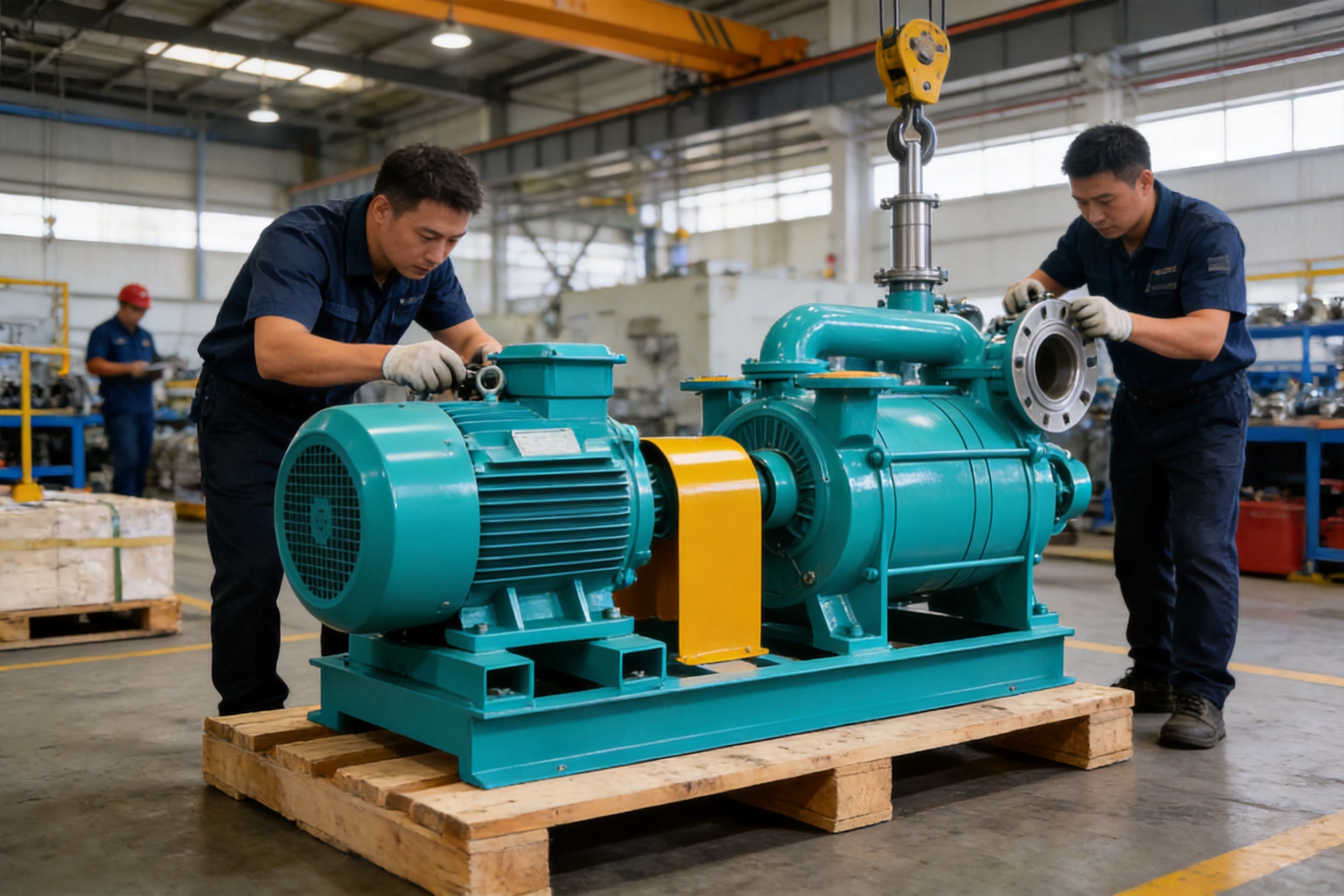
Taizhou Edwin Electric Co., Ltd. was founded in 2008 and operates as an integrated manufacturing enterprise. Its capabilities include independent research and development, mass production, and global export. This combination is important for industrial pump customers because a successful project requires more than a single piece of equipment. It requires product selection, production coordination, documentation, order tracking, delivery planning, and after-sales communication.
Independent research and development allows a manufacturer to improve products according to actual market feedback and application needs. Pump development involves fluid mechanics, motor matching, mechanical structure, materials, sealing, vibration, electrical control, and installation requirements. Experience across several pump categories can help an engineering team understand how different operating conditions affect pump performance.
Edwin Pump’s wider product portfolio includes deep well pumps, submersible pumps, domestic booster pumps, circulation pumps, solar water pumps, intelligent booster pumps, and other water-related equipment. Although the SK Series is a liquid ring vacuum pump, this broader background demonstrates the company’s involvement in rotating equipment, water movement, pressure control, and pump-system integration.
Industrial customers often require repeatable quality, consistent delivery, and the ability to support different order quantities. Mass production capability helps a manufacturer organize raw-material purchasing, component preparation, machining, assembly, testing, packaging, and shipment in a coordinated manner.
Repeatable production is especially important for distributors and engineering contractors. When the same pump is reordered, dimensional consistency and predictable documentation reduce the risk of installation changes. Production planning can also help support project schedules when several pumps are needed for a plant expansion or replacement program.
Liquid ring pumps require correct alignment between the impeller, casing, shaft, bearings, seals, ports, and working-liquid connections. Assembly quality affects vibration, leakage, noise, starting behavior, and operating stability. A structured assembly process should include inspection of mating surfaces, verification of rotating clearances, fastening control, seal installation, and functional checks.
Before a pump enters service, the buyer should request the applicable factory test information and confirm the test conditions. Performance can vary according to suction pressure, discharge pressure, gas composition, liquid temperature, and liquid flow. Clear communication between the manufacturer and user is therefore important when comparing test data with actual plant conditions.
Edwin Pump has developed a professional structure for procurement planning, order tracking, cross-border delivery, and foreign-trade services through associated companies established in 2012. This supports customers who require international sourcing and coordinated logistics.
Export experience can be valuable when a project involves commercial documents, packaging requirements, shipping schedules, spare-parts planning, and communication across different time zones. Industrial buyers should still confirm the exact scope of documentation, warranty terms, spare-parts availability, and technical support before placing an order.
The company’s product range extends beyond one pump type. It includes water pumps, solar pumps, intelligent booster pumps, circulation pumps, submersible pumps, and pump accessories. For contractors, wholesalers, and industrial procurement teams, a broad product portfolio can simplify supplier management.
A one-stop purchasing approach may reduce the number of separate suppliers involved in a project. It can also make it easier to coordinate packaging, shipment, technical communication, and replacement-part procurement. The SK Series can therefore be considered within a broader equipment-sourcing program when the customer also needs other pump products.
No vacuum pump is ideal for every duty. The main advantage of the SK Series is not that it replaces all other technologies, but that its liquid ring operating principle provides a strong solution for specific industrial conditions. The following comparison should be treated as a general selection guide rather than a substitute for application engineering.
| Technology | Typical Strength | Potential Limitation in Wet or Dirty Service | Position of the SK Series |
|---|---|---|---|
| Liquid ring vacuum pump | Handles humid gas, condensable vapor, and certain liquid carryover; suitable for continuous industrial service | Requires working-liquid management and may consume water or another compatible liquid | Strong candidate for wet, humid, dirty, and high-capacity process vacuum duties |
| Oil-sealed rotary vane pump | Can achieve relatively deep vacuum in suitable applications | Oil contamination, vapor handling, and liquid carryover may require careful control | More suitable when robust wet-gas handling is more important than very deep dry vacuum |
| Dry claw or screw pump | Oil-free gas path and potential energy advantages in selected duties | May require protection from condensation, solids, and sticky process materials | Useful where a liquid-sealed process and vapor tolerance are priorities |
| Roots vacuum booster | High pumping speed and strong performance in combination systems | Usually requires a backing pump and may be sensitive to unsuitable operating conditions | Can serve as an alternative or complement depending on the required vacuum range |
| Reciprocating vacuum pump | Can provide strong vacuum in specific operating ranges | More mechanical reciprocating parts and potentially higher pulsation | Offers smoother rotary operation for many continuous process duties |
The SK Series is particularly attractive when process gas contains moisture or vapor and when the plant values simple, durable, and continuously operating equipment. A competitor may be preferable when the application requires oil-free operation with no working liquid, exceptionally deep vacuum, extremely low utility consumption, or special gas-handling characteristics. The correct decision depends on total lifecycle performance rather than purchase price alone.
The first selection parameter is the vacuum level required at the process connection. Vacuum is often expressed as absolute pressure, gauge pressure, or percentage vacuum. These values should not be confused. The manufacturer should receive the required operating pressure in a clear and standardized form.
It is also important to distinguish between ultimate vacuum and normal working vacuum. A process may need a certain vacuum during most of its operating cycle but a different level during startup, evacuation, or shutdown. The pump should be selected for the real operating point rather than a single idealized value.
Gas flow may be expressed in cubic meters per hour, cubic feet per minute, or another unit. The specified flow should be stated at the relevant suction pressure and temperature. A nominal flow at atmospheric pressure is not directly equivalent to the flow at deep vacuum.
System leakage, pipe volume, vessel volume, product vapor load, air infiltration, and safety margin all affect the required capacity. Oversizing can increase energy and working-liquid consumption, while undersizing may prevent the process from reaching its target vacuum. A complete system calculation is therefore recommended.
Gas composition is critical in chemical, paint, petroleum, plastics, and pharmaceutical-related environments. The user should identify water vapor, solvents, corrosive gases, combustible gases, dust, oil mist, and any substances that may react with the working liquid.
Gas temperature also affects density, vapor pressure, material compatibility, and condensation behavior. Hot gas may require cooling or pre-condensation before entering the pump. If vapor condenses inside the inlet line, the system must be designed to manage the resulting liquid load.
Water is commonly used in liquid ring pumps, but it is not automatically suitable for every process. The working liquid should be compatible with the gas, pump materials, seals, local regulations, and discharge system. Its vapor pressure influences the achievable vacuum, especially at elevated temperature.
Users should establish a method for checking liquid temperature, flow, clarity, chemical condition, and replenishment. In recirculation systems, cooling and filtration may be necessary. In once-through systems, water quality and discharge management should be reviewed.
The installation location should provide adequate ventilation, drainage, access, and protection from excessive dust or flooding. The foundation must support the pump and motor while limiting vibration. Electrical equipment should be selected according to the local environment and applicable safety classification.
In outdoor or corrosive environments, enclosure protection and material selection become more important. The buyer should also consider ambient temperature, altitude, seasonal conditions, and the availability of cooling water or other utilities.
The pump should be mounted on a stable foundation or correctly designed base. The motor and pump coupling must be aligned according to the manufacturer’s instructions. Misalignment can cause vibration, premature bearing wear, seal damage, and coupling failure.
After installation, the shaft should rotate freely by hand where safe and practical. Guards must be installed before operation. Bolts, pipe supports, electrical connections, and safety devices should be checked before commissioning.
The suction line should be as short and direct as practical. Excessive elbows, undersized pipe, sharp restrictions, and poorly positioned valves can increase pressure loss and reduce pump performance. The pipe should be independently supported so that its weight does not load the pump casing.
Inlet filtration or separation may be required when the gas contains dust, fibers, solids, or liquid droplets. The filter must be sized to avoid excessive pressure drop and should be accessible for cleaning. A drain point can help remove accumulated condensate from low sections of the piping.
The discharge line should be designed for the compressed gas and any working liquid carried from the pump. A vapor-liquid separator may be installed close to the discharge connection. The separator should have suitable capacity, drainage, inspection access, and corrosion resistance.
Backpressure must be controlled because excessive discharge pressure can affect the pump’s ability to compress gas and may increase power consumption. A check valve or isolation arrangement may be required to prevent reverse flow when the pump is stopped.
The working-liquid circuit should provide the flow required for stable operation. The system may include a supply valve, flow control device, strainer, cooler, separator, level control, and drain. The exact configuration depends on whether the liquid is used once and discharged or continuously recirculated.
Insufficient liquid can reduce sealing and cooling, while excessive liquid may increase power demand or cause unwanted carryover. The user should follow the manufacturer’s specified operating range and monitor the system during commissioning.
Before startup, confirm that the pump contains the required working liquid and that all suction and discharge connections are correctly arranged. Check the motor rotation direction, electrical protection, coupling guard, lubrication points, valve positions, and separator condition.
The first startup should be observed carefully. Record vibration, sound, current, liquid temperature, suction pressure, discharge pressure, and any visible leakage. Sudden noise, overheating, unstable vacuum, or abnormal current should be investigated immediately rather than ignored.
Routine inspection should include the working-liquid level or flow, liquid temperature, pump vibration, bearing condition, seal leakage, motor current, suction performance, discharge condition, and separator drainage. Trends are often more useful than isolated readings. A gradual increase in vibration or power may indicate wear, contamination, misalignment, or an operating condition outside the intended range.
Filters and strainers should be cleaned according to the actual contamination level. In dusty or fiber-producing industries, inspection may need to occur more frequently than in clean applications. The separator should be drained and inspected so that accumulated liquid does not block the discharge path.
Working-liquid quality has a direct effect on performance. Solids, oil, corrosive chemicals, biological growth, and excessive hardness may affect internal surfaces or reduce heat-transfer capability. Recirculating systems should include a suitable treatment and replacement plan.
If the process gas contains soluble substances, the liquid composition may change over time. A liquid that was initially compatible may become corrosive or unsuitable after absorbing process contaminants. Regular sampling may be appropriate for demanding chemical or petroleum applications.
Mechanical seals and bearings are wear components that require inspection over the service life of the pump. Leakage should be evaluated according to the manufacturer’s allowable limits. A small change may be normal during break-in, while continuous or increasing leakage may indicate the need for service.
Bearings should be lubricated using the specified method and lubricant. Over-lubrication can be as harmful as under-lubrication. Maintenance personnel should follow a documented schedule and use genuine or correctly specified replacement parts.
Industrial users can reduce downtime by keeping critical spare parts available. Typical items may include seals, gaskets, bearings, couplings, filters, valves, and other wear components. The correct spare-parts list depends on operating hours, process severity, plant criticality, and expected delivery time.
Because Taizhou Edwin Electric Co., Ltd. serves global customers and provides export-oriented order coordination, buyers can discuss spare-parts planning during the initial procurement stage. This is preferable to waiting until an unexpected shutdown occurs.
Purchase price is only one part of the cost of a vacuum system. Working-liquid consumption, electricity, cooling requirements, maintenance, spare parts, downtime, and disposal costs all contribute to lifecycle expense. The SK Series should be evaluated at the actual operating point, not merely by comparing catalog price.
Energy consumption depends on gas load, suction pressure, discharge pressure, impeller speed, liquid temperature, liquid flow, motor efficiency, and system losses. A properly sized pump normally performs better than a heavily oversized pump operated far from its design point. Multiple-pump systems may improve efficiency when process demand varies widely.
Water consumption can be reduced through recirculation, cooling, filtration, and separator recovery when appropriate. However, a recirculation system introduces additional equipment and maintenance. The best arrangement depends on local water cost, discharge rules, gas contamination, cooling availability, and process requirements.
Reliability is also an economic factor. A pump that tolerates wet and dirty gas may reduce unplanned cleaning or replacement compared with a technology that requires extensive upstream drying and filtration. The overall system should therefore be assessed according to availability, maintainability, and process compatibility.
The SK Series combines the established liquid ring compression principle with a single-stage industrial configuration. Its principal value lies in dependable operation under conditions that can challenge dry vacuum technologies. Humidity, condensable vapor, moderate liquid carryover, and variable process conditions are common reasons to consider this type of pump.
The series is also supported by a manufacturer with experience in pump development, production, and international supply. Edwin Pump’s product portfolio demonstrates involvement in multiple pump categories, while its company structure includes research and development, mass production, export coordination, and procurement services.
For customers buying several types of pumps, this broader capability can simplify communication and sourcing. Deep well pumps, submersible pumps, booster pumps, circulation pumps, solar pumps, intelligent pumps, accessories, and industrial vacuum equipment may be coordinated through an established supplier relationship. This can be especially useful for contractors, distributors, agricultural projects, municipal projects, mining operations, HVAC installations, and industrial plants.
At the same time, responsible selection requires technical honesty. The SK Series is not automatically the best choice for every vacuum application. Extremely deep vacuum, strict oil-free requirements, aggressive chemicals, hazardous gases, very high temperatures, or abrasive solids may require a special configuration or another technology. The manufacturer should receive complete process information before confirming the model and accessories.
Document the required vacuum range, gas flow, gas composition, temperature, operating hours, startup frequency, and process changes. Include information about moisture, condensable vapor, dust, oil, solvents, corrosive substances, and combustible gases.
Identify the available electrical supply, cooling water, working liquid, drainage, ventilation, and control signals. Confirm voltage, frequency, motor requirements, installation location, ambient temperature, and hazardous-area needs.
Determine whether the installation needs a vapor-liquid separator, inlet filter, condenser, cooler, check valve, isolation valve, vacuum gauge, flow control, liquid tank, or recirculation system. Accessories should be selected as part of the complete vacuum package rather than added without system analysis.
Request the relevant technical data, dimensional drawings, connection information, materials, operating instructions, test records, packing details, warranty conditions, and recommended spare-parts list. Confirm the meaning of all performance values and the conditions under which they were measured.
For international projects, confirm production lead time, packaging, shipping terms, customs documents, installation support, commissioning assistance, and replacement-part availability. Edwin Pump’s export and procurement-service structure can support this coordination, but the project responsibilities should be agreed in writing before the order is finalized.
The SK Series is a single-stage liquid ring vacuum pump designed to remove and compress gas in industrial and process applications. It creates vacuum by rotating a vaned impeller inside a cylindrical casing while a working liquid forms a dynamic sealing ring.
The pump uses liquid as part of its sealing and compression process. As a result, moisture and condensable vapor are generally more compatible with its operating principle than with many dry vacuum technologies. The exact tolerance depends on gas composition, temperature, liquid selection, and system design.
It can be considered for moderately dirty or contaminated gas, particularly where moisture and liquid carryover are present. However, abrasive solids, heavy dust, sticky materials, and corrosive contaminants should be controlled with suitable filters, separators, or pre-treatment equipment.
A liquid ring pump requires a working liquid. Water is commonly used, but another compatible liquid may be necessary for certain chemical or process conditions. The liquid may be supplied continuously or recirculated through a separator and cooling arrangement.
Compressed gas leaving a liquid ring pump may contain droplets of working liquid. A vapor-liquid separator removes these droplets, protects downstream equipment, reduces liquid loss, and may allow the separated liquid to be recovered or returned to the pump.
It may be suitable for many chemical duties, especially those involving humid or condensable gas. Chemical compatibility must be confirmed before selection. The gas, working liquid, casing, impeller, seals, gaskets, and discharge system must all be evaluated for corrosion and reaction risks.
Provide the required vacuum level, gas flow, gas composition, temperature, working-liquid type and temperature, operating hours, installation altitude, electrical supply, suction and discharge conditions, and any hazardous or corrosive characteristics.
The liquid ring principle is well suited to continuous industrial service when the pump is correctly sized and supplied with the required working liquid. Continuous operation still requires appropriate cooling, lubrication, alignment, filtration, separation, and routine inspection.
Maintain correct liquid quality and flow, prevent excessive solids from entering, keep suction and discharge piping clear, check alignment, inspect seals and bearings, monitor vibration and temperature, and use recommended spare parts. Early attention to abnormal noise, leakage, or performance changes can prevent major failures.
Potential industries include general manufacturing, food processing, paint, chemical production, paper, brick extrusion, automotive, metalworking, petroleum, mining, oil and gas, plastics, textiles, power and utilities, cement, and related industrial sectors.
Taizhou Edwin Electric Co., Ltd. was founded in 2008 and operates as an integrated enterprise covering independent research and development, mass production, and global export. The company also provides procurement planning, order tracking, cross-border delivery, and foreign-trade support through its related business structure.
Yes. The company’s wider product lines include deep well pumps, submersible pumps, domestic booster pumps, circulation pumps, solar water pumps, intelligent booster pumps, pump accessories, and other water-related products. This can support customers seeking broader pump procurement.
No. A liquid ring pump is strongest in wet, humid, dirty, condensable, and high-capacity duties. Applications requiring exceptionally deep vacuum, completely dry operation, special hazardous-gas certification, or highly aggressive chemical resistance may require a different technology or a specially engineered configuration.
The SK Series Single-Stage Liquid Ring Vacuum Pump is a robust option for industrial users who need reliable vacuum generation in humid, dirty, vapor-laden, or high-capacity environments. Its operating principle is based on a rotating vaned impeller and a dynamic liquid ring formed inside a cylindrical casing. The eccentric arrangement creates changing compression chambers that continuously draw in, compress, and discharge gas.
Compared with many dry vacuum technologies, the SK Series offers a practical advantage when process gas contains moisture, condensable vapor, or limited liquid carryover. It provides smooth rotary operation, integrated cooling through the working liquid, a relatively straightforward mechanical arrangement, and broad application potential across heavy industries.
The pump’s effectiveness depends on correct engineering. Vacuum level, flow, gas composition, temperature, working-liquid quality, separator design, piping, filtration, and maintenance all influence final performance. Buyers should therefore select the complete system rather than evaluating the pump in isolation.
Taizhou Edwin Electric Co., Ltd. supports the product with experience in independent research and development, mass production, global export, and one-stop pump procurement. Founded in 2008, the company has expanded its portfolio to include several categories of water and intelligent pump equipment, while continuing to serve industrial, agricultural, municipal, construction, mining, HVAC, and household water-supply markets.
For chemical plants, food processors, paper mills, mining operations, petroleum facilities, metalworking plants, utilities, and general manufacturers, the SK Series can provide a dependable foundation for a well-designed vacuum system. When matched with appropriate accessories and maintained under the recommended conditions, it offers a durable and flexible solution for demanding process applications.
1. Manufacturer-provided product description for the SK Series Single-Stage Liquid Ring Vacuum Pump.
2. Manufacturer-provided application information covering general manufacturing, food processing, paint, chemical, paper, brick extrusion, automotive, metalworking, petroleum, mining, oil and gas, plastics, textile, power, cement, and utility industries.
3. Manufacturer-provided company information for Taizhou Edwin Electric Co., Ltd., including company history, product development, manufacturing, export, and procurement services.
4. General industrial principles of liquid ring vacuum pump operation, including impeller rotation, liquid-ring formation, gas compression, working-liquid management, and vapor-liquid separation.
5. General industrial guidance for pump selection, installation, commissioning, maintenance, process compatibility, and lifecycle evaluation.
edwina@edwin-pump.com
+86-13586290903 (WhatsApp)
Xuri Gongliang Cutting Tool Entrepreneurship Park, Wenqiao Town, Wenling City, Taizhou City, Zhejiang Province, China

High Performance Smart Pump Factory


 English