
edwina@edwin-pump.com

View All Products
en
Wastewater management requires equipment that can operate reliably in difficult environments, handle contaminated liquids, and continue performing under demanding working conditions. The Submersible Sewage Pump VB is designed for drainage and sewage-transfer duties in factories, construction sites, commercial facilities, municipal treatment systems, residential drainage stations, methane pools, and rural irrigation applications. Its submersible configuration allows the pump to operate directly inside the liquid, reducing the need for complicated suction arrangements and helping simplify installation in pits, tanks, and collection wells.
Developed for practical wastewater drainage, the VB series combines a compact submerged structure with a copper-wound motor, built-in thermal protection, stainless steel shaft construction, Class B insulation, and IPX8 protection. These features are intended to improve operational safety, support dependable service in wet environments, and reduce the risks commonly associated with motor overheating and water ingress.
As a product manufactured by Taizhou Edwin Electric Co., Ltd., the VB sewage pump benefits from the company’s experience in pump research, production, export, and application-oriented product development. Edwin Pump operates as an integrated manufacturing enterprise with capabilities covering independent research and development, mass production, procurement coordination, order management, and international delivery. This combination allows the product to serve not only individual replacement needs but also project-based purchasing and long-term industrial supply requirements.
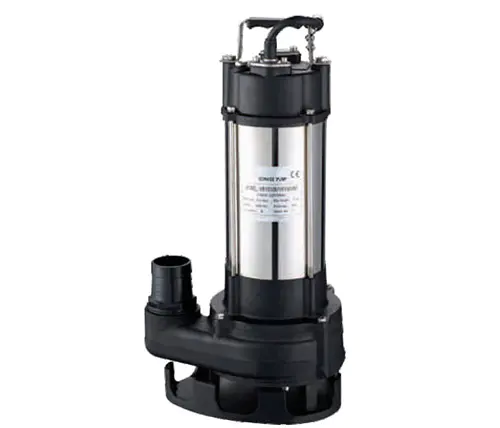
SUBMERSIBLE SEWAGE PUMP VB
Sewage and wastewater drainage systems are essential in almost every modern building, industrial facility, construction project, and municipal infrastructure network. Wastewater can contain suspended particles, organic matter, and other contaminants that make conventional clean-water pumping equipment unsuitable. A dedicated sewage pump must be designed to work in collection pits, drainage chambers, treatment tanks, and other locations where the pump is surrounded by liquid.
The main purpose of the Submersible Sewage Pump VB is to remove wastewater from a lower level and transfer it to a drainage line, treatment system, storage tank, or discharge point. Because the pump is installed below the liquid surface, it does not need to lift water through a long suction pipe before operation. This arrangement can help reduce priming difficulties and make the overall pumping installation more straightforward.
Submersible operation also provides a practical solution where floor space is limited. A conventional surface-mounted pump often requires a dry equipment room, suction piping, a base, valves, and additional structural support. In contrast, a submersible sewage pump can be positioned in a collection pit or tank, with the discharge pipe and electrical cable routed toward the control or discharge point.
The VB model is suitable for applications that require drainage rather than high-pressure clean-water delivery. Its working range includes wastewater drainage in factories, construction sites, commercial facilities, municipal sewage treatment plants, residential drainage stations, methane pools, and field irrigation in rural areas.
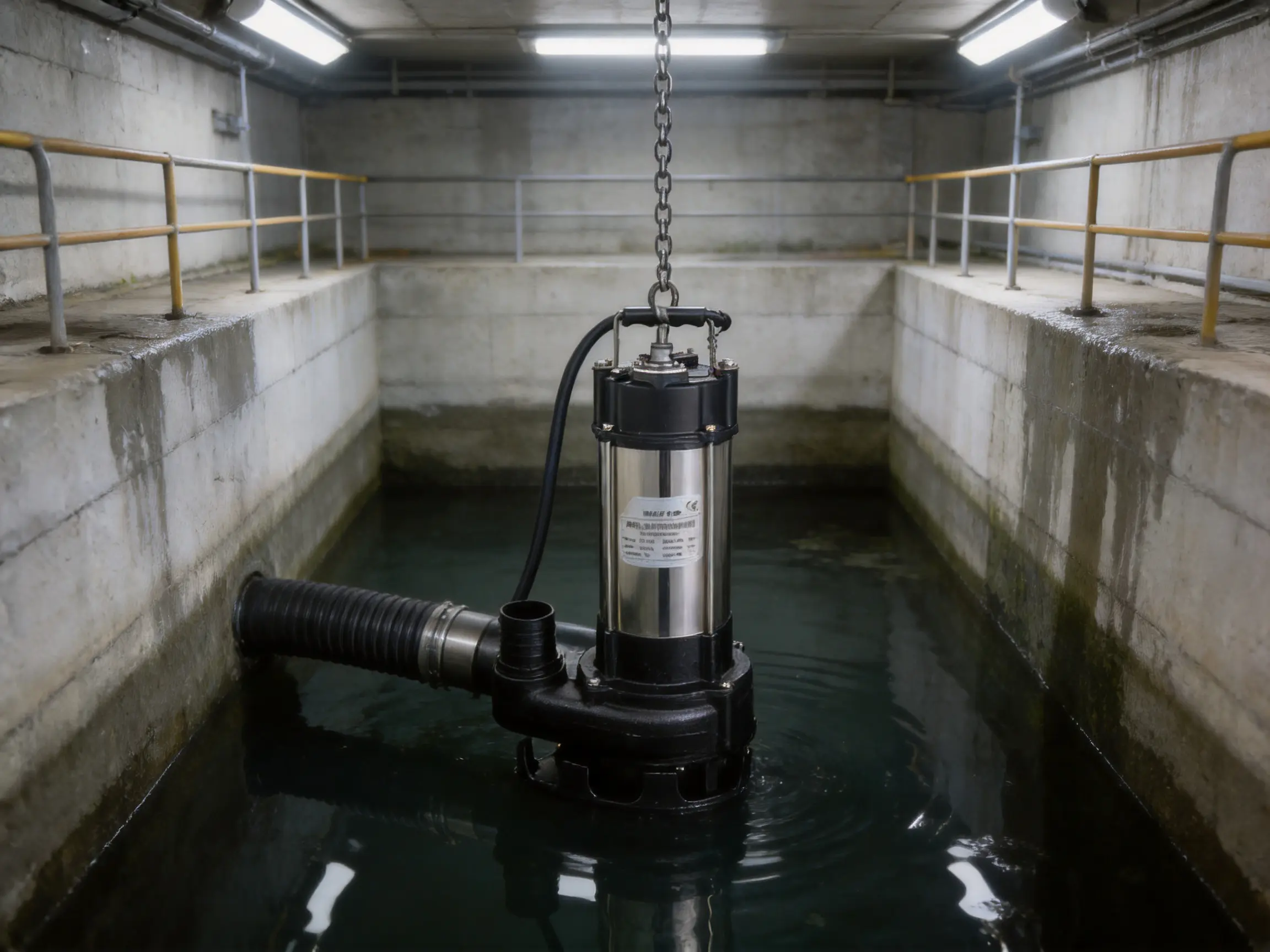
The Submersible Sewage Pump VB is built around a motor-and-pump assembly designed to work while immersed. The pump body is placed in the wastewater, while the motor drives the hydraulic components that move liquid through the discharge outlet. This direct submerged arrangement helps the pump draw liquid from the surrounding collection area without relying on a separate suction lift system.
The maximum immersion depth is specified as 5 meters. This rating provides a useful operating range for many drainage pits, collection tanks, construction excavations, and residential sewage chambers. Correct installation should always consider the actual water level, cable length, discharge-pipe arrangement, pump support, and local electrical requirements.
The maximum liquid temperature is 40°C, equivalent to 104°F. This makes the VB appropriate for ordinary wastewater and drainage liquids within a moderate temperature range. It is not intended for high-temperature industrial fluids unless the application has been specifically reviewed and approved by a qualified technical representative.
The pump is designed for liquids with a pH value from 5 to 9. This range covers many common domestic, commercial, municipal, and agricultural wastewater conditions. However, the pH value should be evaluated together with the liquid’s chemical composition. A liquid can fall within a general pH range and still contain substances that may affect elastomers, metals, insulation, or other wetted components.
The listed liquid kinematic viscosity range is approximately 7 × 10⁻⁶ to 23 × 10⁻⁶ square meters per second, based on the technical information supplied for the product. The maximum liquid density is specified as 1.2 × 10³ kilograms per cubic meter. These values help define the type of liquid the pump can handle while maintaining predictable hydraulic and motor performance.
| Item | Specification | Practical Significance |
|---|---|---|
| Product type | Submersible sewage pump | Designed for submerged wastewater and drainage duties |
| Maximum immersion depth | 5 meters | Suitable for many pits, tanks, and drainage chambers |
| Maximum liquid temperature | 40°C / 104°F | Appropriate for moderate-temperature wastewater |
| Liquid pH range | pH 5–9 | Covers many common drainage and sewage conditions |
| Maximum liquid density | 1.2 × 10³ kg/m³ | Defines the intended liquid-density operating range |
| Motor winding | Copper | Supports efficient electrical conduction and dependable motor operation |
| Thermal protection | Built-in thermal protector | Helps reduce the risk of motor damage caused by overheating |
| Shaft material | Stainless steel welded shaft | Provides a corrosion-conscious shaft solution for wet service |
| Insulation class | Class B | Provides defined thermal insulation performance for the motor winding |
| Protection class | IPX8 | Supports continuous immersion under specified conditions |
One of the most important advantages of a submerged sewage pump is the simplified installation arrangement. The pump is placed directly in the collection liquid, which can reduce the length and complexity of suction piping. This can be especially valuable on construction sites, in residential drainage pits, and in municipal pumping stations where equipment-room space is restricted.
A simpler hydraulic arrangement can also help reduce the number of installation points that require inspection. Long suction lines may introduce additional joints, bends, air-leak risks, and alignment requirements. By operating in the liquid, the VB pump can support a more direct route from the collection point to the discharge line.
Surface-mounted pumps usually need to be correctly primed before operation. If air enters the suction line or the suction pipe is not properly sealed, the pump may fail to draw liquid. A submersible pump is naturally surrounded by the pumped liquid, so the normal operating arrangement avoids many of the priming challenges associated with surface suction systems.
This feature can be useful in applications where the liquid level changes frequently. When correctly positioned and installed, the pump can begin drainage as the collection pit fills, subject to the control method and minimum operating level required by the installation.
The VB design places the motor and pump assembly inside the drainage area, leaving less equipment above ground. This can help preserve valuable space in commercial buildings, factories, residential facilities, and small municipal stations. It can also reduce the need for a dedicated pump room in applications where a submerged installation is acceptable.
Wastewater drainage areas are often humid, dirty, and exposed to splashing or complete immersion. The IPX8 protection class is an important design characteristic for a pump intended to operate underwater. It indicates that the product is designed for continuous immersion under conditions defined by the manufacturer and applicable testing requirements.
IPX8 protection does not eliminate the need for correct installation. The cable, electrical connection, control equipment, grounding system, and discharge connection must all be selected and installed in accordance with local regulations and the operating environment. Nevertheless, the protection rating gives the pump a strong foundation for submerged wastewater service.
The VB pump uses copper motor winding. Copper is widely used in electric motors because of its strong electrical conductivity and established performance in industrial equipment. Efficient conduction can help reduce electrical losses within the winding and support stable motor operation when the pump is correctly matched to the power supply and hydraulic duty.
In a sewage pump, motor reliability is particularly important because the motor is enclosed within a compact assembly and operates in a demanding environment. Quality winding practice, correct insulation, precise assembly, and suitable thermal protection all contribute to the long-term performance of the motor.
The motor includes a built-in thermal protector. This component is intended to help protect the motor if the winding temperature rises excessively. Overheating can occur because of overload, abnormal voltage, blocked hydraulic passages, insufficient cooling, frequent starting, or operation outside the intended working range.
Thermal protection provides an additional layer of safety, but it should not be considered a substitute for proper system design. The pump should still be connected to correctly selected electrical protection, and the cause of any thermal trip should be investigated before the pump is returned to service. Repeated overheating may indicate an incorrectly selected pump, an obstruction, a damaged cable, inadequate voltage, or an operating condition beyond the stated product limits.
The pump uses a stainless steel welded shaft. Because the shaft transfers motor torque to the pumping components, its mechanical integrity is essential. Stainless steel is a practical material choice for wet environments because it offers greater resistance to corrosion than many ordinary carbon-steel alternatives.
The welded shaft construction is intended to provide a robust connection within the rotating assembly. Proper shaft balance, bearing support, sealing, and assembly accuracy remain important to reliable performance. A well-maintained rotating assembly can help limit vibration and reduce unnecessary stress on bearings, seals, and motor components.
The motor has Class B insulation. Insulation class defines the thermal capability of the winding insulation system. Class B insulation is widely used in electrical machinery and provides a recognized temperature capability for the motor winding under specified operating conditions.
Actual motor life depends on more than insulation class. Excessive heat, repeated overload, moisture penetration, poor voltage quality, and frequent starts can all shorten service life. The combination of Class B insulation and built-in thermal protection supports a more controlled operating environment when the pump is used within its design range.
IPX8 protection is particularly relevant to a submersible product. The rating indicates protection for continuous immersion in water under manufacturer-defined conditions. This is a central requirement for equipment that operates inside a wastewater pit or tank.
Users should remember that the protection rating applies to the pump assembly as tested. Installation personnel must protect the electrical connection from moisture, prevent damage to the cable, maintain proper grounding, and avoid opening sealed sections unnecessarily. Routine inspection should include the cable entry, external housing, lifting arrangement, and discharge connection.
Factories frequently generate wastewater during cleaning, processing, equipment maintenance, and general site operation. The VB pump can be used in drainage pits and collection tanks where wastewater must be moved toward a treatment plant, sewer connection, or storage system.
Industrial users should assess the liquid carefully before installation. The stated pH, temperature, viscosity, and density limits must be respected. If the liquid contains aggressive chemicals, abrasive solids, unusual fibers, flammable vapors, or high concentrations of suspended material, a technical review is recommended before selecting the pump.
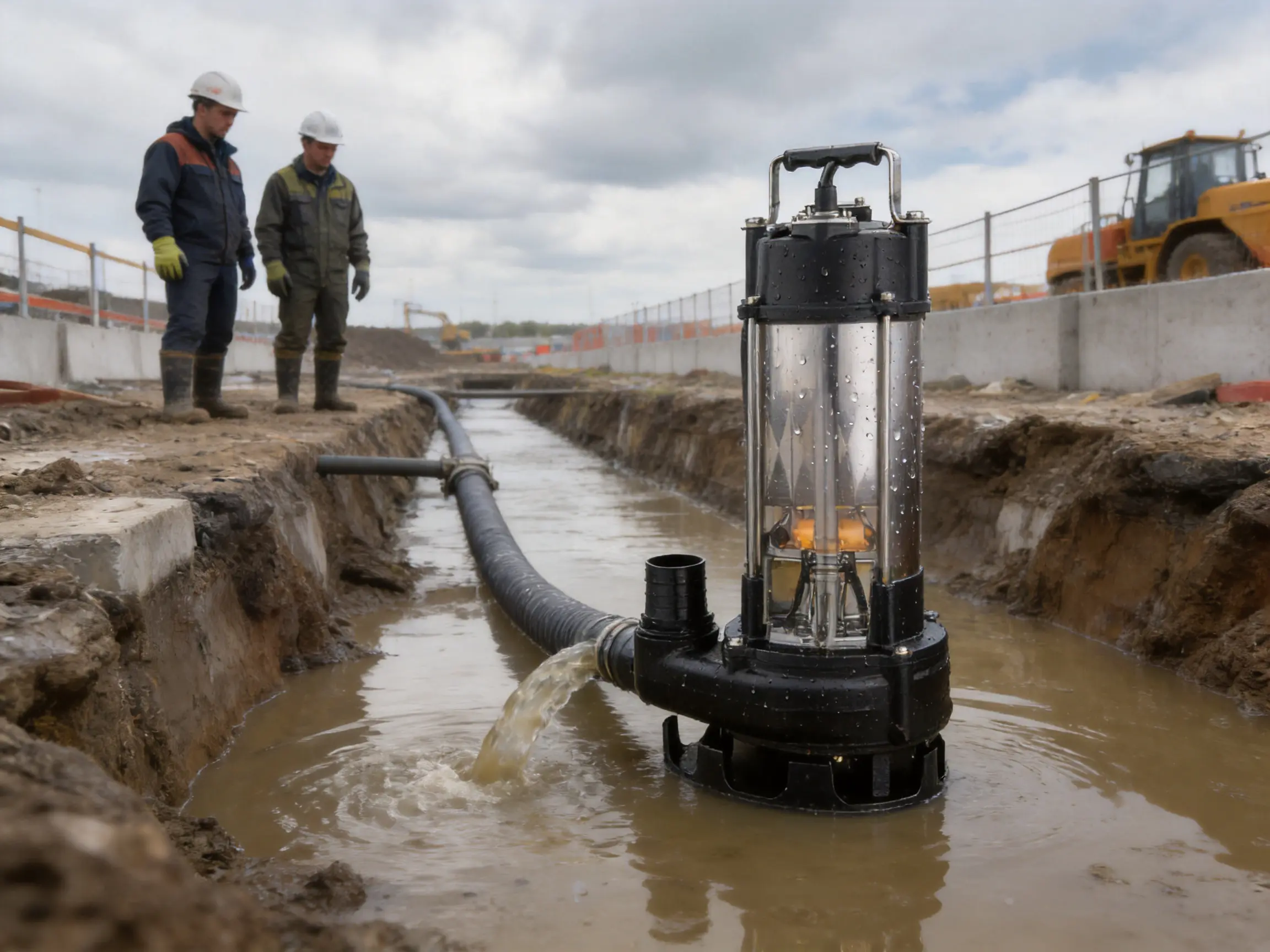
Construction sites often experience rainwater accumulation, groundwater seepage, foundation-pit flooding, and temporary drainage requirements. A submersible pump can be deployed in a low area and connected to a temporary discharge route. Its submerged design is helpful when there is no permanent pump room or fixed drainage infrastructure.
Construction conditions can be harsh, so the pump should be protected from severe impact, excessive sediment, and cable damage. The installation should also ensure that workers cannot accidentally contact exposed electrical components and that the pump can be safely removed for cleaning or inspection.
Commercial buildings, warehouses, restaurants, service facilities, and office complexes may require drainage from underground areas, utility rooms, parking areas, or sewage collection chambers. The VB pump can support these drainage duties where the liquid characteristics remain within the specified limits.
Commercial facility operators often value compact equipment and straightforward maintenance. A pump that can be installed inside a collection pit may help reduce the footprint of the mechanical room. Proper access should still be provided so that the unit can be lifted, inspected, and cleaned without unnecessary disruption to building operations.
Municipal sewage treatment plants contain multiple pumping stages, including collection, transfer, equalization, drainage, and sludge-related handling. The VB pump is applicable to drainage stations and selected wastewater-transfer duties within municipal systems, subject to the characteristics of the liquid and the required flow and head.
Municipal users typically need consistent documentation, repeatable quality, dependable supply, and responsive technical communication. These requirements align with the capabilities of an established manufacturer that combines production with export services and order coordination.
Residential quarters may use collection pits or sewage stations when gravity drainage is not possible. This can occur in basements, low-lying buildings, remote properties, and developments located below the public sewer level. The VB pump can be used to transfer wastewater from these lower areas to the main drainage network.
In residential applications, noise, safety, maintenance access, and automatic control are important considerations. The pump should be installed with suitable control equipment, level detection, check valves, isolation arrangements, and alarm functions where required by the system design.
The supplied application information includes methane pools and field irrigation in the countryside. In these applications, the liquid may need to be moved from a collection or storage area to a treatment, drainage, or irrigation location. The pump’s submerged design can be useful where the source liquid is held in a tank, pit, or pool.
Special care is necessary in methane-related environments. The complete electrical installation must be evaluated for the presence of combustible gases, and users must follow applicable safety regulations. The standard pump should not be assumed to be suitable for hazardous or explosive atmospheres unless the required approvals and protections have been explicitly confirmed.
When comparing sewage pumps, buyers should evaluate more than purchase price. The most useful comparison considers installation complexity, protection level, motor construction, application range, supplier capability, service support, and the consistency of future supply. The VB pump presents several practical advantages within this broader evaluation.
The VB is designed as a submersible sewage pump rather than a general clean-water surface pump. This distinction matters because wastewater applications require equipment suited to wet, enclosed, and contaminated environments. Compared with an unsuitable surface pump, the VB format can reduce priming concerns and provide a more direct installation solution.
IPX8 protection and the submerged motor arrangement distinguish the pump from equipment intended only for dry installation. The product is designed to remain in the liquid within its rated immersion conditions. This supports use in pits and tanks where ordinary surface motors would require extensive environmental protection.
The combination of a copper winding, built-in thermal protector, Class B insulation, and stainless steel shaft provides a balanced motor package for demanding drainage work. While no pump is immune to misuse or poor installation, these features help address common causes of failure such as overheating, corrosion exposure, and mechanical stress.
The same product family can serve industrial, commercial, municipal, residential, construction, and agricultural drainage needs. This flexibility can simplify procurement for distributors and project contractors that support multiple types of customers. It also allows users to standardize selected pump solutions across different locations when the operating conditions are similar.
A product’s long-term value depends partly on the supplier behind it. Taizhou Edwin Electric Co., Ltd. was founded in 2008 and has developed an integrated operation covering research and development, production, and global export. The company’s related trading and industrial-service entities support procurement planning, order tracking, cross-border delivery, and foreign-trade services.
This structure can provide an advantage over suppliers that only resell standard products without direct control over production. Manufacturer involvement may support better communication regarding specifications, packaging, production scheduling, repeat orders, and project requirements. For importers and distributors, coordinated export support can be as important as the pump itself.
The manufacturing process behind a submersible sewage pump has a direct effect on reliability. A pump must be assembled with accurate mechanical alignment, consistent electrical winding, dependable sealing, and appropriate inspection procedures. Edwin Pump’s manufacturing approach is based on integrated production and product development rather than simple trading activity.
Independent research and development enables a manufacturer to adjust products to practical market needs. Pump users may require different installation formats, electrical configurations, hydraulic capacities, materials, or control arrangements. An in-house development capability helps a company understand these requirements and improve product designs over time.
For sewage pumps, research and development may involve motor cooling, sealing, shaft durability, hydraulic efficiency, vibration control, corrosion resistance, and protection against operating abnormalities. The objective is to create equipment that is easier to install, safer to operate, and more suitable for real-world working conditions.
Mass production requires repeatable processes. A pump manufactured in small quantities by inconsistent methods may vary from unit to unit. Established production experience can help standardize winding, assembly, testing, packaging, and documentation.
For distributors and project customers, repeatability is especially valuable. They may need multiple units across different orders, replacement units over several years, or consistent products for a regional market. A manufacturer with mass-production experience is better positioned to coordinate these requirements than a supplier without a stable production system.
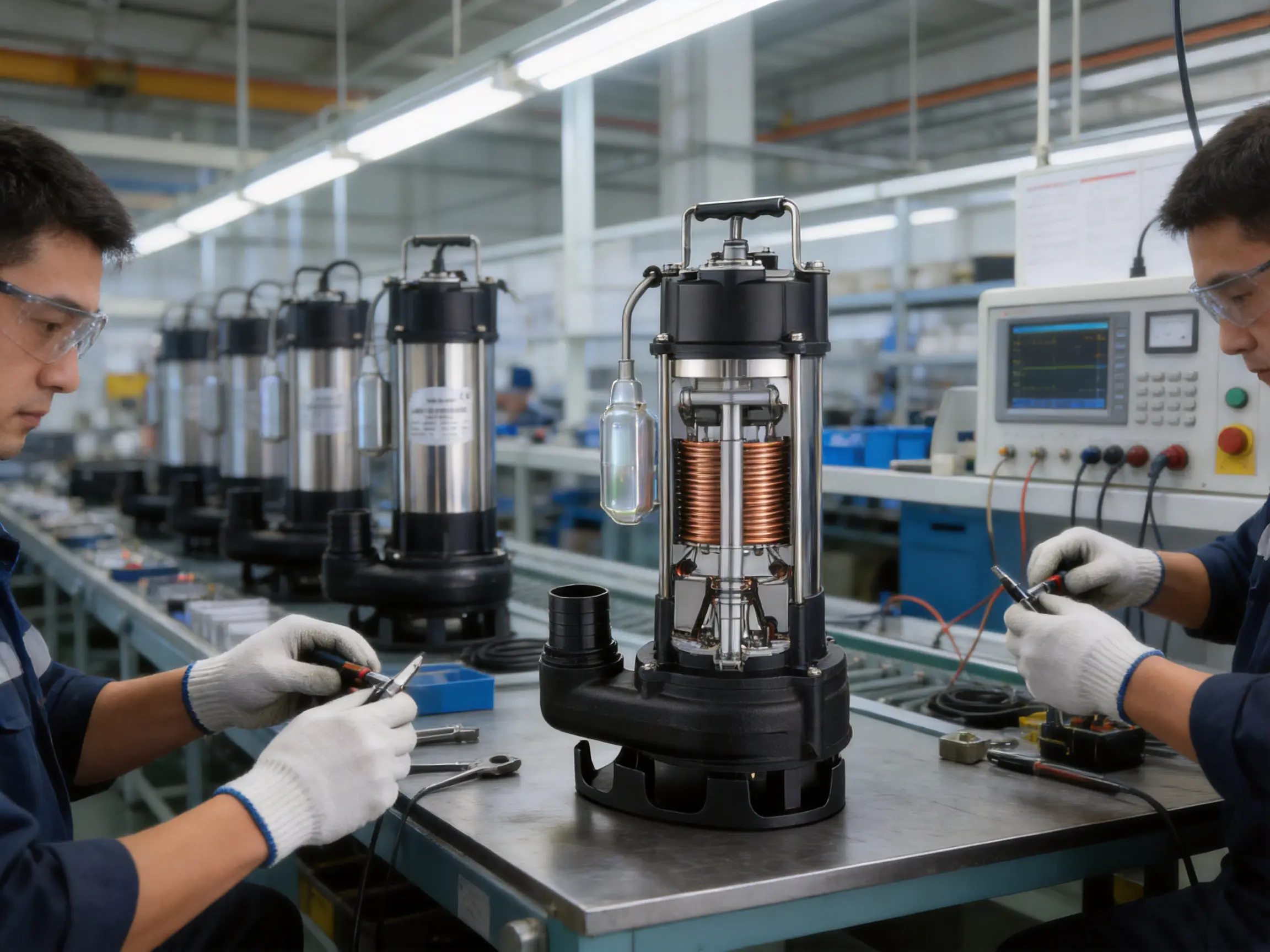
Motor production is a central manufacturing stage for the VB pump. Copper winding must be applied accurately, insulation must be protected, and electrical connections must be assembled correctly. The built-in thermal protector must also be integrated into the motor design so that it can respond appropriately to excessive temperature.
Electrical assembly quality should be supported by suitable inspection and testing. Although the specific factory test procedures are not listed in the supplied information, a professional pump manufacturer generally needs to verify electrical continuity, insulation performance, rotation, current behavior, sealing integrity, and general operating condition before shipment.
The stainless steel welded shaft and rotating components must be assembled with careful attention to alignment. Incorrect alignment can create vibration, noise, seal wear, and bearing stress. Accurate assembly is therefore important for both initial performance and service life.
A production system that controls component dimensions, shaft runout, bearing placement, seal installation, and fastener tightening can improve consistency. These details may not be visible to the purchaser, but they have a direct effect on the pump’s operation after installation.
Submersible products require strong attention to sealing. Water must be prevented from reaching the motor windings and electrical areas. The housing, cable entry, shaft seal, and joint surfaces all contribute to the pump’s resistance to water ingress.
The IPX8 rating reflects the product’s intended submerged service, but maintaining that protection depends on production quality and correct field handling. The pump should not be opened without reason, and damaged sealing components should be replaced with appropriate parts during maintenance.
Edwin Pump serves international customers and has established supporting companies for import and export services. This is a significant strength for overseas buyers because pump procurement involves more than manufacturing. It may include technical clarification, packaging, labeling, shipping documentation, production scheduling, and coordination with freight providers.
A professional export structure can help reduce communication gaps between the factory and the buyer. It can also support distributors that need a reliable partner for recurring orders, mixed product procurement, and international delivery planning.
The VB pump should be installed by qualified personnel who understand electrical safety and wastewater equipment. Before installation, confirm the required flow, discharge head, liquid temperature, pH, density, viscosity, immersion depth, electrical supply, and discharge-pipe size.
Position the pump so that it remains stable and cannot tip, vibrate excessively, or become trapped against the wall of the pit. The pump should not be suspended from the electrical cable. Use an appropriate lifting rope, chain, guide arrangement, or support method that can safely handle the unit’s weight and operating conditions.
Ensure that the discharge pipe is adequately supported. Excessive pipe weight or mechanical strain should not be transferred to the pump outlet. Where appropriate, install a check valve to help prevent reverse flow when the pump stops. An isolation valve may also be useful for maintenance, although the final arrangement depends on the system design.
The electrical supply must match the pump’s required voltage, frequency, phase, and current characteristics. Use suitable overload protection, grounding, cable protection, and control equipment. The built-in thermal protector is an important feature, but the complete electrical system still requires an appropriately selected circuit breaker or motor-protection device.
Before energizing the pump, confirm that the liquid level is sufficient for safe operation and that the pump is not obstructed by large objects, excessive sediment, cable ties, construction debris, or other materials. Check the discharge route and make sure the receiving system can accept the pumped liquid.
Regular inspection can help extend pump service life. The inspection frequency should reflect the wastewater characteristics, operating hours, number of starts, and consequences of failure. A pump used in a municipal station may require a different maintenance schedule from a temporary construction-site unit.
Inspect the external housing for cracks, severe corrosion, impact damage, or unusual deposits. Check the lifting arrangement, cable, cable entry, discharge connection, and mounting position. If the pump has moved or tilted, correct the installation before continued operation.
Monitor abnormal noise, vibration, frequent thermal trips, reduced discharge, unusual current draw, or repeated starting problems. These symptoms may indicate an obstruction, worn component, damaged seal, electrical problem, incorrect liquid conditions, or a mismatch between the pump and the system.
Before removing the pump, disconnect and isolate the power supply according to an approved lockout and safety procedure. Wastewater may contain harmful biological or chemical substances, so maintenance personnel should use appropriate protective equipment and follow site hygiene requirements.
Clean the pump when deposits or solids accumulate. Do not use tools or cleaning methods that may damage the housing, cable, seals, or rotating components. If internal repairs are necessary, the unit should be handled by trained service personnel using suitable replacement parts.
Purchasers should begin with the actual system duty rather than selecting a pump based only on outlet size or motor power. The required flow rate and discharge head determine whether the pump can perform the intended task. The liquid properties then determine whether the materials and motor design are appropriate.
Buyers should provide the supplier with details about the liquid, including temperature, pH, density, viscosity, suspended solids, fibers, abrasive particles, and possible chemical exposure. Information about the pit dimensions, immersion depth, discharge distance, pipe diameter, vertical lift, and operating frequency is also valuable.
For projects requiring multiple pumps, purchasers should consider standardization. Using a consistent pump type can simplify spare-parts management, operator training, maintenance procedures, and replacement planning. Edwin Pump’s broad product portfolio, which includes deep well pumps, submersible pumps, domestic booster pumps, circulation pumps, solar water pumps, intelligent booster pumps, and other water-treatment-related products, can support broader procurement programs.
Distributors should also evaluate packaging, labeling, technical documents, delivery schedules, minimum order expectations, warranty procedures, and after-sales communication. These factors influence the total commercial value of the product and the distributor’s ability to support end users.
A sewage pump is a working machine, not merely a catalog item. Its value is determined by how consistently it performs after installation and how effectively the supplier responds when questions arise. A manufacturer with long-term industry experience is more likely to understand the difference between laboratory conditions and actual wastewater applications.
Taizhou Edwin Electric Co., Ltd. has operated since 2008 and focuses on pump development, production, and international supply. Its products are intended for new energy projects, agricultural irrigation, municipal engineering, mining, construction, HVAC systems, and household water supply. This cross-sector experience can contribute to a broader understanding of fluid-handling requirements.
Since 2018, the company has invested in new energy and intelligent technology, including solar water pumps and intelligent booster pumps. Although the VB sewage pump is a separate product category, this investment demonstrates a continuing effort to expand technical capability and respond to changing market expectations.
The company’s one-stop procurement approach is also relevant to project customers. Instead of sourcing every pump category from a different supplier, buyers may coordinate several requirements through a manufacturer and its associated export-service organizations. This can simplify communication, reduce purchasing administration, and improve order tracking.
Every pump has an intended operating envelope. The VB model should be used within its stated maximum immersion depth of 5 meters, maximum liquid temperature of 40°C, pH range of 5 to 9, viscosity range, and maximum liquid-density condition. Operating outside these limits may reduce performance or cause premature failure.
The supplied information identifies the product as a sewage pump, but it does not provide a complete solids-passage specification. Users should therefore confirm the allowable particle size and solids-handling capability before pumping liquids containing large objects, long fibers, heavy sludge, stones, or abrasive materials.
The pump should not be used for flammable or explosive atmospheres unless the complete product and installation have the required approvals. Methane-pool applications require special attention to gas hazards, ventilation, electrical classification, and local regulations.
Correct sizing is equally important. An oversized pump may cycle too frequently, operate inefficiently, or create excessive flow in the discharge line. An undersized pump may run continuously, fail to achieve the required drainage rate, or experience repeated thermal protection trips. Technical selection should be based on the complete hydraulic system.
The VB is a submersible sewage pump designed for wastewater drainage and liquid transfer in factories, construction sites, commercial facilities, municipal systems, residential drainage stations, methane pools, and rural irrigation applications.
Yes. The pump is designed for submerged operation and has an IPX8 protection class. Its maximum specified immersion depth is 5 meters. Correct installation of the pump, cable, electrical connections, and control system remains essential.
The maximum liquid temperature is 40°C, or 104°F. Liquids above this temperature should not be pumped unless the manufacturer has specifically confirmed suitability for the application.
The stated liquid pH range is 5 to 9. Users should also review the liquid’s chemical composition because pH alone does not identify every possible material-compatibility risk.
The motor uses a copper winding, built-in thermal protection, Class B insulation, and IPX8 protection. These features support safe operation in the intended submerged environment, provided that the pump is correctly selected and installed.
Copper offers strong electrical conductivity and is widely used in reliable electric motors. In the VB pump, the copper winding supports efficient motor operation when the electrical supply and operating duty remain within the product’s design conditions.
It can be used for factory wastewater drainage when the liquid remains within the specified temperature, pH, viscosity, density, and immersion conditions. The user should verify chemical compatibility and solids-handling requirements before installation.
Yes. The submerged format is suitable for many temporary or permanent construction-site drainage duties, including water accumulation in pits and excavated areas. The pump and cable should be protected from impact, debris, and unsafe handling.
The supplied application information includes methane pools. However, methane can create a hazardous atmosphere. The complete installation must be evaluated for gas risk and electrical safety, and the pump should not be treated as explosion-proof unless the required certification has been confirmed.
Confirm the required flow rate, total head, liquid properties, temperature, pH, density, viscosity, immersion depth, solids content, electrical supply, discharge-pipe arrangement, and operating frequency. Supplying this information to the manufacturer helps ensure correct selection.
Taizhou Edwin Electric Co., Ltd. combines product research and development, mass production, and global export. Its related organizations support procurement planning, order tracking, cross-border delivery, and foreign-trade services, which can be valuable for distributors and project purchasers.
No. The built-in thermal protector is an additional motor-safety feature. The installation still requires suitable electrical protection, grounding, switching, and control equipment selected according to local regulations and the pump’s electrical requirements.
Inspect the cable, housing, discharge connection, lifting arrangement, mounting position, and operating behavior. Clean deposits and obstructions when necessary, and investigate abnormal noise, vibration, reduced flow, repeated thermal trips, or unusual electrical behavior.
The Submersible Sewage Pump VB is a practical solution for wastewater drainage where reliable submerged operation, compact installation, and motor protection are important. Its 5-meter maximum immersion depth, 40°C maximum liquid temperature, pH 5–9 operating range, copper motor winding, built-in thermal protector, stainless steel welded shaft, Class B insulation, and IPX8 protection provide a balanced foundation for industrial, municipal, commercial, residential, construction, and agricultural applications.
Compared with general-purpose pumps not designed for immersion, the VB offers a more suitable configuration for pits, tanks, and sewage collection points. Its submerged format can simplify installation, reduce priming concerns, and save above-ground space. The product also benefits from the manufacturing and export capabilities of Taizhou Edwin Electric Co., Ltd., an established pump enterprise with experience in independent research and development, mass production, international supply, and one-stop procurement services.
Responsible selection remains essential. Buyers should match the pump to the actual flow, head, liquid characteristics, solids content, electrical system, and site conditions. When applied within its specified operating range and maintained correctly, the VB sewage pump can support dependable wastewater transfer and drainage in a wide variety of demanding environments.
1. Taizhou Edwin Electric Co., Ltd., Submersible Sewage Pump VB product information and technical specifications.
2. Taizhou Edwin Electric Co., Ltd., Corporate profile and manufacturing capability information.
3. International Electrotechnical Commission, Degrees of Protection Provided by Enclosures for Electrical Equipment.
4. International Electrotechnical Commission, Rotating Electrical Machines: Rating and Performance Principles.
5. General engineering practice for submersible pump installation, wastewater drainage, electrical protection, and preventive maintenance.
edwina@edwin-pump.com
+86-13586290903 (WhatsApp)
Xuri Gongliang Cutting Tool Entrepreneurship Park, Wenqiao Town, Wenling City, Taizhou City, Zhejiang Province, China

High Performance Smart Pump Factory


 English
