edwina@edwin-pump.com

View All Products
en
Pressure management is one of the most important factors in the reliable operation of thermal systems, boiler installations, solar heating systems, and compact water circulation networks. A well-selected pressure tank helps reduce unnecessary pump cycling, absorb changes in fluid volume, stabilize pressure, and protect connected components from avoidable hydraulic stress. The ET Series vertical tank is designed for these duties through a practical combination of a carbon steel vessel, a fixed rubber balloon, a compact vertical structure, and a factory-specified pre-charge pressure.
With models ranging from 4 liters to 18 liters, the series is suitable for installations where space, operating stability, and straightforward maintenance are important. Its stated maximum working pressure is 4 bar, while the pre-charge pressure is 1.5 bar. The product is intended for thermal systems, boiler systems, and solar systems, making it a useful pressure-control component for residential, light commercial, and equipment-integrator applications.
Unlike a simple empty expansion chamber, a bladder-type pressure tank separates the system fluid from the pressurized gas cushion. This arrangement provides more predictable expansion control and helps limit direct contact between the stored air charge and the working fluid. For installers and original equipment manufacturers, the ET Series offers a compact pressure vessel platform that can be incorporated into packaged heating, solar, and circulation equipment.
Water and heat-transfer fluids change volume as their temperature changes. When a closed or semi-closed system is heated, the fluid expands. Without an appropriate expansion volume, system pressure can rise rapidly. When the system cools, pressure can fall. These repeated changes may create unstable operating conditions, unnecessary safety-valve discharge, pump cycling, noise, and premature wear on fittings and controls.
A pressure tank provides a controlled area for this expansion and contraction. The tank contains a gas charge, normally separated from the system fluid by a flexible rubber balloon or bladder. As fluid enters the tank, the gas space is compressed. As the system pressure decreases, the compressed gas pushes fluid back into the circuit. This process smooths pressure variation and supports more stable operation.
In a pump-assisted installation, pressure tanks can also reduce the frequency of pump starts. Frequent starting and stopping is undesirable because each start places an electrical and mechanical load on the motor, shaft, bearings, seals, and switching components. A correctly sized tank allows a small volume of water to be delivered without immediately starting the pump, depending on the control arrangement and pressure settings.
For solar and boiler installations, the expansion function is especially important. Heating cycles can be repeated every day, and the system may experience significant temperature differences between operation and standby. A robust tank with a suitable temperature rating helps accommodate these changes while supporting safe and predictable pressure control.
The ET Series is a vertical carbon steel pressure tank equipped with a fixed SBR rubber balloon according to the supplied product specification. The steel vessel provides the structural enclosure required to contain internal pressure, while the rubber balloon provides separation between the system medium and the gas cushion.
The vertical format offers several practical advantages. It uses a relatively small floor footprint compared with a horizontal vessel of similar capacity, which can be valuable inside boiler cabinets, solar control rooms, plant rooms, pump skids, and equipment enclosures. The upright form also makes the tank easy to position beside a pump, manifold, heat exchanger, or expansion circuit.
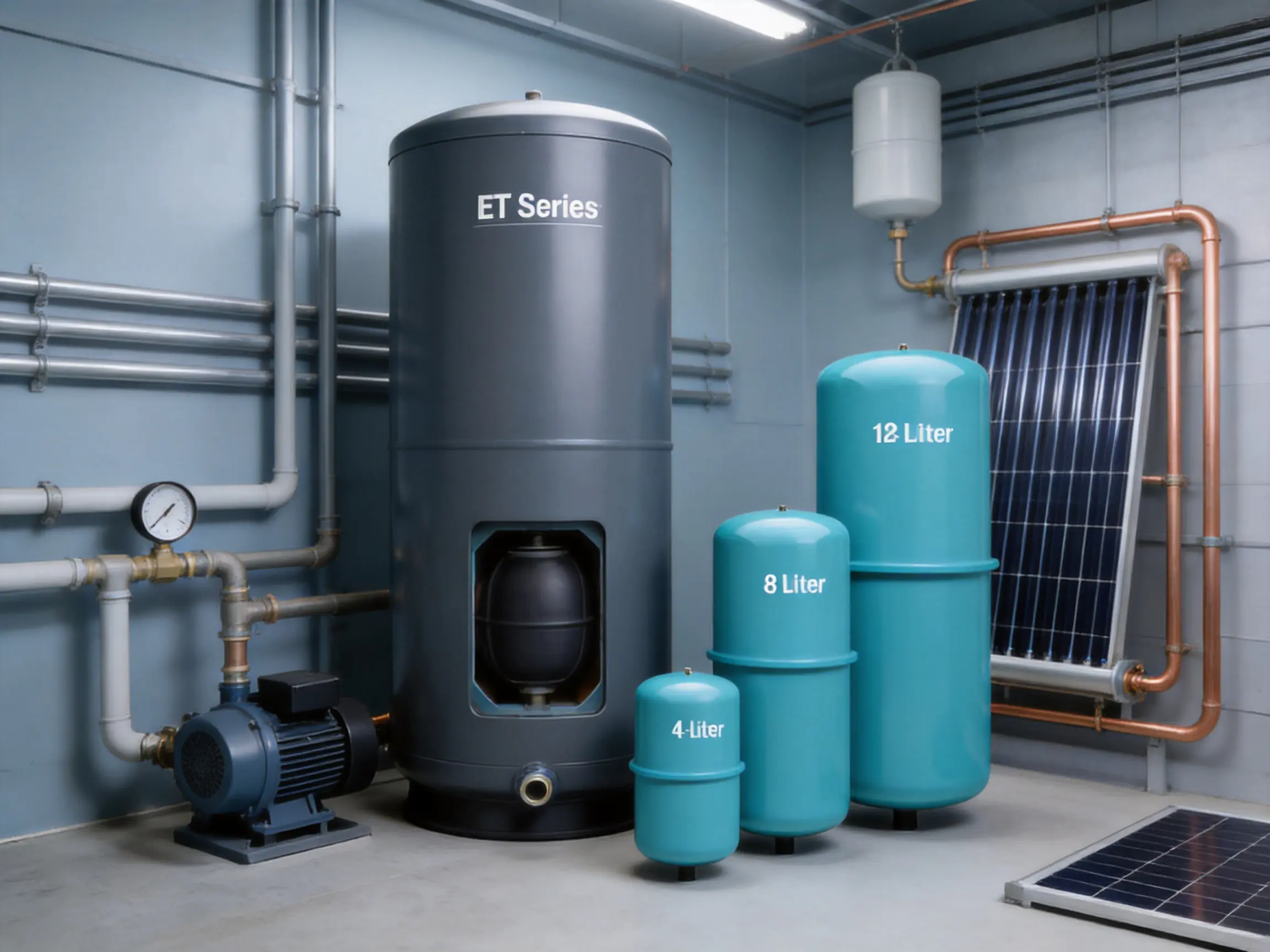
The compact product range includes four nominal capacities: 4 liters, 8 liters, 12 liters, and 18 liters. These sizes allow designers to match the tank more closely to system volume and expected thermal expansion. Selecting a tank that is too small can cause excessive pressure changes, while selecting one that is much larger than required may increase cost and occupy valuable installation space.
The series uses a 3/4-inch connector across the listed models. Standardization of the connection size simplifies purchasing and helps installers plan common fittings, valves, adapters, and service tools. The final connection arrangement should always be checked against the system design, applicable local codes, and the requirements of the connected equipment.
| Model | Nominal Capacity | Diameter | Height | Connector | Packing Volume |
| ET-4L | 4 L | 220 mm | 200 mm | 3/4 inch | 0.01088 CBM |
| ET-8L | 8 L | 220 mm | 295 mm | 3/4 inch | 0.01569 CBM |
| ET-12L | 12 L | 290 mm | 280 mm | 3/4 inch | 0.02567 CBM |
| ET-18L | 18 L | 290 mm | 400 mm | 3/4 inch | 0.03499 CBM |
The common operating parameters for the listed series include a pre-charge pressure of 1.5 bar and a maximum working pressure of 4 bar. The stated working temperature range is -10°C to 99°C, with EPDM identified in the temperature specification. Because the product content also identifies a fixed SBR rubber balloon, buyers and system designers should confirm the exact diaphragm or balloon material supplied for the selected model and application. Material selection should correspond to the fluid, temperature range, local regulations, and the manufacturer’s final technical documentation.
A vertical tank can deliver useful expansion volume without requiring a wide horizontal mounting area. This is particularly valuable in modern mechanical rooms, where pumps, boilers, controllers, manifolds, filters, and electrical cabinets must share a restricted space. The ET-4L and ET-8L models have a listed diameter of 220 mm, while the ET-12L and ET-18L models have a listed diameter of 290 mm.
The compact footprint can make the product easier to integrate into packaged systems. An equipment manufacturer can place the tank alongside a circulation pump or inside a custom enclosure rather than designing a large horizontal support frame. For retrofit projects, the vertical arrangement may also simplify the use of existing wall or floor space.
A four-model range provides more selection than a single universal tank. Smaller systems may benefit from the ET-4L or ET-8L, while systems with greater fluid volume or stronger temperature-related expansion may require the ET-12L or ET-18L. The correct capacity depends on total system volume, fluid type, minimum and maximum operating temperature, pressure settings, safety-valve rating, and the required usable acceptance volume.
Offering several sizes also helps distributors and installers maintain a focused inventory. Instead of stocking numerous unrelated pressure-vessel formats, a supplier can cover common small-system requirements with a coordinated series that shares important characteristics such as connector size, pre-charge pressure, pressure rating, and general construction concept.
The fixed rubber balloon is a central functional element of the ET Series. By separating the gas charge from the system fluid, the design can provide more consistent expansion behavior than an unseparated air chamber. The balloon also helps reduce direct air contact with the circulating fluid, which can be beneficial in systems where air entrainment, corrosion, or oxidation must be controlled.
The balloon must remain flexible over the intended pressure and temperature range. Its long-term performance depends not only on the rubber compound but also on the system fluid, temperature exposure, pressure cycling, installation orientation, and correct pre-charge maintenance. For this reason, the tank should be installed and operated within the stated limits rather than treated as a general-purpose vessel for every fluid or temperature condition.
Carbon steel is widely used for pressure-vessel bodies because it offers a practical balance of strength, manufacturability, and cost. A properly formed and finished steel tank can withstand the pressure conditions required by many heating and solar circuits while remaining economical for large-scale production.
The steel shell also provides a stable mounting structure for the connection and internal balloon assembly. In comparison with lightweight plastic vessels, a steel body may offer better resistance to external impact and higher perceived mechanical robustness. The actual service life, however, depends on surface protection, water chemistry, installation conditions, and compliance with the specified working pressure.
The ET Series should be compared with alternatives according to the application rather than by price alone. A basic unpressurized chamber may have a lower initial purchase price, but it may not provide the same controlled gas separation or predictable expansion response. A tank that is too small may operate close to its pressure limits, while an oversized product may create unnecessary expense and consume more space.
One advantage of the ET Series is the combination of a defined pre-charge pressure and a stated maximum working pressure. These values give designers a starting point for system calculations and commissioning procedures. The 1.5-bar pre-charge provides a known baseline, while the 4-bar maximum working pressure establishes an important upper operating boundary.
Another advantage is the coordinated series format. The models share a common product concept and connector size, allowing a system builder to use the same general installation method across different capacities. This can reduce design variation, simplify staff training, and make replacement planning easier.
The vertical structure is also a practical differentiator where installation space is limited. Some competing products may be designed primarily as horizontal tanks or may require a broader support area. A compact vertical vessel can be easier to place beside a boiler, near a solar circulation station, or within a pump equipment cabinet.
For distributors, the product’s application range is another strength. The stated uses include thermal systems, boiler systems, and solar systems. This allows one product family to serve multiple channels, including heating installers, solar equipment integrators, boiler manufacturers, pump system suppliers, and maintenance contractors.
These advantages should be evaluated alongside essential technical checks. A pressure tank is not automatically suitable for every heating fluid, antifreeze mixture, potable-water application, or high-temperature circuit. Buyers should verify material compatibility, certification requirements, pressure settings, temperature conditions, and installation orientation before selecting the product over another supplier’s model.
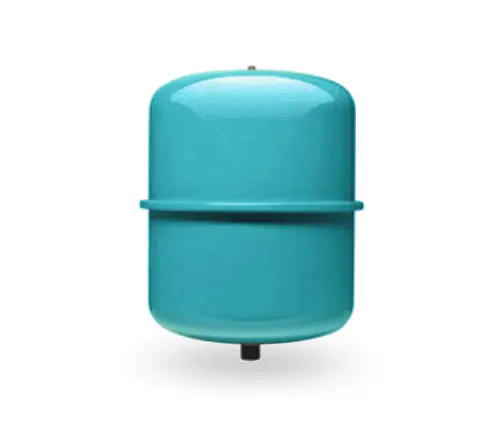
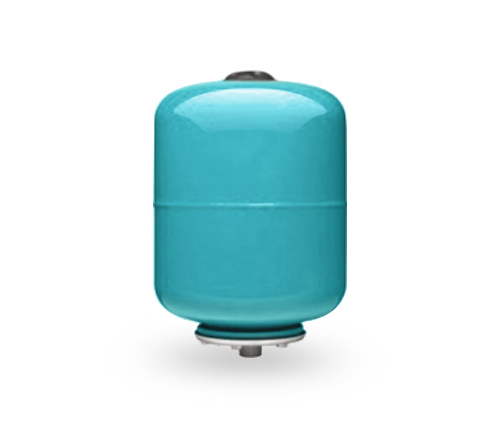
ET Series vertical tank
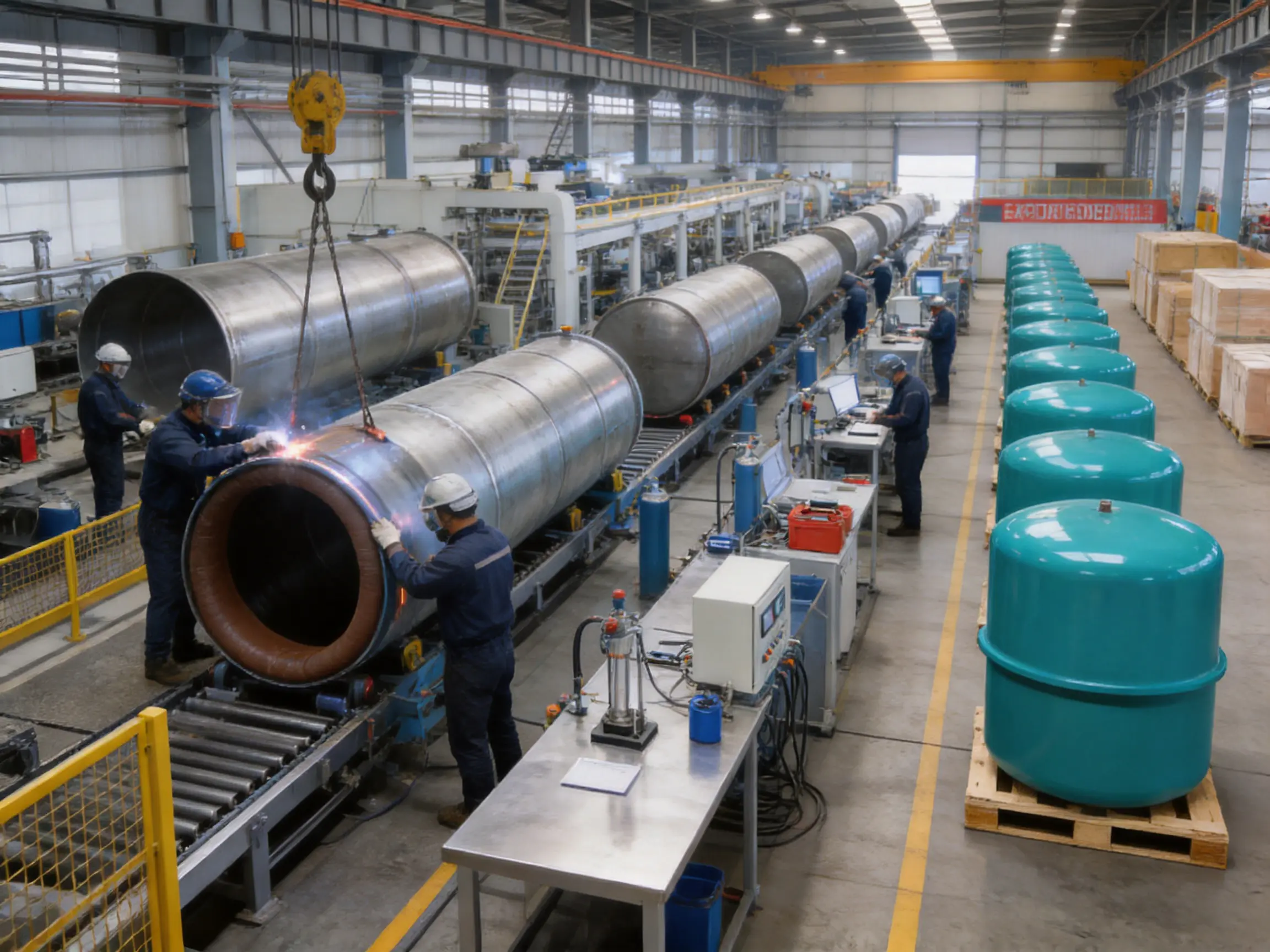
A pressure tank may appear simple from the outside, but its performance depends on the consistency of several manufacturing operations. The vessel must be formed accurately, the connection must be securely joined, the balloon must be correctly installed, and the final unit must retain its pressure without leakage. Small variations in any of these stages can affect service life and operating stability.
Manufacturing quality begins with the selection and control of carbon steel sheet or formed components. Material thickness, surface condition, chemical composition, and mechanical properties should be controlled according to the vessel design and the intended working pressure. Proper material management helps reduce variability during forming and welding.
For a professional production operation, incoming materials should be inspected and identified before entering the production line. Traceability can connect raw materials with production batches, inspection records, and finished products. This is especially valuable for OEM customers that require repeatability across multiple purchase orders.
The tank body must be shaped to provide the required internal volume while preserving dimensional consistency. Controlled forming helps maintain the specified diameter and height for each model. Consistent dimensions are important because they affect packaging, installation clearances, internal balloon fit, and the positioning of the connector.
Accurate forming also supports efficient production. When tank bodies are consistent, welding fixtures and assembly tools can be set up with fewer adjustments. This improves throughput and helps reduce variation between units. It also enables more predictable packaging and container loading, which can be important for export orders.
The welded joints in a pressure tank are critical safety and performance points. A sound weld must provide structural continuity and resist leakage under the specified pressure. Production controls may include fixture alignment, welding parameter control, operator qualification, visual inspection, and pressure or leak testing.
High-quality welding is not limited to appearance. A visually smooth joint must also have adequate penetration, suitable geometry, and no unacceptable defects. Consistent preparation before welding, including clean surfaces and accurate fit-up, helps improve the reliability of the finished vessel.
Carbon steel requires suitable surface protection when it is exposed to humid storage conditions, mechanical-room air, or other corrosive environments. A controlled surface-treatment and coating process can improve resistance to rust during transportation and service. Coating preparation may include cleaning, degreasing, surface conditioning, and controlled application of the protective finish.
The final result depends on coating coverage, adhesion, curing, and handling. A pressure tank should not be dragged across rough floors or stored in conditions that damage the protective surface. Buyers receiving export shipments should inspect packaging and products for impact damage, moisture exposure, or coating defects before installation.
The rubber balloon must be installed without cuts, folds, abrasion, or incorrect positioning. The connection between the balloon assembly and the tank opening must be secure and properly aligned. Production personnel need suitable tooling and inspection procedures to prevent damage during insertion and assembly.
The rubber compound also requires controlled storage. Excessive heat, ultraviolet exposure, ozone, oils, and incompatible chemicals can affect elastomer performance. A well-organized factory should protect balloon components before assembly and use appropriate stock rotation to reduce aging-related risks.
Testing is essential because the tank operates as a pressurized component. Depending on the production and certification program, testing may include air-tightness checks, water pressure tests, pre-charge verification, connector inspection, and dimensional checks. Testing helps identify leaks, faulty joints, damaged balloons, or incorrect valve settings before shipment.
Factory testing also supports customer confidence. A distributor or OEM buyer needs more than a product photograph; the buyer needs assurance that the supplied batch is consistent. Inspection records, batch identification, and defined acceptance criteria can help integrate the tank into a customer’s quality-management process.
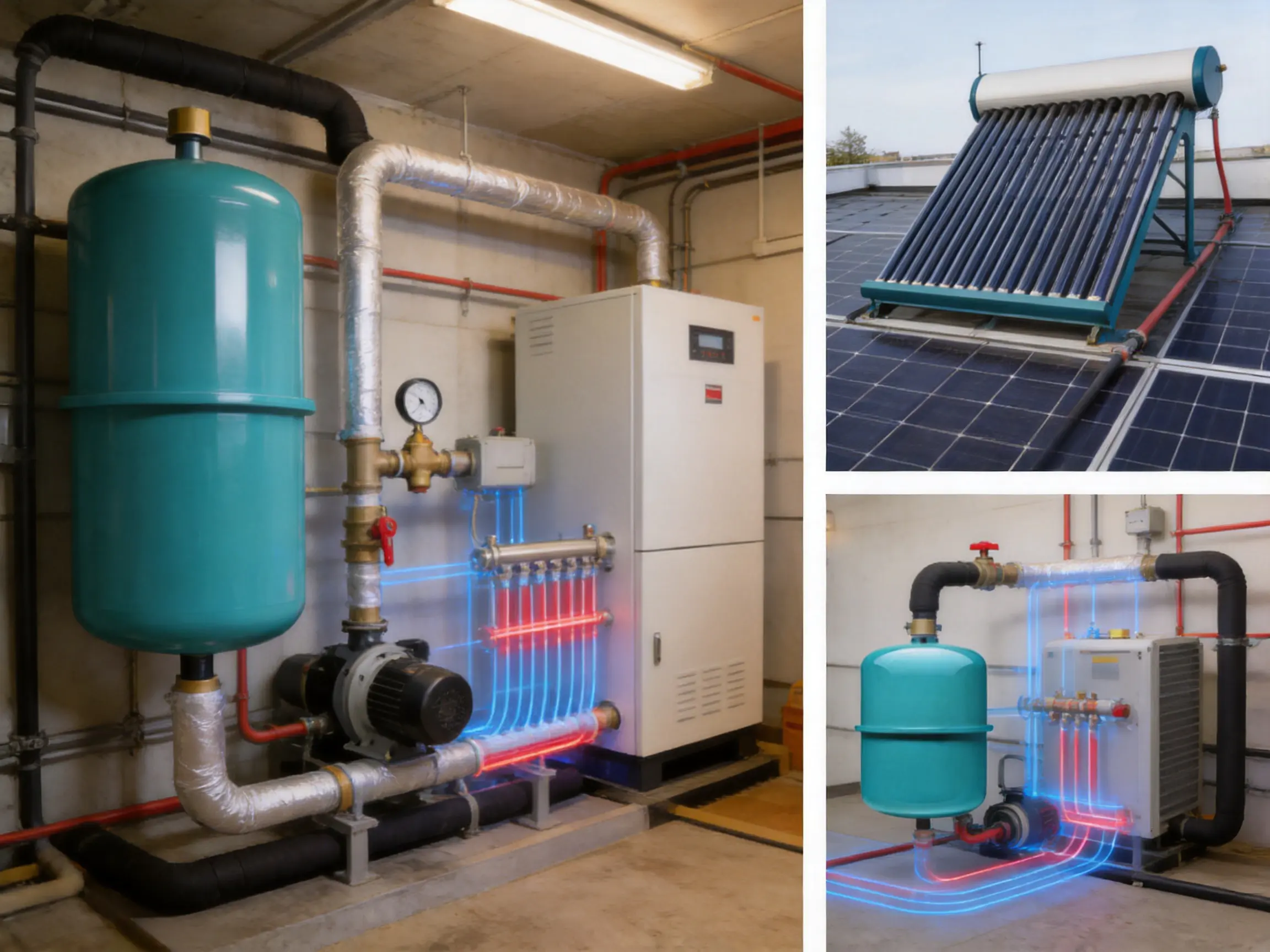
Thermal systems can be open or closed, high-temperature or low-temperature, and simple or highly integrated. The tank selection must reflect the actual system design. In a boiler circuit, the tank may accommodate water expansion during heating. In a solar thermal circuit, it may experience repeated daily temperature cycles and may be exposed to water-glycol mixtures. In a hydronic heating system, it may work alongside pumps, valves, radiators, underfloor heating loops, and heat exchangers.
The ET Series is specified for thermal systems, boiler systems, and solar systems. These applications benefit from a pressure tank that occupies limited space and can be installed near the system’s expansion connection. The 1.5-bar pre-charge and 4-bar maximum working pressure provide defined reference points, but system designers must calculate the actual operating pressure and ensure that safety devices are correctly selected.
Temperature must receive special attention. The supplied specification lists a working temperature of -10°C to 99°C and identifies EPDM in the temperature line, while the product description identifies a fixed SBR balloon. The exact elastomer construction should be confirmed with the supplier before the tank is used in a high-temperature or chemically demanding circuit. This confirmation is important because rubber compounds have different resistance to heat, glycol, oils, oxygen, and various treatment chemicals.
Where a solar system uses antifreeze, the fluid concentration should be checked against the balloon material and the tank manufacturer’s compatibility information. Fluid degradation can also occur when a solar collector stagnates at high temperature. Proper system design, pressure relief, temperature control, and expansion capacity remain necessary even when a suitable pressure tank is installed.
Tank sizing should be based on the total fluid volume and the expected operating conditions rather than on pump horsepower alone. Designers normally consider the system’s minimum temperature, maximum temperature, fill pressure, maximum allowable pressure, and the expansion coefficient of the fluid. The usable acceptance volume of the tank is smaller than its nominal physical volume because part of the vessel is occupied by the gas cushion and changing pressure conditions.
The ET-4L model may be appropriate for a compact system with a limited fluid volume, while the ET-8L, ET-12L, and ET-18L provide progressively greater nominal capacity. The correct model cannot be selected solely from the product name. A qualified designer should calculate the required expansion volume and verify that the tank will remain within its pressure and temperature limits.
The tank should normally be installed at a point where pressure changes can be effectively absorbed and where service access remains available. The connecting pipe should be appropriately sized and arranged to avoid unnecessary restriction. Isolation valves, drain arrangements, and service unions may be useful, provided they are installed in a manner that does not accidentally isolate the tank from the system during operation.
The pre-charge should be checked before commissioning and after the system has been safely depressurized according to the applicable service procedure. Measuring or adjusting pre-charge while the water side remains pressurized can produce misleading results. The commissioning technician should follow the tank supplier’s instructions and use calibrated equipment.
A pressure relief valve remains essential. The tank does not replace a safety valve, temperature protection, automatic air vent, pressure gauge, or other required system controls. Each component has a different function, and the complete assembly should be designed as a coordinated pressure-management system.
Inspect the tank for dents, damaged coating, damaged threads, loose components, or signs of moisture ingress. Confirm the model, capacity, connector size, and pressure information against the purchase order and system design. Check that the product has not been stored in an environment that could damage the rubber balloon or external finish.
Review the fluid type and operating temperature. The tank should not be installed in a circuit containing a fluid that is incompatible with the balloon or vessel materials. If the system contains glycol, corrosion inhibitors, cleaning agents, or other additives, compatibility should be verified before filling.
Use suitable tools and sealing methods for the 3/4-inch connector. Avoid excessive tightening, which may damage the connection or deform the fitting. Support the connected piping so that the tank connector is not exposed to unnecessary bending loads or vibration.
Choose a location protected from direct impact, severe vibration, extreme ambient heat, and freezing conditions outside the stated range. Leave sufficient clearance for inspection, pressure measurement, replacement, and access to the system connection. The tank should be installed in accordance with the orientation and mounting requirements provided by the supplier.
Confirm the pre-charge pressure and compare it with the system’s design pressure. Fill and vent the system gradually, observing the pressure gauge for abnormal changes. Check all joints and the tank connection for leakage. Operate the system through an appropriate heating or circulation cycle and verify that pressure remains within the intended range.
If the pressure rises excessively during heating or falls sharply during cooling, possible causes include incorrect tank sizing, incorrect pre-charge, trapped air, a closed isolation valve, a blocked connection, an undersized pipe, or a damaged balloon. Troubleshooting should be carried out by qualified personnel rather than by simply increasing the system fill pressure.
Routine inspection should include checking system pressure, looking for corrosion or coating damage, examining the connection for leakage, and confirming that safety devices remain functional. The frequency depends on the application, operating temperature, fluid chemistry, local regulations, and the importance of the installation.
If the tank loses pre-charge repeatedly, the cause should be investigated. A leaking valve core, damaged membrane, permeation, incorrect measurement procedure, or a system-side leak may be responsible. Repeatedly adding air without identifying the cause may mask a developing failure.
Before service work, isolate and depressurize the tank and connected circuit using an approved procedure. Never drill, weld, cut, or modify a pressurized vessel. If the balloon or vessel is damaged, replacement should be performed with a compatible component or a complete approved tank.
The ET Series is suited to OEM customers that build boiler packages, solar heating stations, circulation modules, heat-pump accessories, compact hydronic systems, and other equipment requiring pressure stabilization. The compact range makes it easier to create standardized product designs for different system capacities.
OEM support is identified in the product information. In practical terms, OEM cooperation may involve model selection, technical communication, packaging requirements, labeling, production scheduling, and order coordination. The exact scope should be agreed during the purchasing process. For a manufacturer, reliable communication is as important as the tank itself because delivery consistency and documentation affect the customer’s entire assembly line.
Distributors can benefit from the product’s broad application potential. A single series can be marketed to heating installers, solar contractors, boiler service companies, pump dealers, and equipment manufacturers. The four capacity options and common 3/4-inch connector help reduce the complexity of product selection.
Export buyers may also value the listed packing volume. The approximate packing volumes are 0.01088 CBM for ET-4L, 0.01569 CBM for ET-8L, 0.02567 CBM for ET-12L, and 0.03499 CBM for ET-18L. These figures can support preliminary freight planning, warehouse layout, and container utilization calculations. Final shipping arrangements should use confirmed package dimensions and weights from the commercial packing list.
A manufacturing supplier with experience in pumps and water-system products can understand how the tank interacts with the wider installation. This broader product knowledge may help customers coordinate pressure tanks with circulation pumps, booster equipment, valves, controllers, and other fluid-handling components. It can also simplify one-stop sourcing for buyers who prefer to consolidate related products.
The supplier described in the source materials is an integrated manufacturing enterprise founded in 2008, with activities in independent research and development, mass production, and global export. Its broader product portfolio includes deep well pumps, submersible pumps, domestic booster pumps, circulation pumps, solar water pumps, intelligent booster pumps, and water-treatment peripheral products.
This product background is relevant to the ET Series because pressure tanks are often selected as part of a complete water or heating solution rather than as isolated components. Experience with pumps and system accessories can support more practical conversations about flow, pressure, cycling, expansion, and equipment integration.
The company’s stated application markets include new-energy projects, agricultural irrigation, municipal engineering, mining, construction, HVAC systems, and household water supply. Although the ET Series is specified primarily for thermal, boiler, and solar systems, a broad industrial customer base can encourage more disciplined production planning, export documentation, order tracking, and technical support.
The supplier also established related import-and-export and industrial companies to support procurement planning, order tracking, cross-border delivery, and foreign-trade services. For international buyers, these capabilities may be valuable when orders involve multiple models, private labeling, customized packaging, or coordinated shipping schedules.
Reliability should be evaluated through a combination of design, materials, process control, testing, installation, and maintenance. No pressure tank can compensate for an incorrectly sized system, incompatible fluid, excessive temperature, or improper commissioning. However, a clearly specified tank with controlled production processes gives installers a stronger foundation for reliable operation.
The ET Series provides several useful reference points: carbon steel construction, fixed rubber balloon design, 1.5-bar pre-charge, 4-bar maximum working pressure, -10°C to 99°C stated temperature range, vertical form, and four capacity options. These specifications make it possible to conduct an initial engineering review before purchase.
Professional buyers should request the latest technical datasheet, material confirmation, test information, drawing, certification documents, warranty conditions, and installation instructions when required by the project. They should also confirm whether the delivered configuration uses SBR, EPDM, or another elastomer for the specific application. This is especially important when fluid temperature and chemical composition are critical.
For competitive procurement, the supplier should be evaluated not only on unit price but also on batch consistency, production capacity, lead time, replacement support, documentation, packaging quality, and communication. A low-cost tank that causes repeated field failures can create a higher total cost than a well-controlled product with dependable technical support.
A pressure tank can contribute to system efficiency by reducing unnecessary pump starts and helping the pump operate in a more stable pressure environment. Lower cycling frequency may reduce mechanical wear and support longer service intervals. In heating and solar systems, better expansion control can also reduce the likelihood of relief-valve discharge and fluid loss.
The tank itself does not create heat or hydraulic energy, so its efficiency benefit is indirect. The greatest benefit comes when the tank is correctly sized and integrated with an efficient pump, suitable controls, low-loss piping, and properly balanced circuits. An incorrectly adjusted pre-charge or an unsuitable tank can reduce these benefits.
Carbon steel is a widely recyclable material at the end of the product’s service life. Responsible disposal should separate the metal body and rubber components where local recycling systems permit. During operation, preventing leaks and maintaining correct pressure can also reduce wasted water or heat-transfer fluid.
The primary function is to provide controlled expansion and pressure stabilization in thermal systems, boiler systems, and solar systems. Its fixed rubber balloon separates the system fluid from the pressurized gas cushion, allowing the tank to absorb changes in fluid volume and help reduce pressure fluctuation.
The listed models are ET-4L, ET-8L, ET-12L, and ET-18L. Their nominal capacities are 4, 8, 12, and 18 liters respectively.
The stated maximum working pressure is 4 bar. The system designer must ensure that the actual operating pressure, pressure-relief setting, and connected components remain compatible with this limit.
The specified pre-charge pressure is 1.5 bar. The correct commissioning value may depend on the system design, and any adjustment should be performed using an approved procedure after the water side has been safely depressurized.
The listed models use a 3/4-inch connector. Buyers should confirm the exact connection configuration and thread standard in the current technical documentation before ordering or installing the tank.
The supplied product information identifies the tank for thermal systems, boiler systems, and solar systems. It does not confirm potable-water certification. Potable-water use should not be assumed unless the supplier provides appropriate material approvals and certification for that application.
The product description identifies a fixed SBR rubber balloon, while the working-temperature specification includes EPDM. Because these descriptions should be reconciled for the specific model, buyers should request confirmation of the actual balloon material before placing an order for a demanding fluid or temperature application.
Potentially, but compatibility must be confirmed. The glycol type, concentration, operating temperature, additives, and possible stagnation conditions should be reviewed against the actual balloon and vessel materials. Solar thermal systems require particular care because collector stagnation can produce high temperatures.
Sizing should consider total system volume, fluid expansion, minimum and maximum temperatures, fill pressure, operating pressure, maximum allowable pressure, and safety-valve settings. Nominal tank capacity alone is not the same as usable acceptance volume. A qualified heating or hydraulic designer should perform the calculation.
No. The tank and safety valve perform different functions. A safety valve protects against excessive pressure, while the tank accommodates normal fluid expansion and helps stabilize the system. Both may be required, along with gauges, vents, controls, and other protective devices.
The vertical design can use less floor area and may fit more easily beside boilers, pumps, manifolds, and solar control equipment. It also provides a consistent installation format across the four listed capacities. The best orientation still depends on available space, mounting requirements, service access, and the manufacturer’s instructions.
Inspect the tank for corrosion, dents, coating damage, leakage, loose connections, and abnormal pressure behavior. Check the pre-charge according to the approved service procedure and investigate repeated pressure loss. Always depressurize the system safely before service.
OEM support is included in the supplied product information. Customers should discuss model selection, labeling, packaging, documentation, order quantities, production schedules, inspection requirements, and shipping arrangements directly with the supplier before confirming an OEM program.
Before purchasing an ET Series vertical tank, confirm the required nominal capacity and calculate the actual expansion requirement. Review the system fluid, operating temperature, minimum pressure, maximum pressure, and expected cycling frequency. Verify that the 4-bar maximum working pressure is suitable for the installation.
Confirm the exact elastomer material, especially where the product will be exposed to glycol, additives, high temperature, or unusual chemical conditions. Request the latest drawings and product documents. Check the connector size and thread details against the planned piping.
Review the installation position and ensure that the tank will be protected from freezing, excessive heat, impact, and vibration. Provide adequate service clearance. Confirm that the tank will remain connected to the system during normal operation and that any isolation arrangement cannot unintentionally prevent expansion protection.
For commercial purchasing, also review packaging dimensions, packing volume, gross and net weight, quantity per carton or pallet, container loading information, production lead time, inspection procedures, warranty terms, and spare-part availability. These factors influence the total cost and long-term usability of the product.
The ET Series vertical tank is a compact carbon steel pressure-tank solution for thermal systems, boiler systems, and solar systems. Its fixed rubber balloon, defined 1.5-bar pre-charge, 4-bar maximum working pressure, vertical structure, common 3/4-inch connector, and four capacity options provide a practical foundation for pressure stabilization and thermal expansion control.
Its advantages over basic or poorly matched alternatives include controlled separation between gas and system fluid, efficient use of installation space, coordinated capacity choices, standardized connection design, and suitability for integration into OEM equipment. These benefits are strongest when the tank is correctly sized, installed, commissioned, and maintained.
The manufacturing value behind the product is equally important. Consistent carbon steel forming, reliable welding, appropriate surface treatment, careful balloon assembly, controlled testing, and organized export support all contribute to a pressure tank that can serve professional heating and fluid-handling markets. The supplier’s wider experience in pumps, solar water systems, booster equipment, and water-treatment products further supports system-level purchasing and OEM cooperation.
Before final selection, customers should verify the latest technical documentation, material configuration, certifications, fluid compatibility, and project-specific requirements. With these checks completed, the ET Series can provide a space-efficient and serviceable pressure-management component for a wide range of small and medium thermal, boiler, and solar installations.
1. Product specification for ET Series vertical tanks, including model dimensions, connector size, pre-charge pressure, maximum working pressure, temperature range, and packing volume.
2. General engineering principles for diaphragm and bladder expansion vessels used in closed hydronic heating and solar thermal systems.
3. Technical guidance on pressure-vessel installation, commissioning, safety-valve protection, and routine inspection.
4. General materials guidance for carbon steel pressure vessels and elastomer components used in water and heating applications.
5. Manufacturer information concerning OEM support, pump-system manufacturing, solar water pumps, circulation pumps, booster pumps, and global export operations.
serieswatershortageprotectionvoltagestabilizationstainlesssteelverticalmultistagepump.jpg "EVR(S) Series Water Shortage Protection Voltage Stabilization Stainless Steel Vertical Multistage Pump")
edwina@edwin-pump.com
+86-13586290903 (WhatsApp)
Xuri Gongliang Cutting Tool Entrepreneurship Park, Wenqiao Town, Wenling City, Taizhou City, Zhejiang Province, China

High Performance Smart Pump Factory


 English