edwina@edwin-pump.com

View All Products
en
Reliable water access is essential for households, farms, gardens, construction sites, and remote communities. In many locations, however, conventional grid electricity is unavailable, unreliable, or too expensive to extend to a pumping site. Solar pumping offers a practical alternative by converting available sunlight into useful hydraulic energy. The effectiveness of a solar water system depends heavily on the design of its pump, motor, electrical input range, hydraulic performance, and ability to operate consistently under changing environmental conditions.
The HVCPM Series Wide Voltage Brushless DC Motor Solar Centrifugal Pump is designed for these demanding conditions. It combines a centrifugal hydraulic structure with a brushless direct-current motor and a wide operating-voltage range. This configuration allows the pump to work efficiently in solar-powered systems where voltage can change throughout the day because of sunlight intensity, temperature, panel configuration, and system loading.
Available models cover power ratings from 750 W to 3,000 W, maximum flow rates from 21 m³/h to 85 m³/h, and maximum heads from 14 m to 28 m. The range includes outlet sizes from 2 inches to 5 inches, allowing users to select a suitable model for small household systems, irrigation networks, water transfer installations, and larger commercial applications.
In addition to its operating performance, the series reflects a manufacturing philosophy centered on product development, mass production, quality consistency, and global supply capability. The manufacturer has experience in deep well pumps, submersible pumps, booster pumps, circulation pumps, and other water-handling equipment. This broad product background supports the development of solar pumping products that are intended to integrate into complete water systems rather than operate as isolated components.
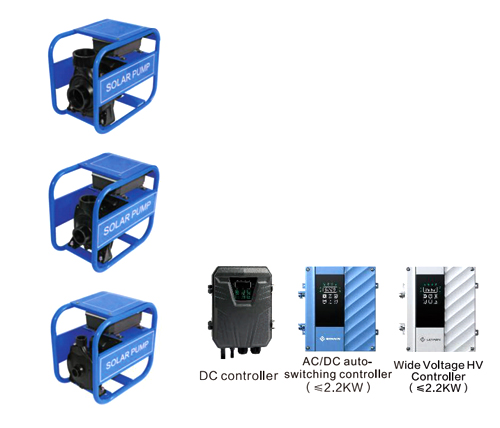
HVCPM Series Wide Voltage Brushless DC Motor Solar Centrifugal Pump
The HVCPM Series is a surface-mounted solar centrifugal pump powered by a brushless DC motor. Unlike a basic fixed-voltage pump, the system is designed for direct use with solar power input within a specified voltage range. Its motor and pump body work together to convert electrical energy into continuous water flow for transfer, irrigation, filling, and general water-supply purposes.
A centrifugal pump uses a rotating impeller to increase the velocity of water and convert that velocity into pressure. This design is widely used where a relatively high flow rate is more important than extremely high lifting height. It is particularly suitable for moving water between tanks, supplying irrigation lines, circulating water across open systems, or transferring water over moderate elevation differences.
The brushless DC motor is a key part of the design. Since it does not rely on traditional mechanical brushes for commutation, it can reduce brush wear and eliminate the need to replace carbon brushes during normal operation. This is valuable in solar installations located in gardens, agricultural fields, remote properties, and other places where frequent service visits are inconvenient.
The wide-voltage concept is another important feature. Solar panels do not produce one perfectly constant voltage under all conditions. Their output changes according to sunlight, weather, panel temperature, wiring configuration, and load. The HVCPM range is engineered around different optimum DC input windows, including 100–350 V, 110–350 V, 200–350 V, and 300–350 V, depending on the selected model.
These input ranges provide system designers with flexibility when configuring photovoltaic arrays. The correct panel arrangement must always be selected according to the pump model, open-circuit voltage limitations, local solar conditions, wiring requirements, and applicable electrical safety practices. The listed solar panel open-circuit voltage requirement is below 450 V, while the recommended solar panel power is at least 1.3 times the rated pump power.
One of the main advantages of the HVCPM Series is its ability to accept a broad DC voltage range. A conventional pump designed for a narrow input voltage may stop frequently when solar output falls below its operating threshold or may require additional electrical equipment to stabilize the supply. By contrast, a properly configured wide-voltage solar pump can make better use of the available photovoltaic power during changing daylight conditions.
This does not mean that the pump produces identical flow at every voltage or under every weather condition. Hydraulic performance always depends on available electrical power, system head, pipe resistance, and solar intensity. However, a wide operating window helps the pump remain compatible with the natural variation of photovoltaic generation and gives installers more flexibility when planning the solar array.
For agricultural users, this feature can help extend useful pumping time in the morning and afternoon. For household or community systems, it can support more practical water collection during periods when sunlight is available but not yet at peak intensity. For off-grid projects, the ability to use direct solar input without depending entirely on a stable grid supply can simplify the system architecture.
The brushless DC motor is designed for efficient electrical-to-mechanical energy conversion. Its electronic commutation system replaces the physical brushes used in traditional brushed motors. This reduces the mechanical contact points inside the motor and helps minimize wear associated with brush friction.
Lower wear can contribute to reduced maintenance requirements over the service life of the pump. This is especially beneficial when the equipment is installed on a rooftop, in an orchard, at a remote storage tank, or in a rural area with limited technical support. Fewer routine replacement parts can also simplify inventory planning for distributors and project contractors.
Brushless motor technology can also support smoother operation and better control of motor speed. Smooth motor behavior is helpful in solar applications because the available electrical power may change continuously. Instead of requiring a rigid, fixed-speed operating condition, the system can be matched more effectively to the available power and hydraulic demand.
The centrifugal design makes the series suitable for applications requiring substantial water movement. The listed maximum flow rates range from 21 m³/h for the smaller model to 85 m³/h for the largest model. This range allows the product family to serve both small-scale and larger water-transfer requirements.
For example, the 750 W model provides a maximum listed flow of 21 m³/h and a maximum head of 14 m. The 1,100 W model reaches up to 26 m³/h and 15 m. Two 1,500 W models are available with different hydraulic priorities: one provides up to 27 m³/h at 21 m head, while another provides up to 50 m³/h at 17 m head. This distinction enables users to select between higher lifting capability and higher flow capacity.
The 2,200 W model reaches a maximum listed flow of 60 m³/h and a maximum head of 20 m. The 3,000 W model reaches up to 85 m³/h and 28 m head. These figures are maximum reference values, not guaranteed operating points under all installation conditions. Actual performance depends on the total dynamic head, pipe length, pipe diameter, fittings, valves, water quality, solar input, and system design.
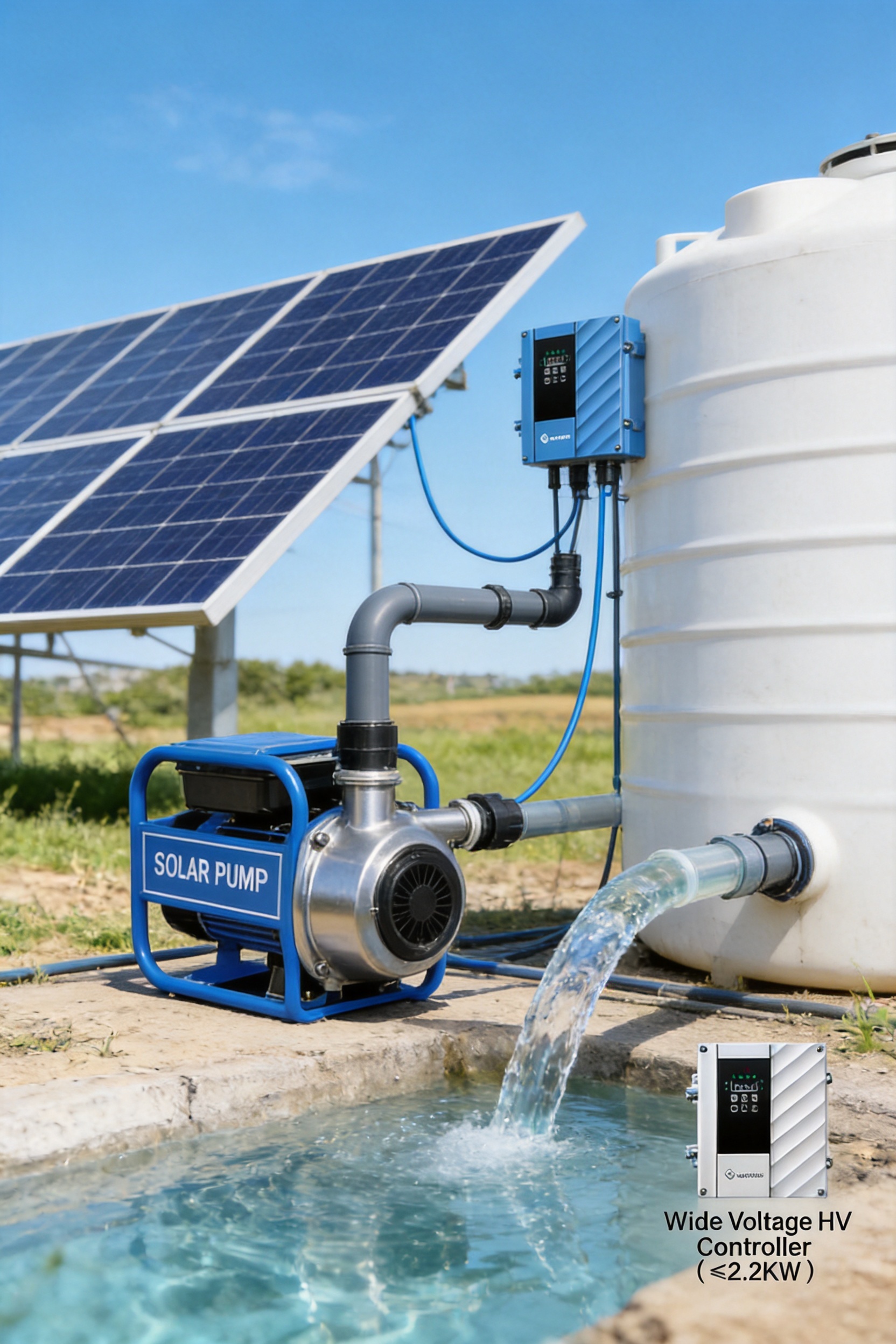
The HVCPM Series is intended for direct integration into solar-powered water supply systems. Its DC input design can reduce the need for a separate AC inverter in applications that are designed around direct photovoltaic power. Eliminating unnecessary conversion stages may reduce equipment complexity and conversion losses, although the complete system still requires appropriate protection, control, isolation, and installation components.
The pump can be combined with solar panels, storage tanks, float switches, pressure controls, filters, non-return valves, pipelines, and irrigation equipment. In many agricultural installations, water can be pumped during daylight into an elevated or ground-level storage tank. The stored water can then be distributed when needed, even when solar production is lower or unavailable.
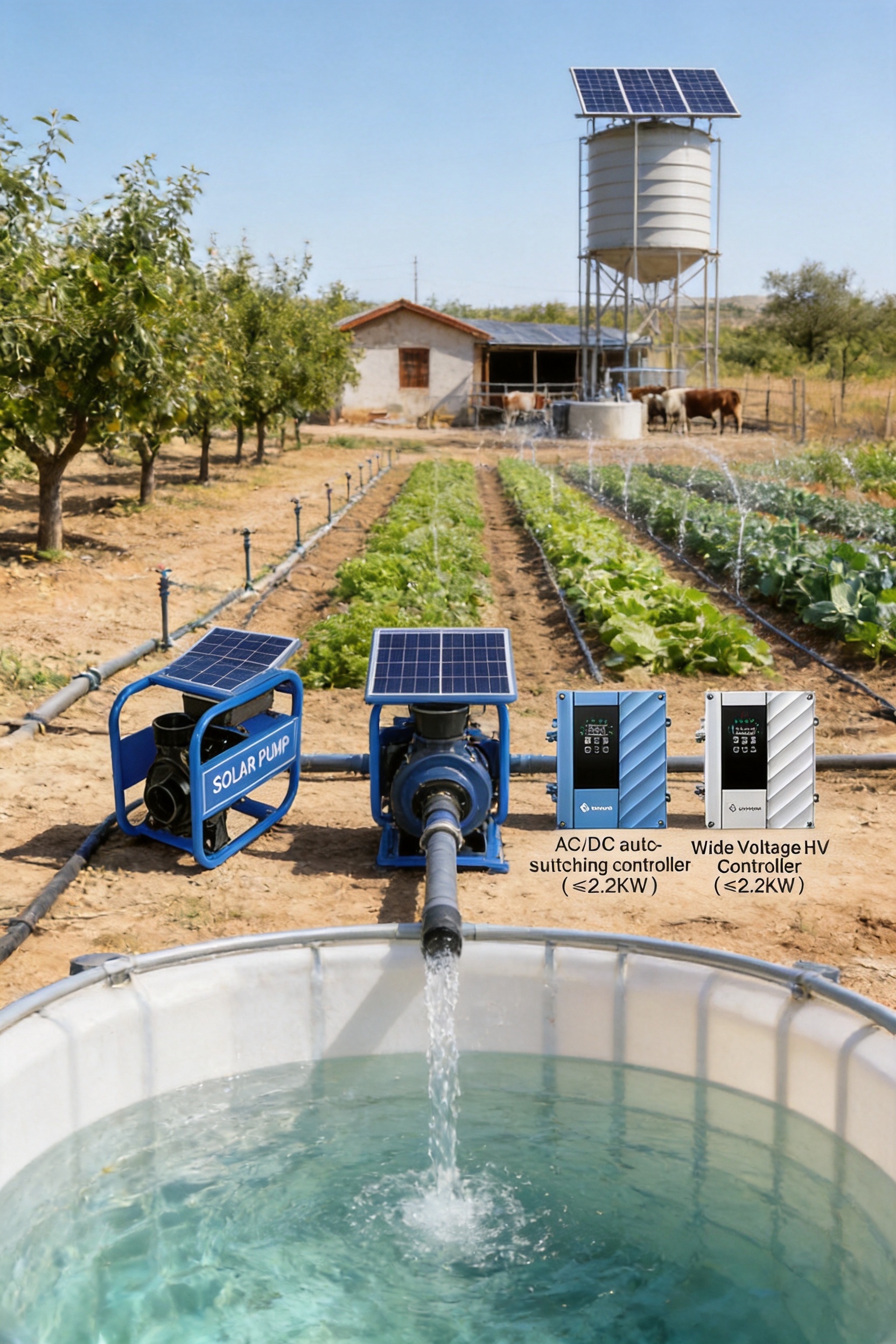
For household applications, a storage tank can help balance variable solar production and daily water demand. For garden applications, the pump can supply sprinkler or drip irrigation systems, provided that the pressure and flow requirements are properly matched. For commercial projects, multiple pumps or larger models may be selected according to the required duty point.
Selecting the correct model requires more than comparing motor wattage. A pump should be selected according to the required flow at the required total dynamic head. The maximum flow and maximum head values listed in a product table are useful for comparison, but they do not usually occur simultaneously. Engineers and installers should review the performance curve and calculate the complete hydraulic system before final selection.
| Model | Optimum DC Input Voltage | Power | Maximum Flow | Maximum Head | Outlet | Recommended Solar Panel Power |
| HVCPM21-14-72-750 | 100–350 V | 750 W | 21 m³/h | 14 m | 2 inches | At least 1.3 times pump power |
| HVCPM26-15-72-1100 | 100–350 V | 1,100 W | 26 m³/h | 15 m | 2 inches | At least 1.3 times pump power |
| HVCPM27-21-110-1500 | 110–350 V | 1,500 W | 27 m³/h | 21 m | 2 inches | At least 1.3 times pump power |
| HVCPM50-17-110-1500 | 110–350 V | 1,500 W | 50 m³/h | 17 m | 3 inches | At least 1.3 times pump power |
| HVCPM60-20-200-2200 | 200–350 V | 2,200 W | 60 m³/h | 20 m | 4 inches | At least 1.3 times pump power |
| HVCPM85-28-300-3000 | 300–350 V | 3,000 W | 85 m³/h | 28 m | 5 inches | At least 1.3 times pump power |
Users who need to fill a large storage pond or supply broad irrigation channels may prioritize flow. In that situation, the HVCPM50-17-110-1500 model, with its 3-inch outlet and listed maximum flow of 50 m³/h, may be more appropriate than a model focused on higher head.
Users who need to raise water to a higher tank or overcome a greater elevation difference may prioritize head. The HVCPM27-21-110-1500 model has a lower listed maximum flow than the 50 m³/h version but offers a higher maximum head of 21 m. The 3,000 W model offers both a high flow rating and the highest listed head in the range, making it suitable for larger systems where the solar array and pipe network can support its requirements.
Pipe size should also be considered. A larger outlet can help reduce flow resistance in higher-volume systems. However, changing the outlet size alone does not guarantee higher performance. The entire pipeline, including suction conditions, discharge length, elbows, filters, valves, and elevation changes, must be evaluated as one system.
The solar array must be designed around both operating voltage and open-circuit voltage. The listed open-circuit voltage requirement is below 450 V. The array should remain within the pump’s electrical limits under the coldest expected panel temperature, because photovoltaic open-circuit voltage can rise when the panel temperature falls.
The recommended solar panel power is at least 1.3 times the pump power. Therefore, a 750 W pump should be paired with solar panel capacity of at least approximately 975 W, while a 3,000 W pump should be paired with at least approximately 3,900 W of panel capacity. The actual design may require more capacity depending on local sunlight, seasonal variation, pumping schedule, desired daily water volume, and system losses.
Professional installers should also consider protective devices, grounding, cable sizing, disconnect switches, surge protection, and safe access to the photovoltaic array. High-voltage DC systems can be hazardous because an arc may continue after a circuit is opened. Installation should comply with local electrical codes and manufacturer instructions.
In homes located beyond reliable utility service, a solar surface pump can transfer water from a well storage tank, pond, collection basin, or ground-level reservoir. The pump can deliver water to an elevated tank, household treatment system, or pressure distribution network, subject to the available head and water-quality requirements.
A storage tank is often useful because household demand does not always match solar production. During the day, the pump can fill the tank while sunlight is available. Water can then be used during the evening or during short periods of cloud cover. This arrangement can reduce the need for batteries, which may simplify maintenance and lower the total cost of an off-grid water system.
Where drinking water is involved, the pump should be installed as part of a properly designed potable-water system. Filtration, disinfection, material compatibility, and local health requirements must be evaluated separately. The pump itself should not be assumed to make untreated water safe to drink.
Gardens and orchards often require regular water delivery but may not have convenient access to grid electricity. The HVCPM Series can support water transfer from a storage pond, rainwater tank, or collection reservoir to irrigation lines.
For drip irrigation, pressure regulation and filtration are important because emitters can be sensitive to suspended particles and excessive pressure. For sprinklers, the required operating pressure and flow rate should be compared with the pump performance curve. A solar pump may operate most strongly around midday, so irrigation schedules can be organized around peak sunlight or supported by water storage.
In orchard projects, the correct model may depend on the number of irrigation zones, the length of the main pipeline, the elevation of the land, and the required daily water volume. A higher-flow model may be beneficial for filling a reservoir quickly, while a lower-flow model may be sufficient for direct irrigation of a smaller area.
Small farms commonly need to move water between wells, ponds, storage tanks, channels, and fields. A surface centrifugal pump can be a practical option where the water source is accessible and the suction conditions are suitable. The pump can be used for filling tanks, transferring water between areas, or supplying a main irrigation manifold.
Water containing sand, plant material, or other solids should be evaluated before installation. Centrifugal pumps generally perform best with relatively clean water unless they are specifically designed for abrasive or solids-bearing fluids. A suitable intake screen or pre-filtration system may be required, but excessive restriction on the suction side should be avoided because it can contribute to poor pump performance and cavitation.
Remote water storage projects benefit from equipment that can operate independently of the electrical grid. Solar panels can power the pump during daylight, while a storage tank provides hydraulic energy storage in the form of available water. This approach may be useful for remote residences, field stations, livestock water points, and community storage systems.
The system can be configured with float switches or level controls so that the pump stops when the destination tank is full. A dry-run protection strategy may also be necessary if the source level can fall below the intake. Proper control equipment protects the pump and reduces water loss.
Small communities may use solar pumping to supply a shared tank, irrigation area, or local distribution point. The product range allows system designers to choose different combinations of flow, head, and outlet size. Larger requirements may be addressed through a higher-capacity model or a properly engineered multi-pump arrangement.
Community systems should include clear operating procedures, accessible isolation points, spare parts planning, and a maintenance schedule. Even a low-maintenance pump requires periodic inspection of electrical connections, pipework, filters, valves, and the water source.
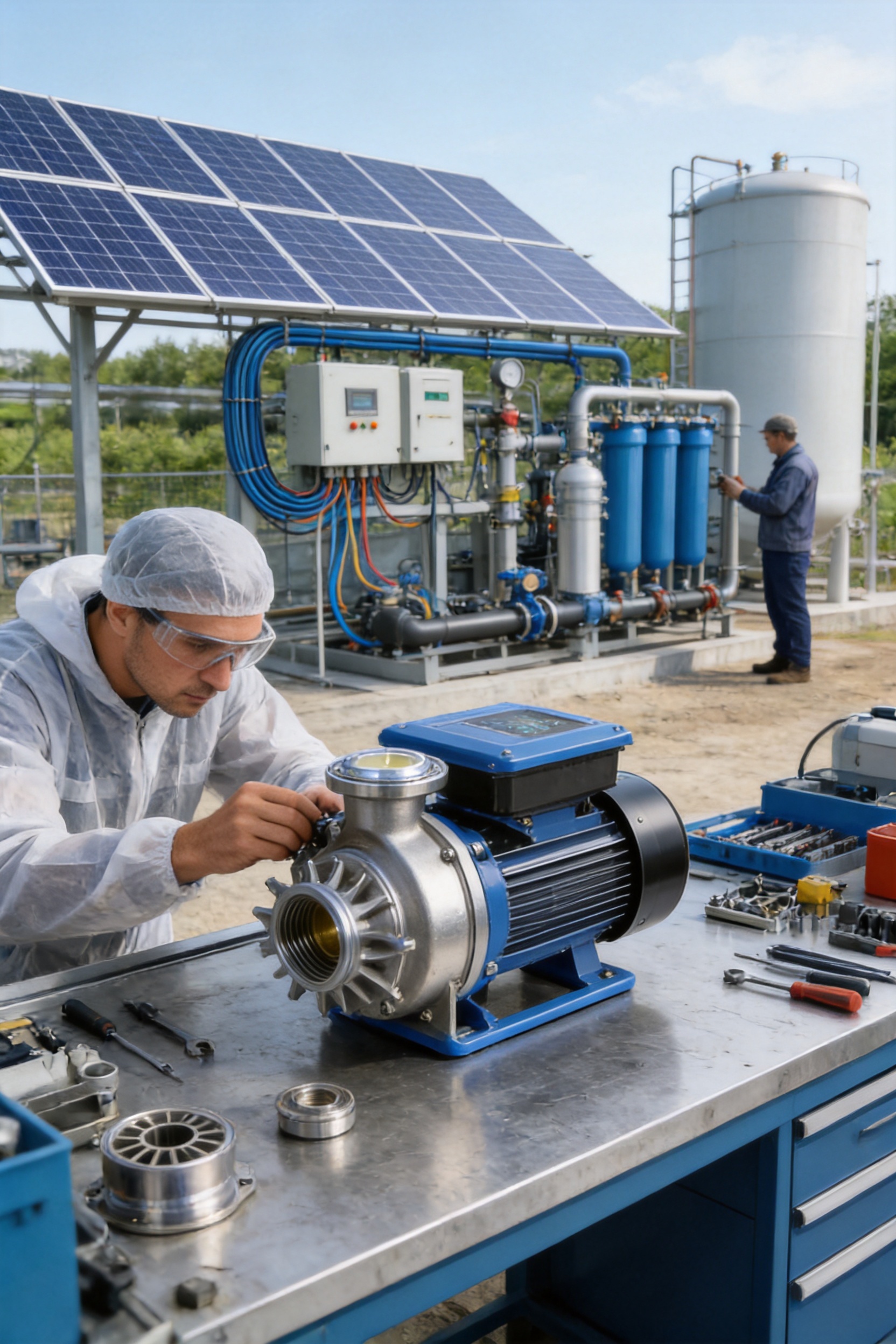
The performance of a solar pump depends not only on its design concept but also on how consistently the product is manufactured. The manufacturer behind the HVCPM Series operates as an integrated enterprise covering independent research and development, mass production, and global export. This structure is important because it connects product design with production planning, quality management, order fulfillment, and after-sales support.
The company’s broader product portfolio includes deep well pumps, submersible pumps, domestic booster pumps, circulation pumps, solar water pumps, and intelligent booster pumps. Experience across these categories provides a practical understanding of different water-system conditions, including pressure boosting, submerged operation, household supply, agricultural irrigation, and energy-efficient off-grid pumping.
This cross-category knowledge can support better product selection and system compatibility. For example, a project may require a solar surface pump for water transfer and a booster pump for final household pressure. A manufacturer with experience in both technologies can offer more coordinated technical guidance than a supplier focused on only one narrow pump type.
Independent research and development allows the manufacturer to adapt pump structures, motors, electrical systems, and application features to changing market requirements. The development of solar pumping products reflects a response to increased demand for renewable-energy water systems and intelligent pumping technologies.
The HVCPM Series demonstrates several design decisions associated with solar application requirements: a brushless DC motor, broad voltage windows, multiple power levels, centrifugal hydraulics, and a range of outlet sizes. These features indicate a product family designed for different water-transfer duties rather than a single standardized operating point.
Product development should involve the coordination of hydraulic design, motor performance, electrical compatibility, mechanical strength, heat management, and installation requirements. When these areas are considered together, the final pump is more likely to perform reliably as part of a complete system.
Mass production can provide important advantages for distributors, engineering contractors, and project buyers. Consistent production supports repeat ordering, predictable product configuration, model availability, and standardized technical documentation. It can also help reduce variation between batches when manufacturing controls are properly implemented.
For international customers, production capability is especially important. Solar water projects may require multiple units, replacement pumps, or different models for several sites. A manufacturer with established production and export operations is better positioned to coordinate volume orders and maintain continuity across project stages.
Consistency must apply to more than the pump body. Motor winding quality, impeller balance, shaft alignment, sealing components, cable assembly, terminal connections, and electrical protection all influence service life. A controlled manufacturing process should therefore address the complete pump assembly rather than focusing only on external appearance.
A reliable manufacturing process for solar centrifugal pumps should include controlled inspection of incoming materials, accurate machining or molding of hydraulic components, careful motor assembly, sealing inspection, electrical testing, and final performance verification. These steps help ensure that the pump can meet its intended operating range.
Although detailed internal factory procedures are not specified in the available product information, the product’s three-year warranty reflects a commitment to long-term reliability and provides customers with additional confidence when evaluating the series. Warranty coverage does not replace correct installation or maintenance, but it is an important indicator of the manufacturer’s willingness to support the product over time.
Many types of pumps can be used in solar water systems, but each approach involves different trade-offs. The HVCPM Series is particularly competitive where users need surface-mounted centrifugal pumping, wide DC voltage compatibility, moderate head, and high flow.
A fixed-voltage AC pump generally requires an inverter or other power-conversion device when connected to solar panels. This can add cost, conversion losses, wiring complexity, and additional components that may require maintenance. An AC pump may still be appropriate when grid power is available or when a centralized inverter system already exists, but a direct DC solar pump can be more straightforward for dedicated off-grid applications.
The HVCPM Series is designed specifically around solar DC input. This allows the pump and photovoltaic array to be planned as a matched system. The result can be a simpler energy path from solar generation to water movement, provided that the electrical design is correct.
Brushed DC pumps can be economical and useful in small applications, but their brushes and commutators are wear components. Over time, friction and electrical arcing can reduce performance and require maintenance or replacement. The brushless motor in the HVCPM Series avoids these brush-related service requirements during normal operation.
Brushless motor systems may require more sophisticated electronic control, but this is balanced by improved durability, efficient operation, and better suitability for long-duration use. This advantage is particularly relevant for irrigation and water-transfer systems that operate frequently during the solar day.
Diaphragm pumps are often selected for low-flow, higher-pressure, metering, or portable applications. They can be useful for spraying, dosing, and small water-supply systems. However, a centrifugal pump is generally more appropriate when the primary requirement is moving a larger volume of water through a relatively open-flow system.
The HVCPM Series offers maximum flow ratings that are well suited to tanks, irrigation, and water-transfer projects. Users should not choose between pump types based only on motor power. Hydraulic duty, fluid characteristics, pressure requirements, and daily water volume remain the decisive factors.
Some basic solar pumps are designed around a narrow voltage window and may require a specific panel configuration. If solar conditions change significantly, the pump may stop or operate below its intended performance level. The wide-voltage architecture of the HVCPM Series offers greater flexibility for panel design and changing sunlight conditions.
Its range of models also gives the buyer more choices. Instead of using one general-purpose pump for every project, the installer can select a model with a more suitable combination of power, flow, head, outlet size, and operating voltage.
Before installation, calculate the total dynamic head. This includes the vertical elevation between the water surface and discharge point, pressure required at the outlet, friction losses in the pipe, and losses through fittings, filters, valves, and other equipment. The pump should be selected to deliver the required flow at this combined operating condition.
The suction pipe should be as short and direct as practical. Air leaks on the suction side can cause loss of prime and unstable operation. The inlet should remain adequately submerged and should be protected from large debris. Where the water source contains sediment, an appropriate intake arrangement should be used.
Every model has a specified optimum DC voltage range. The solar array must be configured so that its operating voltage is suitable for the selected pump. Both maximum operating voltage and open-circuit voltage must be considered. The listed panel open-circuit voltage limit is below 450 V, but local conditions and installation rules must also be reviewed.
Solar cables should be sized according to current, distance, ambient temperature, and permissible voltage drop. Connections should be protected against moisture, ultraviolet exposure, and mechanical damage. DC disconnects and protective equipment should be accessible for maintenance and emergency isolation.
Because the product uses high-voltage DC input on several models, installation should be performed by qualified personnel. Incorrect wiring can damage the pump, create an arc-flash hazard, or cause serious injury. The system should be grounded and protected according to local regulations.
Water storage is an effective way to manage the variable nature of solar energy. A float switch or level controller can stop the pump when the destination tank is full. A source-level control can prevent operation when the water supply is too low. These controls can reduce unnecessary running time and protect the equipment.
Where direct irrigation is used, a pressure tank or control strategy may be required to prevent rapid cycling. The system designer should make sure that valves are opened and closed gradually where possible, because sudden changes in water velocity can create water hammer.
Although the brushless motor reduces brush-related maintenance, the complete water system still requires inspection. Solar panels should be kept reasonably free from dust, leaves, and other obstructions. Electrical terminals should be checked for signs of overheating, corrosion, or looseness. The pump inlet, filters, valves, and pipework should be inspected according to the site environment.
Users should monitor unusual noise, vibration, reduced flow, fluctuating pressure, overheating, or repeated shutdowns. These symptoms may indicate blockage, air entry, insufficient water level, electrical instability, excessive head, or component wear. Early diagnosis can prevent more serious damage.
The HVCPM Series is supplied with a three-year warranty. For buyers evaluating solar pumping equipment, warranty duration is one factor in assessing expected product support and manufacturer confidence. It can also help distributors structure their customer service and project documentation.
Long-term value depends on more than the initial purchase price. A pump that uses available solar energy efficiently, requires limited routine maintenance, and operates with a properly sized system may provide better lifecycle value than a lower-cost pump that needs frequent replacement or complex conversion equipment.
The manufacturer’s experience in global export and one-stop procurement services can also benefit international buyers. Project customers may need several types of pumps, accessories, valves, and related water-system products. Coordinated sourcing can simplify purchasing, order tracking, shipping arrangements, and after-sales communication.
For commercial customers, reliable documentation and model consistency are especially important. A clear performance table, defined voltage range, outlet information, cable length, and solar-panel recommendation help engineers and purchasing teams compare options and prepare system designs.
A disciplined selection process helps prevent oversizing, undersizing, and electrical mismatch. First, define the required daily water volume. The daily requirement may be expressed in cubic meters per day for household, livestock, irrigation, or community use.
Second, determine when the water must be delivered. If pumping is limited to several strong sunlight hours, the required instantaneous flow may be higher. If water can be stored throughout the day, a lower flow rate may be adequate.
Third, calculate total dynamic head, including elevation and pipeline losses. Fourth, identify the required pipe and outlet size. Fifth, select a model whose performance curve meets the duty point rather than choosing solely by maximum flow or rated wattage.
Sixth, design the solar array according to the selected model’s voltage range and minimum recommended panel power. Seventh, add suitable protection, controls, storage, filtration, and isolation equipment. Finally, review the complete system with a qualified installer before commissioning.
It is a surface-mounted solar centrifugal pump powered by a wide-voltage brushless DC motor. It is intended for water transfer, irrigation, storage filling, household supply, and similar applications.
The series is designed for solar DC input within the specified voltage range of each model. A correctly configured photovoltaic array can provide direct power, but the system still requires appropriate electrical protection, control, grounding, and professional installation.
The listed models range from 750 W to 3,000 W. The best choice depends on the required flow, total head, solar resource, and daily water volume.
The maximum listed flow rates range from 21 m³/h to 85 m³/h. Actual flow depends on the operating head, pipe resistance, solar input, and system design.
The maximum listed head values range from 14 m to 28 m. These are reference maximums and should not be interpreted as the flow available at every head condition.
A brushless motor eliminates traditional mechanical brushes, reducing brush wear and related maintenance. It is also well suited to efficient electronic control in changing solar-power conditions.
The listed recommendation is at least 1.3 times the rated pump power. For example, a 1,500 W pump should generally be paired with at least 1,950 W of solar panel capacity, subject to local solar conditions and complete system design.
It may be used in a household water system, but drinking-water suitability depends on the complete installation, water source, materials, filtration, disinfection, and local regulations. The pump alone does not guarantee potable water.
A storage tank is not always mandatory, but it is often beneficial. It allows the pump to operate during sunlight hours and stores water for later use, reducing dependence on batteries and helping balance variable solar production.
The product should be used with water conditions compatible with its centrifugal design. Sand, debris, and abrasive particles can damage hydraulic components or reduce service life. Intake protection and suitable filtration should be considered where water quality is uncertain.
Calculate the required flow and total dynamic head, then compare the duty point with the performance curve. Also check voltage requirements, outlet size, solar-panel capacity, pipe size, and installation conditions.
The HVCPM Series is provided with a three-year warranty. Warranty conditions should be confirmed with the supplier and are generally dependent on correct installation, operation, and maintenance.
The HVCPM Series Wide Voltage Brushless DC Motor Solar Centrifugal Pump offers a practical solution for solar-powered water transfer. Its combination of a brushless DC motor, broad input-voltage capability, centrifugal hydraulic performance, multiple model sizes, and compact installation format makes it suitable for residential, agricultural, off-grid, and small commercial projects.
Compared with conventional fixed-voltage AC pumps, brushed DC pumps, and narrow-range solar pumps, the series offers important advantages in solar compatibility, maintenance reduction, system flexibility, and high-volume water movement. Its model range enables users to choose between different flow, head, power, outlet, and voltage requirements.
The product is supported by a manufacturing organization with experience in research and development, mass production, international export, and multiple pump categories. This integrated capability can help global customers obtain consistent products and coordinated procurement support for complete water-system projects.
Successful operation still depends on correct engineering. The pump, solar array, pipeline, storage tank, controls, valves, protection devices, and water source must be designed as one system. When properly selected and installed, the HVCPM Series can help convert dependable sunlight into useful water access while reducing dependence on grid power and supporting efficient long-term pumping.
1. Product technical information for the HVCPM Series Wide Voltage Brushless DC Motor Solar Centrifugal Pump.
2. Manufacturer product data covering model power, voltage range, flow, head, outlet size, cable length, and solar-panel recommendations.
3. General principles of centrifugal pump selection, total dynamic head calculation, and pipeline loss evaluation.
4. General photovoltaic system design principles for operating voltage, open-circuit voltage, cable sizing, grounding, and DC protection.
5. General guidance on solar water pumping, water storage, irrigation planning, and off-grid water-supply system design.
edwina@edwin-pump.com
+86-13586290903 (WhatsApp)
Xuri Gongliang Cutting Tool Entrepreneurship Park, Wenqiao Town, Wenling City, Taizhou City, Zhejiang Province, China

High Performance Smart Pump Factory


 English