edwina@edwin-pump.com

View All Products
en
Reliable access to water is essential for households, farms, gardens, remote communities, and many small commercial installations. In locations where grid electricity is unavailable, unreliable, or expensive, solar-powered pumping provides a practical alternative. However, a solar pumping system must be designed to work with changing sunlight, variable electrical input, different water requirements, and demanding outdoor conditions. The HVSU Series Wide Voltage Low Power Consumption DC Solar Centrifugal Pump is developed specifically for these challenges.
The HVSU Series combines a wide-voltage direct-current motor, a centrifugal hydraulic design, low power consumption, and a selection of flow and head capacities. The result is a flexible surface-pumping solution for solar-powered water transfer, irrigation, household supply, and off-grid applications. Its operating range allows the pump to continue working under changing solar conditions, while its centrifugal construction supports smooth and continuous water delivery.
Available models range from 750 W to 2,200 W, with maximum flow rates from 20 m³/h to 50 m³/h and maximum heads from 15 m to 30 m. Depending on the selected model, the pump uses a 2-inch or 3-inch outlet and accepts a specified DC input range. This broad product family allows system designers, installers, distributors, and end users to select a pump according to the required combination of flow, pressure, solar array, pipe size, and application conditions.
Manufactured by Taizhou Edwin Electric Co., Ltd., the HVSU Series reflects the company’s long-term experience in pump research, production, export, and application development. Since its founding in 2008, the company has developed product lines covering deep well pumps, submersible pumps, domestic booster pumps, circulation pumps, solar water pumps, and intelligent booster pumps. Its integrated approach includes independent research and development, mass production, procurement coordination, order tracking, and international delivery services.
A conventional electric pump is normally selected according to a stable voltage and frequency supplied by a power grid. Solar pumping is different. Solar modules produce an output that changes throughout the day as a result of sunlight intensity, cloud cover, temperature, shading, and panel temperature. A pump that operates efficiently only within a narrow voltage range may stop frequently, operate inefficiently, or require additional electrical equipment.
The HVSU Series is designed around a wide-voltage DC motor. The listed models operate within DC input ranges of either 110 V to 350 V or 300 V to 350 V, depending on the model. This design gives the system a broader operating window than a narrow-voltage motor and helps the pump make better use of available solar energy.
In the morning, solar production may begin at a relatively low level. Around midday, the available voltage and power may rise significantly. In the afternoon, the output may decline again. A wide-voltage design helps accommodate these natural changes. It does not eliminate the need for proper solar array sizing, but it gives the complete pumping system greater flexibility and operational resilience.
Solar pumping also requires a careful balance between hydraulic demand and available energy. A pump that is too large may not start reliably during low-light periods. A pump that is too small may not deliver sufficient water. The HVSU range provides multiple power and performance options so that the installer can match the pump more accurately to the water source, pipe network, elevation, irrigation requirement, and daily water target.
The system is also intended for direct solar applications where reducing energy consumption is important. Lower power consumption can reduce the required solar array size, lower operating costs, and make the system more practical in remote locations. For users who need water without depending on a grid connection, this combination of solar compatibility and hydraulic efficiency is a major advantage.
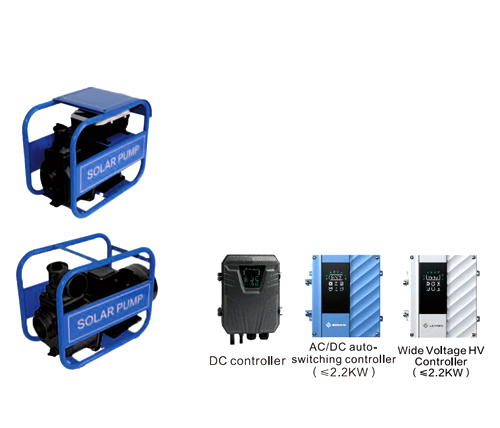
HVSU Series Wide Voltage Low Power Consumption DC Solar Centrifugal Pump
The main electrical advantage of the HVSU Series is its wide-voltage DC motor. The motor is designed to operate across a broad solar input range rather than depending on one fixed voltage point. This makes it suitable for solar installations where the electrical output changes during the day.
The 110 V to 350 V models include several options for medium-capacity pumping applications. The higher-voltage models operate within a 300 V to 350 V range and are paired with higher-power configurations. The solar panel open-circuit voltage must remain below 450 V, which provides an important system-design limit for selecting and wiring the solar modules.
A wide-voltage operating range can also simplify product selection. Installers may have more flexibility when arranging solar panels in series and parallel configurations, provided the final voltage and power remain within the specified limits. Correct electrical design remains essential, but the motor’s input range provides a practical foundation for different solar array layouts.
The HVSU Series is engineered for low power consumption while maintaining useful water output. Energy efficiency is particularly important in solar pumping because every watt affects the number of panels required, the cost of the installation, and the amount of water available during periods of limited sunlight.
The product data recommends a solar panel power capacity of at least 1.3 times the pump power. For example, a 750 W pump requires a recommended solar panel power of at least 975 W, while a 2,200 W pump requires at least 2,860 W of solar panel power. This design approach provides an energy margin that supports stable pumping and helps compensate for real-world losses caused by temperature, wiring, dust, orientation, and changing solar conditions.
Low power consumption also benefits users who need to transport water over moderate distances or fill storage tanks during the day. By using energy more effectively, the pump can help reduce the total cost of the solar array and make off-grid water supply more accessible for farms, gardens, homes, and remote projects.
The HVSU Series uses a centrifugal pump design to provide smooth and continuous water flow. Centrifugal pumps are well suited to applications where a relatively high volume of water must be moved through surface piping, irrigation systems, storage tanks, or transfer lines.
Compared with pumping systems intended mainly for narrow, high-pressure applications, the HVSU Series focuses on practical flow capacity. Its listed maximum flow rates range from 20 m³/h to 50 m³/h, allowing the product family to support different irrigation and water-transfer requirements. The hydraulic design is particularly relevant to gardens, orchards, small farms, household water storage, and off-grid transfer projects.
A centrifugal pump can also provide a stable discharge pattern when properly matched to the system curve. The actual flow will depend on total dynamic head, pipe length, pipe diameter, valves, fittings, water level, and other resistance factors. For this reason, the maximum flow rating should be used as a reference point rather than as a guaranteed flow under every operating condition.
The HVSU Series is not limited to one standard configuration. Seven listed models provide different combinations of power, maximum flow, maximum head, and outlet size. This range makes the product suitable for small residential installations as well as larger agricultural or commercial water-transfer projects.
The 750 W model delivers a maximum listed flow of 20 m³/h and a maximum head of 15 m. The 1,100 W model with the 2-inch outlet provides a maximum flow of 23 m³/h and a maximum head of 17 m. A 1,500 W model increases the maximum head to 25 m while maintaining a listed maximum flow of 23 m³/h.
For higher-capacity applications, the 2,200 W model with a 2-inch outlet provides a maximum listed flow of 28 m³/h and a maximum head of 30 m. The 3-inch outlet models provide higher flow capacity, including 35 m³/h, 43 m³/h, and 50 m³/h options. These configurations are useful where the application requires the movement of larger water volumes through a larger pipe network.
The pump is designed for relatively straightforward installation in surface applications. Its compact construction makes it suitable for rooftops, small farms, gardens, water-transfer points, and remote water projects where installation space may be limited.
A compact pump can reduce the amount of structural support, simplify handling, and make routine access easier. It may also be easier to integrate with a tank, filter, pipe manifold, irrigation line, or solar control system. The listed cable length is 0.6 m for the available models, so the installer should plan the electrical enclosure, junction point, and cable protection accordingly.
Compact installation does not mean that the pump can be installed without preparation. The foundation or mounting surface should be stable and level. The suction line should be properly sized and sealed. The pump should be protected from flooding, excessive dust, impact, and unsuitable ambient conditions. Correct installation is necessary to achieve the expected service life and hydraulic performance.
Selecting a solar pump should begin with the required water volume and the total head. Total head includes the vertical elevation between the water surface and the discharge point, as well as friction losses in pipes, bends, filters, valves, and other components. The required flow must then be considered together with the available sunlight and the desired daily operating schedule.
The term maximum flow describes the highest listed flow under favorable hydraulic conditions. The term maximum head describes the highest listed head under conditions where the flow may be substantially lower. These values should not be interpreted as simultaneous operating points. A complete system should be selected by reviewing the pump performance curve and matching the expected duty point to the curve.
The HVSU Series product information includes a performance-curves section for engineering reference. The curve should be reviewed together with the total dynamic head, required flow, and solar input. If the project requires a precise design, the installer should confirm the operating point with the supplier before finalizing the solar array and pipe system.
| Model | AC Voltage | Optimum DC Input Voltage | Power | Maximum Flow | Maximum Head | Outlet | Cable | Solar Panel Open-Circuit Voltage | Recommended Solar Panel Power |
|---|---|---|---|---|---|---|---|---|---|
| HVSU20-15-110-750 | / | 110 V–350 V | 750 W | 20 m³/h | 15 m | 2 in | 0.6 m | <450 V | At least 1.3 times pump power |
| HVSU23-17-110-1100 | / | 110 V–350 V | 1,100 W | 23 m³/h | 17 m | 2 in | 0.6 m | <450 V | At least 1.3 times pump power |
| HVSU23-25-100-1500 | / | 110 V–350 V | 1,500 W | 23 m³/h | 25 m | 2 in | 0.6 m | <450 V | At least 1.3 times pump power |
| HVSU28-30-300-2200 | / | 300 V–350 V | 2,200 W | 28 m³/h | 30 m | 2 in | 0.6 m | <450 V | At least 1.3 times pump power |
| HVSU30-15-110-1100 | / | 110 V–350 V | 1,100 W | 35 m³/h | 15 m | 3 in | 0.6 m | <450 V | At least 1.3 times pump power |
| HVSU43-17-100-1500 | / | 300 V–350 V | 1,500 W | 43 m³/h | 17 m | 3 in | 0.6 m | <450 V | At least 1.3 times pump power |
| HVSU50-20-300-2200 | / | 300 V–350 V | 2,200 W | 50 m³/h | 20 m | 3 in | 0.6 m | <450 V | At least 1.3 times pump power |
The model data shows an important distinction between flow-oriented and head-oriented configurations. The 2-inch models include options with higher head capability, including a 30 m maximum-head model. The 3-inch models emphasize higher water volume, reaching a listed maximum flow of 50 m³/h. This gives project planners a clear starting point when deciding whether the priority is pressure, elevation, or bulk water transfer.
For example, a small orchard irrigation system with moderate elevation and a high daily water requirement may benefit from a 3-inch model. A household storage system or a project requiring water to be lifted to a higher tank may require closer evaluation of the 2-inch models with greater head capability. The correct choice must always be verified against the system’s actual duty point.
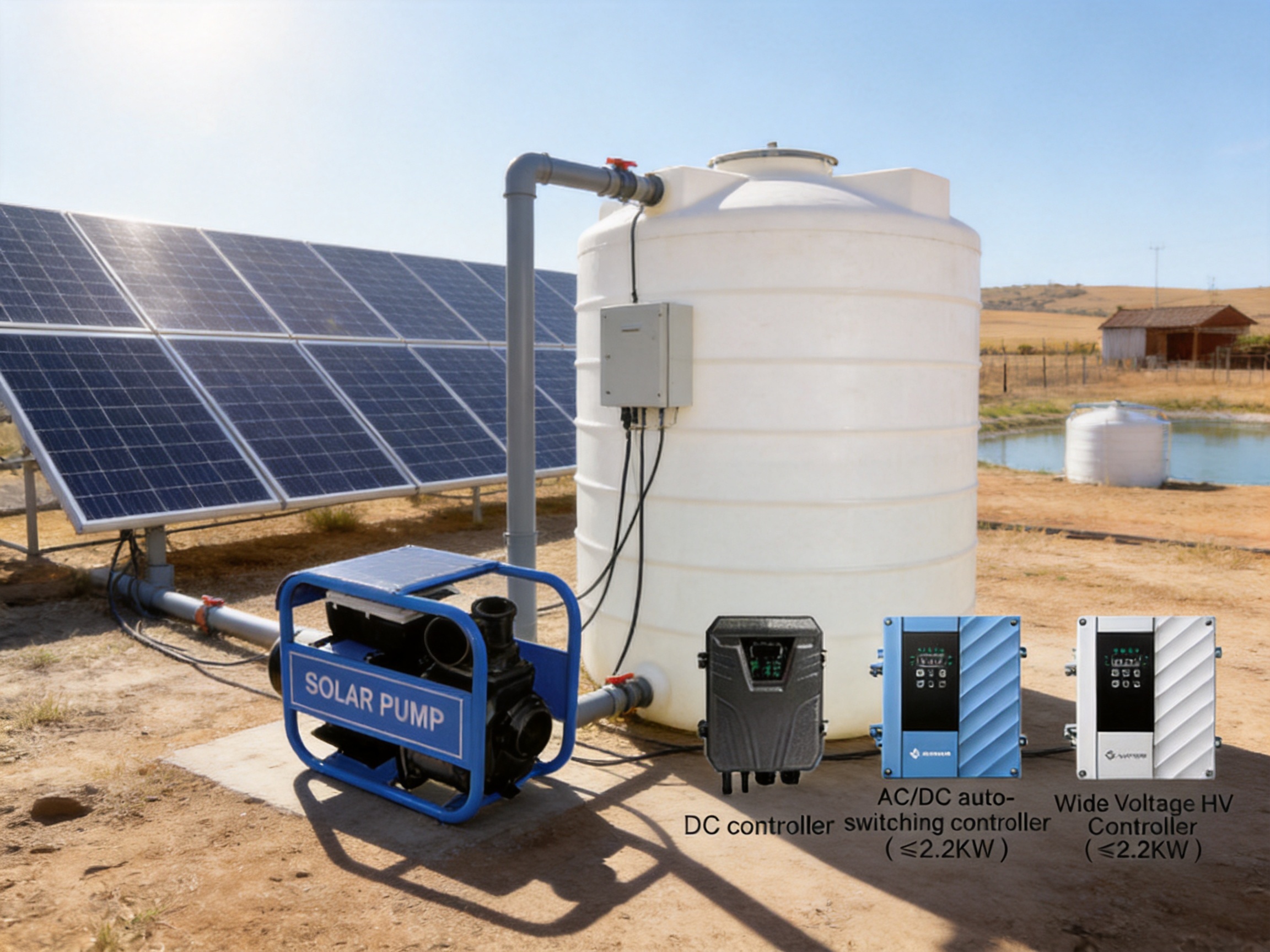
The HVSU Series can support household water supply in locations where grid electricity is limited or unavailable. Water may be drawn from a surface reservoir, collection tank, open water source, or other suitable source and transferred to a storage tank for later use.
Using a storage tank can make the complete system more reliable. The pump can operate when solar energy is available, while the stored water can be used in the evening or during temporary periods of cloud cover. This approach may reduce the need for batteries, depending on the household’s water schedule and storage capacity.
For domestic use, water quality and source conditions must be evaluated carefully. The HVSU Series is a centrifugal surface pump, so it should be applied within the appropriate suction and water-quality conditions. The water source should be free of excessive solids, abrasive particles, and contaminants that could damage the hydraulic components or make the water unsuitable for household use.
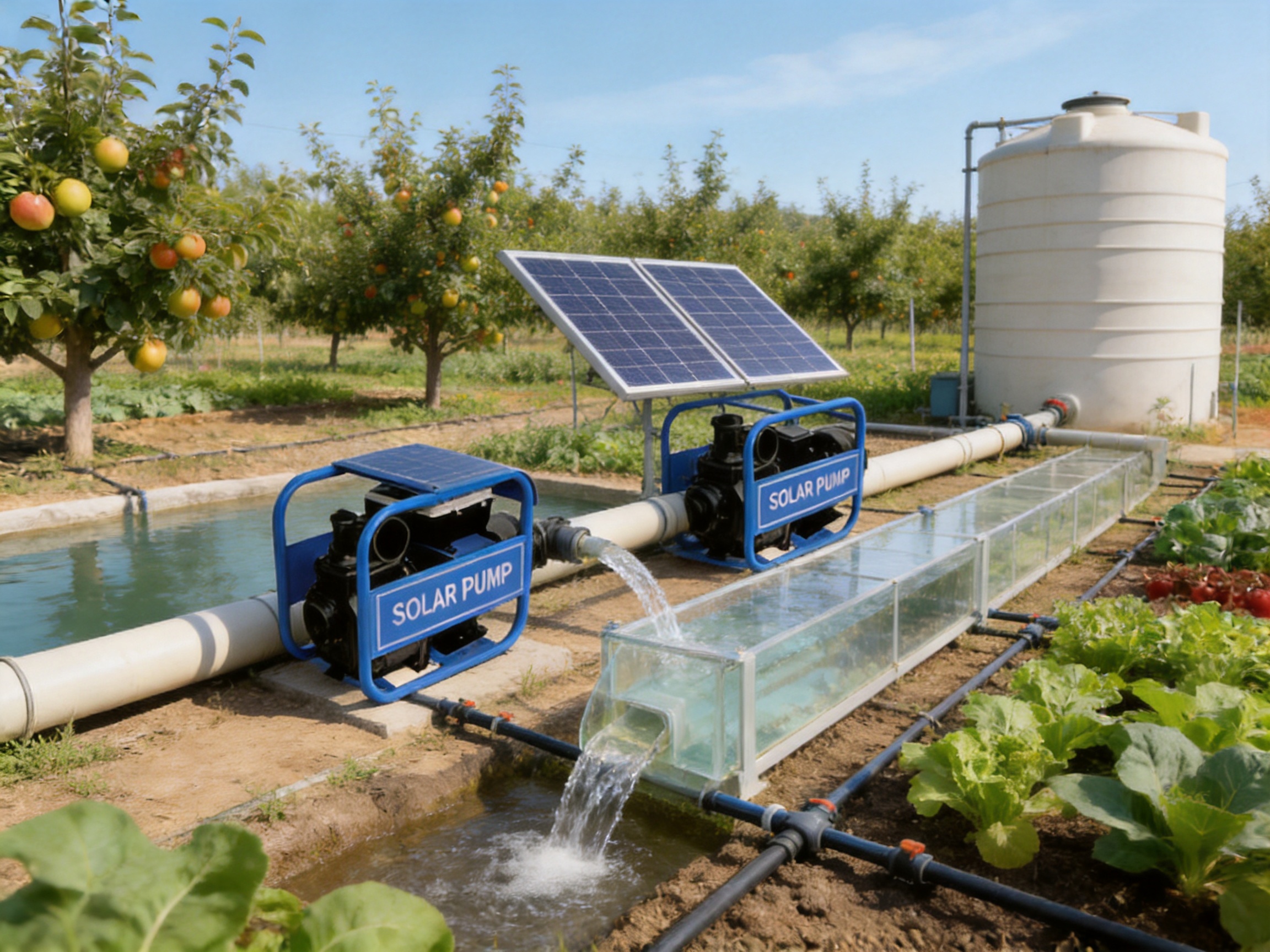
Gardens, orchards, and small farms often require a dependable supply of water during daylight hours. Solar pumping aligns naturally with irrigation because the strongest solar production often occurs during the same part of the day when irrigation is needed.
The pump can be connected to drip irrigation, sprinkler systems, storage tanks, or distribution manifolds, subject to the pressure and flow requirements of the selected equipment. A 3-inch model may be suitable for moving large volumes of water through a low-pressure irrigation network, while a 2-inch configuration may be considered where greater head is required.
Proper filtration is important in irrigation applications. Filters protect emitters, valves, and nozzles from blockage. The filter must be sized so that it does not create excessive pressure loss. The pump and filter should be selected as part of one hydraulic system rather than as separate components.
Remote construction areas, field stations, small community projects, and water storage sites may need to transfer water without access to conventional electricity. A solar centrifugal pump can provide a practical method for moving water from a source to a tank, pond, reservoir, or elevated distribution point.
Because the pump uses direct-current power and is designed for solar input, it can be integrated into an off-grid arrangement with solar panels and suitable protection equipment. The system can be designed to operate during daylight and fill a storage reservoir. This method reduces dependence on fuel-powered generators and can lower the need for routine fuel transport.
Small communities may require water transfer for storage, non-potable distribution, or local agricultural use. The HVSU Series offers multiple flow ranges that can be considered for these applications. The 3-inch models, in particular, provide higher listed flow rates for projects that need to move substantial volumes of water over relatively moderate heads.
Community projects require careful planning. Demand should be estimated by considering the number of users, seasonal conditions, livestock, irrigation needs, storage capacity, and acceptable pumping hours. The solar array must be sized for the required daily output rather than simply for the pump’s nominal wattage.
The HVSU Series offers several practical advantages when compared with pumps designed for a narrow electrical input or systems dependent entirely on grid electricity. These advantages do not mean that one pump is appropriate for every application. Instead, they show where the HVSU design is especially valuable.
A narrow-voltage motor may require a specific electrical input to start and operate correctly. Solar energy, however, changes continuously. The HVSU Series wide-voltage DC motor is better suited to the natural variation of photovoltaic power, especially when the system is correctly designed within the specified voltage limits.
This can improve the practical operating window and reduce the risk of losing useful pumping time during the morning and afternoon. It may also give installers more flexibility in arranging solar modules, although open-circuit voltage and operating voltage must always be checked carefully.
Compared with fuel-driven pumps, a solar pump does not require regular fuel delivery, fuel storage, engine oil, or combustion-engine maintenance. Compared with a conventional grid-connected pump, it can operate in remote locations and may reduce electricity costs.
The absence of fuel consumption is especially valuable in agricultural or remote areas where fuel transportation is inconvenient. Solar pumping can also reduce exposure to fluctuations in fuel prices. The main energy source is sunlight, while the principal ongoing requirements are inspection, cleaning, hydraulic maintenance, and electrical safety checks.
Some solar pumps are designed mainly for small household use, while other systems are built for much larger agricultural installations. The HVSU Series covers a useful middle range, with listed maximum flow rates from 20 m³/h to 50 m³/h. This makes it relevant to both domestic water transfer and small-scale agricultural applications.
The availability of 2-inch and 3-inch outlets also helps align the pump with different pipe networks. Larger outlet sizes can reduce flow resistance in high-volume applications when the rest of the installation is designed accordingly.
Low power consumption is an advantage not only for operating cost but also for system sizing. A lower-energy pump may require fewer solar modules, a smaller supporting structure, and less extensive wiring. These factors can contribute to a more manageable installation, particularly where transportation and construction resources are limited.
The recommended solar panel capacity of at least 1.3 times the pump power creates a practical design margin. It helps account for the difference between rated panel output and actual field performance. Although this recommendation does not replace a full solar assessment, it provides a clear starting point for system planning.
The product’s performance depends not only on its design but also on how consistently it is manufactured. Taizhou Edwin Electric Co., Ltd. operates as an integrated manufacturing enterprise with independent research and development, mass production, and global export capabilities. This structure supports the development of products for different markets while maintaining a consistent focus on pump quality and application suitability.
The company’s product portfolio includes deep well pumps, submersible pumps, domestic booster pumps, circulation pumps, solar water pumps, intelligent booster pumps, and related water-pumping products. Experience across these categories can strengthen the company’s understanding of hydraulic systems, motor performance, water supply requirements, and installation conditions.
A manufacturer with experience in several pump categories can also respond more effectively to projects requiring different pump types. For example, a solar surface pump may be used together with a storage tank, a booster pump, valves, pipes, or a submersible pump in a larger water system. Broader product knowledge supports more coordinated project planning.
Independent research and development is important for adapting pump products to changing market needs. Solar pumping requires attention to motor input range, energy efficiency, hydraulic matching, outdoor use, and system integration. The HVSU Series reflects this product-development direction through its wide-voltage DC motor and low-power centrifugal configuration.
Research and development also helps a manufacturer refine model ranges instead of offering only one general-purpose pump. The seven listed HVSU configurations demonstrate an effort to address different combinations of flow, head, power, and pipe size. This is useful for distributors and system integrators who need more than one standard option.
Mass production supports consistent availability for distributors, contractors, and international project customers. It can also support repeat orders, private-label programs, and larger procurement schedules, subject to specific commercial arrangements.
For a pump buyer, manufacturing capacity is relevant because project delays can occur when products are not available in sufficient quantities. An established production organization can help coordinate purchasing, inspection, packaging, and delivery. These capabilities are particularly important when pumps are being supplied for multiple agricultural sites, housing projects, or regional distribution networks.
Reliable pump manufacturing requires control at multiple stages. Materials must be selected for the intended operating conditions. Motor components, hydraulic components, seals, wiring, and connections must be assembled accurately. The completed pump should be checked for appearance, electrical function, and operating performance according to the manufacturer’s internal procedures.
The supplied company information emphasizes reliable quality and recognition among customers worldwide. For purchasers, quality should be evaluated through technical documentation, sample testing, inspection arrangements, consistency between batches, packaging standards, and after-sales communication. These factors are as important as nominal flow and power ratings when the pump will be installed in a demanding location.
Taizhou Edwin Electric Co., Ltd. established related import and export organizations to support procurement planning, order tracking, cross-border delivery, and foreign trade services. This one-stop approach can simplify communication for international customers who require both product supply and logistical coordination.
International pump projects often involve more than manufacturing. Customers may need assistance with model selection, documentation, packaging, shipment scheduling, spare parts, and communication across time zones. A dedicated export and service structure can help reduce friction throughout the purchasing process.
The solar array should be designed according to the pump’s power and electrical input range. The product information recommends solar panel power of at least 1.3 times the pump power. The array’s open-circuit voltage must remain below 450 V, and the operating voltage must match the range specified for the selected model.
For the 110 V to 350 V models, the array should be arranged so that the operating voltage can reach the required range under expected sunlight while remaining within the maximum allowable open-circuit voltage during cold or high-voltage conditions. For the 300 V to 350 V models, the array must be planned more carefully because the operating window is narrower and starts at a higher voltage.
Panel orientation, tilt, shading, cable length, conductor size, and local climate all affect real output. A professional installer should review these factors before installation. The solar array should include appropriate disconnects, overcurrent protection, grounding, and weather-resistant connections in accordance with local electrical requirements.
As a surface pump, the HVSU Series should be installed with attention to suction conditions. The suction pipe should be as short and direct as practical, with a suitable diameter and airtight connections. Unnecessary bends, undersized piping, and poorly sealed joints can reduce performance and cause operating problems.
The pump should not be allowed to run dry. If the water source level can fall, the system should include an appropriate water-level protection method or operating procedure. A foot valve or other suitable intake arrangement may be required depending on the installation design and local conditions.
The discharge system should be designed around the required flow and head. Pipe diameter, length, elevation, fittings, filters, valves, and irrigation devices all contribute to total resistance. The outlet size of the pump should be considered when selecting the main discharge pipe.
Isolation valves can simplify maintenance, while a check valve may help prevent unwanted reverse flow where appropriate. The valve arrangement should not create excessive restriction. If the system includes a storage tank, float control, pressure control, or automatic irrigation equipment, the pump should be evaluated under each relevant operating condition.
The pump should be mounted on a stable surface that limits vibration and protects the unit from standing water. Outdoor installation should include suitable protection from rain, direct physical impact, excessive dust, and unauthorized access. Electrical connections must be protected from moisture and ultraviolet exposure.
The cable length listed for the models is 0.6 m. This means the connection point should be located close enough to the pump for safe routing, while still allowing proper service access. Cable extensions, if needed, must be selected and installed according to the electrical load, voltage, environment, and local regulations.
Solar pumping systems are often installed in places where service access is difficult. Preventive maintenance therefore plays an important role in protecting the investment. Regular inspections should include the solar panels, cable connections, pump mounting, suction line, discharge line, filters, valves, and water-source conditions.
Solar panels should be kept reasonably clean because dust, pollen, leaves, and bird deposits can reduce energy production. Shading from new vegetation or nearby construction should also be checked. A decline in sunlight reaching the panels may appear as reduced pump output even when the pump itself is operating normally.
Filters should be inspected and cleaned according to the water quality and application. A blocked filter increases pressure loss and may reduce the delivered flow. Irrigation systems should also be checked for damaged pipes, blocked emitters, leaking fittings, and incorrectly adjusted valves.
The pump should be inspected for unusual noise, vibration, leakage, overheating, or changes in water output. Any change in performance should be investigated before it develops into a more serious problem. If the system is seasonal, the pump and piping should be protected from freezing, sediment buildup, or extended periods of unsuitable operation.
Routine service should be carried out by qualified personnel. Electrical work involving high-voltage DC solar arrays can be hazardous even when the pump is not running. The solar array should be isolated using suitable procedures before electrical maintenance begins.
Distributors should consider the full model range rather than purchasing only one configuration. A combination of 2-inch and 3-inch models may allow a distributor to serve household, garden, irrigation, and water-transfer customers more effectively.
Project buyers should provide accurate application details when requesting a quotation. These details should include the water source, required daily volume, target flow, vertical lift, pipe length, pipe diameter, water quality, available solar area, local sunlight conditions, and preferred storage method. Better application information allows the correct model to be selected and reduces the risk of an improperly sized system.
Bulk buyers may also need to confirm packaging, labeling, documentation, spare parts, inspection procedures, lead times, and shipping arrangements. Because the company supports international export and order tracking, these matters can be coordinated as part of the procurement process.
Product support is particularly important for solar pumps because the pump and solar array must work together. A supplier that can provide technical information about voltage ranges, recommended solar power, outlet sizes, and performance data offers greater value than a supplier that provides only a nominal wattage.
The HVSU Series is a DC surface solar centrifugal pump. It is intended for surface water pumping, transfer, household supply, irrigation, storage filling, and other suitable off-grid applications.
The motor is designed for a wide DC input voltage range. Depending on the model, the optimum input range is 110 V to 350 V or 300 V to 350 V. This allows the pump to work with changing solar conditions when the solar array is correctly designed.
The product is designed for solar-powered operation and uses DC input. The complete installation must still include suitable electrical protection, correct wiring, and a solar array that meets the specified voltage and power requirements. The open-circuit voltage of the solar panel system must remain below 450 V.
The product information recommends solar panel power of at least 1.3 times the pump power. The exact array design depends on the selected model, local sunlight, panel characteristics, wiring losses, and the required operating schedule.
The listed maximum flow rates range from 20 m³/h to 50 m³/h across the available models. Actual flow depends on head, pipe resistance, valves, filters, water level, and the operating point shown on the pump performance curve.
The listed maximum head values range from 15 m to 30 m. Maximum head and maximum flow are different operating limits and should not be assumed to occur at the same time. The correct duty point should be checked against the performance curve.
The HVSU30-15-110-1100, HVSU43-17-100-1500, and HVSU50-20-300-2200 models have a listed 3-inch outlet. These models emphasize higher flow capacity, with listed maximum flows of 35 m³/h, 43 m³/h, and 50 m³/h respectively.
The HVSU23-25-100-1500 model has a listed maximum head of 25 m, while the HVSU28-30-300-2200 model has a listed maximum head of 30 m. The final choice must be based on the actual duty point and complete hydraulic system.
It can be suitable for solar-powered household water transfer and storage applications when correctly selected and installed. Water quality, suction conditions, storage requirements, filtration, and local health regulations must be considered before using the system for domestic purposes.
Yes. The product is intended for applications including gardens, orchards, small farms, and solar-powered irrigation. The pump should be matched with the irrigation flow, pressure, filtration, pipe network, and daily water requirement.
The supplied product information describes the pump as a DC solar pump but does not specify that batteries are required. A system may be designed to pump during sunlight hours and store water in a tank. Whether batteries, a controller, or additional equipment are needed depends on the final system architecture and operating schedule.
The HVSU Series is manufactured by Taizhou Edwin Electric Co., Ltd., an integrated pump manufacturer founded in 2008. The company focuses on research and development, mass production, international export, and a broad range of water-pumping products.
The HVSU Series Wide Voltage Low Power Consumption DC Solar Centrifugal Pump is a practical solution for users who need reliable water transfer without depending entirely on grid electricity or fuel. Its wide-voltage DC motor is designed for variable solar conditions, while its centrifugal hydraulic design provides smooth flow for household, agricultural, and off-grid applications.
The available models cover 750 W to 2,200 W, maximum flow rates from 20 m³/h to 50 m³/h, maximum heads from 15 m to 30 m, and 2-inch or 3-inch outlet configurations. This range gives installers and project planners flexibility when matching the pump to water demand, pipe size, elevation, and solar resources.
Its principal advantages include energy-conscious operation, broad DC voltage compatibility, practical flow capacity, compact installation, and suitability for remote projects. When combined with correct solar array sizing, proper hydraulic design, suitable filtration, and regular maintenance, the HVSU Series can support efficient and dependable water supply in many locations.
The product is also supported by the manufacturing and export capabilities of Taizhou Edwin Electric Co., Ltd. The company’s experience in multiple pump categories, independent research and development, mass production, quality-oriented production, and international order services provides a strong foundation for distributors, contractors, and industrial customers seeking a long-term solar pumping supply partner.
1. HVSU Series product performance data, including model power, voltage range, maximum flow, maximum head, outlet size, cable length, solar open-circuit voltage, and recommended solar panel power.
2. HVSU Series product feature information concerning the wide-voltage DC motor, centrifugal pump design, low power consumption, compact installation, and intended applications.
3. Taizhou Edwin Electric Co., Ltd. company information concerning manufacturing history, product categories, research and development, mass production, global export, and procurement services.
4. General principles of centrifugal pump selection, including the relationship between flow, head, total dynamic head, pipe resistance, valves, filters, and system duty points.
5. General photovoltaic water-pumping design principles concerning solar array sizing, variable solar input, open-circuit voltage, operating voltage, energy margins, and storage-based water distribution.
edwina@edwin-pump.com
+86-13586290903 (WhatsApp)
Xuri Gongliang Cutting Tool Entrepreneurship Park, Wenqiao Town, Wenling City, Taizhou City, Zhejiang Province, China

High Performance Smart Pump Factory


 English