
edwina@edwin-pump.com

View All Products
en
Solar-powered water pumping projects often involve challenging operating conditions, including deep wells, elevated storage tanks, remote agricultural areas, and locations without reliable grid electricity. High-pressure applications require careful coordination between hydraulic performance and available solar energy. A pump with sufficient motor power may still fail to meet the project's daily water delivery target if the site conditions are not properly evaluated.
At Edwin, we believe that preparing accurate technical information before requesting a quotation helps buyers reduce specification errors and simplify equipment evaluation. A high pressure solar water pump project requires several key inputs, including water demand, total dynamic head, solar irradiation, water source characteristics, and electrical installation conditions. This article outlines the site data that distributors, contractors, and engineering purchasers should prepare before discussing a solar pumping solution with us.
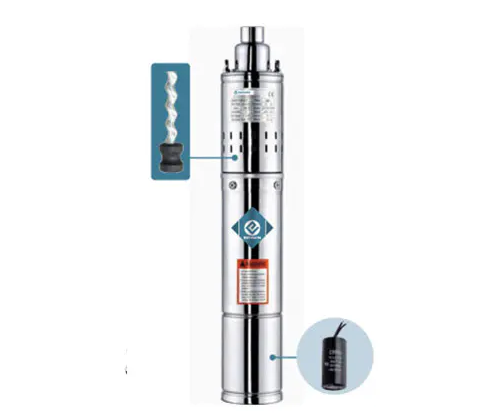
The required water volume determines how much pumping work the system must complete each day. Project buyers should calculate actual consumption rather than relying on an estimated pump flow rate.
Different applications have different delivery requirements. Agricultural irrigation, livestock watering, industrial water supply, and remote community projects should be evaluated separately.
For example, a project requiring 30 m³ of water per day needs a different pumping arrangement from a site requiring 10 m³, even when both locations have similar elevation differences.
Total Dynamic Head (TDH) represents the energy required to transport water from its source to the delivery point. High-pressure solar pumping projects require accurate measurements because vertical elevation and pipeline resistance directly influence pump performance.
For borehole installations, buyers should provide the resting water level, pumping water level, borehole depth, and expected drawdown. The delivery height from the water source to the storage tank or final outlet must also be recorded.
Pipe friction depends on several installation details:
A simplified TDH calculation is:
TDH = Static Head + Drawdown + Friction Losses + Required Delivery Head
For example, a pumping project may have 45 m of static head, 5 m of drawdown, 8 m of pipeline losses, and 12 m of required delivery head. The estimated TDH is 70 m. The final pump specification should be verified against the manufacturer's performance curve at the required flow rate.
Solar energy availability affects the daily pumping schedule and the electrical capacity required by the system. A project located in a high-solar-irradiation region may achieve different daily output from an installation operating under frequent cloud cover.
We recommend collecting the following information before evaluating the PV array:
Panel orientation, tilt angle, ventilation, and installation space should also be evaluated. Seasonal irradiation data is particularly useful for projects requiring consistent water delivery throughout the year.
The water source influences pump construction, installation depth, and material requirements. A deep borehole, open reservoir, river, or underground storage tank may require different pump configurations.
At Edwin, we recommend that buyers provide these source-related details:
Water containing abrasive particles or corrosive substances may require particular attention to hydraulic components and wetted materials. Pump compatibility should be confirmed through the manufacturer's technical specifications.
A solar pumping installation generally integrates three major components: photovoltaic panels, a pump controller, and an electric motor-pump assembly. Their electrical specifications must be compatible throughout the operating range.
| Technical Parameter | Information to Confirm |
| PV Array | Total rated power, panel quantity, voltage, and current |
| Pump Motor | Rated power, voltage, frequency, and operating current |
| Solar Controller | Input voltage range, output compatibility, and protection functions |
| Electrical Cables | Cable length, conductor size, and voltage drop |
| Protection | Dry-running, overload, overvoltage, and other applicable protections |
Buyers should also indicate whether the project requires battery storage, direct solar operation, or a hybrid power arrangement. These decisions affect system architecture, investment costs, and operating flexibility.
To help us evaluate project requirements, we suggest preparing a technical information sheet covering the following items:
Drawings, borehole test reports, site photographs, and existing equipment specifications can also help clarify installation conditions. With these details, our team can review the hydraulic requirements and assess the compatibility of the pump, motor, controller, and solar array.
Successful high-pressure solar pumping projects depend on coordinated hydraulic and electrical planning. Daily water demand defines the required delivery capacity, TDH establishes the pumping workload, and solar irradiation determines the available energy throughout the operating season. Water quality, installation depth, and controller compatibility add further considerations to the technical assessment.
At Edwin, we work with project purchasers and distribution partners to evaluate solar pump requirements based on actual site conditions. Providing detailed project measurements before requesting a quotation makes technical communication more straightforward and helps us discuss suitable product configurations. Contact our team with your application details to begin evaluating a solar water pumping solution for your project.
edwina@edwin-pump.com
+86-13586290903 (WhatsApp)
Xuri Gongliang Cutting Tool Entrepreneurship Park, Wenqiao Town, Wenling City, Taizhou City, Zhejiang Province, China

High Performance Smart Pump Factory


 English