edwina@edwin-pump.com

View All Products
en
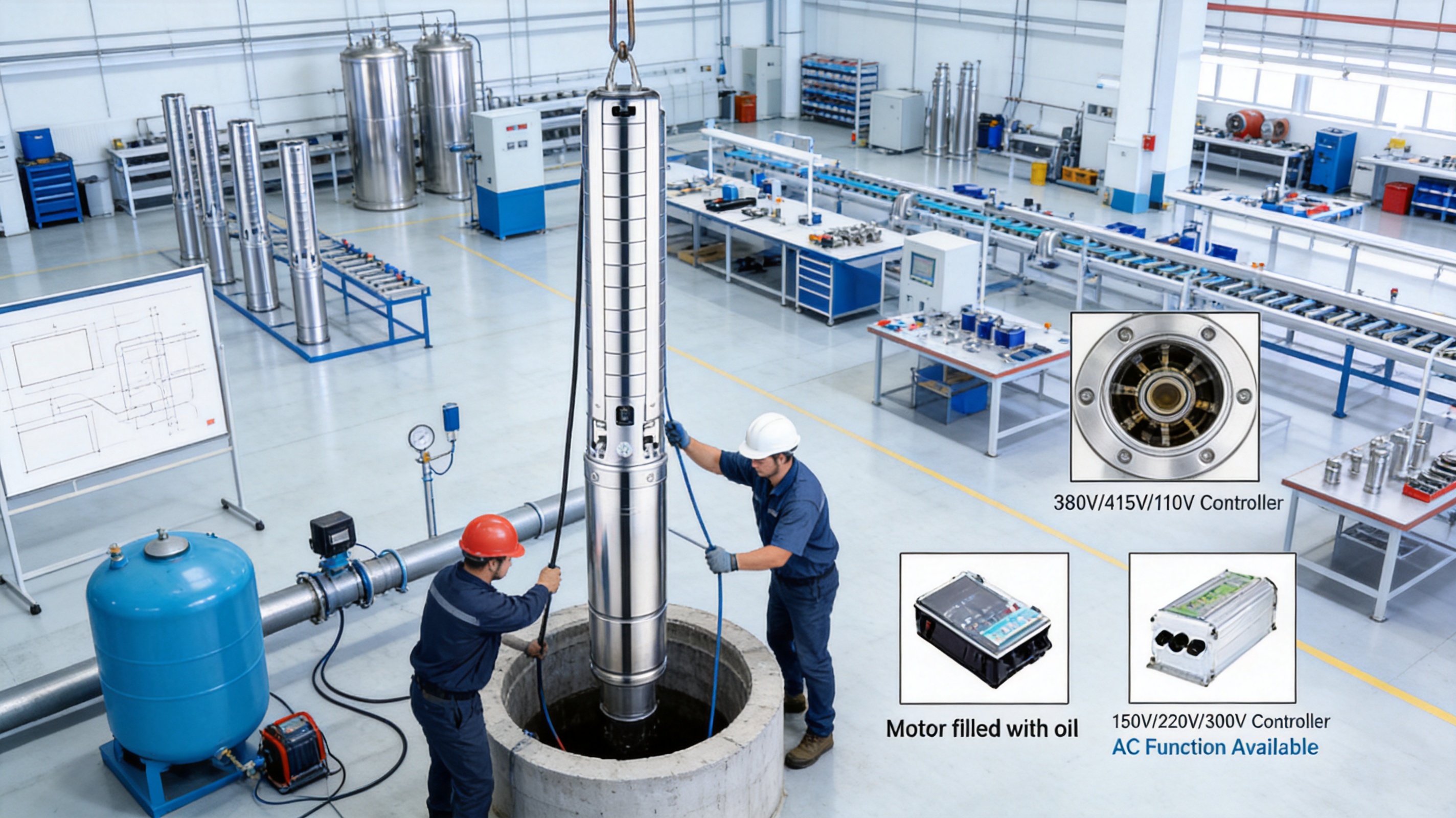
Reliable access to water is essential for agriculture, livestock production, rural communities, construction sites, mining operations, and remote industrial facilities. In locations where grid electricity is unavailable, unstable, or expensive to extend, solar-powered pumping provides a practical alternative. The 4ESSC solar submersible borehole pump is designed for these conditions, combining a narrow 4-inch submersible format with multiple voltage, power, flow, and head configurations.
This product family is developed and manufactured by Taizhou Edwin Electric Co., Ltd., an integrated pump enterprise with experience in independent research and development, mass production, and international export. The company’s wider portfolio includes deep well pumps, submersible pumps, domestic booster pumps, circulation pumps, solar water pumps, intelligent booster pumps, and related water-treatment products.
The 4ESSC series is not a single fixed pump model. It is a complete range intended to cover different hydraulic requirements. Available versions begin with a 300 W, 36 V model and extend to 3,000 W, 300 V configurations. Maximum listed flow rates range from 3.5 to 20 m³/h, while maximum listed heads range from 24 to 300 m. This range allows users to select a pump according to well depth, required delivery volume, pipeline resistance, solar-system design, and application conditions.
Compared with many conventional borehole pumping solutions, the key advantage of the 4ESSC concept is its suitability for solar-powered water supply. The pump can be used in systems designed around photovoltaic energy, reducing dependence on traditional grid power or fuel-driven generators. Its 4-inch diameter also supports installation in many standard boreholes where larger submersible equipment may not fit.
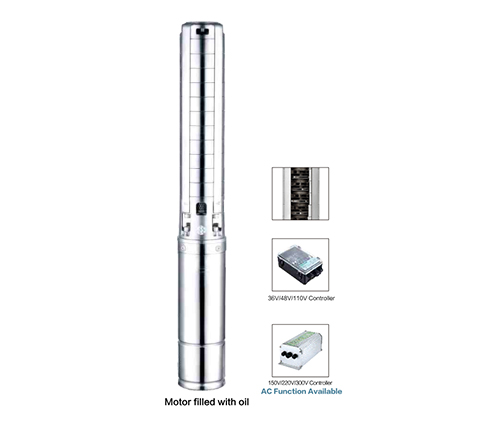
4ESSC Solar submersible borehole pump
The 4ESSC is a solar submersible borehole pump intended for installation inside a drilled well or deep-water source. Because the pump operates below the water surface, it pushes water upward through the delivery pipe rather than relying on surface suction. This arrangement is particularly suitable for deep wells, where a surface pump may face suction limitations, priming problems, or reduced efficiency.
The product family includes models designed for low-power domestic or agricultural water supply as well as high-head applications. Smaller versions, such as the 4ESSC3.5-24-36/300, operate at 36 V and 300 W. Higher-capacity versions, including the 4ESSC20-80-300/3000, operate at 300 V and 3,000 W and can provide high flow at substantial delivery head.
The model codes contain useful selection information. In general, the first numerical value identifies the approximate maximum flow category, the following value represents the approximate maximum head category, the voltage appears before the slash, and the wattage appears after the slash. For example, the model 4ESSC12-140-300/3000 belongs to the approximately 12 m³/h flow class, the 140 m head class, the 300 V voltage group, and the 3,000 W power group.
Actual pump selection should not be based only on the maximum figures in a model name. The correct operating point depends on the required flow and total dynamic head. Total dynamic head includes the vertical lift from the water level to the discharge point, pipeline friction, fittings, valves, filters, tanks, and any required pressure. A pump that reaches a high shutoff head may deliver a much lower flow at that head than it delivers at a lower lift.
The 4ESSC series has a compact 4-inch pump diameter across the listed configurations. This dimensional format is valuable for borehole projects because it supports installation in wells with restricted internal diameter. The available outlet sizes include 1.25 inches, 1.5 inches, and 2 inches, allowing the user to match the discharge connection to the desired flow range and pipe arrangement.
The series covers a broad electrical range. The listed voltage groups are 36 V, 48 V, 110 V, 150 V, 220 V, and 300 V. Power options include 300 W, 500 W, 1,000 W, 1,500 W, 2,200 W, and 3,000 W. This provides flexibility when designing a photovoltaic array, controller, battery-supported installation, or hybrid solar and grid system.
Flow capability extends from small water-transfer duties to larger irrigation and commercial requirements. The listed maximum flow rates include 3.5, 4, 5, 5.5, 6.7, 7, 7.5, 12, 18, and 20 m³/h. Maximum listed head values include 24, 30, 47, 53, 60, 62, 70, 77, 80, 88, 90, 108, 123, 128, 130, 140, 175, 190, 195, 215, 220, and 300 m, depending on the model.
The following table summarizes the listed configurations. The maximum flow and maximum head values are reference figures taken from the supplied product information. Actual performance should be confirmed against the applicable pump curve and the conditions of the installation.
| Model | Voltage | Power | Maximum Flow | Maximum Head | Outlet | Pump Diameter |
|---|---|---|---|---|---|---|
| 4ESSC3.5-24-36/300 | 36 V | 300 W | 3.5 m³/h | 24 m | 1.25 in | 4 in |
| 4ESSC4-62-48/500 | 48 V | 500 W | 4 m³/h | 62 m | 1.25 in | 4 in |
| 4ESSC7.5-34-48/500 | 48 V | 500 W | 7.5 m³/h | 30 m | 1.25 in | 4 in |
| 4ESSC5-128-110/1000 | 110 V | 1,000 W | 5 m³/h | 123 m | 1.25 in | 4 in |
| 4ESSC5.5-90-110/1000 | 110 V | 1,000 W | 5.5 m³/h | 90 m | 1.25 in | 4 in |
| 4ESSC6.7-88-110/1000 | 110 V | 1,000 W | 6.7 m³/h | 82 m | 1.5 in | 4 in |
| 4ESSC7.5-70-110/1000 | 110 V | 1,000 W | 7.5 m³/h | 70 m | 1.5 in | 4 in |
| 4ESSC12-53-110/1000 | 110 V | 1,000 W | 12 m³/h | 53 m | 2 in | 4 in |
| 4ESSC18-29-110/1000 | 110 V | 1,000 W | 18 m³/h | 29 m | 2 in | 4 in |
| 4ESSC4-190-150/1500 | 150 V | 1,500 W | 4 m³/h | 190 m | 1.25 in | 4 in |
| 4ESSC7-130-150/1500 | 150 V | 1,500 W | 7 m³/h | 130 m | 1.5 in | 4 in |
| 4ESSC12-77-150/1500 | 150 V | 1,500 W | 12 m³/h | 77 m | 2 in | 4 in |
| 4ESSC18-60-150/1500 | 150 V | 1,500 W | 18 m³/h | 60 m | 2 in | 4 in |
| 4ESSC4-215-220/2200 | 220 V | 2,200 W | 4 m³/h | 215 m | 1.25 in | 4 in |
| 4ESSC5-195-220/2200 | 220 V | 2,200 W | 5 m³/h | 195 m | 1.25 in | 4 in |
| 4ESSC7.5-175-220/2200 | 220 V | 2,200 W | 7.5 m³/h | 175 m | 1.5 in | 4 in |
| 4ESSC12-108-220/2200 | 220 V | 2,200 W | 12 m³/h | 108 m | 2 in | 4 in |
| 4ESSC20-47-220/2200 | 220 V | 2,200 W | 20 m³/h | 47 m | 2 in | 4 in |
| 4ESSC4-300-300/3000 | 300 V | 3,000 W | 4 m³/h | 300 m | 1.25 in | 4 in |
| 4ESSC7-220-300/3000 | 300 V | 3,000 W | 7 m³/h | 220 m | 1.5 in | 4 in |
| 4ESSC12-140-300/3000 | 300 V | 3,000 W | 12 m³/h | 140 m | 2 in | 4 in |
| 4ESSC20-80-300/3000 | 300 V | 3,000 W | 20 m³/h | 80 m | 2 in | 4 in |
The strongest differentiating feature of the 4ESSC family is its alignment with solar pumping applications. A conventional AC pump usually requires a stable electrical grid or a generator. In remote agricultural and rural locations, those sources may be unavailable or costly to operate. A solar submersible pump can use energy generated during daylight hours, making it suitable for autonomous or semi-autonomous water systems.
Solar pumping is especially effective when water can be stored in a tank. Instead of requiring the pump to operate continuously at a constant flow, the system can pump during periods of sunlight and store water for use later. This approach reduces the need for large battery banks, lowers maintenance requirements, and can make the overall project more economical.
The range of voltage and power options also gives system designers more freedom. Low-voltage models may be appropriate for compact photovoltaic systems or small remote installations. Higher-voltage models can help reduce current in the electrical circuit for a given power level, potentially reducing cable losses and conductor size when the system is properly engineered.
A 4-inch pump diameter allows the 4ESSC to fit many narrow boreholes. Smaller boreholes can require less drilling material, less casing, and less site space than larger wells. The compact format is therefore useful for residential wells, farms, rural water projects, and locations where drilling access is limited.
Compared with oversized pumping equipment, a correctly selected 4-inch model can simplify installation and reduce the amount of infrastructure required around the well. It may also be easier to replace or service within a standard borehole casing. The actual clearance must always be checked, including the outer diameter of the complete pump assembly, cable, pipe, couplings, and any protective components.
One of the problems with single-model pump offerings is that the pump may be too powerful for a small well or unable to meet the required head for a deep installation. The 4ESSC range addresses this issue by providing multiple hydraulic patterns within the same general product family.
For low-head, higher-volume duties, models such as the 4ESSC18-29-110/1000 or 4ESSC20-47-220/2200 may be considered, subject to the operating curve. For high-head, lower-flow applications, models such as the 4ESSC4-190-150/1500, 4ESSC4-215-220/2200, or 4ESSC4-300-300/3000 provide a different hydraulic profile. This makes the product family more adaptable than a pump range built around only one flow and head combination.
Diesel generators can provide strong power output, but they involve fuel transportation, storage, noise, emissions, engine servicing, and mechanical wear. In remote areas, the cost and difficulty of delivering fuel can be significant. A solar pumping system based on a 4ESSC pump can reduce these operating burdens when the available solar resource is sufficient.
Solar energy also has a predictable daily pattern. For irrigation systems, this can be advantageous because water demand often occurs during the same daytime period when solar generation is available. With a properly sized storage tank, the water supply can remain available beyond daylight hours without requiring continuous pump operation.
The product range supports staged development. A small installation may begin with a lower-power pump and a modest solar array. If water demand increases, the project can be reassessed and upgraded with a higher-capacity configuration, larger storage, or additional distribution infrastructure. This flexibility is useful for farms, villages, and commercial sites that expand gradually.
Flow and head are interconnected. A pump does not normally deliver its maximum flow and maximum head at the same time. Maximum head is generally associated with a near-zero-flow condition, while maximum flow is associated with a lower head. The operating point is established where the pump curve intersects the system curve.
The supplied performance information provides selected head values at different flow rates for several model groups. For example, the 4ESSC18-29-110/1000 is listed with a head of approximately 29 m at zero flow and shows a gradual reduction in head as flow rises. The listed points include approximately 26 m at 2 m³/h, 23 m at 4 m³/h, 21 m at 6 m³/h, 20 m at 8 m³/h, 18 m at 10 m³/h, and lower values at higher flow rates.
Similarly, the 4ESSC12-53-110/1000 is shown with approximately 53 m at zero flow, 43 m at 2 m³/h, 35 m at 4 m³/h, 28 m at 6 m³/h, 25 m at 8 m³/h, 16 m at 10 m³/h, and approximately 2 m at 12 m³/h. These points illustrate why the required flow must be identified before selecting a model.
The 1,500 W group includes high-head and high-flow alternatives. The 4ESSC4-190-150/1500 is intended for a lower flow and higher head profile, while the 4ESSC18-60-150/1500 provides a higher flow profile with a lower maximum head. The 2,200 W and 3,000 W groups follow the same principle, offering both high-head and high-flow choices.
Some supplied table entries contain abbreviated or incomplete curve points, and certain maximum-head values differ slightly from selected curve values. This is common when a product listing combines nominal model data with summarized performance points. For engineering procurement, the buyer should request the latest official pump curve, operating range, electrical requirements, allowable installation conditions, and controller compatibility for the selected model.
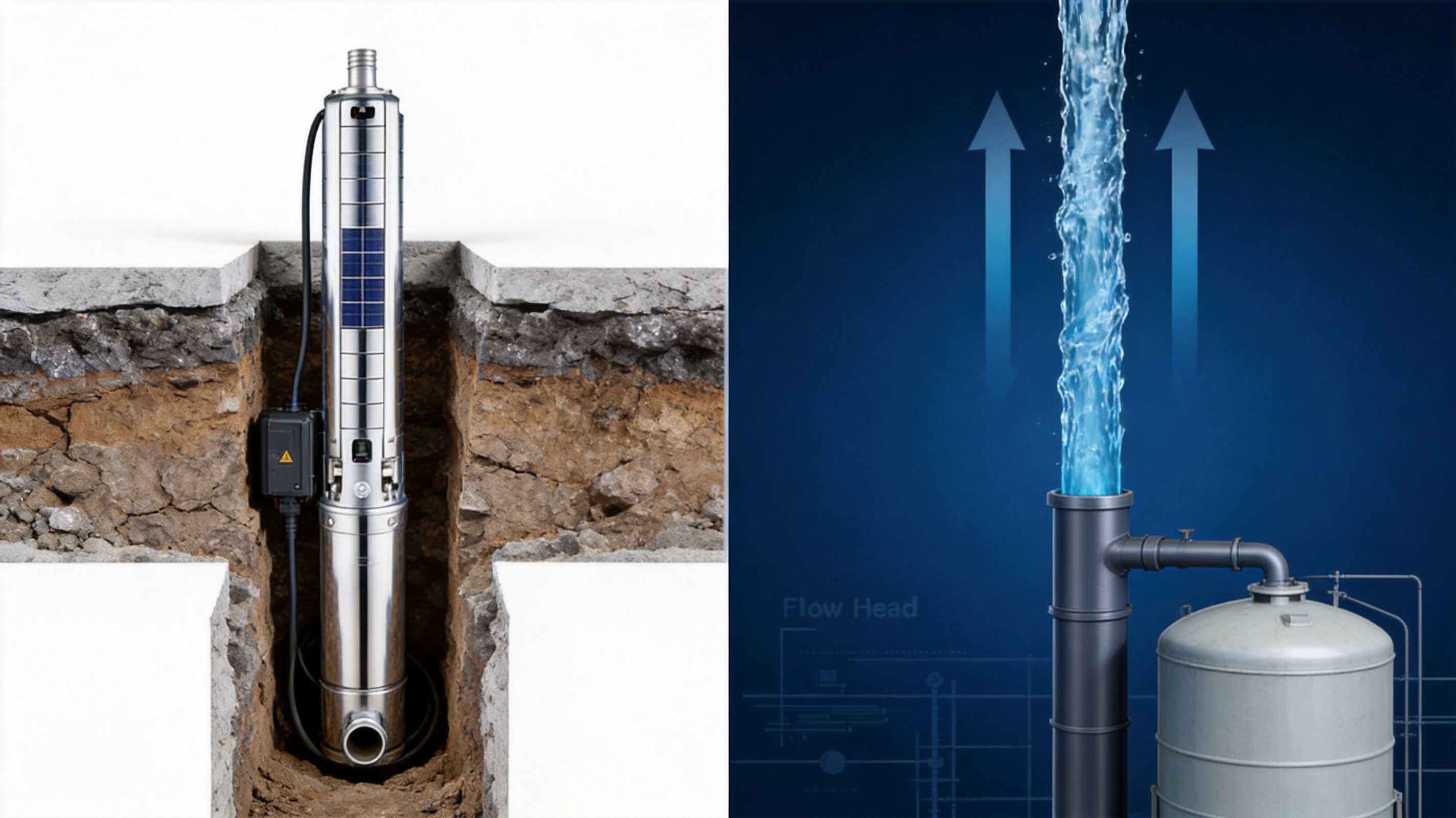
Begin by calculating the quantity of water required over a given period. Agricultural demand may be expressed in cubic meters per day, while household applications may be expressed in liters per minute or cubic meters per hour. Convert all figures into consistent units before comparing them with the pump range.
For example, a requirement of 36 m³ per day does not necessarily mean that the pump must deliver 36 m³/h. If the pump operates for six effective solar hours per day, the average required flow during operation would be approximately 6 m³/h, excluding system losses and reserve capacity. A storage tank may allow the pump to operate during the strongest sunlight hours while water is used throughout the day.
Total dynamic head is more than the depth of the well. It normally includes the vertical distance from the dynamic water level to the discharge point, the elevation difference between the water source and destination, pipe friction, bends, valves, filters, and pressure requirements at the outlet.
The dynamic water level should be used instead of the static water level whenever possible. Pumping can lower the water level, particularly in wells with limited recharge. If the pump is selected using only the static level, the actual operating head may be higher than expected and the delivered flow may be lower.
The pump should not withdraw water faster than the well can sustainably provide. A high-capacity model may appear attractive because it offers a larger flow rate, but excessive pumping can lower the water level, cause the pump to run dry, increase sand movement, or damage the well structure.
A well-development test or pumping test can help determine the sustainable yield. The selected pump should be matched to that yield and to the desired operating schedule. For solar irrigation, it is often preferable to pump at a controlled rate into a tank rather than extract water aggressively for short periods.
The photovoltaic array, controller, cables, protection devices, and pump must be electrically compatible. A 36 V pump requires a different array and control arrangement from a 220 V or 300 V model. The system designer should consider the panel voltage at maximum power, open-circuit voltage, current, cable length, ambient temperature, shading, and controller input limits.
Solar irradiance changes throughout the day. A system that works under strong midday sunlight may produce reduced flow during early morning, late afternoon, cloudy weather, or seasonal conditions. The pump controller should be selected to manage the available solar input and provide appropriate protection against overcurrent, under-voltage, dry running, overload, and abnormal operating conditions where supported by the complete system.
The listed outlet sizes are 1.25 inches, 1.5 inches, and 2 inches. The discharge pipe should be selected according to flow rate, pipe length, allowable friction loss, installation cost, and local standards. A pipe that is too small can increase friction and reduce the delivered head at the required flow.
For long rising mains, increasing the pipe diameter can reduce energy losses and improve the total system performance. The outlet size of the pump is an important reference, but it does not automatically determine the ideal pipe diameter for every installation. A hydraulic calculation should be completed before final procurement.
Agricultural irrigation is one of the most suitable applications for the 4ESSC solar pump. Farms located far from the electrical grid can use solar panels to lift groundwater into a reservoir, irrigation pond, elevated tank, or pressurized distribution system. The broad range of flow and head options allows the product to serve small vegetable plots, orchards, nurseries, livestock farms, and larger irrigation projects.
For drip irrigation, a lower flow and stable pressure may be more important than maximum volume. A high-head model can lift water to an elevated tank or compensate for elevation and pipeline losses. For open-channel or storage-tank filling, a higher-flow model with moderate head may be more appropriate.
Livestock watering systems can also benefit from solar pumping. Water can be delivered to troughs or storage tanks in remote grazing areas without running fuel-powered generators every day. Automatic float controls, level sensors, and a properly sized storage tank can help prevent overflow and reduce unnecessary pump operation.
Rural domestic water supply is another important use. A borehole pump can deliver groundwater to a household tank, community reservoir, or treatment system. In these projects, water quality, sanitation, filtration, tank hygiene, and local regulatory requirements must be considered alongside pump performance.
The pump may also be suitable for construction-site water transfer, groundwater management, small-scale municipal projects, and remote facilities. The correct model depends on whether the application requires clean water, filtered groundwater, irrigation water, or another permitted fluid. The supplied information identifies the product as a borehole water pump, so fluid compatibility and contamination limits should be confirmed before use in unusual conditions.
A pump’s performance depends not only on its published specifications but also on the consistency of its manufacturing process. Taizhou Edwin Electric Co., Ltd. describes itself as an integrated manufacturing enterprise specializing in independent research and development, mass production, and global export. This integrated structure is important for customers seeking repeatable product quality and stable supply.
Independent research and development allows a manufacturer to refine hydraulic designs, motor arrangements, electrical matching, product configurations, and application-specific solutions. For a solar pump, the relationship between motor characteristics, pump hydraulics, power electronics, and variable solar input is especially important. Product development must consider not only peak output but also practical behavior under changing operating conditions.
The company’s investment in new-energy and intelligent technology since 2018 indicates a strategic focus on solar water pumps and intelligent booster pumps. This direction supports the development of products for modern water systems that increasingly require energy efficiency, automation, remote-site operation, and reduced dependence on fossil fuels.
Mass production can provide several advantages when supported by appropriate process controls. Repeated assembly procedures, standardized components, inspection checkpoints, and organized production planning can help reduce variation between units. For distributors and project contractors, consistent supply is valuable because it simplifies inventory management, replacement planning, and after-sales service.
High-volume production also allows a manufacturer to support a wider model family. The 4ESSC range includes multiple power and hydraulic configurations while maintaining the same general 4-inch borehole format. This approach can help customers source different pump capacities from one manufacturing partner instead of combining unrelated products from several suppliers.
Through its associated import and export service companies, the enterprise has established a professional team for procurement planning, order tracking, cross-border delivery, and foreign-trade services. This is relevant to international buyers who need more than a product quotation. Large orders may require specification confirmation, packaging coordination, document preparation, shipping support, and communication between the manufacturer, freight provider, and installation contractor.
One-stop procurement can be particularly useful for solar pumping projects because the pump is only one part of the complete system. The buyer may also need controllers, cables, pipe fittings, valves, sensors, tanks, protection equipment, and installation guidance. Product integration should be confirmed for each project, but a manufacturer experienced in multiple pump categories may be able to support broader procurement requirements.
The company reports that its pumps are used in new-energy projects, agricultural irrigation, municipal engineering, mining, construction, HVAC systems, and household water supply. Exposure to different applications can help a manufacturer understand varied requirements, including high head, frequent operation, restricted installation space, variable demand, and continuous-duty service.
The 4ESSC product is especially aligned with new-energy and agricultural applications, but its available head range also makes it relevant to deep-water lifting and remote infrastructure. A manufacturer with experience in both domestic and commercial pump categories can apply knowledge from different fields to product development and customer support.
The pump should be treated as part of a complete water and energy system. A successful installation requires hydraulic sizing, solar-array sizing, electrical protection, mechanical support, water storage, and appropriate controls.
The photovoltaic array should provide enough power for the selected pump under the expected operating conditions. A nominal pump rating, such as 1,000 W or 2,200 W, does not by itself define the required solar-array capacity. Designers must account for controller efficiency, motor efficiency, cable losses, temperature effects, dust, shading, panel orientation, and local solar availability.
In many systems, the array is sized above the nominal pump power so that the pump can continue operating during less-than-ideal sunlight. However, the maximum input voltage and current of the controller must never be exceeded. The array configuration should be reviewed by a qualified solar or electrical engineer.
For water pumping, storage tanks are often more practical than large battery banks. Water can be pumped when solar energy is available and stored for later use. This reduces battery replacement costs and avoids some of the losses associated with charging and discharging batteries.
Batteries may still be appropriate when water must be delivered during the night, when the pump must operate under irregular weather, or when the site requires a hybrid backup system. The final choice depends on water demand, climate, budget, reliability requirements, and the availability of alternative power sources.
A solar pumping controller should be matched to the voltage and power characteristics of the selected 4ESSC model. Depending on the complete system design, the controller may regulate variable photovoltaic input, adjust operating speed, provide soft starting, and protect the motor from abnormal conditions.
Protection may include disconnects, fuses or circuit breakers, surge protection, grounding, overcurrent protection, under-voltage protection, and dry-run protection. The exact equipment must comply with local electrical codes and the manufacturer’s installation instructions. A submersible pump installation should not be energized without verifying cable insulation, grounding, water level, and correct connections.
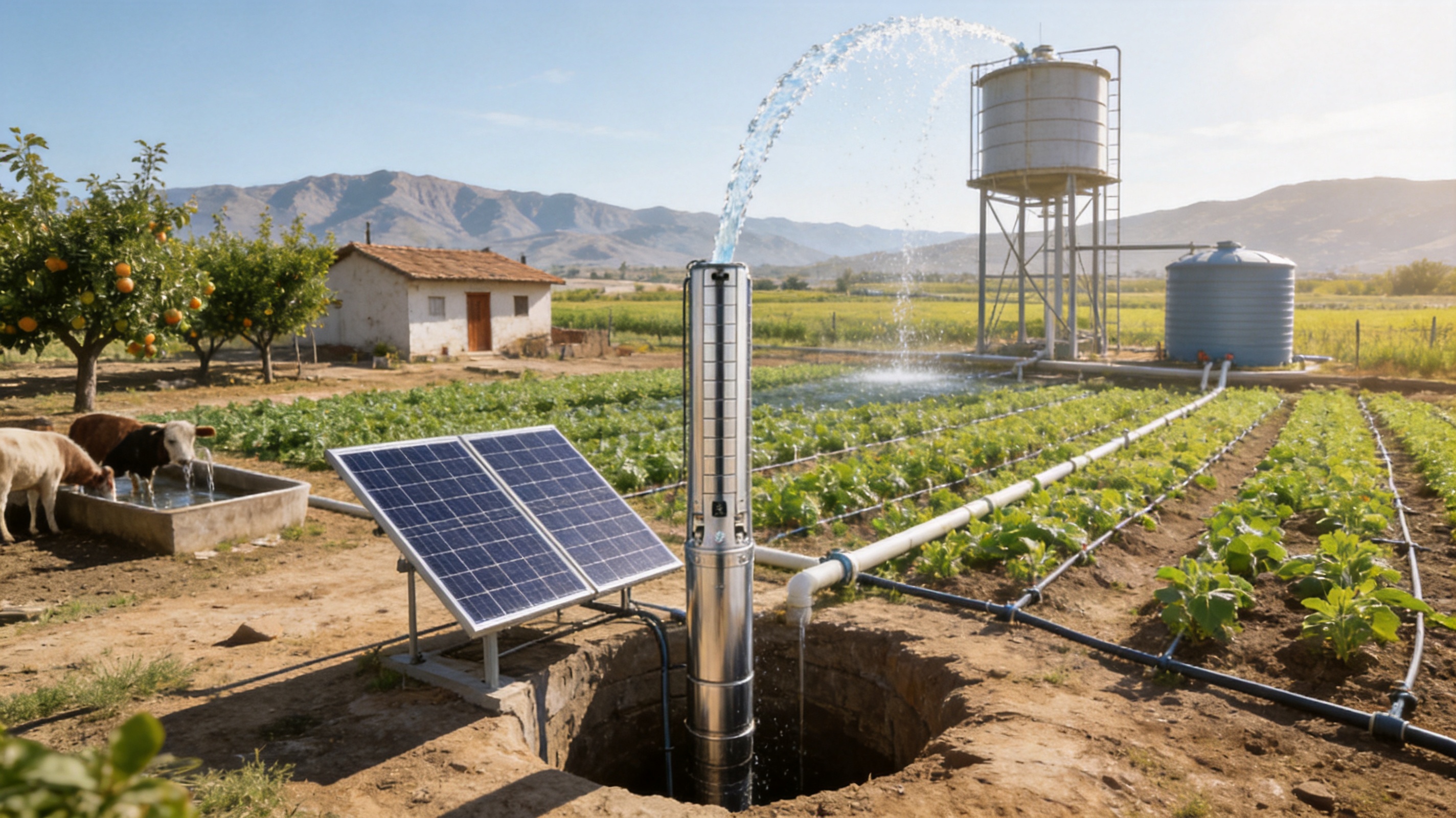
The borehole should be properly developed and cleaned before the pump is installed. Sand, drilling debris, and loose sediment can reduce pump life and affect hydraulic performance. The pump must be positioned according to the specified minimum submergence and cooling requirements. It should not rest directly on the bottom of the well unless the installation design specifically allows it.
The well diameter must provide adequate clearance around the 4-inch pump. The installer should also consider cable protection, pipe couplings, the pump’s lifting arrangement, and the possibility of future removal. The pump should be suspended with suitable support rather than relying on the electrical cable to carry mechanical load.
The discharge pipe must be strong enough for the expected pressure, installation depth, temperature, and water chemistry. All joints should be secure and suitable for submersible use. A check valve may be required depending on the system design to limit reverse flow and reduce water hammer during shutdown.
The electrical cable should be sized according to current, distance, voltage, installation method, ambient conditions, and allowable voltage drop. Low-voltage systems can require higher current for the same power, making cable sizing especially important. The cable should be protected against abrasion during lowering and should be secured appropriately to the rising pipe.
Submersible pumps require adequate water for lubrication and cooling. If the water level drops below the allowable operating level, the pump may overheat or suffer accelerated wear. A level sensor, well probe, controller function, or storage management strategy can help prevent dry running.
Water level conditions can change seasonally or during extended pumping. Therefore, dry-run protection should be considered even when the well appears reliable during initial testing. The installer should record static and dynamic water levels and establish a safe operating schedule.
Solar pumping systems generally have fewer moving components than fuel-driven generator systems, but they still require inspection. Solar panels should be kept reasonably clean, wiring should be checked for damage, and control equipment should be protected from moisture, heat, and unauthorized access.
The well should be monitored for changes in water level, sand content, flow, and discharge pressure. If the pump produces less water than expected, possible causes include reduced sunlight, blocked filters, increased pipe friction, a falling water level, worn hydraulic components, electrical problems, or a change in the pump operating point.
Compared with a surface centrifugal pump, a submersible borehole pump avoids many suction-side limitations. Surface pumps must lift water through a suction pipe, and their practical suction performance is affected by atmospheric pressure, water temperature, pipe losses, air leaks, and priming conditions. A submersible pump pushes water from below the water level, making it more suitable for deep sources.
Compared with a standard fixed-speed AC submersible pump, the 4ESSC is more directly suited to solar energy system design because the product family includes multiple DC-oriented voltage and power configurations. A conventional AC pump may require an inverter, increasing system complexity and conversion losses. The best choice still depends on the available power source, local service capabilities, and project requirements.
Compared with a diesel-powered pump, a solar submersible system can reduce fuel use, noise, exhaust emissions, and daily engine maintenance. It may be particularly advantageous where fuel delivery is difficult. However, solar output varies with weather and daylight, so the system normally requires adequate storage, a backup power strategy, or an operating schedule that matches water demand.
Compared with a low-cost pump selected only by maximum flow, the broad 4ESSC range allows more careful matching of flow and head. Correct hydraulic matching can reduce energy waste and improve service life. The purchaser should compare complete operating curves, not just catalog maximums, when evaluating competing products.
For commercial and international buyers, reliability includes more than the expected service life of the motor. It also includes product consistency, availability of replacement units, documentation, packaging quality, technical communication, and responsiveness during installation.
An integrated manufacturer can help coordinate these elements. The reported combination of R&D, production, export, and procurement services provides a foundation for serving distributors, contractors, original equipment customers, and project buyers. Buyers should still request formal technical documents and clarify warranty terms, inspection procedures, packaging requirements, spare-parts availability, and delivery schedules before placing an order.
For repeat purchases, standardizing on a pump family can reduce training and inventory complexity. A distributor may stock several 4ESSC configurations for different customer needs while maintaining a consistent installation approach. Contractors can also benefit from familiarity with the product format, outlet options, and controller requirements.
Pre-shipment inspection may include visual inspection, model and voltage verification, insulation testing, electrical testing, hydraulic testing, accessory confirmation, and packaging review. The precise inspection scope should be agreed upon between the buyer and supplier. Project customers may also require third-party inspection or batch documentation.
The 300 W model is suited to comparatively modest water requirements and lower-head applications. The 4ESSC3.5-24-36/300 provides a listed maximum flow of 3.5 m³/h and maximum head of 24 m. It may be considered for small storage tanks, household water transfer, garden irrigation, and compact off-grid systems when the hydraulic requirements are within its operating curve.
The 500 W group offers two distinct choices. The 4ESSC4-62-48/500 emphasizes higher head at lower flow, while the 4ESSC7.5-34-48/500 is intended for a higher flow and lower head pattern. This difference demonstrates why the model must be selected from the application requirement rather than from wattage alone.
The 1,000 W group provides several hydraulic alternatives. The 4ESSC5-128-110/1000 is directed toward high-head, lower-flow service. The 4ESSC18-29-110/1000 and 4ESSC12-53-110/1000 address higher-flow requirements at more moderate heads. These configurations may serve agricultural storage, livestock systems, rural supply, and commercial water transfer.
The 1,500 W group increases both head capability and flow capacity. Its models range from approximately 4 m³/h at high head to approximately 18 m³/h at lower head. This makes the group useful for deeper wells, elevated tanks, larger farms, and commercial installations requiring more substantial daily water production.
The 2,200 W and 3,000 W groups are intended for more demanding systems. The highest-head option listed is the 4ESSC4-300-300/3000, with a maximum listed head of 300 m. Higher-flow models in these power groups include the 4ESSC20-47-220/2200 and 4ESSC20-80-300/3000. These pumps may be considered for large irrigation systems, deep boreholes, industrial water transfer, and remote infrastructure, subject to confirmed operating conditions.
The listed pump diameter is 4 inches across the supplied 4ESSC configurations. The installer should verify the complete assembled diameter and required borehole clearance before installation.
Yes. The product is identified as a solar submersible borehole pump and is available in several voltage and power configurations intended for photovoltaic-based systems. A compatible controller, solar array, cables, and protection equipment are required for a complete installation.
The highest listed maximum flow is 20 m³/h, available in the 4ESSC20-47-220/2200 and 4ESSC20-80-300/3000 configurations. The actual flow depends on total dynamic head, solar input, pipe losses, controller operation, and well conditions.
The highest listed maximum head is 300 m for the 4ESSC4-300-300/3000 model. This is a maximum reference value rather than a guarantee of a particular flow at 300 m. The complete pump curve should be reviewed for the required operating point.
Choose a high-head model when the water must be lifted through a large elevation difference or a long pipeline with significant resistance. Choose a high-flow model when the elevation is moderate and the main requirement is to move a larger volume of water. The selection must be based on the intersection of the required system curve and the pump curve.
A solar pumping system can often operate without batteries when water is pumped during daylight and stored in a tank. Batteries may be added when nighttime operation, backup capacity, or irregular water demand requires electrical energy outside solar-generation hours.
Not automatically. The well must provide adequate clearance, depth, water level, yield, and structural support. The installer should also check the pump cable, discharge pipe, couplings, and protection components to ensure that the complete assembly can be lowered safely.
Provide the required flow, total dynamic head, well diameter, static and dynamic water levels, water quality, solar resource, preferred voltage, operating hours, pipe length, discharge elevation, destination tank size, and any backup-power requirements. This information allows the supplier to recommend a more appropriate model.
No. Higher wattage may support greater head, greater flow, or both, but the hydraulic design determines the actual performance. A 1,500 W high-head model may deliver less water at moderate head than a 1,000 W high-flow model. Pump curves are more useful than wattage alone.
Maintenance includes checking solar panels, electrical connections, protection devices, water levels, filters, pipeline joints, tank controls, and pump output. The well should be monitored for sand or sediment, and the pump should be protected from dry running and unsuitable operating conditions.
Solar pumping projects often involve several technical disciplines. The equipment must work hydraulically, electrically, mechanically, and operationally. An experienced manufacturer can help customers compare models, identify relevant specifications, coordinate production, and prepare products for international delivery.
Taizhou Edwin Electric Co., Ltd. was founded in 2008 and has developed a product portfolio covering deep well pumps, submersible pumps, booster pumps, circulation pumps, solar pumps, and other water equipment. Its reported investment in intelligent and new-energy technology reflects the growing need for efficient and automated water systems.
The company’s manufacturing and export structure is also relevant to buyers seeking long-term supply. Independent R&D supports product development, mass-production capability supports volume orders, and foreign-trade service supports cross-border procurement. These strengths can be valuable for distributors, engineering contractors, agricultural-equipment suppliers, and commercial project developers.
The 4ESSC series demonstrates the benefits of a product family rather than a one-size-fits-all design. Customers can choose a lower-voltage compact model for a small remote system or a higher-power, high-head model for demanding borehole conditions. The common 4-inch format provides continuity across much of the range while the different hydraulic configurations address varied project requirements.
The 4ESSC solar submersible borehole pump is a flexible solution for water lifting in locations where solar energy, compact borehole equipment, and reliable remote operation are important. Its principal strengths include a 4-inch pump diameter, multiple voltage options, power ratings from 300 W to 3,000 W, maximum listed flow rates up to 20 m³/h, and maximum listed head values up to 300 m.
Its advantages over conventional alternatives include reduced dependence on grid electricity and fuel, suitability for remote installations, compatibility with water-storage strategies, and a broad selection of hydraulic profiles. The pump can serve agricultural irrigation, livestock watering, rural domestic supply, construction, commercial water transfer, and other borehole applications.
Correct selection remains essential. Buyers should calculate total dynamic head, determine the required flow, evaluate the sustainable well yield, select a compatible solar system, size the discharge pipe correctly, and confirm the latest performance curve. Installation should be completed by qualified personnel with appropriate electrical, mechanical, and well-safety procedures.
Supported by an integrated approach to research and development, mass production, international export, and project procurement, the manufacturer is positioned to serve customers seeking high-performance water-pumping equipment. For a properly designed solar water system, the 4ESSC range offers a practical combination of compact installation, hydraulic choice, and renewable-energy compatibility.
1. Product technical information for the 4ESSC solar submersible borehole pump, including model specifications and supplied performance data.
2. Taizhou Edwin Electric Co., Ltd. company information concerning research and development, manufacturing, product categories, and global export activities.
3. General principles of centrifugal and submersible pump selection, including flow, head, system resistance, and operating-point analysis.
4. General photovoltaic water-pumping system design practices covering solar-array sizing, controllers, cable selection, storage tanks, and electrical protection.
5. General borehole installation and maintenance practices covering well yield, dynamic water level, dry-run prevention, pipe installation, and pump servicing.
edwina@edwin-pump.com
+86-13586290903 (WhatsApp)
Xuri Gongliang Cutting Tool Entrepreneurship Park, Wenqiao Town, Wenling City, Taizhou City, Zhejiang Province, China

High Performance Smart Pump Factory


 English