
edwina@edwin-pump.com

View All Products
en
Modern water supply projects increasingly require pumping systems that are powerful, efficient, adaptable, and capable of operating where grid electricity is unstable or unavailable. The 6ADSC AC/DC powered solar deep well pump with stainless steel impeller is designed for these demanding conditions. It combines solar DC operation with conventional AC power compatibility, allowing users to build dependable water systems for irrigation, livestock watering, rural households, storage tanks, community water supply, and high-head deep well extraction.
This article focuses on the product’s technical value, operating advantages, application flexibility, manufacturing background, and competitive strengths. It also explains why an AC/DC hybrid submersible solar pump is an intelligent choice for buyers who need long service life, high flow capacity, and stable performance across agricultural, municipal, and off-grid environments.
6ADSC AC/DC Powered Solar Deep Well Pump with S/S Impeller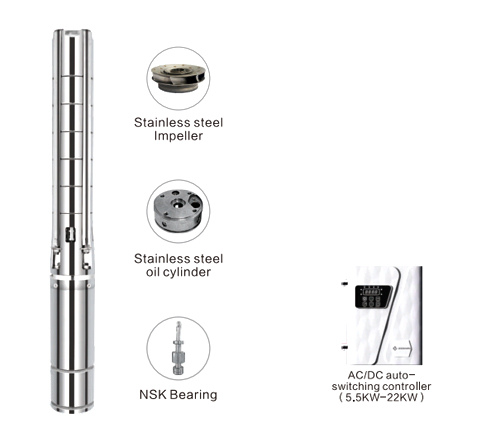
The 6ADSC AC/DC powered solar deep well pump is a submersible solar pump developed for deep well water extraction. It is engineered to operate with both solar DC power and standard AC electricity, giving users the ability to pump water during sunny periods from photovoltaic panels and continue operation with AC input when solar power is insufficient or when backup grid power is required.
Unlike ordinary single-power pumps, this hybrid design offers more operational freedom. A farm, orchard, greenhouse, rural household, or remote community can use available sunlight during the day to reduce energy costs, while still maintaining dependable pumping capability when weather changes or water demand increases. This is especially valuable in agricultural projects where water timing directly affects crop yield and livestock health.
The pump series is built for demanding high-head applications. The performance data includes models with maximum flow options of 36 m³/h, 46 m³/h, 65 m³/h, and 95 m³/h, with maximum head ratings reaching up to 467 m depending on the selected model. Power options range from 5,500 W to 37,000 W, enabling the product family to support medium and large-scale water supply projects.
A stainless steel impeller is one of the core structural advantages of this pump. In deep well applications, pump components must withstand long-term contact with water, minerals, pressure, and continuous rotation. Stainless steel improves corrosion resistance, dimensional stability, and wear performance compared with lower-grade materials. This contributes to stable hydraulic efficiency and longer working life.
Solar pumping has become an important solution in many regions because it reduces dependence on diesel fuel and conventional electricity. However, a purely DC solar pump may be limited by sunlight conditions, panel configuration, and seasonal weather. A purely AC pump, meanwhile, depends on grid power or generators, which may increase operating cost and reduce independence in remote areas.
The AC/DC hybrid concept solves this challenge by giving the user two practical power pathways. When solar energy is strong, the pump can run from DC input supplied by photovoltaic panels. When solar energy is weak, users can switch to AC input, depending on system design and available power. This makes the pump suitable for locations where water demand cannot wait for perfect sunlight conditions.
For agricultural irrigation, this flexibility can be decisive. Crops may require water at specific growth stages, and irrigation delay can reduce productivity. In livestock watering, interruption can cause stress, health problems, and operational risk. In community water supply, reliability is not optional; it is a basic requirement. Hybrid operation therefore provides a competitive advantage over pumps that depend on only one energy source.
The 6ADSC series uses an AC380/DC520V configuration, with an optimum DC input voltage range of 520 V to 650 V. The solar panel open-circuit voltage requirement is generally below 900 V for many models, with several higher-power groups listed below 800 V. The recommended solar panel power is at least 1.3 times the pump power, helping ensure adequate energy input for practical operation.
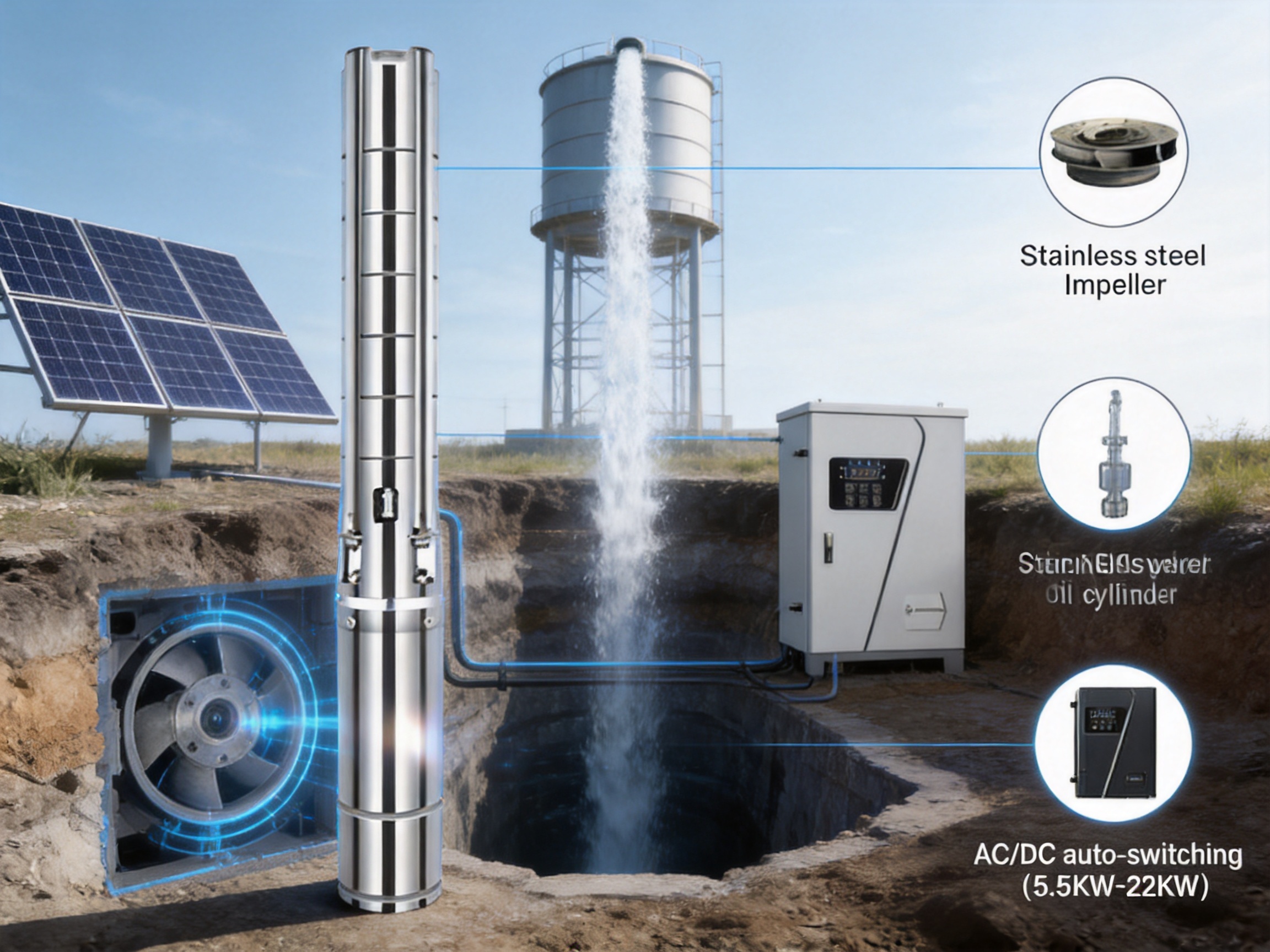
Many conventional deep well pumps are designed only for AC grid power. They can perform well where electricity is stable, but they create limitations in remote farmland, mountainous areas, ranches, and rural communities. Diesel generators can solve the power problem, but they introduce fuel cost, maintenance work, noise, and emissions.
Compared with these single-source systems, the 6ADSC pump provides a more resilient water supply approach. The ability to use solar DC power reduces operating expenses during daylight hours, while AC compatibility provides a dependable backup pathway. This makes the pump more attractive for users who are planning long-term water infrastructure rather than short-term pumping.
Deep well projects require pumps capable of overcoming significant vertical lift. Low-head pumps may deliver acceptable flow near the surface but become inefficient or unusable when the water level is deep. The 6ADSC series addresses this problem with models designed for high lifting heights, including versions with maximum head ratings far above typical domestic or small garden pump ranges.
The 36 m³/h group includes models with maximum heads from 108 m to 310 m. The 46 m³/h group extends from 86 m to 467 m. The 65 m³/h group ranges from 63 m to 324 m. The 95 m³/h group supports high-volume applications with heads from 66 m to 237 m. This broad selection allows users to match pump output to actual well depth, pipeline losses, storage elevation, and irrigation pressure needs.
The stainless steel impeller is a major benefit in challenging water environments. In many deep wells, water may contain minerals or dissolved substances that accelerate corrosion in ordinary components. Stainless steel resists corrosion better than many standard materials, helping preserve pump geometry and hydraulic performance over time.
Competitor pumps with lower-grade impellers may show efficiency loss, vibration, or component degradation after long service in difficult conditions. By using stainless steel impeller construction, the 6ADSC pump is positioned for durability, stable flow, and reduced maintenance burden. This is especially important for remote installations where maintenance access is difficult and downtime can be expensive.
Energy efficiency is not simply a marketing feature; it directly affects total cost of ownership. In solar pumping, improved efficiency can reduce the photovoltaic array size needed for a given water output. In AC operation, it lowers electricity consumption. For farms and projects that operate pumps daily, efficiency improvements can produce meaningful cost savings over the pump’s working life.
The 6ADSC series is described as using an energy-efficient motor optimized for high performance and stable water flow. Its brushless motor design helps reduce wear and maintenance compared with brushed systems. Lower maintenance requirements matter because submersible pumps are not as easy to service as surface equipment. A durable motor and hydraulic structure support continuous operation with fewer interruptions.
A common weakness of many competing pump lines is limited model coverage. If the available pump is too small, it cannot satisfy flow or head requirements. If it is too large, it may waste power, increase cost, and operate away from its best efficiency point. The 6ADSC series offers many model choices across multiple flow and head combinations, improving the chance of accurate project matching.
For example, a project needing moderate flow but very high lift may select a 36 m³/h or 46 m³/h model with a higher head rating. A larger irrigation project requiring high volume at moderate head may consider the 65 m³/h or 95 m³/h groups. This range helps engineers, distributors, and end users build systems around actual site conditions instead of forcing the site to fit a narrow pump selection.
The following table summarizes key performance ranges from the 6ADSC AC/DC powered solar deep well pump series. Exact model selection should be based on well depth, dynamic water level, pipeline length, irrigation pressure, required daily water volume, solar panel configuration, and available AC backup conditions.
| Parameter | Representative Range or Value | Practical Meaning |
| Power Supply | AC380V / DC520V | Supports hybrid operation using AC electricity or solar DC input |
| Optimum DC Input Voltage | 520V–650V | Suitable for properly configured photovoltaic pumping systems |
| Power Range | 5,500W–37,000W | Covers medium and large deep well water supply projects |
| Maximum Flow Options | 36, 46, 65, and 95 m³/h | Allows selection for different irrigation and water delivery demands |
| Maximum Head Range | Up to 467 m | Supports high-lift deep well pumping and elevated storage applications |
| Outlet | 3 inches or 4 inches | Designed for substantial water delivery pipelines |
| Cable | 2 m or 2.5 m according to model | Provides basic connection length for installation planning |
| Solar Panel Open Circuit Voltage | Below 900V or below 800V depending on model | Guides safe photovoltaic array design |
| Recommended Solar Panel Power | At least 1.3 times pump power | Helps ensure adequate energy supply under real sunlight conditions |
Agricultural irrigation is one of the most important uses for this pump. Fields, orchards, greenhouses, and plantations often require large water volumes, and many farms are located far from reliable grid power. The 6ADSC pump can use solar panels to supply water during the day, which often aligns naturally with irrigation schedules and sunlight availability.
In irrigation design, both flow and head must be considered. Flow determines how much water can be delivered within a certain time, while head determines whether water can be lifted from the well and moved through pipes, filters, valves, and distribution systems. The wide 6ADSC model range makes it possible to select a pump that better fits drip irrigation, sprinkler irrigation, reservoir filling, or direct field supply.
Remote livestock farms require reliable water delivery for cattle, sheep, goats, poultry, and other animals. Water systems must work consistently because animal health depends on continuous access to clean water. A solar-powered deep well pump can fill elevated tanks or ground reservoirs during the day, creating stored water for use throughout the night.
The AC/DC hybrid function adds another layer of reliability. If weather conditions reduce solar output, the system can use AC backup where available. This reduces the risk of water shortage and supports farm management in areas where fuel delivery or generator maintenance would be inconvenient.
Many rural communities need safe water supply from deep wells. A submersible solar pump is often more practical than extending power lines over long distances. The 6ADSC series can support household clusters, schools, small villages, and community storage tanks depending on water demand and local engineering design.
For community supply, reliability and low maintenance are essential. The pump’s stainless steel impeller, robust submersible structure, and efficient motor design help reduce service frequency. This benefits users who may not have easy access to technical support or spare parts at short notice.
Water pumping is also required in rural construction, mining support, municipal engineering, and infrastructure development. In these environments, temporary or semi-permanent pumping systems may need to operate before the electrical grid is available. The hybrid power approach gives contractors and project owners more flexibility in planning water supply.
Because the 6ADSC pump can be selected across a wide power and flow range, it is suitable for different project sizes. It can be used to fill storage tanks, supply process water, support dust control, or move water from deep underground sources to working sites.
Although the pump is designed for demanding deep well use, it may also support water transfer to storage tanks, fountains, and landscape systems when the hydraulic requirements match the selected model. In these applications, solar operation can reduce electricity cost and provide a more sustainable water circulation or filling solution.
For any landscape or fountain application, engineers should confirm the required pressure, pipe friction loss, elevation difference, and duty cycle. A high-performance deep well pump should be selected carefully to avoid oversizing, energy waste, or excessive system pressure.
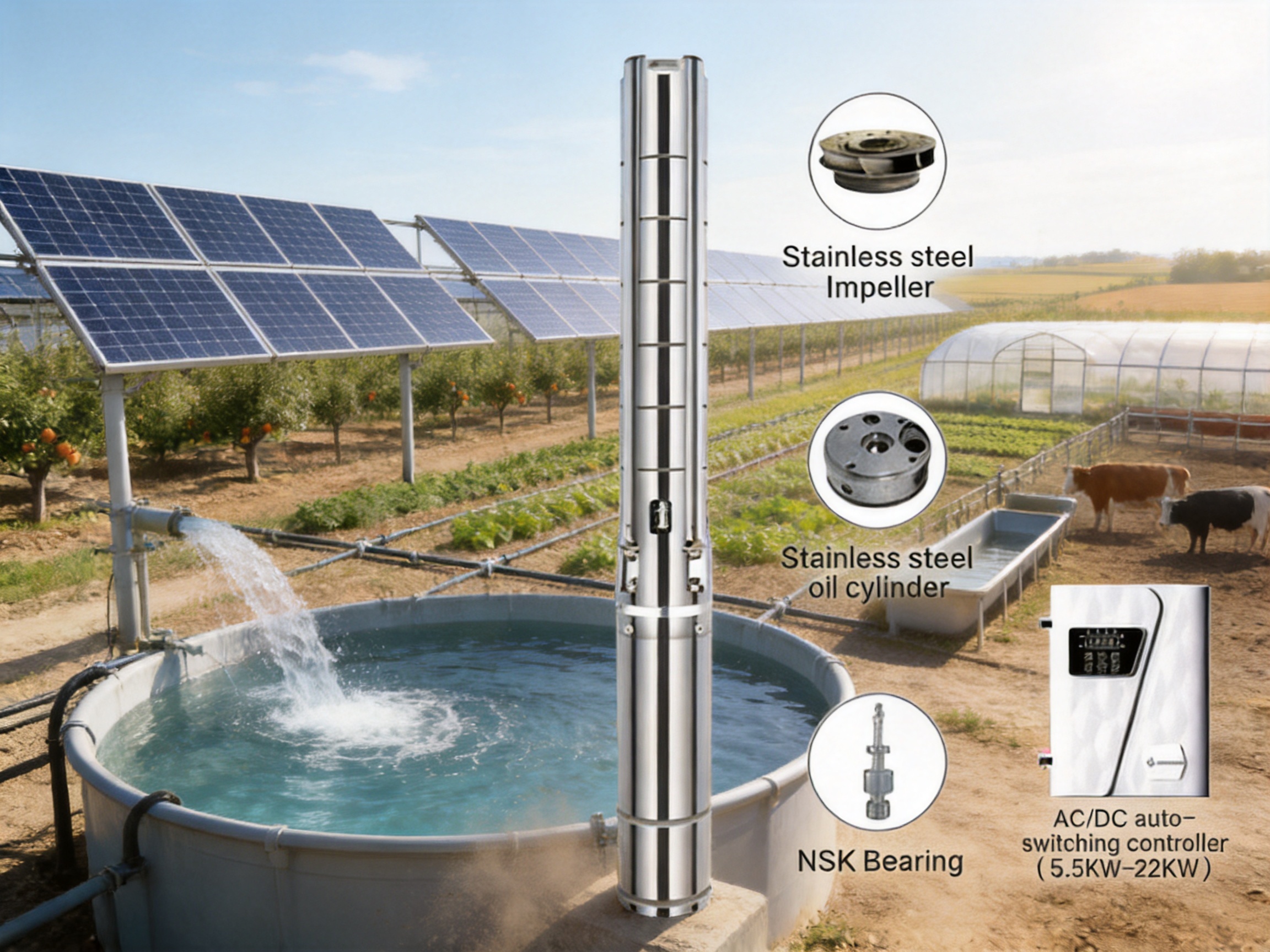
Taizhou Edwin Electric Co., Ltd. was founded in 2008 and has developed as an integrated manufacturing enterprise with independent research and development, mass production capability, and global export experience. Its core product lines include deep well pumps, submersible pumps, domestic booster pumps, and circulation pumps, with a focus on medium-to-high-end global markets.
The company’s manufacturing strength is important because deep well pumps are long-service products installed in environments where failure can be costly. A buyer is not only purchasing a pump; the buyer is also relying on the manufacturer’s design discipline, material control, machining quality, assembly precision, testing process, and export service capability.
With years of experience in water pump manufacturing, the company has built product knowledge across household water supply, agricultural irrigation, HVAC circulation, municipal engineering, mining, construction, and new energy pumping. This broad application background helps the manufacturer design pumps that address real operating conditions rather than only laboratory performance targets.
Independent research and development is a valuable strength in pump manufacturing. It allows a manufacturer to optimize hydraulic design, motor matching, control compatibility, material selection, and production processes according to user needs. For the 6ADSC solar deep well pump, R&D capability supports the integration of high-head hydraulic performance with AC/DC hybrid operation.
Solar water pumping is not simply a conventional pump connected to panels. It requires attention to voltage range, starting behavior, energy fluctuation, motor efficiency, heat management, cable connection, and system stability. A manufacturer with new energy product experience can better refine these details and provide more practical solutions for global buyers.
Mass production capability matters because international buyers need stable quality across repeated orders. A single sample pump may perform well, but long-term cooperation depends on consistent production. Standardized production procedures, component inspection, controlled assembly, and final testing help ensure that each model meets its intended specifications.
For distributors, installers, and project contractors, product consistency reduces after-sales risk. When pump dimensions, electrical characteristics, outlet sizes, and performance ratings are consistent, installation planning becomes easier and customer confidence increases. This is a significant advantage over suppliers with unstable quality control or inconsistent component sourcing.
The stainless steel impeller represents a practical material advantage. In pump hydraulics, the impeller is responsible for transferring energy from the motor to the water. Its strength, balance, surface quality, and corrosion resistance affect both efficiency and lifespan. Stainless steel construction helps the impeller maintain performance under continuous contact with water.
Other structural components must also be selected and processed with durability in mind. Submersible pumps operate underwater, often under pressure, and may be installed deep below the surface. Motor protection, sealing, cable quality, and mechanical alignment all influence long-term reliability. Advanced manufacturing emphasizes these details rather than focusing only on headline flow and head values.
Performance curves and performance data are essential tools for selecting a deep well pump. They allow users to estimate operating flow at a given head and compare models. A responsible manufacturer must test pump performance carefully and provide data that supports correct application design.
For the 6ADSC series, performance data includes model numbers, voltage configuration, optimum DC voltage, power, maximum flow, maximum head, outlet, cable length, solar panel open-circuit voltage limit, and recommended panel power. This information helps system designers plan pump selection, photovoltaic array sizing, electrical protection, pipe diameter, and storage capacity.
Global water pump buyers often need more than products. They need procurement planning, order tracking, cross-border delivery coordination, and responsive foreign trade service. The company strengthened its export capabilities by establishing related trading and industrial service teams, helping meet diverse purchasing needs and support international customers.
This service background provides a competitive advantage for distributors and project buyers. A high-performance pump is most valuable when it is delivered reliably, documented clearly, and supported by a supplier who understands international purchasing requirements. For multi-product orders, the company’s broader portfolio also supports one-stop procurement for pumps and water treatment peripheral products.
Correct pump selection begins with determining required flow and total dynamic head. Total dynamic head includes static lift from the water level to the delivery point, drawdown during pumping, pipe friction loss, valve loss, filter loss, and any required operating pressure for irrigation equipment. Selecting only by well depth can lead to mistakes because long pipelines and irrigation systems can add significant resistance.
The 6ADSC series offers multiple flow groups. A 36 m³/h model may be suitable for projects requiring high lift with moderate volume. A 46 m³/h model can serve higher flow systems with extensive head options. A 65 m³/h model supports larger water transfer needs, while 95 m³/h models are appropriate for high-volume applications where head requirements remain within the model range.
The recommended solar panel power is at least 1.3 times the pump power. This ratio helps compensate for real-world conditions such as temperature, dust, panel aging, cable loss, and changing sunlight angle. For example, a 7,500 W pump should be paired with a photovoltaic array sized above the pump power according to the recommended factor and local solar conditions.
Voltage must also be managed carefully. The optimum DC input range is 520 V to 650 V, and the solar panel open-circuit voltage must remain below the specified limit for the chosen model. Since open-circuit voltage can rise in cold weather, system designers should calculate array voltage under local minimum temperature conditions to maintain safety and equipment compatibility.
AC backup can be valuable in cloudy seasons, emergency water demand, or high-intensity irrigation periods. Since the pump supports AC380V input, project planners should confirm the availability and quality of AC power. Proper protection devices, wiring, grounding, and control equipment should be included according to local electrical standards and professional installation practice.
Hybrid power does not mean careless switching between sources. The electrical system should be designed by qualified technicians to prevent unsafe connections, overvoltage, short circuits, or control conflicts. When properly designed, the hybrid system offers both solar economy and AC reliability.
The series includes 3-inch and 4-inch outlet models. Larger outlets support higher flow with reduced friction when matched with appropriate pipe sizes. If a high-flow pump is connected to undersized piping, energy loss increases and actual delivered water may be lower than expected. Therefore, pipeline design should match pump capacity, distance, elevation, and flow velocity requirements.
Valves, check valves, fittings, elbows, filters, and water meters all add resistance. A complete system calculation should include these elements. Correct pipe sizing improves efficiency, reduces pressure loss, lowers energy consumption, and helps the pump operate closer to its intended performance range.
Although the stainless steel impeller improves corrosion resistance, water quality should still be evaluated. Excessive sand, abrasive particles, or corrosive chemicals can shorten the life of any pump. If the well contains sand, proper well development, filtration, or pump placement above the sediment zone should be considered.
Submersible pumps should be installed with attention to cooling, cable protection, vertical alignment, and safe lowering procedures. The pump should not run dry. Water level monitoring and suitable protection devices can help prevent damage caused by insufficient water. Good installation practice is one of the most important factors in achieving long service life.
Solar pumping reduces operating expenses by using sunlight as the primary energy source. For agricultural users, this can reduce dependence on grid electricity or diesel fuel. Over time, savings can be significant, especially in regions with high energy costs or long irrigation seasons.
Environmental benefits are also important. Solar-powered pumping reduces fuel consumption, exhaust emissions, and generator noise. For farms, rural communities, and development projects seeking sustainable infrastructure, a solar deep well pump supports cleaner water delivery. The AC/DC hybrid design preserves reliability while still promoting renewable energy use.
Compared with diesel-driven pumping, solar pumping can also reduce maintenance work. Diesel engines require fuel storage, oil changes, filters, mechanical service, and frequent inspection. A submersible electric solar pump has fewer routine engine-related tasks. When combined with a durable brushless motor and corrosion-resistant impeller, the system can offer a more convenient long-term operating profile.
The 6ADSC pump stands out in the solar pump market because it combines several important features in one product family: AC/DC hybrid power, high-head performance, large flow options, stainless steel impeller construction, energy-efficient motor design, and broad model availability. Many competing products may offer one or two of these strengths, but fewer combine them across such a wide performance range.
For distributors, this means the product can serve multiple customer segments. A single series can cover irrigation projects, livestock water supply, off-grid homes, rural water stations, and engineering applications. This simplifies inventory planning and sales training because the same product family can address many project requirements.
For project contractors, the advantage is practical selection flexibility. Instead of switching suppliers for different head and flow requirements, contractors can evaluate the 6ADSC range and select the most suitable model. This supports standardized installation practices, easier communication, and more efficient procurement.
For end users, the advantage is dependable water access. Water supply equipment must work in real conditions, not only in ideal specifications. The hybrid power design, stainless steel impeller, and high-head capability help users build a system that can withstand changing weather, challenging well depths, and demanding daily operation.
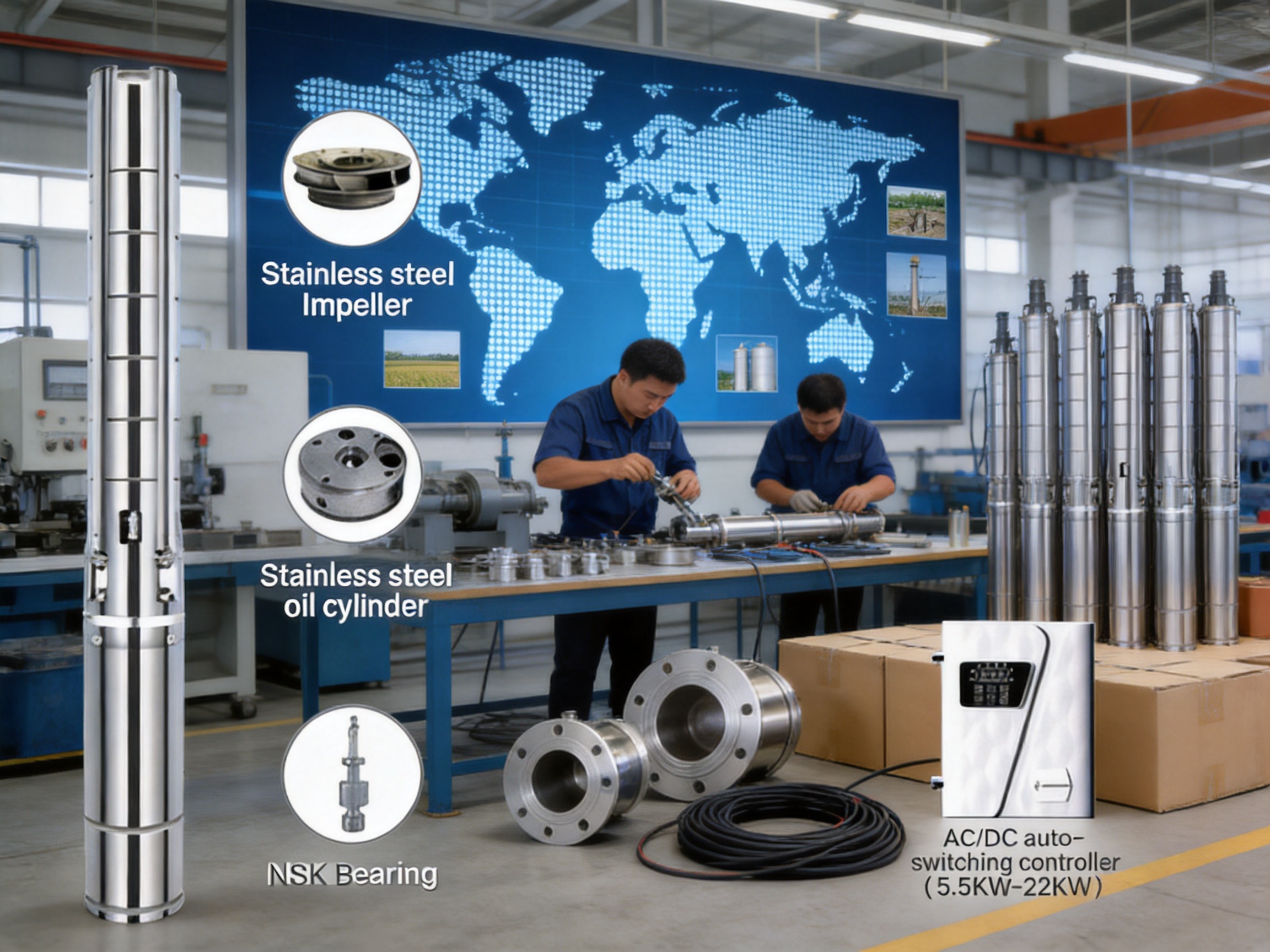
The 36 m³/h group is suitable for users who need strong lifting capacity with controlled flow. Models in this group include power levels from 5,500 W to 18,500 W and maximum head values from 108 m to 310 m. These pumps can be considered for deep wells where head is a primary challenge and flow demand is moderate.
The 46 m³/h group provides a wider high-head range, extending up to 467 m in the highest listed model. This makes it especially useful for demanding deep well projects, mountainous water transfer, elevated tanks, or long-distance pumping where significant vertical and friction losses must be overcome.
The 65 m³/h group increases volume capacity while maintaining substantial head capability. With models ranging from 63 m to 324 m maximum head, this group can serve larger irrigation systems, reservoir filling, and rural engineering projects requiring more water per hour.
The 95 m³/h group is designed for high-volume water supply. It includes models with maximum head ratings from 66 m to 237 m. This group may be suitable for large farms, community storage systems, or applications where water volume is the dominant requirement and the total head remains within the selected model’s capability.
In centrifugal and multistage submersible pumps, impeller quality strongly influences hydraulic performance. The impeller must maintain its shape under rotation, resist corrosion, and remain balanced. Any deformation or wear can reduce efficiency, increase vibration, and shorten bearing or motor life.
Stainless steel provides improved resistance to corrosion compared with many ordinary metals. It also offers good strength for demanding pumping conditions. In deep well systems, where pumps may remain installed for long periods, material reliability reduces the need for frequent removal and repair.
The stainless steel impeller also supports stable hydraulic performance. When impeller surfaces remain intact and geometrically accurate, water movement remains more efficient. This helps maintain flow and head performance over time, which is especially valuable for solar systems where available energy should be used as effectively as possible.
Low maintenance is a major selling point for remote pumping equipment. Every maintenance event may require technicians, lifting equipment, travel time, production interruption, and replacement parts. For deep wells, removing a pump can be difficult and costly. Therefore, durability must be built into the product from the beginning.
The 6ADSC pump’s brushless motor and robust construction are designed to reduce downtime and maintenance needs. Brushless technology avoids the wear associated with brushes, supporting longer service intervals. Combined with corrosion-resistant hydraulic components, the pump is better suited for continuous or frequent operation in agricultural and rural environments.
Long lifespan also depends on proper installation and operation. Even a high-quality pump can be damaged by dry running, incorrect voltage, sand intrusion, severe overheating, or poor wiring. Buyers should follow professional installation procedures and use suitable protection systems to achieve the best results.
Taizhou Edwin Electric Co., Ltd. has developed from a pump manufacturer into an integrated enterprise serving global customers. The company’s product portfolio includes deep well pumps, submersible pumps, booster pumps, circulation pumps, solar water pumps, intelligent booster pumps, and related water supply products. This broad product base demonstrates manufacturing experience across multiple water movement technologies.
Since 2018, the company has invested in new energy and intelligent technology, launching solar water pumps and intelligent booster pumps to expand its product portfolio. This strategic direction aligns with global market demand for renewable energy, smart control, and efficient water infrastructure.
The company’s pumps are used in new energy projects, agricultural irrigation, municipal engineering, mining, construction, HVAC systems, and household water supply. This diverse application experience helps the manufacturer understand performance requirements in different markets and climates. Such experience is important when supplying international customers who may face different water sources, voltage standards, installation habits, and service expectations.
In addition to manufacturing, the company has built professional trade service capabilities for procurement planning, order tracking, cross-border delivery, and foreign trade communication. For overseas buyers, these services help reduce purchasing complexity. A supplier with both manufacturing strength and export service experience can support smoother cooperation from inquiry to delivery.
Before selecting a 6ADSC model, buyers should collect key project information. This includes well diameter, static water level, dynamic water level, total lift to the outlet or tank, pipeline distance, pipe diameter, required flow, required daily water volume, irrigation method, available solar radiation, AC backup availability, and local electrical safety requirements.
Buyers should also consider future expansion. If a farm plans to expand irrigation area, it may be useful to select a model and pipeline system that can support increased water demand. However, excessive oversizing should be avoided because it can increase investment cost and reduce operating efficiency.
For solar array planning, the recommended panel power of at least 1.3 times pump power should be treated as a practical minimum. In cloudy regions or high-temperature environments, additional margin may be beneficial. Professional solar pump system design can help balance performance, cost, and reliability.
For distributors, it is useful to stock models that match common regional well depths and irrigation needs. In areas with deep groundwater, high-head models may be more important. In regions with broad fields and moderate lift, higher-flow models may be more attractive. Understanding local application patterns helps improve sales efficiency and customer satisfaction.
The main advantage is power flexibility. The pump can operate with solar DC power when sunlight is available and can also work with AC electricity when backup power is needed. This improves water supply continuity compared with pumps that depend on only solar power or only grid electricity.
It is suitable for agricultural irrigation, orchards, greenhouses, livestock watering, rural household water systems, community water supply, deep well extraction, storage tank filling, and remote engineering projects. It is especially useful where high head, large flow, and energy savings are important.
The stainless steel impeller improves corrosion resistance, strength, and durability. Because the impeller is a key hydraulic component, better material quality helps maintain pump efficiency, stable flow, and long service life in deep well environments.
The product data recommends solar panel power of at least 1.3 times the pump power. This helps compensate for real-world losses caused by temperature, dust, sunlight angle, cable loss, and panel aging. Designers should also keep the solar panel open-circuit voltage within the specified limit for the selected model.
Yes. The hybrid AC/DC design is well suited for areas with unstable grid power because it can use solar energy as a major power source and AC power as backup when available. Proper electrical design and protection are required for safe operation.
Important information includes well depth, dynamic water level, required flow, total dynamic head, pipeline length, outlet elevation, irrigation pressure, water demand per day, solar conditions, and available AC power. Accurate data helps select a pump that operates efficiently and reliably.
Compared with diesel systems, solar pumping can reduce fuel cost, noise, emissions, and engine maintenance. The AC/DC pump also provides backup flexibility without relying only on diesel generation. Over time, this can lower operating costs and simplify daily management.
Professional installation is strongly recommended. Deep well pumps involve electrical wiring, solar voltage configuration, submersible installation, pipe connection, grounding, and protection devices. Correct installation helps prevent dry running, overvoltage, poor cooling, and mechanical damage.
The 6ADSC AC/DC powered solar deep well pump with stainless steel impeller is a strong solution for users who need reliable high-head water supply with renewable energy advantages. Its hybrid AC/DC operation provides flexibility, while its stainless steel impeller, efficient motor, and broad model range support durability and practical performance in demanding environments.
Compared with conventional AC-only, DC-only, or diesel-dependent pumping systems, this product offers a better balance of reliability, energy savings, sustainability, and application versatility. It can serve farms, livestock operations, rural communities, engineering projects, and storage systems where water access is essential.
The manufacturing background of Taizhou Edwin Electric Co., Ltd. further strengthens the product’s value. With independent R&D, mass production experience, global export service, and investment in new energy pumping technology, the company is positioned to support buyers who require dependable products and long-term cooperation.
For projects involving deep wells, high lift, large water volume, and off-grid or hybrid energy conditions, the 6ADSC series deserves serious consideration. When correctly selected, installed, and supported by a properly designed solar and AC power system, it can provide efficient water delivery and long-term operational value.
1. Hydraulic Institute. Pump Application Guidelines for Centrifugal and Submersible Pump Systems.
2. International Electrotechnical Commission. Electrical Safety Principles for Photovoltaic Power Systems.
3. Food and Agriculture Organization. Solar Photovoltaic Water Pumping for Irrigation and Rural Water Supply.
4. American Society of Agricultural and Biological Engineers. Irrigation Pumping Plant Performance and Energy Efficiency Guidance.
5. Renewable Energy Engineering Handbook. Practical Design Considerations for Solar Water Pumping Systems.
6. Pump Systems Matter. Total Dynamic Head, Pump Selection, and Lifecycle Cost Principles.
edwina@edwin-pump.com
+86-13586290903 (WhatsApp)
Xuri Gongliang Cutting Tool Entrepreneurship Park, Wenqiao Town, Wenling City, Taizhou City, Zhejiang Province, China

High Performance Smart Pump Factory


 English