
edwina@edwin-pump.com

View All Products
en
Reliable access to water is essential for agriculture, livestock, rural households, gardens, greenhouses, and remote infrastructure. In locations where grid electricity is unavailable, unstable, or expensive to install, solar pumping provides an efficient alternative. The 2EPC Brushless DC Motor Submersible Solar Deep Well Pump is designed for these conditions, combining direct-current motor technology, solar compatibility, compact construction, and durable internal components in one practical water-lifting solution.
This pump is engineered for deep well and narrow-borehole applications where dependable water delivery must be achieved with limited power infrastructure. Its brushless DC motor reduces maintenance requirements compared with traditional brushed motors, while the solar-powered operating concept allows users to convert renewable energy into a useful water supply. The available models cover 200 W, 300 W, and 400 W power levels, with maximum heads from 35 m to 64 m and maximum flow rates up to 1.7 m³/h.
Manufactured by Taizhou Edwin Electric Co., Ltd., the product reflects the company’s experience in pump research and development, mass production, export, and integrated water-system supply. Edwin Pump has operated since 2008 and supplies deep well pumps, submersible pumps, domestic booster pumps, circulation pumps, solar water pumps, intelligent booster pumps, and related products for international customers.
More than a simple motor-and-impeller assembly, the 2EPC series is intended to provide an organized solution for remote water projects. Its compatibility with solar panels and MPPT controllers makes it suitable for systems that must operate without conventional mains electricity. Its material selection, including copper components, NSK bearings, and a high-performance plastic impeller, is intended to balance durability, efficiency, weight, and cost.
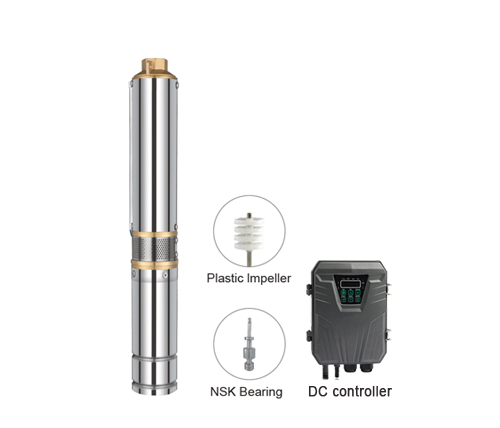
2EPC Brushless DC Motor Submersible Solar Deep Well Pump
The 2EPC is a submersible solar pump driven by a brushless DC motor. Unlike a surface pump, it operates below the water level and pushes water upward through the discharge pipe. This arrangement is especially valuable for deep wells because the pump does not need to lift water through a long suction line. Instead, it delivers pressure directly from inside the well, helping reduce suction-related limitations and improving suitability for deep-water applications.
The pump is designed around a compact form factor for deep wells and narrow boreholes. The product title identifies it as a 2-inch solar deep well pump, while the supplied performance table lists a 0.75-inch outlet for the available models. This information should be checked carefully during project planning so that the selected pipe, fittings, cable, controller, and installation accessories match the actual model configuration.
Three listed versions allow users to select a configuration according to voltage, power, flow, and lifting requirements. The 24 V models are rated at 200 W and 300 W, while the 400 W model operates at 48 V. The higher-voltage model is designed for a greater maximum head, reaching 64 m under the stated performance conditions.
Solar pumping performance depends on more than the pump’s rated wattage. Available sunlight, solar-panel orientation, seasonal weather, well depth, water-level variation, pipe diameter, friction loss, and required delivery pressure all influence the actual operating point. For this reason, the maximum flow and maximum head should not be treated as simultaneous values. A professional system design should use the pump curve and the total dynamic head of the installation to select the correct model.
The brushless DC motor is one of the principal advantages of the 2EPC series. Traditional brushed motors use physical brushes and a commutator to transfer electrical power to the rotating assembly. These components gradually wear, create friction, and may require periodic replacement. A brushless motor uses electronic commutation instead, eliminating the normal brush-wear mechanism.
For a remote solar pumping system, this design can be particularly useful. A pump installed in a well may be difficult or expensive to remove for service. Reducing the number of wearing electrical components helps support longer operating intervals and lowers routine maintenance needs. Brushless operation also supports low-noise performance and efficient energy conversion, which are important when the available solar power is limited.
The motor is powered by direct current and is intended to work with a suitable solar pumping system. An MPPT controller can help regulate the available solar input and keep the motor operating more effectively as sunlight changes. The controller must be selected according to the pump voltage, current, solar-panel voltage range, and system protection requirements.
The pump incorporates a copper outlet and copper oil cylinder. Copper is valued in pump construction for its strength, corrosion resistance, thermal conductivity, and ability to support reliable mechanical connections. In a submersible environment, component protection and sealing are critical because the assembly is exposed to water pressure and continuous contact with the surrounding medium.
The copper oil cylinder contributes to the motor’s internal protection and sealing structure. A stable oil-filled or oil-protected motor design can help isolate sensitive motor components from water and support smooth operation. The quality of seals, assembly accuracy, and inspection procedures remain essential, but the use of copper in these areas provides a durable material foundation for long-term service.
NSK bearings are specified for the 2EPC pump to support stable shaft rotation and reduce friction. Bearings must operate under rotational loads while resisting vibration and maintaining alignment. In a submersible pump, smooth bearing operation affects motor efficiency, noise, heat generation, and service life.
Using recognized bearing technology also supports consistency in manufacturing and replacement planning. Proper lubrication, sealing, shaft alignment, and operating conditions are still necessary. A pump should not be run dry, overloaded, or operated outside its rated voltage range, because these conditions can place excessive stress on bearings and other internal components.
The pump uses a plastic impeller designed to provide efficient water movement while keeping the rotating assembly lightweight. A well-designed plastic impeller can offer useful resistance to corrosion and many common water conditions. Its lower mass can reduce the energy required for acceleration and may help the motor respond efficiently to variable solar input.
The impeller is also described as wear-resistant and optimized for water delivery. Because the impeller is a primary hydraulic component, its geometry directly influences flow, head, efficiency, and operating stability. Consistent molding and dimensional control are therefore important manufacturing considerations. When the impeller, motor, and pump chamber are correctly matched, the assembly can deliver a practical balance between output and energy consumption.
The 2EPC series is designed for solar-powered operation and is compatible with solar panels and MPPT controllers. The recommended solar-panel power is at least 1.3 times the pump power. This provides a useful planning reference when creating a solar array, although the final panel size should also account for local solar conditions, controller efficiency, cable losses, and the desired operating schedule.
The listed solar-panel open-circuit voltage limits are below 60 V for the 24 V models and below 110 V for the 48 V model. These limits are important safety and compatibility parameters. The panel array must remain within the controller and pump system’s permitted voltage range under the coldest expected conditions, because open-circuit voltage can increase in low temperatures.
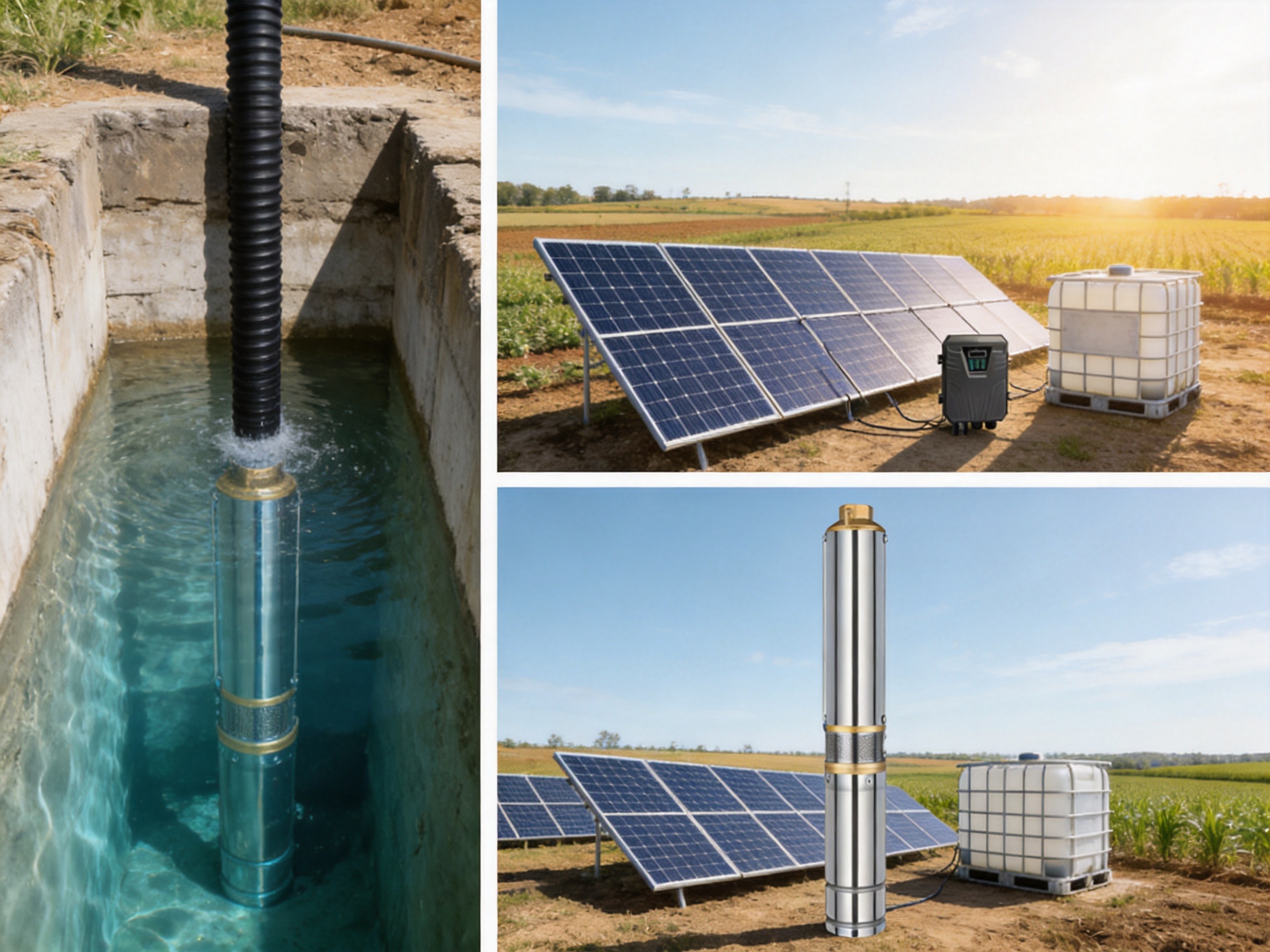
The three listed models provide different combinations of voltage, power, flow, and head. The following table summarizes the available data supplied for the product series.
| Model | Rated Voltage | Optimum DC Input | Power | Maximum Flow | Maximum Head | Listed Outlet | Cable Length | Solar Panel VOC | Recommended Solar Panel Power |
|---|---|---|---|---|---|---|---|---|---|
| 2EPC1.5-35-24-200 | 24 V | 30–48 V | 200 W | 1.5 m³/h | 35 m | 0.75 in | 2 m | Below 60 V | At least 1.3 × pump power |
| 2EPC1.7-45-24-300 | 24 V | 30–48 V | 300 W | 1.7 m³/h | 45 m | 0.75 in | 2 m | Below 60 V | At least 1.3 × pump power |
| 2EPC1.7-64-48-400 | 48 V | 60–90 V | 400 W | 1.7 m³/h | 64 m | 0.75 in | 2 m | Below 110 V | At least 1.3 × pump power |
The 2EPC1.5-35-24-200 is the lowest-power option in the series. With a maximum stated flow of 1.5 m³/h and a maximum head of 35 m, it is suitable for applications with moderate lifting requirements. Typical uses may include small agricultural plots, garden irrigation, greenhouse watering, livestock trough filling, and rural household storage tanks.
This model may be appropriate when the well is not exceptionally deep and the required daily water volume is moderate. Its 24 V operating platform can also be convenient for smaller solar arrays and battery-based systems. However, the installer must calculate the total dynamic head, including elevation, pipe friction, valves, filters, and the required pressure at the delivery point.
The 2EPC1.7-45-24-300 increases the power rating to 300 W and provides a maximum head of 45 m. Its listed maximum flow is 1.7 m³/h. This model can serve installations where the 200 W version may not provide sufficient lifting capacity, while retaining the 24 V system configuration.
It may be used for larger garden areas, small and medium farms, village water distribution, and livestock systems with greater elevation differences. The 300 W model can also provide additional design flexibility when water must pass through longer pipe runs or several fittings. The actual flow will depend on the working head and the solar energy available at the time of operation.
The 2EPC1.7-64-48-400 is the highest-power version shown in the data. It operates at 48 V, accepts an optimum DC input range of 60–90 V, and reaches a maximum stated head of 64 m. Its listed maximum flow is 1.7 m³/h.
The 48 V configuration can be advantageous in systems where a higher voltage helps manage current and cable losses. For a given power level, higher voltage generally means lower current, which may allow more practical cable sizing over longer distances. The installer must still follow electrical codes, controller instructions, grounding requirements, and all applicable safety procedures.
A conventional electric submersible pump requires a stable AC electricity supply or a generator. In remote areas, extending a grid connection can involve substantial construction, permitting, and operating costs. Fuel-powered generators require fuel delivery, lubrication, maintenance, noise control, and exhaust management.
The 2EPC solar pump directly addresses these challenges by using solar energy as its primary power source. Once the solar array and pumping equipment are installed, the system can produce water without regular fuel consumption. This can reduce dependence on distant infrastructure and make water delivery possible in isolated agricultural, pastoral, and residential locations.
Brush replacement is a common maintenance concern in brushed DC motors. In contrast, a brushless DC motor uses electronic commutation and eliminates physical brushes. This can reduce routine service requirements and is especially valuable when the pump is installed deep underground or in a remote borehole.
The pump is not maintenance-free. Water quality, sediment, cable condition, seals, controller settings, and solar-panel cleanliness still influence system reliability. Nevertheless, the brushless architecture reduces one important category of mechanical electrical wear and supports a longer-service design compared with many basic brushed alternatives.
Deep wells often have limited internal diameter. A pump that is too large cannot be installed, removed, or operated safely in the borehole. The 2EPC series uses a compact design intended for deep well and narrow borehole applications. This can provide greater flexibility when existing wells cannot accommodate larger equipment.
A compact pump also simplifies system planning in projects where drilling diameter, casing size, or access conditions are constrained. The actual borehole clearance must always be checked before purchase, including the outside diameter of the pump, cable, discharge pipe, cable guard, and any required safety rope.
Solar pumping systems are often limited by the amount of energy available from the panels. The brushless motor and lightweight plastic impeller are designed to support efficient operation. MPPT control can further improve energy use by adjusting the electrical operating point as sunlight changes.
Compared with a system that uses a conventional AC motor and an inverter, a direct-DC solar pump may reduce the number of conversion stages. Fewer conversion stages can simplify the system and potentially reduce energy losses. The final result depends on the quality and configuration of the controller, solar array, cables, protection devices, and pump.
The copper outlet, copper oil cylinder, NSK bearings, and wear-resistant plastic impeller create a component combination suited to continuous water service. Copper contributes strength and corrosion resistance, bearings support stable rotation, and plastic hydraulic components can reduce corrosion concerns while keeping weight low.
Material selection is particularly important in solar water projects because the pump may be expected to operate repeatedly over many seasons. A durable design can lower the frequency of replacement and help reduce the total cost of ownership. Actual service life depends on installation quality, water chemistry, sediment concentration, voltage stability, and operating discipline.
Small and medium farms can use the pump to lift groundwater for drip irrigation, sprinkler systems, storage tanks, or open-channel distribution. Solar pumping is especially useful where cultivated land is far from utility connections. Water can be pumped during daylight hours and stored in an elevated tank for later irrigation, reducing the need for batteries.
Farmers should determine the daily water requirement of the crop, the irrigation schedule, the total lift, and the desired pressure. Drip systems may require filtration and pressure regulation, while sprinklers often require higher working pressure. The pump should be selected using the complete system curve rather than maximum head alone.
Remote pastures and livestock facilities often need reliable water without permanent grid access. The 2EPC pump can supply water to troughs, storage tanks, and distribution points for cattle, sheep, goats, and other animals. A storage tank can provide a buffer during cloudy periods and prevent animals from depending on real-time solar output.
Livestock systems should include suitable float valves, overflow protection, filtration where necessary, and a secure pump installation. The well must provide enough replenishment capacity so that pumping does not lower the water level below the safe operating position.
Rural homes and village communities can use solar pumping to transfer water from wells to elevated tanks or local distribution systems. A tank-based design can supply water in the morning, evening, and at night even when the pump operates mainly during daylight.
For domestic use, water quality must be assessed independently. The pump itself is a water-lifting device and does not automatically make untreated groundwater safe to drink. Testing, filtration, disinfection, and local public-health requirements should be addressed before water is used for consumption.
Gardens and greenhouses often require controlled and predictable watering. The 200 W or 300 W versions may be suitable for smaller installations when the well depth and pipe losses are within their capabilities. Solar operation can help reduce operating costs and support sustainable watering in locations where utility electricity is unavailable.
A timer, moisture sensor, float switch, or controller can be added to manage watering cycles. These accessories should be electrically compatible with the solar pump system. When precise irrigation is required, the pump may feed a storage tank or pressure-regulated manifold rather than supplying emitters directly.
The pump is suited to environmentally focused projects that require water in remote locations. Examples include emergency water points, rural development projects, small ecological facilities, remote construction camps, and off-grid service buildings. Its low-maintenance brushless design can be valuable where technical support is not immediately available.
Total dynamic head is the combined height and pressure that the pump must overcome. It includes the vertical distance from the dynamic water level to the discharge point, the height of the storage tank or outlet, friction losses in the pipe, losses from bends and valves, and any required terminal pressure.
For example, a well with a 25 m water lift may still require a pump capable of more than 25 m of head if the delivery pipe is long or the outlet requires pressure. A model that reaches 35 m at zero flow may provide considerably less flow at a practical operating head. The performance curve should therefore be used for final selection.
The supplied recommendation is that solar-panel power should be at least 1.3 times the pump power. This means the 200 W model should generally be paired with no less than approximately 260 W of panel power, the 300 W model with approximately 390 W, and the 400 W model with approximately 520 W.
This is a starting point rather than a complete design rule. A larger array may be appropriate in regions with weak sunlight, short winter days, frequent cloud cover, or a requirement for longer daily pumping. Panel voltage must remain within the specified open-circuit limits, and the array must match the controller’s input range.
An MPPT controller is recommended for solar compatibility because it can track the panel’s most productive operating point and regulate power supplied to the brushless motor. The controller should match the pump voltage, input voltage range, maximum current, panel open-circuit voltage, and protection requirements.
Important protective functions may include dry-run protection, overcurrent protection, overvoltage protection, undervoltage protection, overload protection, thermal protection, and soft start. The exact functions depend on the selected controller. Using an incompatible controller can cause unstable operation or damage to the motor and electronics.
A submersible pump must not operate without sufficient water around the intake. Dry running can cause overheating, seal damage, and accelerated wear. A water-level sensor, probe, float device, or controller-based dry-run function should be considered, especially in wells with seasonal fluctuations.
The pump should be installed at a safe distance above the bottom of the well to avoid drawing excessive sediment. At the same time, it must remain below the lowest expected dynamic water level. These two requirements should be balanced through a proper well survey and installation plan.
The listed models include a 2 m cable. Depending on the depth and installation design, additional submersible cable may be required. Cable joints must be properly waterproofed and mechanically supported. The cable should not carry the pump’s weight; a separate safety rope or support system should be used.
Pipe diameter affects friction loss. A pipe that is too small may reduce delivered flow and increase the head requirement. Valves, elbows, filters, check valves, and tank inlets should be selected with the same attention. The listed 0.75-inch outlet data should be confirmed for the exact order before purchasing connecting hardware.
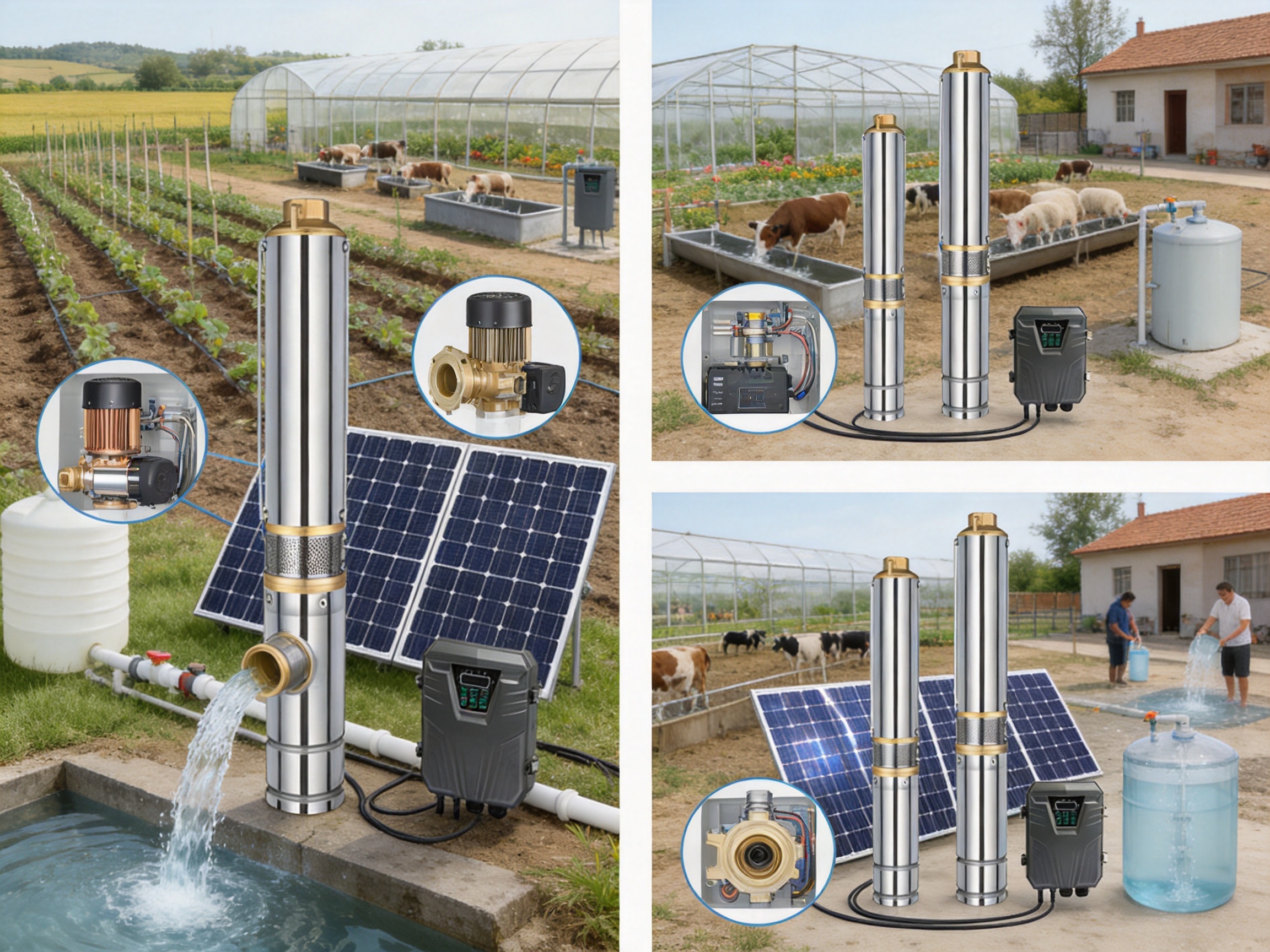
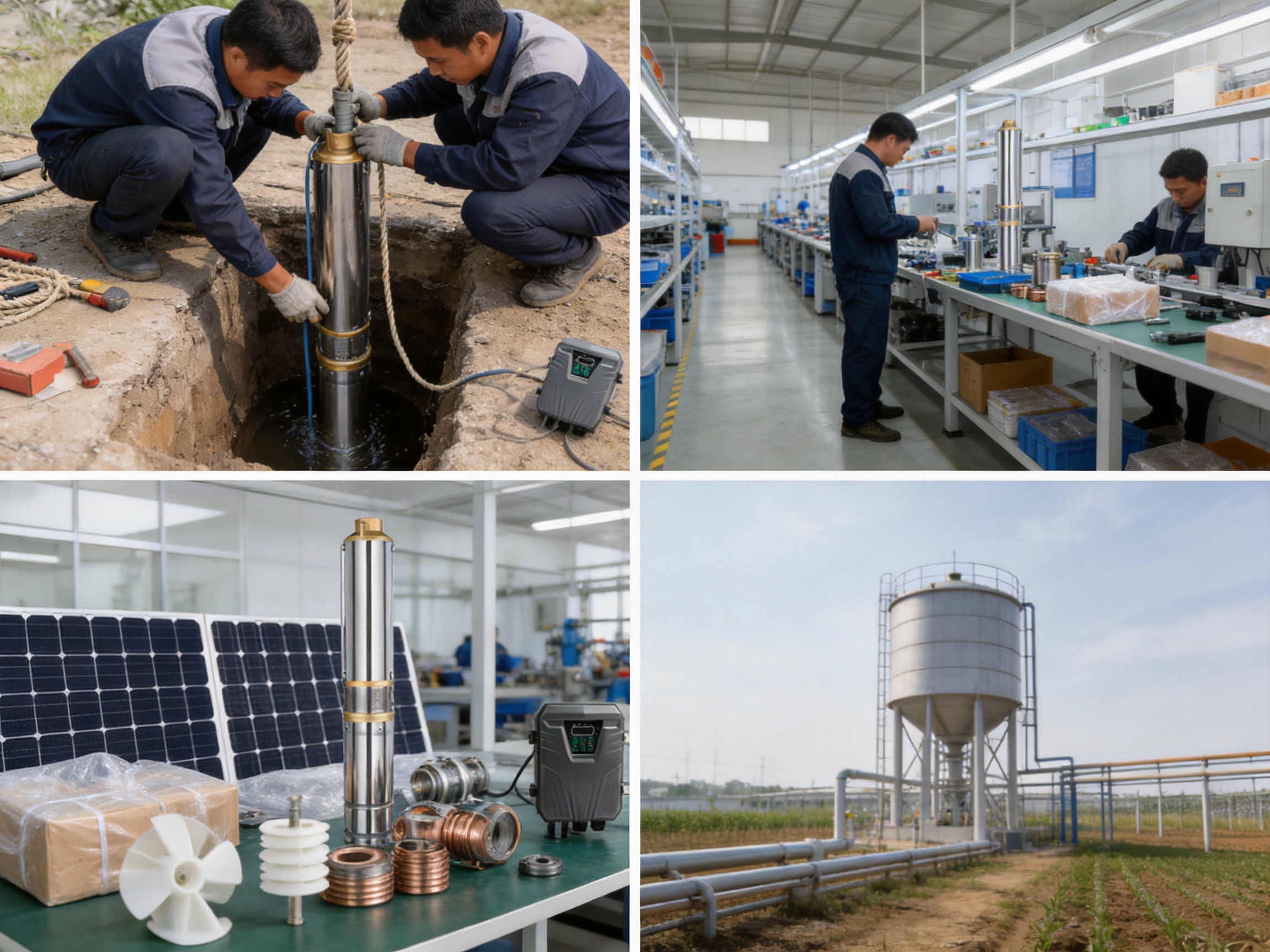
Taizhou Edwin Electric Co., Ltd. was founded in 2008 and operates as an integrated manufacturing enterprise focused on independent research and development, mass production, and global export. This combination is important for pump buyers because product performance depends not only on a design concept but also on repeatable production, component control, inspection, packaging, and after-sales coordination.
Independent R&D allows a manufacturer to refine motor systems, hydraulic components, materials, sealing structures, and control compatibility around actual application requirements. For the 2EPC series, the combination of a brushless DC motor, solar compatibility, compact submersible construction, copper components, NSK bearings, and a plastic impeller reflects a product approach aimed at off-grid water service.
Engineering development also supports the creation of multiple models within one product family. The 200 W, 300 W, and 400 W versions provide different head and voltage options while maintaining a consistent application concept. This gives distributors, contractors, and project integrators more flexibility when matching equipment to site conditions.
Mass production can improve consistency when it is supported by standardized processes and quality checks. Repeated assembly procedures help control shaft alignment, bearing installation, seal placement, impeller positioning, electrical connections, and final inspection. Consistency is particularly important for submersible pumps because many internal components are inaccessible after installation.
A production enterprise with established manufacturing capacity can also support stable procurement for distributors and project buyers. Availability of repeat models, consistent specifications, and organized order handling helps reduce uncertainty during multi-unit installations or replacement planning.
A pump’s reliability depends on the relationship between its components. The motor must match the hydraulic load, the impeller must match the chamber, the bearings must support the shaft, and the seals must protect the motor under submersible conditions. Using copper components, NSK bearings, and a high-performance plastic impeller is meaningful because these parts are integrated into a single operating system rather than selected independently.
Assembly quality is equally important. Correct clearances, accurate fastening, clean sealing surfaces, and proper electrical insulation all influence the pump’s service life. A manufacturer that controls product development and production together can adjust these relationships more efficiently than a company that only resells unrelated components.
Edwin Pump serves customers in the global market and has developed associated companies for procurement planning, order tracking, cross-border delivery, and foreign trade services. This wider organization can be valuable to international buyers who require more than a product quotation.
Cross-border projects often involve model confirmation, packaging requirements, documentation, shipping schedules, spare parts, and communication across different time zones. A supplier with experience in these areas can help buyers coordinate the commercial and technical aspects of an order more efficiently.
The company’s product portfolio includes deep well pumps, submersible pumps, domestic booster pumps, circulation pumps, solar water pumps, intelligent booster pumps, and other pump-related products. This range supports one-stop sourcing for customers working on residential, agricultural, commercial, municipal, industrial, and renewable-energy projects.
A broad portfolio also enables system-level discussions. For example, a solar submersible pump may supply a storage tank, while a booster pump may later be used to pressurize water inside a building. Circulation pumps may be needed for heating, cooling, or water-treatment systems. A supplier familiar with multiple pump categories can help organize procurement across an entire water project.
Before installation, inspect the well, measure the static and dynamic water levels, confirm the casing diameter, and verify the pump model. Check the power rating, voltage range, cable length, outlet specification, controller compatibility, and panel open-circuit voltage. Confirm that all equipment is suitable for the local environment and applicable electrical regulations.
Install the pump vertically where possible and keep it clear of the well bottom. Secure the discharge pipe and support rope independently. Protect the electrical cable from abrasion against the casing and avoid sharp bends. All underwater electrical joints must use appropriate waterproof connection methods.
After installation, check the direction and stability of operation according to the controller instructions. Observe current, voltage, flow, discharge pressure, water clarity, and any unusual vibration or noise. The first operating period should be monitored carefully because it can reveal installation issues such as sediment intake, insufficient water level, blocked piping, or an incorrect controller setting.
Do not operate the pump outside its specified voltage range. Do not connect the pump directly to an unregulated solar array unless the system has been specifically designed for that arrangement. Do not operate it dry, and do not use the pump to handle liquids for which it was not designed. If water contains high levels of sand, chemicals, salt, or abrasive materials, consult the supplier before installation.
The brushless design reduces routine motor maintenance, but the complete solar pumping system still requires periodic inspection. Solar panels should be kept reasonably clean and free from shading. Electrical connections should be checked for corrosion, looseness, moisture, and mechanical damage.
Inspect the well and water level periodically, particularly after droughts or seasonal changes. If flow decreases, check for a lower water level, blocked intake, sediment accumulation, damaged piping, clogged filters, or reduced solar output. A change in performance does not necessarily indicate a motor failure.
Storage tanks, float valves, pressure devices, filters, and check valves should be inspected according to their own maintenance requirements. If the pump must be removed, use proper lifting equipment and avoid pulling it by the electrical cable. After removal, inspect the cable, seals, impeller, intake, and discharge connection before reinstalling or replacing components.
For installations that operate in freezing climates, exposed above-ground pipes should be protected or drained when necessary. The submersible pump and pipe arrangement should be designed to prevent damage caused by freezing water, sudden pressure changes, or uncontrolled backflow.
For distributors, the 2EPC series offers a clear product concept that is easy to position in the growing solar-water market. The range covers several power levels and head requirements, allowing a distributor to serve different small and medium off-grid projects without carrying unrelated product designs.
For contractors, compact dimensions, direct-current operation, and compatibility with MPPT controllers can simplify system integration. The contractor can combine the pump with a properly sized solar array, controller, storage tank, sensors, and piping system according to the site’s needs.
For project buyers, the most important value is the relationship between purchase cost, installation cost, operating cost, and serviceability. A solar pump may require an initial investment in panels and controls, but it can reduce recurring fuel or electricity expenses. The brushless motor, durable materials, and low-maintenance structure further support long-term operating value.
International buyers can also benefit from working with an established manufacturer that provides product development, mass production, export coordination, and a wider range of pump products. These capabilities can help support repeat orders, project expansion, replacement procurement, and customized sourcing discussions.
The 2EPC is a brushless DC motor submersible solar deep well pump. It is installed below the water level and is designed to lift groundwater for agricultural, domestic, livestock, garden, greenhouse, and remote solar-water applications.
Yes. The pump is designed for solar-powered operation and can be connected to a suitable solar-panel array and MPPT controller. The final system must be designed within the specified voltage, power, and controller limits.
The listed models are rated at 200 W, 300 W, and 400 W. The first two models use a 24 V nominal platform, while the 400 W model uses a 48 V nominal platform.
The highest listed maximum head is 64 m for model 2EPC1.7-64-48-400. Actual flow at a working head will be lower than the maximum flow stated at a different operating condition, so the performance curve should be consulted for final selection.
The listed maximum flow is 1.5 m³/h for the 200 W model and 1.7 m³/h for both the 300 W and 400 W models. Actual flow depends on head, pipe resistance, water level, solar availability, and system configuration.
A brushless motor eliminates physical brushes, reducing brush wear and routine maintenance. This is useful for pumps installed in locations where removal and servicing are difficult. Brushless operation also supports low-noise and efficient performance.
The supplied product information recommends solar-panel power of at least 1.3 times the pump power. This corresponds approximately to 260 W for the 200 W model, 390 W for the 300 W model, and 520 W for the 400 W model. Local sunlight and system losses may require a larger array.
A compatible MPPT solar pump controller should be selected according to the pump’s nominal voltage, optimum input voltage, panel open-circuit voltage, current, and protection requirements. The controller should be confirmed with the supplier before installation.
The pump lifts water but does not purify it. Groundwater intended for drinking must be tested and treated according to local health requirements. Filtration, disinfection, and water-quality control should be designed separately when necessary.
Buyers should confirm the model, voltage, power, maximum head, required flow, outlet specification, cable length, solar-panel voltage, controller compatibility, well diameter, water quality, and delivery requirements. The supplied table lists a 0.75-inch outlet, so this detail should be verified against the exact product configuration despite the 2-inch product-series description.
The pump is manufactured by Taizhou Edwin Electric Co., Ltd., also known as Edwin Pump. The company was founded in 2008 and focuses on pump research and development, mass production, global export, and integrated procurement services.
The 2EPC Brushless DC Motor Submersible Solar Deep Well Pump is a practical solution for water lifting in locations where grid electricity is unavailable or unreliable. Its brushless motor, solar compatibility, compact submersible design, copper outlet, copper oil cylinder, NSK bearings, and lightweight plastic impeller create a balanced product for remote water applications.
The three available configurations support different project requirements, from moderate 35 m lifting duties to applications requiring a maximum stated head of 64 m. Agricultural irrigation, livestock watering, rural household supply, greenhouse irrigation, and solar-powered community projects can all benefit from a properly designed 2EPC installation.
Its advantages are strongest when the entire system is correctly engineered. Solar-panel sizing, MPPT controller selection, water-level protection, total dynamic head, pipe friction, cable protection, and well conditions must all be considered. With proper installation and maintenance, the pump can help reduce dependence on fuel and utility power while providing a reliable renewable-energy water supply.
Backed by a manufacturer with experience in independent R&D, mass production, export, and a broad pump portfolio, the 2EPC series is positioned as more than an isolated component. It is part of a wider approach to efficient, durable, and accessible water-pumping technology for global industrial, agricultural, residential, and renewable-energy markets.
1. Product specification and performance data for the 2EPC Brushless DC Motor Submersible Solar Deep Well Pump.
2. Manufacturer-provided information on brushless DC motor operation, copper components, NSK bearings, plastic impeller construction, and solar compatibility.
3. Manufacturer company profile and product portfolio information for Taizhou Edwin Electric Co., Ltd.
4. General engineering principles for submersible pump selection, total dynamic head calculation, solar-array sizing, and MPPT controller integration.
5. General maintenance practices for solar pumping systems, deep wells, submersible electrical equipment, and agricultural water infrastructure.
edwina@edwin-pump.com
+86-13586290903 (WhatsApp)
Xuri Gongliang Cutting Tool Entrepreneurship Park, Wenqiao Town, Wenling City, Taizhou City, Zhejiang Province, China

High Performance Smart Pump Factory


 English