edwina@edwin-pump.com

View All Products
en
Reliable access to water is essential for rural communities, farms, gardens, livestock operations, remote facilities, and decentralized infrastructure. In locations where grid electricity is unavailable, unstable, or too expensive to extend, solar pumping provides an efficient and sustainable alternative. However, not every solar pump is suitable for demanding deep-well applications. A practical solution must combine dependable hydraulic performance, compatibility with changing solar input, corrosion resistance, compact installation dimensions, and long operating life.
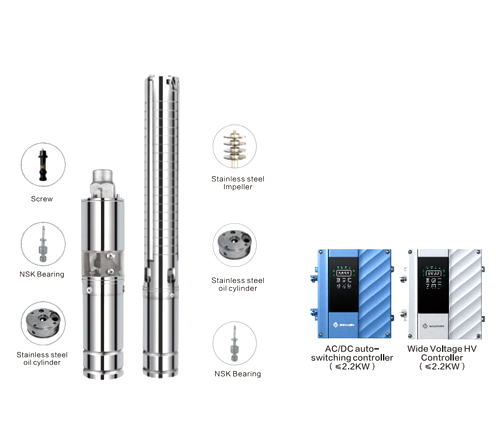
The 3HVSC Wide Voltage Stainless Steel Impeller Solar Deep Well Pump is designed to meet these requirements. This compact three-inch DC submersible solar pump uses a brushless motor, stainless steel hydraulic components, NSK bearings, and high-temperature copper wire to provide reliable water delivery in small wells and remote environments. Its wide-voltage operating range enables the pump to make effective use of variable photovoltaic power, while its stainless steel impeller offers greater resistance to wear and corrosion than conventional plastic impellers.
The pump is available in several configurations, with rated power options of 750 W, 1,100 W, and 1,500 W. Depending on the model, maximum flow reaches 6 cubic meters per hour and maximum head reaches 135 meters. This range enables users to select a configuration for drinking-water supply, orchard irrigation, drip irrigation, tank filling, and other low- to medium-flow applications.
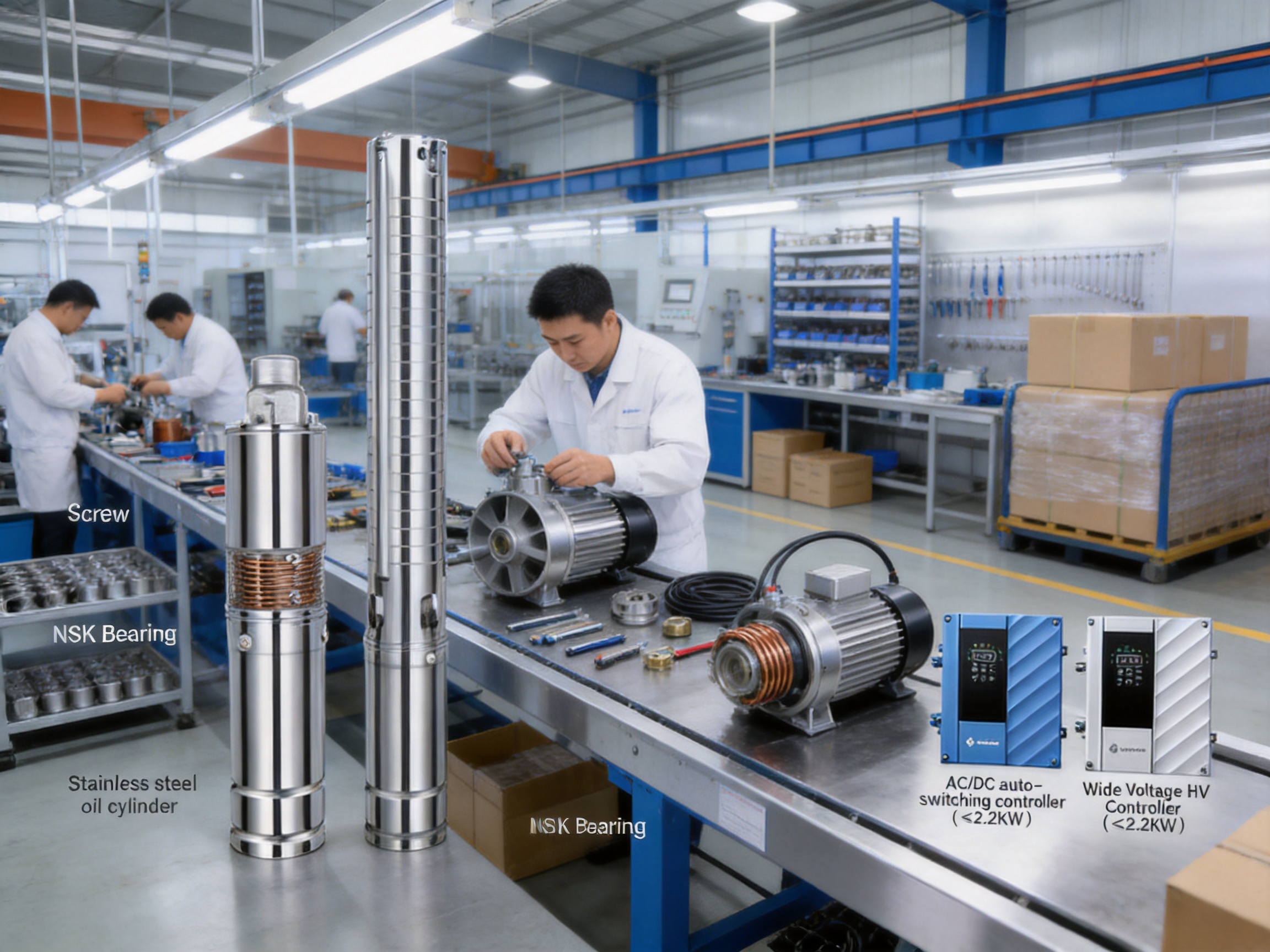
Behind the product is Taizhou Edwin Electric Co., Ltd., an integrated pump manufacturer with experience in independent research and development, mass production, export, and one-stop procurement services. The company’s product portfolio includes deep well pumps, submersible pumps, domestic booster pumps, circulation pumps, solar water pumps, and intelligent booster pumps. Its manufacturing and service capabilities support customers that need consistent product supply, customized purchasing coordination, and practical solutions for different water systems.
3HVSC Wide Voltage Stainless Steel Impeller Solar Deep Well Pump
A solar pumping system is more than a motor placed inside a well. The pump must work with a photovoltaic array whose output changes throughout the day. Solar irradiance varies according to time, weather, season, temperature, shading, and panel orientation. A pump that performs acceptably under stable grid power may fail to operate efficiently when its voltage and available power fluctuate.
Deep-well installations introduce additional requirements. The pump must overcome the vertical elevation between the water level and the discharge point, along with friction losses in the rising pipe, valves, elbows, and irrigation equipment. The equipment also operates in a confined and often inaccessible location. Removing a failed pump from a deep well can require considerable labor, lifting equipment, and downtime. For that reason, material durability and motor reliability are central considerations during product selection.
Small wells create another challenge. Many agricultural and residential wells have a narrow bore, so the pump must provide sufficient performance without requiring a large installation diameter. A three-inch pump is suitable for applications where a larger pump cannot be installed or where the available water yield is limited. Its compact format supports targeted water delivery without encouraging excessive extraction from a small aquifer.
The 3HVSC series addresses these conditions through a combination of a compact three-inch bore design, a wide-voltage brushless DC motor, stainless steel wetted components, and multiple head-flow configurations. Rather than offering one oversized model for every installation, the range allows users to match pump power and hydraulic performance to the depth, pipe arrangement, and daily water requirement.
The three-inch diameter format is one of the product’s most practical advantages. Many small wells, monitoring wells, household wells, and narrow agricultural wells cannot accommodate conventional larger submersible pumps. A compact pump allows installers to work within existing bore dimensions while maintaining a useful level of water delivery.
The smaller form factor is also valuable when the water source has a relatively low recovery rate. A pump that is too large may draw water faster than the well can replenish it, causing the water level to fall and potentially leading to dry running or unstable operation. The 3HVSC range includes low-flow options around 4.8 to 6 cubic meters per hour, making it more appropriate for controlled extraction, storage-tank filling, orchard irrigation, and household supply than an unnecessarily oversized unit.
Compact construction can simplify transportation and installation in remote areas. Solar projects are often located far from paved roads, workshops, and electrical services. Equipment that is easier to move and install can reduce logistical effort and help installers complete projects with fewer resources.
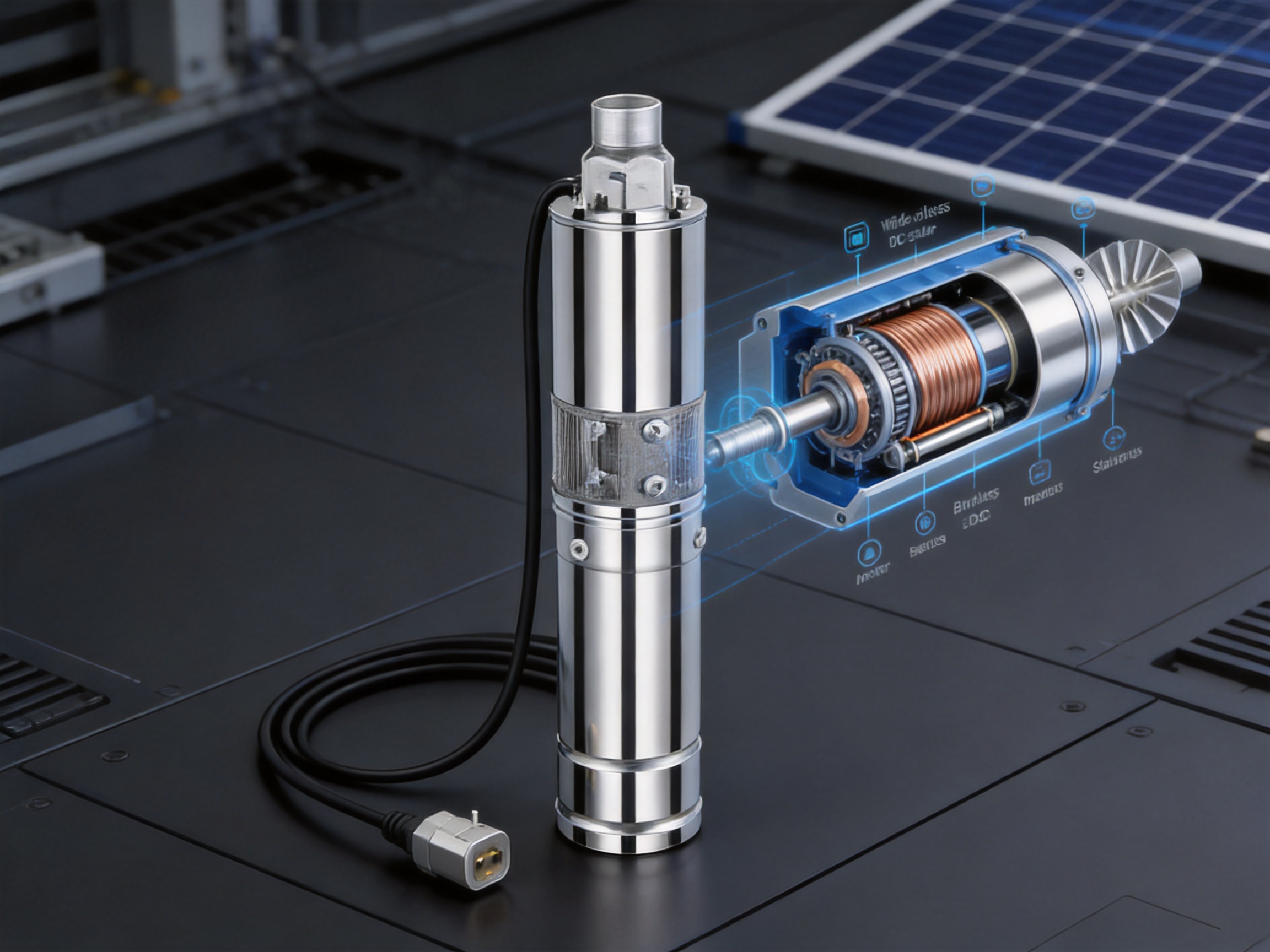
The pump uses a wide-voltage brushless DC motor designed for solar power input. The listed optimum input voltage ranges are 110 V to 350 V DC or 150 V to 350 V DC, depending on the selected model. This broad operating window enables the pump to work with different photovoltaic array arrangements and to continue operating as solar conditions change.
Brushless motor technology eliminates the mechanical brushes used in traditional brushed motors. This reduces brush wear, removes a common replacement component, and supports longer service intervals. The absence of brush friction also helps improve operating efficiency and reduce mechanical losses within the motor.
Wide-voltage operation is particularly useful in off-grid installations. Early in the morning, late in the afternoon, or during partially cloudy conditions, a solar array may produce less voltage and power than it does at midday. A motor with a narrow operating range may stop frequently or fail to start. A wide-voltage design provides greater flexibility for using available solar energy, although actual output will still depend on irradiance and system design.
It is important to distinguish wide-voltage compatibility from unlimited operation. The solar array must still be configured within the specified voltage limits. The product data indicates that the solar panel open-circuit voltage should remain below 450 V, while the operating input range varies by model. Proper panel selection, wiring, protection, and controller configuration remain essential for safe and reliable operation.
The stainless steel impeller is a major differentiator of this product. In many entry-level solar pumps, plastic impellers are used to reduce manufacturing cost and weight. Plastic components can be suitable for clean, mild water, but they may be more vulnerable to abrasion, deformation, or chemical attack in challenging environments.
A stainless steel impeller offers improved resistance to wear and corrosion. This is useful when the water contains fine suspended particles, when the pump experiences frequent operation, or when the installation is exposed to a demanding water chemistry. Stainless steel also maintains its structural integrity across a broad range of operating conditions, helping the hydraulic assembly retain stable performance over time.
The impeller is responsible for transferring motor energy into water pressure and flow. Damage or erosion at the impeller can reduce hydraulic efficiency, increase vibration, and lower the delivered head. A more durable impeller can therefore support more consistent operation and reduce the risk of premature hydraulic performance loss.
Compared with a conventional plastic impeller, the stainless steel component provides a stronger choice for customers who prioritize service life and material durability over the lowest initial purchase price. This is particularly important in deep wells, where replacing a pump can be significantly more expensive than selecting a durable component at the beginning of the project.
The product also features a stainless steel cylinder and a robust pump body. These components protect the internal motor and hydraulic system while supporting resistance to corrosion in submerged conditions. A submersible pump is continuously exposed to water, and any weakness in its external structure can eventually affect internal components.
Stainless steel construction gives the pump a durable exterior suitable for long-term immersion. It also contributes to a clean and professional appearance for installations where equipment quality and finish are important. For drinking-water supply, rural household systems, and agricultural projects, material selection is an important part of evaluating long-term reliability.
The stainless steel cylinder further supports the pump’s mechanical strength during installation and operation. Deep-well equipment may be subjected to handling stress, cable tension, pipe loads, vibration, and pressure changes. A robust body helps the pump withstand these conditions when the system is correctly installed and supported.
The motor is equipped with NSK bearings to support smooth rotation and reduce friction. Bearings play a critical role in maintaining shaft alignment, minimizing vibration, and transferring rotational loads. In a continuously operating pump, bearing quality directly influences noise, efficiency, temperature, and service life.
High-temperature copper wire is used in the motor winding. Copper provides excellent electrical conductivity, while high-temperature insulation supports reliable operation when the motor experiences elevated temperatures. Solar pumping systems can operate for extended periods during hot weather, and the motor must dissipate heat while remaining electrically stable.
The combination of quality bearings and high-temperature copper wire strengthens the motor’s ability to operate under variable solar conditions. These elements do not eliminate the need for correct installation or protection, but they provide a stronger internal foundation than a motor built with low-grade conductive materials or less durable bearing components.
The 3HVSC series includes six listed configurations. The models differ by maximum flow, maximum head, input voltage range, and motor power. The table below summarizes the available performance data.
| Model | Optimum DC Input Voltage | Power | Maximum Flow | Maximum Head | Outlet | Cable Length | Maximum Solar Open-Circuit Voltage | Recommended Solar Panel Power |
| 3HVSC4.8-95-110-750 | 110–350 V | 750 W | 4.8 m³/h | 95 m | 1.25 inches | 2 m | Below 450 V | At least 1.3 times pump power |
| 3HVSC5-112-110-1100 | 110–350 V | 1,100 W | 5 m³/h | 112 m | 1.25 inches | 2 m | Below 450 V | At least 1.3 times pump power |
| 3HVSC5-135-150-1500 | 150–350 V | 1,500 W | 5 m³/h | 135 m | 1.25 inches | 2 m | Below 450 V | At least 1.3 times pump power |
| 3HVSC6-60-110-750 | 110–350 V | 750 W | 6 m³/h | 60 m | 1.25 inches | 2 m | Below 450 V | At least 1.3 times pump power |
| 3HVSC6-85-110-1100 | 110–350 V | 1,100 W | 6 m³/h | 85 m | 1.25 inches | 2 m | Below 450 V | At least 1.3 times pump power |
| 3HVSC6-115-150-1500 | 150–350 V | 1,500 W | 6 m³/h | 115 m | 1.25 inches | 2 m | Below 450 V | At least 1.3 times pump power |
The model names indicate a useful relationship between flow and head. The 4.8 m³/h and 5 m³/h versions are oriented toward higher lifting requirements, while the 6 m³/h versions provide greater flow at lower maximum head ratings. Selection should be based on the actual total dynamic head and required flow rather than maximum figures alone.
For example, a 750 W model with a 60-meter maximum head may be appropriate for a relatively shallow well and short discharge route where the main requirement is higher flow. A 750 W model rated for a 95-meter maximum head may be better suited to a deeper lifting application with a lower water delivery requirement. The 1,100 W and 1,500 W models offer greater head capability for demanding vertical lifts, but their suitability depends on the complete hydraulic system and available solar power.
Maximum head is not the same as continuous operating head at maximum flow. As with most centrifugal pumping equipment, flow and head vary according to the pump curve. At higher flow, available head generally decreases; at higher head, flow generally decreases. Installers should use the manufacturer’s performance curve and calculate system resistance before final selection.
One of the clearest advantages over basic competitor products is the use of a stainless steel impeller rather than relying exclusively on a plastic impeller. This can improve resistance to abrasion, corrosion, and mechanical stress. Although material suitability depends on the exact water chemistry and particle concentration, stainless steel provides a durable option for customers concerned about long-term wear.
The stainless steel cylinder and pump body extend this material advantage beyond the impeller. A product that combines durable external and internal components is better positioned for continuous immersion and demanding service than one that uses lower-cost materials throughout the hydraulic assembly.
Many conventional pumps are designed around stable AC grid power or a narrow DC input range. The 3HVSC series is specifically configured for solar applications and accepts a broad DC voltage range. This increases design flexibility and allows the system to use different photovoltaic array configurations while accommodating changing conditions during the day.
Wide-voltage brushless operation can also reduce unnecessary cycling caused by temporary changes in solar input. More consistent operating behavior is valuable for tank filling and irrigation, where frequent stops and starts can reduce daily water output and increase system stress.
Brushless motor construction reduces the need to replace mechanical brushes. When combined with NSK bearings and durable materials, the design supports a lower-maintenance operating profile. This is especially important in remote sites where technicians may need to travel long distances to inspect or repair equipment.
Low maintenance does not mean maintenance-free. Solar panels must be kept reasonably clean, electrical connections must be protected, the well must be monitored for sediment and water-level changes, and the pump should not be operated outside its intended conditions. Nevertheless, reducing wear components can make scheduled maintenance easier to manage.
Large pumps are not always better. A pump that is too large for a narrow well may be impossible to install, while an oversized hydraulic capacity may cause excessive drawdown. The 3HVSC series focuses on small-well compatibility and controlled flow rates. This makes it a more practical alternative to large, energy-intensive pumps for small farms, gardens, residences, and remote water systems.
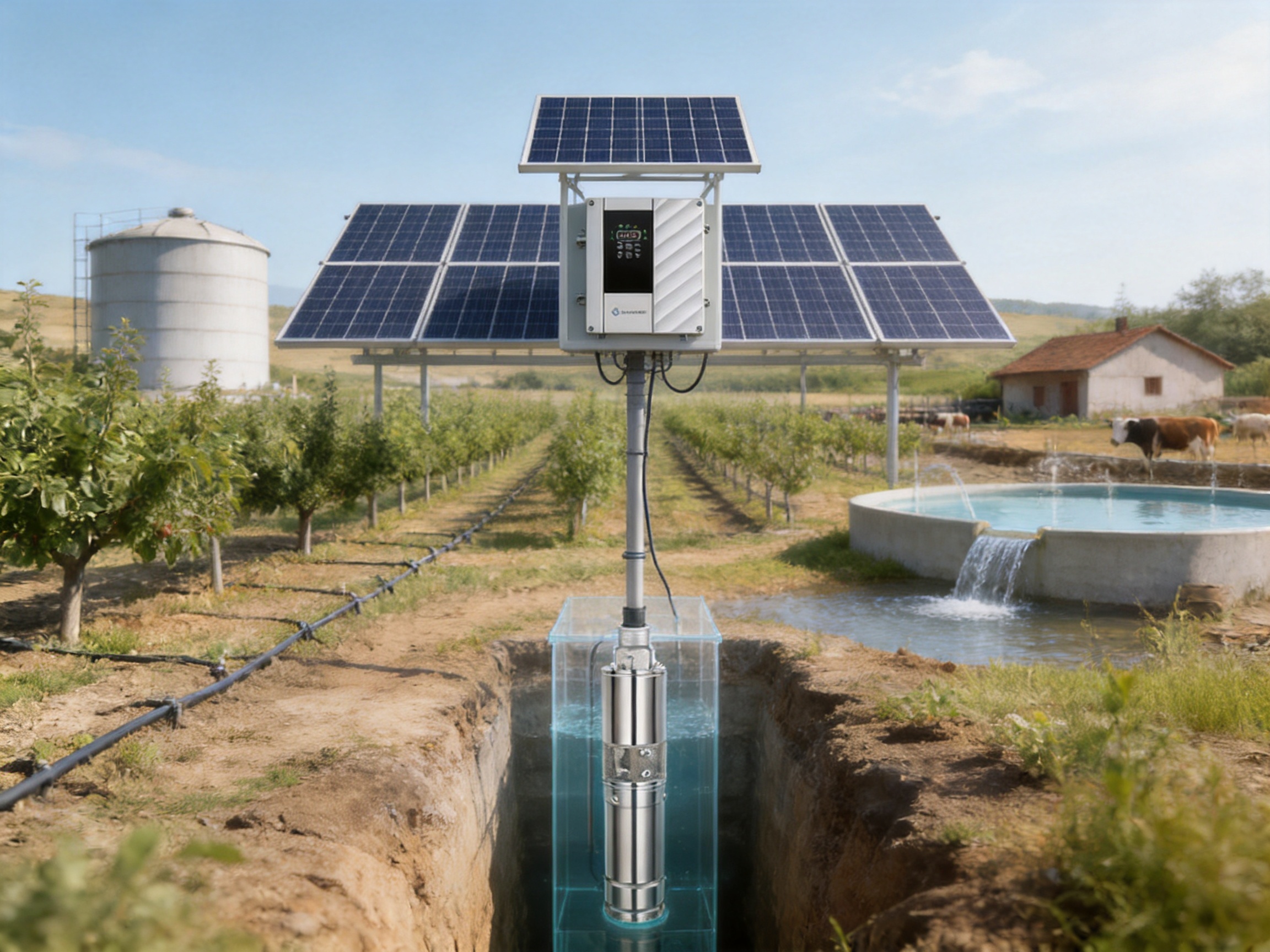
The product can support several applications without requiring a completely different pump platform for each project. Its uses include rural drinking-water supply, low-flow agricultural irrigation, drip irrigation, solar-powered transfer to storage tanks, and deep-well water delivery in remote environments.
This versatility benefits distributors and engineering purchasers. A product family with several power and head configurations can simplify inventory planning while still covering a broad range of customer requirements.
The listed performance data recommends solar panel power of at least 1.3 times the pump power. On this basis, a 750 W pump requires a minimum recommended panel capacity of approximately 975 W, a 1,100 W pump requires approximately 1,430 W, and a 1,500 W pump requires approximately 1,950 W.
This ratio provides an operating margin because solar panels rarely deliver their rated output continuously. Real-world power is affected by temperature, dust, cloud cover, panel aging, wiring losses, orientation, and seasonal conditions. In locations with frequent cloud cover or high water demand, the system designer may choose additional capacity after evaluating local solar resources.
Panel voltage must be selected carefully. The pump models specify an operating input range, and the solar panel array open-circuit voltage must remain below 450 V. The open-circuit voltage is the voltage produced by the array when no load is connected, and it can increase under cold conditions. A qualified installer should calculate the highest possible array voltage, not only the nominal voltage under standard test conditions.
A suitable solar pump controller or drive is necessary to regulate the DC input and operate the motor safely. The controller should be compatible with the pump’s voltage, power, current, and motor characteristics. It should also support protection against overvoltage, undervoltage, overload, overheating, dry running, and other conditions required by the installation.
Electrical protection should be selected according to local regulations and project requirements. Appropriate disconnects, fuses, surge protection, grounding, cable protection, and weather-resistant enclosures help protect the system from electrical faults and lightning-related surges. High-voltage DC systems require particular care because DC arcs can be difficult to extinguish.
All electrical work should be completed by qualified personnel. The pump cable, solar array, controller, and grounding system must be installed according to applicable safety standards. The pump should never be connected to a solar array that exceeds the specified voltage limits.
Submersible pumps rely on surrounding water for cooling and lubrication in their operating environment. If the well water level falls below the required submergence level, the pump may overheat or suffer premature damage. A reliable installation should include a water-level sensor, dry-run protection, or controller function that stops the pump when the water source is insufficient.
Well yield should be evaluated before selecting the pump. The maximum pump flow should not exceed the sustainable production of the well. A storage tank can help balance intermittent solar generation and well recovery. The pump can fill the tank during daylight, while a separate distribution system supplies users when water is needed.
Total dynamic head includes static lift, drawdown, discharge elevation, friction losses, and required outlet pressure. Static lift is the vertical distance from the pumping water level to the delivery point. Drawdown refers to the additional lowering of the water level while the pump is operating. Pipe friction depends on pipe diameter, length, material, flow rate, and the number of fittings.
The 1.25-inch outlet should be connected to a pipe system that balances flow velocity and friction. An undersized discharge pipe can create unnecessary pressure losses and reduce delivered flow. A properly selected pipe, check valve, isolation valve, and support arrangement help the pump operate closer to its intended performance.
Installers should also consider water hammer, especially in long rising mains. Gradual valve operation, suitable check-valve selection, and secure pipe support can reduce hydraulic shock. The pump cable should be fastened to the rising pipe at appropriate intervals without placing excessive tension on the electrical connection.
Remote villages, cabins, field stations, and isolated homes may require a dependable water source without access to grid power. A solar deep-well pump can lift groundwater into an elevated tank, pressure vessel, or household storage system. The stored water can then be distributed by gravity or through a separate booster pump.
The stainless steel hydraulic components are valuable in these applications because the pump may be difficult to remove and service. Before use for drinking water, the complete system should be evaluated for local potable-water requirements, water quality, materials compliance, filtration, and disinfection. Pump material alone does not guarantee that raw well water is safe to drink.
Small farms and orchards often need reliable water delivery but may not require the very high flow rates associated with large irrigation pumps. The 3HVSC series can support low-flow irrigation for fruit trees, vegetable plots, nurseries, and small livestock operations when the selected model matches the available water source and required pressure.
Solar pumping can be coordinated with daytime irrigation, or water can be accumulated in a tank for evening and early-morning use. This approach reduces dependence on batteries because the system stores energy in the form of water rather than electricity. Drip systems can further reduce water consumption by delivering moisture directly to the root zone.
Drip irrigation requires controlled flow and adequate pressure. A solar deep-well pump can transfer water to a filtration and distribution system, provided that the hydraulic design accounts for elevation changes, filter losses, pressure regulators, and the length of the irrigation network.
The pump should not be selected solely by the number of emitters. Designers must calculate the combined flow requirement, pressure at the farthest section, and additional losses through filtration and valves. A storage tank may be used to separate the variable solar pumping process from the more precise pressure requirements of the drip network.
Tank filling is one of the simplest and most effective solar pump applications. During periods of sunlight, the pump lifts water into a tank. A float switch or level sensor can stop the pump when the tank is full, while a low-level sensor can prevent the well from being over-pumped.
Because the tank provides a buffer, the pump does not need to operate at a constant rate. This suits the variable output of solar energy and can reduce the need for battery storage. The tank can also provide emergency reserve capacity for household use, livestock watering, or irrigation.
Construction sites, mining support areas, agricultural outposts, and temporary field operations may need water transfer without a permanent electrical connection. The compact pump can be incorporated into a portable or semi-permanent solar system, subject to appropriate lifting equipment, cable management, and protection against environmental exposure.
Remote installations benefit from robust components because service access may be limited. The combination of a brushless motor, stainless steel impeller, stainless steel cylinder, and durable motor materials helps reduce the risk associated with long intervals between service visits.
Taizhou Edwin Electric Co., Ltd. was founded in 2008 and operates as an integrated manufacturing enterprise. Its activities include independent research and development, mass production, and global export. This integrated structure is important for pump buyers because product design, manufacturing coordination, and international order fulfillment can be handled within an established business system.
Independent research and development enables the manufacturer to respond to changing market needs rather than relying only on generic pump designs. The development of solar water pumps and intelligent booster pumps reflects attention to energy transition, decentralized water supply, and modern automation requirements.
For the 3HVSC series, product development is reflected in the combination of a wide-voltage brushless motor and solar-compatible performance range. The use of stainless steel hydraulic components also demonstrates an emphasis on durability in applications where conventional low-cost materials may not provide the desired service life.
Research and development is not limited to motor design. A complete pump solution requires consideration of hydraulics, electrical compatibility, materials, installation dimensions, cable connections, and application conditions. A manufacturer with multiple pump categories can apply experience from deep-well, submersible, booster, circulation, and other products to broader system design challenges.
Mass production can provide more consistent availability and repeatable manufacturing for distributors, contractors, and original equipment customers. It also allows a product family to be manufactured in several power and hydraulic configurations, supporting different project requirements without requiring a completely new development for each order.
Consistent production depends on controlling key components and assembly steps. In this product, important areas include motor winding quality, bearing installation, impeller assembly, stainless steel body construction, sealing, cable connection, and electrical testing. Proper process control helps ensure that pumps produced at different times maintain comparable performance and reliability.
The company’s broad product portfolio also supports purchasing efficiency. Customers that need several types of pumps may coordinate sourcing through one supplier instead of managing separate vendors for deep-well pumps, domestic booster pumps, circulation pumps, and related equipment.
Component selection is a central part of manufacturing quality. Stainless steel for the impeller, cylinder, and pump body provides a durable foundation for submerged operation. NSK bearings contribute to smooth mechanical performance, and high-temperature copper wire supports motor winding stability.
These components are meaningful because they address common failure mechanisms. Impeller wear can reduce output. Bearing degradation can increase vibration and temperature. Inadequate winding materials can reduce motor life under heat. By focusing on these areas, the manufacturer improves the product’s ability to deliver dependable service in variable and remote operating conditions.
The manufacturer has developed a global export and service structure to support international customers. Taizhou Haipai Import & Export Co., Ltd. and Golden Falcon Industrial Co., Ltd. were established in 2012 to provide procurement planning, order tracking, cross-border delivery, and foreign trade services.
These capabilities are important for commercial buyers who need more than a product quotation. International projects may require coordinated documentation, production scheduling, packaging, shipment planning, model confirmation, and communication among several parties. A professional foreign-trade team can help reduce misunderstandings and improve order visibility.
Global customers may also have different requirements for voltage, packaging, labeling, installation documentation, and market positioning. Working with a manufacturer experienced in export markets can make it easier to organize these details before production and shipment.
Before installation, verify the well diameter, static water level, dynamic water level, well depth, water quality, sustainable yield, and desired delivery point. Confirm that the selected three-inch pump can be lowered into the well with sufficient clearance and that the rising pipe and cable are compatible with the outlet and electrical requirements.
Inspect the pump, cable, connectors, and accessories for visible damage. The pump should be suspended securely from the rising pipe or an appropriate support system. The electrical cable must not carry the mechanical weight of the pump. Cable joints should be waterproof, mechanically protected, and positioned according to the installation design.
The pump should be installed at a depth that maintains adequate submergence during operation. It should not rest directly on the bottom of the well, where it may draw in sediment or become obstructed. If the well contains sand or sediment, the well should be developed and cleaned before commissioning.
Before energizing the system, check the solar array open-circuit voltage and polarity. Confirm that the voltage remains below the specified maximum and that the operating voltage is compatible with the chosen model. Verify controller settings, grounding, protection devices, and emergency disconnects.
During initial commissioning, observe the pump current, voltage, flow, discharge pressure, water clarity, and operating sound. Check for excessive vibration, leakage, unstable cycling, or unusual temperature rise. Confirm that the pump stops correctly when the storage tank is full or when the water level protection is activated.
Initial water may contain sediment or installation debris and should be discharged appropriately until the water is clear. For drinking-water applications, conduct the required water-quality testing and treatment before consumption.
Solar pump systems generally require less routine mechanical maintenance than combustion-powered systems, but regular inspection remains important. Solar panels should be checked for dust, leaves, bird droppings, shading, and physical damage. Reduced panel output can appear as a pump problem even when the pump itself is operating correctly.
Electrical enclosures and cable connections should be inspected for moisture, corrosion, loose terminals, and damage from animals or weather. The controller should be kept clean and ventilated. Any fault codes or abnormal shutdowns should be investigated rather than repeatedly reset without identifying the cause.
Water production should be monitored over time. A gradual reduction in flow may indicate falling groundwater levels, increased pipe resistance, sediment accumulation, impeller wear, a blocked filter, or reduced solar input. Comparing pump voltage, current, flow, and solar conditions can help distinguish between hydraulic and electrical causes.
The well should be checked for changes in water quality and sediment concentration. If sand enters the pump, it can accelerate wear in hydraulic passages and bearings. A properly designed well screen, filtration arrangement, and water-level control strategy can help protect the pump.
At the end of a seasonal operating period, the system should be inspected before long-term shutdown. In climates exposed to freezing temperatures, above-ground pipes and valves may need to be drained or protected. The pump itself is submerged, but connected equipment may still be vulnerable to freezing.
For distributors, the 3HVSC series offers a clear product position: a compact solar deep-well pump with stainless steel hydraulic components and a wide-voltage DC motor. This positioning distinguishes it from basic plastic-impeller models and from larger pumps designed primarily for conventional electrical systems.
The six model configurations allow a distributor to address multiple customer requirements. Lower-power models can serve small household and garden projects, while higher-power versions can support deeper lifting requirements. The range can be promoted for both new installations and replacement projects where a customer wants stronger corrosion resistance or better solar compatibility.
For engineering contractors, the product’s published data provides an initial basis for system design. The operating voltage, power, maximum flow, maximum head, outlet size, cable length, solar voltage limit, and recommended panel capacity are all important for quotation and specification work. Final design should still use the applicable performance curve and project calculations.
For original equipment manufacturers and system integrators, the manufacturer’s independent development and mass-production capabilities may support repeat orders and product integration. A supplier that offers multiple pump categories can also help consolidate sourcing for complete water-supply packages.
For end users, the main commercial value comes from reducing lifecycle risk. A durable pump that operates effectively with variable solar input can provide more dependable water delivery and reduce the likelihood of frequent extraction, repair, or replacement. The correct model selection remains essential; no pump can compensate for an undersized solar array, an unsuitable well, or an incorrectly calculated head.
The 3HVSC series is a DC submersible solar deep-well pump. It is designed for installation in small wells and is powered by a suitable solar photovoltaic system through compatible control equipment.
The pump uses a compact three-inch bore design. This allows it to fit applications where larger submersible pumps may not be suitable, including narrow residential wells, small agricultural wells, and remote water sources.
A stainless steel impeller offers improved resistance to wear and corrosion compared with conventional plastic impellers. It is a suitable choice for users who prioritize durability in long-term submerged operation and challenging water environments.
Depending on the model, the optimum DC input voltage range is 110–350 V or 150–350 V. The solar array open-circuit voltage should remain below 450 V. The array and controller must be designed according to the selected model’s specifications.
The listed recommendation is at least 1.3 times the pump power. This corresponds to approximately 975 W for a 750 W pump, 1,430 W for a 1,100 W pump, and 1,950 W for a 1,500 W pump. Local sunlight conditions and system losses may justify additional capacity.
The listed maximum flow rates are 4.8, 5, and 6 cubic meters per hour, depending on the model. Actual flow depends on total head, pipe friction, solar input, water level, and system configuration.
The listed maximum head ranges from 60 meters to 135 meters. A higher maximum head does not mean the pump delivers its maximum flow at that height. The performance curve should be consulted to determine the expected flow at the project’s operating head.
The listed outlet size is 1.25 inches for all models in the provided performance data.
The performance data lists a two-meter cable. The complete installation may require additional certified submersible cable, waterproof joints, support equipment, and electrical protection depending on the well depth and local regulations.
It can be used in rural or off-grid drinking-water supply applications, but the complete system must meet applicable local requirements. Well water should be tested and treated as necessary. Pump suitability alone does not confirm that the water is potable.
The wide-voltage brushless DC motor is designed to work across varying solar inputs, but available flow and head will decrease when solar power is reduced. A properly sized solar array, storage tank, or backup power arrangement can improve water availability during poor weather.
No pump is completely maintenance-free. The brushless motor reduces brush-related wear, while stainless steel components support durability. The solar array, controller, electrical connections, well, filters, pipework, and water-level protection should still be inspected regularly.
Selection should consider the required flow, static and dynamic water levels, total head, pipe friction, well yield, solar resource, storage capacity, and operating schedule. Compare the project duty point with the manufacturer’s performance curve rather than selecting only by maximum flow or maximum head.
The pump is manufactured by Taizhou Edwin Electric Co., Ltd., an enterprise specializing in research and development, mass production, global export, and a range of water-pump products.
The manufacturer’s product lines include deep-well pumps, submersible pumps, domestic booster pumps, circulation pumps, solar water pumps, intelligent booster pumps, and related water-system products.
The 3HVSC Wide Voltage Stainless Steel Impeller Solar Deep Well Pump is designed for users who need reliable water delivery from small wells without depending on grid electricity. Its three-inch compact format supports narrow-well installations, while the wide-voltage brushless DC motor is suited to the variable electrical output of photovoltaic systems.
The stainless steel impeller, stainless steel cylinder, and robust pump body provide a strong advantage over basic plastic-impeller alternatives. NSK bearings and high-temperature copper wire further support stable motor performance and long-term operation. With power options from 750 W to 1,500 W, maximum flow up to 6 cubic meters per hour, and maximum head up to 135 meters, the series can be adapted to a wide range of rural, agricultural, residential, and remote water applications.
Its success in the field depends on correct engineering. The solar array must remain within the specified voltage limits, panel power must be adequately sized, the well must provide sufficient water, and the total dynamic head must be calculated accurately. Proper controller selection, dry-run protection, electrical safety, installation support, and periodic maintenance are equally important.
Supported by a manufacturer with independent research and development, mass-production capabilities, multiple pump categories, and international procurement experience, the 3HVSC series represents a practical option for customers seeking durable solar pumping equipment. It combines material strength, solar compatibility, compact installation, and model flexibility in one product family, making it suitable for dependable off-grid water infrastructure.
1. Product performance data and technical information supplied for the 3HVSC Wide Voltage Stainless Steel Impeller Solar Deep Well Pump.
2. Manufacturer information concerning Taizhou Edwin Electric Co., Ltd., its product portfolio, research and development activities, manufacturing operations, and global export services.
3. General principles of centrifugal pump selection, including the relationship between flow rate, total dynamic head, pipe friction, and pump performance curves.
4. General photovoltaic system design principles concerning open-circuit voltage, array sizing, operating conditions, temperature effects, and electrical protection.
5. General engineering practices for submersible pump installation, well-yield evaluation, dry-run protection, cable support, and water-storage system design.
serieswatershortageprotectionvoltagestabilizationstainlesssteelverticalmultistagepump.jpg "EVR(S) Series Water Shortage Protection Voltage Stabilization Stainless Steel Vertical Multistage Pump")
edwina@edwin-pump.com
+86-13586290903 (WhatsApp)
Xuri Gongliang Cutting Tool Entrepreneurship Park, Wenqiao Town, Wenling City, Taizhou City, Zhejiang Province, China

High Performance Smart Pump Factory


 English