
edwina@edwin-pump.com

View All Products
en
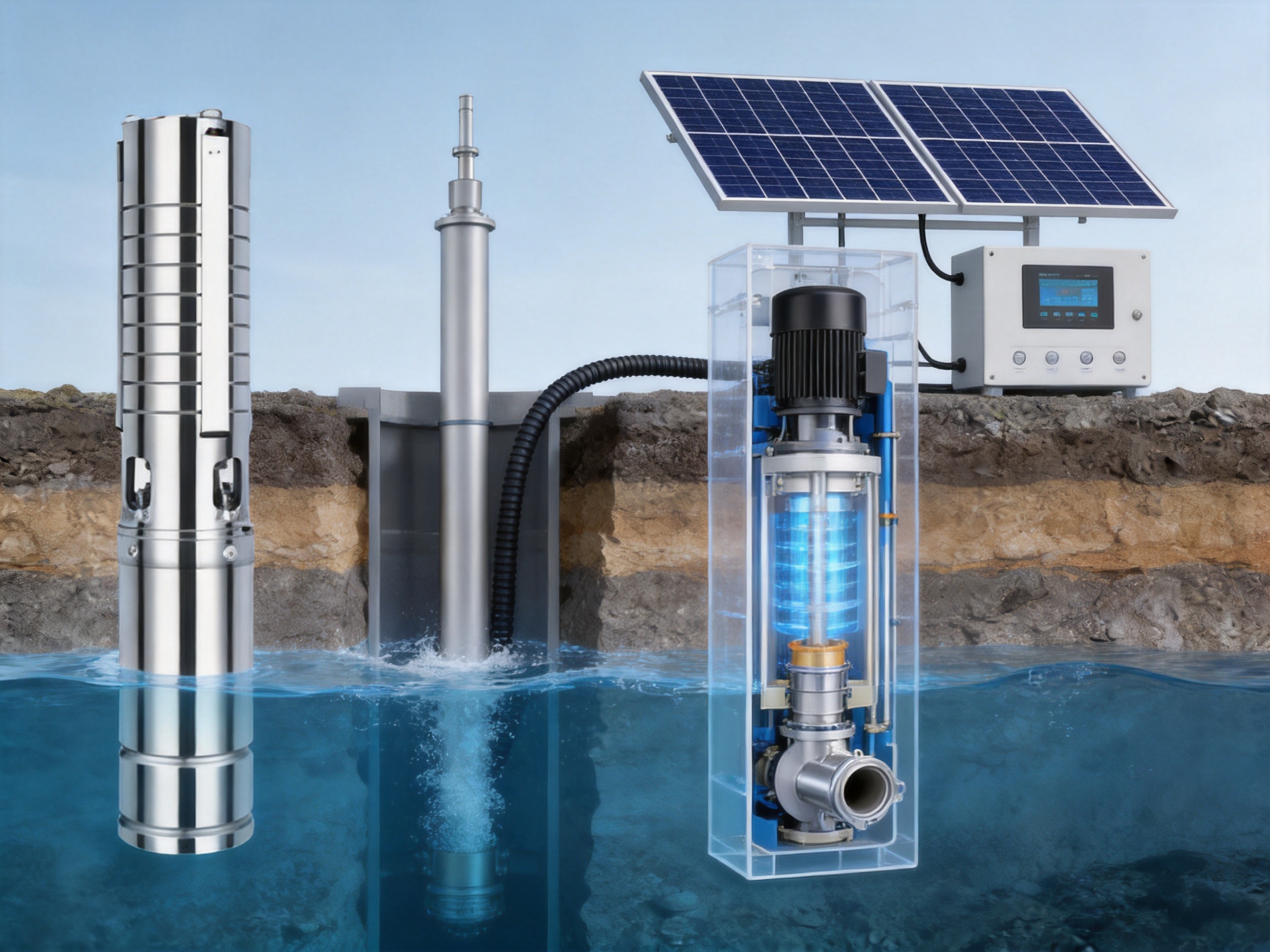
Reliable access to water is essential for households, farms, rural communities, commercial facilities, and infrastructure projects. In many locations, however, conventional pumping systems face significant challenges. Grid electricity may be unavailable or unreliable, fuel-powered generators may be expensive to operate, and traditional submersible motors can require frequent maintenance because of seal wear, overheating, or corrosion. Solar-powered pumping provides a practical alternative, but the quality of the pump, controller, motor, and hydraulic system determines whether the installation delivers dependable long-term performance.
The 4ADSCW brushless AC/DC water-filled solar deep well pump is designed to address these challenges through a combination of solar compatibility, dual-power flexibility, water-cooled motor technology, corrosion-resistant construction, intelligent control, and multiple hydraulic configurations. Its four-inch form factor allows installation in standard deep wells while its available models cover different flow and head requirements, from moderate household water supply to demanding irrigation and high-lift applications.
Unlike a basic DC solar pump that depends entirely on sunlight, this AC/DC hybrid submersible pump can operate from both solar DC power and AC electricity. This allows users to prioritize renewable energy during daylight hours and use grid or backup AC power when solar conditions are insufficient. The result is a more flexible water supply system with improved continuity and broader application potential.
The pump is manufactured by Taizhou Edwin Electric Co., Ltd., an integrated pump enterprise specializing in research and development, mass production, and global export. Since its establishment in 2008, the company has developed product lines covering deep well pumps, submersible pumps, domestic booster pumps, circulation pumps, solar water pumps, and intelligent booster pumps. Its manufacturing and supply capabilities support customers involved in agriculture, household water supply, municipal engineering, mining, construction, HVAC systems, and new energy projects.
The 4ADSCW is a brushless, water-filled submersible pump intended for deep wells and other applications requiring reliable vertical water transfer. The pump uses a compact four-inch housing and is compatible with a wide operating range of AC and DC input voltages. Depending on the selected model, rated power ranges from 750 W to 2,200 W, maximum flow reaches 30 m³/h, and maximum head reaches 255 m.
These specifications make the product suitable for different system designs. A lower-power model can serve a household storage tank, rural water point, or small irrigation installation. A higher-head model can deliver water from deep wells or transfer water through systems with significant elevation differences. Higher-flow models can support agricultural irrigation, reservoir filling, commercial water transfer, and other applications where volume is more important than extreme lifting height.
The pump series is designed around a brushless motor. Brushless technology eliminates the mechanical brush components found in conventional brushed motors. This reduces friction-related wear, minimizes maintenance requirements, and supports stable operation over extended periods. The motor is also water-filled and water-cooled, which helps dissipate heat while reducing dependence on conventional mechanical sealing arrangements.
The product title identifies a stainless steel impeller configuration, while the product description also emphasizes a durable plastic impeller and stainless steel structural components. Because actual impeller material may vary by configuration or production specification, buyers should confirm the exact material before ordering. Regardless of the selected configuration, the pump is intended to provide corrosion resistance, low maintenance, and dependable performance in deep-well environments.
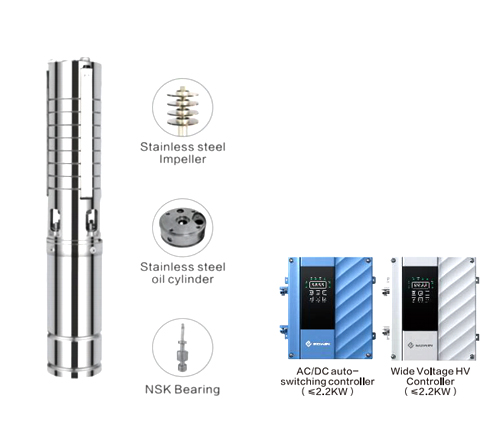
4ADSCW Brushless AC/DC Water Filled Solar Deep Well Pump with SS Impeller
One of the most important advantages of the 4ADSCW series is its ability to accept both AC and DC power. Many solar pumps operate only with direct current supplied by photovoltaic panels. Although this design can be efficient, it may become inconvenient during periods of weak sunlight, heavy cloud cover, seasonal changes, or increased water demand outside solar production hours.
The AC/DC hybrid design provides an alternative operating strategy. Solar panels can supply the pump during normal daytime operation, reducing energy costs and dependence on the electrical grid. When solar power is insufficient, AC electricity can be used as a backup or as the primary supply. This is particularly valuable for household water systems, livestock facilities, agricultural sites, and commercial installations that cannot tolerate extended interruptions.
The specified AC input range is 85 V to 280 V, while the DC input range is 80 V to 430 V, depending on the controller and selected model. The broad voltage range allows greater flexibility when designing the solar array and electrical supply system. It also supports installations in regions where grid voltage may fluctuate or where photovoltaic array voltage must be configured according to local conditions.
Compared with a single-input solar pump, the hybrid system can reduce the need for a separate backup pump. A conventional installation may require one pump for solar operation and another pump for grid-powered operation. The 4ADSCW approach combines both power sources in one integrated pumping solution, potentially reducing equipment duplication, installation complexity, and spare-parts requirements.
AC/DC operation also supports more consistent water management. For example, a farm can use solar energy to fill an elevated storage tank during the day and use AC power to maintain supply during periods of low solar availability. A household can use the same pump for both off-grid and grid-connected operation. A remote project can begin with solar power and later connect to an available utility supply without replacing the pump.
The system is designed to work with photovoltaic power and includes an intelligent controller with an MPPT solar mode. Maximum Power Point Tracking helps the controller adjust operating conditions so that the solar array can provide energy more effectively under changing sunlight conditions. The stated controller efficiency exceeds 99 percent, helping minimize electrical losses between the power source and motor.
For the listed models, the recommended solar panel power is at least 1.3 times the pump power. The solar panel open-circuit voltage must remain below 430 V. These values are important design parameters. The array must provide enough power for the motor and controller while staying within the specified voltage limit. Correct system sizing is essential for achieving dependable performance and protecting the equipment.
Solar pumping performance naturally changes according to sunlight intensity, panel orientation, shading, ambient temperature, water level, pipe resistance, and required head. The intelligent controller helps manage these conditions, but it cannot create energy that the solar array does not produce. A properly designed installation should therefore consider water storage, seasonal solar conditions, and the required daily water volume.
The water-filled motor is a major design feature of the 4ADSCW pump. In a water-filled motor, the internal motor environment is designed to use water for cooling and lubrication-related functions. This differs from some oil-filled motor arrangements and can be advantageous in applications where oil-free operation is preferred.
The water-cooled structure allows the surrounding water to absorb and carry away heat generated during motor operation. Heat management is important in deep-well pumps because the motor may run continuously or for long periods under load. Excessive temperature can accelerate insulation aging, bearing wear, and component deterioration. By using water as part of the cooling structure, the pump is designed to maintain a more stable operating temperature.
The product materials emphasize an environmentally friendly, oil-free construction. This is useful for rural drinking water systems, household water supply, and other applications where minimizing the risk of oil contamination is important. The oil-free design also simplifies the environmental profile of the equipment and can make the pump more suitable for sensitive water applications, subject to local water-quality requirements and installation standards.
The water-filled arrangement is also associated with reduced dependence on mechanical seals. Mechanical seals are precision components that separate the motor chamber from the pumped water. They can wear because of abrasion, dry running, pressure variation, misalignment, or contamination. When a seal fails, water may enter the motor chamber, potentially leading to electrical damage. The water-filled brushless design is intended to eliminate potential leakage problems commonly associated with mechanical seals, improving reliability in demanding operating environments.
No pump design is completely immune to installation or operating problems. The unit must still be installed at the correct depth, protected from excessive sand, operated within its rated hydraulic range, and prevented from running dry. Proper cable connections, grounding, overload protection, and controller configuration are also necessary. Nevertheless, reducing the number of vulnerable mechanical sealing elements can be a meaningful advantage over conventional designs.
Deep-well pumps are exposed to water, dissolved minerals, pressure, and sometimes abrasive particles. Material selection therefore plays a critical role in service life. The 4ADSCW series uses corrosion-resistant components, including environmentally friendly oil-free 304 stainless steel for core parts. Stainless steel helps protect the pump from rust and deterioration in many water environments.
The stainless steel cylinder provides a strong external structure for the four-inch pump body. A compact metal housing is important because deep wells often have limited bore diameter. The four-inch format allows the pump to fit many standard well applications while maintaining sufficient internal space for the motor and hydraulic components.
The stainless steel structure also supports long-term durability during installation and removal. Deep-well pumps may need to be lowered into a well on a delivery pipe and cable, then lifted for inspection or servicing. A robust housing reduces the risk of damage caused by handling, vibration, or contact with the well casing.
The impeller and other hydraulic components must be selected according to the application. The supplied product information refers to a durable plastic impeller and also identifies the product as having an SS impeller. Plastic impellers can offer low weight, corrosion resistance, and smooth hydraulic surfaces, while stainless steel impellers can provide increased mechanical strength and resistance to certain operating conditions. Buyers should request the applicable technical drawing or model-specific bill of materials when the impeller material is a critical purchasing requirement.
Bearings are among the most important internal components in a submersible pump. They guide the rotating assembly, control vibration, and support the rotor under operating load. The 4ADSCW series uses Japanese NSK bearings, which are recognized for consistent manufacturing quality, wear resistance, and long service life.
The pump also includes an enhanced rotor shaft and thrust bearing. In a vertical submersible pump, the hydraulic assembly can create axial forces that act along the shaft. The thrust bearing helps support these forces and maintains stable rotor positioning. Proper thrust support reduces excessive friction, vibration, and uneven wear.
The rotor shaft is described as having a ceramic coating to improve wear resistance. A wear-resistant shaft surface can be particularly valuable in water-filled motor systems, where the rotating components operate in a wet environment. The coating is intended to reduce surface deterioration and contribute to longer operating life.
These internal details distinguish the pump from low-cost products that may use basic bearings and untreated shafts. The initial purchase price is only one part of the total cost of ownership. A pump that operates longer between maintenance events can reduce labor, downtime, replacement costs, and disruption to water supply. For remote wells or agricultural sites, service accessibility can be as important as the pump’s nominal power rating.
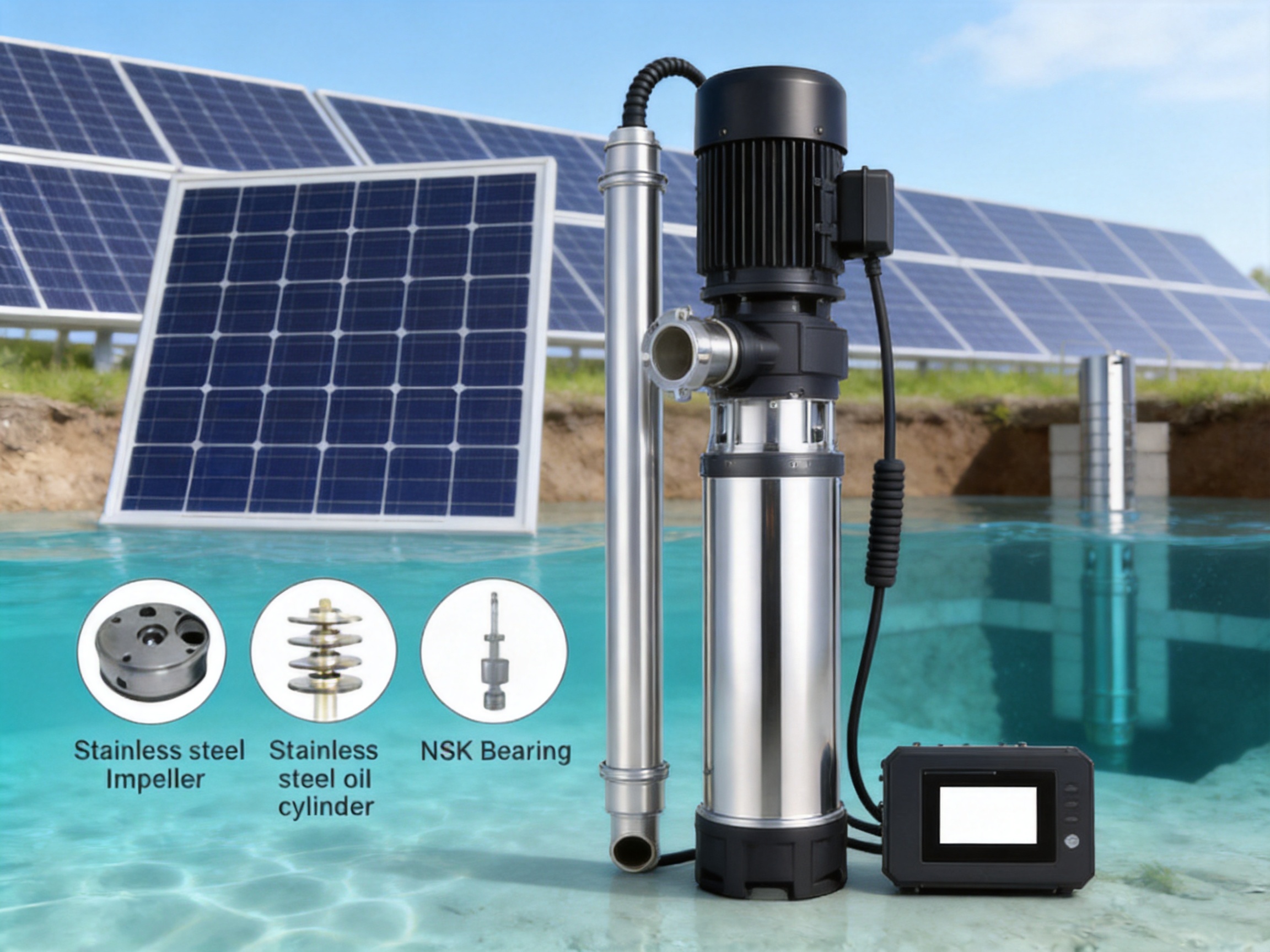
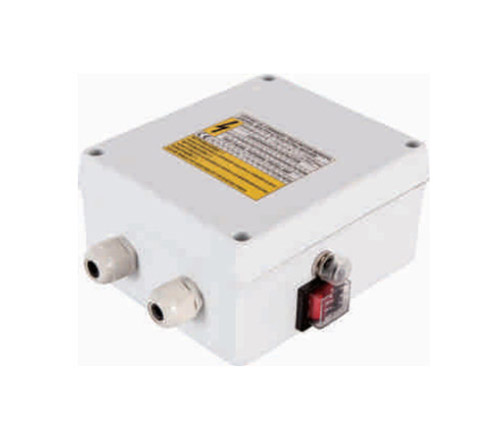
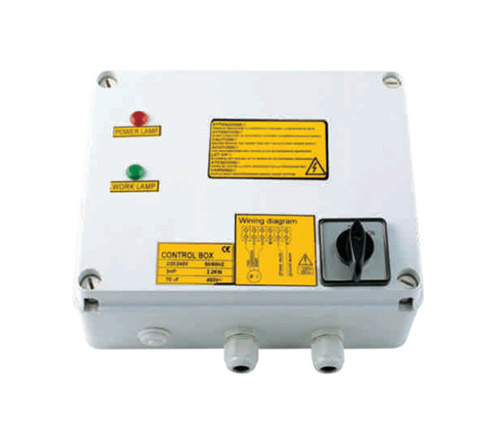
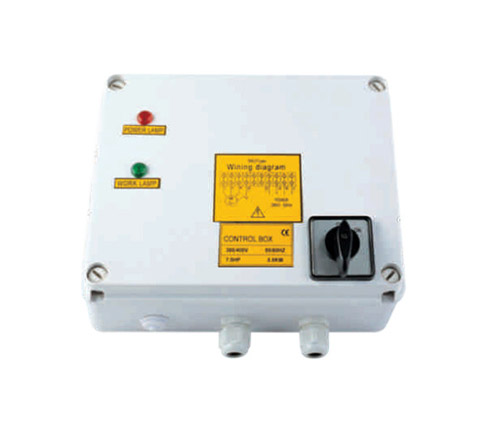
The intelligent controller is an essential part of the 4ADSCW system. It coordinates the power source and motor, protects the equipment, and helps the pump respond to changing operating conditions. The controller includes automatic start and stop, soft start, AC/DC switching, and MPPT solar mode.
Automatic start and stop functions can reduce the need for manual supervision. Depending on the complete water system, the controller may operate in conjunction with water-level sensors, pressure controls, or other system devices. This allows the pump to run when water is required and stop when the target condition is reached.
Automatic control is especially useful for storage tanks and reservoirs. When a tank requires filling, the pump can start according to the control logic. When the tank reaches the specified level, the pump can stop. This helps prevent unnecessary operation, reduce energy consumption, and limit the risk of overflow.
Soft start gradually increases motor speed instead of applying the full electrical load instantaneously. This can reduce starting current, mechanical shock, hydraulic pressure surges, and stress on the electrical system. Soft starting is beneficial for solar installations because photovoltaic power is limited and variable. It can also reduce disturbance to other equipment connected to the same AC supply.
Automatic switching between AC and DC power provides operational flexibility. The system can use solar energy when available and change to AC power when required. This reduces the need for operators to manually change connections and helps maintain a more reliable water supply.
MPPT control helps the system draw energy from the photovoltaic array more efficiently. Solar panel output varies throughout the day, and the controller must continually adapt to changing voltage and current conditions. By managing the relationship between the solar array and motor load, MPPT can improve energy utilization compared with a fixed operating strategy.
The 4ADSCW product family includes multiple performance configurations. The model numbers identify different combinations of flow, head, and motor power. Selecting a pump solely by maximum flow or motor wattage can lead to poor results. The pump must be matched to the required operating point, including static lift, dynamic water level, pipe friction, fittings, discharge pressure, and daily water demand.
| Model | Power | Maximum Flow | Maximum Head | Outlet | AC Voltage | DC Voltage |
| 4ADSCW5.2-67-110-750 | 750 W | 5.2 m³/h | 67 m | 1.25 in | 85–280 V | 80–430 V |
| 4ADSCW5.2-203-200-1500 | 1,500 W | 4.8 m³/h | 203 m | 1.25 in | 85–280 V | 80–430 V |
| 4ADSCW5.2-101-150-1100 | 1,100 W | 5.2 m³/h | 101 m | 1.25 in | 85–280 V | 80–430 V |
| 4ADSCW5.2-146-200-1300 | 1,300 W | 5.2 m³/h | 146 m | 1.25 in | 85–280 V | 80–430 V |
| 4ADSCW7.5-80-150-1300 | 1,300 W | 7.5 m³/h | 80 m | 1.25 in | 85–280 V | 80–430 V |
| 4ADSCW7.5-100-200-1500 | 1,500 W | 7.5 m³/h | 100 m | 1.25 in | 85–280 V | 80–430 V |
| 4ADSCW11-60-200-1500 | 1,500 W | 11 m³/h | 60 m | 2 in | 85–280 V | 80–430 V |
| 4ADSCW19-35-200-1500 | 1,500 W | 19 m³/h | 35 m | 2 in | 85–280 V | 80–430 V |
| 4ADSCW25-26-200-1500 | 1,500 W | 25 m³/h | 26 m | 2 in | 85–280 V | 80–430 V |
| 4HVSCW5.2-255-300-2200 | 2,200 W | 5.2 m³/h | 255 m | 1.25 in | 85–280 V | 80–430 V |
| 4HVSCW7.5-150-300-2200 | 2,200 W | 7.5 m³/h | 150 m | 1.25 in | 85–280 V | 80–430 V |
| 4HVSCW11-120-300-2200 | 2,200 W | 11 m³/h | 120 m | 2 in | 85–280 V | 80–430 V |
| 4HVSCW19-60-300-2200 | 2,200 W | 19 m³/h | 60 m | 2 in | 85–280 V | 80–430 V |
| 4HVSCW30-36-300-2200 | 2,200 W | 30 m³/h | 36 m | 2 in | 85–280 V | 80–430 V |
The table shows the breadth of the series. The 5.2 m³/h models are available in configurations ranging from 67 m to 255 m of maximum head, making them suitable for different well depths and elevation conditions. The 19 m³/h, 25 m³/h, and 30 m³/h models provide greater water volume at lower maximum head, which is often more suitable for irrigation, tank filling, or transfer between nearby water sources.
Maximum head and maximum flow are not normally achieved at the same operating point. A pump curve must be used to determine the expected flow at the required total dynamic head. Buyers should review the supplied performance curves and provide the manufacturer with well depth, water level, pipe length, pipe diameter, elevation, and desired daily volume before selecting a model.
The 4ADSCW series offers several advantages compared with conventional single-power submersible pumps and basic solar pumping products.
A single-input DC pump may stop when solar power falls below the required level. A conventional AC pump may require a stable grid connection or generator. The AC/DC hybrid 4ADSCW combines both options, allowing users to balance renewable energy use, operational continuity, and installation flexibility.
Traditional sealed motors depend on mechanical seals that can become a failure point. The water-filled motor design is intended to reduce leakage concerns associated with those seals. This can contribute to improved reliability and lower maintenance requirements, particularly in installations where removing a deep-well pump is costly or difficult.
The brushless motor eliminates brush replacement and reduces mechanical contact within the motor. Combined with water cooling, NSK bearings, a ceramic-coated rotor shaft, and thrust-bearing support, the design is intended for stable continuous operation with less routine intervention than many basic motor designs.
The wide selection of flow and head combinations means that the series can be specified for household water supply, rural drinking water, small and medium irrigation, storage tank filling, reservoir transfer, and off-grid projects. A broad product family is valuable for distributors and system integrators because it allows them to serve multiple projects with a consistent technology platform.
The four-inch diameter is suitable for many standard wells and helps expand installation possibilities. A compact pump can reach deep water sources without requiring an oversized borehole. This can be especially important in rural developments and retrofit projects where the existing well diameter is fixed.
The integrated controller provides MPPT solar operation, soft starting, automatic switching, and automatic control functions. These features provide a more sophisticated operating platform than a simple pump connected directly to a solar array. Better control can improve energy use, system protection, and user convenience.
Product performance depends not only on the published specifications but also on the manufacturer’s ability to maintain consistent quality from design through production and export. Taizhou Edwin Electric Co., Ltd. operates as an integrated manufacturing enterprise with independent research and development, mass production, and international supply capabilities.
The company was founded in 2008 and has developed expertise across several pump categories. Its portfolio includes deep well pumps, submersible pumps, domestic booster pumps, circulation pumps, solar pumps, and intelligent booster pumps. This broad product experience gives the company a practical understanding of different hydraulic systems, motor technologies, controller requirements, and end-user applications.
Independent research and development allows the manufacturer to adapt pump structures, motor designs, controller functions, and materials to changing market requirements. The 4ADSCW series reflects this approach by combining brushless motor technology, water-filled construction, AC/DC compatibility, and intelligent solar control in one product platform.
Research and development is also important when serving different international markets. Water conditions, electrical standards, well dimensions, climate, installation practices, and pumping requirements vary between countries. A manufacturer with in-house technical capability can provide more effective model selection and application support than a company that only resells generic equipment.
Mass production supports consistent availability and helps distributors plan inventory for repeated orders. It also provides the manufacturing scale required to serve household, agricultural, commercial, municipal, and industrial customers. For international buyers, reliable production capacity can be as important as the specification of an individual pump.
Consistent production requires controlled assembly procedures, suitable component sourcing, electrical testing, hydraulic inspection, and final product verification. The use of recognized NSK bearings, stainless steel components, and specialized rotor and thrust-bearing structures indicates attention to internal component quality. Specific inspection standards and test reports should be confirmed for each order according to the buyer’s requirements.
To support one-stop purchasing and international trade, the company established Taizhou Haipai Import & Export Co., Ltd. and Golden Falcon Industrial Co., Ltd. in 2012. These related organizations support procurement planning, order tracking, cross-border delivery, and foreign trade services.
This structure can simplify purchasing for overseas customers. Instead of coordinating separately with a factory, logistics provider, and export agent, a buyer can work through a professional team familiar with product selection, documentation, packaging, shipment scheduling, and international delivery. This is particularly useful for distributors, engineering contractors, and project procurement departments.
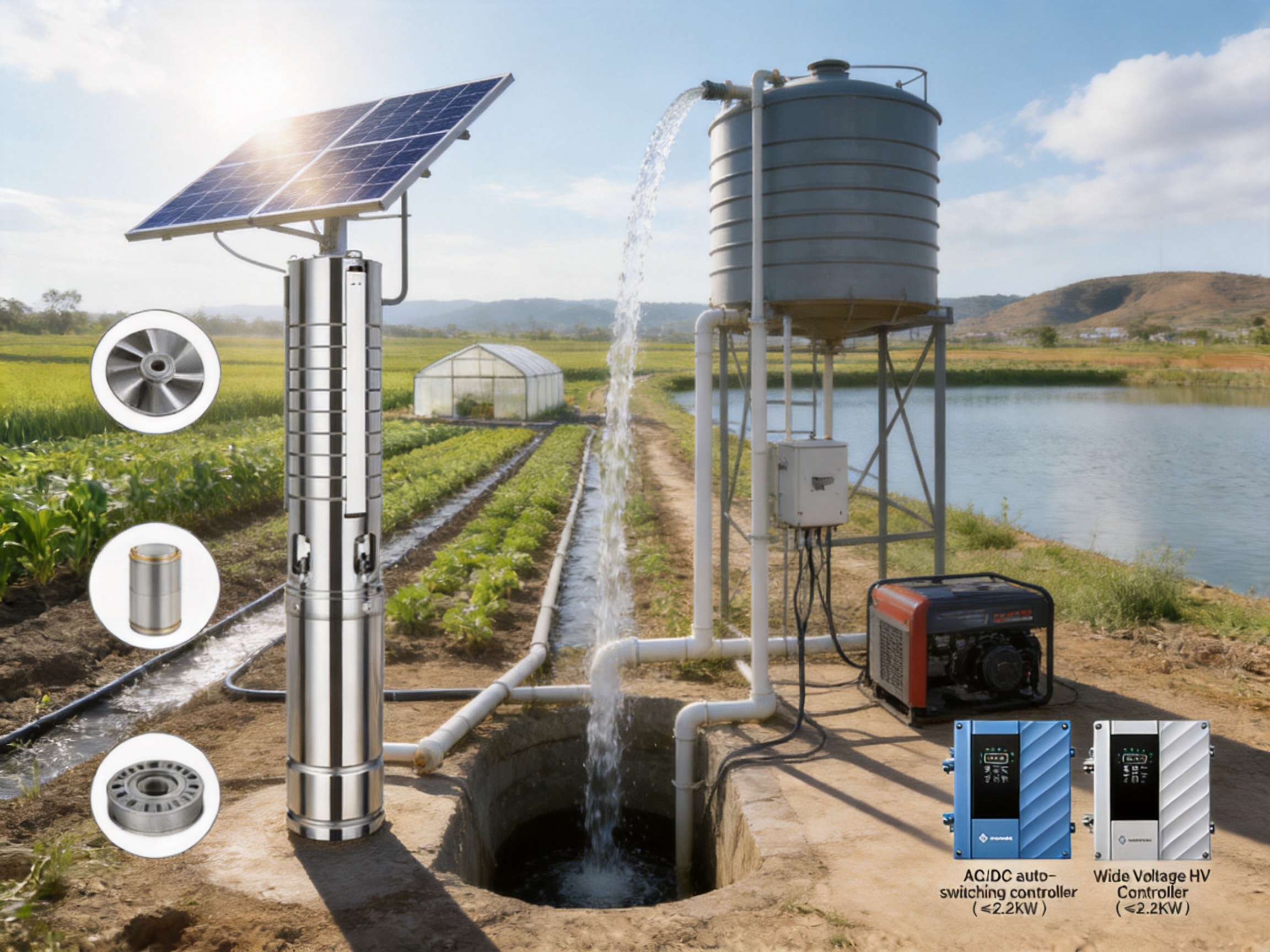
Rural communities often need to transport water from wells to elevated tanks, treatment points, distribution networks, or public water stations. The oil-free water-filled design and stainless steel construction are suitable for applications where reliability and material resistance are important. The AC/DC capability also helps communities use solar power without losing access to backup electricity.
For drinking-water projects, the complete installation must comply with applicable local regulations. Water quality depends on the well, piping, storage tank, filtration, disinfection, and all materials in contact with the water. The pump should therefore be evaluated as one part of the complete water-supply system.
The pump can supply household storage tanks, pressure systems, and small community water networks. Automatic start and stop functions reduce the need for constant supervision. Solar energy can reduce electricity costs, while AC backup power helps maintain supply during periods of insufficient sunlight.
A storage tank is often recommended for solar pumping systems because it separates water production from immediate water demand. The pump can operate when sunlight is available and fill the tank, while users can draw water at any time. This approach can reduce the need for batteries and extend system availability.
Small and medium-sized farms can use the 4ADSCW series for drip irrigation, sprinkler systems, greenhouse supply, livestock watering, and field storage tanks. The correct model depends on the required flow, irrigation pressure, field elevation, pipe network, and operating schedule.
Solar pumping can reduce fuel consumption and operating costs in agricultural locations without reliable grid access. During sunny periods, the pump can deliver water directly to the irrigation system or fill a reservoir. When irrigation demand continues after sunset, stored water or AC backup can maintain the required supply.
Remote construction camps, monitoring stations, rural enterprises, and emergency water projects may not have convenient access to grid electricity. A solar-powered deep-well pump can provide an independent water source with limited fuel requirements. The hybrid input design adds a layer of flexibility when a generator or temporary AC supply is available.
The pump can transfer water from a well or source reservoir to an elevated tank, ground-level storage tank, or irrigation reservoir. The selected model should be matched to the total lifting height and pipeline losses. Automatic control equipment can be used to stop the pump when the destination tank is full or the source water level is too low.
A successful installation requires more than selecting a pump based on its maximum head. The system designer should calculate total dynamic head, which generally includes the vertical lift from the pumping water level to the discharge point, pressure requirements at the outlet, and friction losses in the pipe and fittings.
The water level should be measured under pumping conditions rather than relying only on the static water level. When a well is pumped, the water level may fall. This drawdown changes the actual lifting requirement and can affect pump performance. The pump should remain submerged by an appropriate margin and should not be allowed to operate without adequate water flow for cooling.
Pipe diameter also affects performance. A pipe that is too small creates greater friction loss and can reduce delivered flow. The outlet sizes in the listed specifications are 1.25 inches or 2 inches, but the complete discharge pipe should be designed according to flow rate, length, material, elevation, and acceptable velocity.
Solar array design must observe the stated voltage and power requirements. The photovoltaic open-circuit voltage should remain below 430 V, including the effects of low-temperature conditions that can increase panel voltage. The recommended solar power is at least 1.3 times the pump power. Additional design margin may be appropriate in regions with frequent cloud cover or high operating requirements.
Electrical installation should include appropriate protection against overcurrent, surge events, grounding faults, and lightning-related transients. Cable sizing must account for voltage drop, cable length, current, ambient temperature, and installation method. The supplied cable length is listed as 2 m, so the installer must plan the complete cable route and waterproof connections carefully.
Before installation, inspect the well for excessive sand, debris, unstable casing, and obstructions. Excessive abrasive material can damage hydraulic components and reduce performance. The pump should be suspended securely using suitable pipework and support arrangements. The power cable must not carry the entire mechanical weight of the pump.
The pump should be positioned according to the manufacturer’s recommended minimum submergence and clearance requirements. It should not rest directly on the bottom of the well, where sediment can enter the hydraulic system. A clean water source and adequate cooling flow are important for long service life.
All electrical connections must be waterproof and protected from mechanical damage. The controller should be installed in a dry, ventilated location away from direct rain, flooding, excessive heat, and unauthorized access. AC and DC wiring must be connected exactly according to the controller documentation. Incorrect polarity, excessive voltage, or unsuitable wiring can damage the controller and motor.
Routine maintenance should include checking water output, unusual noise, vibration, current, controller status, and changes in well water level. A gradual reduction in flow may indicate a blocked intake, pipe obstruction, well drawdown, worn hydraulic components, or a change in system head. Prompt investigation can prevent minor problems from becoming major failures.
Although the brushless water-filled design reduces maintenance requirements, the system should still be inspected periodically. Solar panels should be kept free from heavy dust, leaves, and shading. Electrical terminals should be checked for corrosion or looseness. Storage tanks, sensors, valves, and filters should also be maintained because problems in these components can affect pump operation.
Purchase price is only one factor in evaluating a deep-well pump. A complete cost assessment should include installation, energy consumption, maintenance, downtime, replacement parts, labor, and the cost of backup equipment. The 4ADSCW series can help reduce operating costs through solar energy use and can reduce equipment duplication through its AC/DC hybrid input.
The brushless water-filled motor may also reduce service costs by avoiding brush replacement and reducing exposure to mechanical seal failure. Durable bearings, a wear-resistant rotor shaft, stainless steel components, and intelligent protection functions are intended to support a longer service interval.
For remote installations, the cost of removing a submersible pump can be substantial. A pump that provides stable operation and requires fewer interventions may offer a significant economic advantage over a lower-cost product with a shorter service life. The actual savings depend on operating conditions, installation quality, water quality, and maintenance practices.
International buyers often require more than a product name and a nominal power rating. They may need performance curves, wiring diagrams, controller information, packing details, inspection documents, spare-parts recommendations, and shipping support. The manufacturer’s integrated production and export structure is intended to meet these broader purchasing requirements.
Before placing an order, buyers should provide the intended application, water source, pumping depth, dynamic water level, required flow, total head, power availability, solar array details, outlet pipe size, and water quality information. This allows the supplier to recommend the most suitable model rather than selecting a pump only by maximum flow or maximum head.
For projects involving multiple pumps, distributors may also request standardized packaging, consistent model availability, private labeling, technical documentation, and order tracking. The company’s experience in mass production and global export can support these requirements, subject to individual project arrangements.
It is a four-inch AC/DC hybrid submersible solar deep well pump with a brushless water-filled motor. It is designed for deep-well water supply, irrigation, storage tank filling, reservoir transfer, and off-grid pumping projects.
Yes. The pump supports AC input as well as DC solar input. It can operate from an appropriate AC supply when solar power is unavailable or insufficient. The exact electrical connection and voltage must follow the controller and model specifications.
The listed DC input range is 80 V to 430 V. The solar array open-circuit voltage must remain below 430 V. System designers should check the maximum voltage under the lowest expected temperature before finalizing the panel configuration.
The listed AC input range is 85 V to 280 V. Buyers should confirm the applicable input requirements for the selected model and ensure that the local electrical supply is suitable.
The listed 4ADSCW and 4HVSCW configurations include models rated up to 2,200 W. The correct power level depends on the required flow, total head, and operating conditions.
The highest listed maximum flow is 30 m³/h, provided by the 4HVSCW30-36-300-2200 model. Maximum flow is a theoretical rating at a specific hydraulic condition and should not be treated as the flow available at maximum head.
The highest listed maximum head is 255 m, provided by the 4HVSCW5.2-255-300-2200 model. Actual flow at this head must be confirmed from the applicable performance curve.
The product includes an intelligent controller for AC/DC switching and MPPT solar operation. Buyers should confirm the complete supplied package and installation wiring with the manufacturer before purchasing, especially when integrating batteries, generators, or external control equipment.
A water-filled motor supports water cooling and oil-free operation. It is designed to reduce heat accumulation and avoid potential leakage problems associated with conventional mechanical seal arrangements.
The brushless motor and water-filled design reduce maintenance requirements, but no pumping system is completely maintenance-free. The well, solar array, controller, cables, valves, sensors, and pipework should be inspected periodically. Dry running, excessive sand, incorrect voltage, and poor installation can reduce service life.
The supplied data recommends solar panel power of at least 1.3 times the pump power. The solar array open-circuit voltage must remain below 430 V. Final sizing should consider local sunlight, seasonal conditions, temperature, shading, daily water demand, and the required pumping head.
The best model depends on the irrigation flow and total head. Higher-flow models such as the 19 m³/h, 25 m³/h, and 30 m³/h configurations may suit lower-head water transfer, while 5.2 m³/h or 7.5 m³/h models may be better for systems requiring greater lift. A pump curve and project calculation should guide the final choice.
The pump is intended for rural drinking water and household water systems. However, the complete installation must comply with applicable local drinking-water regulations. Buyers should confirm material suitability, water quality requirements, and any required approvals before using the pump in a potable-water system.
Important information includes well diameter, pumping depth, static and dynamic water levels, required flow, total head, pipe length and diameter, outlet pressure, available AC power, solar panel specifications, water temperature, sand content, and intended daily operating time.
The 4ADSCW brushless AC/DC water-filled solar deep well pump is designed for customers seeking a flexible and dependable water supply solution. Its combination of solar DC operation, AC backup capability, brushless motor technology, water cooling, oil-free construction, corrosion-resistant materials, NSK bearings, ceramic-coated rotor shaft, thrust-bearing support, and intelligent controller functions provides a strong technical foundation for modern pumping systems.
Its model range covers different hydraulic requirements, from household and community water supply to agricultural irrigation, reservoir filling, and high-head deep-well applications. The four-inch housing supports installation in many standard wells, while the broad AC and DC voltage ranges give system designers greater freedom when planning power supplies.
The product is also supported by a manufacturer with experience in research and development, mass production, pump technology, new-energy applications, and international export. This combination of product engineering and manufacturing capability is valuable for distributors, contractors, project developers, and end users who need more than a basic commodity pump.
Proper model selection and installation remain essential. The pump should be evaluated using the required operating point, total dynamic head, water conditions, solar resources, and electrical design. When correctly specified and installed, the 4ADSCW series can provide an efficient, low-maintenance, and adaptable solution for reliable deep-well water pumping.
1. Product technical information for the 4ADSCW and 4HVSCW AC/DC hybrid submersible solar pump series.
2. Manufacturer-provided performance data, hydraulic model listings, and electrical input specifications.
3. General principles of photovoltaic maximum power point tracking and solar pumping system design.
4. General engineering guidance for submersible pump installation, total dynamic head calculation, and deep-well system sizing.
5. General technical information concerning brushless motors, water-cooled motor structures, stainless steel pump components, and thrust-bearing support.
6. Manufacturer company information concerning research and development, mass production, global export, procurement planning, and pump application fields.
edwina@edwin-pump.com
+86-13586290903 (WhatsApp)
Xuri Gongliang Cutting Tool Entrepreneurship Park, Wenqiao Town, Wenling City, Taizhou City, Zhejiang Province, China

High Performance Smart Pump Factory


 English