
edwina@edwin-pump.com

View All Products
en

Reliable pressure control is essential in almost every water pumping application. Domestic water supply systems, agricultural irrigation equipment, booster installations, storage tanks, and many commercial pumping systems all depend on accurate switching between pump operation and standby conditions. When pressure control is unstable, a pump may start too often, run longer than necessary, fail to maintain service pressure, or operate under unsafe conditions. A suitable pressure switch helps prevent these problems by monitoring system pressure and controlling the electrical circuit connected to the pump.
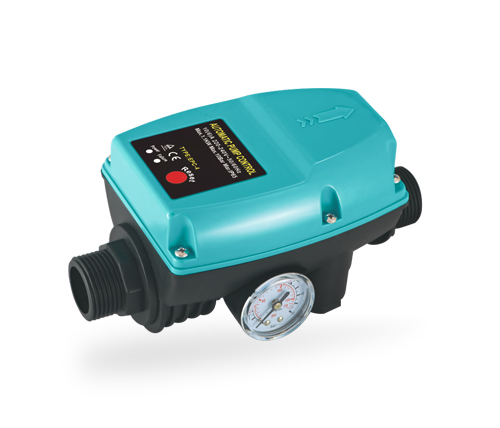
The EPC-10 Series Manual and Time Modes NBR Rubber Membrane Pressure Switch is designed for water pump systems that require dependable pressure control, flexible operation, and practical installation. It combines a pressure-switching function with manual and time-based operating possibilities, allowing users to select a control method that matches the requirements of the pumping system. Its NBR membrane, IP65 protection rating, adjustable pressure range, and delay-start settings make it suitable for a broad range of water applications.
Manufactured by Taizhou Edwin Electric Co., Ltd., the EPC-10 Series reflects the company’s long-standing experience in pump equipment, intelligent booster systems, water treatment peripherals, and international manufacturing. Since its establishment in 2008, the company has developed an integrated business model covering product research and development, production, quality management, export coordination, and customer service. This combination supports consistent product delivery for customers seeking reliable pump-control components and complete water-system solutions.
A water pump does not always need to operate continuously. In a typical pressure-controlled system, the pump starts when pressure falls below a defined starting point and stops when the pressure reaches a defined stopping point. This operating pattern maintains water availability while reducing unnecessary energy consumption and limiting mechanical wear.
A pressure switch provides the connection between hydraulic conditions and electrical control. When the pressure changes, the switch responds by opening or closing the relevant circuit. In this way, the pressure switch can control the pump motor, relay, contactor, or other control equipment. A properly selected unit must respond accurately, withstand the working environment, and remain reliable through repeated switching cycles.
Pressure control is particularly important in systems with variable demand. A household may use water intermittently throughout the day. An irrigation installation may require pressure during scheduled watering periods. A booster system may need to respond to pressure changes caused by several outlets opening and closing at the same time. In each case, the pressure switch must work predictably without excessive sensitivity or delayed response.
The EPC-10 Series is designed for these requirements. Its adjustable starting pressure range extends from 0.5 bar to 6.7 bar, while its stopping pressure setting ranges from 0.8 bar to 7.0 bar. This range gives system designers and installers room to configure the switch for different pressure conditions instead of relying on one fixed setting.
The EPC-10 Series is a pressure switch for water pump systems that uses an NBR rubber membrane to sense and respond to pressure. The membrane forms a sealed interface between the fluid-side pressure and the switching mechanism. NBR, also known as nitrile rubber, is widely used in fluid-handling applications because it offers good sealing performance and useful resistance to water, oils, and many common operating fluids.
The product supports two principal control concepts. The first is a normally open operating mode. In this mode, the electrical circuit remains open below the selected pressure point and closes when the pressure reaches the designated switching condition. The second is a normally closed operating mode. In this mode, the circuit remains closed below the selected pressure point and opens when the pressure reaches the required condition.
These operating options allow the EPC-10 Series to be integrated into different circuit arrangements. Depending on the pump system, the switch may be connected to activate a pump, interrupt a motor circuit, operate a relay, or provide a signal to another control device. The selection should always be made according to the electrical design and the pump manufacturer’s instructions.
In addition to pressure settings, the product offers delay-start adjustment. The delay-start range includes 0.1 to 1 hour and 1 to 24 hours. This function can be useful where a system requires timed activation, scheduled operation, or a controlled delay before pump startup. It may help reduce unnecessary rapid cycling in selected applications, although the correct setting depends on the pump, pipework, storage arrangement, and water-use pattern.
The pressure switch is rated for a maximum working pressure of 1.0 MPa and a maximum working temperature of 60 degrees Celsius. Its IP65 protection rating provides protection against dust ingress and water jets from various directions, making it suitable for installation in many pump-room and water-system environments when correctly mounted.
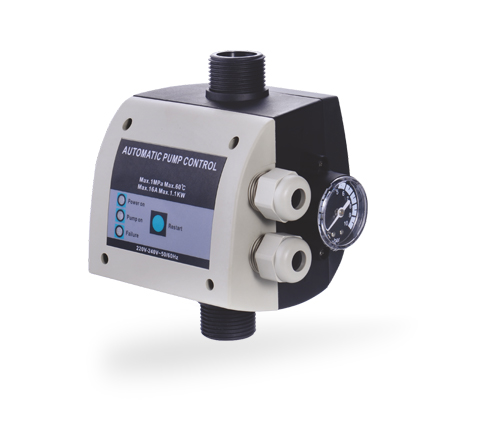
EPC-10 Series Manual and Time Modes NBR Rubber Membrane Pressure Switches for Usage with Water Pump System
The following table summarizes the principal technical parameters supplied for the EPC-10 Series. Installers should confirm the final model configuration, electrical compatibility, connection dimensions, and application conditions before commissioning.
| Parameter | Specification |
|---|---|
| Product type | Manual and time modes pressure switch for water pump systems |
| Membrane material | NBR rubber |
| Rated voltage | 110 V to 120 V |
| Power frequency | 50/60 Hz |
| Starting pressure setting | 0.5 bar to 6.7 bar |
| Stopping pressure setting | 0.8 bar to 7.0 bar |
| Delay-start setting | 0.1 to 1 hour; 1 to 24 hours |
| Maximum working pressure | 1.0 MPa |
| Maximum working temperature | 60 degrees Celsius |
| Protection rating | IP65 |
| Screw type | Female or male configurations |
| Female connection arrangement | Fixed nut: 1/4 inch or 3/8 inch; rotary connection: 1/4 inch |
| Male connection arrangement | 1/4 inch |
The specifications demonstrate that the EPC-10 Series is intended to provide flexible pressure management rather than function as a single-purpose fixed-pressure switch. The broad adjustment range can simplify system matching, especially when different pump models, pipe lengths, elevation changes, or end-use requirements are involved.
One of the main advantages of the EPC-10 Series is its two-mode operating design. Different water systems may require different electrical logic. A normally open arrangement may be preferred when the pressure switch must close a control circuit after a specified condition is reached. A normally closed arrangement may be selected when the control circuit must remain active until the switching pressure causes it to open.
This flexibility can reduce the need to stock several specialized pressure-switch designs. Distributors, installers, and system integrators can use one product family across a wider range of pump-control configurations. It also gives engineers more freedom when designing protection, relay, and pump-starting circuits.
Manual operation can be useful during commissioning, maintenance, inspection, or temporary service conditions. A technician may need to test the pump independently, confirm wiring, check the pressure response, or restore operation after an interruption. A time-based function can support scheduled operation or delayed startup where immediate pump activation is not desirable.
Competitor products are often limited to one switching logic or one fixed operating method. Some basic pressure switches offer pressure sensing but do not include time-based control. Others may provide electronic timing but have a narrower pressure range or more complicated installation requirements. The EPC-10 Series is positioned between these categories by combining practical mechanical pressure control with additional operating flexibility.
When selecting the mode, the installer should consider the complete control circuit rather than the pressure switch in isolation. The electrical load, motor-starting current, relay arrangement, overload protection, and local safety requirements must all be evaluated. For larger pumps or systems with high motor current, the pressure switch may need to operate a suitable contactor rather than switch the motor directly.
The membrane is a critical component in a pressure switch because it transfers hydraulic pressure to the switching mechanism while helping protect the internal electrical parts from the pumped medium. The EPC-10 Series uses an NBR rubber membrane to provide a dependable sealing interface.
NBR is valued in water-system components for its balance of flexibility, resilience, and resistance to many common fluids. A well-designed NBR membrane can maintain contact with the surrounding sealing surfaces during pressure changes and repeated operating cycles. This helps minimize the risk of leakage and supports stable pressure detection.
Compared with unsuitable low-grade elastomers, a properly selected NBR membrane can offer better resistance to swelling, deformation, and loss of elasticity under normal operating conditions. This is especially important in pump systems that experience frequent starts and stops. A weak or poorly fitted membrane may lead to inaccurate switching, pressure loss, or premature component failure.
The membrane also contributes to the product’s practical maintenance profile. Because the pressure-sensing element is designed as a sealed component, routine operation does not require the user to access the electrical switching mechanism. This supports safer use and helps protect internal components from moisture and contamination when the switch is installed correctly.
However, the suitability of NBR depends on the actual fluid and temperature. The EPC-10 Series is intended for water pump systems within the stated operating limits. Applications involving aggressive chemicals, unusual fluids, temperatures above 60 degrees Celsius, or pressure above 1.0 MPa require separate technical evaluation.
The EPC-10 Series provides a starting pressure setting from 0.5 bar to 6.7 bar and a stopping pressure setting from 0.8 bar to 7.0 bar. These adjustment ranges enable the product to be configured for low-pressure domestic systems, moderate booster installations, and other water applications requiring a higher pressure threshold.
The starting pressure determines when the system responds to a pressure decrease. If the pressure falls below the selected value, the switch can initiate the pump-starting sequence according to the selected operating mode. The stopping pressure determines when the pump-control circuit changes state after the system pressure has recovered.
Correct adjustment is important. If the starting pressure is set too high, the pump may start unnecessarily or operate more frequently than needed. If it is set too low, users may experience inadequate water pressure before the pump starts. If the stopping pressure is set beyond the pump’s practical performance, the pump may run for too long or fail to reach the target pressure.
The difference between starting and stopping pressure should be coordinated with the pump curve, system volume, pressure tank capacity, pipe friction, vertical lift, and expected flow rate. A suitable differential helps prevent rapid cycling. Rapid cycling, sometimes called short cycling, can increase motor heating, mechanical stress, and electrical wear.
The adjustable design gives the EPC-10 Series an advantage over narrow-range competitors. A fixed-pressure product may work well in one installation but require replacement when the system is modified. An adjustable switch can remain useful after changes to the pump, pipework, tank, or building layout, provided the new requirements remain within the product’s limits.
Many pumping systems benefit from a controlled startup rather than immediate activation. For example, a system may need to avoid starting repeatedly during brief pressure fluctuations. A storage or distribution system may require a waiting period before the pump responds. In scheduled applications, the pump may need to operate at a defined time rather than simply reacting to every pressure event.
The EPC-10 Series includes delay-start settings covering short delays from 0.1 to 1 hour and longer periods from 1 to 24 hours. The available range gives users the ability to match operation to the characteristics of the water system and the intended service pattern.
A delay can reduce nuisance switching caused by small or temporary pressure changes. It may also support more orderly operation when several pumps or control devices are installed. In a multi-stage system, for example, a delay may help coordinate the sequence between a pressure switch and another control component.
The delay function should not be used as a substitute for correct hydraulic design. If a system has an undersized pressure tank, blocked pipework, excessive leakage, or an incorrectly selected pump, changing the delay setting may conceal the symptom without correcting the cause. The delay should be treated as one part of a complete control strategy.
Water pump equipment is commonly installed in locations where moisture, dust, splashing, and condensation may be present. The EPC-10 Series has an IP65 protection rating. In practical terms, this rating indicates protection against dust ingress and protection against water jets from different directions under specified test conditions.
This level of protection can improve reliability in pump rooms, utility areas, agricultural installations, equipment enclosures, and other locations where the pressure switch may be exposed to environmental contamination. It is an important advantage compared with unsealed or lightly protected pressure switches intended only for clean, dry indoor conditions.
IP65 protection does not mean that the switch may be submerged or installed without regard to its surroundings. Correct cable entry, sealing, mounting position, and enclosure arrangement remain necessary. Water can still enter through improperly fitted wiring, damaged seals, open covers, or unsuitable connectors. Installation should therefore preserve the original protection level.
The maximum working temperature is 60 degrees Celsius. This rating supports many normal water-pump applications, but it should be observed carefully in systems handling heated water or exposed to high ambient temperatures. The actual temperature at the switch should remain within the specified limit during normal operation and abnormal but foreseeable conditions.
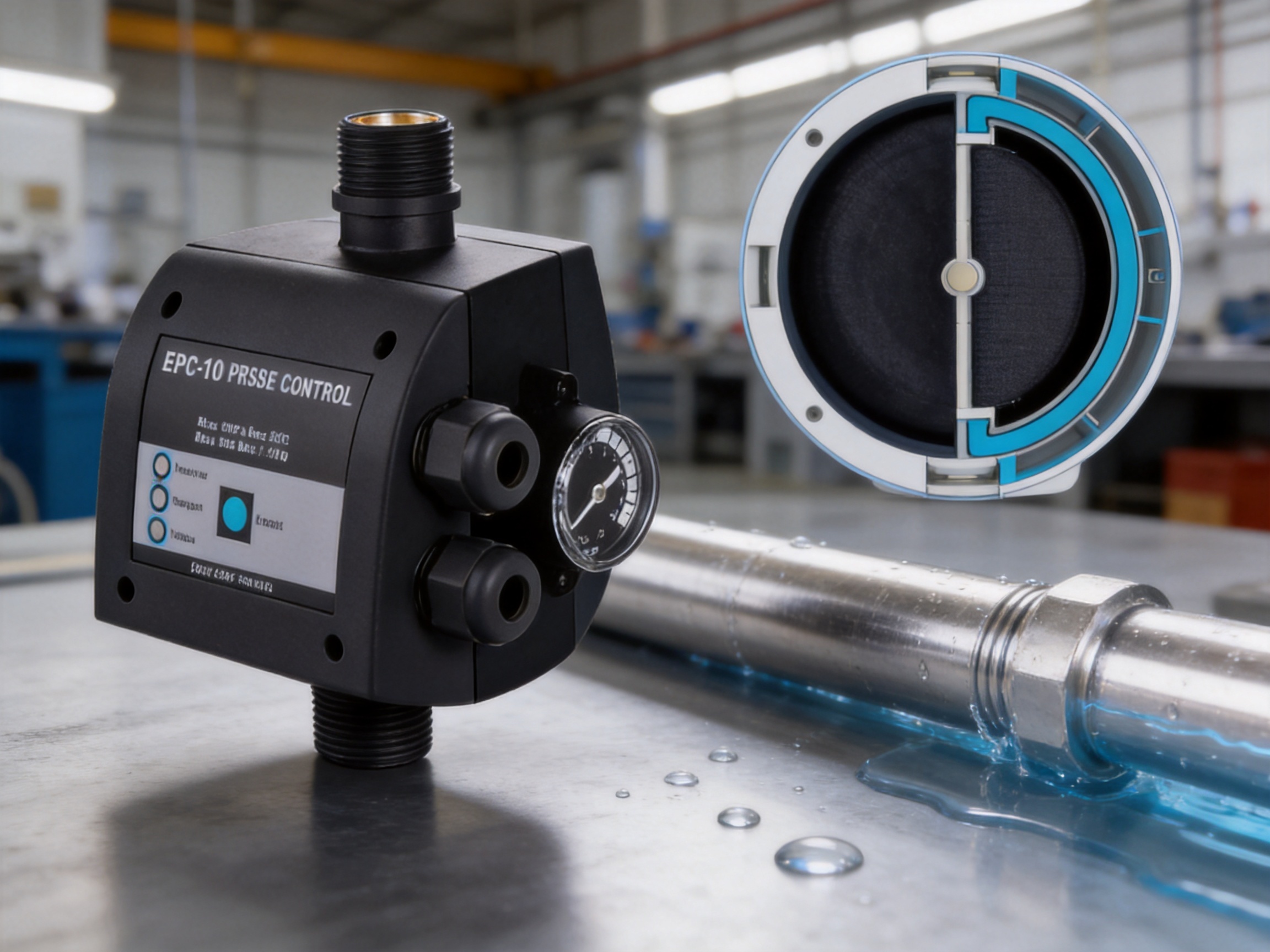
The EPC-10 Series is available with female and male screw configurations. The female configuration includes a fixed nut arrangement of 1/4 inch or 3/8 inch and a 1/4-inch rotary connection. The male configuration is listed with a 1/4-inch connection. These options support connection to common water-system fittings and can make integration easier across different pump and pipe layouts.
Before installation, the technician should verify the connection type, thread standard, available clearance, and orientation of the pressure port. The correct sealing method should be used for the selected thread and the operating pressure. The switch should not be forced into a mismatched fitting, and excessive tightening should be avoided because it may damage the connection or internal components.
The pressure switch should be installed where it can sense representative system pressure. A location immediately affected by turbulence, severe vibration, water hammer, or trapped air may produce unstable readings. If necessary, a suitable connector, damping arrangement, or pressure manifold can be used to improve measurement conditions.
Electrical installation should be carried out by a qualified person. The rated voltage is 110 V to 120 V at 50/60 Hz, and compatibility with the pump-control circuit must be confirmed before energizing the system. The switch should be protected by appropriate circuit protection, and the pump motor should have suitable overload and short-circuit protection.
During commissioning, the installer should check for hydraulic leaks, confirm the pressure gauge reading, verify the starting and stopping response, test the selected operating mode, and confirm that the delay-start function behaves as expected. A written record of the final settings can simplify future service and troubleshooting.
The EPC-10 Series offers several practical advantages over basic pressure switches that provide only a simple on-off response.
The adjustable starting range from 0.5 bar to 6.7 bar and stopping range from 0.8 bar to 7.0 bar allow the product to serve more system types. Basic fixed-pressure switches may be unable to meet the requirements of a modified installation, while the EPC-10 Series can be recalibrated within its rated range.
The availability of normally open and normally closed operating logic gives installers more control-circuit options. Manual and time-mode functions also broaden its usefulness for commissioning, scheduled operation, and controlled startup.
The NBR membrane supports reliable pressure sensing and sealing. This is especially valuable in water systems where leakage, contamination, and repeated pressure changes can affect performance. The membrane-based design separates the hydraulic environment from the electrical switching area.
The IP65 rating provides a stronger level of environmental protection than many unsealed indoor pressure switches. This can be beneficial in pump rooms, agricultural areas, service spaces, and installations where dust or splashing is expected.
The delay-start setting differentiates the EPC-10 Series from simple pressure-only products. It gives users an additional tool for managing startup timing and reducing unwanted responses to short-term system events.
Male and female screw options support installation across different water-pump configurations. This can reduce the need for extensive adapters and simplify replacement work when the existing connection arrangement is compatible.
Product performance depends not only on the final design but also on the manufacturing system used to produce it. Taizhou Edwin Electric Co., Ltd. operates as an integrated manufacturing enterprise with activities covering independent research and development, mass production, and global export. This structure allows technical knowledge from pump applications to influence the development of control components such as the EPC-10 Series.
The company was founded in 2008 and has built experience across deep well pumps, submersible pumps, domestic booster pumps, circulation pumps, solar water pumps, intelligent booster pumps, and related water-system products. This broad portfolio provides a practical understanding of the pressures, flow conditions, installation environments, and control challenges faced by pump users.
Rather than developing a pressure switch in isolation, a manufacturer with pump-system experience can evaluate how the component works with complete equipment. Starting pressure, stopping pressure, delay time, membrane sealing, electrical switching, and environmental protection all need to be considered in relation to the pump and the water network.
Mass-production capability is another important strength. Consistent manufacturing depends on controlled materials, standardized assembly, repeatable adjustment procedures, inspection of sealing components, electrical testing, and traceable quality processes. These controls help reduce variation between production batches and support reliable supply for distributors and project customers.
The company’s focus on independent research and development also supports product improvement. Changes in customer requirements, regional standards, pump applications, and intelligent-control technologies can be incorporated into future product development. This is particularly important as water systems become more automated and energy-conscious.
Edwin Pump has also invested in new energy and intelligent technology since 2018. Its product development in solar water pumps and intelligent booster pumps demonstrates an effort to respond to changing market needs. The EPC-10 Series fits this broader direction by adding flexible control functions to water-pump systems.
A reliable pressure switch requires attention to every stage of production. The first stage is material selection. The NBR membrane must be made from a suitable compound and formed with consistent dimensions. Variations in hardness, thickness, elasticity, or surface quality can affect switching accuracy and sealing performance.
The next stage is component preparation. Housings, connection parts, adjustment components, electrical contacts, springs, seals, and membrane supports must be produced or sourced according to controlled specifications. Components that appear small can have a major effect on operating life, particularly in a product that is repeatedly exposed to pressure changes.
Assembly requires accurate positioning of the membrane and switching mechanism. The pressure-sensing element must transfer force consistently, while the electrical contacts must move cleanly between their operating states. Incorrect assembly can lead to unstable switching, leakage, excessive contact wear, or difficulty achieving the specified pressure range.
Adjustment and calibration are also essential. Each unit should be checked against its starting and stopping pressure requirements. The pressure-switch mechanism must respond at the correct points and maintain an appropriate differential. Time-mode functions should likewise be verified so that the delay setting corresponds to the intended operating range.
Sealing and protection inspections help confirm that the finished product can maintain its environmental rating. The connection points, enclosure, cable-entry areas, and cover interfaces need to be examined for assembly defects. Electrical continuity and insulation checks can help identify wiring or contact problems before shipment.
Final inspection should combine visual, dimensional, hydraulic, electrical, and functional checks where appropriate. A manufacturer serving international markets must also pay attention to packaging, labeling, documentation, and product consistency. These details support easier installation and reduce uncertainty for overseas distributors and system integrators.
In residential water systems, the EPC-10 Series can help control booster pumps that supply showers, faucets, washing machines, and other outlets. Adjustable pressure settings allow the switch to be matched to the building’s desired service pressure and pump capacity.
Irrigation systems may experience changing demand as valves open and close across different zones. A pressure switch can assist with pump activation and shutdown while the time function may support scheduled operation. Outdoor installation should include suitable protection against direct weather exposure, flooding, and cable damage.
Water storage systems often require a pump to maintain pressure between defined limits. The EPC-10 Series can be installed as part of a pressure-controlled arrangement, provided that the pump, tank, pipework, and pressure switch are correctly matched.
Small offices, workshops, guesthouses, and retail facilities may need stable water pressure without the complexity of a large centralized control system. The EPC-10 Series can provide a practical switching component for suitable booster or distribution systems.
Cleaning equipment, small process-water systems, and utility pumping installations may require a pressure-responsive control signal. The product’s operating range and connection choices can support integration into a variety of compact systems.
Solar water pumps and intelligent booster systems often require coordinated control between the energy source, pump, pressure conditions, and user demand. The EPC-10 Series can serve as one component within such a system, although the complete electrical and control architecture must be reviewed before use.
When selecting the EPC-10 Series, buyers should first identify the pump’s voltage, frequency, motor current, maximum head, normal operating pressure, and expected flow range. The pressure switch’s 110 V to 120 V rating must be compatible with the intended control circuit. If the pump requires a different voltage or higher current capacity, an intermediate relay or contactor may be necessary.
The next consideration is the pressure range. The selected starting pressure should reflect the minimum acceptable service pressure, while the stopping pressure should remain achievable by the pump under actual flow conditions. The maximum working pressure of 1.0 MPa must not be exceeded.
Connection configuration is also important. Buyers should confirm whether the system requires a male or female connection and whether a 1/4-inch or 3/8-inch fixed-nut arrangement is appropriate. Correct thread matching can reduce installation time and minimize the risk of leakage.
Environmental conditions should be reviewed carefully. The IP65 rating supports protection from dust and water jets, but the switch should not be submerged. The working temperature must remain at or below 60 degrees Celsius. If the installation is outdoors, a protective enclosure or sheltered mounting location may still be advisable.
For distributors, the product’s broad adjustment range and dual-mode design can simplify inventory management. A single product family may meet the needs of several customer groups, including domestic pump installers, agricultural equipment suppliers, maintenance contractors, and small commercial-system integrators.
Before installation, isolate all electrical power and release hydraulic pressure from the relevant section of the system. Inspect the pressure switch, connection threads, seals, wiring terminals, and housing for visible damage. Confirm that the selected model and connection arrangement match the application.
Install the pressure switch on a suitable pressure point using the correct sealing method. Do not apply excessive force to the housing or rotary connection. The switch should be supported adequately and protected from unnecessary vibration. The pressure port should remain free of debris, sealant fragments, and obstructions.
Connect the electrical circuit according to the selected normally open or normally closed mode. Use conductors and protective devices appropriate for the circuit. If the pressure switch is controlling a motor through a contactor, confirm the contactor coil voltage and the correct arrangement of overload protection.
After the hydraulic connections are complete, slowly pressurize the system and inspect all joints. Any sign of leakage should be corrected before electrical testing. Confirm that the pressure gauge provides a stable and credible reading.
Set the starting and stopping pressures conservatively at first. Run the pump and observe the pressure response. Adjust the settings gradually while checking that the pump starts and stops at appropriate points. Avoid setting the stopping pressure beyond the pump’s attainable pressure or the safe pressure of any connected component.
Test the manual and time functions where applicable. Confirm that the delay-start setting does not create an undesirable operating condition. Finally, record the settings, verify the IP-protection-related installation details, and provide operating instructions to the system owner.
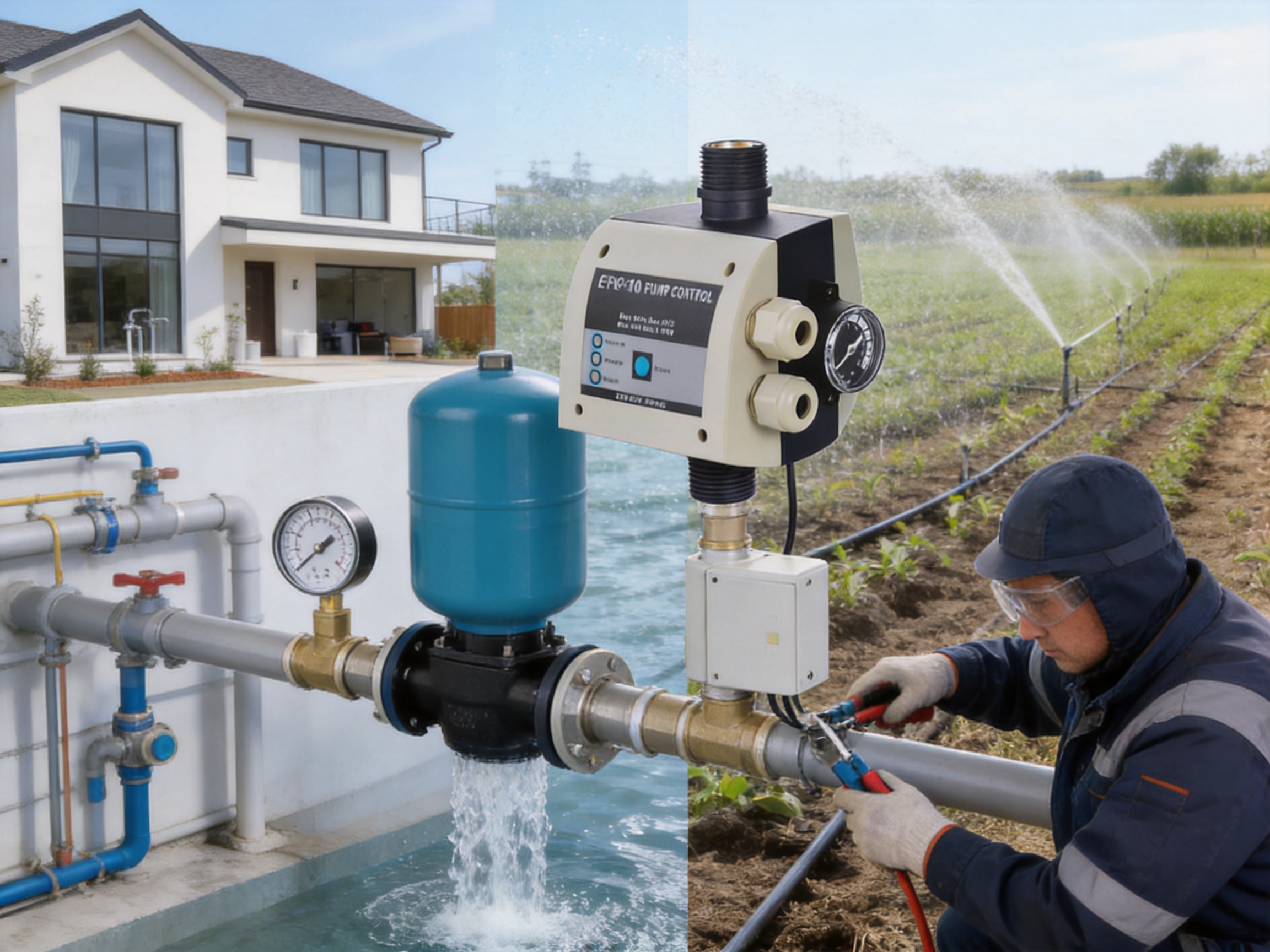
Routine maintenance begins with visual inspection. Check for water leakage, cracked fittings, damaged cables, loose covers, corrosion, unusual noise, and signs of overheating. The pressure switch should remain clean and securely mounted.
If the pump does not start, verify the power supply, circuit protection, wiring mode, pressure reading, and starting-pressure setting. A closed valve, blocked pipe, empty water source, or air-locked system can also prevent normal pressure response. If the pump starts but does not stop, check whether the stopping pressure is too high for the pump or whether there is continuous water demand or leakage downstream.
Frequent starting and stopping may indicate an unsuitable pressure differential, insufficient pressure-tank volume, a leaking non-return valve, pipe leakage, or a pressure setting that does not match the pump. The delay-start function may reduce some nuisance responses, but the underlying hydraulic problem should still be investigated.
Pressure-switch adjustment should be performed carefully and only within the specified range. Do not disassemble the sealed electrical section while the system is energized. If the membrane, contacts, or internal mechanism appears damaged, replacement by a qualified technician is generally safer than attempting an improvised repair.
Maintenance intervals depend on the environment, operating frequency, water quality, and system importance. High-cycle commercial or agricultural installations may require more frequent inspection than occasional residential systems. Keeping records of pressure settings and service events can help identify gradual performance changes.
Pressure switches are relatively compact components, but their correct selection affects the performance of the entire pumping system. Manufacturer support can help customers choose the correct connection type, pressure range, operating mode, and installation arrangement.
Taizhou Edwin Electric Co., Ltd. operates alongside related import, export, procurement, and industrial service organizations. This structure supports order planning, production coordination, cross-border delivery, and foreign-trade communication. For international customers, these capabilities can be as important as the product itself.
The company’s product portfolio includes water pumps and water-treatment peripheral products. This enables customers to explore one-stop procurement for complete pumping projects rather than sourcing every component from unrelated suppliers. For buyers managing multiple projects, coordinated procurement can simplify technical communication and logistics.
Edwin Pump serves applications including new-energy projects, agricultural irrigation, municipal engineering, mining, construction, heating and ventilation systems, and household water supply. Experience across these sectors gives the company exposure to different operating conditions and customer expectations.
Its focus on quality, innovation, high-performance pumps, and intelligent technology supports continued development of control products such as the EPC-10 Series. Customers can benefit from working with a supplier that understands both the pressure-control component and the larger water-pump system in which it operates.
The EPC-10 Series is designed for use with water pump systems. It responds to pressure conditions and can control a pump circuit or an associated relay or contactor, depending on the electrical design.
The starting pressure can be adjusted from 0.5 bar to 6.7 bar. The stopping pressure can be adjusted from 0.8 bar to 7.0 bar. The final setting must remain suitable for the pump and the safe operating pressure of the system.
The NBR membrane transfers hydraulic pressure to the switching mechanism while helping seal the fluid side from the electrical section. It supports reliable pressure sensing and helps reduce leakage when correctly installed and operated within the specified conditions.
Yes. The product supports normally open and normally closed operating modes. The appropriate mode depends on the intended control logic and the design of the pump circuit.
Yes. The EPC-10 Series includes delay-start settings from 0.1 to 1 hour and from 1 to 24 hours. The selected delay should match the hydraulic and electrical requirements of the system.
The maximum working pressure is 1.0 MPa. The system should be designed so that normal and foreseeable pressure conditions remain within this limit.
The maximum working temperature is 60 degrees Celsius. Applications above this temperature require a product specifically rated for higher-temperature service.
The product has an IP65 protection rating, which provides protection against dust and water jets under specified test conditions. It is not intended for underwater installation, and correct cable entry and mounting are essential.
Female and male screw configurations are available. The listed arrangements include a female fixed nut of 1/4 inch or 3/8 inch with a 1/4-inch rotary connection, and a male 1/4-inch connection.
The correct connection depends on the electrical rating and motor starting current. For larger pumps, the pressure switch should normally control a suitable relay or contactor rather than carry the motor current directly. A qualified electrical professional should confirm the arrangement.
The product is intended primarily for water pump systems. Chemical compatibility and temperatures above 60 degrees Celsius must be evaluated separately before use.
Check the pressure differential, pressure-tank condition, pipe leakage, check valves, and pump sizing. The delay-start function may help with some temporary pressure fluctuations, but it should not replace proper hydraulic troubleshooting.
Its competitive strengths include a broad adjustable pressure range, normally open and normally closed modes, manual and time-based operation, an NBR membrane, IP65 protection, multiple connection options, and support from a manufacturer experienced in complete water-pump systems.
The EPC-10 Series provides a practical balance between mechanical pressure control and flexible operating functions. Its adjustable pressure settings allow system matching, while the manual and time modes support different installation and operating requirements. The NBR membrane contributes to sealing reliability, and the IP65 rating improves suitability for demanding pump environments.
Its value is strengthened by the manufacturing background of Taizhou Edwin Electric Co., Ltd. The company combines independent research and development, mass production, international export experience, and a broad pump portfolio. This integrated capability supports consistent products and more informed technical assistance.
For distributors, the product offers a versatile pressure-control solution that can serve several water-system segments. For installers, the connection options and adjustable settings can simplify project integration. For end users, dependable pressure switching can contribute to stable water delivery, reduced unnecessary pump operation, and improved equipment management.
The EPC-10 Series should always be selected and installed according to its technical limits. Correct electrical protection, appropriate hydraulic design, compatible fittings, suitable pressure settings, and regular inspection are essential for safe and reliable operation. When these requirements are followed, the pressure switch can provide effective control across domestic, agricultural, commercial, and utility water-pump systems.
Modern water-pump systems require more than a simple on-off device. They need accurate pressure response, dependable sealing, environmental protection, flexible control logic, and compatibility with different installation conditions. The EPC-10 Series Manual and Time Modes NBR Rubber Membrane Pressure Switch addresses these requirements through its adjustable starting and stopping pressures, dual operating modes, delay-start function, NBR membrane, IP65 protection, and practical connection options.
Compared with basic pressure switches, it provides broader application flexibility and more control over pump operation. Compared with highly specialized electronic controllers, it offers a straightforward pressure-switching solution supported by a familiar mechanical membrane design. Its usefulness is further supported by the manufacturing and water-pump expertise of Taizhou Edwin Electric Co., Ltd.
For water-system professionals seeking a reliable pressure-control component, the EPC-10 Series represents a versatile choice for properly designed pump installations. Its combination of functional flexibility, sealing performance, environmental protection, and manufacturer support makes it suitable for a wide range of water-pump applications.
1. Product technical data supplied for the EPC-10 Series Manual and Time Modes NBR Rubber Membrane Pressure Switch.
2. Manufacturer information concerning Taizhou Edwin Electric Co., Ltd., its product portfolio, manufacturing activities, and international service capabilities.
3. General principles of pressure-switch control in domestic, agricultural, commercial, and utility water-pump systems.
4. General engineering guidance for NBR elastomer sealing components used in fluid-handling equipment.
5. General reference principles for IP65 enclosure protection, electrical safety, pump protection, and pressure-system commissioning.
edwina@edwin-pump.com
+86-13586290903 (WhatsApp)
Xuri Gongliang Cutting Tool Entrepreneurship Park, Wenqiao Town, Wenling City, Taizhou City, Zhejiang Province, China

High Performance Smart Pump Factory


 English