edwina@edwin-pump.com

View All Products
en
Reliable access to water is essential for agriculture, livestock production, household supply, construction, mining, municipal projects, and remote infrastructure. In many locations, however, traditional water pumping systems face serious limitations. Grid electricity may be unavailable or unreliable, diesel fuel can be expensive to transport, and conventional pumps may require complicated installation and regular maintenance. Solar-powered submersible borehole pumps offer a practical alternative by combining renewable energy with direct, efficient water extraction from wells and boreholes.
The 3C/4C Solar Submersible Borehole Pump is designed for users who need a compact, efficient, and dependable pumping solution in areas where electricity access is limited or operating costs must be controlled. Available in several direct-current configurations, this product range covers different voltage, power, flow, head, outlet, and borehole diameter requirements. The models are suitable for a broad variety of small and medium-scale water supply applications, including agricultural irrigation, livestock watering, rural water systems, garden irrigation, and solar-powered water projects.
Unlike many basic solar pumps that compromise durability for low initial cost, this range incorporates permanent magnetic brushless DC motor technology, stainless steel components, NSK bearings, oil-filled motor construction, and an internal controller. These features are intended to improve energy conversion, simplify installation, reduce maintenance requirements, and support reliable operation in demanding environments.
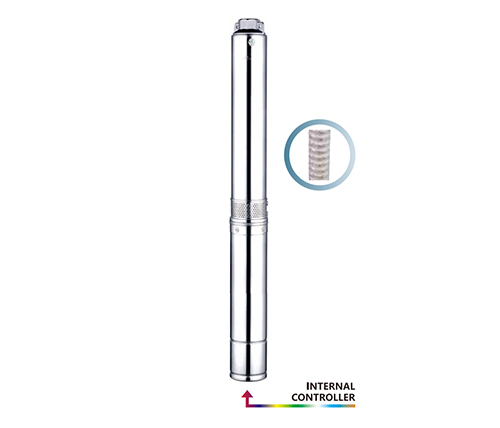
3C/4C Solar submersible borehole pump
The 3C/4C range consists of four compact solar submersible borehole pump models. Each model is designed to operate from a direct-current power supply, making it suitable for connection to a solar photovoltaic system or another compatible DC power source. The pumps are installed below the water level inside a borehole or well, where they push water upward through a discharge pipe.
Submersible installation provides several important benefits. Because the pump is positioned close to the water source, it does not need to create a strong suction lift at the surface. This helps avoid many of the priming and suction limitations associated with surface-mounted pumps. The submerged pump can also operate quietly, conserve space, and deliver water directly through the pipeline to a storage tank or irrigation system.
The product family includes three 3-inch models and one 4-inch model. The 3-inch models are appropriate for narrower boreholes and compact water systems, while the 4-inch model provides a higher maximum flow rate and maximum head for applications requiring additional hydraulic performance. The range includes low-power and higher-power options, allowing users to select a pump according to available solar energy, water demand, well depth, and pipe arrangement.
Model |
Voltage |
Power |
Maximum Flow Rate |
Maximum Head |
Outlet Size |
Pump Diameter |
3C24-DC |
24 V |
120 W |
2 m³/h |
11 m |
1 inch |
3 inches |
3C36-DC |
36 V |
300 W |
3.2 m³/h |
25 m |
1 inch |
3 inches |
3C48-DC |
48 V |
600 W |
3.5 m³/h |
40 m |
1 inch |
3 inches |
4C48-DC |
48 V |
600 W |
4 m³/h |
45 m |
1.25 inches |
4 inches |
The stated maximum flow and head values are reference ratings. Actual performance depends on water level, borehole conditions, solar radiation, photovoltaic array capacity, pipe length, pipe diameter, elevation difference, fittings, and system resistance. For correct selection, the required daily water volume and total dynamic head should be evaluated together rather than considering maximum flow or maximum head separately.
One of the principal advantages of the 3C/4C pump range is its permanent magnetic DC brushless motor. Traditional brushed motors use physical carbon brushes and a commutator to transfer electrical power to the rotating section. These parts wear over time, generate friction, and may require replacement during the operating life of the motor. A brushless motor uses electronic commutation instead, eliminating the need for conventional mechanical brushes.
The absence of brushes can provide several practical benefits. Mechanical wear is reduced, motor operation is generally smoother, and routine maintenance requirements can be lowered. The design is also well suited to solar pumping because it can operate directly from a DC power source without requiring a separate AC inverter in suitable system configurations. Avoiding an inverter can simplify the system architecture and reduce one potential source of energy loss or failure.
The permanent magnetic design supports efficient conversion of electrical energy into rotational motion. According to the product information, motor efficiency is improved by approximately 15% to 30% compared with less efficient motor arrangements. The actual improvement varies according to operating conditions and the comparison system, but the principle is especially important in solar applications. Every reduction in electrical loss can help make better use of available sunlight and may reduce the required photovoltaic array size for a specific pumping duty.
For remote installations, motor simplicity is more than a technical benefit. It can reduce service visits, spare-part requirements, and downtime. A pump that operates with fewer wear-prone mechanical components is particularly valuable for farms, rural water points, temporary construction sites, and off-grid facilities where maintenance personnel may not be nearby.
Solar pumping systems work within a variable energy environment. Solar radiation changes throughout the day and across seasons. Cloud cover, temperature, panel orientation, dust, and shading can all affect the available electrical output. An efficient pump motor can therefore make a major difference to the total amount of water delivered each day.
The 3C/4C pump range is designed to make effective use of direct-current solar energy. The permanent magnetic motor reduces unnecessary electrical losses, while the internal controller helps manage the relationship between the motor and the available power supply. This integrated arrangement can help the pump start and operate more effectively under changing solar conditions, subject to correct system sizing and installation.
Energy efficiency also affects long-term operating economics. A diesel-driven pump requires fuel, transportation, lubrication, and periodic engine servicing. A grid-powered pump depends on electricity availability and tariff costs. A solar pump uses sunlight as its primary energy source after installation, making it possible to reduce recurring energy expenses. Although the initial solar system investment must be considered, the reduced operating cost can be particularly attractive for applications with daily water demand.
In practical terms, the best performance comes from matching the pump to the photovoltaic array and the hydraulic system. Oversized or undersized solar panels may prevent the pump from operating at its intended capacity. Similarly, excessive pipe friction or an incorrectly selected pump can reduce water output. A professional system design should therefore consider the water source, pumping schedule, storage tank, pipeline, and expected solar conditions as one complete system.
The product information identifies an internal controller as one of the pump’s key advantages. Integrating the controller into the pump structure can simplify wiring and installation compared with systems that require a separate external control box. Fewer external components can also create a cleaner system layout and reduce the number of connections that must be protected from moisture, dust, and accidental damage.
An internal controller is responsible for managing the electrical operation of the brushless DC motor. Depending on the system configuration, motor control electronics can support efficient commutation, start-up management, and protection functions. The exact protection parameters should be confirmed with the supplier and selected according to the application, but integrated electronic control is generally valuable for maintaining stable operation.
For installers, a simpler arrangement can reduce labor time and make commissioning more straightforward. For end users, it may mean fewer separate components to inspect or replace. This is especially useful in decentralized installations where the pump may be installed far from a workshop or electrical service center.
Even with an integrated controller, proper installation remains essential. The power supply must be compatible with the pump voltage. Cable size should be selected according to the distance between the photovoltaic system and the pump. The pump should not be operated outside its permitted submergence or water-quality conditions. Electrical connections must be properly sealed, and the system should be protected against accidental mechanical damage.
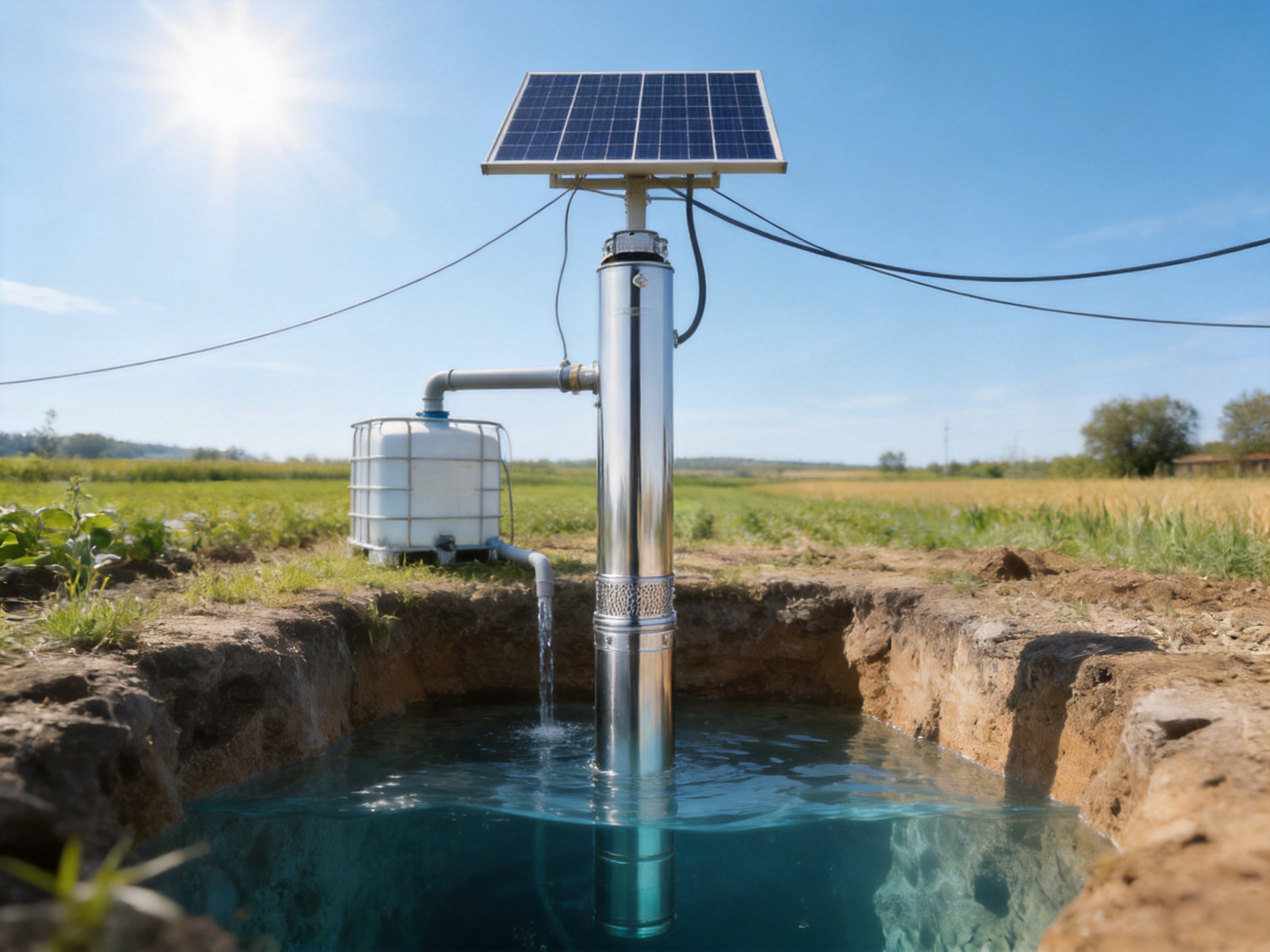
The pump range uses stainless steel rotors and screws. Stainless steel is widely used in water-handling equipment because it provides a useful combination of mechanical strength, corrosion resistance, and clean appearance. Components exposed to water, pressure, vibration, and repeated starting cycles must maintain their integrity over time, particularly in borehole environments where service access can be difficult.
Stainless steel components can help protect critical mechanical areas from corrosion. This is important because rust or surface deterioration may affect clearances, fastening strength, hydraulic passages, and future disassembly. Stainless steel does not eliminate every corrosion risk, and the appropriate grade should be confirmed for the local water chemistry. Nevertheless, the use of stainless steel in important rotating and fastening components represents a meaningful advantage over low-cost designs that depend heavily on ordinary untreated metal.
Material selection is especially significant when the pump is used in agricultural or rural water systems. Such installations may operate for long periods with limited inspection. A robust material strategy can contribute to longer service life and more consistent performance. It can also reduce the likelihood of premature replacement caused by corrosion-related failures.
The stainless steel rotor and screws complement the oil-filled motor design and the compact submersible structure. Together, these features are intended to support dependable underwater operation while protecting the internal motor assembly from the surrounding water environment.
The 3C/4C pumps use oil-filled motors. In a submersible pump, the motor must be protected while operating below the water surface. An oil-filled arrangement provides an insulating and heat-transfer medium around the motor components. It can assist with thermal management and help protect internal parts from direct contact with external water when the motor sealing system is correctly maintained.
Heat management is important because motor efficiency, insulation life, and bearing performance are all affected by operating temperature. A motor that can transfer heat effectively may be better positioned to handle continuous or repeated operation within its rated conditions. The oil-filled structure also supports the compact design required for borehole installation.
As with any submersible pump, sealing quality and installation discipline are essential. The pump should be handled carefully to avoid damaging cables, seals, or the external housing. It should not be run dry, because the surrounding water normally contributes to cooling and hydraulic operation. If the water level may fall below the pump intake, the system should include an appropriate water-level management strategy.
The product specifications identify NSK bearings as part of the motor construction. Bearings support the rotating shaft and help maintain alignment between the motor and pump assembly. High-quality bearings can reduce friction, vibration, and mechanical noise when used within their intended load and speed limits.
Bearing quality affects more than smoothness. Excessive vibration may place additional stress on seals, fasteners, motor windings, and pipe connections. Stable shaft support can therefore contribute to the reliable operation of the complete pump assembly. In a borehole pump, where access for repair may require removing the unit from the well, durable bearing selection can help reduce maintenance interruptions.
Bearings must still be used under suitable conditions. Water quality, operating temperature, pump alignment, hydraulic loading, and correct voltage all influence service life. A quality bearing cannot compensate for dry running, blockage, severe abrasive contamination, or operation far beyond the rated duty point. Correct application remains the foundation of dependable performance.
The 3-inch and 4-inch diameter options allow the product family to serve different borehole sizes. Borehole diameter is often a fixed project constraint, so the pump must fit through the available casing while leaving sufficient clearance for installation and water movement. The 3-inch models provide a solution for narrower boreholes, while the 4-inch model offers greater hydraulic capacity where the well design permits it.
A compact submersible form also saves surface space. Unlike a surface pump installation, there is no need for a large pump room or exposed suction assembly directly beside the water source. The pump can be suspended inside the borehole, with the discharge pipe carrying water to the surface or storage tank. This arrangement can improve site appearance and help protect the equipment from weather, accidental impact, and unauthorized interference.
Compact dimensions should not be interpreted as limited usefulness. The 3C48-DC model, for example, reaches a stated maximum head of 40 meters at 600 watts, while the 4C48-DC model reaches a stated maximum head of 45 meters and a maximum flow rate of 4 cubic meters per hour. These specifications make the range suitable for more than simple household water transfer, provided the system is designed within the pump’s performance limits.
The 3C24-DC operates at 24 volts and has a rated power of 120 watts. With a maximum flow rate of 2 cubic meters per hour and a maximum head of 11 meters, it is appropriate for relatively low-lift applications. Possible uses include small storage tanks, garden irrigation, livestock watering, and basic water transfer from a shallow borehole or well.
Its lower voltage and power requirement may be helpful for compact solar systems. It can be considered where the daily water requirement is moderate and the elevation difference between the water source and delivery point is limited. The 3-inch pump diameter makes it suitable for compatible narrow boreholes.
The 3C36-DC operates at 36 volts and 300 watts. Its maximum flow rate is 3.2 cubic meters per hour, and its maximum head is 25 meters. This configuration provides a balance between power consumption and hydraulic performance for medium-duty water supply.
It may suit small agricultural plots, rural water storage, livestock systems, and domestic water transfer where the delivery point is elevated above the borehole. The higher head rating compared with the 3C24-DC provides additional flexibility for pipelines with greater elevation or moderate friction loss.
The 3C48-DC operates at 48 volts and 600 watts. It offers a maximum flow rate of 3.5 cubic meters per hour and a maximum head of 40 meters. This model is designed for applications requiring greater lifting capability while still fitting a 3-inch borehole.
It can be considered for elevated storage tanks, longer delivery lines, agricultural irrigation systems, and rural water projects where the total dynamic head is substantially higher than the capability of a low-power model. The 48-volt configuration may also help reduce current compared with a lower-voltage system at the same power level, which can be beneficial for reducing cable voltage drop when the installation is correctly designed.
The 4C48-DC also uses a 48-volt, 600-watt power configuration. It provides a maximum flow rate of 4 cubic meters per hour and a maximum head of 45 meters. With a 4-inch pump diameter and a 1.25-inch outlet, it is the largest configuration in the listed range.
This model may be appropriate for projects that require higher water delivery and have a borehole casing large enough to accommodate a 4-inch pump. Potential applications include larger agricultural plots, community water points, storage tank filling, construction water supply, and other systems requiring stronger hydraulic performance within the stated ratings.
The first major advantage is reduced dependence on grid electricity. In rural or remote locations, extending an electrical connection can be expensive and time-consuming. A solar submersible pump can operate from a properly designed photovoltaic system, allowing water infrastructure to be installed where conventional electrical service is unavailable.
The second advantage is reduced fuel dependence. Diesel pumps can provide high power, but they require fuel delivery, engine maintenance, oil changes, exhaust management, and regular supervision. For small and medium water applications, these operating requirements may create a significant long-term burden. A solar pump has no fuel combustion engine and can reduce recurring energy and maintenance costs.
The third advantage is quieter operation. A submersible electric motor does not produce the same surface noise as a diesel engine or many exposed mechanical pump systems. This can be beneficial near homes, schools, livestock areas, public facilities, and environmentally sensitive locations.
The fourth advantage is installation flexibility. The pump can be installed in a borehole and connected to a storage tank, irrigation line, or distribution network. The compact 3-inch and 4-inch formats allow the range to serve boreholes with different internal dimensions.
The fifth advantage is simplified maintenance. Brushless operation eliminates mechanical brushes, while stainless steel components, oil-filled motor construction, and quality bearings support durability. The internal controller reduces the number of external components required for operation. These features do not eliminate the need for inspection, but they can reduce routine service demands compared with more complicated or wear-prone alternatives.
The sixth advantage is scalability. A solar pumping system can often be developed in stages. Users may begin with water storage and livestock supply, then expand the photovoltaic array, tank capacity, or irrigation distribution system as water demand grows, provided the pump and electrical system remain within their approved operating conditions.
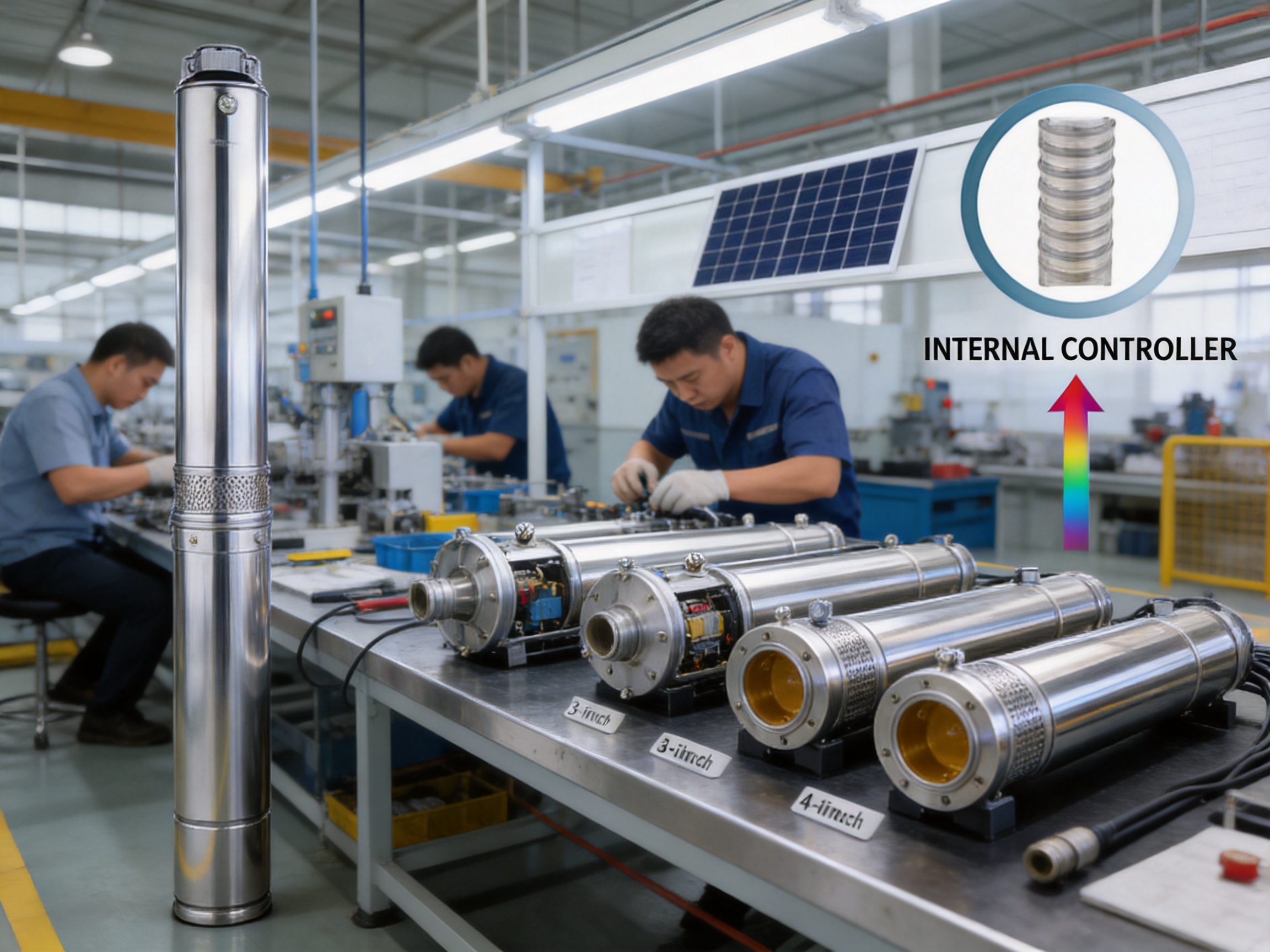
Taizhou Edwin Electric Co., Ltd., operating under the Edwin Pump name, was founded in 2008. The company is described as an integrated manufacturing enterprise specializing in independent research and development, mass production, and global export. This combination is important for buyers seeking more than a generic pump assembled solely for short-term price competition.
Independent research and development enables the manufacturer to work directly on motor design, hydraulic performance, materials, controls, and application requirements. For solar pumping products, this is particularly valuable because the pump must function within a variable power environment rather than a stable grid supply. Motor efficiency, start-up behavior, controller integration, heat management, and low-voltage operation all influence the final system result.
Mass production provides another important strength. A manufacturer with established production capability can standardize components, develop repeatable assembly procedures, and support more consistent output across orders. Standardization is important for distributors, engineering companies, and project purchasers that need several units with comparable performance and interchangeable service parts.
The company’s product portfolio includes deep well pumps, submersible pumps, domestic booster pumps, circulation pumps, solar water pumps, intelligent booster pumps, and related water treatment peripheral products. This broad range supports one-stop procurement for customers who need multiple pump types across a project or product catalog.
The company has also established Taizhou Haipai Import and Export Co., Ltd. and Golden Falcon Industrial Co., Ltd. to support procurement planning, order tracking, cross-border delivery, and foreign trade services. For international buyers, these capabilities can be as important as the product itself. Clear communication, production coordination, documentation, and shipping support help reduce the risks associated with overseas purchasing.
The manufacturing quality of a submersible pump depends on a sequence of controlled processes rather than a single component. The motor, pump body, rotor, shaft, bearings, seals, controller, cable, and hydraulic passages must work together. An integrated manufacturer can coordinate these stages more effectively than a trading organization with no direct control over production.
Motor assembly begins with the preparation of the stator, rotor, windings, insulation system, and shaft components. Precision and consistency are important because uneven winding quality or incorrect rotor alignment can affect efficiency, vibration, and operating temperature. The use of permanent magnetic motor technology requires careful control of magnetic components and electronic commutation compatibility.
Mechanical assembly must ensure that the shaft, bearings, impellers, fasteners, and sealing elements are correctly aligned. Stainless steel rotors and screws provide a durable material foundation, while NSK bearings support rotating movement. Assembly accuracy is essential for maintaining stable operation and reducing unnecessary vibration.
The oil-filled motor must be sealed correctly before final testing. The oil quantity, sealing surfaces, cable entry, and mechanical interfaces all contribute to the protection of the internal motor. A suitable production process should include inspection of these areas before the pump leaves the factory.
Controller integration requires electrical testing and functional verification. The internal controller must be compatible with the designated DC voltage and motor characteristics. Wiring, insulation, terminal connections, and protective functions should be inspected to reduce the risk of field failures.
Final pump testing should verify basic electrical and hydraulic behavior. Depending on the manufacturer’s testing program, this may include insulation checks, no-load or load-current measurement, leakage checks, noise and vibration observation, start-up testing, and flow or head verification. The purpose of factory testing is to identify assembly or component problems before shipment and to improve consistency between production units.
For overseas customers, product quality must be supported by reliable supply-chain management. The manufacturer’s experience in global export and foreign trade services can help coordinate production schedules, packaging, shipping documentation, and order communication. These activities are particularly important for distributors and project contractors working under fixed installation schedules.
Quality control should cover incoming materials, in-process assembly, finished pump testing, and packaging. Components such as stainless steel parts, bearings, cables, seals, and electronic control elements need to meet defined specifications. Consistent inspection helps reduce variation between batches and supports predictable product performance.
Packaging is also a part of product quality. Submersible pumps may be transported over long distances and handled multiple times before installation. Proper protection should help prevent impact damage, moisture intrusion, cable deformation, and surface damage. Product labeling and documentation should make it easy to identify the model, voltage, power, outlet size, and recommended application.
For project procurement, buyers may also require technical data sheets, packing lists, commercial invoices, inspection records, and other documents. An experienced export-oriented manufacturer is better positioned to organize these materials and support international delivery requirements.
Before installation, confirm the borehole diameter, static water level, dynamic water level, total depth, water quality, and expected daily demand. The pump diameter must be compatible with the casing, and sufficient clearance should remain for lowering and retrieving the equipment. The pump should not be forced through a casing that is too narrow or obstructed.
Calculate the total dynamic head rather than relying only on vertical elevation. Total dynamic head includes the vertical distance from the water level to the delivery point, pressure requirements at the outlet, and friction losses in the pipe, elbows, valves, and fittings. Select a pump that can provide the required flow at the actual operating head.
Install the pump with a suitable discharge pipe and secure support system. The electrical cable should be protected against abrasion and should not carry the mechanical weight of the pump. Use appropriate cable clamps or supports, and avoid sharp bends that could damage the insulation.
Connect the pump to a compatible DC power system. The photovoltaic array, controller arrangement, cable size, isolating devices, and protection equipment should be selected by a qualified installer. Confirm polarity and voltage before energizing the pump. Incorrect electrical connection can damage the controller or motor.
The pump should remain adequately submerged during operation. Dry running can cause overheating, seal damage, and premature failure. If the water source has a variable level, consider a water-level sensor, float control, storage tank management system, or other method of preventing operation when the water level is too low.
Flush or clean the borehole before permanent operation if sand, drilling debris, or excessive sediment is present. Abrasive particles may accelerate wear in hydraulic components. The water quality should be reviewed for sand, corrosive chemicals, salt, and other substances that could affect the pump materials or seals.
A solar pump should be selected according to daily water volume, not only peak instantaneous flow. Determine how much water is required each day and during which seasons. Then evaluate the available solar radiation, photovoltaic array orientation, expected cloudy periods, and storage capacity.
Water storage is often an effective way to balance variable solar energy. Instead of requiring the pump to operate at exactly the time water is needed, the pump can fill a tank during suitable daylight hours. The stored water can then be used for irrigation, livestock, domestic supply, or other purposes according to demand.
Voltage drop must be considered when the solar array is far from the borehole. Long cables with insufficient cross-sectional area can reduce the voltage available at the pump and lower performance. The installer should calculate cable losses and select suitable conductors, connectors, and protection devices.
Solar panels should be installed where they receive strong, unobstructed sunlight. Dust, shading, poor orientation, and improper tilt can reduce energy production. Regular cleaning and visual inspection may be needed, particularly in agricultural or dusty environments.
In agriculture, the pump can supply water for drip irrigation, greenhouse irrigation, orchard watering, and small-scale field systems. Solar operation is especially valuable for farms located far from electrical infrastructure. Water can be pumped into a tank and distributed through irrigation lines according to crop requirements.
For livestock production, the pump can provide water for cattle, sheep, goats, poultry, and other animals. A storage tank and float valve can help maintain a dependable supply while preventing unnecessary operation after the tank is full.
In rural domestic water systems, the pump can transfer groundwater to elevated tanks or household distribution points. The appropriate model depends on well depth, household demand, tank elevation, and pipeline resistance. Water quality should always be tested before using groundwater for drinking.
For construction sites, the pump can support temporary water transfer, dust suppression, concrete preparation, and site service systems. Solar power may be useful where a temporary grid connection is unavailable or where fuel logistics are inconvenient.
In municipal and community projects, multiple pumps may be used to support decentralized water points or small distribution systems. The compact borehole design and model range make it possible to match pump selection to different well dimensions and hydraulic requirements.
In new energy projects, solar pumping can complement photovoltaic infrastructure by using available solar generation for productive water supply. The system can provide direct value from renewable energy while reducing dependence on fuel-based pumping.
Although the brushless motor and durable construction reduce routine maintenance, regular inspection remains recommended. Check the solar array, electrical cable, mounting hardware, tank, pipeline, valves, and visible connections. Monitor changes in water output, operating sound, start-up behavior, and power consumption.
A gradual reduction in flow may indicate a falling water level, blocked intake, sediment accumulation, pipe damage, increased friction, or solar system deterioration. It may also indicate that the pump is operating at a different point on its performance curve because system conditions have changed.
Keep the area around the solar panels clean and free from shading. Inspect cable insulation and connectors for weathering or mechanical damage. Ensure that external electrical protection devices remain secure and dry.
If the pump must be removed from the borehole, use suitable lifting equipment and avoid pulling on the electrical cable. Inspect the pump body, cable entry, discharge connection, and external surfaces. Any repair involving the motor, seals, controller, or electrical insulation should be performed by qualified personnel.
Maintain records of installation date, model, operating voltage, measured flow, water level, and service work. These records can help identify performance changes and support future maintenance planning.
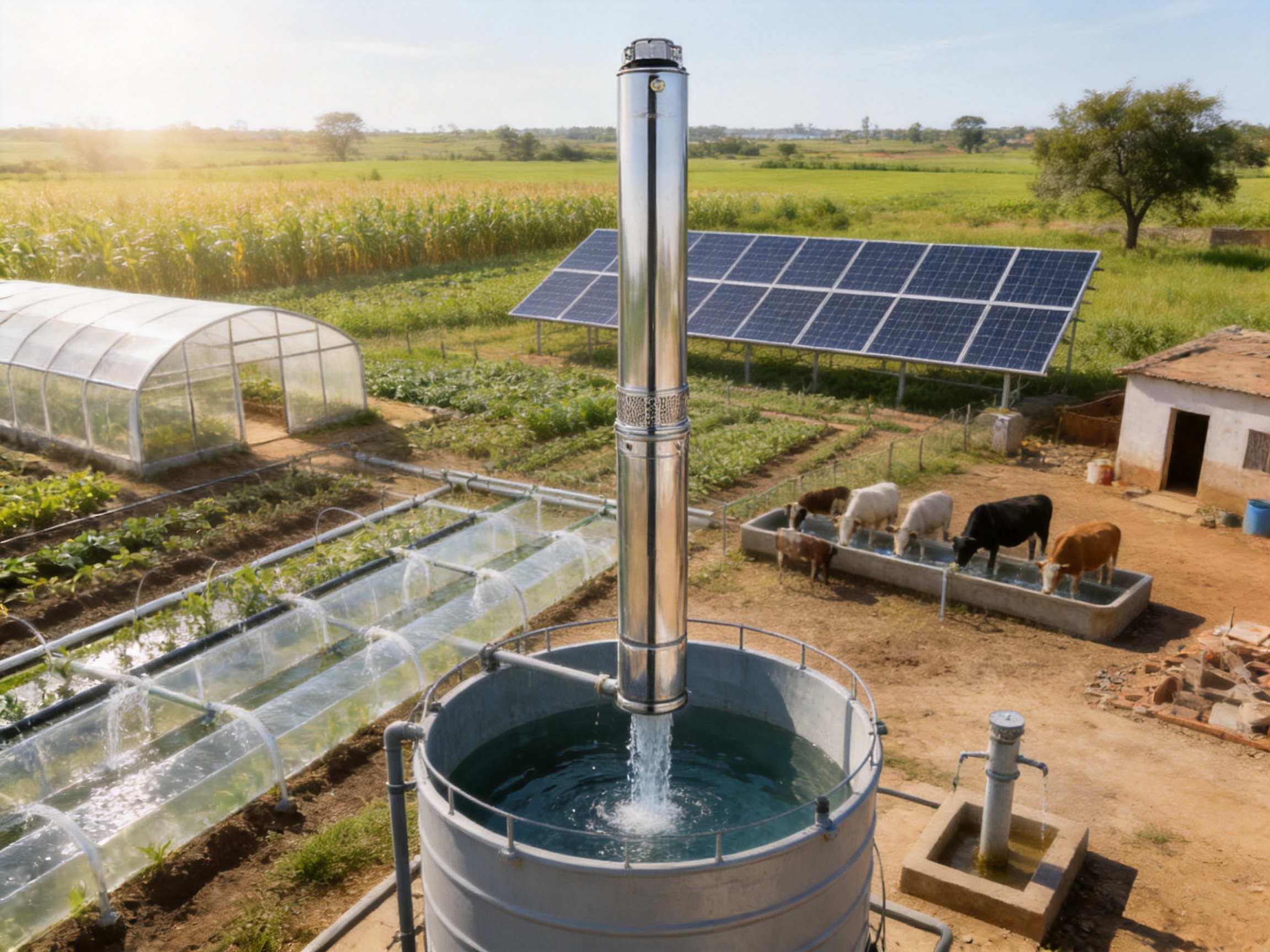
A solar submersible borehole pump is an electric pump installed below the water level inside a well or borehole and powered by a solar photovoltaic system. It pushes groundwater to the surface or to a storage and distribution system.
The 3C models have a 3-inch pump diameter and a 1-inch outlet. The 4C48-DC model has a 4-inch diameter and a 1.25-inch outlet. The 4C model also provides a higher listed maximum flow rate and maximum head than the 3C48-DC, making it suitable for larger compatible boreholes and higher-capacity applications.
The pump is designed for direct-current operation and may be used in a direct solar pumping system, subject to correct system design and controller compatibility. Whether a battery is required depends on the intended operating schedule, water storage arrangement, solar conditions, and control strategy. A qualified installer should determine the appropriate configuration.
The 3C24-DC may be suitable for lower-head applications because its listed maximum head is 11 meters. However, the actual selection must include pipe friction, delivery elevation, required flow, and the available solar power.
The 4C48-DC has the highest listed maximum flow rate at 4 cubic meters per hour and the highest listed maximum head at 45 meters. It requires a compatible 4-inch borehole and a correctly sized 48-volt solar power system.
A brushless motor does not use conventional mechanical carbon brushes, reducing brush wear and maintenance requirements. Permanent magnetic brushless motors can also provide efficient electrical-to-mechanical energy conversion, which is valuable in solar applications where available power varies.
Stainless steel provides corrosion resistance and mechanical durability in water-handling environments. These materials can help protect critical components from rust and deterioration, although the appropriate material grade should be confirmed for particularly corrosive water conditions.
The pump should not be operated dry. Adequate submergence is important for cooling and proper hydraulic operation. A water-level control or other protective method should be considered where the borehole water level may fluctuate.
The product information states that the pump has an internal controller. This can simplify installation by reducing the number of external control components. The complete solar system may still require suitable isolators, protection devices, monitoring equipment, or other components according to local electrical requirements.
The water should be evaluated for sand, sediment, corrosive chemicals, salt, and other contaminants. Excessive abrasive particles or aggressive water chemistry may reduce service life. A water analysis is recommended for challenging applications.
Selection should be based on borehole diameter, water level, required daily water volume, desired flow, total dynamic head, pipe length, solar radiation, and available photovoltaic power. Maximum flow and maximum head should not be treated as simultaneous operating values.
The product combines direct-current solar compatibility, brushless motor technology, an integrated controller, compact borehole dimensions, stainless steel components, and oil-filled motor construction. These features can reduce dependence on grid power and simplify operation in locations where maintenance access is limited.
The 3C/4C Solar Submersible Borehole Pump range provides a practical solution for efficient groundwater pumping in off-grid and energy-conscious applications. With four configurations covering 24-volt, 36-volt, and 48-volt operation, the range can address different combinations of borehole size, water demand, lifting height, and available solar power.
Its principal technical advantages include permanent magnetic brushless DC motors, stated motor efficiency improvements of 15% to 30%, stainless steel rotors and screws, NSK bearings, oil-filled motors, internal controllers, and easy installation. These features are designed to reduce maintenance, improve energy utilization, and support dependable long-term operation.
The product is backed by Taizhou Edwin Electric Co., Ltd.’s experience in research and development, mass production, international export, and broad pump manufacturing. The company’s wider product portfolio and foreign trade support also make it suitable for distributors, engineering contractors, agricultural suppliers, and industrial customers seeking one-stop pump procurement.
Correct application remains essential. The selected model must match the borehole, hydraulic system, solar array, and daily water requirement. When properly designed and installed, the 3C/4C Solar Submersible Borehole Pump can help provide reliable water access while reducing fuel use, grid dependence, operating noise, and recurring energy costs.
1. Product technical information for the 3C/4C Solar Submersible Borehole Pump, including model ratings, motor features, materials, and construction details.
2. Manufacturer company information concerning research and development, mass production, export services, and water pump product lines.
3. General engineering principles for solar photovoltaic water pumping system design, hydraulic head calculation, and storage-based water distribution.
4. General technical guidance for submersible pump installation, borehole sizing, cable selection, water-level protection, and maintenance planning.
5. General reference principles for permanent magnetic brushless DC motors, stainless steel water-handling components, bearings, and oil-filled motor assemblies.
edwina@edwin-pump.com
+86-13586290903 (WhatsApp)
Xuri Gongliang Cutting Tool Entrepreneurship Park, Wenqiao Town, Wenling City, Taizhou City, Zhejiang Province, China

High Performance Smart Pump Factory


 English