edwina@edwin-pump.com

View All Products
en
Reliable water access is essential for agricultural production, rural communities, livestock management, greenhouse cultivation, and off-grid infrastructure. In locations where grid electricity is unavailable, unstable, or too expensive to operate continuously, solar pumping provides a practical alternative. The 4HVSCW Wide Voltage DC Water-Filled Stainless Steel Impeller Solar Submersible Pump is designed for these demanding conditions, combining a 4-inch submersible format, a wide-voltage brushless DC motor, stainless steel hydraulic components, and a broad selection of flow and head configurations.
This product is engineered to convert variable solar power into dependable water delivery. Its DC operating range of 80V to 430V allows the pump to work with different solar array configurations and changing sunlight conditions, while its water-filled motor supports efficient cooling during submerged operation. The stainless steel cylinder and impeller help resist corrosion, and NSK bearings are used to support smooth rotation, reduced friction, and extended service life.
Unlike a pump designed only for a narrow electrical input or a single fixed duty point, the 4HVSCW series offers multiple models for different well depths, water demands, and project sizes. Available configurations range from 5.2 m³/h at a maximum head of 67 meters to 30 m³/h at a maximum head of 36 meters. Higher-head models reach up to 255 meters, making the series suitable for both moderate-depth water lifting and demanding deep-well applications.
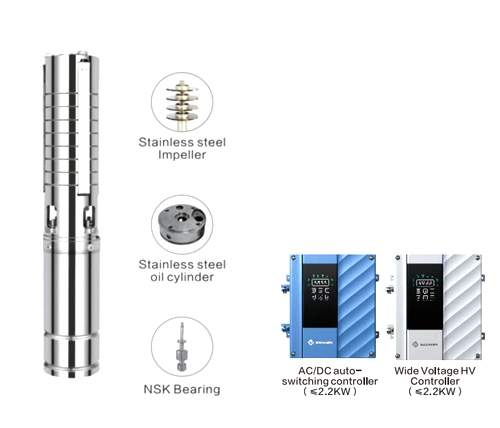
4HVSCW Wide Voltage Dc Water Filled Stainless Steel Impeller Solar Submersible Pump
The 4HVSCW is a solar-powered DC submersible pump developed for installation in 4-inch boreholes and deep wells. It is intended to operate below the water level, where the pumped water surrounds the motor and helps dissipate heat. The pump is driven by a brushless DC motor and is suitable for direct connection to a compatible solar pumping system or DC power source.
The product’s wide-voltage design is one of its most important characteristics. The specified DC input range is 80V to 430V, with the required solar panel open-circuit voltage remaining below 430V. This broad range gives system designers greater flexibility when arranging solar panels in series and parallel. It also helps the pump remain operational as solar output changes during the day.
Solar power is naturally variable. The available voltage and current can be affected by cloud cover, panel temperature, shading, season, and time of day. A narrow-voltage pump may stop frequently when the array moves outside its preferred operating range. The 4HVSCW design is intended to accommodate a wider operating window, reducing the limitations associated with changing solar conditions.
The motor is water-filled rather than air-cooled. In a submerged environment, the water-filled structure provides a practical way to transfer motor heat to the surrounding water. This design is particularly suitable for deep-well use because the pump is installed in a water environment and does not depend on a large external cooling system.
Hydraulic parts are made with stainless steel components, including the cylinder and impeller. These materials provide a strong balance of mechanical durability, corrosion resistance, and suitability for long-term water contact. Stainless steel construction is valuable in wells where moisture is constant and where ordinary materials may be more vulnerable to rust or surface deterioration.
The brushless DC motor is designed for efficient operation in solar and DC-powered applications. Because it does not use traditional mechanical brushes for commutation, it can reduce brush wear and the maintenance associated with brush replacement. The brushless structure also supports stable operation and is well suited to automated solar pumping systems.
The 80V to 430V DC range gives the pump a significant operating span. This is useful for projects that need to balance solar array voltage, cable distance, available panel types, and daily water demand. A system designer can select an appropriate panel arrangement without being restricted to an unusually narrow voltage window, provided that the final system remains within the pump’s specified electrical limits.
The wide-voltage design does not mean that electrical planning can be ignored. The solar array must still be correctly sized, protected, and configured. The open-circuit voltage must remain below 430V, and the recommended solar panel power is at least 1.3 times the pump power. Proper cable sizing, overvoltage protection, grounding, isolation, and installation practices remain essential.
A water-filled motor is suitable for a submersible application because the surrounding water can help remove heat from the motor housing. Effective thermal transfer supports stable operation and can help protect motor components during extended pumping periods.
The water-filled arrangement also contributes to a compact submersible design. Rather than requiring a large external cooling assembly, the pump uses the installation environment as part of its thermal management approach. This is one reason submersible pumps are often preferred for deep wells where surface space is limited.
Installation teams should follow the manufacturer’s instructions regarding submergence, water quality, cable protection, and startup. The pump should not be operated in conditions outside its intended application, such as dry running or an unsuitable well with excessive sand and abrasive particles.
The stainless steel cylinder provides a durable external structure for the submerged pumping assembly. It is exposed to moisture throughout its working life, so corrosion resistance is an important design requirement. A stainless steel body also supports a professional appearance and helps the equipment remain suitable for long-term use in agricultural, residential, and rural water systems.
The stainless steel impeller is responsible for transferring energy from the motor into the water. Its material selection supports resistance to corrosion and helps maintain hydraulic performance over time. In comparison with less corrosion-resistant components, stainless steel can provide greater durability in many normal water conditions.
Material selection should always be matched to the actual water chemistry. Extremely aggressive water, high salinity, unusual acidity, or heavy abrasive loading may require a detailed compatibility assessment. Stainless steel offers meaningful protection, but no pump material should be considered universally resistant to every water condition.
NSK bearings are used to support smooth shaft rotation and controlled mechanical movement. Low-friction bearings can reduce mechanical resistance, support quieter operation, and help limit unnecessary energy losses. They also contribute to stable operation by keeping rotating components properly aligned.
For a solar pump, efficient mechanical transmission is especially valuable. Solar energy availability is limited and changes throughout the day, so reducing avoidable friction allows more of the available electrical energy to be used for moving water. Bearing quality is therefore not only a mechanical consideration but also an energy-efficiency factor.
The 4-inch borehole format is compatible with many standard deep-well applications. Its compact diameter allows installation in appropriately sized wells while providing sufficient hydraulic capacity for the available model range. This makes the product useful for farms, rural homes, livestock facilities, and small to medium-scale irrigation systems.
Before installation, the borehole diameter, pump outer dimensions, static water level, dynamic water level, well yield, and required discharge pipe should be verified. A pump should never be selected only by its maximum head or maximum flow. The actual duty point must be considered together with the well’s sustainable yield and the total system resistance.
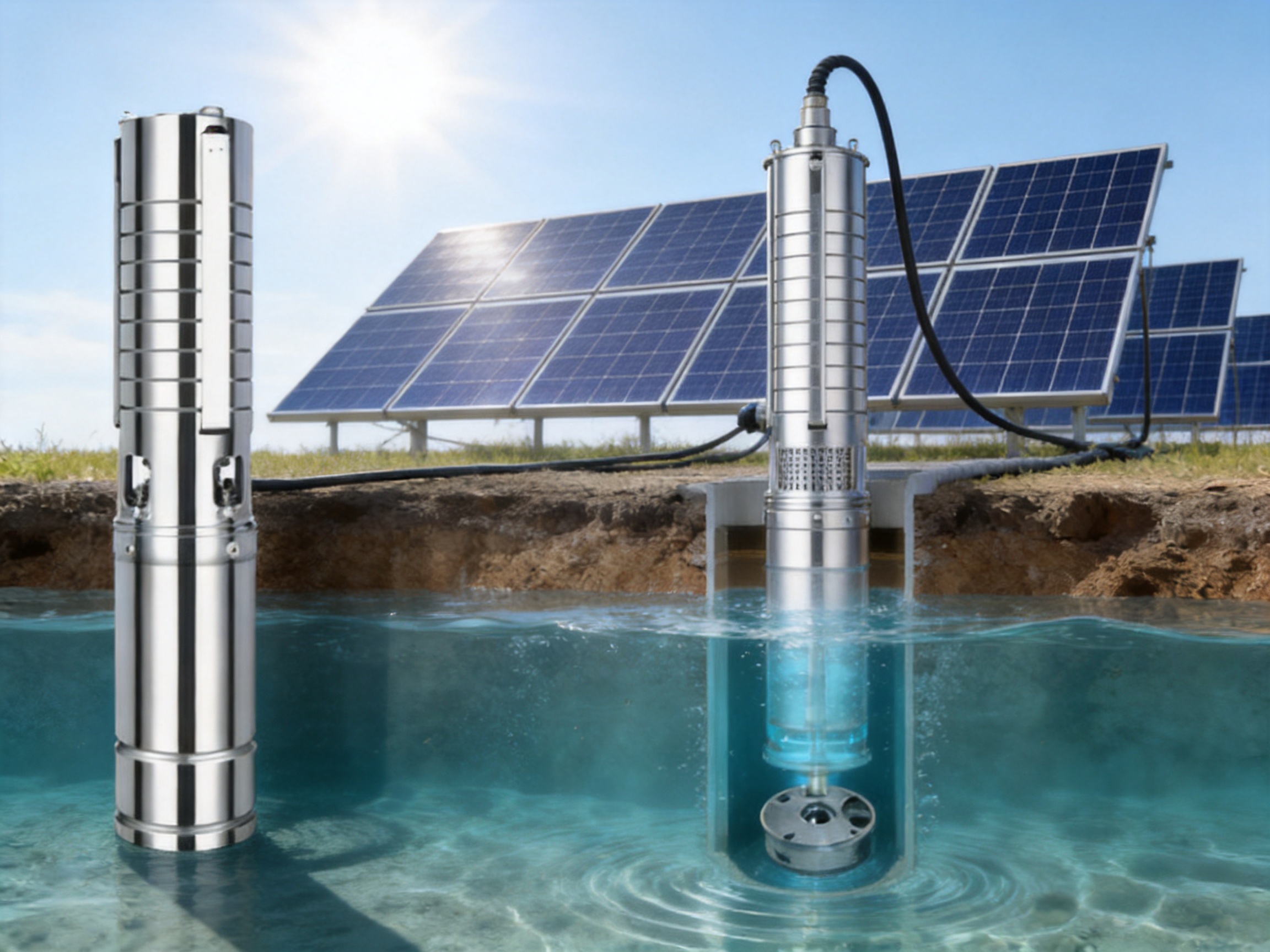
The 4HVSCW series includes models with different combinations of maximum flow, maximum head, and motor power. This allows the pump family to serve more than one type of water project. Some models emphasize high lifting distance, while others deliver greater flow at a lower maximum head.
| Model | DC Voltage | Power | Maximum Flow | Maximum Head | Outlet | Cable | Recommended Solar Panel Power |
|---|---|---|---|---|---|---|---|
| 4HVSCW5.2-67-110-750 | 80V-430V | 750W | 5.2 m³/h | 67 m | 1.25 inches | 2 m | At least 1.3 times pump power |
| 4HVSCW4.8-203-200-1500 | 80V-430V | 1500W | 4.8 m³/h | 203 m | 1.25 inches | 2 m | At least 1.3 times pump power |
| 4HVSCW5.2-101-150-1100 | 80V-430V | 1100W | 5.2 m³/h | 101 m | 1.25 inches | 2 m | At least 1.3 times pump power |
| 4HVSCW5.2-146-200-1300 | 80V-430V | 1300W | 5.2 m³/h | 146 m | 1.25 inches | 2 m | At least 1.3 times pump power |
| 4HVSCW7.5-80-150-1300 | 80V-430V | 1300W | 7.5 m³/h | 80 m | 1.25 inches | 2 m | At least 1.3 times pump power |
| 4HVSCW7.5-100-200-1500 | 80V-430V | 1500W | 7.5 m³/h | 100 m | 1.25 inches | 2 m | At least 1.3 times pump power |
| 4HVSCW11-60-200-1500 | 80V-430V | 1500W | 11 m³/h | 60 m | 2 inches | 2 m | At least 1.3 times pump power |
| 4HVSCW19-35-200-1500 | 80V-430V | 1500W | 19 m³/h | 35 m | 2 inches | 2 m | At least 1.3 times pump power |
| 4HVSCW25-26-200-1500 | 80V-430V | 1500W | 25 m³/h | 26 m | 2 inches | 2 m | At least 1.3 times pump power |
| 4HVSCW5.2-255-300-2200 | 80V-430V | 2200W | 5.2 m³/h | 255 m | 1.25 inches | 2 m | At least 1.3 times pump power |
| 4HVSCW7.5-150-300-2200 | 80V-430V | 2200W | 7.5 m³/h | 150 m | 1.25 inches | 2 m | At least 1.3 times pump power |
| 4HVSCW11-120-300-2200 | 80V-430V | 2200W | 11 m³/h | 120 m | 2 inches | 2 m | At least 1.3 times pump power |
| 4HVSCW19-60-300-2200 | 80V-430V | 2200W | 19 m³/h | 60 m | 2 inches | 2 m | At least 1.3 times pump power |
| 4HVSCW30-36-300-2200 | 80V-430V | 2200W | 30 m³/h | 36 m | 2 inches | 2 m | At least 1.3 times pump power |
For deep wells and elevated discharge points, the high-head models are designed to provide greater pressure capability. The 4HVSCW5.2-255-300-2200 model reaches a listed maximum head of 255 meters, while the 4HVSCW4.8-203-200-1500 model reaches 203 meters. These configurations are appropriate for projects where water must be lifted through a substantial vertical distance.
High-head selection should be based on the total dynamic head rather than well depth alone. Total dynamic head includes the vertical lift from the pumping water level to the delivery point, pressure required at the outlet, friction loss in the pipe, and losses through valves, filters, bends, and other fittings. The pump curve should be used to confirm the expected flow at the actual operating head.
The models delivering approximately 5.2 m³/h or 7.5 m³/h can support many agricultural and rural water applications. They may be used for orchard irrigation, greenhouse supply, storage tank filling, livestock watering, and household water delivery, subject to system design and local water requirements.
For irrigation, the pump may operate with a storage tank rather than feeding irrigation equipment directly. During strong sunlight, water can be lifted into a tank. The stored water can then be distributed through gravity or a separate pressure system when needed. This approach reduces dependence on batteries and allows the solar pump to operate during the most productive daylight hours.
The larger-flow models include options reaching 11 m³/h, 19 m³/h, 25 m³/h, and 30 m³/h. These models are suitable for projects that need to move more water at comparatively moderate head levels. Possible uses include filling reservoirs, supplying broad irrigation zones, managing livestock water demand, and transferring water between tanks or ponds.
High-flow systems require careful attention to pipe diameter. A small discharge pipe can create excessive friction loss, reduce the actual flow, and increase the energy required for delivery. The 2-inch outlet options provide a suitable starting point for higher-capacity system design, but the final pipe size should be selected according to flow, pipe length, elevation, and operating pressure.
Many conventional DC solar pumps are designed around a relatively narrow input voltage range. Such products may require a specific panel arrangement and may be more sensitive to changes in solar conditions. The 4HVSCW series offers an 80V to 430V range, giving installers more flexibility in selecting and arranging solar panels.
This advantage can simplify system planning for sites with different solar resources and cable distances. It may also reduce the need to redesign the pump system when the project’s panel configuration changes, provided that the voltage and power limits remain compliant.
A solar submersible pump can operate without a permanent utility connection. This is particularly valuable for remote farms, rural households, pastureland, emergency water points, and off-grid development projects. Eliminating or reducing grid dependence can lower operating costs and improve access to water where extending electrical infrastructure would be expensive.
The system can be designed with direct solar operation, water storage, or an appropriate control arrangement. In locations with limited sunlight, a hybrid system may be considered, but the electrical architecture should be designed by qualified personnel.
The stainless steel cylinder and impeller provide an important durability advantage over pumps that rely heavily on less corrosion-resistant materials. The pump is continually exposed to water during operation, and stainless steel helps support long-term performance in ordinary water environments.
Corrosion resistance is also beneficial for maintenance. Components that maintain their structural integrity and surface quality are less likely to experience premature deterioration caused by rust. This can be especially valuable in agricultural installations where service access may be difficult.
The brushless motor avoids the routine replacement of mechanical brushes used in some older motor designs. This reduces one common wear item and supports a lower-maintenance operating model. Combined with NSK bearings and a robust stainless steel structure, the pump is designed for dependable long-term use.
Lower routine maintenance does not mean that the pump can be ignored. Solar panels, electrical connections, support cables, pipework, valves, and the well itself should still be inspected. Preventive maintenance helps detect abnormal vibration, reduced flow, cable damage, blocked intake areas, and changes in well water conditions before they become major problems.
A single fixed pump model cannot efficiently serve every application. The 4HVSCW product family addresses this issue by offering multiple flow and head combinations. Buyers can choose a model closer to the project’s actual duty point instead of over-sizing a pump and wasting energy or under-sizing it and failing to meet the required water demand.
The availability of both 1.25-inch and 2-inch outlet options also supports different discharge system designs. This gives distributors, engineering contractors, and project owners more flexibility when standardizing equipment for multiple installations.
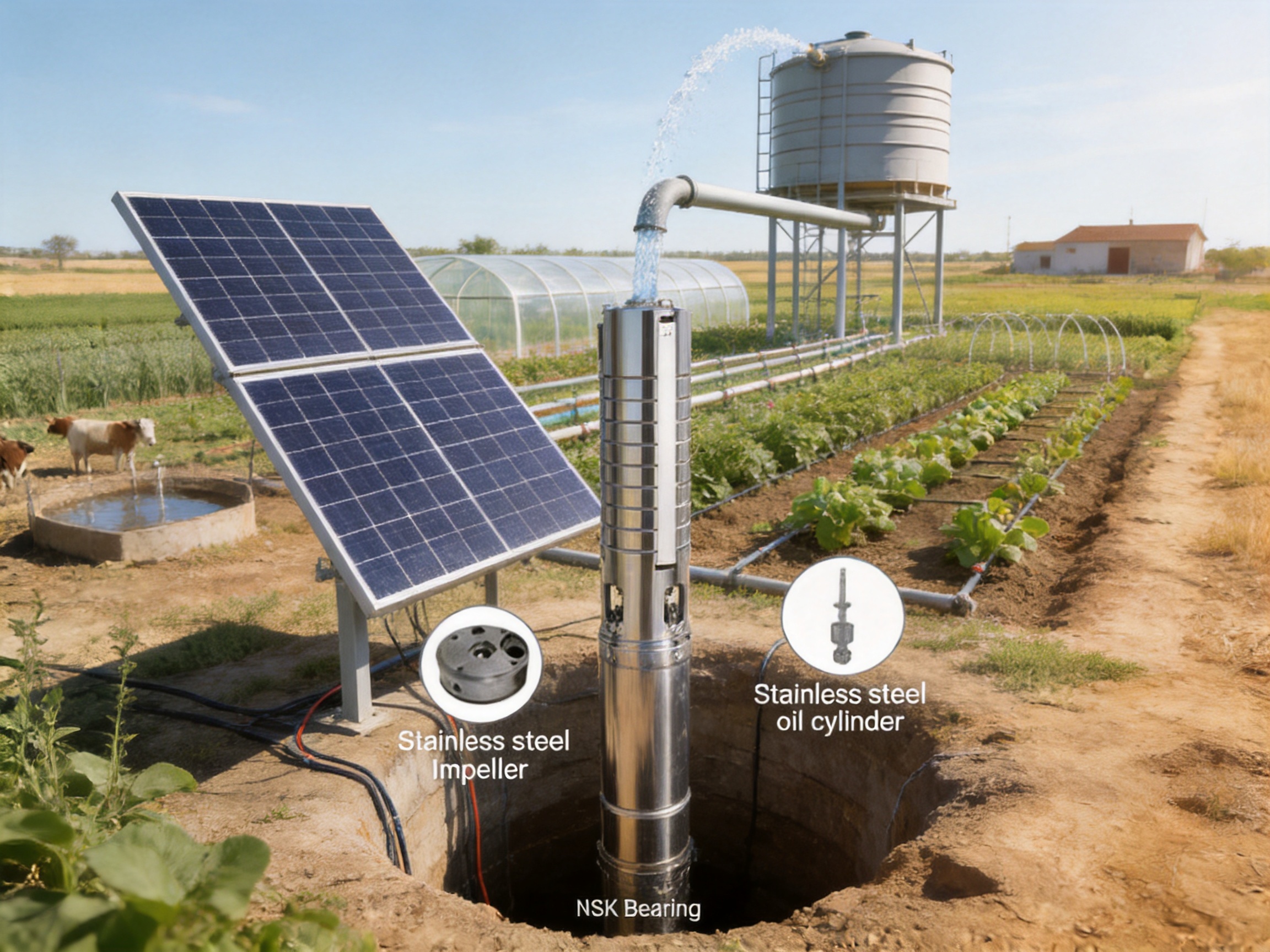
Agricultural irrigation is one of the most important applications for a solar submersible pump. The 4HVSCW can draw water from a deep well and deliver it to an irrigation network, elevated tank, or field distribution point. The wide-voltage motor allows the system to make productive use of available sunlight without depending on a stable utility supply.
For orchards, water can be stored in a tank during the day and distributed through drip or micro-sprinkler irrigation. For open fields, the pump can supply a larger reservoir or irrigation channel. The correct model depends on crop water demand, well depth, pipe routing, irrigation pressure, and the number of operating hours available each day.
Greenhouses require controlled and dependable water delivery. A solar pumping system can supply tanks, filters, fertigation equipment, and irrigation headers. The submersible design keeps the pump below the water surface and avoids occupying valuable space near the greenhouse.
Where precise irrigation scheduling is required, water storage can be combined with automated valves and a separate control system. The solar pump then focuses on replenishing the storage tank, while the irrigation system supplies plants according to the cultivation schedule.
Remote homes and small communities may need water for drinking, cooking, sanitation, and general household use. The 4HVSCW series can be used to lift water from a borehole into a storage tank or pressure system. A storage tank is often beneficial because it provides water after sunset and during temporary low-solar periods.
For drinking water projects, the pump itself is only one part of the complete solution. Water quality testing, filtration, disinfection, tank hygiene, and local public health requirements must be addressed separately. The pump should be selected for the required flow and head while the overall water treatment system is designed according to the source water conditions.
Livestock operations often need water in locations far from buildings and utility infrastructure. A solar submersible pump can supply troughs, tanks, or pasture distribution points. The pump may operate during daylight and fill a reserve tank that supports animals through the night.
For livestock systems, reliability and simple maintenance are especially important. A properly sized pump, protected solar array, secure cable installation, and accessible storage tank can help reduce service interruptions. Filters and sediment management should be considered when the water source contains sand or suspended particles.
The product is suitable for remote water projects where access to fuel, grid electricity, or regular technical service is limited. Examples may include construction camps, remote agricultural plots, environmental facilities, and temporary water supply installations.
Compared with fuel-powered pumping, solar operation can reduce fuel transport, engine noise, exhaust emissions, and routine engine servicing. The main operating energy comes from sunlight, which can help reduce long-term energy expenses when the solar array is correctly sized and maintained.
The performance data specifies solar panel power of at least 1.3 times the pump power. This means a 750W pump should be paired with a solar array of at least approximately 975W under the stated recommendation, while a 1500W pump should be paired with at least approximately 1950W of panel power. A 2200W pump should have a solar array of at least approximately 2860W.
The minimum ratio is a design reference rather than a guarantee of identical output throughout the day. Actual solar production depends on panel orientation, local irradiance, temperature, shading, dust, wiring losses, controller efficiency, and seasonal conditions. Project designers may select additional capacity when the system must meet a specific daily water volume.
The solar panel open-circuit voltage must remain below 430V. This requirement is critical when panels are connected in series because the voltage increases with each additional panel. Designers should calculate the maximum possible open-circuit voltage under the lowest expected panel temperature, not only the nominal voltage under standard test conditions.
Appropriate protection may include DC isolators, overcurrent protection, surge protection, grounding, cable glands, waterproof connectors, and a suitable solar pump controller where required. All high-voltage DC installations should be completed by qualified professionals because DC arcs can be difficult to interrupt and may present serious safety risks.
One of the practical advantages of water pumping is that water can often serve as the stored resource. Instead of using batteries to power the pump after sunset, the system can pump water into an elevated or ground-level tank during daylight. The stored water can then be used later.
This approach can reduce battery cost, battery replacement, and battery maintenance. It also avoids some energy losses associated with charging and discharging batteries. A battery-supported system may still be appropriate when pumping must continue at night or when the project requires constant pressure, but water storage is often a cost-effective option for irrigation and livestock applications.
The well must produce enough water to support the selected pump. If the pump extracts water faster than the well can recharge, the water level may fall and the pump may be exposed to unsuitable operating conditions. A professional well test should be considered before final pump selection.
The pump should be positioned according to the installation instructions and kept adequately submerged. The discharge pipe and safety cable must be properly supported. Electrical cables should be protected from abrasion, tension, sharp edges, and water ingress at all connection points.
Taizhou Edwin Electric Co., Ltd. was founded in 2008 and operates as an integrated manufacturing enterprise focused on independent research and development, mass production, and global export. This combination is important for a product such as the 4HVSCW because solar pumping requires coordination between motor engineering, hydraulic design, materials, electrical compatibility, and application support.
An integrated manufacturer can manage more of the product lifecycle internally. Product development can be connected with production planning, component procurement, assembly, inspection, packaging, and export logistics. This structure can help maintain consistency between the design specification and the manufactured product.
The company has invested in new energy and intelligent technology since 2018, including solar water pumps and intelligent booster pumps. The 4HVSCW series reflects this focus on adapting pump technology to renewable-energy applications.
Solar pumping requires more than simply replacing an AC motor with a DC motor. The pump must be matched to variable input conditions, energy availability, water storage strategies, and installation requirements. Development work must consider motor efficiency, thermal behavior, hydraulic output, component durability, and electrical operating limits.
Mass production capability supports supply continuity for distributors, contractors, and project developers. A manufacturer with established production experience can organize repeatable assembly procedures and support multiple model configurations within the same product family.
The 4HVSCW range includes different power ratings, outlet sizes, flow capacities, and head capabilities. Managing this product variety requires systematic component control and clear model identification. A structured manufacturing process helps reduce confusion between similar configurations and supports more reliable order fulfillment.
The use of stainless steel cylinders and impellers, water-filled motors, and NSK bearings demonstrates an emphasis on component selection for submerged service. Each part has a defined function: the stainless steel structure supports corrosion resistance, the water-filled motor supports underwater cooling, and the bearings support smooth rotation.
Quality is not determined by one component alone. Reliable pump production depends on correct machining, dimensional control, shaft alignment, seal installation, motor winding quality, electrical insulation, impeller balance, fastening, and final assembly. These elements must work together to produce stable performance in the field.
Through its related import and export companies, the group provides procurement planning, order tracking, cross-border delivery, and foreign trade services. This is valuable for international buyers who may need more than a pump alone. They may also require technical clarification, model matching, packaging coordination, shipping documentation, and delivery management.
The company’s pumps are used in new energy projects, agricultural irrigation, municipal engineering, mining, construction, HVAC systems, and household water supply. Exposure to different applications can help the manufacturer understand the varied requirements of distributors and engineering contractors.
Before installation, confirm the well diameter, water depth, well yield, expected flow, total dynamic head, discharge pipe size, solar array voltage, solar array power, and cable length. The selected model should operate near the project’s required duty point rather than being chosen solely by the maximum values printed in a specification sheet.
Inspect the pump, cable, outlet, fasteners, and protective components before lowering the unit into the well. The pump should be installed vertically unless a specific installation method has been approved. It should not rest directly on the bottom of the well, where sediment may enter the hydraulic system.
Use a suitable safety cable and support the discharge pipe according to the installation requirements. Do not suspend the entire pump weight from the electrical cable. Cable joints should be waterproof and mechanically protected, and all electrical work should comply with applicable local regulations.
During operation, observe flow, pressure, sound, vibration, solar voltage, and water level. A sudden reduction in flow may indicate a blocked intake, damaged pipe, insufficient solar power, a falling water level, or a hydraulic problem. Unusual noise or vibration should be investigated promptly.
Routine maintenance may include cleaning solar panels, checking electrical connections, inspecting support hardware, verifying tank and valve operation, and examining filters. The well should also be monitored for sand production, sediment accumulation, or changes in water quality.
Never operate the pump dry unless the specific control system and manufacturer’s instructions expressly permit that operating mode. Dry running can cause overheating, accelerated wear, and damage to internal components. A water-level sensor or suitable protection device may be used where the well level can change significantly.
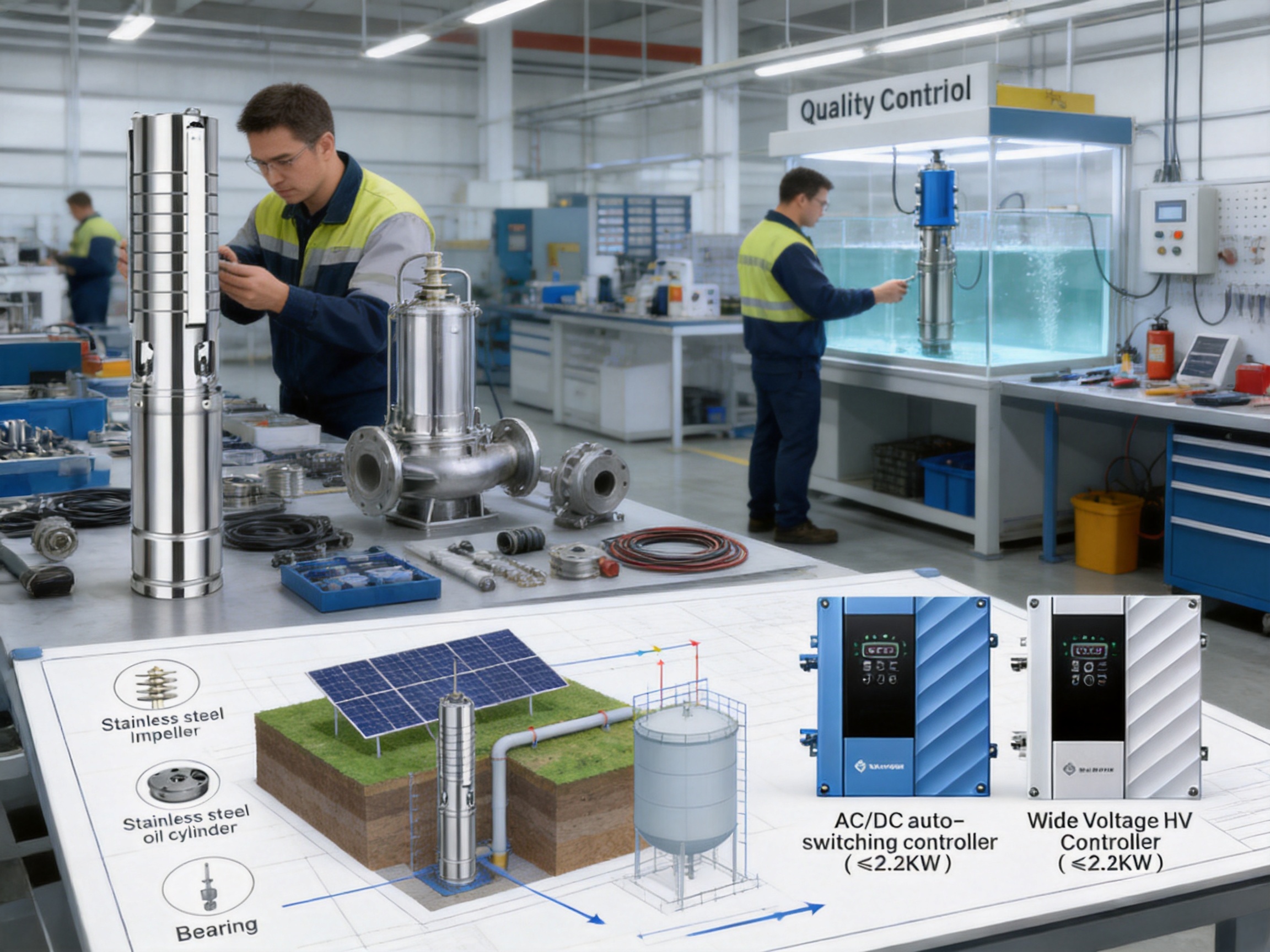
Begin with the required daily water volume. Estimate how much water is needed for household use, irrigation, livestock, or industrial service. Then determine how many hours per day the solar system is expected to pump. The required average flow can be estimated by dividing the daily water volume by the expected pumping time.
Next, calculate the total dynamic head. Include the vertical distance from the lowest operating water level to the delivery point, the required outlet pressure, and all friction losses. Compare this value with the pump curve rather than relying only on the listed maximum head. Maximum head normally corresponds to very low or zero flow, so it should not be treated as the expected flow at every installation.
After establishing flow and head, review the electrical requirements. Confirm that the solar array can supply the recommended power and remain within the 80V to 430V DC operating range. Check that the open-circuit voltage is below 430V under the coldest expected panel condition.
Finally, confirm the outlet connection, cable length, well diameter, water quality, and installation depth. Selecting a pump that matches all of these conditions will generally provide better performance and longer service life than selecting a pump only by its power rating.
Professional project buyers often need consistency, model variety, technical communication, and dependable supply. The 4HVSCW series addresses these requirements through a family of standardized configurations rather than a single general-purpose pump.
The wide-voltage DC architecture supports solar projects in different regions. The stainless steel construction supports submerged durability. The water-filled brushless motor is suitable for continuous underwater service when correctly installed. The range of flow and head options allows contractors to match equipment to different wells and delivery systems.
For distributors, the product family can serve multiple market segments, including residential water supply, small farms, livestock systems, greenhouse projects, and larger agricultural installations. For engineering contractors, the listed electrical and hydraulic data provides a foundation for system design, quotation, and model comparison.
The manufacturer’s experience in pump production, independent research and development, mass production, and export services further supports professional procurement. Buyers can discuss application conditions, model selection, solar panel requirements, and delivery planning with a supplier that focuses on a broad range of water-pumping solutions.
The 4HVSCW is a DC submersible solar pump with a 4-inch format. It uses a wide-voltage brushless DC water-filled motor and is designed for deep-well and submerged water supply applications.
The listed DC voltage range is 80V to 430V. The solar panel open-circuit voltage must remain below 430V. The complete solar array should be designed and protected by qualified personnel.
The pump is designed for solar and DC-powered environments. The final system may require a compatible controller or protection equipment depending on the project design. The panel voltage, power, switching, protection, and control arrangement must comply with the pump specifications and local electrical requirements.
The performance data specifies solar panel power of at least 1.3 times the pump power. For example, a 1500W pump should be paired with at least approximately 1950W of solar panel power. Actual sizing may need to be increased based on climate, shading, seasonal conditions, cable loss, and required daily water volume.
The highest listed maximum head is 255 meters for model 4HVSCW5.2-255-300-2200. The actual flow at a specific installation head must be confirmed from the performance curve and total system calculation.
The highest listed maximum flow is 30 m³/h for model 4HVSCW30-36-300-2200. This model has a listed maximum head of 36 meters and a 2-inch outlet. Actual output depends on the operating head and system resistance.
The water-filled motor is designed for submerged operation and allows the surrounding water to help dissipate motor heat. It supports a compact deep-well structure and is suitable for installation below the water surface when operated according to the manufacturer’s instructions.
The stainless steel cylinder and impeller provide corrosion resistance and mechanical durability in normal water environments. They are especially useful for equipment that remains submerged for long periods. Water chemistry and abrasive content should still be evaluated before final selection.
A battery is not necessarily required for daytime pumping if the solar array and control system are correctly designed. Many installations use a storage tank to store water during sunny periods. A battery may be considered when the system must pump at night or maintain a specific electrical operating schedule.
The pump can be used in a rural household or community water supply system, but drinking-water suitability depends on the complete installation. Water quality, filtration, disinfection, materials, local regulations, and hygienic tank design must all be assessed separately.
Maintenance should include checking solar panels, electrical connections, support cables, pipework, valves, filters, flow, and water level. The pump should be protected from dry running, excessive sand, unsuitable water chemistry, and electrical conditions outside its specified range.
Buyers should provide the required flow, total head, well diameter, static and dynamic water levels, water quality, outlet pipe size, expected daily operating time, location, solar resource, and preferred delivery requirements. This information helps the supplier recommend the correct model instead of selecting only by motor power.
The 4HVSCW Wide Voltage DC Water-Filled Stainless Steel Impeller Solar Submersible Pump is designed for dependable water delivery in deep wells and off-grid environments. Its key advantages include an 80V to 430V DC operating range, a brushless water-filled motor, stainless steel hydraulic components, NSK bearings, and a broad selection of flow and head configurations.
These features make the series suitable for solar irrigation, rural household supply, livestock watering, greenhouse projects, storage tank filling, and remote infrastructure. Compared with narrower-voltage or less corrosion-resistant alternatives, the product offers greater system flexibility, durable submerged construction, and reduced routine maintenance requirements.
The manufacturer strengthens the product offering through independent research and development, mass production, pump-industry experience, new-energy investment, and international export services. For professional buyers, this combination supports not only equipment selection but also project planning, procurement coordination, and long-term application support.
Correct sizing remains essential. The best performance will be achieved when the pump model, solar array, well yield, total dynamic head, pipework, protection equipment, and water storage strategy are designed as one complete system. When these factors are properly matched, the 4HVSCW series can provide an efficient and practical foundation for reliable solar-powered water supply.
1. Product performance data and technical information supplied for the 4HVSCW Wide Voltage DC Water-Filled Stainless Steel Impeller Solar Submersible Pump.
2. Manufacturer-provided company information concerning product development, manufacturing, export operations, and application sectors.
3. General engineering principles for solar photovoltaic system sizing, DC electrical protection, and renewable-energy water pumping.
4. General pump selection principles concerning total dynamic head, well yield, hydraulic losses, flow requirements, and storage-tank design.
5. General maintenance practices for submersible pumps, deep-well systems, solar arrays, electrical connections, and water distribution equipment.
edwina@edwin-pump.com
+86-13586290903 (WhatsApp)
Xuri Gongliang Cutting Tool Entrepreneurship Park, Wenqiao Town, Wenling City, Taizhou City, Zhejiang Province, China

High Performance Smart Pump Factory


 English