
edwina@edwin-pump.com

View All Products
en
Reliable water access is essential for agriculture, livestock production, rural households, construction sites, and remote infrastructure. In locations where grid electricity is unavailable, unstable, or expensive to extend, solar pumping provides a practical alternative. The 4ELR DC Motor Stainless Steel Plastic Impeller Solar Deep Well Pump is designed for precisely this type of application. It combines direct-current motor technology, photovoltaic power compatibility, a corrosion-resistant stainless steel body, and a lightweight plastic impeller in one compact submersible pumping solution.
Unlike conventional AC deep well pumps that normally depend on a stable electrical grid, the 4ELR series can operate from a properly configured solar panel system and MPPT controller. This enables water extraction from boreholes and deep wells without fuel consumption, routine generator operation, or dependence on long electrical cables. The result is a lower-energy water supply system that can be deployed in agricultural fields, remote pastures, rural communities, and renewable-energy projects.
The range is available in several voltage, power, flow, and head configurations. Depending on the selected model, maximum flow rates reach from 5 m³/h to 20 m³/h, while maximum head values range from 45 m to 110 m. Power ratings range from 550 W to 1,500 W. These options allow users, installers, distributors, and project engineers to select a pump based on well depth, required delivery rate, pipe arrangement, and available solar generation capacity.
More than a simple solar water pump, the 4ELR product represents a coordinated approach to efficient hydraulic design, durable materials, off-grid operation, and production scalability. Manufactured by Taizhou Edwin Electric Co., Ltd., the pump benefits from the company’s experience in deep well pumps, submersible pumps, booster pumps, circulation pumps, and other water-management products. The company’s integrated capabilities include independent research and development, mass production, quality-focused assembly, export coordination, and one-stop procurement support.
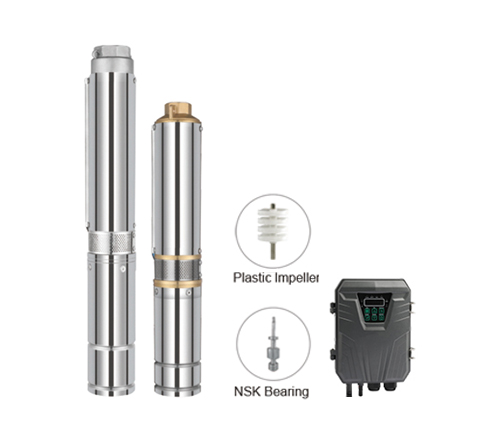
4ELR DC Motor Stainless Steel Plastic Impeller Solar Deep Well Pump
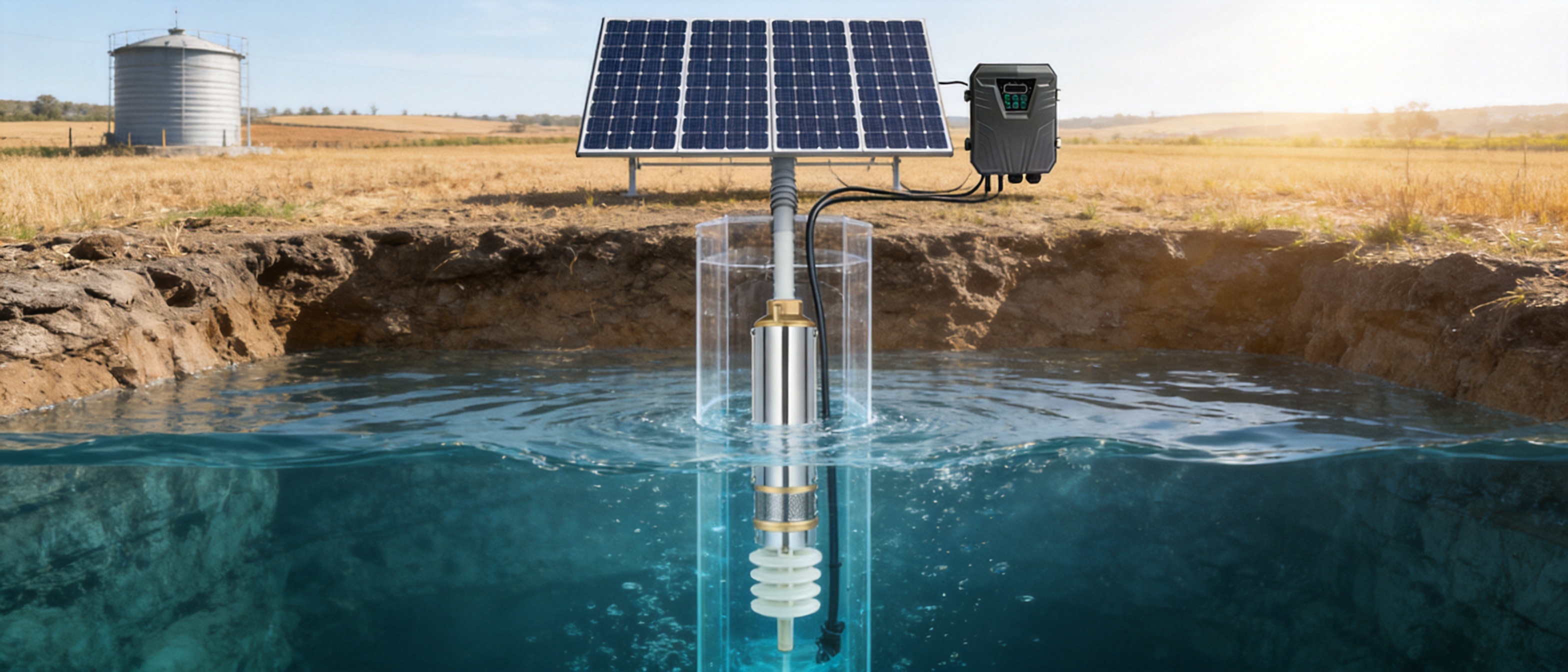
The 4ELR is a DC submersible solar pump intended for deep well and borehole water extraction. A submersible pump is installed below the water level, allowing the pump to push water upward through a discharge pipe rather than relying on surface suction. This configuration is particularly suitable for deep water sources because it minimizes the limitations associated with suction lift and helps maintain stable water delivery when the pump is correctly selected and installed.
The pump receives direct-current electrical power from a photovoltaic system. In a typical installation, solar panels are connected to a suitable MPPT controller or solar pump controller, which manages the variable output of the panels and supplies the pump with an appropriate operating voltage. The controller can help the system make better use of changing sunlight conditions, although the exact control functions depend on the selected controller and system configuration.
During periods of strong solar radiation, the panels provide the energy needed to drive the pump motor. Output can vary with sunlight intensity, panel temperature, shading, season, and system design. For that reason, the performance figures stated for the 4ELR series should be understood as maximum or rated selection values rather than guaranteed output under every field condition. Proper hydraulic sizing and solar array design are necessary to obtain the expected result.
The pump’s stainless steel body protects key components from rust and provides mechanical strength in demanding well environments. Inside the hydraulic section, the plastic impeller is designed to reduce weight and resist corrosion. The combination of stainless steel and engineered plastic provides a balance between durability, hydraulic efficiency, material cost, and ease of handling.
The 4ELR range includes models with 72 V and 110 V nominal voltage options. The 72 V versions generally operate within an optimum input range of 90 V to 120 V DC, while the 110 V versions generally operate within an optimum input range of 110 V to 150 V DC. Solar panel open-circuit voltage must remain below the specified limit: below 170 V for applicable 72 V models and below 220 V for applicable 110 V models.
The most important advantage of the 4ELR series is its compatibility with direct-current solar power systems. Traditional pumps often require AC electricity, an inverter, or a fuel-powered generator. Each additional conversion stage can introduce energy losses, equipment costs, and maintenance requirements. A DC pump can simplify the power architecture by using the output of a solar controller more directly.
This design is especially valuable in remote locations. Farms, ranches, off-grid homes, construction areas, and environmental monitoring sites may be far from utility infrastructure. Installing a solar array and DC pumping system can be more practical than extending a utility connection over a long distance. Once installed, the system can provide daytime water pumping without regular fuel purchases.
Solar operation also supports predictable long-term operating costs. Sunlight is free, while diesel, gasoline, and grid electricity are ongoing expenses. Although the initial cost of a complete solar pumping system includes panels, controller, cables, pipework, protection equipment, and installation, the reduction in fuel and electricity consumption can make the system attractive over its service life.
Water pump materials must withstand continuous exposure to moisture, pressure, minerals, and changing environmental conditions. The stainless steel construction of the 4ELR body provides corrosion resistance and physical protection. This is important in deep wells, where components may remain submerged for long periods and where replacement or retrieval can be time-consuming.
Compared with ordinary painted steel housings, stainless steel offers a stronger barrier against rust and surface deterioration. This can be particularly useful in outdoor agricultural systems, rural water projects, and installations where maintenance access is limited. The material also gives the pump a clean, professional appearance that suits commercial, residential, and infrastructure applications.
Material selection should always be matched to the water chemistry. Stainless steel provides strong general corrosion resistance, but extremely saline, acidic, or chemically aggressive water may require a detailed compatibility assessment. Water analysis is recommended for demanding applications, especially where the pump will operate continuously or where the cost of retrieval is high.
The impeller is one of the most important hydraulic components in a centrifugal pumping system. The 4ELR uses a plastic impeller designed to provide efficient water movement while maintaining corrosion resistance. Plastic is lighter than many metal alternatives, which can reduce rotating mass and help lower mechanical loading on the motor during operation.
A lightweight impeller can also support efficient transportation and installation. This is beneficial for remote projects where equipment must be moved manually or where installation crews need to handle several pumps and accessories. The corrosion-resistant characteristics of engineered plastic make the impeller suitable for many clean-water applications and help protect hydraulic performance over time.
The use of plastic does not mean that the hydraulic section is intended for abrasive slurry or heavily sand-laden water. Borehole conditions should be evaluated before installation. Excessive sand, grit, or suspended solids can accelerate wear in any pump, regardless of whether the impeller is plastic or metal. Proper well development, filtration, and installation depth are important for long-term reliability.
The 4ELR product family includes models designed for significant lifting requirements. Selected versions provide maximum head values up to 110 m. This makes the series suitable for deep well extraction and elevated delivery points, including storage tanks, irrigation systems, and rural distribution networks.
Head is not the same as well depth alone. Total dynamic head also includes vertical elevation, pipe friction, valves, bends, filters, and the pressure required at the discharge point. A pump that reaches a maximum head of 100 m may not deliver useful flow at that maximum value. Engineers should consult the actual performance curve and calculate the complete system head before selecting a model.
The range of flow options allows the user to prioritize either higher pressure or higher volume. Models with maximum flow values of 5 m³/h and 6 m³/h are suitable for applications requiring stronger lifting performance at comparatively lower flow. Other models offer 12 m³/h, 15 m³/h, 16 m³/h, or 20 m³/h for larger-volume water transfer where the required head is lower.
Solar pumping systems have fewer operating parts than fuel-powered systems. There is no engine oil, fuel filter, spark plug, exhaust system, or routine generator refueling. The 4ELR DC motor and submersible design can therefore reduce the number of regular maintenance tasks compared with a generator-driven alternative.
Reduced maintenance does not mean maintenance-free operation. Solar panels should be kept clean, electrical connections should be inspected, and the well should be monitored for sand or sediment. Controllers, protection devices, cables, pipework, and valves must also be checked periodically. Nevertheless, eliminating fuel handling and engine servicing can significantly simplify operation in rural or remote areas.
The 4ELR series is offered in a broad selection of configurations. Model names identify important performance characteristics, although the complete specification should always be verified against the product data and performance curve. For example, a model designation such as 4ELR7.5-100-110-1100 indicates a nominal maximum flow group of 7.5 m³/h, a maximum head group of 100 m, a 110 V version, and a 1,100 W power rating.
| Model | Voltage | Optimum Input Voltage | Power | Maximum Flow | Maximum Head | Outlet | Panel VOC Limit |
|---|---|---|---|---|---|---|---|
| 4ELR5-85-110-750 | 110 V DC | 110–150 V DC | 750 W | 5 m³/h | 85 m | 1.25 in | Below 220 V |
| 4ELR6-65-72-550 | 72 V DC | 90–120 V DC | 550 W | 6 m³/h | 65 m | 1.25 in | Below 170 V |
| 4ELR7.5-100-110-1100 | 110 V DC | 110–150 V DC | 1,100 W | 7.5 m³/h | 100 m | 2 in | Below 220 V |
| 4ELR7.5-110-110-1500 | 110 V DC | 110–150 V DC | 1,500 W | 7.5 m³/h | 110 m | 2 in | Below 220 V |
| 4ELR12-75-72-1100 | 72 V DC | 90–120 V DC | 1,100 W | 12 m³/h | 75 m | 2 in | Below 170 V |
| 4ELR12-100-110-1500 | 110 V DC | 110–150 V DC | 1,500 W | 12 m³/h | 100 m | 2 in | Below 220 V |
| 4ELR15-60-110-1100 | 110 V DC | 110–150 V DC | 1,100 W | 15 m³/h | 60 m | 2 in | Below 220 V |
| 4ELR16-70-110-1500 | 110 V DC | 110–150 V DC | 1,500 W | 16 m³/h | 70 m | 2 in | Below 220 V |
| 4ELR20-45-110-1500 | 110 V DC | 110–150 V DC | 1,500 W | 20 m³/h | 45 m | 2 in | Below 220 V |
The table presents representative models from the available range. Additional configurations include 4ELR7.5-65 models, 4ELR12-50 models, 4ELR15-45 models, and other combinations of voltage and power. Users should select the model according to the required duty point rather than choosing only by maximum flow or maximum head.
Maximum flow is the highest stated delivery value under suitable hydraulic conditions, normally at a relatively low head. Actual flow decreases as the total head increases. For irrigation, the required flow may be determined by the area, crop type, irrigation method, and watering schedule. Drip irrigation generally requires lower flow and more controlled pressure than flood irrigation or large-volume tank filling.
For livestock systems, daily water demand and peak demand should be considered. A pump may be selected to fill a storage tank during sunlight hours, allowing animals to access water throughout the day. This approach can reduce the need for the pump to operate continuously and can provide a buffer during periods of cloud cover.
Maximum head indicates the highest theoretical lifting capability under specified conditions, but it does not represent the normal operating point. At maximum head, the flow may approach zero. A practical design should identify the required flow at the actual total dynamic head. The performance curve supplied with the product should be used for final selection.
In a borehole installation, total head may include the distance from the dynamic water level to the outlet, the height of a storage tank, friction through the rising pipe, losses through valves, and the pressure needed by irrigation equipment. Seasonal changes in the water level should also be considered. A pump that appears suitable during the rainy season may be undersized during a dry season when the water level falls.
The 72 V models are designed for an optimum input range of 90 V to 120 V DC, with solar panel open-circuit voltage below 170 V. The 110 V models are designed for an optimum input range of 110 V to 150 V DC, with panel open-circuit voltage below 220 V. The solar array must be wired to provide the correct operating range without exceeding the open-circuit voltage limit.
Higher system voltage can help reduce current for a given power level, which may allow more efficient cable selection over longer distances. However, higher voltage also increases electrical safety requirements. Installers must follow applicable local standards, use suitable DC-rated isolators and protection devices, and prevent accidental contact with energized conductors.
The panel power recommendation in the supplied data is at least 1.3 times the pump power. For example, a 750 W pump should generally be paired with a solar panel array of at least approximately 975 W, subject to controller requirements, local solar conditions, and system design. In locations with frequent cloud cover or high seasonal variation, additional panel capacity may be considered by a qualified designer.
AC pumps are widely used and can provide excellent performance where a stable electrical supply is available. However, they may be less convenient in remote locations. An AC system may require a long utility connection, an inverter, or a generator. The 4ELR DC series is designed around the renewable energy source itself, reducing the need for unnecessary electrical conversion in a solar installation.
This can improve system simplicity and make solar pumping more accessible for farms, villages, and off-grid projects. It also reduces exposure to grid outages and rising electricity costs. Where water demand is primarily during daylight hours, direct solar pumping can be highly practical.
Fuel-powered pumps can operate at night and during poor weather, but they require continuous access to gasoline or diesel. Fuel transportation can be costly and difficult in isolated areas. Engine noise, emissions, vibration, oil changes, and mechanical servicing also increase the total operating burden.
The 4ELR solar pump produces no direct fuel emissions during operation and does not require engine oil or combustion maintenance. It is therefore more suitable for environmentally sensitive projects, agricultural sites near homes, and locations where noise must be minimized. A storage tank or hybrid power arrangement can be added when water is needed beyond available sunlight hours.
Some solar pumps are designed primarily for shallow wells, water transfer, or low-pressure irrigation. Their performance may not be sufficient for deep boreholes or elevated storage tanks. The 4ELR range offers models with head ratings up to 110 m, providing greater flexibility for installations that require substantial vertical lifting.
The availability of multiple flow groups also helps prevent the user from being forced into a one-size-fits-all solution. A small agricultural plot may use a lower-flow model, while a larger farm or commercial water project may require a 12 m³/h, 15 m³/h, 16 m³/h, or 20 m³/h configuration.
Some low-cost pumps rely heavily on ordinary steel or materials that may deteriorate rapidly in humid or submerged environments. The 4ELR stainless steel housing provides a stronger material solution for long-term exposure to water. Its plastic impeller adds corrosion resistance in the hydraulic area while keeping the rotating assembly comparatively lightweight.
Although purchase price is important, the complete life-cycle cost should include retrieval, replacement, downtime, labor, energy consumption, and lost agricultural production. A durable material configuration can provide greater value when the pump is installed in a deep or difficult-to-access well.
Taizhou Edwin Electric Co., Ltd., operating as Edwin Pump, was founded in 2008. The company operates as an integrated manufacturing enterprise with capabilities covering independent research and development, mass production, and global export. This combination is important for international buyers because it connects product design, factory production, order management, and after-sales coordination within an established industrial organization.
The company’s core product lines include deep well pumps, submersible pumps, domestic booster pumps, circulation pumps, solar water pumps, and intelligent booster pumps. This broad product portfolio gives the manufacturer practical experience across different water systems. Knowledge gained from submersible pumping, pressure boosting, circulation, and solar applications can support better product matching for complete water projects.
Independent research and development enables a manufacturer to adapt products to changing market requirements instead of relying entirely on external designs. The 4ELR series reflects the company’s focus on combining DC motor efficiency, solar compatibility, material durability, and practical installation requirements.
Research and development in solar pumping involves more than selecting a motor. It requires attention to hydraulic performance, voltage variation, controller compatibility, thermal behavior, cable requirements, sealing, corrosion resistance, and field serviceability. A manufacturer that develops multiple models across different flow and head ranges can support a wider range of project conditions.
Mass production supports consistency, delivery capacity, and repeatable product quality. For distributors and project contractors, this is especially important when several pumps with the same specifications are required. A factory with established production processes can organize component sourcing, assembly, inspection, packaging, and shipment in a more controlled manner than a small workshop producing individual units.
Standardized model families also simplify inventory management. The 4ELR range uses recognizable model designations that communicate major performance characteristics. This can help distributors organize product catalogs and help project teams compare options during procurement.
To support diverse purchasing needs, the company established Taizhou Haipai Import & Export Co., Ltd. and Golden Falcon Industrial Co., Ltd. in 2012. These related operations provide procurement planning, order tracking, cross-border delivery, and foreign trade services. For overseas customers, these capabilities can be as important as the product itself.
International pump orders often require communication about voltage, outlet size, cable length, packaging, documentation, shipping schedules, and local installation conditions. A professional export team helps coordinate these details and reduces the risk of misunderstanding between the factory, distributor, freight provider, and end user.
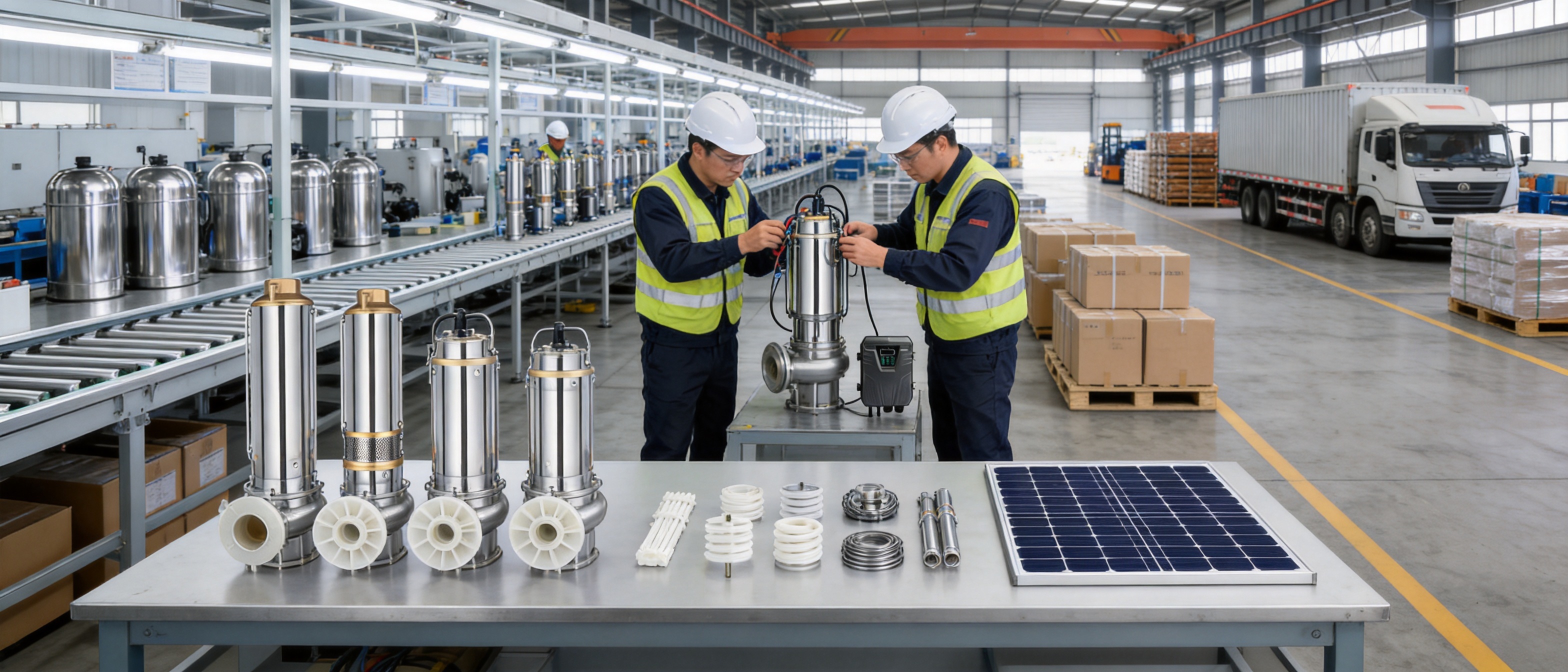
The manufacture of a submersible solar pump involves several controlled stages. Material preparation begins with stainless steel body components, plastic hydraulic parts, electrical components, seals, cables, fasteners, and motor-related assemblies. Each component must be compatible with the intended operating environment and assembled according to the product design.
Hydraulic components must be fitted accurately so that the impeller rotates correctly and maintains the intended water passage. Motor assembly requires attention to winding, insulation, rotor and stator alignment, bearing support, and sealing. Cable connections must be protected against moisture ingress because submersible equipment operates in a continuously wet environment.
After assembly, products can be checked for appearance, electrical continuity, insulation performance, rotation, sealing integrity, and hydraulic operation. Performance testing is especially important because the pump must provide an appropriate relationship between flow, head, power, and voltage. A controlled factory process helps identify problems before products are packaged for delivery.
It is important for buyers to request the specific inspection and certification documentation required in their market. Requirements can vary according to country, installation type, voltage level, and application. Edwin Pump’s manufacturing and export structure provides a foundation for coordinating such documentation and project requirements.
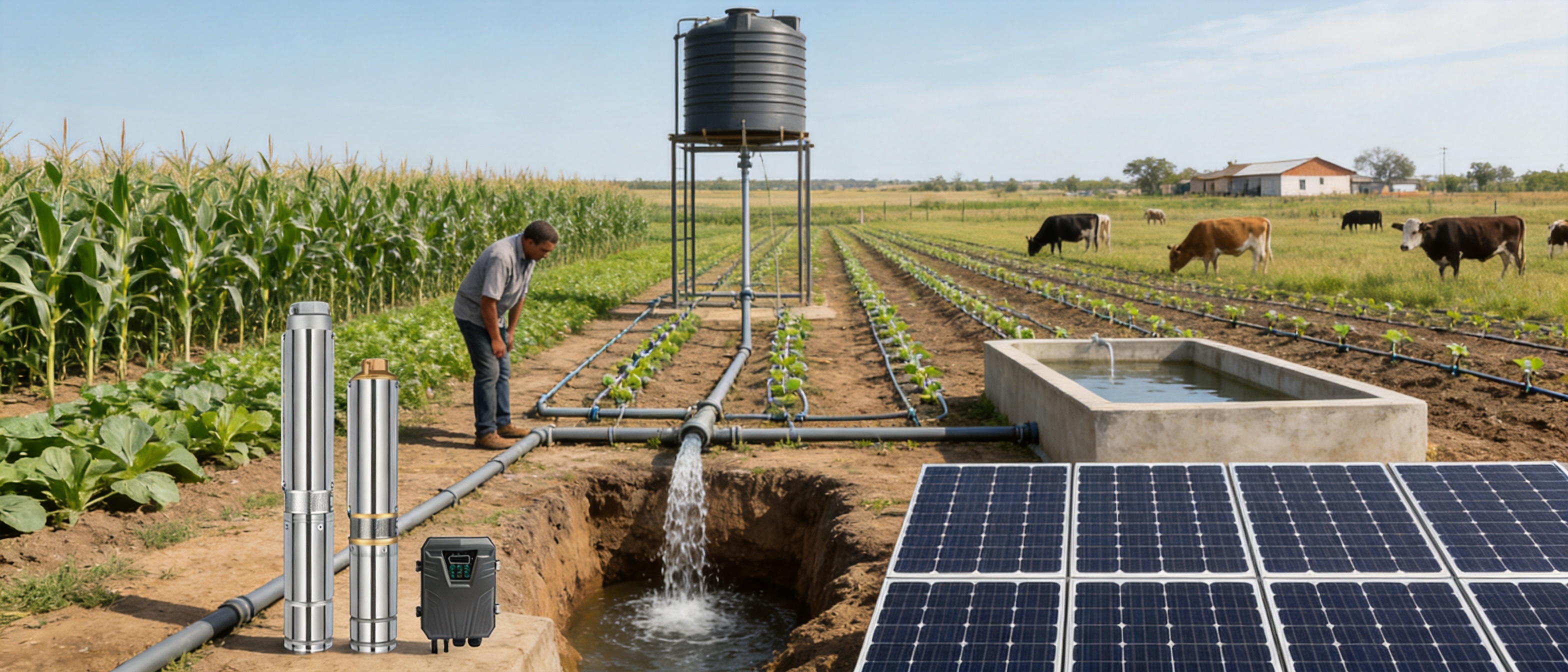
Agriculture is one of the most important applications for solar deep well pumps. The 4ELR can draw water from a borehole and deliver it to drip irrigation lines, sprinklers, storage tanks, or greenhouse systems. Solar generation often aligns naturally with irrigation demand because crops commonly need water during daylight hours.
For drip irrigation, the pump should be selected according to the required pressure and filtration arrangement. A storage tank may be used to separate pumping from irrigation distribution. This allows the pump to operate during strong sunlight while irrigation continues according to a controlled schedule.
For larger fields, the 12 m³/h, 15 m³/h, 16 m³/h, and 20 m³/h models may be considered when the required head is within the selected model’s operating range. The final selection must account for pipe diameter, field elevation, filtration, valves, and the number of irrigation zones.
Greenhouses and plant nurseries require dependable water distribution and often benefit from clean, controllable pumping. A solar-powered submersible pump can supply a tank or pressurized irrigation network without occupying valuable greenhouse floor space. The stainless steel body is suitable for humid environments, while the compact design supports flexible installation.
Because greenhouse systems may use fine emitters, adequate filtration is essential. The pump itself should not be expected to remove sediment from the water source. A well-designed system may include a sediment filter, pressure regulator, non-return valve, storage tank, and automatic irrigation controller.
Remote livestock farms and ranches often need water at locations far from buildings and utility connections. A solar pump can transfer well water to elevated tanks or troughs, reducing the need to transport water manually. The pump’s off-grid capability is useful for pastures, cattle stations, sheep farms, and other distributed animal-watering systems.
Storage capacity is important in livestock applications. It allows the system to continue supplying animals when sunlight is temporarily reduced. The tank should be sized according to herd size, climate, daily consumption, and the expected duration of cloudy weather.
The 4ELR series can support rural homes and small communities where a borehole is the primary water source. Water may be pumped to a rooftop tank, ground-level reservoir, or pressure system. The pump can provide a sustainable source of water for household use, provided that water quality treatment is designed separately where necessary.
For domestic applications, the system should include appropriate dry-run protection, overcurrent protection, tank-level control, and water treatment. The pump is a water delivery device and should not be considered a purification system. If the source contains bacteria, excessive minerals, or other contaminants, filtration and disinfection equipment may be required.
Community water projects, humanitarian installations, environmental facilities, and renewable-energy demonstration systems can benefit from a standardized solar borehole pump family. The range of voltage and flow options allows engineers to match the pump to available solar arrays and local water requirements.
For projects involving multiple sites, using a consistent product family can simplify training, spare parts planning, maintenance procedures, and procurement. Edwin Pump’s broader product portfolio and export support can also help customers coordinate pumps, accessories, and related equipment for larger projects.
Construction sites may require water for dust suppression, concrete work, cleaning, and worker facilities. In remote locations, a solar pump can provide a temporary or semi-permanent water source without installing a full grid connection. The system can be relocated or integrated into a site water plan as construction progresses.
A successful installation begins with accurate site information. Before choosing a pump, determine the static water level, dynamic water level, borehole depth, well yield, required daily water volume, delivery elevation, pipe length, outlet pressure, and expected sunlight conditions. These details determine whether the pump can deliver the required water at the required time.
The supplied data recommends solar panel power of at least 1.3 times the pump power. This means a 550 W pump should have at least approximately 715 W of panel capacity, while a 1,500 W pump should have at least approximately 1,950 W. These are basic minimum recommendations and do not replace a complete solar design.
Panel power should also reflect local solar irradiation, seasonal conditions, panel orientation, dust, temperature, shading, controller losses, and cable losses. A system designed only around laboratory conditions may produce disappointing results in the field. Professional designers may increase array capacity to improve daily water production during weak sunlight periods.
The solar array must be configured so that the operating voltage is suitable for the pump and controller. The open-circuit voltage must stay below the stated limit, even during low-temperature conditions when panel voltage may rise. Exceeding the permitted voltage can damage the controller or motor and may create a serious electrical hazard.
For 72 V models, the recommended optimum input range is 90 V to 120 V DC and the solar panel open-circuit voltage should remain below 170 V. For 110 V models, the optimum input range is 110 V to 150 V DC and the open-circuit voltage should remain below 220 V.
The pump should be installed below the dynamic water level but not placed directly on the bottom of the well. Keeping suitable clearance from the bottom helps reduce the intake of sand and sediment. The installer should also confirm that the well yield is sufficient to prevent the water level from falling below the pump intake during operation.
A strong safety rope or suitable suspension arrangement should be used. The electrical cable should not carry the weight of the pump. The discharge pipe should be properly supported, and all joints should be checked for leakage before commissioning.
A solar pump controller or MPPT controller should be selected to match the pump voltage, power, current, and control requirements. Protective functions may include overvoltage, undervoltage, overload, overtemperature, dry-run, reverse-polarity, and short-circuit protection, depending on the controller model.
Additional field equipment may include DC isolators, fuses or circuit breakers, surge protection, grounding, water-level sensors, tank float switches, non-return valves, pressure gauges, and flow meters. The exact arrangement depends on the project and local electrical regulations.
Installers should follow all applicable safety standards. High-voltage DC from solar arrays can remain dangerous even when the pump is not running. Wiring work should be performed by qualified personnel using properly rated connectors, enclosures, cable glands, and protective devices.
One of the advantages of a submersible solar pump is the limited number of routine mechanical service tasks. However, preventive inspection remains essential. The solar panels should be cleaned when dust, bird deposits, or agricultural residue reduces light transmission. Panel mounting structures should be checked for corrosion and mechanical looseness.
Electrical connections should be inspected for heat damage, moisture, oxidation, and loose terminals. The controller should be kept dry and ventilated. Cable insulation should be examined, especially at points where the cable enters a wellhead, junction box, or protective conduit.
The well should be monitored for changes in water quality, sand content, and recovery rate. A sudden reduction in flow may be caused by a falling water level, blocked pipe, damaged cable, controller fault, impeller wear, or increased sediment. Early diagnosis can prevent more serious damage and reduce downtime.
Where the pump operates in areas with sediment, a well-development program and periodic inspection may be necessary. The use of an appropriate screen or filtration arrangement can help reduce the entry of solids. The pump should not be operated outside its intended hydraulic conditions or used to handle abrasive materials unless the manufacturer has confirmed suitability.
In cold climates, exposed pipework should be protected against freezing. In areas subject to lightning, surge protection and proper grounding are strongly recommended. Harsh weather, poor wiring, and unprotected controllers can reduce the reliability of an otherwise durable pump system.
The 4ELR series offers several benefits for wholesale buyers, engineering contractors, and pump distributors. Its range of model configurations supports different markets without requiring an entirely different product family for every project. The recognizable model structure also makes it easier to organize quotations and technical comparisons.
The product’s stainless steel construction, solar compatibility, and multiple performance levels provide clear selling points in markets where customers are seeking energy independence. Distributors can position the pump for agriculture, livestock, rural water supply, renewable-energy projects, and small commercial installations.
For project buyers, the manufacturer’s broader product range can support one-stop procurement. In addition to solar deep well pumps, Edwin Pump supplies deep well pumps, submersible pumps, domestic booster pumps, circulation pumps, intelligent booster pumps, pump accessories, pipes, valves, and other related products. This can reduce the need to coordinate with multiple unrelated suppliers.
International supply also requires dependable communication. The company’s export-related organizations provide procurement planning, order tracking, cross-border delivery, and foreign trade coordination. These services can be valuable when projects involve multiple models, staged shipments, customized packaging, or delivery to different destinations.
Solar pumping combines electrical, mechanical, hydraulic, and environmental requirements. A factory experienced only in one type of pump may not have the same understanding of complete off-grid system conditions. A manufacturer with product experience across solar pumps, submersible pumps, booster pumps, and circulation pumps can approach development from several technical perspectives.
Factory experience also influences component consistency. Motors, impellers, seals, stainless steel housings, cables, and controllers must function as a coordinated system. Standardized assembly procedures, inspection routines, and supplier management help reduce variation between batches.
Edwin Pump’s development in new energy and intelligent technology since 2018 demonstrates a strategic focus on modern pumping solutions. Solar water pumps and intelligent booster pumps extend the company’s capabilities beyond traditional water-moving equipment. This direction is relevant to customers who are planning energy-efficient water infrastructure rather than purchasing isolated mechanical products.
The company’s history since 2008 also provides a foundation for understanding international market expectations. Global customers may require different voltage standards, documentation, packaging specifications, product labels, shipping arrangements, and technical support. A manufacturer familiar with export operations can better coordinate these requirements from quotation through delivery.
Suppose a rural water project requires water to be lifted from a deep borehole to a tank located on elevated ground. The desired flow is moderate, but the total head is high. A model in the 5 m³/h, 6 m³/h, or 7.5 m³/h class may be more appropriate than a high-flow model designed for lower head.
The engineer should calculate the complete dynamic head and then compare that point with the performance curve. If the operating point is too close to the maximum head, a higher-head model should be chosen to provide a reasonable margin.
A farm filling a large storage reservoir may prioritize volume over extreme lifting height. If the total dynamic head is approximately 45 m, a 4ELR20-45-110-1500 model may be considered because its maximum flow group reaches 20 m³/h. The final flow will depend on the actual system resistance and solar power available.
Large-volume applications should use suitably sized pipework. A pipe that is too small can create high friction losses and prevent the pump from achieving its expected output. Valve selection and tank inlet design should also be considered to avoid unnecessary restrictions.
For livestock, a moderate-flow pump may fill an elevated tank during the day. The tank then supplies troughs by gravity or through a separate booster system. This arrangement reduces the need for continuous pump operation and provides water reserve during short periods of weak sunlight.
The system should include a reliable tank-level control method. A float switch or water-level sensor can stop the pump when the tank is full and prevent unnecessary operation. Dry-run protection should be included where the borehole yield may vary.
The 4ELR is a DC submersible solar deep well pump. It is designed for installation in boreholes and deep wells and is powered by a suitable direct-current solar system.
Yes. The pump is designed for solar-powered operation and can work in an off-grid installation when connected to correctly sized photovoltaic panels and a compatible MPPT or solar pump controller.
The range includes 72 V and 110 V versions. The 72 V models generally use an optimum input range of 90 V to 120 V DC, while the 110 V models generally use 110 V to 150 V DC.
Depending on the selected model, the stated maximum flow ranges from 5 m³/h to 20 m³/h. Actual flow depends on total dynamic head, pipe friction, solar power, water level, and system configuration.
The listed models provide maximum head values from 45 m to 110 m. The correct model must be selected using the required operating flow and total dynamic head rather than maximum head alone.
The supplied product data recommends solar panel power of at least 1.3 times the pump power. A complete design may require additional capacity depending on weather, location, temperature, system losses, and daily water demand.
The stainless steel body provides strength and resistance to rust and moisture. It is suitable for many outdoor and submerged applications, although unusually aggressive water chemistry should be assessed before installation.
The plastic impeller is lightweight and corrosion-resistant. It is designed to support efficient hydraulic performance while reducing corrosion concerns in the water-moving section. The pump should be protected from excessive sand and abrasive solids.
The pump can support rural or domestic water systems, but drinking-water suitability depends on the complete installation, water chemistry, materials, local regulations, and required treatment. The pump itself does not purify water.
A direct solar system normally pumps when sufficient sunlight is available. Night operation requires an additional energy source, such as batteries, a grid connection, or a hybrid system. In many applications, daytime pumping to a storage tank is a more economical solution.
Routine maintenance is generally simpler than for a fuel-powered pump, but the solar array, controller, electrical connections, well condition, pipework, valves, and water level should still be inspected periodically.
Buyers should confirm required flow, total dynamic head, well diameter, dynamic water level, water quality, voltage, solar panel arrangement, outlet size, cable length, controller compatibility, and delivery requirements.
The pump is intended for suitable water sources, not uncontrolled abrasive slurry. Excessive sand can wear hydraulic components and reduce service life. Well development and appropriate filtration or screening should be considered.
The product is manufactured by Taizhou Edwin Electric Co., Ltd., also known as Edwin Pump. The company specializes in water pumps, including deep well pumps, submersible pumps, solar water pumps, booster pumps, and circulation pumps.
The 4ELR DC Motor Stainless Steel Plastic Impeller Solar Deep Well Pump is a practical solution for reliable water delivery where energy efficiency, corrosion resistance, and off-grid operation are important. Its DC motor is suited to photovoltaic systems, while the stainless steel body supports long-term outdoor and submerged use. The plastic impeller provides a lightweight and corrosion-resistant hydraulic design that contributes to efficient operation and easier handling.
With models ranging from 550 W to 1,500 W, maximum flow groups from 5 m³/h to 20 m³/h, and maximum head ratings from 45 m to 110 m, the series provides flexibility for agricultural irrigation, livestock watering, rural domestic supply, borehole projects, storage tank filling, and renewable-energy water systems.
Its advantages over conventional competitors are most evident in remote applications. The pump reduces dependence on grid electricity and fuel, simplifies routine operation, supports clean solar energy, and offers a durable material configuration. Compared with basic low-head solar pumps, the 4ELR range provides stronger deep-well capability and a wider choice of flow and head combinations.
The product is also supported by the manufacturing strengths of Taizhou Edwin Electric Co., Ltd. Since 2008, the company has developed an integrated structure covering research and development, mass production, product diversification, export coordination, and one-stop procurement services. Its investment in solar and intelligent pumping technology further supports its position as a supplier of modern water-management equipment.
For the best result, users should treat pump selection and solar system design as one integrated engineering task. Correct sizing, suitable controller selection, proper voltage protection, adequate solar capacity, clean water conditions, and professional installation are essential. When these requirements are met, the 4ELR series can provide dependable and energy-conscious water pumping for a wide range of agricultural, residential, commercial, and environmental applications.
1. Taizhou Edwin Electric Co., Ltd. Product specification and performance data for the 4ELR DC Motor Stainless Steel Plastic Impeller Solar Deep Well Pump.
2. Taizhou Edwin Electric Co., Ltd. Company information and product portfolio documentation.
3. General principles of centrifugal pump selection, total dynamic head calculation, and hydraulic system design.
4. General photovoltaic system design practices for DC water pumping applications.
5. General installation and maintenance principles for submersible pumps, borehole systems, and solar-electric equipment.
serieswatershortageprotectionvoltagestabilizationstainlesssteelverticalmultistagepump.jpg "EVR(S) Series Water Shortage Protection Voltage Stabilization Stainless Steel Vertical Multistage Pump")
edwina@edwin-pump.com
+86-13586290903 (WhatsApp)
Xuri Gongliang Cutting Tool Entrepreneurship Park, Wenqiao Town, Wenling City, Taizhou City, Zhejiang Province, China

High Performance Smart Pump Factory


 English
