
edwina@edwin-pump.com

View All Products
en
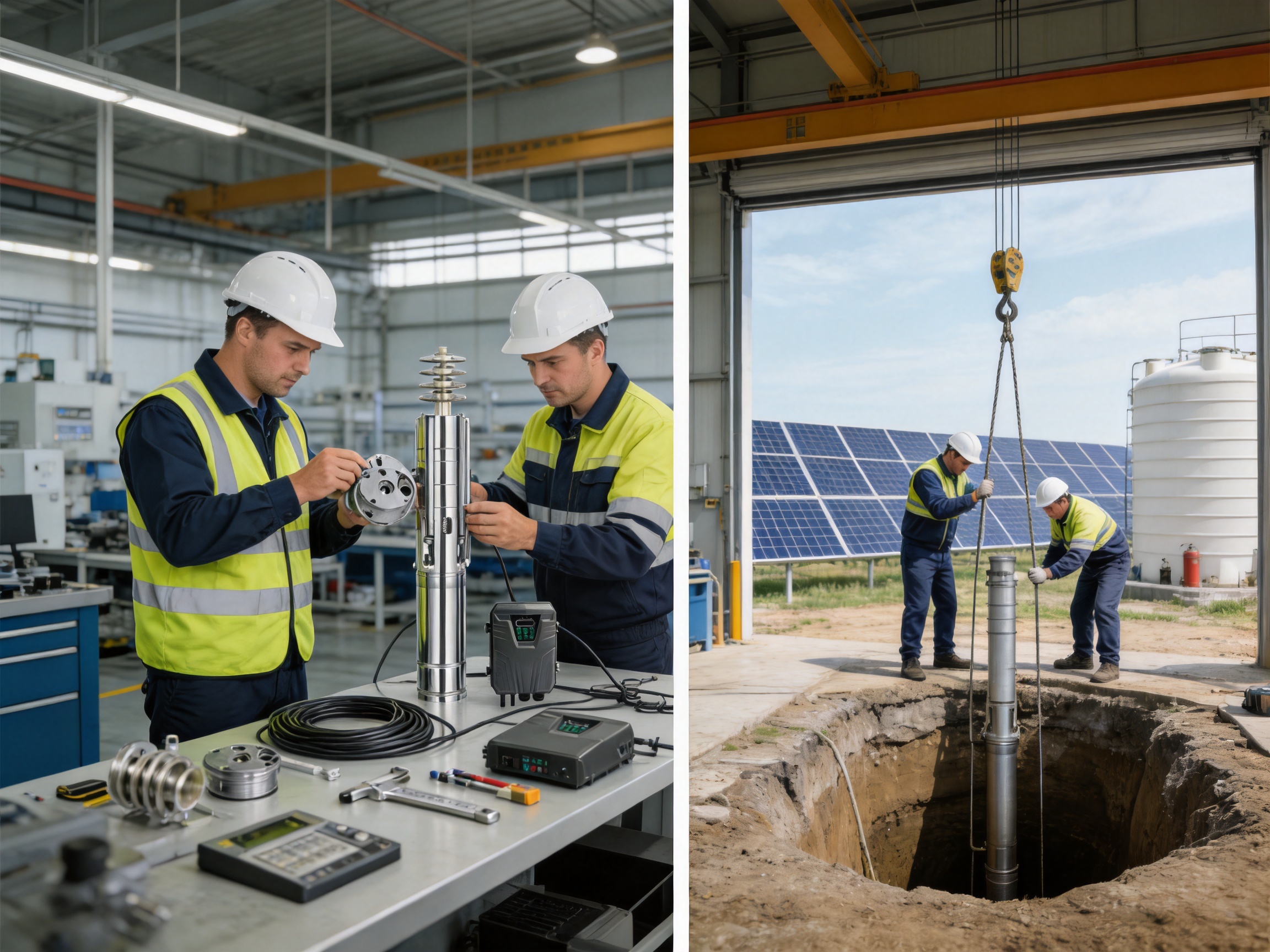
Reliable access to water is one of the most important requirements in agricultural production, livestock management, rural development, and remote infrastructure. In locations without dependable grid electricity, a solar-powered pumping system can provide a practical and sustainable alternative. The 4ESC and 4/6ESC DC Powered Stainless Steel Impeller Solar Deep Well Pump is designed for precisely this purpose: lifting water from deep wells and transferring it to irrigation networks, storage tanks, household systems, and livestock watering points by using solar or battery-generated direct current.
This pump series combines a DC-powered drive system, a corrosion-resistant stainless steel impeller, compact construction, and multiple flow-and-head configurations. Its available models range from 9.5 cubic meters per hour to 36 cubic meters per hour, with maximum heads from 19 meters to 90 meters. This broad performance range allows system designers, installers, farmers, and project developers to select a configuration that matches the required water volume and elevation.
Manufactured by Taizhou Edwin Electric Co., Ltd., the product reflects the company’s long-term focus on pump research and development, mass production, quality control, and international supply. Edwin Pump has operated since 2008 and has developed product lines covering deep well pumps, submersible pumps, domestic booster pumps, circulation pumps, solar water pumps, and intelligent booster pumps. Its manufacturing and export experience supports the needs of customers seeking a complete and dependable water-pumping solution rather than an isolated pump component.
A deep well pump must overcome more than the physical depth of a well. It must also overcome friction losses in the pipe, changes in ground elevation, pressure requirements at the discharge point, and variations in solar power availability. Selecting the correct pump therefore requires a balance between flow rate, head, electrical input, installation conditions, and expected daily water demand.
Traditional well-pumping systems often depend on grid electricity or fuel-powered generators. Grid power may not be available in remote areas, while generators require fuel transportation, regular maintenance, and continuous operating supervision. Solar pumping reduces dependence on these external inputs by converting sunlight into electrical energy for the pump motor. When combined with a storage tank, the system can deliver water when it is needed, even when the pump is not operating.
The 4ESC and 4/6ESC series is intended for applications in which a direct-current pump can be integrated with solar panels, a suitable controller, or a battery-supported power system. This approach is particularly useful for farms, orchards, greenhouses, pastureland, rural homes, remote communities, and small infrastructure projects where energy independence is important.
Unlike a general-purpose surface pump, a submersible deep well pump is installed inside the water source. This allows it to push water upward through the delivery pipe instead of relying on surface suction. Submersible installation can reduce suction-related limitations and is especially appropriate for wells where the water level is significantly below ground level.
The product is a DC-powered solar deep well pump with a stainless steel impeller. The 4ESC models are generally associated with 4-inch pump configurations, while the 4/6ESC models provide larger-capacity options suitable for higher flow requirements and larger discharge arrangements. The product data includes models with 2-inch and 3-inch outlets, 72V and 110V nominal voltage options, and power ratings from 750W to 1500W.
Its main operating characteristics include the following:
• Direct-current operation for solar and battery-powered systems.
• Stainless steel impeller construction for corrosion resistance and long service life.
• Brushless DC motor technology designed for efficient operation and reduced energy consumption.
• Maximum flow rates from 9.5 m³/h to 36 m³/h, depending on the selected model.
• Maximum heads from 19 m to 90 m, depending on the selected model.
• 2-inch and 3-inch outlet configurations.
• 2-meter cable supplied according to the listed performance data.
• Solar array recommendations based on a minimum solar-panel power of 1.3 times the pump power.
• Solar panel open-circuit voltage limits below 170V for 72V models and below 220V for 110V models.
These specifications make the range suitable for both moderate-head and higher-head water systems. A low-head, high-flow configuration may be selected for water transfer or irrigation distribution, while a higher-head version can be used for deeper wells or elevated storage tanks.
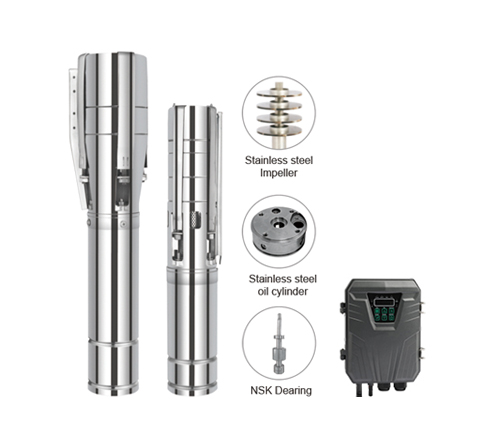
4ESC & 4/6ESC DC Powered Stainless Steel Impeller Solar Deep Well Pump
The most important advantage of this product is its compatibility with direct-current power sources. Solar panels generate DC electricity, and batteries also store and deliver DC electricity. A DC pump can therefore be integrated naturally into an off-grid system without requiring unnecessary conversion between DC and alternating current.
Reducing the number of energy conversions can simplify system design and help avoid additional conversion losses. In a remote application, fewer components may also mean fewer potential failure points. The final design still requires a correctly matched controller and appropriate electrical protection, but the basic power relationship between the solar array, battery system, and pump is straightforward.
Direct-current operation is especially valuable for rural water supply projects. A farm may be located several kilometers from the nearest electrical connection, or a livestock watering point may be situated far from existing infrastructure. In such situations, installing a dedicated grid connection can be expensive and slow. A solar-powered DC pump offers a flexible alternative that can be expanded or relocated as the water requirement changes.
The impeller is one of the most important internal components in a centrifugal or multistage pumping system. It transfers energy from the motor to the water and operates continuously in contact with the pumped medium. The stainless steel impeller used in the 4ESC and 4/6ESC series is designed to resist corrosion and provide durable operation in normal clean-water deep well applications.
Stainless steel construction offers several advantages over less corrosion-resistant materials. It can provide better resistance to oxidation, help maintain the shape of the impeller passages, and support stable hydraulic performance over time. This is useful in wells where water quality may vary or where the pump will be exposed to moisture during long periods of operation.
Material selection must always be evaluated against the actual water chemistry. The product should be used in accordance with the manufacturer’s operating recommendations, and water containing excessive sand, aggressive chemicals, or unusual mineral concentrations may require additional evaluation. Nevertheless, the stainless steel impeller provides a strong foundation for durability and is a significant product advantage for general deep well water applications.
The product description identifies a brushless DC motor design. Brushless motors eliminate the mechanical brushes used in conventional brushed motors. This can reduce brush wear, limit maintenance requirements, and support stable long-term operation when the system is correctly installed and protected.
Energy efficiency is particularly important in solar applications because the available power changes throughout the day. A pump that uses energy efficiently can produce more useful water from the same solar array. This can reduce the required panel capacity, lower the total system footprint, or allow the pump to continue operating during periods of weaker sunlight.
The motor is also designed for quiet and stable pumping. Low vibration and reduced noise are beneficial in residential areas, near livestock facilities, and in agricultural environments where the equipment may operate for many hours. Less vibration can also support the long-term reliability of pipe connections, mounting arrangements, and electrical cable installations.
Water systems rarely have identical requirements. One project may need a high head to fill a tank positioned on a hill, while another may need a high flow rate to distribute water across a relatively level field. The 4ESC and 4/6ESC range addresses this variation with multiple combinations of flow, head, voltage, and power.
For example, the 4ESC9.5 series includes configurations with maximum heads of 50m, 75m, and 90m. The 4ESC15 series includes versions with maximum heads of 45m and 55m. Other models offer maximum flows of 16m³/h, 20m³/h, and 25m³/h. The 4/6ESC range extends the flow options to 30m³/h and 36m³/h.
This product breadth provides an advantage over a single-model pump range. Instead of adapting the entire water system to one fixed pump, the installer can begin with the hydraulic requirement and select a closer match. Proper matching can help reduce oversizing, unnecessary power consumption, excessive throttling, and insufficient water delivery.
Deep wells often have limited internal diameter. Pump equipment must fit inside the casing while leaving enough space for safe installation and water flow. The compact construction of the 4ESC and 4/6ESC series is intended to support installation in confined well environments.
A compact pump can simplify lowering and removal procedures, provided the well casing, pipework, cable, and support system are properly prepared. The pump should be installed with an appropriate discharge pipe, secure cable support, and protection against mechanical damage. The 2-meter cable length listed in the performance data should be considered during system planning, and additional cable requirements should be confirmed before ordering.
The series can be used in a variety of water supply applications. These include solar irrigation for farms, orchards, and greenhouses; household and community water supply in off-grid locations; livestock and pasture watering; remote water projects; and small-scale transfer to elevated or ground-level storage tanks.
This flexibility is valuable for distributors and project contractors. A product family that covers multiple applications can simplify procurement, spare-parts planning, and technical support. It can also help customers adapt their water infrastructure over time. For instance, a small farm may begin with a storage tank and basic irrigation, then expand to greenhouse production or additional livestock watering points.
The following table summarizes the listed performance data. Maximum flow and maximum head are rated values and should not be interpreted as occurring simultaneously in every operating condition. Actual performance depends on the pump curve, water level, pipe diameter, total dynamic head, solar conditions, controller configuration, and system resistance.
| Model | Voltage | Optimum Input Voltage | Power | Maximum Flow | Maximum Head | Outlet | Cable | Maximum Solar VOC | Recommended Solar Power |
|---|---|---|---|---|---|---|---|---|---|
| 4ESC9.5-50-72-750 | 72V | 90–120V DC | 750W | 9.5m³/h | 50m | 2" | 2m | <170V | ≥1.3 × pump power |
| 4ESC9.5-50-110-750 | 110V | 110–150V DC | 750W | 9.5m³/h | 50m | 2" | 2m | <220V | ≥1.3 × pump power |
| 4ESC9.5-75-110-1100 | 110V | 110–150V DC | 1100W | 9.5m³/h | 75m | 2" | 2m | <220V | ≥1.3 × pump power |
| 4ESC9.5-90-110-1500 | 110V | 110–150V DC | 1500W | 9.5m³/h | 90m | 2" | 2m | <220V | ≥1.3 × pump power |
| 4ESC15-45-72-750 | 72V | 90–120V DC | 750W | 15m³/h | 45m | 2" | 2m | <170V | ≥1.3 × pump power |
| 4ESC15-45-110-750 | 110V | 110–150V DC | 750W | 15m³/h | 45m | 2" | 2m | <220V | ≥1.3 × pump power |
| 4ESC15-55-110-1100 | 110V | 110–150V DC | 1100W | 15m³/h | 55m | 2" | 2m | <220V | ≥1.3 × pump power |
| 4ESC16-70-110-1500 | 110V | 110–150V DC | 1500W | 16m³/h | 70m | 2" | 2m | <220V | ≥1.3 × pump power |
| 4ESC20-48-110-1500 | 110V | 110–150V DC | 1500W | 20m³/h | 48m | 2" | 2m | <220V | ≥1.3 × pump power |
| 4ESC25-26-110-1500 | 110V | 110–150V DC | 1500W | 25m³/h | 26m | 2" | 2m | <220V | ≥1.3 × pump power |
| 4/6ESC30-19-72-1100 | 72V | 90–120V DC | 1100W | 30m³/h | 19m | 3" | 2m | <170V | ≥1.3 × pump power |
| 4/6ESC30-19-110-1100 | 110V | 110–150V DC | 1100W | 30m³/h | 19m | 3" | 2m | <220V | ≥1.3 × pump power |
| 4/6ESC30-31-110-1500 | 110V | 110–150V DC | 1500W | 30m³/h | 31m | 3" | 2m | <220V | ≥1.3 × pump power |
| 4/6ESC36-22-110-1500 | 110V | 110–150V DC | 1500W | 36m³/h | 22m | 3" | 2m | <220V | ≥1.3 × pump power |
The available voltage should be selected according to the solar array, controller, battery arrangement, cable length, and local electrical design. The 72V versions list an optimum input voltage of 90–120V DC and a solar open-circuit voltage below 170V. The 110V versions list an optimum input voltage of 110–150V DC and a solar open-circuit voltage below 220V.
These values are not interchangeable. A solar array must be configured so that its operating voltage falls within the pump’s recommended range while its open-circuit voltage remains below the stated limit under the lowest expected temperature conditions. A qualified installer should calculate the panel series and parallel arrangement using the actual panel voltage characteristics.
Flow rate represents the volume of water the pump can move per unit of time. A farm requiring frequent irrigation may prioritize a higher-flow model, while a household system with a relatively small storage tank may require less. Selecting a pump with excessive flow can increase pipe friction, create unnecessary water pressure, and require a larger solar array.
Models with maximum flow from 9.5m³/h to 16m³/h may be appropriate for many household, greenhouse, orchard, and moderate irrigation applications. The 20m³/h, 25m³/h, 30m³/h, and 36m³/h models can support larger transfer and irrigation requirements when the pipe network and water source can accommodate the flow.
Head is the height or pressure that the pump must provide. It includes the vertical distance from the water level to the discharge point and the friction losses created by pipe length, bends, valves, filters, and fittings. A pump rated for a maximum head of 90m is not expected to deliver its maximum flow at that head. As head increases, flow generally decreases.
Before selecting a model, the installer should measure or estimate the lowest operating water level, the elevation of the storage tank or irrigation manifold, and the total length and diameter of the discharge pipe. The selected pump should then be checked against its performance curve at the actual duty point.
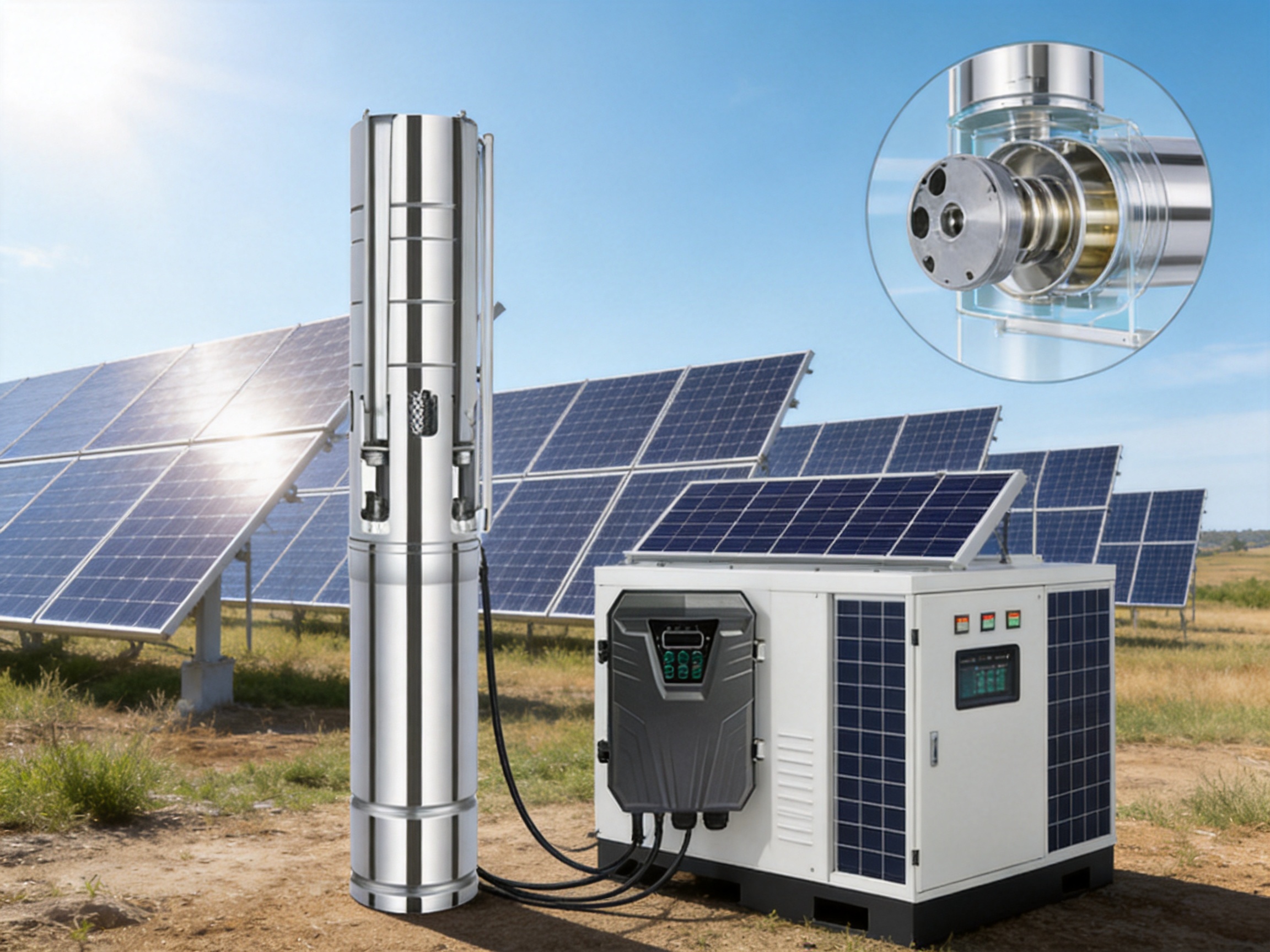
The listed performance data recommends solar panel power of at least 1.3 times the pump power. This means a 750W pump should be paired with a solar array of at least approximately 975W, while a 1100W pump should generally be matched with at least approximately 1430W of panel power. A 1500W model would require at least approximately 1950W according to the same ratio.
This ratio is a starting point rather than a complete design rule. Solar irradiation, panel orientation, seasonal weather, ambient temperature, cable losses, controller efficiency, and the daily water requirement must also be considered. In regions with frequent cloud cover or short winter daylight hours, a larger array or battery-supported configuration may be appropriate.
A solar deep well pump should be operated with a controller that is compatible with its voltage, power, current, and motor technology. The controller may regulate the variable output of the solar panels, provide motor-starting control, and include protection against dry running, overload, overvoltage, undervoltage, and abnormal operating conditions, depending on the selected system.
Because the product is a DC pump, the controller must be designed for the correct DC input range. Connecting the pump directly to an unsuitable solar array can cause unstable operation or electrical damage. The open-circuit voltage must remain below the stated limit, and the operating voltage must remain within the specified optimum range.
Solar pumping does not always require a battery. In many agricultural systems, the pump operates during daylight and fills a storage tank. Water is then distributed later by gravity or by a separate pressure pump. This approach can reduce battery costs and avoid battery replacement requirements.
A battery may be beneficial when water is needed during the evening, when sunlight is intermittent, or when a continuous pressure supply is required. The battery capacity should be calculated according to pump power, operating time, desired autonomy, discharge limits, and local solar conditions. The choice between direct solar operation and battery-supported operation depends on the project’s water-use pattern and budget.
Deep wells may experience fluctuating water levels, especially during dry seasons or periods of heavy extraction. Operating a submersible pump without sufficient surrounding water can cause overheating or accelerated wear. A water-level sensor, well probe, or controller-based dry-run protection system should therefore be considered.
Water-level protection is also important for systems that draw water from tanks, reservoirs, or open sources. The pump should not be allowed to operate when the water level falls below the safe submergence level specified for the installation.
Pump performance is determined by the relationship between flow and head. The maximum flow value shown in a product table is normally measured under a low-head condition, while the maximum head value is normally associated with a very low or near-zero flow condition. The actual operating point lies between these extremes.
For this reason, project designers should not select a pump based only on the maximum flow or maximum head printed in a catalog. Instead, they should identify the required duty point. For example, if a system needs 10m³/h at a total dynamic head of 45m, the installer should select a model whose performance curve can provide approximately that flow at that head.
Pipe selection has a major effect on efficiency. A pipe that is too small can create excessive friction losses and reduce delivered flow. Larger pipework may have a higher initial cost but can reduce energy loss over the life of the system. Long pipelines should be evaluated carefully, particularly where the water must be transported across farmland or between a well and a remote storage tank.
Valves, filters, elbows, check valves, and flow meters also contribute to system resistance. A well-designed installation uses suitable fittings and avoids unnecessary restrictions. When the hydraulic system is correctly matched, the pump can deliver more useful water while operating closer to its intended efficiency range.
Before installation, the well should be checked for internal diameter, depth, water level, sediment, casing condition, and available yield. The well must be able to supply the selected flow without excessive drawdown. If the pump removes water faster than the well can replenish it, the water level may fall and trigger dry running or reduce the long-term reliability of the system.
The pump should be positioned at an appropriate depth below the dynamic water level while remaining clear of the bottom sediment. Installing the pump too close to the bottom may allow sand or sediment to enter the hydraulic passages. Installing it too high may result in inadequate submergence when the water level falls.
The discharge pipe must be strong enough to support the water column and resist pressure during operation. The pump should not be suspended solely by its electrical cable. A suitable support rope or mechanical support arrangement should be used, and the cable should be secured to the pipe at appropriate intervals without damaging the insulation.
The listed cable length for these models is 2m. The complete installation may require an extension cable between the pump and controller. Cable size should be selected according to current, length, permissible voltage drop, insulation requirements, and local electrical regulations.
Even though the system operates on DC power, it can involve dangerous voltage levels, especially on the solar-panel side. The system should include correctly rated disconnects, fuses or circuit breakers, grounding where required, surge protection where appropriate, and protection against reversed polarity or overcurrent.
All connections should be protected from water ingress and mechanical damage. Solar panels can produce voltage whenever they receive light, so the array should be isolated before service work. Installation and commissioning should be performed by personnel familiar with DC solar systems and submersible pump equipment.
After installation, the system should be checked for correct polarity, voltage range, cable continuity, pipe security, valve position, and adequate water level. The pump should be started under controlled conditions while the installer observes flow, sound, vibration, current, and discharge pressure.
Initial water may contain sediment or installation debris. A flushing procedure may be required before connecting the pump to sensitive irrigation emitters, household filters, or other equipment. The operating current and voltage should be recorded as a reference for future maintenance.
Solar deep well pumps can provide water for drip irrigation, sprinkler systems, orchard lines, greenhouse cultivation, and water storage. The most suitable configuration depends on crop water demand, irrigation schedule, field elevation, and pipe network design.
For drip irrigation, filtration and pressure regulation are essential. The pump may fill a tank or supply a regulated manifold. For sprinkler irrigation, the required head may be higher because the sprinklers need operating pressure. In both cases, the pump must be selected according to the actual hydraulic duty point rather than nominal flow alone.
Greenhouses often require reliable and predictable water delivery. A solar pumping system can fill a storage tank during the day, allowing irrigation to operate according to a timer or control system. The stainless steel impeller and quiet operation of the 4ESC series are appropriate features for installations located near production areas.
Livestock watering points may be located far from buildings and utility connections. A solar pump can transfer well water to troughs or elevated tanks, reducing the need for manual transport. Higher-flow 4/6ESC models may be considered for larger livestock operations, provided that the well yield, tank size, and distribution pipe are appropriately designed.
In remote homes and small communities, a deep well pump can supply a ground-level or elevated tank. Water can then be distributed through a domestic booster pump or gravity-fed network. A tank-based arrangement allows the solar pump to operate during favorable sunlight and provides a reserve for periods of high demand.
Construction sites, rural development projects, and small water-management systems may need to transfer water between wells, reservoirs, and storage tanks. The 4ESC and 4/6ESC range offers multiple flow and head options for these applications. Its DC power design is especially useful where temporary or mobile solar systems are being considered.
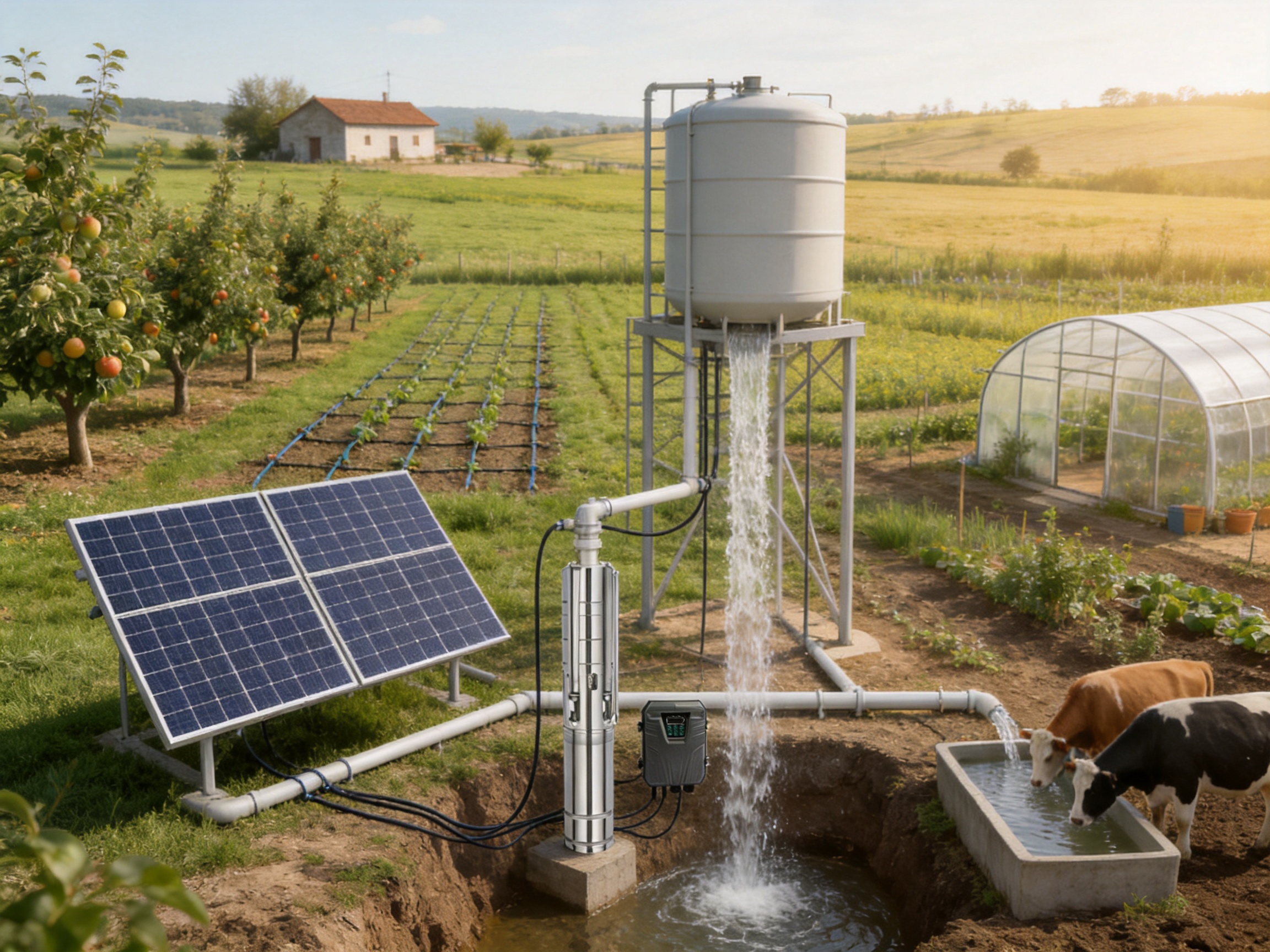
The performance of a pump depends not only on its design but also on the consistency of manufacturing. Impeller geometry, motor assembly, sealing, cable connection, dimensional accuracy, and final testing all influence the product’s reliability. A manufacturer with experience in research, mass production, and export supply can provide important benefits for distributors and project contractors.
Taizhou Edwin Electric Co., Ltd. was founded in 2008 and operates as an integrated manufacturing enterprise. Its capabilities include independent research and development, mass production, and global export. This integrated structure supports a closer connection between product design, production planning, quality management, and customer service.
Independent research and development enables the company to adapt pump products to changing market requirements. The company’s portfolio includes deep well pumps, submersible pumps, household booster pumps, circulation pumps, solar water pumps, and intelligent booster pumps. This product breadth provides experience across different pumping conditions, from agricultural water supply and new-energy projects to HVAC systems, municipal engineering, mining, construction, and household applications.
Mass production provides another important advantage. A project customer may require repeat orders, replacement pumps, or multiple models for different installations. Established production capability can help support consistent availability and coordinated order fulfillment. It also allows manufacturing procedures to be standardized across product batches.
Since 2018, the company has invested in new energy and intelligent technology, including solar water pumps and intelligent booster pumps. This direction is relevant to current demand for energy-efficient, automated, and remotely located water systems. Solar pumping requires an understanding of motor control, variable power input, electrical protection, and hydraulic system integration. Continued investment in this area supports the development of more adaptable off-grid pumping products.
The company also established Taizhou Haipai Import & Export Co., Ltd. and Golden Falcon Industrial Co., Ltd. in 2012 to support procurement planning, order tracking, cross-border delivery, and foreign trade services. For international buyers, these functions can be as important as the pump itself. Clear communication, coordinated documentation, and reliable shipping support can reduce delays and simplify the purchasing process.
Customers should still request the exact quality documents, inspection records, testing procedures, warranty terms, and compliance information required for their market or project. However, the company’s integrated manufacturing and export structure provides a practical foundation for serving global industrial clients.
A fuel-powered generator or engine-driven pump can operate independently of the electrical grid, but it requires fuel, lubrication, engine maintenance, and regular supervision. Fuel prices and transport requirements can also increase the operating cost of remote installations. A solar-powered DC pump reduces the need for daily fuel consumption and can operate with fewer routine mechanical service requirements.
The solar system has its own requirements, including panel installation, controller protection, and periodic cleaning. Nevertheless, for locations with adequate sunlight, the reduction in fuel logistics can be a substantial operational advantage.
Grid-connected pumps are convenient where a stable electrical supply is available. However, grid extension may be expensive in rural areas, and power interruptions can disrupt irrigation or household water supply. The 4ESC and 4/6ESC series gives project designers the option to create a stand-alone system using solar panels, batteries, or storage tanks.
This does not mean that a solar pump is always superior to a grid-connected pump. The best choice depends on local energy prices, sunlight, infrastructure, operating schedules, and capital budget. In off-grid and weak-grid conditions, however, the DC solar configuration directly addresses the limitations of conventional alternatives.
A product range with only one flow and head configuration can force users to compromise. They may end up with insufficient delivery, excessive energy use, or a system that requires throttling and oversized components. The 4ESC and 4/6ESC models offer a broader selection, from moderate flow and high head to high flow and lower head.
This range improves the likelihood of achieving a closer match between the pump and the water system. Better matching can help reduce operating waste and make the solar array more appropriately sized.
Internal corrosion can affect impeller surfaces, hydraulic clearances, and long-term performance. The stainless steel impeller used in this series is a durable choice for ordinary clean-water pumping and provides a clear material advantage over designs made from less corrosion-resistant materials.
Solar pumping systems generally require less daily attention than fuel-powered systems, but they are not maintenance-free. Solar panels should be inspected and cleaned when dust, leaves, bird residue, or other deposits reduce sunlight. Electrical enclosures and connectors should be checked for moisture, heat damage, loose terminals, and mechanical wear.
The well should be monitored for changes in water level, sand content, and yield. If the water becomes unusually cloudy or abrasive, the pump and pipework may require inspection. Excessive sand can accelerate wear in hydraulic components and should be addressed through well development, filtration, or operating adjustments where appropriate.
Operators should periodically compare current flow, pressure, voltage, and current with the values recorded during commissioning. A gradual reduction in flow may indicate a blocked filter, damaged pipe, falling water level, impeller wear, or a change in solar input. Unusual noise or vibration should be investigated rather than ignored.
The pump should be removed and inspected according to the maintenance schedule recommended by the manufacturer and the actual working environment. Service intervals may differ according to operating hours, water quality, sand concentration, installation depth, and seasonal conditions.
For a successful purchase, customers should provide the manufacturer or distributor with accurate project information. This should include the well depth, static and dynamic water levels, desired daily water volume, required flow rate, total head, pipe length, discharge elevation, solar resource, and intended operating schedule.
The customer should also specify whether the system will use direct solar power, batteries, an elevated tank, or a hybrid arrangement. The required voltage and controller type should be confirmed before ordering. If the pump is part of a larger irrigation or water-supply project, the installer should coordinate the pump selection with filters, valves, pressure tanks, controllers, and storage facilities.
For distributors, the model range supports a more complete product offering. Stocking several configurations can help serve customers with different head and flow requirements. The manufacturer’s broader product portfolio can also support cross-selling opportunities in submersible pumping, domestic boosting, circulation, intelligent pressure systems, and pump accessories.
International buyers may benefit from working with a supplier that combines factory production with export-service capability. Order tracking, procurement planning, packaging coordination, technical communication, and shipping documentation are all important when equipment is supplied across borders.
The pump is designed for DC-powered systems, including solar-panel and battery-supported applications. The correct voltage model, controller, wiring, and protection equipment must be selected according to the product data and project requirements.
A complete solar pumping system normally requires a compatible controller and appropriate electrical protection. Direct connection should only be considered when the system has been specifically designed and approved for that arrangement. The solar array’s operating voltage and open-circuit voltage must remain within the pump’s specified limits.
The product range includes different pump configurations and outlet sizes. The listed 4ESC models generally use 2-inch outlets, while the listed 4/6ESC models use 3-inch outlets and provide higher flow options up to 36m³/h. Exact selection should be based on the required hydraulic duty point and installation dimensions.
First determine the required flow rate and total dynamic head. Then consider the well diameter, water level, pipe size, solar array, controller voltage, and daily water demand. Use the manufacturer’s performance curve to confirm the expected flow at the required head.
No. Maximum head is a rated limit associated with very low flow. The actual operating point depends on the system resistance. A pump must be evaluated using its performance curve at the required flow and total head.
The listed data recommends solar-panel power of at least 1.3 times the pump power. This indicates approximately 975W for a 750W model, 1430W for a 1100W model, and 1950W for a 1500W model. Actual system sizing should also account for sunlight, seasonal conditions, controller efficiency, and cable losses.
The stainless steel impeller is intended to provide corrosion resistance in normal deep well water applications. Water containing high levels of sand, aggressive chemicals, or unusual minerals should be evaluated before installation. The manufacturer’s water-quality recommendations should be followed.
It can be used in an off-grid household water-supply system, commonly by filling an elevated or ground-level storage tank. A separate pressure-control arrangement may be required for stable domestic pressure. The complete system should include suitable filtration, storage, controls, and safety protection.
Not necessarily. A system may operate during daylight and fill a storage tank, eliminating the need for batteries. Batteries may be added when water is needed outside sunlight hours or when a more consistent electrical supply is required.
Maintenance includes monitoring flow and electrical performance, inspecting the solar panels and electrical connections, checking water levels, evaluating sand or sediment, and servicing the pump according to the manufacturer’s recommendations. Any unusual noise, vibration, current, or flow reduction should be investigated.
Yes. The stated applications include irrigation for farms, orchards, and greenhouses. The pump must be matched to the irrigation system’s flow, pressure, filtration, pipe size, and daily water demand.
Customers should provide the desired flow, total head, well depth, water level, well diameter, outlet size, solar or battery voltage, expected operating hours, destination country, and any required documentation or packaging specifications. This information helps the supplier recommend the most suitable model and accessories.
The 4ESC and 4/6ESC DC Powered Stainless Steel Impeller Solar Deep Well Pump is a flexible solution for reliable water supply in off-grid and solar-powered environments. Its DC operation supports direct integration with solar and battery systems, while the stainless steel impeller provides corrosion resistance for ordinary clean-water applications. The brushless motor design, compact construction, quiet operation, and broad selection of flow and head ratings make the series suitable for residential, agricultural, livestock, community, and remote water projects.
The product’s main advantage is not a single specification but the combination of electrical compatibility, hydraulic variety, durable materials, and application flexibility. The available models cover outputs from 9.5m³/h to 36m³/h and heads from 19m to 90m, allowing system designers to select a closer match for different well and distribution conditions.
Taizhou Edwin Electric Co., Ltd. supports this product with experience in independent research and development, mass production, international export, and a broad range of pump technologies. Its investment in solar water pumps and intelligent pumping systems reflects the changing needs of global water infrastructure. Through coordinated manufacturing and foreign-trade services, the company is positioned to support distributors, contractors, agricultural users, and industrial customers seeking dependable pumping equipment.
For the best result, every installation should be engineered around the actual well, hydraulic duty point, solar resource, controller, pipe network, and water demand. When correctly selected and installed, the 4ESC and 4/6ESC series can provide an efficient and durable foundation for sustainable water access.
1. Taizhou Edwin Electric Co., Ltd., 4ESC and 4/6ESC DC Powered Stainless Steel Impeller Solar Deep Well Pump Product Data.
2. Taizhou Edwin Electric Co., Ltd., Solar Pump Performance and Application Information.
3. General principles of centrifugal pump selection, total dynamic head calculation, and hydraulic system design.
4. General photovoltaic system design principles for DC motor loads, voltage matching, and solar array sizing.
5. General guidance for submersible pump installation, dry-run protection, electrical safety, and well-water management.
edwina@edwin-pump.com
+86-13586290903 (WhatsApp)
Xuri Gongliang Cutting Tool Entrepreneurship Park, Wenqiao Town, Wenling City, Taizhou City, Zhejiang Province, China

High Performance Smart Pump Factory


 English