
edwina@edwin-pump.com

View All Products
en
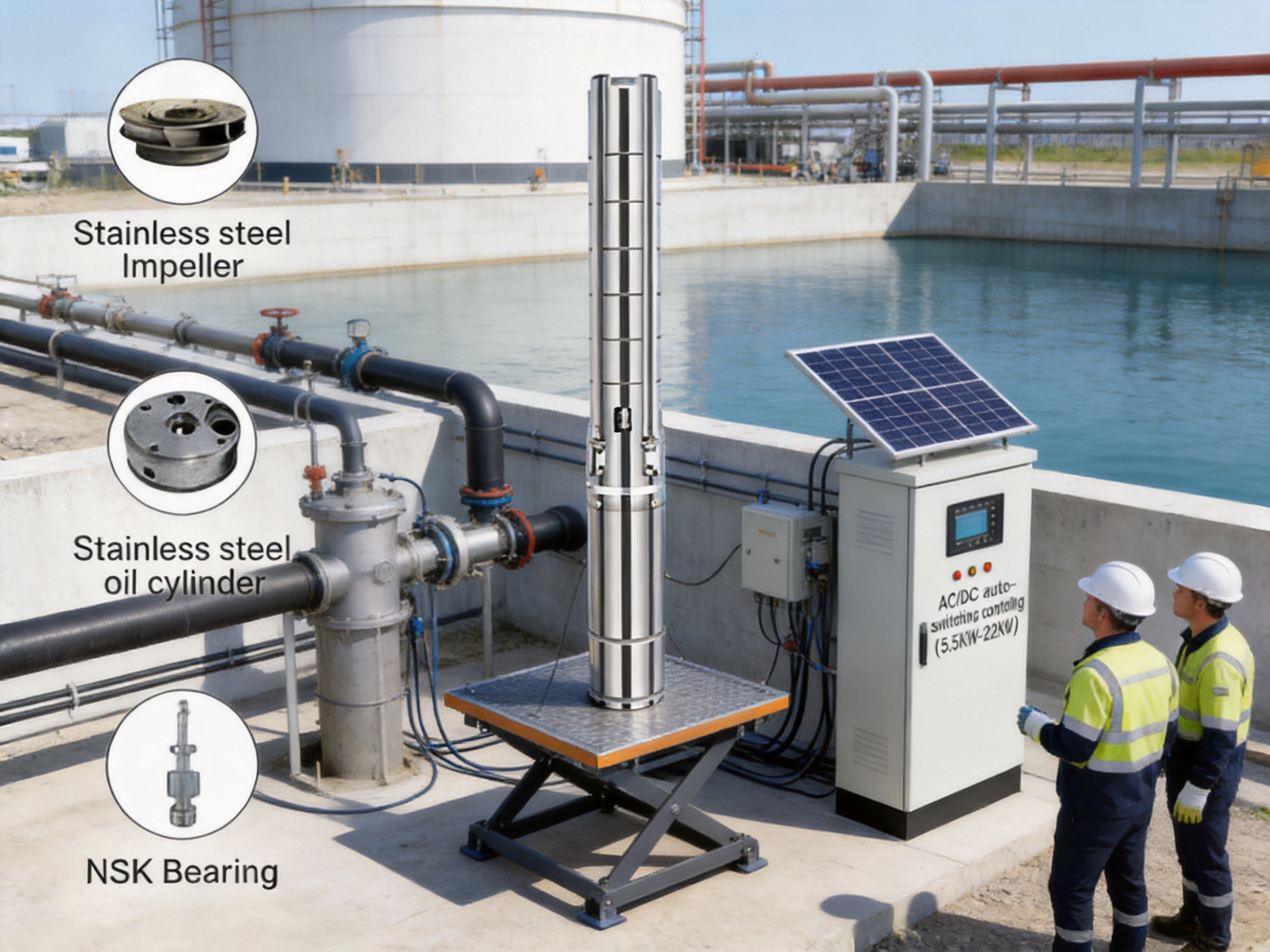
Reliable access to water is essential for agricultural production, livestock management, rural development, industrial operations, and off-grid communities. In many locations, however, conventional pumping systems are limited by unstable grid electricity, high operating costs, difficult terrain, or the absence of dependable power infrastructure. Solar pumping technology offers a practical alternative, but the quality and flexibility of the pump itself determine whether a water system can operate consistently over the long term.
The 8ADSC Stainless Steel Cylinder AC/DC Hybrid Solar Deep Well Pump is designed to address these challenges. It combines a corrosion-resistant stainless steel cylinder, a high-efficiency motor, deep-well pumping capability, and hybrid AC/DC operation in one commercial-grade system. The pump can use solar-generated DC power as its primary energy source while also accepting conventional AC electricity when solar energy is insufficient. This dual-power design helps maintain water availability through changing weather conditions, seasonal variations, and different operating environments.
With available models rated at 11,000 W and 22,000 W, the 8ADSC series is intended for demanding applications that require substantial water output and dependable hydraulic performance. The models can deliver a maximum flow of 150 cubic meters per hour, with maximum heads of 37 meters or 77 meters depending on the selected configuration. These specifications make the series suitable for large-scale irrigation, water storage, livestock supply, rural water infrastructure, and other commercial or industrial installations.
Traditional deep-well water systems are often designed around a single source of electricity. A grid-powered pump can provide strong and stable performance, but connection costs may be high in remote areas. Grid outages can also interrupt irrigation, livestock watering, and domestic water supply. Diesel-powered alternatives may operate independently of the grid, yet fuel transportation, engine maintenance, emissions, and fluctuating fuel prices can make them expensive over the life of the system.
Solar pumping addresses many of these concerns by converting sunlight into usable electrical energy. Solar panels can supply power during daylight hours without fuel consumption, and the water can be pumped directly into an elevated tank or storage reservoir for later use. Nevertheless, solar energy is variable. Cloud cover, seasonal sunlight, and early morning or evening conditions may reduce available power. A pump that relies exclusively on solar DC input can therefore experience reduced output or temporary shutdown during unfavorable conditions.
The AC/DC hybrid design of the 8ADSC series provides a solution to this limitation. The pump can operate with solar DC power when sufficient photovoltaic energy is available and switch to conventional AC electricity when necessary. This gives users the operating economy of solar energy together with the continuity of a backup electrical supply. For commercial and agricultural users, that flexibility can be more valuable than relying on a single power source.
Hybrid operation is particularly beneficial when water demand cannot be postponed. For example, a greenhouse may require a scheduled irrigation cycle even on an overcast day. Livestock may need a continuous or predictable supply regardless of weather. A rural water project may also need to serve a community during periods when solar generation is lower than normal. By supporting both AC and DC power, the 8ADSC pump can be integrated into a more resilient water-supply strategy.
The stainless steel cylinder is one of the defining features of the 8ADSC deep well pump. Pump equipment installed in wells is exposed to water, minerals, sediment, pressure, and changing environmental conditions. Ordinary materials may corrode over time, particularly when the water contains aggressive chemical elements or when the pump is used in demanding agricultural and industrial environments.
Stainless steel provides a durable exterior structure with strong resistance to corrosion. This helps protect the pump body and supports longer service life in challenging water conditions. It also creates a clean and robust appearance suitable for professional installations. Compared with less corrosion-resistant materials, stainless steel can reduce the likelihood of surface deterioration, structural weakening, and maintenance problems associated with rust.
The cylinder also contributes to mechanical stability. A deep-well pump must withstand vibration, hydraulic forces, and the stress associated with repeated starting and stopping. A well-constructed metal housing supports the internal motor and hydraulic components while helping the pump maintain alignment during operation.
Material selection is especially important in systems that are difficult to remove from the well. If a pump requires frequent repair or replacement, labor, lifting equipment, and service interruptions can increase the total cost of ownership. The corrosion-resistant stainless steel construction of the 8ADSC series is therefore not simply an aesthetic feature; it is part of the product’s strategy for reducing maintenance requirements and extending operating reliability.
The pump is designed for AC380/DC520 V operation, with an optimum DC input voltage range of 520 V to 650 V. This configuration allows the pump to work with a properly designed solar array while remaining compatible with conventional three-phase AC electricity. The hybrid power architecture is suitable for installations that want to prioritize renewable energy without giving up access to a backup power source.
During periods of strong sunlight, solar energy can power the pump directly and reduce dependence on grid electricity. When photovoltaic output falls below the required level, an AC source can help maintain pumping performance. This can be useful during cloudy weather, at night, during seasonal changes, or whenever the water requirement exceeds the instantaneous solar generation capacity.
A hybrid system can also help users plan their energy costs. Solar energy reduces the need to purchase electricity during daylight operation, while AC backup avoids the need to oversize the solar array solely for occasional low-light conditions. The best configuration depends on local solar resources, water demand, well depth, storage capacity, and the availability of grid electricity.
The AC/DC capability also makes the pump suitable for staged project development. A user may begin with a solar-powered installation and later connect an AC backup supply as the water system expands. Alternatively, an existing AC-powered installation may add solar generation to reduce operating expenses. This adaptability can help protect the initial investment while allowing the system to evolve with changing requirements.
The 8ADSC series uses an energy-efficient motor designed to provide strong and stable water flow while minimizing unnecessary power consumption. Motor efficiency is important in every pumping system, but it is particularly important in solar applications because the available power is limited by the size and performance of the photovoltaic array.
A more efficient motor can convert a greater proportion of electrical input into useful mechanical output. This may allow the system to achieve the required water delivery with a smaller energy reserve, or it may help maintain more consistent performance when solar conditions are less than ideal. Efficient operation also reduces energy losses that would otherwise appear as heat, potentially supporting longer component life.
The product information identifies the motor as brushless. Brushless motor technology eliminates the mechanical brushes used in some traditional motor designs. This can reduce wear associated with brush replacement and help lower routine maintenance requirements. In a deep-well installation, reduced maintenance is a major advantage because access to the pump may require specialized equipment and significant labor.
The motor and pump should always be matched with suitable electrical protection, cable sizing, control equipment, and installation practices. The product’s efficiency benefits are maximized when the complete system is designed correctly, including the solar array, AC supply, protection devices, water pipe, valves, and storage arrangements.
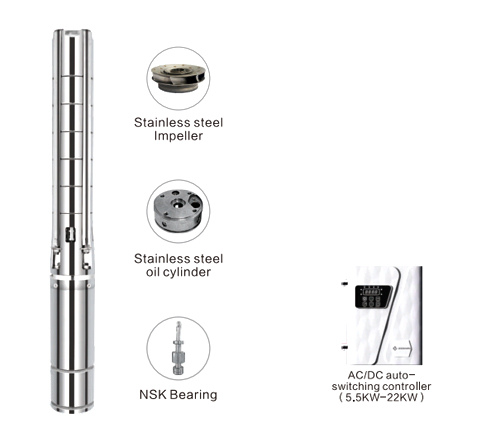
8ADSC Stainless Steel Cylinder AC/DC Hybrid Solar Deep Well Pump
The available 8ADSC configurations provide a maximum flow of 150 cubic meters per hour. This is a substantial water-delivery capacity for large irrigation projects, reservoirs, livestock facilities, and commercial water systems. The two listed models are differentiated primarily by their maximum head and motor power.
| Model | Operating Voltage | Optimum DC Input Voltage | Power | Maximum Flow | Maximum Head | Outlet | Cable Length | Solar Panel Open-Circuit Voltage | Recommended Solar Panel Power |
| 8ADSC150-37-380/520-11000 | AC380/DC520 V | 520–650 V | 11,000 W | 150 m³/h | 37 m | 5 inches | 2 m | Below 780 V | At least 1.3 times pump power |
| 8ADSC150-77-380/520-22000 | AC380/DC520 V | 520–650 V | 22,000 W | 150 m³/h | 77 m | 5 inches | 2 m | Below 780 V | At least 1.3 times pump power |
The 11,000 W version offers a maximum head of 37 meters, making it suitable for applications where the water must be lifted through a moderate vertical distance. The 22,000 W version provides a maximum head of 77 meters and is more appropriate for installations requiring greater elevation, longer delivery routes, or additional system pressure.
Maximum flow and maximum head are reference values rather than guaranteed operating points for every installation. Actual performance depends on well conditions, dynamic water level, pipe diameter, pipe length, fittings, valves, elevation changes, water quality, and the operating point selected by the system designer. Users should evaluate the complete pump curve and system curve before final selection.
The 5-inch outlet supports high-volume water transfer and should be connected to a properly sized discharge pipe. An undersized pipe can increase friction loss, reduce delivered flow, and create unnecessary stress on the pumping system. Correct pipe sizing is therefore essential for achieving the expected performance of a high-capacity pump.
A conventional AC-only deep-well pump depends entirely on grid electricity or a generator. This can be a disadvantage in areas where electricity is expensive, unreliable, or unavailable. The 8ADSC series can use solar DC power, allowing users to reduce reliance on purchased electricity during daylight hours.
A conventional DC-only solar pump has the opposite limitation. It may operate efficiently during sunny periods, but its output can be affected by low solar radiation. Without a backup power source or water storage, the system may not satisfy demand when sunlight is insufficient. The hybrid architecture combines the advantages of both approaches and reduces the operational risk associated with either one alone.
Diesel pumps can be useful in remote areas, but their operating costs include fuel, transport, lubrication, engine servicing, exhaust control, and potential downtime. Solar-powered operation does not require daily fuel delivery. Once the photovoltaic system has been installed, sunlight can provide a renewable source of energy for routine pumping.
The AC backup function means that users do not need to rely on a diesel generator whenever solar output falls. This can reduce noise, emissions, fuel storage requirements, and maintenance obligations. For farms, communities, and industrial sites seeking lower-carbon water infrastructure, the 8ADSC pump provides a practical path toward greater renewable energy use.
Some competing pumps use materials that may be less suitable for aggressive water conditions or long-term exposure. The stainless steel cylinder of the 8ADSC series is designed to provide improved resistance to corrosion and wear. This is particularly valuable in deep wells, where mineral deposits and water chemistry can affect metallic components over time.
Corrosion resistance does not eliminate the need for water-quality evaluation. Sand, abrasive particles, high salinity, and unusual chemical conditions can still influence pump life. However, a stainless steel structure provides a strong foundation for durability and can offer a longer service interval than a less resistant housing when the equipment is correctly selected and installed.
Deep-well pump maintenance can be more complicated than surface-pump maintenance because the equipment is installed below ground level. Removing a submersible pump may involve disconnecting electrical and water lines, lifting long pipe sections, and arranging specialized labor. A durable construction and brushless motor can therefore create meaningful savings over time.
The 8ADSC series is designed with low-maintenance operation in mind. Stainless steel construction helps resist environmental deterioration, while brushless motor technology reduces brush-related wear. These features do not replace scheduled inspection, but they can help reduce the frequency of intervention and the likelihood of routine mechanical replacement.
Many small solar pumps are designed for household water supply or limited irrigation. They may not provide the flow rate or head required by large farms, reservoirs, commercial projects, or centralized water systems. With a maximum flow of 150 cubic meters per hour and options up to 22,000 W, the 8ADSC series addresses higher-capacity requirements.
Its commercial-scale specifications make it more suitable for projects where water demand is measured in large daily volumes. The pump can be used to move water from a deep well to a storage tank, irrigation network, livestock watering system, or other distribution point. System designers can select the model according to the required lifting height and operating conditions.
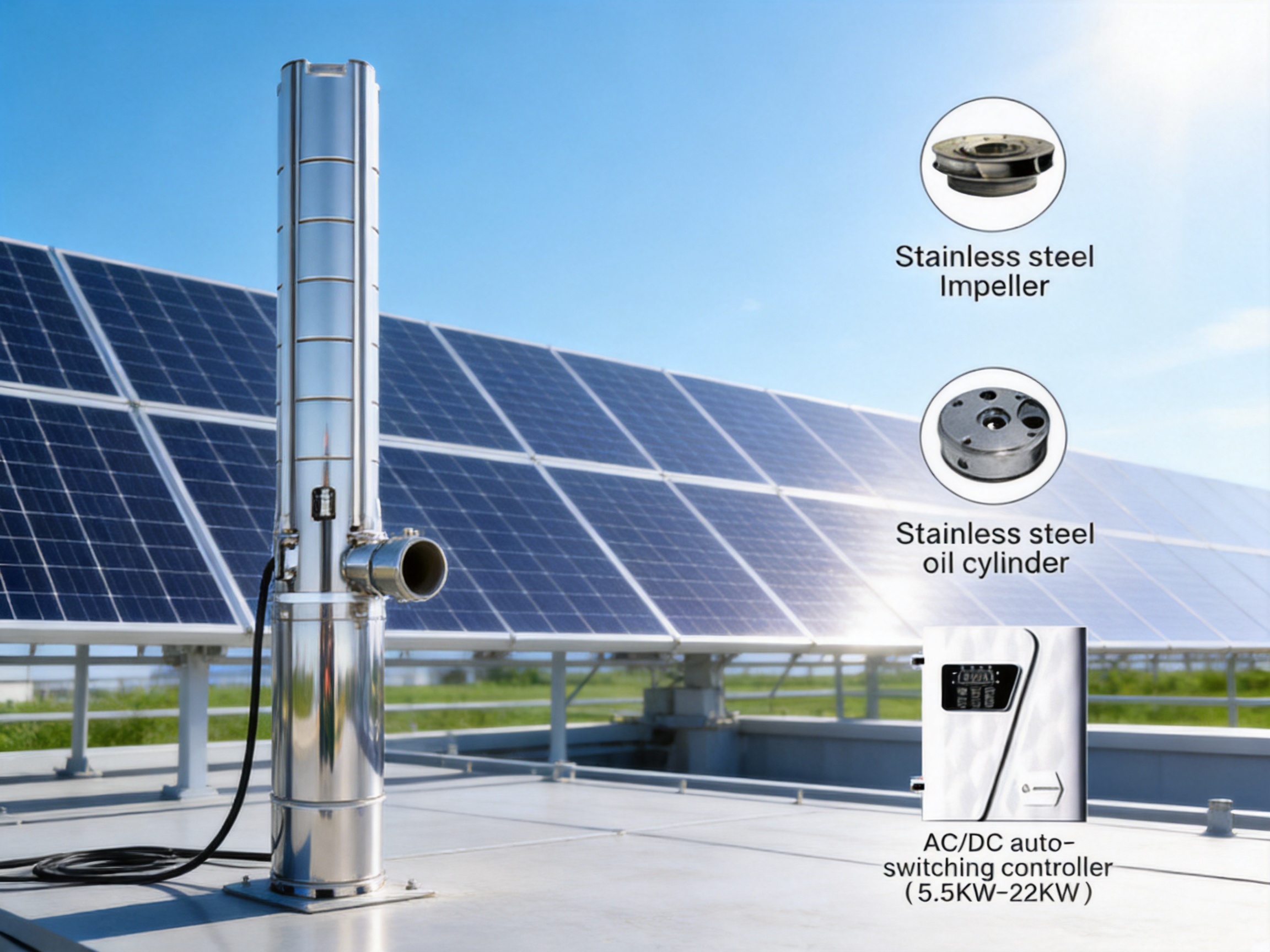
Agricultural irrigation is one of the most important applications for high-capacity solar pumping. Farms may be located far from reliable grid connections, and energy costs can represent a significant portion of operating expenses. A solar-assisted deep-well pump can deliver water to drip irrigation systems, sprinklers, pivot systems, storage ponds, and elevated tanks.
The 8ADSC pump can support irrigation for open fields, orchards, greenhouses, and other cultivation areas. Solar operation is naturally aligned with daytime irrigation schedules, while AC backup can provide additional flexibility when crops require water during cloudy weather or when irrigation timing is critical.
For an agricultural installation, the pump should be integrated with appropriate filters, valves, pressure controls, and water storage. If the source water contains sand or suspended solids, pretreatment may be necessary to reduce wear on hydraulic components. The irrigation network should also be designed to match the pump’s flow and pressure characteristics rather than simply connecting the pump to an unrestricted outlet.
Greenhouse crops often require precise water management. Irrigation schedules may be determined by temperature, humidity, crop variety, growth stage, and soil or substrate conditions. A stable water source supports more accurate control of fertigation and irrigation cycles.
The hybrid power design can help greenhouse operators maintain predictable water delivery despite variable solar conditions. Solar energy can cover much of the daytime load, while AC power can supplement the system when the weather changes. The pump can supply tanks or intermediate reservoirs, allowing automated irrigation equipment to draw water at controlled pressure and volume.
Livestock and poultry require dependable access to clean water. In remote farms and ranches, water sources may be located far from buildings or electrical infrastructure. A solar deep-well pump can transfer groundwater to elevated tanks, troughs, or distribution lines.
The 8ADSC series is suitable for projects requiring substantial water quantities, including larger livestock operations. The stainless steel cylinder is beneficial in environments where durability and resistance to moisture are important. The AC backup capability can also provide additional assurance during periods of poor sunlight or unusually high demand.
Water quality should be tested before installation. The pump system should be selected according to the source depth, water chemistry, sediment level, and required daily volume. Storage capacity is also important because a tank can provide a buffer between solar generation and animal consumption.
Remote communities may have access to groundwater but lack stable public electricity. A high-capacity solar pump can provide a foundation for a centralized water system, especially when paired with elevated storage. Water can be pumped during periods of available sunlight and distributed later through gravity or a secondary pressure system.
The 8ADSC pump’s AC/DC hybrid functionality helps communities combine renewable energy with an existing grid connection, generator, or future electrical infrastructure. This flexibility may simplify the transition from conventional power to a more sustainable system while preserving the ability to operate during periods of low solar output.
Many industrial and agricultural sites need to move water from a well to a reservoir, pond, tank, or treatment facility. The pump’s high flow capability can shorten filling times and support large-volume water transfer. The selected model should be matched to the required vertical lift and the friction losses in the delivery pipeline.
Storage-based systems are particularly effective with solar pumping because they separate energy availability from water demand. The pump can operate when sunlight is abundant, and the stored water can be used during the evening or during temporary interruptions in power generation. This approach can reduce the need for batteries, which are often expensive and require their own maintenance.
Commercial facilities, construction sites, water infrastructure projects, and selected industrial operations may require high-volume water movement. The 8ADSC series can be considered for applications where a deep-well submersible pump must operate with a renewable energy source and a backup AC supply.
Industrial users should conduct a detailed technical assessment before purchase. Important factors include the water’s chemical composition, temperature, solids content, required duty cycle, discharge pressure, and environmental conditions. The installation may also require control panels, protection systems, remote monitoring, non-return valves, and specialized lifting arrangements.
The product is manufactured by Taizhou Edwin Electric Co., Ltd., an integrated enterprise founded in 2008. The company’s stated capabilities include independent research and development, mass production, and global export. This combination is important for buyers seeking more than a single pump model, because commercial projects often require technical customization, consistent production, documentation, order coordination, and long-term supply support.
An integrated manufacturing structure can help connect product design with production feedback. Engineers can evaluate field requirements, improve components, and standardize manufacturing processes across product families. Production teams can then apply those designs through controlled assembly, testing, inspection, and packaging procedures.
The company’s product lines include deep-well pumps, submersible pumps, domestic booster pumps, circulation pumps, solar water pumps, and intelligent booster pumps. This broad product portfolio indicates experience across different hydraulic applications and market segments. It also gives project buyers the possibility of sourcing related pumping equipment from one manufacturing organization rather than coordinating multiple unrelated suppliers.
Since 2018, the company has invested in new energy and intelligent technology. The development of solar water pumps and intelligent booster pumps reflects an effort to respond to changing market requirements, including renewable energy integration, improved control, and more efficient water management. These capabilities are relevant to the 8ADSC series because hybrid solar pumping requires knowledge of both pump hydraulics and electrical energy conversion.
Independent research and development can support continuous improvement in pump construction, motor efficiency, hydraulic design, materials, and system compatibility. For solar pumping, development work must consider changing input voltage, variable power availability, motor control, protection functions, and the relationship between the pump and the photovoltaic array.
A manufacturer with experience in both conventional and solar pump technologies can evaluate the complete operating environment. This may lead to better product matching, more practical installation guidance, and improved integration between the motor, controller, solar panels, and AC supply.
Mass production is valuable for distributors, engineering contractors, and project developers that require repeat orders. Standardized manufacturing can improve consistency among units, support more predictable delivery schedules, and simplify spare-parts planning. It also enables the manufacturer to serve both individual projects and larger procurement programs.
For commercial buyers, production capacity should be considered together with quality control. A reliable manufacturer must balance output volume with inspection discipline, process control, traceability, and final performance testing. Pumps should be checked for electrical characteristics, mechanical assembly, sealing, insulation, rotation, hydraulic behavior, and packaging integrity before shipment.
Edwin Pump has established related import and export companies to support procurement planning, order tracking, cross-border delivery, and foreign trade services. International pump purchases involve more than manufacturing. Buyers may need assistance with product selection, technical documents, shipping coordination, customs preparation, packaging requirements, and communication between factories and project teams.
A one-stop procurement structure can reduce coordination time and help international customers manage complex orders. It may be particularly useful when a project requires several pump types or related products such as valves, pipes, accessories, booster systems, or circulation pumps. The manufacturer’s broader product range can support a more unified purchasing process.
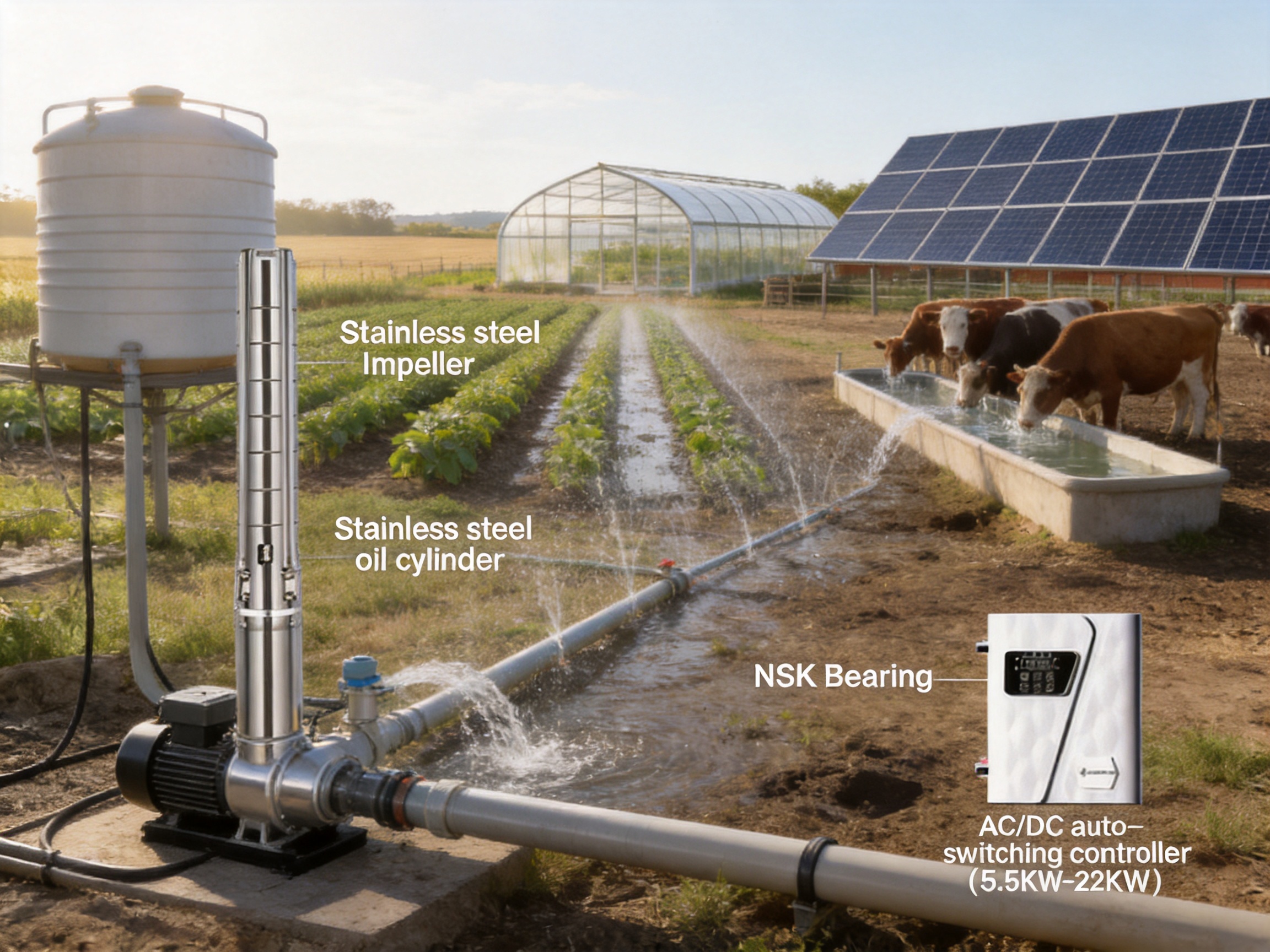
Maximum head is one of the most important selection criteria. The total dynamic head includes the vertical distance from the pumping water level to the discharge point, pipe friction, pressure requirements, and losses through valves and fittings. The 37-meter model and the 77-meter model should be selected according to the actual system requirement rather than motor power alone.
It is important to distinguish between static water level and dynamic water level. When the pump operates, the water level in the well may fall. This drawdown affects the lifting distance and may change the pump’s operating point. A professional well assessment should confirm that the water source can sustain the required flow without excessive drawdown or dry running.
The required flow depends on the number of irrigation zones, tank-filling schedule, livestock population, household consumption, industrial demand, and desired operating hours. A pump that is too small may fail to meet demand, while a pump that is too large can increase system cost and create inefficient operation.
Because the listed maximum flow is 150 cubic meters per hour, the 8ADSC series is oriented toward high-volume use. The final system should include an appropriate control strategy, such as tank-level control, pressure management, or scheduled operation. The discharge network must also be capable of handling the selected flow without excessive velocity or pressure loss.
The product information specifies a solar-panel open-circuit voltage below 780 V and recommends solar-panel power of at least 1.3 times the pump power. For the 11,000 W model, this indicates a recommended minimum solar array capacity of approximately 14,300 W. For the 22,000 W model, the corresponding minimum is approximately 28,600 W.
These values are design references and should be verified against the complete electrical system, local solar conditions, controller requirements, and installation regulations. The array voltage must remain within the allowable limits under both normal operation and open-circuit conditions. Temperature can affect photovoltaic voltage, so the system designer should account for the lowest expected cell temperature as well as the highest operating temperature.
The solar array should be oriented and tilted according to the site’s latitude, seasonal energy requirements, shading conditions, and available roof or ground area. Proper cable sizing, grounding, surge protection, disconnects, and overcurrent protection are essential. High-voltage DC systems require qualified electrical installation because DC arcs can be difficult to extinguish.
The AC input is specified as 380 V. A suitable three-phase supply, protection system, and switching arrangement must be provided. The AC source should be compatible with the pump’s electrical requirements and installed in accordance with local codes.
Where both AC and DC sources are connected, the system must include an appropriate hybrid controller or switching arrangement to prevent unsafe back-feeding, source conflict, or incorrect voltage application. The operating sequence should be clearly defined. Automatic transfer may be desirable for critical water systems, while manual selection may be sufficient for simpler installations.
Submersible pumps depend on surrounding water for cooling and must not operate without adequate water coverage. A well-level sensor, dry-run protection device, or suitable control logic can help prevent damage when the water level falls below the safe operating point.
Electrical protection should address overload, short circuit, phase loss, voltage irregularities, and abnormal operating conditions. The motor cable must be properly sized for the installation distance and voltage drop. Control equipment should be installed in a dry, accessible, and ventilated location, protected from direct weather exposure and unauthorized access.
A non-return valve can help prevent reverse flow when the pump stops. Isolation valves support maintenance and system control, while pressure gauges can help operators monitor performance. Depending on the application, the installation may also require air-release valves, filters, flow meters, pressure-relief devices, and water-treatment equipment.
The pump should not be forced to operate against a closed discharge valve for extended periods. Excessive throttling can create heat and unstable hydraulic conditions. The system should be designed so that the pump operates within a suitable portion of its performance range.
Although the 8ADSC series is designed for low-maintenance operation, regular inspection remains important. Preventive maintenance can identify electrical, hydraulic, and structural issues before they develop into major failures.
Operators should monitor flow, pressure, current, voltage, pump starting behavior, and the water level in the well. A gradual reduction in flow may indicate pipe blockage, filter fouling, increased friction, water-level changes, or wear. An unexpected increase in current may indicate mechanical resistance, electrical problems, or operation outside the intended performance range.
The solar array should be inspected for dust, shading, loose connections, cracked modules, and cable damage. Dirty panels can reduce energy generation and may cause the pump to operate below its expected output. The control cabinet should be checked for moisture, overheating, corrosion, and signs of loose terminals.
Water quality should also be monitored. Sand and abrasive particles can damage hydraulic components, while mineral deposits can affect passages and valves. If the well produces sediment, the system may need a settling arrangement, filtration, or periodic well maintenance. The pump should be removed and serviced only by trained personnel using appropriate lifting equipment.
During periods of long-term shutdown, the system should be protected according to the manufacturer’s recommendations. Electrical sources should be isolated safely, and exposed pipework should be protected from freezing or physical damage where relevant. A documented maintenance schedule is especially valuable for commercial installations with multiple pumps or remote monitoring points.
The purchase price is only one part of the cost of a deep-well pumping system. Buyers should evaluate installation, solar panels, control equipment, electrical protection, pipework, foundations, lifting arrangements, maintenance, energy consumption, and expected service life.
The 8ADSC series can help reduce operating expenses by using solar power during suitable conditions. Solar energy has no fuel cost, and it can lower the amount of electricity purchased from the grid. The hybrid configuration also helps avoid the need to design the solar array for every possible operating condition, because AC power can provide support when necessary.
The stainless steel cylinder and brushless motor may contribute to lower maintenance costs. Reduced corrosion and fewer brush-related service requirements can be valuable when the pump is installed in a remote or difficult-to-access well. The economic benefit is greatest when the equipment is correctly sized, operated within its design parameters, and protected by suitable controls.
Water storage can further improve the financial performance of a solar pumping system. Instead of using batteries to store electricity, the system stores water in a tank or reservoir. This approach can reduce battery replacement costs and provide a simple energy-management method for irrigation and water supply.
Solar-powered water pumping can contribute to lower emissions by reducing the use of diesel fuel and grid electricity generated from fossil fuels. It also enables productive use of renewable energy in areas where solar resources are available but electrical infrastructure is limited.
For agriculture, solar pumping can support food production while helping control energy costs. For rural communities, it can improve access to water without waiting for extensive grid expansion. For livestock operations, it can reduce fuel logistics and provide a more predictable supply solution. These benefits are strongest when the water source is managed responsibly and the pumping rate does not exceed sustainable well yield.
Sustainability also depends on equipment durability. A pump that lasts longer and requires fewer replacement parts can reduce material consumption, transportation, and waste over its service life. The 8ADSC series combines renewable energy operation with corrosion-resistant construction to address both operating efficiency and long-term equipment use.
Before ordering, buyers should prepare a complete technical profile of the project. This profile should include well diameter, well depth, static water level, dynamic water level, desired flow, total head, water quality, daily operating hours, solar resource, AC availability, discharge pipe size, and storage capacity.
The 11,000 W model may be appropriate for applications requiring up to 37 meters of head, while the 22,000 W model is intended for applications requiring up to 77 meters of head. Both listed configurations have a maximum flow of 150 cubic meters per hour. The correct selection should be based on the actual operating point and not solely on the maximum figures.
International buyers should also confirm electrical standards, shipping requirements, installation responsibilities, spare-parts availability, warranty terms, product documentation, and commissioning support. For large projects, it is advisable to request a technical review before production so that the pump, solar array, controller, and pipe system are compatible.
Distributors may benefit from the manufacturer’s broad product portfolio and export experience. Engineering contractors can use the company’s one-stop procurement capability when a project requires several types of pumps and water-system accessories. End users should focus on selecting the correct configuration and establishing a professional installation and maintenance plan.
The 8ADSC is an AC/DC hybrid solar deep-well submersible pump. It is designed to operate in deep-well water-supply applications and can use both solar DC power and conventional AC electricity.
The listed configurations are rated at 11,000 W and 22,000 W. The 11,000 W model has a maximum head of 37 meters, while the 22,000 W model has a maximum head of 77 meters.
Both listed models have a maximum flow of 150 cubic meters per hour. Actual flow will depend on the operating head, pipework, water level, electrical input, and other system conditions.
Yes. The pump supports conventional AC electricity at 380 V, allowing it to operate when solar power is unavailable or insufficient. A qualified technician should design the AC connection and hybrid switching arrangement.
The specified optimum DC input voltage is 520 V to 650 V. The solar-panel open-circuit voltage should remain below 780 V. The complete photovoltaic design must account for temperature, wiring, controller requirements, and local electrical regulations.
The stated recommendation is at least 1.3 times the pump power. This corresponds to approximately 14.3 kW of solar-panel power for the 11 kW pump and approximately 28.6 kW for the 22 kW pump. Site conditions and system design may require additional capacity.
Stainless steel provides strong resistance to corrosion and supports durability in water-exposed environments. It can be especially useful where water chemistry, moisture, and difficult maintenance access create demanding service conditions.
Yes. The pump is designed for high-volume deep-well water delivery and can be used for farmland, orchard, greenhouse, and other agricultural irrigation systems. The irrigation network must be designed to match the pump’s flow and head characteristics.
Yes. Its high flow capacity and solar-compatible operation make it suitable for livestock and poultry water supply projects, especially in remote areas. Water quality, storage, daily demand, and well yield should be evaluated before installation.
All pumping systems require inspection and preventive maintenance. The brushless motor and stainless steel construction are intended to reduce routine maintenance needs, but operators should still monitor electrical readings, flow, pressure, water level, solar-panel condition, and pipework.
A storage tank is often recommended for solar pumping systems. It allows the pump to operate when sunlight is available and stores water for use during the evening or during temporary periods of low solar generation. Storage can also reduce the need for electrical batteries.
Buyers should confirm well depth, well diameter, dynamic water level, required flow, total head, water quality, solar resource, AC availability, pipe size, operating schedule, control requirements, and local installation standards. These details help determine whether the 37-meter or 77-meter configuration is more suitable.
The product is manufactured by Taizhou Edwin Electric Co., Ltd., a Chinese pump manufacturer with experience in research and development, mass production, export, solar water pumps, submersible pumps, deep-well pumps, booster pumps, and circulation pumps.
The 8ADSC Stainless Steel Cylinder AC/DC Hybrid Solar Deep Well Pump is designed for users who need reliable, high-volume water delivery combined with flexible energy options. Its ability to operate with both solar DC power and conventional AC electricity helps overcome the limitations of single-power pumping systems. Solar energy can reduce operating costs and fuel dependence, while AC backup supports continuity when sunlight is insufficient.
The stainless steel cylinder provides corrosion resistance and mechanical durability, while the brushless high-efficiency motor supports stable performance with reduced maintenance requirements. With 11,000 W and 22,000 W configurations, a maximum flow of 150 cubic meters per hour, and maximum heads of 37 meters or 77 meters, the series is suitable for agricultural, livestock, rural, commercial, and selected industrial applications.
Its performance and service life will depend on correct system design. The well, solar array, AC source, control equipment, pipework, valves, protection devices, and storage system must all be matched to the pump. When professionally selected and installed, the 8ADSC series can provide a durable and sustainable foundation for modern deep-well water systems.
Supported by an integrated manufacturer with research and development, mass-production, export, and one-stop procurement capabilities, the product represents a practical option for project developers, distributors, contractors, farms, and organizations seeking dependable solar-assisted water infrastructure.
1. Taizhou Edwin Electric Co., Ltd., 8ADSC Stainless Steel Cylinder AC/DC Hybrid Solar Deep Well Pump product specifications.
2. Taizhou Edwin Electric Co., Ltd., product information concerning deep-well pumps, submersible pumps, solar water pumps, booster pumps, and circulation pumps.
3. International Electrotechnical Commission, guidance and standards relating to low-voltage electrical installations and photovoltaic power systems.
4. International Organization for Standardization, general principles for water-supply system planning, pump selection, and energy-efficient equipment operation.
5. Solar pumping system design literature covering photovoltaic array sizing, water storage, hydraulic head calculation, and off-grid water infrastructure.
edwina@edwin-pump.com
+86-13586290903 (WhatsApp)
Xuri Gongliang Cutting Tool Entrepreneurship Park, Wenqiao Town, Wenling City, Taizhou City, Zhejiang Province, China

High Performance Smart Pump Factory


 English