
edwina@edwin-pump.com

View All Products
en
The ECC Series stainless steel end-suction horizontal centrifugal pump is engineered for industrial fluid-handling applications where corrosion resistance, dependable hydraulic performance, maintainability, and material flexibility are essential. With a stainless steel pump body and impeller, the pump is suitable for seawater, wastewater, acids, alkaline liquids, ammonia, and other corrosive or mildly abrasive fluids, subject to proper material and seal selection.
Unlike a conventional cast-iron water pump intended primarily for clean freshwater, the ECC Series is designed around the demanding requirements of chemical, petrochemical, marine, refining, paper, sugar, pharmaceutical, food-processing, and wastewater-treatment operations. Its end-suction configuration offers a familiar and practical layout, while its horizontal centrifugal design supports efficient continuous transfer across a wide range of industrial duties.
The pump is manufactured by Taizhou Edwin Electric Co., Ltd., a Chinese integrated pump enterprise with capabilities in research and development, mass production, export, and procurement support. Since its establishment in 2008, the company has developed a broad product portfolio covering deep-well pumps, submersible pumps, domestic booster pumps, circulation pumps, solar water pumps, intelligent booster pumps, and commercial pumping equipment. The ECC Series expands this portfolio into a more demanding industrial segment requiring engineered stainless steel construction and flexible configuration.
For buyers, engineering contractors, distributors, and plant operators, the value of the ECC Series lies not only in its stainless steel construction. Its principal advantages include international dimensional interchangeability, several corrosion-resistant material grades, multiple shaft-sealing options, heavy-duty bearing arrangements, optimized hydraulic coverage, and a manufacturing approach designed to support repeatable quality and long-term service.
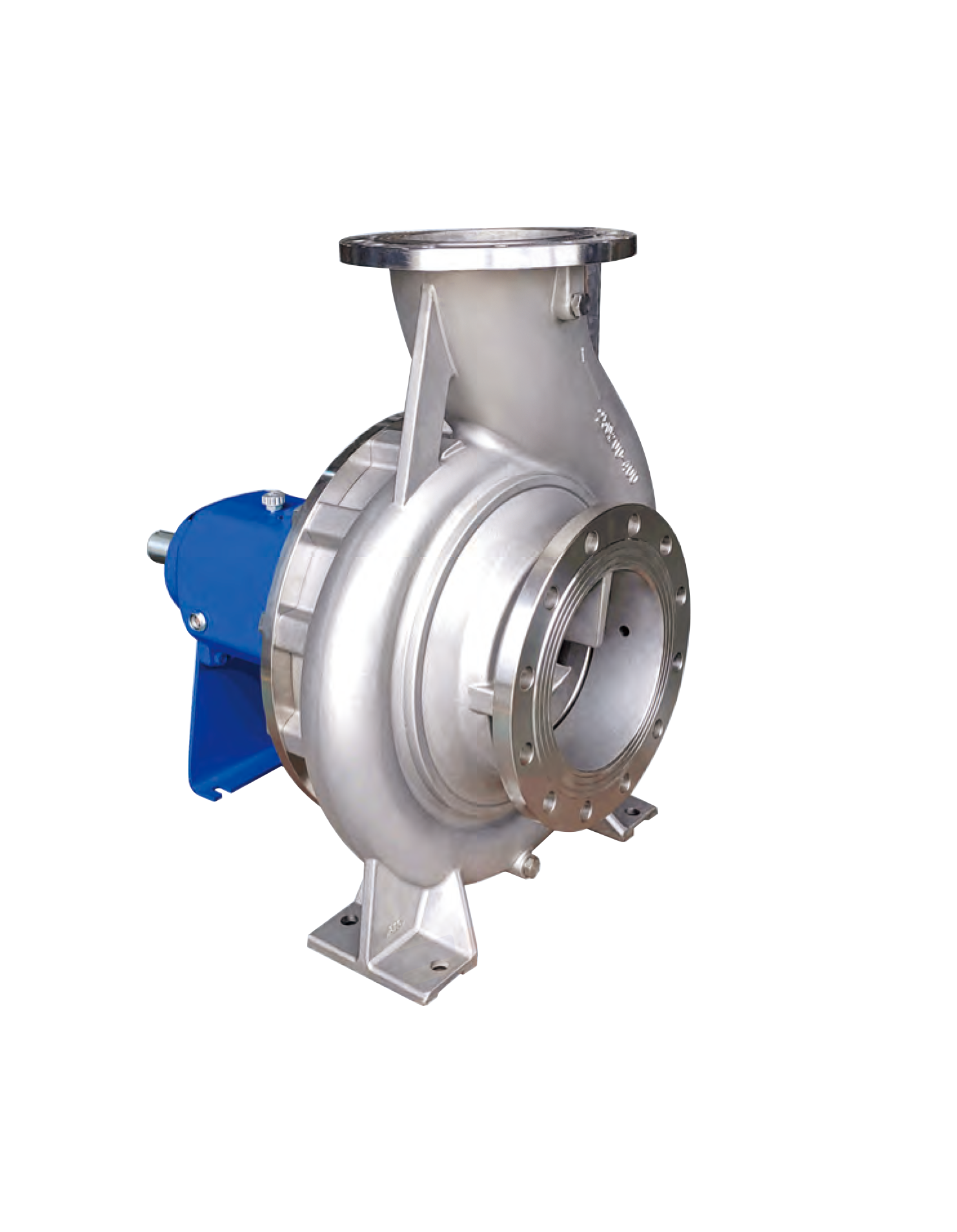
ECC Series SS Sea Water End Suction Horizontal Centrifugal Pump For Light Chemical Industrial
The ECC Series is an end-suction horizontal centrifugal pump. In this arrangement, liquid enters axially through the suction nozzle and is discharged radially through the casing after passing through the rotating impeller. The pump converts mechanical energy from the motor into hydraulic energy, generating flow and pressure for transfer, circulation, process supply, and general industrial liquid handling.
The end-suction structure is widely used because it is straightforward to install, easy to inspect, and familiar to maintenance teams. The suction and discharge connections are arranged in a conventional industrial layout, allowing the pump to be integrated into process pipelines, water-treatment systems, cooling systems, seawater systems, and chemical-transfer installations with minimal complexity.
The ECC Series pump body and impeller are available in stainless steel grades including 304, 316, 316L, 2205, and 2507. This range enables the pump to be configured according to the chemical composition, chloride concentration, temperature, abrasive content, and operating conditions of the pumped liquid.
Stainless steel 304 can be suitable for many general industrial liquids and less aggressive water applications. Stainless steel 316 and 316L provide improved resistance to chlorides and many chemical environments. Duplex stainless steel 2205 offers a combination of strength and corrosion resistance, while super duplex 2507 is intended for more severe chloride-containing and marine services when the application conditions justify its selection.
Material selection must always be confirmed against the actual liquid. A pump described as stainless steel is not automatically suitable for every chemical, concentration, or temperature. The ECC Series provides a material platform that gives engineers more choices than standard carbon-steel or cast-iron pumps, but the final selection should consider the complete process duty.
One of the most important differences between the ECC Series and ordinary general-purpose pumps is its stainless steel wetted construction. The pump body and impeller can be produced from several stainless steel grades rather than being limited to gray cast iron, ductile iron, or a single basic stainless alloy.
Corrosion can rapidly reduce the wall thickness of a pump casing, damage impeller vanes, increase clearances, contaminate the pumped liquid, and lead to unplanned shutdowns. In seawater and chemical applications, the consequences may be more serious because corrosion often occurs together with erosion, pitting, crevice attack, and galvanic effects.
The use of 316L, duplex, or super duplex materials can provide a more suitable foundation for difficult service than standard stainless steel or painted carbon steel. The correct grade depends on the liquid and operating conditions, but the availability of multiple grades gives the ECC Series a competitive advantage when a project requires a tailored materials solution.
End-suction pumps are among the most widely understood centrifugal pump designs in the world. Their operating principles are familiar to technicians, mechanical contractors, and plant maintenance departments. This familiarity can reduce training requirements and simplify the availability of replacement components.
The axial suction port promotes direct liquid entry into the impeller. When the suction line is correctly designed and the pump is installed with adequate net positive suction head, the arrangement supports stable hydraulic operation. The horizontal layout also provides convenient access to the casing, impeller, shaft seal, bearings, and coupling.
Compared with more complex pump arrangements, a conventional end-suction structure can reduce installation uncertainty. It is suitable for skid systems, process lines, utility rooms, water-treatment plants, and industrial pump houses where space, access, and serviceability must be considered together.
The ECC Series is designed to be interchangeable with similar international process-pump designs and follows dimensional and performance principles associated with ISO 5199 and ISO 2858, as well as EN 25199, EN 22858, and DIN 24256 references. The product information also identifies compliance with ISO 7005-1:1992 PN16 flange dimensions as a standard configuration.
Interchangeability is valuable when an operator needs to replace an installed pump without redesigning the entire pipeline. If the pump envelope, nozzle dimensions, base arrangement, shaft centerline, and performance range correspond to the existing equipment, conversion work can be reduced. This can lower installation labor, shorten downtime, and simplify spare-parts planning.
International standard alignment is also beneficial for engineering companies working across different markets. It provides a recognizable technical basis for comparing pumps from different suppliers. However, dimensional compatibility should always be verified through certified drawings and project-specific data before purchase.
Industrial pump performance depends on more than the casing and impeller. The shaft, shaft sleeve, wear rings, gaskets, bearings, and mechanical seal must all be compatible with the pumped liquid and operating conditions.
The ECC Series can be supplied with single mechanical seals, double mechanical seals, cartridge mechanical seals, gland packing, and dynamic-seal arrangements depending on the selected configuration. This flexibility gives plant engineers more control over leakage prevention, maintenance requirements, emissions management, and process safety.
A single mechanical seal may be appropriate for many standard duties. A double mechanical seal can be considered when the liquid is hazardous, volatile, toxic, crystallizing, or difficult to seal. A cartridge seal may reduce installation errors and simplify replacement, while gland packing may be selected for certain heavy-duty or cost-sensitive services.
The correct seal is determined by pressure, temperature, fluid chemistry, solids content, shaft speed, environmental regulations, and the required leakage standard. Offering several arrangements is a competitive advantage because it allows the pump to be adapted to the application rather than forcing every user into one standard seal design.
The ECC Series includes bearing configurations developed for industrial service. The stated design uses a cylindrical roller bearing at the impeller end and two angular-contact ball bearings arranged back-to-back at the drive end in the heavy-duty arrangement. The product information identifies a design bearing life of up to 25,000 hours under appropriate operating conditions.
Bearings support the rotating assembly, control shaft movement, and help maintain the correct relationship between the impeller and casing. In process pumps, bearing reliability is especially important because excessive shaft movement can accelerate seal wear, increase vibration, disturb impeller clearances, and reduce hydraulic efficiency.
The back-to-back angular-contact arrangement is intended to manage axial forces in both directions while maintaining rotational stability. The cylindrical roller bearing supports radial loads at the impeller end. Bearing lubrication may be provided through grease life, grease, or oil lubrication according to the selected pump configuration and service requirements.
The ECC Series incorporates a hydraulic design with impeller diameters up to 547 millimeters. This gives the product platform wider performance coverage than a narrow single-duty pump family. A broader range allows users to select a pump closer to the actual operating point instead of over-sizing a smaller model or operating a larger model inefficiently.
Correct hydraulic selection is essential. A pump should operate near its best efficiency region whenever possible. Running far to the left or right of the preferred operating range may result in excessive recirculation, vibration, noise, bearing loading, seal stress, or energy consumption.
Because the ECC platform covers multiple nominal discharge sizes and impeller configurations, it can serve diverse industrial duties. Final selection should be based on flow rate, total dynamic head, liquid density, viscosity, temperature, vapor pressure, solids content, suction conditions, motor speed, and required control method.
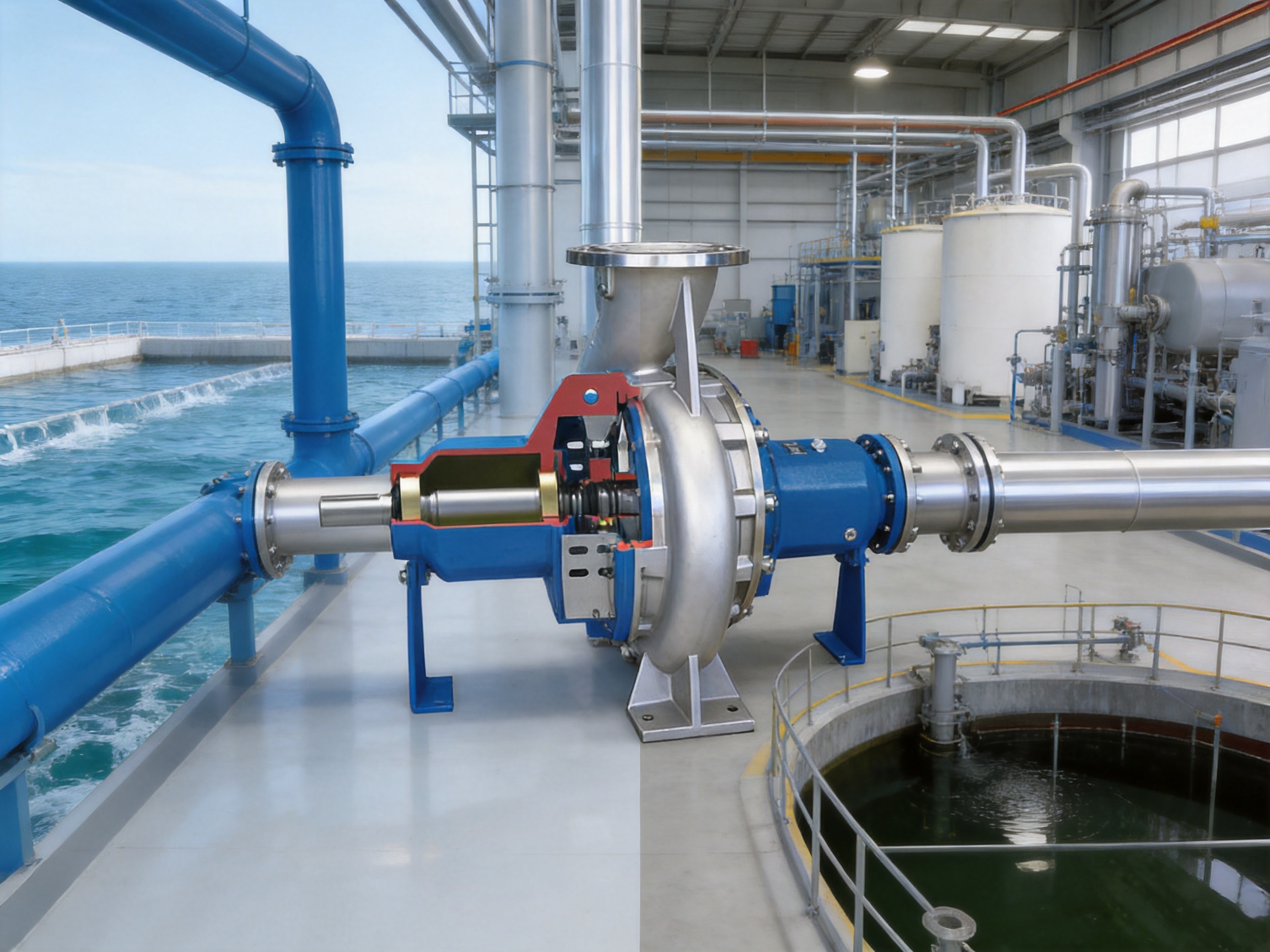
Seawater contains chlorides and dissolved salts that can be highly aggressive toward ordinary carbon steel and unsuitable stainless grades. The ECC Series is designed to address this challenge through a choice of stainless steel materials, including duplex and super duplex options for more demanding conditions.
Typical seawater applications may include seawater intake, cooling-water circulation, desalination support systems, marine utility systems, aquaculture installations, coastal industrial plants, and seawater transfer. The selection of material, seal, gasket, and fastener must be coordinated to limit corrosion and galvanic incompatibility.
Seawater service also requires attention to suspended solids, marine growth, temperature, suction conditions, and intermittent operation. A properly selected pump can provide dependable transfer, but filtration, pipeline design, flushing, and maintenance remain important parts of the overall system.
Chemical plants often handle liquids that vary in acidity, alkalinity, temperature, viscosity, and vapor pressure. The ECC Series can be applied to selected chemical-transfer and circulation duties when its materials and seals are matched to the process liquid.
Possible duties include process-water circulation, chemical solution transfer, wash-water handling, cooling-water movement, neutralization systems, and auxiliary services. For aggressive chemicals, the selected stainless steel grade must be verified using corrosion data rather than relying only on a general material label.
Petrochemical facilities also value pump interchangeability, seal flexibility, and maintainability. A standardized horizontal pump can simplify spare-parts management across several process units and reduce the number of different pump families held in inventory.
Refineries use pumps throughout cooling systems, utility systems, wastewater units, desalination facilities, chemical dosing support, and process-fluid transfer. The ECC Series may be suitable for selected water-based, seawater, and chemically compatible duties within a refinery environment.
Refinery applications require careful consideration of hazardous-area motor requirements, mechanical-seal plans, fire safety, pressure ratings, temperature limits, and process containment. The pump should be integrated into the plant’s engineering standards and inspection procedures.
Paper mills consume large volumes of water and use chemical additives throughout pulping, bleaching, washing, coating, and wastewater treatment. Pumps may encounter suspended fibers, chemicals, elevated temperatures, and continuous operating cycles.
The ECC Series can be considered for compatible water and chemical services, particularly where stainless steel construction provides an advantage over painted or unprotected carbon steel. The pump’s seal and impeller configuration should be selected according to the concentration and nature of solids in the liquid.
Sugar production includes washing, extraction, clarification, evaporation, crystallization, and wastewater-handling stages. Water and process liquids may contain dissolved chemicals, suspended solids, and organic matter.
Stainless steel construction can be useful where corrosion resistance, hygiene, and cleanability are important. In food-related environments, the selected materials and seals should be reviewed for the applicable sanitary and regulatory requirements. The pump should not be assumed to be hygienic-service certified unless the specific configuration has been documented accordingly.
Wastewater systems often involve variable chemistry, suspended solids, biological matter, and intermittent or continuous operation. The ECC Series is suitable for selected wastewater duties where the solids concentration, particle size, and abrasion level remain within the hydraulic design limits.
For heavily solids-laden wastewater, a dedicated solids-handling or non-clog pump may be more appropriate. For clarified water, treated effluent, chemical wastewater, filtration systems, and utility circulation, a stainless steel end-suction pump can offer a useful combination of corrosion resistance and maintainability.
Pharmaceutical and food-processing facilities require careful control of contamination, cleaning, material compatibility, and leakage. The ECC Series may serve compatible water, cleaning, cooling, and utility applications when the selected materials, surface finish, seal arrangement, and documentation meet the project requirements.
Where the pump handles a product that is consumed or injected, the purchaser should request the appropriate sanitary design, surface finish, elastomer certification, and cleaning validation information. For non-product utility systems, the standard industrial configuration may be adequate when approved by the plant engineer.
Component |
Available or stated material/configuration |
Engineering significance |
Pump body |
Stainless steel 304, 316, 316L, 2205, or 2507 |
Provides a material basis for freshwater, seawater, chemical, and corrosive-liquid service selection. |
Impeller |
Stainless steel 304, 316, 316L, 2205, or 2507 |
Maintains hydraulic integrity while improving resistance to corrosion and selected abrasive conditions. |
Shaft |
Stainless steel |
Supports the rotating assembly and reduces the risk of rapid corrosion at the shaft surface. |
Shaft seal |
Mechanical seal, double mechanical seal, cartridge seal, gland packing, or dynamic seal options |
Allows configuration according to leakage control, pressure, temperature, and chemical requirements. |
Bearings |
Industrial bearing arrangement; NTN bearing brand identified |
Supports radial and axial loads and contributes to rotating-assembly stability. |
Lubrication |
Grease life, grease, or oil lubrication |
Provides flexibility for different operating speeds, service intervals, and duty requirements. |
Flanges |
PN16 standard arrangement; other flange patterns available by request |
Facilitates integration with industrial pipelines and project-specific connection standards. |
The casing contains the pressure generated by the impeller and guides liquid toward the discharge nozzle. Its stainless steel construction is central to the pump’s corrosion-resistance strategy. The casing must also maintain dimensional accuracy so that the impeller operates with the intended clearances and hydraulic alignment.
The impeller is the primary energy-transfer component. Its optimized hydraulic profile is intended to provide efficient liquid movement across a broad performance range. An impeller diameter of up to 547 millimeters enables the series to cover larger industrial duties than many compact general-purpose end-suction pumps.
Impeller and shaft connection is described as a tapered arrangement. This design increases the strength of the shaft connection and helps maintain a secure transfer of torque. A robust connection is important in applications involving frequent starts, variable loads, high power, or extended operating hours.
The stainless steel shaft supports the impeller and transmits motor power. In corrosive service, shaft material is important because exposed or poorly protected areas can become sources of pitting and seal damage.
Shaft sleeves can be used to protect the shaft in the seal area. The ECC Series includes options associated with single mechanical seals, double mechanical seals, and packing arrangements. A replaceable sleeve can help control maintenance costs by allowing the worn sealing surface to be renewed without replacing the complete shaft.
Wear rings help control the internal clearance between the impeller and casing. By providing a replaceable wear surface, they can protect the main casing and impeller from accelerated clearance growth. Correct clearance is important for maintaining hydraulic efficiency and limiting internal recirculation.
The ECC Series uses front and rear wear rings and balancing holes in the impeller design to balance most of the axial force. The residual axial force is managed by back-to-back angular-contact ball bearings at the drive end. This combination reduces the load transferred to the motor and helps stabilize the rotating assembly.
Wear-ring materials and clearances should be selected according to the liquid, temperature, speed, and risk of solids ingress. Excessive clearance can reduce efficiency, while insufficient clearance can cause contact during thermal expansion or shaft deflection.
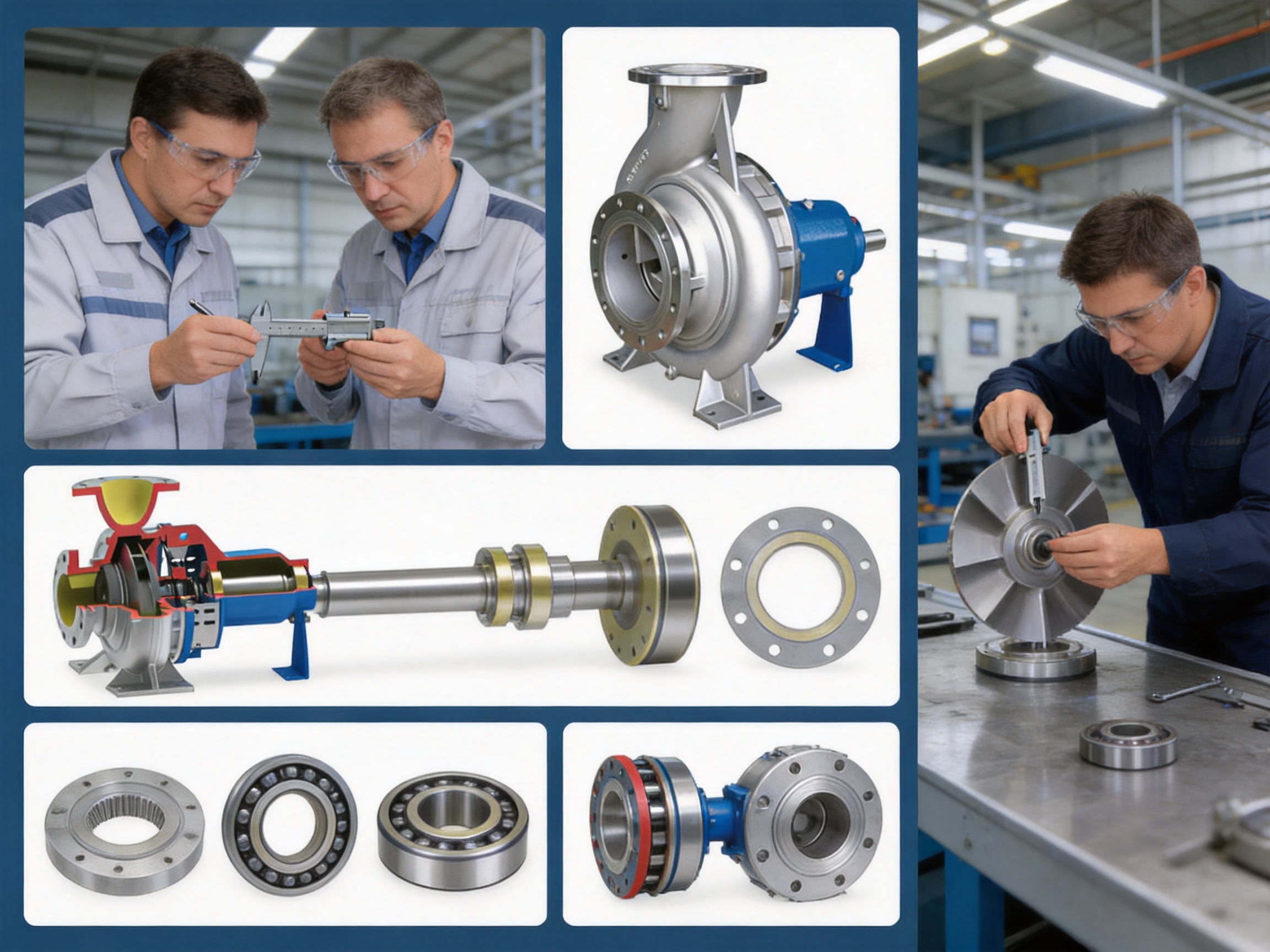
Taizhou Edwin Electric Co., Ltd. operates as an integrated manufacturing enterprise with independent research and development, mass-production capability, and global export experience. This structure is important because it connects product design with manufacturing feedback, field requirements, component sourcing, and after-sales support.
For an industrial pump, research and development is not limited to drawing a casing. It includes hydraulic design, material selection, shaft-strength evaluation, bearing-life assessment, seal compatibility, structural analysis, dimensional interchangeability, and production repeatability.
An integrated manufacturer can revise a design based on production experience and customer feedback more efficiently than a trading organization that only resells unrelated products. This can improve consistency between engineering specifications and the physical pump delivered to the customer.
Material control is a critical manufacturing strength for stainless steel process pumps. Different stainless grades have different chemical compositions, mechanical properties, welding characteristics, corrosion resistance, and cost structures.
A professional manufacturing process should identify the required grade at the purchasing, production, inspection, and documentation stages. Casing, impeller, shaft, sleeves, fasteners, and auxiliary components should not be treated as interchangeable simply because they are all described as stainless steel.
For project applications, the manufacturer can support better decision-making by confirming the selected grade, component application, surface condition, and relevant inspection documentation. This is particularly important for seawater and chemical systems where material substitution can create premature failure.
Industrial pump components require accurate geometry. The casing passages, suction inlet, impeller vanes, shaft fits, bearing seats, seal chambers, and flange faces must be manufactured within controlled dimensional limits.
The production process normally involves forming or casting the casing and impeller, removing excess material, machining critical surfaces, drilling and finishing flange holes, and completing final inspection. Regardless of the specific equipment used, the manufacturing objective is consistent geometry and repeatable assembly.
Precision machining is especially important at bearing housings and seal chambers. A misaligned bearing seat can cause vibration and premature bearing wear, while an inaccurate seal chamber can create leakage or excessive seal-face loading. Accurate flange machining also supports reliable pipeline installation.
Hydraulic efficiency depends on the shape of the impeller, casing passages, blade angles, clearances, and surface condition. The ECC Series is presented as having an optimized hydraulic design with broader performance coverage than the referenced EN 25199/22858 range.
Impeller balancing is another important production step. An unbalanced impeller creates centrifugal forces that increase vibration and bearing loads. Dynamic or static balancing, according to impeller size and design, helps ensure smoother operation and protects the shaft-seal and bearing systems.
A quality-focused manufacturer should verify the rotating assembly after machining and balancing. This is particularly important for larger impellers, higher rotational speeds, and pumps used in continuous-duty industrial applications.
Final assembly determines whether individually acceptable parts function correctly as a complete pump. The shaft, impeller, wear rings, casing cover, bearings, seal, bearing housing, and coupling must be assembled according to controlled procedures.
Alignment between the pump and motor is essential. Poor alignment can increase vibration, overload bearings, damage the mechanical seal, and reduce service life. The pump base, support foot, coupling, and shaft centerline should be checked during assembly and again during site installation.
The availability of standard and heavy-duty bearing housings gives the ECC Series additional configuration flexibility. A standard arrangement can meet many general industrial duties, while a heavy-duty design may be selected for more demanding continuous-operation conditions.
Industrial pump testing may include dimensional inspection, hydrostatic pressure testing, rotating checks, leakage inspection, vibration monitoring, noise assessment, and performance verification. The exact inspection plan should be agreed according to the project specification and required certification.
Performance testing confirms the relationship among flow, head, power, and efficiency. It helps identify whether the selected impeller diameter and hydraulic configuration meet the intended duty. Testing is also valuable for detecting abnormal vibration, seal problems, bearing noise, or hydraulic instability before shipment.
For export projects, documentation can include nameplate information, inspection records, material information, test reports, operating instructions, spare-parts lists, and installation drawings. A complete documentation package improves commissioning and future maintenance.
The company established Taizhou Haipai Import & Export Co., Ltd. and Golden Falcon Industrial Co., Ltd. in 2012 to support procurement planning, order tracking, cross-border delivery, and foreign-trade services. This organizational capability can be valuable for international customers purchasing pumps, accessories, valves, piping products, or multiple equipment categories.
Global pump projects often involve more than manufacturing. Buyers need quotation coordination, technical confirmation, packaging, shipping documents, delivery scheduling, spare parts, and communication across time zones. A manufacturer with an established export support structure can help reduce administrative friction.
Edwin Pump’s broader product portfolio also enables customers to consolidate some purchasing requirements. Its product categories include solar pumps, deep-well pumps, submersible pumps, surface pumps, booster pumps, circulation pumps, garden pumps, pool and spa pumps, commercial multistage pumps, pump accessories, end-suction pumps, pipes and valves, and intelligent booster pumps.
Correct installation is essential for achieving the expected service life of the ECC Series. The pump should be mounted on a rigid foundation that can support the pump, motor, base, piping loads, and operating vibration. The foundation should be level and sufficiently strong to prevent distortion.
The suction pipeline should be as short and direct as practical. Unnecessary elbows, valves, reducers, or high points near the suction nozzle can increase hydraulic losses and encourage air accumulation. The suction pipe should be properly supported so that its weight is not transferred to the pump casing.
The suction line must be airtight. Even a small air leak can cause loss of prime, unstable flow, noise, vibration, and reduced capacity. For suction-lift installations, the pump should be positioned as close as possible to the liquid source, and the available net positive suction head must be checked.
The discharge pipeline should include suitable isolation and check valves where required by the system design. A check valve can help prevent reverse flow during shutdown, while an isolation valve allows maintenance without draining the entire system.
Before commissioning, the operator should verify the motor voltage, rotation direction, lubrication condition, coupling guard, flange bolts, seal arrangement, valve positions, and pipeline cleanliness. The pump must not be operated dry unless the specific seal and pump configuration are designed for that condition.
After startup, the operator should observe discharge pressure, flow, motor current, vibration, bearing temperature, seal leakage, and unusual noise. A small amount of controlled leakage may be acceptable for some packing arrangements, while mechanical seals should be evaluated according to their specified operating behavior.
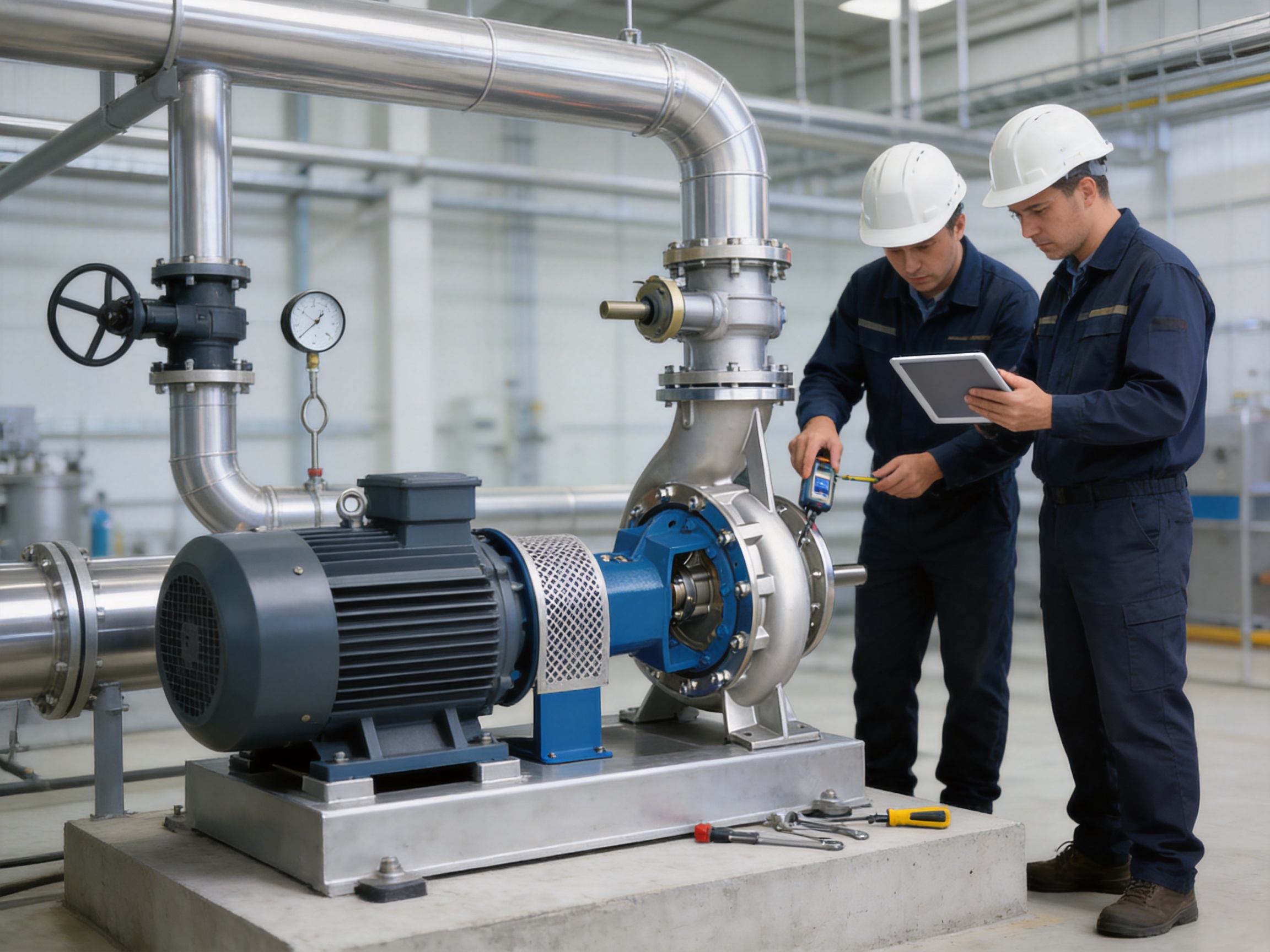
Preventive maintenance is generally more economical than corrective maintenance in industrial pumping systems. The ECC Series should be included in a planned maintenance program based on operating hours, liquid characteristics, criticality, and manufacturer recommendations.
Routine inspections should include checking for abnormal vibration, unusual bearing noise, seal leakage, loose foundation bolts, coupling wear, corrosion, and changes in pressure or flow. Any change from the normal operating condition should be recorded and investigated.
Operators should also monitor motor current. A change in current may indicate altered system resistance, impeller damage, increased liquid viscosity, bearing problems, or operation away from the intended duty point.
Bearing lubrication must follow the selected arrangement. Over-greasing can raise temperature and damage seals, while insufficient lubrication can cause rapid wear. Oil-lubricated bearing housings require correct oil level, suitable oil quality, and regular inspection for contamination.
The stated NTN bearing option provides a recognized industrial bearing source. Nevertheless, bearing life depends on alignment, loading, lubrication, contamination control, operating speed, and installation quality. The stated design life of up to 25,000 hours should be understood as dependent on appropriate operating conditions.
Mechanical seals are precision components. They require clean, compatible liquid at the seal faces and should not be exposed to dry running, excessive vibration, or improper installation. Seal failure may result from worn shafts, misalignment, cavitation, high temperature, crystallization, solids, or incorrect material selection.
When replacing a seal, the shaft sleeve and seal chamber should be inspected. Damaged or scored surfaces can cause premature leakage even when a new seal is installed. Cartridge seals may simplify replacement by integrating several components into a preassembled unit.
Wear-ring clearance should be inspected during overhaul. Excessive clearance reduces pump efficiency and may increase recirculation. Impeller surfaces should be checked for erosion, corrosion, cavitation damage, blockage, and imbalance.
In seawater or chemical service, deposits may accumulate in the impeller passages and casing. Cleaning intervals should be established based on actual operating experience. If the pump handles abrasive particles, inspection may need to be more frequent.
The purchase price of a pump is only one part of its total cost. Energy consumption, maintenance, seal replacement, downtime, spare parts, and system efficiency often have a greater financial impact over the operating life.
The ECC Series can contribute to lifecycle value through optimized hydraulic design, appropriate impeller selection, efficient operation near the best efficiency region, and the availability of replaceable wear components. Stainless steel construction may also reduce the frequency of casing or impeller replacement in corrosive applications.
Energy savings depend on selecting the correct pump and motor combination. A pump that is too large may require throttling and consume unnecessary power. A pump that is too small may fail to provide the required head or operate continuously at an overload point. Variable-frequency control may be considered where demand changes significantly, provided the motor, bearings, seal, and hydraulic system are suitable for variable-speed operation.
Maintenance teams should evaluate the cost of corrosion-related failures. A lower-cost cast-iron pump may be attractive initially, but if it requires frequent repainting, impeller replacement, or emergency shutdowns, a properly selected stainless steel pump can provide better long-term value.
The pump should be selected using a complete duty specification rather than flow and head alone. The following information should be prepared before requesting a technical quotation.
Required flow rate and expected minimum, normal, and maximum flow.
Total dynamic head, including static head, friction losses, and pressure requirements.
Liquid name, concentration, density, viscosity, temperature, and vapor pressure.
Chloride concentration and corrosive components for seawater or chemical service.
Suspended solids, particle size, abrasiveness, and risk of blockage.
Suction condition, liquid level, pipe diameter, and available NPSH.
Power supply, motor voltage, frequency, speed, and hazardous-area requirements.
Required flange standard, pressure rating, installation dimensions, and base arrangement.
Mechanical-seal plan, leakage requirements, and elastomer compatibility.
Required certificates, inspection documents, testing standards, and spare parts.
Once these parameters are available, the manufacturer can recommend the appropriate pump size, impeller diameter, material grade, seal type, bearing arrangement, motor power, and flange configuration. The final selection should be confirmed using a certified performance curve and dimensional drawing.
The ECC Series combines several characteristics that are difficult to obtain in a basic standard pump. It offers a familiar end-suction layout, stainless steel construction, multiple material grades, flexible sealing arrangements, international interchangeability, and industrial bearing options.
Its greatest competitive advantage is adaptability. The pump can be configured for different liquid conditions instead of being restricted to one material and one seal. This is especially useful for engineering contractors and distributors serving multiple industries.
The product is also supported by a manufacturer with a broad experience base in water pumps and export-oriented production. Edwin Pump’s history in domestic, agricultural, municipal, commercial, and intelligent pumping systems provides a foundation for understanding different operating environments. Its investment in new-energy and intelligent technology since 2018 demonstrates an interest in expanding from conventional pumping equipment into more advanced energy and control solutions.
For industrial customers, manufacturing scale is valuable when it is combined with engineering discipline. Mass production can improve component availability and repeatability, while independent research and development supports product adaptation. Export support can help international buyers coordinate technical requirements, procurement, documentation, and delivery.
The ECC Series is a stainless steel end-suction horizontal centrifugal pump. Liquid enters through the axial suction nozzle, passes through the rotating impeller, and exits through the discharge passage.
The pump is intended for water, seawater, acids, alkaline liquids, ammonia, and other corrosive or abrasive liquids when the selected materials, seals, and hydraulic configuration are compatible with the actual service.
Yes, the ECC Series is designed for seawater applications. Stainless steel 316, 316L, duplex 2205, or super duplex 2507 may be considered depending on chloride concentration, temperature, velocity, oxygen content, and other conditions.
There is no universal answer. Stainless steel 304 may suit less aggressive liquids, while 316 or 316L is often considered for higher chloride exposure. Duplex and super duplex grades may be appropriate for more severe marine or chemical conditions. The selection should be confirmed using specific corrosion data.
Available options include single mechanical seals, double mechanical seals, cartridge mechanical seals, gland packing, and dynamic-seal arrangements. The correct choice depends on the fluid, pressure, temperature, solids, leakage requirements, and maintenance strategy.
The series is designed for interchangeability with similar pumps and references ISO, EN, and DIN process-pump standards. However, the purchaser must verify the existing pump’s nozzle dimensions, base dimensions, shaft centerline, motor power, performance, and flange details before replacement.
The product information identifies an impeller diameter of up to 547 millimeters. The actual impeller diameter depends on the selected model, required flow and head, speed, material, and operating point.
The ECC Series offers bearing configurations including a heavy-duty arrangement. The described design uses a cylindrical roller bearing at the impeller end and two back-to-back angular-contact ball bearings at the drive end. Bearing selection should match the pump size and duty.
PN16 flange dimensions are identified as the standard arrangement, with reference to ISO 7005-1:1992. Other flange patterns, including ANSI configurations, may be available by request and should be confirmed during technical review.
The pump can handle selected wastewater duties, but it is not automatically a non-clog solids-handling pump. The concentration, particle size, fiber content, and abrasion level must be checked. A dedicated sewage or solids-handling design may be more suitable for heavily contaminated liquids.
Before startup, verify the foundation, pipeline support, valve positions, motor rotation, lubrication, coupling alignment, seal condition, flange bolts, suction conditions, and system cleanliness. The pump should not be operated dry.
The ECC Series is manufactured by Taizhou Edwin Electric Co., Ltd., also known as Edwin Pump. The company focuses on pump research and development, production, global export, and one-stop procurement support for water and industrial pumping products.
The ECC Series stainless steel end-suction horizontal centrifugal pump is a versatile industrial solution for seawater, corrosive liquids, wastewater, and light chemical service. Its stainless steel construction, range of available grades, flexible sealing systems, heavy-duty bearing options, and international-standard orientation make it more adaptable than many basic general-purpose pumps.
The product is particularly attractive for applications where corrosion resistance and maintainability are more important than the lowest initial purchase price. Its end-suction structure remains familiar and practical, while its materials and configuration options allow engineers to address more demanding process conditions.
Supported by Taizhou Edwin Electric Co., Ltd.’s integrated R&D, manufacturing, mass-production, and export capabilities, the ECC Series offers a combination of technical flexibility and supply-chain support. For the best result, buyers should provide complete process data and request confirmation of pump performance, materials, seals, flange dimensions, motor requirements, testing, and documentation before placing an order.
1. ISO 2858, End-Suction Centrifugal Pumps—Dimensionally Classed, Designation, and Nominal Duty Point.
2. ISO 5199, Technical Specifications for Centrifugal Pumps—Class II.
3. ISO 7005-1, Metallic Flanges—Steel Flanges and Related Dimensions.
4. EN 22858, End-Suction Centrifugal Pumps—Dimensionally Classed, Designation, and Nominal Duty Point.
5. EN 25199, Technical Specifications for Centrifugal Pumps.
6. DIN 24256, End-Suction Centrifugal Pumps—Technical and Dimensional Requirements.
7. Pump Manufacturer Product Information, ECC Series Stainless Steel End-Suction Horizontal Centrifugal Pump.
8. Pump Manufacturer Material and Component Information, Stainless Steel 304, 316, 316L, 2205, and 2507 Configurations.
edwina@edwin-pump.com
+86-13586290903 (WhatsApp)
Xuri Gongliang Cutting Tool Entrepreneurship Park, Wenqiao Town, Wenling City, Taizhou City, Zhejiang Province, China

High Performance Smart Pump Factory


 English