
edwina@edwin-pump.com

View All Products
en
Modern water supply systems increasingly need pumps that can operate reliably in remote locations, under unstable grid conditions, and in renewable-energy installations where solar power is the preferred source. The 4ADPCW AC/DC water-filled solar deep well pump with plastic impeller is designed for exactly these demanding applications. It combines hybrid power compatibility, a brushless water-filled motor, intelligent control, solar MPPT technology, and corrosion-resistant construction in a compact 4-inch submersible body. For rural drinking water, household supply, livestock watering, and small- to medium-scale irrigation, this product provides a practical balance of efficiency, durability, installation flexibility, and long-term operating value.
The pump belongs to the AC/DC hybrid submersible solar pump category, meaning it can operate from solar DC power and also accept AC power within a broad voltage range. This dual-source capability is a major advantage where solar energy is available during the day but grid power or generator power may be required at night, during cloudy weather, or in emergency water supply situations. Rather than forcing users to choose between a solar-only pump and a traditional electric submersible pump, the 4ADPCW series provides one integrated solution for both energy environments.
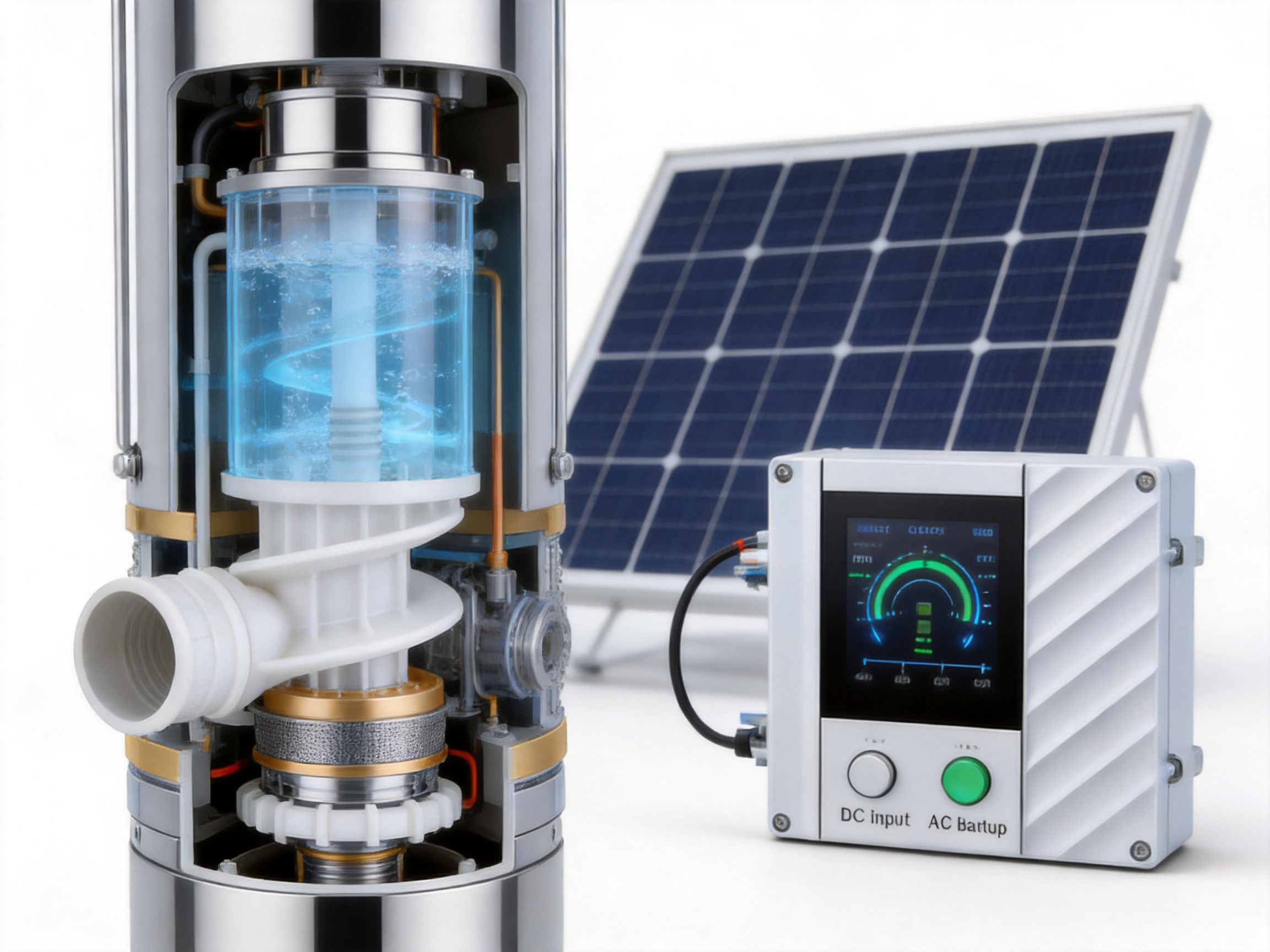
At the center of the design is an AC/DC brushless water-filled motor. The motor is water-cooled and oil-free, reducing environmental concerns while improving heat dissipation in deep well operation. The water-filled structure helps eliminate potential leakage risks commonly associated with mechanical seals and oil-filled motors. In applications where pumped water may be used for household or agricultural purposes, this oil-free design provides an important safety and cleanliness advantage.
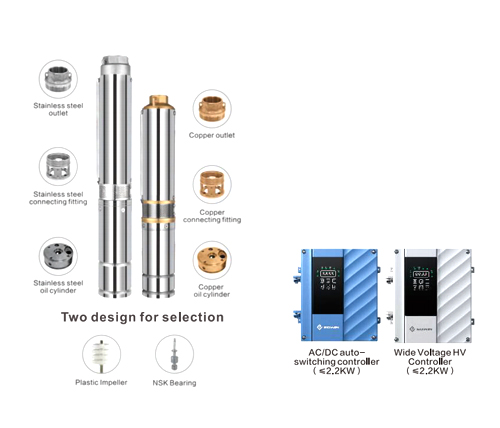
4ADPCW AC/DC Water Filled Solar Deep Well Pump with Plastic Impeller
The 4ADPCW series is developed for users who need dependable water lifting from wells while minimizing dependence on conventional energy. It is especially suitable for remote farms, mountain villages, orchard irrigation projects, greenhouse water supply, pasture management, and domestic water systems in areas with fluctuating grid voltage. The pump’s ability to work with solar panels makes it useful in regions where electricity access is limited, expensive, or unreliable.
Unlike many conventional deep well pumps that require a stable AC supply, this pump accepts AC voltage from 85V to 280V and DC voltage from 80V to 430V. This wide operating window allows the pump to adapt to variable solar input and unstable mains power. In solar mode, the built-in controller uses MPPT, or maximum power point tracking, to continuously optimize energy harvesting from the solar array. This is particularly valuable in real-world conditions where sunlight changes throughout the day because of clouds, temperature, panel angle, or dust accumulation.
The product is available in multiple performance configurations, with maximum flow options including 6m³/h, 9m³/h, 9.5m³/h, 13m³/h, and 17m³/h, and maximum head values ranging from 36m to 175m. This wide selection makes it possible to match the pump to different well depths, pipe lengths, tank heights, and irrigation requirements. Instead of using a single oversized pump that wastes power, users can select a model closer to the real duty point, improving system efficiency and extending service life.
The compact 4-inch diameter housing allows the pump to fit many standard boreholes. In deep well installations, compactness is not merely a convenience; it can determine whether a pump can be installed at all. A pump that combines a narrow profile with high head performance gives installers more flexibility and reduces the need for expensive well modifications.
The 4ADPCW pump is built around a water-filled motor concept. In many submersible pumps, mechanical seals are critical wear components. If seals fail, leakage can occur, leading to motor damage, water contamination, or expensive maintenance. By using a water-filled and water-cooled structure, the 4ADPCW design reduces dependence on oil-filled sealing systems and supports cleaner operation. This is a strong advantage over many low-cost competitors that still rely on less environmentally friendly motor structures.
The brushless motor also contributes to durability. Brushless technology eliminates carbon brush wear, reduces electrical losses, and supports smoother speed control. For solar pumping, brushless operation is especially useful because input power can vary continuously. The motor and controller can adjust more effectively to the energy available from the solar panels, helping maintain stable operation without the frequent stress caused by hard starting.
The intelligent controller provides automatic start and stop functions, soft start, AC/DC switching, and MPPT optimization. Soft start reduces the mechanical and electrical shock that occurs when a pump starts suddenly at full load. This helps protect the motor, impeller system, bearings, cable, and connected pipework. Automatic start and stop improve daily usability, especially in unattended installations. When the system is properly designed, the pump can begin operation when solar input becomes sufficient and stop when the available energy falls below the operating requirement.
MPPT performance is a key competitive advantage. Solar panels do not always deliver their rated output. Their voltage and current vary depending on sunlight intensity, temperature, and load. A pump controller without effective MPPT may operate away from the best power point and waste available energy. The 4ADPCW controller is designed to achieve efficiency exceeding 99% in solar mode, helping convert more solar energy into useful water output.
Deep well pumping creates difficult working conditions. The pump is submerged, difficult to access after installation, and exposed to water chemistry, mineral content, pressure, vibration, and long operating hours. Therefore, structural material and component quality are essential. The 4ADPCW series uses environmentally friendly, oil-free 304 stainless steel for core components. 304 stainless steel is widely valued for its corrosion resistance, mechanical strength, and suitability for water-handling equipment.
The pump includes a stainless steel cylinder, which improves structural stability in deep well environments. A corrosion-resistant impeller system supports reliable hydraulic performance over time. The product is also equipped with Japanese NSK bearings, known for wear resistance and precision. Bearing quality is often one of the differences between a short-life pump and a long-life pump. In submersible operation, bearing failure can lead to noise, vibration, rotor misalignment, loss of efficiency, and eventual motor damage. By selecting high-quality bearings, the pump is engineered for long service life and stable operation.
A ceramic-coated rotor shaft further improves wear resistance. The rotor shaft is a high-stress component exposed to continuous rotation and axial loads. Ceramic coating helps protect the shaft surface from abrasion and corrosion, especially during long operating cycles. The thrust bearing provides stable support against axial hydraulic forces generated by the impeller stages. This contributes to smoother running and reduced internal wear.
Compared with many basic solar pumps that focus only on low price, the 4ADPCW series emphasizes service life. In remote installations, maintenance cost is not limited to spare parts. It also includes travel, labor, downtime, crop risk, water shortage, and system interruption. A more durable pump can therefore reduce total ownership cost even if its initial purchase price is higher than a low-end alternative.
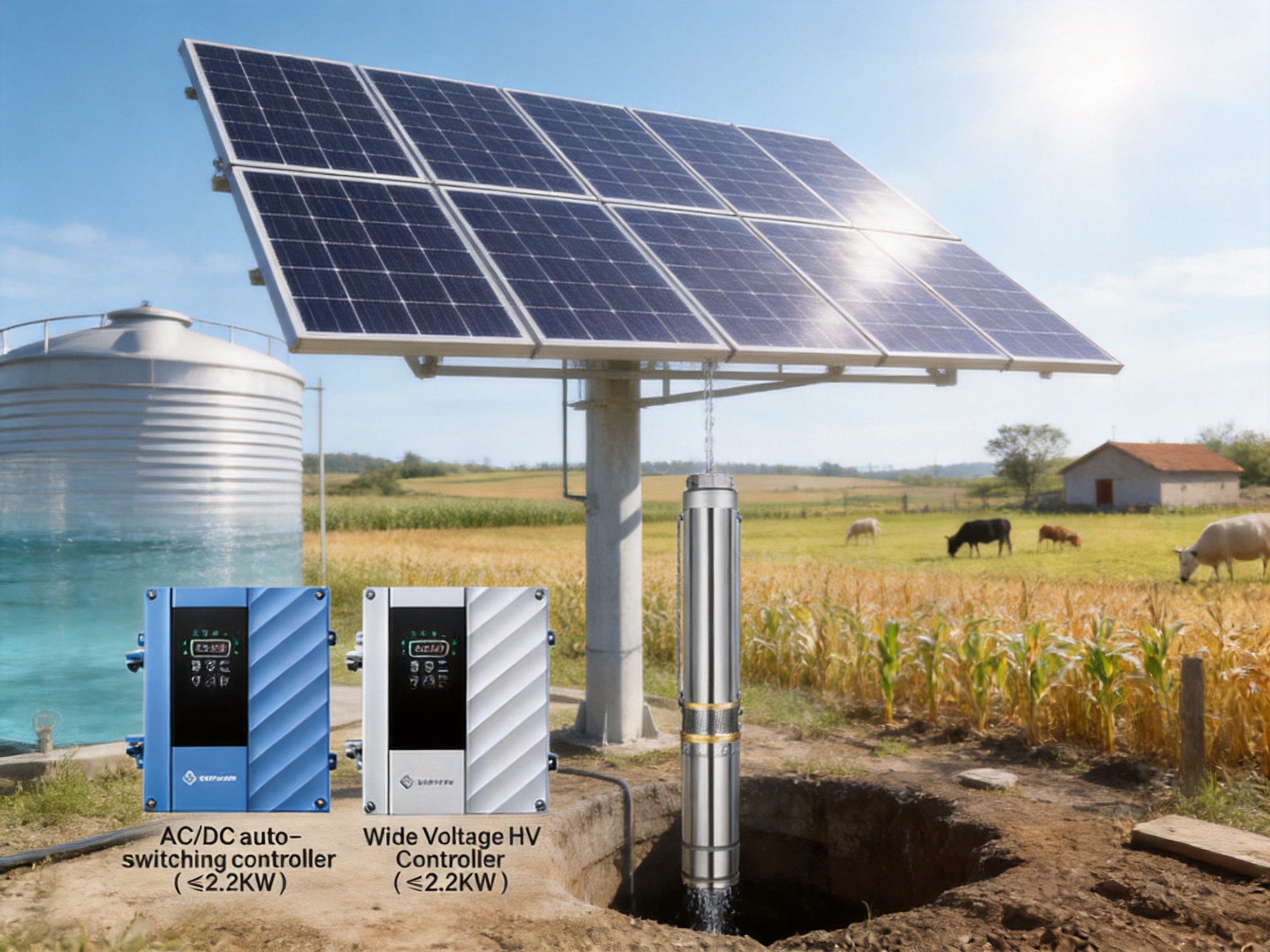
One of the strongest selling points of the 4ADPCW series is its hybrid AC/DC input design. The pump can be powered by solar panels during daylight hours and can also operate from AC power when needed. This flexibility is valuable for users who want renewable-energy savings but cannot accept water supply interruption during poor sunlight conditions.
The AC input range of 85V to 280V is broad enough to handle many unstable grid conditions. In rural and agricultural regions, voltage fluctuation is common, especially at the end of long distribution lines or during peak demand. Conventional AC pumps may fail to start, overheat, or suffer shortened motor life under poor voltage. A pump with wide-voltage tolerance improves reliability and reduces the need for additional voltage stabilization equipment.
The DC input range of 80V to 430V gives system designers flexibility in solar panel configuration. The solar panel open circuit voltage must be below 430V, and the recommended solar panel power is at least 1.3 times the pump power. This guidance helps ensure that the pump receives sufficient energy under normal conditions and improves daily water output. For example, a 750W model should be paired with a solar array of at least approximately 975W, while a 2200W model should use at least approximately 2860W of solar panel capacity.
Hybrid pumping offers a practical transition path for users who are not ready to rely entirely on solar energy. They can start with a solar array sized for daytime pumping and retain AC input as backup. Over time, they may expand solar capacity or add water storage tanks. This approach is often more economical and resilient than relying solely on batteries, which increase system cost and maintenance.
The built-in intelligent controller is more than a power converter. It is a management system that improves the pump’s operation under variable conditions. Automatic start and stop help the pump respond to available power. Soft start reduces start-up current and mechanical shock. AC/DC switching supports multiple energy sources. MPPT improves solar utilization. Together, these functions make the pump easier to install and more reliable in daily use.
In many competitor systems, the controller is separate, basic, or poorly matched to the motor. This can create compatibility issues, wiring complexity, and reduced efficiency. An integrated controller designed specifically for the pump improves coordination between motor performance and electrical input. It also simplifies system design for installers and distributors, because the pump and control logic are matched as one product family.
For solar pumping, intelligent control directly affects water output. A pump may have good mechanical efficiency, but if the controller cannot track panel performance, the system will underperform. The 4ADPCW series is developed for solar mode efficiency exceeding 99%, allowing more of the available solar power to be converted into pumping work. Over a season, this can translate into a meaningful increase in total water delivered.
Soft start also has an important safety and longevity function. A sudden start can produce water hammer in pipelines, stress pipe joints, and cause electrical surges. By starting smoothly, the pump reduces stress on the installation and improves system reliability. This is particularly important in deep well installations with long riser pipes, where mechanical shock can be amplified.
The 4ADPCW series includes multiple models designed for different combinations of flow and head. Proper pump selection should be based on well depth, static water level, dynamic water level, vertical lift to the tank or outlet, pipeline friction loss, irrigation pressure requirement, and desired daily water volume. Choosing the right model is critical because a pump that produces too much flow may waste energy, while a pump with insufficient head may fail to deliver water to the required location.
The following table summarizes the key performance data from the product range. All listed models support 85V to 280V AC input, 80V to 430V DC input, a solar panel open circuit voltage below 430V, and recommended solar panel power of at least 1.3 times pump power.
| Model | Power | Maximum Flow | Maximum Head | Outlet | Cable | Typical Use Focus |
| 4ADPCW6-56-110-750 | 750W | 6m³/h | 56m | 1.25" | 2m | Moderate-depth household and small irrigation supply |
| 4ADPCW6-84-150-1100 | 1100W | 6m³/h | 84m | 1.25" | 2m | Deeper domestic wells with stable flow demand |
| 4ADPCW6-112-150-1300 | 1300W | 6m³/h | 112m | 1.25" | 2m | High-head rural water lifting |
| 4ADPCW6-135-200-1500 | 1500W | 6m³/h | 135m | 1.25" | 2m | Deep well applications requiring pressure reserve |
| 4ADPCW9-45-110-750 | 750W | 9m³/h | 45m | 2" | 2m | Higher-flow shallow to medium wells |
| 4ADPCW9-58-150-1100 | 1100W | 9m³/h | 58m | 2" | 2m | Small farm and garden irrigation |
| 4ADPCW9-71-150-1300 | 1300W | 9m³/h | 71m | 2" | 2m | Medium-head irrigation and household storage filling |
| 4ADPCW9-85-200-1500 | 1500W | 9m³/h | 85m | 2" | 2m | Higher-head agricultural pumping |
| 4ADPCW13-36-110-750 | 750W | 13m³/h | 36m | 2" | 2m | High-flow low-head transfer |
| 4ADPCW13-49-150-1100 | 1100W | 13m³/h | 49m | 2" | 2m | Efficient irrigation where flow is prioritized |
| 4ADPCW13-54-150-1300 | 1300W | 13m³/h | 54m | 2" | 2m | Farm supply and water tank filling |
| 4ADPCW13-60-200-1500 | 1500W | 13m³/h | 60m | 2" | 2m | Medium-scale irrigation with moderate head |
| 4ADPCW17-48-200-1500 | 1500W | 17m³/h | 48m | 2" | 2m | Large flow delivery at moderate lift |
| 4ADPCW6-175-300-2200 | 2200W | 6m³/h | 175m | 1.25" | 2m | Very deep well water lifting |
| 4ADPCW9.5-125-300-2200 | 2200W | 9.5m³/h | 125m | 2" | 2m | Deep well pumping with higher flow |
| 4ADPCW13-110-300-2200 | 2200W | 13m³/h | 110m | 2" | 2m | High-flow deep irrigation systems |
This range shows that the product family is not limited to a single duty point. The 6m³/h models are well suited for deeper lifting where head is the priority. The 9m³/h and 9.5m³/h models balance flow and head for farms and larger households. The 13m³/h and 17m³/h models are better for irrigation and water transfer where higher volume is required. The 2200W models extend the series into more demanding deep well conditions.
Traditional AC submersible pumps are widely used, but they rely on grid power or generators. In locations with unreliable electricity, they may be costly to operate or difficult to use consistently. The 4ADPCW pump’s solar compatibility reduces operating cost by using available sunlight. This is particularly beneficial in agricultural areas where pumping demand often coincides with sunny daytime conditions.
Another advantage is reduced dependence on fuel generators. Diesel or gasoline generators require fuel transport, regular maintenance, oil changes, and operator attention. They also produce noise and emissions. A solar pumping system using the 4ADPCW series can operate quietly and automatically during the day, reducing labor and environmental impact.
Compared with conventional AC pumps, the hybrid input design provides more resilience. If solar power is insufficient, AC input can be used. If grid power is unavailable, solar input can continue operating. This redundancy is valuable for water security. For households, it supports daily water availability. For farms, it can protect crops and livestock from water shortages.
The water-filled, oil-free motor is also an important differentiator. Some conventional submersible pumps use oil-filled motors, which may raise contamination concerns if sealing systems fail. The oil-free structure of the 4ADPCW series provides cleaner operation and aligns better with drinking water and agricultural water expectations.
The solar pump market includes many low-cost products, but not all are suitable for long-term deep well use. Some basic solar pumps have limited voltage ranges, simple controllers, low-grade bearings, weak shaft protection, or limited head capability. The 4ADPCW series is engineered to compete on reliability and performance rather than only on initial price.
Its integrated intelligent controller reduces the complexity of matching pump, motor, and controller. The MPPT function improves solar power utilization, while soft start protects the system. The brushless motor reduces wear. The ceramic-coated rotor shaft and NSK bearings improve mechanical endurance. The 304 stainless steel components and stainless cylinder provide corrosion resistance and structural reliability. These features create a stronger total value proposition than low-cost units that may require early replacement.
Another competitive advantage is the wide product range. Some competitor solar pumps are available in only a few duty points, forcing buyers to compromise. The 4ADPCW range offers various combinations of power, flow, and head, making it easier to design systems accurately. A well-matched pump runs more efficiently and experiences less stress, which improves operating economy.
The AC/DC hybrid capability also distinguishes the pump from solar-only alternatives. Solar-only pumps can be excellent in fully off-grid systems, but users may still need backup pumping during extended cloudy weather. A hybrid pump gives the user more options without requiring a second pump. This reduces equipment duplication and simplifies the installation.
The manufacturer behind this product, Taizhou Edwin Electric Co., Ltd., also known as Edwin Pump, was founded in 2008 and has developed as an integrated manufacturing enterprise specializing in independent research and development, mass production, and global export. Its core product lines include deep well pumps, submersible pumps, domestic booster pumps, circulation pumps, solar water pumps, and intelligent booster pumps. This broad pump manufacturing background supports the development of specialized products such as the 4ADPCW AC/DC hybrid solar deep well pump.
The company focuses on medium- to high-end global markets, where consistent quality and dependable service are essential. Since 2018, it has invested in new energy and intelligent technology, expanding into solar water pumps and smart pumping solutions. This direction aligns closely with the needs of modern water systems, where energy efficiency, automated control, and renewable power compatibility are increasingly important.
Advanced manufacturing is not defined by a single machine or process; it is the combination of material control, component precision, motor design, hydraulic performance, electronic control integration, assembly discipline, and testing. For a submersible solar pump, every part must work under real operating stress. The stainless steel cylinder must maintain dimensional accuracy. The motor must remain stable under variable input. The rotor shaft must resist wear. The bearings must support continuous rotation. The controller must react to voltage and sunlight changes. The finished pump must deliver the expected flow and head.
In production, high-quality material selection is the first step. 304 stainless steel is used for core oil-free components because it offers strength and corrosion resistance. Precision processing of metal parts helps ensure correct alignment, stable rotor clearance, and reduced vibration. The ceramic-coated rotor shaft adds a protective surface treatment to one of the most important rotating elements. Bearing installation requires cleanliness and precision because bearing damage at assembly can shorten pump life even before the product enters service.
Motor assembly is especially important in a water-filled brushless pump. The stator, rotor, shaft, bearings, and thrust support must be aligned to reduce friction and noise. The water-filled structure must be clean and stable. The brushless motor must coordinate with the intelligent controller. Controller assembly and calibration require electrical expertise because MPPT performance, soft start behavior, and AC/DC switching must be reliable under varied power conditions.
Before shipment, a responsible manufacturer typically verifies electrical safety, running performance, water output, vibration, insulation, and controller behavior. While specific test procedures depend on the production line and order requirements, the product’s design clearly requires performance validation. Pumps used in deep wells are difficult to retrieve, so quality control at the factory is far more economical than correction in the field.
For global buyers, product quality is only part of the purchasing decision. They also need order support, delivery coordination, documentation, spare parts planning, and technical communication. To support diverse purchasing needs and one-stop services, the company established Taizhou Haipai Import & Export Co., Ltd. and Golden Falcon Industrial Co., Ltd. in 2012. These service structures support procurement planning, order tracking, cross-border delivery, and foreign trade services.
This is significant for distributors, contractors, and project buyers because solar pumping projects often require more than one pump. They may need accessories, pipes, valves, booster pumps, circulation pumps, and technical selection assistance. A manufacturer with a broad product category base can support integrated procurement more effectively than a supplier with only one product line.
The company’s pumps are used in new energy projects, agricultural irrigation, municipal engineering, mining, construction, HVAC systems, and household water supply. Such application diversity helps strengthen product knowledge. Lessons from deep well pumping, domestic pressure systems, and industrial water handling can support better design decisions in solar pump development.
The 4ADPCW AC/DC solar deep well pump supports cleaner water supply by reducing dependence on fossil-fuel generators and enabling direct use of solar energy. In many agricultural areas, pumping is one of the major recurring energy costs. Solar pumping can reduce electricity bills or fuel consumption, especially during irrigation seasons. Because the pump can operate when sunshine is abundant, it matches well with daytime water demand.
The oil-free water-filled motor design also provides environmental value. By avoiding oil-filled construction, the pump reduces the potential for oil leakage into well water. This is especially important in drinking water and food-production environments. The use of stainless steel core components improves durability, reducing the environmental burden associated with frequent product replacement.
Economic value should be evaluated over the full service life. A cheaper pump that fails early may cost more in labor, downtime, replacement, and lost water supply. The 4ADPCW series addresses long-term value through quality bearings, a ceramic-coated rotor shaft, stainless construction, intelligent control, and efficient solar operation. These features help reduce maintenance risk and improve daily output.
The recommendation to size solar panel power at least 1.3 times pump power also supports practical performance. Oversizing the solar array relative to the pump helps compensate for sunlight variation, panel temperature effects, and non-ideal installation angles. A properly sized solar system allows the pump to operate for more hours per day and deliver more consistent water volume.
Although the pump is designed for flexible operation, good system design remains essential. The installer should confirm the well diameter, static water level, dynamic water level, total head, required flow, pipe diameter, cable length, and power source. The pump should be selected according to the actual duty point rather than only maximum head or maximum flow. Maximum head is the point where flow approaches zero, and maximum flow is measured under low head conditions. Real operation usually occurs between these extremes.
The solar panel array must be designed so that the open circuit voltage remains below 430V. The array power should be at least 1.3 times the pump power. Local sunlight conditions, seasonal variation, panel angle, and shading should be considered. In areas with frequent cloudy weather, a larger solar array or AC backup may improve water security.
Pipework should be sized to reduce friction losses. A pipe that is too small can reduce flow and increase energy consumption. Check valves, protection devices, water level sensors, and storage tanks may be used depending on the project design. Water storage is often more economical than battery storage in solar pumping systems. By pumping water into an elevated or ground storage tank during the day, users can access water when the pump is not running.
The 2m cable supplied with the pump is a basic factory cable length. In most deep well installations, additional submersible cable is required. Cable sizing should account for current, voltage drop, installation depth, and local electrical standards. Proper waterproof cable joints are essential because poor connections are a common cause of pump failure.
The pump should not run in conditions outside its intended range. Proper submergence, clean water conditions, and protection against dry running or severe sand content help extend service life. If the well contains high sand content, users should evaluate suitability carefully and consider filtration or well development measures.
For rural drinking water supply, the pump can lift water from a borehole into a storage tank during the day using solar panels. The household can then use gravity feed or a pressure booster system for daily consumption. The oil-free water-filled motor structure is beneficial in this context because water cleanliness matters.
For small and medium irrigation, the higher-flow models such as 9m³/h, 13m³/h, and 17m³/h can support orchards, vegetable fields, greenhouses, and livestock water points. When irrigation scheduling is aligned with daylight hours, solar pumping can significantly reduce energy expenses.
For remote farms, the AC/DC hybrid function provides resilience. The pump can use solar energy most of the time, while AC power or a generator can be used when urgent water supply is needed. This is more flexible than a solar-only system and more economical than a generator-only system.
For deep well applications, the 6m³/h high-head models and the 2200W models offer head ratings up to 175m. These models are suitable where vertical lift is the main challenge. The combination of stainless construction, quality bearings, and thrust support is important for these demanding conditions.
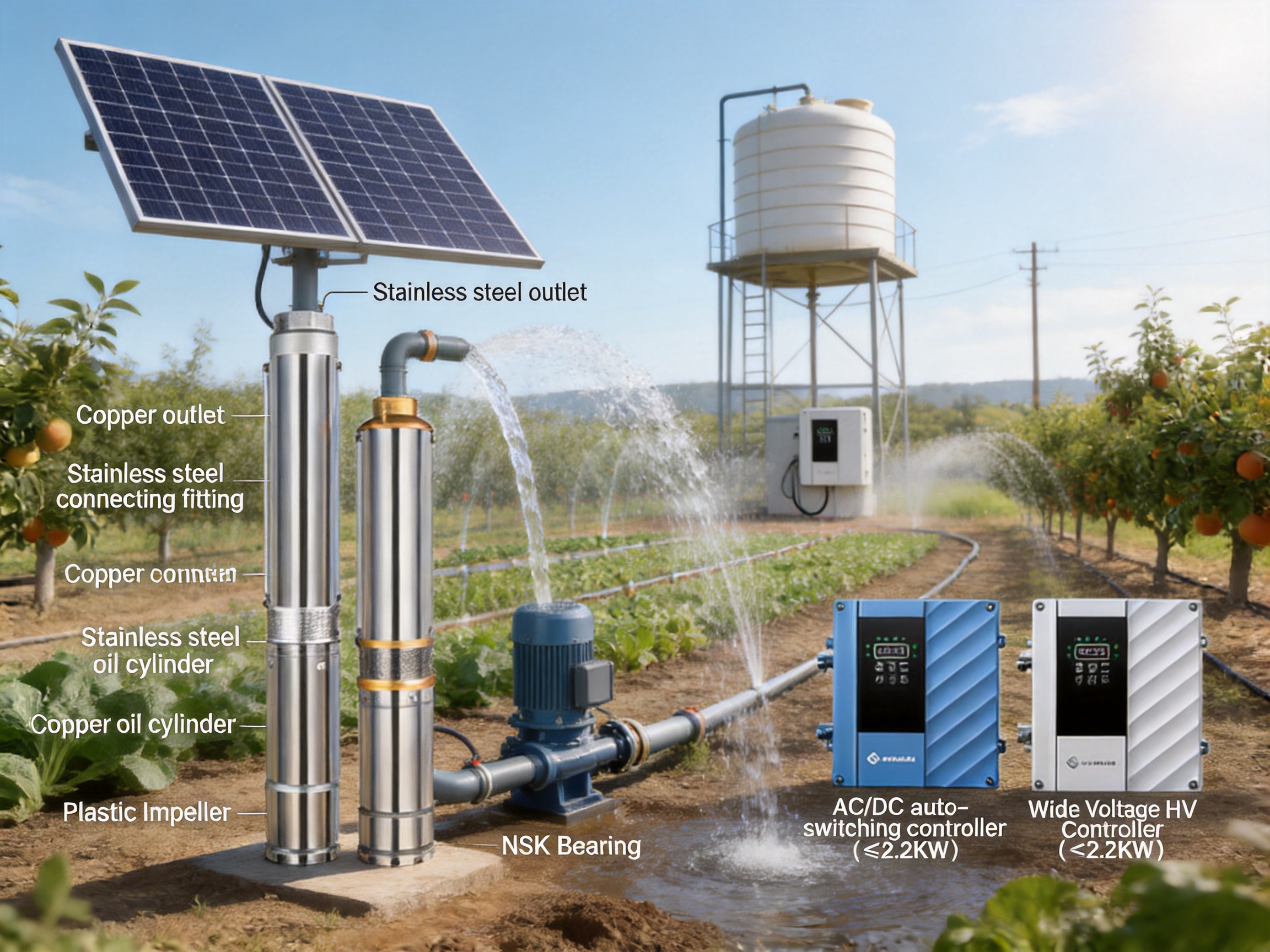
Distributors and project suppliers need products that are technically competitive, easy to explain, and suitable for multiple market segments. The 4ADPCW series offers clear selling points: AC/DC hybrid input, brushless water-filled motor, oil-free construction, MPPT efficiency, wide voltage range, stainless steel core components, NSK bearings, ceramic-coated rotor shaft, soft start, and multiple models. These features help sales teams present the pump as a premium practical solution rather than a commodity product.
The product also fits growing market demand for renewable-energy water systems. Solar pumping is expanding in agriculture, rural development, and off-grid infrastructure. A pump that can use solar power while retaining AC compatibility gives distributors access to both traditional and renewable-energy customers.
Because the manufacturer offers broad water pump categories, buyers can combine solar deep well pumps with other product lines such as submersible pumps, booster pumps, circulation pumps, garden pumps, pool and spa pumps, commercial multistage pumps, end suction pumps, pipes, valves, and pump accessories. This supports one-stop procurement and simplifies supplier management.
It is an AC/DC hybrid submersible solar deep well pump designed for operation from both solar DC power and AC power. It uses a brushless water-filled motor and an intelligent controller with MPPT in solar mode.
The pump is suitable for rural drinking water, household water supply, agricultural irrigation, livestock watering, water tank filling, and small- to medium-scale water projects, especially where solar energy or unstable grid power is common.
The series supports AC input from 85V to 280V and DC input from 80V to 430V. The solar panel open circuit voltage should remain below 430V.
The recommended solar panel power is at least 1.3 times the pump power. For example, a 1500W pump should generally be paired with at least 1950W of solar panel capacity, subject to local sunlight and system design conditions.
MPPT allows the controller to track the best operating point of the solar panels, helping the pump use available sunlight more efficiently. This improves daily water output compared with basic controllers that do not optimize solar input effectively.
A water-filled motor supports cooling and oil-free operation. It reduces potential leakage concerns associated with oil-filled designs and is well suited for water supply applications where cleanliness is important.
Brushless motors reduce wear because they do not rely on carbon brushes. They also support efficient operation and better control under variable solar power conditions.
Durability comes from the combination of 304 stainless steel core components, stainless cylinder construction, quality NSK bearings, ceramic-coated rotor shaft, thrust bearing support, water-cooled structure, and soft-start intelligent control.
Yes. In many solar pumping systems, the pump can work directly with a properly designed solar panel array. Water storage tanks are often used instead of batteries to store useful output.
Solar panels do not generate power at night, but the pump can operate from AC power if an appropriate AC source is available. This is one of the benefits of the AC/DC hybrid design.
Users should calculate total dynamic head, required flow, well depth, water level, pipe friction loss, and daily water demand. The selected model should match the real duty point, not only the maximum flow or maximum head value.
The listed models provide maximum head values from 36m up to 175m, depending on power and flow configuration.
The listed models include maximum flow options from 6m³/h up to 17m³/h.
AC/DC switching allows users to operate with solar energy when available and use AC power as backup. This improves water supply reliability and reduces dependence on a single energy source.
The 4ADPCW AC/DC water-filled solar deep well pump with plastic impeller is a modern pumping solution for users who need dependable water supply, renewable-energy compatibility, and long-term durability. Its hybrid AC/DC input design allows flexible operation from solar panels or AC power. Its brushless water-filled motor supports efficient, oil-free, water-cooled performance. Its intelligent controller provides automatic start and stop, soft start, AC/DC switching, and MPPT optimization with solar mode efficiency exceeding 99%.
From a mechanical perspective, the pump is engineered for deep well reliability through 304 stainless steel core components, a stainless steel cylinder, corrosion-resistant hydraulic construction, Japanese NSK bearings, a ceramic-coated rotor shaft, and thrust bearing support. From a system perspective, the wide model range enables accurate selection for household water, rural drinking water, livestock supply, irrigation, and high-head deep well projects.
Compared with conventional AC pumps, the 4ADPCW series reduces dependence on unstable grid power and fuel generators. Compared with basic solar pump competitors, it offers stronger intelligent control, better component quality, broader power flexibility, and a more complete performance range. Supported by an experienced manufacturer with integrated R&D, mass production, global export service, and investment in new energy and intelligent pump technology, the product provides strong value for end users, installers, distributors, and project buyers.
For water supply systems that must be efficient, resilient, clean, and suitable for renewable energy, this AC/DC hybrid submersible solar pump is a practical and future-ready choice.
1. Solar Photovoltaic Water Pumping Systems: Design Principles and Field Application Guidelines.
2. Submersible Pump Engineering Handbook: Motor Cooling, Bearing Support, and Hydraulic Performance.
3. Stainless Steel Materials in Water Handling Equipment: Corrosion Resistance and Service Life Considerations.
4. Brushless DC Motor Control for Renewable Energy Pumping Applications.
5. Maximum Power Point Tracking Methods for Solar Pump Controllers.
6. Agricultural Irrigation Pump Selection and Total Dynamic Head Calculation Manual.
edwina@edwin-pump.com
+86-13586290903 (WhatsApp)
Xuri Gongliang Cutting Tool Entrepreneurship Park, Wenqiao Town, Wenling City, Taizhou City, Zhejiang Province, China

High Performance Smart Pump Factory


 English