edwina@edwin-pump.com

View All Products
en
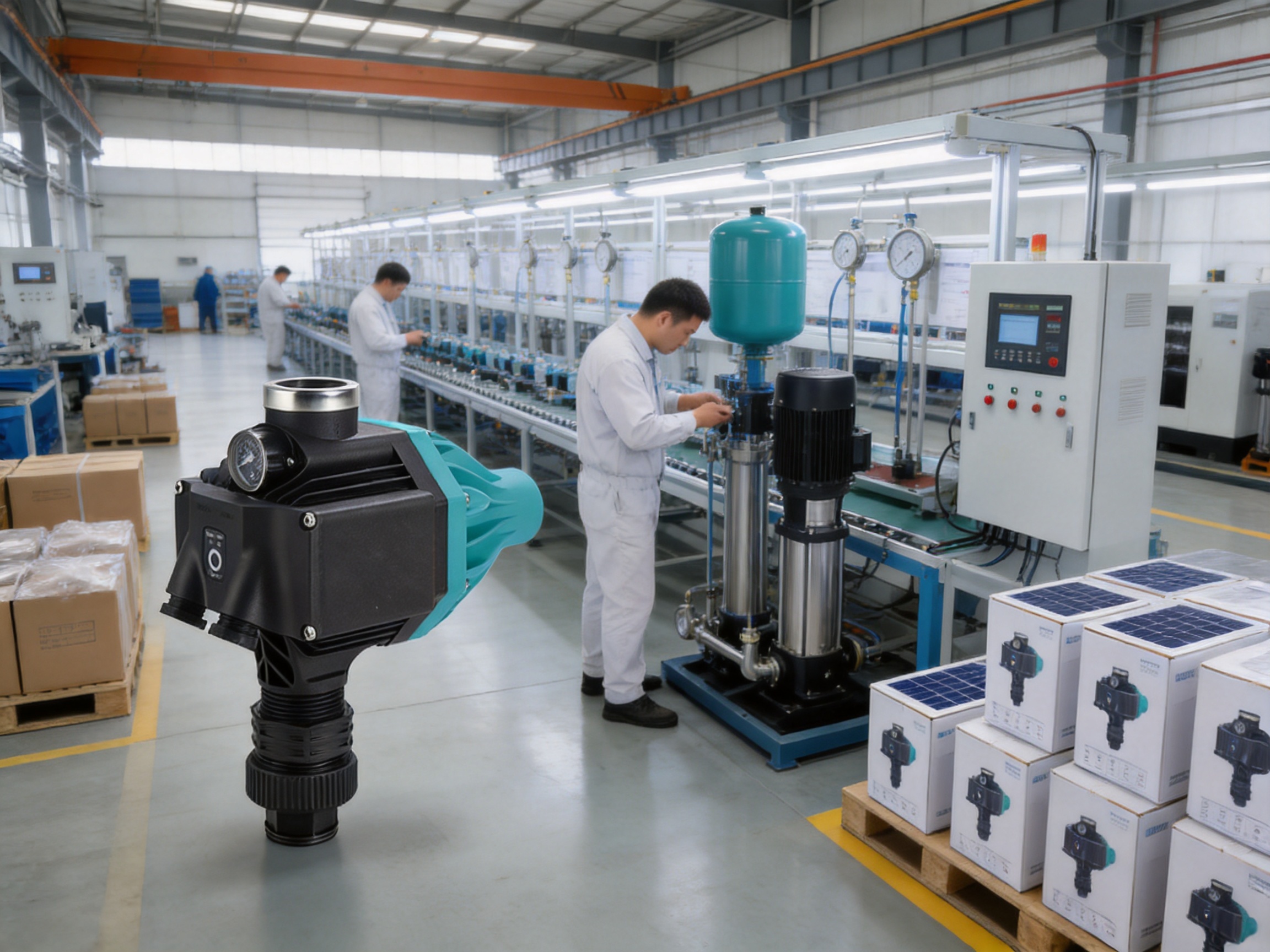
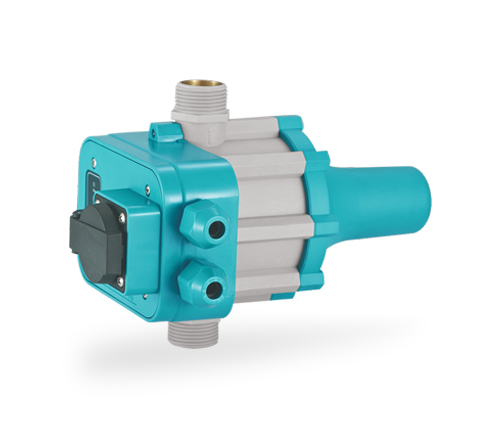
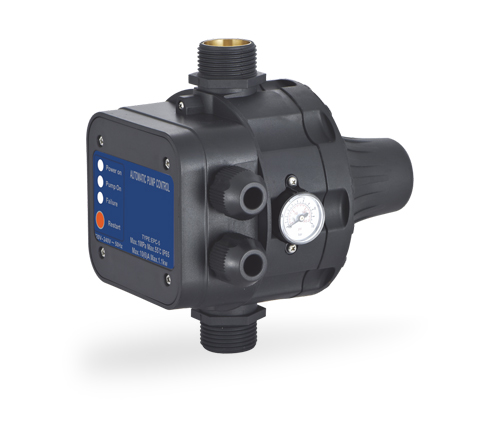
Reliable pressure control is essential in residential, agricultural, commercial, and light industrial water systems. A pump may have sufficient motor power and hydraulic capacity, but without an appropriate control device, the system can experience unstable pressure, unnecessary cycling, dry-running damage, leakage-related operation, and inconvenient manual intervention. The EPC-13M Series 10 Bar 1.5 kW Auto Reset Pressure Switch is designed to address these operating requirements by combining automatic pump control, pressure monitoring, protective functions, and flexible electrical compatibility in one compact controller.
Designed for water pump applications, the EPC-13M Series can control pumps with a maximum rated power of up to 1.5 kW in the corresponding voltage configuration. It supports a maximum working pressure of 10 bar, operates at 50/60 Hz, and offers IP65 protection. Its built-in check valve, status indicator, external pressure gauge connection, selectable starting pressure, and optional anti-dry-run and auto-reset functions make it a practical solution for systems that need dependable automatic operation.
The controller is suitable for booster pumps, surface pumps, domestic water supply pumps, garden pumps, submersible pump installations, and selected small commercial water systems. It can help transform a manually operated pump into a more convenient automatic water supply system by starting the pump when pressure falls and stopping operation when the water demand is satisfied.
Beyond the product itself, the manufacturing strength behind the controller is also important. Taizhou Edwin Electric Co., Ltd. is an integrated manufacturer with experience in independent research and development, mass production, and international export. Its broader product portfolio includes deep well pumps, submersible pumps, domestic booster pumps, circulation pumps, solar water pumps, intelligent booster pumps, and water-treatment accessories. This wider engineering background supports a better understanding of complete pumping systems rather than treating the pressure switch as an isolated component.
The EPC-13M Series is an automatic pressure controller developed for water pumps that require reliable start-and-stop management. Instead of requiring a user to operate the pump manually, the controller responds to changes in system pressure. When water is used and the pressure decreases to the selected starting level, the controller sends a signal to start the pump. When demand stops and pressure conditions stabilize, the pump can stop automatically according to the controller’s operating logic.
The controller is rated for a maximum working pressure of 10 bar. This pressure rating provides a useful operating margin for many domestic, agricultural, and light commercial systems. The actual system pressure must still be selected according to the pump curve, pipe rating, tank rating, fittings, valves, and local installation requirements. A pressure switch should never be used to compensate for an incorrectly sized pump or an unsuitable pipe network.
The EPC-13M Series is available in several electrical configurations. The supplied technical information lists 220–240 V, 110–120 V, and 110–240 V versions. Depending on the voltage version, the maximum applicable motor power may be 1.5 kW, 0.75 kW, or 0.75/1.5 kW. Correct matching between the pressure controller, motor voltage, motor current, and wiring arrangement is essential for safe and dependable service.
Operating at 50/60 Hz, the controller can be used in different electrical markets when the correct voltage configuration is selected. The maximum working temperature is 55°C, and the IP65 protection rating helps protect the enclosure against dust ingress and water jets from different directions. The IP rating does not mean that the device should be submerged or exposed to permanent flooding. Installation in a protected, correctly oriented location remains necessary.
Product series | EPC-13M Series |
Product type | Automatic pressure controller for water pumps |
Maximum working pressure | 10 bar |
Rated voltage options | 110–120 V, 220–240 V, or 110–240 V |
Frequency | 50/60 Hz |
Maximum motor power | Up to 1.5 kW, depending on the voltage version |
Starting pressure options | 1.2 bar, 1.5 bar, or 2.2 bar configurations |
Connection threads | G1 and G1¼ configurations |
Maximum working temperature | 55°C |
Protection rating | IP65 |
Main additional features | Built-in check valve, status indicator, pressure gauge connection, anti-dry-run and auto-reset options |
Warranty information | One-year warranty coverage |
The starting pressure can be selected according to the application and the required level of water service. The available technical configurations include 1.2 bar, 1.5 bar, and 2.2 bar. Product literature also describes an adjustable starting-pressure range of approximately 1.5 to 2.5 bar. Because pressure settings can vary by version or configuration, buyers and installers should confirm the exact setting before ordering and commissioning.
One of the main benefits of the EPC-13M Series is its automatic response to changing water demand. In a conventional installation, the user may need to start and stop the pump using a manual switch. This can be inconvenient and can lead to the pump being left running after a tap or irrigation outlet has been closed. An automatic pressure controller reduces this dependence on manual operation.
When a faucet, shower, irrigation outlet, or other water-use point is opened, the pressure in the system begins to fall. Once the pressure reaches the selected starting point, the controller activates the pump. As the pump supplies water and the demand changes, the controller manages the operating sequence according to the pressure conditions. When the demand ends, the system can return to a stable state without requiring the operator to switch off the pump manually.
This operating method is particularly useful for homes, small farms, gardens, workshops, and commercial premises where water is consumed intermittently. It can improve user convenience while also reducing the risk of incorrect manual operation. In applications with multiple outlets, correct pump sizing and suitable pipework remain important because a controller cannot create flow or pressure that the pump is unable to provide.
Automatic control may also help improve the service life of the installation by ensuring that the pump is activated in response to actual demand rather than being operated continuously. However, the frequency of starts and stops should be considered. If a system has very small leaks, an undersized pressure vessel, or a poorly adjusted pressure setting, the pump may cycle repeatedly. Proper installation and system inspection are therefore necessary to obtain the best result.
The built-in check valve is a valuable feature for maintaining pressure within the discharge line. A check valve helps prevent water from flowing backward through the controller and pump when the pump is not operating. This can support faster pressure recovery, reduce reverse flow, and help maintain a more stable operating condition.
In a system without effective non-return protection, water may drain back toward the source after the pump stops. Such backflow can cause pressure loss and may result in unnecessary pump restarts. The integrated check valve simplifies the installation by combining an important hydraulic function with the electronic pressure control assembly.
The check valve should not be considered a substitute for every other valve required by the system design. Depending on the installation, additional isolation valves, foot valves, filters, pressure vessels, relief devices, or service valves may still be necessary. For deep wells and suction-lift installations, the installer should confirm that the check-valve arrangement is suitable for the pump type and water source.
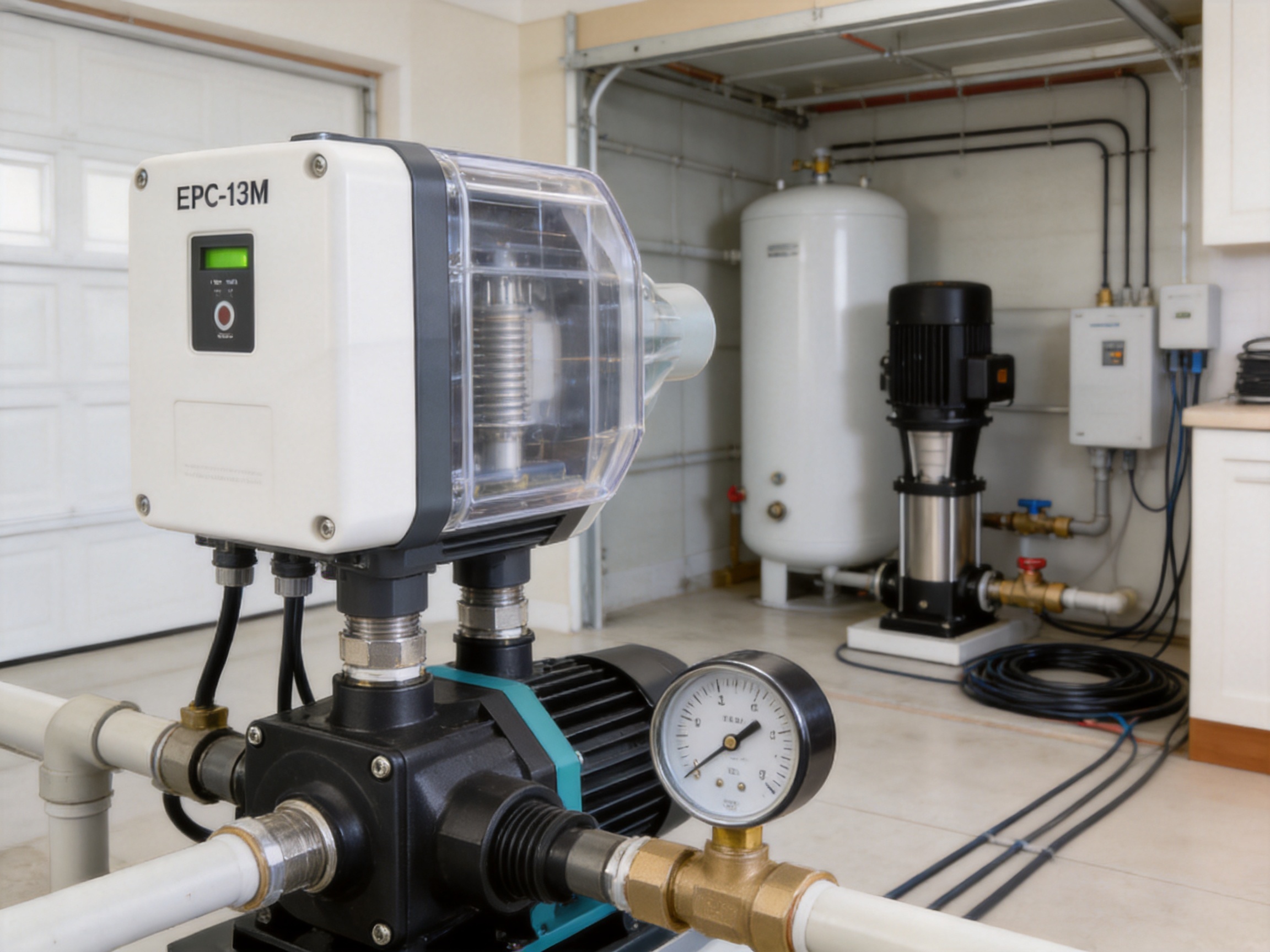
The EPC-13M Series provides a connection for an external pressure gauge. This feature allows the operator or technician to observe system pressure directly during installation, testing, adjustment, and maintenance. A visible pressure reading can make troubleshooting more efficient because it provides information about pressure behavior rather than relying only on pump sound or water flow.
A pressure gauge can help identify several common conditions. If the pressure does not rise as expected, the cause may be insufficient pump capacity, an air leak, a blocked suction line, a damaged impeller, a leaking valve, or inadequate water supply. If the pressure rises too quickly or reaches an unexpectedly high level, the discharge line, outlet valve, or pressure setting may require inspection.
The gauge connection also helps users compare actual system performance with the pump’s rated operating range. This is especially useful when the controller is installed on a booster system or a pump serving several outlets. The gauge should be selected with a suitable pressure range, connection size, and accuracy for the application. Installation should be completed with appropriate sealing methods while avoiding excessive tightening that could damage threaded components.
An indicator light reflects the working status of the controller. This simple visual feature can save time during operation and service. A technician can quickly determine whether the controller has electrical power, whether the pump-control sequence is active, or whether further testing is required.
Status indication is especially useful in installations where the pump itself is located in a pit, well, plant room, or remote equipment area. Instead of opening the pump enclosure immediately, the operator can first inspect the controller’s visible indication. Although an indicator light cannot replace electrical testing or pressure measurement, it provides an immediate reference for routine checks.
For commercial users and maintenance teams, clear indication can also support faster fault reporting. An operator may record the pump condition, water demand, pressure gauge reading, and indicator status before contacting a service technician. This information can reduce unnecessary site visits and help maintenance personnel prepare the correct replacement components.
The auto-reset function is one of the most distinctive features of this pressure controller. If a pressure drop or temporary system fault occurs, the controller can automatically attempt to restore normal operation after the underlying condition has been resolved. This reduces the need for manual resetting and can be particularly valuable in installations that are not constantly supervised.
Automatic recovery is useful in situations such as temporary water interruption, an air pocket in the suction line, or a brief abnormal operating condition. Instead of requiring a person to return to the controller and restart the system, the auto-reset logic can provide another opportunity for normal operation. This is convenient for domestic water systems, garden irrigation, and remote agricultural installations.
The smart program also offers an anti-dry-run option. Dry running occurs when the pump operates without an adequate supply of water. This condition can cause overheating, accelerated wear, seal damage, and other failures. By detecting an abnormal operating pattern or pressure condition, the controller may interrupt pump operation to reduce the risk of damage.
Anti-dry-run protection is an important additional safeguard, but it should not be treated as a replacement for correct pump installation. The water source must provide an adequate supply, suction lines must be sealed, filters must be maintained, and submersible pumps must remain properly submerged. The protection system is most effective when combined with good hydraulic design and regular inspection.
Because different applications may require different control strategies, buyers should specify whether anti-dry-run and auto-reset functions are required. The product information identifies these functions as smart-program options, meaning the exact configuration should be confirmed before purchase.
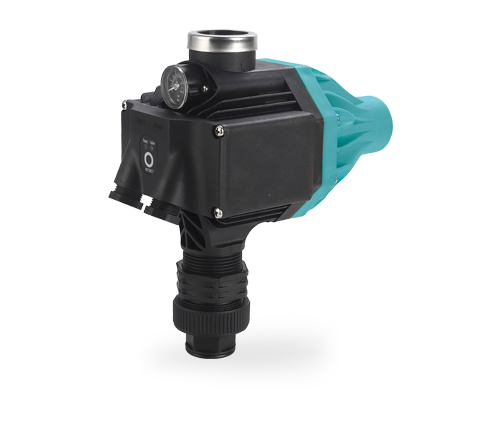
EPC-13M Series 10Bar 1.5KW Auto Reset Functions Pressure Switch Applied for Water Pumps
Electrical compatibility is one of the most important considerations when selecting an automatic pressure controller. The EPC-13M Series is available for 110–120 V, 220–240 V, and 110–240 V applications. The correct version must be selected according to the supply voltage and the motor nameplate information.
The controller’s power capacity also depends on the voltage version. The listed maximum power is 1.5 kW for the 220–240 V configuration, 0.75 kW for the 110–120 V configuration, and 0.75/1.5 kW for the 110–240 V version. Motor current, starting current, phase arrangement, and local electrical requirements must be reviewed before installation.
Although a motor may be described by its kilowatt rating, electrical current is also critical. Two motors with the same power rating may have different current requirements because of voltage, efficiency, power factor, and design. The controller should never be selected solely by comparing the nominal motor power. A qualified installer should verify the complete electrical data and use suitable circuit protection.
Installation should include appropriate overcurrent protection, grounding, cable sizing, isolation, and protection against moisture. All electrical work should comply with applicable local codes and should be carried out by qualified personnel. Power must be disconnected before opening the enclosure or working on the pump and controller.
The EPC-13M Series is supplied with G1 and G1¼ connection thread configurations. These sizes support common water-pump piping arrangements and can simplify integration with existing pipework. The included joint or adapter arrangement can help accommodate different inlet connection requirements, but the exact supplied fitting should be confirmed for each order.
Correct flow direction is essential. The controller should be installed according to the arrow or connection markings on the housing. Incorrect orientation may prevent the check valve from operating correctly and may cause unreliable pressure detection. Threaded connections should be clean, aligned, and sealed with materials suitable for potable or non-potable water, depending on the application.
The controller should normally be installed on the pump discharge side in a position where it can sense system pressure correctly. The installation location should be protected from impact, excessive vibration, direct flooding, and temperatures above the specified maximum of 55°C. Although the IP65 enclosure provides strong protection against dust and water jets, cable entries and connected piping must also be installed correctly.
Before commissioning, the system should be filled and air should be removed where appropriate. The suction line should be checked for leaks, the water source should be confirmed, and all valves should be placed in the correct operating position. Starting the pump without sufficient water may cause damage even when an anti-dry-run function is available.
The IP65 protection rating gives the controller a strong level of enclosure protection for many normal pump-room, utility, garden, and outdoor installations. The first digit indicates protection against dust ingress, while the second digit indicates protection against water jets. This helps the controller operate more reliably in locations where dust, splashes, humidity, or occasional hose spray may be present.
IP65 does not indicate resistance to immersion. The controller should not be installed in a location that can remain underwater or in an area where condensation accumulates inside the enclosure. A covered installation with adequate drainage and ventilation can further improve operating reliability.
Good cable management is equally important. Cable glands should be properly tightened, cables should not pull against the terminals, and water should not be allowed to run along a cable directly into the enclosure. These installation details protect the controller from environmental stress and help preserve its intended performance.
Basic mechanical pressure switches can provide simple on-and-off control, but they may require additional components and more frequent manual attention. The EPC-13M Series combines pressure control with a built-in check valve, status indication, gauge connection, and optional intelligent protection functions. This integrated approach can reduce installation complexity and provide more information during operation.
Compared with a basic manual switch, the EPC-13M Series offers automatic pump activation based on water demand. This is more convenient for users and can reduce the possibility of leaving a pump running unnecessarily. Compared with an unprotected electronic controller, the optional anti-dry-run and auto-reset functions provide additional safeguards for systems exposed to intermittent water supply or limited supervision.
Compared with a pressure-only device that lacks a check valve, the integrated non-return function can help maintain pressure and reduce backflow. Compared with a controller without a visible indicator, the status light provides a quicker way to check operating conditions. Compared with a sealed product that offers no gauge connection, the external gauge interface makes system diagnosis more transparent.
These advantages do not mean that the controller is suitable for every application. Large industrial pumps, high-current motors, multi-pump systems, variable-speed systems, and complex pressure-management networks may require specialized control panels or other equipment. The EPC-13M Series is strongest in compact automatic water-pump applications within its rated voltage, power, pressure, and temperature limits.
In homes, the controller can be used with suitable surface pumps or booster pumps to improve water pressure at taps, showers, kitchen outlets, and household appliances. Automatic operation allows the pump to respond when water is used, making the system easier for residents to operate.
For domestic installations, noise, pressure comfort, pump cycling, and water quality should be considered. If the system requires smooth pressure during very low flow, a pressure tank or a different control arrangement may be appropriate. The controller should be selected according to the pump’s electrical and hydraulic specifications.
Garden pumps often operate intermittently as sprinklers, hoses, or irrigation zones are opened and closed. Automatic pressure control can simplify these applications by starting the pump when the outlet is opened and stopping it when demand ends. The anti-dry-run option is particularly valuable where the water source is a storage tank, rainwater reservoir, or shallow well with a variable level.
Filters should be installed and maintained where the water contains leaves, sand, or other particles. Blocked filters can reduce flow and may create abnormal pressure conditions. The controller can support the system, but regular cleaning and inspection remain necessary.
Small farms, nurseries, greenhouses, and livestock facilities may require automatic water delivery without a permanently supervised pump station. The EPC-13M Series can be considered for suitable pump sizes and pressure requirements. The auto-reset function may help restore operation after temporary interruptions, while the gauge connection allows operators to monitor actual pressure.
Agricultural installations can expose equipment to dust, moisture, fertilizer residue, and temperature changes. The controller should be installed in a protected enclosure or equipment area when environmental conditions exceed normal service conditions. Long pipe runs and multiple irrigation zones should be evaluated to ensure that the selected pump and starting pressure are appropriate.
Booster pump applications are a natural fit for an automatic pressure controller. The device can be installed on a pump that increases pressure from a storage tank, municipal supply, or low-pressure source. When downstream demand begins, the controller activates the pump and helps maintain usable pressure.
For booster installations, the incoming supply pressure must be considered. A controller does not eliminate the need for adequate inlet flow. If the incoming water supply is unstable, the system may require a storage tank, low-water protection, or an alternative control design.
Workshops, small offices, guest facilities, and service buildings may use automatic pump control for cleaning points, utility sinks, washdown systems, or general water supply. The 10 bar maximum working pressure provides flexibility for many small-scale arrangements, provided that all system components are rated appropriately.
Commercial users should consider duty cycle, expected daily starts, water quality, ambient temperature, and maintenance access. Where continuous high-demand operation is expected, a larger control system may be more suitable.
Product performance is closely connected to the capabilities of the manufacturer. Taizhou Edwin Electric Co., Ltd. was founded in 2008 and operates as an integrated manufacturing enterprise focused on independent research and development, mass production, and global export. This combination provides a foundation for developing products that are designed not only for technical performance but also for repeatable production and international supply.
The company’s experience covers a broad range of pump technologies, including deep well pumps, submersible pumps, domestic booster pumps, circulation pumps, solar water pumps, intelligent booster pumps, and related accessories. This product diversity is valuable because pressure controllers must be matched to real pump behavior, water demand, electrical conditions, and installation environments.
Since 2018, the company has invested in new energy and intelligent technology. The development of solar water pumps and intelligent booster pumps reflects an effort to address changing market needs, including energy-conscious pumping, remote or off-grid water supply, and more automated operation. This background supports the use of smart functions such as anti-dry-run protection and auto-reset control in compact water systems.
The company also established associated import and export service organizations to support procurement planning, order tracking, cross-border delivery, and foreign trade services. For international buyers, these capabilities can be important because a reliable product supply chain involves more than manufacturing alone. Clear communication, order coordination, packaging, documentation, and shipment tracking all affect the total purchasing experience.
The EPC-13M Series requires consistent production across several areas: enclosure molding, electrical assembly, pressure-sensing components, threaded hydraulic connections, sealing elements, cable interfaces, and functional programming. A professional manufacturing process should control each of these areas to maintain dimensional accuracy, electrical safety, and reliable pressure response.
During enclosure production, material selection and molding consistency influence impact resistance, dimensional stability, and protection against dust and water. A correctly formed enclosure helps maintain the IP65 protection level when the cover, gasket, cable glands, and assembly interfaces are properly fitted. Surface quality and thread accuracy are also important because the controller must connect securely to the water system.
Electrical assembly requires careful routing and secure termination. The controller must be assembled so that conductors remain separated from hydraulic pathways and moving or pressure-sensitive parts. Consistent terminal tightening, insulation control, and wiring verification help reduce the risk of loose connections or intermittent operation.
Pressure-control components must be produced and assembled with attention to sensitivity and repeatability. Starting pressure settings should correspond to the specified configuration, while the pressure-sensing pathway must remain free of obstructions. Functional testing can verify whether the controller reacts appropriately when pressure falls and whether it stops or resets according to the intended program.
The built-in check valve also requires dimensional control. The valve must open under normal pump flow and close effectively when the pump stops. Poor alignment, contamination, or inconsistent sealing can cause backflow or excessive flow resistance. Integrating this function into the product means that hydraulic assembly quality directly affects electronic control performance.
Final inspection should cover appearance, connection dimensions, electrical continuity, pressure response, indicator operation, and enclosure integrity. For products sold internationally, batch traceability and consistent labeling are also important. These practices help manufacturers identify production variation and support after-sales service when customers need technical assistance.
Global pump buyers often operate in different climates, electrical systems, water conditions, and regulatory environments. A manufacturer serving international customers must therefore consider more than one standard installation scenario. Voltage options, 50/60 Hz operation, connection threads, packaging, technical documentation, and product identification all influence successful deployment.
The manufacturer’s experience in global export supports a more structured approach to international orders. Procurement planning can help customers select the correct product configuration, while order tracking and shipment coordination can reduce delays. For distributors, consistent supply and clear technical information are especially important because the controller may be sold alongside pumps, pipes, valves, pressure tanks, and other accessories.
Quality is also supported by product-family knowledge. A company that manufactures pumps and controllers can better understand common field problems such as dry running, pressure loss, repeated starts, poor suction conditions, and mismatched motor ratings. This knowledge can improve technical communication and help buyers select a more complete pumping solution.
The EPC-13M Series includes one-year warranty coverage according to the supplied product information. Warranty terms should be reviewed together with installation conditions, electrical requirements, operating limits, and service procedures. Correct installation is essential because damage caused by overpressure, incorrect wiring, flooding, dry running, or use outside the rated specifications may not be covered.
Before installation, identify the pump type, motor voltage, motor power, water source, desired starting pressure, maximum system pressure, pipe size, and environmental conditions. Confirm that the controller is suitable for the pump’s current and operating requirements.
Check the suction pipe, discharge pipe, valves, filter, storage tank, and water source. The suction side must be airtight where applicable. A small air leak can prevent the pump from priming and may cause unstable pressure behavior.
Choose the starting pressure according to the pump’s capability and the water system’s requirements. A higher starting pressure is not automatically better. The pump must be able to generate the required pressure, and the selected value must be compatible with faucets, tanks, pipes, and connected equipment.
Connect the controller according to the marked inlet and outlet direction. Use suitable sealing materials and avoid forcing misaligned threads. Where adapters are required, confirm that the fitting size and thread standard match the pump and pipework.
Verify the supply voltage and connect the controller through suitable protection and isolation equipment. Grounding and cable protection should comply with local requirements. Electrical installation should be completed by a qualified professional.
Fill the pump and suction line when required by the pump design. Open a water outlet, energize the system, and observe whether the pump starts at the selected pressure. Check for leaks, confirm that the pressure rises normally, and verify that the controller responds when the outlet is closed.
If the anti-dry-run and auto-reset functions are included, test them according to safe manufacturer procedures. Never intentionally operate a pump dry for a prolonged period. Confirm that the system returns to normal operation after the water supply is restored.
Routine maintenance is relatively simple but should not be neglected. Inspect the controller for signs of water entry, cracked housing, loose cables, corrosion, or unusual noise from the pump. Check the pressure gauge reading and compare it with normal operating conditions.
If the pump does not start, first verify the power supply, circuit protection, motor connection, water supply, and pressure condition. A blocked pressure passage, incorrect flow direction, or pressure setting that is too high for the pump may also prevent starting.
If the pump starts and stops repeatedly, inspect the system for leaks, dripping outlets, damaged check valves, insufficient pressure-vessel capacity, or an unsuitable starting pressure. Repeated cycling can increase motor and controller wear, so the cause should be corrected rather than ignored.
If the pump runs but pressure remains low, inspect the suction line for air leakage, check the water level, clean the inlet filter, examine the pump impeller, and confirm that all valves are fully open. Long or undersized pipes can also create excessive pressure loss.
If the controller does not reset automatically, verify whether the selected version includes the auto-reset function and whether the fault condition has actually been resolved. The water supply, pressure pathway, electrical supply, and pump condition should all be checked before repeated reset attempts.
Maintenance work must be performed with the electrical power disconnected. If the controller or pump shows signs of overheating, burning, repeated electrical tripping, or internal water damage, the unit should be inspected by a qualified technician.
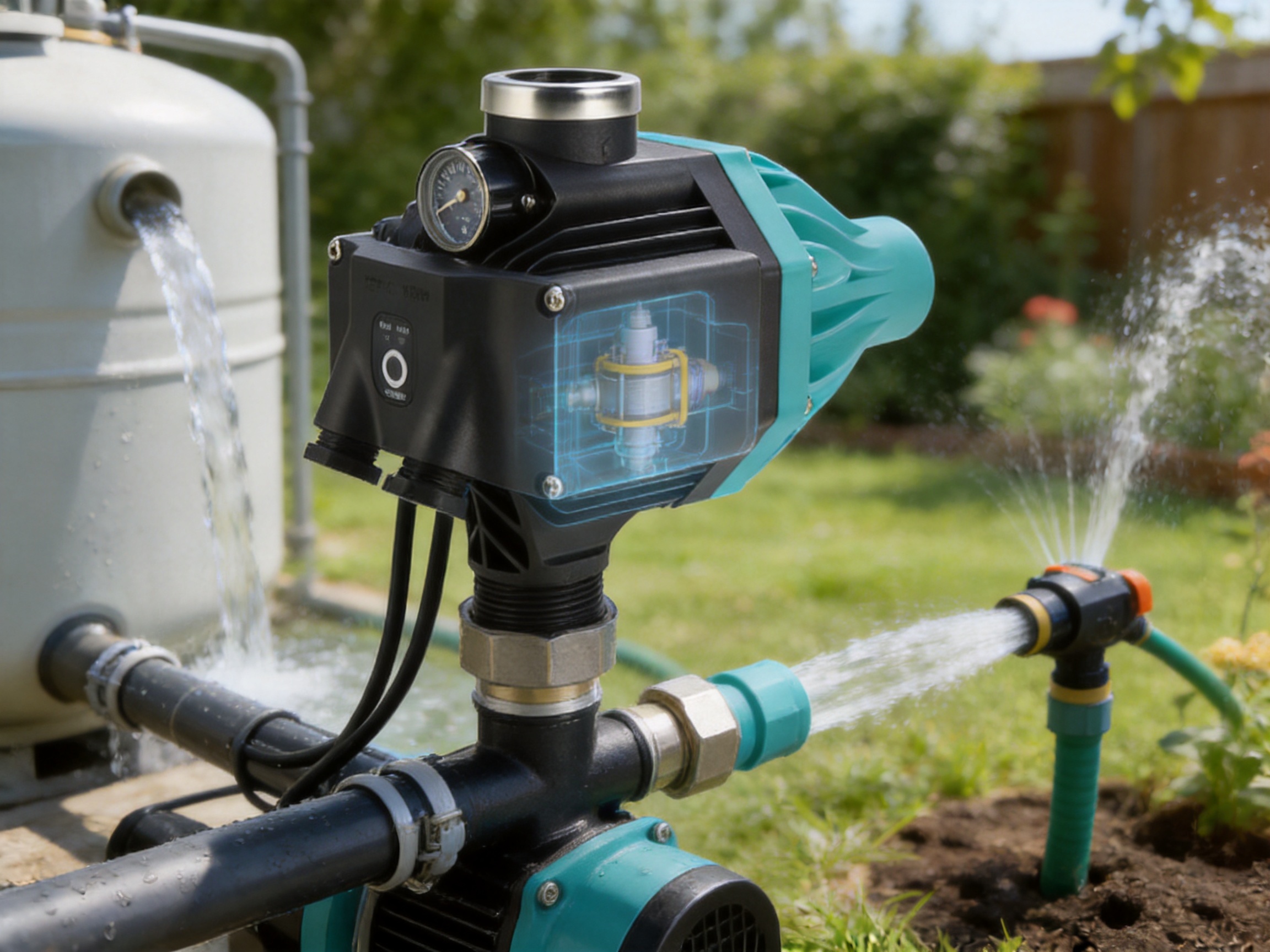
The EPC-13M Series is positioned as a practical middle point between a simple manual switch and a complex industrial pump-control cabinet. It provides more functionality than a basic on-off device while remaining compact and relatively straightforward to install. This makes it attractive to distributors, installers, pump manufacturers, and end users who need dependable automatic control without unnecessary system complexity.
Its 10 bar working-pressure capability is an advantage for applications that require more than low-pressure domestic service. The availability of multiple voltage versions also supports international distribution. The built-in check valve and gauge connection can reduce the number of separate components required, while the indicator light improves day-to-day usability.
The optional smart functions provide another competitive benefit. Anti-dry-run protection addresses one of the most damaging conditions in pump operation, while auto-reset functionality improves convenience in systems with occasional interruptions. These features can reduce manual intervention and support more autonomous operation when correctly configured.
Another advantage is the manufacturer’s wider pump-system experience. A supplier specializing in pumps, intelligent boosters, solar pumping, and related accessories can offer better product matching than a supplier focused only on a single control component. This is particularly useful for wholesale customers and project buyers who need coordinated sourcing from one experienced production network.
Distributors should identify the voltage and power version clearly in product listings and quotations. The 110–120 V, 220–240 V, and 110–240 V versions should not be treated as interchangeable without verifying the motor and electrical system. Product packaging and labels should also make the configuration easy to identify during warehouse handling.
Project buyers should evaluate the entire pump system rather than selecting the pressure controller independently. The pump’s maximum head, flow rate, current, connection size, duty cycle, and water-source conditions should be compared with the controller’s limits. If the project includes several pumps operating together, a dedicated control panel may be more appropriate.
Customers should also specify whether they need the anti-dry-run function, auto-reset function, a particular starting-pressure setting, or a specific connection size. Confirming these details before production and shipment helps avoid field installation problems.
For private-label or repeated wholesale orders, buyers may also discuss labeling, packaging, technical documents, inspection procedures, spare parts, and warranty handling with the manufacturer. A long-term supply relationship can benefit from standardized configurations and consistent quality-control requirements.
Automatic pressure control can support more efficient pump use by activating the pump when water is needed rather than leaving it running continuously. The actual energy savings depend on the pump, system demand, pipe design, operating schedule, and frequency of starts. Proper sizing remains the most important factor in efficient operation.
The availability of solar water pumps and intelligent booster pumps in the manufacturer’s product portfolio also reflects wider attention to energy-conscious water supply. In off-grid or remote locations, automatic pressure control can contribute to a more practical water system when combined with suitable solar generation, storage, and pump protection.
Users should avoid oversizing the pump or selecting an unnecessarily high pressure setting. Excess pressure can increase leakage, pipe stress, energy use, and component wear. A balanced system provides the required flow and pressure while minimizing unnecessary operating load.
The controller must be used only within its specified pressure, voltage, frequency, temperature, and power limits. Exceeding these limits can cause unreliable operation or equipment damage. All connected pipes and accessories must have pressure ratings suitable for the maximum possible system pressure.
Electrical safety is equally important. The installation should include correct grounding, circuit protection, cable sizing, and an accessible isolation device. The enclosure should remain closed during normal operation, and the product should not be modified without authorization.
Water and electricity create a serious hazard when combined. Installation, testing, and maintenance should be performed by trained personnel. If there is evidence of water entering the electrical enclosure, power should be disconnected immediately and the unit should be inspected before further use.
The EPC-13M Series is an automatic pressure controller designed to manage water pumps. It starts and stops a suitable pump in response to system pressure and can provide additional functions such as anti-dry-run protection and automatic reset, depending on the selected configuration.
The maximum working pressure is 10 bar. The complete water system, including pipes, valves, fittings, tanks, and connected equipment, must also be rated for the operating pressure.
The controller can handle up to 1.5 kW in the applicable configuration. The maximum listed power differs by voltage version: 1.5 kW for 220–240 V, 0.75 kW for 110–120 V, and 0.75/1.5 kW for 110–240 V. Motor current and starting characteristics must be checked before selection.
The listed versions are 110–120 V, 220–240 V, and 110–240 V. The selected controller must match the electrical supply and the pump motor nameplate.
Yes. The product design includes a built-in check valve intended to help prevent reverse water flow and maintain pressure in the discharge line.
Yes. The controller includes an external pressure gauge connection. A gauge can help users observe operating pressure and make installation and troubleshooting easier.
The technical information lists starting-pressure configurations of 1.2 bar, 1.5 bar, and 2.2 bar. Other product information describes an adjustable range of approximately 1.5 to 2.5 bar. The exact setting should be confirmed for the selected version before ordering.
When enabled, the auto-reset function can automatically attempt to restore pump operation after a temporary pressure drop or system interruption has been resolved. It reduces the need for manual resetting but does not correct the underlying cause of a persistent fault.
Anti-dry-run protection is designed to help stop the pump when it operates without an adequate water supply. It can reduce the risk of overheating and damage, but correct water-source design and regular maintenance are still required.
The controller has an IP65 protection rating, which provides protection against dust and water jets under specified test conditions. It is not designed for immersion and should be installed where flooding and continuous water exposure cannot occur.
The listed connection threads are G1 and G1¼. Buyers should confirm the required inlet, outlet, adapter, and joint configuration for their specific installation.
It may be used with a suitable submersible pump when the pump’s electrical rating, water supply, pressure, and installation arrangement meet the controller’s requirements. The complete system should be reviewed by a qualified installer.
The indicator light reflects the controller’s working status. It provides a quick visual reference during normal operation and basic troubleshooting, although it does not replace electrical testing or pressure measurement.
The supplied product information states one-year warranty coverage. Warranty conditions should be confirmed with the supplier and are normally subject to correct installation and operation within the specified limits.
An experienced pump manufacturer understands the relationship between pressure control, pump performance, water-source conditions, electrical requirements, and system accessories. This broader knowledge can help buyers select compatible products and obtain coordinated support for complete water-supply projects.
The EPC-13M Series 10 Bar 1.5 kW Auto Reset Pressure Switch is a versatile automatic controller for compact and medium-duty water pump systems. Its combination of automatic pressure control, 10 bar working pressure, multiple voltage options, IP65 protection, built-in check valve, gauge connection, status indicator, selectable starting pressure, and smart protective functions provides a strong balance of convenience and practical performance.
Its advantages are particularly relevant to domestic water supply, garden irrigation, booster systems, small agricultural installations, workshops, and light commercial applications. Compared with a basic pressure switch, it offers a more integrated solution with greater operational visibility and optional protection against dry running and temporary faults.
The product is supported by a manufacturer with experience in pump research and development, mass production, global export, and a broad portfolio of intelligent and conventional pumping equipment. This manufacturing and engineering background can benefit distributors and project buyers who need dependable product matching, coordinated sourcing, and long-term supply support.
For the best results, the controller must be selected according to the pump’s voltage, current, power, pressure, connection size, and duty requirements. Correct installation, suitable electrical protection, adequate water supply, and regular maintenance are essential. When these conditions are met, the EPC-13M Series can provide convenient, reliable, and intelligent pressure management for a wide range of water-pumping applications.
1. EPC-13M Series product technical parameters and application information supplied for this article.
2. Manufacturer product information for automatic pressure controllers and water-pump accessories.
3. General principles of centrifugal and submersible pump installation, pressure control, and hydraulic system maintenance.
4. General electrical safety practices for motor-driven water-pump equipment.
5. General enclosure protection principles for IP-rated electrical equipment.
6. General guidelines for water-system pressure management, non-return valves, dry-run prevention, and pump commissioning.
edwina@edwin-pump.com
+86-13586290903 (WhatsApp)
Xuri Gongliang Cutting Tool Entrepreneurship Park, Wenqiao Town, Wenling City, Taizhou City, Zhejiang Province, China

High Performance Smart Pump Factory


 English