edwina@edwin-pump.com

View All Products
en
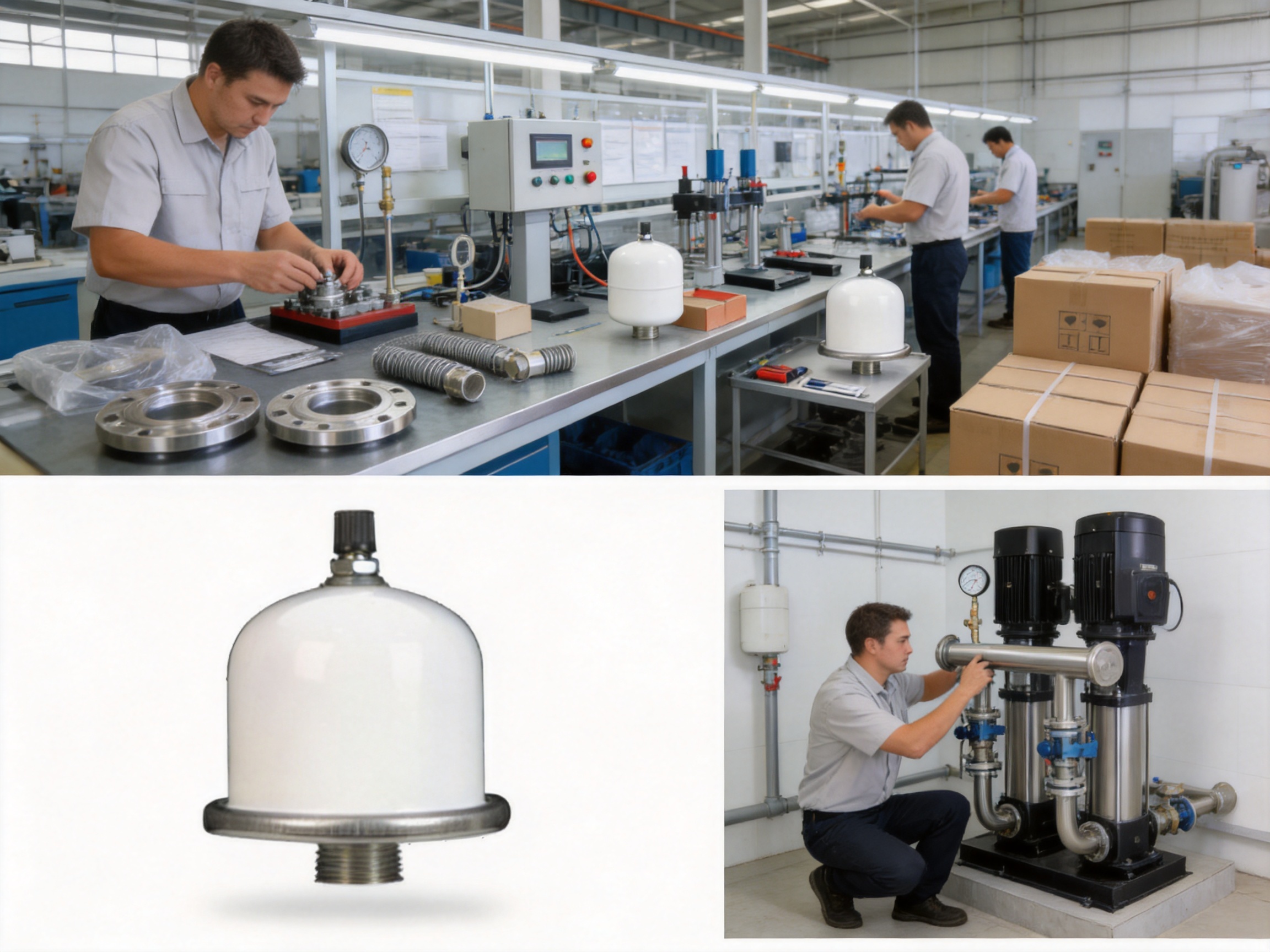
Reliable pressure control is essential in heating systems, domestic water networks, irrigation installations, and many other fluid-handling applications. When water is heated or when demand changes rapidly, the volume and pressure of the water in a closed system can fluctuate. Without suitable pressure compensation, these fluctuations may cause water hammer, unnecessary pump cycling, unstable water delivery, leakage, component fatigue, and premature system failure. The VT0.16 Series Stainless Steel Flange 8 Bar Fixed Membrane Expansion Pressure Tank is designed to provide a compact and dependable solution for managing these conditions.
This fixed membrane expansion tank combines a corrosion-resistant stainless steel flange, an internal membrane, an 8 bar maximum working pressure, and a wide operating temperature range of -20°C to +99°C. Its purpose is to absorb changes in system volume and help stabilize pressure without requiring complex control equipment. Although compact in size, the tank contributes to the performance, service life, and energy efficiency of a complete pumping or heating installation.
The tank is manufactured for professional applications where reliable pressure regulation, durable materials, and convenient integration are important. It can be used as part of a heating system or water supply network, and its compact design makes it suitable for installations with limited space. The fixed membrane separates the water from the air or gas charge, helping protect the tank body and maintain a stable pressure-buffering function over repeated operating cycles.
Water is generally considered incompressible, but its volume still changes when its temperature changes. In a sealed heating circuit, water expands as it warms. If there is no space available for this expansion, system pressure can rise sharply. When water cools, pressure can fall again. Similar pressure changes may occur in booster systems, water supply networks, and pump installations when valves open and close or when demand changes suddenly.
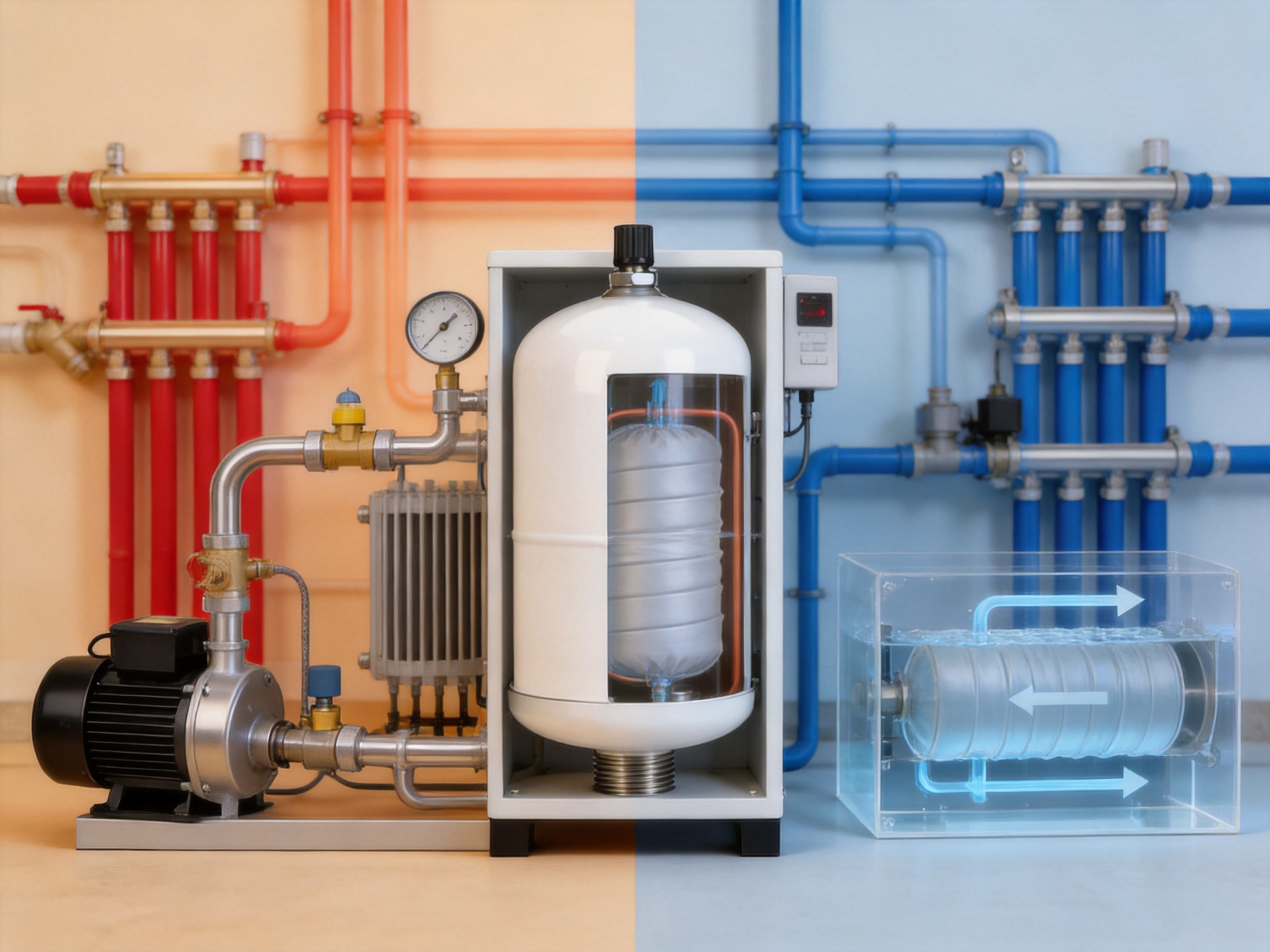
An expansion pressure tank provides a controlled cushion for these volume changes. The tank contains a water chamber and a gas-charged chamber separated by a flexible membrane. When the pressure in the water system increases, water enters the tank and compresses the gas on the opposite side of the membrane. When system pressure decreases, the compressed gas pushes water back into the system. This process helps maintain more consistent pressure.
The result is a more stable hydraulic system. Pumps may operate with fewer rapid starts and stops, pressure fluctuations can be reduced, and the risk of water hammer can be lowered. The expansion tank does not replace a pump, pressure switch, pressure controller, safety valve, or temperature-control device. Instead, it works together with these components to improve the overall performance and reliability of the installation.
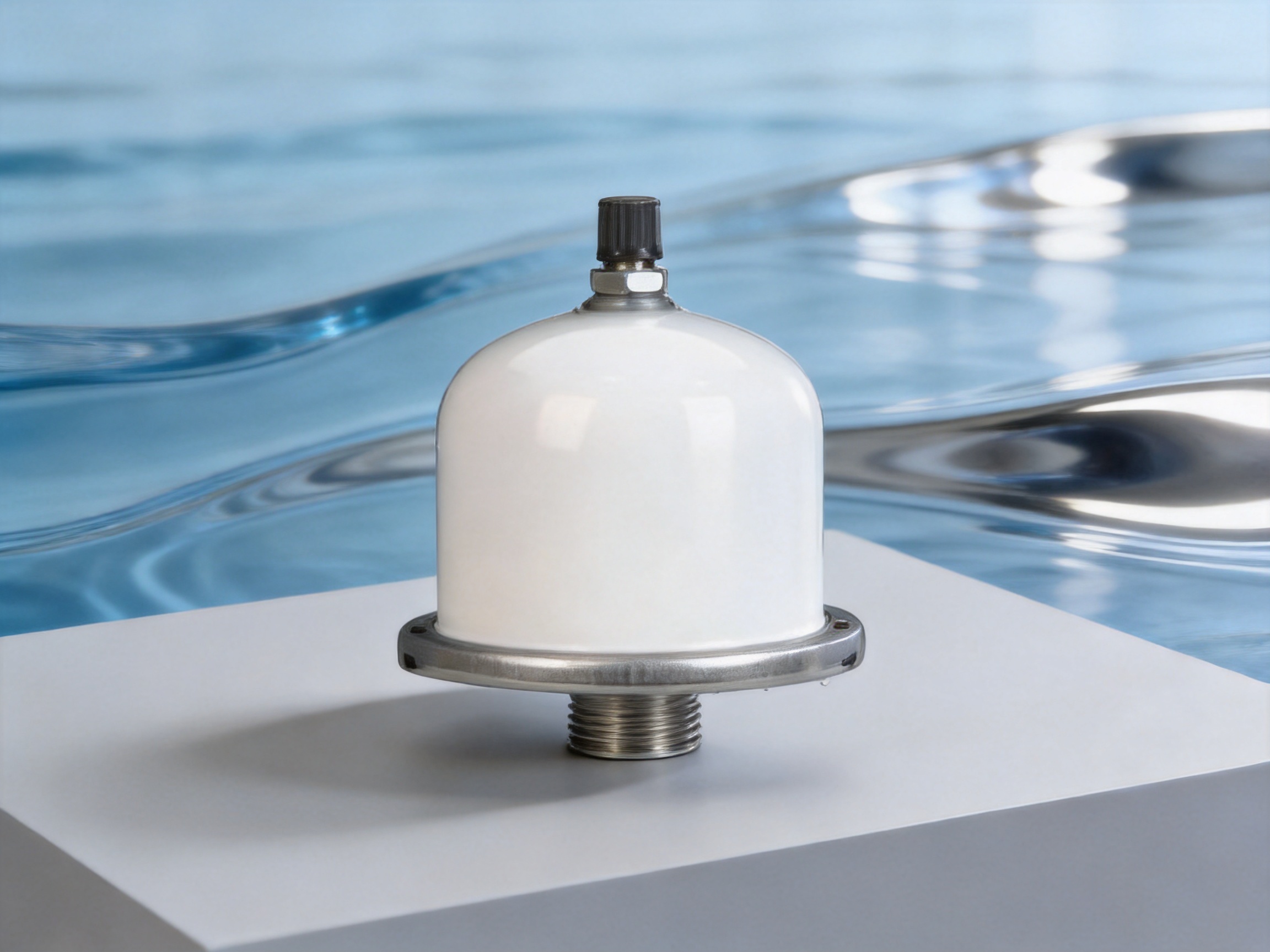
The VT0.16 Series is a fixed membrane expansion tank developed for pressure regulation and water storage in heating and water supply applications. The product information identifies the unit as a stainless steel flange model with an 8 bar maximum pressure rating. Its specified working temperature range is -20°C to +99°C, allowing use in both cold-water and hot-water environments when the complete system is correctly designed.
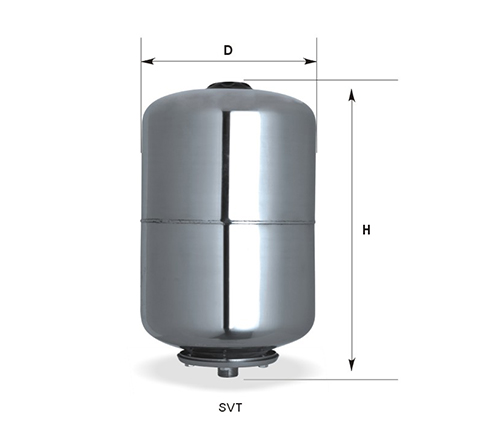
The compact model designation is VT0.16-XY. According to the available technical data, the unit has a maximum pressure of 8 bar, a diameter specification of 65/79 mm, a height of 105 mm, a precharge pressure of 3.5 bar, and a 1/2-inch connector. The listed packing volume is 0.0309 CBM for 30 pieces. These specifications should be checked against the final product drawing, order confirmation, and application requirements before installation.
| Technical item | Specification |
|---|---|
| Series | VT0.16 |
| Model | VT0.16-XY |
| Tank type | Fixed membrane expansion pressure tank |
| Flange material | Stainless steel |
| Maximum working pressure | 8 bar |
| Working temperature | -20°C to +99°C |
| Precharge pressure | 3.5 bar |
| Diameter | 65/79 mm |
| Height | 105 mm |
| Connector | 1/2 inch |
| Packing information | 0.0309 CBM / 30 pieces |
Dimensions and connection details are especially important when replacing an existing tank or integrating the unit into a packaged pump system. Installers should verify the available mounting space, connection orientation, system pressure, operating temperature, and required precharge before commissioning. A pressure tank should always be selected as part of a complete hydraulic design rather than solely by physical size.
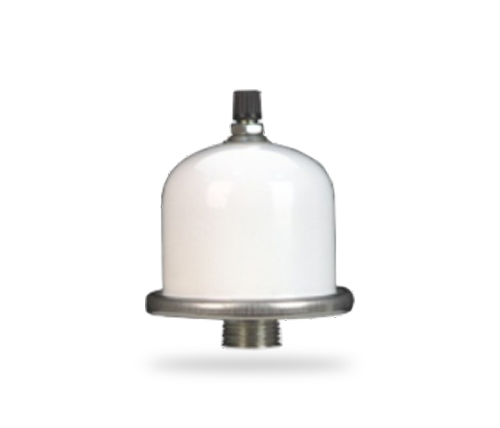
VT0.16 Series Stainless Steel Flange 8 Bar Fixed Membrane Expansion Pressure Tank
The central functional component of the VT0.16 Series is its fixed membrane. The membrane separates the system water from the precharged gas. This separation is important because it limits direct contact between the water and the gas charge and helps maintain the tank’s pressure-compensation function.
When system pressure is lower than the pressure inside the tank, the membrane remains closer to its initial position. As water pressure rises, water enters the tank and deflects the membrane, compressing the gas charge. When water pressure falls, the stored gas energy moves the membrane back and returns water to the system. This repeated movement supports smoother pressure behavior during normal operation.
A fixed membrane construction is often selected for compact pressure-control equipment because it provides a simple and economical arrangement with few moving parts. Compared with systems that require larger external air chambers, complex mechanical controls, or frequent manual intervention, a membrane tank offers an integrated pressure-buffering solution. Its operation is passive, which means it does not require a separate motor or electrical power supply.
The membrane must be compatible with the intended water quality, pressure, and temperature. The specified operating range of -20°C to +99°C gives the VT0.16 Series flexibility for many cold-water and heating applications. However, the tank should not be used outside the manufacturer’s stated limits. The maximum pressure, temperature, fluid type, and installation environment must always be considered together.
The stainless steel flange is one of the product’s important durability features. Flanges and connection areas are exposed to mechanical loads, pressure stress, moisture, and possible condensation. A corrosion-resistant stainless steel component can help maintain the integrity of the connection and reduce the risk of deterioration in demanding environments.
Stainless steel is widely valued for its resistance to rust and surface degradation. In heating rooms, pump rooms, utility areas, and equipment cabinets, the atmosphere may contain humidity, cleaning chemicals, or temperature variations. A stainless steel flange provides a strong and stable interface under these conditions when the correct grade, gasket, fasteners, and installation practices are used.
The stainless steel component also supports long-term water system hygiene. Corrosion products can contaminate water, obstruct small passages, damage valves, or interfere with pressure-control components. By using a corrosion-resistant flange, the tank is better positioned to preserve connection quality and reduce maintenance caused by rust-related problems.
One competitive advantage of the VT0.16 Series is that it combines the compact form of a small expansion tank with a stainless steel connection element. Some lower-cost alternatives rely heavily on ordinary carbon steel components or surface coatings. Coatings can provide protection, but damage, abrasion, condensation, or poor storage conditions may expose the underlying metal. Stainless steel construction offers a more inherent resistance to corrosion at the connection point.
The product category supplied with the unit may refer to pressure tanks generally, including carbon steel pressure tank classifications. The product-specific description identifies the VT0.16 Series as a stainless steel flange fixed membrane tank. For purchasing and engineering purposes, customers should confirm the exact wetted materials and flange material in the technical approval documents.
The VT0.16 Series is designed for a maximum pressure of 8 bar. This rating makes the tank suitable for a range of pressure-regulation tasks in domestic, commercial, and light industrial water systems, provided the operating pressure remains within the allowable limit and all associated components are correctly rated.
A maximum pressure rating is not the same as a recommended continuous operating pressure. The actual operating pressure should be determined by the system design, safety margin, pump curve, pressure switch settings, water temperature, and applicable regulations. Safety valves and other protective devices should be selected to prevent the tank and connected equipment from exceeding their approved pressure limits.
The 8 bar rating gives system designers useful flexibility. It can accommodate pressure fluctuations in many booster and heating applications while maintaining a compact product size. It is also important when a pressure tank is installed downstream of a pump, where the pump’s shut-off pressure may be substantially higher than its normal operating pressure.
Proper pressure management can reduce stress on pipes, valves, heat exchangers, seals, and pump components. When the tank absorbs part of the pressure variation, the complete installation may experience fewer severe pressure shocks. This is particularly valuable in systems with frequent demand changes, automatic valves, or pumps that start and stop throughout the day.
The specified operating temperature range of -20°C to +99°C is another major strength of the VT0.16 Series. Many pressure tanks are designed mainly for room-temperature water, while heating systems require components that can tolerate substantially higher temperatures. The VT0.16 Series is described as suitable for heating systems and can also support cold-water applications within its approved range.
The lower temperature limit is relevant to installations exposed to cold service areas, seasonal conditions, or transport and storage environments. The upper temperature limit is important in closed heating circuits, where water temperature may rise significantly during normal operation. By supporting both low and high temperatures, the tank can be applied across a broader range of projects than a basic cold-water-only pressure vessel.
Temperature affects pressure behavior. As water heats, its volume increases, and the expansion tank must absorb the additional volume. As temperature falls, the water contracts and the tank can return water to the system. The membrane and tank materials must therefore remain stable through repeated temperature cycles.
System designers should recognize that pressure ratings can be affected by temperature and that the lowest-rated component determines the safe operating boundary of the complete installation. The tank’s stated range should be used together with the manufacturer’s technical documentation, local codes, fluid compatibility information, and the requirements of the heating equipment.
Water hammer is a pressure surge caused by a sudden change in water velocity. It can occur when a valve closes quickly, when a pump stops abruptly, or when a check valve changes position. The resulting pressure wave may create knocking sounds, pipe movement, vibration, leakage, or damage to valves and fittings.
The VT0.16 Series helps reduce the severity of pressure fluctuations by providing a compressible gas cushion. Unlike water, gas can be compressed. When a pressure surge reaches the tank, the membrane can move and the gas chamber can absorb part of the hydraulic energy. This does not eliminate every possible pressure surge, and it cannot replace a properly designed water-hammer arrestor where one is required, but it can contribute to smoother system operation.
Pressure stabilization also helps prevent nuisance operation of pressure switches. In a system without sufficient expansion volume, a small amount of water use may cause a rapid pressure drop and trigger the pump. When the pump stops, pressure may rise again, creating short cycling. A correctly sized expansion tank stores a small amount of water and reduces the frequency of these cycles.
Fewer starts and stops may extend the service life of the pump motor, contactor, relay, pressure switch, and related control equipment. It may also reduce electrical inrush events and mechanical stress. The actual benefit depends on tank size, precharge setting, system pressure range, pump capacity, and consumption pattern.
The VT0.16 Series operates without its own electric motor. Its pressure-buffering function is created by the relationship between water pressure, gas compression, and membrane movement. This passive operating principle helps the system manage pressure without adding a separate electrical load.
Energy efficiency is achieved indirectly. By reducing unnecessary pump starts, the tank may help a pump spend more time operating in stable cycles rather than repeatedly accelerating and stopping. In domestic booster systems, this can reduce wasted energy caused by short cycling. In heating systems, smoother pressure behavior can support more stable circulation and reduce stress on circulating equipment.
Energy savings should not be overstated. The tank itself does not make an inefficient pump efficient, and the total result depends on the pump, pipework, control strategy, operating schedule, and system demand. Nevertheless, the tank can be an important supporting component in a well-designed energy-conscious installation.
Correct precharge is essential to achieving the intended performance. If the gas precharge is too low, the tank may fill with excessive water and provide limited usable volume. If it is too high, the tank may accept too little water and may not provide effective pressure buffering. The stated precharge pressure for the VT0.16-XY model is 3.5 bar, but installers must confirm the correct setting for the application and follow the manufacturer’s instructions.
Heating systems experience regular temperature-driven expansion and contraction. In a closed-loop system, the water must have somewhere to go as it expands. The VT0.16 Series can serve as a compact expansion component for suitable heating installations within its pressure and temperature limits.
Typical applications may include small heating circuits, compact boiler assemblies, circulation systems, radiant heating equipment, and packaged thermal systems. It may also be used alongside circulation pumps, control valves, heat exchangers, and temperature-management equipment.
In a heating circuit, the tank should be installed in a position that supports proper pressure management and minimizes unnecessary thermal stress. The installer must consider the location of the pump, the point of no pressure change, the expansion pipe, isolation valves, air separators, safety valve, and drain arrangement. The best position depends on the specific hydraulic design.
The tank should not be installed where it can be exposed to temperatures above the specified limit, direct flame, severe vibration, corrosive chemicals, or mechanical impact. It should be supported correctly, and the connector should not be used to carry the full weight of unsupported pipework.
In a water supply or booster installation, the tank can act as a pressure buffer between the pump and the demand points. When a small quantity of water is used, the stored volume may supply part of the demand without immediately starting the pump. When water consumption increases, the pump can operate to restore pressure and replenish the tank.
This arrangement is useful in residential water supply, small commercial buildings, irrigation control systems, equipment skids, and other applications where demand changes throughout the day. The tank can help maintain a more comfortable pressure at outlets and reduce abrupt pressure changes in the pipe network.
The 1/2-inch connector makes the VT0.16-XY suitable for compact assemblies where a small connection is appropriate. Compatibility must still be confirmed with the pipe size, adapters, valves, union fittings, and pressure-control equipment. A connection that is mechanically compatible may not always provide the required flow capacity or installation convenience.
When used with a booster pump, the tank should be selected according to the pump’s flow rate, cut-in pressure, cut-out pressure, expected drawdown, and number of starts per hour. A small tank can be effective in compact systems, but a larger tank may be needed where the demand pattern requires greater stored volume or longer pump-off periods.
The VT0.16 Series offers several advantages over basic pressure vessels that use less corrosion-resistant connection materials or lack a properly separated membrane chamber. Its stainless steel flange provides enhanced resistance to corrosion at a critical connection point. Its fixed membrane separates the water and gas sides, supporting consistent pressure-buffering performance. Its 8 bar rating and broad temperature range also make it suitable for more demanding applications than simple low-pressure tanks.
Compactness is another advantage. A tank with a small footprint can be easier to install in a boiler cabinet, pump skid, utility room, equipment enclosure, or compact water-treatment assembly. Space savings can reduce installation complexity and make maintenance access easier when the system is designed correctly.
The passive design is also beneficial. There are no electrical controls inside the tank, no motor to maintain, and no complicated drive system. The unit can therefore be integrated into a wide variety of pump and heating systems without creating additional control-panel requirements.
The fixed membrane design may also provide more predictable separation than an unseparated air chamber. In a basic air-over-water tank, air can dissolve into the water over time, changing the pressure relationship and requiring more frequent adjustment. A membrane tank limits this interaction and helps preserve the gas charge under normal operating conditions.
Compared with oversized or highly complex pressure-control equipment, the VT0.16 Series can provide a practical balance of performance, material durability, installation flexibility, and cost control. It is especially appropriate when the system requires a compact expansion function rather than a large storage vessel.
The tank is supplied by Taizhou Edwin Electric Co., Ltd., an integrated manufacturing enterprise established in 2008. The company’s stated capabilities include independent research and development, mass production, and global export. This combination is important for pressure-tank customers because successful delivery requires more than a finished product. It also requires consistent manufacturing, technical coordination, quality control, packaging, and export support.
The company operates within a broader water-pump product portfolio that includes deep well pumps, submersible pumps, domestic booster pumps, circulation pumps, solar water pumps, intelligent booster pumps, and related water-treatment peripheral products. This product background gives the manufacturer practical experience with the systems in which expansion tanks are commonly installed.
A manufacturer with experience across pumping applications can better understand the relationship between tanks, pressure switches, controllers, valves, pipes, motors, and hydraulic demand. This system-oriented knowledge is valuable when customers need a product for an original equipment package, a replacement project, or a complete water-supply solution.
Advanced manufacturing is not limited to automated machinery. It includes product design, material selection, process control, dimensional inspection, membrane assembly, pressure testing, leakage testing, surface inspection, packaging control, and traceable order management. For a pressure tank, these stages are particularly important because small defects in sealing, connection geometry, membrane installation, or pressure retention can influence field performance.
Independent research and development supports continuous improvement in tank geometry, membrane behavior, connection design, material selection, assembly procedures, and compatibility with modern pump controls. Mass-production capability supports repeatability. Global export experience supports standardized documentation, packaging, product identification, and logistics coordination.
The company established Taizhou Haipai Import & Export Co., Ltd. and Golden Falcon Industrial Co., Ltd. in 2012 to support procurement planning, order tracking, cross-border delivery, and foreign-trade services. For international buyers, these capabilities can simplify communication and reduce the administrative burden associated with multi-product orders.
The company also reports investment in new energy and intelligent technology since 2018. This development is relevant to modern water systems, where pressure tanks increasingly operate alongside variable-speed pumps, smart controllers, solar pumping systems, remote monitoring, and energy-management strategies.
A reliable fixed membrane expansion tank begins with controlled raw-material selection. The tank body, flange, connector, membrane, sealing components, and protective finishes must be selected according to pressure, temperature, fluid compatibility, and expected service conditions. Stainless steel components should be checked for surface quality, dimensional accuracy, and resistance to corrosion in the intended environment.
Forming and fabrication processes must maintain consistent geometry. Any distortion at the flange or connection area may affect sealing, assembly, or installation. Controlled welding or joining procedures are necessary where applicable, followed by inspection for surface defects, deformation, and incomplete joints.
The membrane is a critical component. It must be manufactured with uniform thickness, reliable elasticity, and suitable resistance to repeated flexing. During assembly, the membrane must be positioned correctly and protected from sharp edges, contamination, excessive twisting, and incorrect clamping. A controlled assembly process helps ensure that the membrane can move freely during pressure changes.
Sealing components must be installed with the correct compression and alignment. A seal that is too loose may leak, while excessive compression may cause premature deterioration. The connector and flange should be checked for thread quality, surface condition, and dimensional conformity.
Pressure testing is essential for a tank rated to 8 bar. Testing may include leak checks, pressure retention checks, and inspection of the finished assembly. The exact testing procedure should be defined by the manufacturer’s quality system and applicable standards. Testing should be carried out using suitable equipment and safe procedures by trained personnel.
Final inspection can include dimensional verification, visual inspection, connector inspection, membrane and valve checks, label confirmation, and packaging review. Consistent product identification helps customers match each tank to the correct specification and installation documentation.
International customers often require more than a technically functional product. They need reliable packaging, stable lead-time planning, accurate documentation, consistent batch quality, and responsive communication. The manufacturer’s experience in global export and procurement coordination supports these requirements.
The listed packing information for the VT0.16-XY model indicates 30 pieces per 0.0309 CBM packing volume. Compact packaging can reduce storage and transportation costs, which is useful for distributors and original equipment manufacturers. Even so, tanks should be protected against impact, moisture, contamination, and deformation during handling and transport.
For bulk orders, buyers may request pre-shipment inspection, sample approval, batch reports, product drawings, pressure-test records, packaging photographs, and labeling confirmation. These documents help establish a clear quality baseline. The precise documentation package should be agreed upon before production begins.
Consistency is particularly important when tanks are supplied for repeated pump assemblies. If connector dimensions, precharge, or external dimensions vary from batch to batch, assembly-line efficiency may be affected. Stable production processes and inspection procedures help reduce these risks.
Installation should be performed by qualified personnel who understand pressure systems and the applicable local regulations. Before installation, inspect the tank for transport damage, check the model and connection size, and confirm that the pressure and temperature requirements match the intended application.
The system should be isolated and depressurized before the tank is connected or removed. The tank must not be installed into a live pressurized system unless a specific approved procedure allows it. All pipework, unions, valves, and fittings should be rated for the maximum pressure and temperature of the installation.
The connection should be sealed using a suitable method for the thread type and fluid. Excessive tightening can damage the connector or distort the seal. Insufficient tightening can result in leakage. Pipework should be independently supported so that mechanical loads are not transferred to the tank connection.
The tank should be installed where it can be inspected and serviced. Avoid locations that are inaccessible, exposed to impact, or subject to standing water. If the tank is installed in a heating system, consideration should be given to heat exposure and the possibility of surface condensation.
The precharge should be checked using suitable equipment when the water side is fully depressurized. The specified precharge for the VT0.16-XY model is 3.5 bar, but the final value should be set according to the system design and manufacturer instructions. Never adjust the gas charge while the water side remains pressurized unless a documented procedure specifically requires it.
Although the VT0.16 Series is designed for low-maintenance operation, periodic inspection is recommended. Check the tank body, flange, connector, surrounding pipework, safety valve, and isolation fittings for corrosion, leakage, mechanical damage, or abnormal vibration.
Pressure behavior can also provide useful information. Rapid pump cycling, unstable pressure, unusual noise, or a sudden change in system performance may indicate a precharge problem, membrane failure, blocked connection, incorrect tank sizing, or an issue elsewhere in the hydraulic system.
The gas precharge should be checked at appropriate service intervals and whenever system behavior changes. The inspection frequency depends on operating temperature, pressure, cycling frequency, water quality, and the importance of the installation. Industrial or commercial systems may require a documented maintenance schedule.
If the membrane has failed, the tank may become waterlogged and lose its expansion function. A qualified technician should diagnose the problem and determine whether the tank can be serviced or must be replaced. The tank should never be drilled, welded, modified, or opened while pressurized.
When the tank reaches the end of its service life, it should be removed safely after complete depressurization. Disposal should follow local regulations for metal components, elastomeric membranes, and any remaining system fluid.
Selecting an expansion tank requires more information than the maximum pressure rating alone. Engineers and installers should consider total system volume, minimum and maximum operating pressure, temperature range, pump characteristics, desired drawdown, fluid type, installation altitude, and the expected number of operating cycles.
For heating systems, the water volume and temperature rise are particularly important. A system with a large volume or a high temperature range may require a larger expansion capacity than a small compact circuit. For booster systems, pump flow rate and pressure-switch settings influence how much usable water volume is required.
The VT0.16 Series is a compact model and should be selected for applications where its capacity is appropriate. If a project requires substantial storage, long pump-off periods, or very high drawdown, a larger tank may be necessary. Using a tank that is too small may lead to frequent pump starts and limited pressure stability.
Precharge pressure must be coordinated with the system’s cut-in pressure. The tank should have sufficient pressure to provide usable volume but should not be charged so high that it prevents water from entering during normal operation. The final setting must be confirmed using the manufacturer’s selection method and the actual system conditions.
Customers should also review regulatory requirements. Some jurisdictions classify pressure vessels according to capacity, pressure, temperature, or installation type. The CE marking identified in the product information indicates conformity with relevant European requirements, but the buyer remains responsible for confirming the rules that apply in the country and application where the tank will be installed.
Modern pumping systems increasingly use electronic controls, variable-speed drives, pressure sensors, and intelligent controllers. An expansion tank can complement these technologies by providing a hydraulic buffer that reduces rapid pressure variation and supports stable operation.
In a variable-speed booster system, the controller adjusts pump speed to maintain a target pressure. The tank can absorb small changes in demand and reduce the need for immediate speed corrections. In a fixed-speed system, the tank can reduce short cycling between pressure-switch cut-in and cut-out points. The correct control strategy depends on the complete system design.
The tank can also be integrated into solar water-pumping and renewable-energy installations where available power may fluctuate. A pressure buffer can help smooth the relationship between intermittent pumping and changing water demand. It does not replace water storage or energy storage, but it can support stable hydraulic operation.
Because the manufacturer also produces intelligent booster pumps and solar water pumps, the VT0.16 Series can be considered as part of a broader equipment package. This may help distributors and system integrators source compatible components from one experienced supplier, although each component must still be verified for the specific application.
A pressure tank is a relatively compact component, but its performance affects the entire water system. Manufacturing experience therefore matters. A supplier that understands pumps, controls, valves, irrigation, heating, and domestic water supply can evaluate the tank from a system perspective rather than treating it as an isolated vessel.
Edwin Pump’s reported experience in agricultural irrigation, municipal engineering, mining, construction, HVAC systems, new energy projects, and household water supply demonstrates exposure to a wide range of operating conditions. These markets require different combinations of pressure, temperature, durability, energy efficiency, and serviceability.
The company’s integrated approach also supports one-stop procurement. Customers may require deep well pumps, submersible pumps, circulation pumps, booster pumps, pressure tanks, pipes, valves, and accessories for a single project. Coordinating these products through an experienced export and procurement team can simplify product matching, order tracking, shipment planning, and after-sales communication.
For original equipment manufacturers, the ability to provide repeatable production and product customization support can be important. For distributors, stable packaging and export coordination may help reduce inventory and logistics problems. For contractors, technical communication and product availability can support faster project execution.
The VT0.16 Series competes through a combination of material quality, compact construction, pressure capacity, temperature flexibility, and manufacturer support. Its stainless steel flange gives it an advantage in connection durability compared with basic models that depend entirely on ordinary steel or thin protective coatings. Its fixed membrane provides a controlled separation between water and gas, supporting predictable pressure compensation.
The 8 bar maximum pressure expands the range of compatible systems, while the -20°C to +99°C temperature range supports both cold-water and heating applications. The compact 1/2-inch connection is suitable for small equipment packages and installations where a large vessel would be impractical.
The product is also supported by a company with a broad pump portfolio and stated capabilities in research, mass production, intelligent technology, and international trade. This combination can be valuable to buyers seeking more than a low-cost pressure vessel. Product reliability, supply consistency, application knowledge, and order support all contribute to the total value of a pressure-tank purchase.
Competitive performance should always be evaluated against the actual requirements of the system. A lower-priced product may appear attractive, but if it has poor corrosion resistance, inconsistent precharge, inadequate membrane quality, weak packaging, or limited technical support, the total cost of ownership may be higher. The VT0.16 Series is positioned as a practical professional solution for customers who value durability and dependable integration.
Pump manufacturers can integrate the VT0.16 Series into compact booster packages, domestic water systems, circulation assemblies, or heating equipment. The small connection and compact dimensions may simplify cabinet or skid design. The tank can also help improve the operating behavior of a packaged pump by reducing rapid cycling and pressure fluctuation.
HVAC contractors can use the tank in suitable closed-loop heating systems where temperature-related water expansion must be managed. The wide temperature range and stainless steel connection provide useful flexibility, subject to correct system sizing and regulatory approval.
Distributors can add the VT0.16 Series to a portfolio that includes pumps, controllers, valves, pipes, and accessories. Its compact packing information may support efficient inventory management, while the recognizable technical specifications make it easier to match the product with common installation requirements.
OEM customers and project buyers can benefit from a supplier that offers pump equipment and pressure-control accessories. Early technical coordination is recommended so that drawings, labels, packaging, precharge settings, connector requirements, and inspection procedures are confirmed before production.
The tank absorbs changes in water volume and pressure in a closed heating or water supply system. It helps stabilize pressure, reduce pump cycling, and reduce the impact of pressure surges.
Fixed membrane means that an internal flexible membrane separates the system water from the precharged gas chamber. The membrane moves as pressure changes, allowing the tank to absorb or return water volume without direct mixing between the water and gas sides.
The listed maximum pressure is 8 bar. The actual operating pressure must remain within the complete system’s approved limits, and suitable safety devices must be installed.
The specified working temperature range is -20°C to +99°C. The tank should not be used outside this range, and the effects of temperature on the pressure rating must be considered during system design.
The listed precharge pressure is 3.5 bar. The correct field setting should be confirmed according to the application, system pressure settings, and manufacturer instructions.
Yes. The product information identifies it as a tank for heating systems. The installer must confirm that the system volume, temperature, pressure, fluid, and applicable regulations are compatible with the tank.
It may be suitable for compact domestic or commercial water booster systems when the pressure, temperature, water quality, connection, and required storage volume match the tank specifications.
The stainless steel flange provides improved resistance to corrosion and wear at the connection area. This can be valuable in humid pump rooms, heating installations, and water systems where corrosion could affect sealing and service life.
No. The tank’s pressure-buffering function is passive and operates through gas compression and membrane movement. It may be used together with electrically powered pumps and controllers, but the tank itself does not require a separate power supply.
It can help reduce pressure fluctuations and soften some pressure surges, but it does not eliminate every type of water hammer. The complete pipework, valve selection, pump controls, and any dedicated water-hammer arrestors must be considered.
The inspection interval depends on operating conditions and system importance. It should be checked during commissioning and periodically thereafter, especially if pump cycling, pressure instability, or unusual system behavior occurs.
Repairability depends on the specific construction and manufacturer instructions. A qualified technician should diagnose the tank after complete depressurization. The tank must not be modified, opened, drilled, or welded while pressurized.
Buyers should confirm the exact model, dimensions, connector size, maximum pressure, working temperature, precharge, materials, packing requirements, certifications, quantity, and application conditions. Technical drawings and final specifications should be approved before production.
The product is supplied by Taizhou Edwin Electric Co., Ltd., a Chinese manufacturer of pumps and water-system products with reported experience in research and development, mass production, export, and intelligent water technology.
The VT0.16 Series Stainless Steel Flange 8 Bar Fixed Membrane Expansion Pressure Tank provides a compact and practical method for managing pressure and volume changes in heating systems and water supply networks. Its fixed membrane separates water from the gas charge, while the stainless steel flange supports corrosion resistance and connection durability. The 8 bar maximum pressure and -20°C to +99°C working temperature range allow the tank to serve a broad selection of professional applications.
Its advantages are not limited to the tank itself. The product is supported by a manufacturer with experience in pumps, intelligent water systems, new energy applications, mass production, and international export. This broader manufacturing and service capability can help customers source compatible equipment, coordinate technical requirements, and maintain consistent supply.
For the best results, the tank should be sized and installed as part of a complete hydraulic system. Pressure, temperature, precharge, pump performance, water quality, safety devices, and local regulations must all be considered. When correctly selected and maintained, the VT0.16 Series can help reduce pressure fluctuation, limit pump cycling, protect connected equipment, and improve the reliability of compact water and heating installations.
1. Product technical information for the VT0.16 Series Stainless Steel Flange 8 Bar Fixed Membrane Expansion Pressure Tank.
2. Manufacturer product information for fixed membrane expansion tanks, pump accessories, and water pressure-control equipment.
3. General engineering principles for hydronic heating expansion systems and closed-loop water circuits.
4. General engineering principles for pressure vessels, pump cycling control, and water-hammer reduction.
5. Manufacturer information concerning pump research and development, mass production, global export, and intelligent water-pump technology.
6. General installation and maintenance practices for diaphragm pressure tanks and closed water systems.
edwina@edwin-pump.com
+86-13586290903 (WhatsApp)
Xuri Gongliang Cutting Tool Entrepreneurship Park, Wenqiao Town, Wenling City, Taizhou City, Zhejiang Province, China

High Performance Smart Pump Factory


 English