edwina@edwin-pump.com

View All Products
en
Reliable access to water is essential for households, farms, rural communities, livestock operations, and many commercial projects. In remote areas, however, conventional pumping systems can be difficult to operate because grid electricity may be unstable, unavailable, or too expensive to extend. Solar pumping provides an efficient alternative, but the performance of a solar water system depends heavily on the quality, flexibility, and protection of its pump.
The 4/6HVSCW Wide-Voltage Water-Filled Motor Stainless Steel Impeller Solar Deep Well Pump is designed for these demanding conditions. It combines a wide-voltage brushless DC motor, water-filled motor construction, stainless steel wetted components, intelligent protection functions, and flexible 4-inch and 6-inch bore compatibility. The result is a deep well pumping solution intended to deliver dependable water supply under changing solar conditions.
With available power ratings from 1,100 W to 2,200 W, maximum flows from 30 to 36 cubic meters per hour, and maximum heads from 19 to 38 meters, the product range can support many moderate- to high-capacity applications. It is suitable for solar-powered household water supply, agricultural irrigation, orchard watering, livestock systems, rural community projects, and other off-grid installations.
A deep well pump operates below the water surface and must overcome several technical challenges. It needs to lift water through a vertical distance, push water through pipelines, tolerate long operating periods, and function inside a wet environment. In a solar installation, it must also adapt to changing input voltage caused by variations in sunlight, temperature, cloud cover, and panel output.
A pump that is designed only for stable grid power may experience inefficient operation or shutdowns when connected to a variable solar source. A pump with insufficient corrosion resistance may suffer from premature wear when exposed to minerals, sediment, or prolonged immersion. A motor without suitable cooling may develop excessive heat during extended operation. These problems can increase maintenance costs and reduce the availability of water.
The 4/6HVSCW addresses these challenges through an integrated design. Its wide-voltage DC operating range allows the pump to work with a broad solar input, while the brushless motor reduces mechanical wear associated with conventional brushed motor designs. The water-filled motor and water-cooling structure help transfer heat away from internal components. Stainless steel construction provides a strong barrier against corrosion and mechanical deterioration.
These features are especially valuable where service technicians, spare parts, and grid electricity are not easily accessible. A well-designed solar pump can reduce reliance on fuel-powered generators, simplify daily water production, and lower operating expenses over the service life of the installation.
The 4/6HVSCW is a DC submersible solar pump intended for deep well water extraction. The designation indicates that the pump is available for both 4-inch and 6-inch well applications. This gives installers greater freedom when matching the pump to existing boreholes or planning new water systems.
The pump uses a wide-voltage brushless DC water-filled motor. Its specified DC input range is 80 V to 430 V, with the solar panel open-circuit voltage required to remain below 430 V. This broad operating range is one of the product’s most important characteristics because solar arrays do not produce a constant operating condition throughout the day.
The available models include configurations with 1,100 W, 1,500 W, and 2,200 W rated power. Depending on the model, maximum flow reaches 30 or 36 cubic meters per hour. Maximum head ranges from 19 meters to 38 meters. Each listed configuration has a 3-inch outlet and is supplied with a 2-meter cable.
The pump is designed for use with a solar array whose power is at least 1.3 times the rated pump power. This sizing principle provides additional solar capacity to support pump operation during less-than-ideal sunlight conditions. Final system selection should consider well depth, static and dynamic water levels, pipeline losses, required discharge pressure, daily water demand, and local solar conditions.
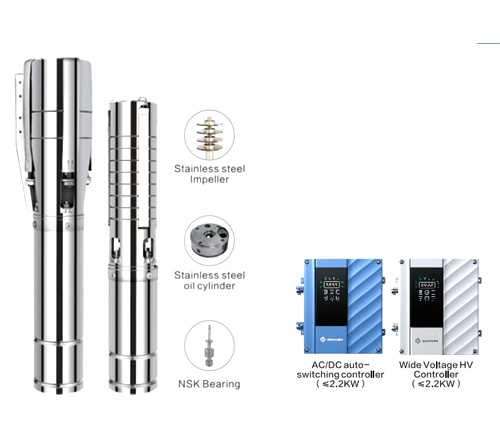
4/6HVSCW Wide Voltage Water-Filled Motor Stainless Steel Impeller Solar Deep Well Pump
Solar energy is naturally variable. At sunrise, panel voltage and available power are limited. Around midday, output may approach the design level. During cloud cover, rain, dust accumulation, or partial shading, the electrical conditions can change rapidly. A solar pump must be able to respond to these changes without unnecessary interruptions or unstable operation.
The 4/6HVSCW supports a wide DC voltage range of 80 V to 430 V. This allows system designers to configure solar panels in different series and parallel arrangements while remaining within the specified electrical limits. It also gives the pump greater flexibility in installations with different solar resources and water requirements.
Compared with a narrow-voltage pump, a wide-voltage model can reduce the risk that the system becomes unusable when the solar array operates outside a small voltage window. The pump can make better use of available solar energy throughout more hours of the day, provided that the array is correctly designed and the voltage remains within the product specifications.
Wide-voltage operation is particularly useful for remote projects where solar conditions vary by season. A system installed in a region with strong summer sunlight and weaker winter sunlight may benefit from a pump that can accommodate a broader operating range. The same principle applies to agricultural sites where water demand is high during some seasons but solar production changes throughout the year.
Installers must still observe the maximum open-circuit voltage requirement. The solar panel open-circuit voltage must remain below 430 V. This is important because the open-circuit voltage can rise when panel temperatures fall. Correct array design should therefore include temperature-related voltage calculations rather than relying only on the nominal voltage printed on a solar panel.
The brushless DC motor is a key part of the pump’s energy and maintenance strategy. Traditional brushed motors use physical brushes and commutators to transfer electrical energy to the rotating assembly. These components gradually wear and may create additional maintenance requirements, especially in equipment that operates frequently or for long periods.
A brushless motor eliminates the conventional mechanical brush contact. This reduces brush wear, helps improve operating reliability, and supports long service intervals. The design is well suited to solar applications because it can be controlled efficiently across changing operating conditions.
Brushless technology also supports smooth motor operation and can reduce the mechanical friction associated with brushed arrangements. In a submersible pump, where access for maintenance may be difficult, reducing wear-prone components is a practical advantage. The motor can remain submerged and operate for extended periods without requiring routine brush replacement.
Energy efficiency is another important benefit. Solar pumping systems must convert limited sunlight into useful water movement. Electrical losses in the motor directly affect the amount of water that can be produced during the day. The brushless DC design is intended to use available power efficiently, helping the pump deliver useful performance without depending on fuel or continuous grid electricity.
Compared with low-cost pumps that may use less efficient motor arrangements or less robust control systems, a wide-voltage brushless DC pump offers a more suitable foundation for professional solar water projects. Its value is not limited to the initial purchase price; it also includes reduced routine maintenance and better compatibility with variable solar energy.
The motor is designed as a water-filled and water-cooled unit. In submersible pumping, the motor is located in an environment where water is readily available for cooling. A water-filled construction uses the surrounding application conditions to support heat transfer and maintain stable motor operation.
Heat is generated by electrical resistance, magnetic activity, and mechanical movement. If heat accumulates inside the motor, insulation, bearings, and other components may be subjected to unnecessary stress. Effective cooling helps control operating temperature and contributes to longer component life.
The water-cooling design is also suitable for extended pumping cycles. Agricultural irrigation and community water systems may require the pump to run for several hours each day. A motor that can maintain a stable temperature under proper submersible conditions is better prepared for this type of duty than a system intended only for occasional operation.
The water-filled structure must be applied and installed correctly. The pump should operate within the required submergence conditions, and the well must provide adequate water around the motor. The pump should not be allowed to run dry. Proper installation, suitable well diameter, appropriate cable protection, and correct pipeline sizing are essential for achieving the intended cooling and operating performance.
By combining a water-filled motor with water cooling, the 4/6HVSCW is designed to balance compact submersible construction with thermal stability. This is an important advantage over systems that rely on less suitable cooling methods in deep well environments.
The cylinder and impeller are manufactured from stainless steel. These parts are directly associated with the water environment and must withstand continuous contact with moisture, minerals, and potential abrasive particles. Stainless steel provides corrosion resistance and structural durability for long-term service.
Corrosion can cause several problems in a pump. It may weaken metal surfaces, increase friction, affect clearances, damage hydraulic passages, and reduce pump efficiency. In severe cases, corrosion can lead to leakage or component failure. Stainless steel construction helps reduce these risks when the material is appropriate for the water conditions.
The impeller is particularly important because it transfers motor energy to the water. It rotates at operating speed and is exposed to hydraulic forces. A durable stainless steel impeller can resist wear more effectively than a less robust component, especially in applications where the water contains a moderate amount of suspended material.
The stainless steel cylinder also supports mechanical strength and corrosion resistance. Its durable structure is appropriate for installation in deep wells, where the pump must withstand handling during installation, vibration during operation, and long periods of immersion.
Material selection should always be matched to the actual water chemistry. Highly corrosive water, excessive sand, or aggressive chemicals may require additional engineering review. Nevertheless, stainless steel cylinder and impeller construction gives the 4/6HVSCW a strong advantage over basic pumps that use more vulnerable materials in the main wetted components.
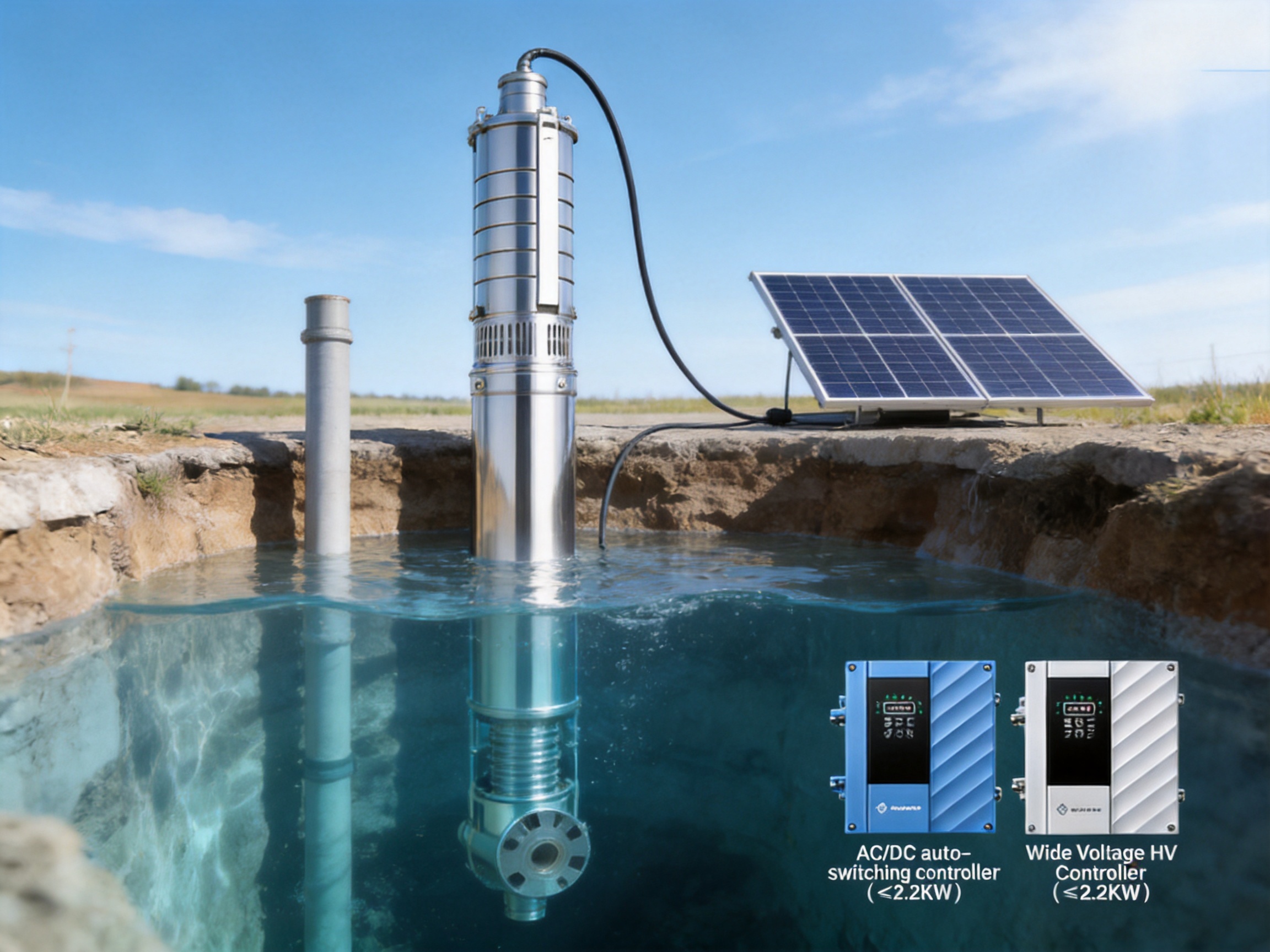
The product family contains four listed performance configurations. Each model has a 3-inch outlet, a 2-meter cable, and a DC voltage range of 80 V to 430 V. The main differences are rated power, maximum flow, and maximum head.
| Model | Rated Power | Maximum Flow | Maximum Head | DC Voltage | Outlet | Cable | Minimum Solar Power |
| 4/6HVSCW30-19-150-1100 | 1,100 W | 30 m³/h | 19 m | 80–430 V | 3 inches | 2 m | At least 1.3 times pump power |
| 4/6HVSCW36-22-200-1500 | 1,500 W | 36 m³/h | 22 m | 80–430 V | 3 inches | 2 m | At least 1.3 times pump power |
| 4/6HVSCW30-31-200-1500 | 1,500 W | 30 m³/h | 31 m | 80–430 V | 3 inches | 2 m | At least 1.3 times pump power |
| 4/6HVSCW36-38-300-2200 | 2,200 W | 36 m³/h | 38 m | 80–430 V | 3 inches | 2 m | At least 1.3 times pump power |
The maximum flow and maximum head values are reference points for model comparison. They should not be interpreted as simultaneous operating values. Actual flow depends on the total dynamic head, pipeline length, pipe diameter, fittings, elevation, water level, and system pressure requirements.
The 1,100 W model may be suitable for applications requiring a moderate flow and relatively low head. The 1,500 W models offer two different hydraulic arrangements: one emphasizes higher flow at a lower maximum head, while the other provides greater lifting capability at a lower maximum flow. This allows the installer to select the model according to the actual water delivery conditions rather than choosing only by motor power.
The 2,200 W model provides the highest listed maximum head and supports a maximum flow of 36 cubic meters per hour. It may be appropriate for larger irrigation systems, higher elevation requirements, or installations where pipeline resistance is significant. The final selection should be based on a pump curve and a complete hydraulic calculation.
The 4/6HVSCW competes with several types of pumping equipment, including AC submersible pumps, narrow-voltage solar pumps, gasoline-powered systems, and basic low-cost DC pumps. Each alternative has a place in the market, but the 4/6HVSCW offers a combination of features that can be advantageous for professional off-grid projects.
Conventional AC pumps normally require grid electricity or an inverter and may not be practical in remote locations. When solar panels are used with an AC pump, the system may require additional conversion equipment. Every conversion stage can add cost, complexity, and energy losses.
The 4/6HVSCW is designed around direct DC solar operation. This can simplify the energy path between the solar array and the pump, depending on the complete system architecture. Fewer conversion stages may help reduce equipment requirements and make the installation easier to manage.
A narrow-voltage pump may require a tightly specified panel arrangement. If the voltage falls below the minimum operating point or rises above the permitted range, the pump may stop or require additional control equipment.
The 80 V to 430 V operating range of the 4/6HVSCW gives installers more configuration flexibility. It can support a broader range of solar array designs while accommodating changes in solar availability. This is a meaningful benefit for projects installed in regions with seasonal or unpredictable sunlight.
Diesel and gasoline pumps can deliver water when there is no grid connection, but they require fuel storage, regular refueling, engine maintenance, and exhaust management. Fuel prices and transportation can significantly affect operating costs in remote locations.
A solar deep well pump uses sunlight as its primary energy source. After installation, the system can operate with much lower routine energy expenses, provided that the solar array is properly designed and maintained. It also avoids direct fuel combustion at the pumping location.
Some low-cost pumps may have limited voltage flexibility, less corrosion-resistant components, or fewer protection functions. These characteristics may be acceptable for small temporary installations, but they can create problems in long-term agricultural or community systems.
The 4/6HVSCW emphasizes durability through stainless steel wetted components, a water-filled motor, NSK bearings, water cooling, and intelligent protection features. This combination is intended for users who value operating reliability and service life rather than only the lowest initial price.
Solar water pumping systems often operate without a technician present. A pump installed in a field, remote village, or livestock area may need to run automatically for long periods. Protection functions are therefore essential for reducing the risk of damage caused by abnormal conditions.
The 4/6HVSCW includes intelligent protection against high temperature, low pressure, and water shortage conditions. These functions help the pump respond to operating problems before they cause severe damage.
High temperatures can result from overload, insufficient cooling, abnormal operating conditions, or environmental factors. A temperature protection function can help prevent the motor from continuing to operate under excessive thermal stress. This supports safer operation and may extend the service life of internal components.
Low pressure may indicate pipeline problems, inadequate water delivery, an incorrect system configuration, or an operating condition outside the intended range. Detecting low pressure can help protect the pump and alert the system operator to a possible fault.
Running without adequate water is one of the most serious risks for a submersible pump. Water helps cool the motor and supports the hydraulic operation of the pump. If the well water level falls too low, continued operation may cause overheating, unstable pumping, or damage.
Water shortage protection is particularly valuable for solar irrigation systems because water levels can change during dry seasons or after prolonged pumping. It provides an additional layer of safety when the installation is not continuously supervised.
Protection functions do not replace correct installation. The well should be evaluated, the pump should be positioned appropriately, and the water source should have sufficient recovery capacity. However, intelligent protection provides useful support when unexpected conditions occur.
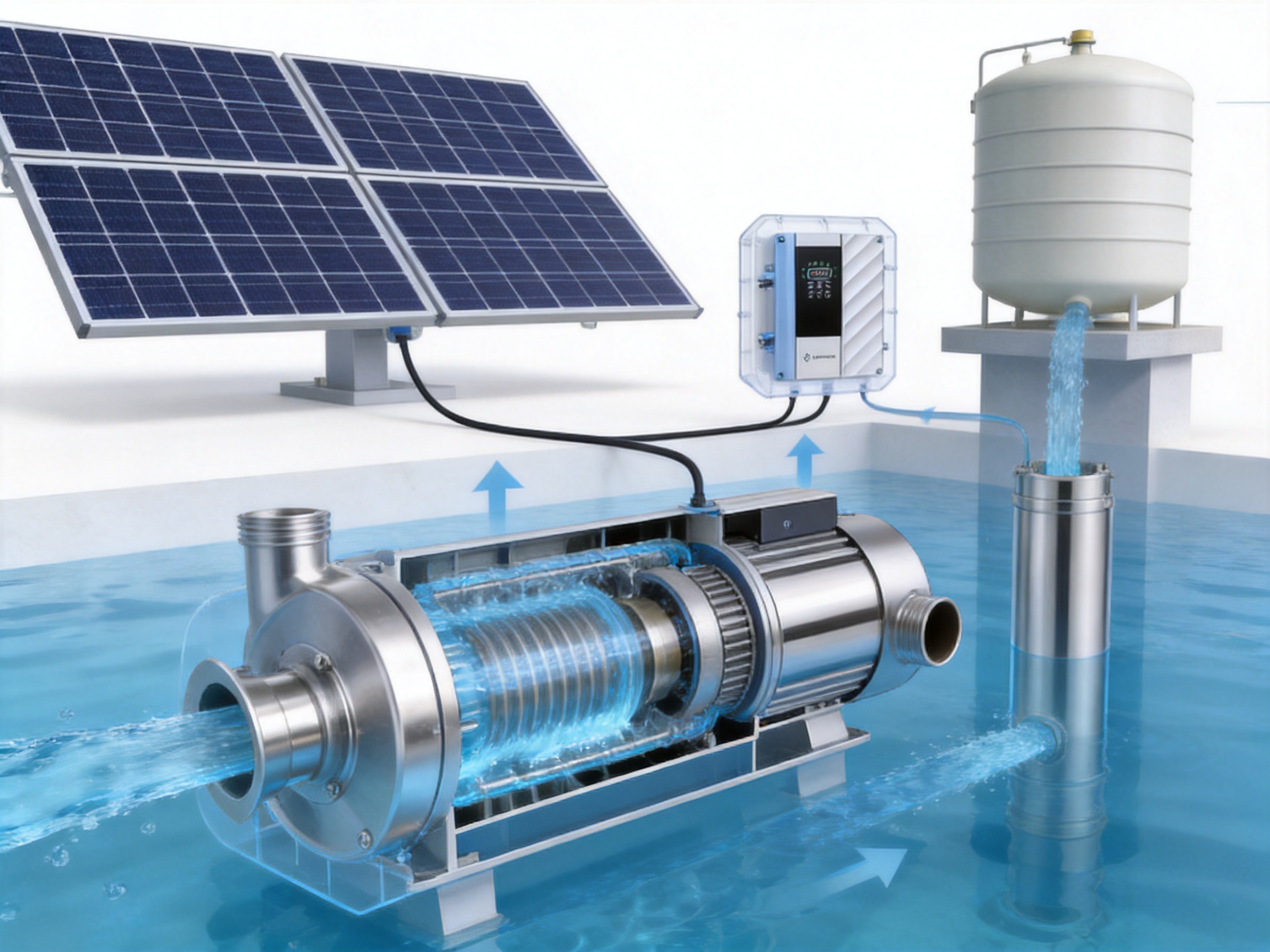
The product uses NSK bearings to support motor reliability and reduce mechanical wear. Bearings guide rotating components and help maintain smooth movement. Their condition affects vibration, noise, energy consumption, and the overall service life of the motor.
In a submersible pump, bearings operate in a demanding environment. They are exposed to rotation, hydraulic forces, temperature changes, and the requirements of continuous operation. Reliable bearings help maintain the correct alignment of rotating components and support stable performance.
The use of recognized bearing components demonstrates attention to the mechanical details of the motor assembly. While the pump’s final performance depends on the complete design and correct installation, suitable bearings can contribute to lower friction and more dependable operation than generic components with inconsistent quality.
For operators, this can translate into reduced maintenance requirements and fewer interruptions. For distributors and project contractors, it provides a clearer product value proposition when comparing professional equipment with low-cost alternatives.
Taizhou Edwin Electric Co., Ltd., operating under the Edwin Pump name, was founded in 2008. The company combines independent research and development, mass production, and global export. This integrated structure supports the development of products such as the 4/6HVSCW, which requires coordinated expertise in motor design, hydraulic performance, electrical control, materials, assembly, and international supply.
An integrated manufacturer can manage more of the product lifecycle internally. Product design feedback can be connected with production experience, field requirements, and customer purchasing data. This can support continuous improvements in performance, reliability, and manufacturing consistency.
Mass production capability is also important for commercial buyers. Agricultural contractors, distributors, engineering companies, and municipal suppliers may require repeat orders with consistent specifications. A manufacturer with established production systems can better support standardized model families, component planning, order tracking, and delivery coordination.
The company’s product lines include deep well pumps, submersible pumps, domestic booster pumps, circulation pumps, solar water pumps, intelligent booster pumps, and related water equipment. This broad product portfolio provides a wider technical perspective on water movement, pressure control, domestic supply, irrigation, and energy-efficient pumping.
Independent research and development is valuable when a product must work under specialized conditions. Solar pumping is not simply a conventional pump connected to a solar panel. It requires attention to variable voltage, motor control, protection functions, thermal conditions, and hydraulic demand.
The development of the 4/6HVSCW reflects this type of application-focused engineering. The wide-voltage design, brushless DC motor, water-filled construction, stainless steel impeller, and intelligent protections are coordinated features rather than isolated additions.
Mass production requires organized processes for component procurement, motor assembly, hydraulic assembly, wiring, sealing, inspection, and packaging. Consistency is particularly important in submersible pumps because many components are enclosed after assembly and cannot be easily inspected by the user.
A structured manufacturing system helps ensure that product specifications are repeated from one unit to the next. It also supports better inventory planning and more efficient response to customer orders. For international buyers, production organization is closely connected with predictable lead times and dependable after-sales support.
The stainless steel cylinder and impeller, NSK bearings, water-filled motor, and protection functions indicate a focus on component reliability. Each part contributes to the overall operating result. A strong impeller cannot compensate for an unsuitable motor, and a reliable motor cannot compensate for poor hydraulic design.
The product’s value comes from the combination of these components. This is one reason it can compete effectively with pumps that may offer similar headline flow figures but lack the same balance of material durability, voltage flexibility, motor design, and protective control.
The exact internal production procedures may vary according to model and production batch, but a professional deep well pump manufacturing process generally requires close control of several stages. The following areas are central to producing a reliable product of this type.
Stainless steel components must be prepared with suitable dimensions, surface quality, and mechanical accuracy. The cylinder must maintain the required shape and strength, while the impeller must be balanced and finished so that it can rotate smoothly inside the hydraulic assembly.
Material preparation also includes inspection of incoming components. Consistent raw materials help reduce variation in corrosion resistance, mechanical strength, and dimensional accuracy. This is particularly important for pumps destined for long-term immersion.
The water-filled brushless DC motor requires careful assembly of the stator, rotor, bearings, seals, internal wiring, and motor housing. The assembly must maintain correct alignment and provide suitable protection for electrical components.
Because the motor is intended for submersible use, sealing and insulation are especially important. The manufacturing process must control contamination, assembly clearances, and connection quality. Proper handling during assembly helps reduce the risk of electrical or mechanical problems during operation.
The impeller, pump chamber, diffuser elements, shaft, and outlet components must be assembled according to the specified hydraulic configuration. Small deviations in alignment or clearance can affect efficiency, vibration, and flow performance.
Different model configurations within the 4/6HVSCW family are designed to provide different relationships between flow and head. Controlled hydraulic assembly helps maintain the intended performance characteristics for each model.
The wide-voltage operating range and intelligent protection functions require careful electrical inspection. Connections, sensors, motor control elements, and protective responses should be checked as part of the production process.
Testing helps identify wiring errors, abnormal current behavior, temperature response problems, and protection failures before the pump leaves the factory. This is important for equipment that may later be installed in a location where troubleshooting is difficult.
Final inspection may include visual examination, dimensional checks, electrical tests, operating checks, and packaging review. The pump must be protected during transportation because damage to cables, connectors, housing surfaces, or outlet threads can create installation problems.
For export products, packaging is especially important. International shipping may involve multiple handling stages, long transit times, changes in climate, and storage before installation. A structured packaging process helps preserve the product condition from factory dispatch to project site.
The 4/6HVSCW can support solar-powered household drinking water systems in areas without dependable grid electricity. A properly designed installation can lift water from a well into a storage tank, pressure vessel, or distribution network.
Using a storage tank is often beneficial in solar pumping. The pump can operate during daylight while the stored water is used in the evening or during short periods of cloud cover. This approach reduces the need for batteries in some system designs and separates water availability from immediate solar production.
For drinking water applications, the complete water system must be designed with appropriate hygiene, filtration, storage, and water-quality controls. The pump itself is one part of the supply system. Well construction, water testing, pipe materials, tank cleanliness, and treatment equipment also affect the safety of the final water.
Agricultural irrigation is one of the most practical applications for solar deep well pumps. Fields and orchards may be located far from power lines, and irrigation demand often coincides with periods of strong sunlight. This creates a natural match between solar energy production and water requirements.
The pump can supply water to drip irrigation, sprinkler systems, storage tanks, or open distribution channels, depending on the design. The selected model should match the irrigation flow rate and required pressure. Pipe diameter should be chosen carefully to limit friction losses, particularly when water must travel over long distances.
For orchards, a stable supply is important because young trees and high-value crops may be sensitive to water stress. A solar pump with intelligent water shortage protection can help reduce the risk of damage caused by continued operation after a well level has fallen.
Farm operators should also consider daily water demand, seasonal changes, and the recovery rate of the well. A pump with a high maximum flow may remove water faster than the well can naturally recover. Professional system design should balance pump capacity with sustainable water extraction.
Livestock operations require dependable water for animals, cleaning, and sometimes small-scale crop production. Pasture locations are often remote, making fuel delivery and grid extension expensive. A solar deep well pump can supply water to tanks positioned near animal areas.
Storage tanks provide an important reserve during cloudy periods or high-demand times. Float valves, level controls, and properly sized distribution lines can help manage water availability. The pump’s intelligent protections add security, but the overall system should also include suitable tank-level and well-level management.
Stainless steel wetted components are beneficial in agricultural environments where equipment may be exposed to minerals, organic matter, and variable water quality. Regular inspection of the well, cable, pipeline, and tank remains necessary to maintain reliable operation.
Small rural communities may require a pump capable of supplying water to several collection points, homes, schools, clinics, or public storage tanks. The 4/6HVSCW’s available power and flow range can support community-scale systems when the hydraulic design is correctly calculated.
A community system should normally include a storage reservoir so that pumping and consumption can be managed independently. Water can be pumped during high-sunlight hours and distributed according to demand. This can reduce the effect of short-term weather changes and make the supply more predictable.
For community projects, durability and maintainability are especially important. The equipment may need to operate for long periods, while technical support may not be immediately available. The pump’s brushless motor, stainless steel components, water cooling, and protection functions are valuable in this context.
Project planners should evaluate water quality, well yield, expected population growth, seasonal demand, spare parts availability, and local installation expertise. A well-selected pump is more effective when integrated into a complete and maintainable water infrastructure.
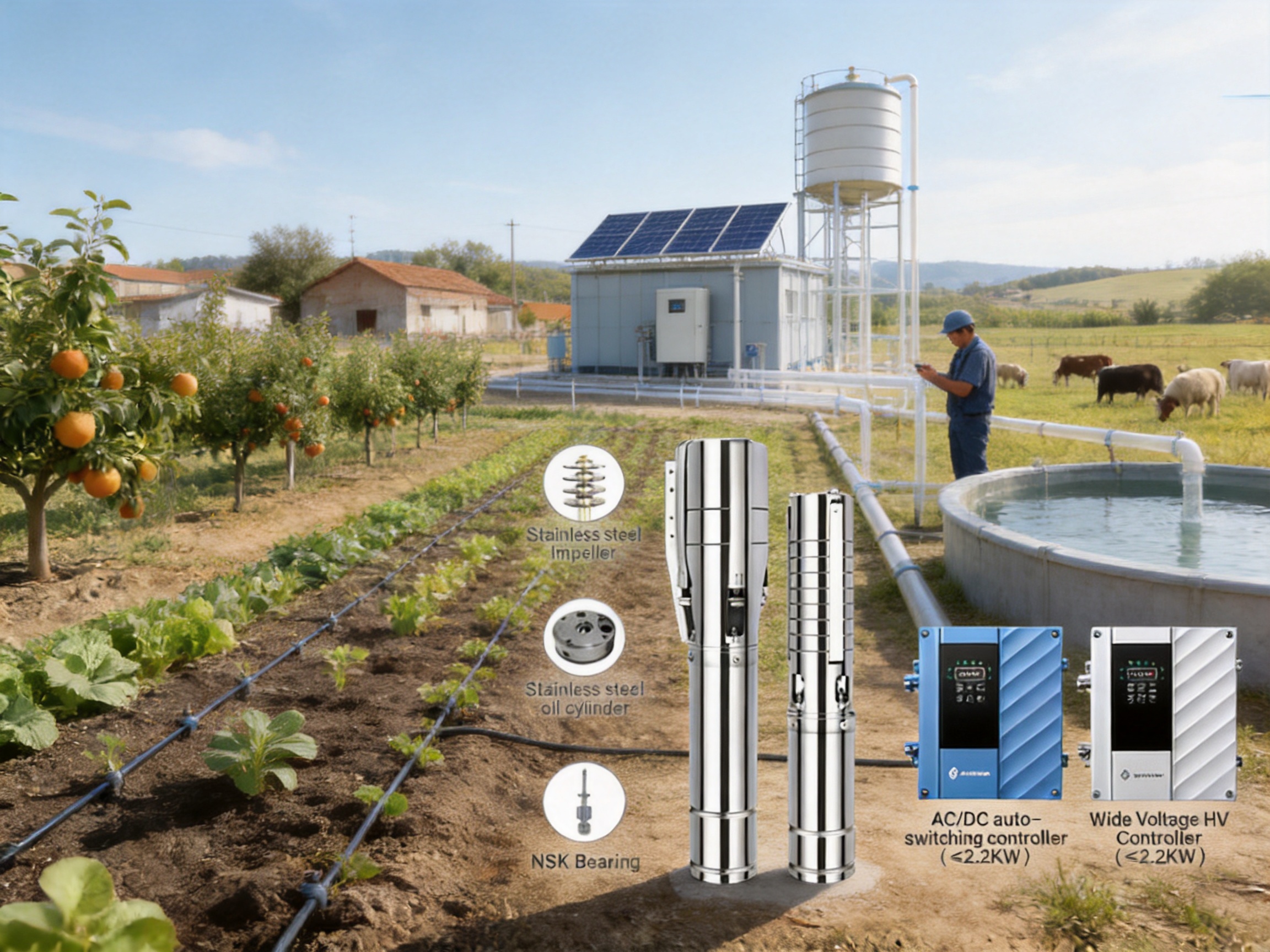
The solar array must be designed around the pump’s electrical requirements. The listed product data specifies a DC operating range of 80 V to 430 V and requires the solar panel open-circuit voltage to remain below 430 V. Exceeding the voltage limit may damage the pump or associated control equipment.
The recommended solar panel power is at least 1.3 times the pump power. Based on the listed models, this corresponds approximately to the following minimum array capacities:
| Pump Power | Recommended Minimum Solar Array Power | Typical Reason for Allowance |
| 1,100 W | At least 1,430 W | Provides operating margin under reduced sunlight |
| 1,500 W | At least 1,950 W | Supports more dependable daily pumping |
| 2,200 W | At least 2,860 W | Provides additional capacity for a higher-power pump |
These values are planning references rather than a substitute for a full solar design. Panel temperature, local irradiance, shading, dust, orientation, tilt, seasonal conditions, and controller characteristics all affect actual performance.
The array should be positioned to receive strong sunlight during the intended pumping hours. Even partial shading can reduce output significantly, especially when panels are connected in series. Regular cleaning may be necessary in dusty agricultural or desert environments.
Electrical protection should be included according to the project requirements. Appropriate disconnects, grounding, surge protection, cable sizing, and weather-resistant enclosures help protect the system and personnel. Installation should be completed by qualified professionals familiar with high-voltage DC systems.
Correct hydraulic design is just as important as electrical design. The pump must be selected according to the total dynamic head rather than only the depth of the well. Total dynamic head includes the vertical lift from the water level to the discharge point, pressure requirements, pipe friction, valves, bends, filters, and other losses.
The dynamic water level should be used when calculating the required head. The water level may fall while pumping, especially in a well with limited recovery. Selecting a pump based only on the static water level can result in insufficient performance during actual operation.
The pipeline should be large enough to keep friction losses within an acceptable range. A narrow pipe may reduce the delivered flow and force the pump to operate under higher resistance. Properly selected valves and fittings also help minimize unnecessary losses.
The pump should be installed at a suitable depth with sufficient water around the motor. It should not rest directly on sediment at the bottom of the well. The cable must be secured and protected during lowering, and the outlet connection should be sealed correctly to prevent leakage.
Before commissioning, the installer should confirm the direction of operation where applicable, verify the voltage range, inspect electrical connections, check the water level, and observe the pump under controlled conditions. Early inspection can identify installation issues before they become expensive failures.
The 4/6HVSCW is designed for durable and low-maintenance operation, but no pump is maintenance-free. A simple inspection program can help preserve performance and identify developing problems.
Solar panels should be inspected for dirt, cracks, loose connections, and shading from vegetation or new construction. The electrical enclosure should remain dry and protected from unauthorized access. Cables should be checked for abrasion, UV exposure, animal damage, and loose terminals.
The water system should be monitored for changes in flow, pressure, noise, vibration, and operating time. A noticeable reduction in flow may indicate a change in the water level, pipeline blockage, filter fouling, impeller wear, or a problem with the solar array.
The well should be checked for sediment accumulation and changes in yield. If the water level falls below the safe operating level, the pump should be stopped and the cause investigated. Water shortage protection is an important safeguard, but operators should not ignore repeated activation.
Preventive maintenance is generally less expensive than emergency repair. Keeping operating records can help identify seasonal changes and support better decisions about irrigation schedules, storage capacity, and future system expansion.
International buyers often need more than a single pump. They may require model selection assistance, solar array guidance, packaging coordination, documentation, spare parts planning, and delivery support. A manufacturer with integrated production and export experience can provide value across these stages.
Taizhou Edwin Electric Co., Ltd. has developed a professional procurement and foreign trade structure through associated import and export operations. This supports order tracking, procurement planning, cross-border delivery, and communication with international customers.
The company’s experience in supplying products for new energy projects, agricultural irrigation, municipal engineering, mining, construction, HVAC systems, and household water supply provides broad application exposure. Such experience is useful when a customer needs to combine solar pumping with other water equipment or develop a complete project solution.
Distributors can also benefit from a product family with different power, flow, and head options. The 4/6HVSCW range allows them to serve different well sizes and project requirements without relying on a completely unrelated pump design for every application.
Solar pumping reduces dependence on fossil fuels and can lower the recurring energy cost of water production. This is particularly important in areas where fuel transportation is difficult or where grid electricity is generated from expensive or carbon-intensive sources.
The environmental benefit depends on the complete system, including panel manufacturing, transportation, maintenance, and end-of-life treatment. Even so, using solar energy during operation can substantially reduce direct emissions at the pumping site.
Efficient water infrastructure also requires responsible water management. A high-capacity pump should not be used to extract groundwater faster than the aquifer can recover. Storage, irrigation scheduling, leak control, and monitoring should be included in the project design.
The 4/6HVSCW supports the transition toward cleaner and more autonomous water supply, but sustainable operation depends on both equipment quality and responsible resource planning.
It is a DC submersible solar deep well pump designed for installation in 4-inch and 6-inch bore applications. It uses a wide-voltage brushless DC water-filled motor and stainless steel cylinder and impeller.
The listed DC operating range is 80 V to 430 V. The solar panel open-circuit voltage must remain below 430 V. The solar array should be designed by considering panel temperature and the highest possible open-circuit voltage.
The listed models have rated powers of 1,100 W, 1,500 W, and 2,200 W. Two different 1,500 W configurations are available, with different maximum flow and maximum head characteristics.
The listed maximum flow values are 30 cubic meters per hour and 36 cubic meters per hour, depending on the model. Actual operating flow depends on total dynamic head and system resistance.
The listed maximum head ranges from 19 meters to 38 meters. The correct model should be selected according to the complete pumping head, including elevation, pipe friction, fittings, and required discharge pressure.
The specified solar panel power is at least 1.3 times the pump power. For example, a 1,100 W pump requires at least approximately 1,430 W of solar panel power, while a 2,200 W pump requires at least approximately 2,860 W. Final sizing depends on local solar conditions and system design.
The water-filled motor is designed for submersible operation and works with the water-cooling structure to help transfer heat away from the motor. This supports stable operation during extended pumping, provided the pump remains properly submerged and does not run dry.
The stainless steel impeller provides corrosion resistance and mechanical durability in long-term water service. It is intended to resist wear better than less durable materials, although water chemistry and sediment conditions should still be evaluated.
Yes. The product includes intelligent protection features for high temperature, low pressure, and water shortage conditions. These functions help reduce the risk of damage during abnormal operating conditions.
It can be used as part of a solar-powered household or community water supply system, but the complete installation must meet local requirements for water quality, filtration, disinfection, storage, and hygiene. The source water should be tested before consumption.
Yes. Its flow and head range is suitable for many agricultural, orchard, livestock, and pasture water applications. The model should be matched to the irrigation method, daily water requirement, well yield, elevation, and pipeline losses.
A solar pumping system may operate without batteries when water is pumped during daylight into a storage tank. Whether batteries are required depends on the desired operating schedule, water storage arrangement, control system, and project requirements.
The installer should verify the well diameter, water depth, dynamic water level, well recovery rate, required flow, total dynamic head, solar array voltage, solar array power, cable length, pipe size, and protection equipment. Professional installation is recommended for high-voltage DC systems.
Use the pump within its specified voltage and hydraulic range, prevent dry running, keep the solar array clean, protect cables from damage, monitor water levels, inspect the pipeline, and respond promptly to changes in flow, pressure, temperature, or vibration.
The 4/6HVSCW Wide-Voltage Water-Filled Motor Stainless Steel Impeller Solar Deep Well Pump is designed as a durable and flexible solution for modern off-grid water supply. Its 80 V to 430 V DC operating range helps it adapt to variable solar conditions, while the brushless water-filled motor supports efficient and low-maintenance operation.
The stainless steel cylinder and impeller provide corrosion resistance and durability in long-term submersible applications. NSK bearings, water cooling, and intelligent protection against high temperature, low pressure, and water shortage further strengthen the product’s reliability profile.
With 4-inch and 6-inch bore options, several power ratings, maximum flows up to 36 cubic meters per hour, and maximum head up to 38 meters, the product family can serve household water systems, agricultural irrigation, livestock operations, rural communities, and other remote projects.
Its competitive advantage comes from the combination of electrical flexibility, durable materials, efficient motor technology, protective functions, and application-focused engineering. Supported by Taizhou Edwin Electric Co., Ltd.’s experience in research and development, mass production, and international export, the pump is positioned as a practical choice for buyers seeking reliable solar-powered deep well pumping equipment.
The best results will always depend on correct system design. When the solar array, hydraulic conditions, well characteristics, installation procedures, and maintenance plan are properly matched to the pump, the 4/6HVSCW can contribute to dependable, energy-efficient, and sustainable water infrastructure.
1. Product technical information for the 4/6HVSCW Wide-Voltage Water-Filled Motor Stainless Steel Impeller Solar Deep Well Pump.
2. Product performance data for DC submersible solar pump configurations, including rated power, maximum flow, maximum head, outlet size, cable length, and solar array requirements.
3. Manufacturer information concerning integrated research and development, mass production, global export, and water pump product applications.
4. General engineering principles for solar photovoltaic system sizing and high-voltage DC installation safety.
5. General pump engineering principles concerning total dynamic head, hydraulic losses, well yield, motor cooling, and preventive maintenance.
edwina@edwin-pump.com
+86-13586290903 (WhatsApp)
Xuri Gongliang Cutting Tool Entrepreneurship Park, Wenqiao Town, Wenling City, Taizhou City, Zhejiang Province, China

High Performance Smart Pump Factory


 English